Shared posts

23 Sep 04:16

One Guide to Getting unLost

by Leah

Last night, I had dinner with my friends Vlada and Michal.


And, before I go on, some context: periodically, I get lost. CRAZY LOST. In my head, it sounds like this. “What am I DOING with my life? Where am I going? How did I ever think I was on the right track? I don’t even know what brings me alive. Wait, no, I think I do, sometimes, but I’m too chickenshit to do anything about it. Uhg, I have SUCH potential, I can feel it, and I’m squandering it away being lost.”

sometimes i get so lost_web


 that’s right. First I get lost, and then I get mad at myself for being lost and the spiral goes on…remember that scene in Alice in Wonderland where she’s falling down a bottomless pit? It feels a lot like that, except I’m not nearly so chipper as she is, and it doesn’t end in tea parties.


Then I enter the final stage of the first-world guilt-trip; the surest way to fall flat on my back if I’m not there already.  “AND on top of all that, I’m so damned privileged I don’t even deserve to be unhappy….Harrumph!”

hardest on the one we love

The problem with all of these mind-generated though-bombs, is they’re true. I mean, just as true as they’re not true. If you haven’t figured it out by now, the universe is one big fat paradox after another.  Solid ground is a total illusion and you’re really not going to chill out until you learn to swim in the sea of change.  (unless, of course, change is the illusion, and we’re all strung together in one multi-dimensional moment of perfection….see what I mean?)


Anyway. Last night I had dinner with Vlada & Michal. From the outside, I sure didn’t look lost. I drove myself down to Palo Alto to have dinner with two of the most beautiful beings on the planet. Afterwards I sat on the couch reading stories to their 1 & 3 year old daughters making all the funny voices. After nearly every sentence, Ella asked, “Why? Why? Why?”  “Wow,” I thought, “we sure are BORN seekers, aren’t we?”  When it was time for bed, they both said “No!” Ella, 3, asked to sleep out in the living room with me. Maya Cried.


But…despite all the counterevidence, my mind was still labeling my current life (whatever that means, exactly), as “Lost.” So after the girls were tucked in, Maya, fast asleep, and Ella in the other room joyfully talking to herself, or possibly her invisible friend “Gaga” (no relation to “Lady”…I asked.)  I told Vlada and Michal “I’m Lost….again.”


Currently, Viada and Michal have their dream life. They have their dream fa

mily. They have their dream partner. They have their dream job, working together on their dream product  on the path to fulfilling their dream mission. And how did they get there, you might ask? (I sure as hell did.)
By choosing to be LOST.

One day, nearly two years ago. They were visiting me at The Happiness Institute. They were NOT happy with work. They were not fulfilled. They had plans and dreams to make 1 billion people happy, but it just wasn’t turning out right, because they weren’t happy. On their way in, they caught a quote posted on the door. At the time, it with the Happiness institute’s Mission statement.


“Do not ask what the world needs. Ask what makes you come alive, and go do that. Because what the world needs is more people who have come alive.” – Howard Thurman

In that moment, they made a commitment to each other. From now on, we’re going to do what makes us happy. even if we can’t connect it to our broader goal. And we’re going to trust that this will lead us to our life’s work.


For the next several months, six or more, they experimented. “That was maybe the trickiest part.” Vlada said, Change. Every now and then they would catch hold of something that felt great and thought, “This might be it.” But soon, the energy would leave, and because of their commitment, they’d let the thread go, and grab a new one. What I loved about this is in this lens Change isn’t happening to you, it’s something you choose, something you use.

Allow change. YES.

Yay-for-change


Michal offered, “One thing that’s really helpful during an experiment like this, is to have some constraints.” And the one he chose, he initially got from Paul Graham: “Produce  Whatever you do in your explorations for what to do just produce something.


Produce is going to mean different things for different people. And I don’t think it’s really worth defining but you just know it when you’ve done it. Sometimes writing an email is producing, but sometimes it isn’t. Sometimes dancing is producing, but sometimes it isn’t. You know what I mean? You know?

At this, I LIT UP.  In three years of soul searching now, I often get strung out (metaphorically, but it feels quite literal in my body) between the high rises of “Doing” and “Being.”  Or “Giving” and “Receiving.” I can only meditate for so long before I chide myself for hiding. I can only engage for so long before I lose myself in the very people I’m trying to love.
Produce. YES.

Lately, they’ve added something else into the mix. “Optimize for Effortlessness.” For years they found themselves pushing pushing pushing for things. But recently they’ve found all their success has come from absolutely no effort whatsoever. It’s come from flukes, serendipities, accidents, and good fortune. That’s not to say they don’t work hard, they do, but they work on that which comes easily, which flows. When they find themselves crimping their flow to get something done, they stop. “This isn’t wanting to happen now.” And they do something else. Later, they find something that was taking them hours before takes five minutes when the time is right.


Optimize for Effortlessness. YES.  

“One thing we had to constantly remind ourselves and each other, was that even on days when we felt as far away as ever, whatever we were looking for might always be right around the corner.”  And in fact, this is what happened to them. Michal was remembering that it was a few days before everything changed when they were feeling almost (key word) hopeless. They reminded each other, yet again, everything could change tomorrow. And sure enough, a few days later they had dinner with

a friend who pointed at a little app they had built together for their daughter, “just for fun”, during all this exploring. “Build that. And I’ll be your first investor.”

not knowing is what trust is for

In the last two years they have launched their product, grown their company, engaged thousands and thousands of users, fulfilling their mission: making people happy.


By the end of the evening, I had repeated about ten times:


Everyday…

  • Do what makes us happy
  • Optimize for Effortlessness.
  • Produce.
  • Allow for Change.
  • And Trust.


Today, I took their advice. And I have to say, it’s only day one, but I just don’t feel so lost anymore.


02 Sep 23:27

shiftyshrike: Aaron Diaz livetweets Moses Prince of Egypt I...


shiftyshrike:

Aaron Diaz livetweets Moses Prince of Egypt

I wield Twitter like a sword of useless fire.

02 Sep 23:22

Me, Myself And The Dark Eye: Memoria

by Adam Smith

I spent some time with the pointy, clicky people of Daedalic at Gamescom, watching walkthroughs of the next Deponia and the intriguing turn-based RPG Blackguards. Memoria wasn’t on display and I hadn’t realised, until I watched the launch trailer handily concealed below, that it’s set in The Dark Eye universe, which is where the Blackguards live. I’ll have more to say about the crime-infested RPG in the near future, but now is the time for extremely earnest fantasy adventures. Sample line – “And next, we’ll make you a fairy again”.

(more…)

02 Sep 23:22

Build Your Own AdventurOS

by Ben Barrett

The basic concept behind AdventurOS is one that has fascinated me for years: build a game that interprets a computer’s file structure as level code, thus creating a unique but repeatable and controllable experience for everyone. Evelend Games have taken this and fitted it naturally within a fantasy metroidvania mold. Each room is built from a folder with doors used to go deeper into sub-folders, while monsters, chests and other oddities are spawned from the files within. Trailer with a more intricate explanation past the jump.

(more…)

01 Sep 06:57

J K Rowling for grown ups

by Harry

It wasn’t snobbery that kept me from reading Harry Potter, just a calculation that at some point I’d have to read them all to one of the kids, and didn’t want to have read them already. But my wife read the first 4 to the eldest and then the first three to the middle one, and by the time my youngest wanted them J.K. Rowling had already published a book for grown ups and I realized that I could be one of the first people alive to read her adult novels without reading having read her children’s books. (In fact, I was about 3/4ths through the first Harry Potter when I finished The Casual Vacancy – and still am, because the boy got scared at that point, and I couldn’t be bothered to find out how it ended). I was drawn to The Casual Vacancy by the couple of slightly sneering and tepid reviews I read, which said it was rambling, misanthropic and full of children’s cruelty, making it sound like I’d love it, and a recommendation from a reliable friend. And, I did.

But not as much as The Cuckoo’s Calling. How long she thought she would remain anonymous I can’t imagine. It is so obviously the work of an experienced, accomplished, writer, and is slyly witty in the same way that The Casual Vacancy is. She does indulge in one moment of male fantasy fulfillment that, perhaps, was designed to make herself seem like a male author; but just the pseudonym, itself, is a dead giveaway (did no-one really guess?). I don’t want to spoil it for anyone, so request that commenters also refrain from discussing the plot (but no guarantees). Suffice to say it is thoroughly entertaining, brilliantly plotted, and tautly written. When you read it you’ll see that Rowling must be incredibly pissed off that her secret came out prematurely. Clearly the book was going to become a major success even under the pseudonym and, equally clearly, she was looking forward to having it properly evaluated in its own right which, I think, The Casual Vacancy wasn’t.
I’ve been suffering withdrawal since Reginald Hill died, and about 5 months ago I realized that the possible posthumous Dalziel/Pascoe that amazon uk mentioned at the time of his death is unlikely to see the light of day. So having a brilliant mystery writer appear, fully fledged (which is rare – the only other I can think of is Benjamin Black), and clearly intending a long series, is a specially delightful surprise. Thoroughly recommended.

(Oh, and, if you haven’t been following the story, apparently all her royalties for the first three years, starting July 15th when she was unmasked, are going to the Soldier’s Charity).

Discussion of the books is very welcome below but if you haven’t read them, BE WARNED there MAY be SPOILERS

01 Sep 06:55

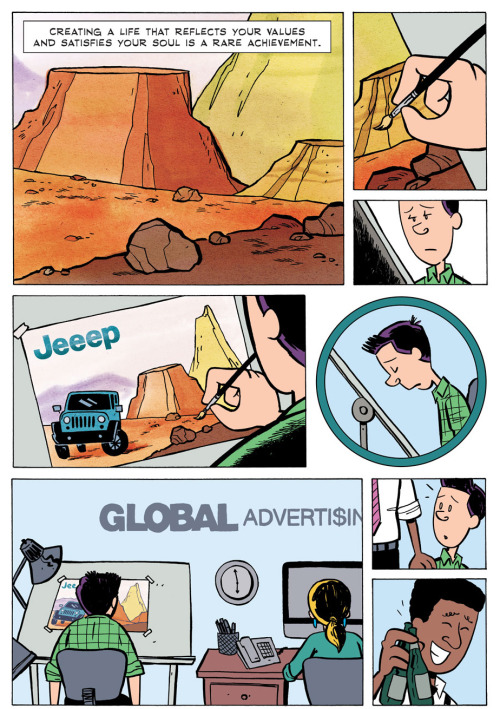
vixyish: zenpencils: BILL WATTERSON ‘A cartoonist’s...


vixyish:

zenpencils:

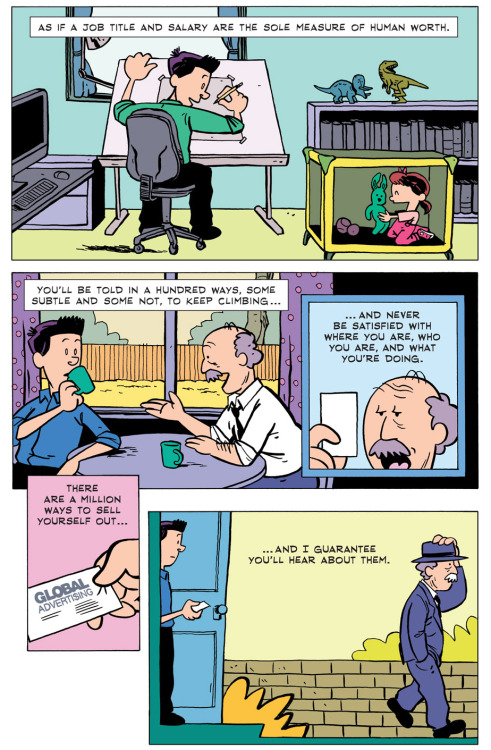
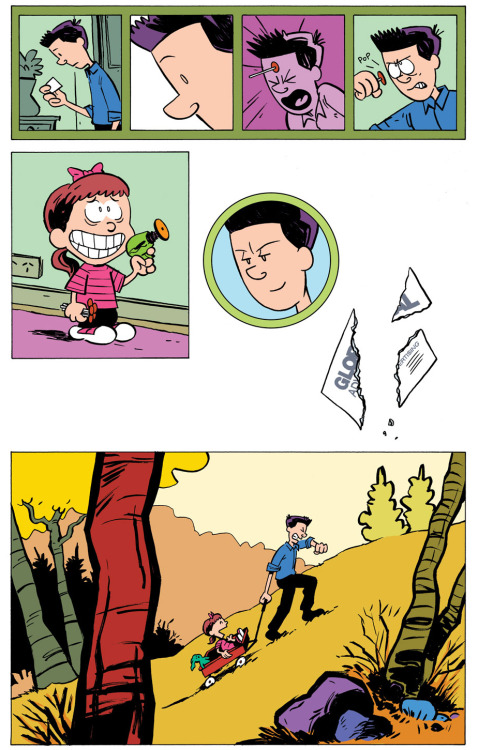
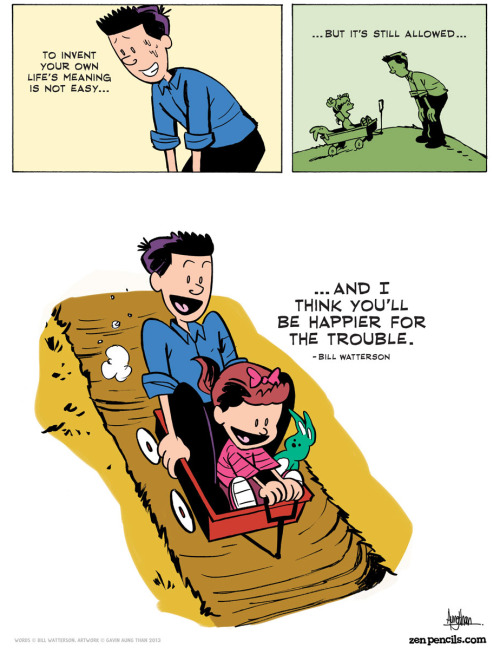
BILL WATTERSON ‘A cartoonist’s advice’

"Someone who takes an undemanding job because it affords him the time to pursue other interests and activities is considered a flake."

I’ve always had a hard time shaking the Protestant-work-ethic-guilt feeling that I must be lazy for having done exactly that.

Thanks, Bill.

31 Aug 21:24

The Love Glove

by Cool Tools

With three cats in the house, fur gets all over our furniture and clothes. I didn’t want to make a dozen Monkey Couch Guardians, so I bought a Love Glove to attack the problem at its source – on the cats.

The Love Glove looks like an oven mitt. The palm side is covered with rubber nubs. To use it, you simply pet your cat. The loose fur comes off and sticks to the glove. It’s easy to peel off. My cats go into throes of ecstasy when I use the Love Glove on them. They even get excited just seeing me approach them with the glove on my hand.

I have collected a lot of fur so far. My younger daughter is saving it because she to make the projects in Crafting with Cat Hair: Cute Handicrafts to Make with Your Cat. -- Mark

Love Glove Grooming Mitt for Cats $6


31 Aug 21:22

The CODE Keyboard

What would you do, if you could do anything?

I don't mean in a fantasy superhero way, but in terms of resources. If someone told you that you now had the resources to attempt to make one thing happen in the world, one real thing, what would that be?

If you're Elon Musk, the patron saint of Hacker News, then you create an electric car and rocket ships. And then propose a hyperloop. Not bad. Not bad at all.

My dream is more modest. I decided to create a keyboard.

The CODE Keyboard, front image with backlight

I've talked about keyboards here for years, but The CODE Keyboard is the only simple, clean, beautiful backlit mechanical keyboard I've ever found. Because we built it that way.

The name is of course a homage to one of my favorite books.

Code, by Charles Petzold

That's what I've always loved about programming, the thrill of discovering that communicating with other human beings in their code is the true secret to success in writing code for computers. It's all just … code.

CODE
/kōd/
A system of words, letters, figures, or other symbols used to represent others

The projects I've worked on for the last eight years are first and foremost systems for efficiently communicating with other human beings, not computers. Both Stack Exchange and Discourse are deeply concerned with people and words and the code they use to talk to each other. The only way those words arrive on your screen is because someone, somewhere typed them. Now, I've grown to begrudgingly accept the fact that touchscreen keyboards are here to stay, largely because the average person just doesn't need to produce much written communication in a given day. So the on-screen keyboard, along with a generous dollop of autocomplete and autofix, suffices.

But I'm not an average person. You aren't an average person. We aren't average people. We know how to use the most powerful tool on the webwords. Strip away the images and gradients and vectors from even the fanciest web page, and you'll find that the web is mostly words. If you believe, as I do, in the power of words, then keyboards have to be one of the most amazing tools mankind has ever created. Nothing lets you get your thoughts out of your brain and into words faster and more efficiently than a well made keyboard. It's the most subversive thing we've invented since the pen and the printing press, and probably will remain so until we perfect direct brain interfaces.

I was indoctrinated into the keyboard cult when I bought my first computer. But I didn't appreciate it. Few do. The world is awash in terrible, crappy, no name how-cheap-can-we-make-it keyboards. There are a few dozen better mechanical keyboard options out there. I've owned and used at least six different expensive mechanical keyboards, but I wasn't satisfied with any of them, either: they didn't have backlighting, were ugly, had terrible design, or were missing basic functions like media keys.

WASD Keyboards

That's why I originally contacted Weyman Kwong of WASD Keyboards way back in early 2012.* I told him that the state of keyboards was unacceptable to me as a geek, and I proposed a partnership wherein I was willing to work with him to do whatever it takes to produce a truly great mechanical keyboard. Weyman is a hard core keyboard nut who absolutely knows his stuff – I mean, he runs a whole company that sells custom high end mechanical keyboards – but I don't think he had ever met anyone like me before, a guy who was willing to do a no strings attached deal just for the love of an idealized keyboard. At one point over a lunch meeting, he paused, thought a bit, and said:

So … you're like … some kind of geek humanitarian?

I don't know about that.

But I'm not here to sell you a keyboard. Buy, don't buy. It doesn't matter. I'm just happy to live in a world where the first truly great mechanical keyboard finally exists now, in exactly the form it needed to, with every detail just so, and I can type this very post on it. As glorious as that may be, I'm here to sell you on something much more dangerous: the power of words. So whether you decide to use the CODE Keyboard, or any keyboard at all, I'm glad you're thinking about writing words with us.

* Yep, we software guys are spoiled – hardware takes forever.

[advertisement] How are you showing off your awesome? Create a Stack Overflow Careers profile and show off all of your hard work from Stack Overflow, Github, and virtually every other coding site. Who knows, you might even get recruited for a great new position!
31 Aug 19:13

The Truth Finally Comes Out

by David Kurtz

Pat Robertson: San Francisco gays wear special sharp-tipped rings contaminated with AIDS that deliberately infect unsuspecting believers with a mere handshake.


30 Aug 03:22

thefingerfuckingfemalefury: mutantlexi: maegyks: ectomasterbio...


thefingerfuckingfemalefury:

mutantlexi:

maegyks:

ectomasterbiomancer:

isthiswittyenoughforyou:

sharkchunks:

awildofnothing:

apiphile:

jaggedfragments:

Nothing could make me more curious about your taxidermy than this.

I need this as a t-shirt as “zoologically improbable and/or terrifying to small children” sums me up.

Finally I know what I want inscribed on my tombstone when I die.

I remember the news article, this is the lion that was removed:

THAT IS FUCKING TERRIFYING

I think we all understand now.

how do you fuck up that badly

Because it was the 18th century and the taxidermist was only given the skin, and had never, seen a lion before.

O.O

I AM NEVER GOING TO SLEEP PEACEFULLY AGAIN

That sign is from the Harvard Museum of Natural History (an awesome place! check out the Kronosaurus!) and that lion is on display at Gripsholm Castle in Sweden.

I don’t know what object the HMNH is talking about (maybe this fugly tiger?), but it’s not the meme lion.

30 Aug 03:20

Meet the judge who suspended a child rapist's sentence because his victim was "older than her chronological age"

by Rob Beschizza

“I think that people have in mind that this was some violent, forcible, horrible rape," said Montana District Judge G. Todd Baugh. "It was horrible enough as it is just given her age, but it wasn’t this forcible beat-up rape."

Stacey Dean Rambold, 54, will spend just 31 days in jail after almost all of his 15-year sentence was suspended.

The 14-year-old Rambold assaulted isn't around to be revictimized by this extraordinarily creepy smalltown judge: she committed suicide after her rape. [Billings Gazette and the LA Times. Photo: Bob Zellar]


30 Aug 03:19

The police, an open door, and probable cause

by Maggie Koerth-Baker

1) After doing some home renovation work late into the evening, my husband had inadvertently left both our garage door and our back door open when he came to bed.

2) There have been a string of burglaries in our neighborhood, often involving somebody kicking in the back door of a house.

3) If the cops are patrolling your neighborhood alleys looking for burglars and they see your garage door and back door open, they might interpret that as a sign that there could be a robbery in progress at your residence. Legal precedent calls this “totality of circumstances”. Just leaving your back door open might not be suspicious, especially if you lock the screen door and, thus, imply that you meant to do that. But combine an open back door with the open garage, an unlocked screen door, the time of night, and the string of burglaries, and cops start to decide that they can’t just shrug their shoulders and walk away. This will end up being important.

4) Turns out, when there is a window unit and a fan on in our bedroom, we can’t hear people yelling something like, for instance, “Police!”, through our back screen door. Or, at any rate, I might hear it, but will not register properly what is being said.

4a) My neighbor and his roommate were not out yelling for their dog at 4:00 in the morning. Also, there are two Minneapolis police officers whose voices sound strikingly like those of my neighbor and his roommate. Small world.

5) If you don’t answer the door at 4:00 in the morning and the cops have a totality of circumstances that lead them to believe a robbery may be in progress, they then have probable cause to enter your house.

6) Upon waking up to strangers and flashlights in the hallway six feet from our bed, my husband’s response is to charge at said intruders while screaming. (It is also worth noting that he is not a pajama kind of guy.) He will later explain his train of thought as, “Strangers! Pregnant wife! Attack!”

7) Confirming previous suspicions, we can now be fairly confident that we benefit from the sort of class and race biases that prevent a man from being shot or tased when he runs screaming, naked, at a cop in the dark at 4:00 in the morning. It probably also doesn’t hurt that there seems to be a correlation between the time it takes to trip and fall into the wall and the time it takes to register that the intruder in your hallway is dressed like a cop and you maybe shouldn’t hit him. Later, I will lie awake for at least an hour, thinking about the many, many ways this situation could have gone poorly and about the strange brew of privilege and circumstance, training and luck, that, instead, made this something I will laugh about.

In conclusion: I think we are pretty good to go on the whole “remember to shut the door at night” thing.

Special thanks to Minneapolis Police Department Sgt. William Powell for answering my questions about probable cause and the likelihood of being prosecuted for assaulting an officer. Photo: Chris Barrie.


30 Aug 02:30

It’s Scary When It’s Darkout

by Ben Barrett

While I think we did pretty well on having given the latest hundred games to be added to Steam our attentions, Darkout was an anomaly. A procedurally generated, biome based survival game with Terraria painted all over it, it hits so many RPS interest points I can’t believe we haven’t talked about it before. Outside of a mention in a four month old Bargain Bucket, however, we just never seem to have taken a look. It’s even actually purchasable, in beta form, over on Desura. Swooping in to fix our omission like a news-based superhero, keyboard and stein in hand, I’ve got the latest trailer for you below.

(more…)

28 Aug 02:01

clearlyheardforever: ❤ from http://imgfave.com/view/3888291

28 Aug 02:01

Researcher controls colleague’s motions in 1st human brain-to-brain interface

by Mark Frauenfelder

"[Video Link] University of Washington researchers have performed what they believe is the first noninvasive human-to-human brain interface, with one researcher able to send a brain signal via the Internet to control the hand motions of a fellow researcher."


27 Aug 05:07

Today's schizophrenics hallucinate different things than those of your grandparents' time

by Maggie Koerth-Baker
Thanks to that whole "mental" part, mental illnesses are often heavily influenced by the cultures and societies in which people live. Case in point: The way people with schizophrenia interpret their own hallucinations has changed over the course of the 20th century, keeping pace with changes in technology. Where people once believed that demons were speaking to them, they came to think of those voices as emanating from secret phonographs. Today, people with schizophrenia are likely to imagine hidden cameras taping them for a reality show. The paranoid delusions are always there, but the context changes.


27 Aug 05:03

Gut microbes may control your brain

by Maggie Koerth-Baker
At The Verge, Carrie Arnold writes about a scientist who thinks that our intestinal bacteria could have an influence on mental health. It's not proven, but it's not a totally crazy idea, either, and there's some good evidence supporting the connection. The catch: Even if what's happening in your gut affects what is happening in your head, there might not be much we can do change the mental health outcomes.


27 Aug 05:02

myampgoesto11: Stefan Sagmeister: “Actually doing the things I...


myampgoesto11:

Stefan Sagmeister: “Actually doing the things I set out to do increases my overall level of satisfaction.”

Bicycle installation from “The Happy Show”

27 Aug 05:00

Photo


27 Aug 04:53

Health care and education are messed up for the same reason

by Ezra Klein

Health care and education pose the same basic threat to the economy: How do you keep costs down for a product when consumers can't say "no"?

Saying "no," after all, is how consumers typically restrain costs. If Sony wants to charge you too much for a television, you can walk out. You might want a television, but you don't actually need one. That gives you the upper hand. When push comes to shove, producers need to meet the demands of consumers.

But you can't walk out on medical care for your spouse or education for your child. In the case of medical care, your spouse might die. In the case of college, you're just throwing away your kid's future (or so goes the conventional wisdom). Consequently, medical care and higher education are the two purchases that families will mortgage everything to make. They need to find a way to say "yes." In these markets, when push comes to shove, consumers meet the demands of producers.

The result, in both cases, is similar: skyrocketing costs for a product of uncertain quality. As the Brookings Institution's Isabel Sawhill writes: "We spend twice as much per capita than most other countries on health care and don't get better outcomes as a result. We also spend twice as much per full-time equivalent student on higher education than other OECD countries, and 38 percent more on elementary and secondary education with disappointing results."

Health-care and education spending now account for fully a quarter of the U.S. economy. Costs in both sectors routinely rise faster than overall economic growth (though health-care costs have slowed in recent years). The question isn't whether there's a problem. It's what's to be done.

One answer, beloved on the right, is that government is the problem and less government is the solution. Both medical costs and education costs are highly subsidized. Those subsidies, some contend, are the cause of rising prices. If people were paying full freight, they'd be acting more like typical consumers and demanding a better deal.

That gets causality backward. The subsidies exist because consumers -- also known as "voters" -- are desperate to get medical care when they need it and secure quality educations for their kids. As prices rise, they appeal to the government for help. They find a way to say "yes."

Unless you can imagine a polity that's comfortable with forgoing expensive chemotherapy and pricey college for kids, there's no sustainable way to end government involvement in these areas. The subsidies will always come back because people will always vote them back.

The key to the Obama administration's new higher-ed plan is turning that question around: Perhaps, they think, the subsidies are actually the solution.

The idea isn't to funnel more money into these sectors. It's to use the existing money differently. If the government is going to pay, then perhaps it can use its huge market share to do what consumers can't: Say "no," or at least be more cautious about when it says "yes."

This is the core cost-control idea behind Obamacare. The government is using the money it spends for Medicare and Medicaid to try to push the health-care system away from fee-for-service medicine and toward pay-for-performance.

This insight is the basis for a bevy of experiments, from gathering mountains of data on care quality and treatment effectiveness to penalizing hospitals with high rates of preventable readmissions, to setting up accountable care organizations that make more when they spend less, to "bundling" payments so providers get a lump sum for all treatment around an illness rather than getting paid for each individual intervention.

There's early evidence that it's working. Health-care costs have slowed sharply in recent years -- much more sharply than the recession, on its own, can explain. Last week, the Kaiser Family Foundation added to the good news, releasing new data showing that health costs for employers are growing much less quickly than they did in the 1990s and 2000s.

Now the Obama administration is looking to use the same strategy to stem ballooning higher-education costs. Right now, the higher-education sector is on a "pay for enrollment" model. Colleges get more money when they sign up more kids. That gives them reason to increase operating costs with expensive lures such as climbing walls, to admit students who probably won't graduate, and to resist innovations that might cut tuition because it would mean less revenue.

The question is whether they can be moved toward a pay-for-performance model under which the institutions that do the best job educating and graduating students make the most money. In theory, it's easy: Just tie federal loans to cost and quality metrics so students have a financial incentive to go to universities that are doing a good job.

In practice, it's hard: Defining the right quality metrics is difficult, and making sure you're not penalizing institutions that accept disadvantaged kids is crucial. And that's before you even get into the politics.

Of course it's hard. If saying "no" were easy, consumers would be doing it already.


27 Aug 04:53

Robert Crumb illustrates the Religious Experience of Philip K. Dick

by Mark Frauenfelder

The early 1980s were an exciting time for alternative comics. Shortly out of high school I discovered RAW, which was launched by the husband-and-wife team of Art Spiegelman and Françoise Mouly, and Weirdo, launched by the husband-and-wife team of Robert Crumb and Aline Kominsky-Crumb. It was in the pages of Weirdo that I discovered The Church of the SubGenius, Stanislav Szukalski, and a bunch of great cartoonists.

Crumb wrote and drew at least one story in each issue of Weirdo (which was published by Last Gasp from 1981 to 1993) and drew every cover. The covers are reminiscent of Humbug, a late-1950s humor magazine created by Crumb's mentor, Harvey Kurtzman (also the creator of MAD):

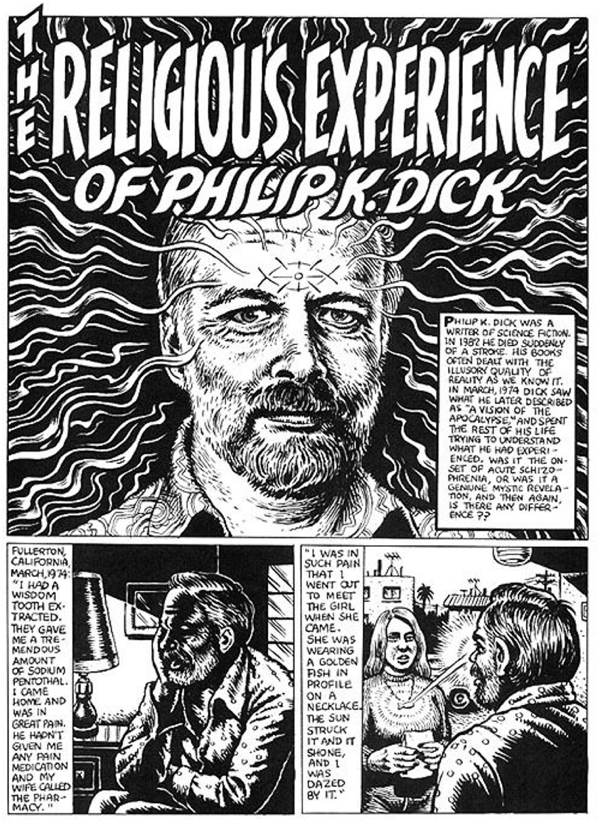
Some of Crumb's best work came out during his Weirdo period. In Weirdo #17, Crumb illustrated an 8-page story called "The Religious Experience of Philip K. Dick," based on a 1978 undelivered speech Dick wrote called "How to Build a Universe That Doesn't Fall Apart Two Days Later" and from passages in an out-of-print book called Philip K. Dick: The Last Testament.

Crumb's story focuses on Dick's bizarre hallucinatory experience of March 1974, in which Dick went back in time to the era of the apostolic Christians. Dick spent the rest of his life trying to figure out what these visions meant. Here's the first page:

Open Culture has an essay about Crumb's cartoon, and links to a low-res scan of the comic.

If you would like a high quality print version of the story, get The Complete Crumb Comics, Vol. 15. This particular volume is loaded with amazing Crumb stories.


27 Aug 02:49

actualteenadultteen: On the left, 18-year-old Bianca Lawson...


actualteenadultteen:

On the left, 18-year-old Bianca Lawson plays 17-year-old Kendra on Buffy the Vampire Slayer.

On the right, 31-year-old Bianca Lawson plays 17-year-old Maya on Pretty Little Liars.

26 Aug 05:14

Hic Sunt Dracones

by Fred Clark

On the one hand, the maker of this globe in 1504 was woefully ignorant about the world.

It looks like South America was torn off roughly at the equator, and where the North American continent ought to be there are only a few scattered islands. The coasts and boundaries of Europe, Africa and Asia are, at best, crude approximations.

But on the other hand, this may be the oldest globe to depict the Western Hemisphere. While it’s far from perfect, it represents a huge leap forward in human knowledge and understanding.

Whoever made this globe knew things that people a generation earlier did not know. Given when this globe was made, and given the extremely limited resources available to whoever made it, it’s a remarkable achievement.

This is how science and learning and human progress works.* The leading edge of learning one day is bound to appear vague, partial and inadequate 500 years later.

We can make maps today that are clearer, more accurate and more complete than this old globe, but we do so mindful that 500 years from now, our best efforts may appear as sketchy as this beautifully carved artifact from 1504. We go about our learning mindful that our best knowledge may, someday, be improved upon in ways we cannot imagine by people with resources we cannot imagine that will enable them to see further and clearer and deeper than we are able to see now.

That’s both humbling and inspiring. Let’s do our best, like this anonymous globe-maker did, to impress our heirs 500 years from now. They will surely notice whole continents of knowledge missing from our best efforts, but let’s try to dazzle them with our care and craftsmanship and our painstaking effort to put together the best of what we know, pointing the way to something better.

- – - – - – - – - – - -

* The sentiment in this post is all quite welcome — even if it’s a bit overly sentimental — as long as the subject is cartography, or astronomy, or physics, or medicine or other fields where dramatic progress over the centuries is obvious and celebrated. But it’s mostly unwelcome if the subject is theology.

This little cartographical object lesson contradicts the mythological narrative we tend to construct around the study of theology, which regards the past as a Golden Age of perfect, complete, wholly accurate knowledge that has gradually been lost over the ensuing centuries. It’s a myth of regress just as powerful and potentially misleading as the myth of inevitable progress I flirt with in the first seven paragraphs of this post.

But it has the opposite effects. The ideal of progress is both humbling and inspiring — reminding us that our best knowledge is always incomplete and pushing us toward further inquiry and perpetual curiosity. But the ideal of regress warns against inquiry and curiosity as dangerous activities that threaten the precious remnants of the truths we have inherited. And rather than encouraging humility, it encourages arrogance — telling us that we may be worse than our ancestors, but we’ll always be better than our descendants.

25 Aug 18:41

Photo

Zephyr Dear

Reminds me of German expressionism somehow


24 Aug 18:05

pulpfanfiction: this has been the scariest night of the I...


a savior rises from the ashes like a phoenix

pulpfanfiction:

this has been the scariest night of the I Fucking Hate Skeletons groups life

24 Aug 17:46

Sure Sounds Like Blizzard Wants To Take WoW F2P

by Nathan Grayson

Only a couple short years ago, most pasty, naked, Earth-dwelling flesh creatures (aka, humans) figured World of Warcraft would forever remain the final bastion of subscription MMOs’ heyday. Now, however, it’s screaming “mayday” as subscriber numbers plummet, proving that no institution is immortal and I should never be allowed to rhyme things. Recent comments from Blizzard suggesting a free-to-play conversion might not be that far off, then, shouldn’t come as much of a surprise – especially since the slowly deflating MMO titan recently added a microtransaction store.

(more…)

24 Aug 17:43

Inattention Please

by Jessie Roberts
by Jessie Roberts

Wayne Curtis praises Serendipitor, a navigation app that encourages you to embrace happenstance:

“Serendipitor is an alternative navigation app for the iPhone that helps you find something by looking for something else,” the developers explain, although not very helpfully. But their explanation gets better: “In the near future, finding our way from point A to point B will not be the problem. Maintaining consciousness of what happens along the way might be more difficult.” Toward that end, the app is “designed to introduce small slippages and minor displacements within an otherwise optimized and efficient route.” Using Google maps as a base, Serendipitor plots random walks for you, from wherever you happen to be to, well, wherever you happen to end up. Along the way “small detours and minor interruptions” pop up, with instructions such as: “Turn left on Chestnut Street and then follow a pigeon until it flies away. Take a photo of it flying.”

I’ve used this app a number of times. And in an obscure kind of way, it actually helps me stop and pay attention. It’s especially handy when I’m traveling. It serves as a sort of anti-guidebook, prodding me out of the deeply worn routes past the usual landmarks, and making me look around. I have yet to take a picture of a pigeon, but Serendipitor once by happenstance had me walk around a school where I watched the tightly choreographed ritual of picking up children at day’s [end] (it was so precisely orchestrated Merce Cunningham could have been behind it). It also once directed me through a sketchy neighborhood where elderly men sat on stoops and watched me with grave suspicion before greeting me with waves and smiles and small conversations. Serendipitor has introduced some minor adventures into otherwise mundane days.

Curtis quotes Walker Percy:

“The search is what anyone would undertake if he were not sunk in the everydayness of his own life,” said Walker Percy’s protagonist in The Moveigoer. “This morning for example, I felt as if I had come to myself on a strange island. And what does such a castaway do? Why, he pokes around the neighborhood and he doesn’t miss a trick. To become aware of the possibility of the search is to be into something. Not to be onto something is to be in despair.”


24 Aug 17:40

LOVEINT: NSA spooks illegally stalking their romantic interests

by Cory Doctorow
Zephyr Dear

*daniel plainview voice* of course they do. Of course they do.


LOVEINT is the NSA practice of stalking people you are romantically interested in, using the enormous, illegal spy apparatus that captures huge amounts of Americans' (and foreigners') Internet traffic. It is so widespread that it has its own slangy spook-name. The NSA says it fires the people it catches doing it (though apparently it doesn't prosecute them for their crimes), but given that the NSA missed Snowden's ambitious leak-gathering activity, it seems likely that they've also missed some creepy stalkers in their midst.

Unless, of course, you believe that being a creepy stalker is incompatible with wanting to be a lawless spy.

Sen. Dianne Feinstein (D., Calif.), who chairs the Senate intelligence committee, said the NSA told her committee about a set of “isolated cases” that have occurred about once a year for the last 10 years, where NSA personnel have violated NSA procedures.

She said “in most instances” the violations didn’t involve an American’s personal information. She added that she’s seen no evidence that any of the violations involved the use of NSA’s domestic surveillance infrastructure, which is governed by a law known as the Foreign Intelligence Surveillance Act.

“Clearly, any case of noncompliance is unacceptable, but these small numbers of cases do not change my view that NSA takes significant care to prevent any abuses and that there is a substantial oversight system in place,” she said. “When errors are identified, they are reported and corrected.”

NSA Officers Sometimes Spy on Love Interests [Siobhan Gorman/WSJ]

(via /.)

(Image: One Hour Photo)


24 Aug 17:39

Demo Memo: Can You Live Without It?

Zephyr Dear

I really expected that to be backwards! Also, someone born in 1977 is a Millennial?

Demo Memo: Can You Live Without It?:

Percentage of Millennials (aged 18 to 36) who say they could live without…

TV: 35%
Sex: 20%
Internet: 17%

24 Aug 17:36

dboybaker: the awakening


dboybaker:

the awakening