Shared posts

09 Dec 22:10

sashayed: You guys, you must stop doing this. You must. We...


sashayed:

You guys, you must stop doing this. You must. We cannot keep yelling at you about it because it makes us so angry, and we are already angry all the time, about real things, like how our lives are turning into a real world Handmaid’s Tale, ha ha ha ha ha ha ha haha ha ha ha ha ha. We cannot keep spending our energy being mad at mediocre men for writing mediocre books that inexplicably win awards and that people tell us to read, for some fucking godawful who knows reason.

So men. My guys. My dudes. My bros. My writers. I am begging you to help me here. When you have this man in your workshop, you must turn to him. You must take his clammy hands in yours. You must look deep into his eyes, his man eyes, with your man eyes, and you must say to him, “Peter, I am a man, and you are a man, so let us talk to each other like men. Peter, look at the way you have written about the only four women in this book.” And Peter will say, trying to free his hands, “What? These are sexy, dynamic, interesting women.” And you must grip his hands even tighter and you must say to him, “ARE THEY, PETER? Why are they interesting? What are their hobbies? What are their private habits? What are their strange dreams? What choices are they making, Peter? They are not making choices. They are not interesting. What they are is sexy, and you have those things confused, and not in the good way where someone’s interestingness makes them become sexy, like Steve Buscemi or Pauline Viardot. Why must women be sexy to be interesting to you? The women you don’t find sexy are where, Peter? They are invisible? They are all dead?” He is trying to escape! Tighten your grasp. “Peter, look at this. I mean, where to begin. ‘She could have been any age between eighteen and thirty-five?’ There are no other ages, I guess? Do you know what eighteen-year-olds really look like, in life? Do you know what forty-year-olds look like? And not that this is even the point, but why are these sexy, dynamic, interesting women BOTHERING with your boring garbage ‘on the skinny side of average’ protagonist? Why did you write it like this, Peter?” 

And maybe Peter will say at last, “I don’t know.” Maybe he will be silent for a long long long time, and then maybe he will say, “I guess it’s scary and difficult for me to imagine the interiority of women because then i would have to know that my mother had an interiority of her own: private, petty, sexually unstimulating, strange: unrelated to me and undevoted to my needs. That sometimes I was nothing to my mother, just as sometimes she is nothing to me. That I was not at all times her immediate concern.”

“I know, Peter,” you can tell him gently.

“I don’t want to know that my mother as a human being with an internal life, because to know that would be to risk a frightening intimacy with her,” Peter will say, maybe. “Because to know that would be to know that she was only a small, complicated person, no bigger or smaller than I am, and I am so small. To know how alone she was. How alone I am. How alone we all are. That my mother survived with no resources more mysterious than my own. She gave me life. My God: she gave me life. How can I pay her back for that? How can I ever, ever give her enough to repay her for my life, every day of my life?” He will be sobbing probably. “I am frightened of her. I am frightened of dying. O God. My God. I didn’t know. I didn’t know.” Drool will run from his mouth as he cries. The way babies cry. He will be ashamed. You must hold him. You must say, “Shh, Peter. Shh.” Wrap your man arms around him. Hum into his thin hair as your own mother hummed once into your own sweet-smelling baby scalp. Kiss him gently on his mouth. There. You did it, men. You fixed sexism. Thank you. You’re the real hero here, you men, and your special man powers, for making art. 

05 Dec 05:33

Trump Miscellany

by Josh Marshall

Not a surprise at this point, but the Post has a story explaining that Trump's call withe the President of Taiwan was planned in advanced by staff on both sides.

Meanwhile, as the Times reports, when Ivanka Trump sat in on that meeting with her father and Japanese PM Abe, her company was in the midst of finalizing a detail with a Japanese apparel giant which - through a few layers of ownership - is majority owned by the government of Japan

From the Times ...

When Donald J. Trump hosted a foreign leader for the first time as president-elect, the guest list included a curious entry: Mr. Trump’s daughter Ivanka, who looked on last month while he and Prime Minister Shinzo Abe of Japan chatted on a white couch high above Manhattan.

Some 6,700 miles from Trump Tower, in Tokyo, another exclusive gathering was already underway: a two-day private viewing of Ivanka Trump products, teeming with Trump-branded treasures like a sample of the pale pink dress Ms. Trump wore to introduce her father at the Republican National Convention.

Ms. Trump is nearing a licensing deal with the Japanese apparel giant Sanei International, both parties told The New York Times. The largest shareholder of Sanei’s parent company is the Development Bank of Japan, which is wholly owned by the Japanese government.

As I've written now several times, I continue to believe we are collectively doing a disservice to the truth by speaking of 'conflicts' and 'complications that seems certain to persist.' There are no conflicts and complications. The Trumps are using the presidency to advance ... 'advance' is insufficient ... to warp drive their business to a realm it has never been in before and never would have been. We know they are currently advancing major new business ventures in numerous foreign countries, all of which need to manage a positive relationship with the United States and its head of state.

This was all but inevitable. But I confess I thought it would be something that was done a bit more secretly, something the details of which would need to be clawed out by investigators over months and years. It's not. It's completely open.

If Trump had taken over Walmart or Amazon or a major golf brand he would of course use it to leverage his other businesses. No one would find this improper. That's how business works. But here the business is the United States. They don't recognize the difference. Or they don't care about the difference. It doesn't matter.

26 Nov 06:05

The Historic Cash-in Continues

by Josh Marshall

We've got another. A long-stalled Trump building project in Georgia (the country) is back on track and ready to go just days after Donald Trump's election. That's major new nugget in a WaPo round up of how Trump's election less than three weeks ago is already turbocharging Trump building projects around the globe.

Remember that Argentine building project which Trump reportedly asked about? Good news! It's back on track and good to go, according to an announcement from Trump's Argentine business partner, Felipe Yaryuri. That announcement came three days after Trump spoke to President Mauricio Macri. And yes, you remember right. It was Yaryuri who Macri had to go to to help arrange the call in which Macri congratulated Trump on his election.

Those two revelations aside, these are the two paragraphs that stand out to me ...

All of it highlights the muddy new world that Trump’s election may usher in — a world in which his stature as the U.S. president, the status of his private ventures across the globe and his relationships with foreign business partners and the leaders of their governments could all become intertwined.

In that world, Trump could personally profit if his election gives a boost to his brand and results in its expansion overseas. His political rise could also enrich his overseas business partners — and, perhaps more significantly, enhance their statuses in their home countries and alter long-standing diplomatic traditions by establishing them as new conduits for public business.

The tone and assumptions contained in these two paragraphs are the key. What is being described here is a personalization of diplomacy and self-enrichment that generations of laws and norms are meant to prevent. But it's the "muddy new world" Trump appears to be ushering in. My point here isn't to criticize the reporters. This may simply be an accurate representation of the reality. But it brings into sharp relief how rapidly the normalization is happening.

We've literally never had a case anything like this in all of American history. The era of transparency and blind trusts has made this impossible for the last forty or so years. Before that you had very wealthy men like the Roosevelts and others. But they were old money, not engaged in active deal-making and business ventures. Of course for much of American history - really almost up until the lifetimes of most of us reading - a developer being actively involved in building and licensing projects in Georgia, Argentina, India, Scotland and numerous other countries wasn't remotely feasible.

We're not even three weeks in. It's apparently already Trump's call if that's how he wants to proceed.

20 Oct 21:09

i got 4 kinds of vinegar today (black, white, red, and rice) and mailed 100 copies of my signature...

i got 4 kinds of vinegar today (black, white, red, and rice) and mailed 100 copies of my signature to london in preparation for the coming bloodbath…and now im waiting for my friend coming from the night airport…some people say people come from other countries and other cities but i have only known people who came from the airport…

07 Oct 18:02

More About Ruby And Japanese

by Giles Bowkett
My "Ruby is 和" blog post is about 8,500 words long. One of the things I cut, to get it down to that compact size, was a section about similarities between Japanese and Ruby, as languages. I also cut it because I spotted a problem with the argument.

First, the part I cut:

One way to understand 和 is as a harmonious blend of disparate elements. This is an accurate description of the Japanese writing system. Written Japanese employs kanji (for example, 和), which are Chinese letters that carry the same meaning they originally held in classical Chinese when Japan adopted them, plus new meanings that Japan has added in the subsequent centuries. Written Japanese further contains our entire alphabet, which, as it was originally the Roman alphabet, is called romaji in Japan. Written Japanese also has two syllabaries, which are like alphabets except each letter represents a complete syllable. The syllabaries are called kana. While kanji and romaji are both character sets in use outside of Japan, neither of the kana syllabaries are used by any other language. However, even with the kana, there's a magpie element in effect: both syllabaries evolved from streamlined, abbreviated ways of drawing kanji.

Each of these four different character sets has different uses in written Japanese, and despite the enormous complexity, it all kind of balances out. Different character sets have different purposes. For instance, one of the syllabaries, the katakana, is primarily used for loanwords — like English, Japanese has a lot of loanwords — but it also functions as an equivalent to italics. Romaji, meanwhile, allow you to type Japanese characters using Western keyboards. Kanji have to be individually memorized, which is a lot of work for Japanese schoolchildren, but kanji have some advantages over written English, which may spell two different pronounciations the same way — e.g., "read" in the present tense vs. "read" in the past tense — or introduce subtle and totally arbitrary distinctions in spelling, like "write" vs. "right." This is also just something that kids have to memorize in school.

Now, for comparison, here's a Python fan on Reddit, complaining about Ruby:

I started working on ruby with a friend and was amazed by the multiplying way they have of making methods. For instance, ruby has for...in but it also has a .each. There are two different notations for ranges (inclusive and exclusive), and myriad unexpected methods for other things: unless (instead if not), upto (instead of the aforementioned range), etc.

It all seemed philosophically messy to me, like they just let whomever patch in whatever tool seemed most useful at the time, and did not imply the same rigid philosophical framework that the python community has adopted.

This could be a fan of English complaining about written Japanese, although English is perhaps a bad example, given that English has more corner cases than most languages. But it still has only one alphabet! And written Japanese definitely lacks unity by comparison.

I won't pick another example, as that could be a huge discussion. You get the idea. Ruby's cheerful willingness to accomodate multiple ways of doing the same thing has an obvious parallel in written Japanese. Fans of Sapir-Whorf will be thrilled to recognize this continuity, where a characteristic of the Japanese language reappears in a programming language created by a native Japanese speaker.

However, Matz himself has said that Ruby was not deliberately modelled on Japanese.

Japanese and Ruby? I try not to think too much about Japanese culture. The method chain looks like Japanese, but it’s just a coincident. Having said that, the support of M17N is heavily influenced by the use case of Japanese people. Otherwise, I wouldn’t spend too much time on such a hard problem.

This is from a tweet in Japanese. The translation comes from Makoto Inoue, a Japanese programmer based in London. He did a very interesting presentation about this, and wrote a blog post which summarizes it. He points out that Japanese sentence structure — subject first, verb last — works well with the Subject.verb syntax favored by object-oriented languages, and raises the same point I've made here about Ruby's versatility:

Doesn’t this “There are many ways to achieve one thing” concept [seem] familiar with Ruby’s philosophy?

Now for the problem with the argument, i.e., the second reason I didn't include this in my "Ruby is 和" post.

Here's a sentence in Japanese:

しつもんがあります。

It's pronounced "shitsumon ga arimasu." You could translate it as "I have a question," and that's what it usually means in my extremely limited experience. I personally say this in emails to my Japanese teacher all the time. But that's not a literal translation.

This sentence has only three words. しつもん ("shitsumon") means a question, or some number of questions, since, like Cantonese, Japanese does not differentiate between the singular or the plural. が ("ga") is a modifying particle like the modifying particles in Attic Greek. It basically means "the word I just said is the subject of this sentence." Since it comes after しつもん, it means the sentence is about a question or some number of questions. The verb, あります ("arimasu"), literally means "exists," or "will exist." Japanese does not differentiate between the present and the future, at least not in the way that English does.
If the languages I'm using for comparison seem random, that's because they are. I'm not a linguist, I've just picked up a bunch of random knowledge here and there.

So the literal translation for しつもんがあります would be "a question, or some number of questions, exists, or will exist." It's up to the reader or listener to understand that, in context, this means roughly the same thing as "I have a question."

Because of all this ambiguity, idiomatic Japanese relies heavily on inference and implication. And this is the problem with the argument that Ruby mirrors Japanese in any meaningful way, in my opinion. Makoto Inoue has an interesting argument which relates this aspect of Japanese to Ruby's functional characteristics. But my concern is that you could imagine a possible programming language which emulated this aspect of Japanese, and Ruby differs from that imaginary language.

For example:

@user = User.find
@user.register!


Here, we have a bit of Ruby which finds a user and has that user register for something. We have to say @user twice. If Ruby were more like Japanese, it might implicitly capture the return value of each expression, and apply the next line to that return value — or resolve scope in the next line while favoring the return value — so that you would never have to say @user explicitly at all.

For example:

User.find
register!


To my knowledge, no programming language does this. You can do stuff like that with method chaining:

User.find.register!

And there was a with statement in Pascal and early versions of JavaScript that allowed something kind of remotely similar, but more explicit:

with(foo = 5) { console.log(foo); }

But it's not the same. I don't expect any programming language to ever really copy this aspect of Japanese, for the same reason that Google Translate basically sucks at Japanese, and I kind of expect that it always will: Japanese relies on context, i.e., information from outside the sentence, and writing code which can infer things from context, the way humans can, is not an easy thing to do. It's probably impossible to develop a programming language which properly emulates this aspect of Japanese without solving very hard problems in artificial intelligence and/or machine learning.

Update: I got a lot of responses to this about possible hacks to implement this, equivalents to with in other languages, and similar stuff. I plan to update with a new blog post semi-soonish but it's going to be after a slight delay, because some of the responses involve languages I'm not at all familiar with, so I want to investigate a little before I post the update.
03 Oct 23:44

She sits in the common area of her apartment, picking at a scab on her thumb. She’s just finished...

Zephyr Dear

hey look izzy is writing things that have me in them

She sits in the common area of her apartment, picking at a scab on her thumb. She’s just finished cleaning out her cave to please the creatures she shares her apartment with, and is now resting, as the appropriate rituals for cleaning are quite draining. She wants to please the creatures she shares her apartment with so that they can please the pale things that have taken over the abandoned cafe downstairs, so that they in turn can please the denizens of the temples in the Human city, which in turn are built to please Gods that the denizens of the temples created out of paper and ink and pain and death. She knows this is a Wrongness, it reeks of things that should not be, but what else is she supposed to do? The Outside is unkind to her people, and she must protect herself however she can.

Her mind drifts to the past week, when she and the Girl with Spider Arms climbed a skyscraper made of living crystal at the edge of the Human city. They watched the sunset filter through the chemical smog that the Human city produces, casting unnaturally-hued light across their tangled bodies. She had told the Girl with Spider Arms that her heart was a lantern, and the Girl with Spider Arms had blinked several of her eyes and thanked her, voice filled with Spidery feelings that made her shiver. She had kissed the Girl with Spider Arms, and the Girl with Spider Arms had kissed her, and they had stayed there atop the crystal spire until the sun went down. They made their way back down, guided by the light from the lantern in the Girl with Spider Arms’ heart.

She comes back to the present as one of the creatures she shares her apartment with enters the common area. It climbs onto the windowsill and begins licking its fur. She watches it for a second, then goes back to idly tracing symbols on the back of her hand. She must regain her energy soon. There is work to be done.

16 Jul 22:01

while i am not in the trough of another rejection i wanna briefly sketch out some thoughts on my...

while i am not in the trough of another rejection i wanna briefly sketch out some thoughts on my saga of interviews

this will likely be p boring to a lot of folks

the thing that struck me the most about all the interviews i had was that none seemed to target the only thing i can think of as reasonably predictive of job success: my ability to learn.

several different times i was given exercises i couldnt do on the spot (like cold, never having seen the problem before) but i was able to finish outside of the interview by the end of the day. this reached a real ironic peak when at least once i was given an exercise in one interview i didn’t do well on that when it came up in the next interview, i did fine at.

google apparently did an internal study of their hiring practices and found they had no relation to whether folks did well on the job. forgive me for not grabbing the stats source, but it was zilcho – the cream of the crop, but even they didn’t have it together. so it is very tough to keep this in mind for myself, but the interview practices i see don’t speak on my own ability in any necessary way

if and when i hit my next rejection i wanted to make this note so i can check back and see how i was perceiving things when i was not feeling too depressed or anxious.

14 Jul 23:30

heteroboremative: with those we love alive is...


heteroboremative:

with those we love alive is beautiful

thanks i love when people take screenshots of my games

04 Jun 03:22

Among the Bowers, Page 8

by Kris
Zephyr Dear

iris....

bh_book3_page008_iris

StumbleUponShare

08 May 17:07

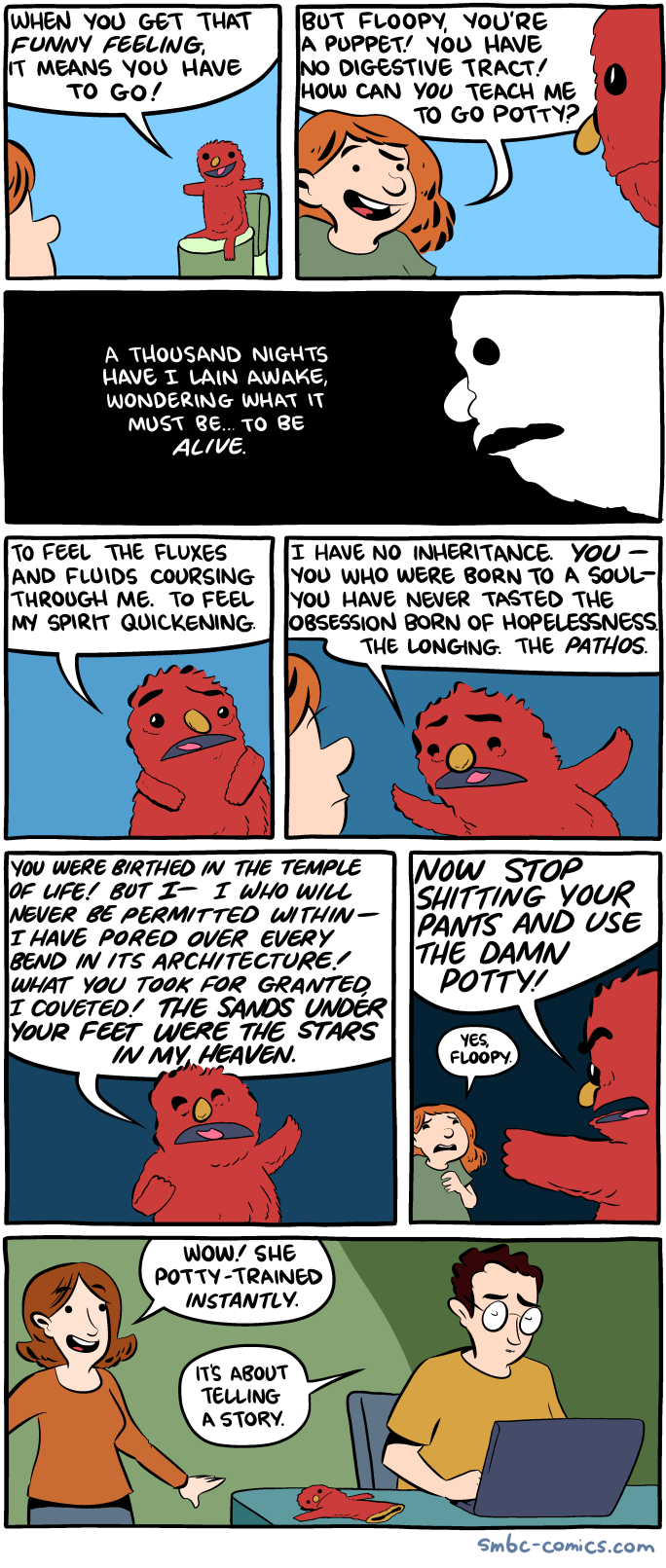
Saturday Morning Breakfast Cereal - Potty Training

by admin@smbc-comics.com

Hovertext: It's time to take our children back from the Puppet Establishment.


New comic!
Today's News:
08 Apr 10:34

erratadala: tw: transphobia Birds, and bird shit, in Porpentine...


erratadala:

tw: transphobia

Birds, and bird shit, in Porpentine games. From top: the sky in the room, their angelical understanding, parasite, ballast, parasite

this is the kind of analysis i love

01 Apr 20:03

Over 6 years ago, when I was still in high school, I started reading the successor to Problem...

Over 6 years ago, when I was still in high school, I started reading the successor to Problem Sleuth. I thought it was arcane, self-indulgent, uselessly complicated, and badly animated.

But it lead me to meeting my dearest friends, understanding my own sexuality and identity, and overcoming years of painful denial. It gave me an example of romance I could connect with in Rose and Kanaya, and in each of them, imperfect people who overcame adversity and fallibility to become not epic heroes or legends, but whole, happy people, who care about and depend upon one another.

And while it has dragged out long past the point of absurdity, I owe so much to this story and it’s characters, and it’s hard to say goodbye. Therefore, alongside a renewed interest in roleplaying and writing fanfic, I’m going to give this story a proper farewell by rereading it in it’s entirety, and keeping commentary here on my old blog. All of my posts will be gathered under the ‘hs reread’ tag.

Let’s begin again.

10 Mar 04:04

"Why did the chicken cross the road? Because the dead return. Because light reverses. Because the..."

Why did the chicken cross the road?

Because the dead return. Because light reverses. Because the sky is a gap. Because it’s a shout. Because light reverses. Because the dead return. Because footsteps on the ceiling. Because footsteps in the basement. Because the sky is a shout. Because it’s a gap. Because the grass doesn’t grow, or grows too much, or grows wrong. Because the dead return. Because the dead return. That. THAT is why the chicken crosses the road.


- Alice isn’t dead - episode 1: Omelet (via itsarkboy)
01 Mar 16:02

i’m excited to finally present one of my most ambitious projects...


i’m excited to finally present one of my most ambitious projects ever, PSYCHO NYMPH EXILE, a novella + multimedia kit that tells the story of two fucked-up women (a disgraced biomech pilot and an ex-magical girl) surviving and being gay as shit in a post-anime gurowave city where trauma is a color-coded resource and state IDs are tarot decks generated from your psyche

it contains:

PNE is in collaboration with the incredible talents of @sloaneshutup​ and @neotenomie + commissioned by Rhizome and presented in conjunction with the New Museum

26 Feb 23:33

nostalgebraist: The actual story here is just “someone came up...


nostalgebraist:

The actual story here is just “someone came up with a model that fits 22 of the 23 presidential elections from 1912 to 2000”

But the awkwardly written headline gave me the image of a wizened, wizardly, Cassandra-like prophet, who has lived with the burden of perfect foresight for over a century – except for that one time he mispredicted a horse race in 1954, which still haunts him today

It was his one tiny moment of respite from his perfect, empty life.  He had never known love or, indeed, companionship of any kind, because he could perceive no more free will in a human than in a pocket watch.  He had sought solace in the notion that he and others truly had nothing in common, that he was simply not human – but then, in 1954, a single crack in the barrier between him and the wall opened.  He had not known he would be wrong about the horse race, and thus he had not known that as a result he would rush home, collapse and cry for hours, that he would know hope for the first time

Or that his hope would be crushed; that after that single thunderclap the model would never again fail; that while he would cry again on occasion, his tears would never surprise him the way they had in 1954, and that he would always afterwards know the difference, the unbearable difference, between life with the model and life as it might be without it

He is very old now.  His peculiar longevity feels like a cruel joke, God adding insult to injury, for every mere minute of life – unraveling tediously, second after second, in slavish accordance with the model – brings him a certain special boredom you or I will never know.  He has, of course, asked the model when he will die; it is not for a long while yet, and he has long since stopped hoping that the model might err once more.  Lacking any other source of stimulation he ruminates, endlessly and painfully, on what lesson he ought to draw from it all.  What was God trying to tell him, in giving him the model and giving him 1954?  Should he, instead of retreating home that day to convulse, have rushed out and tracked down the horse whose win he failed to foresee?  (Long dead by now, surely.)  What made that day special?  What made him special?

For he, possessing the model, able to write down its simple logic and its impeccable results, had never been able to share any of it with anyone.  The model, as if jealous, never foresaw anyone else coming to know its powers.  Except on February 26, 2016, when – and what did God mean by this? – the forecast instead called for him to say a few words about it all to a savvy and short-sighted journalist (why her?).

The journalist asks him what any journalist would.  On the phone, aware of her impatience, he bites his tongue and says nothing of the great changes awaiting them, nothing of the aliens, or, of the secrets that will be brought forth from the soil, for it was not forecast that he would speak of these things.

Instead he tells her that yes, Donald Trump will become president.

But are you sure, she asks.

I’ve only been wrong once in 104 years, he tells her again, trying to hide the quiver of forbidden hope in his voice.

25 Feb 22:39

datasaint: publicdomainreview: illustrations from Vaught’s...


datasaint:

publicdomainreview:

illustrations from Vaught’s Practical Character Reader, a book on phrenology by L. A. Vaught published in 1902.  See many more images from the book ON THE MAIN SITE. 

Tag yourself…I’m What We See Ghosts With

22 Feb 18:26

How Computers Feel Different Now

by Giles Bowkett
I learned how to program a computer on a TRS-80, in BASIC. I was six years old. At the time, "computers" meant things like the TRS-80. Today, your phone is a computer, your TV's a computer, your car's made of computers, and, if you want, your frying pan can be a computer.

But it's not just that everything's a computer now; it's also that everything's on a network. Software isn't just eating the world because of Moore's Law, but also because of Metcalfe's Law. In practice, "software is eating the world" means software is transforming the world. It might make sense to assume that software, as it transforms the world, must be making the world more organized in the process.

But if Moore's Law is Athena, a pure force of reason, Metcalfe's Law is Eris, a pure force of chaos. Firstly, consider the fallacies of distributed computing:
  • The network is reliable
  • Latency is zero.
  • Bandwidth is infinite.
  • The network is secure.
  • Topology doesn't change.
  • There is one administrator.
  • Transport cost is zero.
  • The network is homogeneous.
The first and the last — "The network is reliable" and "The network is homogenous" — are basically equivalent to saying "chaos reigns supreme." No area is ever the same, because the network is not homogenous (and the topology is ever-changing), and things don't always happen the same way they happened before, because the network isn't always there. So chaos reigns over both space (the non-homogenous network) and time (the ever-changing network which is only sometimes there).

Chaos also reigns in a social sense: the network isn't secure, and there are many administrators. So if Moore's Law makes everything it touches more automatic and organized, Metcalfe's Law makes everything it touches less reliable and more unpredictable. An unspoken assumption you can see everywhere is that "software is eating the world" means that the world is becoming more organized along the way. But since networking is an implicit fundamental in the definition of software today, everytime software makes the world more organized, it brings networking along with it, and networking makes everything more chaotic.

Everything that software eats becomes newly organized and newly chaotic. Because you have a new form of organization replacing an old form of organization, while a new form of chaos replaces an old form of chaos, it's impossible to really determine whether or not software, when it eats the world, makes it more organized or more chaotic. The net effect is impossible to measure. You might as well assume that they balance perfectly, and Moore's Law and Metcalfe's Law are yin and yang.

But the thing is, when personal computers were a new idea, they emanated order. You typed explicit commands; if you got the command perfectly right, you got what you wanted, and it was the same thing, every time. They didn't have the delays that you get when you communicate with a database, let alone another computer on an unreliable and sometimes absent network. They didn't even have the conceptual ambiguity that comes with exploring a GUI for the first time.

Even the video games back then were mostly deterministic. It's why big design up front looks so insane to developers today, but made sense to smart people at the time. During WWII, the cryptographers who developed computing itself were mathematicians who based everything about computing on rock-solid, Newtonian certainties. You did big design up front because everything was made of logic, and logic is eternal.

This is no longer the case, and this will never be the case again. And this is what feels different about computers in 2016. A few decades ago, "non-deterministic computer" was a contradiction in terms. Today, "non-deterministic computer" is a perfect definition for your iPhone. Everything it does depends on the network — which may or may not exist, at any given time — and you can only use it by figuring out a graphical, haptic interface which might be completely different tomorrow.

Every Netflix client I have operates like a non-deterministic computer. Here's a very "old man yells at cloud" rant. This happened. I go on Netflix, and I start watching a show. There's some weird network glitch or something, and my Apple TV restarts. I go on Netflix a second time, and I go to "previously watched," but the Apple TV didn't tell the network in time, so Netflix doesn't know I was watching this show. So I go manually search for it, and when I hit the button to watch it, Netflix offers me the option of resuming playback where I was before. So it knows I was watching it, now.

Basically, whatever computer cached the list of previously watched shows didn't know the same thing that the computer which cached the playback times did know.

A few decades ago, it was impossible for a computer to have this problem, where the right hand doesn't know what the left hand is doing. Today, it's inherent to computers. And this has long-term consequences which are subtle but deep. Kids who see chaos as an intrinsic element of computing from the moment they're old enough to watch cartoons on Netflix are not going to build the same utopian fantasies that you get from Baby Boomers like Ray Kurzweil. My opinion of transhumanists is that they formed an unbreakable association between order and computers back when networks weren't part of the picture, and they never updated their worldview to integrate the fundamental anarchy of networks.

I don't want to old man yells at cloud too much here. That's where you get these annoying rants where people think the iPad is going to prevent kids from ever discovering programming, as if Minecraft were not programming. And I'm already telling you that the kids see the world a different way, like I'm Morley Winograd, millennial expert. But there's a deep and fundamental generation gap here. Software used to mean order, and now it just means a specific blend of order and chaos.
18 Feb 20:42

Tangentially related: European cinema might not even allow all that much bloodless violence in a PG-13 rated film. We will, however, allow more sexual content in a PG-13 than the US does. It's interesting to see which one of sex and violence each side of the Atlantic considers more in need of restriction in 'child-safe' media.

Yeah, and I feel like in both sex and violence the parameters we use (at least in the US, don’t know in detail how it works other places) to determine offensiveness are really skewed.

Like for sex, there’s so much focus on which specific body parts are visible, which… who gives a shit?  “What a nipple looks like” is not a dangerous secret.

What I would like rating committees to look at in sex scenes is whether the content requires someone to already understand things like “in real life, girls don’t usually like when you do that without asking” or “in real life, people’s bodies don’t have to look like that to be attractive.”

…Then again, the whole idea of a committee judging the moral value of art bothers me, and I’m not all that comfortable saying “well, it’s okay if they use the right moral standards.”  I’ll personally support media that meets my standards but I wouldn’t want it formally enforced.

I just think that if we have to formally enforce standards, they could at least be sensible ones, instead of worrying about whether children are prematurely exposed to the vowel in between “f” and “ck.”

11 Feb 16:15

also someone please go back in time and stop past lia from trying to play manic pixie dream girl all...

also someone please go back in time and stop past lia from trying to play manic pixie dream girl all the time, and also stop other people from letting her do that/buying into it

not that it’s bad to want to make other people happy, or help them with their problems, or love and support them as unconditionally as you can manage, or just have a good time with them

but it’s bad when you’re doing it partly to avoid addressing the fact that there are a zillion hungry rodents furiously gnawing your own personal internal wiring to sharp, electrically charged, nonfunctional confetti

11 Feb 15:42

one of my coworkers is pursuing a T Rxey asks me questions, and i answer as i can about it. it sucks...

one of my coworkers is pursuing a T Rx

ey asks me questions, and i answer as i can about it. it sucks to confirm for em that as ey expect, ey will experience a new respect from others. though i found myself explaining it is conditional. extended as a courtesy by men to others they perceive as broadcasting standard masc signals. it can be retracted at any time. manhood is always a conditional thing

it put me in mind: what else could i have said to myself ten years ago, as i was beginning my transition?

mostly i guess i’d tell myself to begin getting gentle as soon as i could

as a girl and a woman, my tenacious argumentativeness and intelligence and stubbornness made me a “bitch” culturally, but no one feared me because of them. and men never felt much threatened by them in a way where they’d enter real dominance relation dancing. i’d been abused by men, but not the way they abuse each other

ive struggled with that a lot. the horn locking. i try to avoid it as much as possible these days. ive gotten better at recognizing the behaviors of folks that will do that persistently. so far they are always other men.

the other prerequisite of gentleness that i didn’t understand as a younger man was how much i needed to prioritize my mental health. esp when exo hormones taken with any irregularity just exaggerate one’s bad moods. the ultimate struggle: TAKE YOUR MEDS ALEX. ON SCHEDULE. still spotty on that one.

i have to look back and thank myself though that even as essentially still a child i began pursuing the things that’d help: therapy, medication, regular work, a safe home, a partner that was good for me. it wasn’t just luck or privilege that i achieved those things. some of it was hard work and i want to take a moment to thank myself for that

this week i am thinking to myself that the gentleness was making sure I wasn’t speaking as the Judge, or under the Judge’s gaze – the suckup brat trying to make sure i was Better. very hard to let that go when any experience of being treated like i am wrong or stupid or incompetent triggers my memories of unfairly being received as those things just because i was a girl and not a boy.

i was talking about transition… nothing is “just trans” stuff though, is it?

to end on a happier note, it has been ten years, but it still makes me happy to hear someone refer to me as “he” or “him”. i love it when cora talks about me and i read those words. i know i was a girl when i was young, but for clarity, it makes me unhappy to ever be “historicized” pronoun-wise back to “she”.

he [alex] was a girl. he is a full grown man now i suppose…

05 Feb 13:45

zedislepidus: heidi8: korota37: accidentalbeardo: poppunkvam...


zedislepidus:

heidi8:

korota37:

accidentalbeardo:

poppunkvampire:

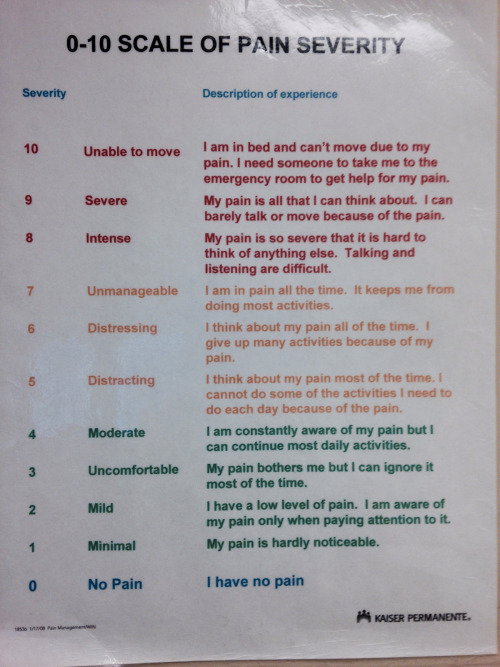
a helpful pain scale for people who have difficulty with doing body inventory or quantifying pain

0-10 Scale of Pain Severity

  • 10 - Unable to Move I am in bed and can’t move due to my pain. I need someone to take me to the emergency room to get help for my pain.

  • 9 - Severe My pain is all that I can think about. I can barely talk or move because of the pain.

  • 8 - Intense My pain is so severe that it is hard to think of anything else. Talking and listening are difficult.

  • 7 - Unmanageable I am in pain all the time. It keeps me from doing most activities.

  • 6 - Distressing I think about my pain all of the time. I give up many activities because of my pain.

  • 5 - Distracting I think about my pain most of the time. I cannot do some of the activities I need to do each day because of the pain.

  • 4 - Moderate I am constantly aware of my pain but I can continue most activities.

  • 3 - Uncomfortable My pain bothers me but I can ignore it most of the time.

  • 2 - Mild I have a low level of pain. I am aware of my pain only when I pay attention to it.

  • 1 - Minimal My pain is hardly noticeable.

  • 0 - No Pain I have no pain.

Hey this is super useful, the scale of frowny faces on the doctor’s wall really does nothing to help me evaluate pain. When my hands were really bad I knew the pain was there all the time and often impacting my ability to sleep or do things but I wasn’t sure how to translate that to numbers. Looking at this chart I think I under-ranked the pain level. 

I’m pretty much always at a 3 or 4.

Particularly useful if you think that you should be able to tolerate it, or if you’ve experienced what you’ve deemed a literal 9 or 10 before and don’t know how to quantify something close, or worse. 

This is amazing because since I’m basically always at at least a 4 or really probably a 5 but if you show me a bunch of frowny faces I’d tell you like a 1 because this is just my reality.

22 Jan 19:24

I'm trying to figure out if I'm autistic. I'm trying to read the criteria. But like its all written in doctor speak and I'm dyslexic and I'm really struggling to work out what it says. Is there anyone who knows a version that uses normal words? Tnx

Here’s an attempt at an ordinary language translation. It’s a bit longer because of having to unpack some of the terms

A: It’s hard for you to talk to people, understand them, and/or make them understand you. This happens consistently in different places, with different people, and over several years. In particular, you have or had all three of:

  1. Difficulty sharing your emotions with others, which can mean gushing at strangers about interesting facts, hiding your thoughts and feelings, refusing to talk to people, or other things
  2. Difficulty understanding things that aren’t said in words, which can mean not understanding what other people’s faces and gestures mean, not understanding what your own face or gestures might mean to others, not making faces or gestures at all, or other things
  3. Difficulty making and keeping friends, which can mean that you don’t know how to act differently with different people, have a hard time playing pretend with others, or simply don’t care about the people around you when they’re not doing anything to you.

B: You do or think about the same specific things over and over. In particular, you have or had two of:

  1. Doing or saying the same thing over and over, without any obvious purpose, like lining up your toys, copying what someone says, rocking, or flapping your hands.
  2. Having to do things the exact same way, or it’s wrong and very upsetting. Changes to your stuff, your plans, or how you can do things are very stressful.
  3. Special interests in very specific topics that take up lots of time and energy.
  4. You notice how things feel too much, or not enough. You might not react to pain or heat or cold, or find a certain sound or texture very upsetting, or need to touch or smell or stare at anything new.

C: Some of this behaviour has to have been there since you were about five or earlier. It might not have been a problem then, or you might have learned to work around it since then, but it needs to be the same sort of behaviour.

D: These difficulties make it hard for you to socialise, hold down a job, or otherwise live your life. 

E: These difficulties aren’t just explained by the idea you might have a learning disorder or slow mental development. If you think you might have both, measure “difficulty” from where your “normal” is - for example, “difficulty understanding things that aren’t said in words” should be measured against how well you understand things that are said in words.

- Mara

14 Jan 20:31

Last night I dreamed you left 2 cacti on my doorstep with a brochure for your cactus club, then I came over and gave you cacti in return. You also helped me rescue a dolphin from a swimming pool. Thank you for the good dream and also dream cacti!

aw, i’m glad we could exchange cactuses. thanks for hosting me in your dream.

i’ve literally been saying that 2016 is the year of cacty, i had an idea for a game about a cactus girl detective….i really feel these spiky friends are on the rise…!

10 Jan 21:48

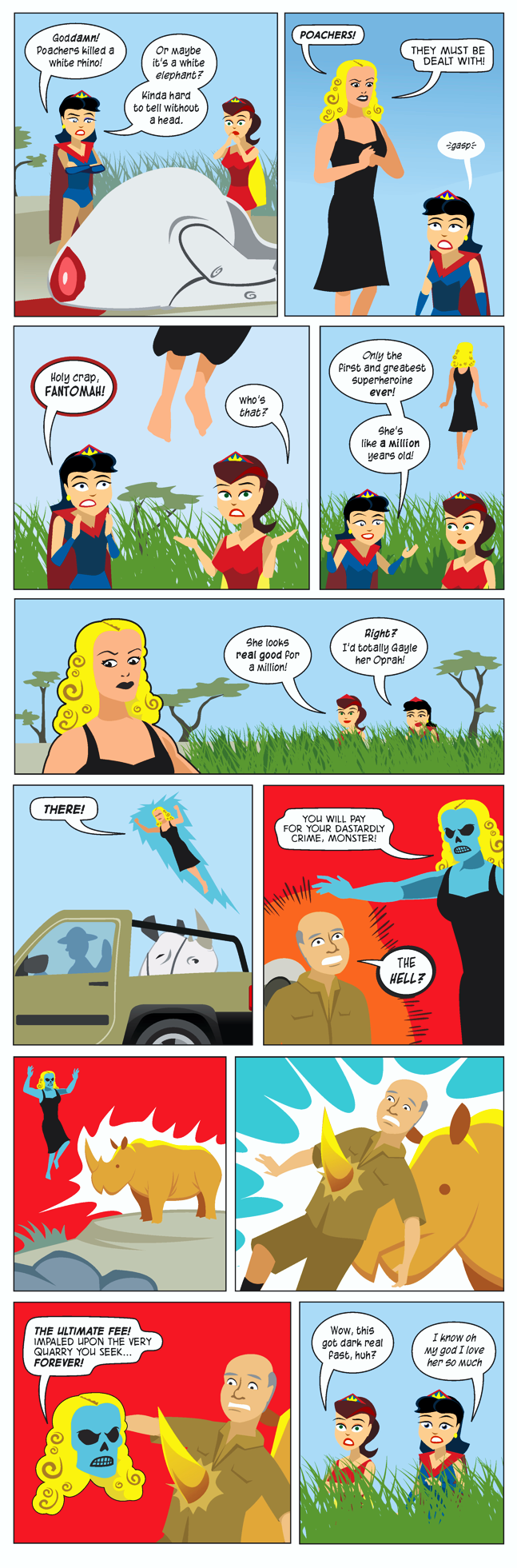
The FANTOMAH Menace

by Justin Pierce

What do you get when you cross an elephant and a rhino? AN ABOMINATION AND YOU SHALL BE PUNISHED FOR YOUR MISDEEDS.

05 Jan 05:34

this is how i feel about 2015. there’s been a lot of tough months where i felt like i was being...

this is how i feel about 2015. there’s been a lot of tough months where i felt like i was being carried when i couldn’t stand up myself. thanks for giving me and my friends money so we have places to live. thanks for giving me space to heal and feel safe and recover.

i’m thankful to brenda for helping me fall asleep at night, all the times she’s fed me when i’ve been unable to do it myself, made sure i’m drinking enough water, and all the other little caring things that kept me alive the last couple years

i’m thankful to erin for helping us find this place where no bugs try to eat me, and walking with me to therapy

i’m thankful to everyone who gave me hormones when my insurance denied it

i’m thankful to everyone who read hot allostatic load and said, this is something that happens, or, this happened to me

thanks everyone who talks to me late at night

thanks for playing my shit and sharing it and saying nice things to me

good luck, support my corporation in 2016

30 Dec 18:45

seagullshroom: yamahacs80: i would absolutely hate to be toby fox right now imagine having this...

seagullshroom:

yamahacs80:

i would absolutely hate to be toby fox right now imagine having this game that you poured your soul into for god knows like five plus years be reduced to sans asmr menstruation roleplay soundcloud uploads

20 Dec 05:02

*Trigger Warning* Why is The Rocky Horror Picture Show popular with the kinky and queer communities? I'm not part of those communities and I don't get it, please explain. It seems to me to be a story in which the kinky queer people are literally not human and try to recruit (and arguably rape by fraud) "normal" people.

Yes, but it’s also a story where kinky queer people are powerful and cool and sexy and fun, and ultimately the straight characters sing about how much freer they feel in a corset fishnets pool orgy.  (And then the house, uh, is a spaceship and it takes off?  Okay.)  It’s also relevant that the movie was written by a nonbinary person; I think the intent was not to demonize kinky queer people, but to tell a story featuring them that also had elements of classic schlock horror and sci-fi movies. 

And remember that this was the 70s, when sympathetic queer characters were thin on the ground, the distinction between “transvestite” and “transsexual” was not crisply defined, and the popular understanding of the difference between “seduction” and “rape” was even less nuanced than it is today.  (Also, the “homosexual agenda” narrative of gay recruitment wouldn’t come around until the 90s.)  This doesn’t make everything okay but it’s important context.

And I’d argue that some of the bad stuff in it is intentionally transgressive–isn’t saying “people who don’t conform to traditional gender and sexual roles are dangerous perverts,” but “you think we’re dangerous perverts? oh honey, you have no idea.”

Yeah, I’m defensive.  This movie means something to me, on a level that’s not apparent on the screen, because I started going to midnight showings when I was fifteen.  And it–counting the audience participation and shadow cast, because you really have to, there’s no point to watching this movie quietly at home–was probably my first experience with queerness being fun.  I already knew it was possible to not be straight, but only as a tragic existence condemned to the shadows.  Rocky Horror wasn’t the first time I learned two men could kiss, but it was the first time I saw two men kiss in front of a crowd that was cheering them on.

So, okay, not “therefore, Rocky Horror is flawless, QED,” but that’s why people like it.  It’s an all-ages queer event you can attend without declaring yourself queer, it’s an introduction to queerness as silly and naughty instead of always being Very Serious Business, and you can throw stuff at the screen.

18 Dec 22:28

porpentine: LocusJam has begun, and runs til January...

Zephyr Dear

ohhh daaaaang

gotta do it gotta do it gotta do it


porpentine:

LocusJam has begun, and runs til January 3rd!

Mission
Make a place. Something specific and discrete, like one room in a structure, or a single fixed perspective. It can be graphical or text or diorama or desktop folders or anything you desire.

Examples
Polly Pocket, The Big City, Chime Shrine, 10 Seconds in Hell

Thoughts
What is idiosyncratic about the place, that would be diminished if it were universalized to fit inside a larger work?
Are you trying to tell a story through the place or just focus on the feel?
What can you see from the place that you can’t reach?

12 Dec 15:28

"“You go into a cab as ‘sir,’ and you come out as ‘ma’am,’ ” she told me. “You can’t train people;..."

“You go into a cab as ‘sir,’ and you come out as ‘ma’am,’ ” she told me. “You can’t train people; they’re going to say what they see.”) I asked Myles if, as a poet, she struggled to refer to an individual person as “they.” She said, “It’s not intuitive at all. But I’m obsessed with that part in the Bible when Jesus is given the opportunity to cure a person possessed by demons, and Jesus says, ‘What is your name?’ And the person replies, ‘My name is legion.’ Whatever is not normative is many.” She liked the idea of a person containing more than one self, more than one gender.

“Part of it is just the fiction of being alive,” she said. “Every step, you’re making up who you are.”


- Eileen Myles, Dolls and Feelings: Jill Soloway’s post-patriarchal television, New York Times (via kareninaeoreileao)
10 Dec 19:14

"Elie Wiesel once stated that the children of murderers are children. I say that the descendants of..."

Elie Wiesel once stated that the children of murderers are children. I say that the descendants of killers do not own the crimes of their ancestors, unless they willingly shield those crimes today. I have noticed that some modern Euro-Americans feel backed into a corner, as though by mere virtue of being Euro-descended they must defend the mythology of conquest over its very brutal reality; as if they would be race traitors should they concede the depths of it. This is recidivist racism, but the backsliding is emotional, and emotion cannot be reasoned away.

I have found out the hard way the visceral nature of this emotional resistance, so to forestall it, I now prepare my Euro-American students to hear difficult information. Here is what I tell them: “You are about to learn some very unsettling facts, mournful things that may even contradict what you heard in the fifth grade. You will want to turn away from these awful facts, but do not turn away from them. Instead, remember: You did not do this.”

Then, I repeat, “YOU did not do this.”

After that sinks in, I continue, “There is no reason for you to assume that you must defend misdeeds, simply because Europeans once committed them. You are not responsible for what happened.”

I conclude with: “All that you are responsible for is what you do, once you walk out the door, knowing that these things did happen.”

The stories that follow reflect no glory on the European invaders of North America. However, I am told that racism is happily passé, so let me say to my Euro-American readers: You do not have to feel like a race traitor should you pause to wipe your eyes or shake your head over what was done. You did not do this. You are not responsible. The only thing that you are responsible for is what you do after you close this book, knowing that these things were done to Native America.


-

Barbara A. Mann, in the introduction to The Tainted Gift: The Disease Method of Frontier Expansion

“All that you are responsible for is what you do, once you walk out the door, knowing that these things did happen.”

(Part 1)