Shared posts

02 Dec 22:32

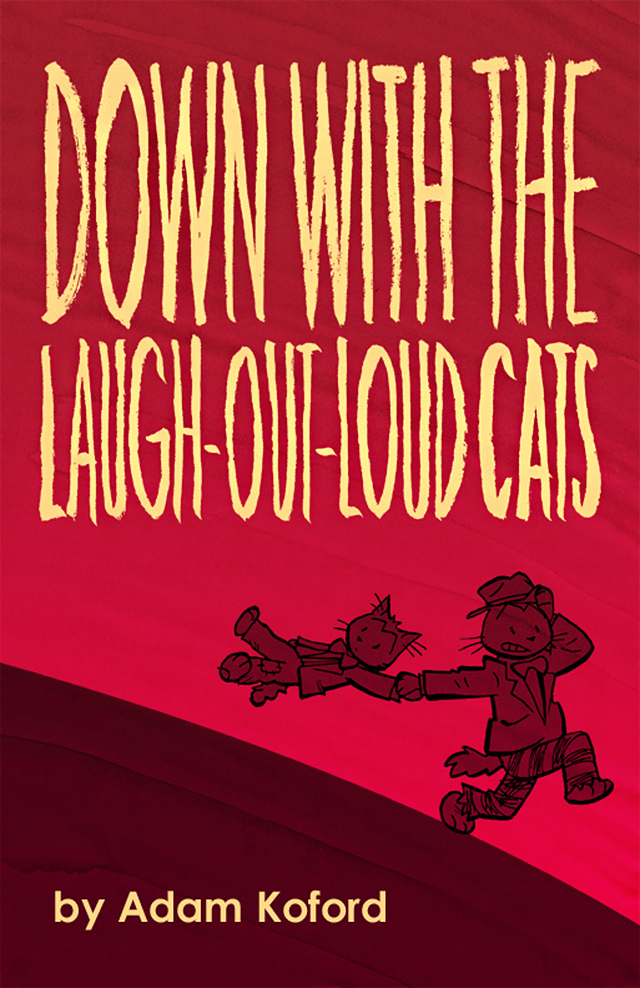
Down with the Laugh-Out-Loud Cats

by Cory Doctorow


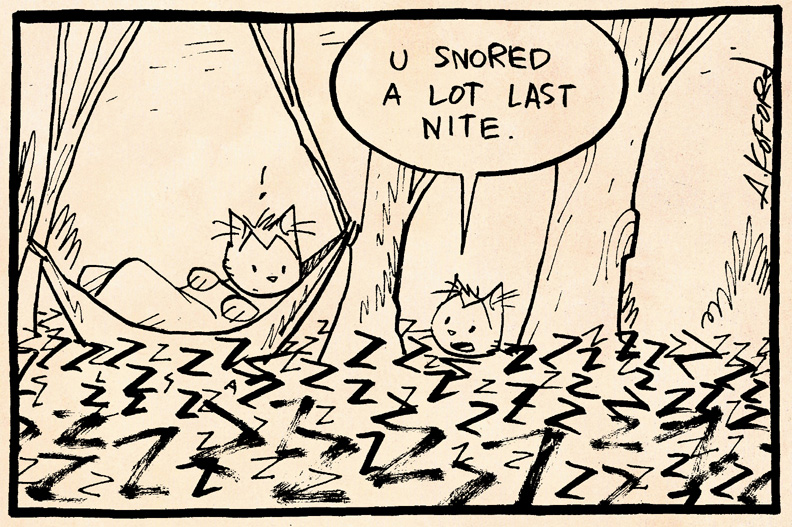
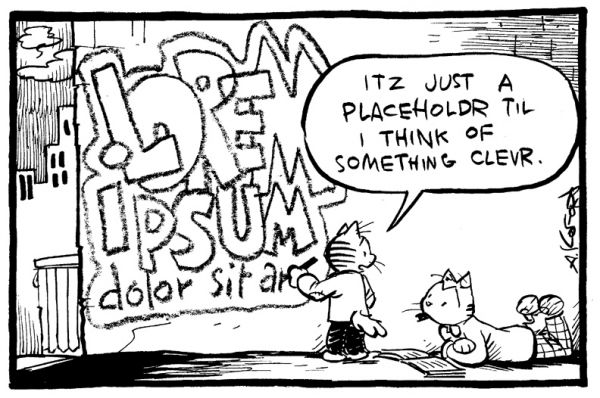
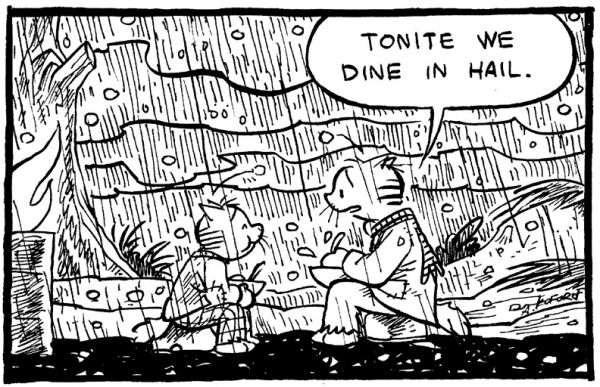
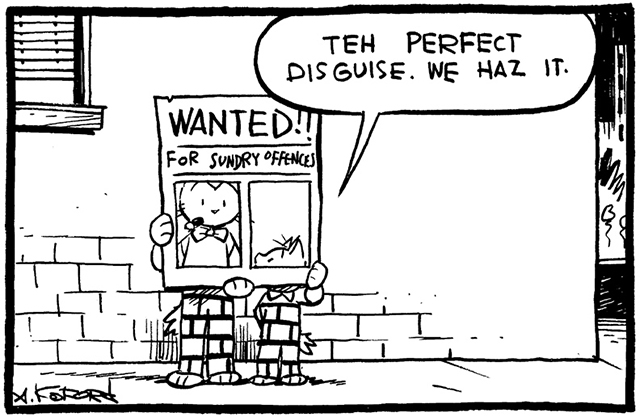
Adam "Ape Lad" Koford's published a new collection of his wonderful Laugh-Out-Loud Cats comics, Down with the Laugh-Out-Loud Cats. The collection is pure, distilled charm.

The Laugh-Out-Loud Cats are the lineal descendants of strips like Peanuts, which mixed extremely contemporary references (in this case, references to Internet slang) with a timeless, childlike humor, and great character design. Pip and Kitteh are eternal hobos on the backroads of the Internet age, shamelessly mixing puns and sight gags in a way that is purely sweet.

As a bonus, this volume is interspersed with the hobo illustrations Ape Lad did for Hodgman's Areas of My Expertise. If you love cute animals, hobos, and Internet humor, you will love The Laugh-Out-Loud Cats.

Down with the Laugh-Out-Loud Cats


02 Dec 18:50

Speech rhythms and brain rhythms

by Mark Liberman
Zephyr Dear

ohhhh, Language Log...

[Warning: More than usually geeky...]

During the past decade or two, there's been a growing body of work arguing for a special connection between endogenous brain rhythms and timing patterns in speech. Thus Anne-Lise Giraud & David Poeppel, "Cortical oscillations and speech processing: emerging computational principles and operations", Nature Neuroscience 2012:

Neuronal oscillations are ubiquitous in the brain and may contribute to cognition in several ways: for example, by segregating information and organizing spike timing. Recent data show that delta, theta and gamma oscillations are specifically engaged by the multi-timescale, quasi-rhythmic properties of speech and can track its dynamics. We argue that they are foundational in speech and language processing, 'packaging' incoming information into units of the appropriate temporal granularity. Such stimulus-brain alignment arguably results from auditory and motor tuning throughout the evolution of speech and language and constitutes a natural model system allowing auditory research to make a unique contribution to the issue of how neural oscillatory activity affects human cognition.


Most of the attention focuses on the "theta band" at about 4-8 Hz, e.g. Huan Luo and David Poeppel, "Phase Patterns of Neuronal Responses Reliably Discriminate Speech in Human Auditory Cortex", Neuron 2007:

How natural speech is represented in the auditory cortex constitutes a major challenge for cognitive neuroscience. Although many single-unit and neuroimaging studies have yielded valuable insights about the processing of speech and matched complex sounds, the mechanisms underlying the analysis of speech dynamics in human auditory cortex remain largely unknown. Here, we show that the phase pattern of theta band (4–8 Hz) responses recorded from human auditory cortex with magnetoencephalography (MEG) reliably tracks and discriminates spoken sentences and that this discrimination ability is correlated with speech intelligibility. The findings suggest that an ∼200 ms temporal window (period of theta oscillation) segments the incoming speech signal, resetting and sliding to track speech dynamics. This hypothesized mechanism for cortical speech analysis is based on the stimulus-induced modulation of inherent cortical rhythms and provides further evidence implicating the syllable as a computational primitive for the representation of spoken language.

Or Uri Hasson et al., "Brain-to-Brain coupling: A mechanism for creating and sharing a social world", Trends in Cognitive Science, 2012:

During speech communication two brains are coupled through an oscillatory signal. Across all languages and contexts, the speech signal has its own amplitude modulation (i.e., it goes up and down in intensity), consisting of a rhythm that ranges between 3–8Hz. This rhythm is roughly the timescale of the speaker’s syllable production (3 to 8 syllables per second). The brain, in particular the neocortex, also produces stereotypical rhythms or oscillations. Recent theories of speech perception point out that the amplitude modulations in speech closely match the structure of the 3–8Hz theta oscillation . This suggests that the speech signal could be coupled and/or resonate (amplify) with ongoing oscillations in the auditory regions of a listener’s brain.

A possible weakness of Luo and Poeppel 2007 (a fascinating and deservedly influential study) was that the same phase analysis that they found to identify the brain responses to different sentences also worked in exactly the same way when applied to the amplitude envelope of the original audio. This suggests that simple modulation of auditory-cortex response by input signal amplitude might be the main mechanism, rather than any more elaborate process of phase-locking of endogenous brain rhythms.

I'm not yet convinced that there's a special role for endogenous rhythms in speech production and perception, beyond the necessary modulation of brain activity by the necessarily cyclic manipulation of speech articulators in production, and by the associated cyclic variation in acoustic amplitudes. All the same, this meme is associated with a range of interesting hypotheses, some of which may well turn out to be true and important.

But I've also noticed that the properties of the overall amplitude-modulation of the speech signal (caused by opening and closing the mouth, by turning voicing and noise-generation mechanisms on and off, and to some extent by varying subglottal pressure) are in some respects not quite as the focus on theta-scale rhythms predicts. To indicate what I'm curious about, I'll show a simple analysis of the TIMIT dataset (which Luo and Poeppel also used) in the 1-15 Hz range.

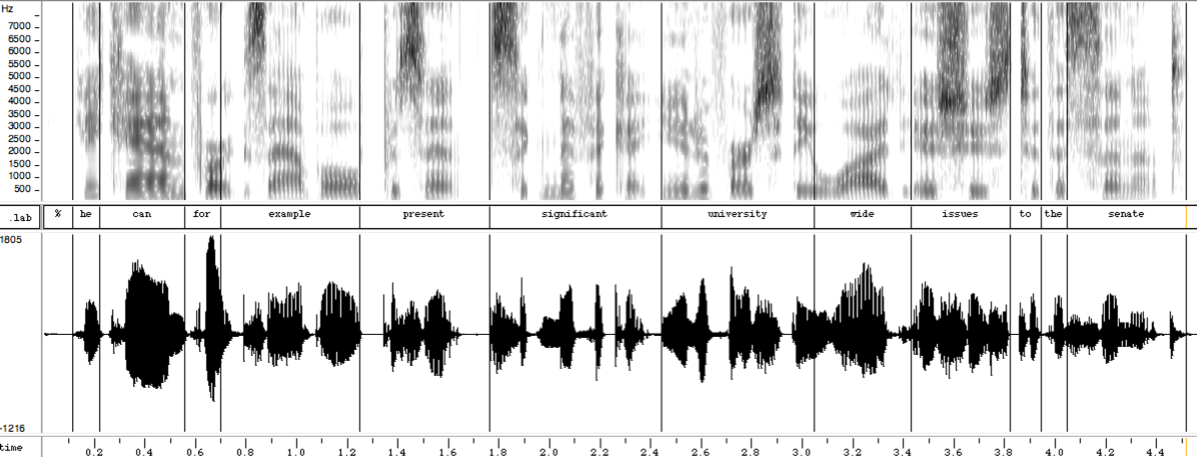
Here's the spectrogram, waveform, and amplitude envelope of a read sentence (one of the 6300 read sentences in TIMIT):

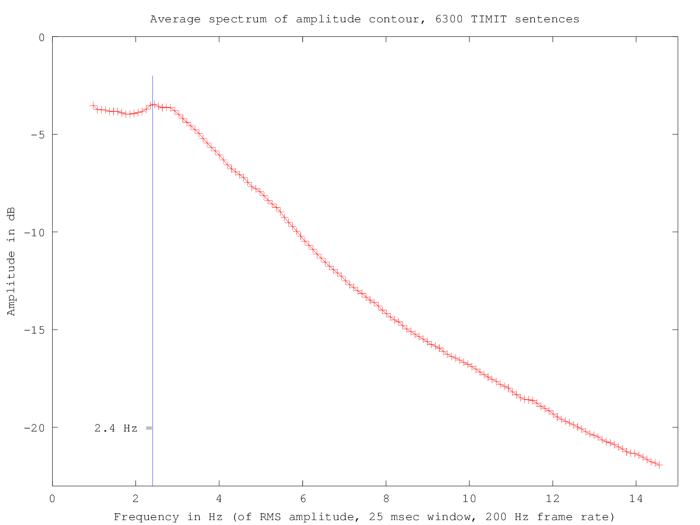
Here's the average spectrum of all 6300 sentences in the range of 1-15 Hz., calculated from the rectified waveforms of all 6300 speech files:

Things don't look very different if we base the spectra on the RMS amplitude in similar 25-msec windows:

2.4 Hz corresponds to a period of 417 msec, which is too long for syllables in this material. In fact, the TIMIT dataset as a whole has 80363 syllables in 16918.1 seconds, for an average of 210.5 msec per syllable, so that 417 msec is within 1% of the average duration of two syllables.

So why is the spectrum roughly flat up to 2.4 Hz or so? And why does there seem to be a different slope between (roughly) 3 and 7.5 Hz, compared to 7.5 to 15 Hz?

One hypothesis might be that this somehow reflects the organization of English speech rhythm into "feet" or "stress groups", typically consisting of a stressed syllable followed by one or more unstressed syllables. But this would predict that similar analysis of material in other languages would show a different pattern — and I'm skeptical, mostly as a matter of principle but also based on the fact that human listeners trying to distinguish between two languages based on lowpass-filtered speech don't typically do very well (e.g. around 65%, where chance is 50%).

Unfortunately there aren't any datasets comparable to TIMIT in other languages; but I'll see what I can come up with as a more-or-less parallel test in languages that are said to be "syllable timed" rather than "stress timed".

If you want to check, challenge, or redo my calculations (and you have a copy of the TIMIT dataset), the needed scripts are doTIMIT1.m, doTIMIT2.m, getENV.m, getRMS.m, and filelist.

02 Dec 18:44

In Which Elan Gale Teaches Two Social Media Lessons

by Ken White

Elan Gale, a reality television producer, had a high-profile Thanksgiving weekend. Mr. Gale live-tweeted a purported confrontation with a woman named "Diane" during a busy holiday flight. The intended message of Mr. Gale's presentation — whether it was "reality," or pure fiction — was that "Diane" was rude to airline staff and unpleasantly entitled, and that Mr. Gale is witty and righteous.

Not everyone took it that way. Some people found Mr. Gale to be an insufferable douchebag who enjoys telling complete strangers "eat my dick" and then crowing about it on Twitter. On the other hand, some people defend Mr. Gale and celebrate him as an honest comic or as a champion of manners.

Mr. Gale serves to teach us two lessons about social media and the internet — and more broadly, about life.

Lesson One: Douchebaggery Is Not A Zero-Sum Game

The first lesson is that boorish behavior is not binary. People are complex, life is complex, and despite our hunger to see the world in simple terms of white hats versus black hats, sometimes all participants in a social media melee are assholes.

In this instance, it's perfectly possible to recognize that (1) that "Diane" — if she exists — was contemptibly rude and entitled towards airline staff who have no control over when a plane leaves and who are simply doing their jobs under trying circumstances, and (2) also recognize that Elan Gale is contemptibly self-involved for seeing Diane's rudeness as an opportunity to confront and torment her for his own amusement and self-promotion. Recognizing one does not diminish the other, because douchebaggery is not a zero-sum game. "Diane" thought — either out of bad character, or temporary frailty — that she was entitled to vent at some poor bastard working for an airline on a holiday. Mr. Gale thought that the abuse of an airline employee was a swell opportunity to put a woman "in her place" and preen for his followers. You can criticize both without letting either one off the hook.

Being human, I've probably been guilty of both. Despite my best efforts I've been rude to people in service jobs (remember what Dave Barry says: someone who is nice to you, but rude to the waiter, is not a nice person), and I've probably written about bad behavior here as a vehicle for one-liners on more than one occasion. It's good to be honest about that before throwing the first stone, but because it's not a zero-sum game, recognizing that doesn't diminish any else's responsibility for their own actions.

Lesson Two: You Control Your Behavior, Not The World's Reaction To It

Elan Gale also taught us another lesson over the weekend: you control your own words and your own behavior, but you don't get to control how the world reacts to you. If you try — if you act like you are entitled to control how people react to you — you'll come off like a fool. Mr. Gale did.

When some people online failed to recognize his righteous genius, Mr. Gale reacted with increasing resentment and petulance.

GaleAngryIsGaleAngry

GaleHowDareYouDisagree

GaleDontYouKnowWhoIAm

Faced with unverified claims that "Diane" might have been acting that way because she has Stage IV lung cancer and is dying — which could be true and could explain the face mask Gale claims she was wearing, or could be completely made up — Mr. Gale responded with more ridicule:

GaleUnicorn

That one's not going to seem very funny if "Diane" is real and actually has cancer. (Well, Maybe Elan Gale would still think it's funny.)

Elan Gale can control what he says or does. He can decide whether or not to use a complete stranger for a comedy routine and whether to solicit praise from his followers by telling women to eat his dick. If the whole thing is made up, it's up to him whether or not to make such things up.

What's not in his control, and not up to him, is how others react.

You can do two things with that truth: you can own your words and live with the reaction to them, or you can react with wounded outrage when folks don't think you're as special as mommy always said you were. Elan Gale is has chosen the later option, erupting like a moody tween at people not embracing his awesomeness. I'm always at risk of blasting someone here who doesn't "deserve" it, but I hope at least I'm not in danger of proclaiming that I have a right to do so without being criticized. Do you want to be edgy? Do you want to crusade against boors? Do you want to use strangers in your comedy routines? Knock yourself out. But if you do so, and then whine when someone tells you that you've acted like an asshole, you're a ridiculous and pathetic figure.

Or perhaps Elan Gale's self-righteous reaction to criticism is scripted as well, and the whole thing is a satire of a culture of narcissistic entitlement on all sides — in which case, well played.

Edited to add: Mr. Gale continues to see himself as a victim, and to have nothing resembling self-awareness:

GaleHelpHelpImBeingOppressed

Edited again: Gale now seems to be suggesting that the whole thing was made up. Is he suggesting that his entitled response was part of the joke? I suspect he will.

In Which Elan Gale Teaches Two Social Media Lessons © 2007-2013 by the authors of Popehat. This feed is for personal, non-commercial use only. Using this feed on any other site is a copyright violation. No scraping.

02 Dec 18:27

Pro director reviews Blackmagic Pocket Cinema camera

by Scott Compton

Back frontI received the new Blackmagic Pocket Cinema Camera, and spent a couple of days putting the camera through its paces around Manhattan. Note that this is not a DSLR. There is no still component. It's a straight up video camera for someone who has a post-production workflow.

I'm impressed with its latitude and its low noise floor. While not as amazing as the 5D in extreme low-light, I found the 800-1600 ASA to be impressive. The footage was all shot at 23.976FPS on the FILM (log ProRes HQ) setting. Shutter angle set to 144 degrees, and at all of the ASAs available. 200, 400, 800, 1600.

The camera's time lapse function is extremely handy and simple to implement. The camera builds the time-lapse for you and it's viewable in playback mode.

I filmed with a set of Lumix lenses (7-14mm f4, 12-35 f2.8 w IS, a 14mm f2.8 pancake and the Bower 7.5mm.

All MFT lenses. I did use a Tiffen Variable ND when possible to open up the iris. The magic really unfolded for us in color grading. So if you have a post workflow that definitely includes time with DaVinci Resolve, this camera is worth checking out.

I found it to be a fantastic roaming/B-roll camera. My friend, DP Norman Bonney came to the telecine session and felt that the pixel feel will complement RED/Alexa shoots.

The incredibly low profile makes it easy to get around with one shoulder bag of lenses, a cardellini or two and more than a few batteries. I do a lot of shoots where a small footprint is important.

Special thank you to Norman Bonney for inspiration, Ayumi Ashley for her colorful eye, editors Joel White and Luke Shock at Remedy for creative editorial and technical experimentation and my friend Jeff Wilk for being a patient model on the Acela Express.

Note that the RAW option came out the week after I filmed, so I did not experiment with it on this shoot. Likewise, I did not spend much time in the Video setting.

Blackmagic Pocket Cinema Camera


02 Dec 17:59

Massive Resistance

by Josh Marshall

Erick Erickson on Obamacare: 'We must deny them the opportunity to fix the law itself.'

01 Dec 21:37

Presenting political argument on Twitter, and the "prestige economy"

by Cory Doctorow


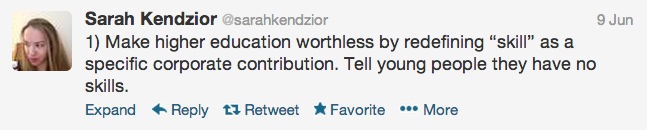
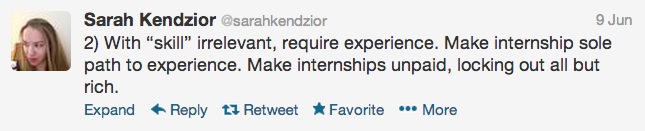
Here's a fabulous interview with activist Sarah Kendzior, a journalist and researcher who made a great, concise argument against unpaid internship as a series of four tweets last June. Policymic talks with Kendzior about her work on the "prestige economy" and the widening wealth-gap, and also talks about the theory of presenting arguments over Twitter, a subject on which Kendzior is every bit as smart as she is on matters economic and political.

Twitter is as effective as a blog for making concise, multipoint arguments. I am careful when I write these to make each Tweet stand alone as well as contribute to a broader point. It is tough to pull off. Umair Haque (@umairh) is the master of this style, but I see others embracing it too.

Twitter forces you to think aphoristically. Some say the character limit inhibits creativity, but I see it as a challenge that pushes you to carefully consider every word. It is a good exercise for any writer...

... In one generation, working for free for people who can pay you went from something laughable, to something wealthy people were doing in a few fields, to something everyone was recommended to do, to something almost everyone has to do. Entry-level jobs were replaced with unpaid internships. That same monopoly on opportunity reshaped lower-skill labor. Jobs that once offered on-site training now require college degrees. In response, universities ramp up tuition, knowing that students have little choice but to pay to compete. Instead of options, there is one path to professional success — one exorbitantly expensive path.

The values of the wealthy elite became the rules that everyone had to live by.

At the same time, the rising cost of living made it “normal” to pay a lot of money for basic things. Ordinary life has been redefined as a luxury good. Health care and home ownership are unaffordable for most young people. This makes them feel desperate, particularly when they begin adult life saddled with stratospheric debt. They feel they have no options but to play along, even if that means being party to their own exploitation.

What they have discovered is that even playing by the rules will destroy you in a prestige economy. Institutional affiliation is promoted as a way to advance professionally by building personal prestige, which is why people are paying to intern at prestigious companies or going into debt for prestigious schools. But these are hollow victories, designed to suck you dry and leave you even more desperate. Prestige decreed by institution means nothing when institutions are rotting.

Why You Should Never Have Taken That Prestigious Internship [Sam Bakkila/Policymic]

(via Making Light)


01 Dec 20:03

Photo


01 Dec 20:01

Photo

Zephyr Dear

If I recall correctly, the Shredder one immediately precedes Bebop and Rocksteady putting the disc in backwards, with HORRIFYING CONSEQUENCES


01 Dec 19:59

Pot Legalization Loses Top Funder

by Josh Marshall

Back on November 21st I was in DC and I got into a conversation about the marijuana legalization movement and some of its more unexpected dimensions. It wasn't a major part of the discussion but one thing I learned was that the bulk of the money funding the movement - from medical marijuana to decriminalization to full legalization - came from one guy, Peter B. Lewis, the CEO of Progressive Insurance.

He reportedly contributed between $40 and $60 million to the effort over the last 30 years. I just found out that he died two days later. And that's raising questions about where the future money for ballot initiatives, organizing, public education and the like is going to come from.

01 Dec 19:52

It’s Not God That Makes You Give

by Andrew Sullivan
Zephyr Dear

Also, *most charitable gifts are to churches*. That seems relevant??

David E. Campbell, the co-author, with Robert Putnam, of the in-depth study of religion’s place in America’s social fabric, American Grace, reveals a twist to the trope that believers are more charitable than the non-religious:

Having found that religion and charity go hand-in-hand, Robert Putnam and I sought to understand why.  The answer might surprise you. We initially thought that religious beliefs must foster a sense of charity—whether inspiration from biblical stories like the Good Samaritan or, perhaps, a fear of God’s judgment for not acting charitably. However, we could find no evidence linking people’s theological beliefs and their rate of giving—which also helps to explain why the “religion effect” varies little across different religions. The rates for charitable giving according to the Jumpstart survey are: 61 percent of Black Protestants; 64 % of Evangelical Protestants; 67 % of Mainline Protestants, 68 % of Roman Catholics, and 76 % of Jews. By contrast, only 46 % of the not religiously affiliated made any charitable giving.

Rather than religious beliefs, we found that the “secret ingredient” for charitable giving among religious Americans is the social networks formed within religious congregations. The more friends someone has within a religious congregation, the more likely that person is to give time, money, or both, to charitable causes. In fact, even non-religious people who have friends within a religious congregation (typically, because their spouse is a believer) are highly charitable—more so than strong believers who have few social ties within a congregation. Our findings thus suggest that if secular organizations could replicate the sort of tight, interlocking friendship networks found within religious organizations, they too would spur a comparable level of charitable giving.

01 Dec 19:46

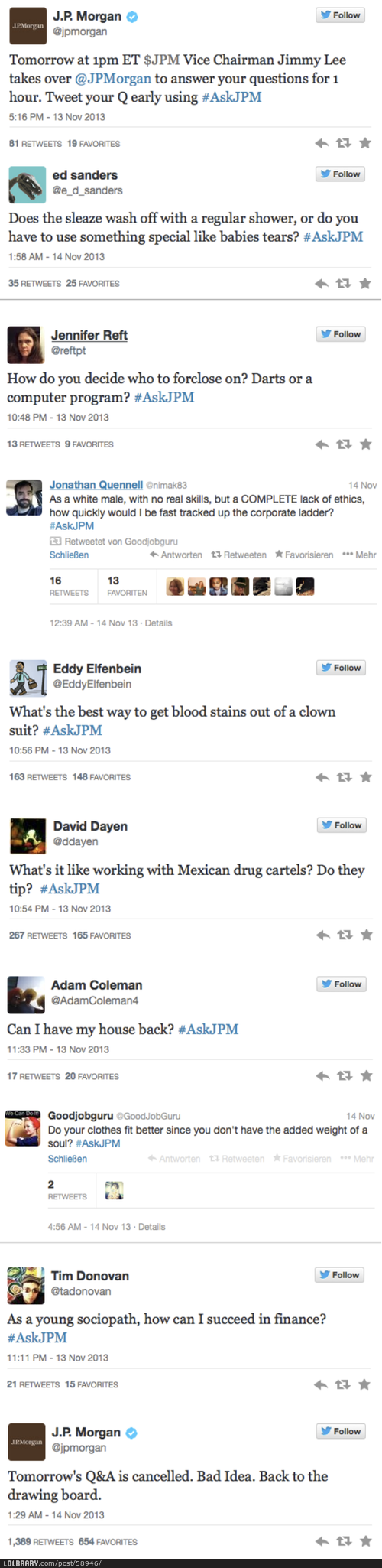
JP Morgan's "Twitter takeover" seeks questions from Twitter, gets flooded with critiques of banksterism #AskJPM

by Cory Doctorow

Tomorrow's Q&A is cancelled. Bad Idea. Back to the drawing board.

— J.P. Morgan (@jpmorgan) November 14, 2013

When JP Morgan's Twitter account announced last month that "VC Jimmy Lee" take questions from the net with the #AskJPM hashtag, they should have been able to predict what was coming next: a stream of hilarious, vicious critiques of late-stage capitalism, banksterism, and financial corruption. One day later, the Q&A was cancelled. The astonishing thing isn't how predictable this was, but how anyone at JP Morgan failed to see it coming -- the greatest irony isn't the questions raised, it was the hubris in thinking that these questions wouldn't be raised at all.

The fiasco is being called one of the worst social media disasters in corporate history, and has spawned lots of creativity, including this video of Stacy Keach and a sock puppet performing the tweets and a Matt Taibbi-sponsored haiku contest.

What's the best way to get blood stains out of a clown suit? #AskJPM

— Eddy Elfenbein (@EddyElfenbein) November 13, 2013

I have Mortgage Fraud, Market Manipulation, Credit Card Abuse, Libor Rigging and Predatory Lending AM I DIVERSIFIED? #AskJPM

— Downtown Josh Brown (@ReformedBroker) November 13, 2013

Active duty millitary overcharged, 18 homes stolen from them. Why is JPM still allowed to exist? #ASKJPM : http://t.co/kfsWqXv24l

— Zane Zodrow (@ZaneZodrow) November 14, 2013

What did those plutocrats think was going to happen?


01 Dec 19:32

Studio Ghibli Gold Box On Amazon Today

by Shane Roberts, Commerce Team

Studio Ghibli Gold Box On Amazon Today

It's not the first time Amazon has run a gold box on Studio Ghibli's amazing catalog, but this is the best, most complete one so far, and features the option of saving on Blu-ray/DVD combos if that's your style. Classics like My Neighbor Totoro and Howl's Moving Castle are marked down to $20/each, along with a few of the newer films, and don't neglect one of my unsung favorites, Whisper of the Heart. [Amazon]

Read more...


01 Dec 04:36

Of Sexist Russell Brand & Why the Revolution was Not Televised

Of Sexist Russell Brand & Why the Revolution was Not Televised:

I actually really like Russell Brand, and my “position” on him is basically, if he is our friend then we can force him to be accountable for alienating our female comrades, no? This is what is so hard about socialism. The point is that everyone gets to be there. So transitional figures from the hegemonic structure that wish to use their mainstream power for revolutionary praxis must undertake the difficult work of extending themselves truly further—in Brand’s case, it will be his true measure as a revolutionary to submit himself to the liberation of women.

01 Dec 04:34

Narnia: Invisible Crimes Against The Tediously Silly

by Ana Mardoll
[Narnia Content Note: Genocide, Religious Abuse, Chivalry, Racism, Slavery.]
Content Note: Slavery, Racism, Classism]

Narnia Recap: In which Lucy goes into the Magician's tower to read a spell.

Voyage of the Dawn Treader, Chapter 10: The Magician's Book

(Short one this week because Thanksgiving has consumed all my resources.)

This week we need to talk about the ways in which Lewis elides marginalization by belittling its victims. This is a common tool in his toolbox, as we've seen numerous times already. When Eustace was wet and traumatized and half-drowned -- which would normally be an exceedingly uncomfortable state to be in -- we were invited to laugh at him for being sick and for being, essentially, a big baby about the situation.

And, of course, I've talked frequently in the past about how the Animals in Narnia are deliberately made over-the-top silly in ways which (a) obscure their historical marginalization (i.e., Aslan and the Emperor doing fuck-all about Miraz and Jadis) and (b) obscure their future marginalization (i.e., them being forced to submit to an absolute monarchy run by a passel of children who have yet to demonstrate that they can rule better or more wisely than a representative Animal council would or could).

Now Lewis is going to go to a great deal of effort (and break his own world-building rules in the process) in order to establish the Dufflepuds as Tediously Silly so that their past, present, and future marginalization is obscured to the reader. And as several of us have already noted: this strategy works very, very well for Lewis. Lots of us (myself included) just plain didn't notice the problems in this situation when we went through the first time.

Step One on the elision process is to keep calling the transformation of the Dufflepuds "uglification" instead of "transformation" or "mutilation" or anything else which would be both more accurate and more difficult to gloss over. "Uglification" isn't really that bad of a curse, Lewis would probably argue, since ugliness is relative anyway and it's especially relative when everyone on the island is equally "uglified". And, of course, the "uglification" will ultimately be neutralized not by restoring the dwarves to their original (and preferred) form, but by Lucy and Coriakin unilaterally deciding that the dwarves are prettier this way anyway, and thus aren't really "ugly". No harm, no foul.

A good example of using "ugly" to obscure the drastic nature of the transformation (as opposed to a more accurate word) is the way the Chief mourns his daughter, Clipsie. If, as I was inclined to do, we interpret his statement that Clipsie was a sweet child before she was uglified as a statement about her mental health and/or emotional outlook, then the change wrought in her by the transformation is serious and deplorable. (Coriakin has stripped innocence and happiness from a young girl who never did him the slightest bit of harm; it's even possible that she was too young to work in the fields and thus wasn't associated with the 'fault' to begin with.)

But if, as boutet points out in the comments, the statement is meant to be rendered as a tautology on the unfortunate transformation of Clipsie's body -- i.e., that Clipsie was a pretty ("sweet") girl before she was made un-pretty -- then the Chief is tacitly confirming that the only harm done to Clipsie is the physical one, and that it is a non-harm to 'right-thinking' people, that is to say people who are not vain (which will be a major theme of this chapter) and to people who prefer the 'improvement' of the Dufflepuds into this form which Coriakin, Lucy, and Lewis assert is more pleasing to their eyes.

Step Two in the process of de-personifying the Dufflepuds is to continue to assert that they habitually are Doin' It Wrong. We haven't yet gotten to Coriakin's justification with regards to the dwarves gathering water at the stream source, but we get a touch of that here with the soup:

   THE INVISIBLE PEOPLE FEASTED THEIR guests royally. It was very funny to see the plates and dishes coming to the table and not to see anyone carrying them. It would have been funny even if they had moved along level with the floor, as you would expect things to do in invisible hands. But they didn’t. They progressed up the long dining-hall in a series of bounds or jumps. At the highest point of each jump a dish would be about fifteen feet up in the air; then it would come down and stop quite suddenly about three feet from the floor. When the dish contained anything like soup or stew the result was rather disastrous.

This doesn't work, and I refuse to believe that Lewis and his army of editors were too stupid to notice that literally a few sentences before (in Chapter 9), it was made clear that the things which the invisible people hold (i.e., their spears) are themselves invisible while held and only become visible when they're let go. If a spear is invisible (and it was), then that means that the wood of the spear shaft being held is invisible, and that any tips used on the spear (it did lodge itself, quivering, in a tree once thrown, which suggests to me an actual head to the spear and not just a sharpened point on the wood, but this isn't my area of expertise) are also invisible, along with any ties or leather strips used to either attach the tip to the spear or to make the spear easier for the wielder to hold.

(Compare the Disney Dufflepuds and their spears here and here.)

And, of course, the clothes of the Dufflepuds and anything they're wearing or carrying on their persons are invisible. So it just doesn't work that the food dishes (and the food inside and/or on those dishes) should be visible to the children. Nor does it even really make sense -- as depizan has already noted -- for this dinner to even take place. They're all literally inside the wizard's house. They think there's an invisible wizard upstairs who harbors extremely hostile intentions towards them and who they can't see or hear and believe may be spying on them. So rather than demand Lucy go up right away, or (better yet) insist that the entire away-team go up with her to protect her (and maybe subdue Coriakin for good measure), they decide the best thing to do is throw a party in the downstairs area of the house and just assume the Evil Wizard won't creep down to listen in on everything.

Nothing about this makes sense, unless you start from the assumption that this scene does something for Lewis' goals. And in that respect, it's a winner. For one thing, he foreshadows the Dufflepuds' unusual forms more thoroughly -- Eustace will muse on whether the people are like large grasshoppers or toads. (Edmund admonishes his cousin not to mention this theory to Queen Lucy the Valiant because obviously like all girls she would be icked out by this.) But for another, Lewis gets to point out how stupid the Dufflepuds are, for sloshing soup everywhere instead of inventing Tupperware or table-side cooking or not serving soup at all. And this is a foreshadowing of Coriakin's prime argument with the Dufflepuds and the reason why it is justifiable for him to torture them: they refuse to do things efficiently and instead do thing their way.

And of course there is the Christian parallel that Lewis would probably want to inject here, that our ways are hella-stupid compared to God's ways and that he has every reason to be pissy when we won't use Tupperware and harvest from the stream where he commands. (Although please note that not all Christian people hold this viewpoint of ourselves and God.)

   The meal would have been pleasanter if it had not been so exceedingly messy, and also if the conversation had not consisted entirely of agreements. The invisible people agreed about everything. Indeed most of their remarks were the sort it would not be easy to disagree with: “What I always say is, when a chap’s hungry, he likes some victuals,” or “Getting dark now; always does at night,” or even “Ah, you’ve come over the water. Powerful wet stuff, ain’t it?” [...] But it was a good meal otherwise, with mushroom soup and boiled chickens and hot boiled ham and gooseberries, redcurrants, curds, cream, milk, and mead. The others liked the mead but Eustace was sorry afterward that he had drunk any.

And Step Three is, of course, making the Dufflepuds not merely inefficient in deed but also stupid and tedious and tiresome in conversation. What is particularly appalling here to me is that it seems not to have occurred to Lewis at all that when your entire life has been lived under the thumb of an all-powerful slave master who has magical ways of spying on your conversation (especially now that he's invisible) and who is given to torturing your entire community for the smallest of infractions, it might be wise to restrict dialogue to the most banal and trivial of observations.

I mean, seriously, the longer I live with Narnia the more horrified I am at how deeply and thoroughly C.S. Lewis seemed to be devoid of empathy for others unlike him.

Even if we take Coriakin out of the picture, by which I mean even if we believe he wouldn't spy on the Dufflepuds' conversation with their guests, what are they supposed to talk about with Caspian and the others? It took weeks of travel for Caspian et. al. to get here in a boat that the Dufflepuds presumably have not the technology to imitate, so news of the outside world may as well be a fairy tale story to them. They could, I'm sure, talk to Caspian about life on their island and about the intricacies of farming, bee-keeping, brewery, and (of course) slavery, but I seriously doubt Caspian would want to hear it or that Lewis would consider their conversation more refined for it.

And indeed I can't help but feel that this caricature of banality (as with water being "powerful wet") is just an exaggerated version of how boring the privileged people think the common little people talk. How dare they dwell on the common and vulgar things in life when they could be discussing great thoughts among the beautiful books in the literal ivory tower up the grand staircase. Etc. And, of course, all this is very convenient that we've not been privy to any of the conversations on the Dawn Treader which probably isn't, after several weeks of enforced togetherness between a bunch of privileged lords and a lot of probably-barely-educated sailors, a bastion of Renaissance enlightenment.

It's easy to portray the Dufflepuds as stupid when we've nothing to compare them to.
01 Dec 04:18

“One Part Ferris Bueller And One Part Saw“

by Andrew Sullivan

One of your favorite holiday movies gets an blunt appraisal:

01 Dec 01:13

The Psychology of Video Game Avatars

by Jamie Madigan

When each of us gets up in the morning, we start messing with what might as well be avatar customization tools to change our appearance. We decide what clothes and jewelry to wear. We decide which hairs to shave and which hairs to style. Some of us occasionally make more radical alterations, such as getting tattoos, piercing various dangly bits with metal, or even going in for cosmetic surgery. In real life, though, we’re often limited in the changes we can make to appear taller or more prosperous. Videogames and virtual realities, on the other hand, are more flexible.

buncha-sims

Researchers have been studying the effects our appearance has on how other people react to us for a long time, but they’ve also started to seriously study the psychology of our video game avatars. At first they used models of human behaviour relevant to appearances in real space, but they have gradually built up new concepts to understand how people behave when they adopt different types of in-game form. Why do we choose the avatars that we do? How do different avatars change our behavior in games? And how does the experience affect us when we select ‘quit game’ and re-enter the real world?

Sure, explaining why we adopt the avatars we do is sometimes easy: we decide to look like an elf because elves get +5 Intelligence and we want to max out our mage build. Put that one in your thesis and smoke it. But what about virtual playgrounds where we have options that aren’t constrained by the game’s mechanics? An emerging line of research says that when the choice is ours, it’s often about building a better version of ourselves.

“Studies have shown that, in general, people create slightly idealized avatars based on their actual selves,” says Nick Yee, who used to work as a research scientist at the Palo Alto Research Center but who now works at Ubisoft. He should know: before joining Ubisoft Yee has spent years studying the effects of avatars on human behavior in settings such as Second Life and World Of Warcraft. “But a compensation effect has been observed. People with a higher body mass index – likely overweight or obese – create more physically idealized avatars, [which are] taller or thinner. And people who are depressed or have low self-esteem create avatars with more idealized traits, [such as being] more gregarious and conscientious.”

Other researchers have found that the ability to create idealized versions of ourselves is strongly connected to how much we enjoy the game, how immersed we become, and how much we identify with the avatar. Assistant professor Seung-A ‘Annie’ Jin, who works at Emerson College’s Marketing Communication Department, did a series of experiments with Nintendo Miis and Wii Fit.1 She found that players who were able to create a Mii that was approximately their ideal body shape generally felt more connected to that avatar and also felt more capable of changing their virtual self’s behavior – a fancy way of saying that the game felt more interactive and immersive. This link was strongest, in fact, when there was a big discrepancy between participants’ perceptions of their ideal and actual selves.

“I would definitely recommend that developers allow players to design and don whatever kinds of avatars they like,” states Jim Blascovich, a professor of psychology at the University Of California in Santa Barbara, and co-author of the book Infinite Reality: Avatars, Eternal Life, New Worlds, And The Dawn Of The Virtual Revolution.2 Doing so tends to make the game more appealing and lets us connect more with our avatar and the world he or she inhabits. But what then? Once we’ve adopted an avatar, how does its appearance affect how we play games and interact with other players?

This research has its roots in what’s called self-perception theory, a watershed concept in social psychology pioneered by physicist-turned-psychologist Daryl Bem in the 1960s. Essentially, the theory says that we observe ourselves and use that information to make inferences about our attitudes or moods, as opposed to assuming our attitudes affect our behaviors. For example, someone who hurls themselves out of an airplane with a parachute might think, “I’m skydiving, so I’m the kind of person who seeks out thrills.”

In one clever study of this theory by Fritz Strack and his colleagues3, subjects were given a ballpoint pen and told to hold it in their mouth in one of two ways. Some were asked to use pursed lips and others were told to hold it between their front teeth, with their lips drawn up and back. The former approach tricked the subjects into frowning, while the latter got them to smile. When asked to rate the amusement value of a cartoon, those who were being made to smile thought it was far funnier than those who were forced to frown. Their appearance was affecting their mood.

My own avatar on Xbox Live

My own avatar on Xbox Live

This kind of “first behavior, then attitude” effect has been widely replicated in other studies. In one, researchers hooked male participants up to a monitor that beeped in time with their heart rates while they perused centerfolds from Playboy magazine.4 When the researchers used their control over the machine to fake an accelerated heartbeat, subjects decided that they must have a thing for the particular model they were viewing. The effect was even still there two months later when subjects were invited back.

So first we perceive what we look like or what we’re doing, and then we draw conclusions about our attitudes and identity. And it turns out that we may continue to act in line with that presumed identity. In fact, Yee started his career by taking the precepts of social identity theory and using them to understand how people behave depending on the virtual avatars they assume. In one of his earliest experiments,5 Yee had subjects don a head-mounted display that let them perceive and move around in a simple virtual environment. There was just a virtual room, another person controlled by someone else, and a virtual mirror. The mirror was important, because it obviously wasn’t a real mirror and the researcher could use it to show whatever ‘reflection’ of the subjects’ avatars he wanted. In fact, Yee randomly showed subjects one of three types of avatar reflection: ugly, normal, and attractive.

What the researchers were interested in was how this would affect how subjects interacted with the other person in the virtual room. After following directions to inspect their avatars in the mirror, subjects were asked to approach the room’s other occupant and chat with him or her. This other person was controlled by a research assistant and followed a simple script to get the conversation going, saying something like: “Tell me a bit about yourself.”

The study revealed that an avatar’s attractiveness affected how its owner behaved. Relative to those with ugly avatars, people assigned attractive looks both stood closer to the other person and disclosed more personal details about themselves to this stranger. Then, in a follow-up study using the same setup, Yee found that people using taller avatars were more assertive and confident when they engaged in a simple negotiation exercise. So, generally speaking, people with prettier and taller avatars were more confident and outgoing than those with ugly and stumpy virtual representations. Like in the real world, we first make an observation about our avatar, infer something about our character, and then continue to act according to our perceived expectations. We needn’t make a conscious decision to do it.

Video game avatar. See what I did there? Eh? Eh?

Video game Avatar. See what I did there? Eh? Eh?

“Studies have shown that people unconsciously conform to the expectations of their avatar’s appearances,” said Yee when I contacted him to talk about this study. “We’ve termed this phenomenon the Proteus effect, after the Greek god who could change his physical form at will. These studies in virtual environments parallel older studies in psychology showing that people conform to uniforms given to them.”

The Proteus effect, then, describes the phenomenon where people will change their in-game behavior based on how they think others expect them to behave. “In our studies at Stanford, we have demonstrated that avatars shape their owners,” agrees Jeremy Bailenson, an associate professor at Stanford University and Infinite Reality’s other author. “Avatars are not just ornaments – they alter the identity of the people who use them.” Subsequent research by Yee, Bailenson and others has even revealed that there doesn’t even have to be an audience for us to feel the need to conform to our avatar’s appearance – an assumed one is sufficient.

But what about after we quit? Well, our avatars’ power extends beyond the game, and perhaps unsurprisingly, there’s an angle to this that involves selling you stuff. Imagine, for example, that you’re in the Xbox dashboard and you notice that your avatar is holding up a branded soft drink and grinning like some kind of moron. Do you think you’d be more likely to remember that brand and pick some up the next time you’re at the shops? Research by Bailenson and his colleague Sun Joo Ahn suggests you would.6 In their study, the team altered photos of people to show them holding up fictitious brands of fizzy drinks like “Cassina” or “Nanaco.” Even though the participants knew the photo was doctored, they tended to express a preference for the fake brand, simply because they’d seen a representation of themselves holding it.

Drink Ternio brand soda, you witless consumer lemming.

Drink Ternio brand soda, you witless consumer lemming. Taken from Ahn & Bailenson (2011).

Other researchers have found similar results when they showed people pictures of themselves in a certain brand of clothing, and one study by Rachel Bailey, Kevin Wise and Paul Bolls at the University Of Missouri in Columbia looked at how kids reacted to advertisements for sweets and junk food that were thinly disguised as Web games. If the ‘advergames’ allowed players to customize their avatars, the kids remembered the snacks better and said that they enjoyed the game more.7

It’s not all scary news, though. For example, psychiatrists use mental visualization as a technique for treating phobias and social disorders. Someone deathly afraid of swimming, for instance, might be coaxed into imagining themselves at a pool. Through this kind of repeated imaginary exposure, the person might eventually seize control of their phobia.

And along those same lines, a body of work around social learning theory has shown that we can be encouraged to adopt new and beneficial behaviours by watching others perform them. The more similar the other person is to us, the more likely it is to work. Today, the technology exists to take our likeness and show it exercising and eating vegetables instead of chugging soft drinks. In fact, some researchers are experimenting with such approaches. Jesse Fox and Bailenson at Stanford University recently published a paper in which they examined this exact possibility.8

In the study, the researchers outfitted participants with a head-mounted display and set of controls that let them experience and navigate a simple virtual environment. Some people saw avatars with photo-realistic images of their faces attached, while others saw no avatar, or an avatar with an unfamiliar face. Everyone was then told about the importance of physical activity, asked to practise some simple exercises, and invited to keep exercising for as long as they wanted. Through a series of experiments based on this setup, Fox and Bailenson found that when people saw avatars that looked like them mirroring the exercises they tended to work out for longer. The effect was even greater when they saw the avatar slim down in the process. When asked later, people who saw their face on happy avatars also reported hitting the gym after being dismissed.

So while you needn’t have a panic attack the next time you see a character-creation screen full of choices, keep in mind that whatever you pick not only says something about you, but it can unconsciously affect how you behave on both sides of the screen as well.

A version of this article first ran in Edge Magazine.

Follow me on Twitter, Facebook, or RSS.

30 Nov 17:26

The Sun's Page 3 Girl was The Playstation 4

by Owen Good
Zephyr Dear

-___-;

The Sun's Page 3 Girl was The Playstation 4

Friday saw the launch of the PlayStation 4 in the U.K., and The Sun's notorious Page 3 treated blokes there to a new model—one much less curvy than usual.

Read more...


30 Nov 17:22

When Thinking Trips You Up

by Andrew Sullivan

A new study from sports psychologist James Bell suggests that neurotic people are more likely to make more accurate judgments the faster they respond:

One hundred and ninety-six teenage male cricketers, all members of regional academies, took part in the study. They watched six clips of footage recorded from behind bowlers during the Twenty20 World Cup in England in 2009. Just as the bowler released the ball, each clip was frozen and remained visible for half a second – the approximate amount of time that a batsman has to decide how to react to a delivery. After the freeze-frame disappeared, the participants pressed one of two keyboard keys as fast as possible to indicate whether they judged it was better to attempt to hit a single run, or to go for a “six” (a boundary shot similar to a home run in baseball). Four qualified cricket coaches agreed on the optimum response for each clip. The participants also completed a neuroticism scale, measured by their agreement with statements like “I worry about things” and “I get stressed out easily.”

The key finding is that for low scorers on neuroticism, the more quickly they responded on average, the poorer their judgments tended to be, yet for high scorers on neuroticism the opposite was true. “The most parsimonious explanation,” the researchers said, “… is that individuals with high levels of neuroticism tend to have a stimulus-driven attentional orientation, which means they are likely to react automatically to environmental stimuli (particularly if it is threat related) resulting in faster and more accurate responses in the context of the current task.”

30 Nov 17:22

Blind Lake

by boulet
Zephyr Dear

I imagine this is roughly how the NSA feels right about now.


30 Nov 16:44

Who Are Superheroes Meant For?

by Andrew Sullivan

Stuart Kelly discovers some surprising views from the legendary comic book writer Alan Moore:

When I mention that Geoff Johns has done a whole series of Green Lantern based on his story “Tygers”, he gets tetchy. “Now, see,” he says, “I haven’t read any superhero comics since I finished with Watchmen. I hate superheroes. I think they’re abominations. They don’t mean what they used to mean. They were originally in the hands of writers who would actively expand the imagination of their nine- to 13-year-old audience. That was completely what they were meant to do and they were doing it excellently. These days, superhero comics think the audience is certainly not nine to 13, it’s nothing to do with them. It’s an audience largely of 30-, 40-, 50-, 60-year old men, usually men. Someone came up with the term graphic novel. These readers latched on to it; they were simply interested in a way that could validate their continued love of Green Lantern or Spider-Man without appearing in some way emotionally subnormal. This is a significant rump of the superhero-addicted, mainstream-addicted audience. I don’t think the superhero stands for anything good. I think it’s a rather alarming sign if we’ve got audiences of adults going to see the Avengers movie and delighting in concepts and characters meant to entertain the 12-year-old boys of the 1950s.”

30 Nov 07:33

notcuddles: valkyrien: aflyingmotorbike: synekdokee: anglepoi...


notcuddles:

valkyrien:

aflyingmotorbike:

synekdokee:

anglepoiselamp:

Is that the weather report?

*sighs*

Everyone knows we get lesbians every goddamn year, and yet every time they arrive people act all shocked. “I’m not ready for lesbians yet! I haven’t put lesbian tyres on my car!” Lady, it happens every year. You were warned beforehand. It’s your own damn fault if you end up in an accident because you weren’t prepared for lesbians.

seriously. so tired of being late for school just because the subway can’t handle lesbians. it’s norway! what do they expect

On the bright side, learning institutions will close in their droves as nations shut down due to the overwhelming presence of lesbians.

:sigh: But you have to make up lesbian days at the end of the school year…

30 Nov 04:10

Questions regarding the prospectus for the ’90-day Tithe Challenge’

by Fred Clark

Matthew Paul Turner tells us that the “90-day Tithe Challenge” is a thing that exists: “If you tithe for 90 days and God does not prove Himself faithful, we’ll refund 100% of your tithe.”

The 90-day time limit here might seem short — implying that God’s faithfulness should only be measured on a quarterly basis — but keep in mind that Jesus said faith is like a mustard seed, and a mustard plant goes from seed to seed-bearing in as little as 60 days.

Despite a page-length registration form that reads like a seven-point financial prospectus, the folks at Sagebrush Community Church neglect to define what it means for God to “prove Himself faithful” in response to a duly and “properly credited” tithe.

What kind of return are we talking about here? Is it strictly financial, or does it include, say, miraculous healing or tangible answers to prayer? And how would we measure the latter?  If you’re praying that your child will be accepted into college and they only get accepted into their safety school, would that count as a wholly faithful or only partially faithful response by God?

What if it turns out that God only proves faithful by providing spiritual returns — something like the fruits of the Spirit, or a deeper love for neighbors and for the outcast? That kind of return would surely seem disappointing — unless, I guess, it was significant enough to help you become the kind of spiritually mature person who wouldn’t think so.

Sagebrush’s prospectus also seems unclear on some of its conditions regarding what constitutes a properly credited tithe. It specifies only that for a tithe to count it must be “10 percent of our income.” But what counts as income? Is this gross or take-home? Before or after taxes? What about health-insurance expenses deducted from payroll? Do tax-refunds like the mortgage-interest deduction count as tithable income? What about subsidies for health insurance?

Say your annual salary is $30,000 a year. That’s a 90-day income of about $7,397, which would require a tithe of $739. But your take-home pay would only come to about $24,000 — a take-home income over 90 days of about $5,918 and a tithe due of only $592. This is an important question, because apparently that $147 difference could determine whether or not God is obliged to be faithful in response.

This is further complicated by the fact that either tithe would, itself, be a tax deductible donation — making the whole calculation of post-tax income itself contingent on the size of the tithe duly paid.

For simplicity’s sake, then, gross income would make this all easier to calculate, but in the example above it would result in a tithe of $739 on take-home pay of only $5,918 — making that “10-percent” donation feel like a 12.5 percent tithe. That added bite could, in turn, ratchet up parishioners expectation of God’s faithful response — making them feel as though God ought to be 25 percent more faithful in return.

Sadly, the subjective nature of this guarantee (“if I am not convinced of God’s faithfulness as a result”), and the likely distorting influence of social pressure against church members actually attempting to collect on it, prevent this from providing a reliable quantitative measurement of divine faithfulness.

Sagebrush could provide regular reports on this — “God’s Faithfulness Q1 2014″ — but unless they make some adjustments to this system (anonymous reporting, clearer definitions, etc.), I’d only treat those divine-faithfulness scores as tentative.

30 Nov 02:27

Black Friday anti-sale

by Cory Doctorow
Cards Against Humanity is having a heck of a Black Friday sale: "Today only! All Cards Against Humanity products are $5 more. Was $25. Now $30." (Thanks, Max!)


30 Nov 00:57

The Good Old Days Of Hideous Webpages

by Andrew Sullivan

Screen Shot 2013-11-25 at 1.41.17 PM

Amid the sleek uniformity of Twitter and Facebook, Joe Kloc longs for the Geocities era:

Geocities began in 1994, advertising an enticing 15 megabytes of free space to any homesteader looking to make their place on the Web. The World Wide Web was only a few years old when this digital Northwest Ordinance was issued, and so its users, often referred to as netizens, were necessarily having their first interactions with the Internet, learning to make a place for themselves in the newly discovered online world. Millions of netizens with little to no experience or understanding of how a webpage “should” look utilized the site’s built-in development tools to create clapboard homes spattered with stray GIFs, looping MIDI files, and busy backgrounds. It was the Internet’s Wild West.

It is easy to dismiss these pages as a sort of outsider art. But outside of what? There was no such thing as a personal page before Geocities. And, in almost every meaningful sense of that word, there is no equivalent today.

Consider a page from [Geocities’] Heartland neighborhood, where one resident wrote, “Hi! My name is Sherry, my husband is Richard. We have three children, Colleen, Alicia, and James and we are out here in the desert of southern California.” Further down on the page is a link to “Richard’s Original Bedtime Stories.” … Where today do families publish their homemade bedtime stories about giant pickles? Sites like these have simply disappeared.

Geocities was bought by Yahoo in 1999, during the height of its popularity. Then along came Myspace in 2003, Facebook in 2004, and Twitter in 2006. And by 2009, Petsburg, Heartland, and the rest of Geocities had been shuttered. The world had chosen the pre-fab aesthetics of social networks over the 15-megabyte tracts of open land offered by Geocities. Jacques Mattheij, the founder of the Geocities archive site Reocities, explained this choice to me: “The Geocities environment offered more freedom for expression. Don’t like blue? Then Facebook probably isn’t for you.”

You’ll certainly find less comic sans.

(Screenshot via Reocities)

30 Nov 00:12

Science show on consciousness, with Alan Moore

by Cory Doctorow


BBC Radio 4 has kicked off a new season of the amazing science show The Infinite Monkey Cage, and the second episode of the series is a wonderful panel discussion on consciousness called Through the Doors of Perception. This episode is greatly enhanced by the presence of Alan Moore, creator of Watchmen, Lost Girls, From Hell, and many other standout comics. Moore's contributions on the relationship of art and magic to consciousness are the most interesting parts of the show -- though the whole thing is fascinating (Download the MP3).

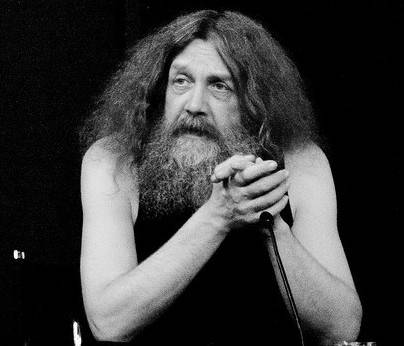
(Image: Alan Moore, a Creative Commons Attribution Share-Alike (2.0) image from mbiddulph's photostream)


29 Nov 18:58

Picking The Poor Kids Last

by Andrew Sullivan

John Greenya is concerned about the affordability of youth sports:

An examination of who plays youth sports from ESPN The Magazine finds that while there may be 21.5 million kids between age six and 17 playing on a team, including teams at schools, the earliest participants come from upper-income families. “We also see starkly what drives the very earliest action: money,” wrote Bruce Kelley and Carl Carchia. “The biggest indicator of whether kids start young, [sports researcher Don] Sabo found, is whether their parents have a household income of $100,000 or more.” Kids from low-income families are the least likely to be on multiple teams.

And disturbingly, 3.5 million kids are expected to lose school sports by 2020, especially in financially strapped states like California and Florida and big inner cities: “Living in poor corners of cities culls even more kids from sports. Nationwide, according to the Robert Wood Johnson Foundation, only a quarter of eighth- to 12th-graders enrolled in the poorest schools played school sports.”

29 Nov 18:36

Zappos Turns Baggage Claim Carousel Into Wheel of Fortune

0zapposbclaim.jpg

How do you take two things most people don't like—airline travel and advertising—and combine them into a pleasing experience? That was the task online retailer Zappos set for Mullen, and the Boston ad agency came up with a client-pleasing solution. This Thankgsiving Eve, travelers through Houston's George Bush Intercontinental Airport found their baggage claim conveyor belt festooned with what appeared to be Zappos advertising banners, but which were in fact prize markers for clothing, appliances, accessories and gift certificates. The entire conveyor belt had effectively been transformed into a giant roulette wheel, with travelers' individual pieces of luggage serving as the ball.

"Zappos wants to intercept people in their everyday lives and bring surprise and delight," Mullen executive creative director Tim Vaccarino told Ad Age. "So right away we're always looking for something fresh in approach."

Zappos staff were on hand to verify prize winnings, with at least one of them dressed like a turkey. And unlike America's usual Black Friday shenanigans, there were no fistfights, stabbings or shootings reported.

(more...)
29 Nov 01:51

China, and the Soaring Price of Bitcoin

by John Gruber

Tyler Cowen, writing at Marginal Revolution:

Right now, you can think of the value of Bitcoin being set in the same way that the value of an export license might be set through bids. If/when China fully liberalizes capital flows, the value of Bitcoin likely will fall. A lot. To the extent the shadow market value of the yuan rises, and approaches the level of the current quasi-peg, the value of Bitcoin will fall, by how much is not clear. Or maybe getting money out through Hong Kong (or Shanghai) will become easier and again the value of Bitcoin would fall. If Beijing shuts down BTC China, the main broker, which by the way accounts for about 1/3 of all Bitcoin transactions in the world, the value of Bitcoin very likely will fall. A lot. You will recall that the Chinese government shut down the virtual currency QQ in 2009; admittedly stopping Bitcoin could prove harder but still they could thwart or limit it.

(Via Scott Simpson.)

29 Nov 00:40

The Americans Who Aren’t Celebrating Today

by Andrew Sullivan

Petula Dvorak talks to Dennis Zotigh, a cultural specialist at the National Museum of the American Indian:

“It makes me really mad — the Thanksgiving myth and what happens on Friday,” said Zotigh, who is a Kiowa, Santee Dakota and Ohkay Owingeh Pueblo Indian. He thinks the holiday, filled with stereotypes about Native Americans, damages Indians and non-Indians. “There are so many things wrong with the happy celebration that takes place in elementary schools and its association to American Indian culture; compromised integrity, stereotyping, and cultural misappropriation are three examples,” Zotigh wrote….

The National Day of Mourning is what the United American Indians of New England has called it since 1970, when they first led a march and protest to the area known as Plymouth Rock. Zotigh said he’s heard from Native American parents who sign their kids out of school on the day of their Thanksgiving reenactments. Their children have been punished in class for bringing up the American Indian’s side of the story and demanding that “the national moral atrocity of genocide” be acknowledged. Some simply call the day of national gorging “The Last Supper.”

Not everyone Dvorak spoke to felt the same way:

“Thanksgiving is like every day for us. Giving thanks is a big part of the native cultures. So the basic message of the holiday, that’s still part of who we are,” said Ben Norman, 32, a member of the Pamunkey tribe in Virginia. His tribe’s chief, Kevin Brown, said he travels to reservations all across America, and he hears about folks who won’t celebrate Thanksgiving. “But most people I know, we love eating and we love being together with family. And that’s what this day is about,” said Brown, 58. “I’m too busy eating and watching football to spend my life worrying about the past,” he said.

28 Nov 20:52

Evan Rachel Wood speaks out against MPAA hypocrisy

by Scott

Per THR:

The phantasmagorical noir Charlie Countryman hit theaters earlier this month, but after finally catching up with the finished version of the film, star Evan Rachel Wood walked away none too pleased.

Music video director Fredrik Bond‘s first feature — which follows Shia LaBeouf as the title character who loses himself to love, mystery, and the colorful underbelly of Bucharest — debuted at the 2013 Sundance Film Festival before heading back to the editing room for another round of tinkering.

During that process, scenes of intimacy between LaBeouf’s and Wood’s character, a local cellist Charlie falls for upon first sight, were cut out because of MPAA demands.

Which led to this thread of tweets from Wood:

After seeing the new cut of #CharlieCountryman I would like 2 share my disappointment with the MPAA, who thought it was necessary to…

…censor a womans sexuality once again. The scene where the two main characters make “love” was altered because someone felt that seeing…

…a man give a woman oral sex made people “uncomfortable” but the scenes in which people are murdered by having their heads blown off…

…remained intact and unaltered. This is a symptom of a society that wants to shame women and put them down for enjoying sex, especially…

…when (gasp) the man isn’t getting off as well! Its hard for me to believe that had the roles been reversed it still would have been cut..

…OR had the female character been raped it would have been cut. Its time for people to GROW UP. Accept that woman are sexual beings…

…Accept that some men like pleasuring woman. Accept that woman don’t have to just be fucked and say thank you…

…We are allowed and entitled to enjoy ourselves. Its time we put our foot down…

…Thanks for listening.

This is not a double standard, it’s a triple standard: male sexuality more acceptable than female, violence more acceptable than sex. I get that we live in a country which has always had a Puritanical streak, but the selectivity as exhibited by the MPAA over and over again — allowing the one, disallowing the other — is not only hypocritical, it also continues to reinforce the status quo of beliefs and behaviors.

If you are a screenwriter or TV writer, this extends to First Amendment concerns. After all, there is a history of censorship in Hollywood, manifest most powerfully with the so-called Hays Code (1930).

Hit More to read the entire set of Hays Code regulations.

A Code to Govern the Making of Talking, Synchronized and Silent Motion Pictures. Formulated and formally adopted by The Association of Motion Picture Producers, Inc. and The Motion Picture Producers and Distributors of America, Inc. in March 1930.

Motion picture producers recognize the high trust and confidence which have been placed in them by the people of the world and which have made motion pictures a universal form of entertainment.

They recognize their responsibility to the public because of this trust and because entertainment and art are important influences in the life of a nation.

Hence, though regarding motion pictures primarily as entertainment without any explicit purpose of teaching or propaganda, they know that the motion picture within its own field of entertainment may be directly responsible for spiritual or moral progress, for higher types of social life, and for much correct thinking.

During the rapid transition from silent to talking pictures they have realized the necessity and the opportunity of subscribing to a Code to govern the production of talking pictures and of re-acknowledging this responsibility.

On their part, they ask from the public and from public leaders a sympathetic understanding of their purposes and problems and a spirit of cooperation that will allow them the freedom and opportunity necessary to bring the motion picture to a still higher level of wholesome entertainment for all the people.

General Principles

1. No picture shall be produced that will lower the moral standards of those who see it. Hence the sympathy of the audience should never be thrown to the side of crime, wrongdoing, evil or sin.

2. Correct standards of life, subject only to the requirements of drama and entertainment, shall be presented.

3. Law, natural or human, shall not be ridiculed, nor shall sympathy be created for its violation.

Particular Applications

I. Crimes Against the Law
These shall never be presented in such a way as to throw sympathy with the crime as against law and justice or to inspire others with a desire for imitation.

1. Murder

a. The technique of murder must be presented in a way that will not inspire imitation.

b. Brutal killings are not to be presented in detail.

c. Revenge in modern times shall not be justified.

2. Methods of Crime should not be explicitly presented.

a. Theft, robbery, safe-cracking, and dynamiting of trains, mines, buildings, etc., should not be detailed in method.

b. Arson must subject to the same safeguards.

c. The use of firearms should be restricted to the essentials.

d. Methods of smuggling should not be presented.

3. Illegal drug traffic must never be presented.

4. The use of liquor in American life, when not required by the plot or for proper characterization, will not be shown.

II. Sex
The sanctity of the institution of marriage and the home shall be upheld. Pictures shall not infer that low forms of sex relationship are the accepted or common thing.

1. Adultery, sometimes necessary plot material, must not be explicitly treated, or justified, or presented attractively.

2. Scenes of Passion

a. They should not be introduced when not essential to the plot.

b. Excessive and lustful kissing, lustful embraces, suggestive postures and gestures, are not to be shown.

c. In general passion should so be treated that these scenes do not stimulate the lower and baser element.

3. Seduction or Rape

a. They should never be more than suggested, and only when essential for the plot, and even then never shown by explicit method.

b. They are never the proper subject for comedy.

4. Sex perversion or any inference to it is forbidden.

5. White slavery shall not be treated.

6. Miscegenation (sex relationships between the white and black races) is forbidden.

7. Sex hygiene and venereal diseases are not subjects for motion pictures.

8. Scenes of actual child birth, in fact or in silhouette, are never to be presented.

9. Children’s sex organs are never to be exposed.

III. Vulgarity
The treatment of low, disgusting, unpleasant, though not necessarily evil, subjects should always be subject to the dictates of good taste and a regard for the sensibilities of the audience.

IV. Obscenity
Obscenity in word, gesture, reference, song, joke, or by suggestion (even when likely to be understood only by part of the audience) is forbidden.

V. Profanity
Pointed profanity (this includes the words, God, Lord, Jesus, Christ – unless used reverently – Hell, S.O.B., damn, Gawd), or every other profane or vulgar expression however used, is forbidden.

VI. Costume
1. Complete nudity is never permitted. This includes nudity in fact or in silhouette, or any lecherous or licentious notice thereof by other characters in the picture.

2. Undressing scenes should be avoided, and never used save where essential to the plot.

3. Indecent or undue exposure is forbidden.

4. Dancing or costumes intended to permit undue exposure or indecent movements in the dance are forbidden.

VII. Dances
1. Dances suggesting or representing sexual actions or indecent passions are forbidden.

2. Dances which emphasize indecent movements are to be regarded as obscene.

VIII. Religion
1. No film or episode may throw ridicule on any religious faith.

2. Ministers of religion in their character as ministers of religion should not be used as comic characters or as villains.

3. Ceremonies of any definite religion should be carefully and respectfully handled.

IX. Locations
The treatment of bedrooms must be governed by good taste and delicacy.

X. National Feelings
1. The use of the Flag shall be consistently respectful.

2. The history, institutions, prominent people and citizenry of other nations shall be represented fairly.

XI. Titles
Salacious, indecent, or obscene titles shall not be used.

XII. Repellent Subjects
The following subjects must be treated within the careful limits of good taste:
1. Actual hangings or electrocutions as legal punishments for crime.
2. Third degree methods.
3. Brutality and possible gruesomeness.
4. Branding of people or animals.
5. Apparent cruelty to children or animals.
6. The sale of women, or a woman selling her virtue.
7. Surgical operations.

Reasons Supporting the Preamble of the Code

I. Theatrical motion pictures, that is, pictures intended for the theatre as distinct from pictures intended for churches, schools, lecture halls, educational movements, social reform movements, etc., are primarily to be regarded as ENTERTAINMENT.

Mankind has always recognized the importance of entertainment and its value in rebuilding the bodies and souls of human beings.

But it has always recognized that entertainment can be a character either HELPFUL or HARMFUL to the human race, and in consequence has clearly distinguished between:

a. Entertainment which tends to improve the race, or at least to re-create and rebuild human beings exhausted with the realities of life; and

b. Entertainment which tends to degrade human beings, or to lower their standards of life and living.

Hence the MORAL IMPORTANCE of entertainment is something which has been universally recognized. It enters intimately into the lives of men and women and affects them closely; it occupies their minds and affections during leisure hours; and ultimately touches the whole of their lives. A man may be judged by his standard of entertainment as easily as by the standard of his work.

So correct entertainment raises the whole standard of a nation.

Wrong entertainment lowers the whole living conditions and moral ideals of a race.

Note, for example, the healthy reactions to healthful sports, like baseball, golf; the unhealthy reactions to sports like cockfighting, bullfighting, bear baiting, etc.

Note, too, the effect on ancient nations of gladiatorial combats, the obscene plays of Roman times, etc.

II. Motion pictures are very important as ART.

Though a new art, possibly a combination art, it has the same object as the other arts, the presentation of human thought, emotion, and experience, in terms of an appeal to the soul through the senses.

Here, as in entertainment,

Art enters intimately into the lives of human beings.

Art can be morally good, lifting men to higher levels. This has been done through good music, great painting, authentic fiction, poetry, drama.

Art can be morally evil it its effects. This is the case clearly enough with unclean art, indecent books, suggestive drama. The effect on the lives of men and women are obvious.

Note: It has often been argued that art itself is unmoral, neither good nor bad. This is true of the THING which is music, painting, poetry, etc. But the THING is the PRODUCT of some person’s mind, and the intention of that mind was either good or bad morally when it produced the thing. Besides, the thing has its EFFECT upon those who come into contact with it. In both these ways, that is, as a product of a mind and as the cause of definite effects, it has a deep moral significance and unmistakable moral quality.

Hence: The motion pictures, which are the most popular of modern arts for the masses, have their moral quality from the intention of the minds which produce them and from their effects on the moral lives and reactions of their audiences. This gives them a most important morality.

1. They reproduce the morality of the men who use the pictures as a medium for the expression of their ideas and ideals.

2. They affect the moral standards of those who, through the screen, take in these ideas and ideals.

In the case of motion pictures, the effect may be particularly emphasized because no art has so quick and so widespread an appeal to the masses. It has become in an incredibly short period the art of the multitudes.

III. The motion picture, because of its importance as entertainment and because of the trust placed in it by the peoples of the world, has special MORAL OBLIGATIONS:

A. Most arts appeal to the mature. This art appeals at once to every class, mature, immature, developed, undeveloped, law abiding, criminal. Music has its grades for different classes; so has literature and drama. This art of the motion picture, combining as it does the two fundamental appeals of looking at a picture and listening to a story, at once reaches every class of society.

B. By reason of the mobility of film and the ease of picture distribution, and because the possibility of duplicating positives in large quantities, this art reaches places unpenetrated by other forms of art.

C. Because of these two facts, it is difficult to produce films intended for only certain classes of people. The exhibitors’ theatres are built for the masses, for the cultivated and the rude, the mature and the immature, the self-respecting and the criminal. Films, unlike books and music, can with difficulty be confined to certain selected groups.

D. The latitude given to film material cannot, in consequence, be as wide as the latitude given to book material. In addition:

a. A book describes; a film vividly presents. One presents on a cold page; the other by apparently living people.

b. A book reaches the mind through words merely; a film reaches the eyes and ears through the reproduction of actual events.

c. The reaction of a reader to a book depends largely on the keenness of the reader’s imagination; the reaction to a film depends on the vividness of presentation.

Hence many things which might be described or suggested in a book could not possibly be presented in a film.

E. This is also true when comparing the film with the newspaper.

a. Newspapers present by description, films by actual presentation.

b. Newspapers are after the fact and present things as having taken place; the film gives the events in the process of enactment and with apparent reality of life.

F. Everything possible in a play is not possible in a film:

a. Because of the larger audience of the film, and its consequential mixed character. Psychologically, the larger the audience, the lower the moral mass resistance to suggestion.

b. Because through light, enlargement of character, presentation, scenic emphasis, etc., the screen story is brought closer to the audience than the play.

c. The enthusiasm for and interest in the film actors and actresses, developed beyond anything of the sort in history, makes the audience largely sympathetic toward the characters they portray and the stories in which they figure. Hence the audience is more ready to confuse actor and actress and the characters they portray, and it is most receptive of the emotions and ideals presented by the favorite stars.

G. Small communities, remote from sophistication and from the hardening process which often takes place in the ethical and moral standards of larger cities, are easily and readily reached by any sort of film.

H. The grandeur of mass settings, large action, spectacular features, etc., affects and arouses more intensely the emotional side of the audience.

In general, the mobility, popularity, accessibility, emotional appeal, vividness, straightforward presentation of fact in the film make for more intimate contact with a larger audience and for greater emotional appeal.

Hence the larger moral responsibilities of the motion pictures.

Reasons Underlying the General Principles

I. No picture shall be produced which will lower the moral standards of those who see it. Hence the sympathy of the audience should never be thrown to the side of crime, wrong-doing, evil or sin.

This is done:

1. When evil is made to appear attractive and alluring, and good is made to appear unattractive.

2. When the sympathy of the audience is thrown on the side of crime, wrongdoing, evil, sin. The same is true of a film that would thrown sympathy against goodness, honor, innocence, purity or honesty.

Note: Sympathy with a person who sins is not the same as sympathy with the sin or crime of which he is guilty. We may feel sorry for the plight of the murderer or even understand the circumstances which led him to his crime: we may not feel sympathy with the wrong which he has done. The presentation of evil is often essential for art or fiction or drama. This in itself is not wrong provided:

a. That evil is not presented alluringly. Even if later in the film the evil is condemned or punished, it must not be allowed to appear so attractive that the audience’s emotions are drawn to desire or approve so strongly that later the condemnation is forgotten and only the apparent joy of sin is remembered.

b. That throughout, the audience feels sure that evil is wrong and good is right.

II. Correct standards of life shall, as far as possible, be presented.

A wide knowledge of life and of living is made possible through the film. When right standards are consistently presented, the motion picture exercises the most powerful influences. It builds character, develops right ideals, inculcates correct principles, and all this in attractive story form.

If motion pictures consistently hold up for admiration high types of characters and present stories that will affect lives for the better, they can become the most powerful force for the improvement of mankind.

III. Law, natural or human, shall not be ridiculed, nor shall sympathy be created for its violation.

By natural law is understood the law which is written in the hearts of all mankind, the greater underlying principles of right and justice dictated by conscience.

By human law is understood the law written by civilized nations.

1. The presentation of crimes against the law is often necessary for the carrying out of the plot. But the presentation must not throw sympathy with the crime as against the law nor with the criminal as against those who punish him.

2. The courts of the land should not be presented as unjust. This does not mean that a single court may not be presented as unjust, much less that a single court official must not be presented this way. But the court system of the country must not suffer as a result of this presentation.

Reasons Underlying the Particular Applications

I. Sin and evil enter into the story of human beings and hence in themselves are valid dramatic material.

II. In the use of this material, it must be distinguished between sin which repels by it very nature, and sins which often attract.

a. In the first class come murder, most theft, many legal crimes, lying, hypocrisy, cruelty, etc.

b. In the second class come sex sins, sins and crimes of apparent heroism, such as banditry, daring thefts, leadership in evil, organized crime, revenge, etc.

The first class needs less care in treatment, as sins and crimes of this class are naturally unattractive. The audience instinctively condemns all such and is repelled.

Hence the important objective must be to avoid the hardening of the audience, especially of those who are young and impressionable, to the thought and fact of crime. People can become accustomed even to murder, cruelty, brutality, and repellent crimes, if these are too frequently repeated.

The second class needs great care in handling, as the response of human nature to their appeal is obvious. This is treated more fully below.

III. A careful distinction can be made between films intended for general distribution, and films intended for use in theatres restricted to a limited audience. Themes and plots quite appropriate for the latter would be altogether out of place and dangerous in the former.

Note: The practice of using a general theatre and limiting its patronage to “Adults Only” is not completely satisfactory and is only partially effective.

However, maturer minds may easily understand and accept without harm subject matter in plots which do younger people positive harm.

Hence: If there should be created a special type of theatre, catering exclusively to an adult audience, for plays of this character (plays with problem themes, difficult discussions and maturer treatment) it would seem to afford an outlet, which does not now exist, for pictures unsuitable for general distribution but permissible for exhibitions to a restricted audience.

I. Crimes Against the Law
The treatment of crimes against the law must not:

1. Teach methods of crime.
2. Inspire potential criminals with a desire for imitation.
3. Make criminals seem heroic and justified.

Revenge in modern times shall not be justified. In lands and ages of less developed civilization and moral principles, revenge may sometimes be presented. This would be the case especially in places where no law exists to cover the crime because of which revenge is committed.

Because of its evil consequences, the drug traffic should not be presented in any form. The existence of the trade should not be brought to the attention of audiences.

The use of liquor should never be excessively presented. In scenes from American life, the necessities of plot and proper characterization alone justify its use. And in this case, it should be shown with moderation.

II. Sex
Out of a regard for the sanctity of marriage and the home, the triangle, that is, the love of a third party for one already married, needs careful handling. The treatment should not throw sympathy against marriage as an institution.

Scenes of passion must be treated with an honest acknowledgement of human nature and its normal reactions. Many scenes cannot be presented without arousing dangerous emotions on the part of the immature, the young or the criminal classes.

Even within the limits of pure love, certain facts have been universally regarded by lawmakers as outside the limits of safe presentation.

In the case of impure love, the love which society has always regarded as wrong and which has been banned by divine law, the following are important:

1. Impure love must not be presented as attractive and beautiful.

2. It must not be the subject of comedy or farce, or treated as material for laughter.

3. It must not be presented in such a way to arouse passion or morbid curiosity on the part of the audience.

4. It must not be made to seem right and permissible.

5. It general, it must not be detailed in method and manner.

III. Vulgarity; IV. Obscenity; V. Profanity; hardly need further explanation than is contained in the Code.

VI. Costume
General Principles:

1. The effect of nudity or semi-nudity upon the normal man or woman, and much more upon the young and upon immature persons, has been honestly recognized by all lawmakers and moralists.

2. Hence the fact that the nude or semi-nude body may be beautiful does not make its use in the films moral. For, in addition to its beauty, the effect of the nude or semi-nude body on the normal individual must be taken into consideration.

3. Nudity or semi-nudity used simply to put a “punch” into a picture comes under the head of immoral actions. It is immoral in its effect on the average audience.

4. Nudity can never be permitted as being necessary for the plot. Semi-nudity must not result in undue or indecent exposures.

5. Transparent or translucent materials and silhouette are frequently more suggestive than actual exposure.

VII. Dances
Dancing in general is recognized as an art and as a beautiful form of expressing human emotions.

But dances which suggest or represent sexual actions, whether performed solo or with two or more; dances intended to excite the emotional reaction of an audience; dances with movement of the breasts, excessive body movements while the feet are stationary, violate decency and are wrong.

VIII. Religion
The reason why ministers of religion may not be comic characters or villains is simply because the attitude taken toward them may easily become the attitude taken toward religion in general. Religion is lowered in the minds of the audience because of the lowering of the audience’s respect for a minister.

IX. Locations
Certain places are so closely and thoroughly associated with sexual life or with sexual sin that their use must be carefully limited.

X. National Feelings
The just rights, history, and feelings of any nation are entitled to most careful consideration and respectful treatment.

XI. Titles
As the title of a picture is the brand on that particular type of goods, it must conform to the ethical practices of all such honest business.

XII. Repellent Subjects
Such subjects are occasionally necessary for the plot. Their treatment must never offend good taste nor injure the sensibilities of an audience.

Movies released domestically today may not be subject to this extreme set of restrictions, but as Wood points out: Where did violence in movies become more acceptable than sex? Where did male sexuality become more acceptable in movies than female sexuality? If the MPAA compels filmmakers to edit movies per such duplicitous standards, isn’t that a tacit form of censorship?

Thanks for @MysteryExec for alerting me to Wood’s tweets.