“$15. $15 for ALL the medications I’ve been paying thousands of dollars a month for for 6+ years. The pharmacist asked how the hell I survived this long having to pay ‘retail’ prices…because no person could possibly afford all the thing I need to stay alive without some kind of insurance. $15 fucking dollars. I’ve never been so happy to swipe my debit card as I just was. Jesus Christ, y’all don’t understand the gravity of this situation. This is like…it changes my life in so many ways. ‘Cause I don’t have to pick between paying my mortgage & buying my meds. I don’t have to ‘skip’ doses to make the bottles last longer. I can just take my meds & go on with my life. Bawling. That’s happening.”
- Crying in the middle of the Walmart pharmacy.
Shared posts
24 Jan 21:13
"$15. $15 for ALL the medications I’ve been paying thousands of dollars a month for for 6+ years. The..."
24 Jan 21:07
How Silicon Valley’s Most Celebrated CEOs Conspired to Drive Down Engineer Salaries
by John Gruber
Mark Ames, reporting for Pando Daily:
In early 2005, as demand for Silicon Valley engineers began booming, Apple’s Steve Jobs sealed a secret and illegal pact with Google’s Eric Schmidt to artificially push their workers wages lower by agreeing not to recruit each other’s employees, sharing wage scale information, and punishing violators. On February 27, 2005, Bill Campbell, a member of Apple’s board of directors and senior advisor to Google, emailed Jobs to confirm that Eric Schmidt “got directly involved and firmly stopped all efforts to recruit anyone from Apple.”
Later that year, Schmidt instructed his Sr VP for Business Operation Shona Brown to keep the pact a secret and only share information “verbally, since I don’t want to create a paper trail over which we can be sued later?”
Amazing story.
Scirocco6 likes this
24 Jan 21:01
"To (have a) dialogue means to believe that the ‘other’ has something worthwhile to say,..."
“To (have a) dialogue means to believe that the ‘other’ has something worthwhile to say, and to entertain his or her point of view and perspective. Engaging in dialogue does not mean renouncing our own ideas and traditions, but the pretense that they alone are valid and absolute.”
- Pope Francis
- Pope Francis
24 Jan 20:58


Bill Gates Plays Chess With The World's Best, Loses In 71 Seconds
by Gergo Vas
The stunned face of Bill Gates, as he realises he has no chance to win against the Norwegian chess grandmaster, Magnus Carlsen, is priceless in the above video. The two met on a TV show last night, and you don't have to wait a lot for the checkmate.
    
|
24 Jan 20:46
This is synthetic heart tissue … beating. This week, my friends...
This is synthetic heart tissue … beating.
This week, my friends over at TED Radio Hour are broadcasting a talk by tissue engineer Nina Tandon. She explains how we’ll someday be able to grow replacement organs from our very own cells.
This is a lump of engineered heart tissue being stimulated by an electrical pulse once every second.
24 Jan 20:42


Cable News In 26 Seconds
by Andrew Sullivan
An MSNBC interview with congresswoman Jane Harman by Andrea Mitchell on the NSA is interrupted … for “breaking news” on Justin Bieber. And the beat goes on …
24 Jan 20:37


Felix the Fire God: a photo from the Boing Boing Flickr Pool
by Xeni Jardin
"Felix the Fire God #2," a photo shared in the Boing Boing Flickr Pool by reader and photographer John K. Goodman. "Felix is a fire god who performs in the Los Angeles area with other local flame deities," John explains.
|
|
24 Jan 20:05

thinksquad: Utah is ending homelessness by giving people an...
Utah is ending homelessness by giving people an apartment or home.
Earlier this month, Hawaii State representative Tom Bower (D) began walking the streets of his Waikiki district with a sledgehammer, and smashing shopping carts used by homeless people. “Disgusted” by the city’s chronic homelessness problem, Bower decided to take matters into his own hands — literally. He also took to rousing homeless people if he saw them sleeping at bus stops during the day.
Bower’s tactics were over the top, and so unpopular that he quickly declared “Mission accomplished,” and retired his sledgehammer. But Bower’s frustration with his city’s homelessness problem is just an extreme example of the frustration that has led cities to pass measures that effective deal with the homeless by criminalizing homelessness.
City council members in Columbia, South Carolina, concerned that the city was becoming a “magnet for homeless people,” passed an ordinance giving the homeless the option to either relocate or get arrested. The council later rescinded the ordinance, after backlash from police officers, city workers, and advocates.
Last year, Tampa, Florida — which had the most homeless people for a mid-sized city — passed an ordinance allowing police officers to arrest anyone they saw sleeping in public, or “storing personal property in public.” The city followed up with a ban on panhandling downtown, and other locations around the city.
Philadelphia took a somewhat different approach, with a law banning the feeding of homeless people on city parkland. Religious groups objected to the ban, and announced that they would not obey it.
Raleigh, North Carolina took the step of asking religious groups to stop their longstanding practice of feeding the homeless in a downtown park on weekends. Religious leaders announced that they would risk arrest rather than stop.
This trend makes Utah’s accomplishment even more noteworthy. In eight years, Utah has quietly reduced homelessness by 78 percent, and is on track to end homelessness by 2015.
How did Utah accomplish this? Simple. Utah solved homelessness by giving people homes. In 2005, Utah figured out that the annual cost of E.R. visits and jail says for homeless people was about $16,670 per person, compared to $11,000 to provide each homeless person with an apartment and a social worker. So, the state began giving away apartments, with no strings attached. Each participant in Utah’s Housing First program also gets a caseworker to help them become self-sufficient, but the keep the apartment even if they fail. The program has been so successful that other states are hoping to achieve similar results with programs modeled on Utah’s.
24 Jan 07:20


Great Firewall of Cameron blocks game update because "XerathMageChainsExtended" contains "sex"
by Cory Doctorow
Zephyr DearInteresting, LoL is written in Lua...
 Redditor LolBoopje discovered that the UK's Great Firewall of Cameron -- the national censorwall put in place by the prime minister -- was blocking updates to the game League of Legends. The update archive contained two files, "VarusExpirationTimer.luaobj" and "XerathMageChainsExtended.luaobj" that had the word "sex" in them, triggering the censorship algorithm. The censorship is totally silent -- users got a "file not found" error -- and it was only some very clever sleuthing that revealed the error.
I've written at length about the worse-than-useless nature of censorware as a means of keeping kids from seeing bad stuff. One of the key points to note here is that silent failure: there is no way of telling how many of the timeouts, file-not-found errors, and other miscellaneous bugs in your daily Web experience are caused by the Great Firewall, and that is by design. It is a system that is intended to make it impossible to tell if it's working. That's not going to be pretty.
The firewall being operated by the UK's biggest internet service providers as part of David Cameron's child internet safety campaign has blocked an update of an online video game due which unintentionally included the letters "s-e-x" in its web address.
The update to online strategy game League of Legends was disrupted by the internet filter because the software attempted to access files that accidentally include the word “sex” in the middle of their file names.
The block resulted in the update failing with “file not found” errors, which are usually created by missing files or broken updates on the part of the developers.
UK porn filter blocks game update that contained 'sex' [Samuel Gibbs/The Guardian] 
|
|
24 Jan 03:17
The Truths Behind ‘Dr. Strangelove’
by John Gruber
Eric Schlosser, writing for The New Yorker:
Half a century after Kubrick’s mad general, Jack D. Ripper, launched a nuclear strike on the Soviets to defend the purity of “our precious bodily fluids” from Communist subversion, we now know that American officers did indeed have the ability to start a Third World War on their own. And despite the introduction of rigorous safeguards in the years since then, the risk of an accidental or unauthorized nuclear detonation hasn’t been completely eliminated.
Scirocco6 likes this
23 Jan 23:53


Rebranding Going Great
by Josh Marshall
Coming off Huckabee's comments this morning about incentivizing horny women with birth control, Rep. Louis Gohmert says government tries to "lure" single moms into "servitude" with welfare. Watch.
23 Jan 21:46

War on Women? Please. We're the Ones Who Respect You for Not Being Sluts!
by Josh Marshall
At Republican National Committee winter conference, former and future presidential candidate Mike Huckabee says government shouldn't be underwriting the horniness of horny women with birth control.
See the quote for yourself at the link above. But there's already a lot of pushback saying that the words might have been ill-chosen but if you really read the comments in their entirety ... No. Sorry. Read the comments. The premise and meaning is crystal clear: birth control is something for women who can't keep their legs closed.
Subtext: Female desire is scaaaaaaarrrrrrryyyyyyy ...
23 Jan 21:39
"Amateurs are content at some point to let their efforts become bottom-up operations. After about..."
“Amateurs are content at some point to let their efforts become bottom-up operations. After about fifty hours of training — whether in skiing or driving — people get to that “good-enough” performance level, where they can go through the motions more or less effortlessly. They no longer feel the need for concentrated practice, but are content to coast on what they’ve learned. No matter how much more they practice in this bottom-up mode, their improvement will be negligible. The experts, in contrast, keep paying attention top-down, intentionally counteracting the brain’s urge to automatize routines. They concentrate actively on those moves they have yet to perfect, on correcting what’s not working in their game, and on refining their mental models of how to play the game, or focusing on the particulars of feedback from a seasoned coach. Those at the top never stop learning: if at any point they start coasting and stop such smart practice, too much of their game becomes bottom-up and their skills plateau.”
- Daniel Goleman
- Daniel Goleman
23 Jan 20:15


Wonkblog: Ten things that aren’t panaceas
by Brad Plumer
1) Legalizing marijuana. “As is his habit, [Obama] nimbly argued the other side. 'Having said all that, those who argue that legalizing marijuana is a panacea and it solves all these social problems I think are probably overstating the case.'" (President Obama)
2) Single-payer health care. "'Single payer isn’t a panacea,' said Uwe Reinhardt, a health economist at Princeton University. 'The magic they have is setting rates. But neither Medicare nor Canada has done anything innovative on the delivery side.'" (Wonkblog's Ezra Klein)
3) Raising the minimum wage. "Raising the minimum wage is hardly a panacea. For one, it does little for the millions of struggling families who have higher hourly wages or a salary." (The New York Times' Annie Lowrey)
4) The Federal Reserve's quantitative easing program. "Yes, the Fed was able to do some good things. For example, it pushed mortgage rates down to record lows, which helped make it easier for people to refinance. But the programs weren’t a panacea for the economy as a whole." (Quartz's Matt Phillips)
5) Getting rid of the $1 bill. "Now, researchers at the Federal Reserve are weighing in, and they, too, find that getting rid of $1 bills entirely wouldn't be the panacea that some analysts have claimed." (Wonkblog's Neil Irwin)
6) Adapting to climate change. "But it's worth noting that even better preparation and infrastructure isn't always a panacea — particularly in the face of massive storms." (Wonkblog's, uh, Brad Plumer)
7) On-line college courses in China. "So while MOOCs are here to stay for the foreseeable future, they’re far from a panacea in tackling China’s educational problems." (The Atlantic)
8) Giving homeless people a place to live. "This does not solve all of a homeless person's problems in life. Typically one does not become homeless without some other misfortune befalling you first... so Housing First is no panacea." (Slate's Matt Yglesias)
9) Breaking up the big banks. "I also think it’s a mistake to assume that somehow breaking up the banks would be a panacea. The lesson that was drawn from the S&L crisis was that the financial system was excessively fragmented." (Larry Summers)
10) Getting married. "Getting married may not be the panacea for poverty that many say it is, a new study argues." (NBC News)
Whoever it is that keeps insisting their preferred policies are panaceas has a lot of explaining to do.
|
|
23 Jan 18:15


Ukraine government sends text to protesters: "Dear subscriber, you are registered as a participant in a mass disturbance"
by Cory Doctorow

Ukraine's dictatorship is revelling in its new, self-appointed dictatorial powers. The million-plus participants in the latest round of protests received a text-message from the government reading Dear subscriber, you are registered as a participant in a mass disturbance.
The identification of protesters was almost certainly accomplished with a "Stingray," a fake cellphone tower pioneered by police in the USA, who routinely and secretly deploy them around cities and especially during protests. The Stingray tricks nearby phones into associating with it, giving police a census of who was where, with whom, and where they went. A federal judge found this to be legal, even without a warrant, because he believes you have no expectation of privacy when it comes to having your movements and associations tracked by the police in secret.
Which is to say that the thing that the Ukrainian police did to those protesters is something that US police forces do routinely to protesters, all the time. The only difference is that American cops don't brag about the fact that they are building dossiers on participants in peaceful, lawful protests by sending taunting and intimidating texts to protesters. Instead, they just build the databases in secret against the day that they're looking for a pretense to arrest someone.
The moral of the story is that when you build surveillance technology, you load a weapon that will be inherited by every government that is to come. Oakland PD's playful, murderous shenanigans -- aiming tear-gas cannisters at protesters' heads -- are on a continuum, and at the other end of it are governments like the Ukrainian state, where they've mobilized tanks against their citizens to crush a popular uprising, and further along, there's Syria, where they're operating modern death-camps.
The cause of freedom in the 21st century is inextricably linked to resistance of technological surveillance. It's in the development of technology that obeys its owners (for example, being able to root your phone in a way that is undetectable to apps and carriers); in the right to report bugs that expose people to surveillance by governments and creeps without being prosecuted.
It's in establishing the principle that technology should do what it is told by its owners, and that it shouldn't be designed to lie to its owners. This is why it's a Big Fucking Deal that the W3C has paved the way for DRM in every browser, which means that it will become impossible to use most of the Web unless you are running closed systems that enjoy special legal status that makes it illegal to report bugs in them, ensuring that everything that touches the Web will have code with long-lived, secret bugs in it that creeps and crooks and governments can use to pwn the devices' owners.
There are people who will sneeringly tell you that this is about whether "information wants to be free." This has nothing to do with the nonexistent desires of "information." This is about people wanting to be free, and the fact that freedom in an information society requires that a "freedom layer" be designed into the technology that handles information on our behalf.
Maybe the Most Orwellian Text Message a Government's Ever Sent [Brian Merchant/Vice] 
|
|
23 Jan 06:25

Should Farmers Give John Deere And Monsanto Their Data? Farmers...
Should Farmers Give John Deere And Monsanto Their Data?
Farmers rely on crop yield data to help them plan each year’s planting regimen. It turns out there’s a lot of variation in yield within a single field because of differing soil types and moisture levels — and they want to plant the more seeds where more seeds can grow.
Starting this year, farmers across the Midwest can sign up for a service that lets Monsanto and John Deere access their data, minute by minute, as they plant and harvest their crops.
The big companies say they will crunch all the numbers, and thanks to the size of their data set, they’ll be able to recommend even more efficient planting “prescriptions” for individual farmers (like this one from Monsanto):

Each box represents an 18 x 18 foot unit of the field. The colors represent different planting rates.
Here’s a promo video from John Deere that showcases their technology (and a lot of shots of a friendly looking farmer sipping coffee).
The future John Deere imagines has a lot of soothing piano music, but the American Farm Bureau Federation is telling farmers to be wary. These services, it says, could threaten farmers’ privacy and give the big companies too much power.
22 Jan 20:55


How to draw Adventure Time characters
by Mark Frauenfelder
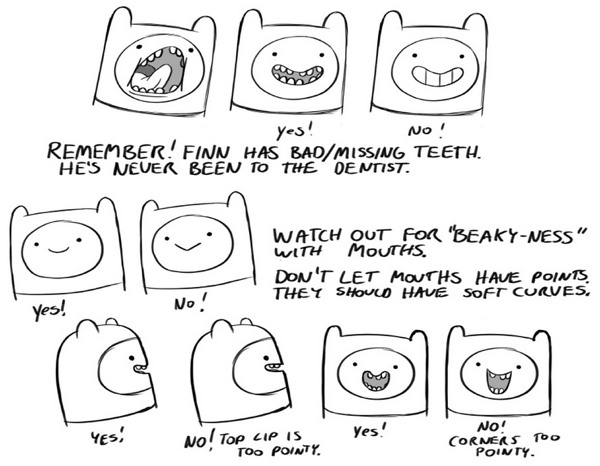 Cartoon producer Fred Seibert posted this fun and informative sixteen-page manual with tips for drawing Finn & Jake from Pendleton Ward's Adventure Time series. Ward is one of the best character designers around! (Via Super Punch)
|
|
22 Jan 20:52


Fighting homelessness by giving homeless people houses
by Cory Doctorow

A program in Salt Lake City decided that it would be smarter -- and more humane -- to spend $11K/year each to house 17 chronically homeless people and provide them with social workers than it would be to waste the average of $16,670/year per person to imprison them and treat them at emergency rooms. As Nation of Change points out, this commonsense, humane and economically sound way of dealing with homelessness works, unlike the savage approaches taken by other cities (like the Waikiki rep Tom Bowker who smashed homeless peoples' carts with a sledgehammer, or cities like Tampa, which banned feeding homeless people).
Here's more on Utah's Housing First program.
Utah started a pilot program that took 17 people in Salt Lake City who had spent an average of 25 years on the street and put them in apartments. Caseworkers were assigned to help them become self-sufficient, but there were no strings attached – if they failed, the participants still had a place to live.
The “Housing First” program’s goal was to end chronic homelessness in Utah within 10 years. Through 2012, it had helped reduce the 2,000 people in that category when it began by 74 percent. Lloyd Pendleton, director of Utah’s Homeless Task Force, said the state is on track to meet its goal by 2015, and become the first state in the nation to do so.
...There’s no question that providing housing for the homeless is the right thing to do, for humanitarian reasons. But it also makes economic sense, so cities can spend less money and still help more people. In 2005, Utah did a study that found the average annual cost for emergency services and jail time for each chronically homeless person was $16,670. The cost to house them and provide case management services was only $11,000 per person.
Wyoming can give homeless a place to live, and save money [Kerry Drake/Wyofile]
(Image: Homeless Encampment, a Creative Commons Attribution (2.0) image from editor's photostream) 
|
|
21 Jan 23:49
The Cord-Cutters Manifesto
Zephyr DearThat would instantly kill all sports, due to the fucked-up economics of cable.
Right now, everyone with cable in the Houston area pays $5 a month to watch Astros games. Basically none of them actually do so.
The Cord-Cutters Manifesto:
- End the blackouts for sports-on-demand. Ah, the most difficult one for you to pull off because of multibillion-dollar contracts between sports leagues and the TV networks. But consider the new revenues that would come in if everyone in the nation (or maybe the world, if you do it right online) could pay $1.99 to watch each New York Knicks game with Jeremy Lin playing. Or if you’re a fan of a hometown team, you could buy a season’s package to watch the games at home. We repeat: Without a cable subscription.
21 Jan 23:44


Female Celebrities and the “Faint Sexual Flame”
by Lisa Wade, PhD
 Thanks to a tip from Jay Livingston, I came across this quote from The Pursuit of Loneliness by sociologist Philip Slater. It’s long, but wow:
[I]t can’t be denied that the female ideal in America is nonaggressive and nonthreatening, to the point of caricature. Take for example the film personality of the much-idolized Marilyn Monroe: docile, accommodating, brainless, defenseless, totally uncentered, incapable of taking up for herself or knowing what she wants or needs. A sexual encounter with such a woman in real life would border on rape – the idea of “consenting adults” wouldn’t even apply. The term “perversion” seems more appropriate for this kind of yearning than for homosexuality or bestiality, since it isn’t directed toward a complete being. The Marilyn Monroe image was the ideal sex object for the sexually crippled and anxious male: a bland erotic pudding that would never upset his delicate stomach.
It’s important to realize that this Playboy ideal is a sign of low, rather than high, sexual energy. It suggests that the sexual flame is so faint and wavering that a whole person would overwhelm and extinguish it. Only a vapid, compliant ninny-fantasy can keep it alive. It’s designed for men who don’t really like sex but need it for tension-release – men whose libido is wrapped up in achievement or dreams of glory.
Slater wrote this passage in 1970, hence the reference to Marilyn Monroe. I would have to think hard about whether I think it still applies broadly, but I think it’s fair to say that the “bland erotic pudding” is still part of the repertoire of essentially every female celebrity who is successful in part because of her appearance. I did a search for some of the most high-profile female actresses and singers today, looking specifically for images that might fit Slater’s description. I invite your thoughts.

(View original at http://thesocietypages.org/socimages)
21 Jan 23:17
INTP Confession #604
I feel somewhat happy about entj as a natural partner. Leaders are biologically the best mates and also they will probably be rich. But entj may be too overbearing and focused on rules and their own things
21 Jan 20:06

From Impeachment to Execution
by Josh Marshall
Florida state House candidate: "I'm past impeachment. It's time to arrest him and hang him high."
In other words, this candidate says the president needs to be lynched.
21 Jan 01:14
"Also, note that the movie showed a time frame in which every computer Jobs developed was a failure...."
“Also, note that the movie showed a time frame in which every computer Jobs developed was a failure. And they had millions of dollars behind them. My Apple ][ was developed on nothing and productized on very little. Yet it was the only revenue and profit source of the company for the first 10 years, well past the point that Jobs had left. The movie made it seem that board members didn’t acknowledge Jobs’ great work on Macintosh but when sales fall to a few hundred a month and the stock dives to 50% in a short time, someone has to save the company. The proper course was to work every angle possible, engineering and marketing, to make the Macintosh marketable while the Apple ][ still supported us for years. This work was done by Sculley and others and it involved opening the Macintosh up too. The movie shows Steve’s driving of the Macintosh team but not the stuff that most of the team said they’d never again work for him. It doesn’t show his disdain and attempts to kill the Apple ][, our revenue source, so that the Macintosh wouldn’t have to compete with it. The movie audience would want to see a complete picture and they can often tell when they are being shortchanged.”
- Steve Wozniak
- Steve Wozniak
21 Jan 00:55

The 4 Most Important Points In Bill Simmons’ Apology For Publishing A Piece Outing A Trans Woman
CREDIT: AP Images/Sang Tan
Bill Simmons, the founder of Grantland, an ESPN-owned sports and entertainment site, issued a wide-ranging public apology on Monday for the site’s decision to publish a piece about the inventor of a golf putter who killed herself while the piece was being reported. Simmons’ piece answers many of the questions I and other critics have raised about the story, “Dr. V’s Magical Putter.” He acknowledged that the reporter, Caleb Hannan, should not have outed the subject of the piece, Essay Anne Vanderbilt, as transgender in a conversation with one of her investors. He admitted that Grantland had been careless in its use of gendered pronouns in referring to Vanderbilt, and in employing other language that implied that being transgender is strange, deceptive, or in keeping with fraud. And most strikingly and importantly, Simmons acknowledged that he and his staff had failed to supplement their own lack of understanding of transgender issues by bringing in outside editors, an omission that the site took a small step towards rectifying by publishing a thorough analysis of the piece by ESPN baseball reporter Christina Kahrl, who is herself transgender.
For some of Grantland’s critics, Simmons’ focus on his own editorial processes, rather than on Vanderbilt’s death, is distasteful. And there are a number of issues he could have, and perhaps should have, touched on. I would have liked to see Simmons more directly address the separate issue of reporting on subjects who are mentally ill, or who have attempted suicide in the past, as Leonora LaPeter Anton did in this piece for the Tampa Bay Times. And I think questions remain about the choice of Vanderbilt, rather than a powerful CBS golf commentator who plugged her products, as the subject of the story, and about the extent to which the putter had actually gained a foothold in the competitive world of golf equipment. But Simmons’ self-accounting is a striking document that should raise the bar for editors who face similar criticism in the future. These are what seem to me as the most important points he makes in it:
1. Simmons recognizes that this was an organizational failure, and that responsibility doesn’t solely rely with Caleb Hannan: Simmons writes:
Another reason we created Grantland: to find young writers we liked, bring them into the fold, make them better, maybe even see if we could become the place they remembered someday when someone asked them, “So what was your big break?” That matters to us. Just about every writer we have is under 40 years old. Many of them are under 30. I am our third-oldest writer, as crazy as that sounds. For us, 31-year-old Caleb Hannan had (and has) a chance to be one of those writers. That’s why it hurts so much that we failed him.
I recognize that some readers have interpreted this section of the statement as prioritizing Hannan’s career over harm done to Vanderbilt. But in terms of organizational improvement, recognizing the role that editors play in preventing reporters from getting stories badly wrong is critically important. Ultimately, someone has to make the decision to run a story, and the way Simmons himself promoted the piece when it was published makes clear that he didn’t recognize the glaring issues with it as an examination of a transgender woman’s life, and as sports reporting. This doesn’t mean that Caleb Hannan is not to blame for the focus he chose, the way he reported out that interest, and the words he used to present the story. But one of the best reasons for large journalistic organizations to hire staff with a broad range of life experience and expertise, and to treat those perspectives as if they’re valuable and deserve deference, is so someone’s present to step in when a piece fails, to educate the writer in question, and to save subjects of pieces from journalistic malpractice, and publications from damaging themselves. I’ll get back to that in a moment.
2. It seems likely that the piece would not have run, absent Vanderbilt’s suicide: Simmons explains that:
We first reached the “Is it worth it?” point with Caleb’s piece in September, after Caleb turned in a rollicking draft that included a number of twists and turns. The story had no ending because Dr. V wouldn’t talk to him anymore. We never seriously considered running his piece, at least in that version’s form.
Our decision: Sorry, Caleb, you need to keep reporting this one. It’s not there.
I would have really liked to see Simmons explain why a pitch that focused on a putter that doesn’t appear to have any real traction in professional golf was accepted in the first place. And I remain curious about why the piece focused on Vanderbilt, rather than on Gary McCord, the CBS commentator who is almost purely responsible for giving Vanderbilt’s putter public attention, and who confirmed many of her lies about her credentials and resume to Hannan. A more thorough interrogation of how the sports reporting in “Dr. V’s Magical Putter” went wrong would help clarify how the piece went off the rails in focusing on Vanderbilt’s gender identity. But at least Simmons acknowledges that the sports reporting wasn’t there.
3. Vanderbilt’s death is, essentially, the reason why piece ran. But it’s not clear that Grantland knew how to handle the sense that they had to publish: Simmons says:
We had no plans to run the piece at that point, but we decided to wait a week or two before we officially decided what to do. When that period passed, Caleb decided to write another draft that incorporated everything that happened. A few more weeks passed, and after reading his latest draft after Thanksgiving, we seriously considered the possibility of running the piece.
Here’s why we made that decision …
For us, this had become a story about a writer falling into, for lack of a better phrase, a reporting abyss. The writer originally asked a simple question — So what’s up with this putter? — that evolved into something else entirely. His latest draft captured that journey as cleanly and crisply as possible. As editors, we read his final draft through the lens of everything we had already learned over those eight months, as well as a slew of additional information that ended up not making the final piece. When anyone criticizes the Dr. V feature for lacking empathy in the final few paragraphs, they’re right. Had we pushed Caleb to include a deeper perspective about his own feelings, and his own fears of culpability, that would have softened those criticisms. Then again, Caleb had spent the piece presenting himself as a curious reporter, nothing more. Had he shoehorned his own perspective/feelings/emotions into the ending, it could have been perceived as unnecessarily contrived. And that’s not a good outcome, either…we worried about NOT running the piece when Caleb’s reporting had become so intertwined with the last year of Dr. V’s life. Didn’t we have a responsibility to run it?
I said to a number of people before Simmons issued his statement that I suspected the piece would have been scrapped entirely if Vanderbilt had not committed suicide. The sports and science reporting weren’t there. And I can see an argument for publishing a consideration of whether Hannan’s reporting led to Vanderbilt’s death. That, however, is not the piece that Grantland published. It seems Simmons recognizes that now. Though, even lack of familiarity with trans issues aside, I’m not sure how the Grantland editorial staff didn’t realize that the piece rang as tasteless and muddled.
4. No one on the Grantland staff is transgender, has experience with trans issues, or raised the possibility of running the story by anyone with any expertise or personal experience on the subject: This is maybe the most important thing Simmons acknowledges about himself and his team, that they failed in their knowledge and empathy, and in the drive to seek it:
We read every incarnation of that piece through a certain lens — just like many readers did from Wednesday morning to Friday afternoon. Once a few people nudged us and said, Hey, read it this way instead, you transphobic dumbasses, that lens looked totally different.
Suddenly, a line like “a chill ran down my spine” — which I had always interpreted as “Jesus, this story is getting stranger?” (Caleb’s intent, by the way) — now read like, “Ew, gross, she used to be a man?” Our lack of sophistication with transgender pronouns was so easily avoidable, it makes me want to punch through a wall. The lack of empathy in the last few paragraphs — our collective intent, and only because we believed that Caleb suddenly becoming introspective and emotional would have rung hollow — now made it appear as if we didn’t care about someone’s life.
We made one massive mistake. I have thought about it for nearly three solid days, and I’ve run out of ways to kick myself about it. How did it never occur to any of us? How? How could we ALL blow it?
That mistake: Someone familiar with the transgender community should have read Caleb’s final draft. This never occurred to us. Nobody ever brought it up.
It’s hard to get starker than that. And it’s hard to consider better evidence of the value of having staff with a wide range of backgrounds, experiences, and perspectives–and of the willingness to go outside your own staff when they reach the limits of their wisdom. Doing this takes humility, and it takes curiosity, an acknowledgement that your own knowledge is not the sum of the world, and a voracious hunger to understand more of it. These are the basic qualities of good journalism. It’s remarkable that so many news organizations fail to apply them to considering the mix of their own staff and contributors. We can only hope that Grantland’s failures in that regard, and Simmons’ willingness to admit to them candidly and without reservation, serve as a warning to other organizations that might suffer from similar myopia.
Update
It should go without saying, but it would be good if Grantland followed this up by announcing some concrete next steps to their style guide and their processes when reporting on members of marginalized communities and on subjects with mental health issues like a history of suicide attempts.
The post The 4 Most Important Points In Bill Simmons’ Apology For Publishing A Piece Outing A Trans Woman appeared first on ThinkProgress.
21 Jan 00:30

Derp, MLK Holiday Edition
by Nick R. Martin
Sarah Palin takes a moment on Martin Luther King Jr. Day to tell President Obama to honor the late Civil Rights giant by not playing the "race card."
20 Jan 19:46


"Choose Your Own Adventure" in medical school
by Maggie Koerth-Baker
The Inkfish blog has a guest post by Amy Savage, a woman who is a professional fake patient — somebody hired to act out an office visit and help medical students learn how to both diagnose patients and treat them well. (You may remember this from the episode of Seinfeld when Kramer and Mickey pretended to have gonorrhea and cirrhosis.)
What you don't pick up from that pop culture portrayal, but that is clear in Savage's essay, is that learning how to ask questions is a huge part of this training exercise. Savage is supposed to provide the medical students with information — but that information might be incomplete or seriously skewed if the students don't ask the right questions, or ask the right questions in the wrong way.
I am expected to give specific, memorized lines about my symptoms, but only if the students ask the right questions in the right way. For example, if a student asks if I use tobacco, that is different from asking if I use or have ever used tobacco products. Asking a woman if she has ever been pregnant is different from asking if she has any children. And, of course, those types of oversights in questioning can lead to different diagnoses.
From this experience, I have learned what to expect from an ideal physician, what to ask, and what not to tolerate. For example, your doctor should not ask leading (or possibly judgmental) questions such as, “You don’t smoke, right?” Nor should they run off a list of questions such as, “Do you smoke, drink, or use drugs?” without giving you time to think. They should ask open-ended questions: “Have you noticed any other changes lately?”
I've also learned that it's important to pay attention to symptoms that may seem unrelated to your chief complaint. If you were experiencing extreme fatigue, for example, you might not think that your newly brittle hair had anything to do with your energy levels, but it could be a thyroid problem.
|
|


20 Jan 06:33


A Celebration Of Video Game Trees. And Bushes. And Grass.
by Luke Plunkett
Zephyr Dear<3 niche tumblrs

If you're a lover of niche video game Tumblrs, here's a fantastic one: Video Game Foliage. "A blog dedicated to the beautiful and weird approximations of plants found in video games."
|
|
20 Jan 06:00
Willful Blindness Worsens Inequality
Willful Blindness Worsens Inequality:
Brooks cannot show, even if he tried, that any of the leading advocates for a higher minimum wage have described economics as a zero-sum game. Quite to the contrary, many of us have pointed to empirical studies showing that raising the minimum wage would increase what economists call aggregate demand, resulting in faster economic growth.
A higher minimum wage would also mean a reduced need for government services such as food stamps and Medicaid, which I, and others, have shown are a form of subsidy for low-wage employers such as Walmart and McDonald’s.
And so are wages low because of the pathological behaviors Brooks blames? Such behaviors exist, for sure. But they always have.
The facts show that wages are down because of government policies. Chief among these is the devastation of unions, which increased employer power. As unionization slid, so did wages.
Next are the so-called “free trade” agreements. They are in fact heavily managed agreements that increase profits and push down wages, just as Adam Smith explained more than two centuries ago occurs when government helping businesses inflate prices and depress wages.
Welfare “reform” flooded the market with low-skill women, driving down low-end wages, as carefully done studies have shown and the empirical wage data shows. Today America ranks first by far in child poverty and second worst in the share of work paying low wages.