Shared posts

11 Feb 20:07

prostheticknowledge: Fish on Wheels A small fishtank that is...


prostheticknowledge:

Fish on Wheels

A small fishtank that is driven by a goldfish with the help of computer vision, put together by studio diip - video embedded below:

By using a camera and computer vision software it is possible to make a fish control a robot car over land. By swimming towards an interesting object, the fish can explore the world beyond the limits of his tank.

Link

11 Feb 00:44

callmeprofessor: dommykittenmommy: gingerhaze: Oh, I know I...


callmeprofessor:

dommykittenmommy:

gingerhaze:

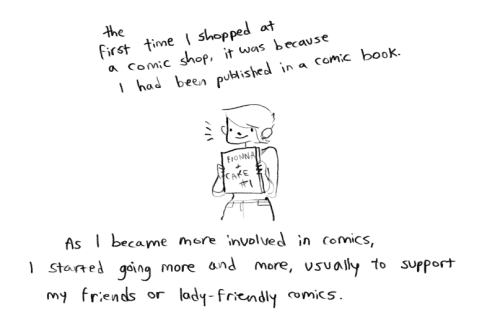
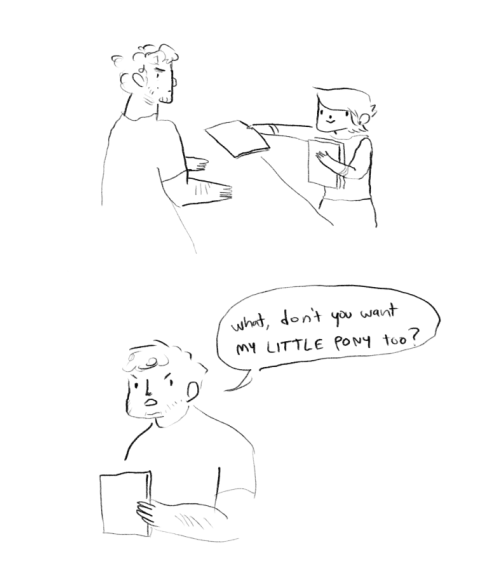
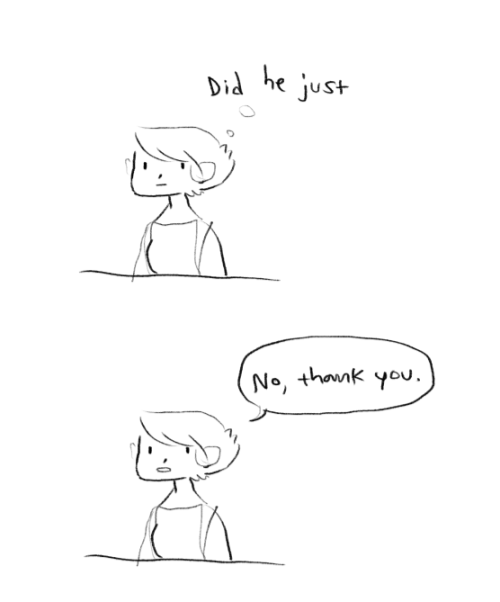
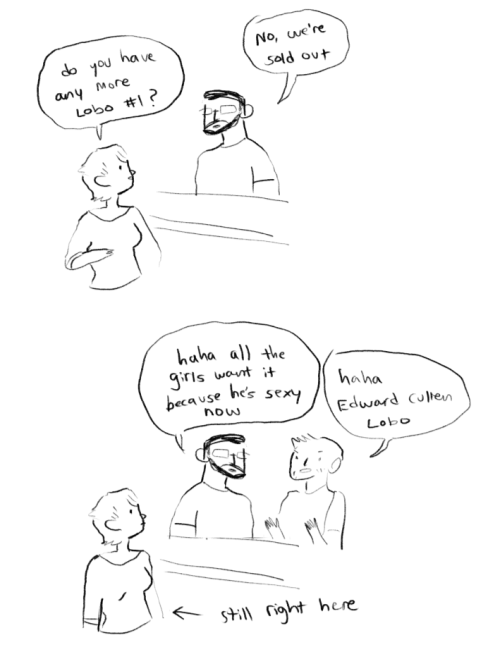
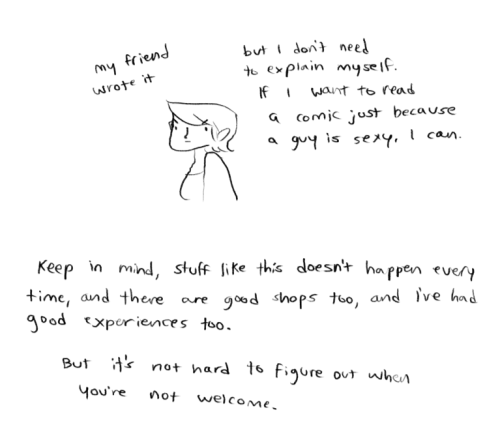
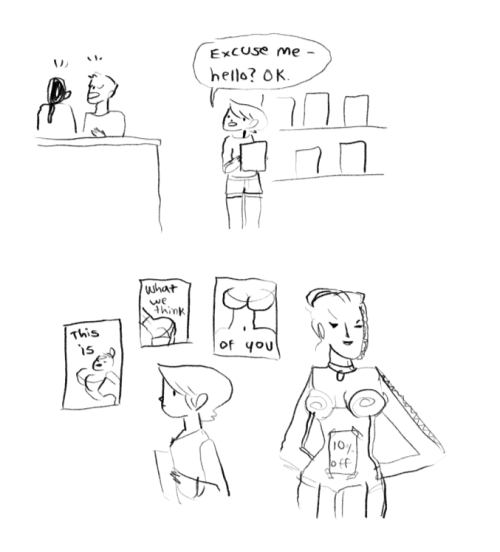
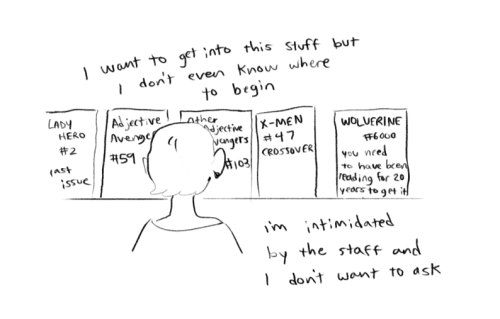
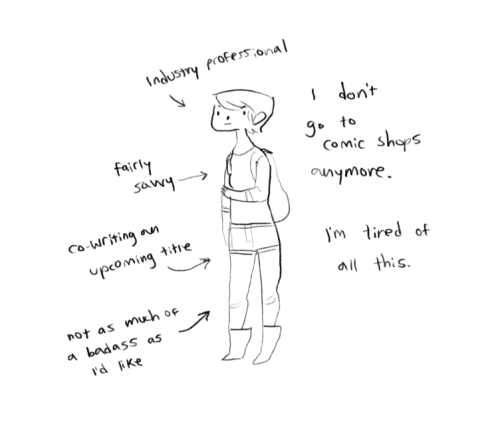
Oh, I know I have it better than a lot of would-be comics buyers, and that’s what worries me. I’ve had it with the self-appointed gatekeepers in comics. 

I hate going into the gaming stores alone. Ugh.

I will continously write this reply until I feel it sticks. Do you want to know why many male nerds are so defensive and harsh about this?

Okey, I can with confidence tell you that the majority of us started this out as a form of escapism. I mean, look at all the tumblr posts about “I love fiction, it’s my way to handle reality” etc etc. It was the same for us. suddenly.. about, idk, 4-5 years ago, feminists started to tell us that we are in the wrong for BUYING things. Instead of going to the writers, we’re the bad guys. Comics I grew up with are being torn to pieces by people who don’t read them anyway. They’re causalized because instead of catering to us, they’re catering to people who don’t really care. I know that the majority of you will go “oh, grow up!”, but you know what? Fuck you, comics were one of the things I had growing up, I emotionally connected to the Hulk, it made me feel that maybe it wasn’t so bad to be a freak.

secondly, I don’t know why women expect to get help with everything and just give up when they don’t get help. When I started out, do you really think anyone would even care about a fat, acne-cursed kid? I did ask, once, they just looked at me and told me to just read the damn comics. So I did. I got into the middle of a story, If I liked it, I tried to hunt down the first one, or the one after. Rinse and repeat. not hard. But now! NOW! You have google, I’m not even kidding, it will take you 30 secs to find ALL information you want. I don’t know why everyone think that being a nerd is “share and share alike!”, it’s socially outcast people who have been wrecked emotionally and socially by other people. You really think that they’re gonna help you without a reason?

I know, it’s really “in” to be a nerd these days, but you’re not a nerd until you know your shit. Don’t believe me?

http://www.oxforddictionaries.com/definition/english/nerd?q=nerd

Being a nerd isn’t something that you flaunt, you’re not gonna get help getting into it, you’re not gonna get praise for trying to. read, then read some more, then read even more. Then doublecheck that info. Not because you’re gonna be “safe” when trying to have people acknowledge your “nerd-cred”, but because you LOVE IT! It’s not a social thing, it has never been. It’s not about sitting around a table and going “OMG! I’m such a nerd! I read a couple of books!”.

Sounds harsh? yeah, it is. But, if you love it, it won’t matter. Cuz you will still have the time of your life. And really.. no one promised to help you. want help? help yourself.

*preparing to get unfollowed by everyone*

btw, I’m not saying that no one can like the same things as me/nerds/others. I’m saying “you’re not special for doing that” and “LOVE IT MORE! If you can’t find basic facts without being spoonfed, do you really LOVE it?”

Okay, you pedantic asshole, listen here.

You read a comic by a woman who reads, cares about, and EARNS A PAYCHECK from comics, that has been reblogged LITERALLY THOUSANDS OF TIMES by other women/minorities who read, care about, and earn paychecks from comics, and you have to gall to say that comics are “catering to people who don’t really care”?

Because you were picked last at kickball and now YOU want to be the bully. Because someone told you you weren’t worthy of something, now you want to be the one to tell other people that they’re not worthy of something. 

First you say “this is escapism for us men” and then you say “no one HELPED me get into it” as if having a medium LITERALLY CONSTRUCTED AROUND PEOPLE WHO ARE EXACTLY LIKE YOU isn’t the biggest spoonfeeding you could possibly get. 

And now there’s a whole lot of people who don’t fit YOUR very narrow definition of what a “true nerd” can be who are FIGHTING UPHILL to be a part of this thing they love that doesn’t love them back and you have the nerve to say they don’t CARE about it enough and they’re expecting special treatment. As if it’s special treatment to BE SAFE FROM HARASSMENT, SEXUALIZATION, AND CONDESCENSION IN A PUBLIC SPACE.

No one’s taking comics away from straight white men. But I certainly wouldn’t mind taking it out of the hands of men like you, that’s for sure. You’re dinosaurs. And you’re not a REAL nerd.

10 Feb 20:28

Memories Of Molestation, Ctd

by Andrew Sullivan

Another remarkable story from a reader:

My dad did things to me, similar to what Woody did to Dylan. The main difference is I’m a male. No sodomy, penetration, etc. He always used “normal” situations as cover – showers, locker rooms, bath time, the “bear trap” game, the “bare bear” game, under-the-cover “parties”, etc. All very “jockish” and Sandusky-like. Hiding in plain sight, as they say. Once when I was about 9, I asked him why we were going to church for something called “Feast of the Circumcision”. His response impressed upon me the importance of not asking questions. He was smart – 160 IQ supposedly. Good at manipulation and not getting caught.

I can’t get too worked up about the possibility that Mia “coached” her daughter. I doubt it. But even if Dylan was coached, every mistreated kid should be so lucky. I wish someone had coached me.

I had a meek obedient mother who turned a blind eye and a complicit much older sister (she may not have known about the sex stuff, but she knew about everything else). My dad was always getting fired, so we moved around the country constantly. My mom’s 60+ aunts, uncles, nieces, and nephews, who otherwise might have intervened, had long since been left in NYC, never to be seen again. My dad’s siblings stopped speaking to him years before (who knows why). My dad did a good job alienating just about everyone else, so no one came around much. We were isolated, which provided extra cover. Dylan is lucky that there were people around to intervene – and yes, even to “coach”.

In addition to his interest in young boys, my dad was violent – lots of street fighting in his teens, 20s, and beyond. He considered himself a man’s man, a tough guy. In addition to brawling with the local Italian kids (some of whom required hospitalization, he boasted), he was also a “gay basher”, to use the current term. He and his friends used to target men who looked gay and beat them up. Years later, when my dad discovered I was gay, he threatened to kill me. He disappeared for a few days, sleeping at hotels, roaming aimlessly around the south suburbs of Chicago. Death threats from my dad – both angry and “light hearted” – were nothing new. But my mom said he was acting strangely even for him, and this time the threats might be cause for concern. He was down at his office where he kept his gun. So, at age 19, I was kicked out of the house.

That was in essence the first day of my life. Despite my childhood, I’ve created a good life. Much pain and much rebuilding. Much happiness eventually. I’m proud of the things I’ve done and how I’ve lived. I worked my way through law school on part-time jobs, loans, and scholarships. I’m a good person, happy most of the time. I know Dylan will be happy one day too.

My dad killed himself a few years ago, at age 83. About three weeks before his death, I told him his care needs were becoming a burden on my sister, causing problems in her marriage. It was true. But I admit I said it to be mean, not to help my sister. It was out of character for me. I don’t normally do that kind of thing. I never would have said it if I thought suicide was possible. It is possible my words contributed to his decision to jump off the roof – nine stories.

At first I was crushed with unimaginable guilt. But gradually I lost that. Now, to be honest, I see the hand of God. I believe God wanted me to have a role in his death. Most victims of childhood abuse never get justice and they take that deep gnawing injustice to their graves. But I admit to feeling a sense of vindication in how his life ended; that he did not die peacefully in bed, but instead left this world tortured and alone on a deserted rooftop at 2AM.

I think Dylan’s letter will give her a sense of justice. She is entitled to that.

I’ll never know for sure if my words contributed to my dad’s suicide. God knows he had many other issues. But if my words were a factor, all I can say is good. Perhaps one day I’ll forgive. But for now, I just think of him up on that roof. The anguish he must have felt, is minor compared to the pain he caused me and others.

Previous posts in the thread here and here.

10 Feb 19:41

How the U.S. government spends millions to get people to eat more pizza

by Brad Plumer

It's no secret that Americans eat a lot of pizza. In fact, around 13 percent of the country is eating a slice or two on any given day, according to a new report from the USDA:

pizza consumption

It all adds up to a lot of calories: On an average day, the report notes, pizza provides 6 percent of the total caloric intake for American children and 4 percent for American adults.

But there's also a subtle policy angle here. Pizza is popular because it's delicious. But the roaring success of pizza isn't entirely a free-market story. "In recent years, [the USDA] has spent many millions of dollars to increase pizza consumption among U.S. children and adults," explains Parke Wilde of Tufts University, who runs the excellent U.S. Food Policy blog.

How the U.S. government promotes pizza

Here's what he's referring to. The USDA runs a "dairy checkoff program," which levies a small assessment on milk (15 cents for every hundredweight of milk sold or used in dairy products) and raised some $202 million in 2011. The agency then uses that money to promote products like milk and cheese. And, as it turns out, pizza.

The USDA claims its checkoff program has been well worth it: For every $1 that the agency spends on increasing cheese demand, it estimates that farmers get $4.43 in additional revenue. But the results have been mixed. Milk consumption has declined in recent decades, while cheese consumption has soared:*

MilkCheeseTrend

The program also helps pizza makers, who use one-quarter of the nation's cheese. A 2010 USDA report details how Dairy Management, Inc. (DMI), a corporation funded by these checkoff fees, spent $35 million in a partnership with Domino's to boost pizza sales:

Domino’s has partnered with DMI since early 2009 using dairy farmer dollars to develop and to promote Domino’s pizza offerings. In February 2009, Domino’s launched the American Legends line of pizza. This line featured regional specialties such as the Honolulu Hawaiian, the Cali Chicken Bacon Ranch, the Pacific Veggie, the Buffalo Chicken, the Philly Cheese Steak, and the Memphis BBQ Chicken, and was advertised as having 40 percent more cheese than Domino’s typical pizzas. Cheese also was used on the crust.

Later, Domino’s expanded the line from six to eight different pizzas, adding the Fiery Hawaiian and the Wisconsin 6 Cheese. According to Patrick Doyle, President and CEO of Domino’s Pizza, “DMI support has allowed us to focus some advertising dollars on areas we would not have considered otherwise. The Wisconsin 6 Cheese pizza has twice the cheese of a regular pizza, but we had neither developed nor advertised such a product. DMI helped fund the research and media to launch this product."

According to the report, the dairy checkoff program also worked with McDonald's to launch McCafe specialty coffees and three new burgers with two slices of cheese on them. It also helped Yoplait develop new yogurt chip technology. The program was renewed in the most recent farm bill.

So what's the problem? Critics of this program often note that efforts to promote fruits and vegetables haven't received nearly the same level of support as dairy and meat products (a few fruits do have their own checkoff programs, including blueberries and watermelons, but not many). That imbalance doesn't explain the popularity of pizza, obviously, but it's one extra unseen force at work here.

Further reading: 

-- Back in January, Siddhartha Mahanta took a longer look at the checkoff program for beef in the Washington Monthly.

-- Somewhat more randomly, here's a report on how the dairy industry is hoping that chocolate milk can halt declining milk consumption.


10 Feb 19:24

McGruff the Crime Dog busted for pot and weapons

by David Pescovitz
McGruff McGruff the Crime Dog was sentenced to 16 years in prison on Monday for possession of 1,000 pot plants and more than two dozen weapons, including a grenade launcher. John Russell Morales, 41, an actor who once played McGruff, was arrested in 2011. (NBC News)


10 Feb 17:45

Toy movie "anti-business", says Fox News

by Rob Beschizza

Fox News claims that the Lego movie is "anti-business", despite the fact that it exists to sell toys. Sean O'Neal, at A.V. Club:

the network has lashed out at the film for attempting to indoctrinate the naïve with simpleminded messages about capitalism, only for the wrong team, blasting a movie based on a global, multibillion-dollar toy manufacturer—and the reinvigoration of its branding through movie-generated merchandising—as being “anti-business.” ... As Dergarabedian goes on to suggest implicitly that calling a major studio’s marketing synergy-based movie franchise “anti-business” might be overreaching, Payne replies that it at least sounds like “hypocrisy” to him. A hypocrisy that may result in the children who see it developing antagonistic attitudes toward business, even as they demand their parents buy them more Lego bricks.

This reminds me of an odd thing about conservative media criticism: when a work of entertainment (and let me stress that I'm not yet including the Lego movie here, as I haven't seen it!) weds a superficial criticism of greed to a more insinuating portrayal of its virtues, it doesn't get praised as a particularly devilish contribution to the cause. Instead, it meets the full brunt of criticism, as if the superficial message was the only one. Moreover, that criticism often focuses on the alleged superficiality of the whole.

Here is a deep mistrust of ambiguity, and an overwhelming belief in marketing as the maker of the message. Conservatives, moreso than others, worry that to be exposed to even a skin-deep "inoculation" or gloss on a movie or book's greater purpose, however manifestly opposite that cover story is to the author's creative intent, is to risk terminal moral infection.

That said, it's also true that Fox has an off-the-shelf story format--movie says greed is bad, woe to our culture--into which any old subject can be shoehorned if a sentence-worth of description matches the pattern.


10 Feb 17:42

Inspiring!

by Josh Marshall

Incredibly inspiring to see anonymous NFL execs and now a prominent ex-NFL coach dumping on a top NFL draft pick who just revealed he's gay and would likely be the first openly gay player in NFL history.

10 Feb 01:00

Finding Peace In Prison

by Andrew Sullivan

Emmanuel Vaughan-Lee’s short documentary “Path of Freedom,” above, shows us how inmates at the John J. Moran Prison in Rhode Island have embraced meditation. Producer Dorothée Royal-Hedinger wrote about what she saw while filming behind bars:

The hour-long meditation class was a place many prisoners felt they could be themselves. Their mindfulness practice, they stressed, was not an escape, but rather a tool that helped them come to terms with the reality of their situation. One prisoner explained, “Once you come to prison, your life keeps tumbling and tumbling and it’s like a never-ending wall that won’t stop building…unless you find a way to get over that wall, or at least in front of it.”

The meditation course gives the prisoners the space to confront their guilt, remorse, grief, and anger; it also opens up the possibilities of making positive choices, no matter how small. As one prisoner expressed, “Someone has given us an opportunity to meditate and connect ourselves. That’s golden.”

(Hat tip: Paul Rosenfeld)

08 Feb 22:12

"We might imagine a great intelligence setting people on an island and telling them that they must..."

Zephyr Dear

And the moral of the story is that the great intelligence is an asshole. Right?

“We might imagine a great intelligence setting people on an island and telling them that they must travel to find a desirable place to live. They can choose any direction in which to travel, and do anything they wish on their journey. But this intelligence knows where the jungles, caves, swamps and dangerous animals are on the island, and so can predict very well the sorts of things that will happen to all those people. Also, the intelligence knows that at the far end of the island there is a beautiful city in which each person can find whatever they like best. Even the supreme intelligence cannot tell exactly what journey each person will make, what dangers they will encounter and how they will react to them. But it can be confident that a great many of them will find their way to the beautiful city and remain there – because that, in the end, is the only place they will be safe, happy and fulfilled.”

- Keith Ward (via kindle.amazon.com)
08 Feb 03:26

Can we all just agree to build permanent Olympic stadiums somewhere?  I know it’s supposed to...

Zephyr Dear

switzerlaaaaaaand

Can we all just agree to build permanent Olympic stadiums somewhere?  I know it’s supposed to symbolize international cooperation and such to move them around, but in practice, the Olympics have come to symbolize “let’s find one of the few countries rich enough to support this stuff, encourage them to financially and socially trash a city, then leave behind gigantic overly-specialized sports facilities that no one will ever use again.”

Let’s just find a place that has some mountainy parts and some flat parts, is snowy in the winter and warm in the summer, and say “Okay, this is where the Olympics are going to be from now on. Everywhere else on Earth, you can stop building fuck-off enormous stadiums and kicking out all your homeless people every two years.”

08 Feb 03:25

Yo, here's something I don't give a shit about: privileged white people competing in a dumb, archaic competition of athleticism, that is being held in a bigoted, dictatorial country, and then posting pictures on the Internet about how their living conditions aren't cozy enough. Fuck the Olympics.

Fuck that bullshit, for sure.

08 Feb 03:21

PSA for the shy, sexually inexperienced, maybe-queer, maybe-bi, maybe-asexual ladies who send me letters about finding someone to snuggle and/or date:

by JenniferP

YOU.

ARE.

LEGION.

You are not alone in writing a (usually beautifully written, well-spelled) note about how you are looking for someone to hang out with and maybe make out with and cuddle but without pressure or expectation of doing more.

You are not alone in feeling like traditional “dating” situations and advice don’t work for you. Common worries: Too much pressure to “come out” and/or categorize yourself in some way, worried that people won’t be satisfied with what you are able to give, worried about being harassed by 10,000 creepy dudes, body image issues, shame about being a late bloomer.

We’ve covered a lot of this on the site already in other threads about meeting new people and dating, but I get, easily, three or four of these specific (female, somewhere on the queer/bi/ace axis, looking for someone who will go really, really slow with sex stuff) letters per week. You are not alone! You are not alone.

I’m resisting a serious urge to matchmake here, like the way I wanted all the ancient statues without heads to go to a party with all the ancient statue heads when I went to the art museum as a child. But I don’t know where anyone lives and that would be creepy and violate all kinds of anonymity.

Perhaps some kind of open thread could be created in the forums at http://www.friendsofcaptainawkward.com for you to talk to one another? Perhaps you could join one of the conventional dating sites en masse and use a special hashtag or code word in your profiles to find each other?

I wish you sweet blanket forts with respectful, adorable, terrifyingly amazing people like yourselves. But mostly I want you to know: You are not alone.

<3,

Jennifer


08 Feb 03:18

→ Employee Stock Options as Explained By an English Major

By my friend and former coworker, Meaghan O’Connell:

If you’re an early employee and the company is new, your options are pretty much worthless for now. If the company succeeds later on, though, this is to your advantage. This is why people shittier than you always want to “get in on the ground floor.” Getting in on the ground floor just means you paid less to get more. Your “strike price” is way lower, and maybe you got your option grant before they hired a lawyer who advised them to stop giving people so much stock, you newbs, you’re giving away the farm.

TIP: Always join a company before the lawyers do.

Wise words.

∞ Permalink

07 Feb 22:17

The Job Losses Republicans Ignore

by Andrew Sullivan
Zephyr Dear

And class tyranny. From capital's point of view, it's a tragedy when the workforce shrinks, and a cause for celebration when large quantities of people are desperate for a job.

Ezra spotlights a massive contradiction:

In context, the freakout over the CBO estimate is perverse. Is it really the Republican position that we should do nothing – - in fact, cut aid — for the millions of long-term unemployed, but express shock and terror that employed people will, in a few years, cut back their hours or leave the labor force by choice? Shouldn’t we be more concerned about people desperate to join the workforce, who can’t, than about people voluntarily leaving the workforce, who can?

Some Republicans will say, of course, that they don’t oppose helping the jobless. They just oppose increasing the deficit or increasing taxes to do so. But repealing Obamacare raises the deficit, too! So rather than increasing the deficit to help people who want jobs get them, we would be increasing the deficit to make sure people who want to leave their jobs can’t. That’s insane.

It’s not insanity. It’s just the result of a party that defines itself solely by being against whatever the president believes. It’s nihilism.

07 Feb 22:08

http://gingerhaze.tumblr.com/post/75864165776


07 Feb 21:59

Perkins 2.0

by Josh Marshall

Billionaire Sam Zell says denigration of 1% must end, "we just work harder." Watch.

Notably Zell's recent work has focused on destroying a series of historic news organizations.

07 Feb 21:57

The CatFoxWolf genderfluid vestiary roundup. Dress however you...


The CatFoxWolf genderfluid vestiary roundup.

Dress however you wanna dress. You’re killing it.

07 Feb 21:53

myths I believed about women of the Bible

by forgedimagination

bathsheba

One of my blogging friends, Libby Anne at Love, Joy, Feminism, has been going through Debi Pearl’s Created to Be His Help Meet a few pages at a time– she’s where I got my idea to break down Fascinating Womanhood. Libby Anne’s gotten to the part of the book where Debi uses Bathsheba as an example of everything a woman shouldn’t be, and blames Bathsheba almost totally for everything that happened– both to her and to David and his family. She’s the biblical face that sunk a thousand ships, as it were.

Reading over Debi’s description felt oh-so-familiar. It was exactly what I was taught about Bathsheba. A quick review of church history– its art, its commentaries, its sermons–  reveals that it’s how most Christians talked about her, too. Bathsheba, to many Christians, was a slutty whore. As I’ve grown into egalitarianism and feminism over the past four years, I’ve become increasingly uncomfortable with that interpretation. There’s no crystal-clear explanation in II Samuel 11 that Bathsheba didn’t consent, but that’s hardly surprising since Bronze Age cultures had no (or little) conception of female consent. Regardless, David was the warrior-king, the warlord, and how exactly was Bathsheba supposed to say “yes”? Consent matters very little when there’s no real possibility of saying no and having that no be respected.

But then, Libby Anne pointed something out that I had completely missed: that the text actually does make it completely and utterly clear that Bathsheba had absolutely no part in what happened to her and she was not to be held responsible. It says it, plain as day, when the passages specifies that she was “purifying herself from her uncleanness” in verse four.

Bathsheba wasn’t bathing on her roof.

Bathsheba was in the mikveh. In the communal pool, the one designated for ritualistic cleansing, the one constructed for privacy, and the one David would have KNOWN naked women went into at least once a month, as the Law commanded.

And not only that, any time David’s actions are discussed anywhere else in Scripture, it is always to place the full, unmitigated blame totally and squarely on David. Never, not even once, is Bathsheba mentioned. She did nothing– nothing– wrong. Considering how severely the Law treats women who “play the harlot in their father’s house” or commit adultery (ie: stoned to death), that any supposed wrong-doing on her part is never even mentioned is pretty strong evidence that David raped her.

Reading that this morning was… beyond mind-boggling. I read that passage my entire life, have heard countless sermons preached on it, and what I walked away with was that Bathsheba was a slut.

The same thing has happened to virtually every other women in the Bible.

Deborah? Just a punishment for men being cowardly and lazy. Huldah? Huh, who’s that? Oh, just some random woman that read the Torah. Forget about how she was a contemporary of four other male prophets. Obviously she’s just there to prove how ungodly Judah had become. Junia? Nope, not an apostle. Dude, she’s not even a woman. Mary Magdalene, the person the Resurrected Christ appeared to first? Also a whore– she was obviously a prostitute. Please ignore how there’s not even a single shred of evidence to support that.

What’s the only thing we know about Sarah? That she mocked God. What did Rebekah do? She manipulated and lied. Rachel? Was a whiny little brat that stole her father’s idols. Danah? Also a slutty slut, nevermind that she was also raped. Eve? Weak and easily deceived, also responsible for the destruction of the human race because she was a fool. Satan knew that Adam was much too smart, much to good, to be deceived. The song of praise and honor meant for all women in Proverbs 31? It’s a list of commands now, you have to do all of it or you’re a worthless good-for-nothing wretch. What do we remember about Hannah? She was discontent with her husband and needed a baby to be happy.

Over, and over, and over again it seems that most Christian theologians over the past few thousand years have spent an inordinate amount of time and energy doing anything possible to discredit and destroy every single last positive example of womanhood in the Bible. It’s so deeply buried in Christian culture at this point that it seems incredibly rare for someone to even bother to show women in the same light that the Bible showed them: as human, yes, but also as glorious, courageous, magnificent, brave, intelligent, dedicated, loving Daughters of Abraham, Heirs of God.


07 Feb 21:49

The Long Twilight Struggle to Take Away Your Health Care Coverage

by Josh Marshall

You know that many states didn't set up their own Affordable Care Act exchanges. Many of the same states refused to accept Medicaid expansion, despite the fact that participating states will only have to pay a tiny percentage of the cost. Now there's this: If you live in a red state and need to use the federal exchange and are eligible for a subsidy, now a growing number of conservatives wants to prevent you from getting that subsidy.

Just because ... well, just because apparently it's really, really important that you not get access to health care insurance. Sens. Cruz, Rubio, Lee and others have signed an amicus brief in support of the lawsuit which is trying to block these subsidies and then there's this email I got last night from TPM Reader JW who notes State AGs who are also on board ...

Read More →
07 Feb 21:30

Al Mohler’s Nihilistic Man vs. Bill Nye’s Reasonable Man

Al Mohler’s Nihilistic Man vs. Bill Nye’s Reasonable Man:

Here is how Mohler articulates his argument:

The problem with human reason is that it, along with every other aspect of our humanity, was corrupted by the fall. This is what theologians refer to as the “noetic effects of the fall.” We have not lost the ability to know all things, but we have lost the ability to know them on our own authority and power. We are completely dependent upon divine revelation for the answers to the most important questions of life. Our sin keeps us from seeing what is right before our eyes in nature. We are dependent upon the God who loves us enough to reveal himself to us—and to give us his Word.

This is a very radically negative view of human nature that could be referred to as Biblical nihilism, namely that our minds are so broken that “we are completely dependent upon divine revelation for the answers to the most important questions of life.” I’m not sure that Mohler has thought through the implications of his statement, which seems like an undigested doctrinal assertion, but to use it as he does to argue for Young Earth Creationism is to say that no scientific knowledge gained through genetics, biology, paleontology, archaeology, and so forth can be trusted because the human scientists who discovered this knowledge were so wicked that they were kept “from seeing what is right before [their] eyes in nature.” In other words, the fall of Adam and Eve are the reason that carbon-14 dating has been lying to us all this time.

Who then can be trusted if we cannot trust what is right before our eyes? Well, the Bible of course, but not just any reading of the Bible — only those who read the Bible sharing Al Mohler’s presupposition that humanity is totally depraved and nothing outside of the Bible can be trusted as a reliable source of knowledge. Mohler’s Biblical nihilism thus creates an elite category of Christian teachers who “get it.” Since the masses cannot know anything “on their own authority and power,” there is a tremendous need for them to have a teaching pastor on whom they can depend to interpret God’s word to them and thus to whom they give all their authority and power.

The doctrine of total depravity is why the Calvinist Southern Baptists have the biggest, most thriving megachurches. It’s a very successful business model: to create a tight authoritarian culture built on the nihilistic fear that we cannot know anything “on our own authority.” And it’s entirely self-serving when you’re at the top of the pyramid like Al Mohler. The more radically Mohler talks about the human inability to know anything for ourselves, the more power he gives to himself as a Biblical teacher who gets it.

07 Feb 01:08

work has no value

First of all: value is a phenomenon of perception. Valuation, gradation, hierarchy etc seem necessary to process sensory input. Without these things, information can seem like a boundless and unapproachable mass that is difficult to distinguish from ourselves or respond to (in my opinion).

Of course input and response patterns that lend themselves to survival would survive. Even though survival isn’t on the line for most of the affluent world, we still use lots of old, desperate ways of thinking from when it was.

One old and shitty way of thinking about life is that “work” matters or has value in some objective way.

We have more than enough food, housing, clothing and clean water for everyone if we agreed to ensure access to these things. So the suffering, want and worry in human culture comes from human thoughts and values, not from anything lacking in the physical world.

Since value is perceptual, the value created by “work” is also perceptual. Two people can perform identical actions but they may not both have that action perceived of as “work” or be valued equivalently.

A “skilled” worker wants their work valued differently than an “unskilled” worker. In our current culture, most of us would like to see the time and effort of training, education and practice reflected in compensation. Placing this value on the worker seems just as arbitrary as any other valuation.

The increase in perceived value of a skilled worker could also be compensated for by supporting the worker’s family, community, educators, trainers, etc. We could compensate the space and context within which the worker becomes skilled. In some contexts, we feel that skilled workers don’t require any extra compensation at all.

I’ve seen some “creatives” go from tentatively, ashamedly speaking about the value of their work to demanding that their time or effort deserves a particular level of compensation now that they are a certain age, have some responsibility, or have accomplished whatever. Some of this seems good — we can learn to value ourselves and find contexts to support this self perception.

Some of this seems like uncritical acceptance of a pretty mediocre system of values. We don’t “deserve” anything “good” or “bad.” If value is perceptual, this extends to our most precious concepts and desires, including our selves.

This is important to us because the systems of value we incorporate into our selves change the shape of our lives. A complaint I have heard about “post-modernism” is that it seemed like a “word game” which I think might have been “the point.”

The story we tell when we say that our work has value implies the existence of things that are “not work” and the existence of activities and people that do not “deserve” (within this transient system of perception) compensation, value etc.

Accepting the positive judgments of our culture can help us feel externally valued but also accepts the devaluation of other activities and people. If my work and time is positively valuable it can only be so in contrast with another whose work and time is not valuable.

Some people can sit still in a quiet room for hours and get paid for it. Other people have a hard time finding someone who will pay them for anything. We’re all bizarre walking nuclear furnaces that absorb organic matter to feed the microscopic animals that live inside of and are us, and we communicate in person via interruptions in the breaths we emit from our combination air and food hole.

From this kind of awareness of our ridiculousness, I think, it makes more sense to live and communicate in a way that admits the constantly fluctuating systems of value we engage with are: arbitrary, damaging, sad, funny, surreal and need to change. The way these systems change needs to change.

No amount of self-awareness can cover up our participation in systems that, even through the language they use to establish themselves, persistently seek to devalue “the other.”

Because if you try to examine “the other” without valuation or hierarchy, you find that like everything else, it is boundless, incomprehensible, impossible to define, and you.

06 Feb 21:12

America And The Protestant Work Ethic

by Andrew Sullivan

Max_Weber_1917

It’s struck me that there is an underlying anxiety to several of our current debates on economic and social issues. That anxiety is that the American work ethic – unparalleled in the developed world – is under threat. That’s the real critique of Obamacare – as opposed to the mendacious “two millions jobs lost” line. A reader writes about his own experience:

My job for the past 20 years was recently eliminated. I am 63 and originally planned to work until at least 65 for one reason: Health Insurance.

If I had to enter the old insurance market at my age, with pre-existing conditions, it would be unaffordable and I would have had to look for work that offered insurance. With the ACA, I can afford health insurance until I am 65, and for that reason I have decided to retire rather than look for work. That provides an opening for someone younger to get a job I might have taken. And I get to enjoy an earlier retirement, spend some of my money on things other than insurance, and be one less person competing for a good paying job. A win-win for the country in my eyes.

Hard to argue with that – but it does mean a relaxation in the work imperative – and that’s worth debating. Or I think of myself – a small business owner with serious pre-existing conditions (HIV, chronic asthma, mild depression). Until Obamacare, it was unthinkable for me to be unemployed at any point, because of the health insurance issue. I was always terrified of losing access and being bankrupted by treating a disease I could not get insurance for. Now (if I were not neck-deep in Dishness) it’s conceivable. I feel empowered by the ACA not to work if I choose to and have the savings to take a break. There are a zillion different scenarios in which the guarantee of health insurance removes the absolute necessity of working if you have some savings to fall back on.

Or think of our debate about social mobility and inequality. With wages stagnant for most Americans since the mid 1970s, and hard, often back-breaking work failing to provide real gains in income, doesn’t the logic of the work ethic get attenuated? Isn’t it also affected by your knowledge that many people at the very top of the pyramid rake in unimaginable dough for working far less hard than your average teacher or healthcare worker? And isn’t the vast accumulation of wealth among so few itself a contributor to the decline in the work ethic, since it provides so many dependents with such easy, unearned cash? It’s not just the left that has created these disincentives. Global capitalism has done its part as well.

Or take the issue of marijuana legalization. One strong thread in the opposition is the fear that we’ll all stay on the couch, binge-watch Netflix and sleep in late, while the Chinese eat our lunch. And it’s strongest among those who experienced the American dream – the over-60s – than among those for whom it seems like a distant memory – the under-30s. And then there is immigration reform. Isn’t there an obvious, if unstated, cultural fear here that Latino culture is less work-obsessed than white Protestant culture (despite the staggering work ethic of so many Latino immigrants)? Beneath the legitimate concerns about border enforcement and security – which Obama has beefed up beyond measure, by the way – there is an anxiety that the core identity of America might change. We might actually begin to live more like Europeans do. Heaven forfend.

At the core of this is a real debate about what we value in life, and what makes life meaningful.

And that’s a real debate we need to have more often and more publicly. Work is an ennobling, mobilizing endeavor. It is our last truly common denominator as Americans. But what if its pre-eminence is unavoidably weakened by unchangeable economic forces? What if the accumulation of wealth through work is beginning to seem like a mug’s game to more and more, trapped in a stalled social mobility escalator? Why wouldn’t people adjust their values to fit the times?

I have to say I feel conflicted about this. I’m a pathologically hard worker, and for me, the American dream remains not only intact, but still inspiring. I believe in work. I don’t want the welfare state to be a cushion rather than a safety net. At the same time, it seems to me that as a culture, we have a work ethic that can be, and often is, its own false idol. The Protestant work ethic we have, for example, is the imperative for industrious striving, self-advancement and material gain. It is emphatically not about being happy. And at some point, if those two values are not easily compatible, something will give.

And would it be such a terrible thing if exhausted American workers were able to take real vacations of more than two weeks a year; or if white-collar professionals could afford to take a breather in mid-career without worrying about their health insurance; or if 63-year-olds like our reader could actually enjoy two more years of leisure at the end of their careers? Would it be so awful if more Americans smoked pot and were able to garner a few more moments of chill and relaxation rather than stress or worry? How damaging would it be if a little Catholic, Latin culture mitigated the unforgiving treadmill so many of us are on?

As I say, I’m conflicted on this. I struggle every day with a saner balance between work and life, and work has consistently won. But the older I get the more I treasure not the money but the time I spend on this earth. I weigh the benefits of incessant work against the new friends I never make, the books I never read, the vacations I find hard to take, the empty afternoons that make life worth living. And, as in any individual life, the life-work balance needs adjusting over time in a society as a whole.

At what point, in other words, is the pursuit of material wealth eclipsing the pursuit of happiness this country was founded to uphold? Is the correction against the Protestant work ethic a destruction of the American values – or actually a sign of their revival after a period of intense and often fruitless striving? I suspect the latter.

(Photo: Max Weber, 1917)

06 Feb 20:46

Get To Work, Dammit!

by David Kurtz

Colbert: “People should be chained by the need for health insurance to jobs they hate.That’s what built this country!”

06 Feb 19:27

and yet ANOTHER internet controversy!: going to church

by forgedimagination

battle
by Wolfgang Hohlbein

Honestly, when all of this hubub showed up on my facebook feed on Monday, I was quite honestly just … bored. I read Donald Miller’s original article, “I Don’t Worship God by Singing, I Worship Him Elsewhere,” and my only thoughts were, “oh, that’s neat.” And then I read a dozen buzzfeed articles on cats. I really like Donald Miller, and Blue Like Jazz has been on my wishlist for ages, but this article didn’t say anything radical– at least not to me. Another person has discovered that– spoilerGod doesn’t just exist in church. Yay for everybody.

But then I saw so many conversations spring up– on facebook, on twitter, in comment sections– and it took me by surprise. Why are people talking about this? Some dude doesn’t regularly attend his church and this is worth talking about? Ok, then, world, you’re a strange beast.

And then this happened.

And this.

And… this.

And then The Gospel Coalition threw their hat in the ring.

And Donald Miller responded.

Even after following all of that, and reading through a number of conversations, I still don’t get it. Mostly because I think that most of the people having these conversations deeply misunderstood Miller’s original point, which was that church hasn’t been the best way for him, personally, to have a good relationship with God. Since that’s been true for me basically my entire life– and true for mostly everyone I know– it just seemed… ho-hum. Like he was just saying out loud what everyone already thought. Most Christians go to church, that’s true, but I think if we were all being honest with ourselves we’d admit that nope, church attendance isn’t really the cornerstone of my relationship with God.

I guess not.

Miller’s already addressed anything I would say about the general arguments, but there is one path in particular I wanted to follow, because it especially leaped out to me because of my religious background. It’s encapsulated pretty well in “Donald Miller’s Prescription for Spiritual Suicide” by Denny Burk:

I don’t know what else to say except that this is profoundly disappointing. Not only that, it’s also dangerous. It’s a recipe for spiritual suicide. I am not denying that people have different learning styles. I am denying that different learning styles in any way trump what God has said to us about His church. The scripture is very clear that the local church is the matrix for Christian discipleship. In short, you cannot be a follower of Jesus and be indifferent about the church.

First, and you all probably know I’m about to say this: anything that comes after “The Bible Clearly Says” is not something I’m going to give a lot of attention to. Burk almost lost me at that paragraph, but I finished the rest of the post, which he ended with how “nothing could be more dangerous to your soul” than … not attending church regularly.

I don’t attend church regularly, and I don’t for entirely different reasons than Donald Miller. A huge part of it is that I’m just not the healthiest person, but the biggest part of it is that almost nothing is more damaging to my faith or my relationship with God than going to church.

Seriously. When I muster up the strength to face a church service, I sit through the entire thing cringing most of the time. Most of my negative experiences have little to do with anything happening at the church service I’m in, to be clear. Most of the time, it’s because my pastor occasionally does or says something that reminds me of them– my abuser, my cult-leader– and, although it’s nothing really to do with this pastor, or this church,  I spend the rest of the sermon fending off a panic attack.

Rarely, though, something happens in a church service that makes me walk out of the building saying fuck it I’m not putting up with this shit anymore fuck it all to bloody hell fuck God fuck his church fuck all these bloody people I’ m never coming back to this fucking place.

Welcome to the inside of Samantha’s head when she’s disturbed by how blind the church can be to how evil the world is and how the church can hurt people.

Anyway, what I think most of Miller’s critics have completely and utterly missed is that a traditional church service is not the same thing as community, as worship, as anything like what’s described in the New Testament. I mean, it doesn’t take a Bible scholar to read Acts of the Apostles and see that church services mostly consisted of everyone getting together for dinner and then talking about Jesus. I don’t exactly need song leaders and sermons for that.

But, again, in all these conversations about “church” there’s a huge part that’s missing: there are people who have been abused by churches, by pastors, by religious teachings, and that most of what’s hurt them happened during church services. Telling people like us that avoiding our triggers, that staying mentally healthy, that struggling to have any faith at all outside of the environment that causes us so much pain is a recipe for suicide is wrong. That all of the people who don’t go to church for whatever reason are horribly bad, neglectful, uncaring, un-spiritual Christians– if we even get to be Christians at all, which according to people like Denny Burk, that’s not even an option.

No, I don’t go to church very often. But, honestly acknowledging that church is not a safe place for me, and overcoming all the mountains of guilt and shame I feel when I don’t get out of bed on a Sunday morning has been the best thing that’s ever happened in my relationship with God.


06 Feb 18:43

Risking Regret

by dbrady

Just north of Moab, Utah, a sandstone fin called The Lion’s Back rises about three hundred feet above the blowsand of the desert floor. It’s closed to the public now, because the public can’t be allowed to have nice things, but it used to be a famous Jeep trail. If you are a fan of scary youtube videos, you’ve probably seen the famous crash that happened there years ago (don’t worry, no one was hurt died). But back in the 1980’s, before the Jeepers really discovered it, it was just a big rock up behind the city dump.

When I was 14 I jumped off the top of it.

lions_back

You Wait What, Off The What of the What Now?

Oh, relax. I had a rope. I even had responsible adult supervision! Well, I had adult supervision at any rate.

My mom was pretty overprotective of me, and when my friend Kenn called and said “A big group of boys and girls from scouts and church are going rappelling today, do you want to come?” I was very excited but also pretty sure I wouldn’t be allowed to go. I remember asking my parents, and my mother making her “worried disapproval” face. But then Dad turned to her and said,

“If you don’t let him go now, when will you?”

Two hours later I was up past the dump near Lion’s Back learning how to rappel.

They chose a small fin next to Lion’s Back and set up practice stations for us. The first jump was maybe five feet high: just high enough to learn how to lean back into the harness. The next was ten or twelve feet: here we learned to work our way down the face. The final station was thirty feet high, enough to get a couple really good bounces off the rock as you came down the rope.

We had arrived in late afternoon, and there were enough of us there that by the time I had tried all three rappelling stations, the sun was starting to set. I figured that was the end of the day, and that it had been a lot of fun. I was really happy I’d come, and I really didn’t see what Mom had to worry about.

“All right,” hollered Kim, our rappelling instructor. “We’re running out of light, so anybody that wants to jump Lion’s Back, we’re going right now.”

Maybe Mom Was Right

I turned around from the tiny fin we had been practicing on. The Lion’s Back went straight up in front of me over 300 feet. I had a sudden attack of vertigo and I wasn’t even looking down. I remember thinking, “I’ll let the other kids go, and if it looks okay, then maybe I’ll try it.”

I think a bunch of us were thinking the same thing, and had the same looks on our faces, because Kim then said “It’s a half-hour hike to the top, and we only got time for one jump, so if you ain’t coming right now, you ain’t coming.”

I knew this was my one chance. I looked at the cliff again. So high, so impossibly, terribly high. The only thing a rational human could do from up there was fall instantly to their death. I mean, obviously. I sighed, and decided not to go, and looked down at my feet.

But then something happened. A tiny little voice in the back of my head piped up and said,

“If you don’t do this right now, you will regret not doing this for the rest. of. your. life.”

I looked back up at the cliff. Yep, still terrifying. But I looked over at Kim and said “I’m coming.”

Fear Is Intense, But Regret Is Forever

By the time we got to the top and anchored our rope, the sun was low over the horizon, starting to turn the desert flame red. Being the chivalrous young men that we were, we let the girls jump first. It was a long drop, and it took each person maybe ten minutes to get down the rope and the next person to get hooked in. By the time the boys could go, the sun was starting to dip beneath the horizon, bathing us in dusk. I was about third from the last, so as jump after jump happened in front of me, dusk came and went, and night settled upon us.

Remember, this was when Moab was a boom town gone bust: there was no light pollution. There was no moonlight to jump by because it was very close to New Moon, but just by starlight alone I could see for miles and miles, the once-red sandstone fins now blue and black but still clearly visible, marching off into the high desert as far as the eye could see.

I figured I could maybe just not jump and hike back down. Since it was dark and all, obviously I wouldn’t be expected to jump. But still that voice told me, convincingly, of the lifetime of regret I would have if I chickened out.

Kim had been bantering with us the whole time, making jokes about how it was such a lovely night for some rappelling, that sort of thing. And suddenly it was my turn. Kim could tell I was terrified, and was about to back out. He smiled kindly, and said in his soft cowboy drawl, “David, me’n your dad used to work at Rio together. We was on the mine rescue team together, and I took him rappelling, too. We’ve jumped some pretty crazy stuff, me’n your dad. But he ain’t never done a night jump. If you tell him you walked back down the trail with me, he’ll understand.”

He could have appealed to my pride, told me how jealous my dad would be if I jumped. He could have urged me to jump, pressuring me a dozen different ways. But all he did was show me what the choice to give up looked like, and reassure me that it would be okay. And it’s taken me nearly thirty years to figure out just how wise his words were: he put the full weight of the decision and the consequences on me, and took the fear away from the decision itself. This was exactly what I needed.

“I’ll never forgive myself,” I said as I straddled the rope.

Kim grinned from ear to ear as he started the safety check. “You’re right,” he said to me quietly. “You never would have. But now… here you are instead.”

Owning Choices Is The Only Way To Own Consequences

The rappelling rig was a friction-stop rig, which meant that to stop, all you had to do was pull down on the loose end of the rope. Unfortunately, this meant that for a stick-thin, 100-pound teenage boy, just the weight of 300 feet of rope hanging down from me was enough to lock up the rig. Kim laughed. “You’re literally gonna have to haul the rope up and pull yourself down the first twenty or thirty feet. It’s okay. Just start walking backwards, and remember not to sit down, just lean back.”

I hauled up on the rope, and it started letting me inch backwards over the edge. For the first twenty feet or so the slickrock curved away, and I was unable to resist the urge to keep my torso vertical. My descent became more and more difficult as my body slowly bent into a sitting position. Above me and now out of sight atop the fin, Kim called down: “David! Lean back!”

I leaned back.

Imagine for a minute that you are not leaning against a mountain, but standing on a wide, flat sandstone floor. Behind you, hundreds of feet away, the desert floor rises like a wall. People are walking around on the wall and if you could turn around, all you would see is the tops of their heads. But you can’t turn around. You can only stand there, hanging in free space, staring at what is directly in front of you:

Infinity.

The stars went on forever. The Milky Way blazed as brightly across the sky as I’ve ever seen. Outside the band marking our galaxy, blue-white dots pierced the utter blackness. And in the gaps between those stars, the inky void of space went on and on to eternity.

There was no up or down to it, just infinite thereness, right in front of me. I stared, openmouthed, at the night sky I had looked at thousands of times already… but somehow, never, ever, actually seen. It spread out before me with a beauty that still, thirty years later, takes my breath away.

And Owning Bad Consequences Is Easier When You Owned The Choice

The sound of a titanium anchor piton snapping is very distinct. To this very day, that single, sharp Tink!, so quiet yet somehow louder than a rifle shot, followed by the gentle feeling of weightlessness as the sandstone began to fly up past my feet, will always be a thing that never actually happened because gotcha.

In reality, I rappelled down Lion’s Back in fine form, had a blast, and formed a memory that will burn bright in my mind until I die (or get Alzheimer’s as karmic retribution for the previous paragraph). That day I swore to never back away from a choice if it would leave me with a lifetime of regret.

And I’ve had to own a lot of consequences as a result. I’ve made bad decisions. I’ve made bad calls. I’ve made bad estimates, done the wrong work, shipped the wrong product at the wrong time to the wrong people. I have permanently screwed up the lives of a few people. I have deeply hurt many others. And I have offended so many people that I’ve lost count. All because I made a choice and took a risk that didn’t work out. And you know what? I don’t feel good about any of those consequences.

But I don’t feel ashamed of the choices. I made the best call I could at the time with the knowledge and abilities I had. Don’t get me wrong–sometimes it takes me a long time to forgive myself when I say or do something hurtful or ignorant or blithe or just plain dumb. But it’s so much easier than forgiving myself for not making a choice and choosing to own it.

Of course I’m only talking about the bad choices I’ve made here. I’ve made lots of good ones, too, and owning the choice is the reason I don’t feel guilty or ashamed that I get to have the nice consequences. There are lots of great things that happen to me on accident, and sometimes I even feel good about them. But sometimes I was just in the right place at the right time with the right skin color or nationality or gender. I can accept those and appreciate those and be grateful for those, but I can’t really own those. And that’s what I’m talking about here: the kinds of choices you can own, and owning them, and owning the risk of choosing–regardless of which side of the choice you took. That’s how you own the consequences.

You Never Regret Taking The Risk

I want to clarify that sometimes the risk is to take the safe path instead of the path everyone expects you to take. I’m not talking about being reckless, or risking more than you can afford, or making a decision before you need to without gathering the information that you need. That’s knowingly making the wrong decision, and there’s no prize for that. That’s stupid at best, and evil at worst. When I say “taking the risk” I mean studying out the odds, calculating the costs of failure, and deciding if the decision is important enough to get wrong.

So you know the kind of risk I mean. The kind where you have the information you need, you know what success could look like, and you know what failure could look like, and you know exactly what living another day without choosing looks like. That decision. THAT risk.

I have never regretted taking that risk, success or fail.

Of course I don’t mean I’ve never regretted a bad decision. But having the chance to make that decision, and thinking I had enough of the right data, and then making the choice–taking the risk–to the best of my ability? Never. Not once. I’ve never cared for the question “what would you do if you knew you couldn’t fail?” It doesn’t motivate me because I can’t know that I can or cannot fail. But Brené Brown rephrased that question into something so much more beautiful that I now keep it on a post-it on my monitor: “What’s worth doing even if I fail?”

That’s the kind of risk I’m talking about here.

I just tried to think of the dumbest risk I’ve ever taken and I ended up spending over an hour writing and deleting and starting over with just the things I’ve failed at this month. I could be the poster child for failure. Not just because I’ve failed so much, so hard and so often, but because I would also look hilarious on that poster.

So What’s With All This Regret And Risk Stuff?

Dumb choices are not the enemy. Big risks are not the enemy. Crazy failures are not the enemy.

Paralysis is the real enemy here.

If you have a choice in front of you, and you don’t want to make it, there’s a hundred things I could say to you. I could remind you that every day you don’t decide, you slide closer to being stuck with the default choice. I could point out that success would be just so awesome. I could say that you miss 100% of the shots you don’t take.

But I’m not going to. I want you to look at that choice, and look at that failure. Just look for a moment. Look at walking down that mountain instead of jumping off of it. And remember: We’ll understand. Stop being afraid of that walk. If you can own that side of the choice, you’re halfway to owning the decision, and owning the risk.

And if it’s a risk that makes sense–I remind you again that I jumped off with a rope–maybe you can let yourself own that, too.

You might regret the consequences. But you’ll never regret taking the risk.

What’s worth doing even if you fail?

How long will you regret it if you don’t even try?

–David

P.S. I’m still writing the Job Replacement Guide, and this post was definitely inspired by my recent research. If there was one thing I could magically place in the book, it would be something that would wave a magic wand and help you get out of your paralysis. Whether you need to network with people you’re afraid of or ask a potential employer to negotiate your salary when you’re currently unemployed, or just put “I enjoy creating abominations of nature” in the interests section of your resumé (join the mailing right now if you want to hear the true story behind that quote, by the way, because it’s a story too good to not include in the book and I’m telling it on the mailing list today or tomorrow.)

jrg_cover_small

The Job Replacement Guide

Learn how to replace your job with a better one in record time. Whether you’re unemployed, hate your job, or just wonder what you could accomplish at work if you were utterly fearless, this guide will give you the confidence that comes from being “unemployment-proof”.

Coming Soon!
Click here to sign up for the mailing list to get updates, advance content, and a discount on launch day.


06 Feb 18:39

Theater Therapy

by Andrew Sullivan

Ryan Jacobs highlights a cheaper form of couples therapy:

A recent study published in the Journal of Consulting and Clinical Psychology reveals that watching romance movies with your partner and then engaging in constructive discussions about the relationship implications afterward “can be just as effective” as more formalized “therapist-led methods.” A three-year analysis of 174 newlywed couples showed that those who participated in the “movie-and-talk” approach actually fared as well as those who completed the more rigorous “conflict management” and “compassion and acceptance” therapies. “All three methods halved the divorce-and-separation rate to 11 percent compared to the 24 percent rate among the couples in the control group,” according to a press release.

06 Feb 18:36

"I think it was Jeff Hammerbacher at Facebook who said that the best minds of his generation were..."

“I think it was Jeff Hammerbacher at Facebook who said that the best minds of his generation were trying to get people to click on ads. Neal Stephenson, the science fiction writer, and others, have tried to suggest that we should step up and think big and not just be concerned with these very commercial and pedestrian and next quarter concerns, but really think out at the generational or civilizational scale. I applaud that 100 percent. There is a tendency right now to short-term thinking, to be concerned about something that will work and scale up within five years or whenever. That is a bad habit for us, and there is in the culture right now a definite short-term bias that is unproductive for the long term. It’s hard to convince people to take that long-term perspective because the future is so uncertain. Are people still going to carry things in their pocket in ten years? Will Wi-Fi even be around? Why should I try and master this? The uncertainty of the future is really working against thinking long-term perspectives, and yet they’re ever more needed.”

- Kevin Kelly
06 Feb 18:05

But They Will Lie Anyway

by Andrew Sullivan

If you thought Republican candidates would not use the untrue “Obamacare costs 2 million jobs” canard, well, where have you been lately?

06 Feb 18:03

Broken Democracy: Republicans poised to take Senate, Americans Reject their Platform

Broken Democracy: Republicans poised to take Senate, Americans Reject their Platform:

A lot of political analysts think it is entirely possible that the Republicans will take the senate next November. This development won’t change much, in all likelihood, if it does occur. The Republican majority in the House of Representatives can already block most legislation, and in 2013 it dedicated itself the the proposition that the country must be punished for re-electing Barack Obama, by being denied virtually any new needed legislation at all. The Republicans won’t have a two-thirds majority in the Senate, and so won’t be able to over-rule an Obama veto.

What is odd, and damning of the current American political system, is that the Republican Party’s major platform positions are roundly rejected by the American people. That is, they are ideologically a minority party. And yet they manage to win elections.

06 Feb 18:02

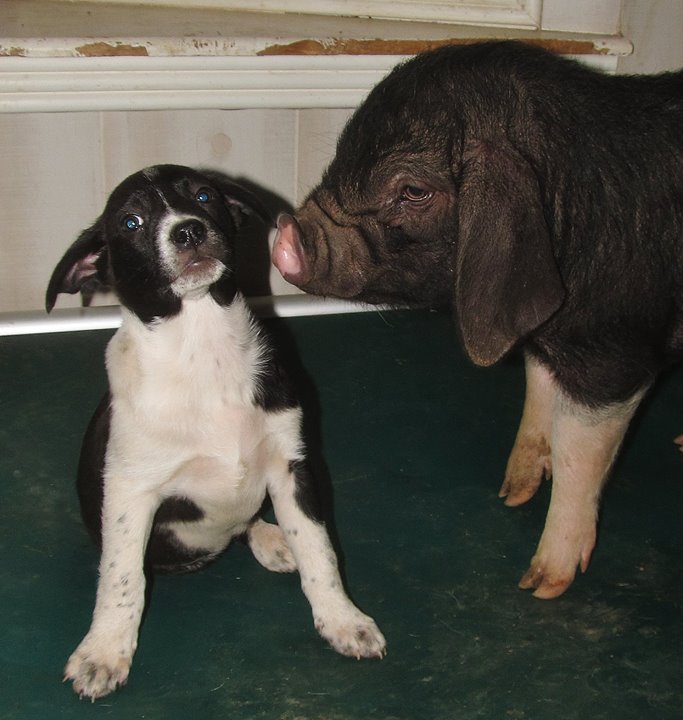
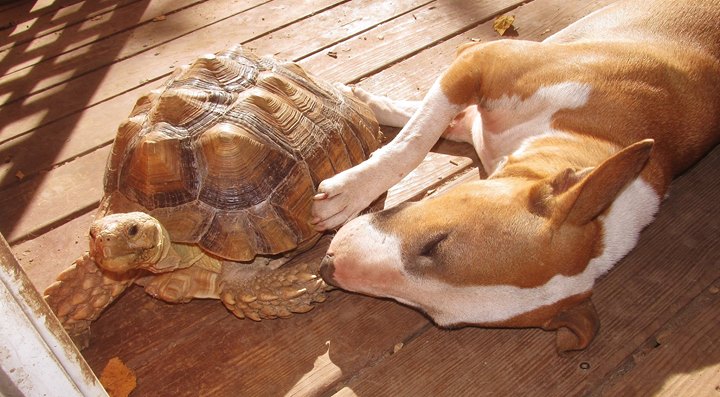
Animals from 60 different species are best pals at this Arkansas critter refuge (photos)

by Xeni Jardin

Via Bored Panda, photographs from Rocky Ridge Refuge in Arkansas, a facility that cares for abused and abandoned animals from some 60 domestic and wild species. [Facebook, website].

[ All images courtesy Rocky Ridge Refuge. HT: Meredith Yayanos].