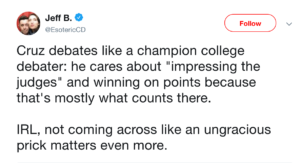
Ted Cruz has been accused of debating Beto O’Rourke in the style of a US college debater, more concerned with winning points than hearts. Twas ever thus.
In the autumn of 1992 I turned up at McGill University, Montreal. I’d wanted to go to France on Erasmus but didn’t qualify. One of my uncles, an economist at UCD, had cast around his desk for a flyer or a phone number, I don’t remember which. He named some other places, then Montreal, which we remembered was in Quebec, where two Belfast cousins had settled some time after my grandmother’s family took them in during the war. One of those cousins, Sean, still lived in Montreal, and was a pathologist at the university. His brother, the novelist Brian Moore, had written a novel about Jesuits in Algonquin that had been made into a film the year before, and featured a scene still etched in my memory of a cute, skinny young priest trying to maintain his dignity as he curled out a shit over the side of a long canoe, to the merriment of the First Nations guys rowing it. That was the clincher, so to speak.
In the first week at McGill, I auditioned for a play and tried out for the debate team. I was cast as a pillar in a Greek drama (no, I don’t know how that would have worked, either), and sent to represent McGill at a novice’s tournament in Bates College, Maine. Debating it was, then.
College debating in Ireland was just free entertainment on a Thursday or Friday night, with speakers prowling the pit of the merely medium-sized Theatre M, throwing out gags and being heckled viciously by what we then called friends, and what I now know were more like colleagues, the hacks in the box at the very top. There were often name-brand invited speakers, usually treated a little more respectfully, but only up to a point and the point was to be either masterful or entertaining, and ideally both.
Once, the British ambassador (or was it Secretary of State for Northern Ireland?) addressed us on the then-stalled peace process. Poor bastard. He seemed not to know that the ultimate sign of weakness in that setting was to read out a prepared speech. He may as well have pulled out his shrunken member and asked us to gently assess it. Worse, perhaps hoping his words would be faithfully reported in the media, he had brought and disseminated a dozen or so typed copies of his speech, each one neatly stapled and double-spaced. A few pages in, the audience grew restive as the great man portentously delivered himself of his wholly unremarkable remarks, and those in the first two rows who had been given copies of the speech began to read along in time with the speaker. Worse, as he neared the bottom of a page, they would loudly draw breath in the rather theatrical style of the public school educated Englishman, smoothly certain that the audience is on tenterhooks for the moment it takes him to turn over the sheet, and resume aping his words on the top of the next page in unison and with gusto, to roars of laughter and applause. That noble servant of Empire would stop to remonstrate, remind us of our manners and complain this was not the hospitality he expected of “the Irish”. We would relent, but a paragraph or so later it would start up again, as we realised first with hilarity, then in that helpless boredom of an acting out child, and ultimately with a sort of grudging respect, that he meant to carry on till the very end.
So you can see why I wanted to learn my trade somewhere off-stage.
As part of the McGill debate team, we would travel to tournaments on the weekend, mostly in eastern Canada and the north-eastern US. The rules were similar in both countries; you would be in a team of two, debating another team of two, and would win or lose on points awarded by judges, themselves student debaters. In Canada, there were points to be won by entertaining or inspiring the audience. In the US, it was more an attritional training for future litigators. You had to check each argument they made, no matter how stupid, otherwise it would be deemed to stand. The more arguments, the more points. The trick for us was to make the audience laugh or feel while also winning at the tedious arithmetical punch and judy.
For a couple of tournaments, as his normal partner wasn’t available, I debated with our team’s president. Gerry spoke with an authority that gathered the jangled masculinity of our many opposing alpha try-hards into itself, exposing their puff and strut as mere mummery. He knocked points down like an apex predator who has only occasionally to swat at something for it to shrink away. I’m not sure what I brought to the partnership. It’s hard to picture it, now. I had the novelty accent, for sure, plenty of earnest and the odd flash of wit. Whatever it was, we took home a fair amount of silver though I never won a tournament or placed in the top three.
We went to Harvard some time in the autumn of 1992, cutting through the preliminary rounds like a hot knife through butter. The semi-final was to be held in a medium-sized, steep walled amphitheatre, just like home. Our opposing team was also a man and a woman, Ted Cruz and a woman whose name I don’t remember. (In fact, I hadn’t recalled that it was Cruz till Gerry reminded me during the US presidential primaries a couple of years back.)
Just before we were due on stage, I nipped into the ladies’ loo. Coming out of the stall, I saw the woman I was about to debate. She was washing her hands. Somehow, part of her skirt had gotten caught up in her tights. I hesitated. She spotted me in the mirror and gave me a filthy look. Tant pis. Some people have to dislike you to fight you.
Moral dilemma: Do I tell her about her skirt or leave her to walk on stage with one ass-cheek hanging out, losing in that very first instant the power you must exert over the audience (that delicious, intoxicating power they both will you to seize and want to hold tight and crush you with)?
Obviously, I told her. Just as obviously, it made her hate me more.
We partner up and go into the amphitheatre through a door at the bottom. My position is ‘first opposition’, so it’s my job to come up with our main arguments and sketch out my own first speech during the first four minutes the woman is talking. Her job is to lay out the case, set a few traps, and balance getting enough points in during her few minutes, while – sometimes – leaving it as long as possible to get to the point, so I have less time to figure out the topic. But there are the set-piece debates of the time – gays in the military, Canadian media content rules, whether the fall of the USSR is desirable/reversible – and more often than not, it’s one of those. She opens her mouth and the first thing out of it is some nonsense about Northern Ireland. How there’s no point having a peace process, how we should all knuckle under to our imperial overlords, how terrorists gonna terrorize whether you talk to them or not.
Gerry and I can’t believe our luck. This patently ignorant Princeton team is going to debate us, two Irish and semi-Irish people, about Northern Ireland. In Boston.
Grinning and shaking my head, I jot down a few arguments. Gerry agrees, probably adds a couple of points, and up I go. To say it’s an easy crowd is an under-statement. Instead of outraged passion, I go for bemused incredulity. I get some laughs in and set things up for the longer, more substantive speech of my partner. But first, Cruz takes his eight minutes.
This would be a much better story if I could remember anything he said. Then again, it would only be a truly interesting story if student Cruz differed much from politician Cruz. He did not. He talked fast, he didn’t care about facts, he was condescending. He said things that probably sounded ok if you didn’t know what he was talking about and had a wont to agree with, but this was not the crowd for that. And yes, he had that plausibly handsome face already curving into a permanent sneer that threatens to unite nose and chin.
Gerry gets up and soberly, reasonably explains why our opponents are not merely mistaken, but dangerously wrong. Bing, bing, bing. Down their points go, with occasional, sturdy outbreaks of applause. Up the woman gets again, tries to rescue the case but it’s hopeless and she merely repeats where she needs to rebut. And it’s not her fault, really. It’s clear from their dynamic that Cruz calls the shots. He’s picked a bad topic and set up a useless case. It’s not her fault he’s her partner, or that she’s straitlaced and humourless and instinctively repelled my imprecations of sisterhood. So many American women debaters are just like that.
Because it’s autumn 1992 and Clinton v Bush has just happened, or is about to. Pat Buchanan has recently made the opening declaration of the culture wars. Hillary is equally despised for her uppity book-reading and her attempted cookie recipes, but it hasn’t yet occurred to me that the least-worst option then for clever American women is to follow the debate rules to the letter and never even attempt the men’s game of dominance and ball-baring humour.
As I prepare for my final speech, I’m not thinking any of this. I’m thinking ‘I can win without being a complete shit. That is the lesson of the restroom. Winning without being a complete shit about it is what we will show this smarmy, grinning Princeton turd.’
We hit the rest of our points home, pirouette a little for style, and accept the actually quite gracious congratulations of our opponents as the panel retires to a classroom to prepare their judging sheets.
Ten minutes later they return and declare us the losers.
The crowd boos. The Cruz grin is restored. Our tournament is over. It is all so perplexing and I keep asking what did we do, what did we do, is it a Canadian versus American kind of thing? Did we misunderstand the rules? And if we lost fairly, why is everyone so annoyed? I acquire a bottle of whiskey somewhere off Harvard Square and neck half of it in the main auditorium, watching the final. We’d have taken either team in it, easily. “I’m Irish,” I say to those around me, “I can drink this like a cup of tea.” I am twenty years old. I cannot.
Some time later, retching and spewing with my head in a basement toilet, I look up. However hazy I am about the other parts of this story (was it really Cruz, that time? Or was it that annoying blonde team from Yale?), this bit definitely doesn’t stack up. I look up from hugging the toilet to see a fair-haired woman asking, laughing, if I’m ok. She’s leaning over stairs I’m at the bottom of. There’s no way I could have been both in the restroom and seeing her at the top of the stairs, but I also know that in that moment I’m aware she’s been sent to check if I’m ok, she’s jealous that I’m currently Gerry’s debate partner, and pleased that I’m clearly a total mess. And this I also remember; I kind of agree with her. It’s just deserts for losing and maybe the toilet is where I live, now.
Later again, I’m in the audience of the auditorium and the prize-giving has begun. Our names are called out and we go down to collect the silver. We’re the highest ranked Canadian team at a US tournament, ever, at that point. I’m concentrating so hard on not falling over that I don’t realise till I’m on the stage that that my skirt is higher than it needs to be and I’ve got no shoes. There may also be a hole in my tights, but that may be a detail my memory has embroidered on. The prize-giver grimaces as we shake hands and I waft a whiff of whiskey-accented puke-breath his way. A few minutes later we do it all again for individual prizes. I’m not sure I ever find those shoes.
Eighteen hours later, we arrive back in Montreal and the team drops me off at the house of my cousins. I’ve never met them before. It’s Canadian Thanksgiving. There are the parents, and a son and daughter, both older than me but probably not by much. I haven’t eaten or drunk since the whiskey, and exhaustion and dehydration have set in. And hunger pains, but I don’t say a word to them about that. We make chit chat for about an hour and it’s agony. Just agony. For some reason, there are no snacks. I think maybe we wait a long time for the son to arrive. Finally, it’s time for dinner.
I stagger slightly making my way to the table but convert it into an odd little bob. There’s more conversation but I can’t contribute. Finally, finally, a bowl of clear soup appears, just inches from my mouth. I wait and wait till everyone has been served but find as I go to pick up the spoon that it’s not just the spoon that’s too heavy but also my hand, and my arm and maybe also my head. The conversation fades away into a thick silence that implies the room is wallpapered in carpet. My eyes feel closer together than they should be and some weird parallax thing is going on. I think about this carefully over the long moment the soup takes in its rush towards my face.
In the next moment I’m lying on the sofa with my feet up, and my female cousin who I seem to remember had boots herself and short hair and perhaps a nose-ring, is pulling my boots off. I fall in love with her a little, though now I wonder if I didn’t just want to be her? They are all so unfussy, but afterwards, when I’ve been fed and treated kindly and driven home, I’m too embarrassed ever to see them again.
The next scene takes place in a Princeton eating club the following spring. By then my early debating promise had tapered off. The final year students I was with sat at a wide table, eating breakfast and competitively tallying law school applications. In my memory, they check their mailboxes and return with acceptance letters. But this is unlikely as it would have been a Sunday. Most of them were genuinely impressive and delightful people, just finishing undergrad dissertations on topics whose contours I could barely make out. Some had been accepted by two Ivy League schools already and wondered which to attend. I suppose it was a little obnoxious, in retrospect. Cruz had been buzzing around the tournament, but I struggle to remember him as distinct from a couple of other similarly careerist and sexually persistent guys that weekend.
Mostly, I’d been thinking about a Scottish guy I’d met at another tournament and who told a story about his dog, Happy Dog. The guy would go out into the garden of their house in Aberdeen and cry “here, Happy Dog, come here”, then slide the sliding door shut so the dog ran into the glass. This seemed a hilarious story to me. Maybe it was the accent. Happily, Happy Dog’s owner found me a lot more resistible than I found him.
And lastly, London, spring 2018. Gerry comes to London for work and a bunch of us meet up in a pub. It’s been over twenty years. There’s a lot of talk about politics and then somehow we get on to Ted Cruz and that time we beat him and were inexplicably robbed of victory. And now, finally, I find out why. Within the last year or two, Gerry had run into one of the judges, I think, having moved house some time before and found the old judging sheets. The loss still seemed perplexing, so he asked what had happened.
“We didn’t want to waste the points,” was the answer. Turns out, in that hyper-competitive, detail-driven way, the US college debate system ranked people based on tournament performance. The more prestigious the tournament, the higher the points. The rankings had become integral to law school applications, so for the US debate judges to award valuable points to a Canadian team was basically just throwing them away. They could be used to help a member of the tribe into law school, and anyway, it wasn’t like they’d ever see us again. Tant pis.
Now, I think; We beat him, but he still won. Pertinent lesson, there, for anyone who debates the hard right.
I also think the lessons I took from it – don’t slack off when you’re winning, and think carefully about how acts of mercy are construed – worked on me perpendicularly. I’ve more or less crafted a life and career about performance (internal and external), avoiding both direct competition and team-work as much as I can.
And finally, I fervently hope O’Rourke beats Cruz. He’s not just a better debater. He’s a wildly better human.





 It's simultaneously the weirdest and most plausible futuristic vision I've encountered in years, building on the world of Bruce Sterling's classic "




 Von Mises won the argument in the 1920s, but a funny thing happened on the way to the 2020s: we are now surrounded by companies and organisations that are as large or larger than the USSR at its apex, which undertake breathtakingly efficient allocations of goods and resources, and all without markets, running as command economies.


