Shared posts

09 Apr 02:47

Keep a Separate Credit Card Just for Bills in Case Your Wallet Is Stolen

by Kristin Wong on Two Cents, shared by Andy Orin to Lifehacker

Most banks have accommodating policies for credit card theft. However, it can still be kind of a pain to cancel your card and all of its automatic payments. NerdWallet writer Virginia McGuire has a solution: designate a specific card for automatic bill pay.

Read more...


09 Apr 02:46

10 Sneaky Ways Retailers Fool You Into Spending More

by Elizabeth Harper

Each day, stores are trying to convince us to put more in our carts and rack up a bigger bill at checkout. From strategic displays to all those tasty freebies, stores try to make an April fool (and year-round over spender) out of customers. So in the spirit of the season, let’s take a look at how shops convince us to open our wallets—which might help us spend just a bit less.

Read more...


09 Apr 02:46

These Are the Essential Items That Should Be In Every "Bug-Out Bag"

by Patrick Allan

A “bug-out bag” or emergency go-bag is something everyone should have in their home or vehicle (or both). When disaster strikes, you’ll be glad you have these survival items pre-packed and ready to go.

Read more...


05 Apr 13:04

Inside Meow Wolf, the amusement park for people who want a weirder Disneyland

by Annalee Newitz

A view from the enchanted forest, showing all the stairs and crawl spaces that you can explore. (credit: Meow Wolf)

SANTA FE, NM—The Meow Wolf art complex looks like a strip mall from another dimension. Located in downtown Santa Fe, its massive main building—a former bowling alley—is covered in zig-zagging lines of explosive color. The parking lot is dominated by towering metal sculptures of a spider and a robot. Its landlord is George RR Martin, author of the Game of Thrones series, and its tenants are a high-tech artist collective called Meow Wolf, known previously for building a full-scale spaceship that visitors could explore.

On March 17, after nearly two years of construction, the Meow Wolf art complex opened its riotously painted doors and invited the public into its first permanent exhibit, called The House of Eternal Return. Think of it as a walk-in science fiction novel built with milling machines, thermoplastic, and Arduinos. Or maybe it's a cross between Disneyland and a massive, multiplayer, IRL game. Built by 135 artists and makers, the result is a 20,000-square-foot dreamworld where your goal is to figure out why an old Victorian house in Mendocino, California, has become ground zero for a rupture in space-time that’s allowing other dimensions to leak into ours.

I took a tour of the Meow Wolf art complex in the final few days before it opened, when dozens of artists and fabricators were working around the clock to finish building what I can only describe as something I never imagined could exist. My tour guides were artist Lauren Oliver, whose magnificent space owl can be found in the dreamscape of Eternal Return, and technology project lead Corvas Brinkerhoff. They fitted me with a hard hat and took me into a building that was once a bowling alley. Now it's another world.

Read 26 remaining paragraphs | Comments

05 Apr 12:56

The Latest: NTSB: Train going 106 mph in 110 mph zone

by wtopstaff

CHESTER, Pa. (AP) — The Latest on Sunday’s derailment of an Amtrak train outside Philadelphia (all times local):

5:45 p.m.

Federal investigators say the Amtrak passenger train that crashed into a backhoe on a track near Philadelphia was going 106 mph in a 110 mph zone before the fatal collision.

The National Transportation Safety Board says the engineer placed the train into emergency mode five seconds before impact.

NTSB investigator Ryan Frigo says videos show construction equipment on the track and a contractor’s equipment on the adjacent track Sunday morning. He says he cannot say who was authorized to be on the track.

The track workers killed are being identified by the Delaware County Medical Examiner’s Office as 61-year-old backhoe operator Joseph Carter Jr. of Wilmington, Delaware, and 59-year-old Peter Adamovich of Lincoln University, Pennsylvania. Autopsies conducted Monday show they died of blunt force trauma.

___

3:50 p.m.

An Amtrak contractor says it was performing work near where a passenger train crashed into a backhoe on the tracks, killing two people outside Philadelphia, but neither its equipment nor its workers were involved.

Autopsies were being performed on the two track workers who were killed Sunday. Federal officials say both victims worked for Amtrak.

A Minnesota company called Loram Maintenance of Way says it had several employees working in the area.

Loram official Tom DeJoseph says the company was doing maintenance on the stones that sit between the railway ties.

DeJoseph says the company had three or four people working there at a time, and more at shift changes.

He says he can’t comment on typical safety procedures for track workers or say if Loram employees witnessed the crash.

___

9 a.m.

Amtrak says trains are operating on or close to schedule along the Northeast Corridor following a deadly derailment outside Philadelphia.

Federal officials say two Amtrak workers were killed Sunday and more than 30 passengers injured when a train hit heavy equipment on the tracks and the lead engine derailed.

Train 89 was heading from New York to Savannah, Georgia, at the time.

It disrupted Amtrak service between New York and Philadelphia for a time Sunday, but train traffic is close to normal in the region on Monday.

The National Transportation Safety Board is investigating.

___

2 a.m.

Amtrak says it is operating trains Monday as regularly scheduled although there may be some delays on Acela Express, Northeast Regional and other services between Philadelphia and Wilmington, Delaware.

Federal officials say two Amtrak workers were killed Sunday and more than 30 passengers injured when a train hit heavy equipment on tracks outside Philadelphia and the lead engine derailed.

Train 89 was heading from New York to Savannah, Georgia, at the time. Service was disrupted for a while on the Northeast Corridor between New York and Philadelphia and was limited between Wilmington, Delaware, and Philadelphia.

An Amtrak spokeswoman would not release other details about the derailment. The National Transportation Safety Board is investigating why the train and the equipment were on the same tracks.

The post The Latest: NTSB: Train going 106 mph in 110 mph zone appeared first on WTOP.

05 Apr 12:56

Cats vs. birds: Natural enemies the focus of NY legal battle

by wtopstaff

WANTAGH, N.Y. (AP) — Forget Sylvester and Tweety: A real-life battle is brewing on Jones Beach over the natural tension between cats and birds.

An American Bird Conservancy lawsuit claims the state is failing to adequately protect an endangered bird species called the piping plover by allowing cat lovers to feed and care for a colony of feral felines on the barrier island where the birds nest. The federal suit wants a judge to order the cats removed.

Advocates on both sides of the debate say the creatures are defenseless and could not survive without human help.

“We just can’t bring these cats somewhere else,” said Stephanie Capuano, who lives near the beach and has been taking care of the cats for about 16 years in makeshift shelters made from pallets and plastic tarps. She said the cats, whose numbers have dwindled over the years from several dozen to about 15, would likely end up euthanized because they are too wild to be domesticated.

Grant Sizemore, the bird conservancy’s director of invasive species programs, said the fact that the cats are well-fed and cared for does not reduce the hazard to the piping plover.

“Feeding feral cats, as happens at Jones Beach, does not eliminate their instinct to hunt,” he said. “And in fact, the mere presence of cats has been shown to have significant adverse effects on breeding birds.”

Piping plovers, small shorebirds with sand-colored plumage on their backs and crown, have been listed as threatened in the Atlantic Coast region for 30 years under the federal Endangered Species Act.

It is too early in the spring for plovers to be out on Long Island’s coast, but on a visit to the beach last week, an Associated Press reporter found several cats in a wooded area off a beach parking lot. The felines dashed off when approached, but they looked to be in good health.

Capuano, among a small group of volunteers that has been taking care of the cats, said they participate in a national initiative that traps, neuters and returns the feral cats to the wild, in order to prevent further proliferation.

“It’s disgraceful the bird people have sued the parks,” said Capuano, who contends that the cat lair is quite a distance from the plover nesting areas and that the cats don’t roam in that direction because they are fed regularly.

Piping plovers, though, have a famously fragile presence on Atlantic beaches. Anne Hecht, an endangered species biologist for the U.S. Fish and Wildlife Service, said an intensive protection effort has helped boost the numbers of the birds along the Atlantic Coast from 790 pairs in 1989 to a 1,850 pairs last year.

The wildlife service in 2009 identified feral cats as a specific threat to piping plovers. Hecht noted that the piping plover chicks are extremely vulnerable to predators because they don’t have the feathers to fly. “And cats are hard-wired to hunt birds.”

A spokesman for the parks department declined to comment, citing the pending litigation.

Becky Robinson, president and founder of Alley Cat Allies, a national advocacy organization dedicated to the protection and humane treatment of cats, argued that the cats at Jones Beach are not reproducing.

“What’s happening at Jones Beach represents a proven approach to managing populations of cats that live outside,” she said. “The lawsuit ignores habitat loss and degradation, which experts agree has severely affected piping plover populations and has occurred all along the Atlantic Coast and throughout the country.”

The post Cats vs. birds: Natural enemies the focus of NY legal battle appeared first on WTOP.

05 Apr 12:55

Woman bitten by Omaha zoo tiger pleads guilty to trespassing

by wtopstaff

OMAHA, Neb. (AP) — A woman who was bitten by a tiger after she sneaked into a zoo in Nebraska has pleaded guilty to trespassing.

Jacqueline Eide (eyed) pleaded guilty Monday in Omaha and was fined $250 plus court costs. Prosecutors dropped two other misdemeanor charges in return for her plea.

The 33-year-old Eide was accused of sneaking into Omaha’s Henry Doorly Zoo following a social function there on Halloween last year. Authorities say Eide was bitten by a Malayan tiger named Mai (meye) when she reached into the tiger’s exhibit. Police say Eide acted aggressively and appeared to be intoxicated.

She was treated for the hand wound at an Omaha hospital.

The post Woman bitten by Omaha zoo tiger pleads guilty to trespassing appeared first on WTOP.

05 Apr 12:55

Candy theft could mean king-size sentence: 20 years to life

by wtopstaff

NEW ORLEANS (AP) — A Louisiana man accused of stuffing $31 worth of candy bars into his pockets faces a possible sentence of 20 years to life in prison, prompting a judge to question whether the sentence was “over the top.”

Orleans Parish prosecutors chose to charge Jacobia Grimes, 34, under a statute that boosts the alleged candy theft to a felony. The law applies to people who have been convicted of “theft of goods” at least twice. Grimes has five prior theft convictions, making him a “quad” offender under the state’s habitual-offender law.

Grimes, 34, pleaded not guilty Thursday, The New Orleans Advocate (http://bit.ly/1SIUcWm) reported.

The possible sentence raised questions with Judge Franz Zibilich, who was overseeing Grimes’ arraignment last week.

“Isn’t this a little over the top?” Zibilich said. “Twenty years to life for a Snickers bar, or two or three or four.”

Grimes’ attorneys, Miles Swanson and Michael Kennedy, said his prior guilty pleas were for similar shoplifting attempts, including stealing from a Rite-Aid, Save-A-Center, Blockbuster Video, and Rouses grocery stores.

Swanson said all the thefts were for less than $500 worth of items. The last theft of socks and trousers from a Dollar General store got him a four-year sentence in 2010.

One of his lawyers said he could have been charged under a different statute than the habitual-offender law.

“They’re spending their time to lock someone up for years over $31 worth of candy,” Swanson said.

Grimes also faces a charge of drug paraphernalia possession. He is currently free on $5,000 bond, court records show. His lawyers say he has a heroin problem. Grimes also has convictions for possession with intent to sell fake drugs and obscenity, a crime committed while he was behind bars, the newspaper reported.

Christopher Bowman, a spokesman for the district attorney’s office, would not comment on the specifics of Grimes’ case, citing office policy. He emphasized that the alleged crime was considered a felony by the state.

The case appears to be an extreme example of a widespread practice in Louisiana, which criminal justice reform advocates say has one of the toughest habitual-offender laws in the country, the newspaper reported.

___

Information from: The New Orleans Advocate, http://www.neworleansadvocate.com

The post Candy theft could mean king-size sentence: 20 years to life appeared first on WTOP.

05 Apr 12:54

California woman gives up home to care for thousands of cats

by wtopstaff

PARLIER, Calif. (AP) — It started with a few kittens. But nearly a quarter century later, a California woman has transformed her 4,000-square-foot home into what’s believed to be the largest no-cage cat sanctuary and adoption center in the U.S.

An estimated 24,000 cats have been saved by the sanctuary, which houses up to 1,000 felines at any given time. Lynea Lattanzio set up Cat House on the Kings after finding out that many nearby shelters euthanize cats who aren’t adopted.

As more feral and abandoned cats took up residence in her home, she moved out into a trailer on her 12-acre property.

Lattanzio spent her entire retirement fund on her pet project, which also relies on donations.

“If I didn’t have to deal with humans and all their drama in life, I would be perfectly content just taking care of cats,” she said.

She now has staff and a team of volunteers to keep the house clean and the cats fed. The sanctuary also employs veterinarians who keep the cats healthy and spayed or neutered. The cats lap up about 1,000 cans of cat food a week.

People looking for a furry companion are allowed kitty cuddle time on adoption days.

A cat-proof fence keeps predators out and cat doors allow them free reign of the home.

“They’ve got this house. They’ve got 12 acres. They can climb a tree. They can go sit in the sun outside,” Lattanzio said. “It just gives these animals a reason to live as opposed to just living in a cage just because no one wants them.”

The post California woman gives up home to care for thousands of cats appeared first on WTOP.

05 Apr 12:52

Wal-Mart apologizes for Terps shirts that mistake Mass. for Md.

by Neal Augenstein

WASHINGTON — If you saw University of Maryland shirts at Wal-Mart that seemed a bit odd, there’s a good explanation — the shirts mistook Massachusetts for Maryland.

Until Monday, customers could buy shirts that featured the word “Terps” over a not-terribly-accurate outline of Massachusetts.

The mess-up was first spotted on Twitter last year by a University of Maryland student.

More recently, another Twitterer included visual aids to point out Wal-Mart’s error, but the company’s tweet suggested the shirts were supposed to be that way.

Finally, on Monday another Wal-Mart employee tweeted an apology and said the shirts were being removed from stores.

In a statement to The Washington Post, Wal-Mart wrote, “We are working with Russell Athletic to determine how this happened and in the meantime are removing the shirt from our stores. We understand the pride Marylanders feel for the Terps, and apologize for the mistake.”

The post Wal-Mart apologizes for Terps shirts that mistake Mass. for Md. appeared first on WTOP.

05 Apr 12:31

Sheriff: 4 men assaulted 9-year-old while mother smoked meth

by wtopstaff

SALT LAKE CITY (AP) — Four men have been arrested for sexually assaulting a 9-year-old girl in a Utah home while her mother was in the garage smoking meth, authorities said Monday.

The girl’s mother left her sleeping on a couch March 27 inside a home in rural Uintah County, which borders Colorado, the Uintah County Sheriff’s Office said in court documents.

The four men were staying at the home and took the child into another room, where they assaulted her, investigators said. When her mother returned, the child said she wanted to leave.

Two days later, the girl told her mother about the assault, deputies said. The woman then reported it to police.

The sheriff’s office identified the men as 36-year-old Larson RonDeau, 20-year-old Josiah RonDeau, 29-year-old Jerry Flatlip and 26-year-old Randall Flatlip.

The men did not have listed phone numbers, and it didn’t appear any of them had a lawyer who could comment on their behalf.

Larson RonDeau, the first to be arrested, was charged Friday with rape and sodomy of a child. His initial court appearance is scheduled for Tuesday in the town of Vernal.

The other three men were arrested several days later. Uintah County Attorney G. Mark Thomas said Monday he expects similar charges to be filed against them in the next few days.

State child welfare officials have taken custody of the girl. Uintah County officials said they had no information on the child’s father.

Thomas said the child’s mother has not been arrested, and any possible charges against her would come after officials finish reviewing the cases against the four men.

Investigators said in court documents the men might be related, but Cpl. Brian Fletcher, a sheriff’s spokesman, said he had no details about that Monday.

He said the men are not from the area and investigators don’t believe they’ve been there long.

The mother told deputies she was friends with a woman who might have been related to some of the men. The mother met the woman during a past stay in jail, deputies said.

Fletcher said he couldn’t comment on the mother’s criminal history or explain why she hasn’t been arrested, noting officials are still investigating.

He said he could not offer further details Monday.

The post Sheriff: 4 men assaulted 9-year-old while mother smoked meth appeared first on WTOP.

05 Apr 02:00

Suit: Georgia prison neglected dead inmate’s infected tattoo

by wtopstaff

SAVANNAH, Ga. (AP) — A federal lawsuit blames the medical staff at a Georgia prison for failing to treat an inmate who died from a severely infected tattoo.

The Southern Center for Human Rights filed a lawsuit Monday against Georgia Correctional Health, a contractor that provides health care at Georgia State Prison in Reidsville. The suit was brought by the sister of 50-year-old Randall Davison, who died in February 2015.

The lawsuit says Davison developed a severe infection in his forearm after receiving a tattoo from a fellow inmate in December 2014. Attorneys say he complained to the prison’s medical staff and was given anti-inflammatory drugs, but no antibiotics to treat symptoms of infection.

Georgia Correctional Health and the state Department of Corrections declined to comment.

The post Suit: Georgia prison neglected dead inmate’s infected tattoo appeared first on WTOP.

05 Apr 02:00

Wayward sea lion snarls traffic in California

by wtopstaff

SAUSALITO, Calif. (AP) — A wayward sea lion snarled Monday morning traffic on a San Francisco Bay Area freeway before it was caught and taken to a marine center for a check-up.

San Jose, California, TV station KNTV reports (http://bit.ly/1Vr3loH) a Sonoma County freeway was completely blocked at 10 a.m. as the sea lion tried to make it across the road.

The sea lion evaded an off-duty officer, before experts from the Marine Mammal Center arrived and caught the critter.

It’s far from the first marine mammal to lose its way in the Bay Area.

Late last month, authorities say a baby seal made it 4 miles from the water to the front yard of a Bay Area home before it was rescued. The female northern fur seal was also taken to the Marine Mammal Center.

The post Wayward sea lion snarls traffic in California appeared first on WTOP.

05 Apr 01:43

Walmart Doesn’t Know The Difference Between Maryland And Massachusetts

by Mary Beth Quirk

It looks like someone at Walmart is due for a geography lesson, or could at least use a refresher on how to pull up a map of the United States on the internet, after a sharp-eyed Twitter denizen pointed out that the chain is selling University of Maryland T-shirts bearing an image of the state of Massachusetts.

Last week, the observant shopper Tweeted at Walmart, alerting the retailer to its very obvious mistake with the UMD Terrapins shirt, bearing the college’s log and the abbreviation “Terps.”

Walmart replied the next day, with a social media representative thanking her, and noting that it’s just those pesky “M” states can be so confusing, what with the fact that they’re shaped kind of, sort of, similarly.

Let’s compare, shall we? (click to enlarge):
maryland

As The Washington Post points out, Walmart has been selling this incorrect shirts since July 2015 at least, when another shopper spotted one in a store:

Walmart didn’t reply to that Tweet.

“We are working with Russell Athletic to determine how this happened and in the meantime are removing the shirt from our stores. We understand the pride Marylanders feel for the Terps, and apologize for the mistake,” a Walmart spokesman told Consumerist in an emailed statement.

In the meantime, do you think these two states are easily confused?

Take Our Poll
05 Apr 01:39

Target’s Cartwheel App Now Clips Manufacturers’ Digital Coupons

by Ashlee Kieler

For the better part of three years, Target has offered a standalone app — Cartwheel — that provides customers with discounts on certain products. While shoppers have always been able to combine actual coupons with this discount, the retailer is now aiming to make the process easier, by adding digital manufacturer coupons to the Cartwheel app.

Target announced on Monday that it is testing a new feature that allows shoppers to combine Cartwheel’s percentage-off deals with actual dollar-off amounts from virtual coupons, all within the app.

So far, the app features about 40 digital coupons — depending on where a shopper lives — showcased right alongside Cartwheel’s typical deals.

The coupons can generally be identified by a dollar-off amount, rather than the the percentage discount that Cartwheel is known for. They also typically have a longer use period – several months, compared to the average weeklong savings of a Cartwheel deal.

combine_images1

Users simply click on the single-use coupon to add it to their Cartwheel barcode. As with the traditional Cartwheel app, the barcode is scanned at the register and the discounts deducted from the purchase.

By adding digital coupons to the Cartwheel app, shoppers can increase the amount they save during a shopping trip since coupons generally provide larger savings — $0.50 to sometimes $2 off products — than the app, which typically offers savings of 5% to 15%.

The new feature is a partnership between the retailer and a third-party provider of digital coupons, TechCrunch reports, noting that the app will be integrated with a coupon database as opposed to Target working with actual product manufacturers.

05 Apr 01:38

The Bacon Cheeseburger Index, And 6 Other Odd Economic Indicators

by Mary Beth Quirk

What does the price of a bacon cheeseburger tell you about the state of the economy? Perhaps the Big Mac contains the “special sauce” to decoding the current consumer condition — or maybe it’s one of the many other oddball economic indicators that take into account everything from nail polish to men’s undies to corpses.

After reading this MarketWatch story that mentioned the Bacon Cheeseburger Index and being tempted to fire up the grill, we decided instead to round up this and a half-dozen other very particular indicators.

1. Bacon Cheeseburger Index

The Bacon Cheeseburger Index, or BCI, is a trademarked index created by Nicholas Colas, chief market strategist at the New York–based global brokerage Convergex.

It can be used as a relatable inflation gauge, Convergex says, simply because of how popular the sandwich’s ingredients are. Consumers all have a pretty clear idea about the price of the ingredients in a bacon cheeseburger — cheese, tomatoes, beef, bread, and of course, bacon — which means it’s ” a remarkably good measure of observed inflation – something that consumers use to anchor their own inflationary expectations,” Convergex claims.

“To understand where consumer inflation expectations are going, you would do well to consider a basket of commonly and frequently purchased goods, Convergex says. “That, after all, is what anchors inflation expectations for many consumers.”

2. Big Mac Index

We continued down the burger path when we found the Big Mac Index, which something The Economist came up with in 1986 to measure purchasing price parity (PPP) between two currencies. Simply put, PPP is when it costs exactly the same to buy goods in one country as it does in another, due to market exchange rates. It “seeks to make exchange-rate theory a bit more digestible,” The Economist said (via Wikipedia).

It also might make you hungry.

3. The Lipstick/Nail Polish Index

If Americans are buying more beauty products, does that mean the economy is in rough shape? Leonard Lauder, chairman of the board of Estee Lauder, thought so, when he introduced the concept of the “Lipstick Index” to describe an uptick in sales of cosmetics during the recession of the early 2000s. The idea here is that women will limit themselves to cheaper, smaller purchases like lipstick when money is tight, instead of splashing out on more expensive items like shoes.

In 2011, a Sally Hansen executive said he thought the lipstick index needed a new name — the nail polish index.

“(Estee Lauder Chairman) Leonard Lauder talked about the lipstick index…Today, I believe it should be called the nail polish index,” Bill Boraczek senior vice president of Global Marketing at the company said at the time, in an attempt to explain why nails were the hot “accessory” of the season.

“The recession and innovation have re-energized the category and clearly played a part in the resurgence,” he noted of the popularity of nail polish.

4. The Men’s Underwear Index

Though you may have no occasion to dwell on the idea of men’s underwear in your daily life, some economists think it’s a pretty good way to assess the health of the economy. The idea here is that when men are feeling good about the economy, they start buying new underwear, sparking the start of economic recovery.

It’s not measured by the government, but Alan Greenspan, the former chair of the U.S. Federal Reserve, is a big fan, MarketPlace noted recently. Again, we don’t usually find ourselves writing about Alan Greenspan and underwear together, but sometimes it happens.

5. The Unclaimed Corpse Indicator

The idea behind this macabre economic indicator is that funerals are a costly endeavor, so some family members will simply never claim the bodies of their deceased loved ones, thus, prompting the city or state to foot the bill.

An example of this, Business Insider notes, comes from Detroit in 2009, when nearly a third of residents were out of work. That year, the city reported a massive increase in the number of unclaimed bodies at its morgue: state payouts for burials almost doubled over a two-month period compared to the year earlier.

Los Angeles experienced a similar kind of effect as well that same year, when the Los Angeles County coroner’s office saw a surge in the number of unclaimed bodies because of economic hardship. The coroner’s office reported 36% more cremations that were done at taxpayers’ expense in the past fiscal year compared with the previous year, 712 versus 525, the Los Angeles Times reported.

6. The Baby Diaper Rash Indicator

Yet another possible economic indicator floating out there that sounds a bit funny, media outlets in 2011 were all abuzz about diaper rationing. Sales of diapers were going down, even has the baby population went up. Also on the rise during tough economic times? Sales of diaper rash cream, ostensibly, because parents were stretching the life of each diaper and needed cream to treat the rashy results, AdAge pointed out.

7. The Appalachian Trail Hiker Index

Communing with nature might be one way to deal with a rough economy, but do people really flock to the Appalachian Trail when they’re out of work? That was one theory in 2011, an idea that didn’t sound quite right to the Appalachian Trail Conservancy: though the number of people who completed a thru-hike was up since the start of the recession that year, using those figures as an economic indicator isn’t necessarily a great idea, a representative for the organization said.

“Hiking 2200 miles for five or six months is not a cheap thrill, like, you know, sitting in the park feeding pigeons,” Brian King, the group’s publisher and author of The Appalachian Trail: Celebrating America’s Hiking Trail, told MarketPlace.

04 Apr 16:28

10 Years After Verdict, Walmart Must Pay $151 Million To Employees Who Worked Off The Clock

by Chris Morran

A case that has been trickling through the state and federal court system for nearly 15 years came to an abrupt ending this morning, with the U.S. Supreme Court refusing to hear Walmart’s appeal of a 2006 verdict ordering the company to pay $151 million to Pennsylvania employees who worked off the clock.

The case dates back to 2002, when a former Walmart employee filed a class action against the nation’s largest retailer, alleging that Walmart workers were forced to work off the clock, through mandated break times, or through meal breaks.

Four years later, a jury sided with the plaintiffs on everything but the food break allegations and awarded the class — totaling more than 187,000 works — $151 million in damages (plus around $36 million to cover legal fees and costs).

Walmart has since spent the better part of a decade making its argument to various appeals courts that the verdict was the result of a “trial by formula,” meaning that instead of looking at all the specific individual instances in which breaks were missed or worked-through, the court listened to the testimony and analysis of statisticians who reviewed Walmart time sheets and determined the extent to which workers were harmed.

Walmart’s expert questioned this analysis, alleging that it failed to take into account things like people who didn’t clock in and out of a break even though they took one, or employees who voluntarily worked through breaks without being told to do so.

The retailer had previously convinced the U.S. Supreme Court to shoot down the “trial by formula” method. In 2011, in Wal-Mart v. Dukes [PDF], a few named plaintiffs sued the retailer over allegations of gender discrimination. A federal appeals court had ruled that a sample set of affected class members could be used to determine the company’s liability. The awarded back pay would be set by a third party and then multiplied by the number of members in the total class “without further individualized proceedings.”

But SCOTUS determined that this meant that Walmart would “not be entitled to litigate its statutory defenses to individual claims,” and ruled that the class should not have been certified to begin with.

However, in 2014, the PA Supreme Court held [PDF] that considerations of Walmart’s time clocks were different from the claims made against Walmart in Dukes.

Whereas, in the discrimination case, SCOTUS was concerned that Walmart was being pre-judged as liable to a large class through mere extrapolation, in the PA workers case, “the evidence of Wal-Mart’s liability to the entire class for breach of contract and WPCL violations was established at trial by presentation of Wal-Mart’s own universal employment and wage policies, as well as its own business records and internal audits.”

In 2015, the retailer hinted that it would take its appeal to the nation’s highest court, hoping to — as SCOTUS did in Dukes — ultimately have the class of plaintiffs decertified.

However, Walmart didn’t even get its day before the eight remaining SCOTUS justices. This morning, the court denied, without explanation, the company’s petition to have its appeal heard.

The Supremes’ decision to deny the petition means that the state Supreme Court ruling remains in place and these workers (and their lawyers) should finally be receiving their long-delayed payout.

In an emailed statement to Consumerist, Walmart writes, “We are disappointed the Supreme Court decided not to review our case. While we continue to believe these claims should not be bundled together in a class-action lawsuit, we respect the court’s decision. We will now determine how we move forward in the trial court.”

Walmart also contends that “Most of these claims are over 10 years old,” which seemed like an odd statement to make for a lawsuit that goes back nearly a decade and a half.

A rep for the retailer confirmed that this statement is referencing the fact that the lawsuit encompasses claims made between 1998 and 2006; and not that the claims themselves were old at the time of filing.

So in effect, Walmart is saying something akin to “Most kids that were born in 2006 or before are older than 10 years old.”

04 Apr 16:26

Alaska Airlines To Buy Virgin America In $4B Deal

by Ashlee Kieler

Virgin Alaska? Alaska American? Either of those — and other combinations — could soon be the fifth largest airline operating in the U.S. after Alaska Airlines agreed to acquire Virgin America in a deal valued at $4 billion. 

Virgin America announced Monday, just two weeks after sources said the airline was looking to sell itself, that the carrier had officially been taken off the market by Alaska Air Group.

The boards of both companies unanimously approved the definitive merger agreement, which will see Alaska paying $2.6 billion in cash and acquiring $1.4 billion debt and operating leases from Virgin America.

“Joining forces with Alaska Airlines will ensure that our mission lives on, and that the stronger, combined company will continue to be a great place to work and an airline that focuses on an outstanding travel experience,” David Cush, Virgin America president and CEO, said in a statement.

The deal, if approved by federal regulators, would allow Alaska to jump in front of JetBlue to become the fifth largest airline by traffic in the country. Seattle-based Alaska Airlines is currently sixth largest, while Virgin America is the ninth largest airline.

Under the deal, Alaska, which already operates Horizon Air, will expand its footprint in high traffic areas such as California, where the airline expects to become the “go-to” carrier for more than 175,000 daily fliers.

Elsewhere, the airlines expect to operate 1,200 daily departures from their hubs in Seattle, San Francisco, Los Angeles, Anchorage, and Portland, OR.

“Our employees have worked hard to earn the deep loyalty of customers in the Pacific Northwest and Alaska, while the Virgin America team has done the same in California,” Brad Tilden, chairman and CEO of Alaska Air Group, said in a statement. “We look forward to bringing together two incredible groups of employees to build on the successes they have achieved as standalone companies to make us an even stronger competitor nationally.”

Virgin America, which launched in 2007 and went public in 2014, reportedly began toying with the idea of putting itself up for sale in mid-March. Last week, sources close to the matter said the airline had received bids from Alaska Airlines and JetBlue.

It’s unclear how much JetBlue offered for the carrier or how far negotiations went.

Virgin America and Alaska Airlines will likely face close scrutiny from regulators in the U.S. who have expressed concerns that further consolidation of the airline industry would result in higher prices for travelers.

Lawmakers and consumer groups have raised issues with airline consolidation since the approval of the $17 billion U.S. Airways and American Airlines merger in 2013. While the Department of Justice sued to block the deal, it was eventually approved and the two airlines officially combined last year.

[via The New York Times]

04 Apr 16:24

FCC, CFPB Announce Nutrition-Like Labels For Broadband

by Kate Cox

When the FCC narrowly approved the Open Internet Order a year ago, most of the discussion involved “net neutrality” — the rules against Internet service providers being able to block, slow down, or prioritize access to specific sites and content. However, the Order also contained new transparency rules requiring broadband providers to, well, be more transparent with consumers, which is why today the FCC announced a new labeling system to help keep consumers informed.

FCC Chairman Tom Wheeler — along with Richard Cordray, director of the Consumer Financial Protection Bureau — unveiled a new “Consumer Broadband Label” designed to let buyers of broadband services (i.e., anyone signing up for a home or mobile data plan) make consistent comparisons between services while shopping for plans.

If the idea of labels you can consistently compare across packaging on every brand sounds familiar, well, there’s a reason for that. The new broadband labels actually do look a lot like the nutritional labels we’ve all been used to for decades, only instead of telling us about calories, carbs, zinc, and sodium, they tell us about average speeds, data caps, and monthly charges.

“If you are going to get competition, competition, competition,” Wheeler said, referring to his frequent mantra for broadband, “you need information, information, information. The more consumers know, the better the opportunity for competition.”

“What we are unveiling today is a simplified approach to the presentation of the core information that consumers need to make an informed purchase decision,” Wheeler continued.

“We relied heavily on the CFPB as we developed this because of their expertise helping explain, in similar kinds of boxes, exactly what is going on in the financial realm, and that experience working with consumers they shared with us and it had a significant impact on what we did.”

“Consumers deserve to know before they owe, with clear, upfront information about the prices, risks, and terms of the deal,” Cordray added. “Broadband is quickly becoming a necessary part of everyday life for millions of consumers.”

The formal order adopting the labels finds that the proposed “nutritional” style labels “display these terms in plain language that is easy to understand without overwhelming consumers with too much information,” which is the tricky line to walk with disclosure notices of any kind.

The proposed labels come in both fixed (i.e. home service from a cable company) and wireless (i.e. your mobile phone) versions. The labels for both types of data are fairly comprehensive, and should, ideally, allow for an apples-to-apples comparison of features, costs, and limitations across plans.

They even include mention of those various surcharges and fees we’ve seen appear across almost every carrier’s bills.

The home version

For example, the template for fixed broadband installation includes categories outlining the monthly cost, the one-time costs, and the hardware rental costs. It also includes description of the typical downstream and upstream speeds, latency, and packet loss — not the “up to [X]” speed that carriers typically advertise.

On top of all that, it also mentions what the data cap is, and what network management practices are at play.

The instructions on the template given to providers are explicit, saying that “other monthly fees” needs to include “any monthly fees that the company chooses to impose in connection with the purchase of broadband service, e.g., regulatory recovery fees,” and basically any other fee that isn’t mandated by the subscriber’s state and local governments.

The instructions also provide that the “typical speed” given needs to be the “typical peak usage download speed for this tier of service,” which works around the issue of an “up to [X]” speed realistically only being attainable at 3 a.m.

The mobile edition

The mobile version is a lot like the fixed version, but has some different features. The monthly costs of data plans, for example, do not include the costs of buying a new phone — a significant but highly variable expenditure for most consumers.

However, the mobile version, like its fixed sibling, not only indicates what the data cap is on purchased plans, but also what happens if you should happen to exceed that cap: whether you are charged for excess data, have your speed throttled, or have your service cut off until the billing period resets.

The mobile label also includes one-time fees and recurring monthly fees, as applicable, and outlines typical performance for connection on mobile broadband networks.

The mobile instructions are also explicit, requiring providers to delineate typical performance for both the primary network for the plan (4G LTE, 3G, etc) and also other networks available.

In a statement, the FCC said the commission receives more than 2000 complaints every year about “surprise fees” on internet service bills. The actual cost can be up to 40% more than advertised, they (and we) have found.

So this is a way to fix that, chairman Wheeler said.

“This is a no-surprises before you buy — actually, I should restate: this is a no-surprises after you buy, because you know when you buy, kind of situation,” Wheeler said.

“Hidden fees have no place to hide. They’re all laid out there.”

Cordray echoed that sentiment, saying, “It is important for consumers to be able to look to see what is there … and it is important that the comparisons be apples to apples, which will affect industry behavior because fees cannot be hidden, they can’t pop up later.”

So all this disclosure sounds great, right? But here’s the catch: ISPs are not actually being required to use these disclosure labels.

The open internet rule does include a transparency requirement, and ISPs are (or at least, will soon be) legally bound to meet that requirement. However, they don’t have to do it in this way; they can still choose an alternative. The FCC is encouraging use of the broadband label, though, by granting “safe harbor” status. Basically, if an ISP fills out and applies this label to the best of their ability, they will be considered in compliance with the rule — with the implication that if the label itself is later found faulty or overturned, the ISPs won’t be held responsible or considered in violation of the transparency rule.

The other challenge? Being able to compare ISPs against each other is great if you happen to have more than one option available to subscribe to. However, tens of millions of Americans effectively live in monopoly territories where competitive options don’t really exist.

04 Apr 16:17

Today's Best Deals: MLB Apparel, Cheap Kindles, Schlage Locks, and More

by Shep McAllister
04 Apr 13:16

Man accused of pushing wife’s hands into deep fat fryer

by wtopstaff

OCEASIDE, N.Y. (AP) — A Long Island man is accused of pushing his wife’s hands into a boiling deep fat fryer during an argument at their Chinese restaurant.

Nassau County police say the couple’s two children, ages 12 and 14, were present during the incident Sunday night in Oceanside.

They say the couple was arguing when the defendant grabbed his wife by the hair and pushed her toward the deep fat fryer.

Authorities say the 39-year-old victim suffered second-degree burns to her hands.

Police arrested the 39-year-old defendant on charges of assault and endangering the welfare of a child. He’s scheduled to be arraigned on Monday.

It wasn’t immediately clear if he had a lawyer who could comment on the charges.

Police didn’t release the name of the restaurant.

The post Man accused of pushing wife’s hands into deep fat fryer appeared first on WTOP.

04 Apr 13:15

Before Flint: D.C.’s drinking water crisis was even worse

by Neal Augenstein

WASHINGTON — Lessons learned the hard way in the aftermath of D.C.’s 2004 water crisis are benefiting residents in Flint, Michigan, who have been forced to deal with lead in their drinking water.

“People don’t realize this — the extent of the problem in D.C. was about 20 to 30 times larger than Flint,” says Virginia Tech environmental engineer Marc Edwards, who has been instrumental in researching the immediate and long-term effects of lead in water in both the District of Columbia and Flint. “There was more lead poisoning, more exposure of people.”

Lead is a toxic metal that, when ingested through paint, water, and soil, can cause brain damage, behavioral problems and developmental problems.

In 2004, the Washington Post reported that a change in water treatment chemicals at the federally operated Washington Aqueduct in 2000 had inadvertently triggered the absorption of lead from the District’s aging lead service lines and lead pipes in older homes.

Although testing by Washington’s Water and Sewer Authority (WASA), which changed its name to DC Water in 2010, revealed increased lead levels in 2000, the information was not widely disseminated until the Post’s investigative report.

“People went crazy because they realized their families had been exposed to high lead without really knowing about it,” Edwards said.

“Ironically, it wasn’t a cost-saving matter like we’ve seen alleged in Flint. This was a result of a protective rule for health coming out of the Environmental Protection Agency, called the ‘disinfectant byproduct rule,'” said George Hawkins, CEO and general manager of DC Water, who joined the agency in 2009.

In 2000, Hawkins said, the Washington Aqueduct, managed by the U.S. Army Corps of Engineers, which runs the water treatment system for D.C., “was changing from chlorine to chloramine, which is a mixture of chlorine and ammonia, to reduce disinfectant byproducts.”

The change from chlorine to chloramine unexpectedly reduced decades of protective mineral coating — or scaling — from the lead service lines, which carry drinking water from the utility’s neighborhood pipes into a home’s plumbing system.

“That allowed lead to leach into the water, and cause lead levels to rise in the drinking water in the city because of the existence of that source, which is the lead service lines, and perhaps pipes, fixtures, and solder inside the home,” said Hawkins.

News of lead in Washington’s drinking water caused intense health concerns among residents.

In 2004, with the District’s drinking water above the EPA’s regulatory threshold for lead levels, water and health officials warned pregnant and breastfeeding women and children to not drink unfiltered water. The agency handed out 30,000 water filters and offered blood testing for concerned residents.

At the time, WASA had committed to replacing seven percent of its lead service pipes yearly, with the goal of replacing the agency’s 23,000 pipes by 2010.

The fix that made matters worse

Despite WASA’s pledge to replace lead service lines, the agency says District law prohibited using ratepayer money to replace pipes on public property.

Few homeowners were willing to foot the bill.

“In most cases the private landowner did not agree to replace the private side lead line when we were replacing the public side lead line,” Hawkins said. He estimates replacing the service line would have cost homeowners approximately $3,000.

“The fix was actually worse than the problem,” said Edwards. “The way they were doing the replacements, they were actually making the problem worse.”

Hawkins agrees that partial lead service lines exacerbated the problem.

“In the short run, it often increases the amount of lead in the water,” said Hawkins. “With the physical work necessary to replace the public side service line, as you dig up the line, it’s shaking and dislodging the whole system, which often means lead that has been captured or might be in corrosion is being dislodged and going into the water, just from the physical act of replacing the line.”

The partial replacements caused a spike in lead in the drinking water.

Hawkins says the EPA eventually OK’d WASA’s request to stop the partial lead service replacement program in 2009, as Hawkins joined the agency.

Early in the crisis, despite troubling water test results, local and federal health departments maintained that people drinking the water hadn’t been harmed.

“The U.S. Centers for Disease Control came into town and wrote a falsified report that literally claimed that not a single man, woman or child in D.C. had any evidence any of them had their blood lead elevated above CDC’s level of concern,” said Edwards. “In other words, as one paper said, this was much ado about nothing.”

A 2004 report from CDC concluded lead was not causing noticeable harm to residents.

Edwards had his doubts.

The most vulnerable victims of lead

In 2008, after the CDC and other agencies refused to provide details, Edwards persuaded Children’s National Medical Center to share data, so he could do independent testing of lead levels in D.C. children’s blood samples.

In published research, Edwards found the incidence of elevated blood levels was more than four times higher in D.C. children than before the water treatment chemicals were changed.

While not proving causality, Edwards determined the number of late-term miscarriages and spontaneous abortions in the District was abnormally high during the years 2000-2004, before the lead crisis was reported.

In 2010, a House investigative committee determined the Centers for Disease Control made “scientifically indefensible” claims in 2004 when it said children were not being harmed.

Soon afterward, in a Washington Post op-ed, CDC director Thomas Frieden acknowledged that in its urgency to rapidly assess the situation, “the CDC communicated scientific results poorly.”

“The CDC’s report left room for misinterpretation and may have led some people to improperly minimize concerns about lead exposure and conclude that lead in the water had never been a problem,” Frieden wrote.

Edwards doesn’t think that acknowledgment goes far enough.

“Kids in D.C. that got hurt and have special needs, their families that are paying these extraordinary educational bills, they got nothing because the federal government covered this problem up completely,” he said.

Edwards says Flint residents are getting hundreds of millions of dollars to help in the wake of their water crisis.

“D.C. kids got the shaft. Their families got the shaft. They didn’t even get an apology,” says Edwards.

Orthophosphate: The right stuff

In 2004, the Washington Aqueduct began adding orthophosphate in the water treatment process as part of the requirements in the EPA’s Lead and Copper Rule – the agency’s guideline that dictates the parameters and actions water companies must meet and follow to stay within acceptable lead limits.

“The mistake we made when we made the treatment from chlorine to chloramine was that we did not use orthophosphate initially, and that caused lead to leach from the pipe,” says Tom Jacobus, general manager of the Aqueduct.

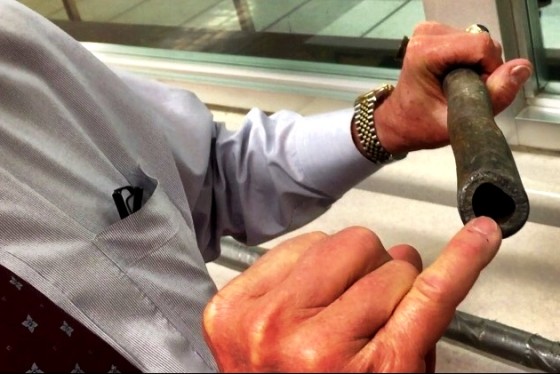
Holding up a piece of old lead pipe from the initial push to remove lead service lines, Jacobus says the addition of the chemical alters the way drinking water interacts with lead pipes.

“It changes the inside of the pipe from lead to an oxide of lead, but that lead oxide is resistant to the leaching as it sits stagnant in the pipe,” said Jacobus.

Edwards says the orthophosphate took several years to work effectively, but DC Water’s Hawkins says within a year lead levels were below EPA’s standards that would have required additional actions to stem the corrosion.

Initially, the Aqueduct used a higher dose of orthophosphate. Once a protective layer formed on pipes, the dose was lowered after complaints of cloudy water, Jacobus said.

“We’re very confident that the orthophosphate system is working,” said Jacobus. “We test it hourly.”

Jacobus says in addition to computer monitoring of orthophosphate levels in the treatment plant, scientists conduct hourly tests of water from the tap in the Aqueduct’s laboratory.

In addition, the Aqueduct runs lead pipe loops, “where we’re measuring finished water leaving the treatment plant with the treatment chemicals, and seeing the effect here at the plant,” says Jacobus. This mirrors conditions in customers’ homes.

Edwards concurs the orthophosphate treatment really is working.

“It’s not perfect but, in general, we find that D.C. tends to have less lead now after this horrible nightmare of the lead crisis and then the cure being worse than the problem. But now, D.C. probably has [a level of] lead in water that’s better than most urban cities with lead pipe,” Edwards said.

In part 2: How to make sure the drinking water in your home is safe. Part 2 will be available online Wednesday, April 6.

The post Before Flint: D.C.’s drinking water crisis was even worse appeared first on WTOP.

04 Apr 13:12

‘Jeopardy!’ shuts down roads in D.C. for 2 weeks

by wtopstaff

WASHINGTON — The Metropolitan Police Department has released a list of roads around the White House that will be closed during the shooting of Jeopardy!

The trivia game show, hosted by Alex Trebek, is filming at the Daughters of the American Revolution’s Constitution Hall from April 3-14. According to ABC7, three different specials will be taped in front of a live studio audience.

The Power Players show will be taped Saturday, Apr. 9, the final rounds of the Teachers Tournament will be taped Sunday, Apr. 10 and the Teen Tournament will be taped on Tuesday, Apr. 12 and Wednesday, Apr. 13 at DAR Constitution Hall. Featured contestants include CNN anchorman Anderson Cooper, actor and comedian Louis C.K. and Minnesota Senator Al Franken.

D.C. police announced Thursday the following streets will be closed to traffic:

  • April 3 – 4, 2016  from 5 a.m. to 5 p.m. D Street, NW, from 17th Street to 18th Street, NW, will be closed.
  • April 8, 2016 from 4:30 p.m. through April 13, 2016, at 11:59 p.m. D Street, NW, from 17th Street to 18th Street, NW, will be closed.
  • April 9, 2016 from 8 a.m. to 9 p.m. C Street, NW, from 17th Street to 18th Street, NW, will be closed.
  • April 10, 2016 from  9 a.m. to 7 p.m. C Street, NW, from 17th Street to 18th Street, NW,  will be closed.
  • April 12-13, 2016 from  9 a.m. to 7 p.m. C Street, NW, from 17th Street to 18th Street, NW,  will be closed.
  • April 14, 2016 from 5 a.m. to 10 p.m. C Street, NW, from 17th Street to 18th Street, NW, will be closed.

The post ‘Jeopardy!’ shuts down roads in D.C. for 2 weeks appeared first on WTOP.

04 Apr 13:10

Prince William County community calendar, April 3-9, 2016 - Washington Post


Prince William County community calendar, April 3-9, 2016
Washington Post
Dale City Farmers Market 8 a.m.-1 p.m. Dale City Commuter Lot, (behind Center Plaza Shopping Center), Dale Boulevard, Dale City. 703-670-7112, Ext. 227. pwcparks.org. Free. Quilt show Cabin Branch Quilters and Stone House Quilters sponsor the show ...

and more »
04 Apr 13:10

Dominion Raceway ready to drop green flag in Spotsylvania - Fredericksburg.com


Fredericksburg.com

Dominion Raceway ready to drop green flag in Spotsylvania
Fredericksburg.com
Drivers line up for practice in what could become a familiar sight at Dominion Raceway once it opens for racing next week. Buy this photo · Dominion Raceway ready to drop green flag in Spotsylvania. TOM ROTHENBERG FOR THE FREE LANCE–STAR ...

04 Apr 12:13

How to Prevent Hair from Knotting

Knotted and tangled hair doesn’t just look messy: it can also be painful and difficult to comb out, and it can lead to a great deal of breakage. There are many things that can cause tangled hair, including particular hair styles and heat products, but knots can also occur in the shower or when you dry your hair. Tightly curled hair is even more prone to knots, and it can also be difficult to keep long hair tangle-free. There are ways to remove knots once they form, but if possible, it’s always best to take preventative measures that will stop knots before they form.

EditSteps

EditPreventing Knots When Grooming

  1. Brush your hair before you wash it. Always use a wide-tooth comb or a paddle brush with plastic tipped bristles,[1] and comb through your hair before showering. This will help stop your hair from tangling when you wash it.[2]
    Prevent Hair from Knotting Step 1.jpg
    • As a general rule of thumb, don’t comb or brush your hair when it’s wet, as wet hair is more prone to damage and breakage.
  2. Shampoo properly. Wash your hair by focusing your shampooing on the scalp, rather than the hair, and never pile your hair on top of your scalp.[3] Use a natural shampoo that doesn’t contain sulfates or harsh detergents, as these can dry out your hair.[4]
    Prevent Hair from Knotting Step 2.jpg
    • Don’t wash your hair every day, as this can strip your hair of oils, leaving it dry and more prone to breakage.
  3. Condition after you shampoo. After you shampoo, work a conditioner into your hair with your fingers and remove any tangles. When you have removed all the knots, gently comb through with a wide-toothed comb.[5]
    Prevent Hair from Knotting Step 3.jpg
    • You shouldn’t normally brush your hair when it’s wet, but as long as you remove all the tangles first, use conditioner, and use the right comb, you can do this in the shower to distribute the conditioner evenly.
    • If you have thick, course, and tightly curled hair, condition your hair twice daily as opposed to just once. Condition once in the morning or after you shampoo your hair, and again before bed with a moisturizer or leave-in conditioner.[6]
  4. Dry your hair gently. Instead of wrapping, twisting, or rubbing your hair, gently squeeze it with a towel to get out the excess moisture. It’s also best to avoid heat products, such as blow dryers and flat irons, which can dry out your hair and leave it prone to damage and tangling.
    Prevent Hair from Knotting Step 4.jpg
    • If you must blow dry your hair, towel and air dry it first to cut down on the blow dryer time.
  5. Moisturize hair regularly. Healthy and moisturized hair is less likely to knot and tangle,[7] so along with regular conditioning, try a weekly hair mask or deep conditioning.
    Prevent Hair from Knotting Step 5 Version 2.jpg
    • To deep condition, work a quarter-sized dollop of deep conditioner into your hair. Wrap your head with a shower cap or plastic wrap, and allow it to rest for 30 minutes to an hour before rinsing.[8]
  6. Seal the tips of your hair. After you condition your hair, apply a hair butter or oil to the tips. This will seal in the moisturizing conditioner and help smooth and relax the ends of the hair, thereby preventing them from coiling around themselves and forming knots.[9]
    Prevent Hair from Knotting Step 6.jpg
    • This step can be skipped if you have fine or medium hair, but should be followed for hair that’s thick, coarse, and tightly curled.
  7. Gently stretch the ends of your hair. This is particularly useful for tightly curled hair, as the stretching will prevent the hair from coiling around itself and forming single-strand knots. You can stretch the tips of your hair by wrapping the ends around rollers.
    Prevent Hair from Knotting Step 7 Version 2.jpg
    • You can also protect your hair from knots by using hair styles that stretch your hair, such as twists, braids, and buns.

EditPreventing Knots Throughout the Day

  1. Tie your hair up when you're being active. If you're playing sports, swimming, or exercising, prevent your hair from knotting by wearing it in a braid, ponytail, or bun. The less your hair moves around and the less it gets matted with sweat and dirt, the more likely you are to be able to brush through it when you're done.
    Prevent Hair from Knotting Step 8 Version 2.jpg
    • Prevent damage to your hair and scalp by positioning your buns and ponytails in different spots on your head every time, and always make sure that such hair styles are loose.
  2. Protect your hair in the wind. Whether you're going for a summer drive with the windows down or if it’s just a windy day, wrap your hair in a scarf, cover it with a hat, or wear it in a protective hair style to stop it from blowing around too much. Not only will the wind ruin your hair style, but it will also blow your tresses into a tangled mess.
    Prevent Hair from Knotting Step 9.jpg
  3. Care for your hair when you sleep. While cotton is a popular choice for bedding, hair can catch on cotton pillow cases as you sleep, and this can create knots. Instead, look for a polished cotton pillow case, or a smooth fabric such as silk.
    Prevent Hair from Knotting Step 10 Version 2.jpg
    • You can also wear a satin bonnet or wrap your hair with a protective fabric to prevent knotting when you sleep.[10]
  4. Get regular trims. To keep your hair healthy and remove damaged ends, you should trim your hair every eight months,[11] but if your hair is prone to tangling, consider trimming it every three months.[12] Removing knots can cause breakage, and frequent trims will remove split ends and broken tips, and ensure your hair stays healthy looking and radiant.
    Prevent Hair from Knotting Step 11 Version 2.jpg

EditRemoving Knots

  1. Work in small sections. Tie or pin up the majority of your hair, and leave a small section of hair free. Once you detangle that section, start a new bun or ponytail to keep the detangled hair separate, and move on to a new section of tangled hair.
    Prevent Hair from Knotting Step 12.jpg
  2. Finger comb your hair. On the first section of hair, start near the tips and run your fingers through your hair to remove knots and tangles. Combs can actually make knots tighter, so untangle what you can with your fingers first.[13]
    Prevent Hair from Knotting Step 13.jpg
    • As you detangle the bottom of that section of hair, move up the strands and continue removing knots until you reach the top of your hair.
  3. Apply water and conditioner as necessary. When you encounter particularly nasty knots, apply some watered down conditioner to the area. Let it sit for a couple minutes, then go back to detangling with your fingers.[14]
    Prevent Hair from Knotting Step 14.jpg
  4. Repeat with a comb. Once you’ve removed all the knots you can with your fingers and can easily run your fingers through the entire length of your hair, gently comb through the same section with a wide-tooth comb. Like before, start at the bottom and work your way to the top.
    Prevent Hair from Knotting Step 15.jpg
    • Divide the section of hair into even smaller sections if you have trouble running the comb through.
    • Add more conditioner as needed to help loosen knots.
  5. Use a needle on tough knots. If you come across a knot that you can't loosen with your fingers or the comb, insert the needle of a safety pin into the center of the knot and move it around to loosen the knot.[15]
    Prevent Hair from Knotting Step 16.jpg
  6. Trim the knot as a last resort. In case you come across a knot that you absolutely cannot remove with conditioner, your fingers, the comb, or the safety pin, you may have to trim it off. Use sharp barber scissors, and make sure you remove as much excess hair from the knot as you can before making any cuts. Try to work the knot down toward the tip of the hair as far as you can to minimize the amount of hair you have to trim.
    Prevent Hair from Knotting Step 17.jpg

EditRelated wikiHows

EditSources and Citations


Cite error: <ref> tags exist, but no <references/> tag was found


04 Apr 00:31

Make Guacamole In a Bag for Portable, No-Cleanup, Go-Anywhere Dipping

by Alan Henry

Putting aside that no one makes guacamole in a blender (or no one should) this video from Nutrisystem is on point with a guacamole recipe that can go anywhere and won’t brown if you squish it down and seal the bag tightly. Cut off the corner and pipe—I mean squeeze—it into a bowl when you’re ready to eat.

Read more...


03 Apr 22:14

Amtrak train hits equipment on track; 2 workers die

by wtopstaff

CHESTER, Pa. (AP) — An Amtrak train struck a piece of heavy equipment just south of Philadelphia on Sunday, causing a derailment that killed two Amtrak workers and sent more than 30 passengers to hospitals, authorities said.

Train 89 was heading from New York to Savannah, Georgia, at about 8 a.m. when it hit the equipment that was on the track in Chester, about 15 miles outside Philadelphia, officials said. The impact derailed the lead engine of the train that was carrying more than 300 passengers and seven crew members.

Chester Fire Commissioner Travis Thomas said two people were killed. A National Transportation Safety Board official confirmed that one was the operator of the equipment. U.S. Sen. Chuck Schumer, D-N.Y., said Amtrak board Chairman Anthony Coscia told him the other person killed was a supervisor and both were Amtrak employees.

The Delaware County medical examiner’s office said no information would be released until after autopsies Monday.

NTSB investigator Ryan Frigo said at an evening news conference that the event data recorder and forward-facing and inward-facing video from the locomotive have been recovered.

He said the locomotive engineer was among those taken to hospitals. Officials said earlier that none of the injuries was deemed life-threatening.

Schumer said it’s unclear whether the equipment was being used for regular maintenance, which usually is scheduled on Sunday mornings because there are fewer trains on the tracks, or whether it was clearing debris from high winds in the area overnight. But he said Amtrak has “a 20-step protocol” for having such equipment, described by Amtrak as a backhoe, on the track, and no trains are supposed to go on a track when equipment is present.

“Clearly this seems very likely to be human error,” Schumer said, calling for Amtrak to review its processes. “There is virtually no excuse for a backhoe to be on an active track.”

An Amtrak spokeswoman said in an email to The Associated Press that any information about the type of equipment on the track and why the train was using that track would have to come from the NTSB. She said any information about the two people killed, including what company they worked for, would have to come from the Delaware County medical examiner.

The company was posting alerts on its website, however, with updates on its service.

Amtrak said service on the Northeast Corridor between New York and Philadelphia began operating after an earlier suspension and limited service was restored between Wilmington, Delaware, and Philadelphia by Sunday afternoon.

Amtrak said Sunday night that it will operate regularly scheduled trains Monday, although there may be some delays on Acela Express, Northeast Regional and other services between Philadelphia and Wilmington, Delaware.

Frigo said he did not know why the equipment was on a track the train was using. He said scheduling, the track structure and the work that was being performed at the time of the accident would be part of the investigation. The event data recorder has been sent to the safety board’s laboratory in Washington and will answer such questions as how fast the train was going at the time of the crash, he said.

Ari Ne’eman, a disability rights activist heading to Washington after speaking at an event in New York, said he was in the second car at the time of the crash.

“The car started shaking wildly, there was a smell of smoke, it looked like there was a small fire and then the window across from us blew out,” said Ne’eman, 28, of Silver Spring, Maryland.

Some passengers started to get off after the train stopped, but the conductor quickly stopped them, he said. Officials began directing people to the rear of the train for evacuation and then to a nearby church.

“It was a very frightening experience. I’m frankly very glad that I was not on the first car,” where there were injuries, Ne’eman said. “The moment that the car stopped, I said Shema, a Jewish prayer. … I was just so thankful that the train had come to a stop and we were OK.”

Businessman Steve Forbes told C-SPAN’s “Book TV” by phone that he was in the next-to-last car when the train “made sudden jerks” as if it was about to make an abrupt stop.

Forbes, chairman and editor-in-chief of Forbes Media, said the train then made another abrupt stop and “everyone’s coffee was flying through the air.”

“The most disconcerting thing … (was) not knowing what had happened,” he said.

Since the public address system was knocked out, he and other passengers were left to speculate for 20 or 25 minutes before a crew member came back to tell them what had happened, he said.

On Sunday afternoon, an Amtrak train in Illinois struck a vehicle at a crossing, killing the driver. An Amtrak spokesman said none of the approximately 248 passengers or dozen crew members was hurt. The crash happened in Somonauk, about 65 miles southwest of Chicago.

The Pennsylvania derailment comes almost a year after an Amtrak train originating from Washington, D.C., bound for New York City derailed in Philadelphia. Eight people were killed and more than 200 were injured in the May 12 crash. The exact cause of that crash is still under investigation, but authorities have said the train had been traveling twice the speed limit.

Nearly three decades ago, an Amtrak train struck maintenance equipment on tracks in Chester, near the site of Sunday’s derailment. More than 20 people were injured in that January 1988 crash of Train 66, the Night Owl. The NTSB determined afterward that an Amtrak tower operator had failed to switch the train to an unoccupied track.

___

Associated Press radio correspondent Julie Walker in New York contributed to this report.

The post Amtrak train hits equipment on track; 2 workers die appeared first on WTOP.

03 Apr 21:59

Study: Waist size a strong predictor of heart disease, better than BMI

by Paula Wolfson

WASHINGTON — There is more evidence that it’s better to be a pear than an apple.

A new study shows yet another link between your waist size and your risk of serious heart trouble.

Researchers at the Intermountain Medical Center in Salt Lake City and at Johns Hopkins in Baltimore followed 200 diabetics — both type 1 and type 2 — with no symptoms of heart disease.

They found those who carried their extra weight in the middle were far more likely to develop problems with their left ventricle, which pumps oxygen to the body.

Left ventricular dysfunction is a common cause of heart disease, including heart failure.

The research team says waist circumference was a better predictor of ventricle dysfunction than total body weight, or body mass index. And they say their study underscores the notion that reducing your waist can cut your risk of heart trouble.

The study findings were presented this weekend at the American College of Cardiology Scientific Session in Chicago.

The post Study: Waist size a strong predictor of heart disease, better than BMI appeared first on WTOP.

03 Apr 21:53

Sunday's Best Deals: 4K Samsung, Little Giant Ladder, Gummi Bears, and More

by Shep McAllister