
Banana bread can be a sweet treat, but not really that healthy for you. Improve your banana bread’s texture and nutritional value by mixing in an avocado.

Banana bread can be a sweet treat, but not really that healthy for you. Improve your banana bread’s texture and nutritional value by mixing in an avocado.

Some people fall asleep better by listening to music. If that sounds like you, check out this collection of music tracks, which correspond to the five stages of sleep.


Everyone has heard how important it is to pay attention to Congress, especially during an election season, but how many of us actually know how to do that? 4USXUS is my new favorite tool because it makes it simple. Or at least, as simple as politics itself can be.


Hash browns are awesome, but they can take a terribly long time to cook. Follow the video instructions above, however, and you won’t have to wait long at all for perfectly crispy hash browns.


Long distance runners and hikers have a variety of ways to deal with blisters , but a new study out of Stanford suggests that the best method might be cheap paper surgical tape.


Most dish brushes can be cleaned in the dishwasher, but if you have one that’s made of wood or you don’t have a dishwasher, this simple trick will get it clean.

 The number of bank tellers in Greater Washington declined by almost half in the past decade, compared with a 17 percent drop nationally and contrasting with a 7.3 percent local employment surge over the same timeframe, The Washington Post reports.
The shift in banking away from brick-and-mortar branches to ATMs and Internet features is not new, but the drop in personnel as seen in the numbers is stark testament to the power of technology disruption — and born out by a 1,000-square-foot Wells Fargo Bank branch that opened three years ago at 1200 First St. NW in D.C.’s NoMa neighborhood.
As we reported in 2013, there are no tellers but rather employees with tablet computers helping customers with the Wells Fargo portfolio of services.
The model aims to help solve a challenge for retail banks: While the Internet, mobile technology and more sophisticated ATMs are making branches less and less relevant, customers still say they want a branch nearby, even if they only use it occasionally.
Wells…
The post We knew bank branches were disappearing. Now the tellers are too. appeared first on WTOP.
EDEN, Md. (AP) — Authorities have seized about 300 dogs from a Wicomico County home.
Wicomico County Animal Control said in a news release Monday that authorities found 200 dogs inside a barn in Eden, while another 100 were found inside a house on the same property on April 6.
Wicomico County Sheriff’s Office Lt. Tim Robinson says it took animal control and the sheriff’s office 14 hours to remove the dogs.
Humane Society of Wicomico County Executive Director Aaron Balsamo tells WBOC-TV (http://bit.ly/1XrkZaZ ) that most of the dogs removed from the property were Pomeranians, with the majority not being in good condition.
Authorities have not released the identities of the dogs’ owners and, as of Monday, Robinson said no charges have been filed.
The post 300 dogs seized from Wicomico County home appeared first on WTOP.
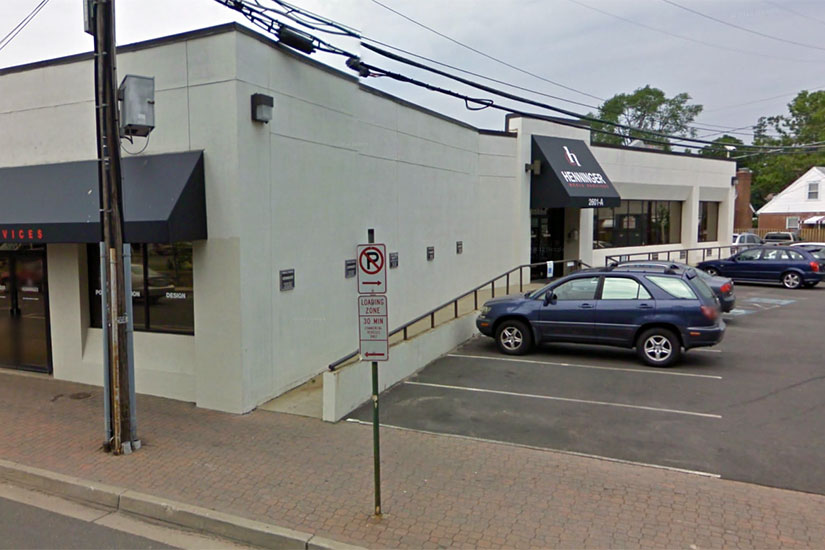 A new Caring Hands Animal Hospital location is “coming soon” to Clarendon.
The facility is currently being built out in the former Henninger Media Services space at 2601-A Wilson Blvd, behind Current Boutique. The local veterinary chain announced the new location on its website.
“Caring Hands Animal Hospital of Clarendon is an AAHA accredited veterinary practice with a state-of-the-art surgical suite, complete in-house laboratory, and a friendly and knowledgeable staff,” the company said. “With ultrasound and digital dental radiography capabilities we strive to provide the best care for you and your pet.”
Building permits for the interior construction were first issued in December.
Photo via Google Maps
The post Animal Hospital Coming to Clarendon appeared first on WTOP.

This week’s Pet of the Week is Angel, a small older dog who needs a forever home. Here is what the good people at Mutt Love Rescue have to say about her:
Poor Angel found herself homeless after her human had to go to a nursing home.
She is a 10-year-old miniature pinscher who, while well loved, was not cared for properly. As you can see by her pictures, Angel was carrying around some extra lbs. when we got her, but she has lost half of her original weight and is now at her target weight of 15 lbs!
While on paper, she may be considered a senior, she still has a lot of spunk! The whole back half of her body wiggles when she wags her non-existent tail. You’ve got to see it.. it’s really cute! Angel is a volunteer favorite and we would love to see her in a wonderful new home.
We have adoption events EVERY SATURDAY from 12-3 p.m. Please note that not all dogs can attend every event, so if you are interested in meeting a particular dog, please complete a no-obligation application on our websiteOR write to adopt@muttloverescue.org.
Are you and Angel a match? If so, let us know and our sponsor, Becky’s Pet Care, will send you $100 in Becky’s Bucks, as well as some treats.
Want your pet to be considered for the Reston Pet of the Week?
Email news@Restonnow.com with a 2-3 paragraph bio and at least 3-4 horizontally-oriented photos of your pet.
Each week’s winner receives a sample of dog or cat treats from our sponsor, Becky’s Pet Care, along with $100 in Becky’s Bucks.
Becky’s Pet Care, the winner of three Angie’s List Super Service Awards and the National Association of Professional Pet Sitters’ 2013 Business of the Year, provides professional dog walking and pet sitting services in Reston and Northern Virginia.
The post Reston Pet of the Week: Angel appeared first on WTOP.
Back in February prank callers preyed on fast food restaurants like Jack in the Box, Burger King, and Wendy’s, instructing workers to break every window and door or face certain disaster. The prank hit again in Minnesota over the weekend, when employees of a Burger King smashed the store’s windows, following directions from what they thought was a fire department official.
The Minneapolis Star Tribune reports that employees answered what they described as a frantic call from a local fire department official who said there was a gas leak in the restaurant.
The purported official reportedly told employees that the gas could buildup, leading to an explosion, unless they smashed all the windows at the restaurant.
That’s when a manager and Burger King employees evacuated the restaurant and then started smashing every ground floor window.
Shortly after the unscheduled demolition began, police responded to the restaurant.
“Officers arrived and found that the manager and employees of the Burger King were smashing out the windows,” a police official tells the Star Tribune. “The manager explained they’d received a phone call from a male who identified himself as a fireman who said there were dangerous levels of gas in the building and they had to break out all the windows to keep the building from blowing up.”
The manager was “frantic and actually believed the building was going to blow,” authorities said, noting that they explained there was no emergency and the call was a hoax.
One employee suffered a minor cut during the window-smashing, police said, no one else was injured.
While there is not yet an estimate on how much the damage costs or any leads on who placed the call, local police and sheriff’s departments say they are investigating.
Authorities reminded fast food, and other employees at business with windows in a statement that they “WOULD NEVER call a residence or business to ask them to take action of any kind.”
“Calls for service come into the 911 dispatch system from someone calling to report a problem, and only then do police, fire and emergency responders respond,” the department said. “In the event you receive a call from someone claiming to be from a police or fire agency asking you to take some kind of action, consider it a prank and call 911 immediately.”
Prank caller leads Coon Rapids Burger King employees to smash their windows [Minneapolis Star Tribune]


The wayward goat, named Milly, came strolling into a Starbucks in Rohnert Park, CA on Sunday morning, the Santa Rosa Press Democrat reports, just before the sun came up.
“It’s not every day a goat walks into a Starbucks,” Rohnert Park police Sgt. Rick Bates told the paper. “The two girls were opening for business. … They tried to give the goat a banana, but it walked right past them.”
No bananas for Milly, no sir. She was more interested in a stack of cardboard boxes, which is where Sgt. Bates found her, chowing down on her snack, when he arrived on the scene around 5 a.m.
As it turns out, Milly wasn’t visiting from some far-off farm or animal refuge: she’s an 11-year-old pet goat who lives two doors down. Her 12-year-old owner said she got out by wriggling out of her leash and walking off from her sleeping area.
“When we heard, we thought she was a little crazy,” he said. “She’s a really happy and sweet goat. She’s also pretty curious.”
Milly’s family took her home from the animal shelter Sunday afternoon, and is resting at home with the family’s dog and six chickens. A new fence is in the works to keep her from straying in the future.
Milly isn’t the first animal to go adventuring in human retail land: we’ve seen sea lions, bears, more bears, deer, more deer, and coyotes take a walk on the tame side on the past.
Rohnert Park Starbucks gets surprise goat visitor [Santa Rosa Press Democrat]

Volkswagen Beetles? That’s so last decade, at least where Best Buy’s Geek Squad is concerned: the tech support service is trading in the retro, kitschy appeal of the VW Beetle for the environmentally-friendly Toyota Prius.
Best Buy unveiled plans today to overhaul the retro-chic image typically associated with its on-the-go Geek Squad agents from top to bottom.
For starters, Geek Squad — which was purchased by Best Buy in 2002 — is getting a new logo and a new marketing campaign called “We Make It Work” that highlights the services’ expanded offerings, such as installing home devices and theater systems.
“Today’s Geek Squad Agent is more likely to help a client with a new home theater experience, optimizing their Wi-Fi or smart security solution than the family computer,” Geek Squad Chief Inspector Nate Bauer said in a statement.
The service, which has more than 20,000 agents who visit homes 13,000 times a day, aims to help customers not only repair their computers, but to learn about and enjoy their technology.
“It is equal part tech savvy and equal part environmentally friendly,” Nate Bauer, the Geek Squad’s chief inspector, told the Star Tribune, of the company’s new vehicle look. “What we stand for has evolved.”
The vehicle change comes as Best Buy looks to make progress on its previously announced commitment to reduce carbon emissions by 45% by 2020. The company estimates that the new, greener Geekmobile will cut the Geek Squad fleet’s emissions by 50%, as compared with the previous vehicle, which rolled out nationwide in 2004.
As part of the revamp, select agents test drove five vehicle options, the Minneapolis Star Tribune reports. The company finally settled on the Prius, Bauer says, after employees felt it was the safest, most efficient, and had the updated technical features used by Squad members.
“The first thing I did was connect my phone to it to see what a phone call would sound like, what the quality of the call would be,” Bauer said. “As well, you can text via voice so the agents aren’t going to have their phones in their hands at all.”
Retail analysts tell the Star Tribune that the Geek Squad revamp could be a sign of the service’s future, noting that one day the Priuses could contribute to Best Buy’s piloted same-day delivery service.
“It’s an owned asset that Best Buy has had for awhile, but that arguably is more important than ever,” Carol Spieckerman, a retail consulate, said. “Every retailer is thinking about how do we create a seamless experience with solutions and services to where consumers don’t just buy products and go on their merry way, but leverage our full platform. That is hitting a fevered pitch in retail right now.”
Best Buy’s Geek Squad to swap Beetles for Priuses [Minneapolis Star Tribune]

It’s one thing when Starbucks staffers mess up your name — hello, I’m “Marky Beth” — but getting a rude message is an entirely other matter. The Seattle coffee chain has apologized for one such incident, in which a customer received his grande white mocha with the words “Diabetes here I come” written on the cup.
The customer shared a photo of the message with Action News Jax on Facebook, saying that he was taken aback because both of his sisters have Type 1 diabetes.
A @Starbucks customer tells me he's hurt by the message he received on his coffee cup. Details on @ActionNewsJax pic.twitter.com/hNMeC6ysRJ
— Kaitlyn Chana (@KaitlynANjax) April 8, 2016
He says he works near the shop and a fellow employee picked up the coffees for their staff, but his was the only one with an unusual message.
The customer added his own note on the same cup with a message for baristas and returned it, in the hopes that they won’t judge others.
“2 of my sisters are diabetic, so … not funny,” he wrote.
“Seeing and knowing the struggle my sisters went through by third, fourth grade, it definitely struck a nerve, and I didn’t just want to let it go,” said the customer.
The news station reached out to Starbucks corporate and received the below comment:
“We strive to provide an inclusive and positive experience for our customers, and we’re disappointed to learn of this incident. We are working directly with the customer to apologize for his experience, and with our partners (employees) to ensure this does not happen again.”
Man gets cup from St. Augustine Starbucks that says ‘DIABETES HERE I COME’ on label [Action News Jax]

Iceberg lettuce — also known as the tasteless afterthought often found in annoyingly huge chunks in salads and shredded into lifeless strands for sandwiches — may be somewhat ubiquitous in the fast food world, but there’s at least one chain that refuses to use the stuff: Chick-fil-A’s test kitchen has taken a hard line against iceberg lettuce.
Chick-fil-A has six chefs working out of its test kitchen in Atlanta on new salads and healthy sides for the chain, who are free to explore the culinary world in search of the next big veggie hit. But there’s one ingredient chefs aren’t allowed to experiment with in the kitchen.
“We have a mandate: Never use iceberg lettuce,” David Farmer, Chick-fil-A vice president of menu strategy and development, told Business Insider. “It’s at the bottom of the salad food chain. There is no nutritional value in iceberg lettuce.”
Instead, he’s a fan of darker leafy greens like kale, which Chick-fil-A now serves at its restaurants, despite having an antithetical stance on the salad staple in the past.
“Our focus over the last couple years has been around health,” Farmer explained. “We’re seeing purchase behavior shift toward healthier items, so we’re fully committed to providing more nutritional options for customers.”
This doesn’t mean you’ll never see iceberg on the menu, however.
“There’s no official ban in place,” Carrie Kurlander, vice president of public relations, Chick-fil-A, tells Consumerist. “What you will find is our premium salads and Superfood Side introduced this year include ingredients like kale and romaine lettuce, and we’ve opted for these because of the nutrients and flavor they pack in every bite.”
Chick-fil-A has banned one ingredient from its restaurants [Business Insider]

Just because something is made in another country’s style, does that mean it has to actually be produced in that foreign land? Not necessarily, a judge said recently in dismissing a potential class action lawsuit accusing Red Stripe of false advertising, among other things, because its “Jamaican style lager” has been made right here in the United States since 2012.
U.S. District Judge Barry Ted Moskowitz said beer drinkers can’t sue Diageo-Guinness for labeling its Red Stripe brew with terms like “Jamaican Style Lager” and “The Taste of Jamaica,” despite the fact that it’s produced in Latrobe, Pa., by City Brewing Co., reports Courthouse News Service.
The two plaintiffs had sued claiming they bought Red Stripe because of those labels, and were seeking class certification and damages for false advertising, unfair competition, business law violations, and negligent and intentional misrepresentation.
“(T)he Court finds that a reasonable customer would not be misled by the visible packaging into believing that Red Stripe is brewed in Jamaica with Jamaican ingredients,” Moskowitz wrote in dismissing the complaint without prejudice. “The mere fact that the word ‘Jamaica’ and ‘Jamaican’ appear on the packaging is not sufficient to support a conclusion that consumers would be confused regarding the origin and ingredients of the beer.”
In his ruling he cited Forschner Group, Inc. v. Arrow Trading Co., in which the Second Circuit held that the phrase “Swiss Army knife cannot fairly be read to mean “made in Switzerland.”
Moskowitz concluded that although the plaintiffs can’t state a claim for deception or misrepresentation based on the Red Stripe bottle labels or packaging for the 12-packs or 6-packs, they can amend their complaint to assert claims based on other facts, and file it again within 15 days.
Red Stripe was first brewed in Jamaica starting in 1938, and was imported to the U.S. starting in 1985. The company that owned the rights before Diageo-Guiness moved production to Pennsylvania in 2012.
‘Sorry, Mon, You Can’t Sue Red Stripe’ [Courthouse News Service]

The geographic center of the United States, as all elementary school students know, is in Kansas. When some services that map a device’s Internet Protocol address don’t know where someone using a website is located, they point to the front yard of a farm in Kansas. The octogenarian owner and her tenants had no idea until recently why they were being harassed.
Following up on a recent story about a couple who regularly find strangers at their door looking for missing smartphones, Fusion’s Kashmir Hill decided to look for more people who might have similar problems. It turns out that there are quite a few, but the farm is the worst of them all.
The farm is a few hours’ drive from the point that’s the exact geographic center of the United States. Early last decade, a company called MaxMind was laying the foundation for what would become a location database for IP addresses. When their database doesn’t know where a user’s IP address is, it returns a latitude and longitude near the center of the country. They rounded the actual address, 39.8333333,-98.585522, to something shorter. Unfortunately, that nice and even address, 38.0000,-97.0000, is precisely in the farm’s front lawn.
“At that time, we picked a latitude and longitude that was in the center of the country, and it didn’t occur to us that people would use the database to attempt to locate people down to a household level,” the company’s founder explained to Hill. “We have always advertised the database as determining the location down to a city or zip code level.” Instead, people read the “somewhere in the United States” address as “at this address in Kansas.”
600 million IP addresses point directly at their address, and it has led to everyone from ambulances to IRS agents on the property, looking for people who definitely don’t live there. For years, the owner and tenants have dealt with having their personal information released online, angry phone calls, and even a toilet dumped in the lawn.
“Our deputies have been told this is an ongoing issue and the people who live there are nice, non-suicidal people,” the county sheriff said. The situation could become even worse if a nice person who were ill or even who had suicidal ideation moved in someday. First responders might not bother to come if the person’s friends or family contacted them if they know the history of the house.
The good news is that now MaxMind knows about the effect their error has had on the people who live in the house, and they’ve changed the default point for the United States to the middle of a lake. It might take a while for that update to roll out to all of their clients, though.
How an internet mapping glitch turned a random Kansas farm into a digital hell [Fusion]

Who says competitors can’t try to help each other out? Wayback Burgers is stepping up to help lure in the real life hamburglar who cooked himself up a snack in the kitchen of a closed Five Guys in Washington D.C. with what should be a tempting reward: free burgers for a year.
Perhaps the move is bit self-serving — just like the crime, get it? — as Wayback gets to join a story that’s already caught the attention of the public. But still, free food.
“As you may be aware, there is a gentleman who broke in and made himself a burger at another restaurant brand last month in the D.C. area and is still at large,” John Eucalitto, President of Wayback Burgers said in a statement. “To that gentleman, I’d like to say that we all make mistakes — from committing this illegal act to your choice of burgers. I strongly encourage you to do the right thing and turn yourself in right away.”
Once the suspect hands himself over to police and takes “accountability” for his actions, Wayback will furnish him with free burgers for a year.
“It’s not too late to turn it around based on what you did,” Eucalitto says. “We’ll be keeping an eye on this story.”
Let’s just hope this doesn’t spur a rash of copycat, burger-cooking crimes from others seeking free food.
(h/t Fox 11)

Ortho, a major player in the garden-care industry and subsidiary of Scotts Miracle-Gro, has tongues buzzing over the news that it will start to “transition away” from using chemicals in its pesticides that are believed to be harmful to honey bees.
The Ohio company says it will eventually stop using neonicotinoid-based pest control products for outdoor use, reports USA Today.
Ortho says it’s also teaming up with Pollinator Stewardship Council, an advocacy group that supports beekeepers, to work on a customer education and lobby for the use of label language that clarifies the purchase of non-neonic pesticides.
“This decision comes after careful consideration regarding the range of possible threats to honey bees and other pollinators,” said Tim Martin, general manager of the Ortho brand. “While agencies in the United States are still evaluating the overall impact of neonics on pollinator populations, it’s time for Ortho to move on.”
“We encourage other companies and brands in the consumer pest control category to follow our lead,” he said.
The moves comes after BJ’s Wholesale Club and Home Depot stopped sale on the pesticides in 2014, with Lowe’s following with a promise in 2015 to stop selling those products to consumers. Ace and TruValue Hardware are now considering taking similar action. Maryland recently passed a bill that if approved, would ban the sale of neonic pesticides for most customers in the state.
Ortho to stop using chemicals considered to be harmful to bees [USA Today]

Back in January, the Internal Revenue Service made it clear that taxpayers had until April 18 to file their federal income taxes. Apparently, Apple’s calendar didn’t get the message.
Instead, the calendar, which can automatically fill in U.S. holidays and other notable days on iPhones and other Apple devices, continues to show “Tax Day” as April 15, the traditional deadline for filing taxes, The Cleveland Plain Dealer points out.

Only this year, April 15 is being used to observe Emancipation Day — which falls on Saturday, April 16 — a legal holiday recognized in Washington D.C., where the IRS is located.
Because the IRS and other government agencies will be closed on Friday, the deadline for filing taxes has been pushed back to the next business day, Monday, April 18.
While the federal government is giving taxpayers a few extra days to submit their filings, it’s important to also check your state filing deadline.
Most states have pushed the deadline to April 18, as well, but a few have actually tacked on an additional day. Maine and Massachusetts are giving taxpayers until April 19 because of Patriot’s Day.
[via The Cleveland Plain Dealer]

Tampons are about to get a little bit cheaper for New York residents, after the state’s senate unanimously approved a bill that exempts feminine hygiene products from sales tax.
The bill was sponsored by Sen. Sue Serino, who received the thanks of Sen. Diana Savino upon the bill’s passing, reports Capital New York.
“It is a way of providing some tax relief to women everywhere, young girls in particular,” Sen. Diane Savino said. “But on behalf of women of a certain age everywhere, I would love to offer a friendly amendment and ask for a rebate program, Senator Serino. But I know it would probably bankrupt the state.”
The legislation was passed by the Assembly passed last month, and has the backing of Gov. Andrew Cuomo. He’s expected to sign it into law.
“We’ve said we’d work with the Legislature to repeal this tax and applaud their action,” said a spokeswoman for the governor.
Last month, five women filed a class action lawsuit against New York’s Department of Taxation and Finance, saying that while other medical items are sold without a tax — including Rogaine, foot powder, dandruff shampoo, ChapStick, adult diapers, and incontinence pads — medical items used only by women like tampons and sanitary napkins are subject to the state’s 4% sales tax.
The department says feminine hygiene products aren’t on the list of medical items because they don’t treat or prevent illnesses or diseases. They do prevent a lot of other really bad things from happening though.
Elsewhere in the country, the Illinois state legislature is considering a bill to exempt feminine hygiene and incontinence products from state sales tax. Last month, the Chicago City Council went ahead of its state and voted to stop collecting city sales taxes on these items.
Senate unanimously passes bill eliminating ‘tampon tax’ [Capital New York]

Only hours after Deutsche Bank canceled its plans to expand its presence in North Carolina — and following a similar decision last week by PayPal — the state’s governor has signed an executive order that softens some aspects of a controversial bill that restricts cities’ ability to protect the rights of people based on sexual preference or gender identification.
That bill, commonly referred to as HB 2, was drafted and passed by the state legislature and signed by Governor Pat McCrory in an expedited session in March. The legislation, which prohibits local lawmakers from establishing rules that protect people against discrimination based on their sexual preference or gender identity, was an apparent attempt to stave off the enactment of a Charlotte city ordinance that would have allowed transgender people to use the public restrooms of whichever gender they identify with. The bill has the far-reaching effect of overriding any existing local rules that protected discrimination against gay and transgender people.
Many North Carolina businesses — including Bank of America — urged the governor to not sign HB 2, saying that such . And even after he put his name to the bill, those companies called on McCrory to rethink and repeal the legislation.
Meanwhile, the state’s attorney general — who also happens to be running for governor — has said that he would and could not defend HB 2 in court.
And so today, Gov. McCrory signed an executive order that extends some protections to previously unprotected communities while leaving in place rules that critics say embody the worst spirit of HB 2.
For example, while the executive order extends — for the first time in North Carolina — anti-discrimination for public employees based on their gender identity or sexual preference, when those same state-employed folks are at work, they must use the restroom that matches the gender on their birth certificate.
So a state agency can no longer decide to not hire someone because of their gender identity, but they can tell that same person which bathroom to use.
Similarly, the executive order leaves it up to private businesses to decide whether or not they want to allow transgender customers, guests, and employees to use the restroom of their preference. However, HB 2 still supersedes all existing or pending local ordinances, meaning a city like Charlotte — or others that had protections for all LGBT people — can’t enact its more flexible restroom rules, and that municipalities are barred from creating anti-discrimination ordinances that aren’t in line with the state’s rules.
HB 2 also stripped North Carolina residents of the right to sue file an anti-discrimination suit against the state in state court; they must now file a claim in federal court. McCrory’s order doesn’t repeal that portion of the law, but he says that he will “seek legislation” in the upcoming session to reinstate that right.
The executive order did not sit well with the Human Rights Campaign, which has been vocally opposed to HB 2.
“The governor’s action is an insufficient response to a terrible, misguided law that continues to harm LGBT people on a daily basis,” says HRC Legal Director Sarah Warbelow in a statement. “It’s absurd that he’ll protect people from being fired but will prohibit them from using the employee restroom consistent with their gender identity.”
The HRC contends that if public schools in North Carolina comply with HB 2, they will be in violation of Title IX — a federal anti-discrimination ordinance — and at risk of losing around $4.5 billion in funding from the U.S. Department of Education.
Even in announcing the order, Gov. McCrory defended HB 2 against the criticism that has been leveled against it and the lawmakers who passed it.
“You know, after listening to people’s feedback for the past several weeks on this issue, I have come to the conclusion that there is a great deal of misinformation, misinterpretation, confusion, a lot of passion and frankly, selective outrage and hypocrisy, especially against the great state of North Carolina,” he says in the video below. “But based upon this feedback, I am taking action to affirm and improve the state’s commitment to privacy and equality.”
Deutsche Bank is currently not commenting on the governor’s executive order. We’ve reached out to PayPal for comment, but have not yet heard back.

Tens of thousands of Verizon employees walked off the job this morning, when months of inconclusive contract negotiations between the company and the union representing those workers finally stalled out completely.
The relationship between Verizon and the union has been publicly testy for some years now. The previous contract expired in August, 2015, but negotiations had both started before and continued since that point. The union, however, has several times in the past two years called out Verizon for failing to maintain legacy services, failing to roll out new services, failing to meet obligations to finish FiOS, and failing to serve low-income areas.
Verizon, alternately, has slammed the union’s statements and tactics. For example, when the city of New York audited Verizon’s FiOS rollout last year, the company said “it’s well known the union has ties to the city administration,” and called the detailed report a “union [negotiating] tactic.”
The war of words over the strike is, of course, pretty ugly, with each side accusing the other of bad faith and shady behavior. You can read both Verizon’s statement and the union’s statement, if you enjoy that sort of thing, but for those who want to know more about what’s happening and less about who blames whom for it, read on.
Who’s fighting?
The stand-off is between Verizon and the Communications Workers of America. The CWA represents about 700,000 telecom line workers nationwide, and that includes 39,000 Verizon employees (out of the company’s 177,000) in the northeast and mid-Atlantic. Many of those employees are also represented by the International Brotherhood of Electrical Workers (IBEW), which is also participating in the action.
The segment of employees that are on strike are primarily technicians, who actually install, repair, and maintain landline networks and equipment.
What services are involved?
The strike affects Verizon’s wire-line businesses. That includes FiOS (around 7 million total households, give or take) and all of the copper-wire landline service (both voice and DSL) in the region.
What customers are likely to be affected?
Primarily, this will affect customers along the East Coast — more or less the Boston-Washington corridor, plus a bit — who subscribe to Verizon landline services.
The union’s own protest site has a handy map of planned events that correlates pretty well to the cities where workers are striking: 
Verizon says it has trained other members of its work force to respond to the kind of calls the striking workers would usually handle, so that customers should see no interruption in service, but the union counters that 10,000 recently-trained replacements can’t handle the volume or type of requests that 39,000 long-time workers usually do.
Who is not really going to be affected?
Verizon subscribers outside of the northeast and mid-Atlantic are not likely to be affected by the strike. Likewise, the ~115 million consumers who buy Verizon Wireless mobile services should not be affected.
(That said, according to the union’s Twitter feed, there are also walkouts at at least one Verizon Wireless location, in Brooklyn, so that may be something to keep an eye on.)
Also, if your service is operating properly and no squirrels chew wires, no cars hit poles, no branches fall down, nothing needs installing, you’re not moving, your box doesn’t crash, your lines stay buried, etc., you personally probably won’t notice that there are fewer people answering phones and fixing problems than usual.
How long is this likely to last?
Who knows? ¯\_(ツ)_/¯
It’s a contract dispute, so the strike will continue until the union and the company reach negotiated terms both parties can agree with. That might be a day or two, a week or two, or a month or two. The last time negotiations failed, in 2011, a similar strike lasted about two weeks.
However, since 2011 Verizon has continued to cut their wire-line workforce and has seen a distinct reduction in subscribers and revenues on wired services, so it is entirely possible they are less motivated than before to resolve the work stoppage quickly.

While JCPenney has been selling plus-size garments for years, the retail chain is ready to make a big move into the fashion category: it’s launching a private label plus-size brand for women called Boutique+.
The department store is partnering with Project Runway winner Ashley Nell Tipton to create two capsule collections for the new brand that’s aimed at millennial shoppers, JCPenney says in a news release.
Boutique+ will hit 500 stores as well as online on May 1, and will be released in conjunction with a new store-within-a-store concept and online section called Boutique. The physical Boutique sections will take up between 980 and 2,000 square feet in more than 200 brick-and-mortar stores, and will host a range of plus sizes in a variety of brands including the new Boutique+ line and its in-house Liz Claiborne label.

“There are millions of incredibly stylish full-figured women who are seeking comfortable, well-fit clothes that offer style and versatility,” said Siiri Dougherty, senior vice president of women’s apparel at JCPenney. “JCPenney is committed to winning her loyalty by designing an entirely new modern brand made just for her and creating a dedicated shopping environment that respects her time and budget with a greater selection of affordable plus-size fashion that takes into account diverse body types.”
The move fits with JCPenney’s emphasis on its private labels like Liz Claiborne, in an effort to turn around sinking sales, MarketWatch points out.
“We are ramping up our penetration of private brands, which carries a higher margin,” Chief Executive Marvin Ellison said in a recent earnings call. “And, frankly, we think we can get a higher margin on our private brands themselves.”
Those in-house brands give the company a “tremendous advantage” against e-commerce competitors, he added.

There are contexts where prepaid debit cards are useful. Consumers without bank accounts who would otherwise deal all in cash use them, and they’re also useful for distributing allowances. The problem with prepaid cards is that they impose high fees for functions like reloading, using out-of-network ATMs, or monthly fees for simply having the card. However, they’re better than they used to be, largely because at least they disclose those fees.
Our colleagues down the hall at Consumer Reports evaluate and rate prepaid cards, and they’ve watched trends in the industry. While you can expect all prepaid cards to come with some kind of fee (they can’t make money by charging you interest, after all) some keep their fees minimal, like the Walmart/American Express Bluebird card with no monthly fee, or Chase’s Liquid Visa which charges a $5 monthly fee. Neither card charges for use of in-network ATMs.
What has made the biggest difference is increased transparency from card issuers. The cards themselves haven’t changed much overall, with some companies still imposing high fees on essential functions. Users didn’t expect to be charged fees per transaction, for example, or to reload their cards. Greater transparency means customers can choose the right card for them, as long as they read the fees carefully and know their options.
Prepaid Card Buying Guide [Consumer Reports]

A week after it was first reported that Senators Dianne Feinstein (CA) and Richard Burr (NC) were prepping a bipartisan bill that would compel tech companies to build their devices and software with weakened encryption or built-in backdoors for law enforcement, the actual bill has been introduced. Here’s what you need to know about why consumer and privacy advocates are concerned.
The Compliance with Court Orders Act of 2016 [PDF] states that “to uphold both the rule of law and protect the interests and security of the United States, all persons receiving an authorized judicial order for information or data must provide, in a timely manner, responsive, intelligible information or data, or appropriate technical assistance to obtain such information or data.”
What does that mean exactly, and what are the implications?
1. It’s An Attempt To Update & Strengthen A 227-Year-Old Law
Way back in 1789, Congress passed the All Writs Act, which allows a judge to compel a person or group to assist in the enforcement of a court order — but only if that assistance is both necessary and “agreeable to the usages and principles of law.”
Law enforcement has long used the All Writs Act to nudge private businesses to aid in an investigation. In fact, the government has used this law more than 60 times in recent years to compel Apple and Google to help with unlocking smartphones and other tasks.
And since the companies had easy ways to comply with these court orders, they did.
But in 2014, both Apple and Google updated their mobile device operating systems so that not even the makers of the software had a way around the encryption. Thus, when a newer iPhone or Android device is locked, only the user can unlock it without having to reset it and lose the stored data.
This is what caused the recent very public spat between Apple and the FBI, which was trying to unlock an iPhone that had belonged to one of the terrorists who killed 14 people on Dec. 2, 2015 in San Bernardino, CA.
Apple has no built-in work-around for its own encryption, but the FBI used the All Writs Act to try to compel them to figure out a way to do so. Apple argued that the relatively ancient law doesn’t require companies to go to such lengths and that this would just be the thin edge of the wedge, setting a precedent whereby Apple would — as additional court-ordered demands for assistance pile up — either need to permanently weaken its encryption or constantly be trying to poke holes in the walls its own employees built.
The bill from Feinstein and Burr would, if passed, make Apple’s argument moot. The company would have no choice — comply with the court order in a timely manner or violate the law.
2. Unbreakable Encryption Could Be Against The Law
The language of the proposed makes it clear that if the company’s encryption is the reason that the sought-after data is unintelligible, then it’s the company’s responsibility to make it intelligible.
Thus, if a company were to make an unbreakable form of encryption — or one that it lacks the ability to break — they would not be able to comply with the law.
This means that tech companies have no incentive — and may even be dis-incentivized — to create world-class encryption.
“This legislation would effectively prohibit Americans from protecting themselves as much as possible,” says Sen. Ron Wyden (OR). “It would outlaw the strongest types of encryption and undermine the foundation of cybersecurity for millions of Americans.”
3. Tech Companies Would Be Forced To Release Poorly Secured Products
While the proposed legislation says that it is not forcing companies to adopt “any specific design or operating system,” it ultimately has the effect of requiring that tech companies include a backdoor to their encryption so it can be decrypted whenever a court order pops up.
Sens. Burr and Feinstein say the believe that data encryption is important, but critics of the bill point out that encryption with a backdoor is like a submarine with a leaky window.
“Data is either encrypted or it is not, and the technical assistance that this legislation mandates is not feasible nor is it in the country’s best interest,” says Jake Ward, CEO of the Application Developers Alliance. “Despite the Act’s Design Limitation provision, these requirements would compel companies and developers to create a specific design or operating system with inherent security flaws.”
4. Weak Encryption Puts All Our Information At Risk
While much of the discussion regarding encryption has centered on criminals and terrorists, with some proponents of backdoors wondering what everyday law-abiding citizens are so eager to keep private, giving hackers a built-in entry point puts us all at risk.
A hacker might not be able to crack the encryption on an online retailer’s credit card database, but if he knows that an employee at that retailer has a hackable phone, that could be the beginning of a path leading to yet another big data breach. One of the largest breaches in history — the 2013 holiday shopping season attack on Target — was achieved by attacking the retailer through one of its air-conditioning vendors.
In a letter sent earlier this week to President Obama, dozens of privacy advocates — including the Electronic Frontier Foundation, the PEN American Center, and the American Library Association — argue that government-mandated weakened encryption would hurt many and provide few, if any, benefits.
“It is beyond dispute that this bill would threaten the safety of billions of internet users, including journalists, activists, and ordinary people exercising their right to free expression, as well as critical infrastructure systems and government databases,” reads the letter. “However, it would likely to do very little to assist in investigations of crime or terrorism, since those who engage in illegal activities will have access to other means to protect their own devices and communications.”
Sen. Wyden echoes that sentiment, saying, “This flawed bill would leave Americans more vulnerable to stalkers, identity thieves, foreign hackers and criminals. And yet it will not make us safer from terrorists or other threats. Bad actors will continue to have access to encryption, from hundreds of sources overseas.”
Congressman Jerry McNerney (CA) argues that, far from helping the government fight crime and terrorism, requiring backdoors could encourage that sort of activity.
“Such a mandate, if enforced, could introduce vulnerabilities into our national security, making it easier for criminals, terrorists, and other bad actors to gain access to secure information,” says the congressman. “Our national security would be best served by an expert-level policy debate on how to ensure that law enforcement has access to necessary information without weakening our security or individual liberties.”

It’s been almost three years since activists first drew the world’s attention to the conditions on fishing boats out of Thailand, where migrant workers recruited from poorer Asian countries work under terrible conditions. Last year, two huge pieces of investigative journalism told their stories and reminded us that it’s still happening, and consumers sued companies like Nestle and Costco for selling seafood produced under these conditions to unwitting customers. That means that this situation has been fixed, right? Not really, the U.S. Department of State tells us.
In their annual report about human rights practices around the world for 2015, the Department of State notes that Thailand updated many of its labor and human trafficking laws, which included protections for whistleblowers. Human traffickers, in the fishing industry and elsewhere, were arrested and punished, but the definition of “forced labor” and “debt bondage” is still fuzzy in practice in Thailand, and reports of workers in bondage continue.
According to reports, men and boys from neighboring countries sign on with labor brokers, who don’t tell them that they will be kept on a boat, sometimes for years on end, and forced to catch fish that will end up fed to farmed shrimp or American cats.
Country Reports on Human Rights Practices for 2015: Thailand [State Department]
US: Forced labor continues on Thai fishing vessels [AP]

Hollywood Reporter |
Samantha Bee proves it's easier to buy a gun than an NRA Eddie Eagle mascot costume New York Daily News America's top gun lobby is a staunch supporter of eagle costume control. The National Rifle Association has made it nearly impossible to purchase a likeness of its gun safety mascot, Eddie Eagle, while fighting to make it easier for Americans to get ... Video: Why is it easier to buy a gun than it is to buy the NRA's mascot outfit? An error occurred.Hot Air Watch: Samantha Bee's Brilliant Takedown of the NRA's Absurd PrioritiesAlterNet Samantha Bee Shows How Strict the NRA's Rules Are — For Everything but GunsMic Vox -Huffington Post -Media Matters for America all 48 news articles » |
NBC4 Washington |
Police identify body pulled from Manassas pond WTOP WASHINGTON — Police have identified a body that was pulled from a pond in Manassas last month. Related Stories. Va. police: Human remains found in retention pond Prince William County, VA News. The Prince William County police say that Rose Marie ... Police identify remains as those of missing womanInside NoVA all 7 news articles » |

Flash storage and RAM, an iPhone 6 battery case, and a popular Wi-Fi router lead off Monday’s best deals.