Shared posts

30 Mar 22:18

How to Buy Ebooks From Anywhere and Still Read Them All in One Place

by Eric Ravenscraft

How to Buy Ebooks From Anywhere and Still Read Them All in One Place

Most ebook sellers try to lock you into a particular ecosystem. If you don't mind buying from the same company every time, this isn't too bad, but you lose the ability to comparison shop, as well as making it difficult to switch apps. Fortunately, there's a way around this problem.

Read more...


30 Mar 22:17

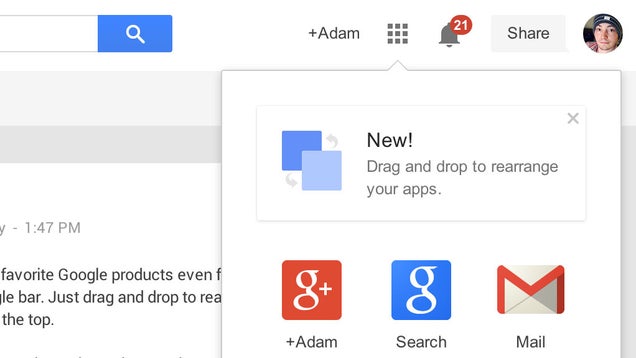
Customize Your Google Shortcuts Bar Through Drag and Drop

by Adam Dachis

Customize Your Google Shortcuts Bar Through Drag and Drop

Google announced today that you can customize your shortcuts throughout your Google account. Want maps at the top? Just drag and drop it.

Read more...


29 Mar 20:56

GM Asks Dealers To Stop Selling Chevy Cruze, Won’t Say Why

by Chris Morran

bluecruzeIn the midst of a recall scandal involving ignition problems that have resulted in the deaths of at least a dozen people, General Motors has another publicity mess on its hand. The carmaker has told its dealers to stop selling certain Chevy Cruze models but isn’t publicly stating a reason for the halt.

GM says it is not recalling the model-year 2013 and 2014 Cruze vehicles with 1.4-liter turbo engines, but is just asking dealers to not sell any of those cars that have gone unsold.

“I can just confirm that we put a stop-sale in last night,” a GM rep told Reuters, only saying that stop-sales generally indicate that a dealer needs to do something to a particular car before it can be made available for sale again. While such orders are not uncommon, they often indicate that a safety issue needs to be dealt with by the dealer.

A Detroit-area dealer tells the Detroit News that no reason was given in the stop-sale letter sent out by GM’s corporate office.

29 Mar 20:56

25 Tons Of Edible Peanut Butter Dumped In Landfill After Dispute Between Plant And Costco

by Ashlee Kieler

Yesterday we told you that Sunland Foods Inc., the peanut butter plant behind the Great Peanut Butter Recall of 2012, was being sold at a bankruptcy auction. Sure, you could say that makes the company the big loser in peanut-gate. But today we learned the real losers are all the lovers of the creamy, nutty food. Why? Because the company is dumping 950,000 jars of safe, edible peanut butter into a New Mexico landfill following a dispute with Costco.

The massive peanut butter dump was initiated after Costco Wholesale refused to take shipment of the product and declined requests to let it be donated to food banks, repackaged or sold to brokers who provide foot to institutions like prisons, NPR reports.

The peanut butter was made from $2.8 million worth of Valencia peanuts owned by Costco. After testing the product, Costco agreed to a court order authorizing the Sunland bankruptcy trustee to sell the retailer the peanut butter.

However, after receiving eight loads of the product Costco determined it could not sell the jars because of leaky peanut oil.

While both companies agreed there was no health or safety issue with the peanut butter, Costco said it would not agree to any arrangement other than destruction.

And so, 25 tons of the peanut butter, valued at $2.6 million, is being hauled to the Curry County landfill in Clovis, NM, where it will be covered in dirt.

Before closing, Sunland produced peanut butter under a number of labels for retailers like Costco, Kroger and Trader Joe’s.

The plant was originally shut down by the Food & Drug Administration for eight months in 2012 after it was linked to 41 salmonella cases in 20 states.

FDA investigators found salmonella bacteria at 28 sites in the plant, and contaminated samples of various nut butters. Inspectors also found unclean equipment and employees handling products improperly. Uncovered peanuts were left outside to collect rain and bird poop.

After a short reopening the plant closed for good in October 2013 when the company filed for Chapter 7 bankruptcy.

Currently there are two companies vying for the Sunland plant: Hampton Farms of North Carolina, and Golden Boy Foods of Canada.

Hampton Farms won the original bidding last week, and it appeared that the bankruptcy court was just about to approve the $20 million sale on Wednesday morning when Golden Boy Foods called in with a $25 million offer. Hampton Farms then raised their bid to $25.1 million, but has made it clear that they believe the court should go by the results of the original bidding.

Cases of Edible Peanut Butter Dumped After Bankruptcy Dispute [NPR}

29 Mar 20:54

Driver-Licenses.org Is Not Where You Renew Your Driver License

by Laura Northrup

Here’s the thing with modern Web browsers: they cater to our innate laziness by making the address bar dual-use. You can type a URL in, or you can type a search term. If you do that while trying to renew your driver’s license online, you may run into trouble.

The problem comes when we apply this across the board, feeding Web addresses into search engines or only visiting our favorite sites by typing “Consumerist” or “Facebook” into Google. Reader John discovered why this can be problematic when he recently tried to follow instructions and renew his driver’s license online.

“I recently received my renewal notice from the state,” he writes to Consumerist, “and in big bold letters on the outside of the envelope, it says ‘RENEW ONLINE! http://www.mva.maryland.gov.’”; Neat. He typed in that address to check it out…only he somehow entered the URL as a Bing search instead or a plain old address in the address bar.

Here’s what he saw:

image001-1

“The first site listed does NOT in fact renew your license on line at all,” grumbles John. “Nor does it offer you any real assistance in doing so. It bills you $16 or so to send you a “guide” that will only repeat the free instructions that were already enclosed in your notice.”

Of course, the reason why the paid site is the first one listed is that they’re paying Bing for that primo placement, even before the real DMV.

At least this page goes to some lengths to let everyone know that they are totally not the DMV. When I visited, I got this huge popup across my screen:

attention

There’s another problem, though, which may be specific to Maryland: pay attention to whether you can renew your license online at all. While all drivers receive the same envelope with the Web address emblazoned on the outside, people over 40 in Maryland have to renew in person in order to take an eye exam.

Bypass the search engines and try just writing out whole Web addresses. Tell your less Internet-savvy friends and relatives to do the same. It’s fun, and saves you from weird situations like this one.

29 Mar 20:53

Fraudulent WEBLEARN Debit/Credit Card Charges Possibly Linked To Earlier “$9.84″ Scam

by Chris Morran

blsscamWe recently told you about a rash of low-value fraudulent charges attributed to a mysterious company called “WEBLEARN” popping up on credit and debit card statements. Since then, we’ve heard from hundreds of people who’ve been hit with these charges and while we still don’t know where the scammers got the purloined card numbers, the identity of the scammers is now less of a mystery.

Sorting through the mountain of e-mails we received from affected consumers, it’s hard to find any trends. The purchases are appearing on both debit and credit cards; some people have actually had multiple card accounts compromised. While the larger banks are the most frequently represented in the reports from readers, that’s to be expected just because of their large numbers of customers, and we’ve heard from readers whose accounts were held by small local banks and credit unions. And as reported originally, the dollar amounts vary, from as low as $8 to highs of around $15.

None of the banks we spoke to were willing to go on the record about the scheme, but several sources at large national banks confirmed to Consumerist that their fraud departments are aware of the fraudulent transactions and are proactively making efforts to prevent the charges from coming through while they continue to investigate.

One source tells Consumerist that the scammers were able to trick legitimate card-processing companies into believing these purchases were on the up-and-up, and that the banks and credit card issuers are now trying to head off the transactions at the processor level. Of course, some are still coming through, as we continue to receive new reports from readers who are seeing new WEBLEARN charges show up on their accounts.

While we and others have had no luck getting through to the phone numbers listed on the WEBLEARN transaction information, some readers say they were actually successful in getting a “customer service” person on the line.

One reader, who was told by the rep that she had apparently been signed up for some sort of monthly online subscription, asked the rep what her company does.

“She said the company helps collect monies for bigger companies for online services,” writes the reader, who says the woman she spoke to promised to cancel her subscription and have her money refunded within a few days. “The whole thing was very shady and I hope I will see the money but I’m not holding my breath.”

Even if you get through to the company and they promise to refund the money, you need to contact your bank and/or credit card company. Don’t rely on scam artists, or even those companies working for scam artists, to give you your money back. Your bank or card issuer can and most likely will issue you a near-immediate credit for the transaction while it investigates. Also, it’s important that victims of the scam alert their banks and card providers so that these companies are aware of the full scope of the crime.

SO WHO IS DOING THIS?
A source at a major national bank tells Consumerist that there is a “strong investigative link” tying the perpetrators of the WEBLEARN scheme to the operators of the so-called $9.84 scam that was exposed earlier this year.

Back in January, cybersecurity expert Brian Krebs pulled back the curtains on that scam, which similarly dinged a large number of bank accounts with small-dollar transactions in the hopes of going unnoticed, tracing back the fraudulent purchases to a group of affiliated websites that were pushing bogus $9.84 transactions through a Malta-based card-processing company.

A VP for that processing company told Krebs that it had severed ties with the scammers, but judging from what we’ve heard from bank sources, it looks like the criminals have just moved on to duping new processors into allowing these fake purchases to go through.

WHAT YOU NEED TO DO
Since we don’t know the source of the stolen card numbers — multiple victims have insisted they were not a part of any of the more notable retail hacks, and some insisted that they had not used compromised cards in months — we can’t say something like “If you were part of XYZ data breach, you should proactively get a new debit/credit card number before you’re hit with fraudulent charges.”

But what we can say is…

1. Be vigilant about checking your debit and credit card statements
Yes, it’s annoying and time-consuming (and depending on how little you have in your bank account and/or how much you owe to a credit card company, it might be depressing), but checking your statements a couple of times a week is the best way to catch these things before it’s too late. The longer these transactions go unnoticed, the harder it is for investigators to do their job, and the harder it is to make your case that it’s fraud.

2. Be mindful of all transactions, not just WEBLEARN
When looking at your statements, don’t just look at the company names for obvious scams. Look at the names and the dollar amounts and make sure each transaction on your card makes sense to you. The $9.84 scam used multiple names but the same amount, while the WEBLEARN scam is using different dollar amounts but the same company name. Previous scams have used company names that look a lot like businesses you might spend money at in order to fly under the radar.

3. Call your bank or credit card company immediately
We made this point above, but it’s worth repeating. Even if you get through to someone who promises to refund your money, you need to contact your bank and/or credit card issuer so they can investigate. Likewise, if you’re unsure of a transaction on one of your cards, the bank can usually provide more information that will help you determine whether or not some strange-looking purchase is legitimate or not. After all, something that looks like it’s coming from a company you’ve never heard of might be a legit purchase in the unfamiliar name of a holding company or franchisee.

29 Mar 20:53

H&M Realizes Menacing Skull Emblazoned On A Star Of David Maybe Isn’t Appropriate, Pulls Shirt

by Mary Beth Quirk

When it comes to choosing designs for clothing sold globally by a major retailer, there should be one simple rule asked before said item hits shelves: Is this possibly offensive? Whoever is responsible at H&M for asking that question must’ve been on vacation, as the retailer is now apologizing for a tank top featuring a menacing skull emblazoned over a Star of David.

The you-know-what hit the fan earlier this week when Times of Israel blogger Eylon Aslan-Levy spotted it at a London H&M, writing that while the shirt is perhaps not intentionally offensive/anti-Semitic, it’s still pretty darn inappropriate.

He wrote:

I doubt that there were anti-Semitic intentions on the part of the designer, but there is no escaping that the juxtaposition – no matter how accidental – of these two symbols is entirely inappropriate and offensive. The more I look at it, the more I am at a loss to explain how H&M commissioned or even approved this item.

H&M has now announced that it’s pulling the shirt from shelves worldwide and has issued an apology for allowing the design to go on sale in the first place, reports the Times of Israel in an update.

“Please accept our most sincere apologies that this has caused offense,” a company spokesperson said. “We understand the criticism and in response to this have decided to remove the T-shirt from all stores with immediate effect.”

European Jewish Congress President Moshe Kantor applauded the decision, reports the Associated Press, calling it a “thoughtless and insensitive design.”

He added that he hopes “that the symbols of the Jewish People will be given the same care as those of other minority groups.”

Previously in misguided Star of David fashions: Urban Outfitters Pulls Shirt That Reminds People Of The Holocaust

29 Mar 20:52

Walmart Slaps Visa With $5B Lawsuit For Allegedly Fixing Card Swipe Fees

by Mary Beth Quirk

Thought retailers were done fighting credit card companies over those credit and debit card swipe fees? You thought wrong! Or not wrong, because no one can predict the future, but Walmart is steamed up and suing mad at Visa, alleging in a new lawsuit that the card company set ridiculously high card swipe fees.

Walmart opted out of a $5.7 billion class action settlement approved by a federal judge in December between merchants, Visa and MasterCard over swipe fees charged to merchants when customers pay with debit or credit cards. Target and Amazon also opted out of the monetary part of the settlement in order to seek their own damages.

This fresh lawsuit was filed this week in the U.S. District Court for the Western District of Arkansas, where Walmart’s headquarters is based, reports Reuters, and Visa has yet to comment on it.

Part of the problem centered on a part of the settlement that would’ve held anyone agreeing with it from suing Visa and MasterCard in the future over the rules disputed in the case, or anything similar that could crop up along the line.

Walmart wants damages for price fixing that it claims took place between January 1, 2004 and November 27, 2012, saying Visa and other banks colluded to set high fees for card swiping, rubbing out any competition and essentially forcing retailers to accept the fees or potentially have to pass them on as surcharges to customers.

“The anticompetitive conduct of Visa and the banks forced Wal-Mart to raise retail prices paid by its customers and/or reduce retail services provided to its customers as a means of offsetting some of the artificially inflated interchange fees,” Walmart says in court documents. “As a result, Wal-Mart’s retail sales were below what they would have been otherwise.”

Walmart is staying mum on its plans to possibly file a similar suit against MasterCard, but it would seem likely that it will, considering past litigation.

Wal-Mart sues Visa for $5 billion over card swipe fees [Reuters]

Follow MBQ on Twitter where there are no fees for doing so: @marybethquirk

29 Mar 20:52

Could A Merger Between DirecTV And Dish Be On The Horizon?

by Chris Morran

DirecTV_dishLast month, in the wake of the news that Comcast would try to gobble up Time Warner Cable, billionaire Dish Network co-founder and Chairman Charlie Ergen asked a reasonable question: If the two biggest terrestrial cable companies could merge, why couldn’t the two largest satellite TV services? Now it looks like Ergen may once again be trying to make that marriage a reality.

Bloomberg News reports that Ergen has already personally reached out to DirecTV CEO Mike White (who is, sadly, not the Mike White who starred in Chuck & Buck) to discuss the possibility of combining their two companies.

Back in 2002, when Dish was still under the EchoStar umbrella, Ergen actually attempted to acquire DirecTV, but the deal fell apart when it became clear that regulators would not let it happen. According to Bloomberg, that is still the major concern of White, who seems to think that the FCC and Justice Dept. would have hard time signing off on a merger that would result in a company with even more customers than a combined Comcast/TWC.

Of course, there are arguments to be made for and against this possible melding of the satellite biggies.

FACTORS WORKING AGAINST THE MERGER
Combining DirecTV and Dish would result in a combined customer base of somewhere around 35 million, which would make it by far the largest pay-TV provider in the country. That would bring with it, a number of concerns about the control that such a company could exert, both in terms of rates charged to customers and licensing agreements with networks and cable channels.

Additionally, the satellite TV industry isn’t exactly flooded with competitors in its current state. Removing either Dish or DirecTV from the market leaves only one company. A combined DirecTV or Dish might need to divest itself of customers and technology in order to spin off a competitor, just to keep up the illusion of competition.

ARGUMENTS FOR COMBINING THE TWO COMPANIES
If the Comcast/TWC deal is approved, one could make the case that the creation of a competitor of similar size would be needed to balance out Comcast’s newfound negotiating power. Rather than a bulked-up Comcast being the de facto determiner for the fees paid to content providers, there would be two large companies that could compete against each other for better deals and improved programming. Of course, if both mega-companies just demand the highest fees possible, we’re all screwed.

Another thing to consider is the survival of satellite TV as a competitor to cable. Right now, Dish and DirecTV each have healthy pay-TV subscriber numbers, but what they don’t have are the Internet-only customers that the cable companies are accruing, because they either don’t provide similar broadband service or, in the case of Dish, haven’t been able to convince consumers to switch to satellite-based broadband.

This means that even though Dish and DirecTV are both making more of their content available online — especially Dish, with DVRs that allow remote viewing — they ultimately rely on their competition to provide the pipelines for that service to their customers.

A combined Dish/DirecTV would have enough subscribers and realize substantial savings that it would be able to stay afloat as a pay-TV provider for quite some time. It may also give the merged company enough capital to invest in a truly competitive broadband service that could reach its customer base.

The biggest long-term concern about the Comcast/TWC deal is what it would mean for consumers’ access to the Internet, as that is both the future of all content delivery and the main source of competition to pay-TV providers. We’re not saying the merger of the two satellite companies would be a good thing, but the only way it could probably make the idea palatable to regulators would be if they could show that a combined DirecTV/Dish would ultimately result in something that provides a competitor to broadband access or is the long sought-after solution for providing quality data connections to consumers in rural areas.

29 Mar 20:51

Fandango, Credit Karma Apps Allegedly Put Consumers’ Personal Information At Risk

by Ashlee Kieler

These are the Fandango puppets. Good thing they don't have personal information to put at risk.

These are the Fandango puppets. Good thing they don’t have personal information to put at risk.

Pop quiz time! What do Fandango and Credit Karma have in common? Yes, they both have really catchy (or annoying) advertisements. But that’s not the answer we were looking for. Give up? Okay, here it is: both companies allegedly deceived millions of consumers and put their personal information at risk. We never said it was a good thing to have in common.

The Federal Trade Commission announced Friday that the two companies settled charges that they misrepresented the security of their mobile apps and failed to secure the transmission of millions of consumers’ personal information.

The FTC alleged that, despite their security promises, Fandango and Credit Karma failed to take reasonable steps to secure their mobile apps.

According to the FTC complaints, Fandango and Credit Karma disabled a critical default process, known as SSL certificate validation, which would have verified that the apps’ communications were secure.

By overriding the validation process, Fandango undermined the security of ticket purchases made through its iOS app, exposing consumers’ credit card information, as well as consumer email addresses and passwords.

Similarly, Credit Karma’s iOS and Android apps disabled validation process exposed consumers’ Social Security numbers, names, dates of birth, home address, phone numbers, email addresses and passwords, credit scores and other credit report details, such as account balances.

According to the FTC, both companies could have easily prevented the vulnerability by performing adequate security reviews of their apps.

“Consumers are increasingly using mobile apps for sensitive transactions. Yet research suggests that many companies, like Fandango and Credit Karma, have failed to properly implement SSL encryption,” FTC Chairwoman Edith Ramirez says in a news release. “Our cases against Fandango and Credit Karma should remind app developers of the need to make data security central to how they design their apps.”

Under the settlements Fandango and Credit Karma must establish comprehensive security programs designed to address security risks during the development of their applications and undergo independent security assessments every other year for the next 20 years.

The companies are also prohibited from misrepresenting the level of privacy or security of their products and services.

Fandango, Credit Karma Settle FTC Charges that They Deceived Consumers By Failing to Securely Transmit Sensitive Personal Information [Federal Trade Commission]

29 Mar 20:50

McDonald’s Giving Away Free Coffee For Two Weeks

by Chris Morran

BjlHWKfCYAADAFsIn an effort to combat recently launched breakfast efforts at Taco Bell and others, as well as trying to score some positive publicity amid months of negative news and lawsuits regarding its labor practices, McDonald’s is acting like Ebenezer Scrooge on Christmas morning, gifting free coffee with a smile for two weeks starting Monday.

The fast food mega-chain announced this morning that from March 31 through April 13, people can stop by participating McDonald’s during breakfast hours for a free small McCafe coffee.

Notice that we emphasized the word “participating,” as most McDonald’s are franchisee-owned, meaning it’s up to the individual owners as to whether or not they will participate.

Every time a major fast food chain with a large number of franchisees does one of these freebie offers, we’re inundated with e-mails from readers whose local franchise says they are not taking part, or which puts bizarre restrictions on the promotion. Given the sheer number of McDonald’s restaurants and the attitudes of some franchisees, we won’t be surprised if we start hearing about customers who are denied their free coffees.

One place there will be gratis caffeine is at the “Make Friends with McCafe” sampling events the chain will be holding at various high traffic locations and transportation hubs in certain cities. Free McCafes will be handed out to commuters at these events, where people will also get “treated” to things like live musical performances, or “spontaneous comedy experiences.”

I’d be tempted to go to the one here in Philadelphia at Suburban Station next week, but I hate mornings, don’t drink coffee, and can think of few things more unpleasant than being in a crowded transportation hub listening to the caterwauling of some local singer/songwriter or being hassled by a hacky comedian, so I’ll probably just remain bleary-eyed here in the Consumerist bat cave with my traditional IV drip of rain water, listening to the soothing grooves of my bootleg recordings of Tuvan throat singing.

29 Mar 20:50

San Antonio Police Watching For New Public Menace: Lyft Drivers

by Laura Northrup

(Raido)

(Raido)

Out of all of the issues that people who drive for ride-sharing services might have, we didn’t imagine this one: wondering whether your next passenger is a cop. Yet Lyft drivers in San Antonio received that warning from the city’s chief of police. Could other cities where these apps are doing battle with governments that regulate taxi medallions do the same?

“This is why we can’t have nice things,” wrote reader Matt when he told us about this situation in San Antonio. His city’s police chief doesn’t think that what Lyft is doing is very nice at all: he thinks that the service is potentially dangerous. “The problem with this is the public is put in danger,” San Antonio Police Chief McManus explained to media outlets. “You don’t know who is going to show up. You don’t know what condition the car is going to be in.”

McManus says that the city has sent a “strongly worded cease and desist letter” to Lyft, which recently expanded to San Antonio and has been recruiting drivers. The company didn’t become a licensed taxi company in the city, and its drivers aren’t licensed taxi drivers.

Ride-sharing services do require detailed photos of the cars that drive for them, but can’t guarantee that the vehicle pictured is the one that will show up on your doorstep. If you listen to local cab companies, though, the apps are sending out jalopies on the verge of collapse, driven by some random person. “Would you want one of your family members getting into an old car that’s not inspected, and the driver doesn’t have any type of credentials or any type of driving background experience, to transport you and charge you an outrageous amount?” the president of a local cab company asked TV reporters from KENS.

Which is odd, actually, because Lyft tells prospective drivers that they’re in for a background check, driving record check, phone and in-person interviews.

The good news for police is that Lyft vehicles attach a pink moustache to the front of their cars while on duty, so that will theoretically make drivers even easier to spot. While California is working with ride-sharing services, Texas apparently isn’t quite there yet.

Police say rogue taxi companies in San Antonio breaking the law; Company denies that [KENS]

29 Mar 17:09

Despite Regulations, Survivors Face Foreclosures After Reverse Mortgage Borrower’s Death

by Ashlee Kieler

There are a number of reasons someone might take out a reverse mortgage: to pay for prescriptions or medial care, to subsidize their daily living expenses or even to settle their fear of becoming a burden to their family. But the product that was designed to keep elderly consumers in their homes is now wreaking havoc on their surviving loved ones.

Children and surviving spouses of reverse mortgage borrowers are finding that the loans are threatening their own livelihood and that lenders aren’t being upfront about their options to resolve the debt, The New York Times reports.

Reverse mortgages allow a borrower, 62 years or older, to convert the equity on their home into a lump sum or monthly payments. The funds are not required to be paid back until the borrower moves or dies

Although the reverse mortgage industry has been in decline since the financial crisis — only 51,000 loans were taken out in 2012, far below the 115,000 loans taken out in 2007 — the default rate is on the rise and surviving family members are left with the bill.

And that’s just the situation that Isabel, whose story is told in the Times piece, found herself in when her mother passed away. Now, she has a stack of foreclosure notices for her parent’s home because she was never told her options in resolving the debt.

Her mother began borrowing against the equity of her home in 2009. When she died two years later the outstanding reverse mortgage balance hovered around $308,000. The company that extended the loan moved to foreclose on the house unless Isabel paid the debt in full.

However, Department of Housing and Urban Development regulations for reverse mortgages require banks offer survivors the option to settle the loan for 95% of the home’s current fair market value. Because reverse mortgage loans are tied to the equity in one’s home, it is a finite amount, which can fluctuate with the changing home value.

Additionally, lenders must offer survivors up to 30 days from when the loan becomes due to decide what to do with the property, and up to six months to arrange financing

Isabel says she was never given that option.

The Times contacted the lender and it agreed to offer Isabel the option to settle for 95% of the homes’ current value, however, that value is much higher than it was two years ago when her mother died.

While it might just be the lenders trying to squeeze more money from survivors, the issue also illustrates that regulators aren’t holding lenders accountable or protecting consumers.

A similar issue resulted in HUD being sued in February by four surviving spouses of reverse mortgage borrowers.

The class-action lawsuit alleges that the agency failed to protect the plaintiffs from displacement and foreclosure as required by federal law, the Washington Post reported.

The suit highlights a federal court’s ruling last year that HUD regulations, which allow banks to foreclose on surviving spouses or force them to pay off the debt, are a contradiction to a federal statute designed to help them.

In 2012, our cohorts at Consumers Union called upon the Consumer Financial Protection Bureau to enact stricter oversight on the market. At the time CFPB had asked for public comment on the issue of reverse mortgages.

Consumers Union, along with California Advocates for Nursing Home Reform, wrote [PDF] to the CFPB to suggest a handful of reforms intended to protect at-risk borrowers, including a suggestion regarding surviving spouses and children.

Spouses and tenants whose names are not on the reverse mortgage loan should be notified about their limited rights to remain in the home after the borrower dies or permanently moves out of the home.

“Reverse mortgages should only be used as a last resort because they can carry huge costs that can quickly drain a homeowners equity,” Norma Garcia, senior attorney and manager of Consumers Union’s financial services program, said at the time. “The reverse mortgage industry insists that it can police itself but it’s clear we need common sense oversight by the CFPB to protect seniors.”

In a 2012 report [PDF] to Congress on reverse mortgages, CFPB concluded that stricter underwriting and counseling sessions would help ensure that borrowers were prepared for the obligations associated with reverse mortgages. However, there were no suggestions to protect surviving spouses and children.

Criticism and issues regarding reverse mortgages go far deeper than just their effects on surviving family members. Consumer advocates have voiced their concerns with the market’s misleading marketing and a lack of fiduciary responsibility on the part of lenders. Advocates suggest elderly consumers explore all other available options before signing on for a reverse mortgage.

Today, tens of thousands of consumers are facing foreclosure because of their parents’ or spouses’ decision to take out a reverse mortgage. And the number only looks to grow. The Federal Reserve estimates the combined debt of consumers ages 65 to 74 is rising faster than any other group.

Pitfalls of Reverse Mortgages May Pass to Borrower’s Heirs [The New York Times]

29 Mar 17:09

People In Alaska Are The Best Tippers, People In Delaware The Worst

by Laura Northrup

Sure, Internet comment threads seem to be evenly split between generous tippers and people who resent the practice, but what about the population at large? Credit card payment service Square analyzed their transaction data and found some interesting patterns in tipping by state. We don’t want to draw any wider conclusions, but we’re also giving Delaware a sidelong glance.

You might associate Square with only small businesses, since it’s an app-based payment service that allows pretty much anyone to accept credit cards. Businesses like taxis, repair services, food trucks, and restaurants that all might receive tips all use Square for payments. They calculated which states’ transactions have the largest proportion that include tips at all, and also the average tip percentage by state.

Quartz created handy purple visual aids for both sets of data, but we find the tip percentage map much more interesting. In this map, the darker a state is, the more generous its residents are.

which-us-states-tip-well-and-which-ones-don-t-_mapbuilder-1

Here’s both sets of data in bar graph form.

which-us-states-are-nicest-to-their-servers-average-tip-customers-who-tip_chartbuilder-2

Which US states tip the most (and least), as shown by millions of Square transactions [Quartz] (via Foodbeast)

29 Mar 16:50

Report: Hackers Would Rather Steal Your Twitter Account Than Your Credit Card

by Mary Beth Quirk

You keep an eye on your credit report and fastidiously pore over each and every statement to guard against identity theft and a drained bank account, and that’s good. But a new report says stolen Twitter accounts are more valuable to hackers on the black market than a stolen credit card number, so keep that password close as well.

The report is the first in a series released by the RAND Corporation, reports ZDNet, called “Markets for Cybercrime Tools and Stolen Data: Hacker’s Bazaar.”

It explains that Twitter accounts cost more on the black market than a stolen credit card in a bit of hacker Schadenfreude — because of that massive Target hack that hit up to 110 million people, the market for credit cards was flooded, causing sale values to drop. While many of those cards probably sold for a high price immediately after the breach, as time goes by, many of those cards have been deactivated and are now worthless.

A Twitter account can be used to provide access to other users’ accounts — possibly by way of spamming your pals once your credentials are hacked — and can turn into cash cows that lead to a smorgasbord of other stolen data.

Someone hacking your Twitter account could use the information gleaned from that to access your info on other sites, as well, opening lots of doors for hackers to gather even more personal data.

“Although prices range widely, RAND found hacked accounts can be worth anywhere from $16 to $325+ depending on the account type,” a rep explains.

Keep your passwords secret, and keep them safe. And remember not to use the same one across all your accounts or you’re basically handing a hacker the keys to your online kingdom.

Hackonomics: Stolen Twitter accounts ‘more valuable’ than credit cards [ZDNet]

29 Mar 16:50

Verizon: Everything Is Great, Let’s Not Mess It Up By Fixing Net Neutrality

by Kate Cox

Ah, Verizon, those well-known lovers of net neutrality. They love it so much that they sued the FCC to get net neutrality tossed out — a move that succeeded earlier this year. And now, Verizon’s showing their deep and abiding fondness for internet openness by telling the FCC just how much we don’t need to protect it at all.

The FCC has been working, in its own slow and halting way, to come up with new net neutrality rules since an appeals court vacated the old ones in January. In a filing with the FCC (PDF), Verizon has joined its corporate brethren Comcast and AT&T to insist that everything is peachy keen as-is and that new rules will be either unnecessary or actively harmful.

Verizon’s statement starts out strong, brazenly stating, “No problems threatening competition or consumers’ enjoyment of the Open Internet have emerged.” And sure, aside from the specter of giant mergers that make an anticompetitive situation even worse, or content companies having to pay off the big ISPs to provide service to consumers at reasonable speeds, everything’s fine.

But that’s just the opening salvo. Once Verizon warms up, they really get going. Because they love the Open Internet just that much, and want to prevent the FCC from ruining it for us all:

Under these circumstances, rather than once again attempting to adopt prescriptive rules aimed at preventing theoretical problems, the Commission should instead rely primarily on consumer choice, competition, transparency, and effective multi-stakeholder processes to guide the development of the Internet. Prescriptive rules are particularly ill-suited for a dynamic marketplace like the Internet and would likely be outdated and counter-productive as soon as they are adopted.

Ah. So instead of creating rules that prevent harm to consumers before companies can cause it, the FCC should wait until after people can’t use the broadband internet access they pay for to do the things they want to do. Well, that does have a kind of logic to it. The kind of logic that results in harm to people, but logic of a sort at least. So if they’re not building a framework within which ISPs need to operate, what should the FCC do in the meantime?

In the meantime, the Commission should focus on what it can do to further encourage broadband deployment and development of new services, such as facilitating the transition to IP-based networks and bringing more spectrum to market. Such actions will do far more to benefit consumers than another prolonged struggle over net neutrality rules.

Verizon seems to think here that encouraging the development of new technologies is somehow mutually exclusive with making sure the existing ones both work well and remain accessible. Only… it’s not. Verizon spends several paragraphs lauding the expansion of their 4G LTE projects, which is fine if that’s where they want to pour their money. But continuing to devote resources to those divisions of their company has more or less nothing to do with favoring certain content providers over others in future agreements.

The climax of Verizon’s argument, though, is also the part that takes the most chutzpah to argue:

The Internet ecosystem is thriving today. Consumers have multiple choices for obtaining broadband Internet access. Traditional telephone companies and cable companies have engaged in fierce competition to retain existing subscribers and attract new ones. Verizon has invested billions of dallars in its all-fiber FiOS network, and other companies have also deployed fiber-based broadband networks. Cable companies likewise have upgraded their networks to DOCSIS 3.0 technology. As a result, as of December 2012, 97 percent of households in the United States were located in census tracts with two or more residential fixed-line broadband connections

That “97%” statistic does a lot of heavy lifting there. Although technically true, it doesn’t represent the whole picture.

Cable broadband competition in Minneapolis-St. Paul.

Cable broadband competition in Minneapolis-St. Paul.

As Consumerist covered earlier this month, what competition exists is often a choice between slow, copper-wire DSL and one single terrestrial cable provider. Want a real high-speed connection? For a huge percentage of addresses in the country, there’s only one company you can actually call.

And where does Verizon fit into that? Although their fiber customers are slightly less miserable than most cable providers’ subscribers, they’re still not exactly happy. And good luck becoming a FiOS customer if you aren’t already; the company has all but stopped expanding fiber service. Even while they’re trying to pull back on servicing copper landlines and pushing consumers to fiber instead.

In their own, similar filing, AT&T claimed that net neutrality would raise costs all around. Verizon isn’t even making claims that concrete. The one drum that they beat, through the entire filing, basically sums up as “net neutrality will hurt fiber and wireless innovation because reasons.”

If those reasons are that Verizon maybe gets to soak everyone for just a smidge less money, well, that’s probably a not-yet-proven harm that most folks are willing to live with.

[via DSL Reports]

29 Mar 16:49

Even Die-hard Zombie Fans Might Balk At ‘Walking Dead’ Beer Made With Real Brains

by Mary Beth Quirk

You’ve got your Daryl Dixon replica crossbow and your escape routes all planned out in case of a zombie invasion that is definitely going to happen, but how deep do your zombie-loving affections actually run? Deep enough to delve into uncharted beer waters with a drink made from actual braaaaaaains?

Okay, so they’re not human brains because we live in modern society where cannibalism is intensely frowned upon. But microbrewers at Dock Street Brewing Co. did go that extra mile for fans of AMC’s The Walking Dead — or any zombie fans, really — by cooking up some goat brains for a new brew called Dock Street Walker.

Yes, goat brains. Smoked brains, to be specific, an ingredient enjoyed by others around the world but perhaps not so much the American public.

According to the brewery’s press release, it’s “an American Pale Stout brewed with wheat, oats, flaked barley, organic cranberry, and Smoked Goat Brains!”

The brewers are big fans of the show and wanted to pay tribute, deciding to go with the “Screw it, let’s use brains!” approach. The brewery’s words, not mine.

“In true walker fashion, don’t be surprised if its head doesn’t hang around forever,” adds the release in what is only one in a string of totally appropriate puns.

The beer debuts on March 30 to coincide with the TV show’s season finale with an event at the brewery’s Philadelphia home.

I only hope that eating goat brains won’t turn people into goat zombies. Because that would be a huge buzzkill.

(H/T Business Insider)

You can follow MBQ on Twitter but know that her screams of anguish will resound from all corners of the Internet if Daryl ever dies: @marybethquirk

29 Mar 16:49

Comfort Food Crime Wave Hits Truckload Of Cognac In Baltimore

by Laura Northrup

shippingThe global crime wave against tasty comfort foods continues unabated. It all began with maple syrup in Québec and Maine to Nutella in Germany, soup in Florida, hamburgers in New Jersey, and candy in Illinois. Now an entire truckload of a different kind of comforting food has been stolen: a cargo container with about $500,000 worth of Hennessy cognac.

This was a theft by the truckload, like some of the earlier comfort food thefts. Police say that the booze bandits acquired a truck and brought it to a local shipping company. They backed it right up to a trailer with a cargo container on it…a cargo container that happened to be full of cognac.

The truck and trailer were found abandoned nine days after the heist, but the cognac was not inside. That trailer was yellow with the letters “MSC” on the side: police would love to hear from anyone who saw such a truck being unloaded in recent weeks.

The theft occurred just before St. Patrick’s Day, one of our nation’s greatest alcohol-fueled holidays.

Hennessy Heist: $500K In Top-Shelf Cognac Stolen From Truck In Rosedale [CBS Baltimore]

29 Mar 16:48

‘Diet Coke Frost Cherry’ Dies Before We’ve Even Had A Chance To Complain About It

by Chris Morran

Diet Coke Frost Cherry: Feb. 26, 2014 - March 26, 2014

Diet Coke Frost Cherry: Feb. 26, 2014 – March 26, 2014

In February, Coca-Cola made a big announcement that Diet Coke lovers had maybe, possibly been waiting a long time for — that the top-selling low-cal cola would now be available in frozen form as something called Diet Coke Frost. But after only a few weeks of having trouble getting the stuff to freeze properly, 7-Eleven has pulled the plug on its exclusive, cherry-flavored version of Frost.

A rep for the convenience store chain tells AdAge.com that a “significant” number of stores had problems getting the Diet Coke Frost mix to firm up to the high standards that all of humankind has come to expect from 7-Eleven Slurpees.

“In keeping with both companies’ quality standards, 7-Eleven has decided to remove the product,” explains 7-Eleven, before getting back to rotating the Big Bites that are heating up on the hot dog machine.

Coke-flavored Slurpees have been around since the dawn of man (well, at least since the dawn of yours truly), but Diet beverages have generally eluded the 7-Eleven Slurpee machines because they lack the sugar that help give sweeter frozen drinks their structure. Obviously, some sugar was added to the Diet Coke Frost Slurpee formula, as it had 30 calories per 20 oz. serving, many times more than you’d get from drinking a regular old, non-frozen Diet Coke.

What remains to be seen is whether this is the true death of Diet Coke Frost, or if it will be resurrected after Coca-Cola’s mad scientists solve this cold conundrum. Additionally, we’re not sure what the 7-Eleven decision does to Coke’s decision to roll out non-cherry Diet Coke Frost to other sellers. That roll out had initially been slated to begin in May.

29 Mar 16:47

Plant Behind Great Peanut Butter Recall Of 2012 Sold At Bankruptcy Auction

by Laura Northrup

Remember the Great Peanut Butter Recall of 2012? We learned that natural peanut butter (the kind that usually contains just nuts and maybe some salt) sold under a huge variety of brands all came from a New Mexico company called Sunland Foods. We were sad to learn that Sunland didn’t make it through the aftermath of that recall, filing for Chapter 7 bankruptcy in the fall of 2013. Now the plant will reopen with a new owner. It’s just not clear yet who that will be.

The plant spent eight months shut down by the Food & Drug Administration, then closed for good when Sunland Inc. filed for bankruptcy, saddening nut butter lovers across the nation. Chapter 7 bankruptcy means that a company shuts down operations, and sells off what assets it has, with proceeds distributed to creditors.

There are two companies vying for the Sunland plant: Hampton Farms of North Carolina, and Golden Boy Foods of Canada. Hampton Farms won the original bidding last week, and it appeared that they would The bankruptcy court was just about to approve the $20 million sale on Wednesday morning when Golden Boy Foods called in with a $25 million offer. Hampton Farms then raised their bid to $25.1 million, but has made it clear that they believe the court should go by the results of the original bidding.

Now the bankruptcy court has a dilemma: they can go by the results of the original bidding process, or they can allow the Canadian company’s bid, getting an additional $5 million.

Canadian Firm Wins Bidding for Peanut Butter Plant [Associated Press]

29 Mar 15:34

Slide survivor tells of 'wave' of mud hitting home

- The roar of the hillside collapsing was so loud that Robin Youngblood thought an airplane had crashed. But when she looked out the window of her mobile home, all she saw was a wall of mud racing across her beloved river valley toward her home.
29 Mar 15:34

Jeremiah Denton, Vietnam POW and ex-senator, dies

O-R-T-U-R-E," blinked into the camera in Morse code, a dispatch that would alert the U.S. military to the conditions he endured.
28 Mar 14:57

Mars Shells Out $270M For Its First New Candy Factory In 35 Years

by Mary Beth Quirk

There are some things you can bet on it’s that there will always be someone, somewhere who wants chocolate. Unless our future alien overlords deprogram our taste for candy, that makes Mars Inc.’s $270 million factory, its first new factory in 35 years, a pretty safe investment.

Mars is opening the new plant’s doors in Topeka, KS, saying it had to build the plant to meet our country’s voracious appetite for M&Ms and Snicker, reports the Associated Press. The factory will be able to churn out 14 million bite-sized Snickers and 39 million M&M’s each day. No word on whether you need a golden ticket to go through the doors.

The factory is certainly providing a river of (non-chocolate, alas) money to the area, as the 500,000-square-foot facility is bringing around 200 jobs to the region. Which means America’s Breadbasket is also sort of America’s Desk Candy Jar.

Despite the possibility of economic misfortune in times ahead, because recessions have a way of coming back, candy is a pretty safe bet, says one analyst.

“There is little reason to suggest that, all of a sudden in the U.S., people will start to dislike chocolate,” he said.

Not unless we suffer a mass brainwashing at the hands of those aforementioned outerspace invaders, but I’m working on a plan to combat that possibility, so hang tight.

$270M chocolate plant proof of US’s sweet tooth [Associated Press]

28 Mar 13:52

More than 1,000 satellites are flying overhead

- The spotting of ocean debris by satellites during the search for the lost Malaysian airliner has drawn attention to those orbiting platforms. A primer on what's in orbit, with help from Nicholas Johnson, who retired Thursday as NASA's chief scientist for orbital debris:
28 Mar 13:51

FBI sting shows San Francisco Chinatown underworld

- Beneath the strings of red paper lanterns and narrow alleyways of the nation's oldest Chinatown lies a sinister underworld, according to an FBI criminal complaint that has stunned even those familiar with the neighborhood's history of gambling houses, opium dens and occasional gangland-style murders.
28 Mar 13:51

Texas must tell attorneys execution drug supplier

- A judge ordered Texas prison officials Thursday to disclose the supplier of a new batch of lethal injection drugs to attorneys for two inmates set to be executed next month, but she stopped short of revealing the identity of the manufacturer to the public.
28 Mar 13:45

Study: Stress of homework hurts students' grades

How much homework is too much? Ann Dolin, president of EC Tutoring and author of the book "Homework Made Simple: Tips, Tools and Solutions for Stress Free Homework," offers guidance by grade level.
28 Mar 13:44

Girl Scouts ditch campfires, 'Kumbaya' for robots

It's not all cookies and campfires for one local Girl Scout troop. These girls build robots and confidence as they advance in robotics competitions.
28 Mar 13:43

10 rescued Sochi dogs looking for homes in D.C. area (Photos)

With names such as Kuzya and Glasha, 10 mixed-breed dogs arrived with puppy-style passports to Dulles Airport Thursday in hopes of finding homes in the D.C. area.
28 Mar 13:39

Records: Man who shot sailor was convicted felon

- The civilian truck driver who killed a sailor aboard a destroyer at the world's largest naval base was a convicted felon from Virginia, according to prison records and the Navy.