Everybody needs an ice pack at some point or another, and you can put together a home made version that won't leak when it melts with a few simple ingredients.

Everybody needs an ice pack at some point or another, and you can put together a home made version that won't leak when it melts with a few simple ingredients.

I've recently taken up baking again and I've been making a lot of bread. Though I give most of it away, part of my experimentation is about seeing how long my different breads last and what I can do with it when it goes stale.


Dear Lifehacker,
We recently moved my father into a long-term care facility. There are a number of wonderful things he wanted my sister and I to have and to share with our children. The trouble is that he was a lifelong smoker and everything reeks from years of smoke. We want to keep these things, but the smell is just awful. What can we do?

 2014 hasn’t been a great year for our planet overall, but here’s one bit of great news in our otherwise gloomy world. Following the news that Five Guys plans to offer bacon as an ingredient in their new customizable shakes, even wackier burger chain Red Robin has announced that they’ll be offering bacon shakes with bourbon, caramel, and a strip of candied bacon to stir the whole thing with.
This milkshake is called the Beam-N-Bacon Boozy Shake, with that “beam” standing for Jim Beam. Specifically, that brand’s maple bourbon. There’s also caramel, bacon bits, vanilla ice cream, and that strip of candied bacon to stir the whole thing up. Or you can eat it. More likely, both.
Red Robin’s head mixologist explained that people just can’t get enough bacon. “Bacon goes with so many things. We even see people putting bacon on top of bacon,” she told USA Today.
The candied bacon does menu double duty and also appears on another limited-time item, the Southern Charm Burger. That burger features BBQ sauce, cheddar cheese, red onions, lettuce, and mayonnaise. That’s all pretty great, but it’s not a milkshake.
Does this sound magical to you? You’re not alone. The popularity of bacon is currently soaring, increasing for the fourth year in a row.
‘Bacon Shake’ takes milkshakes to new level [USA Today]

Barter systems are, on the surface, very simple. When two parties each have something that the other wants, they can trade. That’s how animals move from one aquarium to another: for example, the New England Aquarium wanted to acquire some puffins, and they orchestrated a trade of 800 mackerel for a dozen puffins. They maintain a jellyfish breeding program in order to have something to trade to other institutions for the critters that they seek.
Meanwhile, zoos don’t usually barter in this way: their animal-sharing model is more like Freecycle. Zoos that need to re-home animals share the news with others, but receive nothing in return other than good karma, and maybe donations from the same or other institutions when their own collections have a gap that needs filling.
A Dozen Puffins Will Get You 800 Mackerel: Inside The Weird Economy Of Zoos [NPR]
Episode 566: The Zoo Economy [Planet Money]

The wee birdie took up residence in the store a few weeks ago, reports the BBC, and spent its time flying around the aisles and eating crumbs. The wily bird refused to be captured, prompting Tesco to give up and apply for a license to shoot it this Sunday after the store closed.
That didn’t go over so well with customers and conservationists including Chris Packham, presenter for nature program Springwatch. He tweeted at Tesco asking it to reconsider, and the company responded that it was open to advice. Tesco now says it will look for another solution with the help of the British Trust for Ornithology, as Packham suggested.
Tesco confirmed the plan, saying in a statement that it would work on capturing the bird for the next several weeks:
“Our goal is always to release any birds which have found their way into our stores, while ensuring we maintain our high standards of hygiene. In spite of repeated efforts to free the bird including laying down traps, deploying nets and opening windows, we have been unsuccessful so far. We’re going to continue to try to release the bird over the next few weeks. We want to give ourselves more time to catch it and we will be liaising with different groups on how best to do this. Our position has always been that we want to catch it and let it go.”
The wagtail has its fans, who are bound to be relieved at the stay of execution.
“You rarely see a wagtail in the wild so it was a lovely to see this one here,” one shopper told the BBC. “It has obviously got quite tame and doesn’t seem to mind being around lots of people. I am glad it is not being shot. I can understand why it should not really be in the store – but I would be much happier if they managed to net it.”
Tesco calls in sniper to shoot protected bird in Norfolk store [BBC]


(Flodigrip’s world)
In a situation that works out quite nicely for Dolan, when it came time to choose which musical act would have the honor of taking the stage before your Uncle Jimmy’s favorite band, he had one already lined up to go: Turns out his band JD & The Straight Shot was available for the gig at Madison Square Garden, which Cablevision has owned since the mid 1990s. Imagine that.
They’re opening tomorrow night, reports The New York Post, with Dolan saying out there, on that stage, in front of all those people? He’s not CEO and chairman you all know him to be.
“I am the singer-songwriter,” he told the NYP, adding that the artist in him needs to be free to express is own opinion.
Fans can look forward to a ballad inspired by a dispute with ex-Gov. Eliot Spitzer over relocating MSG in 2008, “Fall from Grace.” Sample lyrics: “See the shame on your face/Look at what you’ve become/And smiling at your fall from grace.”
“He [Spitzer] threatened me at the meeting,” Dolan said. “We were figuring we were going to have a big fight, and on Monday he started not being the governor anymore.”
But seriously guys, you’ve gotta give it to the guy for having the ability to enjoy his hobby by opening for a six-time Grammy-winning rock group by being a billionaire who Runs Things. He’s got feelings too, after all. Rock on, Dolan.
“You are definitely putting it out there and making yourself vulnerable and susceptible to criticism, and since it’s so personal, you run the risk of being hurt,” he said.
He’s not the only CEO who loves to get his jam on — British media magnate Richard Desmond is the resident drummer in his band with Roger Daltrey of The Who, RD Crusaders. I’m sensing a cross-Atlantic collaboration in the future, guys.
Jim Dolan’s band to open for the Eagles at MSG [The New York Post]

In every common-sense, everyday way, a corporation is not a person. Corporations don’t date, don’t have families, don’t go catch a movie on Friday night. They also don’t go to jail when they do something criminal. But in the eyes of the law, corporations enjoy many of the same rights — including free speech and religious expression — and protections afforded to individuals.
Groups of people have joined together to become a single legal entity for, literally, thousands of years. But in modern American law, this useful legal fiction — of a corporation as a single legal person — has taken on new aspects. Over the past two hundred years, and particularly in the last five, the Supreme Court has repeatedly found that not only are corporations people, but also that being people gives them the same constitutional rights as the rest of us.
But corporations are not actually living, breathing, physical beings. They cannot go to jail, they cannot lose their lives, and they do not think or feel. Their actions and inactions are the sum total of the actions and inactions of their members.
It’s easy for us to point to an individual and say, “There he is, this man did a thing, and he is responsible.” It’s harder for us to point to a group. So where does the fictional person of a corporation begin and end? What rights does it have, and what responsibilities? Where is the corporation at fault, and where do the real people come in?
Criminal statutes that apply to “whoever” violates them, or to any “person” that commits a crime, are legally defined as including “corporations, companies, associations, firms, partnerships, societies, and joint stock companies, as well as individuals.”
But the legal extent to which corporations have shared the same legal rights and responsibilities as other kinds of people, including actual people, has changed significantly over time.
In late 2013, a report from the Congressional Research Service (PDF) explained the constitutional protections afforded to corporations:
“Corporations have no Fifth Amendment privilege against self-incrimination. On the other hand, the courts have recognized or have assumed that corporations have a First Amendment right to free speech; a Fourth Amendment protection against unreasonable searches and seizures; a Fifth Amendment right to due process and protection against double jeopardy; Sixth Amendment rights to counsel, jury trial, speedy trial, and to confront accusers, and to subpoena witnesses; and Eighth Amendment protection against excessive fines.”
Law is iterative. It evolves whenever a conflict between two parties ends up being resolved by the courts. The legal foundation that guarantees corporate persons those rights and protections was not delivered wholesale by an act of Congress, but rather is the sum total of several different Supreme Court rulings.
In 1819, the Supreme Court protected the rights of corporations to exist and to act without interference from the states. Since then, there have been a handful of particularly important cases that redefined or clarified the constitutional protections afforded to corporations as we know them today.
Santa Clara County v. Southern Pacific Railroad, 1886
Sometimes, landmark case law springs from the most unlikely of sources. In this case, the issue was over whether or not the state of California had the power to tax the railroad for their fencing (the railroad paid taxes on other property, like rails and train cars).
The Court unanimously held that the state was improperly assessing taxes on the railroad, but in the long history of corporate personhood, that part — and the rest of the case — doesn’t matter at all. Instead, the case is remembered for a headnote appended to it by the court reporter, in which the Court’s Chief Justice, Morrison Waite, said he and the other justices believed that the protections of the Fourteenth Amendment of course applied to corporations as well as to individuals:
“The Court does not wish to hear argument on the question whether the provision in the Fourteenth Amendment to the Constitution which forbids a state to deny to any person within its jurisdiction the equal protection of the laws applies to these corporations. We are all of opinion that it does.”
Although that note is not part of any official opinion, concurrence, or dissent, it is part of the official court record and was reaffirmed in later cases. Corporate persons have since been granted equal protection under the law, which forms the foundation for granting a number of other rights.
Through the 20th century, the Supreme Court debated and affirmed those rights in dozens of other cases. Through the 1950s, 1960s, 1970s, and 1980s, corporations were found to have rights against unreasonable search and seizure and double jeopardy. They were also found to have rights to due process, legal representation, and to public and speedy trials (or at least, what passes for “speedy” in the system we have).
In the 21st century, questions of corporate personhood have moved away from questions of legal process in criminal and civil liability, though, and have moved on to a different core concept entirely: freedom.
The 2013 Congressional Research Service report cites an 1892 case that found “since a corporation has no soul, it cannot have actual wicked intent” to, for example, intentionally defraud or murder someone, and in 1909, the Supreme Court found it “true that there are some crimes which, in their nature, cannot be committed by corporations.”
These cases are among the historical legal precedents separating corporate “people” from physical people. A corporation has no soul, no intent, and no need not to incriminate itself because it has no body and cannot be executed or go to jail. It’s a complicated web of federal law, but still all pretty straightforward — until we get to the current decade.
In a pair of now-infamous cases from 2010 and 2014, the Supreme Court expanded the legal view of corporate personhood to include some rights under the first amendment that had previously been reserved for the sort of actual humans who do have bodies and can act with intent: enter free speech and religious expression.
Citizens United v. Federal Election Commission, 2010
The case began when a lobbying group, Citizens United, wanted to spend a large pile of money making and advertising a film critical of a presidential candidate right up against the primary elections. At the time, it was illegal for corporations to spend on “electioneering” within 30 days of a primary or 60 days of a general election.
Citizens United argued that limits on campaigning were violations of their rights to free speech under the First Amendment, and the Supreme Court agreed.
In a 5-4 ruling, the court held that if individuals have free speech, then so must collected groups of individuals. Corporations are groups of individuals and, therefore, they have free speech rights. Further, the Court found, the ability to spend money is central to the ability to disseminate speech. Therefore, limiting spending is also unconstitutional, because limiting money is equal to limiting speech.
Burwell v. Hobby Lobby Stores, 2014
In a particularly contentious and hot-button case from earlier this year, the Supreme Court moved to protect the religious beliefs not just of individuals, but of the corporations they work for.
The Affordable Care Act requires health insurance plans provided by employers to include coverage for an array of health services, including certain contraceptives. The family that owns Hobby Lobby claimed that providing contraception to female employees runs contrary to their Christian religious beliefs. Explicitly religious non-profit organizations, like churches, were exempted from the law but no such provision existed for for-profit, secular corporations and so the family, representing the company, sued the government.
In another 5-4 ruling, the Supreme Court ruled with Hobby Lobby, finding that closely-held companies — ones that aren’t publicly traded on the stock market — can file for exemptions to federal law on religious grounds, in the same way that churches can.
In the Hobby Lobby case, the Court set the precedent that for-profit corporations can have a religion that the government must not interfere in the practice of, just as individuals do.
“Corporations,” as the CRS report explains, “cannot be incarcerated. Nor can they be put to death,” although “government action, public scorn, or the two in concert may wipe them out of existence.”
Otherwise, though, they “face many of the same consequences [as individuals] following conviction.” They can be fined, placed on probation, or ordered to pay restitution. They can have their assets confiscated, or can be prohibited from engaging in certain kinds of activity.
Although corporations are fictional persons rather than literal ones, they can indeed be held both civilly and criminally responsible when they get caught doing bad things. But how do you decide whether an incorporeal, fictional “person” had intent to commit a crime?
Corporate criminal liability focuses on the actions of individuals within the corporation, because it has to. Companies, as solo entities, can’t actually do anything; the people employed by them do. And so corporate criminal liability covers crimes committed by the corporation’s “officers, employees, or agents,” within the scope of their work, and “at least in part for the benefit of the corporation.”
That’s still a definition with a lot of wiggle room in it. The Department of Justice makes a determination whether or not to prosecute a corporation as a whole, instead of just individuals in it, based on a wide array of factors.
Basically, if a (usually high-ranking) person employed by a corporation does something illegal, related to their job, with the purpose of helping the corporation, then the company can be found criminally liable — even if the employee was told not to do the thing. So if the CFO of SmithCo shreds all of the incriminating files in her office, even though the CEO of SmithCo told her, “Don’t shred those files,” SmithCo can still be prosecuted (along with the CFO).
As corporations are collections of individuals, another kind of criminal problem pops up fairly frequently: conspiracy. If multiple employees in a corporation conspire to commit or hide a crime, then the corporation, along with the individuals, can be held responsible for the conspiracy. But if there’s just one corporate officer involved, the individual and the company cannot be treated as co-conspirators.
The Justice Department has discretion deciding whether to prosecute individuals, corporations, or both for a criminal action. When deciding whether or not to prosecute a corporation, they can take into account whether it looks like something was the act of a rogue employee or whether it looks like it went all the way up. They can also consider the past history of a corporation and at how well it has complied or not complied with processes and regulations.
Earlier this year, Attorney General Eric Holder insisted that no corporation is too big to jail, but the facts say otherwise. Actions and inactions by several large banks both spurred and worsened the 2008 economic crisis from which we are still recovering, and yet prosecutions have been few and far between.
(The executives who ran the banks likewise mostly still have jobs and have not been prosecuted. And the former DOJ prosecutor in charge of investigating these banks admitted he lost sleep at night over concerns about the damage that could result from bringing charges against these execs.)
Prosecutions do occasionally happen. In 2013, for example, Bank of America was found liable for actions taken by Countrywide. Usually, however, investigations result in settlements before any further action can take place, like the $25 billion group settlement in 2012, or the $13 billion JPMorgan Chase settlement in 2013, or the $16.65 billion Bank of America settlement earlier this year.
Those agreements cost corporations big bucks, but allow them to defer prosecution and avoid admitting or being found guilty of any actual criminal wrongdoing. The head of the SEC has been pushing hard to make companies admit wrongdoing in these settlements, as has Senator Elizabeth Warren, but we’ve seen very little change.
Of course, if you can argue that a law doesn’t apply to you at all, then you don’t have to worry about being prosecuted for ignoring or breaking that law. The expanding rights of corporate persons into the arena of the first amendment also makes it likely that companies will gain ever more freedom to pick and choose which laws and regulations they feel like following, and which their legal teams find a way to declare them exempt from.
Justice Ruth Bader Ginsburg pointed to such future problems in the dissent to Hobby Lobby earlier this year:
“In a decision of startling breadth, the Court holds that commercial enterprises, including corporations, along with partnerships and sole proprietorships, can opt out of any law (saving only tax laws) they judge incompatible with their sincerely held religious beliefs. In the Court’s view, RFRA demands accommodation of a for-profit corporation’s religious beliefs no matter the impact that accommodation may have on third parties who do not share the corporation owners’ religious faith — in these cases, thousands of women employed by Hobby Lobby and Conestoga or dependents of persons those corporations employ.”
If a corporation can lay claim to any earnest belief that exempts it from law and regulation, then law and regulation lose their power and third parties, as Justice Ginsburg pointed out, will suffer.
Can a for-profit corporation claim religion as a reason to discriminate in hiring, if the C-suite officers think women shouldn’t do certain work? Can a company with a highly religious ownership refuse to permit patrons of the “wrong” race, religion, or sex?
An individual can believe whatever she or he wants, in daily life. But a corporation, by its nature and under the law, is comprised of and works with any number of different and different kinds of people, each of whom is also free to believe whatever she or he wants. Now, nominally secular corporations get to pick and choose religious exemptions to federal law — and employees and customers with different beliefs are now subject to all of the challenges that arise.
Third parties — meaning “ordinary people” — are also the most vulnerable to harm from corporations having gained expanded first amendment rights. Removing barriers to unlimited corporate political spending in Citizens United also led to the removal of limits on individual political spending in McCutcheon vs FEC earlier this year.
Corporations (and individuals) still face firm limits on contributions directly to candidates or their campaigns, but the removal of aggregate contribution and “electioneering” limits immediately led to a massive increase in political spending that still continues unchecked. In the 2012 election cycle, “outside spending” — the non-campaign organizations that corporations are allowed to give to — topped $1 billion for the first time. This was not a gradual increase; spending in every previous cycle stayed well south of the $400 million mark.
The amount of money spent in state and local elections has also skyrocketed since 2010. Meanwhile, fewer and fewer organizations are disclosing where their money comes from.
The result is a political system that, even more than it already was, is basically available for purchase by the highest bidders. And as giant wads of undisclosed corporate cash become more and more critical for getting into office, fewer elected officials will be willing or able to take any stance against it.
For now, it seems corporations increasingly are joining the ranks of we other people. Some lawmakers, though, are working to push back.
The effort that has gotten the most traction at both the state and federal level is a call for a constitutional amendment that would reverse the effects of Citizens United.
The Senate debated on a Constitutional amendment to do just that this week. The text of the proposed amendment reads:
Section 1. To advance democratic self-government and political equality, and to protect the integrity of government and the electoral process, Congress and the States may regulate and set reasonable limits on the raising and spending of money by candidates and others to influence elections.
Section 2. Congress and the States shall have power to implement and enforce this article by appropriate legislation, and may distinguish between natural persons and corporations or other artificial entities created by law, including by prohibiting such entities from spending money to influence elections.
Section 3. Nothing in this article shall be construed to grant Congress or the States the power to abridge the freedom of the press.
An amendment needs to be passed by a two-thirds majority in both the Senate and the House in order to be sent to the states, where it must then be ratified by three-fourths (38) of the states. The proposed amendment received 54 (of 66) yea votes in the Senate this week, on a party-line vote.
Advocacy groups are urging the House also to debate the potential amendment, but getting 2/3 of either house of Congress to do anything in the current political climate is unlikely at best… especially when the status quo benefits so many of them.

The answer is all in the washing, explains NPR’s always informative The Salt (thanks for the tip, K.C.!), but everyone is basically on the same side, fighting contamination from bacteria like salmonella.
See, Americans, the Japanese, Australians and Scandinavians all wash eggs when the pop out of hens, and in doing so, scrub off a barely visible protective layer on the egg’s shell that keeps it from becoming porous and letting bad things in, while keeping water inside.
Egg producers in the U.S. then spray the eggs with oil and refrigerate them, to make up for the loss of that coating.
“The egg is a marvel in terms of protecting itself, and one of the protections is this coating, which prevents them from being porous,” food writer Michael Ruhlman, author of Egg: A Culinary Exploration of the World’s Most Versatile Ingredient explained to The Salt.
Many countries that used to wash their eggs also freaked out after a batch of eggs in Australia that had been bathed went rotten, starting a chain reaction against the practice. In places like Asia (with the exception of Japan) and most other foreign countries, washing is prohibited.
So which method is better? Is it more effective to vaccinate hens against salmonella, as some European countries do, or require washing and refrigeration, along with other safety measures, as the U.S. does? Both work fine as long as there’s consistency, explains Vincent Guyonnet, a poultry veterinarian and scientific adviser to the International Egg Commission.
But if you’re going to refrigerate them, it has to be from the farm to the store and everywhere in between. Once the eggs go from cold to warm, “they’re going to start sweating,” he says. Sweat can lead to mold, and that’s gross.
Eggs also stay good longer when chilled — 50 days with refrigeration and about 21 without.
“They’re different approaches to basically achieve the same result,” Guyonnet told The Salt. “We don’t have massive [food safety] issues on either side of the Atlantic. Both methods seem to work.”
Previously in important egg issues: From Gadgets To Diners: How To Make Or Order The PerfecT Egg Every Time
Why The U.S. Chills Its Eggs And Most Of The World Doesn’t [The Salt]

Despite this morning’s cheery news that kindhearted folks have been stepping up to donate onions to the disappointed kids in Maine, more produce evil has been done to a preschool in New Mexico.
According to the Associated Press, the school’s pumpkin patch was struck over the weekend, with school officials finding destroyed vines and missing pumpkins when they arrived Monday morning.
It’s a big loss — four full pumpkins were just about ready to turn orange, after the school’s 26 students spent time studying them, weeding the patch and taking care of them since they were sprouts. If that doesn’t make you sad, I don’t know what will.
But the kids aren’t mad, the center’s director explains.
“They are more indignant in asking, `Why didn’t they just ask permission? We would have given them the pumpkins,'” she said.
There is a light at the end of this story as well — to combat the pumpkin loss, 10 pumpkins have already been donated to the school, some by drivers who heard the story on the radio and made a stop at the school to drop off replacements. Meanwhile, a local Boy Scout troop has pledged its help and a nearby radio station is organizing a pumpkin drive.
Stop this right now, villains of the world. Seriously.
THIEVES STEAL PUMPKINS GROWN BY PRESCHOOLERS [Associated Press]

Specifically, the air bag problem is an issue with the part that connects the steering wheel and the air bag. The parking brake problem is one where only one of the vehicle’s brakes engaged on the wheel.
The 2015 Corvette has been very popular, but the company hasn’t recalled vehicles that have already been sold. The company hasn’t indicated that 2015 Corvettes that are on the road have issues: recalling cars that have already been sold is a different process from simply stopping shipments to dealers.
Of course, this isn’t the first time that Corvettes have been part of the Recallapalooza celebration: cars from the 2014 model year were recalled for possible problems where door trim blocked one of the side air bags, and 140,000 Corvettes were recalled before that for problems with their low-beam headlights.
GM Issues ‘Stop Delivery’ Order on 2015 Corvettes [Wall Street Journal]

The story caught the attention of onion growers around the country, reports CentralMaine.com, prompting generous hearts to send in or drop off bags of onions so the kids can still donate them to local food pantries and use them in the school cafeteria, which was the plan for the 100 onions grown by the fifth-grade class.
So far, more than 200 pounds of onions have rolled in from nearby farms, and more are coming from as far away as Texas and New York.
“They grow produce to donate to local food pantries and for the college cafeteria, so when she saw we were donating the onions for the same reason, she connected,” the kids’ teacher said of the director of a farm at a college nearby. “She brought them in this morning.”
Another local farmer read the article and called up the school to say he wanted to donate some onions. He brought in two 50-pound sacks of onions and told the school that the reason he did was not only because he felt bad for the kids, but for the person who took their onions in the first place, saying “he doesn’t know any better.”
“I mean, look at that!” one student said. “We got 210 onions here and we’re getting another 100 from Texas and 100 from New York. We’re getting more than we planted. It’s not tomatoes, it’s not pizza, it’s not apples — it’s onions. I mean, who would donate onions? Who would steal onions?”
Who indeed? We might never know, but the teacher says it’s all part of a learning process for the students.
“So, this is the lesson the kids are learning,” she said. “It renews their belief in human nature, which is what disasters do. Not that disasters are good, but when something goes wrong and you hang in there, something good comes of it.”
Onion donations bloom after Waterville school garden theft [CentralMaine.com]

At Va. wineries, high design invades the tasting room Washington Post If you've ever made your way into Virginia's wine country, you've probably seen your share of log-cabin chic. Golden-hued wooden beams are the material of choice for holding the roofs of tasting rooms aloft, while the tasting bars are cobbled together ... |
Gainesville library, park restrooms shut down due to E. coli in water systems Inside NoVA The bathrooms at Gainesville Neighborhood Library and James Long Park have been closed due to water contamination. Prince William Supervisor Pete Candland, R-Gainesville, said he was notified of the E. coli contamination this week. "I have sent an ... |
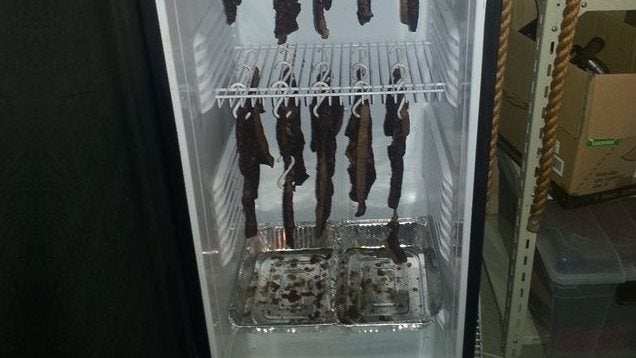
Food dehydrators are a great way to prepare tasty snacks, but they can be expensive. When the time comes to replace your old fridge, don't immediately send it off to the dump—you can give it a new lease of life.


Delivering an elevator pitch or even telling your boss about an idea can be nerve-wracking. Entrepreneur James Altucher has crafted "the six U's of persuasion" to make sure your idea gets heard.


Cleaning is a chore we all have to deal with, and whether you find it a nightmare or you think it's relaxing, having the right gear to get the job done makes a huge difference. Luckily, there are some cleaning products that can clean just about anything you ask them to. Let's make a list of them.


These days, you can have the perfect pair of glasses come to you, instead of going to the mall or eye store to deal with salespeople selling subpar frames. Last week we asked you for your favorite online retailers , then looked at the five best online glasses stores . Now we're back to highlight the crowd favorite.


Navigating conversations in the work place can often leave you dealing with "fake talk" and useless jargon to avoid conflicts and difficult topics, but sometimes you need to speak up and be heard.


(910to911)


