Shared posts

12 Dec 10:36

Why Netflix could have lost Friends — and what it means for the future of streaming

by Todd VanDerWerff
The Friends are here. But for how long?!

Whatever comes next will probably look a lot more like the expensive cable bundles that cord-cutters tried to escape.

A great panic recently swept across the internet. Friends was leaving Netflix!!

For a portion of the first few days of December, the popular sitcom’s landing page on the streaming network noted that the show would no longer be available as of January 1 because the contract that Netflix signed to begin streaming Friends in 2015 was due to expire.

But on Monday, December 3, Netflix’s chief content officer, Ted Sarandos, dismissed Friends leaving the service as “a rumor” (albeit one apparently started by his own company) and the language about Friends leaving the network was pulled. Netflix confirmed that the show would remain part of its streaming catalog “throughout 2019.” All was well!

The hue and cry over the threat of Friends leaving Netflix was similar to the hue and cry over a piece of big Netflix news from the week before, when the service unceremoniously canceled the Marvel superhero series Daredevil — the network’s fourth most popular original show, by some estimations — on Thursday, November 29. In short, people were mad at Netflix for not making sure that Friends would be available to stream in perpetuity, just as people had been mad at Netflix for canceling the show.

Their anger made sense in the case of Daredevil, because it was Netflix that decided to pull the plug on the show. But it made a lot less sense in the case of Friends, where Netflix has little say over whether it retains the show’s streaming rights if WarnerMedia, the company that consists of Warner Bros., HBO, and Turner and which controls the rights to Friends, isn’t interested in extending its deal.

And if subsequent comments from the CEO of AT&T, the parent company of WarnerMedia, are any indication, then the nonexclusive deal that Netflix cut to keep Friends streaming is one that should concern anybody who has cut the cord to save money on cable TV. The streaming era is on the precipice of becoming just as expensive as the cable era. And both the Daredevil cancellation and the Friends deal explain why.

Netflix, explained

Netflix red envelope Karen Roach/Shutterstock
Remember Netflix’s red envelopes? Here’s an artistic representation of them!

Though it’s easy to forget, Netflix began its life as a direct-mail DVD rental service. It bought thousands of movies and TV shows on DVD, then shipped them through the mail to customers all over the country. But it was not making those movies and TV shows or manufacturing those DVDs. It was purchasing them from the studios that produced them and shipping them directly to you, so you could watch them and then return them. And while Netflix not making the content it was providing isn’t a perfect metaphor for how the company operates in the streaming era, it’s going to get us close enough.

In the late 2000s and early 2010s, Netflix quietly began locking down the rights to stream much of the content it was also purchasing on DVD. If you were on Netflix’s streaming service in, say, 2011, it was kind of a remarkable era. It felt like everything was there. In reality, Netflix’s streaming catalog was a pale shadow of what the company had in DVD inventory, but back then, the various companies that controlled streaming rights to films and TV shows didn’t see why they should be so concerned about selling those rights for a song.

And so Netflix streaming became an endless scroll of programs, from recent movie hits to schlocky stuff that budget studios were just happy to have somebody pay any money for at all. For media nerds who didn’t like leaving the house — and who also didn’t mind the often shoddy video quality of Netflix’s early streaming platform — it was heaven.

This was also the era when TV networks started to realize how much value there was in making sure their shows were available to stream on Netflix or Hulu (the only other major streaming competitor in existence in the early 2010s in a form that more or less mirrors its current one).

The classic example has always been Breaking Bad, a show whose ratings struggled to justify its renewal for several seasons, but also a show that concluded its run with more than 10 million viewers tuning in for its finale. Series creator Vince Gilligan has cited the show’s presence on Netflix as a big part of its audience development.

But by putting their content on Netflix, the studios were also accidentally creating a competitor that had eyes on being just like them. Beginning in earnest with the launch of House of Cards in February 2013, Netflix soon began producing its own original programming. (Lilyhammer, a mostly forgotten mob series that was technically the first Netflix original, was an overseas acquisition.)

However, the company wasn’t (yet) set up to produce that original programming all on its own, so it also signed contracts to purchase exclusive streaming rights to certain programs coming from other production houses. In the case of three early Netflix successes, those houses were Media Rights Capital, which owns House of Cards; Lionsgate Television, which owns Orange Is the New Black; and Tornante, which is run by former Disney head Michael Eisner and owns BoJack Horseman.

These companies have always controlled the other rights to their programs, which is how, for instance, both House of Cards and Orange Is the New Black have landed on DVD, while BoJack Horseman airs in reruns on Comedy Central. Netflix has no control over what happens to these series after they first run on Netflix.

Meanwhile, Netflix has continued to buy streaming rights to existing content from other networks and studios. It has made blockbuster deals for NBC’s The Blacklist, much of the programming on The CW, and old hits like Friends. And while there’s no hard data on whether Netflix subscribers watch all, some, or none of the network’s original programming, what evidence we have suggests there’s still a lot of viewing of old favorites on the platform. It’s not hard to imagine that old favorites may even account for most of what subscribers watch. (At least one survey of UK Netflix subscribers concluded that Friends was the most-watched show on the service in that region.)

Netflix responded to the early problem of not controlling all of the rights to some of its biggest original hits first by spending more money to lock down exclusivity for shows it bought from other studios (like a blockbuster deal for the drama Bloodline, which fizzled after three seasons). But eventually, it started making more and more of its own shows. If it owned the programs outright, then nobody would be able to pull them from the service for as long as Netflix existed.

Making your own shows is expensive, however. And as companies like WarnerMedia began to realize just how valuable all those Friends reruns really were, they started thinking about building their own streaming services. Which made it seem sillier and sillier to let Netflix have access to their shows, even for limited windows of time. After all, did people subscribe to Netflix because they were loyal to Netflix? Or was it because Netflix made it so easy to watch their favorite shows?

Put another way: Would you still subscribe to Netflix if it only had Netflix originals? It’s a question you might be asking yourself in five years.

And all of the above brings us to the events of the past couple of weeks.

How Daredevil’s cancellation and the Friends deal are the same story about the rapid reinvention of an entire industry

Daredevil Netflix
So long to Daredevil.

Netflix’s business model doesn’t require it to attain a virtual monopoly on the entertainment landscape in the near-ish future, but it would sure help. The company is, in essence, in the process of turning itself from a video store, which had to maintain a symbiotic relationship with movie studios, into a studio itself. But because it also controls its own means of distribution, it can, effectively, evolve into an entire media ecosystem of its own, provided it has enough programming that you want to keep watching.

Companies like WarnerMedia and Disney (which controls the rights to Daredevil through its ownership of Marvel, which produced the show for Netflix) are currently betting that your loyalty to their various programs and films is ultimately going to prove more sustainable than your loyalty to Netflix. Hence, when both companies start their own streaming services in the near future, they’re likely going to feature many programs that were popular on Netflix — but are no longer available there.

This bet makes a certain amount of sense! It’s hard to argue against the cultural omnipresence of Mickey Mouse and Star Wars, of Friends and Superman, especially when Netflix’s biggest pop culture icon is probably Stranger Things, a huge series but a drop in the bucket compared to, say, Game of Thrones (whose rights are controlled by WarnerMedia’s HBO).

Netflix, meanwhile, has also started to jettison shows produced by other studios while it simultaneously attempts to shore up its own production arm and holds onto a handful of key programs from other studios that people are fond of (like Friends or The Office). The chief beneficiary of this strategy has been Hulu, which is a joint venture of several different studios and has been scooping up abandoned Netflix licenses left and right, especially in a huge 2017 deal with 20th Century Fox (which itself will almost certainly become part of Disney) that netted it dozens of shows and more than 3,000 episodes of TV.

Netflix, in essence, needs to ensure that the original series it produces itself are the centerpiece of its strategy, because it has no real control over what ultimately happens to so many of its other shows. American Vandal (produced by CBS Studios) and Daredevil (produced by Marvel) are examples of shows that Netflix will eventually, someday, have to renegotiate the rights for, and like all networks, the service is getting cagier about renewing and picking up shows it doesn’t make itself. (Read more about this here.)

Understandably, the complicated morass of corporate wrangling that goes into a streaming contract is something that few viewers are aware of, even if you watch to the end of the credits to see who produced the show, rather than letting autoplay start the next episode. So when Netflix cancels Daredevil or seems to be slacking on renewing its deal for Friends, it’s easy for viewers to leap to the conclusion that “Netflix is doing something stupid!”

But also of note in the Friends deal is what AT&T chair and CEO Randall Stephenson ultimately revealed at the UBS Global Media and Communications Conference: that the show is no longer exclusive to Netflix. This means that not only can WarnerMedia sign a deal to license Friends to Netflix, but it can also put Friends on its own streaming service, which is expected to launch in late 2019.

And Netflix’s deal for Friends expires in 2020. So who’s to say WarnerMedia won’t just take back Friends’ streaming rights entirely at that point? If you really want to watch Friends and this future WarnerMedia-affiliated platform is the only place to get it, it might become much more tempting than a Friends-less Netflix.

This crisis is looming for Netflix in particular, but also for Amazon, for a proposed new streaming service from Apple, and for whatever’s going on with Facebook and YouTube’s forays into original programming. (Hulu looks like it’s about to be owned by Disney, thanks to the proposed Disney/Fox merger, which would give it a parent company with massive pockets and a massive entertainment library.)

Both Netflix and Amazon are huge, with many subscribers, but it’s not clear to outside observers how many of their customers are subscribing because they want to watch programs that the platforms don’t control the rights to.

Netflix, which invested at least $8 billion in programming this year, certainly has the money to compete, but making TV and movies is an expensive proposition, and it sure helps when you’ve got access to back catalogs full of stuff that people already know they love. That’s true for Disney and WarnerMedia especially, and true for the other handful of big studios and networks to a slightly lesser degree. So what happens when all of them launch their own streaming services, each of which will have one or two of your favorite shows?

It strikes me as inevitable that cord-cutting consumers will eventually return to the place they were trying to escape when they subscribed to any given streaming network — and in that place, they’ll likely find an expensive monthly bill that bundles together a bunch of different services and keeps escalating in price as more and more are added.

And since cable companies currently control a lot of the US’s broadband connections and have experience in grouping channels into tiered packages, they’re probably going to end up at the forefront of whatever this new movement looks like.

This evolution won’t take years. With both Disney and WarnerMedia planning to launch their services in 2019, it’s likely going to happen in a matter of months. The cable bundle died so its souped-up younger brother could live.

11 Dec 14:37

The political tribalism of Andrew Sullivan

by Ezra Klein
The problem with Andrew Sullivan’s diagnosis of political tribalism.

Sullivan’s essay on political tribalism shows he’s blinded by his own.

I knew when we launched Vox that there would be criticisms I didn’t anticipate, but I’ll admit, I never foresaw one of them being that writing explainers doesn’t satisfyingly replace the role of religion in people’s lives.

Yet here we are:

But the banality of the god of progress, the idea that the best life is writing explainers for Vox in order to make the world a better place, never quite slakes the thirst for something deeper.

Rats. Foiled again!

That’s Andrew Sullivan writing in New York magazine, and while the column caught my attention for that line, which I will now have needlepointed on a pillow, the broader piece is wrong in more important, less amusing, ways.

Sullivan claims that the modern West has lost Christian practice and gained, in its place, a monstrous political tribalism. It’s a looping, strange argument in which he stitches together eloquent reflections on the hollowness of human existence, musings about electronic distraction, and concerns that an ethos of materialist progress has replaced an appreciation of metaphysical awe, all to end in a slashing justification of his own political resentments.

To be clear, I have no interest in litigating anyone’s faith. What I am interested in is American politics, and in this essay, Sullivan offers a nostalgic analysis of our current problems that has become popular among a certain class of pundits — David Brooks calls Sullivan’s essay a shoe-in for his annual Sidney Awards — but that doesn’t hold up to the slightest scrutiny, and in fact displays the very biases it laments.

Let’s begin here, with Sullivan’s thesis:

Liberalism is a set of procedures, with an empty center, not a manifestation of truth, let alone a reconciliation to mortality. But, critically, it has long been complemented and supported in America by a religion distinctly separate from politics, a tamed Christianity that rests, in Jesus’ formulation, on a distinction between God and Caesar. And this separation is vital for liberalism, because if your ultimate meaning is derived from religion, you have less need of deriving it from politics or ideology or trusting entirely in a single, secular leader. It’s only when your meaning has been secured that you can allow politics to be merely procedural.

To put this more simply, Sullivan is saying that Christianity lowers the stakes of political conflict. A politics moderated by Christianity is merely procedural because the fundamental questions of human dignity have been answered elsewhere.

Absent the calming effects of Christianity, he continues, Americans look to politics to find their meaning, and that escalates the stakes of political conflict. Politics ceases to be procedural and becomes fundamental. Boundaries must be drawn and tribal membership policed. This is Sullivan’s diagnosis of our current divisions. He writes:

Now look at our politics. We have the cult of Trump on the right, a demigod who, among his worshippers, can do no wrong. And we have the cult of social justice on the left, a religion whose followers show the same zeal as any born-again Evangelical. They are filling the void that Christianity once owned, without any of the wisdom and culture and restraint that Christianity once provided.

This is a relentlessly ahistorical read of American politics. America’s political past was not more procedural and restrained than its present, and religion does not, in general, calm political divides. What Sullivan is missing in these sections is precisely the perspective of the groups he’s dismissing.

But if Sullivan’s essay fails as historical analysis, it succeeds as a metaphor for our times. What he has done is come up with a tribal explanation for political tribalism: The problem is not enough people like him, too many people unlike him. Speaking of what he calls American’s “political cults,” Sullivan writes:

They do not believe in the primacy of the individual, they believe the ends justify the means, they do not allow for doubt or reason, and their religious politics can brook no compromise.

Political tribalism is first and foremost a psychological phenomenon, a way of looking at what you’ve defined as your out-groups and seeing in them something very different from what you see in your allies. Yet even as Sullivan decries political tribalism, here is his theory of it: A decline in people practicing his form of Christian faith has led to a rise in “political cultists” who find their ultimate meaning in politics, who will stop at nothing to achieve their political goals, and who cannot be reasoned or compromised with.

This is not an analysis of the thinking deepening our political divides, but a demonstration of it.

When was American politics merely procedural?

The simplest objection to Sullivan’s narrative is that American politics has never been merely procedural — and, indeed, the more procedural it has felt, the more fundamental its internal conflicts have often been.

The Atlantic’s Adam Serwer put it well in our podcast conversation. “A lot of what people nostalgically consider eras without tribalism are in fact moments in American history where people of color, particularly black people, have been deprived of political power, and so things like ethnic and racial lines became less salient.”

I have written about this before, but politics was certainly not mere proceduralism in the country’s early years, when new arrivals from Europe drove out the Native Americans, brought over millions of enslaved Africans, and wrote laws making women second-class citizens.

Presumably, Sullivan isn’t thinking of the runup to the Civil War, either. He can’t possibly be describing the Civil War itself as a period of procedural politics calmed by Christian practice. There’s no way it could’ve been the bloody aftermath of the Civil War, when Southern whites reestablished control of their territory through a campaign of state violence and political repression.

That brings us to the 20th century, when partisanship did indeed ebb as the Dixiecrats’ commitment to white supremacy scrambled the parties ideologically. But this was hardly a calm era in American politics. For much of the 20th century, the right to vote was, for African Americans, no right at all. Lynchings were common. Freedom Riders were murdered across the American South. Suffragists were beaten and tortured for seeking the franchise. National Guard members fired on, and killed, student protesters at Kent State. Police had to escort young African-American children into schools as jeering crowds shouted racial epithets and threatened to attack.

“What happens when this religious rampart of the entire system is removed?” asks Sullivan. “I think what happens is illiberal politics.”

Here, too, the evidence contradicts his thesis. The consensus is that American politics was far more illiberal in our past than in our present. The Varieties of Democracy project, which has been surveying experts on the state of global democracies since 1900, gave the US political system a 48 on a 1-to-100 scale in 1945 and a 59 in 1965. It was only after the civil rights movement that America began scoring in the 70s and 80s, marking it as a largely successful democracy.

The US has lost a couple points in the past few years, to be sure, but its 2017 rating was still 73. The era Sullivan looks back on fondly was, by almost any measure, more illiberal in its politics and more fundamental in its conflicts, in part because the meaning of America — who got to participate in it, and whose claims it heard — was so deeply contested.

But if Sullivan’s sense of history is wrong, it’s not unusual. He looks back on American history and sees a politics of becalmed proceduralism, which was often — though certainly not always — true for white men. He looks around now and he sees identity politics everywhere, political cults warring over fundamental questions of dignity and belonging.

This speaks to a paradox of American politics: It often feels most stable when it is least just, and it often feels least stable when progress is being made. This is a point Steven Levitsky and Daniel Ziblatt make powerfully in their book How Democracies Die:

The norms sustaining our political system rested, to a considerable degree, on racial exclusion. The stability of the period between the end of Reconstruction and the 1980s was rooted in an original sin: the Compromise of 1877 and its aftermath, which permitted the de-democratization of the South and the consolidation of Jim Crow. Racial exclusion contributed directly to the partisan civility and cooperation that came to characterize twentieth-century American politics. The “solid South” emerged as a powerful conservative force within the Democratic Party, simultaneously vetoing civil rights and serving as a bridge to Republicans. Southern Democrats’ ideological proximity to conservative Republicans reduced polarization and facilitated bipartisanship. But it did so at the great cost of keeping civil rights — and America’s full democratization — off the political agenda.

Sullivan’s essay is animated by animus at the “woke” warriors he loathes. “‘Social justice’ theory requires the admission of white privilege in ways that are strikingly like the admission of original sin,” he writes. That’s one way to put it.

Another way to put it is that social justice theory encourages the consideration of privilege in order to prevent people from being so blinded by their own perspective that they look at America’s political past and declaim this the era in which we departed from political proceduralism and collapsed into illiberalism.

The “No true Christian” problem

An alert reader, absorbing Sullivan’s thesis, might notice another problem: Doesn’t religion regularly escalate the stakes of politics beyond proceduralism? Indeed, in many of the periods I’ve mentioned, Christianity was the handmaiden of political escalation, for both great good and great ill. Sullivan himself gestures toward one side of this reality, writing that “it was Christianity that gave us successive social movements, which enabled more people to be included in the liberal project.” And today, there’s no single group that supports President Trump as intensely as white evangelicals.

Ah, but Sullivan has thought of this:

Their leaders have turned Christianity into a political and social identity, not a lived faith, and much of their flock — a staggering 81 percent voted for Trump — has signed on. They have tribalized a religion explicitly built by Jesus as anti-tribal. They have turned to idols — including their blasphemous belief in America as God’s chosen country. They have embraced wealth and nationalism as core goods, two ideas utterly anathema to Christ. They are indifferent to the destruction of the creation they say they believe God made. And because their faith is unmoored but their religious impulse is strong, they seek a replacement for religion. This is why they could suddenly rally to a cult called Trump.

There’s a logical fallacy called the “no true Scotsman” problem. As the handy website YourLogicalFallacyIs.com (ain’t the internet grand?) explains, “in this form of faulty reasoning one’s belief is rendered unfalsifiable because no matter how compelling the evidence is, one simply shifts the goalposts so that it wouldn’t apply to a supposedly ‘true’ example.”

I am not here to judge anyone’s religion, and I’ve been moved many times in the past by how Sullivan writes of his faith. But as a matter of political analysis, Sullivan is trying to close a gaping hole in his argument by defining his Christian practice as true and competing interpretations, no matter how widespread they are, as aberrant. That’s a fine hobby, but it’s not a useful interpretive lens for understanding America’s past or guiding our future.

To state the obvious: Christians were found among both the abolitionists and the secessionists, the segregationists and the Freedom Riders. Study the moments of maximum collision in America’s past and you will find them thick with godly rhetoric and devout believers. Political rhetoric in America is filled with signifiers of Christian identity, and it always has been. It is absurd to suggest that Christianity was somehow less of a social and political identity in the past.

Towards a better explanation of political tribalism

Sullivan is grappling for an explanation of rising political tribalism, and there, he may want to dispense with the introspection and explore the work of people who actually study it, like political scientist Lilliana Mason. Her work shows that groups’ behavior hardens when identities stack on top of each other and weakens when they pull in different directions.

All else being equal, a 62-year-old white, Christian Democrats who lives in rural Montana will loathe Republicans less than a 23-year-old Hispanic, agnostic Democrat who lives in Los Angeles. A young, conservative atheist will be more open toward liberals than a conservative evangelical (which neatly solves the mystery of Trump’s intense support among the Christian right).

Polarization is rising, and to the extent that Sullivan senses a hardening of tribal lines, he’s not wrong. But the driving force here isn’t the waning of Christianity but the politicized sorting of it, and much else. Married white Christians made up 80 percent of voters in the 1950s, and were evenly split between the two parties; today, they make up less than 40 percent of voters, and they’re overwhelmingly concentrated in the Republican Party. The parties have similarly organized around race, geography, and even age.

“The two parties are now divided over race and religion — two deeply polarizing issues that tend to generate greater intolerance and hostility than traditional policy issues such as taxes and government spending,” write Levitsky and Ziblatt. Their work finds what seems obvious: Adding religious identity into political conflict often makes it worse, not better.

The particular pathologies of politics in an age of rapid demographic and cultural change are serious and worrying. Indeed, I am working on a book trying to understand them, and my main lesson, so far, is that mapping the workings of a sociopolitical system this complex, this human, is maddeningly difficult. It demands humility of us all. That is not to say that all groups are equal, that all ideologies are the same, or that some actors are not worse than others. But if our explanation for political tribalism takes the form of “it’s everyone else’s fault,” more likely than not, we have gone awry.

06 Dec 07:32

52 Things Learned in 2018

by Jason Kottke

Consultant Tom Whitwell is back this year with 52 things he learned in 2018.

4. 35% of Rwanda’s national blood supply outside the capital city is now delivered by drone. [Techmoran]

13. US nuclear testing between the 1940s and 1970s may have killed as many Americans (from radioactive pollution) as were killed by the bombs dropped on Hiroshima and Nagasaki. [Tim Fernholz]

26. Men who’ve experienced earthquakes are willing to take more risks and gamble more. Women show no such effect. [Chie Hanaoka & co]

51. Vanilla pods now cost $500/kg, roughly the same as silver. Madagascan farmers have briefly become vanillionaires, causing chaos in areas where the nearest bank might be a day’s walk away. [Annah Zhu]

Check out his lists from 2017 and 2016.

Tags: lists   Tom Whitwell
22 Nov 09:18

Fistikerade särskrivningar

by Hexmaster
Ordet finns inte med i SAOL. Och det lär dröja så länge som det inte går att hitta mer än ett (1) belägg. Men någonstans tänker jag att det borde väl finnas fler som använt ordet? Fistikerad.
En så fistikerad, kvantitet av kvalité
i höga glas fyllda med Saint Tropez
- Elin Hellström, iNTIM: Saint Tropez (2015)


Hur nybildningen än uppstått så hade det hade knappast varit första gången som en särskrivning gett upphov till ett ord, även om jag just nu inte kommer på något exempel.

Apropå de omskrivna särskrivningarna så finns det massor av folk som tror att man enbart ägnat sig åt sådant hitom 2000. Det är så fel som det kan bli.
Tidtals, särskildt på 1870-talet, har särskrifningen drifvits till en beklaglig ytterlighet, så att vanliga och tydliga sammansättningar sönderdelats. Ännu i senare hälften af 1880-talet får man se sådana orimligheter som "biljett kontor", "filt hatt", "grof smed", "i akt taga", "i akt tagelse", "knapp handel", "lama själar", "rak salong", "stats kontoret", "universitets stad" o. d.
- Nils Linder, Regler och råd angående svenska språkets behandling i tal och skrift (1886)

19 Nov 14:11

How the media should respond to Trump’s lies

by Sean Illing
President Donald Trump speaks to supporters during a rally at the Southern Illinois Airport on October 27 in Murphysboro, Illinois.

A linguist explains how Trump uses lies to divert attention from the “big truths.”

President Donald Trump has hacked the media.

As Vox’s Ezra Klein argued recently, the press is in a lose-lose situation — and we all know it. Trump thrives on opposition, and often the media plays right into his hands, feverishly chasing every lie and half-truth he utters or tweets.

George Lakoff, a professor of linguistics and cognitive science at UC Berkeley and the author of the 2004 book Don’t Think of an Elephant, recently published an article laying out the media’s dilemma. Trump’s “big lie” strategy, he argues, is to “exploit journalistic convention by providing rapid-fire news events for reporters to chase.”

According to Lakoff, the president uses lies to divert attention from the “big truths,” or the things he doesn’t want the media to cover. This allows Trump to create the controversies he wants and capitalize on the outrage and confusion they generate, while simultaneously stoking his base and forcing the press into the role of “opposition party.”

I reached out to Lakoff to talk about Trump’s media strategy, but also, more importantly, about solutions. If the president has indeed turned journalistic conventions to his advantage, how can we, the media, respond constructively?

A lightly edited transcript of our conversation follows.

Sean Illing

Can you lay out for me in simple terms how President Trump manipulates the media?

George Lakoff

He manipulates the media by constantly tweeting and saying more and more outrageous things. The media says, “Well, we have to cover the president. We have to repeat what he says.” But there is no real reason this has to happen. Journalists could, if they choose to, ignore the president’s tweets.

Sean Illing

What, then, would you have reporters do? Ridiculous or not, what the president of the United States tweets or says has real-world consequences, so it’s not quite that simple.

George Lakoff

I wrote a book called Don’t Think of an Elephant, which makes the point that if you negate a frame, you activate the frame. When Trump says something and people working in the media deny it, they’re helping him. But they don’t realize that they’re helping him.

There’s another possibility. Journalists could engage in what I’ve called “truth sandwiches,” which means that you first tell the truth; then you point out what the lie is and how it diverges from the truth. Then you repeat the truth and tell the consequences of the difference between the truth and the lie.

If the media did this consistently, it would matter. It would be more difficult for Trump to lie.

Sean Illing

So you’re saying that instead of amplifying the president’s message by repeating it in the course of debunking it, we should focus on his tactics and talk about the truths he’s trying to suppress.

George Lakoff

Well, not just talk about the truth he’s trying to suppress. The truth sandwich is more than that. It shows the difference between the truth and what he’s saying — putting the truth first, and then putting it afterward, and talking about its consequences.

People say, “Oh, well, here’s the real fact.” That doesn’t really matter because Trump is getting his frame out there first. What he’s trying to do in each of the tweets he sends out is to frame something first and then repeat it.

Notice that when you repeat something, you’re strengthening it in people’s brains. The more a neural circuit is activated, the stronger it gets. Trump is using certain communicative tactics that are very sophisticated and he doesn’t realize it.

“Democrats believe in what is called enlightenment reasoning — that if you tell people the facts, they’ll reach the right conclusion. That just isn’t true.”

Sean Illing

I take your point, but I wonder if Trump is just kryptonite for a liberal democratic system built on a free press. If someone is truly indifferent to the consequences of lying, if they welcome negative coverage and are backed by a base primed to disbelieve inconvenient facts, I’m not sure there’s much we can do to contain that person once they’ve ascended to power.

George Lakoff

It’s difficult; I know it’s difficult. But I don’t think it’s impossible. It has to do with the media not being willing to be manipulated by Trump, not being willing to say, “Oh, we have to report everything he says.”

If his tactics didn’t work, he wouldn’t be able to manipulate people the way that he has.

Sean Illing

So you’re saying that the president has created a situation in which journalists, by merely doing their jobs, are reinforcing his entire communications strategy.

George Lakoff

Right. That’s where we’re at, but you see, there’s still a question of what the media’s job is.

Many journalists still assume that language is neutral, that you can just repeat language and it’s completely neutral. In fact, language is never neutral. Language is always framed in a certain way, and it always has consequences.

If in the process of reporting, you simply repeat the language Trump is using, you’re missing what’s going on.

Sean Illing

But if the president spreads malicious lies, those lies have consequences. Take the recent shooting at the Tree of Life synagogue. Trump helped popularize a conspiracy theory about George Soros funding a caravan of illegal immigrants, and an extremist took that claim seriously and acted on it.

Isn’t that a strong case for why we have to expose or challenge lies?

George Lakoff

I totally understand, but simply exposing the lie about the Soros conspiracy theory doesn’t work, because to call it a lie is to repeat it, to repeat the content, which strengthens it in people’s brains. If I say don’t think of an elephant, you think of an elephant.

Sean Illing

So how exactly should the media have responded in this case to the Soros conspiracy theory tweeted by the president?

George Lakoff

By not reporting it.

Sean Illing

At all?

George Lakoff

Not one bit.

Sean Illing

The president has 55 million Twitter followers and a vast conservative media-industrial complex that will happily amplify his comments. Nothing the rest of the media does will change this. Is there a solution to this problem?

George Lakoff

Well, it’s not a simple solution, and your point about the conservative media is a good one. But you have to have a media that is engaged with what I call truth sandwiches and that repeats them — that’s all you can do.

“Language is never neutral. Language is always framed in a certain way, and it always has consequences.”

Sean Illing

Why do Republicans seem to be doing much better in terms of framing the debate?

George Lakoff

A lot of Democrats believe in what is called Enlightenment reasoning, and that if you just tell people the facts, they’ll reach the right conclusion. That just isn’t true.

People think in terms of conceptual structures called frames and metaphors. It’s not just the facts. They have values, and they understand which facts fit into their conceptual framework. You can’t understand something if your brain doesn’t allow it, if your brain filters it out in terms of your values.

Democrats seem not to understand this, and they keep trying to employ reason as a persuasive vehicle. I wish Enlightenment reasoning was an accurate model for how most people think and judge, but it isn’t, and we better acknowledge that fact.

Sean Illing

So on some level, you’re saying that Democrats have to accept that they’re playing a different kind of conversational game, in which truth and falsity are irrelevant. If that’s the case, what use is there for a free press, or for discourse at all?

George Lakoff

Well, that’s why the truth sandwiches are important. Let me say one more thing that’s really crucial in this respect. Kellyanne Conway talked about alternative facts at one point, so the phrase comes from her. When I heard that, it occurred to me that there’s a sense in which she’s right.

If you’re someone who shares Trump’s worldview, there are certain things that follow from that worldview. In other words, certain things have to be true, or have to be believed, in order to sustain that worldview. The things that aren’t actually true but nevertheless preserve that worldview are “alternative facts” — that’s what Conway was getting at, whether she knew it or not.

The conservatives use those alternative facts all the time, and so does Trump. If he’s talking to his base, he’s talking to people who have already bought into a picture of the world, and his job is to tell them things that confirm that picture — and he knows they’ll believe it for that very reason.

I think we have to understand “alternative facts” in this way, and understand that when Trump is lying, he’s lying in ways that register with his audience. So it may be lying, but it’s strategic lying — and it’s effective.

Sean Illing

Do you think the media is going to be able to adapt and figure this out, or do you think it’s going to persist in aiding Trump in the way it has?

George Lakoff

I’m an optimist. I think the media can get out of it. But I don’t know if it will.

Journalists don’t study the field of cognitive science. They don’t study how brains actually work and how the mind works. Cognitive science is a field that is not widely reported on, but it needs to be, because journalists cannot serve the public if they don’t understand basic facts about the human mind.

The sorts of things I’m saying have to be repeated over and over — it has to be argued. The evidence has to come forth.

This story was originally published on November 15, 2018.

19 Nov 07:43

How to Talk to People, According to Terry Gross

Image
Terry Gross says that “Tell me about yourself” is the only ice-breaker you’ll ever need.CreditCreditDaniel Dorsa for The New York Times

Terry Gross says that “Tell me about yourself” is the only ice-breaker you’ll ever need.CreditCreditDaniel Dorsa for The New York Times

It’s fair to say Terry Gross knows some things about talking to people. The host and co-executive producer of NPR’s “Fresh Air” has interviewed thousands of personalities over the course of her four-decade career.

It all started in the early 1970s, when, floundering a bit in her post-college life, she landed a gig at WBFO, a radio station in Buffalo. There she would call subjects and interview them for the program she hosted, “This Is Radio.” She moved to Philadelphia in 1975 to host “Fresh Air,” the brainchild of a colleague from WBFO.

Ms. Gross brings a combination of empathy and rigorous preparation to the job. “I read, watch or listen to as much of the person’s work as possible, so I have an understanding of what makes them, or their story, important,” she said. “I try to clarify in my own mind why this person matters, and why it’s worthy of our listeners’ time.”

One thing she does not allow of her interview subjects, however, is input on the edit. “When the interview is over, you don’t have a chance to call back and say, ‘Well I like my answer to this, I don’t like my answer to that, can you edit that out,” she said. (As someone who has been interviewed by Ms. Gross, I would like to say that I wish I hadn’t insisted that her cats hate her. That said, I never asked for my comment to be removed from that particular episode of “Fresh Air.”)

In a subsequent chat, our roles reversed, Ms. Gross offered her thoughts on how to have a good conversation.

Those are the only four words you need to navigate a potentially awkward conversation, whether on a blind date or at a cocktail party. Ms. Gross avoids asking more pointed questions (for example, “What do you do for work?”) that presume information to be true.

The beauty in opening with “tell me about yourself” is that it allows you to start a conversation without the fear that you’re going to inadvertently make someone uncomfortable or self-conscious. Posing a broad question lets people lead you to who they are. As an interviewer, Ms. Gross’s goal is to find out how her subject became who they are; as a conversationalist, make that goal your own.

Image
Ms. Gross in the WHYY studios in Philadelphia. “A good conversationalist is somebody who is fun to talk to,” she said.CreditDaniel Dorsa for The New York Times

Interviewing a person and having a conversation with them are two different things, but a common thread that can help you to excel at both, according to Ms. Gross, is “being genuinely curious, and wanting to hear what the other person is telling you. I can respond to what somebody saying by expressing if I’m feeling sympathy or empathy, and explaining why.”

“A good conversationalist is somebody who is fun to talk to,” she said. Ms. Gross, it’s worth noting, is very funny. If you can’t be funny, being mentally organized, reasonably concise and energetic will go a long way in impressing people.

Most of us will never find ourselves in the position of being interviewed by someone like Ms. Gross, but most of us will certainly find ourselves in the position of being interviewed by someone. Preparation, she says, is key. “It helps to organize your thoughts beforehand by thinking about the things you expect you’ll be asked and then reflecting on how you might answer,” she said.

A place where this can be especially helpful, particularly when meeting someone for the first time in a social setting, like a date, is considering how comfortable you are with opening up on certain topics. “It’s helpful to think through where your boundaries are, so that you’re not paralyzed agonizing over whether you’re willing to confide something or not.”

In a job interview, organizing your thoughts by thinking about the things you expect you’ll be asked and reflecting on how you might answer can help you navigate if things start to go badly.

Ms. Gross offered help for how to handle a job interview that’s going badly. “If somebody is asking you questions and you don’t feel that you have a strong response for it, say, ‘let me share an experience.’” From there, you can share an experience that points to your talents and areas where you excel.

An interview is a two-way street, which can be hard to remember when you’re the applicant who desperately wants to land the gig, but Ms. Gross gently reminds us that as an interviewee, you’re there to do some sussing out of your own. What is the job really like? What would be expected of you? Being prepared, too, can help you avoid getting caught off guard, or help you to more easily pivot the conversation to a subject that you’ve prepared yourself to talk about in a way that plays to your strengths.

“Well, I don’t think it is in my self-interest to tutor people on how to dodge a question,” Ms. Gross said. But, when pressed — perhaps regretting the previous advice she gave to this interviewer about how to get people to answer questions they don’t want to answer (“keep asking”) — she suggests using honesty. Say, “I don’t want to answer that,” or, if that’s too blunt, hedge with a statement like, “I’m having a difficult time thinking of a specific answer to that.” Going the martyr route with something like, “I’m afraid by answering that I’m going to hurt somebody’s feelings and I don’t want to do that,” is another option.

Ms. Gross wishes that everyone would pay attention to other people’s body language. “Try to pick up on when you’ve kind of lost somebody’s attention,” she said. That way, you can avoid boring your fellow interlocutor to death or holding someone up from getting to wherever they may actually need to be. If the person engaging you in ceaseless chatter won’t take the hint, Ms. Gross again recommends honesty. “Well, there’s the truth, which is I’d love to talk some more, but I’m really late,” even, she says, if it feels rude to cut things off. “If a person is being insensitive to you, you don’t have a commitment to be beholden to their insensitivity.”

Ms. Gross prefers to interview artists and creators over politicians, and she approaches those baskets of interviewees differently. Politicians, she believes, “owe us an answer,” and so she, in her own very Terry Gross way will “keep asking and re-asking and asking, and maybe I’ll ask it in separate ways, and maybe I’ll point out that they haven’t yet answered the question.” She prefers, however, to interview people who work in arts and culture, and offers those subjects more leeway to set parameters for the conversation. “I tell people that if I ask them anything too personal they should let me know and I’ll move on,” she said. “I want the liberty to ask anything with the understanding that if I’m pushing too far, my guest has the liberty — and they know they have the liberty — to tell me that I’m going too far. And once you told somebody that, you’ve committed to it, and you better fulfill the commitment.”

A version of this article appears in print on , on Page ST4 of the New York edition with the headline: A Master Class in the Fine Art of Conversation. Order Reprints | Today’s Paper | Subscribe
19 Nov 07:30

I Found the Best Burger Place in America. And Then I Killed It.

The way Stanich sees it, he has two options: he can either partner with another restaurant operator to open it back up, or he can franchise. Both options are on the table, and he needs to decide what to do, but until that time, Stanich’s will likely not re-open. And no matter what happens, in all likelihood, the Stanich’s that had been open since 1949, the Stanich’s that I fell in love with, then clumsily broke like Lennie with the puppy in Of Mice and Men, will never be the same again.  

And that fact is the thing I can’t quite get past. That a decision I made for a list I put on the internet has impacted a family business and forever altered its future. That I have changed family dynamics and relationships. And it could very easily happen again.

I’ve been asking myself what the other side of this looks like. How do I do this better? Is there a way to celebrate a place without the possibility of destroying it? Or is this just what we are now -- a horde with a checklist and a camera phone, intent on self-producing the destruction of anything left that feels real, one Instagram story at a time?

Clearly, I don’t have an answer. I understand there are larger forces involving tourism and technology and society writ large at play here, and I’m not enough of a hypocrite to turn this into a morality play about the internet and the consequences of our actions, but maybe if we were all as kind to each other as Steve Stanich has been to me, we might just survive this apocalyptic puddle of shit we currently find ourselves in.

Before I left, Stanich told me he had one more thing to show me.

He walked me out behind the office to the vast green of the Rose City Cemetery. There, not more than twenty five yards away, lay the graves of his parents, George and Gladys Stanich. As we stood and stared down at the black gravestone, Stanich told me a story about how his parents had started the restaurant in 1949 to help pay hospital bills after he was born prematurely. He was wistful and philosophical and clearly in pain, but it wasn’t a pain he wanted to reveal to me in detail, and I wasn’t one to ask anything of Steve Stanich except forgiveness, so I tried again to apologize for putting in motion a series of changes he wasn’t asking for. He looked at me for the first time since we were out at his parents grave, and gave a quick nod, then he started to hobble off back towards the restaurant.

He’d forgotten, he said, to close it back up.  

14 Nov 07:31

Dear Jeff

by DHH
You could blow up the extractive motive if you wanted to

I‘ve been thinking about your regret minimization framework for making decisions lately. I don’t recall whether I read about it in an interview, or if you shared it with Jason and me in person in those early days after your involvement in Basecamp. But regardless, I think you’re currently making bad decisions that you’re going to regret. Maybe even decisions that we as a whole society will come to regret.

It doesn’t have to be like this. You’re literally the richest man in the world. Markets have suspended disbelief for decades, and let you rule as you see fit. It’s well within your power and purvey to change course.

The HQ2 process has been demeaning if not outright cruel. At a time when politicians are viewed as more inept, more suspicious, and more corrupt than ever, you made city after city grovel in front of your selection committee. They debased themselves in a futile attempt to appeal to your grace and mercy, and you showed them little. The losers ended up worse than where they started, and even the winners may well too.

For what? Extracting a few more billions that Amazon does not need in subsidies? If you tilt your perspective a little, I think you’ll be able to catch the optics that the richest man in the world asking for tribute like this is an ugly one.

Amazon is Jeff Bezos. You can’t cover decisions behind committees or other shareholders. You hold the reins, you reap the lion’s share of the rewards, and thus you’re accountable for its actions.

As many great conquerors in history, I’d be surprised if you didn’t care about establishing a legacy. I mean, you clearly already have. But there’s still time to shape that legacy into something more than the man who killed retail, extracted the greatest loot from its HQ cities, and who expanded the most monopoly holdings the fastest.

Rather than keep asking what cities and countries can do for Amazon, maybe start asking what Amazon can do for them. Be magnanimous. Be responsible.

Not just because it’s the right thing to do, but because it’s the smart thing to do. The better business move. At some point people are going to have had enough, and when they figure out a way to channel that discontent into political action, they’re going to come looking for the heads of those that did them the most egregious wrongs.

I know it doesn’t look like that big of a risk right now. People still seem to trust Amazon more than most of the big tech companies, but that’s a lagging indicator. The clouds are gathering in the distance. It starts with a few pioneers calling for antitrust action, and then one day you wake up, and that’s what the whole world wants.

It’s hard to be proud of having you as a minority owner in Basecamp right now. Maybe there’s even a tinge of regret. I’d very much like to minimize that.

Jeff owns a minority, no-control stake in Basecamp (the company that Jason and I co-own). For the first few years after purchasing that, Jason and I would meet or talk to him about once a year. It’s probably been 7–8 years since we spoke with Jeff directly last. If we get another chance, this would be the most pressing topic.


Dear Jeff was originally published in Signal v. Noise on Medium, where people are continuing the conversation by highlighting and responding to this story.

13 Nov 07:21

‘An Unshakable Humanism’ — Michael Chabon on Stan Lee

by John Gruber

Michael Chabon, on Instagram:

Some people are influences. Others — a rare few — rearrange the very structure of your neurons. Stan Lee’s creative and artistic contribution to the Marvel pantheon has been debated endlessly, but one has only to look at Jack Kirby’s solo work to see what Stan brought to the partnership: an unshakable humanism, a faith in our human capacity for altruism and self-sacrifice and in the eventual triumph of the rational over the irrational, of love over hate, that was a perfect counterbalance to Kirby’s dark, hard-earned quasi-nihilism. In the heyday of their partnership, it was Stan’s vision that predominated and that continues to shape my way of seeing the world, and of telling stories about that world, to this day.

There’s something apt about Chabon using a primarily visual medium like Instagram as an outlet for the perfect words to remember a man whose life’s work was writing for comic books.

23 Oct 08:44

iPhones are hard to use

I once wrote a user manual for a handheld engine-diagnostics module for Daewoo cars. I know “hard to use” when I see it. iPhones are hard to use.

  • On two occasions on the same bus route, I couldn’t stand to watch late-middle-aged persons (eyeglasses perched on forehead in one case) struggle to read their iPhones. I took hold of their phones for a moment each (I got permission) and brought up the well-hidden screen for text-size selection. They picked the bigger fonts they’d needed all along. They were so grateful it was embarrassing.

  • The same thing later happened, though not on a bus, with an 85-year-old who was also struggling.

  • Another senior knows he can send a text message to a certain phone number containing the ID number of a bus stop, but had no idea that was the worst possible way to get a transit prediction, nor that transit predictions could work everywhere, nor what to do if he were in an unfamiliar place and/or could not find the number of a bus stop.

    (How did this senior learn to use his iPhone? He asked his wife how to do things. He also thought he had to use the Gmail app to read his Gmail.)

  • My almost-blind friend upgraded from an iTouch to an iPhone 8, then couldn’t check his voicemail for weeks because iPhone keyboards and keypads randomly change or invert their colours and he simply could not see or locate the number buttons.

    Light keypad, then dark keypad with Voicemail title

    Before and after calling voicemail

  • What was obviously an itinerant Filipina nanny or maid on the way to a temp gig stopped me to ask where a well-hidden street with a hard-to-pronounce name was. “Huh?” I said. She opened her iPhone X (which had then just been released) and showed me its map. She had no idea she could ask the phone for directions. (And only after I saw the map did I understand the name she mispronounced.)

  • I had to tell someone who uses his Apple Watch for notifications and daily fitness tracking that his watch could give him directions and that his phone had a Health app. I had to explain to him how to search for it.

Very advanced, very tuned-in people learn about, and learn how to use, new Apple features by watching them being demonstrated onstage during Apple keynote events.

Then there’s everybody else.

Don Norman told us several times several years ago () that iPhones hide their functions. Apple never admits it makes mistakes. The next time you hear Tim Cook or somebody recounting a tale of a guy who crashed his car and was able to call a paramedic using his Apple Watch, think instead of millions of people who cannot use their phones for basic or truly serious needs.

With an alleged one billion “iOS devices” in use over a decade, Apple’s mistakes are the butterfly effect writ large. Anything that people could get wrong, or simply not know about, will be gotten wrong or will go unknown by tens of millions.

It’s a 1½-way street

In the iPhone context there are things you should reasonably expect are possible without any reflection (my iPhone has a calculator). There are things that should have been obvious in retrospect (my iPhone can give me directions).

Yet sometimes people just need to learn the basics. There are people who Google “Facebook” to go to Facebook. (They don’t know what a browser address bar is despite its having stared them in the face for a decade, and also don’t know about bookmarks.) There are people who know what address bars are but not search bars, so they go to google.com for every search. (Cf. the browser Find command.)

You shouldn’t be afraid of your phone. You shouldn’t feel inhibited from just trying things out. But we are. Me, too.

Two absolute necessities

And they’re both hidden.

Text size

Larger text screen with third-to-last option selected If Apple actually cared about accessibility (it does not), on the setup screen for every iPhone, iPad, and iPod Touch would be a step you could not skip wherein you have to choose your preferred text size. And it would state explicitly that if you have to pick a size that seems a bit too big or one that’s a bit too small, go bigger.
This function relates to blindness less than you might expect. Blind people don’t all need things blown up huge. My blind friend mentioned above needs normal-sized type. This issue relates to hundreds of millions of middle-aged people with presbyopia, the aging-related inability to focus that got its name three centuries ago. (It’s inability to focus. Nothing you can do will bring the object into focus without moving it or adding a lens.)

If – further – Apple were committed to diversity (it is not), middle-aged persons would be involved in product and software development and would be present to kick up a fuss when they themselves cannot read the products they created. (Or their complaints would actually be heeded.)

Constant intrusive reminders of wifi networks

Even just yesterday I saw the hundredth or thousandth person instantly and reflexively and uncomprehendingly dismiss the alert box that jumps up whenever you aren’t near a wifi signal you’ve logged into while there are other networks to choose from. (I stood next to a friend once and took the phone out of his hand to turn this function off. I did not get permission but I did it anyway.)

If anything in the Apple “ecosystem” reeks of the kind of Windows autism that repels Macintosh supremacists, it is every iPhone’s insistence on interrupting you just because you passed by a wifi router.

Try this experiment. Take any kind of ride through an urban setting passing coffeeshops or dense residences like high-rises and condos. (Or just businesses. Everybody has wireless Internet.) Hold your phone and pretend to do something with it. You’ll be interrupted endlessly.

I say again: Everyone dismisses this dialogue instantly, with no knowledge of what they’re doing or what it was doing, and with no memory of having done it. It’s a special kind of annoyance akin to dissociative anæsthesia, in that you may not know what just happened but you sure as shit don’t want to relive it. Yet you will: It’s on by default. (And it’s too maddening for a screenshot here.)

Security (of the person)

  • Because Apple calls its passwords passcodes, nobody has any clue at all that you can use an alphanumeric password instead of a string of six digits. (Like 000000?)

    The terminology is painful across the board. “Numeric passcode” and “password” and “alphanumeric passphrase” and “alphanumeric” are all terms we shouldn’t have to use.

    The interface biases you almost irrevocably toward a numeric passcode instead of a password. My blind friend had no idea what was going on one day when my login screen came up showing a keyboard.

    Note that passwords are so unusual there was a time when you couldn’t log into your phone if you were Greek and used one. Yes, it stands to reason that passwords don’t have to use the characters on an American computer keyboard. Even Apple did not know that for a while.

  • Seniors love iPads, but seniors and unhealthy people in general have a serious pressing need to fill out the Medical ID section (not obvious) in the Health app (also not obvious). Exactly the people who need this function are the least likely to use it. We cannot, and should not, rely on these seniors’ grandkids or caregivers to do it for them.

    Fill out these fields and not only could a paramedic, or just a bystander, learn what medical conditions you have if you’re unconscious, they can phone your emergency contacts (and also call an ambulance via 911 or local equivalent). Somebody could steal your phone while you’re lying half-dead on a sidewalk, but somebody else could give you a serious headstart on getting your emergency taken care of.

  • Few know that Siri and Maps can give you spoken and written directions. Even explaining it that way is too dry and abstract. I’ve had to say the following to people who visibly do not understand when I tell them their phone can give them directions: “If you ever get lost, hold the button down and say ‘Get me home.’ You can also hold the button down and say ‘Where am I?’ ”

    I have had to use both of those features. Within broad limits, there is no need to get lost ever again if you have an iPhone. Now specify for me how many people know that.

  • You really need to tell the phone, and/or Siri, who you are and who your family members are. This involves creating a contact card (what’s that?) for yourself and linking to it. Then all your family members need their own cards, and you have to laboriously specify their relationships to you.

    I insist this is not an optional or nice-to-have feature. If you have chest pain, you have to be able to hold the button down and say “Call Charlie” or “Call my wife.” (God help us if Siri asks which Charlie to call.)

    Another friend really did have chest pain in a foreign country and it never occurred to him to call anybody. So in fact, Apple, a trillion-dollar corporation, has to put considerably greater resources into telling people how to set up their phones for emergencies so they will actually use those phones then. Again, this means forcing people to do it upon setup and making it exceedingly clear, in writing and in video, what their phones can do for them when they need their phones the most.

    As a simple example any non-autist could have figured out over the last half-decade of iPhone development, say the following to Siri: “I’m in trouble.” Or try “I need help.” Shouldn’t those do something useful?

    Further, if you set up a contact card and identify yourself as the owner, anyone can ask Siri “Whose phone is this?” if they find your lost phone.

  • Last but not least, almost nobody knows you can designate some correspondents as “VIP,” so that their messages and E‑mails really get in your face. It’s also so hard to do that I have to Google it every time.

Seriously advanced security features like two-factor authentication (which kind? Apple offers two) are exactly the sort of thing only experts who don’t need them will ever set up.

“Basic” features few understand

Observing what are dismissively called “normal people” (or “users”) for more than a decade, the one thing iPhone owners are proud they know how to do is force-quit apps. They also know how to set a ringtone and choose atrocious wallpaper.

And that’s it. But they aren’t to blame.

  • People kind of don’t know that they can swipe up or down from top or bottom of screen. As an example, I certainly almost never see anybody turn wifi on or off that way (it’s almost always through Settings). They certainly don’t know what Control Center and Notification Center are by name. (They also don’t know what their iSight camera is. They don’t know what Springboard is, and shouldn’t have to. But do they know what the home screen is?)

  • Swiping from left and right edges is barely known as being equivalent to Back and Forward commands.

  • You can directly manipulate almost anything on the lock screen. (They don’t know it’s a “lock screen.” They don’t know what they’ve done to their phone is “lock” it. They know they haven’t turned it off, exactly, except for the minority who completely power down their phones every single time they stop using them. Again, my blind friend was one of those people at the outset – because he believed what a Windows/Android user had told him about “battery life.”) They don’t know that those aren’t pictures on their screen but objects that can be manipulated.

    Exception: Music or podcasts, because the play/pause icons are self-explanatory. But try getting someone to clear a meeting reminder, or respond to a message, right from the lock screen. Only experts know that.

  • Press-and-hold is completely undiscoverable except by accident. (But is that “3D Touch” or is it “press and hold” or might it be “press deeply”?)

    What can press-and-hold do that people don’t know about?

    • Directly move a scrollbar. (Fails most of the time due to tiny narrow hotspots you’re expected to hit on the first go.)

    • Show a magnified absolute-centred duplicate of nearly anything onscreen you cannot actually manipulate, like whatever is in the title bar. (Try pressing and holding on the battery icon.)

    • Reader Mode in Safari, hugely useful in and of itself and nearly unknown. (Tap to activate; hold to customize.)

    • Copy and paste. I insist that few know this function exists.

    • Scroll to the top by tapping the clock. (Who would possibly discover that by accident? Somebody had to tell me about it.) Of course there’s no system-wide way to scroll to the bottom, because obviously that will never come up, because obviously no Apple software engineer has had to get to the very end of a list of 250 wedding guests in a hurry.

  • Move apps around. Creating a folder by dropping one app onto another is the second-worst interface feature of iOS. (Nº 1 with a bullet is undo; see below.) Pressing and holding on apps is what people do by accident.

    In fact, pressing and holding happens only by accident for non-experts.

  • Did you know drag-and-drop exists on iPhones? I do. I can’t get it to work half the time. It requires a lighter press than 3D Touch but more than a tap.

HONOURABLE MENTION: If somebody told you your Home button was going to wear out, hence you turned on AssistiveTouch, you were lied to. (That lie will have been expressed in Chinese. I have never seen a disabled person with AssistiveTouch turned on. Only people with broken screens and ethnic Chinese use it, in my direct observation and according to popular lore.)

Diabolical interfaces

  • The user interface for call waiting (another example) not only is confusing on its face, it’s impossible to use while you’re talking on the phone and after you realize there’s another call coming in and while you’re trying not to miss that call (or are annoyed because your phone interrupted you).

  • You can search your iPhone. Whole categories of items cannot be found (e.g., photos with real filenames), but you can search. You just have to know the following sequence:

    1. Find a spot in Springboard (what’s that?) with no apps or folders.

    2. Pull down. (Not from the top of the screen.)

    3. Type your search term.

    It turns out you can swipe left (in most languages) from the home screen and Search appears there, too – but, due to banner blindness, it’s functionally invisible with the avalanche of coloured and vibrant items below it. I know it’s there and I basically never see it.

  • The two hardest things to get onto or off of an iPhone: A photo or an URL.

  • The simplest task that is functionally impossible to do (also on Macintosh): Play exactly one song.

If experts who get paid to cover Apple do not know a feature exists, it does not

The most advanced Apple experts – one, actually – had no idea the following was possible. And, as with so many features, the right way to demonstrate them is via video, not a written explanation.

You can select lots and lots of photos.

  • Albums in the Photos app are opaque and basically go unused; that’s why Camera Roll had to be reinstated after it was removed for our own good.

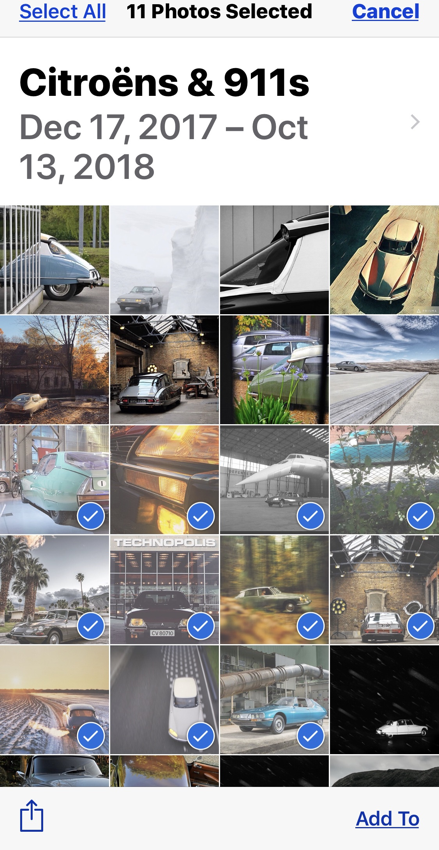
    Still, go into any album. (Except shared ones, and except a few other kinds.) Hit the Select button. Tap the first photo. Touch and don’t lift your finger from the next photo, then drag immediately to the end of the row. Keep dragging straight down through rows to select more rows.

    Selecting many photos (11 with checkmarks)
  • Need to deselect a few? You can. Just tap them again (and you can drag through them).

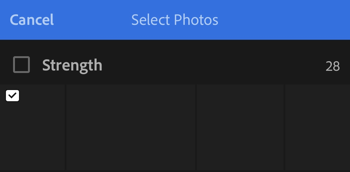
Now you see with Adobe Lightroom has a select-all checkbox.

Lightroom with Select checkbox

But Apple does know, at a preconscious level, that selecting many or all pictures is an issue: In the Recently Deleted album, whose location changed in iOS 12 such that I couldn’t find it, you can Delete All in two presses.

(Fun fact: You can drag and drop photos in some albums, which I discovered by getting the sequence wrong that I just listed above.)

Advanced features few understand

  • AirDrop.

  • Apple Pay. Inscrutable and scary even in countries that have had chip cards forever, like Canada.

  • What a Share menu is, and the fact you can reorder such menus and remove items you never use. (Much more important with big fonts because the menus side-scroll.)

  • Remove the suggestion bar on your keyboard, which (again, after a decade) I have seen actually used only in Chinese and Japanese keyboards where you have no choice in the matter. (People can see it. They just do not use it.)

  • Remove “apps” from Messages (that row of icons just below your text-entry field – nobody knows what they’re called, and few use or want them).

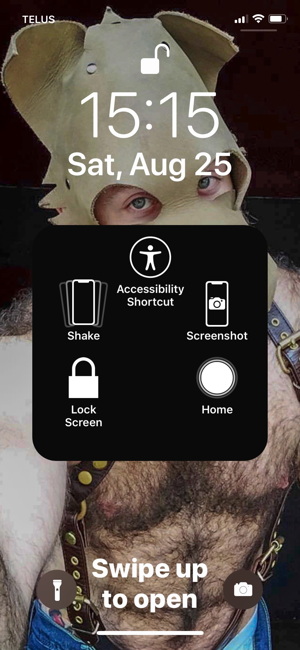
  • Home screen (with shirtless dude in pup hood) showing AssistiveTouch menu with home button, undo, other items The gold standard here is Undo. You have to shake your iPhone (or giant iPad Pro) to undo an action. You discover this by accident as you get up from a restaurant table with your phone in your hand, only to be greeted with an Undo Typing dialogue box. Unless you are an expert, you have no idea what just happened.

    If you really want and need the Undo feature, turn it on with AssistiveTouch. But AssistiveTouch itself has a diabolical user interface.

    [Yes, I have a Home button in my AssistiveTouch, as there are weird force-quit scenarios (yes, I force-quit apps) where it’s the only thing that works.]

Siri is hard to use

Like you, I can’t get Siri to set something up correctly on the first go more than three-quarters of the time. You shouldn’t have to talk a certain way to a virtual assistant. After this many years, he should understand you; he does not. (Siri is an Australian male.)

Set up an appointment with Fred tomorrow at two
“Which Fred?”
If it’s near midnight, he’ll ask you which day you mean
If you aren’t a savage and are using a 24-hour clock, he will get the time right no matter what you say
Set up an appointment for nine
Tries to make it for 21:00, not 09:00, when people generally have “appointments”
Set up an appointment for tomorrow at two
“Let me know if you want to make any changes.” “What does that mean?” “Sorry for being obtuse”
It turns out you can laboriously change any part of an item: “Change the time to 2:35”; “Change the title to ‘Late lunch’ ”

Genuine nice-to-have features

  • Have your phone say out loud who’s calling you. This one is so pressing even David Pogue wrote about it. (Settings ☞ Phone ☞ Announce Calls.)

  • Change how Messages depicts the name of your contacts. Generally you just want first name or nickname, yes, not first name plus last initial? (Settings ☞ Contacts ☞ Short Name.)

  • The only people who need their screen to “lock” within only a few seconds are those in high-security jobs (and wary teenagers). Almost everybody else can function better with a lag time of several minutes. (Settings ☞ Display & Brightness ☞ Auto-Lock.)

Did you know there’s a user manual?

In the iBooks (or is it Books?) Store you can download an iPhone User Guide for each major software version. There are usually iPad and sometimes iPod Touch user guides, too.

Once you do that (you won’t), you’ll find that almost nothing I have described here is covered. It does mention the ability to announce who’s calling you, but buries text size in the accessibility gulag, recapitulating the entire problem.

I sat and stewed about this posting for months. If nothing else, I need to keep it from becoming a script for a YouTube video about “hidden features” in iOS.

iPhones are hard to use.

(See also: My setup.)

23 Oct 06:33

11 B2B Copywriting Tips to Boost Your Content's Engagement Right Now

B2B copywriting is an investment. You’re spending time and money producing copy, and you want a high ROI–including supercharged brand awareness, greater lead acquisition, and high-quality conversions, right?

That’s why it’s important to understand the reach and engagement achieved by each piece of published copy. For example:

  • How many visitors did it direct to your site?
  • How many read the post and for how long?
  • What percentage of readers engaged with or shared it?

Analyzing a post’s engagement metrics might be disappointing. It’s tough to see the ROI of a post fall short of your goals–especially if you’ve spent hours of your time (and cash) to piece it together.

But, there is a solution. With a little bit of time and effort, you can spruce up your content to start getting the results you want.

Here are 11 B2B copywriting tips to take your content from zero to hero:

1. Know who you’re talking to

One of the most integral B2B copywriting tips is to know yourself and the audience you’re targeting. You can’t dig deep into your audience’s pain points (and ultimately generate conversions) if you haven’t got the basics covered.

Your copy–whether it’s a blog post or complex whitepaper–should reflect your understanding of your industry, and of your customers’ needs and problems.

Take Dropbox, for example. They make it easy for users to backup, share, and collaborate on files. It’s a tool that’s invaluable for businesses. But when Dropbox launched, the company had a tough time getting potential users to understand the service.

So what did Dropbox do?

They created a video that explained the product, and how it solved issues its audience faced.

Included in the video are a number of inside jokes and easter eggs that appealed to the intended audience—a tactic that went over swimmingly (and can be duplicated in written copy, too):


But knowing that the software was still prone to bugs, Dropbox launched a private, closed beta to test its product.

The result? Within a day, Dropbox’s users went from 5,000 to over 75,000, and has surpassed 5oo million to date. But they couldn’t have done that without a through understanding of their customer’s pain points, and solving them through the content they created.

You can do this by creating your own buyer personas through surveying your top customers. You could ask:

  • What made you purchase this product?
  • Which problem were you trying to solve?
  • What are your biggest challenges?

Make your buyer personas a focal part of your content marketing strategy, and don’t write a single piece of content without looking at it first.

Otherwise, it’s a complete waste of time.

2. Compile a style guide

A style guide holds the rules that your content should follow.

But why is it so important? Simply put: A style guide is the only way to maintain consistency across your entire content marketing strategy–regardless of who’s writing it.

Without it, it’d be tricky to keep content on-brand and recognizable.

It’s also important if you’re outsourcing your writing. While you may be your brand’s sole copywriter right now, if your brand wants to increase its output, they’ll need to hire a copywriter that creates on-brand content.

When creating a style guide, you may want to default to something that’s already well-known and used, like the Associated Press Stylebook or Chicago Manual of Style.

You may even elect to adopt some “house rules,” specifying which established conventions are okay to break (and how), what dialects to write in, and what tone of voice your brand uses.

Who knows—with a style guide in place, you might even be able to take a vacation!

Every business creating content *needs* a style guide. Here's why--and how to create your own. Click To Tweet

3. Learn from your competitors

In many cases, your competitors have already done much of the groundwork of figuring out which B2B copywriting tactics work (and don’t work) for your target audience.

By capitalizing on the foundations they’ve laid out, you can save time and money.

First, head over to some of your competitors’ websites. Which competitors most closely resemble what you offer or have a solid hold on your ideal audience? It’s those who you want to focus on and learn from.

Then, click through their content and take note of their SEO. Are they receiving high-quality backlinks? Which keywords are they targeting? Do they drive much organic traffic?

Use a tool like SEMrush to find this data:

b2b copywriting tips - use semrush to copy competitors
Source

(Noting the keywords that bring you to their site is an copywriting hack—especially considering how time-consuming and hit-or-miss it is to figure which keywords work for your niche or industry.)

You may not be able to outrank your competitor without much effort, but there’s a chance they’ve overlooked a popular keyword that you can rank for.

Also look at the tone, messaging, and format of your competitor’s content. Does their copy resonate with your audience? If they’re failing to provide relevant data and case studies, there’s an opening for you to better serve your market by performing some research.

Staying aware of what your competitors are up to will help you write strong and unique copy that outshines theirs.

That’s the goal, right?

4. Craft a killer headline

What’s the first thing you notice when you load up a blog or see a post shared on social media? The headline, of course–it’s one the most important elements of any type of content, especially blog posts.

That’s because 80% of readers only read the headline before moving on to something else. It doesn’t matter how much blood, sweat and tears have gone into writing your copy if you lose the attention of 80% of would-be readers at the headline.

You need to craft a powerful, compelling, and interesting headline that pulls readers in and says, “Hey, this is something you need to read.”

This can be done by steering clear from clickbait-style headlines. Sure, clickbait gets the clicks—but it’s at the expense of annoying and turning away readers who expect something specific, only to get disappointed.

That won’t do any favors for your user experience or bounce rate.

Instead, your headlines should:

Your headline should also reflect the type of copy you’re writing. Lists acknowledge that a given number of items are included within so a reader knows exactly what to expect.

(Bonus: Stick to an odd number if possible–studies show they tend to perform better.)

A killer headline can even go a long way toward making your content go viral. So, don’t push it to the bottom of your content priority list.

You only have 37 seconds to grab your readers attention. @elisedopson shares how you can demand it in just five. Click To Tweet

5. Get to the point… quickly

Businesses don’t have time to waste; wasted time is wasted money.

Your customers don’t have time to waste, either. They’re not going to wade through fluff to get to the point. We’re busy people.

The statistics prove it: Most readers spend 37 seconds reading an article, on average. You’ve got a tiny window to intrigue them, demonstrate that you understand your niche and your audience, and explain what solution you’re offering.

Feeling the pressure?

Readers also need to immediately identify the value in your copy.

What insights, data, or advice are you offering that they can implement in their own business? Can you give them a unique strategy that sets you apart from the competition, and puts your brand at the forefront of their mind?

A fantastic way to do this is to tell stories in your content. It’s a B2B copywriting technique that allows you to highlight the benefits your customers reap from your product, boosting the chances of conversions from it.

Fancy an example? Check out how Backlinko craft the introductions to their blog post for time-short readers:

b2b copywriting tips - introduction to blog post

No fluff, and certainly no promising the world.

Your content should be the same. Make the most of your readers’ time by cutting through the chaff to provide real, verifiable, and useful information–your reputation will benefit.

Remember: You don’t have long to prove yourself!

6. Write like a human, not a robot

Somewhere along the line, B2B copywriting got a reputation for being boring. Words like “generate”, “leverage” and “low-hanging fruit” are expected at any given second, but we’re smashing that reputation.

Have fun with your content.

The people reading your content are, in fact, real people with sense of humor; not robots.

Fellow freelance copywriter Megan Rose agrees. She says:

“You need to use common jargon for the industry, so you’re speaking their everyday language, but you’ll want to avoid overdoing the technical terms that are less familiar and make it harder to follow.”

Take a look at this snippet I took from Sales and Orders’ Google Express resource page:

how to make b2b copywriting more fun

I’ll bet that sentences makes you chuckle, and breaks down the idea that Sales and Orders is a fun brand–not one that’s professional 24/7. (Because let’s face it, nobody is.)

At the risk of making English majors everywhere gasp in terror, B2B copywriting is also no place for some of the more stringent rules of writing. Granted, you should never litter your copy with “lols” or “u” in place of “you,” but you can overlook some common rules of grammar, such as:

  • Starting sentences with “and”, “but” or “yet”
  • Writing one-sentence paragraphs
  • Using slang (only if your customers use it, too)
  • Writing in the first person
  • Crafting complete sentences

The bottom line is:

You may be leading (or part of) a multi-million dollar business, but guess what? You’re still human. Your customers are too.

There’s a reason why even digital assistants like Alexa and Siri have some semblance of personality. And, injecting personality into your writing or brand voice helps readers relate to you on a personal level.

That’ll do great things for your conversion rates.

“You may be leading (or part of) a multi-million dollar business, but guess what? You’re still human. Your customers are too.” Click To Tweet

7. Don’t be afraid of using humor

You don’t need to be a professional stand-up to add some humor to your copy. In fact, peppering a few puns and jokes throughout your content can really spice it up and engage your readers.

Remember what we said about our B2B audience being people, too?

A report by Sprout Social discovered that 75% of consumers appreciate brands who use humor–so if you’re not adding a few LOLs (copywriting rule broken) into your content, you could be missing out.

The best part? Your name doesn’t need to be Jim Carrey to inject humor into your copy, either.

Much of your humor can be drawn from your experience and industry insight. Your knowledge and expertise can be a font of humor through which to relate to your audience and spruce up your copy.

Just take Volvo, for example.

(This doesn’t need an explanation; the video tells all.)

Although I fear that you’ll think I’m overreacting, I balled at this video until my jaw ached.

It shows me that Volvo have a sense of humor and they’re a relatable brand–while giving my stomach muscles an exercise, in the meantime.

8. Keep readers interested by writing with an active voice

Blog posts will be better if they are written in an active voice.

Writing in an active voice makes your blog posts better.

Notice the difference in those two sentences?

This goes hand-in-hand with my advice to write like a human, but it’s a B2B copywriting tip that stands on its own, too.

The passive voice (or talking in the past tense) is boring. Worse, it’s generally more clunky and overly professional. It has its time to shine in sterile fact-based reporting, but it’s not the best way to represent your B2B brand.

Stick to using the active voice instead.

Not only does the latter cut down on your word count, but it keeps readers interested in what you have to say. You’re not lulling them to sleep as if they’re reading a governmental memo or academic research paper.

…The college days are over.

The college days are over... Stick to using the active voice in your content, as @elisedopson explains: Click To Tweet

9. Use case studies and hard data

You can spend all day preaching about the features and benefits of using your product or service, but without supporting facts, all your effort will be wasted.

Why? The answer is simple:

Before a customer parts with their hard-earned cash, they want cold, hard evidence that your solution works.

That’s especially true for B2B buyers, who have complex purchasing processes before they hit the “buy” button on your website. They’re unlikely to checkout and make off-the-cuff decisions, and need to make it’s 100% essential before they pitch the case to their finance managers.

However, you can make that argument easier for them by conducting original research.

Original research is a powerful way to generate data-driven content—content that’s yours and yours alone, and answers your readers’ burning questions, like this data compiled by Buzzsumo:

using original research for b2b copywriting

One survey found that 18% of survey respondents cited original research as the most effective form of content marketing.

Gareth Hancock, Copywriter at That Content Shed, agrees:

“Back up every report you cite and stat you use by linking to sources. It’s adds legitimacy and credibility. Plus, it strengthens your argument.”

That’s because original research builds your authority, establishes credibility, and reveals a challenge or opportunity your audience hasn’t yet thought of. You’re aiding a customer through the sales funnel by answering their known and unknown questions and presenting a tried-and-true solution.

10. Write only as much as you need to

Long-form content outperforms shorter content by over 40%, and blog posts ranking on the first pages of Google are over 2,450 words in length:

seo content length

…But that doesn’t mean you need to stuff unnecessary words into all the copy you write.

SEO best practices are always changing, but high-quality content will always reign supreme. That’s why my ninth B2B copywriting tip is to write only as much as you need to–avoiding fluff at all times.

Let’s put this into practise.

Have you ever looked up a recipe only to click on an article and face an overbearing wall of text in which the author rambles on about a personal story, when all you want to do is bake some cookies?

It’s frustrating.

You don’t want to do the same, and bombard your audience with 2,000+ words of content if their question can be answered with 500. Stick to the subject and stay on topic.

Leave the long-form content to take its place for ultimate guides, where readers know (and expect) to be faced with walls of content.

Otherwise, take one point, or answer one overarching question–and then finish.

Content tip: Don't bombard your audience with 2,000+ words of content if their question can be answered with 500. Yes, long-form is good for SEO, but it doesn't always hit the mark for user experience. Click To Tweet

11. Include a powerful call to action

Your content may be chock-full of data, research, and information but, ultimately, you want readers to do something at the end of your post. That could be anything from:

  • Subscribing to a newsletter
  • Downloading a lead magnet
  • Contacting a sales rep
  • Entering a giveaway
  • Leaving a comment

But without a powerful call to action, readers aren’t encouraged to take the next step through your sales funnel.

90% of website visitors will read your CTA, so you’ll need to make it a good’un.

Much of the advice I’ve given you already applies to writing a powerful CTA. For example: An effective CTA should include power words and highlight the benefits of following through with the action.

Subscribe to my newsletter” is boring and falls short of inspiring you to click-through, right?

Instead, use psychology tactics in your copywriting and craft a more effective CTA, such as “Show me how to get more leads”. It tells readers, “Hey, click here and take the next step for more of this…”, and passes them further into the sales funnel.

Here’s a fantastic example from Shopify, encouraging readers of their blog post to sign-up for a free trial using the words “free” and “no credit card required”–solving two pain points of their target customer:

b2b call to action - shopify example

Like with headlines, writing a powerful CTA will take some time and effort (you might need to split-test the heck out of them), but the results speak for themselves.

Take your B2B copywriting to the next level

The content you’re creating is a crucial aspect of building your brand’s authority and generating leads–you already know that. But by implementing these B2B copywriting tips, you’re setting your sights on a better ROI for your efforts, and making your content the best it can be.

Remember to write for humans, inject personality into your content, and ditch the rules you were taught in English class.

It can take time to see results, but trust me when I say it’ll be worth it.

18 Oct 06:13

The Wizard of Q

In 2006, when the internet was younger and seemed to hold untapped artistic possibilities, I was asked to write a serial novel for Slate. The subject of the “book” was up to me, so I chose themes that seemed appropriate to the new medium: high-tech surveillance, cultural fragmentation, selfhood eroded by scrutiny. I imagined people reading my dark tale surreptitiously at their office computers and feeling almost as hunted as the characters, who were a mix of anarchists and federal agents, omniscient spies and hapless nobodies. I titled the novel The Unbinding and filled it with experimental devices—specifically, scores of hyperlinks—meant to hasten a Great Leap Forward for fiction. One of the hyperlinks took you to a video of a metal band from Scandinavia playing a sped-up, scary-sounding cover of Neil Diamond’s “Solitary Man.” How I thought it might help the story I no longer recall. I may have stuck it in just because I could.

The Unbinding was, needless to say, a flop. Few people ever found it on the web, and fewer still bought the printed version that followed (in which the hyperlinks appeared in bold but were functionally moot). Not surprising: it was borderline incoherent. When I started the book, I had a notion that I would use current events to shape the plot. It was a clever idea but not a good one. Fashioning a tale without an ending, a tale that swerved as the headlines changed yet retained its inner logic, was a stunt I simply couldn’t manage. I wrote it in installments, week by week, laying down a railroad track to nowhere. I should have called the project “The Unhinging,” since writing it nearly sent me around the bend.

To console myself for my failure I concluded that the internet and the novel were natural enemies. “Choose your own adventure” stories were not the future of literature. The author should be a dictator, a tyrant who treated the reader as his willing slave, not as a cocreator. And high-tech flourishes should be avoided. Novels weren’t meant to link to Neil Diamond songs or, say, refer to real plane crashes on the day they happen. Novels were closed structures, their boundaries fixed, not data-driven, dynamic feedback loops. Until quite recently, these were my beliefs, and no new works emerged to challenge my thinking.

Then, late last year, while knocking around on the internet one night, I came across a long series of posts originally published on 4chan, an anonymous message board. They described a sinister global power struggle only dimly visible to ordinary citizens. On one side of the fight, the posts explained, was a depraved elite, bound by unholy oaths and rituals, secretly sowing chaos and strife to create a pretext for their rule. On the other side was the public, we the people, brave and decent but easily deceived, not least because the news was largely scripted by the power brokers and their collaborators in the press. And yet there was hope, I read, because the shadow directorate had blundered. Aligned during the election with Hillary Clinton and unable to believe that she could lose, least of all to an outsider, it had underestimated Donald Trump—as well as the patriotism of the US military, which had recruited him for a last-ditch battle against the psychopathic deep-state spooks. The writer of the 4chan posts, who signed these missives “Q,” invited readers to join this battle. He—she? it?—promised to pass on orders from a commander and intelligence gathered by a network of spies.

I was hooked.

Known to its fan base as ­QAnon, the tale first appeared last year, around Halloween. Q’s literary brilliance wasn’t obvious at first. His obsessions were unoriginal, his style conventional, even dull. He suggested that Washington was being purged of globalist evildoers, starting with Clinton, who was awaiting arrest, supposedly, but allowed to roam free for reasons that weren’t clear. Soon a whole roster of villains had emerged, from John ­McCain to John Podesta to former president Obama, all of whom were set to be destroyed by something called the Storm, an allusion to a remark by President Trump last fall about “the calm before the storm.” Clinton’s friend and supporter Lynn Forrester de Roth­schild, a member by marriage of the banking family abhorred by anti-Semites everywhere, came in for special abuse from Q and Co.—which may have contributed to her decision to delete her Twitter app. Along with George Soros, numerous other bigwigs, the FBI, the CIA, and Twitter CEO Jack Dorsey (by whom the readers of Q feel persecuted), these figures composed a group called the Cabal. The goal of the Cabal was dominion over all the earth. Its initiates tended to be pedophiles (or pedophilia apologists), the better to keep them blackmailed and in line, and its esoteric symbols were everywhere; the mainstream media served as its propaganda arm. Oh, and don’t forget the pope.

As I read further, the tradition in which Q was working became clearer. Q’s plot of plots is a retread, for the most part, of Cold War–era John Birch Society notions found in books such as None Dare Call It Conspiracy. These Bircher ideas were borrowings, in turn, from the works of a Georgetown University history professor by the name of Carroll Quigley. Said to be an important influence on Bill Clinton, Quigley was a legitimate scholar of twentieth-century Anglo-American politics. His 1966 book Tragedy and Hope, which concerned the power held by certain elites over social and military planning in the West, is not itself a paranoid creation, but parts of it have been twisted and reconfigured to support wild theories of all kinds. Does Q stand for Quigley? It’s possible, though there are other possibilities (such as the Department of Energy’s “Q” security clearance). The literature of right-wing political fear has a canon and a pantheon, and Q, whoever he is, seems deeply versed in it.

While introducing his cast of fiends, Q also assembled a basic story line. Justice was finally coming for the Cabal, whose evil deeds were “mind blowing,” Q wrote, and could never be “fully exposed” lest they touch off riots and revolts. But just in case this promised “Great Awakening” caused panic in the streets, the National Guard and the Marine Corps were ready to step in. So were panels of military judges, in whose courts the treasonous cabalists would be tried and convicted, then sent to Guantánamo. In the manner of doomsayers since time began, Q hinted that Judgment Day was imminent and seemed unabashed when it kept on not arriving. Q knew full well that making one’s followers wait for a definitive, cathartic outcome is a cult leader’s best trick—for the same reason that it’s a novelist’s best trick. Suspense is an irritation that’s also a pleasure, so there’s a sensual payoff from these delays. And the more time a devotee invests in pursuing closure and satisfaction, the deeper her need to trust the person in charge. It’s why Trump may be in no hurry to build his wall, or to finish it if he starts. It’s why he announced a military parade that won’t take place until next fall.

As the posts piled up and Q’s plot thickened, his writing style changed. It went from discursive to interrogative, from concise and direct to gnomic and suggestive. This was the breakthrough, the hook, the innovation, and what convinced me Q was a master, not just a prankster or a kook. He’d discovered a principle of online storytelling that had eluded me all those years ago but now seemed obvious: The audience for internet narratives doesn’t want to read, it wants to write. It doesn’t want answers provided, it wants to search for them. It doesn’t want to sit and be amused, it wants to be sent on a mission. It wants to do.

From November on, as his following on 4chan, Reddit, Twitter, and other platforms grew, Q turned his readers into spies and soldiers by issuing coded orders and predictions that required great effort to interpret and tended to remain ambiguous even after lengthy contemplation. The messages often consisted of stacked one-liners that looked like imagist poems. They radiated mystery and portent. Take this example from March 3:

Who controls the narrative?

WHO wrote the singular censorship algorithm?

WHO deployed the algorithm?

WHO instructed them to deploy the algorithm?

SAME embed across multiple platforms.

Why?

Why is the timing relevant?

Where is @Snowden?

Why did ES leave G?

To initiates, this set of clues (Q’s audience calls these “crumbs” and strives to “bake” them into “bread,” meaning plain En­glish) alludes to an elaborate range of incidents related to Trump’s war on the Cabal and to the Cabal’s war—doomed to fail—on us, the innocents. “ES,” for instance, is Eric Schmidt, the former executive chairman of Alphabet, Google’s parent company, whose resignation had been linked in previous posts to covert dealings with North Korea, in Q mythology a CIA puppet state and a center of trafficking in drugs and sex slaves. The insidious censorship algorithm is the work of Edward Snowden, who isn’t a whistle-blower but a double or triple agent of murky allegiances who works with Twitter’s Dorsey in some obscure capacity to keep the citizenry blind and muzzled.

Preposterous, huh? Well, the Q people don’t think so. Indeed, they feel we’ll soon come over to their side, once we understand the true relationship between Q’s crumbs and the subsequent news events that the crumbs predicted. The North Korean peace talks, for example, which some students of Q saw coming last winter. Or the scandalous revelations about Facebook’s illicit peddling of users’ data. “Do you believe in coincidences?” asks Q repeatedly, and the answer he obviously wants is no. That’s why his minions labor to make connections between such disparate phenomena as the flight paths of jumbo jets and the alleged escape plans of A-list fugitives. “Expand your thinking,” Q exhorts his legions, particularly when they falter in their cryptography or lag in their online detective work. He’s the author as case officer, tasking slow-witted readers with enigmas whose solutions he already knows but insists that they discover on their own.

And his posts aren’t all nonsense. Some are quite uncanny in the way they anticipate the headlines. On March 9, he told his troops to watch for “liquidity events” in the stock charts of social media companies. Days later, Facebook fell into disgrace and suffered a sizable market sell-off. Then there are the intriguing correlations between the posts and the president’s Twitter outbursts, which Q would have us think are synchronized with split-second precision. The proofs he offers involve comparing time stamps, and mathematically minded Qbots swear by them. That they’re willing to fuss with such puzzles is a testament to the compulsive power of Q’s methods. By leaving more blanks in his stories than he fills in, he activates the portion of the mind that sees faces in clouds and hears melodies in white noise.

Could Q have actual foreknowledge? Was he somehow the oracle he purported to be? Having followed the posts for months now, I wish I could summarily dismiss them, but so outrageous is our current reality, so reliably unpredictable and odd, that it does not seem impossible to me that there might exist an internet seer stationed in the White House whose job is to brief lowly geeks on global intrigues. My friend Matthew, who saw combat in Afghanistan and has reported on intelligence issues, believes that Q may be the result of psyops conceived to maintain morale among Trump’s base. The trick, he says, is to fashion a mental filter that will make Trump’s losses look like victories, his missteps like chess moves, his caprices like plans. After all, if most news is fake, as Trump insists, the real news must be hidden out of sight. Q claims to offer glimpses of it, along with warnings about what would happen if we beheld it all at once. To wake in an instant to the Luciferian horrors of the Cabal’s perverted machinations would be like rushing forth from Plato’s cave—blinding, debilitating, maybe deadly. Instead, Q leads us gently toward the light, a patient guide, like Virgil was to Dante.

One night this spring, in northwest Arkansas, Matthew and I stayed up past midnight interpreting several recent posts from Q that trembled on the verge of clarity, seeming to offer highly privileged insights into a crisis rumored to be forthcoming. I sat on the couch. He paced. We thought out loud, competing to crack the message and setting different values for different variables. We argued our cases as the night slid by; we raved away in an ecstasy of guesswork. Q was being good to us. Q was delivering everything we craved.

Q is part fabulist, part fortune-teller, holding up a computer-screen-shaped mirror to our golden age of fraudulence. He composes in inklings, hunches, and wild guesses, aware that our hunger for order grows more acute the longer it goes unsatisfied. Q calls the vista he’s gradually revealing the map, and he knows how badly his people crave it, which is why he doesn’t disclose in one fell swoop Trump’s strategy for national salvation. A hope fulfilled is also a hope exhausted. Tension and foreboding, on the other hand, are thrills that keep on thrilling, for fear can never be fully put to rest. Even if his followers’ dreams come true and the Clintons, Podestas, Schmidts, and Dorseys are hustled off in chains to distant gulags, and even if Kim Jong-un is released from the CIA contract that requires him to play a nuclear madman to keep the world off balance so America’s spymasters can rule it, one can never be sure the Cabal won’t rise again. And it will, of course, since that’s what archfiends do: rise from the dead.

The novel is the same way. It dies and dies so it can live and live. The Q tale may be loathsome and deeply wicked, a magnet for bigots and ignoramuses whose ugly dreams it caters to and ratifies, but as a feat of New Age storytelling I find it curiously encouraging. The imagination lives. A talented bard can still grab and keep an audience. Now for a better story, with higher themes. Now for the bracing epic of recovery that the dark wizards have shown us how to write. 

You are currently viewing this article as a guest. If you are a subscriber, please sign in. If you aren't, please subscribe below and get access to the entire Harper's archive for only $45.99/year.

= Subscribers only.
Sign in here.
Subscribe here.

11 Oct 06:30

Self-doxxing

by mathowie

Thought experiment: is it possible to write a paragraph about your life so filled with minor but important facts that someone could figure out how to answer every challenge question possible and retrieve your password from almost any system on earth? Screenshot 2018-10-10 16.18.55.png

(to be clear, nothing above is true)

03 Oct 07:55

When Security Researchers Pose as Cybercrooks, Who Can Tell the Difference?

by BrianKrebs

A ridiculous number of companies are exposing some or all of their proprietary and customer data by putting it in the cloud without any kind of authentication needed to read, alter or destroy it. When cybercriminals are the first to discover these missteps, usually the outcome is a demand for money in return for the stolen data. But when these screw-ups are unearthed by security professionals seeking to make a name for themselves, the resulting publicity often can leave the breached organization wishing they’d instead been quietly extorted by anonymous crooks.

Last week, I was on a train from New York to Washington, D.C. when I received a phone call from Vinny Troia, a security researcher who runs a startup in Missouri called NightLion Security. Troia had discovered that All American Entertainment, a speaker bureau which represents a number of celebrities who also can be hired to do public speaking, had exposed thousands of speaking contracts via an unsecured Amazon cloud instance.

The contracts laid out how much each speaker makes per event, details about their travel arrangements, and any requirements or obligations stated in advance by both parties to the contract. No secret access or password was needed to view the documents.

It was a juicy find to be sure: I can now tell you how much Oprah makes per event (it’s a lot). Ditto for Gwyneth Paltrow, Olivia Newton John, Michael J. Fox and a host of others. But I’m not going to do that.

Firstly, it’s nobody’s business what they make. More to the point, All American also is my speaker bureau, and included in the cache of documents the company exposed in the cloud were some of my speaking contracts. In fact, when Troia called about his find, I was on my way home from one such engagement.

I quickly informed my contact at All American and asked them to let me know the moment they confirmed the data was removed from the Internet. While awaiting that confirmation, my pent-up frustration seeped into a tweet that seemed to touch a raw nerve among others in the security industry.

The same day I alerted them, All American took down its bucket of unsecured speaker contract data, and apologized profusely for the oversight (although I have yet to hear a good explanation as to why this data needed to be stored in the cloud to begin with).

This was hardly the first time Troia had alerted me about a huge cache of important or sensitive data that companies have left exposed online. On Monday, TechCrunch broke the story about a “breach” at Apollo, a sales engagement startup boasting a database of more than 200 million contact records. Calling it a breach seems a bit of a stretch; it probably would be more accurate to describe the incident as a data leak.

Just like my speaker bureau, Apollo had simply put all this data up on an Amazon server that anyone on the Internet could access without providing a password. And Troia was again the one who figured out that the data had been leaked by Apollo — the result of an intensive, months-long process that took some extremely interesting twists and turns.

That journey — which I will endeavor to describe here — offered some uncomfortable insights into how organizations frequently learn about data leaks these days, and indeed whether they derive any lasting security lessons from the experience at all. It also gave me a new appreciation for how difficult it can be for organizations that screw up this way to tell the difference between a security researcher and a bad guy.

THE DARK OVERLORD

I began hearing from Troia almost daily beginning in mid-2017. At the time, he was on something of a personal mission to discover the real-life identity behind The Dark Overlord (TDO), the pseudonym used by an individual or group of criminals who have been extorting dozens of companies — particularly healthcare providers — after hacking into their systems and stealing sensitive data.

The Dark Overlord’s method was roughly the same in each attack. Gain access to sensitive data (often by purchasing access through crimeware-as-a-service offerings), and send a long, rambling ransom note to the victim organization demanding tens of thousands of dollars in Bitcoin for the safe return of said data.

Victims were typically told that if they refused to pay, the stolen data would be sold to cybercriminals lurking on Dark Web forums. Worse yet, TDO also promised to make sure the news media knew that victim organizations were more interested in keeping the breach private than in securing the privacy of their customers or patients.

In fact, the apparent ringleader of TDO reached out to KrebsOnSecurity in May 2016 with a remarkable offer. Using the nickname “Arnie,” the public voice of TDO said he was offering exclusive access to news about their latest extortion targets.

Snippets from a long email conversation in May 2016 with a hacker who introduced himself as Adam but would later share his nickname as “Arnie” and disclose that he was a member of The Dark Overlord. In this conversation, he is offering to sell access to scoops about data breaches that he caused.

Arnie claimed he was an administrator or key member on several top Dark Web forums, and provided a handful of convincing clues to back up his claim. He told me he had real-time access to dozens of healthcare organizations they’d hacked into, and that each one which refused to give in to TDO’s extortion demands could turn into a juicy scoop for KrebsOnSecurity.

Arnie said he was coming to me first with the offer, but that he was planning to approach other journalists and news outlets if I declined. I balked after discovering that Arnie wasn’t offering this access for free: He wanted 10 bitcoin in exchange for exclusivity (at the time, his asking price was roughly equivalent to USD $5,000).

Perhaps other news outlets are accustomed to paying for scoops, but that is not something I would ever consider. And in any case the whole thing was starting to smell like a shakedown or scam. I declined the offer. It’s possible other news outlets or journalists did not; I will not speculate on this matter further, other than to say readers can draw their own conclusions based on the timeline and the public record.

WHO IS SOUNDCARD?

Fast-forward to September 2017, and Troia was contacting me almost daily to share tidbits of research into email addresses, phone numbers and other bits of data apparently tied to TDO’s communications with victims and their various identities on Dark Web forums.

His research was exhaustive and occasionally impressive, and for a while I caught the TDO bug and became engaged in a concurrent effort to learn the identities of the TDO members. For better or worse, the results of that research will have to wait for another story and another time.

At one point, Troia told me he’d gained acceptance on the Dark Web forum Kickass, using the hacker nickname “Soundcard“. He said he believed a presence on all of the forums TDO was active on was necessary for figuring out once and for all who was behind this brazen and very busy extortion group.

Here is a screen shot Troia shared with me of Soundcard’s posting there, which concerned a July 2018 forum discussion thread about a data leak of 340 million records from Florida-based marketing firm Exactis. As detailed by Wired.com in June 2018, Troia had discovered this huge cache of data unprotected and sitting wide open on a cloud server, and ultimately traced it back to Exactis.

Vinny Troia, a.k.a. “Soundcard” on the Dark Web forum Kickass.

After several weeks of comparing notes about TDO with Troia, I learned that he was telling random people that we were “working together,” and that he was throwing my name around to various security industry sources and friends as a way of gaining access to new sources of data.

I respectfully told Troia that this was not okay — that I never told people about our private conversations (or indeed that we spoke at all) — and I asked him to stop doing that. He apologized, said he didn’t understand he’d overstepped certain boundaries, and that it would never happen again.

But it would. Multiple times. Here’s one time that really stood out for me. Earlier this summer, Troia sent me a link to a database of truly staggering size — nearly 10 terabytes of data — that someone had left open to anyone via a cloud instance. Again, no authentication or password was needed to access the information.

At first glance, it appeared to be LinkedIn profile data. Working off that assumption, I began a hard target search of the database for specific LinkedIn profiles of important people. I first used the Web to locate the public LinkedIn profile pages for nearly all of the CEOs of the world’s top 20 largest companies, and then searched those profile names in the database that Troia had discovered.

Suddenly, I had the cell phone numbers, addresses, email addresses and other contact data for some of the most powerful people in the world. Immediately, I reached out to contacts at LinkedIn and Microsoft (which bought LinkedIn in 2016) and arranged a call to discuss the findings.

LinkedIn’s security team told me the data I was looking at was in fact an amalgamation of information scraped from LinkedIn and dozens of public sources, and being sold by the same firm that was doing the scraping and profile collating. LinkedIn declined to name that company, and it has not yet responded to follow-up questions about whether the company it was referring to was Apollo.

Sure enough, a closer inspection of the database revealed the presence of other public data sources, including startup web site AngelList, Facebook, Salesforce, Twitter, and Yelp, among others.

Several other trusted sources I approached with samples of data spliced from the nearly 10 TB trove of data Troia found in the cloud said they believed LinkedIn’s explanation, and that the data appeared to have been scraped off the public Internet from a variety of sources and combined into a single database.

I told Troia it didn’t look like the data came exclusively from LinkedIn, or at least wasn’t stolen from them, and that all indications suggested it was a collection of data scraped from public profiles. He seemed unconvinced.

Several days after my second call with LinkedIn’s security team — around Aug. 15 — I was made aware of a sales posting on the Kickass crime forum by someone selling what they claimed was “all of the LinkedIN user-base.” The ad, a blurry, partial screenshot of which can be seen below, was posted by the Kickass user Soundcard. The text of the sales thread was as follows:

Soundcard offering to sell what he claimed was all of LinkedIn’s user data, on the Dark Web forum Kickass.

“KA users –

I present you with exclusive opportunity to purchase all (yes ALL) of the LinkedIN user-base for the low low price of 2 BTC.

I found a database server with all LinkedIN users. All of user’s personal information is included in this database (including private email and phone number NOT listed on public profile). No passwords, sorry.

Size: 2.1TB.

user count: 212 million

Why so large for 212 million users? See the sample data per record. There is lot of marketing and CRM data as well. I sell original data only. no editz.

Here is index of server. The LinkedIN users spread across people and contacts indexes. Sale includes both of those indexes.

Questions, comments, purchase? DM me, or message me – soundcard@exploit[.]im

The “sample data” included in the sales thread was from my records in this huge database, although Soundcard said he had sanitized certain data elements from this snippet. He explained his reasoning for that in a short Q&A from his sales thread:

Question 1: Why you sanitize Brian Krebs’ information in sample?

Answer 1: Because nothing in life free. This only to show i have data.

I soon confronted Troia not only for offering to sell leaked data on the Dark Web, but also for once again throwing my name around in his various activities — despite past assurances that he would not. Also, his actions had boxed me into a corner: Any plans I had to credit him in a story for eventually helping to determine the source of the leaked data (which we now know to be Apollo) became more complicated without also explaining his Dark Web alter ego as Soundcard, and I am not in the habit of omitting such important details from stories.

Troia assured me that he never had any intention of selling the data, and that the whole thing had been a ruse to help smoke out some of the suspected TDO members.

For its part, LinkedIn’s security team was not amused, and published a short post to its media page denying that the company had suffered a security breach.

“We want our members to know that a recent claim of a LinkedIn data breach is not accurate,” the company wrote. “Our investigation into this claim found that a third-party sales intelligence company that is not associated with LinkedIn was compromised and exposed a large set of data aggregated from a number of social networks, websites, and the company’s own customers. It also included a limited set of publicly available data about LinkedIn members, such as profile URL, industry and number of connections. This was not a breach of LinkedIn.”

It is quite a fine line to walk when self-styled security researchers mimic cyber criminals in the name of making things more secure. On the one hand, reaching out to companies that are inadvertently exposing sensitive data and getting them to secure it or pull it offline altogether is a worthwhile and often thankless effort, and clearly many organizations still need a lot of help in this regard.

On the other hand, most organizations that fit this description simply lack the security maturity to tell the difference between someone trying to make the Internet a safer place and someone trying to sell them a product or service.

As a result, victim organizations tend to react with deep suspicion or even hostility to legitimate researchers and security journalists who alert them about a data breach or leak. And stunts like the ones described above tend to have the effect of deepening that suspicion, and sowing fear, uncertainty and doubt about the security industry as a whole.

29 Sep 09:18

Facebook Security Bug Affects 90M Users

by BrianKrebs

Facebook said today some 90 million of its users may get forcibly logged out of their accounts after the company fixed a rather glaring security vulnerability in its Web site that may have let attackers hijack user profiles.

In a short blog post published this afternoon, Facebook said hackers have been exploiting a vulnerability in Facebook’s site code that impacted a feature called “View As,” which lets users see how their profile appears to other people.

“This allowed them to steal Facebook access tokens which they could then use to take over people’s accounts,” Facebook wrote. “Access tokens are the equivalent of digital keys that keep people logged in to Facebook so they don’t need to re-enter their password every time they use the app.”

Facebook said it was removing the insecure “View As” feature, and resetting the access tokens of 50 million accounts that the company said it knows were affected, as well as the tokens for another 40 million users that may have been impacted over the past year.

The company said it was just beginning its investigation, and that it doesn’t yet know some basic facts about the incident, such as whether these accounts were misused, if any private information was accessed, or who might be responsible for these attacks.

Although Facebook didn’t mention this in their post, one other major unanswered question about this incident is whether the access tokens could have let attackers interactively log in to third-party sites as the user. Tens of thousands of Web sites let users log in using nothing more than their Facebook profile credentials. If users have previously logged in at third-party sites using their Facebook profile, there’s a good chance the attackers could have had access to those third-party sites as well.

I have asked for clarification from Facebook on this point and will update this post when and if I receive a response. However, I would have expected Facebook to mention this as a mitigating factor if authorized logins at third-party sites were not impacted.

Update: 4:46 p.m. ET: A Facebook spokesperson confirmed that while it was technically possible that an attacker could have abused this bug to target third-party apps and sites that use Facebook logins, the company doesn’t have any evidence so far that this has happened.

“We have invalidated data access for third-party apps for the affected individuals,” the spokesperson said, referring to the 90 million accounts that were forcibly logged out today and presented with a notification about the incident at the top of their feed.

Original story:
Facebook says there is no need for users to reset their passwords as a result of this breach, although that is certainly an option.

More importantly, it’s a good idea for all Facebook users to review their login activity. This page should let you view which devices are logged in to your account and approximately where in the world those devices are at the moment. That page also has an option to force a simultaneous logout of all devices connected to your account.

26 Sep 13:08

Viral Twitter threads are the latest scam designed to sell you garbage

by Rebecca Jennings
A man opens Twitter on his iPhone.

Beware of “relatable” Twitter threads.

Normally the most annoying thing you’ll see in the replies to a viral tweet are the people firing off creepy and/or rude comments to the writer. But if you scroll down far enough, one increasingly common phenomenon you’ll find is a link to a sketchy website trying to sell you garbage.

Apparent scammers have recently been using seemingly empowering, relatable tweets to go viral, then threading them into a crafted story whose conclusion is a link to sign up for, say, a three-month weight-loss teatox program.

On September 15, a now-defunct account with the username @ashleyeats tweeted the following: “you ever see a girl in denial about being in a toxic relationship and want to grab her by her face and tell her how much better her life will be once she comes to her senses :/ that shit is the absolute worst to just stand by and watch after you’ve been through it all yourself...”

The thread, which managed to get an astronomical 83,000 retweets, continues for another 30 posts, weaving a story about “Ashley’s” struggle with her ex-boyfriend, who’d control her actions and force her to eat in front of him, thereby causing her to gain weight. It includes dozens of photos and videos documenting the weight fluctuations of a woman who is presumably Ashley, who is also presumed to be in an abusive relationship.

But as the story continues, the focus is more and more on Ashley’s weight loss progress, which she claimed was due to a mysterious program she’d seen floating around social media. She then includes videos of a woman reviewing a weight loss program, though the women in the photos looks suspiciously different from the previous photos.

 Twitter
A cached version of the since-deleted viral thread.

That’s because neither of the women is Ashley at all — most of the photos had been stolen from a cam girl on a fetish site, while the videos of the woman reviewing the shakes were ripped from a YouTuber named Vanessa Blanco.

Despite the initial positive response (Twitter tends to reward a weight-loss narrative), users were pretty quick to realize once they got to the final few tweets and clicked the links that it had all been a scam to sell Therma Trim, a shady diet supplement.

It’d be easy to dismiss the @ashleyeats thread as just another part of the world we live in today, one where celebrities use their influence to shill dubious products all the time, and conclude that we simply have to be more aware about how viral marketing practices target us. But just because both of those things are true doesn’t mean this type of advertising doesn’t have serious consequences. And it isn’t the first time this has happened.

The untold consequences of viral scam threads

The account @ashleyeats may have been suspended, but the story isn’t over for the cam girl from whom she stole the photos, which provided the bulk of the emotional potency in the thread. The model, who specializes in feederism, a fetish involving eating and weight gain, spoke to Motherboard under the condition of anonymity. She said that not only was she outed as a sex worker to her friends and family, but that her weight loss was in actuality a result of anorexia and cocaine abuse.

“The whole situation has really freaked with my sense of privacy and paranoia, because this fetish is VERY private to me and taboo to the rest of the world really. I’ve had multiple of my friends send me the thread and I had to tell them about what I’ve been doing and all in all, it’s really embarrassing,” she said.

Plus, the entire story rests on a likely fake account of emotional abuse as a way to sell a product that is, in all likelihood, a dangerous laxative. As others on Twitter have noted, the thread is also deeply fatphobic and preys on young women’s anxieties about weight. And yet, these reasons likely contributed to how far the thread was able to travel.

The @ashleyeats account was suspended and the thread has been deleted, but as Motherboard noted, numerous other accounts, such as @ashleysjourney, sprouted up in its place and tweeted the exact same thread, gaining thousands of retweets before they too were taken down.

A similar thread went viral last month, when a user named @chaobella tweeted “i love when dudes from high school hit me up like ‘i don’t know why we didn’t talk when we were younger’ umm because y’all made fun of me? a thread...”

This one uses a similar tone as that of @ashleyeats — it’s presumed to be written by a woman who, once upon a time, had experienced bullying or abuse, and seems like she’s interested in helping others. In both cases, the “twist” is that bullying or abuse no longer happens to her because she lost a dramatic amount of weight. And it too ended up using stolen photos, in a scam to sell Nutra-SX Garcinia Cambogia, another sketchy weight loss pill.

People have always attempted to capitalize on viral success

To be fair, social media posts that happen to go viral are almost always met with a reply from the original poster with a link to something they want to get more eyeballs on — their Instagram handle, YouTube page, or, as is so often parodied, their Soundcloud account. The difference is that in the cases of @ashleyeats and @chaobella, they’re threads that are specifically constructed to go viral, but are done under false pretenses using predatory tactics.

There can, however, be a little bit of a gray area here. Last year, a tweet from a woman named Dorthy Holmes went viral that depicted the baby shower of her best friend, Chelsie Collins. “Nobody showed up to my best friends baby shower. Just my boyfriend and me :(” it read, accompanied by four photos of empty chairs and tables and the expectant mother looking despondent.

The tweet evoked enough sympathy to garner more than 16,000 retweets before it was deleted, but in that time span, Dorthy had published Chelsie’s Walmart gift registry and a link to her PayPal. According to reports at the time, more than 350 gifts were purchased for Collins, which is also around the time people started getting suspicious. One Twitter user claimed to have called the restaurant where the shower took place and said that all 12 guests had indeed showed up, leading to numerous accounts claiming the whole thing was a scam.

In an interview with Select All, however, Holmes and Collins said that even though more people did eventually arrive, at the time it was posted it was all true. Holmes said that she originally wrote it “to fuck with my online mutuals” and that Collins received less than $100 anyway.

Then there was the #PlaneBae saga from this past July, in which a woman used her riveting yet deeply intrusive viral thread about a couple who seemed to be flirting on a plane to ask for a film deal and a job at BuzzFeed. Though she eventually apologized, it was difficult not to see the situation as someone attempting to secure fame and money by invading the privacy of two unsuspecting strangers. The photos might not have been stolen from a cam girl or a YouTuber, but the couple never asked for their likenesses and activities to be dissected on the Today show.

Accounts can easily mimic the tone of viral tweets to sell you stuff

Though the perpetrators of #PlaneBae and the sad baby shower didn’t seem to engineer their virality in an effort to sell stuff, those who do can easily mimic the tone and voice of viral tweets in a way that makes their marketing seem more organic.

@HornyFacts, a handle with more than 4 million followers that tweets stereotypically relatable content about sex and relationships such as, “date idea: just come over and sleep, that’s it,” recently retweeted an account posing as NBC News that claimed a mysterious new drug would soon be available to try. (The account, which has since been suspended, seemed to exist solely to shill the same pill.)

 @hoegivesnofucks/Instagram
A t-shirt sold by an affiliate of the popular meme account @hoegivesnofucks.

The practice isn’t limited to Twitter, either. Popular meme Instagram accounts pretty uniformly make their sponsored ads look like any other meme on their page, for everything from their own merch to sketchy lash gel to dubious vaginal steaming products. So it’s no surprise that now, people selling weight-loss programs are taking the practice one step further by adopting the tone of elaborate viral threads.

All this goes to show that pretty much every time something gets even remotely popular on a social media network, scammers will find a way to make money off of it — without any concern for the identity and privacy of others.

20 Sep 12:43

Products mocked as “lazy” or “useless” are often important tools for people with disabilities

by s.e. smith

From banana slicers to sock sliders to pre-peeled oranges.

On a June episode of his show Last Week Tonight, John Oliver went in on a product called the Sock Slider. While discussing the same topic on the Hannity Show, he took a moment to highlight the dwindling number of companies willing to associate themselves with his news program — ”My Pillow, Recticare cream, and of course, the Sock Slider.”

Audience members roared with laughter as Oliver rolled footage of a Sock Slider ad, featuring people moaning and groaning dramatically as they struggled to put on their socks before trying out the device and beaming at the ease of use. The camera cut back to Oliver chuckling to himself as he mocked the device and the people who use it.

You’ve probably seen examples of these kinds of “useless products for lazy people” before. Things like banana slicers, egg separators, jar openers, buttoners, tilting jugs for dispensing liquids, and much more are the subject of constant amusement on the internet: “Who uses these kinds of things?” “You don’t need an avocado slicer.” These products are typically positioned as “useless” in scathing roundups of products no one could possibly need, representing little more than wastes of plastic and resources.

Imagine being unable to slice a banana over your morning cereal because your hands are paralyzed or joint contractures make it hard to grip both the banana and the knife. If you’re a baker who loves making cakes, what would you do if you couldn’t separate an egg by casually cracking it on the edge of the bowl and using the shell to tease the yolk and white apart? The inability to perform these kinds of activities independently can have huge consequences for people with disabilities.

A variety of impairments can make these tasks challenging, including hand tremors or weakness, paralysis or paresis, limited range of motion, arthritis and other joint conditions, chronic pain, neurological disabilities or stroke, developmental disabilities, and amputations. These issues may be congenital or acquired or even temporary. Some people, for example, just need support while they recover from surgery or injuries. And so those products Oliver and the internet at large enjoy mocking? Not so useless after all.

“Useless” products can actually spell independence

”If I didn’t have that silly piece of plastic with ropes, I wouldn’t be able to put socks on,” says Emily Ladau, a disabled advocate, writer, and speaker with Larsen syndrome, a congenital skeletal disorder. (She’s talking about a similar device, not the exact as-seen-on-TV gadget.)

Ladau, who uses a wheelchair for mobility, cannot bend over to put on socks. Without a “sock putter-onner,” as she calls it, she would be forced to rely on the assistance of a personal care attendant (PCA) to put her socks on every morning. “Something that people think is a silly piece of plastic is one of the reasons I don’t need a PCA when I travel.”

Ladau, like other people with disabilities, is used to seeing late-night hosts, internet memes, and people on social media mocking the “silly pieces of plastic” that can be life-changing. For her, the sock slider and an extended shoe horn represent freedom; imagine being literally unable to put on socks unassisted before leaving the house on a cold winter day, and not being able to slip your socked feet into a pair of sturdy boots on your own.

Sometimes, living independently as a member of the disability community means having to rely on a little help, and in many cases, a gadget can be very useful. Help may also take a human face: Personal care assistants, aides, home health attendants, and other direct service professionals are vital, though there’s also a heavy social expectation that family members provide unpaid caregiving labor, a practice many people with disabilities oppose along with other exploitative labor practices.

If you can’t use your hands to open a jar of pasta sauce, does that mean you should live in an institution?

In many cases, wasting these services on tasks that people could perform with the assistance of a gadget is not very efficient. Nor do people with disabilities necessarily want to use such services this way.

Kim Sauder, a disability scholar and advocate, notes that people with disabilities may not want to be forced to wait for help with tasks like peeling oranges; there’s something very dehumanizing about the thought of just wanting a snack and being stymied by a rind you can’t remove on your own. Plus, says Ladau: “I get frustrated by the notion that I should always be okay with asking for help. I’d like to try to use my own solution.”

And attendant care is expensive, costing a median of $45,000 annually in 2015, according to the Kaiser Family Foundation. Few people pay this cost out of pocket: Instead, it’s typically part of the Home and Community-Based Services (HCBS) benefits provided to the disability community and older adults under programs like Medicaid and Medicare.

For those who use these government programs to pay for part or all of their services, there’s no guarantee that officials will authorize enough work hours to provide all the assistance someone needs. The amount of benefits provided is dependent on a “needs assessment” in which an evaluator meets with a disabled person to determine the extent of services they require. Many people with disabilities complain that these assessments tend to understate the amount of care they need, taking a “budget-driven” approach.

Furthermore, being unable to perform tasks independently can force people into institutional settings if they lack the support systems needed to survive. Whether you call them useless inventions, lazy products, or pointless gadgets, says Greg Hartley, a faculty member at the University of Miami’s physical therapy department and president of the Academy of Geriatric Physical Therapy, a component of the American Physical Therapy Association, these tools can enable people to lead their lives on their own.

“[Instead of having] to go to someplace that requires a lot of assistance and ultimately a lot of money, these little things can make huge differences in people’s quality of life, enabling them to be independent and have a sense of self-worth,” Hartley says.

Unwittingly, critics of “useless products” are sitting at the core of a battle the disability community has been engaged in for decades: The right to live in their communities, and to receive the services that enable them to do that. If you can’t use your hands to open a jar of pasta sauce, does that mean you should live in an institution? Republicans attacking Medicaid funding have HCBS squarely in their sights, a policy change that could be devastating to the disability community.

But for those complaining about cost overruns, pushing people into institutions is also bad economics. In 2012, the National Council on Disability found that HCBS is less expensive than institutionalization, and you can see why: Many of these products cost less than $40, while institutionalization can cost more than $300,000 annually in some states, much less affordable than attendant services. (Although many people with disabilities argue attendants should be paid more.)

An adult sippy cup won’t make the difference between staying at home and going into an institution — and the government certainly won’t pay for it — but it can sit at the cusp of a slippery slope between being able to live independently and being forced into institutional care.

Some of the most useful products for people with disabilities weren’t developed with them in mind

Products like the banana slicer, pizza shears, or similar items, says Hartley, can be especially useful for people who can’t safely or comfortably use knives. That can include people with disabilities who have impairments that make it hard to grip and direct their movements, as well as older adults struggling with arthritis and declining hand strength. These products can also help with cooking in less-accessible spaces: A wheelchair user who is using a cutting board on their lap because they can’t reach the counter may not want to use a knife.

Still, not all of these “useless inventions” were developed with the disability community in mind. Monique Haas, of the Hutzler Manufacturing Company that makes the infamous banana slicer, explains: “We are trying to look at what would make life in the kitchen easy for anyone and everyone. We do have a lot of one-handed things, just because it is easier to use one hand.”

While the product became the subject of mocking commentary in the early 2010s, she says, it had already been in their product line for a long time. And in case you’re wondering, the company has a sense of humor about its cult status. “If you read the reviews on Amazon, you will be rolling with laughter. They are really creative, they are really funny.”

These universal design practices are something people with disabilities are aware of. Sauder sometimes likes to turn the conversation back on people who make fun of convenience devices. If an egg separator or a shower chair is “useless,” “I expect you to take things out of the oven without gloves,” she says.

Unfortunately, she notes, the shaming around such items tends to push people with disabilities to try to do without, something Ladau notices as well. “Sometimes I feel like I’m deterred from making some of these purchases,” she says, “because I think society has this mindset that it’s all just another gimmick.”

People with disabilities themselves often end up filling the gaps for those who haven’t or can’t access professional services. They swap tips and tricks for products that have worked for them, like using household tongs as convenient reachers. (Tongs are another item Ladau often includes in her luggage, much to the confusion of the TSA.)

This kind of innovative repurposing of tools for accessibility purposes is common in disability spaces. Sometimes no viable product exists at all, and at other times the commercial version comes with an “accessibility tax” that makes it far too expensive.

Take, for example, people with disabilities who started using iPads as communication tools instead of cumbersome and expensive purpose-built tools covered by Medicaid. The Allora Speech Generating Device, for example, starts at $6,000. An iPad Mini can cost less than one-tenth the price, with no lengthy delivery time and a much easier interface. Buying a robot vacuum cleaner can cost a few hundred dollars, which more than pays for itself when the owner doesn’t have to rely on an aide to do light housekeeping.

The internet makes it easier than ever for context to be stripped away

The internet can have a flattening effect on the way humans view each other. On social media, people jostle for the most memeable, shareable, viral content, and don’t consider the consequences. Sauder notes, for example, that a tweet making fun of peeled and packaged oranges has gained notoriety multiple times, even after people with disabilities have criticized the sentiment behind the original “joke.” Each time it pops up in Sauder’s timeline under a new name, it goes viral all over again.

It’s easy to strip content of both context and empathy, whether intentionally or otherwise. And with the speed of distribution and the internet’s love of screenshots, everything is forever. When content mocking the disability community — like memes about ambulatory wheelchair users getting up to grab something high at the store — spread like wildfire, commentary from the affected community is rarely attached. This has a dehumanizing tendency, creating a world that rewards judgmental, snappy commentary and eliminates nuance.

When viral content dips into commentary about people’s identities, it can take on sinister overtones that cut both ways — a tweet mocking a low-vision person reading a book on the train can hurt just as much as inspiration porn that uses people with disabilities as Very Special Object Lessons. (Think “what’s your excuse” posters featuring disabled athletes, or “heartwarming” viral stories about disabled children.)

For the disability community, that thing the internet mocks may be a lifeline. And pushing back on these attitudes, Sauder says, can be exhausting.

Imagine losing the use of your left arm in a stroke and then seeing people mock the buttoners, zipper pulls, and other tools you use to get dressed one-handed. It’s not just that people with disabilities have a use for items like these and are tired of hearing that they’re wasteful or silly: When the need for such products is called into question, it can exacerbate social divides that contribute to larger policy issues that keep people with disabilities from public life, whether it’s the frenzied call for straw bans, claims that complying with the Americans with Disabilities Act is too onerous, or applying work requirements to Medicaid.

A sock slider, it turns out, is never just a sock slider.

19 Sep 10:54

Expressen trollar med siffror

by Hexmaster
När Expressen frågade folkvalda M-politiker ute i landet om M bör ta makten med hjälp av SD-förhandlingar svarade över hälften ja.
 - 324 M-politiker: Ta makten med hjälp av SD, Expressen 18 september 2018

Över hälften! Det är ju avgjort nyhetsvärde. Efter att ha gått igenom ett antal mer eller mindre kända företrädare så kommer efter själva artikeln det som ibland kallas metoddelen, hur man genomförde undersökningen. Och då hittar man följande:
Webbundersökningen, som skickades ut via Netigate till 4 299 förtroendevalda inom Moderaterna i hela landet under måndagsförmiddagen, hade besvarats av 16 procent strax efter klockan 20 samma dag. 
609 personer svarade på frågan: ”Tycker du att M ska ta makten med hjälp av SD-förhandlingar om det krävs?” Av dessa svarade 324 ja, 285 svarade nej.
Svarade över hälften ja? Ja, av de som svarade alls. Men de 324 är bara 7 % av alla tillfrågade. Expressen må komma undan med rubriken men att skriva som de gör i ingressen är inte ens "att luras utan att ljuga" (vilket även är titeln på en liten pärla till bok av Erik Ryding) utan att ljuga, punkt.
14 Sep 11:02

The First Man controversy is grounded in partisanship, not patriotism

by Alissa Wilkinson
Ryan Gosling in <em>First Man.</em>

It’s time for bad-faith hysteria about unseen movies to stop.

When Darren Aronofsky’s movie Noah came out in 2014, I was the chief film critic at Christianity Today. I liked the movie, and I gave it a positive review. Almost instantly, I was informed by a flood of emails and comments from readers that my opinion was wrong.

What was strange was that the emails were coming from people who couldn’t possibly have seen Noah, since it hadn’t hit theaters yet; I had seen it at a pre-release screening for critics. Almost everyone had a similar complaint: The movie “didn’t even mention God.”

I was mystified. People are always talking about God in Noah. They don’t use the name “God”; they talk about “the Creator,” a reasonable thing to do for people who are meant to be, at most, about 10 generations removed from the actual act of creation. But calling God by various other names isn’t considered strange or aberrant to conservative Christians — in fact, Christian bookstores have long sold posters celebrating God’s many monikers.

Plus, I’d seen the movie. I knew the claim that the movie “didn’t even mention God” wasn’t true. There had to be a patient zero somewhere.

Russell Crowe in Noah
Russell Crowe played the titular character in Darren Aronofsky’s 2014 film Noah.

It turned out that, in his review of the film, the Hollywood Reporter’s Todd McCarthy made a passing comment about the specific word “God” not actually being used, and that detail had been picked up and spotlit by Breitbart. On the same day the Breitbart story ran, Glenn Beck — whose star was much brighter in 2014 than it is now — also picked up on the story, citing McCarthy’s review alongside a common complaint that the film’s interpretation of Noah was merely worried about “environmental issues.” Noah, to these observers, was just another example of liberal, godless Hollywood’s attempts to destroy religion and goodness. A fire was lit.

If any mention or notion of God truly had been eradicated in Noah, or if the film’s protagonist was just worried about the environment (rather than mankind’s sinful destruction of all life, including human beings), this particular controversy may have had some legs.

But by the time I saw the film and wrote my review, the damage was already done. Nothing I could write would convince certain people — who, again, hadn’t yet seen the film — that Noah did, in fact, contain plenty of references to God (though some of my colleagues tried). And because they already believed something untrue about it, they declared they would never go see it, which means they would never be challenged in their belief.

That was the first time I’d ever seen an echo chamber constructed so rapidly and distressingly, right before my eyes. Noah — a movie too weird and challenging to have ever really become a box-office hit, but that’s beside the point — had been crudely fashioned into a blunt instrument for culture warriors. (Beck said on his program that he “hates to give Hollywood a dime.”) It didn’t matter one bit that the film clearly believes God is real, that humans are created, and that man’s wickedness is bad; whatever Noah’s faults as a piece of filmmaking, it never deserved to be co-opted that way.

When the First Man controversy broke over Labor Day weekend, I thought a lot about Noah.

The controversy around First Man is sharply undermined by the film itself — but that won’t matter to those who’ve bought into the outrage

I’ve seen First Man now, on an IMAX screen at the Toronto International Film Festival, two weeks after it debuted at the Venice Film Festival. It’s a stunning portrait of Neil Armstrong, the first man to set foot on the moon, as he both trains alongside his fellow Project Gemini astronauts and grapples with his more private grief over the death of his daughter.

Following the film’s Venice premiere, some comments by its star, Ryan Gosling (who plays Armstrong), set off a firestorm of controversy over whether the film is anti-American, unpatriotic, and “total lunacy” for not explicitly showing the iconic, familiar moment in which an American flag is physically planted on the surface of the moon.

When asked about why that moment isn’t depicted in the film, Gosling specifically said that it doesn’t appear because First Man chooses to cast the moon landing both as an American achievement and a “human achievement.” The actor also noted that Armstrong (as revealed in the authorized biography on which the movie is based) didn’t see himself as “an American hero,” and so the filmmakers opted to focus on “the way Neil viewed himself.”

Gosling’s comments ultimately became the basis for a series of much broader claims, such as the idea that the film “omits” the American flag entirely, or (in the weirdest rumor I heard through the grapevine) that it’s replaced with Chinese flags.

No matter that First Man clearly shows the flag on the moon — twice, in fact — planted firmly next to the lunar landing module. Nor that there are flags everywhere in the film: on the shuttles, on the arms of the astronauts’ uniforms, in the celebratory flower basket left in Armstrong’s quarantine room when he returns to Earth. In one scene, Armstrong’s son runs a flag up to the awning of their house, and we watch it flap proudly in the breeze for a moment. I’d have almost thought the filmmakers added the scene to thumb their noses at the unfounded outrage if I didn’t know the film was finished before said outrage took hold.

The American flag appears both in scenes on the moon and on the astronauts’ uniforms in First Man, despite reports and rumors from those who had not seen the film. Universal Pictures via AP
A scene from First Man, one of many in which the American flag is proudly displayed.

As happened with Noah, I’ve gotten emails and seen tweets about First Man since writing about the controversy. As far as I know, none of them have come from people who’ve seen the film.

Some people are angered by the “omission” of the flag-planting scene. Others are livid because, they insist, the flag “never” appears in the film. Still others have argued that First Man not only minimizes the flag, but in doing so illustrates how Hollywood “censors” its movies to appeal to the Chinese market, as if to suggest that Chinese audiences would be okay watching a movie that clearly showed Americans were the first to land on the moon, but draw the line at being overtly reminded that an American planted a flag onto the moon. (The only thing that argument reveals is that the person making it has not only not seen First Man, but also doesn’t understand how censorship, filmmaking, or the Chinese market works in Hollywood right now.)

It’s perfectly acceptable to criticize movies. But people and their art deserve basic respect.

It’s true that First Man doesn’t specifically contain a scene in which the Apollo 11 astronauts pull out a flag and stick it into the surface of the moon. It’s also true that you won’t hear the word “God” uttered in Noah. Instead, in Noah, we hear about “the Creator,” and in First Man we’re given a glimpse into Armstrong’s mental state, which is less interested in the heroic act and more interested in his own personal need to cope with the death of his daughter.

As I watched First Man’s story unfold and thought about how out of control the controversy around it had become — with politicians like Marco Rubio and Donald Trump, right-wing opportunists like Dinesh D’Souza and Mike Cernovich, and astronaut Buzz Aldrin himself making statements about it — I couldn’t help but recall my experience with Noah.

The controversy around the inclusion of God’s name in Noah wasn’t really about people’s feelings about God. It was about reinforcing and confirming existing biases against liberal Hollywood, and refusing to consider any information that would complicate or challenge that bias. In the same way, the idea that First Man is “unpatriotic” or “anti-American” isn’t about the film itself; it’s about rallying around already-established biases and refusing to believe that initial reports could be misleading or flat-out wrong.

These sorts of controversies are typically seized upon by people who profit greatly from fueling the fears of their audience. They’re cynical moves by opportunists who benefit from the attention they bring. But they’re not about standing up for principles or looking for the truth.

It’s not that I can’t imagine someone finding a way to convincingly argue that seeing the flag being planted on the moon surface would have improved First Man in some way, or that the film’s focus on Neil Armstrong’s perspective narrows its story too much. I would disagree with that criticism, but it’s the sort of disagreement that critics engage in all the time.

It’s also a very different sort of disagreement than the one driving the controversy around First Man. What’s important to understand here is that nobody gets to demand that a filmmaker who aims to make a very intimate biographical movie about a man grappling with the burden of grief insert a scene we’ve all seen before. We can criticize the movie after we’ve seen it, based on what we think might have made it better on its own terms. I fully support that. It’s my job, and it’s yours, too, if you care about art.

But judging it to be bad because someone said it doesn’t look like you think it should, or because it doesn’t contain the precise words that will make you like it, is not just disrespectful. It also runs against the grain of what it means to be human and to connect with others, and with the things they make, in good faith and with love.

Art, a friend of mine is fond of saying, does not owe you anything. You might want a movie to contain a specific scene, or to end with your preferred conclusion. But that isn’t what art does. Art exists to challenge us, to make us see the world in a new way. As the Neil Armstrong of First Man might put it, good art often takes us out of our everyday, self-centered cluelessness, our facile assumptions about the world and about other people, and changes our perspective.

If we make up our mind about a work of art before we even see it, or see it but then fail to consider its objectives in criticizing it, then we’re the problem. And a movie like First Man — which, whatever its faults as a piece of filmmaking, thinks one’s country is worth protecting, one’s family deserves to be loved, one’s flag deserves a place of honor at home and in space, and one’s fellow man deserves respect — never deserved to be co-opted that way.

13 Sep 13:25

The homebody economy, explained

by Kaitlyn Tiffany
Women who stay in bed have become a desirable demographic.

How women who stay in became a prize demographic.

Hillary Benton is hatching a plan to stay in bed.

“Starting a new lifestyle blog called Diet Coke and Klonopin where I will share secrets on how to minimize your time spent out of bed,” the 26-year-old Brooklyn-based marketing professional tweeted in August.

Some tips she shared in advance of the proposed blog launch included stowing all morning and evening skincare products in a nightstand basket, setting up a coffee making station within reach, and avoiding the shower. “Showering requires being upright, as well as being SPRAYED with WATER!” she points out. “You can lay down in the bath, throw some bubbles in, almost as good as bed.”

Later, over the phone, Benton says she was joking about starting the blog, but serious about everything else. “Staying in bed is something I feel very strongly about.”


Benton is not alone — she’s part of a big and profitable demographic of young women who sleep. Or, more broadly, stay home, in bed, acting as the center of what we can call the homebody economy. The hit novel of the summer was Ottessa Moshfegh’s My Year of Rest and Relaxation, a story about a beautiful 26-year-old New Yorker who comes up with a plan to spend only 40 hours awake in a four-month period. The plan is mostly drugs, but her goal is to emerge refreshed and renewed, “bolstered by the bliss and serenity [she had] accumulated.”

“The narrator — relatably enough — is passionate only about sleeping,” Jia Tolentino wrote in her review for The New Yorker. “There is something in this liberatory solipsism that feels akin to what is commonly peddled today as wellness.”

“Staying in bed is something I feel very strongly about.”

A January analysis using 10 years worth of the American Time Use Surveys conducted annually by the US Bureau of Labor Statistics showed that millennials spent 70 percent more time at home than the general population. As with everything millennials do or don’t do, this is annoying to some people, and the New York Post ran a headline in June 2016 announcing “Millennials don’t deserve NYC.”

But it’s an opportunity for others. Younger Americans who are ensconced in their homes and uncharmed by nightlife, with all its associated “effort,” are also spending more money on food delivery than they are in restaurants and talking about self-care in terms of the products that it involves.

They’re the reason that nascent alcohol courier apps in limited markets can partner with Netflix, and the reason that the fiercest and dirtiest brand rivalries are now between mattress-in-a-box companies. They’re responsible for the boom of Korean skincare in the United States, which is why K-beauty e-commerce site Peach and Lily now has a line of its own face masks available at its Target mini-shop, which sold out their first day.

The economy built around it is made up of clothes and homegoods and streaming services and courier apps and millennial-friendly zero percent APR financing on a set of luxury sheets.


Obviously anyone who makes a living via the delivering of things benefits from the homebody. It would be inefficient to run through them all, but just know that Postmates makes $1 billion worth of sales annually, GrubHub (which owns Seamless) was valued at $2 billion when it went public in 2014, and there is a ridiculous number of alcohol delivery startups that essentially all have a cutesy name that sounds like a euphemism for peeing or sexual harassment. (Thirstie, Drizly, Tipsy, and so on.)

Saucey (gross), an LA-based alcohol courier app that will also bring you cigarettes, ice cream, and Doritos — all in 30 minutes or less — launched in 2014 and has since raised $10.2 million in funding and expanded throughout California and into Chicago. “The new going out is staying in,” marketing director Danielle Silveira tells me. “Why go out and wait in a line? Sit back and chill on your couch with Netflix … or Hulu or Amazon or any streaming service.”

Nobody wants to drive to a grocery store in LA, she argues. Especially during a heatwave. And now that Saucey is in Chicago, it’s relevant to point out that nobody wants to go outside when it’s cold. Basically, nobody wants to go outside.

View this post on Instagram

Our wild Saturday night plans, hbu? #stayinwithsaucey

A post shared by Saucey (@sauceyapp) on

The bulk of Saucey’s weeknight customers are ordering small quantities of wine and beer, around 7 PM, a trend that competitor Minibar has also noticed. Co-founder Lindsey Andrews tells me that more than 50 percent of Minibar’s sales are wine, and most orders are for one or two bottles. She says it’s also been “the year of spiked seltzers,” and other lower-alcohol drinks — cider, rose, Ketel One’s new line of vodka that comes in flavors like Grapefruit Rose and Cucumber Mint — that people can drink slowly, and are more popular with women.

Minibar often partners with Netflix to create tie-in promotions — tweeting an emoji of a wine bottle while you’re binge-watching a popular show can lead to a free bottle of pinot noir at your door. The New York-based startup raised $5 million in funding last summer.

Netflix loves the stay-at-home, drink, watch Netflix crowd — see these wine-themed socks that will turn off your TV when you fall asleep — even though it has reportedly explicitly asked people to stop saying “binge-watch,” because it sounds tacky and has connotations related to alcoholism and junk food.

You know who else loves a stay-at-home millennial? Everyone who makes things that are comfortable to sit or lie on. A handful of warring but wildly successful mattress-in-a-box companies have sprung up in the last few years, all chasing the “urban professional” millennial market.

There’s Casper, with its subway ads and its rent-by-the-hour nap pods. There’s Brooklinen, which offers financing plans for $129 sheet sets and has 75,000 followers on its tangentially related lifestyle Instagram. There’s Burrow, a couch-in-a-box company that has recently taken over vacant New York storefronts and filled them with elaborate dioramas of laziness, captioned with the tagline “Good for nothing.”

“Wellness trends and self-care trends — going out doesn’t align with people’s goals in that regard. The drinking. The eating out. Everything in the world makes us want to stay home.”

There’s Walmart sub-brand Allswell, which carries only two mattresses and explicitly markets the “Firmer” option as ideal for sitting, working, and watching TV in an “Instagram-worthy dream bed.” President Arlyn Davich tells me it is much more popular than the classic design.

She also says, when I ask if she loves the napping millennials, “It’s fun to stay home. And it’s scary out there, with the political environment. Wellness trends and self-care trends — going out doesn’t align with people’s goals in that regard. The drinking. The eating out. Everything in the world makes us want to stay home.” That’s nice for Allswell because people who stay in all the time will spend more on things for inside, like a new mattress or a $70 decorative pillow.

“People are spending more time in bed, so they’re asking not just how good are these for sleeping, but how good are they for doing all the things I do in bed,” she says. “You’re seeing people spend more time, and wanting to make sure it’s a beautiful environment.”


Moshfegh’s anti-heroine in My Year of Rest and Relaxation sleeps in part as a response to a wealth-obsessed culture she finds noxious. And Malcolm Harris, author of last year’s Kids These Days: Human Capital and the Making of Millennials, says the broader homebody culture is a response to something too: “I think it’s basically just a happy face on declining living standards,” he tells me. “Like how we all supposedly love tiny houses. We don’t love staying home; we’re tired and anxious and alienated and have a historically low stock of free time and public, common spaces.”

Gen X may have been known as the Slacker Generation, but brands didn’t see them as people who loved to stay in bed. Coming into their 20s at the end of the 20th century and the beginning of the 21st, they were young during the height of American wealth culture — the (first) Trump years, the Hilton years. This is when Kim Kardashian was hosting vodka launches, not narrating her at-home remedies for psoriasis on Instagram behind a four-foot thick brick wall in Calabasas.

And before them? Baby boomers helped T.G.I. Fridays open 100 locations in the United States in 10 years — becoming the first bar to come up with the idea of “ladies night” (and potato skins!), and the first restaurant chain to codify the notion of happy hour, kicking off an entire era of reasonably-priced frozen cocktails and an expectation of making out in public places. It launched in tandem with birth control; it went public via Goldman Sachs in 1983.

 Allswell
Brand imagery for Allswell’s sheet sets.

What young people buy isn’t the best way to understand them, Harris argues, since they don’t control what’s for sale. What’s more pertinent is their relationship to labor, which is “a bad one.”

Millennials are ordering from Postmates and they’re the ones doing delivery for Postmates, Harris points out. Service work constitutes a higher percentage of American labor than it has in the past, which means more “affective labor, the work of feelings,” is required of today’s workers. “That can be a strain on your ability to perform socially.”

“Wages are down, exploitation is up,” he says. “A heavy divergence between productivity and the wage rate is what characterizes the millennial experience more than anything. Being exploited, that’s going to make you want to stay home.”


If you haven’t heard, this generation is into self-care. This is not just face masks, but it is partly face masks.

“The Korean beauty routine has so many different layers,” Peach and Lily co-founder Alicia Yoon tells me. “That plays into this moment of self-care.” She’s noticed customers gravitating toward sheet masks because they have a longer application period — “You’re empowered to focus on yourself and connect with yourself.”

Along with a sheet mask, you can also pick up T-shirts at Target that read “Naps and snacks,” “Namast’ay in bed,” and “I want it all and I want it delivered,” designed by a brand run out of the Chico, California, airport that boasts licensing rights for Marvel, Coca-Cola, and MTV, among other big names. Fifth Sun, started by former civil engineer Dan Gonzalez in the early ’90s, is one of the largest graphic T-shirt manufacturers in the United States and sells its mass appeal products via every other major retailer you can think of — Walmart, K-Mart, Macy’s, Kohl’s, etc. (Asked to comment for this story Gonzalez replied, “no thx.” Why should he! The proof is in the pudding.)

You can find the same “Namast’ay in Bed” untrademark-able nonsense phrase on over 1,300 items on Etsy (yoga sweaters, doormats, pillowcases, coffee mugs, wall decals, mason jars, hand-stamped mimosa spoons), and you can find people who live off of that.

 SycamoreHill Etsy store
Namast’ay in bed mimosa spoon.

Courtney Lovenberg, a 27-year-old nurse from Lake Hopatcong, New Jersey, says she makes about 20 percent of her income from the Etsy store where she sells slogan-based T-shirts — a side gig that takes about 10 hours of her time per week. She started the shop when she got engaged two years ago, focusing on designs that pertained to being a fiancée or a bride. But since she’s settled into married life in the last year, she’s noticed that she’s hanging out at home more, and making shirts that reflect that.

“Sometimes I feel like ‘I don’t know if people are going to relate to this,’ but then you realize how many other introverted, ‘I just want to be lazy on a Friday night’ women are out there,” she says. “I’ve had tons of repeat customers.”

Top-sellers like “Homebody,” “I just want to stay home with my dog,” and “Introverted AF,” are each ordered about 10 times per month from her modestly sized shop.

The “Homebody” shirts that Courtney sells are negligibly different than the ones that 27-year-old Wooster, Ohio. mother Emily Weckesser sells in the Etsy shop she runs with her husband Brad — a project they started seven years ago and which now provides their primary household income. Their shop is mostly sets of graphic tees designed to be worn by babies, or parents and their babies, or parents who are not coordinating outfits with their babies at present but do still want you to know that they have a baby, and that they and the baby are both homebodies.

“We’re introverts and work from home,” Emily says. “Our designs reflect that and we treasure that. I think introverts are reclaiming their spot in the world and not being ashamed to own up to it. We love our home and we love our kids. At this stage, we’re curled up on the couch.”


In the era of Instagram, curling up on the couch makes for — by some measures — as productive a night as going out in a stellar outfit.

Just ask an influencer: Hélène Heath is a fashion and beauty writer and consultant based in New York, with a moderate Instagram following and a popular lifestyle blog. Last summer, the Chill Times (the editorial arm of SoHo cafe and spa Chillhouse) paid her to pose with the Public Hotel’s digital manager Shelby Eastman and Instagram influencer Tesa Pesic, wearing Morgan and Lane silk pajamas, feeding each other cheeseburgers ordered via Postmates, braiding each other’s hair, sipping out of gold champagne flutes and pink mugs that read “Literally Can’t Even,” then cuddling up in the same bed, under a loose-knit blanket.

“Smart brands today understand that it’s about creating moments of social shareability,” she told Vox in an email. “Think of last year’s hygge trend, or how a lot of candle brands are popping up and gaining momentum thanks to Instagram, or how masking has become a huge trend.”

Don’t just stay home — stay home beautifully. The hundreds of available and nearly identical homebody-themed graphic t-shirts exist because they’re perfect for Instagram, she points out, making being alone still-shareable. “We are undoubtedly not done with derivative products in my opinion … especially as we head into winter cocooning season!”

The original concept of a girls’ night is a pop culture trope as old as women being permitted to appear in groups in cinema, and at least partially explains why the homebody economy is directed more explicitly at women, who were already having sleepovers and spending their discretionary income on each other and on their homes.

What is somewhat new is the affiliation of “girls night in” and true luxury products. Suddenly, it’s everywhere. Lenny Letter — the email-based media company founded by Lena Dunham and her producing partner Jenni Konner in 2015 — is currently offering readers a chance to win a three-day “BFF” trip to Mexico. A lucky pair of buds will go to Mexico and then … stay inside: In addition to the resort comps, the winners receive a “girls’ night in pack” that includes designer candles, expensive moisture-wicking underwear, and two “vibes” from Dame (“the Glossier of female vibrators”). So, everything they need for a chill night in a hotel room in Juluchuca, ignoring the landscapes and masturbating together, which I’ll admit would bring two pals a lot closer.

Girls Night In is also the name of Alisha Ramos’s successful lifestyle brand and recommendation newsletter. (Ramos was previously a design director at Vox Media, Vox’s parent company.) Girls Night In is explicitly about self-care, illustrated by Instagram posts in which women in charcoal masks read fake newspapers. The philosophy it espouses is big on going to bed early, saying no to plans, taking a bath, and reading Joan Didion’s The Year of Magical Thinking to get into a “magical thinking” mood on a Monday morning. (For the record, that book is literally about mourning the surprise deaths of your husband and only child.)

The idea is that you shouldn’t have to go anywhere if you don’t want to — and you shouldn’t! — but if you’re going to stay home there is some stuff you should probably buy.

Girls Night In partners with Penguin Random House, Outdoor Voices, Girlboss, Sweetgreen, and Madewell, to name a few listed on its website, and sells merchandise that says, can you guess? “Homebody.”


Moshfegh’s narrator does leave the house periodically. For example, she buys a new VCR at Best Buy so she can tape the news coverage of the attacks on the World Trade Center, which she watches “over and over” to “soothe” herself.

The novel is satirical, viciously pulling apart New York City’s vapid culture of wealth and image-obsession at the turn of the millennium, but there are a few thoughts that flit through the sociopathic narrator’s head that feel true enough: “It was too much to consider in all, stretching out, a circular planet covered in creatures and things growing, all of it spinning slowly on an axis created by what — some freak accident?”

“Implicit in the introvert, stay-at-home discourse is the idea that life is increasingly bad”

Probably all of the homebodies have one good reason or another for doing what they’re doing — lying around. And one of those reasons is that it sucks to be outside in the terrible world.

It’s not a ridiculous question: If you can do everything at home — including date and drink and eat and live-stream Coachella — why wouldn’t you? Millennials get shamed nonstop no matter what, but having pizza and wine delivered via some apps instead of going out to a fancy restaurant or any bar can have explanations beyond laziness and misanthropy.

As the generation that will never pay off its student loans or own homes or retire, we are also just working more and for less — it’s at least partly as simple as being physically tired and not making very much money.

“Going out into the world and enjoying it and spending money to be in public and have fun is a pretty standard way to measure well-being and your ability to enjoy things,” Harris says. “Or it has been in the United States. We have less of that, which means life is worse. Implicit in the introvert, stay-at-home discourse is the idea that life is increasingly bad.”

So if you would prefer to celebrate namast’aying in bed rather than admit that it’s basically your only option ... okay, sure, why not? Urban Outfitters launched its own beauty line this week and all of the creams are called “Have a moment.” They’re a mere $10; I will buy them.

It pays to never leave the house. I mean, it doesn’t pay you but it pays someone.

03 Sep 08:06

Nationalliberalism?

by rasmus

Borde vi kanske åter tala om nationalliberalism? Här kommer några osorterade observationer.

Lika bra att jag säger direkt vilka jag tänker på. Jag tänker i allra första hand på vissa f.d. libertarianer som under förra årtiondet var ledande i Piratpartiet och Frihetsfronten, eller som rörde sig i dessa kretsar. De som visserligen stod till höger men odlade en anarkistisk profil, försvarade nätets frihet mot staten, utifrån den ideologiska premissen att allt borde få flöda fritt: information, människor, kapital. I andra hand tänker jag på vad jag sett av de nya högerradikala partier som konkurrerar med Sverigedemokraterna i årets val, framför allt ett av dem, som tycks skilja sig från SD delvis genom att profilera sig som uttalade marknadsliberaler. I tredje hand tänker jag på en mer allmän tendens inom den svenska borgerligheten, där vissa avde som varit mest libertarianska nu tycks ha blivit de som är mest besatta vid att värna nationens gränser mot vissa slags flöden.

Därtill finns en lång och bitvis intressant Flashbacktråd med rubriken, “Libertarianska Fascistkonvertiter“, startad 2016.

För 10–15 år sedan hade “nationalliberalism” uppfattats som en absurd eller kuriös motsägelse, särskilt bland de självutnämnda libertarianerna. Dessa stod självklart för principen om alla människors rätt till fri rörlighet. Inte idag. Nu ser jag hur gamla libertarianer, typ han som grundade Piratpartiet, med flera, tycks allt mer fångade i tanken på att värna nationalstaten, dess homogena kultur och dess yttre gränser.

Lustigt nog går det att se en parallell till socialismens historiska öde – från proletär internationalism till “socialism i ett land“. På motsvarande vis syns nu ideologiskt hårdnackade liberaler kräva “liberalism i ett land”. Nationens totala suveränitet som förutsättning för individens totala frihet. Förutsatt att individen är medborgare, och lyckas sälja sin arbetskraft. För den som inte är medborgare i nationen, eller inte lyckas sälja sin arbetskraft, finns ingen frihet och inga rättigheter. Låt dem dö, så länge det sker utom vårt synhåll.

Historiskt så betecknar “nationalliberalism” en rörelser som växte fram i Europa under 1800-talet, med bland annat tyska Nationalliberale Partei som grundades på 1860-talet och snart blev till det största partiet i Tysklands parlament. En av dess främsta politiker var Heinrich von Treitschke som utmärkte sig för sin hätskt antisemitiska retorik. Det var han som myntade frasen “Die Juden sind unser Unglück!” som senare skulle bli motto för den ökända nazisttidningen Der Stürmer.
Det nationalliberala partiet splittrades 1918, i samband med revolutionsvågen i första världskrigets slutskede. Merparten grundade ett nytt nationalliberalt parti, Deutsche Volkspartei (DVP). Högerflygeln gick in i Deutschnationale Volkspartei (DNVP) som var mer uttalat antisemitiskt och slutade som stödparti till NSDAP.
Efter 1945 fortsatte nationalliberalismen i viss mån att vara en levande tradition i Tyskland, framför allt i det liberala partiet FDP, som under efterkrigsåren utmärkte sig för sitt motstånd mot avnazifieringen. Det går definitivt att se Alternative für Deutschland (AfD) som ett barn av den nationalliberala traditionen, även om partiet snart radikaliserades i högerradikal, etnonationalistisk riktning. Så som ofta tycks ske när liberalismen blir nationalistisk.
Även österrikiska FPÖ, som nu sitter i regeringen, förvaltar tydligt ett nationalliberalt arv.

Jag är osäker på hur stark kontinuiteten är och därför även på hur lämpat begreppet “nationalliberalism” är i dagens läge. Nationen har (liksom liberalismen) spelat olika roller i olika faser av kapitalismens historia. På 1800-talet kunde nationalliberalismen vara moderniserande, för att inte säga “progressiv”, i förhållande till de gamla regimerna. Den ville bygga “demokrati i ett land”, i ett läge där demokratiska nationalstater var någonting nytt på den europeiska kontinanten.
Dagens situation är en annan. Nu handlar det inte längre om den demokratiska nationalstatens gryning, utan dess skymning. Följaktligen blir nationalliberalismen snarare reaktionär än progressiv.

I suggest that Treitschke‘s support for antisemitismis a symptom of contradictions intrinsic to liberal society, by which is understood a modern form of society characterized by the duality and interplay of a “civil society” and a “liberal state”. Antisemitism develops from within; it is not a challenge coming from somewhere outside that society and its values. To the extent that antisemitism is anti-liberal, it is an element of the self-negation of liberal society. In antisemitism, liberal society revokes its promise to gradually expand emancipation to all groups ot the population. Liberalism is understood here to be a tradition of modern thinking that is as much concerned with individuals (rights-bearing subjects who are owners and sellers of commodities) as with how best to construct the state they form in line with their specific needs and interests. Liberal theory often asserts, and always implies, that in order to meet the needs of an association of individuals of selfish interests, the state must be provided with an ethos of belonging and a sense of “us”, which is typically referred to as “the nation”. Liberalism without some form of nationalism is therefore an impossibility.

Den möjliga länken från liberalism till antisemitism är inte mindre aktuell i dagens Sverige. Som avslutande exempel i detta inlägg kan vi nämna en viss Sofia Arkestål, som tycks ha varit ganska en etablerad libertariansk profil. Hon har varit organisationssekreterare för FMSF (Fria moderata studentförbundet), styrelseledamot i Stureplanscentern, grundare av “Frihetssmedjan“. Sommaren 2014 startade hon nyhetstjänsten bubb.la, en “libertariansk nyhetsaggregator” tänkt att bli “ett alternativ till xenofobiska sajter som Avpixlat och socialistiska sajter som Politism”. Samtidigt kandiderade Arkestål till riksdagen för Centerpartiet och drev en personvalskampanj som samlade 210 kryss. Frihetsfrontens ordförande rekommenderade en röst på henne eftersom hon ansågs vara “en stabil libertarian“.
Fyra år senare har libertarianen Arkestål hunnit röra sig från Centerpartiet till det etnonationalistiska och högerradikala partiet Alternativ för Sverige (AfS), som bildats av uteslutna sverigedemokrater. AfS skäms inte det minsta för att göra öppet rasistiska, antisemitiska och pro-fascistiska utspel. De stoltserar också med sin vänskap till Putin och al-Assad.

AfS profilerar sig alltså som ett parti till höger om SD. Samtidigt förefaller AfS vara mer liberalt än SD, exempelvis i synen på ekonomisk politik. Potentiellt kanske även i andra avseenden, kanske en mer laissez-faire kultur- eller narkotikapolitik. Jag vet inte så noga och tror generellt inte att man får ut så mycket relevant kunskap av att bara läsa partiprogram, så i vilken mån som t.ex. AfD bygger vidare på en nationalliberal tradition får vara en öppen fråga så länge.
Klart är däremot att SD inte kommer ur en nationalliberal tradition. Som alla vet, kom SD ur den efterkrigsmiljö av nazister, fascister och nysvenskar som kallade sig “den nationella rörelsen” och som överlag knappast var särskilt intresserad av att tala om individens frihet. Läser man tidiga nummer av SD-kuriren är det ett himla tjat om att knark och rockmusik förstör ungdomen. Inte heller var man särskilt förtjust i etiketten “höger” – till skillnad från nationalliberalerna, den “nya högern” och “alternativhögern“.

Utifrån detta vill jag väldigt preliminärt kasta fram fem hypoteser:

1. Liberalismen är inte immun mot rasism eller antisemitism.
2. Inom liberalismen och libertarianismen finns en spänning mellan nationalism och globalism. (Om det senare ordet alls går att använda som annat än antisemitiskt kodord.) Kanske går det att skönja en historisk pendelrörelse.
3. Vår tids fascism (som är postmodern och eklektisk) rymmer ett spektra från liberala till antiliberala varianter. Detta pekar på en underliggande spänningar inom den liberala ideologin.
4. Skiljelinjen höger/vänster har begränsad användbarhet i sammanhanget, men är heller inte helt oanvändbar. På sätt och vis fördubblas den. I ett klassiskt demokratiskt perspektiv står fascismen onekligen till höger, men samtidigt finns det inom fascismen en höger och en vänster, som bildar en skala i en annan dimension än den demokratiska höger/vänster-skalan.
5. Hästskoteorin är värdelös.

16 Aug 05:49

My own reasons for leaving Twitter

by mathowie

I explained to some friends why I gave up on Twitter, and since there’s a lot more to say about it from a personal perspective, I realized I might as well share it in public too.

After a great deal of reflection, Twitter had three main problems for me:

  1. How much time I spent reading/refreshing because of a little red notification number.
  2. How much I wrote there instead of anywhere else.
  3. How problematic I find Twitter at managing their own aspects of community.

After the first couple years of Twitter being a “yeah, whatever, fuck it, post something there” place for friends it quickly became a thing I paid LOTS of my attention to. Any time I wasn’t doing something, I was reading my timeline. I was following over a thousand people, and I cared deeply about everything they wrote, and everything else they retweeted. At some point a few years in, I fell into the numbers trap of wanting more followers and likes and RTs for things I wrote. Even though I limited my notifications as much as I could, I was totally addicted to the little red bubble on my phone app that showed I had 5 unread things. I stopped doing whatever I was doing to check it every 15 minutes or so, basically every hour I was awake, for many years.

On the second point, it killed my desire to ever blog about things or write more than a few sentences about complex subjects. I would go six months between writing something 1,000 words long to put online when that was something I’d do every few days pre-Twitter. When Twitter moved to 280 characters, all hope was lost, since there really was no reason to have a blog for anyone anymore. I didn’t like that everything I wrote ended up being hard to find or reference, and even hard for me to pull up myself when I wanted, where a blog makes it pretty dang easy to see everything you wrote about in the past.

The third point is obvious, but in the past year, Twitter has gone to great lengths to engage the alt-right and give them blue check marks and allow them to organize rallies using the platform and appease conservatives and entertain their imaginary persecution notions of being “silenced by algorithm” and the last straw was them doing nothing about Infowars. When every social network decided to ban or block Alex Jones, Twitter chose to be the network where white nationalism could have a home. And that’s not where I want to put my words, so I deleted them all.

Rethinking everything

Twitter created something truly addictive and I found myself putting all my time and energy into it at the cost of everything else. Something famous authors often said about Twitter was they couldn’t believe people gave away their thoughts on it for free, and though I thought that was a silly notion when I heard it, I can’t say I ever got paid thanks to my twitter presence. It wasn’t entirely for naught, I did get really good at editing my own words. Forcing yourself to whittle concepts down to limited characters for a decade made me much better at editing my work, and helped my writing elsewhere. It was also a great network for underrepresented voices, and there’s a whole world of people I wouldn’t understand nearly as well until I got to read their daily thoughts. But this is also the company that killed Vine, an entire platform for underrepresented voices making their own media. On the whole, as much fun and information I got out of Twitter, being good at Twitter doesn’t translate into job offers or freelance gigs considering all the effort that goes in.

Up until a few weeks ago, the thought of deleting the twitter app or stopping posting sounded absolutely unimaginable to me. I have many friends that have taken twitter breaks and they often keep their break going way longer than they expected, and only return with lots of limitations and caveats on how they’ll proceed. I felt any of that was impossible, until I finally did it.

What I didn’t expect was to suddenly feel free. I used to walk around with a part of my brain wondering what I would tweet next. I would listen and observe and wonder if what I was looking at would make a good tweet. So when that feeling was finally lifted, it was being freed from something you were addicted to all this time but never could see in your own eyes.

After almost a week, I feel great about it. I am glad I started blogging more here, and it’s kinda fun to not really get much feedback. Twitter is a feedback firehose, both good and bad and whether or not you like it, it demands a lot of your time and can be overwhelming in a way a personal blog never will.

At work I started and completed three projects last week, where a project or two a week is my norm. It was nice to be able to crank on work for hours without interruptions.

I logged back into Mastodon but I don’t see myself posting there more than once or twice a day and using it mostly to stay in contact with friends. It very much feels like early days twitter over there, which is fun and lighthearted, but I never want it to become a thing that overtakes my life like Twitter did, so I’m going to keep myself from looking at it more than a couple times a day too (it helps that most of the mobile clients aren’t polished like Twitter’s).

I left Twitter and deleted all my posts because I no longer liked what the place had become a host for. But I also realized I let it overtake my life and the best way forward was to do something drastic to improve things, so I did. I encourage everyone to do the same sort of reflection of what it takes away from your life and think about what’s best for you.

09 Aug 13:51

“I Have a Secret. My Father Is Steve Jobs”

Lisa Brennan-Jobs on her father’s lap in the Palo Alto home she shared with her mother, 1987.

T hree months before he died, I began to steal things from my father’s house. I wandered around barefoot and slipped objects into my pockets. I took blush, toothpaste, two chipped finger bowls in celadon blue, a bottle of nail polish, a pair of worn patent-leather ballet slippers, and four faded white pillowcases the color of old teeth.

After stealing each item, I felt sated. I promised myself that this would be the last time. But soon the urge to take something else would arrive again like thirst.

I tiptoed into my father’s room, careful to step over the creaky floorboard at the entrance. This room had been his study, when he could still climb the stairs, but he slept here now.

He was propped up in bed, wearing shorts. His legs were bare and thin as arms, bent up like a grasshopper’s.

“Hey, Lis,” he said.

Segyu Rinpoche stood beside him. He’d been around recently when I came to visit. A short Brazilian man with sparkling brown eyes, the Rinpoche was a Buddhist monk with a scratchy voice who wore brown robes over a round belly. We called him by his title. Near us, a black canvas bag of nutrients hummed with a motor and a pump, the tube disappearing somewhere under my father’s sheets.

“It’s a good idea to touch his feet,” Rinpoche said, putting his hands around my father’s foot on the bed. “Like this.”

I didn’t know if the foot touching was supposed to be for my father, or for me, or for both of us.

“Okay,” I said, and took his other foot in its thick sock, even though it was strange, watching my father’s face, because when he winced in pain or anger it looked similar to when he started to smile.

“That feels good,” my father said, closing his eyes. I glanced at the chest of drawers beside him and at the shelves on the other side of the room for objects I wanted, even though I knew I wouldn’t dare steal something right in front of him.

While he slept, I wandered through the house, looking for I didn’t know what. The house was quiet, the sounds muffled. The terra-cotta floor was cool on my feet except in the places where the sun had warmed it to the temperature of skin.

In the cabinet of the half bath near the kitchen, where there used to be a tattered copy of the Bhagavad Gita, I found a bottle of expensive rose facial mist. With the door closed, the light out, sitting on the toilet seat, I sprayed it up into the air and closed my eyes. The mist fell around me, cool and holy, as in a forest or an old stone church.

Later, I would put everything back. But now, between avoiding the housekeeper, my brother and sisters, and my stepmother around the house so I wouldn’t be caught stealing things or hurt when they didn’t acknowledge me or reply to my hellos, and spraying myself in the darkened bathroom to feel less like I was disappearing—because inside the falling mist I had a sense of having an outline again—making efforts to see my sick father in his room began to feel like a burden, a nuisance.

For the past year I’d visited for a weekend every other month or so.

I’d given up on the possibility of a grand reconciliation, the kind in the movies, but I kept coming anyway.

Before I said good-bye, I went to the bathroom to mist one more time. The spray was natural, which meant that over the course of a few minutes it no longer smelled sharp like roses, but fetid and stinky like a swamp, although I didn’t realize it at the time.

As I came into his room, he was getting into a standing position. I watched him gather both his legs in one arm, twist himself 90 degrees by pushing against the headboard with the other arm, and then use both arms to hoist his own legs over the edge of the bed and onto the floor. When we hugged, I could feel his vertebrae, his ribs. He smelled musty, like medicine sweat.

“I’ll be back soon,” I said.

We detached, and I started walking away.

“Lis?”

“Yeah?”

“You smell like a toilet.”

In the spring of 1978, when my parents were 23, my mother gave birth to me on their friend Robert’s farm in Oregon, with the help of two midwives. The labor and delivery took three hours, start to finish. My father arrived a few days later. “It’s not my kid,” he kept telling everyone at the farm, but he’d flown there to meet me anyway. I had black hair and a big nose, and Robert said, “She sure looks like you.”

My parents took me out into a field, laid me on a blanket, and looked through the pages of a baby-name book. He wanted to name me Claire. They went through several names but couldn’t agree. They didn’t want something derivative, a shorter version of a longer name.

Top, Lisa with her mother, in Saratoga, California, 1981; Bottom, Lisa with her father, three days after she was born, 1978.

“What about Lisa?” my mother finally said.

“Yes. That one,” he said happily.

He left the next day.

“Isn’t Lisa short for Elizabeth?” I asked my mother. “No. We looked it up. It’s a separate name.” “And why did you let him help name me when he was pretending he wasn’t the father?” “Because he was your father,” she said.

During the time my mother was pregnant, my father started work on a computer that would later be called the Lisa. It was the precursor to the Macintosh, the first mass-market computer with an external mouse—the mouse as large as a block of cheese. But it was too expensive, a commercial failure; my father began on the team working for it, but then started working against it, competing against it, on the Mac team. The Lisa computer was discontinued, the 3,000 unsold computers later buried in a landfill in Logan, Utah.

Until I was two, my mother supplemented her welfare payments by cleaning houses and waitressing. My father didn’t help. She found babysitting at a day-care center inside a church run by the minister’s wife, and for a few months we lived in a room in a house that my mother had found on a notice board meant for women considering adoption.

Then, in 1980, the district attorney of San Mateo County, California, sued my father for child-support payments. My father responded by denying paternity, swearing in a deposition that he was sterile and naming another man he said was my father.

I was required to take a DNA test. The tests were new then, and when the results came back, they gave the odds that we were related as the highest the instruments could measure at the time: 94.4 percent. The court required my father to cover welfare back payments, child-support payments of $385 per month, which he increased to $500, and medical insurance until I was 18. The case was finalized on December 8, 1980, with my father’s lawyers insistent to close. Four days later Apple went public and overnight my father was worth more than $200 million.

But before that, just after the court case was finalized, my father came to visit me once at our house in Menlo Park, where we had rented a detached studio. It was the first time I’d seen him since I’d been a newborn in Oregon.

“You know who I am?” he asked. He flipped his hair out of his eyes.

I was three years old; I didn’t.

“I’m your father.” (“Like he was Darth Vader,” my mother said later, when she told me the story.)

“I’m one of the most important people you will ever know,” he said.

By the time I was seven, my mother and I had moved 13 times. We rented spaces informally, staying in a friend’s furnished bedroom here, a temporary sublet there. My father had started dropping by sometimes, about once a month, and he, my mother, and I would go roller-skating around the neighborhood. His engine shuddered into our driveway, echoing off our house and the wooden fence on the other side, thickening the air with excitement. He drove a black Porsche convertible. When he stopped, the sound turned into a whine and then was extinguished, leaving the quiet more quiet, the pinpoint sounds of birds.

I anticipated his arrival, wondering when it would happen, and thought about him afterward—but in his presence, for the hour or so we were all together, there was a strange blankness, like the air after his engine switched off. He didn’t talk much. There were long pauses, the thunk and whir of roller skates on pavement.

We skated the neighborhood streets. Trees overhead made patterns of the light. Fuchsia dangled from bushes in yards, stamens below a bell of petals, like women in ball gowns with purple shoes. My father and mother had the same skates, a beige nubuck body with red laces crisscrossed over a double line of metal fasts. As we passed bushes in other people’s yards, he pulled clumps of leaves off the stems, then dropped the fragments as we skated, making a line of ripped leaves behind us on the pavement like Hansel and Gretel. A few times, I felt his eyes on me; when I looked up, he looked away.

After he left, we talked about him.

“Why do his jeans have holes all over?” I asked my mother. He might have sewn them up. I knew he was supposed to have millions of dollars. We didn’t just say “millionaire” but “multi-millionaire” when we spoke of him, because it was accurate, and because knowing the granular details made us part of it.

She said my father had a lisp. “It’s something to do with his teeth,” she said. “They hit each other exactly straight on, and over the years they cracked and chipped where they hit, so the top and bottom teeth meet, with no spaces. It looks like a zigzag, or a zipper.”

For him, I was a blot on a spectacular ascent. For me, it was the opposite.

“And he has these strangely flat palms,” she said.

I assigned mystical qualities to his zipper teeth, his tattered jeans, his flat palms, as if these were not only different from other fathers’ but better, and now that he was in my life, even if it was only once a month, I had not waited in vain. I would be better off than children who’d had fathers all along.

“I heard when it gets a scratch, he buys a new one,” I overheard my mother say to her boyfriend Ron.

“A new what?” I asked.

“Porsche.”

“Couldn’t he just paint over the scratch?” I asked.

“Car paint doesn’t work like that,” Ron said to me. “You can’t just paint over black with black; it wouldn’t blend. There are thousands of different blacks. They’d have to repaint the whole thing.”

The next time my father came over, I wondered if it was the same car he’d been driving the last time, or if it was a new one that just looked the same.

“I have a secret,” I said to my new friends at school. I whispered it so that they would see I was reluctant to mention it. The key, I felt, was to underplay. “My father is Steve Jobs.”

“Who’s that?” one asked.

“He’s famous,” I said. “He invented the personal computer. He lives in a mansion and drives a Porsche convertible. He buys a new one every time it gets a scratch.”

The story had a film of unreality to it as I said it, even to my own ears. I hadn’t hung out with him that much, only a few skates and visits. I didn’t have the clothes or the bike someone with a father like this would have.

“He even named a computer after me,” I said to them.

“What computer?” a girl asked.

“The Lisa,” I said.

“A computer called the Lisa?” she said. “I never heard of it.”

“It was ahead of its time.” I used my mother’s phrase, although I wasn’t sure why it was ahead. I brought it up when I felt I needed to, waited as long as I could and then let it burst forth. I don’t remember feeling at a disadvantage with my friends who had fathers, only that there was at my fingertips another magical identity, an extra thing that started to itch and tingle when I felt small, and it was like pressure building inside me, and then I had to find a way to say it.

The author, photographed at home in Brooklyn.

One afternoon around this time my father brought over a Macintosh computer. He pulled the box out of the backseat and carried it into my room and put it on the floor. “Let’s see,” he said. “How do we open it?” As if he didn’t know. This made me doubt he was the inventor. He pulled the computer out of the box by a handle on the top and set it on the floor near the outlet on the wall. “I guess we plug this in.” He held the cord loose like it was unfamiliar.

He sat on the floor in front of it with his legs crossed; I sat on my knees beside him. He looked for the On switch, found it, and the machine came alive to reveal a picture of itself in the center, smiling. He showed me how I could draw and save my drawings on the desktop once I was finished with them, and then he left.

He didn’t mention the other one, the Lisa. I worried that he had not really named a computer after me, that it was a mistake.

For a long time I hoped that if I played one role, my father would take the corresponding role. I would be the beloved daughter; he would be the indulgent father. I decided that if I acted like other daughters did, he would join in the lark. We’d pretend together, and in pretending we’d make it real. If I had observed him as he was, or admitted to myself what I saw, I would have known that he would not do this, and that a game of pretend would disgust him.

Later that year, I would stay overnight at my father’s house on several Wednesdays while my mother took college classes in San Francisco. On those nights, we ate dinner, took a hot tub outside, and watched old movies. During the car rides to his house, he didn’t talk.

“Can I have it when you’re done?”I asked him one night, as we took a left at the leaning, crumbling white pillars that flanked the thin, bumpy road ending at his gate. I’d been thinking about it for a while but had only just built up the courage to ask.

“Can you have what?” he said.

“This car. Your Porsche.” I wondered where he put the extras. I pictured them in a shiny black line at the back of his land.

“Absolutely not,” he said in such a sour, biting way that I knew I’d made a mistake. I understood that perhaps it wasn’t true, the myth of the scratch: maybe he didn’t buy new ones. By that time I knew he was not generous with money, or food, or words; the idea of the Porsches had seemed like one glorious exception.

I wished I could take it back. We pulled up to the house and he turned off the engine. Before I made a move to get out he turned to face me.

“You’re not getting anything,” he said. “You understand? Nothing. You’re getting nothing.” Did he mean about the car, something else, bigger? I didn’t know. His voice hurt—sharp, in my chest.

The light was cool in the car, a white light on the roof had lit up when the car turned off. Around us was dark. I had made a terrible mistake and he’d recoiled.

By then the idea that he’d named the failed computer after me was woven in with my sense of self, even if he did not confirm it, and I used this story to bolster myself when, near him, I felt like nothing. I didn’t care about computers—they were made of fixed metal parts and chips with glinting lines inside plastic cases—but I liked the idea that I was connected to him in this way. It would mean I’d been chosen and had a place, despite the fact that he was aloof or absent. It meant I was fastened to the earth and its machines. He was famous; he drove a Porsche. If the Lisa was named after me, I was a part of all that.

I see now that we were at cross-purposes. For him, I was a blot on a spectacular ascent, as our story did not fit with the narrative of greatness and virtue he might have wanted for himself. My existence ruined his streak. For me, it was the opposite: the closer I was to him, the less I would feel ashamed; he was part of the world, and he would accelerate me into the light.

It might all have been a big misunderstanding, a missed connection: he’d simply forgotten to mention the computer was named after me. I was shaking with the need to set it right all at once, as if waiting for a person to arrive for their surprise party—to switch on the lights and yell out what I’d held in.

“Hey, you know that computer, the Lisa? Was it named after me?” I asked many years later, when I was in high school and splitting my time between my parents’ houses. I tried to sound like I was curious, nothing more.

If he would just give me this one thing.

“Nope.” His voice was clipped, dismissive. Like I was fishing for a compliment. “Sorry, kid.”

When I was 27, my father invited me to join for a few days on a yacht trip that he, my stepmother, my siblings, and the babysitter were taking in the Mediterranean. He didn’t usually invite me on vacations. I went for a long weekend.

Off the coast of the South of France my father said we were going to make a stop in the Alpes-Maritimes to meet a friend for lunch. He wouldn’t say who the friend was. We took a boat to the dock, where a van picked us up and drove us to a lunch at a villa in Èze.

It turned out to be Bono’s villa. He met us out front wearing jeans, a T-shirt, and the same sunglasses I’d seen him wearing in pictures and on album covers.

He gave us an exuberant tour of his house, as if he couldn’t quite believe it was his. The windows faced the Mediterranean, and the rooms were cluttered with children’s things. In an empty, light-filled octagonal room, he said, Gandhi had once slept.

We had lunch on a large covered balcony overlooking the sea. Bono asked my father about the beginning of Apple. Did the team feel alive? Did they sense it was something big and they were going to change the world? My father said it did feel that way as they were making the Macintosh, and Bono said it was that way for him and the band, too, and wasn’t it incredible that people in such disparate fields could have the same experience? Then Bono asked, “So, was the Lisa computer named after her?”

There was a pause. I braced myself—prepared for his answer.

My father hesitated, looked down at his plate for a long moment, and then back at Bono. “Yeah, it was,” he said.

I sat up in my chair.

“I thought so,” Bono said.

“Yup,” my father said.

I studied my father’s face. What had changed? Why had he admitted it now, after all these years? Of course it was named after me, I thought then. His lie seemed preposterous now. I felt a new power that pulled my chest up.

“That’s the first time he’s said yes,” I told Bono. “Thank you for asking.” As if famous people needed other famous people around to release their secrets.

Adapted from Small Fry by Lisa Brennan-Jobs, to be published September 4, 2018, by Grove Press. © 2018 by the author.

09 Aug 09:21

Did this unassuming small-town couple steal a $160 million Willem de Kooning painting?

by Jason Kottke
Pelle Sten

En fascinerande historia.

De Kooning Stolen

When Jerry and Rita Alter died, a painting was found in their bedroom in the tiny town of Cliff, NM, and then was sold to an antiques dealer along with the rest of their effects for $2000. The dealer soon discovered that the painting was an original Willem de Kooning worth in the neighborhood of $150 million. The painting had been stolen in a daring raid from a Tucson museum in 1985 and a recently discovered piece of evidence shows the Alters were in Tucson on the day before the theft.

De Kooning Stolen

The next morning, a man and a woman would walk into the museum and then leave 15 minutes later. A security guard had unlocked the museum’s front door to let a staff member into the lobby, curator Olivia Miller told NPR. The couple followed. Since the museum was about to open for the day, the guard let them in.

The man walked up to the museum’s second floor while the woman struck up a conversation with the guard. A few minutes later, he came back downstairs, and the two abruptly left, according to the NPR interview and other media reports.

Sensing that something wasn’t right, the guard walked upstairs. There, he saw an empty frame where de Kooning’s “Woman-Ochre” had hung.

At the time, the museum had no surveillance cameras. Police found no fingerprints. One witness described seeing a rust-color sports car drive away but didn’t get the license plate number. For 31 years, the frame remained empty.

Earlier this year, WFAA made a short documentary film about the Alters and the heist.

(If you don’t want to watch the entire video, at least check out the bit starting at 18:00 where the painting is given back to the museum and authenticated…that is something you rarely see on video as it happens.)

Adding to the mystery: the couple obviously never sold the painting but they retired early, travelled the world, and left a $1 million inheritance, all seemingly beyond their means as public school employees.

Something else doesn’t add up. Jerry and Rita Alter worked in public schools for most of their careers. Yet they somehow managed to travel to 140 countries and all seven continents, documenting their trips with tens of thousands of photos.

And yet, when they died, they had more than a million dollars in their bank account, according to the Sun News.

“I guess I figured they were very frugal,” their nephew, Ron Roseman, told WFAA.

Hmm, where did they get all that coin?

Tags: art   crime   video   Willem de Kooning
09 Aug 08:38

There Is No Magic in Magic Leap

by Emanuel Maiberg

One of the most annoying adages in writing about science and technology is the last of Arthur C. Clarke's three laws, which states that "any sufficiently advanced technology is indistinguishable from magic."

This is wrong, obviously, because technology would only seem like magic if you spent no effort in trying to understand how it works. If you did, you'll fall down rabbit holes that are way more interesting than magic. Want to blow your own mind? Spend a minute reading a top-level slideshow about how the CPU you're currently using is made. If you're not curious about how technology works and are easily distracted by sleights of hand, you're probably disappointed with the first round of impressions of Magic Leap's mixed reality headset.

For years, the company's CEO Rony Abovitz promised the world a device that would change the way we use technology without actually showing it in action or clearly explaining how it works, most notably in a 2015 concept video which showed a user checking his email and blasting robots with laser weapons, all of which were convincingly placed in a real world environment.

Now that the Magic Leap One Creator Edition is here, for sale in six US cities for the lol-worthy price of $2,295, we can definitively say that Magic Leap was full of shit.

Unlike the concept video would lead the average viewer to believe, the Magic Leap does not fill the viewer's field of view, blurring the line between digital reality and real reality. The line is very clear, and it has a horizontal FOV of 40 degrees, a vertical of 30 degrees, and a diagonal of 50 degrees, which is 45 percent larger than Microsoft's HoloLens, according to Road to VR. This means you're looking at a tiny transparent screen overlaying digital images on the real world, and not enveloped in a mixed reality experience. Unlike the concept video, the digital images that Magic Leap places in IRL environments don't look like opaque, solid objects you can touch. The motion sensors, like all motion sensing technology currently available, are far from perfect, and at times not responsive.

The Verge said the Magic Leap One Creator Edition "doesn’t seem like a satisfying computing device or a radical step forward for mixed reality."

"These experiences are certainly on par with other augmented reality and virtual reality demos I have seen. Are they really mind-blowingly better than the competition? Not yet," Wired, which previously gave Abovitz a breathless cover story, wrote today.

Image: Wired

The gap between what Magic Leap promised and what it released today is surprising only if you gullibly believed everything the company said, and/or spent no time looking at other augmented and mixed reality tech.

In 2015, I went to the Augmented Reality Expo in California and spent a couple of days trying a number of augmented and mixed reality headsets. Some of them were very crude prototypes that I could never imagine taking off in any meaningful way. The company that made the best device I saw there, CastAR, had a headset that looks as good as any real Magic Leap demo I've seen, but shuttered in 2016.

The problem with mixed and augmented reality then is the same as it is now and it's not one that Magic Leap manages to escape: it's a cool idea, it seems like it should be the future of computing, but there isn't a product on the market today that has more compelling functionality than a two-dimensional screen, and it doesn't offer anything other than novelty. It is still an unproven technology. That's not a bad thing. Technology is unproven until it is, and the only way we get cool new things is when someone tries something new. It's good that Magic Leap is trying, but when viewed in the larger context of what's happening in the augmented reality space, it becomes clear that it's unlikely for some small startup in Florida to change how we interface with computers overnight.

What makes this problem worse is that companies in this space tend to over-promise and confuse investors with misleading concept videos. Microsoft's promotional videos for HoloLens don't convey the actual experience of using them. CastAR's promotionals videos were similarly fantastical. In Today's Wired story, Abovitz admits that Magic Leap over-hyped its product and threw his marketing team under the bus: “It was like, which culture is going to win? This splashy big company kind of thing? Everyone else was just like, that doesn’t feel right." I could understand if this excuse came from a lowly engineer at Magic Leap, but Abovitz is the CEO, someone who directly benefited from the hype created by the marketing team, and who over-promised himself in interviews. At the very least, he knew that the concept videos were bullshit.

At the 2015 Augmented Reality Expo, VP of product at the augmented reality company DAQRI Matt Kammerait said that augmented reality companies should sign a treaty that concept videos shouldn't show anything the product couldn't currently accomplish, because it creates expectations that companies can't meet—which has the potential of turning off the very audience these devices need in order to take off. I don't think we can trust Magic Leap or any technology company to stop overhyping its products any time soon, but if there's anything to learn from its disappointing launch it's that we should stop believing in magic and start to understand how the technology we're promised actually works.

09 Aug 06:19

'People You May Know:' A Controversial Facebook Feature's 10-Year History

by Kashmir Hill on Gizmodo, shared by Cheryl Eddy to io9

In May 2008, Facebook announced what initially seemed like a fun, whimsical addition to its platform: People You May Know.

“We built this feature with the intention of helping you connect to more of your friends, especially ones you might not have known were on Facebook,” said the post.

It went on to become one of Facebook’s most important tools for building out its social network, which expanded from 100 million members then to over 2 billion today. While some people must certainly have been grateful to get help connecting with everyone they’ve ever known, other Facebook users hated the feature. They asked how to turn it off. They downloaded a “FB Purity” browser extension to hide it from their view. Some users complained about it to the U.S. federal agency tasked with protecting American consumers, saying it constantly showed them people they didn’t want to friend. Another user told the Federal Trade Commission that Facebook wouldn’t stop suggesting she friend strangers “posed in sexually explicit poses.”

In an investigation last year, we detailed the ways People You May Know, or PYMK, as it’s referred to internally, can prove detrimental to Facebook users. It mines information users don’t have control over to make connections they may not want it to make. The worst example of this we documented is when sex workers are outed to their clients.

When lawmakers recently sent Facebook over 2,000 questions about the social network’s operation, Senator Richard Blumenthal (D-Conn.) raised concerns about PYMK suggesting a psychiatrist’s patients friend one another and asked whether users can opt out of Facebook collecting or using their data for People You May Know, which is another way of asking whether users can turn it off. Facebook responded by suggesting the senator see their answer to a previous question, but the real answer is “no.”

Facebook refuses to let users opt out of PYMK, telling us last year, “An opt out is not something we think people would find useful.” Perhaps now, though, in its time of privacy reckoning, Facebook will reconsider the mandatory nature of this particular feature. It’s about time, because People You May Know has been getting on people’s nerves for over 10 years.

Advertisement

Advertisement


Facebook didn’t come up with the idea for PYMK out of thin air. LinkedIn had launched People You May Know in 2006, originally displaying its suggested connections as ads that got the highest click-through rate the professional networking site had ever seen. Facebook didn’t bother to come up with a different name for it.

“People You May Know looks at, among other things, your current friend list and their friends, your education info and your work info,” Facebook explained when it launched the feature.

That wasn’t all. Within a year, AdWeek was reporting that people were “spooked” by the appearance of “people they emailed years ago” showing up as “People They May Know.” When these users had first signed up for Facebook, they were prompted to connect with people already on the site through a “Find People You Email” function; it turned out Facebook had kept all the email addresses from their inboxes. That was disturbing because Facebook hadn’t disclosed that it would store and reuse those contacts. (According to the Canadian Privacy Commissioner, Facebook only started providing that disclosure after the Commission investigated it in 2012.)

Though Facebook is now upfront about using uploaded contacts for PYMK, its then-chief privacy officer, Chris Kelly, refused to confirm it was happening.

“We are constantly iterating on the algorithm that we use to determine the Suggestions section of the home page,” Kelly told Adweek in 2009. “We do not share details about the algorithm itself.”

There was one golden rule: “Don’t suggest the mistress to the wife.”

Advertisement

Advertisement

Address books were so valuable to Facebook in its early days that one of the first companies it acquired, at the beginning of 2010, was Malaysia-based Octazen, a contact importing service that had been used, until its acquisition by Facebook, to tap into user contacts on the world’s biggest social and email sites.

In a TechCrunch post at the time, Michael Arrington suggested that acquiring a tiny start-up on the other side of the world only made sense if Octazen had been secretly keeping users’ contact information from all the sites it worked with to build a “shadow social network.” That would have been incredibly valuable to a then-fledging Facebook, but Facebook dismissed the unsupported claim, saying that it just needed a couple of guys who could quickly help it build tools to suck up contacts from novel services as it expanded into new countries.

That was important because to be the best social network it could be, Facebook needed to develop a list of everyone in the world and how they were connected. Even if you don’t give Facebook access to your own contact book, it can learn a lot about you by looking through other people’s contact books. If Facebook sees an email address or a phone number for you in someone else’s address book, it will attach it to your account as “shadow” contact information that you can’t see or access.

That means Facebook knows your work email address, even if you never provided it to Facebook, and can recommend you friend people you’ve corresponded with from that address. It means when you sign up for Facebook for the very first time, it knows right away “who all your friends are.” And it means that exchanging phone numbers with someone, say at an Alcoholics Anonymous meeting, will result in your not being anonymous for long.

Smartphone behemoth Apple seems to have only recently realized how valuable address books are, and how easily they can be abused by nefarious actors. In a Bloomberg report, an iOS developer called address books “the Wild West of data.” In June, Apple changed its rules for app developers to forbid accessing iPhone contacts “to build a contact database for your own use.” Apple didn’t respond to a request for comment about whether Facebook’s collection of contact information for its People You May Know database violates that rule.


In 2010, Ellenora Fulk of Pierce County, Washington, saw a woman she didn’t recognize pop up in her People You May Know. In the accompanying profile photo, the woman was with Fulk’s estranged husband, standing next to a wedding cake and drinking champagne. After Fulk alerted the authorities, her husband, a corrections officer who had changed his last name, was charged with bigamy. He was sentenced to one year in jail, but was able to suspend the sentence by paying a $500 “victim compensation” fee, presumably to wife #1. Both marriages were ended, the first in divorce and the second in annulment. PYMK takes casualties.

Advertisement

Advertisement

Early on, Facebook realized there were some connections between people that it shouldn’t make. A person familiar with the People You May Know team’s early work said that as it was perfecting the art of linking people, there was one golden rule: “Don’t suggest the mistress to the wife.”

One of the primary ways PYMK systems figure out who knows each other is through “triangle-closing,” as LinkedIn put it in a blog post: “If Alice knows Bob and Bob knows Carol, then maybe Alice knows Carol.” But that can get awkward if you are making those connections by looking at a person’s private contact list rather than at their public friend list. Bob might have phone numbers for both Alice and Carol in his phone because Alice is his wife and Carol is his side piece. Bob doesn’t want that particular triangle to close, so Facebook’s engineers initially avoided making suggestions that relied solely on “two hops” through a contact book.

Despite hiccups like the Fulk incident, People You May Know was batting it out of the park. During a presentation in July 2010, the engineer in charge of PYMK said it was responsible for “a significant chunk of all friending on Facebook.” That was important because “people with more friends use the site more,” according to the 2010 presentation by Lars Backstrom, who went on to become the head of engineering for all of Facebook.

Backstrom got his PhD from Cornell where he studied how social networks evolve. When he joined Facebook in 2009, he got the chance to control the evolution. Backstrom built “the PYMK backend infrastructure and machine learning system.” Backstrom explained in his 2010 talk how the PYMK algorithm decided which “friends of friends” to put in your “People You May Know” box: Facebook looked at not just how many mutual friends you had, but how recently those friendships were made and how invested you were in them.

That all got converted into math. In engineering language, a person is a “node” and a friendship between people is an “edge.” If you appear to be in a clustered node with someone else—i.e., have a lot of mutual friends—and all the edges are fresh—i.e., a lot of those friendships are recent—that is like an algorithmic alarm bell going off, saying that a new clique has been formed offline and should be replicated digitally on the social network.

Illustration: Lars Backstrom (Graphanalysis.org)

Advertisement

Advertisement

But just having friends in common doesn’t mean that you necessarily want to be friends with someone. In 2015, Kevin Kantor recounted in spoken poetry how painful it was to have his rapist show up as a “person you should know.” He and his rapist had three mutual friends.

“When my rapist showed up under the People You May Know tab on Facebook it felt like the closest to a crime scene I’ve ever been.”

The same year, a woman whom I will call Flora, to protect her anonymity, went on a first date with a guy she met via a dating app. Flora doesn’t like new, strange men to know too much about her, so she only tells them her nickname. She was happy about that in this case, because things immediately turned sour with the guy, and he began to harass her via text, sending her messages repeatedly for months which she ignored. In the fall of 2016, about a year after she first met him, he sent her a message revealing he now knew her real name because she had been suggested to him as a “person he may know” on Facebook.

When you start aggressively mining people’s social networks, it’s easy to surface people we know that we don’t want to know.


In the summer of 2015, a psychiatrist was meeting with one of her patients, a 30-something snowboarder. He told her that he’d started getting some odd People You May Know suggestions on Facebook, people who were much older than him, many of them looking sick or infirm. He held up his phone and showed her his friend recommendations which included an older man using a walker. “Are these your patients?” he asked.

The psychiatrist was aghast because she recognized some of the people. She wasn’t friends with her patients on Facebook, and in fact barely used it, but Facebook had figured out that she was a link between this group of individuals, probably because they all had her contact information; based apparently on that alone, Facebook seemed to have decided they might want to be friends.

Advertisement

Advertisement

“It’s a massive privacy fail,” the psychiatrist told me at the time.


In 2016, a man was arrested for car robbery after he was suggested to his victim as a Facebook friend. How that connection was made, if it wasn’t just a coincidence, is inexplicable.

In his 2010 presentation, Lars Backstrom said it would be near impossible for Facebook to suggest more than “Friends of Friends” as People You May Know. Yet he showed a graph that demonstrated that a good number of friendships on Facebook were between people who had no obvious tie. There was no path between them, even if you did a network analysis that allowed for 12 degrees of Kevin Bacon.

To be able to predict connections between people where the “paths” weren’t obvious, Facebook would need more data. And since then, it has developed new avenues to learn more about its users. It bought Instagram in 2012, and can now use information about whose photos you care about to recommend friends. In 2014, it bought WhatsApp, which would theoretically give it direct insight into who messages who.

Facebook says it doesn’t currently use information from WhatsApp for People You May Know, though a close read of its privacy policy shows that it’s given itself the right to do so: “Facebook ... may use information from us to improve your experiences within their services such as making product suggestions (for example, of friends or connections, or of interesting content).”

Advertisement

Advertisement

Facebook continues to seek out novel ways to better get to know its users, reportedly seeking data from hospitals and from banks. And as more and more people downloaded Facebook’s apps to their smartphones, Facebook engineers realized that offered a well of valuable data for PYMK. In 2014, Facebook filed a patent application for making friend recommendations based on detecting that two smartphones were in the same place at the same time; it said you could compare the accelerometer and gyroscope readings of each phone, to tell whether the people were facing each other or walking together.

Facebook said it hasn’t put that technique into practice and despite persistent claims to the contrary, says that it doesn’t use location derived from people’s phones or IP addresses to make friend suggestions.

In 2015, an engineer suggested in a patent application that Facebook could look at photo metadata, such as presence of dust on the camera lens, to determine if two people had uploaded photos taken by the same camera. That anyone would ever want to be subjected to this level of scrutiny and algorithmic pseudo-science for the sake of a friend recommendation was not addressed by the engineer.


In 2016, North Carolina artist Andy Herod opened a show called Sorry I Made It Weird: Portraits of People You May Know. Herod had painted portraits of 30 strangers who Facebook had suggested he might know. He didn’t actually know any of them.

Artist Andy Herod with one of the portraits inspired by a People You May Know suggestion he received on Facebook
Photo: Andy Herod

“Facebook is such a big part of people’s lives,” said Herod by phone. “They don’t think about the fact that their photos are constantly being popped up into strangers’ homes, through PYMK.”

Advertisement

Advertisement

Herod wanted to put those photos permanently on someone’s walls. An Asheville art collector, who prefers to stay anonymous, bought the bulk of Herod’s series. As it happens, the collector is not a member of the social network; he quit Facebook in 2009 because it was “one big ad space” and a “graveyard of ex girlfriends”—which is how a lot of people might describe their People You May Know.

Quitting Facebook is the obvious answer for users disturbed by the social network’s practices. But for people dependent on Facebook for professional or personal reasons, it’s not an option, so they remain and have to accept that the social network will mine information about them that they can’t see or control to make unwelcome suggestions to them.

“Thank you, Facebook, for being the fucking Stasi.”

That mining is particularly disturbing because it seems Facebook may have abandoned its own golden rule against making friend suggestions based on “two hops” though contact books. Last year, in 2017, Facebook recommended I friend a relative I didn’t know I had. I could not figure out how Facebook had linked me to Rebecca Porter, a biological great-aunt from an estranged part of my family, because none of the people who linked us were on Facebook. Since then I’ve determined it must be because Facebook drew a long and complicated path between me and a distant relative by analyzing information in the contact books of two otherwise disconnected users: Rebecca Porter and my stepmother both had the email address and phone number for another Porter, and I am friends with my stepmother on Facebook. If that is indeed how Facebook made the link, that is some NSA-level network science.

Making connections like that is how you wind up “recommending the mistress to the wife.” An acquaintance of mine recently told me that happened to him, but the gender roles were reversed. He figured out his wife had resumed an affair she had ended years earlier when the guy suddenly started showing up in his People You May Know. Facebook was essentially telling him, “Hey, this guy is part of your network again.” He confronted his wife and she admitted to it.

“Thank you, Facebook, for being the fucking Stasi,” he texted me.

Advertisement

Advertisement

Facebook won’t make its current People You May Know team available for interviews. But in a leaked memo published by Buzzfeed in March, Facebook executive Andrew Bosworth explained the thinking that motivates tools like PYMK.

“The ugly truth is that we believe in connecting people so deeply that anything that allows us to connect more people more often is *de facto* good,” he wrote in 2016. “That’s why all the work we do in growth is justified. All the questionable contact importing practices. All the subtle language that helps people stay searchable by friends.”

In other words, People You May Know is an invaluable product because it helps connect Facebook users, whether they want to be connected or not. It seems clear that for some users, People You May Know is a problem. It’s not a feature they want and not a feature they want to be part of. When the feature debuted in 2008, Facebook said that if you didn’t like it, you could “x” out the people who appeared there repeatedly and eventually it would disappear. (If you don’t see the feature on your own Facebook page, that may be the reason why.) But that wouldn’t stop you from continuing to be recommended to other users.

Facebook needs to give people a hard out for the feature, because scourging phone address books and email inboxes to connect you with other Facebook users, while welcome to some people, is offensive and harmful to others. Through its aggressive data-mining this huge corporation is gaining unwanted insight into our medical privacy, past heartaches, family dramas, sensitive work associations, and random one-time encounters.

So Facebook, consider belatedly celebrating People You May Know’s 10th anniversary by letting users opt out of it entirely.


Contact the Special Projects Desk

This post was produced by the Special Projects Desk of Gizmodo Media. Reach our team by phone, text, Signal, or WhatsApp at (917) 999-6143, email us at tips@gizmodomedia.com, or contact us securely using SecureDrop.


12 Jul 12:59

The open-plan office is a terrible, horrible, no good, very bad idea

by DHH

Not because there aren’t people who actually enjoy working in an open office, there are. Quite a few, actually. But they’re in the distinct minority. The vast majority of people either dislike the open office or downright hate it. So how is that going to work, exactly?

By force, of course! Open offices are more appealing to people in management because they needn’t protect their own time and attention as much. Few managers have a schedule that allows, or even requires, long hours of uninterrupted time dedicated to a single creative pursuit.

And it’s these managers who are in charge of designing office layouts and signing leases. It’s also these managers who are responsible for booking photo shots of the FUN-FUN office, giving tours to investors, and fielding interviews with journalists. The open office is an excellent backdrop for all those activities.

What it isn’t, though, is conducive to better collaboration. A new study shows that the number one argument for the open office, increased collaboration, is bullshit. Converting traditional offices with walls and doors and separation into open-plan offices causes face-to-face interaction to plummet, not rise. People try to shield their attention (and sanity!) by retreating into headphone-clad cocoons, and instead rely on instant messaging or email to interact. D’oh!

My personal distaste for the open office goes back to the turn of the millennium when I worked at several tech companies with open-office layouts. It was a tyranny of interruption, distraction, and stress. The quality of my work suffered immensely, and so did my mental wellbeing. I feel quite comfortable stating that I would never have been able to create Ruby on Rails or any of my other software or creative achievements in such an environment.

One particular incident from those days stand out. We were already working from an open office, but at least I had a desk with a wall behind me, so there was a modicum of privacy and psychological safety. Then management decided that it would “look better” if we went to circular desks where several of us would be sitting with our backs to the hallway, so everyone walking past would be looking at our screen as they passed. It took a minor rebellion that lasted several weeks before management backed down from that horrendous idea.

Now, an open office is a continuum. The absolute worst is when you have dozens of people from all different departments in the same room. Sales, marketing, support, administration, programmers, designers, what have you. These departments have very different needs for quiet or concentration or use of phones or open conversation. Mixing them together is peak bad open office design.

Less bad — but still not great — is to again have dozens of people in the same room, but from largely the same functions or complimentary ones. Programmers, designers, writers together. The problem here is that even within the same domain, different people will have very different sensibilities about what’s a reasonable level of conversation or interruption. Remember, there’s a sizable minority of even creative people who enjoy the open office!

And probably least bad is small team rooms of fewer than ten people, preferably fewer than six. I’ve sat together with really small teams before and that’s been OK. Some people who don’t like the open office at all might even still enjoy this configuration.

None of this is new. There’s been an endless stream of studies showing that the open-plan office is a source of stress, conflict, and turnover. And yet it’s still the default in tech. An almost unquestioned default. That’s a fucking travesty.

We’re squandering human health and potential on an epic scale by forcing the vast majority of people who dislike or hate the open office into that configuration. Their work deteriorates, their job satisfaction declines. And for what? Because a minority of people kinda like that configuration? Because it’ll look good in a few photos? Because it’ll impress strangers who visit the office? Get outta here.

The Basecamp office has a row of desks out in the open which we govern by Library Rules. We also have four private work rooms. Usually fewer than five people work from the office on any given day. The rest is remote. Want to learn more about how we try to keep it calm at Basecamp? Got a new book coming Oct 2, 2018 called It Doesn’t Have To Be Crazy At Work. Check it out.


The open-plan office is a terrible, horrible, no good, very bad idea was originally published in Signal v. Noise on Medium, where people are continuing the conversation by highlighting and responding to this story.

06 Jul 06:38

Did blogs ruin the web? Or did the web ruin blogs?

by Tim Carmody

Here are three essays that make very different arguments but are worth reading, and (I think) worth reading together.

1. “How the Blog Broke the Web,” by Amy Hoy. Hoy’s essay is alternately nostalgic for the early days of blogs and smartly critical of the choices that were made then and how they affected the later development of the web.

Suddenly people weren’t creating homepages or even web pages, but they were writing web content in form fields and text areas inside a web page.

Suddenly, instead of building their own system, they were working inside one.

A system someone else built.

In particular, Hoy argues, the push towards chronological organization and frequent chronological updates privileged blogs over other kinds of early web production, and drove out sites that had a weirder, more perpendicular relationship to time.

2. Dave Winer, “What Became of the Blogosphere? Winer is focused on a narrower problem, but he gives it wide implications.

What changed is we lost the center. I know something about this because I created and operated weblogs.com. It worked at first, but then the blogosphere grew and grew, and weblogs.com didn’t or couldn’t scale to meet it. Eventually I sold it because it was such a personal burden for me.

The blogosphere is made of people, but the people treated the center like a corporation, and it wasn’t. If we ever want to reboot the center, there has to be a cooperative spirit, and a limit to its scope to avoid the scaling problems. You can’t put a big corp at the center of something so independent, or it ceases to be independent…

There used to be a communication network among bloggers, but that’s gone now.

3. Navneet Alang, “Ding Dong, The Feed Is Dead.” Alang is interested in how the disappearing story is coming to displace the chronological archive.

Even if a tweet didn’t ruin your life, you still have an archive of embarrassment that Facebook has diligently saved for you: ill-advised jokes, too-earnest expressions of emotion, and photos in which we simply look terrible. While movements like #deletefacebook were ostensibly about protecting your data from corporations, perhaps they also reflected a desire for another kind of privacy: a way to just erase all that unflattering history.

What happens next is probably not the overthrow of Facebook or Twitter especially now that those platforms are making a lot of noise about how they want to change. The need for an online presence, even if it’s just LinkedIn, is a big historical shift, not just a fad. But instead of a handful of big, public platforms, I wonder if we can expect a proliferation of smaller, more private platforms to find their place. Not only are they safer and friendlier, but they also foster a loyalty and intimacy that the big networks simply can’t….

These smaller, temporary spaces produce a similar effect to traditional social media—a space to vent and laugh and carebut without the downsides of a public forum.

There are some things that reverse chronology is good for, and some things where it isn’t. There are some cases where a greater visibility and intercommunication is exactly what you want, and some where you want the exact opposite. But we’re also riding the wave of dozens if not hundreds of subtly shaping decisions that are not ours, and maybe were never ours. We can only change them if we understand them first.

That’s a tall order for anyone, even if you weren’t here for the entire history of how everything unfolded in the first place.

05 Jul 07:18

Hours before a critical EU vote on mass internet censorship, European Wikipedia projects go dark

by Cory Doctorow

Tomorrow, July 5, the European Parliament will vote on whether to conduct a debate and review of the new copyright directive that was approved by the legislative committee last month. (more…)

02 Jul 08:35

Harlan Ellison

by Neil Gaiman


I was in LA two weeks ago, to record the person who is playing the actual Voice of God in Good Omens. I had hoped for a long enough trip to see old friends and catch up with the world, but the trip was immediately truncated, as I was needed in Toronto where they were having press days for the next season of American Gods. I had just enough time, between leaving the airport and getting to my hotel, to see a friend.

I went to see Harlan and Susan Ellison. Harlan's been my friend for 33 years. We met in 1985, in the Central hotel in Glasgow, where he was Guest of Honour at the Eastercon. I was there as a young journalist to do an interview with him for a magazine that went out of business between me handing in the interview and them printing it. They were closed down by the publisher after printing the black and white pages of the magazine but before they printed the colour pages (which cost more). I sold the interview to another magazine, and the editor was immediately fired and everything he had bought spiked. And then I put the article away, convinced it was a Jonah.

A couple of years later, when I had just started writing comics, Harlan phoned me up to shout at me about having Batman break the law by entering a hotel room without a warrant ("But that's why he wears a mask," I said. "So he can break the law.").  That wound up with me turning up at his house, the next time I was in LA for a signing,  bringing with french fries, the kind he liked. And after that we were friends.

A phone call from Harlan was still like a phone call from a tropical storm that's about to turn hurricane. My assistant Lorraine dreaded them.

I've written about Harlan a few times over the years. I wrote the introduction to his collection The Beast that Shouted Love at the Heart of the World.

A few quotes from it:

It has, from time to time, occurred to me that Harlan Ellison is engaged on a Gutzon Borglum–sized work of performance art—something huge and enduring. It’s called Harlan Ellison: a corpus of anecdotes and tales and adversaries and performances and friends and articles and opinions and rumors and explosions and treasures and echoes and downright lies. People talk about Harlan Ellison, and they write about Harlan, and some of them would burn him at the stake if they could do it without getting into too much trouble and some of them would probably worship at his feet if it weren’t for the fact he’d say something that would make them feel very small and very stupid. People tell stories in Harlan’s wake, and some of them are true and some of them aren’t, and some of them are to his credit and some of them aren’t . . . 
That was true until he died. (Gutzon Borglum was the man who carved the faces into Mount Rushmore.)   I also wrote in the introduction about me and Harlan. This is part of what I wrote:

I’ve had a personal relationship with Harlan Ellison for much longer than I’ve known him. Which is the scariest thing about being a writer, because you make up stories and write stuff down and that’s what you do. But people read it and it affects them or it whiles away your train journey, whatever, and they wind up moved or changed or comforted by the author, whatever the strange process is, the one-way communication from the stuff they read. And it’s not why the stories were written. But it is true and it happens.  
I was eleven when my father gave me two of the Carr-Wollheim Best SF anthologies and I read “I Have No Mouth and I Must Scream” and discovered Harlan. Over the next few years I bought everything of his I could find. I still have most of those books. 
When I was twenty-one I had the worst day of my life. (Up to then, anyway. There have been two pretty bad days since. But this was worse than them.) And there was nothing in the airport to read but Shatterday, which I bought. I got onto the plane, and read it crossing the Atlantic. (How bad a day was it? It was so bad I was slightly disappointed when the plane touched down gently at Heathrow without bursting into flames. That’s how bad it was.) 
And on the plane I read Shatterday, which is a collection of mostly kick-ass stories—and introductions to stories—about the relationship between writers and stories. Harlan told me about wasting time (in “Count the Clock That Tells the Time”), and I thought, fuck it, I could be a writer. And he told me that anything more than twelve minutes of personal pain was self-indulgence, which did more to jerk me out of the state of complete numbness I was in than anything else could have done. And when I got home I took all the pain and the fear and the grief, and all the conviction that maybe I was a writer, damn it, and I began to write. And I haven’t stopped yet.  
Shatterday, more or less, made me what I am today. Your fault, Ellison.

And it's true too. The urging voice in the back of my head, when I was a young writer, the one that drove me forward, that voice was Harlan's from his introductions and essays: fierce, unapologetic, self-shaped and determined. I wasn't that person, but Harlan's voice lit a fuse that kept burning. And Harlan demystified writing. The way he described it, it was something you could do. It was within your reach. And you could get better.

He was his own worst enemy, and that's even more impressive when you stop to think that he is the only person I know to have actually had an official Enemy group (for a while they actually called themselves the Enemies of Ellison). He inspired great loyalties and great enmities, and thought it a huge character failing in me that I really liked most people (including several of the Enemies of Ellison) and that most people seemed to like me.

Harlan and I stayed real friends, through ups and through downs.  The most recent down was his stroke, three years ago. He went to bed and didn't get up again. He had been a fighter, but he stopped fighting. Was not always there: lost memories, was sometimes confused, was still Harlan.

I was very aware that each time I saw him could be the last. We were painfully honest with each other. You try not to leave things unsaid, when death's in the air.

The last time I saw him he was more himself than at any time in the last few years. But a milder version of himself. He wanted me to tell him the set-up to a joke I had told him 15 years ago that, he said, was the funniest joke he'd ever heard, but he had forgotten how to tell it, and I did, and he laughed again.  I told him about the Mermaid Parade, and Amanda and Ash. (I took Amanda to meet Harlan, when we first started dating, in the way you take someone to meet the family.) He said he had learned from Susan how to be at peace with things, and that she had learned, in the 32 years they had been together, how to be angry.

Yesterday, I left the Good Omens edit, and saw that I had missed several calls. I called Susan Ellison, and she told me the news, that Harlan had died in his sleep.

I am glad he went peacefully.

I loved him. He was family, and I will miss him very much.

He left behind a lot of stories. But it seems to me, from the number of people reaching out to me and explaining that he inspired them, that they became writers from reading him or from listening to him on the radio or from seeing him talk (sometimes it feels like 90% of the people who came to see Harlan and Peter David and me talk after 911 at MIT have gone on to become writers) and that his real legacy was of writers and storytellers and people who were changed by his stories.