https://www.egscomics.com//comic/2014-09-25">- Look at looking
https://www.egscomics.com//comic/party-044">- How Diane knows Luke
Luke represents approximately the six thousandth way they could go about this. Seriously, from a tangible consequences standpoint, the potential breaking of that wand only really served to give Tedd and Justin excuses to talk about certain things.
Okay, it not being missing and/or broken would have made confirming Justin's awakening immediate for everyone, https://www.egscomics.com//comic/2015-01-07">but we already know he has.
Sleepy Cartoonist
I confess that it might not have been the best idea to stay up until nearly four in the morning to finish this page. I didn't feel terribly tired, but I clearly was, for I nearly posted this page with enough dialogue balloon errors that they might have started popping.
Half of Tedd's dialogue in panel three? Attributed to Sarah. Sarah's actual dialogue? Attributed to Tedd. Justin's latter bit of dialogue in the second half of the penultimate panel? Attributed to Tedd. Diane's last line? Attributed to Tedd.
Oh, and Justin's dialogue in panel three was attributed to no one, which I guess would imply someone off-panel. Probably Tedd.
On reflection, maybe it was less I was tired, and more Tedd was greedy? In any case, I've heard that adequate tiredness can effectively mimic drunkenness, and I take nearly posting this page in such a state as strong evidence in support of that assertion. I plot to make a point to start correcting my sleep patterns this weekend.
1p>Over 4,100 exoplanets have been found, worlds orbiting other stars. A variety of methods has been used to discover them, including transits, radial velocity measurements, and even direct imaging (see the planets themselves in images).
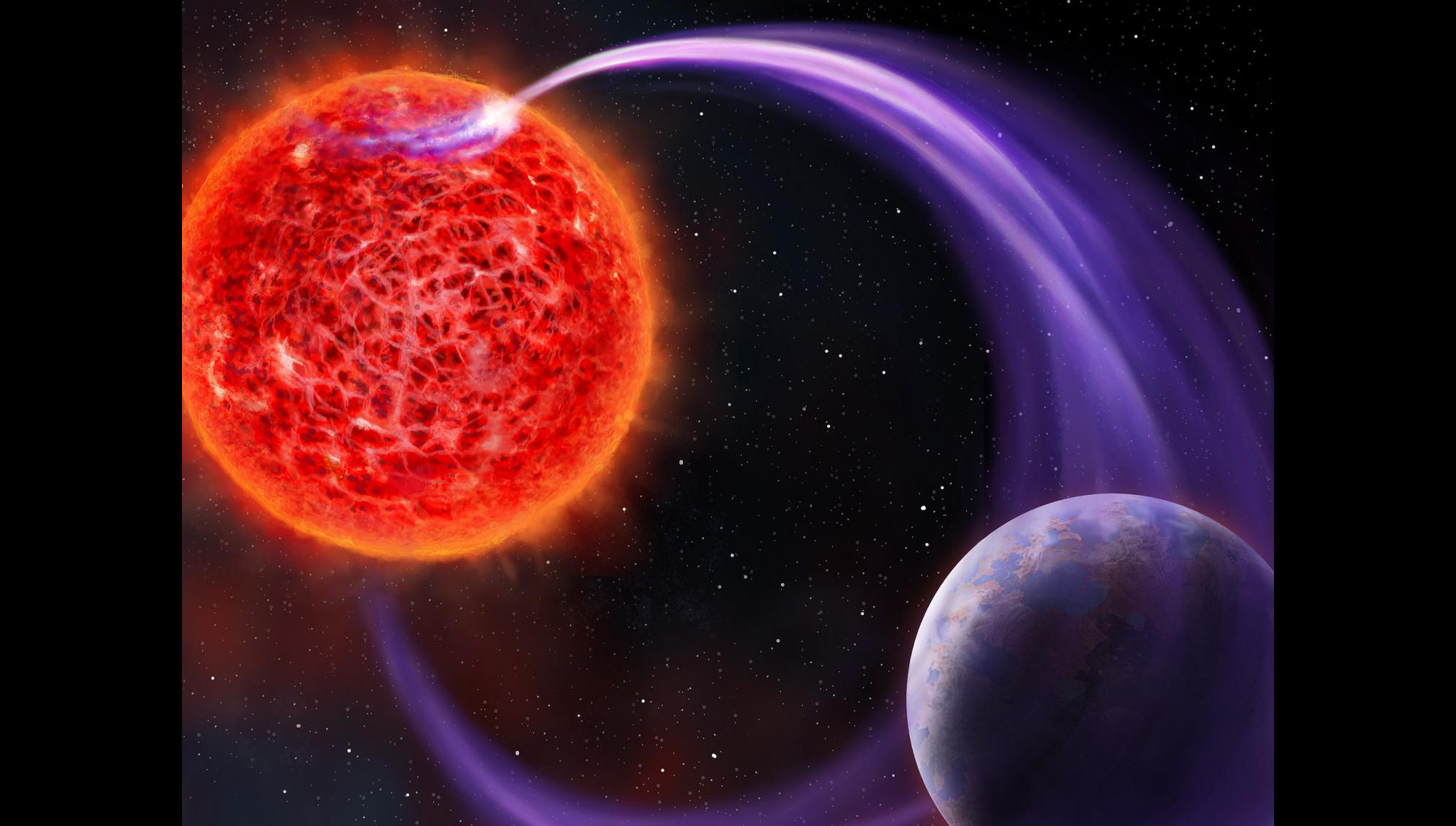
A team of astronomers has just announced they may have found a planet orbiting the red dwarf star GJ 1151, but the technique is entirely novel: The planet is interacting with the star magnetically, creating an aurora not on the planet but on the star itself!
This happens on other planets too, but in different ways as well. For example, Jupiter has an aurora caused by its moon Io. The moon is volcanic, sending sulfur atoms up off the surface. As Jupiter spins, its strong magnetic field strips those atoms away, and they get trapped in the planet's magnetic field and fall down to Jupiter's poles. As they do, they spiral around the magnetic field lines, emitting radio waves (called synchrotron emission). The radio emission we see from Jupiter strengthens when Jupiter and Io align in a certain way with respect to us observing from Earth, so we see radio emission going up and down, with its strength tied to Io's orbit.
This light is very faint, though, so what the astronomers did was clever: Using the Gaia database, they cross-checked a radio wave all-sky survey recently done by the Low Frequency Array (or LOFAR) against the locations of stars known to be within 65 light years of the Sun. This radio aurora glow is relatively weak, so they constrained their efforts to nearby stars to maximize their chance of seeing it.
They found quite a few matches, most of which were red dwarf stars, dim bulbs that are faint and cool. The first viable target they got was the red dwarf GJ 1151, which is a mere 26 light years from Earth. It has a mass 1/6th the Sun's, and a diameter 1/5th of the Sun, so it's indeed pretty dinky.
Then things got interesting. The star was observed by LOFAR four times, and only once was it seen emitting radio waves out of those observations. Many red dwarfs are very magnetically active, blasting out stellar storms (like flares and such), but as it happens GJ 1151 is quiescent. In other words, it doesn't do that. Not only that, but the polarization of the radio waves is exactly what you'd expect from an aurora.
LOFAR observations of the star GJ 1151 show that sometimes it emits low-frequency radio waves (left) and sometimes it doesn’t (right). This may indicate auroral activity generated by an orbiting planet. Credit: Vedantham et al.
If this is the case, then the best fit to their data is a planet orbiting the star, interacting with the star's magnetic field. Perhaps the planet is volcanic, or has an atmosphere that's getting stripped by the star. But one way or another, atoms are "leaking" into space, following the star's magnetic field lines, and emitting polarized radio waves as they slam into the gas above the star's surface, creating an aurora there.
The reason it appears in one observation but not the other three makes sense if that's the case, too, because the planet and star have to be aligned just the right way with respect to Earth for us to see these waves. Again, if this is true, the planet would have to have an orbit of 1–5 days to match the observations.
As it happens, GJ 1511 is a target of planet hunters already, and (very) recently announced observations show that no planet is detected there of more than 5.6 times the mass of the Earth. All that means is that no gas giants orbit the star, but there's lots of wiggle room for smaller ones. And in fact we know that red dwarfs tend to make smaller planets more readily than big ones… and many such systems have their planets all huddled close to the star, so a 1–5 day orbit is no problem.
Hopefully, even more follow-up observations of this star will reveal the existence of this planet (or these planets). If confirmed, this would be a brand new way to find planets around nearby stars: by their aurorae.
Incidentally, this method might work for brown dwarfs, too; objects intermediate in mass between planets and stars. In 2018 one was found that appeared to have an aurora, and while it's hard to know for sure it may be low mass enough to be considered a rogue planet, a planet without a star. A massive one for sure, more massive than Jupiter! But still, the auroral emission may indicate it has a moon orbiting it, and it's creating an aurora like Io does with Jupiter. So not only is this a good way to find exoplanets, it might even help us find exomoons.
In the early 1990s we didn't know if other planets even existed. Now we know of thousands, and there are more than a dozen methods used to find them. It's funny what you can do once you know it's actually possible.
We're starting to see a fair number of DDR4 memory options on the market, but DDR3 is still, by far, the go-to RAM. DDR4 is currently limited to Intel's X99 platform and Extreme processors, which are more expensive, and not much better for gaming, than the Core i5s and i7s we're accustomed to. DDR4 is still much more expensive than DDR3, but it also hits higher clock speeds. The question, then: how different is DDR4 from its predecessor, exactly? The folks over at AnandTech have gone to great lengths to answer that.
First off, DDR4 operates at a lower voltage than DDR3. DDR4 runs at 1.2 volts, down from 1.5. It doesn't sound like much, and it's really not for your typical home PC. Most Haswell-E desktop systems (where you'll most often see DDR4 in use) will operate somewhere in the 300W to 1200W range. The voltage difference for those numbers might account for a 15W savings over DDR3—not a lot for a home user. But for server farms and other large-scale computer architectures, where you could have hundreds of systems running thousands of DDR4 modules, that 15W difference adds up.
Another big difference between DDR3 and DDR4 is speed. DDR3 specifications started at 800 MT/s (or Millions of Transfers per second) and some went as high as 2133. DDR4, meanwhile, starts at 2133 MHz. The increased speed means an overall increase in bandwidth.
This unfortunately comes with an increase in latency as well, but the increased clock speed makes for quicker transfers while maintaining an overall latency comparable to DDR2 and DDR3. DDR3-1600 operated at a latency of CL11, which took 13.75 nanoseconds to initiate a read. DDR4-2133 sits at CL15 and performed a read at 14.06 nanoseconds—only a 2% increase.
So how does this translate to real-world performance? Should we all be eager for Intel's next chipset to move us all to DDR4? Well, not really. As Anandtech found in some comprehensive benchmarks comparing DDR3 and DDR4, neither was a clear performance leader. The difference between DDR3-2133 and DDR4-2133 was negligible in a number of applications, ranging from Handbrake video conversion to half a dozen different games. DDR3 was slightly faster about half the time, and typically only a few percentages points separated the two memory types.
The AnandTech article goes into significantly greater detail about the differences between the two memory standards. Check it out for more info.
Technology is changing, and more and more people are communicating with emoticons. Anthony reports on an interesting new study that shows how we're starting to perceive emoticons as real facial expressions.
If I’ve learned anything from prison dramas, it’s that sometimes a stern talking to just doesn’t do the trick. You also need plenty of hard-work, a commitment to understand your prisoners, and a rousing and inspirational third-act speech, in which you learn that, actually, it was them teaching you all along. Alternatively, you need guns. For Prison Architect’s seventeenth alpha update, Introversion have gone for the second option.
Armed guards will intimidate prisoners by increasing their “Supression” rating, and making them more compliant. The downside is that, to hire them, you’ll need to build an Armoury, which will be an instant target for violent prisoners should a riot break out. In future, when reform systems are in place, suppressed prisoners will be less susceptible to education programs and rehabilitation, but for now, you’re free to fill your jail with more guns than a Battlefield weapons crate.
Also in the update: trees! A new Forestry tile will automate the woodcutting industry introduced in the last update. You can read about all of the alpha 17 changes over at the Introversion forum.