Mattalyst
Shared posts


20 Oct 16:05


mindblowingscience: This Truculent Duck Evolved The Bodily...
This Truculent Duck Evolved The Bodily Equivalent Of Brass Knuckles
Everyone, meet the steamer duck. The steamer duck is one bad mother. See those orange nubbins on its wings? Those are keratinized spurs, which the steamer duck has evolved to wallop the living cuss out of any creature hapless enough to cross its path. (See that red stuff on the duck’s head? Yeah. That’s blood.)
Photos featured by kind permission of Arthur Grosset. See more of his photography here
Over at Absurd Creature of the Week, Matt Simon recounts a disturbing instance of duck-on-duck violence, involving a pugnacious male steamer duck, an unfortunate shoveler duck, and an onlooking female steamer:
From time to time the steamer would drag the shoveler under, then resurface and continue beating the tar out of it as the female watched. At one point he shuffled over to her, but after 30 seconds returned to his victim and punched the poor critter 15 to 20 more times. “He then released the limp body of the shoveler,” wrote Nuechterlein, “pecked at it, and released it again.” At last he returned to the female for good, calling to her while she stretched, and the two flew off together. The shoveler eventually regained consciousness, and though seriously crippled, struggled to shore. It died 15 minutes later.
This is the avian version of Bloodsport, only without all of the terrible yet somehow endearing acting. The four species of steamer duck (so named for their penchant for flapping and running along the surface, kicking up water like steamboats) in South America are famous—at least in ornithological circles—for their brutality, getting all up in the grills of not just other steamers, but also other species in scrums lasting as long as 20 minutes.
Why the ducks are so aggressive is unclear, but one hypothesis is that steamers have evolved to be violent not only to chase off threats and competition, but to make an example of them:
Says Nuechterlein in the paper describing the fight between the steamer and the shoveler: “Possibly observational learning is important, and holding a ‘public beating’ enhances the effectiveness of territorial displays.” And that, my friends, may be the only time “public beating” has ever appeared in a scientific paper.






19 Oct 23:21



poignantperfume: icalledyoudumb: myideaoffuniskillingeveryone: ...
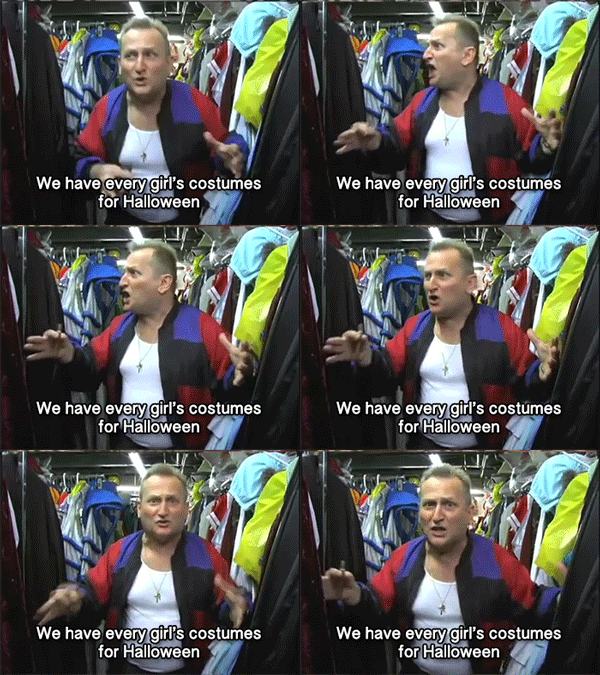
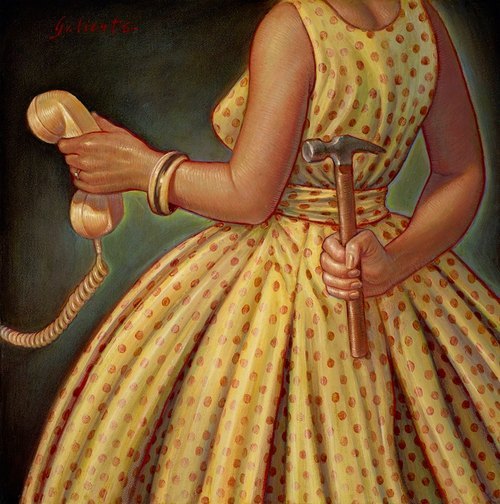
Danny Galieote
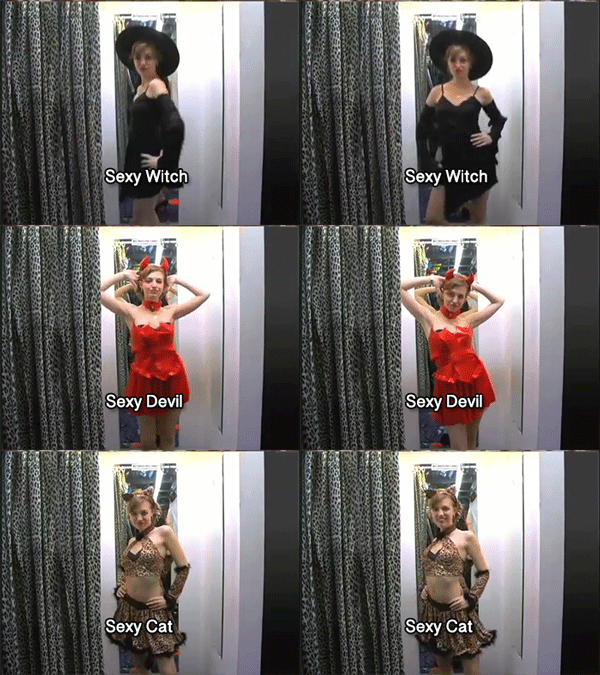
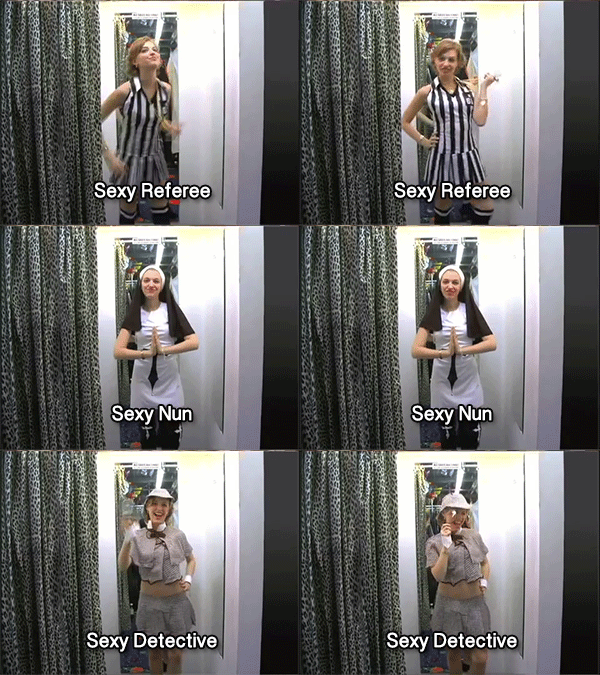
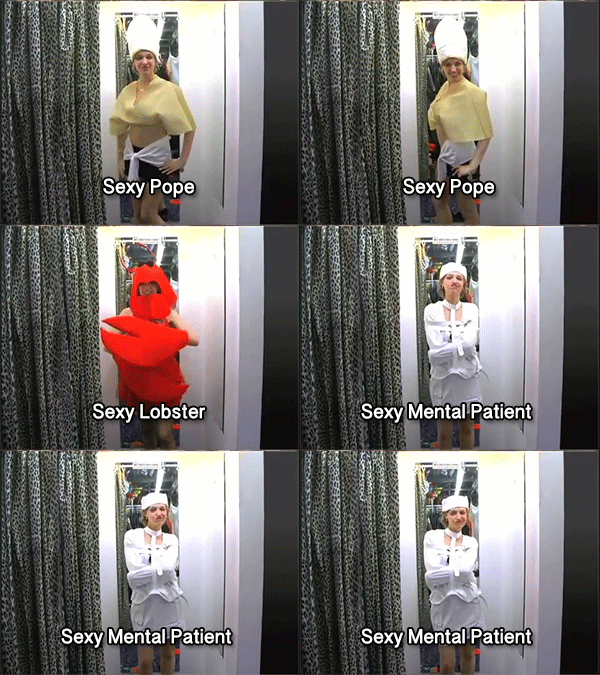
I would frame and hang these in my house in a heartbeat.
YES
19 Oct 23:10


tentakrule: sixpenceee: Metalosis Maligna is a fake disease...
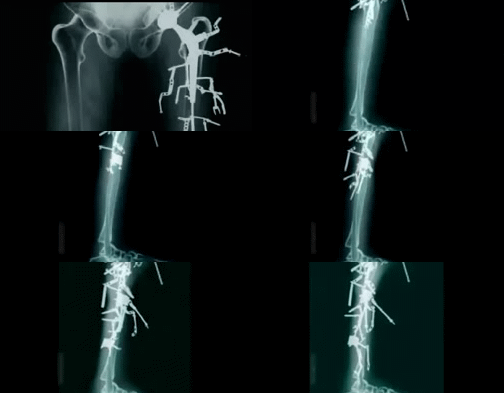
Metalosis Maligna is a fake disease invented by award-winning Dutch filmmaker Floris Kaayk.
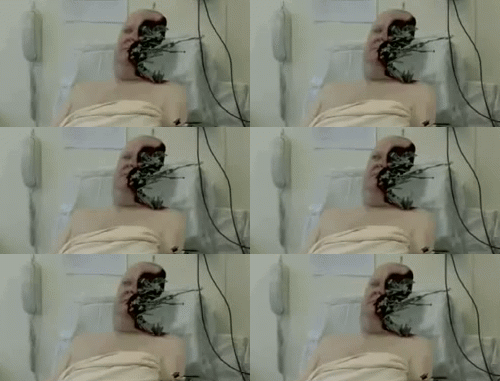
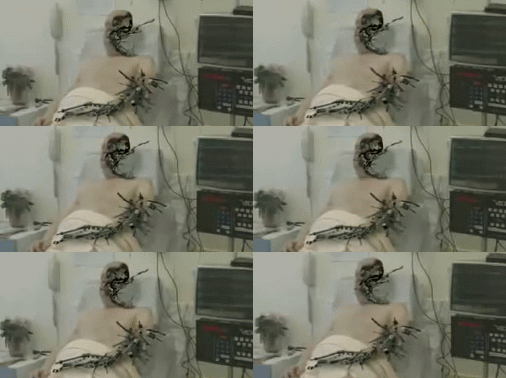
According to the mockumentary, Metalosis Maligna occurs when a metal implant has a bad interaction with human body tissues, causing the metal to grow tendrils that eventually puncture the skin from within and destroy it.
I was skimming through the video at first not knowing it was a mockumentary and landed on the part of the man in bed. I nearly died.
Here’s an alternative link to watch it on vimeo, in higher resolution, from the creator’s channel.

19 Oct 22:53


Scientist Has Chill Run-in With Puppy-Sized Spider
by Brad Friedman
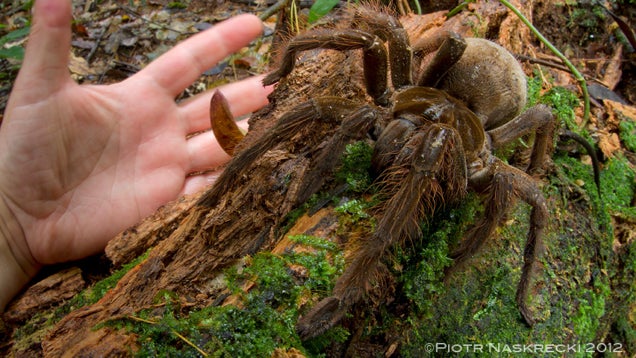
Our eventual cession of global dominance to giant spiders came one step closer this month when a scientist detailed his encounter with a spider that weighs roughly as much as a puppy. The South American Goliath birdeater (real name!) has a footlong legspan and two-inch fangs. Its body is about the size of a fist and it is the largest spider in the world—that we know of.
19 Oct 22:43
Fantasia 2014:'Bag Boy Lover Boy' is teeming with youthful energy - Sound On Sight
MattalystSo when the lights came up in the theater last night after the end of this, I was close enough to be able to hear one of the dudes who organized the screening mutter, "what the FUCK did I just watch." I loved it, and I picked this review to share because it tells you almost nothing about the plot. Don't watch the trailer.
 Bag Boy Lover Boy
Written by Toni Comas and Andres Torres
Directed by Andres Torres
USA, 2014
Made in the tradition of the New York underground, Bag Boy Lover Boy is a portrait of contemporary frustration. Albert is a pitiful hot dog vendor who soon finds himself intertwined in the bizarre world of fetish photography. Albert’s aspirations are centered on his desire to win the affections of a frequent customer at his stall, and her apparent love for art. Raw, funny and twisted, the film rips through the perceived comfort of modern living by putting focus on one of society’s outcasts. Albert is not just a sad sack, he’s more than a little slow and more than a little different.
Albert’s trajectory over the course of the film is what really sells it. Brought to life by Swedish amateur actor Jon Wachter, there is an uncomfortable naturalism and otherness in what he brings to the screen. The performance transcends caricature in a film brimming with exaggerated and surreal characters, hitting a point of such discomfort that audiences are left wondering at what point Jon ends and Albert begins — an uncomfortable allusion that further adds to the film’s messy and angst-ridden attack on the exploitative environment of New York City.
Perhaps the greatest struggle that Albert faces is a failure to communicate. The film itself is filled with characters who fail to speak clearly, and are either the manipulated or the manipulators. Language becomes an integral force, and art becomes the facilitator and the burden of the voiceless. As Albert comes to see himself more and more as an artist, his behavior and language transform, as he adopts the violent and hateful vernacular of his mentor Ivan. Yet, he is never truly an artist; at best he is the circus freak muse of a corpulent capital-driven monster. Albert’s role as model or muse is integral, adding yet another layer of the cannibalistic, exploitative nature of the modern art world. Albert is being used but he is not fully able to appreciate why or how, only that the promise that he will learn about art is not being fulfilled and he is forced to find his own artistic voice, which is ironically just a very twisted rip-off of Ivan’s.
The lack of voice takes on other resonances, in particular through fantasy and dream sequences that the film employs. Beautifully integrated, these moments suggest an impulse towards expression that Albert lacks. Some sequences are more obviously staged about actual dreams and desires, such as a brief seduction scene, whereas others transcend literal meaning and reach into darker and deeper crevices of the mind. One particular sequence, shot in black and white, harkens back to scenes from Fellini but also early Scorsese films like Who’s that Knocking at My Door? (1967).We are given a look into the interior world of characters who struggle with expression, whose words fail them, and we see the humanity that lies within them. The integrity of symbolism and metaphor, though arguably lost on Albert, becomes part of the natural tapestry of the human mind. This is only further emphasized through a very playful score, that adds a buoyant sense of comedy and absurdity to the action. Limiting our understanding of living to the exterior world is one that betrays our shared interiority and only further fuels alienation.
In the post-film Q&A, director Andres Torres described the emotion that inspired the film: “You feel angry and you have no one to  shout at”. This energy, for better or for worse, fuels the film. The entire atmosphere of Bag Boy Lover Boy is caustic and confrontational, almost to the point of being hateful. It is appropriate, however, that a film about alienation be somewhat alienating. While much of this misanthropic energy is reeled in through the use of humour, just enough remains to put the audience in a place of unease. The film does not allow for too much comfort in the audience and continually destabilizes our expectations and desires for the narrative and the characters.
Bag Boy Lover Boy is a film teeming with youthful energy. It is almost exploding off the screen with neon lights and colourful gels, embodying a refreshingly vibrant metropolitan world. The film has an incredible energy of chaos, a feeling of helplessness, and a desire to be heard. Stifled and exploited, the protagonist finds his voice through violence only because he has no other means of expression. The sound design is enveloping and the editing sharp and clever. Bag Boy Lover Boy is not necessarily easy for all audiences, but it is also a film that does not permit passive engagement. In a world where everyone is trying to get noticed and be heard, this film succeeds to make a mark.
– Justine Smith
Please visit the official website of the Fantasia International Film Festival.
bag boy lover boy, Fantasia 2014, Fantasia Film Festival, Fantasia Film Festival 2014, New York City, transgression, Underground
19 Oct 07:49


jamesfactscalvin: magieundfreiheit: micdotcom: Alarming...
Alarming Whispers reveal the ridiculous sex ed lessons schools give teens
Follow micdotcom
WHEN WE WERE LITTLE SOME TEACHER TOLD US, THE GIRLS, THAT WE WERE LIKE FLOWERS, AND EVERY MAN WE HAD TOOK A PETAL WITH THEM. IF WE HAD TOO MANY WE WOULD END UP LIKE AN UGLY, WITHERED FLOWER AND NO ONE WOULD WANT US
Oh my God, these people are horrible!

19 Oct 07:13
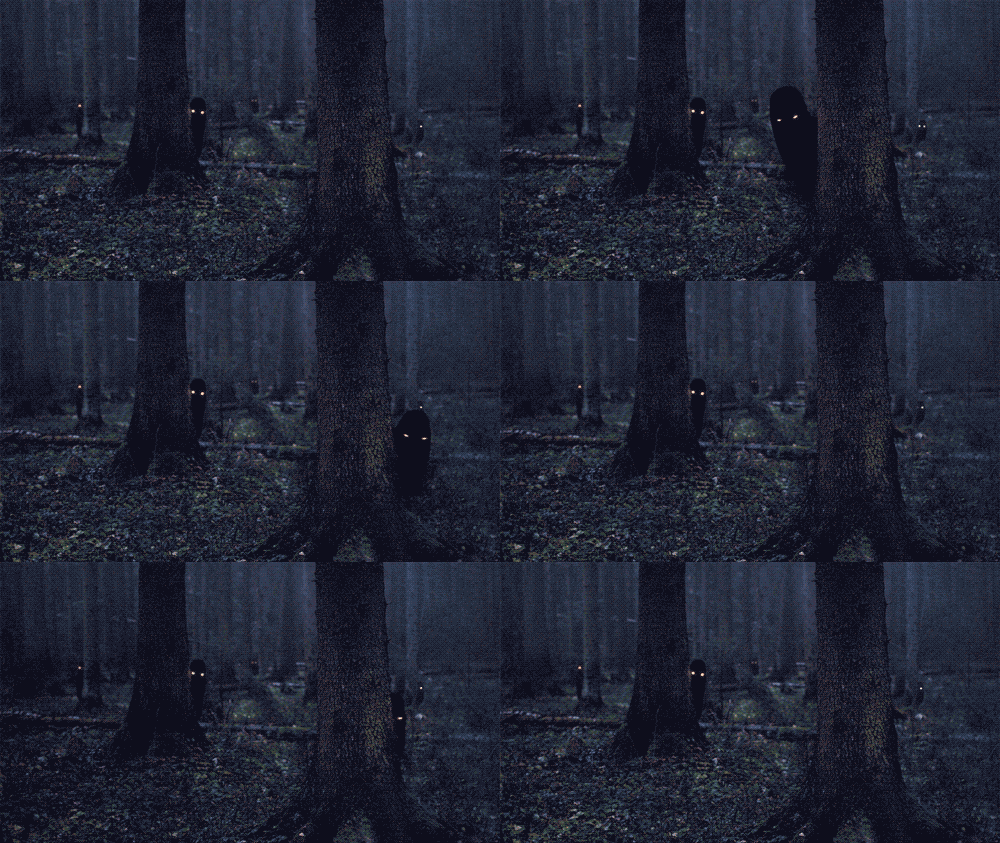
fezwhatfez: thequietpagan: bywandandsword: Fucking shit This...
Fucking shit
This is simultaneously cool-looking and absolutely terrifying.
i was like, ohhhh what adorable little - AHHHHHH NO



18 Oct 01:41

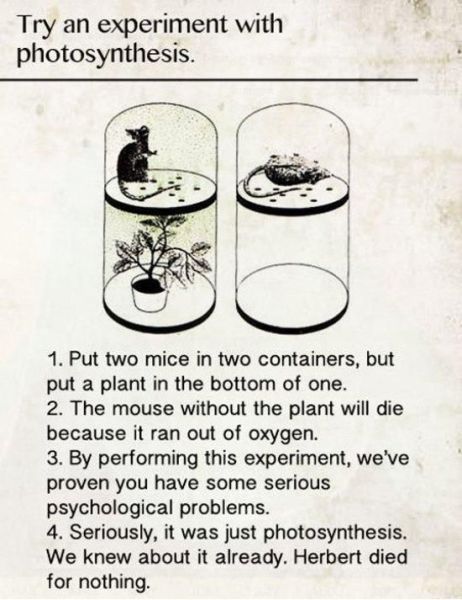
PrettyEyz31 / 33 / F / Murphysboro, Illinois
MattalystSo, periodically I try to find the absolute worst match I can for myself on OKC...
What I’m doing with my life
Don’t overthink this one; tell us what you’re doing day-to-day.
I currently work full time in administration/retail. I work full time and I enjoy my job and love the people I work with. When Im not working Im usually chilling@ home with my family. I have an amazing family and Im blessed to have such a wonderful relationship with my brother and sisters the way I do .. My family means EVERYTHING to me!! I have 7 adorable nieces & 3 lil nephews that I absolutely adore and Love with my whole heart!! Im always spending time with them and we have fun no matter what we do .. its all about making memories with them because they grow up so fast..
I’m really good at
Go on, brag a little (or a lot). We won’t judge.
Hmmmm is this a trick question? Lol!! I LOVE cooking and I usually cook most of our family meals. Cooking is my passion and I probably should go to culinary school but I dont believe thats what I wanna do. I don't mind cooking for my family and friends actually I love it but I just couldn't see myself doing that in a restaurant lol!! My family tells me that Im a very well organized gal. Ive been told many times that I should go to school for interior design because Im constantly re arranging the rooms in the house .. constantly organizing and keeping things neat and tidy. Everyone also tells me that Im fantastic with kids.. I have alot of patience and I spend Quality Time with each one... I cant wait to have my own precious little angels someday :) I love to sing too and have been told that I should do something with my voice... ahhh maybe someday :) I sang "Strawberry Wine "karoke@ Oklahoma State Fair and I received a standing ovation it was amazing ;)))
The first things people usually notice about me
I’m an empty essay… fill me out!
My eyes and hair.. I have an awesome personality too so that always helps :)
Favorite books, movies, shows, music, and food
Help your potential matches find common interests.
Twilight Series Love it!! TV shows - The Voice, X-Factor , American Idol, NCIS, CSI all of them, Hawiaa Five O , The Mentalist, etc..... I love my music mostly country and rock. Some of my favorites are Three days grace, Shinedown, Hinder, 3 Doors Down, Breaking Benjamin, Crossfade , Alter Bridge, Craig Morgan, Luke Bryant, The Band Perry, Sugarland, Sara Evans, Mariah Carey, Carrie Underwood, Chris Daughtry .. so many more just ask me :)
The six things I could never do without
Think outside the box. Sometimes the little things can say a lot.
God - Hes the reason for my existence! My amazing family because I would be lost with out them! My awesome friends :) it would be a boring dreadful place without them! .. Ok now I have to be honest on this one and it would be my cell phone, my gum, mascara n lipgloss ... just being honest :))
I spend a lot of time thinking about
Global warming, lunch, or your next vacation… it’s all fair game.
How I wish I could turn back time.. It would be so awesome if that was possible so I could" undo" certain things.. Most of the time I spend alot of time thinking how nice it would be to just be happily married with children :)
On a typical Friday night I am
Netflix and takeout, or getting your party on — how do you let loose?
Either chilling@ home with my family watching a movie or Im out n bout hanging out with friends!
The most private thing I’m willing to admit
I’m an empty essay… fill me out!
Umm cant think of anything at the moment!
You should message me if
Offer a few tips to help matches win you over.
My profile caught your eye and you would like to get to know me better. I have alot to offer to the "right" man! Its taken me awhile to realize that but, I have. I refuse to settle for anything less than everything!
18 Oct 01:26
boosmygod: shamblingshitpickle: shakypigment: Viktor...
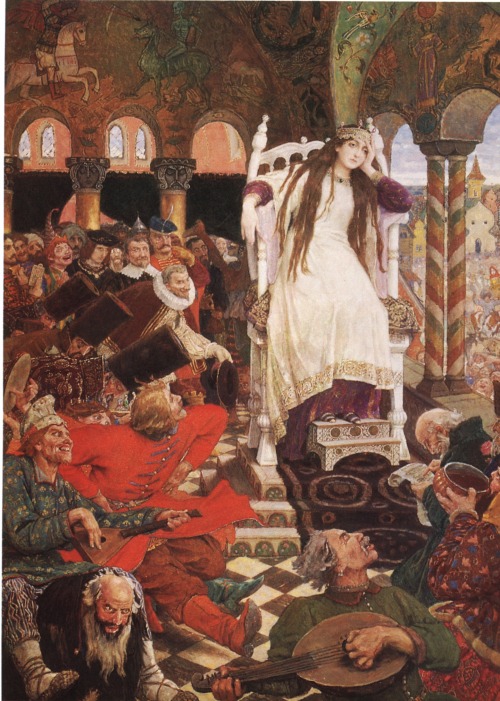
Viktor Vasnetsov - The princess who never smiled
and why would she
look at all this bullshit she’s putting up withwho painted this picture of me

17 Oct 20:27



Mysterious campaign appears to be latest salvo in net neutrality battle [Updated]
by Ars Staff
Mattalyst"Sorry we can't come to the phone right now," the call-in greeting says. "We just got wind of the juiciest celebrity rumor and we're working to confirm it. So please leave your suggestion for the future of the Internet at the beep and visit Onward Internet dot com next month to see what we've done with it."
Telecom lobbyists: just like you, they understand that only old nerds watch the news!
This piece originally appeared in Pro Publica.
This story has been updated to include a comment from the National Cable and Telecommunications Association.
On a recent Monday evening, two bearded young men in skinny jeans came to a parklet in San Francisco's trendy Hayes Valley neighborhood and mounted what looked like an art installation. It was a bright blue, oversized "suggestion box" for the Internet.
Read 30 remaining paragraphs | Comments


17 Oct 17:23
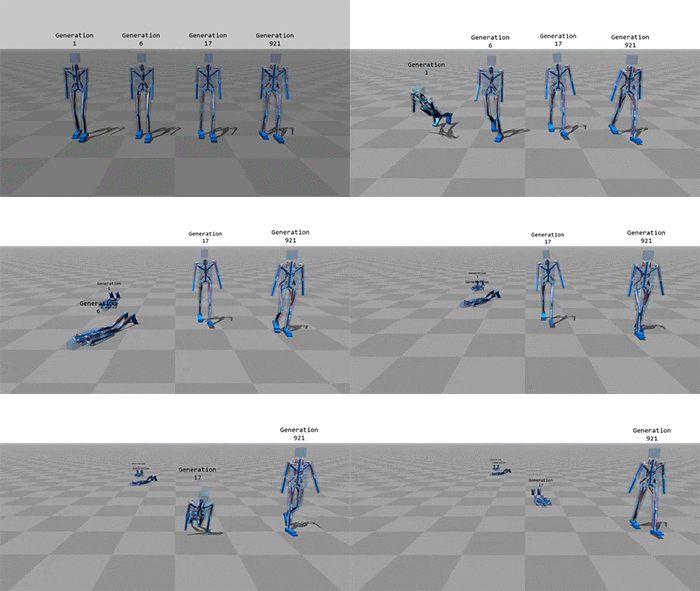
Gamergate's heroes disappoint it
by Rob Beschizza
Andy Baio covers Gamergate's bewilderment and frustration as gamer heroes "disappear one by one into their blacklists." You'd think it might cause a little self-reflection, but that's not how the mob mind works.

17 Oct 14:46


staceythinx: Breaking Wave is a kinetic sculpture designed...
MattalystLocal corporate headquarters envy.
Breaking Wave is a kinetic sculpture designed by Plebian Design and Hypersonic for the biotechnology company Biogen-Idec’s new headquarters in Cambridge, MA.
About the project:
Breaking Wave tells the story of the search for patterns, and the surprising results that come by changing our point of view. 804 suspended spheres move in a wave-like formation. When the wave crests and breaks, the balls hover momentarily in a cloud. From almost anywhere in the room, this cloud is purely chaotic, but step into one of two hidden spots, and this apparent chaos shows a hidden pattern. From the first, a labyrinth hints at the search for knowledge, and from the second, a Fibonacci spiral inspired flower reminds us of the natural order and patterns found in nature.
Scientists search through billions of experimental data points in order to find patterns to develop new drugs, to treat Multiple Sclerosis, Cancer, and other diseases. Without a particular framework or perspective, these are just 0’s and 1’s, with no form or information. But with the perspective of an understanding of molecular dynamics, these data points create a clear picture about the hidden dynamics within the body, and allow scientists to craft drugs to successfully treat these diseases.
Above the sculpture lies the mechanism that drives its motion. A motor drives a large rotating stainless steel cam. 36 rollers follow the contour of the cam, which traces out the overall waveform. Each roller slides on a linear track, pulling a cable that spins one of the 36 output shafts. Distributed along each shaft are different sized drums from which the wooden sphere (coated in zinc and steel, and then rusted chemically) are hung. As the shafts rotate, the drums pull the balls up and down – larger drums pull balls higher. In this way, the size of the 804 drums mechanically programs the images hidden in the cloud of balls.
See it in motion in this video:
Breaking Wave from PLEBIAN DESIGN on Vimeo.
17 Oct 01:03

What research says about cats: they're selfish, unfeeling, environmentally harmful creatures
by Joseph Stromberg
MattalystSo basically all the same reasons I prefer them, is what they're saying.
For years, dog and cat owners have been bickering over the relative merits of each type of pet.
But in recent years, scientific researchers have started to weigh in — and most of their findings so far come down firmly on the side of dogs.
cats don't have the same sort of emotional attachment to their owners
Compared to dogs, scientists have found, cats don't seem to have the same sort of emotional attachment to their owners, and show genuine affection far less often than you might think. Further, they're an environmental disaster, killing literally billions of birds in the US every year — many of them from endangered species.
Most alarmingly (and as explained in this 2012 Atlantic article), there's compelling evidence that a parasite often found in cat feces can subtly change people's personalities over time, increasing rates of neuroticism, schizophrenia, and perhaps even suicide.
In other words, research is telling us that cats are selfish, unfeeling, environmentally devastating creatures. If you need to convince someone not to get a cat, here's the research you need to show them.
Your cat probably doesn't love you

Daniel Mills, a veterinary researcher at the UK's University of Lincoln, is a cat lover. You can see his cat in the photo on his faculty page on the university's website. But experiments he and colleagues have conducted at the university's Animal Behaviour Clinic suggest that cats, as a whole, do not love their owners back — at least not in the same way that dogs do.
The researchers adapted a classic child psychology experiment called "the strange situation," in which a parent slips out of a room while a baby or young child is playing and then later returns. The child's behavior upon being abandoned and reunited with the parent is observed and analyzed. This sort of thing has been also done with dogs several times (including by Mills), and the experiments have found that dogs demonstrate an attachment with their owner — compared to a stranger, the dogs become more disturbed when their owners leave, and interact with them more when they return.
By contrast, Mills' cat experiments — which are still ongoing and haven't yet been published, but were featured in a BBC special last year — haven't come to the same conclusion. On the whole, the cats seem disinterested both when their owners depart and return. "Owners invest a lot emotionally in the cat relationship," Mills told the BBC. "That doesn’t mean that the cat’s investing in the same sort of emotional relationship." At the time, he said the results were inconclusive, but at the very least, it's safe to say that they haven't yielded the same obvious results that the dog studies have.

Cats, aloof as ever. (Tom Wicker)
Meanwhile, other experiments carried out by a pair of Japanese researchers have provided evidence for a fact already known to most cat owners: they can hear you calling their name, but just don't really care. As detailed in a study published last year, the researchers gathered 20 cats (one at a time) and played them recordings of three different people calling their name — two strangers, plus their owners.
Regardless of the order, the cats consistently reacted differently upon hearing their owner's voice (in terms of ear and head movement, as graded by independent raters who didn't know which voice belonged to the owner). However, none of them meowed or actually approached the speaker, as though they'd be interested in seeing the person.
Why are cats so different from dogs in this way? The researchers speculate that the difference can be explained by evolutionary history: dogs were domesticated an estimated 15,000 years ago, compared to just 9,500 years for cats. Additionally, it's believed that dogs were actively selected by humans (to guard and herd animals), whereas cats likely selected themselves, spending time near people simply to eat the rats consuming grain stores. This difference — along with the extra evolutionary time — could explain why dogs are so much more interested in responding to the human voice.
Your cat isn't really showing you affection

A cat feigns affection to mark its territory. (Erik Tjallinks)
Cat lovers will probably respond here that their pets do show affection, purring and rubbing up against their legs. But there's good reason to believe that, much of the time, these sorts of behaviors that look like affection are conducted with entirely different goals in mind.
Many cats, for instance, will rub up against the leg of their owner (or another human) when the person enters a room. It's easy to construe this as a sign of affection. But many researchers interpret this as an attempt, by the cat, to spread his or her scent — as a way to mark territory. Observations of semi-feral cats show that they commonly rub up against trees or other objects in the exact same way, which allows them to deposit pheromone-containing secretions that naturally come out of their skin.
semi-feral cats commonly rub up against trees and other objects to mark territory
Purring, in some cases, also seems to mean something different than what you imagine. As part of 2009 study, researchers at the University of Sussex recorded the purring sounds made by 10 different cats in two types of situations: when they wanted food, and when they didn't.
As it turned out, the food-related purrs were noticeably different: the otherwise low-toned noises had a spike in the 220 to 520-hertz frequency, which is similar to a baby's cry. Human study participants also rated these purrs as more urgent and less pleasant.
What may be going on, the researchers concluded, is that cats have figured out how to purr in a way that triggers humans' parenting instincts. They don't always purr this way, but they do so when they want food, because they know it'll get results.
Finally, there's some evidence, turned up by Mills, that many cats don't actually like being petted by humans at all. In a 2013 study, he and other researchers measured levels of stress hormones in cats, with the intention of figuring out whether having multiple cats in the same household is a bad idea. That didn't turn out to be true, but they did find that the cats who allowed themselves to be petted had higher stress levels afterward than the cats who disliked it so much that they simply ran away.
Cats are an environmental disaster

An invasive cat destroys its local environment. (Etienne Valois)
In the US, domestic cats are an invasive species — they originated in Asia. And research shows that, whenever they're let outside, cats' carnivorous activity has a devastating effect on wild bird and small mammal populations, even if the cats are well-fed.
Of course, dogs are likely a net negative for the environment too. There isn't as much data available, but researchers note that dogs spread diseases (such as rabies) and also prey on various species, including many types of birds, as well.
cats kill somewhere between 1.4 and 3.7 billion birds annually in the us
But in terms of raw numbers, it seems unlikely they can match the impact of cats. A study published last year found that cats kill far higher numbers of songbirds and mammals than previously thought: somewhere between 1.4 and 3.7 billion birds, and 6.9 and 20.7 billion mammals annually. Many of the mammals might be mice and rats (species that have no problem sustaining their numbers), but the prey also includes many endangered bird species.
This isn't just a symbolic problem — it's a truly significant one. The best data we have on birds killed by other sorts of threats, from the Fish and Wildlife Service, isn't great (it's a little old, and the estimates are rough), but a comparison indicates that cats kill as many birds as collisions with buildings, and kill more birds than collisions with cell phone towers, power lines, cars, and wind turbines combined.
Cat owners can do a few simple things to easily cut down on this threat. Research indicates that leaving cats inside at night, or tying a bell around their neck (so prey hear them coming) means they kill significantly fewer birds and mammals. But right now, few cat owners do this, whether because they want their pets to get the pleasure of killing, or out of sheer laziness.
Your cat might be driving you crazy

A cyst filled with Toxoplasma gondii parasites, as seen in a mouse brain. (Jitinder P. Dubey)

Finally, there's the weird, unsettling connection between cats, a parasite called Toxoplasma gondii, and litter boxes.
This parasite can infect pretty much any sort of animal — including humans — but it can only sexually reproduce when inside the intestines of cats. In order to get there, it's been found to alter the behavior of infected rodents, making them less fearful of predators. In other words, when T. gondii gets picked up by a mouse, it increases the chance that the mouse will get eaten by a cat, so the parasite can reproduce once again.
This may seem bizarre enough, but over the past few years, some scientists have begun to suspect that the parasites alter human behavior in a similar way. Humans often pick up T. gondii from handling cats' litter boxes (because the parasites can be found in their feces), and there's an increasing amount of evidence that the resulting long-term, latent infection can subtly change a person's personality over time.
When parasites found in cat litter infect humans, they seem to subtly change personality over time
Of course, we're not rodents, so the parasites aren't successful in getting us eaten by cats. But the actual consequences are just as troubling. People who have been infected have greater rates of neuroticism and schizophrenia, and have slower reflex times in lab experiments. As a result, it seems, they get into traffic accidents more often. There's evidence that they have higher rates of suicide. All this, it seems, are unintended results of the parasite's ability to alter a mouse's brain to increase the chance of predation.
Now, everyone who owns a cat doesn't get infected by T. gondii, and there are other ways of getting the parasite (like eating undercooked meat). And the infection itself doesn't seem to cause these behavioral changes in everyone — they just occur at slightly higher rates among the millions of people worldwide who are infected.
Still, if you needed one more reason not to house an animal that doesn't love you, manipulates your emotions to get food, and helps to eradicate endangered species, it's a pretty damn good one.
Further reading: Kathleen McAuliffe's eye-opening article in the Atlantic: How Your Cat Is Making You Crazy
Burly.Thurr likes this
16 Oct 23:14
First Demonstration Of Artificial Intelligence On A Quantum Computer
MattalystNo, not really. But the experiment is still an interesting waypoint.
How do you demonstrate machine learning on a quantum computer? Teach it to recognize a 69 or course.
To keep the experiment simple, the team trained their machine to recognize the difference between a handwritten 6 and a handwritten 9. The vectors representing 6s and 9s can then be compared in this feature space to work out how best to distinguish between them. In effect, the computer finds a hyperplane in the feature space that separates the vectors representing 6s from those representing 9s.
Comments
16 Oct 22:52
I Went to a Nu-Kawaii Cosplay Rave in Brooklyn
by Michelle Lhooq
MattalystWell of course you did.
I Went to a Nu-Kawaii Cosplay Rave in Brooklyn
Chelsea likes this
16 Oct 20:18


Cop Blames Media Coverage for Distrust of Cops
by Ed Krayewski
MattalystLet's spare a thought for the real victims here.
 The Daily Caller
has a column by a cop writing under the name “Deputy Matt” who
complains about how much harder his job has become since Ferguson,
Missouri, became a national news story. The cop begins by telling a
story about responding to a call about a belligerent teenage son in
a “fairly nice complex” where they were “able to calm him and get
him into handcuffs without any blows being thrown” but not before
the teen refused to follow their orders. According to the cop, the
teen, who he described as half-white and half-Hispanic, said he
wouldn’t listen to the cops because he didn’t trust them because of
“Ferguson.” The cop says the parents apologized “profusely” for
their son’s comment.
The Daily Caller
has a column by a cop writing under the name “Deputy Matt” who
complains about how much harder his job has become since Ferguson,
Missouri, became a national news story. The cop begins by telling a
story about responding to a call about a belligerent teenage son in
a “fairly nice complex” where they were “able to calm him and get
him into handcuffs without any blows being thrown” but not before
the teen refused to follow their orders. According to the cop, the
teen, who he described as half-white and half-Hispanic, said he
wouldn’t listen to the cops because he didn’t trust them because of
“Ferguson.” The cop says the parents apologized “profusely” for
their son’s comment.
Deputy Matt says he works 1,700 miles from Ferguson but that it’s become the “latest defense for committing crime,” presumably by people who would be committing crimes anyway, but that this time:
The same people who we used to count on for support, the good, law abiding general public, are now reluctant to trust us.
We, the local cops they have seen and contacted in the past, have not changed. We have done nothing different.
What has changed is the public’s perception of us, created by the reckless reporting by nearly every news outlet very early after the shooting of Michael Brown. The rush to be first with the story over the desire to be correct is having dire consequences nationwide, and quite honestly, has made my job more difficult and more dangerous.
Were Michael Brown the only person police shot since August, or in August, or if he were the only unarmed person shot that week or anywhere close to it, Deputy Matt’s complaints, where they’re accurate, might have some merit.
Reporting about Ferguson isn’t what’s caused the public’s trust in the police. Increased attention to long-existing patterns and practices of police brutality, from California to New York island, thanks in part to the ubiquity of personal recording devices, has been eroding that trust for far longer than Ferguson’s been in the news.
It’s important to note, too, in the face of Deputy Matt’s chicken little-ish depictions, that cops remain, at least according to Gallup, among the less distrusted institutions in society, polling a fairly steady 50-ish percent trust since Gallup started asking in the early 1990s.