MattalystI'm impressed. But indeed, it makes no sense that I can discern that LSD is treated more harshly than heroin.
Last night voters in California approved Proposition 47, an initiative that effectively changes the status of a number of low-level, nonviolent drug and property offenses from felonies to misdemeanors.
The initiative changes the possession of most drugs, including cocaine and heroin, from a felony offense to a misdemeanor. Possession of certain, less common Schedule I and II substances (including LSD for some reason) will remain a felony offense. Certain property offenses such as shoplifting, grand theft, receiving stolen property, forgery, fraud, and writing a bad check will all be considered misdemeanor offenses, as long as these crimes involve $950 or less.
The initiative also allows offenders currently serving felony sentences for these offenses, including some inmates sentenced under the state’s draconian Three Strikes law, to petition a court for resentencing.
For offenders who have previously been convicted of one or more certain serious or violent offenses, however, current convictions of these crimes would remain felonies punishable by 16 months, two, or three years in a county jail.
California’s Legislative Analyst’s Office (LAO) estimates California will save “several hundred million dollars annually, primarily from freeing jail capacity” at the county level.
LAO also estimates the initiative could result in the release of “several thousand inmates” from state prisons, which could temporarily reduce the state prison population “for a few years.”
The initiative stipulates that the 65 percent of the savings achieved be used to support “mental health treatment, substance abuse treatment, and diversion programs for people in the criminal justice system, with an emphasis on programs that reduce recidivism of people convicted of less serious crimes,” 25 percent of the savings be used on a program to reduce truancy and support students who are “at risk of dropping out of school or are victims of crime,” and 10 percent be used to support trauma recovery centers and to provide services to victims of crime.
Some may say this ballot initiative was necessary to overcome the state government’s lack of political will to pursue any type of meaningful sentencing reform to help reduce it’s unconstitutionally overcrowded prisons. Indeed, Governor Brown vetoed legislation just last year that would have given prosecutors the choice of charging low-level drug possession as a felony or a misdemeanor, depending on the case.
Yet an overwhelming number of voters—58 percent—cast their ballot for Proposition 47 yesterday, a measure that’s arguably much more “radical” than the sentencing reform bill vetoed by Brown last year.
The success of the measure can be attributed, in large part, to the amount of outside support it received.
All in all, the measure received roughly $10.8 million in financial support from groups and individuals of all political and ideological backgrounds, including conservative billionaire B. Wayne Hughes, Jr. and Netflix CEO Reed Hastings. Opponents of the measure managed to raise only $500,000. Notably, B. Wayne Hughes, Jr. and former drug warrior turned reformer Newt Gingrich co-authored an op-ed published in the Los Angeles Times touting the benefits of the measure’s proposed reforms.
 Proposition 47 also drew the support of a number
of A-list celebrities such as Jay Z, Olivia Wilde, Brad Pitt,
Cameron Diaz, John Legend, and others who were featured on the
website, artistsfor47.com.
For a criminal justice reform initiative, this type of support is
truly unprecedented.
Proposition 47 also drew the support of a number
of A-list celebrities such as Jay Z, Olivia Wilde, Brad Pitt,
Cameron Diaz, John Legend, and others who were featured on the
website, artistsfor47.com.
For a criminal justice reform initiative, this type of support is
truly unprecedented.
It’s hard to believe that this measure passed in the same state in which voters once enacted the nation’s most draconian Three Strikes law just 20 years ago, which required offenders convicted of any third felony offense, including minor drug possession offenses, to be sentenced to life in prison.
The success of this measure indicates that sentencing reform is starting to become palatable to more than just libertarians, but the general public. Criminal justice reform is certainly an issue both Democrats and Republicans agree is going to play a central role in the 2016 presidential election. Let’s hope that what happened in California last night may be replicated elsewhere, either by legislators or voters themselves.

A new study by Stetson University Associate Professor and Chair of Psychology (and researcher) Christopher Ferguson shows that there's no correlation between buying and consuming violent media and real-world violence. The research comes from a two part study that compares violent video game and movie consumption with statistics on homicide.
MattalystHuh, I was just the other day writing some speculative microbiology (for a game) for which this would have been relevant.

Geneticists are able to manipulate the genomes of a variety of organisms, starting when the embryo is a single cell. Once the organism becomes more developed, it becomes more difficult to make those changes. That difficulty prevents scientists from replacing disease-causing gene variants with healthy copies as a means of treating genetic disorders. David Liu of Harvard University led a team of researchers in developing a technique that is able to use specialized proteins to edit the genome of living animals.
MattalystOh ho, it's looking like the rumors were true.
Developer and publisher Bethesda has filed a trademark for Fallout: Shadow of Boston in Germany, suggesting that the popular post-apocalyptic RPG series is set to return.
The trademark relates to “computer game discs”, “downloadable computer game programs” and “computer games program downloaded via the internet [software]”.
It’s not the first time the Fallout series has been linked with a possible Boston-set sequel. All the way back in 2012, an anonymous poster on Reddit said, “the rumors are true, Fallout 4 will take place in Boston.”
“In case you haven’t heard, Bethesda has recently been scoping out and researching Boston. They also have a strong connection to MIT. I may or may not be an MIT employee. But that’s really all I can say for fear of losing my job.”
In 2013, fuel was added to the rumour fire when documents purporting to be from the game leaked, detailing further connections to the Michigan Institute of Technology. You can read about that through here.
For now that’s all we’ve got, but Fallout 3 was one of the best RPGs of the last generation (New Vegas was alright too) and Bethesda are masters of the genre. Any news related to a new announcement should be greeted with hand-rubbing glee.
Unless it's a match-3 mobile game of course, in which case urgh.
[Via NeoGAF]

MattalystInteresting numbers, I would have guessed lower on several of them...
Putting aside highly-publicized recent attempts to masquerade abuse as sexual preference by former CBC host Jian Ghomeshi, we're actually pretty confused, as a society, about kink.
Fantasies of submission and domination are usually considered outside of the norm of cultural acceptability, but a recent study suggests that they're far more common than we might think. This may not come as too much of a surprise in a culture of 50 Shades of Grey. Yet a scientific understanding of the difference between normal sexual fantasy and sexual deviance could have important implications for our acceptance of sexual differences and medical treatment of sexual pathology.
Part of the problem lies in definition: There has yet to be any real scientific agreement on what types of erotic desires are considered typical or atypical. Instead, most discussions of "deviancy" rely on a cultural or moral judgment. But new research from two institutions affiliated with University of Montreal sought to scientifically define sexual deviancy for the first time ever.
"Our main objective was to specify norms in sexual fantasies, an essential step in defining pathologies," Christian Joyal, the study's lead author, said in a statement. "And as we suspected, there are a lot more common fantasies than atypical fantasies. So there is a certain amount of value judgment in the DSM-5."
The Diagnostic and Statistical Manual of Mental Disorders (DSM-5) defines paraphila in rather strict terms, which may not reflect the actual prevalence of certain sexual fantasies. According to the DSM-5, regular BDSM fantasies (non-consent, or any "suffering or humiliation of oneself or one’s partner") are sexually deviant.
"The DSM-5 classifies many of these fantasies as paraphilic interest, i.e. 'anomalous' or not 'normophilic,'" Joyal said in an email to The Huffington Post. "The study demonstrates it is not the case -- many are statistically common."
To find out how 'normal' various fantasies might be, the researchers polled over 1,500 adults living in Quebec (799 men and 718 women with an average age of 30 years old). The participants answered an online questionnaire describing their fantasies, and also describing their favorite fantasy in detail. The results pointed to a wide range of sexual desires, and significant gender differences in sexual fantasy.
Some of the most surprising findings were the rate of sadomasochistic fantasies among both men and women, and the significant number of people who fantasized about performing both submission and domination, according to Joyal.
Here were some common fantasies described by study participants:
There were significant gender differences in the participants' responses. Men reported more fantasies overall and described them more vividly than did women. Women were more likely to draw a distinction between fantasy and desire, for example those who described extreme submission fantasies (domination by a stranger, for instance) also said that they did not want those fantasies to actually come true. Most men, however, indicated they were interested in enacting their fantasies in real life. Among coupled respondents, women were more likely to incorporate their spouses into their fantasies.
While the study's findings should not be viewed as conclusive across the board -- the survey was conducted over the Internet, and only looked at adults in Quebec -- the research does provide a framework for further study and a need for broader notions of what's considered typical sexual fantasy.
"This study indicates that there are very few statistically unusual sexual fantasies," the study's authors write. "Future definitions of disorders of sexual interest should... focus more on subjective complaint associated with any sexual fantasy than on its content."

Fossilized remains of Uintacrinus socialis crinoids at the Smithsonian National Museum of Natural History in Washington DC.

There are signs that the pro-net neutrality coalition is under increasing strain as the Federal Communications Commission nears a decision over the form and scope of its new Open Internet rules.
The FCC is seriously considering a hybrid approach that seeks to forge a compromise on one of the most contentious issues in tech policy—and that compromise could end up dividing what has historically been a strong, largely unified bloc of net neutrality advocates.
FCC Chairman Tom Wheeler has made clear that he wants the agencys new rules to withstand legal scrutiny. This is particularly important because the FCCs net neutrality rules have suffered high-profile legal defeats, most recently in January when a federal judge threw out most of the agencys previous Open Internet order because it was built on faulty legal authority.
In the wake of that ruling, many public internet groups coalesced around the idea that the FCC should reclassify internet service providers, or ISPs, under the common carrier provisions of Title II of the Communications Act of 1934.
Such reclassification, which would treat ISPs as telecommunications services, would give the agency greater power to prevent ISPs from blocking or discriminating against online content or services, two concepts at the heart of net neutrality.
Its worth noting that a decade ago, the FCC chose not to classify ISPs in this way, but rather as information services—a fateful decision that many experts argue laid the groundwork for the legal defeats and cloud of uncertainty that has for years swirled around the agencys Open Internet rules.
Earlier this year, FCC chairman Wheeler proposed new rules that would stop short of reclassification and instead rely on the agencys existing authority under Section 706 of Telecommunications Act of 1996. This prompted howls of protest from Title II advocates, and a record-breaking 3.7 million public comments, most of them urging reclassification.
Recently, the idea of a new, hybrid approach to Open Internet rules has gained currency in some quarters of the public interest community, threatening to undermine the Title II reclassification consensus that emerged after Wheelers proposal earlier this year.
One hybrid approach under discussion would split internet service into the front-end, or last mile, relationship between ISPs and users, and the back-end relationship between ISPs and the online companies that deliver content over their pipes. In this compromise approach, the FCC would classify the back-end relationship under Title II rules, while leaving the last mile relationship under the FCCs existing Section 706 authority.
Importantly, this approach would still leave room for paid prioritization, according to the Wall Street Journal, which broke the story.
Paid prioritization refers to commercial arrangements in which an ISP could strike a deal with an online video company, for example, to offer it privileged service on its network. Many net neutrality advocates argue that such arrangements could spell the end of net neutrality because they would give deep-pocketed corporate giants an advantage over startups, imperiling the emergence of the next YouTube, Skype or Netflix.
For the FCC, such an approach would amount to a compromise between hardcore Title II proponents and the corporate interests warning that reclassification would have a chilling effect on investment and amount to government overreach.
Such a Solomonic deal might also appeal to some net neutrality advocates who are keen to see new rules built upon a solid legal foundation. A compromise approach could lessen the fierce legal and political blowback the FCC would face from the ISPs and GOP lawmakers.
The Journal report prompted a range of responses from public interest groups, suggesting that the net neutrality coalition may be poised for a schism, with some groups sticking to their Title II guns, and other groups warming to a hybrid approach.
Among the former group, Free Press and the Electronic Frontier Foundation issued strong statements insisting that full Title II reclassification is necessary to protect net neutrality.
Such an untested, too-clever-by-half approach is bad law and a bad idea, said Craig Aaron, president and CEO of Free Press, referring to the hybrid approach. It will not survive in court, and it is clearly inferior to reclassifying broadband under Title II of the Communications Act. He added: This approach will only serve to squander the political support of millions and millions of Americans who have weighed in at the agency asking for strong rules that will stand up in court."
Corynne McSherry, intellectual property director at EFF, also believes that full Title II reclassification is necessary to protect net neutrality. If the FCC is going to craft and enforce clear and limited neutrality rules, it must first do one important thing: reverse its 2002 decision to treat broadband as an information service rather than a telecommunications service, McSherry wrote in a blog post. This is whats known as Title II reclassification.
Other public interest groups, however, appear more sympathetic to the idea of a hybrid approach. We believe that a hybrid model can be a workable, sound approach to establishing the FCCs authority to promulgate meaningful open Internet rules, Erik Stallman, Center for Democracy and Technology Open Internet Project Director. Most importantly, the FCC must maintain focus on strong, end-to-end open Internet protections."
And Public Knowledge, long a stalwart proponent of net neutrality, issued a statement praising the FCC for moving towards a Title II framework in its process. Although there are many details that do not appear to have been worked out, we are confident that the proposal they're considering could use Title II and other regulatory tools in a manner that effectively addresses the most important issues in the debate, said Gene Kimmelman, the groups president.
Kimmelman added that reports of allowing inappropriate paid deals between ISPs and edge providers is worrisome, and said that the FCC should explain what sort of prioritization is allowed and if allowed, why that level of prioritization is not harmful.
Its important to note that the hybrid approach under discussion even includes a Title II component, representing a non-trivial change in Wheelers position. It shows that the fierce Title II advocacy by many groups has had an impact on Wheelers thinking.
Its also worth noting that the hybrid approach is just one of several under consideration, including full Title II reclassification and an approach that relies on the FCCs existing 706 authority.
A FCC spokesperson declined to comment on the various approaches under discussion because no decision has been reached, but said that all Title II options are under serious consideration, meaning that full reclassification of ISPs as common carriers is still possible.
For Marvin Ammori, a prominent First Amendment lawyer, and other net neutrality advocates who believe in full Title II reclassification, the apparent move by some in the public interest community toward compromise is a worrisome development. "Now well see who is really committed to fighting for strong net neutrality rules that are lasting and will stand up in court and protect Americans, and who cares more about just being at the table," said Ammori.
In truth, whatever path the FCC chooses is bound to anger some constituencies. A compromise solution may splinter the net neutrality coalition, but that won't change the fact that the FCCs new rules will almost certainly wind up in court once again.
MattalystDon't beat yourself up too much, I laughed, too.
Three people in a flight simulator have died after a real plane crashed into the building in the United States.
The pilot of the twin-engine aircraft also died when the aircraft lost power after takeoff, and smashed into a Kansas Flight Safety centre.

The crash injured at least five others and ignited a fire that sent up towering plumes of black smoke.
Only the pilot was on the plane, but it wasn't immediately clear how many people were inside the building at Wichita Mid-Continent Airport, US, where more than four people were found dead, authorities said.
Four more people remained unaccounted for hours after the crash, but a search was halted after a portion of the building collapsed.
Wichita Fire Marshal Brad Crisp assured onlookers the search would resume as soon as the building was stable.
UPDATE: At least 2 dead and 4 injured after plane crash at Wichita Airport http://t.co/wz1xc0xUrF pic.twitter.com/34ZHdo6Xli
— NBC News (@NBCNews) October 30, 2014#BREAKING: A plane has crashed into a building at MidContinent Airport in Wichita, Kansas. Photo: @mojorisinhi pic.twitter.com/DL0RtbJkOU
— Tim Williams (@realtimwilliams) October 30, 2014BREAKING: Small plane crashes into building at Mid-Continent Airport in Wichita, Kansas http://t.co/9Jmew8qXFr pic.twitter.com/2tpV5qHz2N
— NBC Nightly News (@NBCNightlyNews) October 30, 2014"We understand that this is a very difficult time, especially for folks who have family members who are working out here and they don't know," Crisp said.
The plane, identified as a twin-engine Beechcraft King Air, crashed into a building that FlightSafety International uses to train pilots to fly Cessna planes, company spokesman Steve Phillips said.
It appeared to strike the top of the building and ignite what Wichita Fire Chief Ronald D. Blackwell described as a "horrific" fire.
Jay Boyle, who works at the airport, said he saw people standing outside and pointing, then spotted the crash site.
"I could see from a distance the cutout in the side of the building where it looked like a wing had gone through and you could actually see the aircraft landing gear through a hole in the building," he said.
The crash did not appear to be significantly disrupting passenger traffic at the airport as planes could be seen taking off from other runways.
Located several kilometres west of downtown Wichita, a longtime aircraft manufacturing hub, Wichita Mid-Continent is used by private aircraft and served by several airlines and their regional affiliates, including American, Southwest, Delta, United and Allegiant.
It saw more than 13,000 departures and about 1.4 million passengers last year, according to the U.S. Department of Transportation.
The crash is the latest in a string of incidents at the airport. In December, an avionics technician was arrested after a months-long undercover sting when he allegedly tried to drive a van filled with inert explosives onto the tarmac in a plot prosecutors say was intended to kill as many people as possible. Then in January, an Oklahoma man rammed his pickup truck through a security gate at the airport. In September, the airport conducted a large-scale disaster exercise featuring the mock crash of a 737 aircraft.
FBI spokeswoman Bridget Patton said it is "too early to rule anything out" about the cause of the crash and confirmed the FBI is assisting in the investigation, but stressed the agency's protocol is to respond to "any and all plane crashes at airports."
 For his latest exhibition, "Suovetaurilia" at Dorothy Circus Gallery in Rome, Belgian artist ROA created works that interact with Rome's past and present, resulting in a narrative about humankind's exploitation of the natural world. The title of the exhibition refers to the ritual of animal sacrifice, a common practice in Rome's pagan history. ROA created all the works in the show on site in the weeks leading up to the opening, using scavenged furniture and cabinets as the canvases for his black-and-white, illustrative animal portraits.
Don't you ever try and fuck me, Tony. Read the rest
This post originally appeared on VICE UK
Let's stop quick and think about some gross stuff. Organs, you know. Buckets full of maggots. Olives. Intimately holding a glass jar with the most tender part of your butthole. Anything sharp coming anywhere near your gums. Impacted verrucae. Olives.
Now think about David Cameron licking his lips, or Nick Clegg's face folding sadly while he wears his "This Is What A Feminist Looks Like" T-shirt, or Ed Miliband honking at a homeless woman, or Nigel Farage holding up a warm pint of ale, or one of the Green ones, doing something green. Guess what: Your brain is doing some extremely electric shit right now. Because, according to scientists at the Virginia Tech Carilion Research Institute, there's a strong link between how your brain reacts to photos of gross stuff and your political beliefs.
Researchers showed participants a load of pictures of maggots, mutilated carcasses, and (possibly worst of all) a sink full of that sort of post-making-dinner collection of egg bits, anaemic spaghetti strands, peas, and carrot peelings. Then they showed them pictures of babies and pleasant landscapes, just to balance things out, and took fMRI scans all the while. Finally, they gave each of the 83 men and women a survey asking them their attitudes towards school prayer, gun control, immigration, and gay marriage. This is what science is.
What they found was kind of cool and weird: By analyzing the resulting brain scans and comparing them with the surveys, researchers were able to predict a person's political leaning with 95 percent accuracy based on how their brain flashed when they looked at gross stuff. "Remarkably, we found that the brain's response to a single disgusting image was enough to predict an individual's political ideology," said Virginia Tech psychology professor Read Montague.
In case you have an fMRI scanner at home and want to try this out, you should know that conservatives tended to be those who were more disgusted by disgusting images than liberals.

A sink. Your brain is going wild right now, looking at this. Photo by Alan Cleaver
Putting aside the fact that, with enough monkeys and typewriters and fMRI scans of brains, you can probably prove anything--are people who eat hot chips more racist than those eating cold ones? LET'S FIND OUT WITH THIS DEEP-FRYER fMRI SCANNER AND A WHOLE BUNCH OF MARMALADE DOLLS--the study does prove, at least, that our brains are always and constantly broadcasting intimate personal details about ourselves through a series of electric pulses and surges of blood flow, which is sort of score one for the tinfoil hat believers.
But it also indicates there's something more hard-wired and inherent to our political beliefs than you might expect. With political researcher Joe Twyman telling VICE this week that political beliefs and sexual peccadilloes are all tied up (UKIP = dildos, for example), maybe there's something to the fact that our neural activity and political ideologies so consistently overlap.
MattalystRegret Orb: dissolution, putrefaction, that one relationship, or simply that you waited so long to act that the universe's baryonic matter is cooling to absolute zero in brown dwarfs.
got6:
got6:
what does this even mean
Regret Orb
( chants & bangs hands on table rhythmically) regret orb regret orb regret orb regret orb
this is an alchemical black sun, it represents dissolution and putrefaction, and can famously be seen in this historic image. since this image was printed in 1622 CE, it is unreasonable and unscientific to call this a “new meme”. the term “regret orb” is, however, wholly acceptable.
sext: There are creatures crawling in the dark under my skin with hungry mouths and pincers, threatening to devour me whole, from the inside out. They’re called feelings, which is what I call beetles.


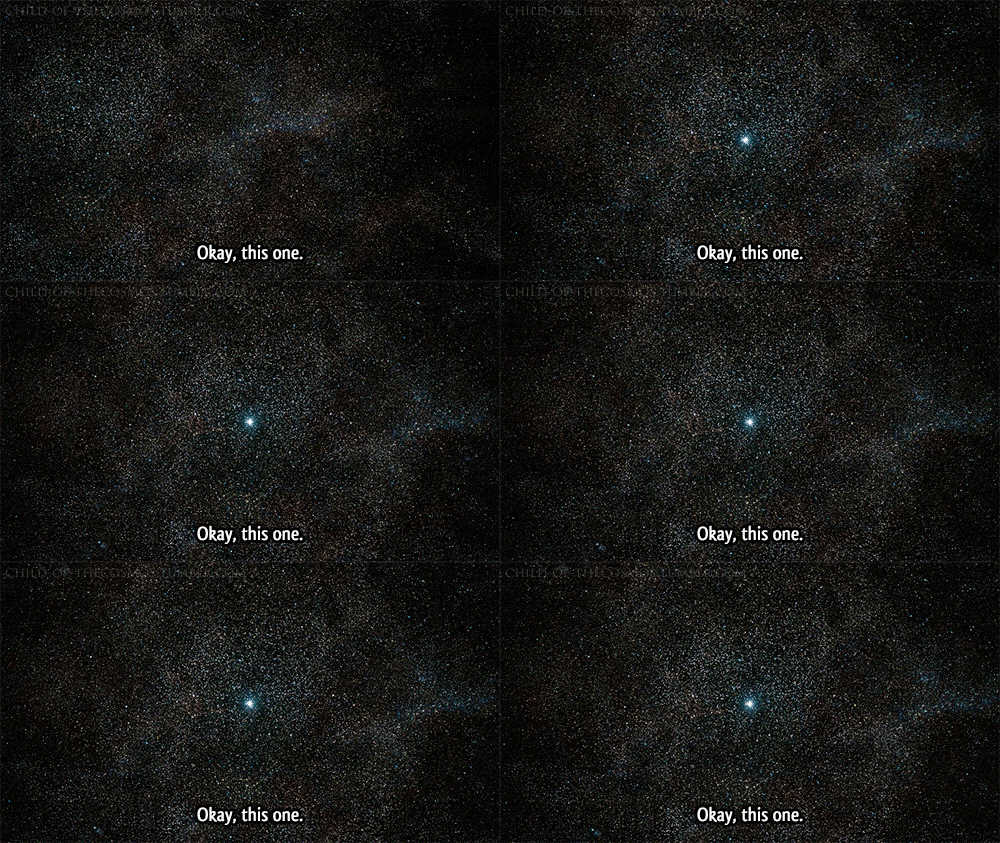





Episode 13: Unafraid of the Dark, Cosmos: A SpaceTime Odyssey
Neil DeGrasse Tyson throwing some of the most incredible shade I’ve ever seen.

Free news it ain't.
If you enJoyed the comic, kindly retweet or share the URL. Thanks!
http://www.geekculture.com/joyoftech/joyarchives/2066.html

Since I can’t log into Tumblr at work, I just use my phone to share this comment at Kotaku regarding Anita Sarkeesian’s appearance on the Colbert Report.
A.. a funny and insightful Kotaku comment? *brain explodes*
MattalystLet's hope.