digg:
This is what people asked the library before Google. (via)
Yes. I've seen the Lars Andersen archery video*. Everybody can stop sending me links to it now.
Speaking as a mediocre archer in my own right, and as somebody who's written three novels with a Mongol archer as a protagonist and done a fair amount of research on the subject of worldwide bow techniques...
That guy's a really good marketer.
But he's not actually doing anything we didn't already know about, he's not shooting in a manner that would be at all effective in combat or for the historically more common purpose of feeding his family, and his quiver-handling skills are worthy of the "before" segment of an infomercial.
I'd like to see him cut a sandwich with a regular knife! It might result in an explosion.
Here's the thing. He's basically misrepresenting a bunch of well-known techniques in non-Western-European archery as his own invention or "rediscovery" (bonus cultural appropriation!), and into the bargain, he's not actually putting any strength into that bow of his.
One of the things about archery is that arrows (even war and hunting arrows) are very light. E=MV^2, as we all know, right? So, if the mass of your projectile is slight, it needs to have a pretty good velocity to do some damage. Where that velocity comes from, in a bow, is the power. And where that power comes from is--surprise--your trapezius muscles.
Not your arms. And not actually the bow: the bow is a mechanical device that transforms back and shoulder strength into velocity, by means of storing the energy you use to draw it. It's more or less a simple mechanism that you spring-load with physical force, and then release. The more energy that bow is physically capable of storing, the more energy it takes to draw the bow.
This is what we mean when we say a bow has a "draw weight." I own two bows--a lightweight recurve, very simple and primitive, and a medium-weight compound bow, which are the ones with pulleys and stuff. (The pulleys are there to create a mechanical advantage, but they don't make it significantly easier to draw the bow. What they do is make it easier to hold the bow in a full draw. This is called letoff, and there's a bunch of technical stuff about round pulleys vs. oblong pulleys and you probably don't care about it anyway--and I don't understand it well enough to explain it even if you did. There are books, you can read some.)
Anyway. The reasons archers draw the way we do--which is to say, standing sideways to the target, less-dominant arm extended and slightly flexed with a relaxed wrist and loose grip on the bow; dominant hand brought back to the jaw or ear; dominant elbow raised and drawn back--is to engage the back muscles and create a broader draw. A significant portion of the power of your draw comes from those final inches, because of the way that springs work.
The thing he says about modern archers only drawing with one arm, by the way, is patent nonsense. Anybody who's had half an hour of archery instruction at a range populated by people who know what they're doing has been told to push the bow away with the bow hand as they simultaneously draw back with the draw hand.)
Also having a reliable anatomical point at which to anchor your draw, and a reliable stance, means that you have a reliable point of aim. Incredibly minor alterations in biomechanics--something as invisible as tensing your neck, or not fully broadening your back--can send an arrow wildly off course over distances as short as ten or twenty yards. Something as major as moving your draw point an inch? No freaking telling where that arrow is going.
When you are drawing a bow correctly, there is a feeling of being inside the span of the bow, a sense that the bow and your body have melded and that you are as much suspended in the tension of the bow as the bow is drawn by you.
Is this effective? Well, worldwide, millions--perhaps hundreds of millions!--of men and women successfully feed their families using this technique to this very day. They have cable channels up in the high digits where you can watch them do it. Whole cable channels devoted to stalking and killing deer and bear with a bow. Turkeys, too. Wild boar. Yes, it's effective.
Anyway, back to Mr. Andersen. His draw is likely to be largely useless for killing anything larger or farther away than a paper plate. It's any which way, and it's insufficient for power. (Also, hunting and war arrows are, generally speaking, much larger and heavier than what he's using there. E=MV^2, after all. Size does matter.)
Compare his release to that of Adama Swoboda (below), and see that Swoboda, even shooting fast, brings the bowstring back to his jaw. Andersen is shooting so fast that he doesn't have time for a full draw.
His tactics, though--speed shooting and so forth--are suited to a shorter recurve (like a Mongol, Hun, or Indian bow), which is designed to be shot in motion and from horseback.
If you're using a very heavy, penetrating bow such as an English/Welsh longbow, different tactics apply. For one thing, a heavier-limbed bow has a lot more mass, and accelerates the arrow in a different way. A laminated Mongol-style bow relies for its power on some gloriously advanced materials hacks involving laminating substances with different compressibility to one another and making them fight. They're snappy, and because they are small the tips of their limbs whip back into position speedily. You can't speed-fire a longbow that way, because the limbs of the bow are large, there's more mass to be moved, and they derive their draw power from compressing a quantity of wood. (They also make use of the varied compressibility of different substances, by the way--but those substances are the heartwood and sapwood of a young tree. Nature provides the lamination itself!)
(And massed fire with the things is indeed withering!)
And Mr. Andersen is firing so fast that he's not actually even getting his Asian-style bow to a full draw! He's basically doing the equivalent of swinging a hammer from the wrist; just plinking away, not really thumping on anything.
You can, in fact, fire these bows quite quickly. I've included some Youtube links to videos of people using them more correctly below. You'll notice that the master archers in those clips are handling their bows quite differently from Andersen. (He also has a death-clutch on the grip, which affects your aim rather badly. Proper grip on a bow is tender enough that when you loose the arrow, the bow actually rocks back against the web of your thumb.)
Meanwhile, to continue debunking his claims that modern archers don't use a right-side draw and that he's somehow reinvented the technique of keeping both eyes open:
If you look closely at the links below, you'll see that one of the Mongol/Hun techniques is indeed a right-side draw, and that a number of archers shoot with both eyes open. (This actually has more to do with whether you have a strongly dominant eye or not, in my experience, than the style of archery you prefer.) Another technique involves whipping the arrow from a quiver opening at your shoulder over your head, and not doing any of Andersen's dramatically inept banging it against the side of the bow. (Another infomercial moment.)
(I feel like Kirk in Wrath of Khan--"He's thinking in two dimensions!")
Andersen also neglects to mention (or possibly is not aware) that there are about seventeen different possible ways to grip a bowstring (not counting modern trigger or twist-style releases), and that one of the technical challenges of anyone who shoots a bow suitable for hunting or war is preventing nerve damage to the fingertips on the draw hand. Possibly because he's using a light bow and not drawing it to its full potential. The classically Asian/Mongol draw uses the thumb to hook the bowstring, with a flat-sided ring carved from animal horn to protect the thumb. (Tabs, archery rings, and so forth serve another purpose beside protecting the archer's fingers. They also provide a smooth surface for the string to slide off of, so that the friction of the archer's fingerprints snagging on her serving does not affect her aim. Yes, that's all it takes.)
You'll also notice that the traditional archers linked below have no problem keeping arrows in a quiver on a cantering horse!
Andersen's various trick shooting bits pretty much have to involve prepared materials. I feel like the Mythbusters have adequately debunked arrow splitting and arrow catching. (I myself have split a modern aluminum tube arrow on more than one occasion, which always makes you feel good but gets expensive.) The armor piercing trick is actually not particularly impressive. That looks to be costume chain, which is basically snipped bits of spring steel twisted together like a bunch of keychains. You can pull it apart with your hands.
And as for his shooting a guy across a table thing--I wouldn't try that with *gun*, frankly, let alone a bow. FBI guidelines for an officer armed with a firearm to safely kill an attacker armed with a knife are... 21 feet. Inside that range, and you are very likely to get cut.
***
*If you haven't seen it, there's an embed and an even eyerollinger response than mine over on Geek Dad. I saw a link to this post just as I was completing my own rant, or I'd probably have saved the time and just linked over there.
***
Here are some examples of similar rapid-fire and archery-in-motion techniques as used by modern archers, and a nice video of a military historian talking about some of the same things I have--and making some points of his own.

With Valentine’s Day coming up, the advertising gets creepy. But that doesn’t make the gag any less cool. Get $10 off the Silencing Slider Cheeseburger Ball Gag by Gorge Ohwell with code EPIPHORA.







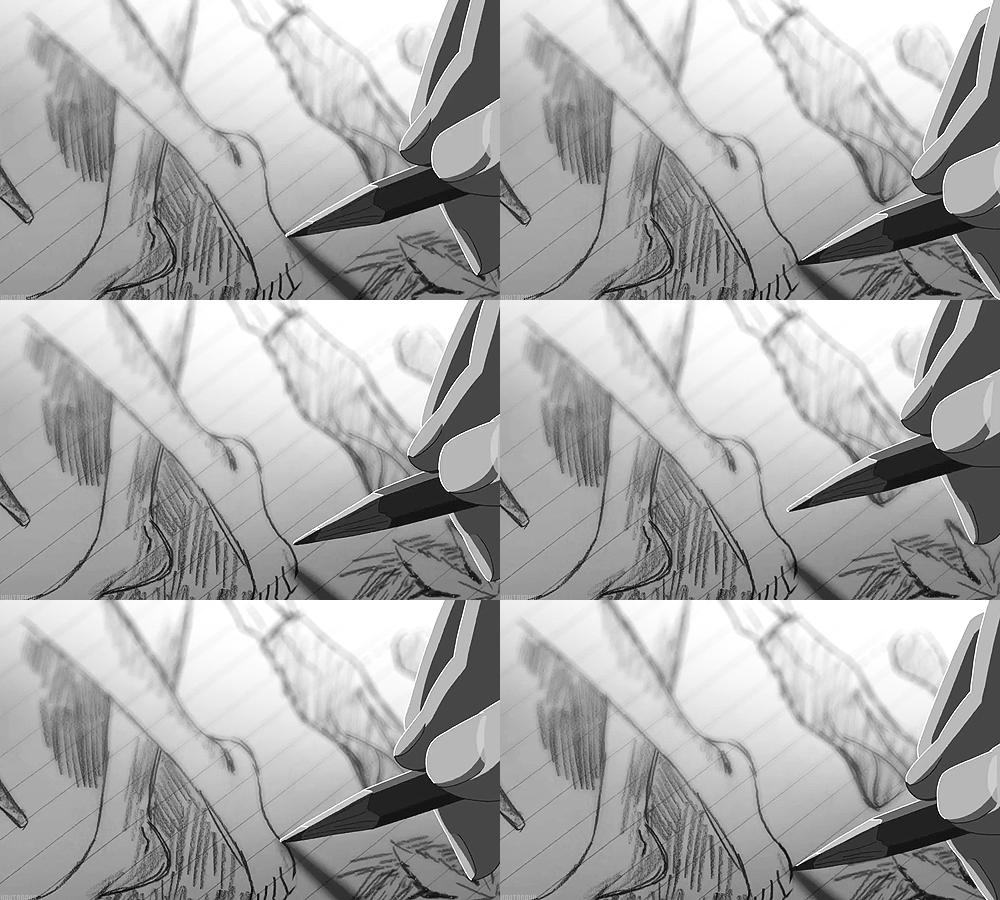
I really just adore the dreamlike fuzziness of high quality animation. It’s so close to reality, and yet there’s just this gentle… sheen to it that lets you know that it’s not real- but the more you watch the easier it is to get sucked into these pieces of art.
Garden of Words (Kotonoha no Niwa) is a beautiful, if questionable message, movie.
I wanna see this.

When it comes to what to depict on rugs, Afghan weavers traditionally turn to what’s most familiar. So in the 1980s, when the Mujahedeen were fighting back the Soviet occupation, some local weavers abandoned flowers and water jugs to illustrate what their days consisted of back then: war.
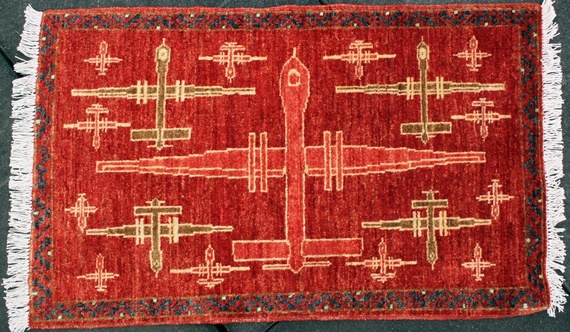
Tanks, helicopters, Kalashnikovs, hand grenades, and bazookas started creeping into the centuries-old tradition, either as elements of a landscape or as icons in a pattern. “My favorite one is an old Beluch style one,” says the 49-year-old U.S. entrepreneur Kevin Sudeith. “The design dates back to the 19th century but it has two helicopters and two tanks at each end of the rug.”
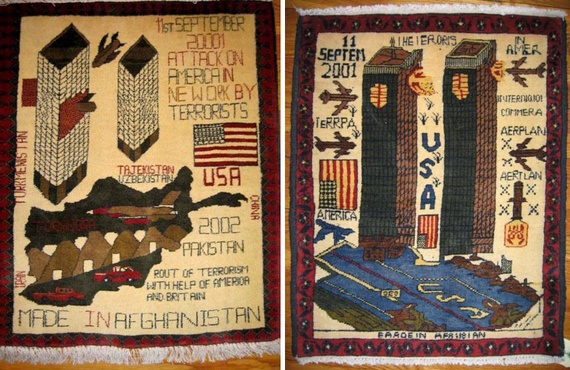
In 1996, Sudeith discovered one of the war rugs in the house of an Italian architect and decided to start collecting them. Shortly after, he was dealing them, both online and in flea markets around New York for prices ranging from a few hundreds to several thousand U.S. dollars each.
After 9/11, he thought his business was going to disappear. Surprisingly, a renewed interest in Afghanistan pushed the orders up, especially following the arrival on the market of a new set of rugs, depicting the attacks to the World Trade Center. In one of them, the misspelled caption “The teroris were nhe American” caused controversy in the U.S., as it seemed to imply that the rugs’ makers were celebrating the attack.
More rugs produced in that period featured F16 fighter jets, Abrams tanks and maps of Bora Bora, confirming that the iconography of Soviet occupation had been replaced by that of the United States military. The majority of weavers, says Sudeith, were Afghan refugees living in Pakistan who, regardless of their former careers back in Afghanistan, had become “a sort of captive labor force.”
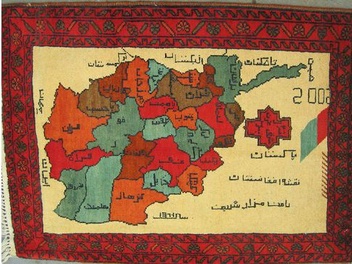
This may be the dark side of war rugs. Although Afghan weavers are traditionally women, Western collectors and dealers only deal with intermediaries, so it’s difficult to verify who actually makes the rugs, and under what circumstances. The U.S. Department of Labor, for example, lists those made in Afghanistan and Pakistan among the crafts that may involve child and forced labor. Sudeith himself never met the Afghan family that makes most of his rugs. “The brass ring for war rug people is to speak with weavers and hear their stories and motivations,” he confesses. “So far, it’s been impossible.”
After the Taliban was removed from Kabul, millions of Afghans were repatriated, causing a new shift in the rugs business: On one hand, most production followed the weavers back to Afghanistan; on the other hand, the rugs that had been woven in Pakistan became rare and therefore more valuable. These, says Sudeith, were the best years for business.
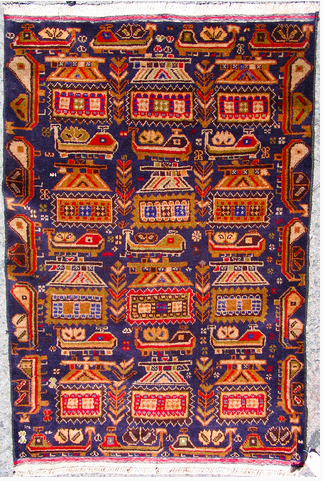
Recently he has noticed that the mysterious weavers seem somehow savvier, more attuned to demands of the market. “If I write a blog post about a particular rug,” says Sudeith, “Eighteen months later contemporary, handmade versions of it will appear.”
“A super subtle drone war rug. Dated 2014. Vegetable dye, super quality wool. Totally unique and timely piece.” In December 2014, Sudeith posted online images of a new set of drone-themed rugs, selling for a few hundred dollars. He calls them the product of a “collaborative process” with a family in Pakistan, based on designs that have previously emerged in the market.
Considering the ongoing program of U.S. drone strikes in Pakistan, these new patterns are likely to pick up as a popular theme among war rugs creators and their collectors. According to an October 2014 update from the U.K.-based Bureau of Investigative Journalism, more than 1,000 civilians have been killed in Pakistan by drone strikes over the past 10 years, around one-fifth of them children.
This post appears courtesy of Colors Magazine.
This article was originally published at http://qz.com/333733/afghan-carpet-weavers-are-putting-drones-on-their-rugs/

MattalystDavid Chang is a national treasure.
Der dritte Teil der Videoserie meines neuen Lieblingsnudelblogs Lucky Peach: „Did you know the Chinese invented Lasagna? Did you know the Italians invented Bechamel? In this episode of People Cooking Things, David Chang makes Ramensagna, just like Nonna makes!“
Vorher auf Nerdcore:
How To make Octopus-Hotdog on Seaweed-Ramen
How To make Ramen Omelette
Fire Ramen
Chinese Robot-Army of Ultramen make Noodles
Ramen Cake
Ramen Chocolate
Ramen Burgers from Japan
Giant Single Noodle Ramen
Dude wants Woman-flavored Ramen in a Bathtub
Mattalyst"“Is Omar cooler than Stringer? I don’t … leave me out of it. To hear people debating what season they love the most … it’s fine. There’s nothing wrong with it. You cannot make me give a fuck. It’s not fair to say to me, ‘I don’t like the way you killed Omar.’ Get in line. Get in line. I don’t give a fuck.”"
“Nobody watched The Wire when it was on,” says David Simon, leaning forward with a conspiratorial whisper, sitting at a neat desk in the ersatz office of Harry Oxman, the long-ago vice-mayor of Yonkers, New York. “Nobody watched The Corner.
“I didn’t believe for a minute [Generation Kill] would pull a number. You make a piece about the American misadventure in Iraq when people still have a taste of Fallujah in their mouths? Then we launched Treme, a show about culture and musicians — good luck.
“And, uh,” Simon says, “I don’t believe anyone’s going to watch this.”
The famously malcontent Simon is harrumphing as usual. His new HBO miniseries, Show Me a Hero — about the fierce and unbelievable public-housing desegregation battle in 1980s Yonkers — is shooting down the hall. It will wrap at the end of the month and won’t air until later this year. And here he is in this uninhabited part of the set, patiently, convincingly, and dramatically explaining why it also will fail to find an audience.
“You are not going to get zombie-like numbers,” he says with more than a hint of disdain, “for a story about 200 units of low-income housing being built on the east side of the Saw Mill Expressway and the racial strife that ensues.”
But in all this harrumphing, there is a glint of stubborn pride. “I’ve gone 16 years,” he says. “I’ve gone as long as you can go in television without having an audience.”
Say hello to David Simon in winter.
Twenty minutes north of the Upper West Side, past the leafy suburban charms of the affluent North Bronx and the breathtaking cliffs ridging the Hudson River, is the working-class town of Yonkers. Proud hometown of Jadakiss1 and DMX, the city also has a lesser-known, more nefarious history.
The events of Show Me a Hero were set in motion in 1985, when U.S. District Judge Leonard Sand ruled that the city had “‘illegally and intentionally’ fostered segregation in its schools and neighborhoods by concentrating all of its public housing in one section of the city.” He then issued a desegregation order and instructed that 200 housing units be built elsewhere in and around Yonkers, including on the city’s largely white east side. This was not the Deep South in the 1950s. This was the liberal Northeast in the ’80s.2
At the center of the story is Nicholas Wasicsko, who successfully ran for mayor in 1987 by pledging to oppose Judge Sand’s demands, then reversed course when a federal appeals court upheld the order days before his inauguration. In the excruciating face-off that ensued, Wasicsko had to stand against a dug-in city council majority who fought the order despite fines that amounted to $1 million a day and nearly crushed the city’s operations. Just 28 years old, Wasicsko was the youngest mayor in the country.
His story ended in tragedy, as the Times reported in the fall of 1993: “The 34-year-old Mr. Wasicsko was found at 5:20 P.M. in Oakland Cemetery in Yonkers, slumped against the base of a tree on a grassy hill overlooking the grave of his father, Nicholas, who died in 1985. He had a single gunshot wound in his head and held in his right hand the .38-caliber pistol that as a former police officer he always wore in a holster on his ankle.”
His was an emphatically human story of courage. Wasicsko wasn’t motivated by an amorphous spirit of justice and goodwill to all men. He was effectively forced into doing the right thing. But he did, ultimately, do the right thing. As the title of Simon’s show suggests, in real life, this is what a hero looks like.
Wasicsko is being portrayed by Oscar Isaac, the 34-year-old actor once described as being of “indeterminate ethnicity”3 whose career has rightfully gone into overdrive in the past few years. At the end of 2015, you’ll see him piloting his X-wing all through Star Wars: Episode VII — The Force Awakens; soon thereafter, he’ll be doing battle with the X-Men as the supervillain Apocalypse. But for now he’s in a drafty municipal building, in a plain office choked by dark wood and pocked with snow shovels, sporting a garish ’80s power suit and an equally garish power mustache.
In today’s scene, Isaac’s Wasicsko is flustered as he begs for legal action against his political enemies. “Well, if the governor were to act, and remove some of these recalcitrant council members,” Isaac pleads on the phone to a would-be ally. “He could get them on malfeasance, nonfeasance, misfeasance.” Pause. “Any of the feasance family!” It’s a classic little Simon run, and Isaac’s delivery is sharp but understated.
In the back of the office, Simon sits at a large wooden conference table. He’s wearing a Champion ringer-tee tucked into his pants and a gray unzipped hoodie, the very model of I-don’t-give-a-fuck. Beside him is the semi-infamous writer-director Paul Haggis,4 who’s helming all six episodes of the miniseries. I’m ushered to a seat at the table as well, to observe quietly, and am introduced to Haggis.“You are a reporter, you’re not playing a reporter,” he grumbles, taking disapproving stock of my outfit. “If you were playing a reporter, you’d be dressed all fucking wrong.”
 HBO
HBO
Then he turns his attention back to the shooting, which he watches through a nifty handheld monitor. Haggis — elegant in a thin blue sweater and neatly trimmed male-pattern baldness — is an able commander of his domain, even when speaking through a mouthful of blueberries. He calls out for walkie-talkies to be turned off; he snaps that the room be cleared of all nonessential personnel. Isaac, sporting slicked-back Pat Riley helmet hair, is a joy to watch: Diligent about his delivery, he’s locked into every line of dialogue on every take.
“Because I was under the impression that Cuomo was some kind of great hope of white liberals everywhere,” Isaac rattles off, smoothing his tie, at one with the Simonese. He’s not far from The Wire’s young, pre-corruption Tommy Carcetti.
But despite Isaac’s ease with the material, a string of mundanities are wreaking havoc on the shoot. Sirens go screaming by an open window. A coffee carafe, requested earlier, has now appeared on Isaac’s desk. But it wasn’t there earlier, so now the continuity is in jeopardy. And, of all people, a boom mic operator isn’t playing ball. His mic keeps showing up in the reflections of the glass-framed diplomas behind Isaac’s head. Shot after shot is ruined as the crew tries to figure out where exactly to position the downright diva-ishly grumpy boom mic guy so as to avoid the reflection.
“John, would you waste more fucking time so I can get a cigarette?” Haggis shouts out to a crew member over his shoulder, already running out for one. Food comes in, and Simon jokingly grumbles, “Do I look like a chicken-salad-eating motherfucker?!” Haggis returns from his break, choosing now to admit to Simon, with a cackle, that he’s not quite sure if the way he’s laid down the camera track for this scene will work. “I’ve never done it like this before!” he says. Simon, in turn, picks up a disconnected phone receiver and pretends to cave in Haggis’s head with it.
And the boom mic reflection is still not resolved. “I feel like we need a long-term solution,” John the crew member says, not without dickish overtones. The ever-sincere Isaac chimes in — “Let’s figure it out together” — before returning to pantomiming his scene. A dramatic bite of a sandwich after delivering the line, or before?
Eventually, miracle of miracles, they do figure out how to cut the reflection. Isaac can get back to business: “Malfeasance, nonfeasance, misfeasance. … Malfeasance, nonfeasance, misfeasance. Any of the feasance family!”
“Another false crisis averted,” John zings. Simon hands him a legal-pad doodle he’s been working on: John, falling overboard, being dragged down by an anchor into the depths of the sea.
For all of his perceived fastidiousness, David Simon would never have become a titan of Golden Age television if it weren’t for a few happy accidents. The first came in the mid-’80s, when he was a junior reporter on the police beat for the Baltimore Sun, racking upward of 300 bylines a year chasing beatings, stabbings, and murders.
Though widely assumed to be a profitable business, the paper announced givebacks in employee medical plans in 1987. An indignant staff went on strike. Their suspicions were confirmed. In anticipation of an imminent sale, the paper’s bosses sought short-term profits to make the Sun appear as valuable as possible. They were, Simon says, “fattening up the frog for the snake.”
Eventually, the strike was settled. But Simon was not. He’d been kicking around a certain idea for a few years. “There was this detective [Bill Lansey],” Simon recalls. “A veteran, a quiet guy. I liked him a lot. I went up one Christmas Eve to bring him a bottle of scotch. You know, Christmas, there’s a quiet lull. A cutting here, a shooting there. And I remember, we’re sitting around drinking on the midnight shift on Christmas Eve and he says, ‘If somebody ever watched the shit that happens here in a year, they’d have a book.’”
Heeding worthy advice, Simon ended up with Homicide: A Year on the Killing Streets — a classic piece of nonfiction, brutal and unrelenting. A sober but not unlyrical account of a year of victims murdered under devastatingly similar circumstances on the streets of West Baltimore, it overwhelms strategically.
The book would become a TV show. As Barry Levinson’s Homicide: Life on the Street, it ran for seven steely seasons. Eventually, Simon was tapped to write scripts. With a foot in the industry, he’d go on to adapt his Homicide follow-up The Corner: A Year in the Life of an Inner-City Neighborhood as an HBO miniseries. Then, in the summer of 2002, came The Wire.
And it all may not have happened if Simon had never made a little suggestion. Dangling the astounding real-life pulp of Homicide in front of studios and directors, Simon’s agents got no action. So finally, Simon suggested, Barry Levinson is from Baltimore. Send him the book. “I do credit myself,” Simon says, “with that one small moment of” — he lets a beat pass — “mental cohesion.”
These days, Simon possesses as little industry heat as he has since before The Wire. Treme had its supporters, but the next conversation you have about it at a party will likely be the first. Eventually, HBO gave it a graceful assisted death, with an abbreviated fourth season. “It was frustrating,” Simon says, but not a “low moment. To their credit, they came up with five hours to let us finish a story that we were telling, and telling well, [but that] wasn’t helping them on Sunday nights.”
After Treme, Simon had a number of projects on the board at HBO, each and every one given a deeply reported, fully realized treatment, with scripts written for multiple episodes and multiseason show bibles assembled. It’s work that can take years to complete.
“We’re not the people who go around with a trunkful of pilot scripts,” Simon says. “‘It’s a medical show! You don’t want a medical show? It’s a legal show! He’s gotta have a dog? OK, he’s got a dog! His partner’s an alien? OK, his partner’s an alien!’”
There was a partial adaptation of Taylor Branch’s massive civil-rights trilogy America in the King Years. A collaboration with George Pelecanos on Times Square in the ’70s and ’80s. A “very careful treatment” of the CIA from 1945 to 2001, written with his Wire buddy Ed Burns. And a telling of the Lincoln assassination with “crackling” scripts that “avoided the marble men of Lincoln and Booth who have been written to death” and functioned “as a sort of post-9/11 allegory.” He describes it as a “traumatizing act of terror” followed by “paranoia and military trials with indefinite detention … the smell of rendition in Guantanamo and overreach and wartime fear.”
Except for the Lincoln project, all are technically still alive, if stuck in some lower rung of development hell. Go ahead and unrequitedly pine.
The original seed for Show Me a Hero predates all of them — even The Wire. It’s based on the 1999 book of the same name by Lisa Belkin, although Simon’s cocreator and former Sun colleague and Wire staff writer Bill Zorzi has done his own extensive re-reporting. And the reason it’s actually being produced is, well, it’s the one that HBO picked.
“I said to HBO, ‘Look, do you want me just to do a miniseries? Less of a commitment?’” Simon says. “They were like, ‘No, no, keep trying to do a series.’ I’m trying. But at a certain point, if what I’m interested in they’re not interested in and vice versa, we gotta stop hitting our heads against the wall.”
 HBO
HBO
Sixteen years without a massive audience and Simon has never considered changing his approach. At 54, more than half a decade since the last scene of his greatest moment of cultural penetration, he finds himself increasingly marginalized. Simon repeatedly and proudly calls himself the “PBS of HBO.” But he’s only going to tell the stories that he’s going to tell.
“Why am I interested in recon marines in an unpopular war? Why am I interested in musicians in a dystopian and damaged city?” he says. “Why am I interested in this?”
He brings up his Times Square project, “a place that has gangsters and pimps and whores and nudity and violence — all of the currencies that we know work in television.”
But “the thing we’re really trying to fucking do is tell a story that’s actually worth telling. And not sustain a franchise. That’s the problem. Certain things sustain franchises and certain things never can. Trombone players? Very hard to sustain a franchise. Gangsters? You can go for years without ever having anything to say. March them on TV and put a bullet in someone’s head.”
In Hero, Simon jokes, there are no dragons, no vampires, no gangsters, no porn. Why is HBO interested in this? he asks himself. But he knows what draws him toward it.
“There’s almost nowhere to fit journalism anywhere,” he says, in words that would not surprise longtime Simon watchers. But, again, he’s not just harrumphing. He explains, patiently.
“Is Omar cooler than Stringer? I don’t … leave me out of it. To hear people debating what season they love the most … it’s fine. There’s nothing wrong with it. You cannot make me give a fuck. It’s not fair to say to me, ‘I don’t like the way you killed Omar.’ Get in line. Get in line. I don’t give a fuck.” —David Simon
“The high end is becoming increasingly narrow. Certainly commentary is much better and much more vibrant with the Internet; I have no qualms about how democratized commentary has become. And certainly there’s a lot of attention to whatever the grand headline of the moment is, or to the newsmaking institutions that attract the most attention: the White House or, in our current moment” — Simon sighs — “Ebola. But there’s very little room for the institutional journalism that used to cover societal structures.”
And then, he counters himself. Here David Simon sits, being paid exorbitantly well to work with some of the best actors working today and enjoying more exposure than your grandest New York Times best seller. Doing a show on 200 units of low-income housing being built on the east side of the Saw Mill Parkway and the racial strife that ensues. Here they are! In Yonkers! Filming this!
“Sometimes,” Simon says, “I read my quotes and it comes off like, ‘He’s so fucking angry.’ What I’m actually saying is, ‘I understand the improbability.’ I’m like the Wandering Jew, with one bag packed. At any moment it could end.”
It’s a strange day to be working. Today is the day that long-rumored layoffs have been announced at HBO. And many on set are spending work breaks checking email and making furtive phone calls to see who of their friends has been spared and who has been gouged.
We’re in the video village, which is crammed into another utilitarian corner of this Yonkers municipal building. Around us are steel filing cabinets and bookshelves full of white three-ring binders with labels like “Traffic Routing and Planning 1985.”
Simon, long-standing HBO employee that he is, joins in the gossip-mongering. He laments the good ones that we lost and slags off the bad ones that survived. To the beaming grins and delight of a small huddle of publicists and casting agents, he goes in on an apparently much-disliked former HBO employee who has transitioned into a career in international relations.
Throughout the set, Simon keeps up an air of highbrow joviality. He wants to talk about the insanity of allowing bankers to short. He says it’s like Catch-22’s Milo bombing his own base because the Germans were paying better. Oh, also, he’s rereading 1984 and the screaming pseudo Trotskyites remind of him of the 24-hour cable-news cycle. He’s supposed to be one of pop culture’s most famed grousers. This? This is downright chummy.
“Not even a little bit,” Isaac answers when I ask if Simon has been intimidating to work with. “In fact, when we were prepping, he came over to my place in Brooklyn and we spent like a six- or seven-hour day together, just going through every single page in the script. All 600 pages. We changed some stuff, fixed some stuff. Or he’d explain to me why it needed to be that way. He was incredibly, surprisingly open.”
On set, I witness them briefly interacting. At one point Isaac is tasked with dismissing some political foes as “buffoons.” But originally, he recalls, the script read “jabronis.” During a quick break, he comes over to powwow with Simon.
“What happened to ‘jabronis’?”
“You like it better than ‘buffoons’?” Simon asks, reminiscing. “It was Nay.” That’d be Nay Wasicsko-McLaughlin, the mayor’s widow. On set as a consultant — in a simple black dress, a cold-pressed juice in hand — she easily stood out from the harried duct-tape-wielding PAs and period-costumed extras.
“She said Nick’d never say it. I liked the New York–ism of it.” He thinks. “You like it better? Go for it.”
“Jabronis” it is, for now. Isaac is visibly pleased. “I haven’t heard ‘jabronis’ since WrestleMania!”
 HBO
HBO
Between production on Hero and script work on his latent projects, Simon stays busy.5 He’s also had to look backward. “Of all things,” he grunts, “they’re trying to release The Wire in HD.”
I’d wondered ahead of time if Simon would be as game to talk shop on The Wire these days. After all, it’s been some time, and the entire arcs of other lauded TV series have since passed. But it turns out he sees The Wire as just another one of his projects that died on the vine, then found rebirth in reappraisal. The only thing you can hope for, he says, is to get it “on the shelf. People will find it. Eventually, people will find it.”
The Wire was more than found, of course: It was sucked up, chewed over, and spat out a million different ways. With extensive consultation from Simon directly, the HD versions were eventually released and re-aired in late 2014. Old fans found themselves reengaged in all the same old debates. In the wake of the traumatic events of Ferguson and Staten Island, they rang louder: the failure of institutions, the corruption of those who are meant to protect, the scourge of the drug war on America’s inner cities.
It also sparked those more — superficial? enjoyable? — debates. Favorite characters, best seasons — the kind of stuff that drives Simon a bit batty. If you may recall, it was partially in response to Grantland’s own Wire bracket that Simon gave a few provocative quotes (in an on-brand kind of way) to the New York Times.
“I get in trouble,” he recalls. “A Times reporter came to me and asked, ‘What do you think about [this]?’ What do I think about it? I think it’s bullshit! And everybody went into high dudgeon: ‘How dare he tell us how to watch The Wire!’ But the guy asked what I thought! I didn’t volunteer! I didn’t issue a proclamation! The guy asked!
“Listen, no harm comes from it.” He stops himself immediately. “Except, on some level … ” He calculates, then continues: “What interests me is when people argue about the themes and stances and politics of the story. When the thing gets off the entertainment pages and people start arguing about it in terms of parsing policy, I’m very gratified and very interested. That’s sort of worth the time. That’s why you spend five, six years working on something.
“I’m not sure that’s me telling you how to watch The Wire other than me telling you how I value the thing. If you don’t wanna hear me say what I value, don’t ask me the question.
“Is Omar cooler than Stringer? I don’t … leave me out of it. To hear people debating what season they love the most … it’s fine. There’s nothing wrong with it. You cannot make me give a fuck. It’s not fair to say to me, ‘I don’t like the way you killed Omar.’ Get in line. Get in line. I don’t give a fuck.”
Simon uses the phrase the “currency of entertainment” several times. He does so to make it clear that this is a currency in which he does not traffic. The dismissiveness is supremely welcome: This is exactly the kind of stuff we want to hear from David Simon, curmudgeonly and impassioned culture warrior. But it’s also a bit of hyperbole.
Taken to its extreme, it’s almost like Simon would claim any traces of fun in The Wire were there only to trick us into paying attention to the important stuff. This is, to borrow a phrase, bullshit. The romantic affectations of Bunk Moreland, the crooked-grin bird-dogging of Jimmy McNulty, the perfectly crafted, endlessly tumbling lines of salty cop-shop dialogue — it may have served a higher calling, but to say it is not also pure in-the-interest-of-joy entertainment would be to lie.
It doesn’t change things: You take from it what you want. Simon knows why he made the show. As he says, he’s the “PBS of HBO.” In winter, Simon is leaning into his marginalization, pulling it over himself like a warm blanket.
By the end of Hero, with all of his various properties through these 16 years — longer now than the time he spent writing newspaper copy on deadline — he’ll have given us 112 hours of television. That is, give or take a few units, 112 hours more than he ever expected to give us when he was a junior reporter on the police beat at the Baltimore Sun.
“You know what I love?” he says. “I love fucking TV that’s not supposed to be on TV.”
An assistant enters the fake office of Harry Oxman, the once-upon-a-time vice-mayor of Yonkers, New York. Simon is needed back on set. He has to get back to work.
Ronald Daniels, the president of Johns Hopkins University, recently became the latest academic to offer his opinions on the funding crisis in biomedical research. It has been almost a decade since the National Academy of Sciences reported that young investigators are receiving an ever-shrinking share of key research grants. Although some reforms were implemented by the National Institutes of Health, a major funding source for biomedical research, it is clear that they haven’t changed much.
For example, the leading NIH grant—the R01—is awarded more than twice as often to scientists over 65 years of age than those under 36 years, and only 1.3 percent of all grant funding was awarded to investigators under 36 years in 2012.
Daniels lists a number of repercussions of this dire funding situation for the youngest researchers. It is leading to an exodus of young scientists from the academic biomedical workforce, forcing them onto alternative career paths. It’s creating a shortage of investigators who are pursuing novel discoveries and therapeutics, a loss of a generation of future scientific leaders, and delaying the growth of diversity in the biomedical workforce. In general, Daniels argues, it’s causing the disappearance of scientists who would be poised to bring new, disruptive ideas to the table.
Read 13 remaining paragraphs | Comments
Mattalyst"Premature" is an odd word. Is there really a "best" age?
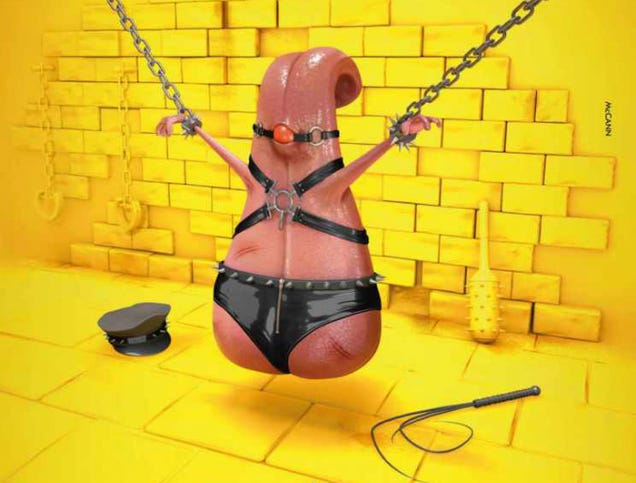
What's a pizza company to do if they want to get in on that sweet 50 Shades of Grey cash cow action, but have absolutely no promo connection to the infamous amalgam of Freaky Friend Fiction word snippets masquerading as dialogue? How about an ad referencing BDSM? OK, great, but even better: how about an ad that references BDSM while being as abjectly terrifying as humanly possible? Wait, what?

Everything movies taught me about archery is wrong. This is a complete mind-blower. 8D
If you are even remotely interested in archery or medieval combat, check this out, it’s just great!
OMFG EVERYONE PLEASE DROP WHAT YOU’RE DOING AND WATCH IT RIGHT NOW O_O
HOLY HELL
OOOOOOOOOOOOOOOOO!
Cries of delight, desire, and oh please, I want to learn this!


Multiple sclerosis, or MS, is an autoimmune disorder that affects the brain and spinal cord. The immune system destroys the patient's own myelin, the protective membrane wrapped about the nerves, thus disrupting communication with the central nervous system. About 50 percent of patients are unable to walk 25 years after their diagnosis.