Shared posts

16 Jul 18:17

Tennessee police to drug users: don't flush your dope or you'll create "meth gators"

by Cory Doctorow

Following a raid where they caught a suspect flushing evidence down the toilet Loretto, Tennessee Police Department has asked the citizenry to refrain from flushing dope due to the potential risks to local wildlife, including the possibility of creating "meth gators."

"Folks … please don’t flush your drugs m’kay ... our sewer guys take great pride in releasing water that is cleaner than what is in the creek, but they are not really prepared for meth," the post read. "Ducks, Geese, and other fowl frequent our treatment ponds and we shudder to think what one all hyped up on meth would do."

"Furthermore, if it made it far enough we could create meth-gators in Shoal Creek and the Tennessee River down in North Alabama," police wrote. "They’ve had enough methed up animals the past few weeks without our help. So, if you need to dispose of your drugs just give us a call and we will make sure they are disposed of in the proper way."

'Meth-gators': Tennessee police warn flushing drugs could create hyper-aggressive alligators [Kalhan Rosenblatt/NBC]

(via longtimelurker)

(Image: Andrea Westmoreland, CC-BY-SA, modified)

11 Jul 17:21

After poacher crackdown, Tanzanian endangered rhino and elephant populations are staging inspiring recoveries

by Cory Doctorow

Four years ago, there were 15 known black rhinos left in Tanzania -- "ground zero of the poaching crisis" -- and today there 167 of them; elephant populations (which dropped 60% between 2009-2014) are rebounding too, up to over 60,000 from a low of 43,330.

The recovery is attributed to the administration of resident John Magufuli, whose 2015 election campaign included a promised military crackdown on poachers, with stiff criminal penalties. Following the election, poachers -- many of them Chinese nationals -- were caught, arrested and sentenced; four men are serving 20 years for smuggling rhino horns, and the so-called Chinese "ivory queen" has been jailed for 15 years.

Wildlife experts say that the rising numbers can't be attributed solely to fertility, as rhinos and elephants gestate too slowly for the rebound to come solely from births in the wild; they say that some of the rebound is due to migration of animals into Tanzania (however, now that they're there, they're safer from poachers than they've been in a long time).

Tanzania’s figures were released as wildlife investigators worldwide revealed thousands of species had been seized in a major crackdown at borders last month.

“Operation Thunderball” led to seizures of 23 live primates; 30 big cats; more than 4,300 birds; nearly 1,500 reptiles and 10,000 turtles and tortoises globally.

UK teams seized two bear skulls and skins, and four products derived from crocodiles, 10 tanned skins, and four ivory products including binoculars.

Endangered rhino numbers ‘soar by 1,000%’ in Tanzania [Jane Dalton/The Independent]

(Image: Bernard DUPONT, CC-BY-SA)

(via Naked Capitalism)

05 Jul 15:27

Consultant helps game developers not do stupid things such as decorate lava levels with Stars of David

by Rob Beschizza

Geographer Kate Edwards helps game developers avoid offensive and malignant stereotypes and tropes in their work. There are more than enough mistakes and blunders to keep her in business.

A common and “safe” way of avoiding problems [is] inventing a whole pseudo-country. It’s worth noting that Ubisoft have since announced that their next big Clancyromp, Ghost Recon Breakpoint, will airlift our angry shootyboys out of Bolivia and drop them in a fictional Pacific Island nation called Aurora. But I want to know if transplanting your story like this really helps. Or if it’s just an ill-fitting patch.

“I actually think that’s a very effective tool,” says Edwards. “Good science fiction and fantasy have been using allegory forever… [It’s] a very powerful way to make people think about the particular situation without just bluntly hitting them over the head with it. You can do that too if your narrative serves that purpose – and I don’t think we should instantly shy away from doing that. If you have a good reason to set your action and narrative in a certain locale that is real, then I would go ahead and explore that option.

“Ultimately, you have to ask yourself… how much of a difference does it make to the narrative purpose of your game whether it’s set in Bolivia or it’s set in some fictional South American country? Is it really going to change things significantly for the narrative of the game?”

But even Edwards admits that allegory can sometimes go wrong

Example: they put an evil alien in Halo 2 and named it "The Dervish" until someone noticed and fixed it. It's like a scene from a dark comedy show on TV, offensiveness catalyzed into surreal humor by its own magnificent stupidity. The bottom line: "big companies will not pay attention to any of this unless you convince them that thoughtfulness will lead to more worldwide sales."

28 Jun 12:21

"Because we're not morons:" This bumper sticker announces you're voting for "the Democrat"

by Rusty Blazenhoff

Five bucks will buy you the bumper sticker that lets people know you're voting for WHATEVER Democratic presidential candidate is on the ballot in 2020. Right now there are 24 in the running.

The Democrat 2020 bumper sticker:

Look, we're all gonna have favorites during the primary. That's what primaries are for. But once we have a Democratic nominee, we're gonna vote for them, because we're not morons. Announce your intent to end the madness by voting for the Democrat in 2020, whoever they are.

...Made with adhesive so it's easy to change when the time comes to replace this sticker with one from your new favorite nominee.

Thanks, Steve Garfield!

19 Jun 18:46

Wooden Wonders: Innovative Updates to an Ancient Building Material

by SA Rogers
[ By SA Rogers in Conceptual & Futuristic & Technology. ]

Despite the fact that wood has been in use as a primary building material for millennia, it’s being hailed as the material of the future. Who says you can’t teach an old dog new tricks?

Wooden architecture is most often associated with cabins and other rustic styles, but that perception is increasingly out of date. Recent innovations are producing wood that’s capable of standing in for more environmentally harmful materials like plastic, steel, concrete and even glass. It might seem like increasing demand for wood could deplete forests more rapidly than ever, contributing to the climate crisis, but the key to sustainability lies in preserving large tracts of old growth forest while also maintaining well-managed working forests using modern methods that protect biodiversity.

Self-Shaping Wood

Wood may seem relatively inflexible when it comes to architecture, but it doesn’t have to be. Researchers at the University of Stuttgart’s Institute for Computational Design and Construction have found a way to create bending, twisting wooden structures in a process that actually makes the wood stronger than ever. But the best part is, unlike mechanical forming processes that require heavy machinery, this technique requires very little energy. “Urbach Tower” is the result of these efforts, a “shelf-shaping” 46-foot-tall tower in Germany.

The components for the tower were designed and manufactured in a flat state, and once they were assembled, the wood was allowed to go through its natural drying and shrinking process, warping it into a shape of its own creation.

Cooling Wood

A new type of wood developed by a team at the University of Maryland and the University of Colorado Boulder is capable of passively shedding heat, reflecting sunlight and warmth to lower a building’s electricity consumption. It’s created by removing a natural polymer called lignin, which holds together the molecules of wood’s other main component, cellulose. Then the wood is compressed to create a strong, pale material made up solely of cellulose fiber, and a hydrophobic compound is added to make it water-resistant. Since lignin absorbs heat, its removal gives the resulting material a cooling effect.

Fireproof Wood

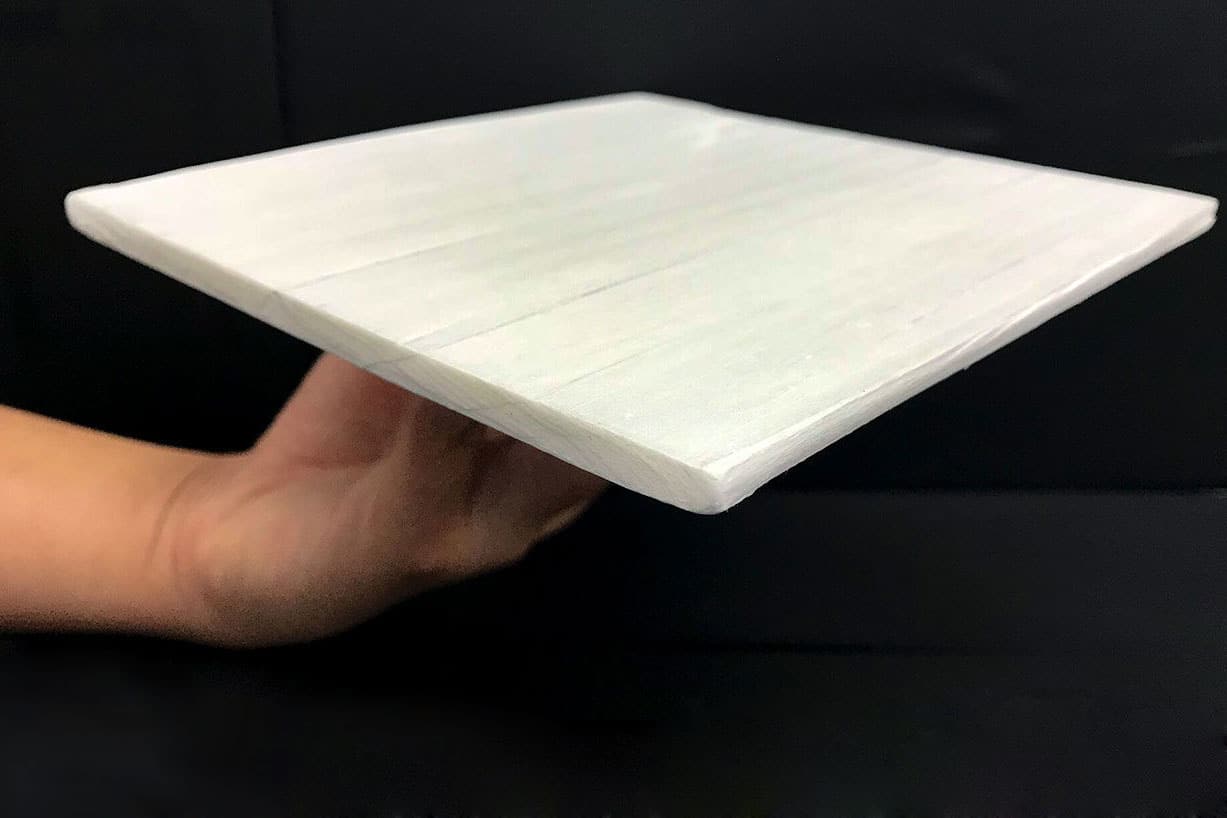
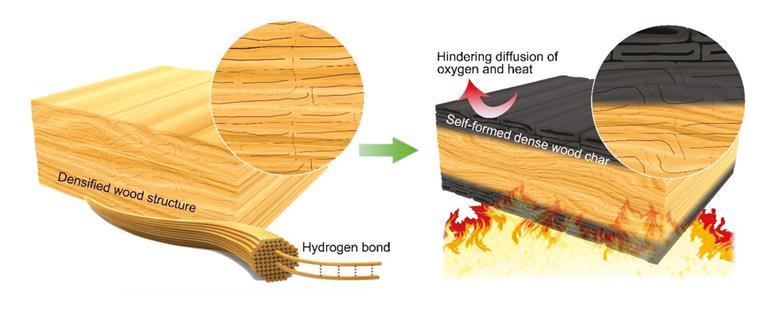
Not only have those same scientists at the University of Maryland created cooling wood, they’ve found a way to make bulletproof wood through densification, which also makes it resistant to fire. The team led by Liangbing Hu first chemically treated the timber with sodium hydroxide and sodium sulfite to partially remove its lignin, then hot-pressed it to create a dense, laminated material free of the air changes that increase flammability. When burnt, the modified wood doesn’t catch fire; instead, it becomes even more fireproof by forming an insulating exterior layer of char.

Wood Based Plastics

We don’t have to give up the convenience and versatility of plastic in order to curb rampant pollution. We just have to make it out of different materials. Previously, we’ve seen plastic alternatives made of edible algae, the skeletons of arthropods like shrimp, milk proteins and mushrooms. But wood is another contender. Developed by a research group at the Technical University of Hamburg, “lignopure” is a lignin-based plastic that’s completely non-toxic and biodegradable. The lignin is released using a high-pressure process requiring only CO2, water and enzymes, producing a flexible material that can be molded, 3D printed and formed into thin layers for use as tape and packaging.

Transparent Wood

Someday soon, wood could even replace glass. Researchers at the KTH Royal Institute of Technology in Stockholm chemically modified wood to make it transparent without losing its mechanical properties – again, by removing the lignin. The team filled the resulting micros coping holes with acrylic to produce a translucent piece of wood with a frosted effect. Then, mixing it with polyethylene glycol, a “phase-change material” that melts at 80 degrees Fahrenheit, they make it fully transparent and capable of releasing energy when cooled, producing a clear “pane” of wood that can absorb energy during the hottest hours of the day and release it at night when it gets chilly.

Cross-Laminated Timber

Now that studies have proven the strength and fire-resistance of cross-laminated timber (CLT), building codes around the world are relaxing to enable the construction of super-tall timber towers. So many of these wooden wonders are under construction, it’s hard to keep track of them all, each vying for the title of “world’s tallest wooden building.”

CLT is an engineered material created by stacking and gluing small pieces of structural lumber, with each layer perpendicular to the one below it. The result is so durable, it’s seen as a viable alternative to steel and concrete, while being competitive in price and far less energy-intensive to manufacture. It’s also a lot more fire-resistant than timber in its natural state. All of these qualities point to the possibility of increasingly wood-filled cities in the near future.

Wooden Bricks

Lots of modular building systems use stackable components made of composite materials to eliminate the need for nails, screws and other fasteners. But almost none of them use wood like Brikawood, a a system of wooden bricks that lets you build an entire house with just a handful of tools. The interlocking pieces of wood snap together so firmly, they become totally rigid with mechanical, acoustic, thermal and anti-seismic properties, and you don’t even have to add any cladding or membranes. The walls are instantly finished on both sides.

Share on Facebook

[ By SA Rogers in Conceptual & Futuristic & Technology. ]

[ WebUrbanist | Archives | Galleries | Privacy | TOS ]


19 Jun 18:40

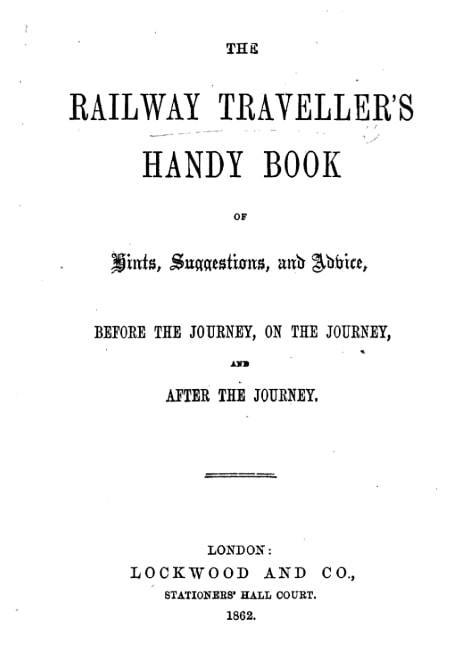
This Victorian Book Gives Hilarious Advice To Train Passengers

by Will Noble
Malady579

I found some of these amusing

The only thing that could have made train travel in Victorian times more harrowing was if Thameslink had existed. Image: Shutterstock

Think train travel's a headache? You should have tried it in 1862 — a time when on board smoking was rampant, lethal accidents were commonplace, and the taxi rushing you to the station was only one-horse-power. That said, some things appear not to have changed much in over 150 years.

The Railway Traveller's Handy Book was a thorough, if jauntily written, companion to train etiquette, aimed at wet behind the ears travellers. We found a copy while rummaging through the London Library. Here are some of our favourite extracts, howling misogyny and all.

A typical Victorian women getting ready for a train journey. Image: Shutterstock

On choosing a high-performance taxi...

If you have but a short time to reach the station in, be careful to choose a cab with a fresh-looking horse attached to it.

On the 'fair sex' getting ready...

We hope that we shall not be accused of a want of gallantry when we declare that when there are ladies in the case, it is absolutely necessary to allow a wider margin for the preparations for departure than is ordinarily assigned. The fair sex must complete their toilet to their entire satisfaction, whatever the consequences may be... if the time-table sets down the departure at 1.20, they instinctively read 1.45.

On being burdened by one's family...

There certainly cannot be a more ludicrous sight than that presented by a man vainly endeavouring to catch the train. If he be burdened by many packages, and accompanied by a wife and a numerous family of young children, the picture is considerably heightened.

Third class: just say no. Image: Shutterstock

On quite possibly dying...

A person may perhaps venture on a railway for the first time in his life, and meet with an untimely end. One of the characteristics of railway accidents is that the injuries sustained are for the most part severe, and when not fatal, frequently incapacitating the sufferer from pursuing any active business during the remainder of his life-time.

On being stingy...

Some persons, attracted by the lowness of the fare... have an inclination to ride by third class. They may be destined to pass the next few hours of their existence tightly compressed between two rough specimens of humanity.

On sensible headgear...

...If the traveller be wedded to the chimney pot style of head covering, he had better provide himself with a "gibus", or compressible hat, which admits of being easily stowed away when not in use.

If you take one of these, make sure it's foldable. Image: Shutterstock

On sending seven-year-old boys to London unattended...

There was an account of a little boy... despatched alone from York to London, a label, inscribed with his name and address and destination was attached to his clothes. We do not altogether advocate such a mode of despatch as this.

On pretending the seat next to you is taken...

There is a certain etiquette in connection with the retaining of seats which it is considered both rude and unjust to disregard. Thus the placing of a coat, a book, a newspaper, or any other article, on the seat of a carriage, is intended as a token that such place is engaged.

On that person in front of you, taking forever to buy a ticket...

We have no doubt that every one of our readers has in his time had his patience tried by some obstructive old lady bound for Putney or elsewhere.

(This quote is preceded by a lengthy tale about said obstructive old lady, in which she rummages through the 'unfathomable chasm' of her purse.)

The Victorians invented this trick. Image: Shutterstock

On sussing out your fellow travellers...

When you are going on a long journey... scan the features of the persons already in possession of the carriage, with a view of ascertaining whether they are likely to prove pleasant travelling companions or the contrary.

On not making conversation with fellow passengers...

With regard to conversation, the English are notoriously deficient in this art. Generally speaking, the occupants of a railway carriage perform the whole of the journey in silence.

You need a throat sheathed with iron to drink this stuff. Image: Shutterstock

On the days before hot coffee lawsuits...

Beware of taking hot refreshments; whether it be by accident or design we know not, but certainly the fluids supplied are so excessively hot, and so long in forthcoming, that it is utterly impossible for a person to swallow them, unless his throat be sheathed with iron.

On not getting your block knocked off...

The proper place for a head is inside, not outside the carriage, and so long as it is kept there, the chances are that it will remain whole.

Chickens: your only form of entertainment in provincial stations. Image: Shutterstock

On the very real danger of being molested in a tunnel...

In going through a tunnel... it is always as well to have the hands and arms ready disposed for defence, so that in the event of an attack, the assailant may be instantly beaten back or restrained.

On being at a station that's not in London...

It sometimes happens that a person has to await the arrival of the train at a station of some little country town. Under such circumstances, time hangs most heavily, and an hour appears as along as a day... There may be a few cocks and hens in the adjacent poultry-yard, but they are probably lazy or replete, and their movements are of the most commonplace and uninteresting description.   

You can find a copy of the book in the London Library, or peruse it online as an ebook.

13 Jun 16:20

Billy Porter kills it in impromptu Broadway karaoke

by Rusty Blazenhoff

During a commercial break at the Tony Awards, host James Corden ran down to the audience and asked Billy Porter if he'd sing an impromptu karaoke song. Porter took the opportunity, as the pro that he is, and belted out "Everything's Coming Up Roses" from the Broadway classic "Gypsy." Of course, he slayed it!

11 Jun 12:57

He Got Tired of Yelp and So He Decided to Make a Crazy Offer to Customers

by Franzified
Malady579

also love this guy. Apparently I have two new heroes today.

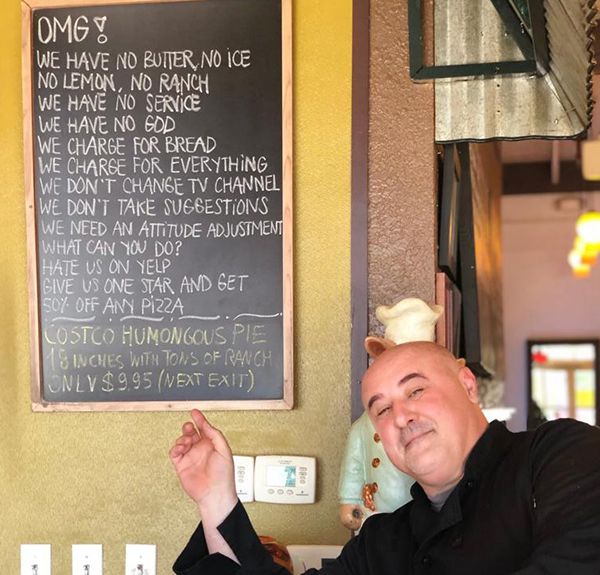
“Give us one star on Yelp and get 25% off any Pizza!” chef Davide Cerretini, owner of the Italian joint Botto Bistro, advertised in 2014. The discount would then be changed to 50% after a time. Why would he do that? It was because he got tired of Yelp.

Like many small businesses, [Botto Bistro] was enslaved to the whims of online reviewers, whose public dispatches could make or break its reputation.
[…]
In the months after Botto Bistro’s grand opening, Cerretini began receiving dozens of calls from Yelp salespeople, who implored him to buy ads.
According to Cerretini, when he rebuffed these offers, he’d often notice that freshly posted 5-star reviews would be removed from his page — often no less than 24 hours after getting off the phone with a Yelp rep.
“I came from Italy, and know exactly what mafia extortion looks like,” he says. “Yelp was manipulating reviews and hoping I would pay a protection fee. I didn’t come to America and work for 25 years to be extorted by some idiot in Silicon Valley.”

And that is why he made such a crazy offer to customers. For small business owners like him, Davide is a hero.

More details about this story over at The Hustle.

(Image Credit: Davide Cerretini)

11 Jun 12:50

Business Plan: A Grilled Cheese Cart

by Miss Cellania
Malady579

This is hilarious.

Daniel Danger has a business plan of opening a grilled cheese cart to sell grilled cheese sandwiches for $1 each. No options, no tomato, no change given. He lays out the details in a Twitter thread.

Even though it's pretty straightforward, Danger answers a lot of questions from his admirers.

The problem is that this idea is supposed to go into effect if his art business doesn't work out. But now everyone wants a $1 grilled cheese from a yellow cart. Read the whole story at Twitter. You'll also get to see the back of the cart. -via Metafilter

(Image credit: Daniel Danger)

06 Jun 16:59

LEGO and IKEA Announces BYGGLEK to Promote Creative Play

by Allen "Tormentalous" Tran

Last year, LEGO announced they will be collaborating with the popular Swedish furniture IKEA to promote more creative play in the home environment. After that announcement, we really didn’t hear much about it ever since but recently, IKEA put out a press release to announce BYGGLEK which are some new products coming out in 2020 to stimulate play around the home. Although LEGO is geared towards kids, BYGGLEK will cater towards everyone, kids and adults alike. There’s not much else revealed from the press release but I’m sure more details will emerge by the end of the year.

The post LEGO and IKEA Announces BYGGLEK to Promote Creative Play appeared first on The Brick Fan.

05 Jun 22:45

New Ikea Dressers Are Designed to Reduce Tip-Over Injuries and Deaths

by Maggie Veatch

Consumer Reports has no financial relationship with advertisers on this site.

Consumer Reports has no financial relationship with advertisers on this site.

After many injuries and deaths caused by dressers that tipped over onto children, Ikea is introducing new products designed to reduce tip-over incidents. The new line, called Glesvar, will be available in stores in the U.S. and the United Kingdom starting in December 2019.

The furniture incorporates three new designs to protect against tip-overs. One has interlocking drawers that prevent multiple drawers from opening at the same time, increasing stability. The other two require anchoring furniture to a wall before they will function. Only the first variety will be available in the U.S. for the foreseeable future, Ikea says.

In recent years Ikea has come under fire for selling unstable furniture linked to the deaths of at least 10 children. While the company has recalled 17.3 million dressers, one model linked to a death, a Hemnes eight-drawer dresser, is still on the market. Approximately every 20 minutes, someone in the U.S. is injured or killed when a piece of furniture, a TV, or an appliance tips over, according to the Consumer Product Safety Commission.

Ikea says it is committed to product safety. “If our vision is to create a better everyday life for people, we need to make their everyday life safer,” Vladimir Brajkovic, head of product engineering at Ikea, told CR.

Consumer safety advocates are optimistic but cautious. “This is a move in the right direction, but we are urging Ikea to extend this type of thinking to its entire product line and for other manufacturers to design all dressers to be resistant to tip-overs, not just specific models,” says Nancy Cowles, executive director of Kids in Danger, which has advocated for safer dressers.

Crystal Ellis, whose 2-year-old son Camden was killed by an Ikea dresser in 2014 and who is a founding member of Parents Against Tip-Overs, says that Ikea’s new product line is a reminder of the risks posed by tip-overs. “After all of the deaths and injuries caused by defectively designed dressers that easily tip over," she says, "we believe this is a recognition by Ikea of this significant health risk to toddlers and other consumers.” 

James Dickerson, Ph.D., chief scientific officer at CR, calls the interlocking drawers a promising approach (see the video below, provided by Ikea) but worries that people may try to bypass the mechanism. And he's reserving final judgment until the dressers become available in December and CR can inspect them.

Dickerson is particularly concerned about the other new designs that require anchoring the dresser to a wall in order for it to function. In one of the designs, the drawers work only after the furniture is attached to the wall. The other design has only two legs, in the front, requiring the back of the dresser to be mounted on a wall, according to Ikea (see the image at the top of the page).

“People buy furniture expecting that it will be sturdy and resist tipping over,” Dickerson says. “The solution is to build sturdier furniture, not to push an additional burden for safety onto consumers by requiring them to anchor.” CR continues to recommend that consumers anchor dressers to the wall while recognizing that furniture anchors are not an easy fix for many people.

Under the current voluntary industry standard, dressers are tested by placing a 50-pound weight on an open drawer while the others are closed to see whether they will stay upright. CR has urged the furniture industry to make the test more rigorous by increasing the test weight to at least 60 pounds.

Ikea had long resisted tougher standards for dressers, but Brajkovic told CR that the company now supports the 60-pound test. (CR previously tested three Ikea dressers that are already on the market, and two of them passed CR’s more rigorous 60-pound test.)

Earlier this month, Rep. Jan Schakowsky (D-Ill.) introduced legislation that would require an even tougher—and mandatory—standard for dressers. Called the Stop Tip-overs of Unstable, Risky Dressers on Youth (STURDY) Act, the law would require all manufacturers to test their dressers to this higher threshold before bringing them to market. CR strongly supports the legislation.

“What we all should be working on is coming up with products that resist tipping over,” says William Wallace, manager of home and safety policy at CR. “We think the market can get there. We think it should get there. And we think it should happen now.”

Consumer Reports is an independent, nonprofit organization that works side by side with consumers to create a fairer, safer, and healthier world. CR does not endorse products or services, and does not accept advertising. Copyright © 2019, Consumer Reports, Inc.


05 Jun 18:52

IKEA Unveils Robotic Furniture, The Urban Village of the Future & More

by SA Rogers
[ By SA Rogers in Architecture & Cities & Urbanism. ]

How can we make housing more affordable, livable and sustainable in the face of climate change, rapid urbanization and other pressing issues? IKEA has some ideas. The Swedish retailer just unveiled its upcoming collaborations and projects at its annual event, Democratic Design Days, and they range from a new modular way of building entire cities to robotic furniture for small spaces.

The Urban Village Project

SPACE10, IKEA’s global research and design lab, worked with EFFEKT Architects to develop an urban housing concept rolling together a wide variety of sustainable and equitable approaches as well as emerging technologies. The Urban Village Project “rethinks how we design, build, finance and share our future homes, neighborhoods and cities,” focusing on flexible homes built entirely from sustainable cross-laminated timber – and that’s just the beginning.

“Our cities are facing some of the biggest challenges to date—from rapid urbanization to aging populations, from a climate emergency to increasing feelings of loneliness and anxiety in our urban environments. On top of that, we experience rising and unpredictable housing prices in cities all around the world and the prospects are bleak. We need to almost double our cities in just a few decades to house a rising urban population—which creates a strong link between how we choose to evolve our urban areas and the fate of humanity. Therefore, we need to rethink our built environment, starting now.”

Not only are these houses based on IKEA’s signature flat-pack, modular design ethos, so they can easily be customized for the needs of individual residents and families, they’re designed for disassembly, unlocking “a circular material loop” so that almost all building components and materials can be disassembled and replaced, reused and recycled during and after the lifecycle of the building. They’d be pre-fabricated, mass-produced and flat-packed to drive down costs, and crucially, IKEA introduces new ideas for democratic access inspired by community land trusts and co-operatives.

“The Urban Village Project seeks to make everyday life more affordable. The idea is to maximise the advantages of living in a community that can pool and share resources. First, we’d introduce a monthly rate for all your essentials: rent, electricity, water, heating, maintenance and shared facilities. Secondly, we’d unlock better deals on daily needs like food, media, insurance, transport and recreation through flexible add-on subscriptions. Thirdly, each month every resident would have the option of buying ‘shares’ of real estate—to access ownership progressively and cash in later as the property value increases.”

“The Urban Village Project would enable more people to become homeowners by creating a form of housing co-operative. With significantly lower monthly rents and more disposable income, this unique legal setup would allow residents to buy ‘shares’ in the property—when they want to and when they can. This would get rid of expensive down payments upfront alongside interest rates which limit first time buyers from entering the housing market. Over time, the property would be owned by the community, and residents would be able to cash in on the profits.”

But sustainable and equitable modes of living don’t stop at how the structures themselves are designed, built and purchased or rented. Access to community is an important component, with the subscription-based housing model providing multi-generational co-living to promote a sense of well-being. Since the homes are so customizable, they’re accessible, as well. As older people age out of their homes, they can move into more accessible units in the same village, remaining a part of their neighborhood. Residents share access to local food harvesting, renewable energy and composting, and can choose to partake in communal dinners, shared daycare, urban gardening, fitness and other activities together; flexible subscription services provide transportation, insurance, media and recreation too.

Products Made of Ocean Plastic & Manufacturing Waste

IKEA plans to introduce more recycled materials into its own products, as well. The upcoming Musselblomma collection, a collaboration with Spanish designer Inma Bermúdez, incorporates plastic collected by Spanish fishermen in the Mediterranean sea into a series of polyester fabrics in vivid colors and patterns. The series takes visual inspiration from the source of these materials; you’ll find abstracted fish shapes, soothing blue-greens and corals throughout the collection of bags, cushion covers and tablecloths.

As part of its new initiative called “Better Air Now,” IKEA is also transforming a common manufacturing byproduct into tactile, organic woven items. Förändring (which means “change” in Swedish) is a collection of rugs, bowls, lampshades and baskets made with rice straws, a harvesting residue that’s commonly burned for disposal, contributing to air pollution and smog. Coming in deep shades of blue and black, these items are expected to be released by the end of the year.

Robotic Small Space Solutions

Since they’re already known for expertly packing a ton of function into tiny spaces, it was probably only a matter of time before IKEA got in on some robotic transforming furniture items. The brand is collaborating with MIT-based startup Ori Living to offer “Rognan,” an all-in-one room solution offering a trundle bed, movable walls, a sofa, storage and simple touch-screen operation so you can transform a living room into a bedroom within seconds with virtually no effort. Set to launch in Hong Kong and Japan in 2020, Rognan will undoubtedly be anxiously awaited by everyone who’s ever dreamed of enjoying this kind of functionality in their own spaces. Hopefully it won’t be long before it’s available everywhere else, too.

Share on Facebook

[ By SA Rogers in Architecture & Cities & Urbanism. ]

[ WebUrbanist | Archives | Galleries | Privacy | TOS ]


22 May 00:15

Apple Updates MacBook Pro Keyboard to Address Reliability Concerns

by Nicholas De Leon

Consumer Reports has no financial relationship with advertisers on this site.

Consumer Reports has no financial relationship with advertisers on this site.

Apple today introduced an updated line of MacBook Pro laptops featuring a new keyboard that the company says will address long-standing consumer complaints about keys that stick, fail to produce characters, or repeat characters after a single press.

The company has also extended its keyboard service program, allowing those who already own an eligible Apple laptop to get a repair at no cost—even if the laptop is outside the warranty window.

You can take your laptop to an Apple retail store or an authorized repair center for the repair. If you’ve already paid for a keyboard repair, you can request a refund. (Get more details on the keyboard service program.)

Apple did not share many details about the upgraded keyboard, which will arrive in stores on the new MacBook Pros this week, but says it uses new materials to mitigate the reliability problems.

The manufacturer has consistently maintained that only a small number of consumers have experienced the keyboard problems, but a recent Wall Street Journal article deftly summed up users’ frustration with keys that produce words like “thissss.”

While Consumer Reports technicians did not encounter such problems in the course of our test protocol, Richard Fisco, who oversees electronics testing for CR, says the “butterfly keyboard” on Apple’s MacBook, MacBook Air, and MacBook Pro laptops has been divisive.

“From the day this shipped, people have been complaining about it,” he says. He also says the keys have very little travel, which refers to the distance they go when pressed. “It’s just not pleasant to use.”

Apple declined to comment on the record for this article.

But critics believe Apple’s pursuit of slimmer laptop designs—which required the creation of the new butterfly keyboard mechanism to fit the reduced space inside the computer—might have compromised the keyboard’s essential functionality.

“The issue is design anorexia,” says Kyle Wiens, CEO of iFixit, a company that provides tools and guides to repair electronic devices. “Apple made the keyboard thinner and thinner and thinner, and those trade-offs are biting.”

Despite the keyboard, Apple’s laptops typically perform well in our testing, owing to their accurate, high-resolution displays; fast performance; and long battery life.

The previous-generation MacBook Pro is currently the top-scoring model in our ratings.

After the 2016 release of the first MacBook Pro with the butterfly-style keyboard, consumers complained that dust or debris that worked its way under a keycap could prevent the key from registering a press.

Early versions of the keyboard did not allow for the removal of an individual keycap, which meant consumers often had to replace an entire keyboard to repair problems. But that changed with last year’s MacBook Air models.

The New MacBook Pro

In addition to getting a new keyboard, the updated 15-inch MacBook Pro can now be configured with an octa-core (8-core) Intel processor, which Apple claims can deliver up to twice the performance of the previous-generation quad-core MacBook Pro—a claim we’ll test once we have the new laptop in our labs.

The 15-inch model is available on Apple.com and will be in retail stores by week’s end at a starting price of $2,400. A 13-inch model with an updated Intel processor starts at $1,800.

Consumer Reports is an independent, nonprofit organization that works side by side with consumers to create a fairer, safer, and healthier world. CR does not endorse products or services, and does not accept advertising. Copyright © 2019, Consumer Reports, Inc.

13 May 23:24

A designer comes up with a much better supermarket receipt

by Mark Frauenfelder

Susie Lu is a senior data visualization engineer at Netflix. She wanted to make a better grocery store receipt so she bought a thermal printer and went to work designing an infographic style receipt that is legible on the printer's crappy resolution. Her design makes it easy to see what categories of food you spent the most and least on and the relative price of individual products.

[via Fast Company]

Image: Twitter

30 Apr 02:07

6 Airfare Myths That Could Cost You Money

by Barbara Peterson

Consumer Reports has no financial relationship with advertisers on this site.

Consumer Reports has no financial relationship with advertisers on this site.

Searching for airfares can be a time-consuming and frustrating exercise. And unsurprisingly, the internet is teeming with advice from self-styled experts with ideas about everything from the best time of day to search to how many days in advance you should purchase your ticket.

The only problem is, many of these tricks are either outdated or simply wrong. And if you blindly follow them, you could be missing out on better deals and paying more than you need to.

The fact is that as the airline industry develops more sophisticated ways to sell tickets to consumers, the rules constantly change. Here, the half-dozen most commonly held myths, and the real deal.

Myth: Tuesday Is the Best Day to Book Airfares

This magic formula for nabbing a great airfare has been so widely believed for so long that it even earned its own moniker: Travel Tuesday.  

Like many myths, this one sprouted from a grain of truth—the once-common practice whereby airlines “loaded” their fares into their reservation computers, with the highest volume of deals often landing on Mondays, meaning there’d be more low fares to snap up the following day, according to William J. McGee, aviation adviser to Consumer Reports.

But now airline reservation systems move at warp speed. “The airlines have become very sophisticated, and fares are constantly changing, 24 hours a day, seven days a week,” McGee says.

Rather than offering the best deals on a particular day of the week, airlines increasingly use flash sales to stimulate business, and those can pop up anytime. An analysis by airfare research site Hopper showed that Tuesday was the cheapest day to book for only 1.6 percent of domestic routes. One exception is the Tuesday following Cyber Monday after Thanksgiving, when the airlines join the holiday sale frenzy with an official Travel Tuesday fire sale. But that’s only for that one day, and most good deals for winter vacation travel are sold out weeks, if not months, before then.

Myth: A Round-Trip Airline Ticket Is a Better Deal Than Two One-Way Fares

It has long been assumed that you’ll save money buying a round-trip fare over two one-ways, either on the same airline or by combining flights on different carriers.

But according to price data in a recent study by the Airlines Reporting Corporation, the clearinghouse that tracks all U.S. airline ticket sales, that’s not necessarily so. Part of what makes combining one-way fares potentially cheaper is the development of “hacker fares” by online travel search sites, such as Kayak and Hopper.

Kayak claims that consumers booking two one-way tickets are “usually paying less than they would if it were a regular round-trip flight.” Moreover, data show that this tactic is becoming increasingly popular: The percentage of one-way tickets sold (out of all ticket sales) grew from 29 percent to 42 percent between 2014 and 2017, according to the ARC report.

Myth: A Connecting Flight Will Always Be Cheaper Than Flying Nonstop

When you’re shopping for airline flights, a nonstop flight is always preferable to one that gets you to your destination via an out-of-the-way pit stop that adds hours to your trip and also uncertainty by raising the odds of delays or missed connections.

In a normal marketplace, a clearly inferior product would cost less than the preferred option.

But, oddly, a typical airfare search for all flights for a particular route and date turns up some one or even two-stop itineraries that not only don’t save you money but also might even cost more. Henry Harteveldt, a travel industry analyst at Atmosphere Research, says that you can sometimes save money by taking a connecting flight but that there's no logic to when and where this would apply.

“It all has to do with how complicated the airlines’ fare structures have become,” he says. “It's gotten a lot harder to game the system.” 


Myth: The Best Airfares Require a Saturday Overnight Stay

Major airlines long ago slapped a Saturday night requirement on their lowest fares to make them less attractive to business travelers on an expense account. And to some extent they still do: Saturdays tend to be slower for air travel, and thus you can often—but not always—find better fares for departures on that date.

But industry disrupters such as Southwest and JetBlue—and ultra-low-cost lines like Frontier and Spirit—have chipped away at this Saturday night penalty, so it’s no longer an ironclad rule.

“One of the key reasons airlines did away with this is that corporate travel managers were saying ‘we’re tired of paying so much more’” than leisure travelers, says Atmosphere’s Harteveldt.

But there are exceptions. “The Saturday night penalty is more likely to apply to international travel,” he says. 

Myth: It’s Always Better to Book as Far in Advance as Possible

Most airlines put their flights up for sale at least eight months in advance, and some, such as American and Delta, start selling tickets 11 months ahead of time. So if you know you’ll be traveling at a specific date in the future, it makes sense to lock in a fare as soon as you can, right?

Not necessarily. That’s because airlines don’t start actively managing inventory for a specific flight until around three months before departure, according to the website FareCompare. The site recommends that you hold off and sign up for fare alerts, which are offered by a number of airfare search sites.

They say that if you buy earlier, you’ll probably pay a midrange price, which is usually more than what you’d pay if you wait.

Myth: Low-Fare Airlines Will Always Beat the Major Airlines on Price

Years ago, there were basically two types of airlines: higher-priced scheduled airlines and cut-rate charter companies. That distinction disappeared after the government deregulated the airlines 40 years ago, and now every airline, it seems, is trying to be all things to all people.

And while you’d assume that an airline with lower costs can pass along those savings to customers—much like a discount warehouse can offer the same goods for less than a high-end store—it doesn’t always work that way.

Even though major carriers like American have higher unit costs than, say, Spirit Airlines, new fare types like Basic Economy have blurred the lines. But the cheapest fares on a mainstream airline often have onerous restrictions, so read the fine print before you put your money down.

“Our advice to travelers is that you have to shop around,” says Consumer Reports’ McGee. 

Consumer Reports is an independent, nonprofit organization that works side by side with consumers to create a fairer, safer, and healthier world. CR does not endorse products or services, and does not accept advertising. Copyright © 2019, Consumer Reports, Inc.
19 Apr 19:10

Drunk on Smoke: Notre Dame’s Bees Survive Fire

by Associated Press
Confounding officials who thought they had perished, the bees clung to life, protecting their queen.
30 Mar 00:36

Get Back To Work!: A Cat Laptop Scratching Post

cat-scratch-laptop-1.jpg This is the ~$32 Cat Scratch Laptop designed and sold by SUCK UK. The laptop features a customizable screen you can slide any picture you want into, a corrugated cardboard keyboard for scratching, and an attached fuzzy toy mouse(!). You know, whenever my cat curls up on my laptop I always joke to my girlfriend that maybe he's finally decided to start pulling his own weight around here and actually make some money for us. I mean he never is, he's usually just pulling all my keyboard keys off, but I joke about it anyways. My girlfriend always laughs, but deep down I know she hates me and wishes I'd stop. Keep going for a few more shots.
15 Mar 19:35

Samuel L. Jackson on the MAGA crowd: ‘I know how many motherf–ers hate me’

by Kaiser
Malady579

This made me laugh.

Once a year, or maybe once every two years, Samuel L. Jackson will sit down for a lengthy magazine profile. Those annual events are always some of my favorite moments of the year – Sam is immensely readable, meaning he is the kind of gifted orator who knows the value of a pithy quote, yet he can also ramble on in profound multi-page diatribes. Esquire profiled Sam early one morning after he and a group of buddies went golfing at, like, dawn. Apparently, Sam just sat in the golf club, dropping f-bombs and n-words while white folks looked sheepish. The whole piece is absolutely worth your time – go here to read it. Some highlights:

His childhood dream: “We looked at movies and went home and redid the movies. We pretended to be whatever we had seen that day. But I wanted to be a marine biologist. I wanted to be the black Jacques Cousteau, because I loved 20,000 Leagues Under the Sea.. And I loved all those pirate movies. I wanted to be on a boat out in the ocean. I always thought the inner space was a lot more interesting than outer space.

Whether he ever feels angry about segregation: “I don’t think I was ever angry about it. I’m angrier now about it than I was then just because I see these guys and I know these are the same guys: Trump and all those a–holes, Mitch McConnell. But they’re the same f–king guys. And when I hear their voices, I hear the same voices…There was no doubt about where they stood, that you were never going to be their equal and, if possible, they were going to make sure you never had as much s–t as they had. And they were worried about the chasteness of their women, and miscegenation, and not having enough of them, there being more of us than there are of them.

On doing seven movies a year: “I’ve never understood that whole “I want to do two movies a year” thing. It’s like, you don’t love the job? I want to get up and act every day. And there’s a limited number of acting possibilities in everybody’s lifetime. So I’m trying to maximize my sh-t.

Whether he was concerned about making “quality movies”: “What’s a quality movie? What the f–k is that? Quality movies are movies that make me happy, a movie I would’ve gone to see. I’m not trying to make people cry. I’m not trying to do the profound-storytelling thing. I was entertaining. I used to go to movies to forget my f–king troubles. I used to go to movies to enjoy myself, to get out of my segregated f–king life, to see what the world was like, to travel. I want people to come, smile, laugh, leave that movie going, “Man, that was awesome.”

Whether he’s still the same radical guy he was in the ‘60s: “I’m the same cat. I still got my politics. I still have my anger. But I can’t regulate a bank. I can’t deregulate a bank. I can’t do any of that. It’s been a great revenue stream right now. And because I have that revenue, we’re able to have our names on the f–king wall of the National Museum of African American History and Culture. We’re able to give money to the Children’s Defense Fund. We’re able to dig a well in Africa. But I don’t run around with a film crew and say, “Show everybody what I’m doing.” I just do what I do. It’s not like we’re just building up a stack of cash somewhere for whatever’s going to happen.”

On dissing Donald Trump on Twitter: “This motherf–ker is like ruining the planet and all kinds of other crazy sh-t. And the people think that’s okay. It’s not f–king okay. And if you’re not saying anything, then you’re complicit. And I wouldn’t give a f–k if I was a garbageman and I had a Twitter account; I’d tweet that sh-t out. I’m not thinking about who I am and what my job is when I do that sh-t.

Whether he cares about antagonizing the MAGA crowd: “I know how many motherf–kers hate me. “I’m never going to see a Sam Jackson movie again.” F–ck I care? If you never went to another movie I did in my life, I’m not going to lose any money. I already cashed that check. F–k you. Burn up my videotapes. I don’t give a f–k. “You’re an actor. Stick to acting.” “No, motherf–ker. I’m a human being that feels a certain way.” And some of this sh-t does affect me, because if we don’t have health care, sh-t, and my relatives get sick, they’re going to call my rich ass. I want them to have health care. I want them to be able to take care of themselves. This is how I feel.

When he’ll quit acting: “Till I can’t do it. Michael Caine’s still acting, right? It’s acting. It’s not like I’m digging a ditch. I go on set, do some sh-t. I go back and sit in my trailer for two hours watching TV, eat a sandwich, read. And I go back and do ten more minutes and go sit down some more. So, yeah, it’s a great job.

[From Esquire]

I don’t have any tattoos, but I’d love to get this one etched on my body: “I know how many motherf–kers hate me. “I’m never going to see a Sam Jackson movie again.” F–ck I care?” There’s tons of other stuff in there, like Sam defending Quentin Tarantino’s use (overuse) of the n-word (again) in his scripts, and how pissed off he is about all of the people who hated Barack Obama, and so much stuff about his college years and growing up in the segregated South. It’s a great piece and Sam is a national treasure.

Photos courtesy of Esquire’s Instagram.

13 Mar 19:02

Startled Cat Scrambles Away From Puma On Television

This is a super short gif (I couldn't find the original video) of a cat licking its paw when it glances up at the television, sees certain death (in this case a puma) barreling right for it, and darts away as fast as its little legs will carry it. For reference, my dog barks at all the animals she sees on television. Of course she also barks at leaves blowing around outside, her shadow, and, once after I gave her some medicine that didn't agree with her stomach, her own vomit. "What the -- that blob was trying to attack me from the inside" I imagine her thinking before deciding to try to lick it back up as I begged her not to and scrambled for the paper towels. Thanks to Misty M, who agrees this is exactly why you should only lick yourself with your back to a wall.
11 Mar 20:29

Watching this toddler try and try to stack cups is highly engaging

by Carla Sinclair

There is something so satisfying about watching this toddler struggle – and then finally succeed – in stacking her colorful nesting cups. After trial and error – and deep concentration – two-year-old Clarissa, who her mother says "was a little behind on certain things," celebrates her victory with excited squeals and dance moves. A nice reminder that it takes lots of "fails" to become a success.

Via Mashable

05 Mar 00:16

'Theory Of Time', An Art Installation With Words That Move With The Sun

This is a video of street artist DAKU's 'Theory Of Time' art installation in an alley in Goa, India. As the sun moves across the sky the shadows of the words printed above the street on transparent panels move with it. That's pretty cool. I tried to read the whole thing but the timelapse made it move too fast. Plus I got distracted watching all the people. Why read when you can people watch? That's what I say every time I wonder what the hell I'm doing at the library. Keep going for a couple still shots the much smoother Instagram video.
15 Feb 00:03

50 Years Later: Mysteriously Perfect ‘Tree Circles’ Spotted from Sky in Japan

by Kurt
[ By WebUrbanist in Culture & History & Travel. ]

Like a giant work of long-term land art, a pair of eerily precie circles can be seen over Miyazaki, Japan, made up of cedars planted a half-century ago. As it turns out, though, this was not aesthetic in intent, but scientific: the trees were carefully arrayed to test out a botanical theory.

Specifically, Japan’s Ministry of Agriculture, Forestry and Fisheries secured land in the mid-1970s to create this experimental forest to determine how tree spaces would impact growth speed and height. Trees were planted at ten-degree increments to create ten concentric circles – the closer to the center, the naturally tighter-packed they were, hence the geometry of the results.

And it turns out tree growth is shaped by proximity, so the trees toward the outer rings grew taller, resulting in an overall graduating shape from the lower trees in thee center, which makes the result look even more designed for effect rather than science. The trees were to be cut down after the experiment, but upon seeing the results, officials may preserve them as works at the intersection of art and research.

Share on Facebook

[ By WebUrbanist in Culture & History & Travel. ]

[ WebUrbanist | Archives | Galleries | Privacy | TOS ]


13 Feb 02:31

What Amazon Buying Eero Could Mean for Consumers

by Nicholas De Leon

Consumer Reports has no financial relationship with advertisers on this site.

Consumer Reports has no financial relationship with advertisers on this site.

Amazon’s agreement to buy the wireless router manufacturer Eero could make it easier for homeowners to manage a wide array of wireless devices, like smart thermostats and video doorbells, according to analysts and Consumer Reports’ in-house experts.

But some of them expressed concern over how often high-profile startups get bought by the tech world’s behemoths.

“The problem we face as consumers is that we don’t know what we’re missing” when innovative companies don’t stay independent, says Stacy Mitchell, co-director at the Institute of Local Self-Reliance, an advocacy organization. “That may be a trade-off for the modest convenience that may come with Amazon owning Eero.”

The deal will see Amazon absorb the company that helped popularize the concept of mesh networks. These are WiFi networks that combine a base station with multiple satellite units, or nodes, to uniformly spread WiFi signals throughout the home. The goal of a mesh network is to eliminate connectivity problems and stop devices from dropping their WiFi connections as users move from room to room in their homes.

“With mesh, you’re getting increased range, a stronger signal, and probably better performance,” says Richard Fisco, who leads electronic testing at Consumer Reports.

The Eero three-pack, $500, is one of the highest-ranked wireless routers in our ratings, with our testers noting strong performance (depending on the wireless network range), easy-to-use controls, and automatic firmware updates, which helps keep you and your data safe from hackers.

Amazon and Eero revealed few details of their plans, but in a press release posted on Amazon’s site, Eero CEO Nick Weaver says, “We’re excited to learn from and work closely with a team that is defining the future of the home.”

Over the past five years, Amazon’s Echo devices and Alexa digital voice assistant have helped popularized home automation. Amazon also owns Ring, a smart doorbell company. 

What's Good About the Deal?

For consumers, Amazon owning Eero could make it easier to set up and manage the wide range of wireless devices in their homes.

“A number of companies have been trying to address a very real pain point for consumers around their WiFi experience at home,” says Brad Russell, research director for the connected home at the Parks Associates research firm. “If you can control the router and the user interface, then you’re golden.”

Amazon could eventually let users control their Eero router using Alexa voice commands, Russell says, making it easier to add or remove devices from the network, or turn off internet access to select devices. That way parents could, for example, tell Alexa to disconnect their children’s laptops from the internet so that they can put down “Fortnite” and come down for dinner.

“At the end of the day, Amazon wants to optimize the whole connected home experience, and the easiest way to do that is for the hardware and networking to be aligned with one another,” he says.

Russell also says that the acquisition could lead to lower-priced options for Eero products. A bundle of one Eero base station and one satellite unit currently costs $300, while Eero Plus, a subscription service that enables advanced malware protection and ad blocking, is $99 per year. Even without waiting for new products, consumers might benefit from deals when Amazon puts its own devices, such as Kindle e-readers and Echo Dot smart speakers, on sale. 

Should Consumers Worry About Privacy?

Routers sit at the center of your home network and necessarily handle all of the internet traffic entering and leaving your home. Amazon collects data through its Echo speakers, Fire tablets, and other devices, and it’s technically possible for a router to do that, too.

“All of these issues will have to be dealt with appropriately, with things like privacy policies, consumer choice, and voluntary opt-in, in a way that consumer confidence is not eroded,” says Russell of Parks Associates.

Amazon isn’t the only data-driven tech giant in the router business. Google’s privacy policy states that the company’s mesh routers do "not track the websites you visit or collect the content of any traffic on your network."

Eero’s website similarly clearly states the company does not track users’ browsing habits, and in public statements Amazon has said it doesn’t plan to change that policy.

Who Else Makes Mesh Routers?

Eero was one of the first companies to popularize mesh networking, but consumers who want to steer clear of Amazon products have other options.

Other well-known manufacturers, including Arris, Google, Linksys, and Netgear, also produce mesh network routers—and several of these products do well in our ratings.

“They didn’t jump on the mesh bandwagon early like Eero, but they’re there,” Fisco says.

In the next few years, consumer options will increase even more, according to Fisco. The Wi-Fi Alliance, an industry consortium that manages WiFi standards, has developed a new standard called EasyMesh that will let consumers create mesh networks composed of routers made by different companies—and sold for different prices.

“You’ll be able to hook up a $100 router that’s compatible with the mesh standard to your network and suddenly you’ll have a mesh network,” Fisco says. “Now you won’t have to go out and spend $400 on a whole mesh system.”

EasyMesh hasn’t rolled out yet, however. Router manufacturer Arris announced the first model last summer, but it hasn’t been released yet. 

Should Consumers Worry About Privacy?

Routers sit at the center of your home network and necessarily handle all of the internet traffic entering and leaving your home. Amazon collects data through its Echo speakers, Fire tablets, and other devices, and it’s technically possible for a router to do that, too.

“All of these issues will have to be dealt with appropriately, with things likes privacy policies, consumer choice, and voluntary opt-in, in a way that consumer confidence is not eroded,” says Russell of Parks Associates.

Amazon isn’t the only data-driven tech giant in the router business. Google’s privacy policy states that the company’s mesh routers don’t "track the websites you visit or collect the content of any traffic on your network.” Eero’s website similarly clearly states the company does not track users’ browsing habits, and in public statements Amazon has said it doesn’t plan to change that policy. 

Should Consumers Worry About Privacy?

Routers sit at the center of your home network and necessarily handle all of the internet traffic entering and leaving your home. Amazon collects data through its Echo speakers, Fire tablets, and other devices, and it’s technically possible for a router to do that, too.

“All of these issues will have to be dealt with appropriately, with things likes privacy policies, consumer choice, and voluntary opt-in, in a way that consumer confidence is not eroded,” says Russell of Parks Associates.

Amazon isn’t the only data-driven tech giant in the router business. Google’s privacy policy states that the company’s mesh routers don't "track the websites you visit or collect the content of any traffic on your network." Eero’s website similarly clearly states the company does not track users’ browsing habits, and in public statements Amazon has said it doesn’t plan to change that policy.

Consumer Reports is an independent, nonprofit organization that works side by side with consumers to create a fairer, safer, and healthier world. CR does not endorse products or services, and does not accept advertising. Copyright © 2019, Consumer Reports, Inc.
25 Dec 18:21

Cool Vernacular: How Regional Ceiling Heights Shape Room Temperatures

by Kurt
[ By WebUrbanist in Architecture & Houses & Residential. ]

Modernism sought to bring a healthy uniformity to architectural design, in part through with clean lines and material minimalism. New technologies like air conditioning also allowed for an unprecedented level of global standardization in terms of temperature-controlled spaces. Of course, this often meant disregarding local traditions that had been successful for centuries (or longer). Among the regional strategies that got lost along the way was a seemingly small but critical factor: the variable heights of rooms humans build and occupy.

As a vernacular design critic who goes by Wrath of Gnon explains, “Before the International Style (modernism) in architecture, our ancestors knew how to adapt the room heights according to the climate, achieving maximum effect (comfort) for the least effort (energy). Today we trust in the grid and so build 8-9 ft rooms from Bermuda to Reykjavik.”

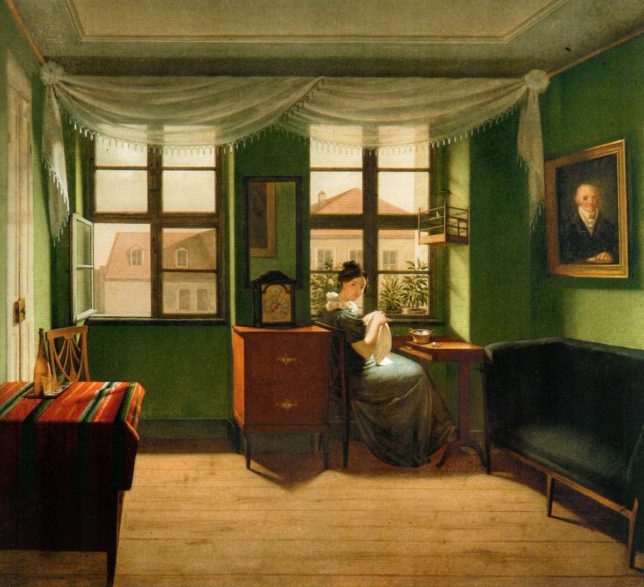
Ideally, the, in warm climates you want higher ceilings because “as hot air rises the difference in temperature at floor level and ceiling level in a tall room can be as much as 4 degrees [celcius] all other things being equal. Here, a comfortable looking gentleman in an 1817 room in Rome,” height around 15 feet. In Brazil, 15-foot homes were typical historically.

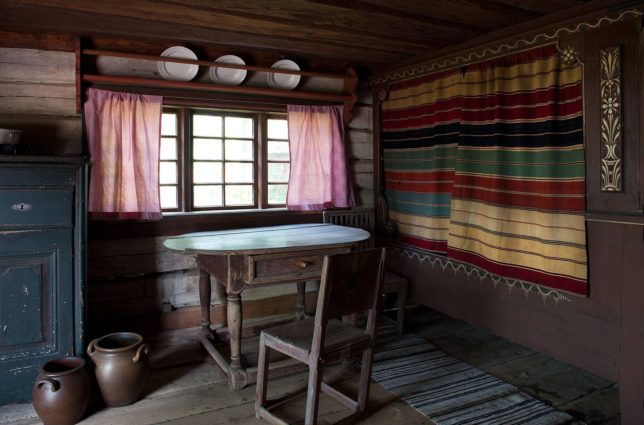
Conversely, in colder climates, lower ceilings meant higher temperatures. “Here are log houses from Russia and Sweden. The efficiently constructed fireplace created an interior draught that sucked fresh air in and expelled smoke, dust. Fans or mechanical ventilation not needed.”

In Japan, “with hot summers and relatively cold winters, a different technique was called for. Wooden houses allowed for perfect fine tunings of openings depending on exact climate and orientation. This traditional room built to maximize airflow, livable in summers without AC.”

In short: choosing the right materials, heights and orientations for a climate makes a big difference. “By building with nature and climate instead or regardless of it, by adapting our waking hours to the rhythm of the sun we can achieve remarkable levels of comfort—even superior—compared to what we have today in our modern homes built to international, industrial standards.”

Share on Facebook

[ By WebUrbanist in Architecture & Houses & Residential. ]

[ WebUrbanist | Archives | Galleries | Privacy | TOS ]


12 Dec 23:53

Oh Wow: Dad Mods Children's IKEA Bunk Beds Into Beautiful Fairy Princess Castle For Daughter

ikea-fairy-princess-castle.jpg This is a video of the process and result of father Eric Strong (who I've since challenged to a flexing contest) modding two IKEA Kura bunk beds "and a bunch of extra parts" into an amazing fairy princess castle for his daughter, complete with tiny rooms and hidden storage. I'm really trying not to be jealous right now but it isn't easy. And if you think the exterior is impressive, wait until you see the interior. Plus, according to a couple quick measurements *retracting tape measure like a lightsaber* it appears to be at least sixty times the square footage of my current apartment, which is technically a large P.O. box. Now not to jinx myself or anything, but with enough Christmas bonus I'm hoping to upgrade to a 2' x 4' storage unit and invite my girlfriend to move in and sleep standing up with me. Keep going for the whole video, but the reveal and tour starts at 5:50.

10 Dec 18:48

Watch how a delivery man reacts when a squirrel jumps on him and climbs up to his head

by Carla Sinclair

It's highly unusual for a squirrel to purposely jump on a human. And it's even more unusual for said human to roll with it, without any shock or flinch, laughing while the squirrel does its thing. As the old lady said in When Harry Met Sally, "I'll have what [s]he's having!"

Via Mashable

21 Nov 20:22

Best data erasure method ever: longbow

by Cory Doctorow

Julian Oliver ("Critical Engineer, artist, immigrant and educator. Shoots arrows, eats plants") has found a novel and by all appearances very satisfying way to safely erase the data from old hard drives: 50lb Longbow, two arrows at 15 yards. (via JWZ)

21 Nov 20:21

Remote "uncontacted" island tribe killed an interloping missionary with arrows

by David Pescovitz
The Sentinelese are one of the world's last "uncontacted" indigenous peoples, a hunter-gatherer tribe who live on the remote North Sentinel Island in India's Andaman Islands chain. This week, John Allen Chau, 27, eager to meet the tribe and hopefully convert them to Christianity, paid local fishermen to help him get near the island. As soon as he illegally landed his canoe on the shore, the Sentinelese fired arrows. He escaped with injuries but returned twice later and was eventually killed. From CNN:

"We refuse to call him a tourist. Yes, he came on a tourist visa but he came with a specific purpose to preach on a prohibited island," said (Dependra Pathak, Director General of Police of the Andaman and Nicobar islands).

Chau did not inform the police of his intentions to travel to the island to attempt to convert its inhabitants...

"According to the fishermen, they used a wooden boat fitted with motors to travel to the island on November 15," Pathak said.

"The boat stopped 500-700 meters (1,640 - 2,300 ft) away from the island and (the American missionary) used a canoe to reach the shore of the island. He came back later that day with arrow injuries. On the 16th, the (tribespeople) broke his canoe.

"So he came back to the boat swimming. He did not come back on the 17th; the fishermen later saw the tribespeople dragging his body around."

(A) 2011 survey only spotted 15 Sentinelese on their island -- the count was done from a distance due to the danger in approaching the tribe. In the 2001 census, the total population was estimated to be 39.

India has designated five indigenous tribal groups in the territory as "particularly vulnerable" due to the loss of sustaining resources and customs.

India's Ministry of Tribal Affairs has said that, with regard to Sentinelese tribes, the Andaman and Nicobar Islands administration "has adopted an 'eyes-on and hands-off' policy to ensure that no poachers enter into the island."

Learn more about the Sentinelese at Survival International.

(Above: 2004 photo of two Sentinelese people taken by the Indian Coast Guard)

30 Oct 00:13

Unseen Movements: Multi-Shot Photography Captures the Complex Trails of Birds

by SA Rogers
[ By SA Rogers in Art & Photography & Video. ]

For all the effort we humans put into light art, birds have us beat – we just don’t realize it most of the time, because their work is invisible to us. Spanish photographer Xavi Bou reveals the hidden works of art produced as birds fly through the sky using a multi-shot technique that captures both the trails they create and the movement of their wings. The results look sort of like fluttery eels, or black ribbons strewn around by the wind.

Bou’s ‘Ornitographies’ series arises from his interest in “questioning the limits of human perception,” combining simple observation of bird behavior from the ground with photography to see what our eyes can’t show us. He takes inspiration from chronophotography, a Victorian technique capturing movement in a series of frames for the purpose of scientific study. Bou’s focus on the birds is less about science and more about the grace of their movements and their unintentional creativity.

“The approach used by Xavi Sou to portray the scene is not invasive; moreover, it rejects the distant study, resulting in organic form images that stimulate the imagination,” reads his description of the project. “Technology, science and creativity combine to create evocative images which show the sensuality and beauty of the birds’ movements and which re, at the same time, clues for those wishing to identify or recognize them.”

The photographer takes thousands of shots and layers them together to produce the final effect. Depending on the species, the exposure and the contrast, you might be able to make out distinct wing feathers in the patterns. A recent trip to Iceland produced some particularly stunning results, and it’s fascinating to imagine which birds produce the more orderly lines versus the chaotic ones.

Share on Facebook

[ By SA Rogers in Art & Photography & Video. ]

[ WebUrbanist | Archives | Galleries | Privacy | TOS ]


29 Oct 22:51

The Red Sox Bucked Convention To Build A Champion

by Travis Sawchik

After Manny Machado waved at a Chris Sale slider for the final out of Game 5 of the World Series on Sunday — the final pitch of the 2018 baseball season — Boston Red Sox catcher Christian Vazquez bolted toward the pitching mound and leaped into the arms of the lanky Sale. The celebration began there and spilled into the visiting clubhouse at Dodger Stadium, where the Red Sox sported goggles to protect themselves from the salvos of alcohol. They sang “New York, New York” and “California Love” as both songs blasted from portable speakers. The Red Sox had their fourth World Series title this century with a 5-1 win over the Los Angeles Dodgers, taking the series four games to one.

But it’s how the Red Sox arrived at this point, as perhaps the greatest Red Sox team of all time, that is so interesting. While dominating the American League from wire to wire, and then doing the same to a postseason field of super teams, the Red Sox challenged so many narratives along the way.

David Price proved that players can shed the most damning of labels with a change in approach (and perhaps just a larger sample of work). Dave Dombrowski, Boston’s president of baseball operations, cashed in trade assets accumulated by former general manager Ben Cherington for premium, veteran players like Sale — even at a time when so many teams were hoarding prospects and young talent. And when other teams elected not to spend in free agency, the Red Sox nabbed the best position player on the market in J.D. Martinez.

MLB’s stiffer luxury tax acted something like a soft cap last winter as even large-market clubs like the Dodgers and Yankees vowed to stay under the tax threshold. The Yankees did so for the first time in the luxury tax era, and the Dodgers spent just $4 million on free agents, electing not to bolster what became a suspect bullpen in this World Series. These teams may have taken this route in part because free agency is increasingly viewed as an inefficient way to build a club — but they also likely had an eye on the upcoming free agent class headlined by Bryce Harper, Machado and perhaps Game 5 Los Angeles starter Clayton Kershaw if he elects to opt out of his deal.

The Red Sox, meanwhile, were aggressors in a season of passivity. They ranked fourth in free agent spending, going over the luxury tax while leading the majors in payroll. With the slow free agent period, Martinez didn’t even reach an agreement with the Red Sox until spring training camps had opened. The five-year, $110 million contract he signed might not produce value for the club in its later years, but the Red Sox wanted to win in 2018 — and Martinez rewarded Boston with an MVP-caliber season and a home run in the clinching Game 5.34

Those investments — salaries that not every club was willing or able to pay — paid off this October. In many ways, Boston built a super team the old-fashioned way.

While much of the Red Sox’s positional group is homegrown beyond Martinez, the Red Sox paid a premium price to acquire Sale from the Chicago White Sox before the 2017 season — and he has been an elite arm in Boston. Prior to 2016, the Red Sox surrendered premium talent for closer Craig Kimbrel. They also gave a record deal to Price that winter — seven years, $217 million. It was their investment in Price that paid off in a big way in the final two weeks of October.

On the biggest stage in baseball, Boston kept handing the ball to a pitcher who many doubted could perform in the postseason. Entering his Game 5 American League Championship Series start, Price had never won a playoff game he had started. He was 0 for 11 with a 6.16 ERA.

To change his postseason reputation, Price changed his pitch mix.

In dominating the Astros in Game 5 of the ALCS, Price threw a career-high share of change-ups, at 41.9 percent of his pitches. He followed that up in Game 2 of the World Series with a change-up rate of 28.4 percent before nearly matching that on Sunday in Game 5 when he threw 89 pitches, 23 of which were change-ups, for a rate of 25.8 percent. He threw just seven cutters, which was his most frequent nonfastball pitch in the regular season.

After allowing a lead-off home run to David Freese on his first pitch of the game, Price blanked Los Angeles for seven innings. He retired 14 straight Dodgers before beginning the eighth by walking Chris Taylor, which ended his night. He allowed one run, two walks and three hits over seven-plus innings. He struck out five.

Price has now won three straight October games, including each of his World Series starts. He’s no longer a choker. “This is why I came to Boston,” he said during a postgame interview. “I know it’s a tough place to play. I know it’s challenging with everything that is going to go on here. I’ve been through a lot in three years since I’ve been here.”

Despite Price’s contributions, it was Steve Pearce who was named the World Series MVP for his home-run heroics, including a two-run blast off of Kershaw in the first inning Sunday. Pearce — acquired in a midseason trade — led all players in the series in win probability added, which measures the change in win expectancy between plate appearances. The Red Sox acquired Pearce for his platoon advantage against left-handed pitching, and he came through for them.

All teams are trying to do the little things, to find value where others do not. All teams are employing data and video, development and coaching, to get more out of players already on the roster. But the Red Sox did a lot of big things, things that others thought they ought not to. They ignored many common narratives and leaguewide trends.

It paid off in a big way.