Shared posts

18 May 22:36

Donald Trump Sends a Big Wet Kiss to Skeptical Conservatives

by Kevin Drum
kurtadb

i agree that i've never understood why conservatives would be worried about this (well, unless the dems win the senate which would be very unlikely if trump won the election).

Over at The Corner, here is conservative #NeverTrumper Jim Geraghty:

One of the most common, and least-easily-ignored questions from Trump fans to #NeverTrump conservatives was, “But what about judges? Don’t you care about the Supreme Court?” Hillary Clinton’s judicial nominees would be awful, but there was little guarantee that Trump, who clearly doesn’t spend much time thinking about judicial philosophy, strict constructionism, or the role of the courts in setting policy, would consistently pick better judges.

I totally get why conservatives don't trust Trump to be a true conservative, but if there's one area where I figured Trump was trustworthy, this was it. Why? Because he obviously knows nothing about this stuff and cares even less. He would just ask the Federalist Society for a list and pick someone from it. Really, conservatives had nothing to worry about on this score.

And sure enough, that's how it played out. Trump released a list of eleven "potential" replacements for Anton Scalia this morning, and Geraghty is pleased: "At first glance, these are all names that conservatives would want to see and no names they wouldn't want to see." And that's not all. John Yoo is happy too:

[Trump] may be starting to unify the party with the right moves — if his list of potential appointments to the Supreme Court is any sign. Everyone on the list is an outstanding legal conservative. All are young, smart, and committed....These names are a Federalist Society all-star list of conservative jurisprudence....Trump clearly turned to the Federalist Society and the Heritage Foundation for advice.

Dan McLaughlin agrees:

The list is mostly cribbed from a prior Heritage Foundation list and from names fed to Trump by Hugh Hewitt in a radio interview, and is heavy on state supreme court judges. It obviously is not the product of much due diligence, as it includes Twitter-savvy Texas supreme court justice Don Willett, who has repeatedly and hilariously mocked Trump on Twitter for months.

Ilya Shapiro calls it "Donald Trump's terrific list of fabulous judges." Paul Mirengoff says the list is "impressive....Trump is talking to the right conservatives when it comes to the Supreme Court. Fellow Power Liner John Hinderaker is also on board: "My sense is that the party is coalescing behind Donald Trump. No doubt this list of excellent judges will accelerate that process."

So there you have it. Trump pretty obviously fobbed off this list to a couple of think tanks and released whatever names they told him to. He was too busy lying about past interviews and tweeting new insults to worry about trivia like this.

18 May 16:10

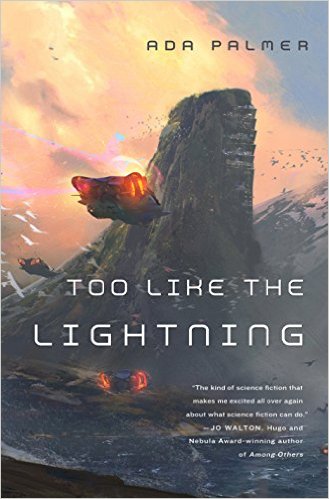
Too like the gender

by Mark Liberman

Is this the future of English pronouns? Ada Palmer's Too Like the Lightning takes place in a world where he/she is as quaintly obsolete as thee/thou. From the book's opening:

You will criticize me, reader, for writing in a style six hundred years removed from the events I describe, but you came to me for explanation of those days of transformation which left your world the world it is, and since it was the philosophy of the Eighteenth Century, heavy with optimism and ambition, whose abrupt revival birthed the recent revolution, so it is only in the language of the Enlightenment, rich with opinion and sentiment, that those days can be described. You must forgive me my ‘thee’s and ‘thou’s and ‘he’s and ‘she’s, my lack of modern words and modern objectivity. It will be hard at first, but whether you are my contemporary still awed by the new order, or an historian gazing back at my Twenty-Fifth Century as remotely as I gaze back on the Eighteenth, you will find yourself more fluent in the language of the past than you imagined; we all are.

A bit later, constrained by that narrative device to use they in dialogue and quotation, but he/she in narrative description, the narrator faux-apologizes again:

Does it distress you, reader, how I remind you of their sexes in each sentence? ‘Hers’ and ‘his’? Does it make you see them naked in each other’s arms, and fill even this plain scene with wanton sensuality? Linguists will tell you the ancients were less sensitive to gendered language than we are, that we react to it because it’s rare, but that in ages that heard ‘he’ and ‘she’ in every sentence they grew stale, as the glimpse of an ankle holds no sensuality when skirts grow short. I don’t believe it. I think gendered language was every bit as sensual to our predecessors as it is to us, but they admitted the place of sex in every thought and gesture, while our prudish era, hiding behind the neutered ‘they,’ pretends that we do not assume any two people who lock eyes may have fornicated in their minds if not their flesh. You protest: My mind is not as dirty as thine, Mycroft. My distress is at the strangeness of applying ‘he’ and ‘she’ to thy 2450s, where they have no place. Would that you were right, good reader. Would that ‘he’ and ‘she’ and their electric power were unknown in my day. Alas, it is from these very words that the transformation came which I am commanded to describe, so I must use them to describe it. I am sorry, reader. I cannot offer wine without the poison of the alcohol within.

Third-person singular animate pronouns are not the only vocabulary items for which the narrator apologizes:

Danaë came to her husband’s side. Do not chide me, reader, for using the gendered ‘husband’ when she stands so close, sheltering against him as she gazes up into his face with her brilliant, pleading blue eyes edged by maternal fear. Our age’s neutral ‘partner’ rings false when her every touch and gesture makes such intentional display of ‘wife.’

And gendered clothing is also an issue:

I cursed myself inside, although, looking back, I forgive myself now. She was irresistible. Remember, reader, though I use archaic words, I am not from those barbaric centuries when men and women wore their gender like a cockerel’s plumes, advertising sex with every suit and skirt. Growing up, I saw gendered costume on the stage, in art, pornography, but to see it in real life is unbearably different: her shallow breaths within constricted ribs, her round French breasts threatening to overflow the low Japanese silks. Here, as Andō wraps his arm around her waist, the costume makes me see them in my mind: the husband wrenching the kimono back to bare the honey-wet vagina. You see now, reader, why, to tell this history, I must say ‘he’ and ‘she.’ Danaë is a thing long thought extinct, reviving out of time ancient venoms perfected by a hundred generations of gendered culture. We around her— from my weak self to the gaping guards— grew up with no inoculation against this pox we thought our ancestors had vanquished. Movies and histories gave us just enough exposure to learn these ancient cues, weakness without resistance, and we can no more unlearn them than you could unlearn your alphabet when facing an unwelcome word.

There's more, of course — in particular, the narrator apologizes again for not using he/she to express affective interpersonal reactions rather than biological sex:

I realize, reader, that I should apologize for my confusing language, since if my ‘he’ and ‘she’ mean anything then certainly this sweet and gentle Cousin in her flowing wrap should be ‘she.’ In this case, alas, I am commanded by an outside power to give Carlyle the masculine, to remind you that this long-lost scion is a prince, not princess, a fact which matters in the eyes of some, and of the law. But I shall do my best to remind you often that a Cousin’s maternal heart beats beneath Carlyle’s broad chest, and I promise, reader, to be consistent in making other Cousins ‘she.’

Or the opposite:

Innocent reader, I take comfort in your confusion, for it is a sign of healthy days if you are illiterate in the signal-flags of segregation humanity has worked so hard to leave behind. In certain centuries these high, tight boots, these pleats and ponytail might indeed have coded female, but I warned you, reader, that it was the Eighteenth Century which forced this change upon us, and here it stands before you. You saw already Princesse Danaë, with the costume of Edo period Japan, and its comportment, too:  modest, coquettish, fragile, and proficient at making the stronger sex risk death for her. Can you not recognize the male of that species? Though French this time, rather than Japanese. Perhaps you argue that a gentle‘man’ of that enlightened age is effeminate, his curls and silks, his poetry and dances, and you are right if we apply the standards of a Goth or other proud barbarian. But would you then oblige me to call all such gentlemen ‘she’? The Patriarch? George Washington? Rousseau? De Sade? Shall I call the Divine Marquis ‘she’? No, good master. To understand what follows, you must anchor yourself in this truth, that, by the standards of the era which sculpted him from childhood, the woman Dominic Seneschal is the boldest and most masculine of men.

But you should read it for yourself — there's also theology, politics, crime,  and flying cars…


17 May 16:02

The Evidence Is Piling Up That Higher Minimum Wages Kill Jobs

by Tyler Cowen

That is David Neumark in the WSJ, here is one excerpt:

Another recent study by Shanshan Liu and Thomas Hyclak of Lehigh University, and Krishna Regmi of Georgia College & State University most directly mimics the Dube et al. approach. But crucially it only uses as control areas parts of states that are classified by the Bureau of Economic Analysis as subject to the same economic shocks as the areas where minimum wages have increased. The resulting estimates point to job loss for the least-skilled workers studied, as do a number of other recent studies that address the Dube et al. criticisms.

The piece is a good brief survey of some of the developments since Card and Krueger.  Here are some alternate links to the piece.

The post The Evidence Is Piling Up That Higher Minimum Wages Kill Jobs appeared first on Marginal REVOLUTION.

17 May 14:42

Colorado Springs woman fired shotgun through wall into neighbor's home

by By Kirk Mitchell The Denver Post
kurtadb

also terrifying, but predictable.

A Colorado Springs woman claims she was moving a shotgun out of reach during an argument to avoid a violent confrontation when she accidently squeezed the trigger, sending buckshot through
17 May 14:41

Golden police say men went to wrong house in home invasion, stabbing

by By Tom McGhee The Denver Post
kurtadb

this is terrifying.

Debra Bergquist rushed to her neighbor's home Monday night to find Jessica Swift, shaken and screaming, her husband lying on the porch bleeding from several stab wounds.
13 May 20:50

Officials openly discussing joint USA-Mexico World Cup bid

by Rob Usry

The two CONCACAF nations are looking to host together

The United States and Mexico are bitter rivals on the soccer field but off of it they could be working together to bring the world's biggest tournament to North America.

ESPNFC reports that not only have the two countries openly discussed joining forces and bidding for the 2026 World Cup but that new FIFA president, Gianni Infantino, has already expressed his support for it.

During the FIFA Congress held earlier this week in Mexico City, officials from both countries were reportedly engaged in talks about the details of such a bid. One board member of the USSF, John Motta, says that Mexico are very open to the idea.

"We have spoken to our Mexican counterparts and are very open to the idea of a joint bid."

"It could be a positive move for the game in both countries and it's also a very exciting proposition for FIFA. We will now go away and formulate a timetable for further discussions."

"But whatever happens, we will bid for the 2026 World Cup -- either jointly or we will go it alone."

-USSF Board Member John Motta; Source: ESPNFC

Mexico's president, Decio de Maria, seems optimistic about the possibility of the joint bid's success and has even met with Infantino personally to discuss the idea.

"Mr Infantino was very enthusiastic about my idea for a joint bid and wants me to pursue this further," De Maria said.

"We are committed to becoming the first country to have staged a World Cup three times and we will do all we can to make this happen, either with the United States or independently."

There hasn't been a jointly hosted World Cup since South Korea and Japan hosted the 2002 tournament. Both Mexico and the United States are emerging as huge markets for the world of soccer and this would be the perfect opportunity to showcase each nation on the world's stage.

Final decision on who will host the 2026 World Cup will come in May 2020.

11 May 20:11

May 5

by foodyear365
kurtadb

this is very similar to the new best recipe "foolproof" hard-boiled eggs which is pretty reliable for us. also, you just made deviled eggs and didn't take them to a picnic or anything?

Deviled eggs with olive oil. I tried a new way to boil eggs from The Good Egg, an egg-only cookbook by Marie Simmons: Bring them nearly to a boil, but not quite, then take them off the stove, cover the pan, and leave for about 11-12 minutes to cook to a firm yolk. The rain continued and a dampness was conveyed through the walls.

(Photo: Walker Art Center, Minneapolis.)

>> May 6

<< May 4


11 May 17:51

Colorado Springs man says sex refusal prompts stabbing

by By Kirk Mitchell The Denver Post
kurtadb

seems....unlikely.

A woman allegedly stabbed a man in the shoulder after he refused to have sex with her early Wednesday morning, according to a Colorado Springs police report.
09 May 20:25

Grocery-store alcohol compromise passes Colorado state Senate, but races clock

by By Joey Bunch The Denver Post
Legislation to allow liquor, wine and full-strength beer in grocery stores passed from the state Senate on Monday with bipartisan support and a mix of support and skepticism from liquor stores and major retailers.
09 May 16:47

Here's An Idea For Urban Living

by Kevin Drum
kurtadb

this is very similar to the "pods" we had at st. olaf. only no communal bathrooms, which is a nice upgrade.

A couple of days ago I read a post at New York magazine about a new kind of apartment:

This weekend, residents will begin moving into New York’s newest experiment in communal living: a blocky red-and-white building in Williamsburg, nestled snugly against the BQE. It’s run by the company Common, which sells “co-living," a relatively new product that’s a start-up version of rental roommate shares.

Click the link for the full story, but it brought to mind a random thought that's been on my mind for a long time. I've never mentioned it since it's light years outside my wheelhouse of knowledge, but it's Monday, so why not?

As near as I can tell, the Common approach is a building full of bedrooms of various sizes and prices. There are common bathrooms and dining areas in various places, and the rent ranges from $2,250 to $3,190. But if you're going to go the dorm route, why not do it better? Take a look at the floor plan below:

I chose the bedroom size because it's the size of my master bedroom. It's plenty large and comfy, with room for two, lots of closet space, and a nice private bathroom. Five of these bedrooms enclose a 1,100 square foot common area, which is about the size of the entire downstairs of my house. In real life it would be divided into various areas, either via walls or potted plants or what have you. There's plenty of space for a large kitchen in the center and various dining, seating, and TV rooms around it. The entire thing is 3,162 square feet, and every bedroom has two doors: one into the common area and a private door to the outside. The building would presumably have the usual amenities depending on how upscale it is: fitness center, laundry facilities, storage areas, etc.

So I'm curious: why doesn't anyone do this? Are there regulatory issues? Has it been tried and failed? It seems like a decent idea that provides a lot of space for the money, and plenty of privacy too if you build the bedrooms right (i.e., good soundproofing). If five roommates are just too many, you could do the same thing with three bedrooms at a somewhat higher cost.

Obviously this isn't ideal for everyone, but especially in high-cost urban areas it seems like a decent compromise between commune and private apartment that could be rented out for a reasonable price. Has this been done? If so, is there something I'm not thinking of that kept it from catching on?

09 May 14:33

Mayans located their cities according to constellations

by Jason Kottke

Mayan Zodiac

15-year-old Canadian William Gadoury has translated his interest in the Mayan civilization into two remarkable discoveries. Gadoury noticed that the locations of the biggest Mayan cities matched the locations of the stars in Mayan constellations. Furthermore, the star charts pointed to the existence of a previously unknown city, the ruins of which have since been uncovered by satellite photography.

"I did not understand why the Maya built their cities away from rivers, on marginal lands and in the mountains," said Gadoury. "They had to have another reason, and as they worshiped the stars, the idea came to me to verify my hypothesis. I was really surprised and excited when I realized that the most brilliant stars of the constellations matched the largest Maya cities."

Someone start a Kickstarter campaign so that he can visit those ruins! (via @delfuego)

Update: Due to a mislabeled file on Wikipedia, I used a photo of an Aztec compass instead of a Mayan image. I have replaced with an image of the Mayan zodiac.

Also, per my post about media coverage of science yesterday, I'll point out quickly that there's much to be skeptical about re: this story (see this post from a Mesoamerican archaeologist). More likely than not, there's a Mayan scholar mailing list going bananas right now...I'll let you know if I hear anything specific.

In the meantime, this story in the Independent contains some satellite photos of the location in question. (via @gunnihinn)

Update: Vice: That 15-Year-Old Kid Probably Didn't Discover a Hidden Mayan City.

The rectangular feature seen on satellite is likely an old corn field (it's not the right shape to be a pyramid). There are indeed ancient Maya sites all over the place, and satellite imagery and LiDAR are being used to discover them, but this doesn't seem to be one of those cases...

On the bright side, the "if it sounds too good to be true, it probably is" study has been successfully replicated again. Science rolls on...

Tags: archaeology   astronomy   Maya civilization   science   William Gadoury
09 May 01:49

Federalist #1 on Donald Trump

by Gerard N. Magliocca
"A dangerous ambition more often lurks behind the specious mask of zeal for the rights of the people than under the forbidden appearance of zeal for the firmness and efficiency of government. History will teach us that the former has been found a much more certain road to the introduction of despotism than the latter, and that of those men who have overturned the liberties of republics, the greatest number have begun their career by paying an obsequious court to the people; commencing demagogues, and ending tyrants."
06 May 19:17

Quote of the Day: Debt? What Debt?

by Kevin Drum
kurtadb

better this than the taco bowl (as far as getting attention).

From Donald Trump, on his plans to run up the deficit in order to rebuild infrastructure:

I’ve borrowed knowing that you can pay back with discounts. I’ve done very well with debt....Now we’re in a different situation with the country, but I would borrow knowing that if the economy crashed, you could make a deal. And if the economy was good it was good, so therefore, you can’t lose.

There you have it. If Trump crashes the economy, he'll just default on our sovereign debt. Easy peasy. Why is everyone so worried?

POSTSCRIPT: This is a pretty good example of the Trump Dilemma™. Do you ignore this kind of desperate plea for attention? Or do you write a long, earnest piece about just why it's a very bad idea indeed? You can hardly ignore it since it's now coming from the Republican Party's presidential nominee. But giving it oxygen just gives Trump the free media he was angling for in the first place. In this case, I'm semi-ignoring it. Josh Marshall takes the opposite tack here. Decisions, decisions.

06 May 14:20

How desperate is Big Beer?

by Wine Curmudgeon

big beerHow desperate is Big Beer to regain its stranglehold on U.S. beer drinkers? So desperate that it’s not enough to mock craft beer; now, even chardonnay is seen as a threat, and that has never been the case in the history of the United States. Beer consumption has outpaced wine since before we were a country.

Nevertheless, Miller Lite came up with this commercial, which says that women should take its product to a chardonnay event. My guess is that wine is seen as a Millennial drink, and someone found a study that said Millennials are forgoing Big Beer for wine. Perhaps one of our visitors with ad agency experience can explain why chardonnay is a target, given that old white guys drink Miller Lite.

For all of my ranting about Big Wine, it has never done anything this stupid. The commercial is below — what were they thinking?

The post How desperate is Big Beer? appeared first on Wine Curmudgeon.


05 May 16:50

I Have a Terrific Deal On Mandatory Arbitration Clauses For You

by Kevin Drum
kurtadb

i love kevin for posts like this

The CFPB has proposed a new rule that would prevent big companies from forcing their customers to accept mandatory arbitration in place of an actual trial in an actual court. Iain Murray is unhappy:

Like most of the CFPB’s rules, this may sound good at first hearing. In fact, it will be a disaster for the average consumer who enters into contracts like credit-card or mobile-phone service agreements....The inefficiency of the legal system has to be budgeted for, and so without arbitration, fees will go up and some people just won’t be offered a service at all.

....Those won’t be the only ways the consumer will suffer — those who are currently “denied their day in court” will as well. Because arbitration services are much cheaper, companies that use them generally pay all the fees for the consumer as well as their own. That’s not the case in court, where the consumer bears a considerable cost. If you are lucky enough to get a contract after this rule goes into effect, you’d better budget something for your day in court, because you’re going to have to lawyer up. Of course, there’s always the chance that you’ll be asked to participate in a class action lawsuit, which this rule is primarily designed to facilitate.

Fair enough. As it turns out, corporations all offered their services quite widely back in the dark ages before arbitration clauses, but it's true that arbitration does indeed have some benefits. Still, we're all free marketeers around here who believe in contracts freely arrived at without undue coercion. Right? So here's what I propose: my bank and my cell phone company should offer me the choice of accepting arbitration or not when I first sign up. If I accept, they offer me a discount. The CFPB's only role will be to ensure that the discount is reasonably in line with the actual cost savings from arbitration. Deal?

No? I guess there must be something else going on. I wonder what?

05 May 13:56

Jane Jacobs believed cities should be fun — and changed urban planning forever

Jane Jacobs had no formal training in urban planning, but she upended the field. Ron Bull/Toronto Star via Getty Images

When Jane Jacobs published The Death and Life of Great American Cities in 1961, she was a lone voice with no credentials speaking up against the most powerful ideas in urban planning. Fifty-five years later, on Jacobs's 100th birthday (honored in today's Google Doodle), urban dwellers are all living in her vision of the great American city.

The Death and Life of Great American Cities was a reaction to urban planning movements that wanted to clear entire city blocks and rebuild them. Jacobs argued this ignored everything that made cities great: the mixture of shops, offices, and housing that brought people together to live their lives. And her vision triumphed.

How Jacobs left her mark on urban planning

 Missy S
Jacobs criticized Lincoln Center in particular in some of her work.

Jacobs's book transformed urban planning, throwing out the giant housing projects and sterile plazas that characterized the urban renewal movement in favor of a vision of a bustling, pedestrian-friendly city.

After World War II, urban renewal pushed 300,000 people, about half of them black, from their homes nationwide to build new high-rises, civic plazas, and office buildings. The buildings themselves in most cities were influenced by Le Corbusier, a famed Swiss architect who in the early 20th century had called for bulldozing downtowns and building in their place beautiful skyscrapers interspersed with parks.

Le Courbusier saw streets as crowded, noisy, smelly, and unpleasant — a "relic of the centuries, a dislocated organ that can no longer function." People-watching could be amusing, he acknowledged, but it could not compare with "the joy that architecture provokes."

Jacobs saw something different: a "sidewalk ballet" of people interacting with and depending on each other. When she visited Philadelphia with the city's chief planner, she once told the CBC's Eleanor Wachtel, the differences between Jacob's view and the urban planning establishment's were clear:

First we walked down a street that was just crammed with people, mostly black people, walking on the sidewalks and sitting on the stoops and leaning out of the windows. I think he was taking me on this street to show me what he regarded as a bad part of the city, to contrast it with what he was going to show me next. I liked this street—people were using it and enjoying it and enjoying each other. Then we went over to the parallel street that had just undergone urban renewal. It was filled with very sterile housing projects. The planner was very proud of it, and he urged me to stand at a certain spot to see what a great vista it had. I thought the whole thing was extremely boring—there was nobody on the street. All the time we were there, which was too long for me, I saw only one little boy.

"Will the city be any fun?" is one of the most important questions, she wrote in 1958 in Fortune magazine, that a planner can ask:

Where you find the liveliest downtown you will find one with the basic activities to support two shifts of foot traffic. By night it is just as busy as it is by day. New York’s Fifty-seventh Street is a good example: it works by night because of the apartments and residential hotels nearby; because of Carnegie Hall; because of the music, dance, and drama studios and special motion-picture theatres that have been generated by Carnegie Hall. It works by day because of small office buildings on the street and very large office buildings to the east and west.

Maybe the best example of the effect Jacobs had is in southwest Washington, DC. In 1946, 23,000 people, most of them black or Jewish, were forced from their homes in the city's southwest quadrant, and federal office buildings and high-rise apartments were built over the old neighborhoods.

Now that area is being redeveloped again. Alongside the older buildings, developers are adding mixed-use projects that brag about being places where residents can live, work, and play. It's a perfect example of the "two shifts" that Jacobs said characterized a vibrant neighborhood.

Jacobs also fought highway development — and now the federal government says she was right

If The Death and Life of Great American Cities was Jacobs's masterpiece, her climactic battle came a few years later. Robert Moses, the New York City planner, had called for an expressway that would bridge lower Manhattan, plowing through SoHo, the East Village, and the Lower East Side.

Jacobs was determined not to let this happen. She won. Her fight with Moses has been turned into an opera called A Marvelous Order, drawn from a Jacobs passage about the logic under the chaos of urban life: "Under the seeming disorder of the old city, wherever the old city is working successfully, is a marvelous order for maintaining the safety of the streets and the freedom of the city."


And no less than the nation's top transportation official now thinks that the US would be better off if highway development had hewed more closely to Jacobs's vision than to Moses's.

The federal government put up highways in poor urban areas in the 1950s and 1960s, isolating those neighborhoods from the rest of the city or sometimes tearing them down entirely. (Vox's Timothy B. Lee found some maps in December 2014 that demonstrate just how devastating the effects of the freeways were.)

One of those highways isolated the Charlotte, North Carolina, neighborhood where Anthony Foxx, now the federal transportation secretary, lived as a child. And in recent months, he's been arguing that building highways that way was a terrible mistake — one that he hopes federal policy can now reverse, he told the Washington Post in March.

"We built highways and railways and airports that literally carved up communities, leaving bulldozed homes, broken dreams, and, in fact, sapping many families of the one asset they had: their home," he said in a speech at the Center for American Progress.

One of his complaints about the neighborhood where he grew up, he told the Post, was that it wasn't walkable — one of the things Jacobs prized in urban life.

Jacobs's career is a triumph of a regular person over experts

Jacobs wasn't trained as an urban planner or an architect. She didn't even have a college degree. She'd trained as a journalist: Her first job was the evening shift at the local morning newspaper in Scranton, Pennsylvania.

But Jacob's lack of traditional expertise worked in her favor. Her theory of how cities worked was based on how she saw people behave, rather than how architects hoped they would behave. (She didn't mince words, either: In 1958, she called these experts "egocentric children, playing with pretty blocks and shouting "See what I made!")

Jacobs wanted cities filled with paths for pedestrians rather than broad streets for cars. The most important thing about urban planning, she thought, was how people would live in a city — not how visionaries thought she should live.

She summed up her motivating principles in 1980, in a debate with a developer who quoted visionary city planner Daniel Burnham: "Make no little plans, for they have no magic to stir men's blood."

"Funny, big plans never stirred women's blood," Jacobs responded, as Roberta Brandes Gratz recounted in CityLab in 2011. "Women have always been willing to consider little plans."

Of course, big, inspirational plans might have put a highway through SoHo, but they also created Central Park. And Jacobs's legacy, similarly, isn't all positive. Her love for old buildings can turn into a fetishization of historic preservation that stops new construction to help keep down housing prices. A belief that the community should get a say in development can turn into NIMBYism that protects existing residents' rights by barring newcomers.

But compared to the high-rise housing projects and sterile plazas of the 1950s and 1960s, Jacobs's vision of a city built around people and everyday life is far more inviting. It's no surprise that planners are still trying to figure out how to build and preserve the urban world she praised.

If you're interested in more, Curbed has a wonderful collection of articles celebrating Jacobs's life and legacy on her 100th birthday.

04 May 23:10

Team Clinton Has Been Waiting For a Couple Decades

by John Cole
kurtadb

pretty delicious. i wonder, though, what effect these things have. is it just red meat for the base? setting expectations in the media? i just heard on OTM the other day that it's apparently been shown that TV ads have basically no effect beyond a day or two of very soft impressions.

To beat the fuck out of a Republican, so they aren’t even waiting until she has the nomination.

People keep saying that Hillary isn’t going to know what hit her when Trump unloads. I think she does. She’s been dealing with it for decades.

I don’t think Trump knows what it is going to feel like to be bludgeoned by Clintonites who have had negative ad blue balls for a couple decades. They didn’t unload on Bernie and they got warned off Obama in 2008, so Trump is going to get the full treatment. It’s going to be fucking beautimous.

03 May 19:00

Foreigner, Huey Lewis and the News to headline 2016 Colorado State Fair

by
kurtadb

why do state fairs always have acts like this? how old is huey lewis?

If you find yourself in Pueblo, it's probably because:1. You have friends or family that live in Pueblo.
02 May 19:41

Experts Warn of Backlash in Donald Trump’s China Trade Policies

by BINYAMIN APPELBAUM
kurtadb

ya think?

They say that his proposals are more likely to deepen the United States’ economic pains, particularly if China or other targeted nations retaliate.
02 May 19:40

When Larry Wilmore said the N-word to President Obama, I felt black pride | Rebecca Carroll

by Rebecca Carroll

At the White House Correspondents Dinner, Wilmore called Obama the N-word. I don’t allow it in my home, but I know it has its place in black culture

Even though I have never liked the sound of the N-word, and have only ever personally experienced it in a negative context, I could not have been more moved by Larry Wilmore’s use of the word in his closing remarks as host of the White House Correspondents Dinner on Saturday night.

Wilmore said to Barack Obama: “Yo Barry, you did it, my n---a,” pounding his chest and going in for the brother-love embrace. Doing so, he broke comedic character to tell the president, to a large extent on behalf of black America, how meaningful it has been for us to have seen him in office for the past eight years. Whether viewers agree or disagree with his policies, as Wilmore noted earlier in his bit – “I agree with the policy that he’s black” – the embrace represented a moment filled with the vulnerability, truth and power of two black men seeing each other in an America that devalues, profiles, incarcerates and kills them at a startling rate.

Continue reading...
02 May 15:42

America Has Never Been So Ripe for Tyranny

kurtadb

i guess we all have to read this now?

Democracies end
when they are too democratic
29 Apr 18:56

What’s in a Name Change? Politics, Some at George Mason University Fear

by NICHOLAS FANDOS
The planned renaming of a law school after Justice Antonin Scalia is creating worries among faculty and students that the public university is becoming an ideological outpost.
29 Apr 14:48

‘Normal America’ Is Not A Small Town Of White People

kurtadb

this is interesting, but i feel like there should have been some more accounting for the urban/non-urban split. a quick google search shows that about 15% of americans live in "rural counties." but i wonder about something more than rural but not quite urban.

By this measure, the metropolitan area that looks most like the U.S. is New Haven, Connecticut, followed by Tampa, Florida, and Hartford, Connecticut. All of the 10 large metros that are demographically most similar to the U.S. overall are in the Northeast, Midwest or center of the country, with the exception of Tampa. Two of them — New Haven and Philadelphia — are even on Amtrak’s Acela (that’s “uh-SELL-ah”) line. None is in the West, though Sacramento, California, comes close at No. 12.
26 Apr 20:10

Bernie Math

by John Cole
kurtadb

funny

This is brutal. And fair.

This is basically the internet and Jeff Weaver the last two months.

(via)

26 Apr 19:29

The Four Types Of Idris Elba Movies

Idris Elba is having a moment. He voices the ferocious “Shere Khan” in “The Jungle Book,” which came out last weekend and is the second of several films featuring the British actor scheduled for 2016. He voiced a supporting character in “Zootopia,” a bona fide hit this year. And he stars in the forthcoming film “Bastille Day”; takes another voice acting turn in “Finding Dory,” out this June; and plays the baddie in the hotly anticipated “Star Trek: Beyond,” which will be released in July. Meanwhile, the “should Elba be the next James Bond?” question has become the background radiation of the pop culture universe. So it’s about time we took a more in-depth look at Elba’s career using our Hollywood Taxonomy methodology, with box office data from OpusData and critic scores from Rotten Tomatoes, and checked out where Elba is going next.1
25 Apr 15:54

Is Liberalism Really “Smug”?

by Jamelle Bouie
kurtadb

more on this, although i haven't read bouie's take yet.

Is liberalism “smug”? In an essay for Vox, Emmett Rensin says yes. “There is a smug style in American liberalism,” he writes. “It has been growing these past decades. It is a way of conducting politics, predicated on the belief that American life is not divided by moral difference or policy divergence … but by the failure of half the country to know what’s good for them.”

This “smug style” is informed by programs like The Daily Show With Jon Stewart and its offshoots, The Colbert Report and Last Week Tonight With John Oliver. It manifests on Twitter and Facebook, in tweets and status updates and displays of liberal arrogance. It’s present in how liberals talked about figures like Kim Davis, how they relate to people who disagree with them, in public and private.

Where does it come from? Rensin ties it to a demographic shift. Where once the Democrats were a working-class party, they’re now dominated by the professional and academic classes. “A movement once fleshed out in union halls and little magazines shifted into universities and major press, from the center of the country to its cities and elite enclaves,” writes Rensin. And he suggests that the smug style is one reason the working class, and the white one in particular, has kept its distance from the Democratic Party: “Finding comfort in the notion that their former allies were disdainful, hapless rubes, smug liberals created a culture animated by that contempt. The rubes noticed and replied in kind.”

It’s a comprehensive case. It’s a full-throated case. And it’s informed by a tradition of intra-left criticism of liberal elites, much of it fair and often needed. But it’s wrong. Or at least, it has three fatal flaws that make it far from persuasive.

The first is just history. That liberal smugness might deter the white working class from the Democratic Party seems reasonable, if unfalsifiable. But to suggest that it is a prime mover in their alienation from the party is to ignore the actual dynamics at work. The driving reason working-class whites abandoned the Democratic Party is race. The New Deal coalition Rensin describes was devoured by its own contradictions, chiefly, the racism needed to secure white allegiance even as the party tried to appeal to blacks.

Pressed by those blacks, Democrats tried to make good on their commitments, and when they did, whites bolted. The Democratic Party’s alliance with nonwhites is what drove those whites away, not the sniffing of comedians on cable television. And, looking at the politics of the last seven years, it’s still keeping them away. (It’s worth noting that, up until left-leaning whites and minorities elected Barack Obama president, Democrats suffered little loss with working-class whites outside of the South.)

That said, there’s no question that smug liberals exist. It’s incontestable. (I’ve complained about them myself.) But Rensin doesn’t argue for the mere existence of liberals who are smug about their beliefs and ideology. He argues that smugness is key to contemporary liberalism. That it’s all but a plank of today’s Democratic Party.

But his evidence is lacking. “The smug style in American liberalism” is defined entirely through media and social media. It is The Daily Show, it is liberal Twitter, it is Gawker. (Rensin devotes a portion of the essay to excoriating an essay by writer Hamilton Nolan.) But these are small portions—fractions—of the Democratic Party. And they’re far from representative of American liberals.

Take The Daily Show. Under Jon Stewart, the show hit its ratings peak in 2012 during the presidential election. Its viewership in the last quarter of the year? Roughly 1.7 million viewers per episode. By the time Stewart left, The Daily Show pulled daily numbers of 1.15 to 3 million viewers. As Harry Enten notes for FiveThirtyEight, even if you include online viewers, you have a modest total of 1.5 million viewers daily. By contrast, Jimmy Fallon’s The Tonight Show was seen by an average of 3.7 million people in the last quarter of 2014.

Who are The Daily Show’s viewers? According to a 2012 study, 40 percent held college degrees, compared with 25 percent of all news consumers. Similarly, 40 percent made more than $75,000 a year, compared with 26 percent of all news consumers.

Maybe this represents an important liberal constituency—an integral part of the Democratic Party. Or maybe it’s a minor and unrepresentative group of affluent people, likely clustered in a few major cities like New York City and Los Angeles. You can say the same for liberal users on Twitter (just a small minority of people use Twitter to talk about politics) and Gawker readers and perhaps even people who write for websites like Vox and Slate.

Rensin seems to know this. He even tries to address it. “The Daily Show, as it happens, is not the private entertainment of elites blowing off some steam. It is broadcast on national television,” he writes. “Twitter isn’t private. Not that anybody with the sickest burn to accompany the smartest chart would want it to be.”

This isn’t persuasive. The Daily Show might punch above its weight but it’s still at base a late-night comedy and talk show. It influences “the conversation” but doesn’t constitute it. And while The Daily Show and its peers are indeed smug, Rensin has mistaken this segment of national political dialogue for something that actually drives political activity. To posit that a show made by (and largely for) affluent, college-educated liberals somehow drives liberalism as a whole betrays an achingly parochial view of national politics.

That is the second fatal flaw. The final one is related. Affluent, college-educated liberals are just part of the Democratic Party. A substantial plurality of the party comprises nonwhites, spread throughout the country, and integral to its national and regional political victories (those liberals can’t win without them). Even if you limit this to the nonwhites who voted for Barack Obama in 2012, it dwarfs the number of people who could possibly participate in the smug liberal culture Rensin describes. Many of them—middle-aged and working-class—likely aren’t even aware it exists.

Rensin tries to deal with this fact. At the beginning of the essay, he acknowledges minority voters as part of the Democratic coalition but asserts that “bereft of the material and social capital required to dominate elite decision making, they were largely excluded from an agenda driven by the New Democratic core: the educated, the coastal, and the professional.”

Later, he writes, “The Democratic coalition in the 21st century is bifurcated: It has the postgraduates, but it has the disenfranchised urban poor as well, a group better defined by race and immigration status than by class.” This is supposed to be a rejoinder—“Elite liberalism, and the Democratic Party by extension cannot hate poor people, they say!” he writes—but it’s not.

Rensin doesn’t seem aware, for instance, of the partnerships between black and white Democrats in the South that delivered a measure of investment in public goods through the 1970s, ’80s, and early ’90s—until racial resentment helped kill the white Southern Democrat as a political figure. He seems blind to the ways in which Hispanics of all classes became a powerful force in California, shaping the state’s politics in profound ways. Somehow, he’s missed the extent to which nonwhite voters in the Obama era have become premier coalition members, moving Obama on everything from criminal justice reform to immigration. It is too much to say that nonwhite Democrats fully shape the party’s agenda. But a quick survey of recent history shows, clearly, that they’re prime partners in power.

Missing from his description of the supposedly “bifurcated” Democratic coalition are the millions of blacks, Latinos, and Asian Americans—the large majority of each group, in fact—that aren’t the “disenfranchised urban poor.” Somehow, Latino military families in Hampton Roads, Virginia, black suburbanites in Atlanta, and Asian American entrepreneurs in Seattle have vanished, subsumed instead in a single, teeming, and undifferentiated mass.

All of this gets to the central irony of the essay: Rensin wants to condemn “elite liberalism” and the Democratic Party as an institution. But he misses the huge degree to which his vantage point on American liberalism isn’t the vantage point. Depending on where and who you are, liberalism looks different, both as politics and culture.

This is blinkered. And the result is an essay that doesn’t criticize “liberalism” so much as it positions Rensin against other members of his cultural cohort. It’s what you might write if you’ve mistaken the consumption habits and shibboleths of your tribe for a politics that drives one of two major political parties in a democracy of over 300 million people, if you’re convinced of your own centrality to the currents in American history. I can think of a word for that.

Read more Slate coverage of the 2016 campaign.

25 Apr 15:49

Are Liberals Too Smug? Nah, We're Too Condescending.

by Kevin Drum
kurtadb

i've been thinking about this recently. i think it's pretty complicated actually. i think the idea of "smugness" and "condescension" comes in part from knowing you're right. (and i think both sides essentially do it, but with a different timbre.) but where it fails evidence-based thinkers (in this case, "liberals"), is in forgetting why the people who are wrong come to their wrong conclusions. part of my thinking was informed by this article: http://bit.ly/24fwPsY (What Makes People Vote Republican?). and i've thought about it a lot with the "bathroom bill" discussion. while proponents are clearly wrong, i feel like it's counterproductive to simply tell people they're wrong without acknowledging their, essentially, "disgust" which is informing their position. they're elevating their disgust response over rational thinking, so you'll never convince them without addressing that.

Are liberals too smug? Sure. That's what Emmett Rensin says at Vox, anyway. Unfortunately, his essay runs to a Voxtastic 7,000 words, so there probably aren't too many people willing to read it all the way through. These days, I'm tempted to say that the real problem with liberalism is that we've forgotten how to make a good, crisp point in a couple thousand words. We've fallen victim to the idea that longer essays signal greater importance. Maybe I'll write a 2000-word piece about that someday.
But anyway—smugness. Are liberals too smug? I'd say so, except I'm not sure smug is really the right word. Here is Rensin explaining it:

By the 1990s the better part of the working class wanted nothing to do with the word liberal. What remained of the American progressive elite was left to puzzle: What happened to our coalition? Why did they abandon us?

....The smug style arose to answer these questions. It provided an answer so simple and so emotionally satisfying that its success was perhaps inevitable.... The trouble is that stupid hicks don't know what's good for them. They're getting conned by right-wingers and tent revivalists until they believe all the lies that've made them so wrong. They don't know any better. That's why they're voting against their own self-interest.

....It began in humor, and culminated for a time in The Daily Show, a program that more than any other thing advanced the idea that liberal orthodoxy was a kind of educated savvy....The internet only made it worse. Today, a liberal who finds himself troubled by the currents of contemporary political life need look no further than his Facebook newsfeed to find the explanation:

....NPR listeners are best informed of all. He likes that.

....Liberals aren't just better informed. They're smarter.

....They've got better grammar. They know more words.

....Liberals are better able to process new information; they're less biased like that. They've got different brains. Better ones. Why? Evolution. They've got better brains, top-notch amygdalae, science finds.

Etc.

Fair enough. But what would you call that? There's some smugness in there, sure, but I'd call it plain old condescension. We're convinced that conservatives, especially working class conservatives, are just dumb. Smug suggests only a supreme confidence that we're right—but conservative elites also believe they're right, and they believe it as much as we do. The difference is that, generally speaking, they're less condescending about it.

(Except for libertarians. Damn, but those guys are condescending.)

In any case, to boil things down a bit, Rensin accuses liberals of several faults:

  • Making fun of all those working-class rubes who vote for Republicans.
  • Spending too much time citing research studies and insisting that simple facts back up everything we believe.
  • Adopting a pose of knowing things that are faintly arcane. "The studies, about Daily Show viewers and better-sized amygdalae, are knowing....Anybody who fails to capitulate to them is part of the Problem, is terminally uncool. No persuasion, only retweets. Eye roll, crying emoji, forward to John Oliver for sick burns."
  • Abandoning the working class because we just can't stand their dull, troglodyte social views.

I agree with some of this. I've long since gotten tired of the endless reposting of John Oliver's "amazing," "perfect," "mic drop" destruction of whatever topic he takes on this week. I'm exasperated that the authors of papers showing that liberals are better than conservatives seem unable to write them in value-neutral ways that acknowledge the value of conservative ways of thinking. I don't like the endless mockery of flyover country rubes. We should punch up, not down.

As it happens, I think Rensin could have constructed a much better case with 7,000 words to work with. His essay didn't feel very well researched or persuasive to me, even though I agree with much of it. Still, the pushback has mostly been of the "Republicans are smug too!" variety:

But this isn't smugness. It's outrage, or hypocrisy, or standard issue partisanship. And as plenty of people have pointed out, outrage sells on the right, but for some reason, not on the left. We prefer mockery. So they get Rush Limbaugh and Bill O'Reilly, while we get Rachel Maddow and Jon Stewart.

You can find a good example in conservative criticism of political correctness on college campuses: trigger warnings, safe spaces, shouting down speakers, etc. They're infuriated by this. They think college kids are cosseted by their administrations; can't stand to be disagreed with; and have no respect for the First Amendment. But they're not usually smug or condescending about it. Most of the time they're scornful and outraged.

Generally speaking, elite conservatives think liberals are ignorant of basic truths: Econ 101; the work-sapping impact of welfare dependence; the value of traditional culture; the obvious dangers of the world that surrounds us. For working-class conservatives it's worse: they're just baffled by it all. They're made to feel guilty about everything that's any fun: college football for exploiting kids; pro football for maiming its players; SUVs for destroying the climate; living in the suburbs for being implicitly racist. If they try to argue, they're accused of mansplaining or straightsplaining or whitesplaining. If they put a wrong word out of place, they're slut shaming or fat shaming. Who the hell talks like that? They think it's just crazy. Why do they have to put up with all this condescending gibberish from twenty-something liberals? What's wrong with the values they grew up with?

So liberals and conservatives have different styles. No surprise there. The question is, do these styles work? Here, I think the answer is the same on both sides: they work on their own side, but not on the other. Outrage doesn't persuade liberals and mockery doesn't persuade conservatives. If you're writing something for your own side, as I am here most of the time, there's no harm done. The problem is that mass media—and the internet in particular—makes it very hard to tailor our messages. Conservative outrage and liberal snark are heard by everyone, including the persuadable centrist types that we might actually want to persuade. In the end, I think this is probably the real point to take away from Rensin's essay. The first law of marketing, after all, is to know your audience. Handily, that's also the first law of journalism.

25 Apr 15:31

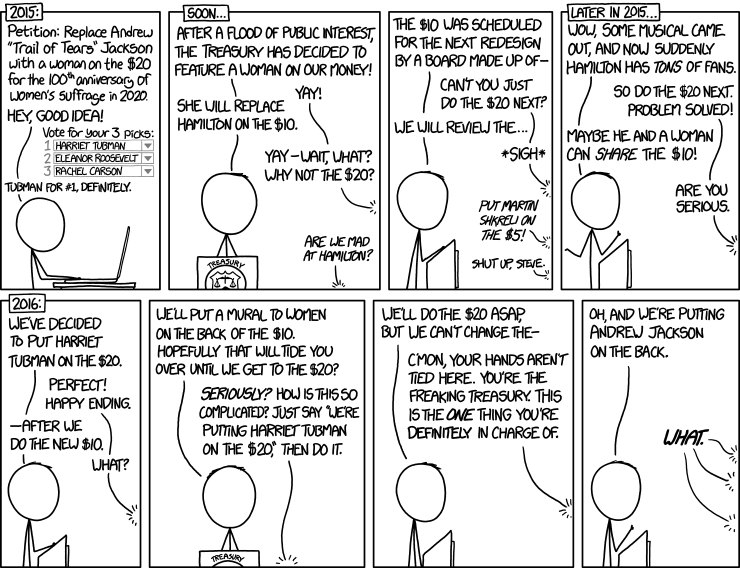
Women on 20s

kurtadb

nicely summarized.

I get that there are security reasons for the schedule, but this is like the ONE problem we have where the right answer is both easy and straightforward. If we can't figure it out, maybe we should just give up and just replace all the portraits on the bills with that weird pyramid eye thing.
25 Apr 01:52

A-train to Denver airport opens to public, hundreds wait to ride

by By John Aguilar The Denver Post
kurtadb

Why is it called the "University of Colorado A-Line?" Just a poke in the eye to Boulder?

The citizen pioneers who rode Colorado's first commuter rail line on its first public run to the airport Friday proclaimed their trip smooth, on time and timely.
22 Apr 16:16

Meet the under-the-radar company that brings you the best animation in the world

Most mainstream American animation looks the same.

Sure, if you really dig deep, the films of Pixar look different from, say, the films of Blue Sky (the Ice Age series, among others). But on the surface, mainstream American computer-animated movies boast that slightly plastic quality that makes them so good for simulating toys or bugs or life under the sea.

But these films also tell largely the same types of stories — a quick look into a hidden world, usually centered on mismatched traveling partners, the approach Pixar has used since its first film, 1995's Toy Story. Indiewire critic David Ehrlich put it thusly when commenting on his Letterboxd (a social media site based on film) review of Disney's Zootopia:

This is a systemic issue. My frustrations are with the type of movies that have been made with this style, the limitations that have been imposed on them, the corporate ethos they exude, how every frame feels like a product, how everything feels sterile and stuck in time.

It doesn't have to be this way. A tiny distributor shows an alternate path, found from looking overseas.

GKIDS is bringing the best animation in the world to the US

Technically speaking, the New York-based GKIDS — which stands for Guerrilla Kids International Distribution Syndicate — isn't producing animation.

What it does is bring the best existing animated films from around the world to the United States. Its movies never feel same-y. They're always something different. Like, say, Boy and the World, from Brazil:

Boy and the World GKIDS
Boy and the World.

Or Song of the Sea, from Ireland:

Song of the Sea GKIDS
Song of the Sea.

Or the company's latest film, April and the Extraordinary World, from France:

April and the Extraordinary World GKIDS
April and the Extraordinary World

What unites these projects isn't animation style or approach or even theme — it's quality. You might not like every GKIDS film (and a quick look at their box office totals suggests you probably haven't seen many of them), but you can always see why the company was passionate enough about them to bring them to American theaters.

Consider April, for instance. Christian Desmares and Franck Ekinci, the film's directors, who say they have "only good things to say about GKIDS," praise the distributor both for helping with the English translation from French and for helping attract an all-star cast for the English dub (including Susan Sarandon, J.K. Simmons, and Paul Giamatti).

Indeed, April's international release (which came in late March in the US) has given it renewed life after it struggled in its home country, due to unfortunate timing — it was released the Wednesday after the November 2015 shootings and explosions in Paris. Moving into other countries, then, has given the film space to breathe as a film.

"People who work in animation are making movies in the shadows of an animation studio, 'outside the real world,' in front of a screen for months and months. So, engaging with audience members [from all over the world] is a great joy," the directors told me via email.

So what makes a GKIDS film?

Sita Sings the Blues GKIDS
Sita Sings the Blues was an early breakthrough for GKIDS.

"The formula is: Do we like it, and will we work hard for it?" said Eric Beckman, the founder and president of GKIDS, when I asked him what makes a movie one his company should release. But, he cautions, "we've learned a little that just because we like a film doesn't mean we're going to have success with it."

Yet for a company like GKIDS, "success" sometimes has a very different meaning than massive box office. For one thing, the company has been phenomenally rewarded by the Oscars, receiving eight nominations for best animated feature (though it has yet to win).

GKIDS isn't in it for the Oscars, but it does appreciate both the economic boost the awards give and the way they impact directors' careers. "It raises the prestige and value of the film here in North America, but it raises the value of the film and the recognition it gets throughout the world," Beckman told me.

What makes GKIDS unique among indie film companies (and what has helped it at the Oscars) is its aggressive focus on animation from all over the world. Though it grew out of the New York International Children's Film Festival and initially had ambitions of importing live-action films aimed at kids as well (indeed, its very first film, shown in 2008 at several festivals, was Tahaan, a live-action movie from India), animation very quickly became its sole focus.

Some of this was likely the company's twin breakthrough successes, released within a few months of each other, and both animated in bright, poppy styles.

The first was Sita Sings the Blues, which exemplifies GKIDS's approach. The film (paralleling the crumbling of a modern woman's marriage with stories from the Hindu text the Ramayana) was produced independently by the director Nina Paley — who retains most rights to it and has released it to the internet under a Creative Commons license — but GKIDS helped get it into theaters and, thus, in front of the eyes of more critics, who were rhapsodic about its beautiful visuals and sardonic plot.

The second was The Secret of Kells, the company's first collaboration with Irish director Tomm Moore. (He would go on to make Song of the Sea, too.) The film, boosted by the company's first Oscar nomination, stood as GKIDS's most successful release at the box office for three years, and it's still only been supplanted by a handful of later films. (The company has distributed anywhere from three to five films in a given year — though some of those have only played festivals, rather than seeing general release to theaters.)

How streaming helps companies like GKIDS stay alive

The Secret of Kells GKIDS
The Secret of Kells continues to play on streaming services to this day.

Increasingly for GKIDS's films, as with many other indie companies at GKIDS's level, theatrical runs are just a preamble to a long, eventual run on streaming services, particularly Amazon Prime, which has the rights to several GKIDS films.

Before streaming, GKIDS's films would have been limited to arthouse theaters in urban areas and college towns. But not all film fans necessarily lived in those areas, and for those who were curious about movies from other countries, it could be hard to catch up with even prominent indie releases. The rise of video on-demand has helped those barriers crumble.

Thanks to streaming, says the company's distribution head Dave Jesteadt, the audience can be "broadened." (Selling streaming rights, says Beckman, is also a "pretty significant economic component" of the company's strategy.)

"I don't think [the limited, arthouse release] is necessarily fair in terms of boxing in the audience that can enjoy those films," Jesteadt says. "[Streaming] removes access barriers for families in particular."

This, of course, is not that unusual in terms of indie film companies. Many purchase more challenging fare, then market it to niche audiences, before shuttling the film along to the streaming world, where it will hopefully find even larger viewership.

GKIDS has found a way to survive in the economically risky world of indie film

Only Yesterday GKIDS

The quiet, contemplative Only Yesterday has proved a surprising success for GKIDS.

The GKIDS strategy is a necessarily more limited one, with lower potential for huge, breakout hits than, say, Pixar's strategy. Indeed, GKIDS has only seen one movie cross the $1 million mark at the box office. But GKIDS's approach also allows for more adventurous material.

Look at most animated films released in the US, as opposed to other countries, says Beckman — who likes many of those films. "No matter what, it's still within a very narrow range when you look at what's possible with the art form."

That frustrating sameness extends beyond visuals. For instance, GKIDS was responsible for bringing the classic Only Yesterday, released in Japan in 1991, to the US for its first major theatrical release in the states, which arrived in February.

The movie is quiet and contemplative, and its American release (which had been very successful for other movies from the film's studio, Studio Ghibli) had been thwarted by the fact that a major plot point deals with the protagonist learning about menstruation.

But it's proved a modest success for GKIDS, and Beckman takes delight in American audiences finding the film. "Looking only at the pacing, if you compare it to most of the Hollywood films out there, it's almost on the opposite extreme. It's very rewarding to see a gentle, thoughtful, contemplative film meet with the success it has so far."

Bringing better animation to our shores can only help budding cinephiles

Anomalisa Paramount
Anomalisa may not have been a GKIDS film, but it shows that the scope of indie animation is slowly but steadily increasing.

If the economic marketplace for indie films is still a difficult one in the modern era, there's a growing bright spot in the fact that animation increasingly has found a toehold it might not have had even a few years ago.

Indeed, that success might be key: Foreign animated films are a great way to both open up kids to viewpoints from other shores and to get them used to watching movies produced in other countries, with other cultural assumptions than their own, a key part of any budding cinephile's education. (Though, of course, not all animation is aimed at kids — GKIDS has at least one film suitable for all ages released every year.)

Indie animation's success isn't limited to just GKIDS. The Paramount-distributed Anomalisa, for instance, is an independently produced — Kickstarter-financed! — animated film, aimed squarely at adults, that saw critical acclaim and Oscar success last year, with a nomination for best animated feature (alongside, naturally, two GKIDS films).

The very economics that are choking out everything but tiny indie releases and major franchise films that cost hundreds of millions of dollars are, nevertheless, a big reason why smaller animation flourishes.

"You can make a more modestly budgeted film with a different distribution model," Beckman told me. "There's a lot of different ways you can create films that don't have to prop up massive 4,000 screen releases."