Shared posts

01 Apr 15:19

Advance scouting an extreme Final Four

by johngasaway
Boeheim

Is this man a defensive mastermind? Lucky that so few teams use his defense? A little of both? (USAT)

In keeping with my decade-old tradition of very late Final Four previews, here are some thoughts I’ve been mulling this week.

Is the Syracuse zone’s effectiveness scheme-blind and a simple matter of novelty? 
The funny thing about the Syracuse reign of defensive terror in this bracket is that — unlike a similar episode in 2013 — this season the Orange defense wasn’t very good.

During the regular season the ACC made 52 percent of its 2s against this D. In the tournament, however, this number has dropped all the way down to a rather ridiculous 36 percent. Are tournament opponents (ACC member Virginia notwithstanding) failing against this defense because it’s so strange and alien to them? Hard to say, but the history here is pretty interesting.

As it happens this season’s 16-percentage-point improvement in interior defense is by far the most extreme manifestation of what was nevertheless a preexisting historical pattern. Starting with Carmelo Anthony’s national championship team of 2003 and running through Sunday evening, the Syracuse defense has been exactly four percentage points better at forcing missed twos in the tournament than it’s been in conference play. (To keep the “novelty” hypothesis clean and tidy I threw out this weekend’s tournament win against league foe UVA, as well as the tournament loss against league foe Marquette in 2011.) That’s a big difference, and the sample sizes here are comforting: Syracuse has played 32 tournament games over that span.

I’ve never really looked at tournament vs. regular-season two-point defense over a decade-plus before, so just to be sure Syracuse really is weird I ran the same numbers for four other national champions of the period: Duke, North Carolina, Kansas and UConn. It turns out Syracuse really is weird. The Blue Devils have also played better interior D in the tournament than they have against the ACC, but the difference is smaller (two percentage points) and, anyway, Duke’s played weaker teams in its NCAA brackets than what it’s seen in conference play. Syracuse, on the other hand, has faced an almost identical strength of schedule both in the tournament and in conference play.

If this novelty-defense theory has any value, Syracuse benefits not so much from the intrinsic merits of the zone as a scheme but rather from the good historical fortune that so few teams use it. Opposing offenses are therefore freaked out and uncomfortable when they see this strange and alien defense, the locus classicus here being an otherwise dominant, forbidding and NBA-talent-laden Indiana offense looking like a sedated frog in the rain in the 2013 Sweet 16.

All of which will be irrelevant, of course, when Syracuse faces North Carolina. Not only have the Tar Heels seen the zone, on paper they’re almost cartoonishly perfect to attack said scheme. If you’re Boeheim the last opponent you want to see is a conference rival that doesn’t shoot threes but does eat offensive rebounds for breakfast, lunch and dinner.

Speaking of that opponent….

A shot-volume tour de force by North Carolina
A few weeks ago I held forth confidently on the magical tournament-game-winning powers of attempting an awfully high number of shots. Little did I realize at the time that the committee would see my post and intentionally sabotage its hypothesis by loading a veritable who’s-who of meh shot-volume teams — Virginia, Kansas, Villanova, and Oklahoma — onto just one side of the bracket.

I’m kidding. The committee had more on its mind than shot volume, but it is true that the Nova-OU winner will be 40 minutes away from a national title despite looking decidedly mediocre in terms of this particular metric. If UNC should prevail against Syracuse, however, we’ll also have the shot-volume poster child in the national final. The Tar Heels ranked No. 1 with a bullet out of 75 major-conference teams when it comes to generating shots, and in the tournament this ability has achieved absurd new heights.

In their last four wins the Heels have held on to the ball on 86.2 percent of their possessions while rebounding 45.7 percent of their missed shots. That nets out to an Easy Shot Volume Solver number of 131.9, which is possibly the most extreme characteristic exhibited by any Final Four team on either side of the ball. This is how Roy Williams’ guys have been able to score 1.33 points per trip, a level of offense no team could ever hope to equal over an entire conference season, while shooting a hair worse than Iowa State just shot over an entire conference season. Fear the shot volume.

A General Patton theory of the Sooners
So far in the tournament, Oklahoma’s played 279 possessions of basketball and allowed opponents to score 280 points. That’s not bad, but when you’re speaking of Final Four teams it’s not distinguished either. So when the topic of discussion becomes how do you stop Buddy Hield, I find I have two reservations.

First, speaking purely as a spectator seeking momentous events, I quite naturally don’t want Hield stopped. I’m a fan, I want to see Hield shatter records on the sport’s biggest stage. This is a transcendent player who’s putting a team on his back in a way we haven’t seen at a Final Four since…Kemba? Carmelo? Danny and the Miracles? You make that call, all I know is it’s ripping good television.

Second, I’m not sure an opponent needs to stop Hield to win. True, West Virginia did exactly that in the Big 12 tournament, I just don’t believe it’s entirely feasible to think you’re going to limit Hield to 1-of-8 shooting from the floor anywhere outside the motivational zerrspiegel known as a conference tournament. Conversely Kansas laid down my preferred template in Lawrence back in January. Want to beat Hield? Score 109 points.

If I’m Jay Wright I’m putting on my jodhpurs, strapping on my ivory-handled revolver and telling my team roughly: I don’t want to get any messages from assistants saying we are holding our position against Oklahoma. We’re not holding anything. Let the Sooners hold their position. We are advancing constantly and attacking a weak defensive rebounding team where it will do the most damage.

Villanova is veering off its analytic script, and it’s worked beautifully
My colleague Dana O’Neil has posted a terrific piece on Jay Wright’s “shoot ’em but don’t allow ’em” approach to three-pointers. Just as college basketball moved as a herd of independent minds toward Bo Ryan’s zero-tolerance approach on turnovers, so too is the sport adopting what for lack of a better term might be called the Mike Krzyzewski-slash-Billy Lange gospel on threes. On defense that gospel basically boils down to not letting opponents attempt them.

Which makes for a highly compelling national semifinal because, of course, Oklahoma will shoot threes. It’s what Lon Kruger’s guys do, and it’s how they win. Indeed it’s how the Sooners beat Villanova to a bloody pulp back in December.

The good news for the Wildcats, however, is that this doesn’t necessarily mean they’re doomed. Villanova opponents have already been shooting threes, both in the regular season and in the tournament, and Wright’s guys are still standing. In Big East play, the team that towered above the rest of the league in implementing the Coach K-Lange approach was Georgetown, and that didn’t go so well for the Hoyas.

On the flip side of that same coin, we have Nova’s performance in the tournament. Both the Wildcats and their last four opponents have devoted precisely the same share (37.4 percent) of their shot attempts to threes. Yet even with this blatant equality on the metric of interest, Nova has advanced to a national semifinal thanks to three games of insane shooting followed by 40 minutes of sublime defensive wizardry.

Simply put, the two teams in Houston that have shown they can win with either offense or defense are Villanova and North Carolina. That doesn’t mean they’re fated to meet each other on Monday night (the fact that far and away the best player at this event is on neither team constitutes an elephant in this otherwise tidy analytic room), but it’s certainly one more intriguing storyline at a Final Four marked by intriguing performance extremities.


31 Mar 21:29

The USMNT vs USWNT wage gap is definitely gender discrimination

by Stephanie Yang
kurtadb

this is....not written by a lawyer. sure "sexism is a market factor." that's believable. but that doesn't mean that the USSF is discriminating based on gender. they can't be expected to correct for a sexist market. at least not legally.

now, that all being said, i suspect they USWNT is being underpaid, AND i know nothing about the legal viability of their case. this article just kind of rubbed me the wrong way. women!

It's not just about revenue.

The United States women's national team has filed a wage discrimination complaint with the Equal Employment Opportunity Commission against US Soccer.

The moment the news hit earlier this morning, you just knew the responses would be predictable. One of the most common is "They should earn money proportional to what they bring in!" Another is "But the free market dictates what they're worth!"

Both of these arguments like to act as though sports exist in some kind of purely theoretical vacuum that can be used as an example in an intro to economics course. But the reality is that sports are often surrounded by heavily politicized context, whether it's issues of race, gender, nationality, or socioeconomic status.

Players on the men's and women's teams are literally doing the same thing: running around on a field, kicking a ball, and occasionally showing up at publicity events to talk up the team. That these activities bring in disparate amounts of money and attention (or they used to; the WNT is definitely closing that gap) is partially a function of sexism, both from within and without the federation.

The valuation of women's sports has always been discounted by society, with the pricing of their activities set arbitrarily lower than men's because "no one wants to watch women's sports." The perception that no one wants to watch women's sports is influenced by a great number of factors, among them the relative youth of women's sports, their lack of marketing and funding, and, yes, sexism.

Men's sports have been given the time and opportunity to flourish. The NFL didn't suddenly spring into creation making hundreds of millions of dollars and ruining cultural discourse with overexpensive Superbowl ads. The NHL started with four teams and lost one of those but was given room and space to grow. MLS has spent decades becoming stable. Let's not ignore that many men's leagues were founded at a time when they didn't have to compete with an oversaturated sporting landscape covered 24/7 by a hellish neverending media cycle.

Let's also not forget that women's soccer has not been developing on a uninterrupted timeline since the first organized women's game in 1895. The women's game was outright banned in both England and Brazil for decades and only officially restarted under the auspices of FIFA in the 70s. The first Women's World Cup didn't even take place until 1991, and even then FIFA didn't really want to put their name on it, so it was called the "1st FIFA World Championship for Women's Football for the M&M's Cup."

Women's soccer as we know it has only really been developing since the early 90s, giving the sport less than three decades of history to work with - and a huge chunk of that development in the United States is directly tied to whether the women win the World Cup or not. For American women, they either have to be the best in the world or they're irrelevant to the media, a level of pressure that certainly does not exist for the men's national team.

Now women can barely elbow their way into both the social consciousness of sports and into the media coverage. In fact, coverage of women's sports as a percentage of total coverage seems to be declining. So yes, overall the number of women's sports stories getting told is increasing just because women's sports are still finding ways to grow, but they still take up the same infinitesimal slice of the overall landscape.

Then there's the money that owners or federations simply refuse to put into women's sports. Women's sports are small time, so they don't draw big audiences, so they don't bring in money, so they stay small time. But what we've seen with big sporting events like the Women's World Cup or Grand Slams is that if someone is willing to interrupt that self-perpetuating cycle of limitations at any point, then the audiences are there.

Just look at the viewing figures for the WWC, as compiled by FIFA:

TV stats
· Canada: CTV and RDS broke the Canadian viewing record for any FIFA Women's World CupTM match (quarter-final: average audience 3.2 million) 
· USA: FOX scored its biggest ever audience for a football match (semi-final: average audience 8.4 million) 
· France: W9 achieved its best figures on record and set a new French digital terrestrial viewing record (quarter-final: average audience 4.1 million) 
· Japan: Fuji TV attracted more than twice the number of viewers for the semi-final than in 2011 (semi-final: 9.3 million)

Digital Stats
· 20 million unique visitors to FIFA.com's FIFA Women's World CupTM section, consuming 225 million pages and spending 7.8 billion seconds engaged 
· 9 billion impressions of Tweets about the FIFA Women's World CupTM
· FIFA's YouTube channel hed its all-time monthly views record in June (28 million views vs. 19 million in June 2014 during the 2014 FIFA World Cup BrazilTM)

The 2015 World Cup on Fox picked up where 2011 left off in terms of promotion and production value. Germany's staging of the tournament in 2011 set a new standard for the way the tournament should look and feel, with top notch production value coming from multiple cameras and a good ESPN broadcast crew. Then, with the tournament moving to Fox, the tournament still managed big numbers despite Fox, Fox Sports 2, and its streaming platforms being in millions fewer homes across America than ESPN. The networks saw the opportunity and took it, then reaped the financial rewards; Fox took in $40 million in ad revenue, five times what ESPN did in 2011. Promote, deliver content, collect cash.

Keep in mind that they got this ad money in spite of companies being hesitant to advertise during the WWC. If more big-name brands had been willing to buy into the event in addition to "non-traditional advertisers," who knows how big that figure could have been. But no one wants to watch women's soccer, so advertisers don't buy in, which depresses the actual monetary valuation of the event, and by extension, the sport. It's that classic pricing error: lowballing a product hoping to entice buyers, but instead just signaling to buyers that the product is cheap and worth passing over.

These are all symptoms of the constant, unending socialization that women's sports are just not good, which is absolutely tied up in fears based on women stepping outside of traditional gender roles. Just look at the avalanche of typical responses to coverage of women's sports: get back in the kitchen, women can't play sports, get back in the kitchen, no one cares, and my personal favorite, get back in the kitchen. It's an instinctive and automatic response for so many men (and women) based on the cultural image we carry of who is an athlete and what is a sport, reinforced by popular media constantly turning women's sports into a punchline (looking at you every single TV show that has made a joke about women's sports being fake just because they're played by women).

So no, the "free market" hasn't determined that the WNT is actually supposed to make less than the MNT because they're less popular. The market is shaped and influenced by people who choose to make a gender-based valuation about a women's team in spite of results. The WNT is paid less than the MNT even when they bring in commensurate revenue and way more prestige. Sexism is a market factor, plain and simple, and people who don't want to accept that are usually those that benefit, whether directly or indirectly, from the existing market structure.

31 Mar 17:32

Senate GOP Kills Equal Pay Bills, Hopes Women Don’t Notice

by Colorado Pols
Sen. Jerry Sonnenberg.

Sen. Jerry Sonnenberg.

The Denver Business Journal’s Ed Sealover reports on the death yesterday afternoon of two bills meant to help women in Colorado close the persistent gap in earnings between themselves and their male colleagues in the GOP-controlled Senate State Affairs Committee:

Three men voted over the objections of two other men Wednesday to kill the two major efforts of the 2016 Colorado Legislature’s session aimed at shrinking the gap in pay between women and men.

After lengthy debates the past two weeks in the House of Representatives on the subject, the Senate State, Veterans and Military Affairs Committee quickly dispatched of a pair of proposals aimed at ensuring that state contractors follow federal equal-pay laws and to ban employers from asking the salary history of job applicants. Both died on 3-2 party-line votes of Republicans over Democrats…

You’ve got to love the stock photo Sealover included with his story, which tells the story all by itself:

equalpay

Although pay equity is a problem nationally even 50 years after the passage of the Equal Pay Act in the early 1960s, statistics show the problem is in fact worse in the state of Colorado than the national average. In Colorado, women earn an average of 78 cents on the dollar their male counterparts make–a gap that advocates say can’t be explained away by the usual presumptions about the lives of women made by…well, made by men.

The Senate State Affairs Committee’s all-male Republican majority included Sen. Jerry Sonnenberg, the very same GOP Senator who had apologized just a couple of days earlier for referring to a female Senate colleague as “eye candy” during debate on a moribund bill to tax corporate earnings stashed away in overseas tax havens. The same female Senator in fact presented the second of the two bills that died yesterday, the irony of which dripped from the hearing even though no one had the boldness to say it into a hot mic.

Nationally, as we know from the headlines, women voters are in the process of being repelled en masse by Republican presidential frontrunner Donald Trump. Trump just yesterday committed perhaps the worst in a seemingly endless procession of woman-alienating gaffes, suggesting and then retreating from the suggestion that women should receive “some form of punishment” for having an abortion. Trump’s gleeful sexist attacks on any woman with the temerity to question him have given him favorability numbers among women somewhere in the post-execution Ted Bundy range. Even if Trump self-destructs in the next few weeks, he has ripped open one of the GOP’s biggest scabs–and we feel pretty confident that Ted Cruz won’t be able to heal it.

Bottom line: if you can’t make the connection for voters from Trump’s over-the-top sexism to Jerry Sonnenberg’s “eye candy,” you should get out of politics. The fractured Republican presidential race is increasingly forecast to have serious downticket implications for Republicans, putting the U.S. Senate, and in some more boostery Democratic circles, even the U.S. House in play.

If we were a Republican under Colorado’s Gold Dome, we’d be every bit as nervous.

30 Mar 19:44

Colorado rain-barrel bill back on track, advances to Senate

by By Joey Bunch The Denver Post
The state Senate Agriculture, Natural Resources and Energy Committee advanced a bill Wednesday making it clear that household rain barrels are legal under Colorado water law.
30 Mar 15:54

It's True: Smart People Would Prefer You Went Away

by Kevin Drum
kurtadb

hits a little close to home, not to be a dick

Most people are happier when they have a lot of social contact. But Christopher Ingraham points to a new paper suggesting an exception to this general rule: smart people, true to stereotype, prefer being left alone. But why?

I posed this question to Carol Graham, a Brookings Institution researcher who studies the economics of happiness. "The findings in here suggest (and it is no surprise) that those with more intelligence and the capacity to use it ... are less likely to spend so much time socializing because they are focused on some other longer term objective," she said.

Think of the really smart people you know. They may include a doctor trying to cure cancer or a writer working on the great American novel or a human rights lawyer working to protect the most vulnerable people in society. To the extent that frequent social interaction detracts from the pursuit of these goals, it may negatively affect their overall satisfaction with life.
To put this a little less nicely, average folks don't really have anything very interesting or enthralling to do with themselves, so getting interrupted by friends represents a net improvement in their daily lives. Smart people do have enthralling—even obsessive—intellectual interests, and social activities take them away from that. So this represents a net loss in happiness.

(Important note for smart, argumentative people reading this: we're talking about averages here. There are plenty of extroverted smart people and introverted dumb people. But on average, smart people tend to dislike socializing because it takes them away from work they find more rewarding.)

But back to the paper. The authors, Satoshi Kanazawa and Norman Li, have a different theory about all this: the measured difference in social preferences is all due to the way we evolved way back on the savanna. Back then, they say, you had a much better chance of surviving if you had lots of friends, so we naturally evolved to value having lots of friends. Things have changed since then—cell phones, computers, cities, houses, etc.—and even though evolution hasn't yet had a chance to adapt to a world where social contact isn't as important, "extremely intelligent" people can use their sheer brainpower to adapt anyway:

"More intelligent individuals, who possess higher levels of general intelligence and thus greater ability to solve evolutionarily novel problems, may face less difficulty in comprehending and dealing with evolutionarily novel entities and situations," they write....Smarter people may be better-equipped to jettison that whole hunter-gatherer social network — especially if they're pursuing some loftier ambition.

This odd thing is that this isn't really an application of evolutionary psychology, even though the authors are evolutionary psychologists. The hypothesis that humans evolved in hierarchical, medium-sized groups that relied on tight social networks for survival is pretty widely accepted. It's nothing new. What's new is the suggestion that smart people can overcome the constraints of cognitive evolution more easily than most people. And that's not really evolutionary psychology. It's just regular old psychology, or perhaps regular old neuroscience. It's pretty likely that this has always been true of smart people, but we just don't know it. Our social science datasets are shockingly inadequate for dates before 20,000 BCE.

Now, I don't have access to the paper itself, and it's possible that the authors address this. The abstract doesn't give any hint of it, though. For the time being, then, I'll take this as a fairly banal observation: people with intense intellectual interests value them more highly than social contact, and almost by definition, it's mostly smart people who have intense intellectual interests. As a refugee from the tech world who dealt with a lot of programmers, and as a blogger who gets annoyed at being interrupted in the middle of writing a post, color me unsurprised.

30 Mar 14:49

Jack and Jill

kurtadb

maybe that's not what jack and jill are really up to

Jill and Jack / began to frack. / The oil boosts their town. / But fractures make / the bedrock shake / and Jack came tumbling down.
29 Mar 15:31

March 21

by foodyear365
kurtadb

one of the few things we liked about gettysburg was buying local meat at the farmer's market about a block from our house. and those in the know could find some of it during the week at the tucked away wine tasting room off the square.

Smoked paprika ketchup, with cloves added. It was made at a farm in Pennsylvania (a lot of the meat and produce I buy comes from a farmer’s market and ultimately from the area around Gettysburg). We were cooking a steak and the dog, who we were watching for a few days, seemed indifferent when I took it out of the fridge and then grew progressively short of breath as I cooked it to medium.

(Photo: Roscoe.)

>> March 22

<< March 20


28 Mar 16:47

David Gregory joins CNN as political analyst

by The Associated Press
kurtadb

this is just complaining, but why is this in my Denver Post Breaking Local News feed? it's none of those things.

NEW YORK (AP) — Former NBC "Meet the Press" moderator David Gregory is joining CNN as a Washington-based political analyst.
28 Mar 13:21

Matt Taibbi's case against Hillary Clinton is surprisingly weak

Long post ahead. Sorry.

I think I've made it clear that I generally support Hillary Clinton over Bernie Sanders in the Democratic race. I don't make a big deal out of this because I like Bernie too. My preference for Hillary is clear but fairly modest. Without diving into a long and turgid essay about this, here are few quick bullet points explaining why I like Hillary:

  • Her entire career has demonstrated a truly admirable dedication to helping the least fortunate.
  • Unlike her husband, she obviously doesn't enjoy the cut and thrust of partisan campaigning. Yet she soldiers on after taking decades of sewage-level abuse that would overwhelm a lesser person. This demonstrates the kind of persistence that any Democrat will need governing with a Republican Congress.
  • She takes policy seriously and she's well briefed. She doesn't pretend that one or two big ideas can suddenly create a revolution.
  • She's a woman, and yes, I'd like to see a woman as president.
  • Special pleading to the contrary, a moderate candidate is almost certain to be more electable in November than a self-declared democratic socialist.
  • In the Senate she demonstrated that she could work with Republicans. Yes, it was always on small things, the GOP being what it is these days. Still, she built a reputation for pragmatic dealmaking and for her word always being good.

Needless to say, Hillary also has weak points. She has decades in the public eye, and voters usually prefer candidates with more like 10-15 years of national exposure. What's more, she obviously comes with a lot of baggage from those decades. On a policy level, I don't get the sense that her foreign policy instincts have changed much based on events since 9/11, and that's by far my biggest complaint about her. Finally, I'm not thrilled with political dynasties.

OK. That's the throat clearing. The real point of this post is Matt Taibbi's article explaining why he disagrees with Rolling Stone's endorsement of Hillary. It's hardly surprising that Taibbi is a Bernie fan, but I was little taken aback by the thinness of his argument. Here's the nut of it:

The implication [of the endorsement] is that even when young people believe in the right things, they often don't realize what it takes to get things done. But I think they do understand....The millions of young voters that are rejecting Hillary's campaign this year are making a carefully reasoned, even reluctant calculation about the limits of the insider politics both she and her husband have represented.

For young voters, the foundational issues of our age have been the Iraq invasion, the financial crisis, free trade, mass incarceration, domestic surveillance, police brutality, debt and income inequality, among others. And to one degree or another, the modern Democratic Party, often including Hillary Clinton personally, has been on the wrong side of virtually all of these issues.

Let's go through those one by one.

The Iraq invasion: This one is totally fair. Hillary did support the invasion, and it was the wrong call. What's more, this is a good proxy for her general hawkishness, which is her weakest point among millennials and her weakest point among an awful lot of older voters too.

The financial crisis: Taibbi doesn't even bother making an argument for this aside from some snark about the speeches Hillary gave to Goldman Sachs. But that's just petty point scoring. Beyond that, it's plainly unfair to blame her by association for legislation signed by Bill, which she had no hand in. And look: the only Clinton-era law that probably had a significant effect on the financial crisis was the Commodity Futures Modernization Act, which was supported by 83 percent of the House and 100 percent of the Senate. Even Bernie voted for it. The truth is that Hillary's positions on Wall Street reform are reasonably solid.

Free trade: This is a "foundational issue" for millennials? Starting in the late 90s, there was a 3-4 year period of anti-globalization protests, and that was about it for high-profile attention. Most millennnials were barely in their teens at that point. A recent Gallup poll asked Americans if increased trade was good or bad, and 35 percent said it was bad. Among millennials, it was 32 percent, lower than most other age groups. Trade is getting a lot of attention lately thanks to TPP and Donald Trump, but it's just never been a foundational issue for millennials.

Mass incarceration: This again? Taibbi says that Bill Clinton "authorized more than $16 billion for new prisons," and slams Hillary because she "stumped for that crime bill, adding the Reaganesque observation that inner-city criminals were 'super-predators' who needed to be 'brought to heel.'" The truth: Bill Clinton had barely any effect on incarceration; Hillary's "super-predator" remark was reasonable in context; and both Clintons have long since said they regretted the carceral effects of the 1994 crime bill—which, by the way, Bernie Sanders voted for. Give it a rest.

Domestic surveillance: Taibbi doesn't actually say anything further about this, but I'll grant that I prefer Bernie's instincts on this issue, just as I prefer his instincts on most national security issues. But anyone who thinks Bernie could make a dent in this is dreaming. In concrete terms, mass surveillance enjoys substantial public support and virtually unanimous support among elites and lawmakers—and that's after the Snowden revelations, which were basically the Abu Ghraib of mass surveillance. It's really not clear that in practice, Bernie would do much more about this than Hillary.

Police brutality: Bernie barely even mentioned this until he was the target of protests from Black Lives Matter a few months ago. It's hardly one of his go-to subjects, and there's no real reason to think Hillary's position is any less progressive than his. In any case, this is almost purely a state and local issue. As president, neither Hillary nor Bernie would be able to do much about it.

Debt and income inequality: Once again, Taibbi doesn't bother to say much about this. Here's his only actual argument: "Hillary infamously voted for regressive bankruptcy reform just a few years after privately meeting with Elizabeth Warren and agreeing that such industry-driven efforts to choke off debt relief needed to be stopped." But this is just plain false. And while there's no question that Bernie is stronger than Hillary on Wall Street issues, both rhetorically and in practice, Hillary has generally been pretty strong on all these issues too. And her proposals are generally a lot more serious and a lot more practical than Bernie's.

Put this all together and here's what you get. Hillary's instincts on national security are troublesome. If that's a prime issue for you, then you should vote against her. It's certainly the issue that gives me the most pause—though I have some doubts about Bernie too, which I mention below.

She also lags Bernie in her dedication to bringing Wall Street to heel. But this is a much trickier subject. Bernie has thunderous rhetoric, but not much in the way of plausible plans to accomplish anything he talks about. Frankly, my guess is that neither one will accomplish much, but that Hillary is actually likely to accomplish a little more.

In other words, there's just not much here aside from dislike of Hillary's foreign policy views. That's a completely legit reason to vote against her, but it's hard to say that Taibbi makes much of a case beyond that.

Bernie Sanders too often lets rhetoric take the place of any actual plausible policy proposal. He suggested that his health care plan would save more in prescription drug costs than the entire country spends in the first place. This is the sign of a white paper hastily drafted to demonstrate seriousness, not something that's been carefully thought through. He bangs away on campaign finance reform, but there's virtually no chance of making progress on this. The Supreme Court has seen to that, and even if Citizens United were overturned, previous jurisprudence has placed severe limits on regulating campaign speech. Besides, the public doesn't support serious campaign finance reform and never has. And even on foreign policy, it's only his instincts that are good. He's shown no sign of thinking hard about national security issues, and that's scarier than most of his supporters acknowledge. Tyros in the Oval Office are famously susceptible to pressure from the national security establishment, and Bernie would probably be no exception. There's a chance—small but not trivial—that he'd get rolled into following a more hawkish national security policy than Hillary.

I'm old, and I'm a neoliberal sellout. Not as much of one as I used to be, but still. So it's no surprise that I'm on the opposite side from Taibbi. That said, I continue to be surprised by the just plain falseness of many of the left-wing attacks on Hillary, along with the starry-eyed willingness to accept practically everything Bernie says without even a hint of healthy skepticism. Hell, if you're disappointed by Obama, who's accomplished more than any Democratic president in decades, just wait until Bernie wins. By the end of four years, you'll be practically suicidal.

26 Mar 15:39

It's hard to win on the road in CONCACAF... when you suck

by Chris White
kurtadb

oof

The USMNT have deep problems, ones that merely firing Jurgen Klinsmann are not going to solve anymore.

I don't know if anyone was unironically using the old "It's hard to win on the road in CONCACAF" line at any point during yesterday's USMNT embarrassment against Guatemala -- we all know the stats: first loss to Guatemala since before I was born, first loss ever to them in World Cup qualifying, etc. -- but I did see a few people putting out the old standby after the Yanks went down 2-0.

As of this writing, the US are currently ranked 30th in the World Rankings by FIFA. They are likely only there because of their stature as one of the "Big Two" of CONCACAF and the fact that people in FIFA probably still think of them as a Round of 16 team from a "group of death" (which it wasn't, but that's a story long past) in the last World Cup. Based on form, there is absolutely no way they should even be sniffing the Top 30. The company they're keeping with their current form and ability is certainly not befitting of any notable status.

Naturally, as it has been for a while, the #FireKlinsmann crowd immediately stormed onto the twitterbox following the loss. This was called "the worst loss of Klinsmann's tenure" by a lot of people, so it's not surprising that they were out in full force. Interestingly, I saw a counter-movement as well out there. They were countered by the folks arguing that, hey, look at the player pool he has to work with, he shouldn't be blamed. The fact that both of those factions can co-exist shows exactly how deep in the muck the USMNT really are right now.

I once called Pablo Mastroeni "the shitty Jurgen Klinsmann," but now I kind of feel like I should flip that script around. For all the issues Pablo has faced since he became Colorado Rapids manager, he at least had the excuse of not being a seasoned manager with Germany and Bayern on his CV when he started out here. From the very start, Klinsmann has been making promises to the United States -- hell, several of the things we "knew" he would be doing with the USMNT were being talked about while Bob Bradley was still the team's manager -- since day one and following exactly none of those promises. He has been taken to task on these things zero times by the USMNT brass, and the slow build-up of it all has finally gotten to a point where simply firing him isn't going to fix things overnight.

One of the biggest selling points of Jurgen was the youth movement he was to bring to the country. We knew under Bob Bradley that the team was aging and losing its big names like Donovan, Bocanegra, Dempsey etc. soon. That 2010 team was one with some of the best talents the US ever boasted, but only a few of those talents were to be reaching in their prime in 2014 rather than passing it. (Altidore and Bradley are the first two that come to my mind.) Behind a rather solid 18-or-so-player group from 2010, there were questions about Bradley's player management -- Robbie Findley to the 2010 Cup, anyone? -- and if he would be able to transition a new generation of USMNT players into the older one for another solid World Cup run.

Klinsmann was supposed to be the savior that would not only bring the entire country's resources together and flood the pipeline with talented youngsters, but teach all of those youngsters the type of attacking, beautiful soccer that we normally associate with the Germanys and Brazils of the world. Under Klinsmann, we would stop worrying about producing another Landon Donovan and finally get on with that silly trope of "producing a Messi".

Instead, things have gotten more confusing every year. What we've gotten in terms of new talent being injected permanently into the USMNT squad over the past five years has been a confusing mix of foreign players and MLS veterans like Chris Wondolowski. Players were dropped and put in for seemingly no reason: recall when the US nearly missed the hex in 2013, the two players who saved their bacon, Eddie Johnson and Herculez Gomez, were left out of the eventual World Cup roster for 2014 with Brad Davis and Wondo getting forward spots instead. If there has actually been a talent issue with the newest crop of youngsters that started emerging in 2011 -- I would argue there hasn't been, but this post is already too long -- we certainly haven't had a chance to tell on the pitch. His odd obsession with MLS veterans and the small batch of youngsters he is giving shots to despite form along with his general avoidance of MLS youngsters has kept guys like Wil Trapp, Matt Miazga and Harry Shipp from getting any more than the occasional sniff.

Did we mention his love of using a completely different line-up every single game? He really likes doing that.

The football has been awful as well, but we already knew that. The "attractive" soccer we have been waiting for with bated breath has instead just been a watered-down version of the counter-attacking style that the US had already been using seemingly forever, featuring trios of defensive midfielders, clog 'n' hoof attacking, and all sorts of other things that only Tony Pulis would comment on as being "beautiful". Players being put out of position, a problem specifically awful last night, has been an awful trend as well. Deandre Yedlin ain't a winger.

Combine the incredibly ugly style of play, the inconsistent rosters and the lack of chances for the vast majority of the most talented youngsters in the US pipeline up until now and you have a player pool that is disjointed, relying on miracles and contains a lot of guys who really shouldn't be there but won't be dropped for continuity's sake. (Mix Diskerud has done nothing but have great hair ever since he signed for NYCFC, for instance, yet remains a staple in the team for reasons unknown.) This is a damaged player pool, with precious little time to get it together before the end of this third round of CONCACAF qualifying.

So yes, the players are a problem right now. Anyone coming in to replace Klinsmann would have a mighty task getting this disjointed squad of players to work together coherently in time to save the campaign. Those in the "Why blame Jurgen?" crowd are correct on that. The fact that the players are a problem right now, however, is a problem entirely born of Klinsmann's five-year non-plan.

So yeah, you've heard a lot of this before. A lot of what I put up there is the standard-issue blurb on "why Klinsmann is bad" that gets stuck into every post like this. (And oh yes, there have been a lot of posts like this over the last few years.) But a lot of those posts then go on to say or imply that Klinsmann being fired might solve something. In this case, I think it might be too late for that. Firing the man is a necessity at some point, to be sure, but will only serve as a starting point to rebuild the system back up from the hole he has dug it into. That hole may take the rest of this cycle to escape, maybe until the start of the 2022 cycle if things are as bad as they looked last night.

The miracle that was the near-flawless run through the Hex and push to the Round of 16 in 2013-2014 has thus far been the only bright spot in the Klinsmann regime. Remembering how inept the team was before that and watching them now only serves to make it look more like a fluke. We have now gotten a total of about one calendar year of watchable soccer out of Klinnsy, and it has now been followed by what has arguably been his worst one yet, a year of unwatchable misery that is likely going to leave the USMNT out of the World Cup for the first time since 1986.

Forget the "tough to win in CONCACAF" mentality. This wasn't the US going to Guatemala and losing a hard-fought 1-0 match, it was the US getting outclassed by what should be a very inferior team. There is no excuse for losing that badly to a team 65 places below you in the FIFA rankings. If Belgium were destroyed by Uganda, regardless of the venue, there would be some major, major questions asked. If Colombia were humiliated by Mali, same thing. England and Uzbekistan, Chile and South Africa, Czech Republic and Antigua/Barbuda... any of those teams losing to the other would be an enormous upset on the world stage. Teams are not separated by 65 spots in the rankings by accident. An upset is one thing; an embarrassment is quite another.

And this is not some blip on the radar, but a continuing rot that we've seen before and especially since the tail end of 2014: the USMNT are a putrid example of a national team right now, and they will need yet another miracle run to even get to the hex. Klinsmann has done enough damage that we might have to be reliant on the current crop of teenage wonderkids around the world to get the USMNT back to growing status come 2022. It's going to be expensive and controversial to get the man fired, but they're going to have to at some point if they're going to get better. After five years of hearing his shtick not change in the slightest, it's not unfair to assume that it never will. At least Pablo Mastroeni has admitted his shortcomings as a manager and how he wishes to better himself; if we ever hear Klinsmann do the same, it will be followed by four large horses from the sky announcing the end of times.

It feels worthwhile to mention that while the USMNT were getting dumped on down in Central America, Mexico were comfortably destroying Canada 3-0 at BC Place. Canada are ranked eight places higher than Guatemala in the World Rankings, coincidentally exactly 65 spots away from 22-ranked Mexico. So yes, it is hard to win on the road in CONCACAF... when you suck.

22 Mar 15:01

No, America Is Not a Poor Country

by Kevin Drum
kurtadb

i would be a lot of people believe it. many people can't separate national wealth from personal wealth (or more importantly, the average personal wealth of the people in one's community).

When Donald Trump says America is a loser, apparently he's dead serious. Judging by some of his answers during his interview with the Washington Post editorial board yesterday, he genuinely thinks we've all but slipped into third-world status these days. Here he is on American support for NATO:

NATO was set up at a different time. NATO was set up when we were a richer country. We’re not a rich country. We’re borrowing, we’re borrowing all of this money.

On South Korea:

That’s a wealthy country. They make the ships, they make the televisions, they make the air conditioning. They make tremendous amounts of products....I think that we are not in the position that we used to be. I think we were a very powerful, very wealthy country. And we’re a poor country now. We’re a debtor nation.
And on Saudi Arabia:

If you look at Germany, if you look at Saudi Arabia, if you look at Japan, if you look at South Korea — I mean we spend billions of dollars on Saudi Arabia, and they have nothing but money. And I say, why?...We pay billions— hundreds of billions of dollars to supporting other countries that are in theory wealthier than we are....I mean we spend billions of dollars on Saudi Arabia, and they have nothing but money. And I say, why?

"We're a poor country now." I wonder how many people believe that just because Donald Trump keeps saying it? In case anyone cares, the actual truth is in the chart on the right. There's not a single country in the world bigger than 10 million people that's as rich as the US.

20 Mar 20:25

But I can see it makes no sense at all

by Doug!
kurtadb

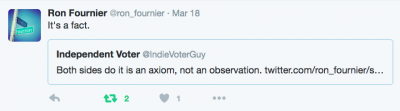
i didn’t realize anybody actually defended "both sides do it.” i thought it was just an insult and people denied that they did that and thought they were just being “objective.” fournier is a true believing moron.

17 Mar 19:24

I Don’t Think Garland is a Sacrificial Lamb

by John Cole
kurtadb

i tend to agree with this. i think he nominated someone who was the best shot, knowing full well it might not happen.

There’s been a great deal of talk about how Garland is a “sacrificial lamb,” but I’m just not buying it. I think Obama nominated Garland because he likes the nominee, believes that he is a good man, and believes that he can seat him. Here’s my reasoning.

1.) Obama doesn’t do sacrificial lambs, or throw people under the bus, or have people fall on their swords, or whatever other metaphor people want to use. In his administration, there have been, that I can recall, five high profile exits.

The first was Van Jones, and Obama didn’t sack the guy, he resigned, and he had to. He’d made a string of unforced errors, some of which were pretty stupid, and he was just not a good fit with the no-drama Obama team. Rahm left to become Mayor. Hillary left to get ready to become the nominee this election. That leaves Shirley Sherrod and Chuck Hagel. Hagel left because of disagreements with his boss and a whole lot of other issues in the Pentagon.

That leaves Sherrod, and that truly was a shitshow. Obama himself has said this was a mistake. Maybe I am missing some others, but these are the ones I remember. This is not a record indicative of someone who routinely mistreats or screws over people for political gain or when the going gets tough. The man does not “use” people. It’s not who he is.

It’s actually one of the things I admire most about this administration and the man. I think being a halfway decent President is akin to steering the Titanic while juggling blindfolded, and Obama has managed to do this with grace all while half the nation has been trying to trip him, throwing spitballs at him and screaming racial epithets. We’re never going to see an administration this well run again in our lifetimes, and he did it under fire from all quarters.

***

2.) Obama has never governed as a screaming liberal, and I don’t see him starting now. For better or for worse, Obama has never governed as a hard left progressive. If historians were honest, Bill Clinton and Barack Obama would be listed as the best moderate Republican Presidents of the last 100 years. Having said that, Obama has achieved a very progressive list of accomplishments. I have long felt that Obama’s personal views are far more progressive than his governance- I don’t think for one minute his positions on gay marriage ever evolved, I think they are the same today as they were years ago. What evolved is the nation full of neanderthals he is forced to govern.

***

3.) Obama has a sense of “fair play,” even when it isn’t deserved. I think it would have been completely out of character for him to nominate a left wing liberal to replace Scalia even if he could get said liberal seated. I just don’t think he would do it. I believe Obama trusts the kind of slow revolution with irreversible gains to large dramatic revolutions that can lead to just as radical course corrections. He plays the long game, and understands that seating Garland will already make the center of the court the most liberal it has been in years, and understands that barring a disaster for Democrats in the fall, will become even more so in the not so distant future.

***

4.) Garland is strong on the role of the federal government an agencies. While this can make many progressives mad, it makes pretty solid sense to me, examining Garland’s record, why an African-American President with a keen take on history would nominate someone who shows deference to the federal government and agency decision makers over “state’s rights.” I believe Obama views that Garland would have been on the right side of many recent bad rulings (VRA, affirmative action, etc.)

***

5.) Obviously, Obama understands that this puts the Republicans in a disastrous hole politically, particularly since they are basically on record saying “If Obama nominated X, we would confirm,” so Obama went out and nominated X and they are left stammering and shifting from foot to foot as dribble like this oozes out their cornfed pieholes:

U.S. Senate Republican leader Mitch McConnell said on Wednesday that President Barack Obama has politicized the Supreme Court nomination process by putting forward veteran appellate court judge Merrick Garland during a presidential election.

“It seems clear that President Obama made this nomination not with the intent of seeing the nominee confirmed, but in order to politicize it for purposes of the election,” McConnell said on the floor of the Senate after Obama, a Democrat, announced his choice at the White House.

“Instead of spending more time debating an issue where we can’t agree, let’s keep working to address the issues where we can,” the senator from Kentucky said.

***

6.) Obama does not want to leave unfinished business when he leaves office on 20 January 2017. Obama took office with a toxic smorgasbord of disasters both immediate and impending, all because his idiot predecessor couldn’t operate a lawnmower much less a nation. He does not want to do that to Hillary, who he believes will be his successor (and I think he is happy about that). He knows how that screwed up the start of his administration, having to focus on fixing things instead of advancing the ball, and he does not want to do that to someone else.

I think he also believes that this is HIS pick, not just some pick you sock away until the next President, whomever that might be. He’s a Constitutional lawyer, FFS. He actually believes in the process and the Constitution.

So, for all those reasons and probably a few more, I think this is a sincere, serious pick, and not some cynical ploy or sacrificial lamb. I think that not only does Obama think he can get him on the court, he wants him on the court. And I don’t think for one instant he would pull Garland’s nomination should the GOP agree to seat him in the lame duck session.

That’s not the kind of man he is, not the kind of negotiator he is. He sees value in Garland being on the court, and will get him on there, and he would never nominate someone like Garland and then pull the rug out from under him. It’s not in his DNA.

Have at it.

*** Update ***

I’ve added a new post commenting on the “moderate Republicans” line and what I really meant, and this from Aimai in the comments can not be said enough:

I also wanted to add that people seem to have a hard time grasping that Obama’s gestures, choices, policy tactics almost always have more than one side to them. They are usually a plan A and a plan B rolled together. To very young, angry, or stupid political viewers its always a zero sum game in which your first shot is your only shot and you can only get everything or nothing. But Obama’s pick of Garland wins whatever the republicans choose to do. He has asserted his constitutional duty, he has embarrased them publicly, he has split their senatorial caucus, he has given the democrats ammunition in senate races, he has increased the likelihood of right wing primaries, and if they roll over and take garland he gets a pick he is happy with completing three historic appts. Lots of his offers to the republicans have had this aspect. Its why they are afraid to negotiate with him at all.

Personally, I think any analysis of Obama and his administration is silly if it does not keep this extremely telling moment in mind:

“I like to know what I am talking about, Ed.”

The idiom goes that in the land of the blind, the one-eyed man is king. Obama has both of his.

15 Mar 18:51

10 Years Prison for Vehicular Homicide of Cyclist on Lookout Mountain

A 20-year-old Aurora man appeared in Jefferson County District Court today to be sentenced for the vehicular homicide death of cyclist Thomas Flanagan, DOB: 10-18-76, on Lookout Mountain in August, 2015. Zachary Scott Strnad, DOB: 3-18-95, was sentenced to ten years in prison.

On August 21, 2015, Strnad was driving westbound, uphill, on Lookout Mountain Road in Golden when he began to illegally pass a vehicle in front of him. He was passing across double yellow lines as they were going around a blind curve. Zachary Strnad crashed head-on into Tom Flanagan, who was traveling downhill on his bicycle.

He was transported to the hospital where he died of his injuries.

Tom Flanagan lived in Golden with his wife and son. An avid cyclist, he had just gone out for a quick bike ride before the family went out to eat.

“This is a senseless tragedy. This young man, in the prime of his life, is struck down by a drunk driver, “said District Attorney Pete Weir, “The judge had several choices in sentencing Mr. Strnad for the charge of Vehicular Homicide - DUI, including probation, community corrections or prison. We strongly advocated for a prison sentence. A lesser sentence would not have been justice for this family. We are pleased that Mr. Strnad received the maximum sentence.”

Zachary Strnad and his passenger, Juan Villela, DOB: 10-8-93, had been drinking whisky in a park near 6th and Sheridan Boulevard earlier that afternoon. At about 5:00 on that Friday afternoon, they decided to drive west on 6th Avenue to Golden, to the top of Lookout Mountain, to check out the view. They first went to a liquor store and bought more alcohol “for the road.” Villela bought alcohol for them because Strnad was underage.

Mr. Strnad was observed driving aggressively on Lookout Mountain Road prior to the crash. He passed two vehicles, over double yellow lines, before he hit and killed Tom Flanagan. Strnad’s BAC was .204 at the scene of the crash, which is over two times the legal limit. He also tested positive for TCH with 5.3 nanograms in his blood, which is over the legal limit.

Strnad pled guilty to Vehicular Homicide - DUI (F3) and DUI (M1) on February 1, 2016.

Pam Russell
DA Public Information
303-271-6905
prussel@jeffco.us

March 14, 2016

Tom Flanagan

zachary strnad

14 Mar 22:10

Oskar Blues buys Cigar City Brewing in deal valued at $60 million

by By Alicia Wallace The Denver Post
kurtadb

i guess we'll have to start hating OB at some point, right?

Oskar Blues Brewing has pulled off an acquisition of yet another fellow craft brewer.
14 Mar 20:47

Who Will the Public Blame For Violence at Trump Rallies?

by Kevin Drum
kurtadb

sadly, i think we know the answer to this.

Unless you just woke from a coma, you know what's been going on at Donald Trump's rallies over the past few days. After months of protesters interrupting his events and being treated with increasing ferocity, things have started boiling over. In Florida on Tuesday, a Breitbart reporter named Michelle Fields tried to ask a question about affirmative action, but Trump's campaign manager grabbed her arm and nearly threw her to the ground—and then started up a Twitterstorm of smears claiming the incident never happened even though there was an eyewitness report, audio tape, and videotape of the incident.

In North Carolina on Wednesday, a Trump supporter sucker punched a protester who was being led out by security guards. On Friday morning in St. Louis, a Trump rally erupted into clashes both inside and outside the arena, leading to dozens of arrests.

Finally, on Friday evening in Chicago, thousands of Trump supporters and protesters engaged in verbal clashes and massive disruption hours before the rally was scheduled to start. A campaign spokesman said that after "meeting with law enforcement," Trump decided to cancel the rally. The altercation then moved outside, where five people were arrested and a CBS reporter was detained covering the melee.

So what was Trump's response? "I don't take responsibility," he said. "Our freedom of speech has been violated totally." Other Republicans agreed. Ted Cruz criticized the tone of Trump's rallies, but said the real responsibility "lies with protesters who took violence into their own hands." Marco Rubio said Trump needed to "own up" to his rhetoric, but "there are people that are protesting tonight that are part of organized efforts to disrupt this event." Sean Hannity also defended Trump: "There's no words that inspire people to hate."

And Trump himself delivered the bottom line: "This increases the vote for Trump."

Is Trump right? There's no question that there's an organized effort by protesters to disrupt Trump's rallies. So far, though, they've been loud but peaceful. Does this mean the public will blame Trump, or will they conclude that the protesters are deliberately trying to stir up violence and they're just getting what they asked for?

Outside the right-wing press, the coverage of Trump's rallies has been almost uniformly anti-Trump. But it's obvious that Trump is reveling in this, and he has an animal cunning for finding the right angle to turn public opinion to his side. This is a delicate moment. Both sides have a point: Trump should be allowed to hold rallies, but he shouldn't be allowed to pretend that he's not consciously encouraging both the protests and the increasing violence. He obviously thinks it will help his cause in the end. Stay tuned.

11 Mar 19:35

RUMOR: Marcelo to the Rapids?

by rapidsrabbi

Are the Rapids on the cusp of another blockbuster signing?

If I told you the Colorado Rapids were making a play for Marcelo, you would certainly respond with: ‘Sarvas? But we already had him. That's done, rabbi.'

If I told you the Rapids were making a play for THIS Marcelo...

Marcelo Viera. Real Madrid's starting left back. The one that wakes up and goes to practice everyday with Tony Kroos, and Cristiano Renaldo, and Karim Benzema, and James Rodriguez. That Marcelo.

You would say: ‘Rabbi, you've lost yo' damn mind. That's, like, never going to happen.

So then I'd respond with this:

...

...

Hmm. Indeed. What IS Marcelo's name doing on a list of pre-orderable Rapids kits you can buy online at the MLS Store? Is this a glitch? Is it a typo? Is it a deep trolling from someone inside MLS?

Is it ... stay with me, people ... conceivable that the Rapids could add one of the finest fullbacks on the planet?

...

via GIPHY

...

It's pretty inconceivable. He's still really, really good. He plays for one of the best teams in Europe. He's not over-the-hill and ready for the "retirement league" of MLS*, since he's only turning 28. He'd certainly be expensive. There are a dozen reasons why there's no way Marcelo is coming to the Colorado Rapids.

But hell. Let's go down that rabbit hole a little.

There are a few reasons why the Rapids might; MIGHT; be going for Marcelo. First, they might have the dough; and they might have been angling to free that dough up for a big signing for the past three months.

The Rapids have their three DP spots locked up. Shkëlzen Gashi, Kevin Doyle, and Tim Howard are our DPs. But the Rapids still have TAM - targeted allocation money. They began the 2016 season with $900,000 in TAM.

The Rapids also acquired undisclosed TAM in a trade with San Jose on February 29th in exchange for general allocation money (GAM), and more TAM for Marcelo Sarvas on February 1st, and even more TAM on January 18th for Clint Irwin.**

The Rapids currently have only 26 of their 28 roster spots filled. And they have 7 international players. MLS rules allow for 8 internationals (these spots are tradable.) So, they have the space.

So let's just say the Rapids have $1.5 million in TAM. Add that to the cost over the maximum roster fee for a ‘regular' player of $460,000, and now you can ask the question.

Can the Rapids get Marcelo from Real Madrid for a salary $2 million?

Leave aside the question of transfer fees. First, it's incredibly Byzantine to understand how MLS navigates this. From what I've seen, the league and the team front that money together, and the team takes on some of that as a hit to their GAM. And the league and the team get a split of that money coming back if a player is flipped to, say, China. But honestly, it's befuddling to me. And as far as I know, the current transfer fee rules aren't public. Share if you know more.

So, still, Marcelo for $2 million a year?

This website, which I can't verify in any way it's reliability***, has him at £80,000 a week.

That's $6 million a year. So, no, we can't get Marcelo. Unless we swap him in as a DP, and move Kevin Doyle to a regular max contract, paid down by TAM. Doyle currently earns $1.2 million.

So is that kind of salary possible? If the transfer fee isn't ludicrous? And the team wants to go really big? That salary is not impossible.

Does Real Madrid want to sell Marcelo?

Perhaps. Real Madrid is on to the quarterfinals of the UEFA Champions league, and Marcelo is a key player on the squad now. But Rob Hughes made a compelling argument in the New York Times that Marcelo is hurting, rather than helping, Los Blancos in their top-tier games.

It's also no secret that Real has under-performed expectation this year: they sit 3rd in the table of La Liga, and they fired manager Rafa Benitez a few months ago. Real Madrid consider any season without winning a double a failure. Being second-best in Spain to Barcelona is not an option. Being third? Entirely unacceptable. (Man, I wonder what being disappointed with third feels like? I'd be thrilled with sixth!)This team is likely to undergo a serious revamp in the offseason. Who knows whether Marcelo is part of the plan going forward?

Would he want to come to Colorado?

That's a pretty big question mark. Last year at this time, I'd say ‘oh hell no.' Back when we were a small market, homegrown player, low budget squad that had just signed their second ever DP, this team did not seem like a place ‘winners' and ‘superstars' would come to. But today? The Rapids can call up any GM in the world and say ‘We've got three top International players. The US league is exploding. Our city is among the fastest growing in the US. It's beautiful here. Why not Colorado?'

I think this is really unlikely. But I said the same thing about Jermaine Jones two months ago, and last night he was decked out in burgundy on Broadway and 11th, in downtown Denver.

It is inconceivable. Totally ridiculous. Could just be a glitch. A longshot. An early April Fool's gag. Or our Colorado Rapids might be - again - about to shock MLS with a surprise signing. They certainly have set that reputation for themselves this season.

-------
* -> I don't at all think MLS is a ‘retirement league'. Except when I look at Lampard and Pirlo. Other Euro players are simply getting the best paydays for themselves while raising the level of the league and giving themselves a new life experience. But this is fodder for a whole nother article.

** -> They also swapped some TAM to LA for the 12th pick in the SuperDraft, later traded away to Chicago.

*** -> I struggle to trust any website with links to pictures of ‘Hottest WAGs!' on the sidebar. There are becoming fewer and fewer publications I can trust these days. Someday, I expect to open a Bible and see ‘This one cool trick for losing weight!' on the side.

11 Mar 16:10

1000 hours of early jazz recordings freely available online

by Jason Kottke

David W. Niven collected jazz records from as early as 1921 and with the help of the Internet Archive, copies of those records have been made available online...that's 1000 hours of jazz.

My 20-year-old cousin introduced me to jazz when I was 10. It was a 10" 78 RPM OK recording of "My Heart" made in Chicago on November 12, 1925, by Louis Armstrong's Hot Five with Kid Ory, trombone; Johnny Dodds, clarinet; Lil Armstrong, piano; and Johnny St. Cyr, banjo. On the reverse was "Cornet Chop Suey."

(via @ftrain)

Tags: music
11 Mar 15:52

Samantha Bee on School Shootings

by Betty Cracker
kurtadb

john oliver and sam bee definitely fill the whole left by jon stewart pretty damn well.

Bee has an unerring instinct for revealing the absurd.

Open thread!

10 Mar 22:23

Free College for Everyone!

by Kevin Drum
kurtadb

but i don't think mattyg is saying he'd vote for sanders now. just that he's convinced that as a policy question, free college should be the end goal. (i heard him talk about this on the weeds podcast but haven't read anything he wrote about it.)

Matt Yglesias says that Bernie Sanders has convinced him on the merits of free college. After all, we provide free K-12 education to everyone, even Donald Trump's kids if they choose to attend a public school (they didn't), so why not college too? The way to make rich people pay is to tax them, not to means-test a college education. Plus this:

The most decisive reason to like Sanders's goal of free college, however, didn't become clear until the campaign itself began. The great thing about free college is that people know what it means and some people are excited about it.

…I'm not sold on the implementation details of Sanders's plan, and most people feeling the Bern seem to have no idea what those details are. If Sanders were to actually become president, the idea would need a lot more work. But Clinton's plan seems like it was written by higher education wonks for an audience of higher education wonks.

…Free college financed by higher taxes is clean, simple, and easy to understand, and makes for a totally coherent goal to organize around over a period of years or even decades. If Democrats want to expend more public funds to make college cheaper, which it seems like they do, they ought to focus their efforts around Sanders's banner.

My take on free tuition at public universities is a lot simpler: Back when I went to college, tuition was basically free at California's public universities. And as near as I can tell, it worked fine. Was the state subsidizing privileged kids who would then go on to make lots of money? I guess so. But low-income families pay little or nothing in state income taxes, so it was mostly the middle class and the rich subsidizing their own kids. Overall, the system seemed simple, fair, and affordable.

But Yglesias puts his finger directly on two problems with this. First: my free tuition came from a California university. This is not a subtle, wonkish point. If you want free college tuition, states are the ones who have to be committed to it. Bernie's plan needs "a lot of work" because it's desperately trying to figure out a way to motivate states to eliminate tuition in a way that won't allow them to game a system of federal subsidies. Good luck with that.

Second, what's the purpose of a presidential campaign? Is it merely to declare your goals? Or is it to demonstrate that you have some notion of how to govern in a way that accomplishes your goals? Sanders and Donald Trump have certainly shown that the former is both easier and more popular. But is it better?

That's a genuine question. There's a lot to be said for choosing a president solely on the basis of their worldview, regardless of how realistic that worldview is. At the very least, it gives you confidence that when decisions and compromises have to be made, your candidate will likely make the right ones.

And yet…I find that I can't go all the way there. Before long you end up with some guy claiming he'll build a wall and Mexico will pay for it. Being president is a real-life job, and dealing with the legislative and diplomatic realities of the world is part of it. Applause lines are great—and they do give movements something to rally around—but I'll continue to want a little more than that. I guess I'm old-fashioned, but I still want to know that anyone jonesing for the Oval Office has at least some idea of just what they're up against if they want to lead the way to real change.

10 Mar 16:24

Effen Vodka/50 Cent In-Store Bottle Signing

kurtadb

weird. this is my liquor store. suburban denver seems like a little bit of a strange place for a 50 cent vodka bottle signing event.

Date & Time

03/13/2016 (Sunday) 12:00pm - 2:00pm

Details

50 Cent will be in-store for a special bottle signing event.  Purchase a bottle of Effen Vodka and have it signed by 50 Cent!  You can purchase at the event, online or in-store.  Just be sure to bring your receipt to have your bottle signed.

Promotion

There will prizes available as well, including a pair of Effen/SMSAudio headphones!

10 Mar 15:37

Obama and Justin Trudeau of Canada Unveil Efforts to Fight Climate Change

by MICHAEL D. SHEAR and CORAL DAVENPORT
kurtadb

obama should do lots of things with trudeau. that guy is super likable.

The two leaders announced commitments to reduce planet-warming emissions of methane and pledged cooperation in preserving the Arctic.


09 Mar 17:24

The Politics of Hair

by Belle Waring

I recently learned something that I had been totally ignorant about: black and Creole women pre-Emancipation were required by law in many places to wear a headwrap in public. Obviously I’m familiar with the image of Aunt Jemima in her checkered kerchief. And my family has some etchings in S.C. of women hawking food on the street in Savannah, calling “swimpee, swimpee, nice and fresh” and the like. (The Gullah word starts with the voiceless alveolar /s/ and then has the rest said like we all say shrimp—according to the dictionary, but the mangled spelling of the etchings is actually a good approximation of how it sounds.) All the women depicted are wearing headscarves—and the women who sell sweetgrass baskets on the street in Charleston, wear them today. (People actually did hawk food on the street when my dad was a kid, which is kind of funny to think about.) Women in Louisiana were subject to the “tignon” law, which mandated a headwrap, starting in 1785. You will not be surprised to learn that the one-drop rule applied to the tignon law, so the many beautiful only-one-black-great-grandparent-having ladies in New Orleans also had to have them on. However, as this great, lavishly illustrated writeup details, it didn’t work out quite as planned,

In an effort to maintain class distinctions in his Spanish colony at the beginning of his term, Governor Esteban Rodriguez Miró (1785 – 1791) decreed that women of color, slave or free, should cover their heads with a knotted headdress and refrain from “excessive attention to dress.” In 1786, while Louisiana was a Spanish colony, the governor forbade: “females of color … to wear plumes or jewelry”; this law specifically required “their hair bound in a kerchief.” But the women, who were targets of this decree, were inventive & imaginative with years of practice. They decorated their mandated tignons, made of the finest textiles, with jewels, ribbons, & feathers to once again outshine their white counterparts.

Nice try, dicks. Free blacks were almost 20% of the New Orleans at the time of the Louisiana Purchase, but both enslaved and free black women had to wear the tignon. And, thinking about it, lots of women in the Caribbean wore/wear this style. You should definitely go read this post which is very detailed and has some superlative turban/hat combos to admire.

09 Mar 17:23

Final Four teams are way better at taking shots than they are at making them

by johngasaway
kurtadb

info for bracket-filling!

Zoubek

The mystery of Duke 2010 — solved!

Last season I was struck by how some of the most incredible performances we saw from teams on offense were not necessarily all that incredible in terms of shooting. I realize this was a long time ago, but think back, for example, to the 82-50 win that Frank Kaminsky-era Wisconsin recorded at home against Iowa. That day the Badgers committed just one turnover and scored an absurd 1.52 points per possession while making 54 percent of their twos and 41 percent of their threes.

Obviously the shooting displayed by Bo Ryan’s guys against the Hawkeyes was excellent, but it’s at least possible for the very best offenses to achieve that roughly that same level of accuracy over an entire season. (Indeed that’s about how well Iowa State just shot in Big 12 play.) Conversely no offense in the history of the game has ever or will ever come anywhere close to scoring a point-and-a-half per trip for any appreciable multi-game length of time.

Mindful of this fact, I made a mental note to look into this whole matter of launching shots in mass quantities. (I vaguely remember thinking I’d use a picture of Phil Spector and tackle the subject under a “Wall of Shots” headline.) Then I got busy and did other things.

Finally a couple weeks ago I got around to musing on shot volume. Since I posted that piece I’ve benefited from some really interesting comments and questions, and I’ve even read a nimble and enlightening follow-up piece that looked at one team in particular through this same lens.

Two further points on shot volume:

It’s no silver bullet
Defense matters too. (Go figure.) This season Georgia Tech and NC State have launched plenty of shot attempts, and in ACC play those two went a combined 13-23. If winning basketball games were as easy as recording a lot of shots, it would be a much simpler sport — not to mention a far less entertaining one.

But within a population of good teams, it may turn out to be one of several handy screening devices
Once we’ve done away with the one-trick shot-volume ponies and we’re down to objectively good basketball teams, it may be the case that excellence in taking shots is just as important as accuracy in making them. In fact it may be even more important, as counterintuitive as that sounds.

In the last six Final Fours we’ve seen no fewer than nine teams that didn’t shoot as well as their league average during conference play. Two of those teams — Connecticut in 2011 and, you guessed it, UConn again in 2014 — even won it all. (The other seven were: Michigan State and West Virginia in 2010; VCU in 2011; Louisville in 2012; Syracuse and Wichita State in 2013; and Kentucky in 2014.) Judging from the recent past, below-average shooting need not pose an insurmountable barrier to reaching the Final Four or even to winning a national title. After all, fully 37 percent of Final Four participants over the last six years have been below-average in terms of shooting during conference play.

During that same time, however, we’ve seen just two Final Four teams — UConn in 2014, and Louisville in 2012 — that during conference play failed to equal their league average for shot volume. Throw a stick at the last six Final Fours and there’s a 92 percent chance you’ll hit a team whose performance in terms of shot volume was above-average that season. Nor does this picture change if we shift from pass-fail to letter grades. In fact the 24 teams that have reached a national semifinal since 2010 have been about as good (excellent) at attempting shots as they’ve been at defense (superb).

Which is not to say shot volume is as important as D, of course, merely that recent teams that have managed to go 4-0 in the brackets (or 5-0; I see you, VCU in 2011) have for whatever reason shown both traits in roughly equal measures.

Take Duke in 2010. That season the defining features of the Blue Devils were excellent defense, horrific two-point shooting, and the fact that none of their players were about to be taken in the first or even second round of the impending draft. Watching Mike Krzyzewski’s guys in real time I wondered how a team like this could win a national championship. Now I feel like I have a better grasp on the answer. For one thing it turns out the national semifinal between Duke and West Virginia that year was an all-time shot-volume showdown, one contested between two masters of the art: Coach K and Bob Huggins.

Now, about this little event coming up next week….
I’m still unclear on whether shot volume’s an actual benefit in the really small sample size called the NCAA tournament, or if this is simply a case where teams that record a lot of shots tend to do well across longer stretches of basketball and therefore earn exceptionally good seeds.

Fortunately the 2016 tournament is shaping up as an ingeniously designed experiment to test that very question. It’s possible that three of this year’s No. 1 seeds will go to teams that ranked at Nos. 49, 50 and 57 out of 75 major-conference teams in terms of shot volume. Talk about good timing. Perhaps there will be definitive answers in the offing.

Meantime here are your year-end results for shot volume in major-conference play, complete with pithy category titles at plus and minus one standard deviation. Feast your eyes.

Easy Shot Volume Solver (ESVS), 2016
Major-conference play only

Gluttonous             ESVS
1.  North Carolina     125.0
2.  Kentucky           122.3
3.  West Virginia      120.8
4.  Baylor             120.3
5.  Michigan State     119.4
6.  Pitt               119.1
7.  NC State           118.8
8.  Notre Dame         118.4
9.  Purdue             118.3
10. Georgia Tech       118.2
11. Iowa               117.6

Normal                 ESVS          
12. South Carolina     117.5
13. Oregon             117.3
14. Texas A&M          117.3
15. Ole Miss           116.9
16. Tennessee          116.7
17. Arizona            116.5
18. Louisville         116.3
19. Indiana            116.0
20. Colorado           115.6
21. Kansas State       115.3
22. Miami              115.2
23. Seton Hall         115.2
24. Florida            115.0
25. Butler             114.9
26. Xavier             114.7
27. Nebraska           114.4
28. UCLA               114.3
29. Kansas             114.2
30. Northwestern       114.1
31. Georgia            114.1
32. Duke               114.0
33. Florida State      113.9
34. Providence         113.6
35. Washington         113.5
36. Clemson            113.4
37. Arkansas           113.2
38. LSU                113.2
39. Syracuse           113.1
40. Wisconsin          113.0
41. Oregon State       113.0
42. USC                113.0
43. Texas Tech         112.7
44. Cal                112.5
45. Texas              112.4
46. Arizona State      112.1
47. Utah               112.0
48. Stanford           111.7
49. Virginia           111.2
50. Oklahoma           110.9
51. Iowa State         110.6
52. Maryland           110.6
53. Ohio State         110.5
54. Mississippi State  110.5
55. Wake Forest        110.0
56. Alabama            110.0
57. Villanova          109.4
58. Penn State         109.4
59. Vanderbilt         109.4
60. Minnesota          109.2
61. DePaul             109.1
62. Michigan           108.8
63. Georgetown         108.6
64. Oklahoma State     108.4
65. Missouri           108.4

Starving               ESVS
66. Creighton          108.0
67. Virginia Tech      107.0
68. Auburn             106.5
69. TCU                105.9
70. St. John's         105.1
71. Marquette          104.0
72. Rutgers            103.9
73. Illinois           103.5
74. Washington State   102.0
75. Boston College     100.0

09 Mar 16:45

The Return of the Black Panther

by Ta-Nehisi Coates
A behind-the-scenes look at the revival of Marvel’s first black-superhero series—and an exclusive preview of the first issue
06 Mar 18:34

What are the core differences between Republicans and Democrats?

If you wish to try to understand Republicans, think of them as seeing a bunch of states, full of Republicans, and ruled by Republicans, and functioning pretty well.  (Go visit Utah!)  They think the rest of America should be much more like those places.  They also find that core intuition stronger than the potential list of views where Democrats are more reasonable or more correct, and that is why they are not much budged by the intellectual Democratic commentary.  Too often the Democrats cannot readily fathom this.
04 Mar 21:56

Mystery in Miniature

by Christopher Benfey
kurtadb

whoa, never heard of this guy. very strange.

Matthias Buchinger—who was born without hands or feet in Nuremberg in 1674 and never grew beyond the height of twenty-nine inches—was a magician and musician, a writing master and itinerant artist active in Britain and the Continent. His wondrous powers have been a longtime obsession of the magician and writer-savant Ricky Jay, who has collected some fifty examples of Buchinger’s baroque work, from engraved self-portraits framed with Buchinger’s characteristic arabesques and curlicues to spiraling texts that would fit on a thumbnail, now on view at the Metropolitan Museum of Art.
04 Mar 16:16

Tax Plan Showdown: Hillary Clinton vs. the Republicans

by Kevin Drum
kurtadb

look at those charts! i wish it were that easy to explain to the general public.

The Tax Policy Center has analyzed Hillary Clinton's various tax proposals, which means we now have data for the top three Republican candidates and the top Democractic candidate: Donald TrumpMarco Rubio, Ted Cruz, and Clinton. Click the links for details. Or just look at the charts below for the nickel summary.

You don't need to look very hard, do you? One of these things is not like the others. The Republicans all give middle-income taxpayers a tiny benefit as a sop to distract them from the humongous payday they give to the rich. Clinton basically leaves middle-income taxpayers alone and makes the rich pay a little more.

On the cost side, all of the supposedly fiscally conservative Republicans would blow a massive hole in the deficit. Clinton would actually make the deficit smaller.

Republicans will claim that their tax plans are designed to supercharge the economy and pay for themselves blah blah blah. This is BS, and they know it. They also claim they'll slash spending. This is mostly BS too. On the other hand, Clinton says she'll use the money from her tax plan to fund additional programs, which is entirely believable. This makes her plan deficit neutral. Basically, we have three fantasy plans and one realistic plan. The difference in fiscal responsibility is kind of mind-boggling, isn't it?

03 Mar 23:03

Big Hands You Know You’re the One

by mistermix
kurtadb

sharing because i enjoyed the title.

turgidson
Trump’s latest brag, that he could have told Mitt Romney to “drop to his knees” as part of Romney’s endorsement, is pushing us further into the homoerotic territory first explored by Marco Rubio with his comments about Trump’s hands (by which he meant, of course, his dick). The last time a penis figured so prominently in our politics was the Clenis, but that popped up in a heteronormative context. In other words, the Donald’s wang and his concern about its measure, as well as his contemplation of jamming it into Mitt Romney’s smug piehole, is leading us into uncharted waters for a national campaign.

How far do you think this will go? Will the Donald regale us with thoughts about other places he’d like his member to occupy? Will he challenge others to whip out their manhood during tonight’s debate? Is Trump’s cock bigger than Putin’s, and if it isn’t, how can he be expected to run our foreign policy effectively?

We must not allow a penis gap!

03 Mar 18:43

Professional bridge has a cheating problem

by Jason Kottke

Players in the top ranks of the world's professional bridge organizations have been caught cheating and the evidence is on YouTube.

On deals in which Fisher and Schwartz ended up as declarer and dummy, they cleared away the tray and the board in the usual manner. But when they were defending-meaning that one of them would make the opening lead-they were wildly inconsistent. Sometimes Fisher would remove the tray, and sometimes Schwartz would, and sometimes they would leave it on the table. Furthermore, they placed the duplicate board in a number of different positions -- each of which, it turns out, conveyed a particular meaning. "If Lotan wanted a spade lead, he put the board in the middle and pushed it all the way to the other side," Weinstein said. If he wanted a heart, he put it to the right. Diamond, over here. Club, here. No preference, here."

Here's a video showing what Fisher and Schwartz were doing:

Once you see it, it's obvious they're cheating.

What an odd seeming game when played at the professional level, BTW. Players seated so they can't see their teammates. Information is passed through bidding, but only through signals that everyone is aware of. And some available information you can use and some you can't:

Expert poker players often take advantage of a skill they call table feel: an ability to read the facial expressions and other unconscious "tells" exhibited by their opponents. Bridge players rely on table feel, too, but in bridge not all tells can be exploited legally by all players. If one of my opponents hesitates during the bidding or the play, I'm allowed to draw conclusions from the hesitation -- but if my partner hesitates I'm not. What's more, if I seem to have taken advantage of information that I wasn't authorized to know, my opponents can summon the tournament director and seek an adjusted result for the hand we just played. Principled players do their best to ignore their partner and play at a consistent tempo, in order to avoid exchanging unauthorized information -- and, if they do end up noticing something they shouldn't have noticed, they go out of their way not to exploit it.

As the story goes on to say, there are technological fixes that would curtail the cheating, but would get rid of the actual cards in a card game. Why not get rid of the humans as well and just run games as computer simulations? Again, odd game. (via @pomeranian99)

Tags: bridge   games   video