Karlpichotta
Shared posts
Mutilated currency examiners
I love reading Montana newspapers. Today's Missoulian has an article entitled "Helena man reassembles five $100 bills eaten by dog". (The article notes that the dog ignored a $1 bill; apparently it didn't taste so good.) The man reassembled the bills after picking the pieces out of subsequent piles of dog poop. Local banks refused to accept the washed, reassembled, and taped-together bills, and eventually he was told to submit them to the government, where, according to (for instance) the website of the Bureau of Engraving, US Department of the Treasury, each case of damaged currency "is carefully examined by an experienced mutilated currency examiner". I infer that non-mutilated people don't get any experience as currency examiners.
And now on to polygamy
Karlpichottalost me in the last paragraph, but i guess that is also the paragraph where i stopped reading and started thinking about horse

THE excitement over the Supreme Court arguments on gay marriage has probably died down until the court comes back with a decision. And what with a majority of senators now in favour, it certainly looks like, whether by judicial or legislative action, gay marriage is on a fairly rapid road to acceptance across America. So this moment, when fewer people are paying attention and it can't do too much harm, seems like a good time for people who support gay marriage to admit that there are a couple of arguments for it which they've always thought were wrong.
Alexander Borinsky's article in N+1 takes up the issue from the perspective of a 20-something gay man who's not entirely comfortable with marriage advocates' campaign to show that gay people's sexual preferences are inborn and involuntary, and to present gay people as non-threateningly monogamous. Sexuality, he feels, is in part something you actively construct as part of the bildungsroman of your life, and that journey for a lot of gay people involves a bunch of sex with strangers. After the dissolution of a relationship led him to a period of screwing around, he writes:
...my promiscuity served a purpose. Abandoning myself to alcohol and flirtation felt like a salvific, if reckless, kind of machismo. Uncommitted sexual encounters meant self-reliance. I vividly remember leaving the house of a waifish, doe-eyed dancer from Devon who grinned and giggled and wore a ripped army jacket. It was around four thirty in the morning. The sex had been terrible, but outside was a lovely, warmish night. As I waited for the night bus I felt disappointed, embarrassed, and a little frightened. I also felt brave, dangerous, and grown...
The urge to prove that I could stand on my own two manly legs came, in part, from the language of helplessness that pervades most messages of gay acceptance: “It’s okay that you’re gay, because you were just born that way. It’s no one’s fault.” Binging and [having sex] made my gayness into, yes, a “lifestyle” choice—not just a hormonal tic I couldn’t help. I was a person making choices, not a sexuality unfolding itself.
Right on. And this kind of sentimental education isn't exclusively or even particularly gay. Who hasn't left the house of a waifish, doe-eyed dancer at 4:30 in the morning? Now, as a heterosexual, I enjoy the privilege of being able to declare that I greatly enjoyed the relatively few such evenings I experienced in my 20s and wish there'd been more of them, without worrying that anyone will then try to deny me the right to get married. But what I was doing, on those evenings, was just as much a volitional construction of my own sexuality and masculinity as what my gay friends were doing at the same age. Mr Borinsky forthrightly notes evidence that gay men are, on average, a lot more promiscuous than straights, which certainly comports with anecdotal experience. And so what? There's no logical or ethical need for proponents of legalising gay marriage to argue that gay men are just as monogamous as straight men, or to imply that being non-monogamous is in itself bad. There may be a political necessity to make that argument, but that's another story.
So there's one aspect of the pro-gay-marriage brief that deserves a mental asterisk. A second argument that has always been a bit weak has been the attempt to minimise the extent to which allowing same-sex marriages will change the definition of marriage for straight married couples. When conservatives have argued that gay marriage would "devalue traditional marriage", the response has often been to ridicule the idea that straight people's marriages will change at all. ("OMG! Marriage is now worthless!") This isn't a serious response. Obviously the legalisation of same-sex marriage represents a major change in the institution and in the meaning of the word, much as the meaning of phrases like "all men are created equal" changed significantly when they began to be understood to include, say, women. For people who have a strongly gendered understanding of their own marriage, this is a paradigm shift. The government is now saying it understands marriage as a long-term legal commitment between two people who are assumed to have a sexually attached relationship to each other. Gender is irrelevant; marriage is simply a paired relationship. It's a big deal when social institutions change this way, and if conservative heterosexuals feel their marriages are affected, they're right, even when the way they phrase their complaints is wrong.
Which brings us to moderately off-the-mark argument number three. One of the assumptions that gay marriage calls into question, for many conservatives, is: why pairs, then? If not man-woman, then why not man-woman-woman, and so forth? Again, the response of gay-marriage proponents is generally ridicule. I don't think this is a ridiculous question. "Why can't you marry your dog, then?" is a ridiculous question; marriage, in our society, is between consenting adult persons. (Though states where girls can marry below the age of legal adulthood violate this premise, and show the traces of a premodern understanding of marriage as a reproductive contract between extended families that few Americans would say they support today.) But "why only two?" isn't a ridiculous question. It's easy enough to show that gay marriage does not empirically lead to pressure to legalise polygamy; that hasn't happened anywhere that gay marriage is legal. But this is different from explaining why opening up the boundaries of the 20th-century understanding of marriage shouldn't raise the possibility of legalising polygamy. Why shouldn't it be legal for more than two consenting adults to marry each other?
There are, obviously, a whole lot of societies in the world where polygamy is legal and normal. In fact the anthropological record suggests that the overwhelming majority of human societies have allowed men to have more than one wife simultaneously. I don't want to be taken to be making a creepy dirty-old-man argument in favour of polygamy. But the reflexive belief that polygamous marriages must be evil and oppressive even in societies where they are traditional is basically an expression of cultural prejudice. I would never want to be in a polygamous marriage myself, because I've grown up in the West and it seems freaky and inegalitarian to me; but for people who grew up in Yemen, or in Swaziland, or in Vietnam before the 1950s, that is not necessarily the case. Women in polygamous societies may decide to become a rich man's second wife rather than a poor man's only wife, and do not necessarily feel oppressed by that choice. Their children usually turn out well-adjusted. To take the typical paradigm-upender, if you imagine a Sudanese man with two wives (and children by each of them) who wins the Green Card lottery and is told he has to divorce one of his wives before coming to America, you have to wonder whose interests the government thinks it is defending.
And yet modernisation in almost every country seems to entail a shift from polygamy to monogamy. This is actually something of a puzzle, according to "The puzzle of monogamous marriage", a paper published last year by Joseph Henrich of the University of British Columbia, Robert Boyd of UCLA, and Peter Richerson of the University of California Davis. It's particularly confusing, they note, in that in any polygamous society, the most powerful men are likely to be the ones who benefit from polygamy. How does a society make a shift in norms that greatly disadvantages its most powerful members? Their argument is that in the case of Europe, the dynamic that led pagan, polygamous Germanic tribes to shift to monogamy and Christianity was competition between proto-states at the group level. In polygamous societies, high-status men marry a disproportionate share of the women, leaving low-status men to fight and scramble for the rest. Monogamous European societies outperformed polygamous societies economically and on the battlefield, the argument runs, because low-status males in polygamous societies were more often engaged in debilitating violence against each other. So monogamous Christian societies defeated and converted polygamous heathen ones, and monogamy gradually spread.
Now this argument may well be wrong. But any other plausible explanation is likely to be similar in that it explains the transition in terms of enhancing the economic welfare and institutional reach of monogamous cultures and states. Monogamy thrives in the service of power. Having grown up in a monogamous society, we respond instinctively to its myths: the brilliant state-building legend of Romeo and Juliet, "one girl, one boy"( to quote the Leonard Bernstein version), the might of the sovereign ("the Prince expressly hath forbidden bandying in Verona streets!") decreeing that marriage as a tool of clan alliance or rivalry will make way for marriage as a pairing of two autonomous individuals in a romantic attachment, answerable to no one but the law. This is the way the state will recognise sexual bonding, because this is the codification of sexual bonding that makes for the strongest state. We absorb these norms, we learn to embrace them, we thrill to them from the age when we watch our first Disney film. Today, gay men and women want to have their sexual bonding embraced within the same norms, to achieve equality, and that's their right. But my guess is that the real answer to the conservative question "why not more than two people, then?" is that we will stick to pairs because marriage is a creature of the state and pairs are the form that makes the state strongest. Nobody, though, gays or conservatives, finds this way of thinking about the issue very appealing, so it probably won't get much play.
(Photo credit: AFP)
Tyrannies: Saturday Twentieth Century Economic History Weblogging
The twentieth century’s tyrannies were more brutal and more barbaric than those of any previous age. And—astonishingly—they had their origins in economic discontents and economic ideologies. People killed each other in large numbers over questions of how the economy should be organized, which had not been a major source of massacre in previous centuries.
Twentieth-Century governments and their soldiers have killed perhaps forty million people in war: either soldiers (most of them unlucky enough to have been drafted into the mass armies of the twentieth century) or civilians killed in the course of what could be called military operations.
But wars have caused only about a fifth of this century’s violent death toll.
Governments and their police have killed perhaps one hundred and sixty million people in time of peace: class enemies, race enemies, political enemies, economic enemies, imagined enemies. You name them, governments have killed them on a scale that could not previously have been imagined. If the twentieth century has seen the growth of material wealth on a previously-inconceivable scale, it has also seen human slaughter at a previously-unimaginable rate
Call those political leaders whose followers and supporters have slaughtered more than ten million of their fellow humans “members of the Ten-Million Club.” All pre-twentieth century history may (but may not) have seen two members of the Ten-Million Club: Genghis Khan, ruler of the twelfth century Mongols, launcher of bloody invasions of Central Asia and China, and founder of China's Yuan Dynasty; and Hong Xiuquan, the mid-nineteenth-century Chinese intellectual whose visions convinced him that he was Jesus Christ’s younger brother and who launched the Taiping Rebellion that turned south-central China into a slaughterhouse for decades in the middle of the nineteenth century. Others do not make the list. Napoleon does not make it, and neither does Alexander the Great or Julius Caesar.
By contrast the twentieth century has seen five or six people join the Ten Million Club: Adolf Hitler, Chiang Kaishek, Vladimir Lenin, Joseph Stalin, Mao Zedong, and Tojo Hideki. Hitler, Stalin, and Mao have credentials that may well make them the charter members of the Thirty Million Club as well—and perhaps the Fifty Million Club. A regime whose hands are as bloody as those of the 1965-1998 Suharto regime in Indonesia—with perhaps 450,000 communists, suspected communists, and others in the wrong place at the wrong time dead at its creation in 1965, and perhaps 150,000 inhabitants of East Timor dead since the Indonesian annexation in the mid-1970s—barely makes the twentieth century's top twenty list of civilian-massacring regimes.
What does this—bloody—political and secret police history have to do with economic history? It seems at first glance that, while deplorable, it has little to do with the story of how people produced, distributed, and consumed the commodities needed and desired for their material well-being.
But it is not possible to write economic history without taking the bloody hands of twentieth century governments into account. First, the possibility that the secret police will knock at your door and drag you off for torture and death is a serious threat to your material well-being. The seventeenth-century political philosopher Thomas Hobbes wrote that people are motivated by sticks and carrots: “the fear of violent death, and the desire for commodious living.” In a century where the chance that a randomly-selected person will be shot or starved to death by his or her own government approaches two percent, the fact of large-scale political murder becomes a very important aspect of everyday life and material well being. Second, the shooting or starvation was often part of the government’s “management” of its economy: the stick used to compel the people to perform service or labor as the government wished. The economies of the Soviet Union in the 1930s and of China in the 1960s cannot be understood without understanding how mass terror was used as a social discipline device.
Third, and most extraordinary, the twentieth century is unique in that its wars, purges, massacres, and executions have been largely the result of economic ideologies. Before the twentieth century people slaughtered each other for the other reasons. People slaughtered each other over theology: eternal paradise or damnation. People slaughtered each other over power: who gets to be top dog, and to command the material resources of society. But only in the twentieth century have people killed each other on a large scale in disputes over the economic organization of society.
When you think about it, killing people on a large scale over what social mechanisms should coordinate economic activity is profoundly stupid: we want social mechanisms that will work in the sense of delivering prosperity, progress, and a reasonably egalitarian distribution of income. Combinations of mechanisms that fail to accomplish this should be rejected; combinations that succeed should be approved; but the stakes are not overwhelmingly large.
Moreover, the power of tyrants and leaders does not depend on the balance of command or market mechanisms in the economies that they govern. Fidel Castro would rule in Havana whether farmers are allowed to sell their crops in roadside stands, or whether they are prohibited from doing so—forced to sell to government monopoly bureaucracies. The power or personal status of leaders or the eternal salvation of peoples had little to do with twentieth century episodes as the Soviet collectivization of agriculture, the Cuban suppression of farmers' markets, the Khmer Rouge's forced emptying of Cambodia’s cities, or the disaster of Mao’s Great Leap Forward. All were in large part attempts to guide and shift the economy along the lines dictated by ideology. Other twentieth century disasters had equally strong roots in economic ideology: it is hard to see World War II in the absence of Adolf Hitler's insane idee fixe that the Germans needed a better land-labor ratio—more “living space”—if they were to be a strong nation.
The last word should be Aleksandr Solzhenitsyn’s:
The imagination and inner force of Shakespeare's villains stopped short at ten or so cadavers, because they had no ideology.... It is thanks to ideology that it fell to the lot of the twentieth century to experience villainy on the scale of millions.
And one of the most important—and certainly one of the most bizarre—things about the history of the twentieth century is that so many of these deadly ideologies were economic ideologies.
What is this?
Daniel Tse spotted this sign in Seoul recently:
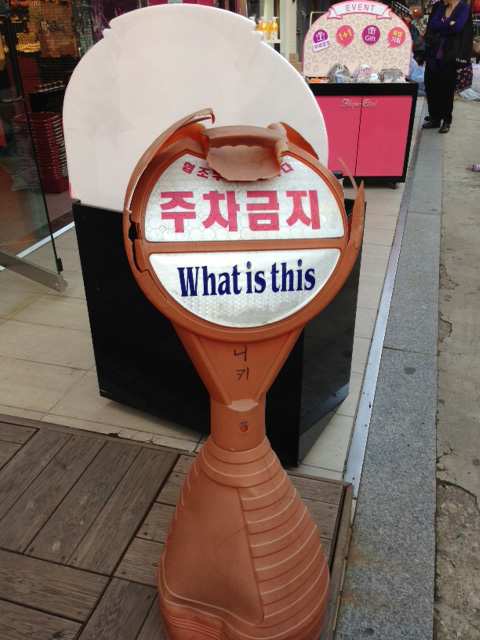
The Korean says:
juchageumji 주차금지 = 駐車禁止 = No Parking
This is from Japanese:
chūsha kinshi 駐車禁止
In Mandarin, for "No Parking", it would be more common to write one of the following:
jìnzhǐ tíngchē 禁止停车
bùdé tíngchē 不得停车
bù zhǔn tíngchē 不准停车
In Cantonese, this would be expressed as bat1 zeon2 paak3 ce1 不准泊車, where paak3 泊 is the Cantonese transcription of the English word "park". This usage has worked its way into Mandarin, where 泊 is pronounced bó. Thus, in Mandarin, bó 泊 has completely lost the close sound correspondence to "park" that it has in Cantonese. This is true of countless English words that have entered Mandarin through Cantonese, including, of course, the ubiquitous "taxi". (See "Fried scholar's".) Never mind that, as a noun, 泊 is pronounced pō and means "lake" and also never mind that, pronounced bó, it can also signify a particular surname.
If you ask a Mandarin speaker why bó 泊 means "park", they might tell you that, as a verb, it originally signified "moor; berth; anchor", so that's just a short step away from what you do with your car or truck when you park it. Since several of my favorite old Chinese poems are about mooring boats beneath bridges or along secluded streams, I choose not to disabuse my Mandarin speaking friends of that notion. It's both incongruous and comforting to imagine that, when one parks one's car in a bustling, modern Chinese city, it is akin to mooring one's little boat in a quiet, secluded nook.
[Thanks to Bill Hannas and Bob Ramsey]
It shouldn't be so hard

IN 2010 a panel created by the White House estimated that American taxpayers spend 7.6 billion hours and some $140 billion a year keeping the IRS off their backs. According to the Washington Post over 80% of taxpayers use software or pay someone to file their taxes. The national taxpayer advocate, a sort-of in-house IRS watchdog, once said, "If tax compliance were an industry, it would be one of the largest in the United States." But of course, it is an industry.
It is an industry made up of accountants and companies like H&R Block and Intuit, which makes the TurboTax software used by many Americans. And it is an industry that, according to ProPublica, has worked hard to keep the IRS from preparing your tax returns for you for free. Intuit, for example, has spent millions lobbying the federal government, opposing bills that would allow the IRS to send you pre-filled-in returns (the agency already has most of your relevant information) and supporting bills that would ban the practice.
A large number of Americans might cringe at the idea of allowing the IRS to prepare their tax returns. The agency would likely err on the side of higher taxes, right? But such a system is already in place in many European countries (where the tax codes are admittedly simpler) and there are few complaints. The system would work something like this: the IRS would use the information it already has to fill in a standard return (a rather effortless process for the government), which would then be sent to you to accept, edit or reject and replace with a new return if you think you can do better.
For those with simple tax returns the system would save enormous amounts of time and a bit of money. Most of us, though, would likely reject the IRS effort and still file our own returns using software or tax preparers. Since that's what we're doing anyway, it's no skin off our backs. It may seem odd for a company like Intuit to lobby against such a system, seeing as it (like many of its competitors) already offers free tax software for filers with easy returns. But on top losing customers who might needlessly pay for the premium goods, it would lose the ability to hook taxpayers on their products before their lives, in the eyes of the IRS, get more complicated. (It's generally easier to stick with one brand of tax software, as opposed to jumping around each year.)
A business protecting its interests in Washington is nothing new. The dynamic here is actually quite familiar to tax analysts. Intuit stands to lose a lot more than any individual taxpayer stands to gain from IRS-prepared returns. It is this same dynamic that keeps America's byzantine tax code, which is the underlying problem, in place. The code is a complicated mess because the gains any individual taxpayer might experience from reform pale in comparison to the losses that would be experienced by certain interest groups. As Jonathan Bernstein puts it, "Revenue-neutral tax reform almost certainly creates marginal winners and solid losers, which means that tax reform legislation produces intense opposition and mild support."
That is why politicians, like Paul Ryan, speak of tax reform in vague (unrealistic) terms. The details would provoke outrage from groups with armies of lobbyists who are willing to storm Washington in order to hang onto their favourable treatment. Just look at the effort put forth by Intuit. The suffering masses, meanwhile, will remain home, quietly cursing each question posed by their TurboTax software.
(Photo credit: AFP)
Markets
Killer Pope
Giacomo Sillari sent in this snapshot of a news-stand display:
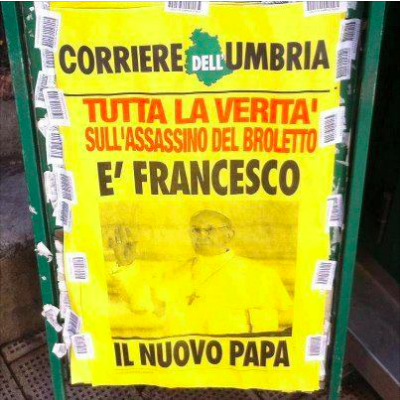
The sign juxtaposes teasers for two different stories, one the election of Pope Francis, and the other a multiple murder and suicide in Umbria.
If we ignore the color-coding and run everything together with the implied punctuation, we get:
Tutto la verità sull'assassino del Broletto: È Francesco, il nuovo Papa.
which means something like
"All the truth about the Broletto killer: It's Francis, the new Pope."
Giacomo submitted this under the heading of "Crash Blossom", but it's really a new form of journalistic misinterpretation. Following the pattern of naming such phenomena after the index case, we could call this a "Killer Pope".


