Shared posts

05 Mar 13:38

Things About 20th-Century American Masculinity I Actually Love

by Mallory Ortberg

masculinityThere’s a lot of playful misandry here on The Toast, so I would like to take a brief moment to list in full the aspects of 20th-century American masculinity that is actually, unqualifiably great. Thanks, American guys from the last 100 years.

  • The way Chuck Connors looks at the camera right after he squeezes off like a thousand rounds in the opening credits of The Rifleman
  • The way Charlton Heston used to say “Oh, my God
  • Pocket squares
  • That scene in The Maltese Falcon where Humphrey Bogart slaps Peter Lorre for not being tough enough and then tells him “When you’re slapped, you’ll take it and like it”
  • The fact that Fred MacMurray used to bring a brown-bag lunch every day to the set of My Three Sons and that also this possibly happened:

“I remember once the wardrobe man coming in and saying, ‘Fred, I really think that we should buy a dozen new shirts for you.’ And Fred replied, ‘Buy a dozen new shirts? Why don’t you just turn the collars around?’”

  • That movie about arm wrestling
  • Short fingernails
  • Taking stairs two at a time
  • That part in High Noon where Gary Cooper knows he has to stay and fight Frank Miller and his woman isn’t going to stand by him and she talks to his last woman and his last woman says “If he were my man, I would never leave him” and his new woman says “Then why are you leaving?” and Katy Jurado just fixes that milquetoast, mush-mouthed Grace Kelly with a look and says “He is not my man” and Grace Kelly changes her life and stands by Gary Cooper and endeavors to be worthy of him
  • The ending of Shane
  • Ossie Davis
  • When young, laid-back male baristas smile genuinely at you and say things like “For sure, yeah” and “Oh, it’s no problem” and “Right on, right on”
  • Slouching
  • Starting meetings by saying “Is everybody here?”
  • Saying “Yeah, that’s cool I guess”
  • Always having an extra set of keys
  • Inviting people to watch you smoke weed or do tricks on your bike
  • Saying “No thanks, I’m good”
  • Fred Astaire
  • Lighting other people’s cigarettes silently
  • Filming it when people get hurt
  • Calling people “champ” or “sports fans”
  • Walking through the front door and calling out “I’m home!”
  • Leather bracelets
  • Opening a newspaper crisply over the breakfast table
  • Young Frankenstein
  • Curt yet friendly head nods
  • Ernest Borgnine
  • Spats

That’s it, thanks guys!!!

Read more Things About 20th-Century American Masculinity I Actually Love at The Toast.

04 Mar 21:54

Lady in Red: A Celebration of Audrey Horne

by Genna Rivieccio

Audrey's introductory smile upon meeting Agent Cooper.One moment brash and blunt, the next vulnerable and venal, Twin Peaks‘ Audrey Horne is one of the most complex characters ever to grace a television screen. Her entire essence can be captured by her infamous assertion, “I’m Audrey Horne and I get what I want.” From the second we’re introduced to Audrey (played to perfection by Sherilyn Fenn), she exudes confidence and sensitivity. Setting her sights on the elusive Agent Cooper (Kyle MacLachlan), she approaches him with calculated politeness and lets it be known that her father, Ben Horne (Richard Beymer), owns the Great Northern Hotel. Cooper, as a current resident of the hotel and lover of their coffee is, of course, impressed. It’s just one in a string of many cases in point of the philosophy of Audrey Horne: attracting attention through a delicate combination of subtlety and apparentness (please enjoy the following clip of her eating a cherry.)

Audrey’s fascination with Agent Cooper is a great example of her simultaneous innocence and baseness; she lusts after the dashing, handsome special agent while knowing in her heart that nothing could ever really happen between them. As she takes great pains to get Cooper to notice her, one of her most self-sacrificing acts during the series is to go undercover as a “lady of the night” at One-Eyed Jack’s, a gambling and sexual getaway owned, incidentally, by her father. The chutzpah it takes for Audrey to pose as a One-Eyed Jack’s employee shows a level of bravado that most of the other characters on Twin Peaks simply do not possess (except perhaps Laura Palmer, and look where she ended up.) Her comportment upon actually being accepted by the madame of the establishment, Blackie (Victoria Catlin), reveals that, beneath the surface, she is far more insecure than she lets on.

Her apparent defenselessness in the face of being trapped amid the web of deceit contained within the walls of One-Eyed Jack’s is counteracted by her innate shrewdness and survival skills. When she learns that her father is coming to check out “the new girl,” she decides to play the coy virgin by putting a mask over her face and claiming to be shy. The ploy initially works against her because her own father is aroused by her standoffishness, but it ultimately stalls enough time for Ben to be called away on another errand. Audrey’s ability to think on her feet exposes her intensive street smarts and a wisdom beyond her years. Though, unfortunately, this maturity isn’t enough to convince Cooper of her as anything other than a friend.

Telling it like it is, cigarette in hand.As for Audrey’s pragmatism, which does exist in spite of most viewers associating her character as sexually appetitive and prone to whimsy, she is at her fairest and most balanced when discussing Laura. After Laura’s funeral, Audrey goes to the RR Café, puts on a sinister, yet sultry song (another dichotomy indicative of the Audrey Horne way) and sits down at the counter to enjoy a cup of black coffee, in her newfound appreciation of all things Agent Cooper-related. Laura’s best friend, Donna Hayward (Lara Flynn Boyle), notices her from afar and goes over to ask her what she was doing at Laura’s services earlier as she had always assumed Audrey hated Laura. Audrey serenely replies, “There were things about Laura I didn’t like, but she did help take care of my brother Johnny. I guess I sort of loved her for that.”

Lady in red.Beyond Audrey Horne’s persona, there is also the Audrey Horne aesthetic, which echoes her binary nature. In many early episodes of the show, she wears pleated plaid skirts with three-quarter sleeve pullover sweaters that hug her chest just so. Saddle shoes complete a decidedly schoolgirl look, but somehow, there appears to be nothing innocent about her. And it’s all rounded out with scarlet red lipstick—her trademark.

Perhaps what makes Audrey’s vigor and sense of self seemingly tenuous at times is her textbook father issues. Her desire for his approval and attention is unabashed, even though she knows he’ll probably never love her as much as she wants him to (a statement that also applies to Agent Cooper, conjuring the term “Electra complex.”) Ben Horne is, in fact, a key piece of the Audrey puzzle.

Ben Horne’s affair with Laura is a source of psychological trauma for Audrey, who vacillates between acting like an impregnable, tough-as-nails adult and a wayward, lost little girl. Before Audrey ever confirms Ben’s relationship with Laura, she intuits it, even casually asking Donna, “Did Laura ever talk about my father?” Audrey seeks attention from Cooper in a similar fashion. Before he’s headed to Laura’s funeral, he asks Audrey to join him for breakfast and pays her a rare compliment, “Audrey, that perfume you’re wearing is incredible.” Elated by his notice, she pushes, “Do you really think so?” He assures, “Yes, I do.” It’s obviously enough to get Audrey through her day.

Erotic rhythm.The similarities Audrey shares with Laura are another facet to consider when examining Audrey’s philosophy. Her devil-may-care approach to life is very much in line with how Laura lived, albeit with a little less abandon. Audrey even feels inclined to confide in Cooper, “We weren’t friends, but I understood her better than the rest.” Laura had a wild child, vixen-like quality that Audrey has just as much difficulty concealing. In Season two of Twin Peaks, her older love interest, John Justice Wheeler (Billy Zane), is a symbol of the good and evil warring within her (not to mention all of Twin Peaks; see: White Lodge vs. Black Lodge.) Even though she knows John is an inherently good man, she also can’t ignore the taboo of pursuing someone so much older. This doesn’t stop her from losing his virginity to him on his private jet. And even though she knows she’ll probably never see him again, she has to throw caution to the wind in the moment, for that’s who she is and that’s all she can do. It harkens back to Cooper’s original warning, “That rightward slant in your handwriting indicates a romantic nature. A heart that yearns… be careful.”

In one respect, Audrey is that effortlessly cool girl who smokes cigarettes in the bathroom and dreams of a life of adventure, knowing all too well that there is a far more exciting world beyond Twin Peaks. At the same time, she’s also the girl who feels perpetually insecure, who can’t quite seem to find her place among the rest. It’s like she says in her prayer to Cooper at One-Eyed Jack’s: “To be perfectly honest, I think I’m in a little over my head. Not that I can’t handle it…”

Read more Lady in Red: A Celebration of Audrey Horne at The Toast.

28 Feb 14:27

Remembering Hollywood’s First Interracial Pairing

by Lakshmi Gandhi

robinson2If you’ve read or watched any of the coverage of Shirley Temple’s death in the last two weeks, you’ve probably seen a mention of Bill “Bojangles” Robinson, the dazzling tap dancer who co-starred with Temple in some of her most memorable films. Temple probably had no idea at the time, but her dance routines with “Uncle Billy” were remarkable not only for their seemingly effortless precision and beauty, but also because they managed to shatter one of Hollywood’s biggest barriers without many people even noticing.

As her New York Times obituary notes, Temple “may have been the first white actress allowed to hold hands affectionately with a black man on screen” (an act that was surely allowed only by the fact that she was seven years old at the time.)

It’s impossible to critically examine Shirley Temple’s film career without talking about race and the way ethnicity was portrayed on film throughout the 1930s. According to black film historian Donald Bogle, “Blacks appeared so often in her important films that there was an inside industry joke that a Temple picture was incomplete without at least one ‘darky.’” And out of all of her co-stars, both black and white, there was no one more important than Bill Robinson.

The pair’s first collaboration was 1935’s The Littlest Colonel, set immediately after the Civil War. Robinson plays Walker, Temple’s grandfather’s stereotypically loyal butler. The film’s most memorable scene is the famous “staircase dance,” which begins when Walker tries to convince his young charge to go to bed (the “affectionate handholding” starts about 2 minutes in):

There are many deeply, heartbreakingly racist things wrong with this scene — Walker’s cheerful subservience chief among them, but the dance itself is still dazzling, all of these generations later.

Throughout her life, Temple would speak of her time working with Robinson in glowing terms and once named him her “favorite star of them all.” She devoted pages and pages of her 1988 autobiography to the memory of working with her “Uncle Billy” on their famous dance routines.

The feeling was most likely mutual. A New York City reporter profiling Robinson once noted that the walls of his home were covered with photos of various stars and other luminaries — including FDR — but that “for each one of those others there [were] two of Shirley Temple.”

On the surface, it was an unlikely friendship even if you took out the vast age difference and racial divide. While to Temple, Robinson was a kind and gentle figure, he was known for his quick temper, fondness for gambling and the little pearl-handled gun he always carried with. He was sharply criticized for his choice in roles and was frequently accused of being an “Uncle Tom.”

Temple and Robinson both became child stars at a very early age. Orphaned by the age of seven, Robinson was raised primarily by his grandmother, a former slave. He began dancing on stage when he was eight. By the time he was 11, he was popular on both the black and white vaudeville circuits, becoming known among the latter as a “pick” or “pickaninny” — a young black child performer who danced behind the white leads. Robinson grew up on the vaudeville circuit and developed his famous “staircase dance” along the way.

Here’s Robinson doing his staircase dance solo in 1932 in his mid-50s.

Although Robinson’s preternatural talent and obvious charisma was obvious right from the beginning — Fred Astaire once called him the greatest dancer of all time – he wasn’t “discovered” by mainstream (that is, white) audiences until 1928, when he was 50 years old, after he was cast in Lew Leslie’s hit Broadway revue Blackbirds of 1928. His routine from the show included his now-famous staircase dance and his performance was both a popular and critical success. In this audio recording, listeners can hear how Robinson’s transforms his feet into a percussive instrument that accompanies Don Redman and his orchestra.

Despite the late start, Robinson’s film career soared, and by 1937 he was making $6,600 a week — an astonishing sum for an African American entertainer. As for Shirley Temple, she was making $10,000 a week during this same period.

Robinson was limited onscreen to playing butlers and other subservient roles. The Littlest Rebel – Robinson and Temple’s second film together — was released later that same year. As the title suggests, the movie takes place on a plantation during the Civil War. This time around Robinson plays “Uncle Billy,” a loyal slave to Temple’s six-year-old Virgie Cary. The film begins with Uncle Billy performing at Cary’s birthday party at the plantation — a dance that is interrupted when the news of the attack on Fort Sumter arrives.

Needless to say, The Littlest Rebel is filled with unrealistic moments, like when the duo heads to Washington to personally ask President Lincoln to pardon Virgie’s father. They decide to tap dance on the street for change when they realize they don’t have any funds:

(The film is also memorable for a scene where Temple is briefly in blackface.)

From a very young age, Temple seemed to be well aware of the social gulf between her and her favorite co-star. She once recalled hearing about Robinson’s isolation during the filming of 1938’s Just Around the Corner, as he carefully followed the unwritten rules of Hollywood at the time:

We were performing in the movies for the last time, a moment which may have escaped us both. Leaving one last kiss on his shiney cheek, as I always did. I headed for my cottage and he towards the commissary. Later I was told that inside he paused to chat at the first circular table, where some other dancers urged him to sit. Declining with a customary chuckle, he had picked a single table against the back wall and eaten alone.

During the filming of Rebecca of Sunnybrook Farm (also released in 1938), after seeing that Robinson continually drove to her rented cottage in Palm Springs to teach her their dance routines, the 10-year-old Temple asked him where he was staying. After initially putting her off, Robinson explained he was staying in a room above a drug store on the main road.

Donald Bogle recounted the conversation that followed in one of his books:

“But that’s where chauffeurs sleep!” said Shirley. “But you’re not a chauffeur!”

“Now darling, don’t you fret. I’ve got a secret,” he told her. “I may be staying at the chauffer quarters, but my chauffeur is staying there too.”

What’s not clear is if Temple ever critically looked at the roles that were offered to her dear friend. Throughout the four films Robinson and Temple appeared in together he was consistently cast as a smiling, helpful, dancing helper. As Bogle points out, in Temple’s films “the black servants represented fellow children with whom she could sympathize with more readily than with real (white) grownups or even real children.”

The strong bond between Robinson and Temple would last long after the veteran dancer’s death in 1949. When Shirley Temple — now known as Shirley Temple Black — was named the Ambassador of Ghana in the seventies, she’d often talk about working with Robinson in her speeches and in private conversations. It was also said that Temple Black made clear to State Department employees and Ghanian officials that she despised Jerry Jeff Walker’s 1968 hit “Mr. Bojangles” — about a homeless man with a drinking problem — and refused to have it played at any official functions or in any car she was riding in.

As she told USA Today in 1998, “He was a classy guy. It drives me up the wall since [the song is] not about him at all.”

Robinson’s film career began to wane after his last film with Temple, leading him to return to his theater roots. He did return to the silver screen in 1943 to star alongside a young Lena Horne in Stormy Weather, which was based in large part on his own rags-to-riches story.

And, yes, they dance on a staircase together and, yes, it’s perfect:

Read more Remembering Hollywood’s First Interracial Pairing at The Toast.

26 Feb 19:09

There Is An Entire YouTube Channel of Teen Boys Reviewing Cigarettes

by Mallory Ortberg

Screen Shot 2014-02-26 at 8.59.37 AMIf this is not art, then nothing is art.

If this is not art, then nothing is art.

If this is not art, then nothing is art.

RealCigReviews is a YouTube channel with over 1000 subscribers that has not posted a new video in more than a year. The channel’s proprietor has reportedly quit. What remains, however, is a back catalog of more than 40 reviews by a group of teenage boys of different brands of cigarettes.

The reviews run about ten minutes long — the boys are nothing if not thorough — and every episode sees each teen smoke a representative of each brand from start to finish (excepting Djarum Blacks, which are notoriously long-lasting). Most episodes are set in a garage in front of an American flag hung lengthwise; a few take place outside and are accompanied by the soothing sound of crickets. All of them are deeply Zen. The boys talk quietly among themselves, light up a cigarette, and smoke in silence before describing the cigarettes to us, their faithful audience.

One of the boys — he usually sits to stage left — wears two bandanas in almost every video, one on his head, and one around his neck. In three of the reviews, he is inexplicably not wearing a shirt.

On Djarum Blacks (featuring guest star Ian):

“The taste is amazing.”

“Yeah, the taste is amazing.”

“The taste is amazing, it’s not like any other cigarette.”

On Camel Crush:

“Yeah, this is the first pack I bought when I was eighteen, we’ve all tried these. I actually skipped school to go buy these.”

As one commenter points out, “These guys are chill as fuck.” A little before 2:00 on the Camel Crush video, Two Bandanas (who is, confusingly, not wearing any bandanas) puts on “Mississippi Queen” by Mountain, which his friend declares “some classic shit.”

“We’re into all types of music, honestly.”

“My dad actually told me about this band. Uh, he saw them live — I don’t know when — but he said it was the best show he’d ever been to. So I had to check ‘em out.”

Please do not mistake my wild enthusiasm for irony here: I love these little dudes so much it makes my heart ache. I want to roll myself up in masculinity and muscle tanks and live in a garage smoking cigarettes with them and talking about music and our dads until the Last Trump sounds.

When the brand in question is Kools, a young lady joins the boys. Her name is Lindsay. She doesn’t smoke.

The channel features only one non-review video (although it does feature smoking); it is a Megal Gear Solid tribute.

It is seven minutes of silence — broken only by the music from Metal Gear Solid – as the boys smoke in the fashion of Snake from the opening sequence.

If this is not art, then nothing is art.

Read more There Is An Entire YouTube Channel of Teen Boys Reviewing Cigarettes at The Toast.

25 Feb 22:40

On Hild, Female Readers of Genre Fiction, and Not Being Game of Thrones

by Zan Romanoff
Jdanehey

for Spiff

hilda

This piece was brought to you by Michael Roston.

If you are a female reader of genre fiction, you have probably gotten used to being dismissed. You are dismissed within the narratives of the stories you love, which all too often cast you as a lover or a witch, a virgin or a crone, a sexy plot-device on two long, supple legs; you are dismissed by half of the people who share your interests under the maddening label of fake-geek girlery. (Unless the genre you prefer is romance or young adult, in which case everyone dismisses you out of hand, because those are frivolous kinds of books for frivolous kinds of people, aka women, specifically young ones.)

The good news is that Nicola Griffith’s Hild is the book you’ve been waiting for, the one that has room for you in it: it’s long and smart and beautiful, set in a world so old that the languages and tribes feel supernatural in their distance from our own, and it’s expansively, gloriously, breathtakingly feminist, nearly six hundred pages of story about women that takes them and their complex, active lives seriously. It’s nominally about the woman who would become St. Hilda of Whitby, but the story covers only her early life, long before her eventual martyrdom. It’s not a catechism; instead it’s an exploration of the confluence of political power and mystical belief, and the way that a clear-eyed storyteller can shape her world and the world of those around her.

urlI love Hild—I have been singing its praises with obsessive fervor since this summer—and I want it to sell. So it’s hard to hate the marketing campaign that relentlessly compares it to Game of Thrones, even though it’s a comparison makes me want to die. I understand why it makes sense to start there: GOT has been a huge crossover success, theoretically because, per everyone’s imaginary boyfriend Ben Wyatt, “they’re telling human stories in a fantasy world.” It’s gotten a lot of people who don’t think they’re interested in fantasy to read thousands of pages of knights bearing standards going off to fight dragons and wights and walkers; the idea is that by invoking its name we’ll trick the reading public into taking on historical fiction, now, too.

But the best thing about Hild is that it’s nothing like Game of Thrones, and that, in fact, it succeeds in telling human stories—as it happens, women’s human stories—in a historical world, in a way that Games of Thrones resolutely does not.

Don’t get me wrong: I enjoyed the hell out of Game of Thrones. I am a high fantasy dork from way back, and one of my favorite side effects of its popularity is how it’s flushed Wheel of Time-reading friends out of hiding, all of us commiserating about the pain of loving something that just. won’t. end. But it is an absolute cesspit of rape and misogyny;

Sady Doyle made a handy list of every incidence of nastiness towards women, and I am deeply grateful to her for it, because now I don’t have to.

Suffice it to say: those are not human stories. They are stories about bodies, and ancestors, and the icons on standards carried into battle. They are stories about politics and monarchy and the will to power. George R. R. Martin’s books use people like playthings, like chess pieces on a black and white board. They do not develop character, and they have no interest in the fabric of everyday life.

Hild, on the other hand, takes a very literal interest in that fabric: Hild is born to a mother, Breguswith, who, like most high-class women of the time, is a weaver. The action of the loom is the metaphor by which Hild comes to understand the world: warp and weft, currents coming at one another from all sides and uniting to create the fabric of her universe. If you don’t know how to weave, cloth looks like a single unit, a cohesive and unbreakable surface. It’s only by studying the process of its creation that you can come to manipulate the strands, and change the picture that the pattern creates.

Breguswith teaches Hild this lesson over and over again: Hild is the daughter of a murdered king whose brother now holds power, and who’s favor she must curry without ever seeming to threaten his rule. So Hild becomes first his seer and then his Fist, and she does this by paying very careful attention to the smallest and most mundane things in her world. She learns the lessons of the loom, and of her mother’s work as a healer: women’s stuff, theoretically minor. She studies the natural world minutely. She uses all of this keen, careful observation (plus her own unerring intuition) when she advises the king, and on her wisdom armies fall and an empire rises.

But this isn’t some behind every great man kind of thing, an attempt to argue that women are controlling men’s actions whether they know it or not; instead Hild has a clear-eyed vision of the way in which even a world that seems, to us, impossibly divided by gender was of course mixed and complicated. Women shear sheep, wash the wool, card it, spin it, weave it into cloth. Men—kings—wear it when they ride through their territory, to flaunt their wealth, to subdue nascent rebellion. We call it women’s work and men’s worth, but that’s just another way of saying warp and weft. Without the both of them it’s just so much loose thread.

Fans of Martin’s argue that the rape (and molestation and misogyny) endemic in his work are nothing more than historical accuracy, and they do have a point. But his is a book that has dragons in it, and this is an old question but it’s always worth asking: why is it that a man can imagine flying, fire-breathing lizards, but he simply cannot get to a world in which women don’t live under the constant threat and fear of rape?

And the sad answer is that George R. R. Martin could imagine it, if he wanted to. If he’d ever had cause to think about what it would be like, to live with a body that is always a weapon waiting to be turned against you, he might have bothered. But it runs deeper than that: if he had ever been left out of a story—and not just one, but a hundred, a thousand, most of the stories he’d read in this life—he would know that stories are often full of shit, and the best historical record barely scratches the surface of what really happened, and that other people are far more fathomless and complex than imaginary battle choreography or whose ancestors descended from which tribes of legend. He would know that making stuff up is one thing but understanding what might have happened is really, entirely, another.

Nicola Griffith, on the other hand: she’s a queer woman with an interest in science fiction. Nicola Griffith knows that she, herself, exists, and yet she isn’t all that often on the record of culture, so she looks back at the past and knows that there must have been women like her, who existed, whose stories didn’t merit telling but who had full and important lives just the same. And so, in Hild, she applies herself to imagining them, and then to telling them. The book is long but quiet, focused on a handful of years, really, the unimportant beginnings of a minor saint. From that subject Griffith extracts easily as much fear and violence as Martin gets in his ever-expanding series—but she gets joy, too, and desire, and love, and the ways that love’s fierceness is, all too often, indistinguishable from cruelty.

It’s telling to consider each book’s major matriarchal figure: Martin’s Cersei, whose mother’s love is calculating, and whose ambition to be more than a pawn in marriage schemes is thwarted by own her useless vanity. (Or, fine, Catelyn, who loves her children so much that she sacrifices a crucial hostage for the slim hope of seeing one of them again, motherhood driving her mad.) Griffith has Breguswith, who is also calculating and sometimes cruel, but whose machinations work. She’s the widow of a king: her life is in danger and her children are in danger every minute of every day. She knows they can never make bold claims to power, but that under power’s wing is where they are safest.

She walks a fine and delicate line, and though she does absolutely horrible things, you cannot help respecting her for some of them, if only because she’s powerful enough to work her will so precisely. Which is to say: Cersei is diminished by her circumstances; Breguswith rises to them.

Martin takes women’s lives at face value: because we have historically been concerned with kitchens and cloth, he assumes that kitchens and cloth are all there is to it, and that only small minds could be so contended with small subjects. Griffith, on the other hand, knows what it means to be assigned to the hot stove, to be dismissed from the main action. She knows that there is meaning in cooking and weaving and tending to wounds, but also that when that’s what you have you find the meaning in it, because you are human, because your big storytelling brain demands it.

Genre fiction tends to encourage repeated plot structures, a sameness in narrative, that allows for the content to be imaginative and expansive: if you know what’s going to happen next, the world in which it happens becomes all the more crucial to the story’s success. Martin captured an audience by subverting narrative expectations, but at the end of the day it’s the same old song, just dragons and sluts and kings, writing a history where men are victors and women are victims.

It’s interesting, but it’s not original, and it is not the story of humanity, or at least any kind of humanity I recognize.

You have to let women speak, to tell human stories: you have to give them motivations other than their children or their vanity or their desire to get fucked. You have to believe that they play roles other than the ones their bodies insist on. You have to be interested, above all, in those people, in what it would feel like, to live a different life. No one has ever insisted that George R. R. Martin inhabit characters who are all that much unlike him; Nicola Griffith has had to all her life. Of course she’s learned empathy and imagination on a scale that escapes him and his work.

Read more On Hild, Female Readers of Genre Fiction, and Not Being Game of Thrones at The Toast.

25 Feb 17:45

All the Sporty Ladies: Female Athletes in Romance Novels

by Mindy Hung
Jdanehey

Relatedly: I did enjoy the Reese Witherspoon-as-softball-star romantic comedy, "How Do You Know."

Screen Shot 2014-02-24 at 12.46.45 PM

Mindy Hung’s previous bodice-ripping work for The Toast can be found here. Most recently: Love in Colour: Multicultural and Interracial Romance Novels. This installment was brought to you by a reader.

Just how does the average wealthy, workaholic male romance novel protagonist find time to lovingly hone the ridges of his rectus abdominis? If the gentleman is a sports star, then that’s easy: The six pack is simply part of his job.

But what happens when a heroine is the athlete? Fewer women make a living as professional athletes than men, and, as scholar Jackie Horne notes, this is reflected in the paucity of sporty heroines. Romance novels featuring gay and straight female athletes often have to address the pay gulf between men and women, the notion that female athletes need to put off love and family in order to have a successful career, or even the idea that muscles or competitiveness aren’t feminine or appealing.

Today, we’ll take a look at the issues facing sporty women of recent contemporary romance novels: the gifted amateurs, the retired pros, and the firmly-muscled crop of current competitors.

urlThe Derby Girl by Tamara Morgan

Gretchen “Honey Badger” Badgerton is a barista, lifeguard, and roller derby jammer. She’s 31 and lives a Philadelphia exurb with her grandmother. She’s changed career paths several times and her sisters never stop reminding her that she’s treading water in the pool of life.

On the surface, Gretchen seems outgunned by Jared Fine, plastic/reconstructive surgeon, privileged male. Jared used to work for an international medical aid agency. He’s called a saint, a hero, and a “panty melter.” He harbors the kind of broody, self-loathing that comes of not being able to live up to his idea of his own godhood. After asking her out, he tries to convince Gretchen of his unworthiness and she responds dryly, “I don’t think I’ve ever heard a man insult himself with so much conceit lingering in the subtext. You have a gift.”

Oh, snap!

Gretchen’s response encapsulates the dynamic between Jared and Gretchen: she takes the piss out of him, and he loves its. She insists that he show her the respect she deserves, even if the world (and sometimes she herself) feels she’s not valuable. The book works as a re-write of a common Harlequin Presents category romance scenario wherein a wealthy, domineering male attempts to bend a quavering, lip-nibbling female underling to his will. In this case, though, derby makes all the difference:

She might not be paid to play for her team, the Philadelphia Spread Eagles, and she might not have as many stories to tell as Jared, but this sport was her sport, this place her place. The women on the team accepted her at face value, took what she had to offer, crashed and tumbled and helped her to her feet when it was all over.

Gretchen may not be a globe-trotting philanthropist surgeon, but she has a place in the world and she’ll defend it vigorously.

url-1Ride With Me by Ruthie Knox 

Bike mechanic Tom Geiger’s solo plans for the TransAmerica Trail are thrown for a loop when his sister informs him that she has found Tom a biking buddy named Alex Marshall. Alex turns out to teacher Alexandra, or actually, Lexie, a Portland high school English teacher.

Tom doesn’t want anything to do with the hyper-organized Lexie but is reluctant to abandon a woman to the trail. In an attempt to discourage her, he feeds her standard misogynist crap about not wanting to spend the next three months yakking about relationships and fixing her flats. In reality, they face similar risks and concerns. Tom’s sister, “doesn’t want [him] to die in a ditch and rot unmourned.” In an echo of that, a frustrated Lexie tells Tom, “All I want is for you to camp where I camp and call my family if I have some kind of horrible accident.”

Funny, isn’t it? Women may seem more vulnerable on the road, but Lexie and Tom’s (ok, his sister’s) requirements come down to the same thing: having someone to make calls during an emergency.

Lexie doesn’t want to ride with Tom either, but he’s her only option. So few women make the ride that she can’t find a female partner or, for that matter, a male, hence her subterfuge about her name: “the wives and girlfriends of the nation’s intrepid adventurers didn’t want their menfolk crossing the country with a strange woman.”

Lexie is hamstrung from the start because of her sex, a familiar situation for many women who participate in sports.

Ride With Me was Knox’s debut, and she’s since written a slew of excellent books. Lexie and Tom don’t seem to have a lot in common at first, but they share an ambitious pace, high hot-sauce tolerance, a love of Walden (he likes the hermit bits, she likes living deep and sucking the marrow out of life), and they both have gorgeous glutes (cycling, baby). Really, that’s more than enough to sustain a relationship.

url-2One Night in the Spa by Kathy Lyons

Gym manager Kim Castillo’s client’s attempt to rape her is foiled when her best friend David Pepke bursts out her office. David works at the spa next door, but he’s been snooping through the gym’s financial records. He’s also been in love with Kim for as long as he’s known her. Kim is a former pro-racquetball player whose knee injuries recently forced her into retirement. If that weren’t enough, her body is also changing. She has finally accrued enough fat that her hormones have come roaring into belated adolescence. She’s worried, twitchy, and very, very horny.

David tells her, “It’s easy to be focused when you don’t have adolescent distractions hitting you all the time. You basically grew up in a hormonal monastery and now—”

“I’m stepping onto a porn set,” she finishes.

She’s also a virgin. And she’s just noticed that her best friend/ secret enemy, David looks like “a really chiseled bar of expensive chocolate.”

There’s a lot of plot. Not surprisingly, in the scramble to resolve the friends-to-lovers, corporate spying/ betrayal, sexual violence/ sexual discovery threads, the second half of the book feels rushed.

But the first half is fascinating, especially when one considers that Lyons, who writes Regency and mystical Chinese historical romances under the name Jade Lee, is a former pro racquetball player. The harms done to Kim’s body—attempted rape, a stabbing and threat of kidnapping in childhood, and the injuries from her playing years—are all gendered traumas. Kim’s career ender, an ACL injury, afflicts women disproportionately, and her lack of regular menses resulting in her current hormonal crisis is a classic symptom of female athlete triad. Despite Kim’s obvious love of racquetball, the narrative contains an interesting ambivalence towards the physical toll of sport on women.

url-3Stealing Kisses by Harmony Evans

Natalie Kenyon, former figure skater turned life coach, shares a similar ambivalence to her former career. She’s hired to revamp bad boy NBA player Derek Lansing’s career after the forward with the fictional New York Skylarks is been suspended for not showing up at morning practices. Natalie tries to get him to stop sabotaging himself by reconciling him to his estranged family while hiding her own secrets and discomfort about her professional sports past.

In both her debut, Lessons in Love, and in her sophomore effort, Evans pairs teacher/ nurturers of sad life experience with outwardly successful/ inwardly stuck men. In this case, Natalie’s affinity for Derek comes from recognition of her own isolation. Her parents are conspicuously absent and it’s hinted that skating is the cause. I would have liked much more about this earlier because sometimes Natalie’s decisions and reactions seemed to come out of nowhere. (Why not just get Derek a better alarm clock if he’s always late for practice, as Derek himself suggests?) That said, Stealing Kisses boasts an adorable one-on-one basketball scene and an explosive chemistry lab episode.

Read more All the Sporty Ladies: Female Athletes in Romance Novels at The Toast.

25 Feb 14:21

Hero Status: Leonora Carrington

by Esme
Jdanehey

Now I want to leave work and go re-read "The Hearing Trumpet."

8TC2D 5LMze x5l5h LdPBU 33wLR 9XfuT
23 Feb 01:53

Standing

Jdanehey

Spiff!

At first I was making fun of them, but joke's on me--the deer is surprisingly ergonomic, except for the kicks.
21 Feb 22:30

When To Give A Kid A Book: The Only Parenting Advice I Will Ever Give You

by Mallory Ortberg
Jdanehey

I love this way too much.

This will probably work best if it is a kid that belongs to you in some official capacity; you will need to begin a campaign of supervised book-giving at an early age, and it’s most easily managed if you’re able to do so while under the same roof. This should result in a pretty good person. If it doesn’t, give me a call and we can discuss where you went wrong.

furfamilyAge Three — The Little Fur FamilyEvery child should have a little furry book. Be sure to get the version with the soft, furry cover; that’s very important. It is a perfect book and you can sleep with it right next to your head, if you are small enough, which a three-year-old ought to be.

Age Four — Can’t You Sleep, Little Bear? This book will be very helpful if your child grows up to be an anxious person or suffer from sleep paralysis or becomes the kind of person who has to watch Netflix on a laptop balanced on their stomach until they are gently and deliriously lulled into passing out rather than falling asleep. There are so many reasons not to want to fall asleep.

sleep

Age Five — Betsy-Tacy and CatwingsCatwings because it is never too early to introduce a child to the works of Ursula K. Leguin, who I did not realize wrote Catwings until yesterday. It is about shifting for yourself and avoiding owls, which are two life lessons worth learning at any age. Betsy-Tacy because they are charming and Midwestern and about best friends and will eventually instill within said child the love for tolerance, the Edwardian era, emotional restraint and Episcopalianism that is necessary for a semester abroad at Oxford. (It will also prepare them to love Maurice, E.M. Forster’s greatest novel, in exactly fifteen years.)

fairyAge Six — The Blue Fairy Book. The other colors can come in whatever order you prefer, but The Blue Fairy Book must come first. They’re going to read Anne Sexton someday, there is nothing you can do to prevent it, but you might as well give them something solid to come back to once they tire themselves out. You might as well throw in Kipling’s Just So Stories while you’re at it, although this may instill in her a degree of affectation so monstrous that she refers to her first love interest as “The Best Beloved” for absolutely years. But that isn’t Kipling’s fault. Plenty of other things are Kipling’s fault, but you can get to those later when you think she’s ready to talk about Gunga Din critically.

greekAge Seven — Bulfinch’s MythologyYou should already have started them on the big, gorgeous D’aulaire’s illustrated version, but they’re ready for the real thing now. You can rage against the canon all you like on your own time, but it’s got to be Bulfinch and it’s got to be now, and you’ve got to pay just as much attention to the boring Charlemagne cycle as you do to the transformation of Daphne.

cain abelAge Eight — The Island of Dr. Moreau and The Illustrated Bible (Nestor Redondo version only, please). Moreau because you have to build a person up to Lovecraft and Shirley Jackson; you can’t just spring them on a body at fourteen and expect to leave a whole and sane person in your wake. The Illustrated Bible because I don’t care what kind of whacked-out UU church you’ve got your kid attending thrice a solstice or whatever, if they can’t recite the basic plot elements of the tale of Job or find the throbbing poignancy of Leah’s discovery in the unlit tent before they reach double digits, you’ve got yourself a worthless kid. (No, your kid is great.) But if your kid reads East of Eden without having gone through the Book of Genesis at least forty times first, their souls will never fully heal

Plus drawings are just cool.

flyAge Nine — The People Could Fly: American Black FolktalesI told you already. Drawings are amazing. And you need to make sure they remain at least a little convinced that human beings are capable of flight under the right circumstances until they reach puberty.

Age Ten – Roll of Thunder, Hear My Cry. Get this in before they have to read To Kill A Mockingbird freshman year. Ask Jaya if you don’t believe me.

Age Eleven — The Wonderful Flight To The Mushroom Planet. There is no science fiction like 1950s-era science fiction for children. Make sure the child reads this, and he or she will be a completely appropriate degree of odd for the rest of his or her life. May be replaced with The Last of the Really Great Whangdoodles if your kid’s a little bit of a wuss. Anything written about space travel shortly before space travel actually became possible will do, however. The important thing is to keep it weird. Not “tapes her ears into elvish points for the entirety of sophomore year” weird, but one or two tiers below. Think “nourishes a healthy appreciation for the works of Jules Verne,” not “regularly attends steampunk conventions.”

jeevesAge Twelve — Jeeves. Twelve is the perfect age for Jeeves. No older, no younger, no matter how precocious you believe this particular child to be. Twelve is just the right age to imprint on Wodehouse, and you always start Wodehouse with Jeeves. Psmith is for fourteen. Mr. Mulliner and Lord Emsworth can wait until college. Twelve is for Jeeves. Start with The Inimitable Jeeves. Make sure you get one with the cover featured to the right, because some of the Jeeves covers are terrible.

You will be tempted to begin with Right Ho, Jeeves! because of the Market Snodsbury prize-giving speech, but this is an error. Do not fall into it. Start with The Inimitable Jeeves, and the rest will follow. Do not buy her a Jeeves omnibus; the spine is too thick and makes it impossible to read in the shower.

Twelve is also an appropriate age to instill in her a deep inner conviction that no matter how strong her appreciation for the collected works of Wodehouse, she must never refer to him as “The Master.” If she does, all is lost. You have created an unlovable pedant.

This is also a good age to get her started on the Berdichever, if her understanding of Heschel is good. But she must love Heschel before she is ready for the Berdichever. If you cannot bring her to love Heschel, you must begin again from scratch. Start with Rumi, maybe.

ivanhoeAge Thirteen — Ivanhoe and The Once and Future King. Do not worry about flinging Anne of Green Gables or A Wrinkle In Time at her; by this age she will have absorbed them by osmosis. She may also at this point have absorbed in passing a smutty book. This can be easily countered by the administering of at least one entry in the X-Wing series of the Star Wars Expanded Universe canon. The Once and Future King should be easy enough, but persist in proffering Ivanhoe until they accept. Ivanhoe will counteract all the petty, countless indignities of being thirteen.

tam linAge Fourteen — Good Omens and Tam LinIn order to understand Good Omens, she will need to be at least passingly familiar with the works of G.K. Chesterton (if you don’t understand the dedication, you’re not ready for the rest of the book). Just Orthodoxy is fine if you don’t have time for The Man Who Was Thursday. If she has the ‘we have sinned and grown old, but our Father is younger than we‘ part memorized, she may be permitted to skip the works of C.S. Lewis entirely.

Good Omens is mandatory if one hopes to develop in the child a sense of humor. The fact that it will never — never — successfully be made into a movie will teach her a sense of whimsy and resignation not unbecoming to a young person. Tam Lin may be omitted if she displays a tendency to want to read the works of Marion Zimmer Bradley.

castleAge Fifteen — Shirley Jackson. It is imperative she not be allowed to read any Jane Austen at this point. Do not allow even the name of Jane Austen to be breathed in the walls of your home. Stop all the clocks, strike out any mention of her works in the newspapers and periodicals that cross your threshold. Should she discover Austen now, she will be lost to you forever. Shirley Jackson and Shirley Jackson alone can save her at this age. We Have Always Lived in the Castle is best — preferably if she can stumble upon it by herself in a used bookstore on a summer afternoon, since this will be the last year she doesn’t have to get a summer job — but The Lottery will do fine. Shirley Jackson before Dorothy Parker, remember.

Now it is too late for you to influence any of her reading choices; now you have lost her. Hope for the best and wait for her to call you in a few years. If you have laid the appropriate groundwork, the call will come sooner rather than later, and you will find her surprisingly pleasant to talk to.*

*Not a guarantee

Read more When To Give A Kid A Book: The Only Parenting Advice I Will Ever Give You at The Toast.

21 Feb 13:57

Ann Maxwell Covers: Futuristic WTFery from the Past - Updated!

Jdanehey

So weird to discover that the stylist for Britney's live "Slave 4 U" performance and then "Toxic" video stole the look from "Firedancer."

by SB Sarah

Recently, a HaBO featuring a reader looking for a book with somewhat sentient hair and possible prism embossing on the cover led to a discussion of Ann Maxwell's books - and the covers thereof. The book in question is likely Timeshadow Rider, but Elise Logan sent me pictures of a few other Maxwell covers from her collection, and, seriously, HOW DID I MISS THESE.

I had no idea there was this gaping void in my memory where excellent futuristic prismatic covers should be! Good thing Elise can help us all fix that.

Ann Maxwell, if you weren't aware, also writes romance under the name "Elizabeth Lowell." I didn't know this until I'd read a pile of Lowell books - I loooooved them. The books below are much-loved science fiction books, too, with many, many positive reviews in various places online. I had no idea she'd written science fiction as well. Or that the covers were SO COMPLETELY AMAZING.

Ready to go back to the future?

First, there's Fire Dancer: (GR | A | BN)

Fire Dancer - a woman who is mostly naked covered with streaks of lightning wielding fire from her hands because thats what she does apparently


No, no, don't worry. Elise also sent a CLOSE UP: 


Close up - her hand has a lot of light coming out of it. Not sure why.


Good heavens. My eyes aren't sure what to look at first: boobs, orbs, or the assortment of erect and elongated things. WAIT A MINUTE. Is this the Olympics of the future?! 

Elise: I love that naked dude behind her is about to throw a discus (and is pointing to where he's aiming) and has completely fabulous glow-in-the-dark eye makeup.

Elise would also like to draw our attention to the tagline: "Were they the last survivors of their planet's blazing glory?"

It appears the blazing glory came with them and is in her hand.


Then there's Dancer's Luck: (GR | A | BN)

Dancer's Luck - woman shooting light out of her hands while dogs wearing spiked armor are in front of her in strategic position plus there's a naked dude in the background


Yes, of course there is a close up: 

A close up of light beam hands naked woman and dogs. Seriously.


Imagine that 911 call: "Sir, sir. I need you to slow down. You say there's a lightning woman and her dog is where?"

I also imagine that in this world, "Never ride the horned dog" is NOT a euphemism. 

Elise: Fire shooting from your hands and dogs coming out of your crotch seems like something you might want to avoid. Just sayin'. 


But wait! There's more! Please meet Dancer's Illusion: ( GR | A | BN )

Dancer's Illusion Still gold but now she has a red toga and some light coming out of her palm and a lot of sideboob


Close up? BUT OF COURSE.

Close up - there's some animals in the background I think. Or rocks - hard to tell.


You know what? I think romance needs more sideboob. And dragonflies, red togas, shoulder armor, and eye makeup. Let's make it happen! 

And the TAGLINE: On a world where nothing is what it seems, ecstasy can be the deadliest trap of all!

THE DEVIL YOU SAY.

Elise: It looks to me like they've been taking LSD, not Ecstasy, but what do I know?

And Good. Lord. Mario World flying jellyfish on the left, bird freaking the fuck out on the right, crazy glowy dragonflies, a dress that would make Nicki Minaj think twice, and homegirl needs some serious hair care. Plus, now the dude is coming out of her ass, - with his eye makeup STILL IN PLACE. That takes serious talent right there.

Remember, people. Ecstasy can be the deadliest trap of all. 


Updated: 21 February 2014

Aislinn in Australia sent me the following email after she saw the collection of covers: 

I found your snark about the Ann Maxwell covers so funny that when I got to work the next day (I work in a second hand book store) I had to try to find some. These must be the Australian covers. Not quite the same level of WTFery, but nevertheless amusing.

Fire Dancer - naked woman with pointy boobs rising out of some very liquid looking fire


woman holding her hair away from her face except she has no hair so far back from her face that it looks like she's scalping herself


woman with her arm turning into molten blue metal


Awwww yeah, Australian editions! If you come across someone you think may be a visitor from another planet, first, check to see if they're wearing a modified malliot and if they have a rather unique hairline.   

BUT WAIT. THERE IS INDEED MORE. 

I also received an email from Gry in Norway, who has the same covers as Aislinn. International cover designs travel far! Gry also says:

I have several of the Ann Maxwell books - including a different cover for Dancer's luck. There isn't that amazing amount of WTFery as the cover you posted, though.

But I hope you will like the other two covers. I particularly think you will like the one for Name of a Shadow - she looks as if she is having an orgasm right there! :D Makes you wonder if it is the dark blobs in the background that are doing the dirty with her, or if that thing she is clutching is a kind of alien sex toy. (Actually, it's not - its supposed to be a musical instrument called a sarsa, peculiar to the cover girl's planet - makes you wonder how she can actually make music on it with the strings festooned with crystals).

Name of a Shadow woman with her head thrown back in presumed bliss playing a harp with strings with crystals all over them. Ouch.


Play that funky music, space girl! 


A dead god dancing - a pale white woman who looks like she's naked and covered with feathers dancing above a group of long haired angry primitive-looking men


Oh, my. I'm not even sure what to say about that cover, except that the fact that her nipple is staring at me is oddly reassuring. 

Categories: Covers Gone Wild! (Non-Snoop Dogg Edition), General Bitching


18 Feb 14:08

Fortunes Told at the Rubenstein

by Kate Collins
Jdanehey

Commonsense advice.

shipton cover square

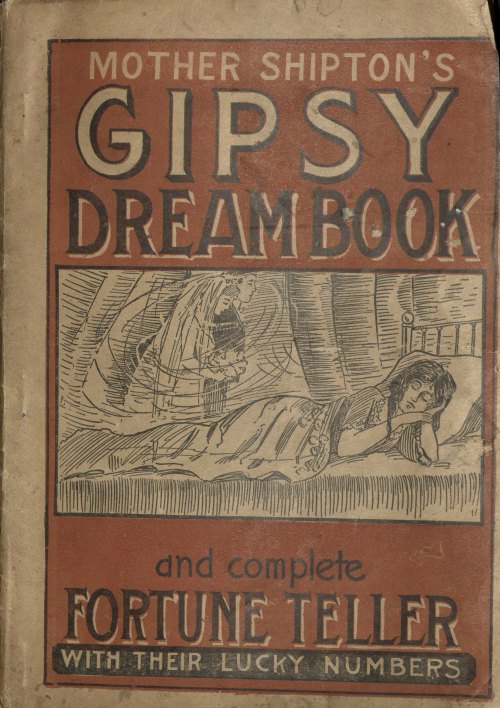
Did Valentine’s Day leave you with more questions than answers? Wondering who sent you that sweet Valentine? Want to know when you’ll meet your own Rapturous Codfish? Perhaps Mother Shipton’s Gipsy Fortune Teller and Dream Book can be of help.

Shipton - Cover


Not which of your many admirers sent you that “love token?” Get your crow quill ready and try this spell on Friday:

Valentine


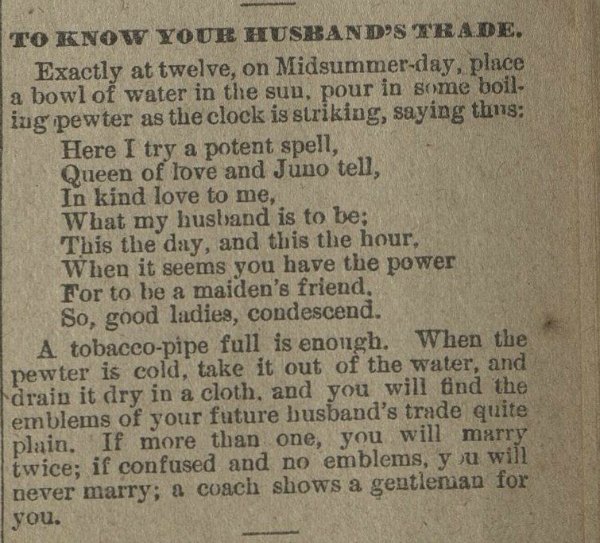
You’ll have to wait until June to try this one – plenty of time to find a tobacco pipe full of pewter so you can augur your future husband’s career:
 
know your husband's trade


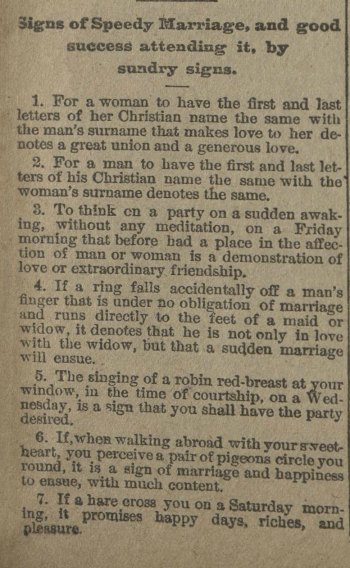
Did two pigeons fly around your and your darling’s heads this weekend? Or maybe a rabbit crossed your path on Saturday morning? Both good signs:
 
speedy marriage

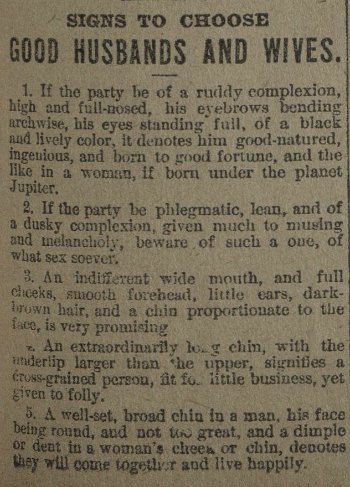
But Mother Shipton thinks you should be careful if your love is the quiet mysterious type “given to musing and melancholy.”
 

signs to choose

17 Feb 13:57

Open Ye Gates! Swing Wide Ye Portals! Part 2

by Edward McPherson

This is the second in a two-part series on St. Louis and the 1904 World’s Fair. Read part 1 here.

arch shadow

Photo: Edward McPherson

The Palace of Agriculture is a blinding colossus in the sun. The man next to me reads from a booklet: twenty acres large, covered with 147,250 panes of glass. I have timed my visit—in one minute a giant clock made of 13,000 flowers will strike the noon hour. I am finished with the exhibits. I have seen the Missouri corn palace, the 4,700-pound cheese; I have laughed at Minnesota’s contribution, “The Discovery of St. Anthony Falls by Father Hennepin” shaped out of one thousand pounds of butter. Now a hiss of compressed air throws the 2,500-pound minute hand the final five feet, where it points to the giant numeral 12. An hourglass flips, doors open to reveal the gears of the clock—the triumph of industrial time—and a massive bell tolls the death of more agrarian rhythms.

Pyramids of fruit on a sea of china plates—the entire Palace of Horticulture smells like apples. Virginia has created a statewide shortage by sending too many to the Fair. I dip my fingers into the fountain, which gushes ice water. Farmers shake their heads at the monstrosities on display: a pineapple the size of a turkey and a mysterious dimpled fruit, said to be the unholy cross between a strawberry and a raspberry.

 * * *

The company is a major employer in this city. One cannot miss its print and radio campaign: “We grow ideas here.” “We work together here.” “We dream here.” “We’re proud to be St. Louis Grown.” Its website offers videos of employees working in food banks, cleaning up after tornados, visiting Forest Park, and standing in front of the Arch. Articles rate the town’s best burger joints, as judged by company workers. The company is a major donor to local charities and institutions, including the university in which I teach. In 2013, the company’s net sales were $14.8 billion, up ten percent. Its chief technology officer won the 2013 World Food Prize. The company has 21,183 employees in 404 facilities in sixty-six countries—but its headquarters are here, where, over the years, the much-maligned Monsanto Company has worked to produce saccharin, PCBs, polystyrene, DDT, Agent Orange, nuclear weapons, dioxin, RoundUp, bovine growth hormone, and genetically modified seeds. 

* * * 

I live in a small apartment building that stands in the footprint of the Horticulture palace. We grow nothing in the backyard but herbs, potted lettuce, and a few stunted rose bushes, but on sunny days I like to think I smell apples.

 * * *

st louis - kingsbury pl

A private gate in an old St. Louis postcard.

In Meet Me in St. Louis, Judy Garland’s older sister reminds her, “Nice girls don’t let men kiss them until after they’re engaged. Men don’t want the bloom rubbed off”—to which Garland responds, “Personally, I think I have too much bloom.”

The film’s crisis comes when Garland’s father declares his intention to move the family to New York City, dashing his daughters’ romantic interests and hopes of the Fair. In the dramatic Christmas Eve denouement, he decides the family will stay put, saying, “New York doesn’t have a copyright on opportunity. Why, St. Louis is headed for a boom that’ll make your head swim.”

* * * 

A slick-haired fellow shouts from an automobile: “One hundred and forty models of cars powered by gas, electricity, and steam!” His eyes shine with belief in the Palace of Transportation. He waves a magazine furiously about; as he reads, he stabs his finger in the air: “This new form of carriage will become perfected, and then the great cities will spread out into the suburbs, and life on an acre will become a possibility for even the humblest class of people!”

 * * *

Opened in 1954, Pruitt-Igoe was a mammoth, state-of-the-art public housing development designed by Minoru Yamasaki, who later would build the World Trade Center. The Pruitt-Igoe development rose on a parallelogram bounded by Cass Avenue, North Jefferson Avenue, Carr Street, and North 20th Street on St. Louis’ northside, close to downtown. A city-designated “slum” was razed and in its place rose a modern utopia, Le Corbusier’s “Radiant City” made real: thirty-three modular eleven-story buildings smartly arrayed in superblocks across fifty-seven acres, each high-rise facing the same direction, vertical neighborhoods of light and space with ample parking and vibrant public areas. Kids scampered in the breezeways. Apartments were clean and bright, offering views better than those enjoyed by the rich. In a recent documentary, The Pruitt-Igoe Myth, a former resident remembers her top-floor apartment as a “poor man’s penthouse.” Another says, “It was like another world,” and then adds, “Everybody had a bed.”

Pruitt-Igoe was founded on the faith of communal, public life; it offered better living through architecture. One set of high-rises was to be white (the Igoe Apartments, named after a Congressman), the other black (the Pruitt Homes, after a Tuskegee airman), but Brown v. the Board of Education came down the year the development opened—and the whites moved out. Black by default, Pruitt-Igoe flourished. In 1957, occupancy was at 91 percent. Fifteen thousand tenants would call it home.

But the project was built for a postwar boom that never came. Another kind of planned community was thriving beyond city borders—the suburb, fueled by the same 1949 Federal Housing Act that enabled Pruitt-Igoe. Having already legally fixed its boundaries, the city couldn’t abate its population decline by annexation. With the middle class fleeing to the suburbs, the development would never be able to raise the significant maintenance fees it needed from its tenants. The city let the brand-new buildings deteriorate almost from the start. There were also more pernicious factors at work. Suburbs passed zoning laws barring low-income housing; public projects became a tool of segregation, the goal being to prevent, in the parlance of the day, “negro deconcentration.”

One historian has called St. Louis “the poster child of white flight.” It’s often ranked as one of the country’s most segregated cities based on what’s called its “dissimilarity score,” which analyzes racial makeup across census tracts. While different measurements suggest the divide might not be so stark, the traditional color line is widely acknowledged to be Delmar Boulevard. Seventy-three percent of residents south of the boulevard are white; head north, and neighborhoods become ninety-eight percent black.

 * * *

In the musical, Garland sings about her home at 5135 Kensington Avenue, a stately three-story Victorian on an idyllic block on the MGM back lot known as “St. Louis Street,” which would appear in a number of films before
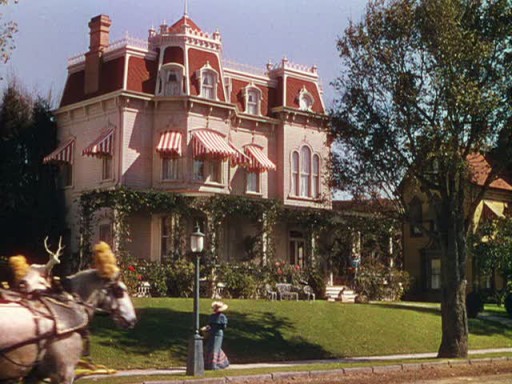
The Victorian on Kensington Ave.

being torn down. The real address, a few blocks north of Delmar, belonged to the writer Sally Benson, from whose memoirs the film was drawn. Benson’s former home was abandoned and demolished in 1994. Today, 5135 Kensington Avenue is a vacant plot with a history of debris and graffiti complaints whose value was last appraised by the city to be $3,800. It is owned by the St. Louis Land Reutilization Authority. In 2001, a ten-year-old boy was eaten by wild dogs in a park two blocks away.

 * * *

I push past the crowds into the Palace of Education and Social Economy. In a model classroom, the teacher struggles to keep the attention of the giggling local children, who are thrilled at their turn to take part in the exhibit. I wander into the “School for Defectives.” Deaf students sewing—blind students on violins. Helen Keller, a senior at Radcliffe, will be lecturing soon. On my way out, I peruse modern treatments for the insane.

 * * *

St. Louis is preoccupied with school districts, perhaps because its public schools were stripped of accreditation by the State Board of Education in 2007. The district was nearly twenty-five million dollars in debt; fewer than one in five students could read at grade level. In fall of 2012, the schools regained provisional accreditation, though the previous spring’s exams had shown only twenty-seven percent of students passing in math.

The problem of St. Louis schools is a Gordian knot of politics and passion. But most people admit the usual “solutions”—bussing; lotteries; a district transfer system; a mix of private, parochial, charter, and magnet schools—have failed to create equal opportunity.

The odds are against the shrinking city. A voluntary transfer system, scheduled to extend until 2019, allows African American students from the city to attend schools in one of the wealthier county districts. Waiting lists are long; each year, thousands of students are turned away. Those who are admitted face an average one-way bus ride of fifty-four minutes, among other challenges. At the start of 2013, 5,036 students transferred from city to county schools. The program also allows white suburban students to transfer to city magnet schools—eighty-seven students took advantage of that opportunity.

 * * *

East St. Louis, Illinois, sits just across the Mississippi River from downtown St. Louis. The U.S. attorney for the district recently called it “the Wild West.” From 2008 to 2011, the city had to cut its police force by thirty-three percent; the per-capita murder rate is more than sixteen times the national average. Since 1960, East St. Louis has lost two-thirds of its population. A casino and the school district provide most of the jobs.

But St. Louis holds its own. In 2013, it ranked as the third most violent city in the U.S., after New Orleans and Detroit. Another report listed two of its neighborhoods on the “Top 25 Most Dangerous Neighborhoods in America.” Such rankings are invariably rebutted by the mayor’s office and police department—often with good reason, as many of these stats are skewed by an antiquated city/county divide that puts St. Louis at a tremendous national disadvantage in the polling methodology. Still, at the time of the Fair, St. Louis was nearly twice the size it is now. It has lost some 500,000 people over the past fifty years. Segregation, disastrous “urban renewal” projects, white flight, “redlining” (racist lending practices), and blockbusting (racist real-estate scaremongering and profiteering) tell some of the complicated story. The fact remains: the last time the city had this few people was in 1870—and the national perception endures that it is dangerous to live in St. Louis on either side of the river.

* * * 

A man in a blue uniform approaches me. He is a physical specimen—of “good feature and bearing”—one of the Jefferson Guard, the omnipresent guides and policemen of the Fair, some three hundred strong. I nod and say, “Just passing through.” He looks at me and smiles, but I feel nervous. I cross the street. He pulls his mustache as he reprimands a boy for spitting: “No one is innocent.” He should know. For fifty dollars a month plus housing, he and his brethren will arrest 1,439 citizens, including 312 trespassers, 421 disturbers of the peace, five murderers, and one vile soul charged with “wife abandonment.” On hot summer days, he sports a lighter khaki.

 * * *

Pruitt-Igoe residents were treated with suspicion and subject to dehumanizing regulations, the subtext being that the poor were in need of forced moral uplift. Televisions were forbidden; apartments could be painted no color but white. Disastrous welfare laws broke up families—no able-bodied man could live in a unit that received federal aid, so fathers hid in closets when they were supposed to be, by regulation, out of the state. Many of the buildings’ modern innovations functioned poorly. “Skip-stop” elevators that didn’t land on every floor—an economic concession that supposedly encouraged mingling and use of the stairs—made residents easy bait for muggers. Public galleries became gauntlets. Residents had been promised beautiful, safe, affordable housing, but city maintenance deteriorated. Elevators smelled of urine and broke down regularly; “vandal proof” light fixtures stayed dark. Firefighters, police officers, and ambulances stopped showing up after frustrated tenants dropped bottles and bricks. Pruitt-Igoe quickly became an emblem of an overblown white fear of black poverty and crime. As the experiment unraveled, a complex story of structured inequality and misunderstood urban forces was turned—by some—into a more vicious parable of how those people just couldn’t be helped, just couldn’t be trusted with nice things.

 * * *

I hurry past an anthracite coalmine belching soot and smoke in a gulch south of the palace. Slipping between a pair of Egyptian obelisks, I enter the Palace of Mines and Metallurgy: an oil rig, a 1,200-pound pot of mercury, the devil made of sulfur. I duck into a dark room that holds a luminous collection of radium ores. They look like fireflies. Next door, at 2:30, the U.S. Government will stage a demonstration of the mysterious element. Cosmopolitan implores I not miss this epochal discovery: “Revealing an energy so powerful, inexhaustible, and apparently so abundant in nature, that its substitution for other forms of light and power now in general use is within the range of possibility.”

* * * 

A local sociologist named Lisa Martino-Taylor recently uncovered a secret Army experiment conducted in the 1950s and 1960s in which St. Louis citizens were unknowingly sprayed with a mixture of zinc cadmium sulfide that she believes might have been radioactive. Chemical sprayers were attached to buildings, schools, and station wagons. Residents were told smoke screens were being tested that might conceal the city from the Russians. The Army admits the aerosol was fluorescent, but it won’t say whether it was radioactive. Many documents remain classified. Most of the spraying was done around the Pruitt-Igoe complex, home at the time to about ten thousand low-income residents, some seventy percent of whom were children.

 * * *

In 1969, Pruitt-Igoe tenants organized a rent strike, a shocking development in public housing. After nine months, the housing authority caved. But that winter, two months after the victory, water and sewage pipes burst, perhaps partly due to an estimated ten thousand broken windows. Sheets of ice cascaded down the façades. Buildings were vacated, then stripped by thieves. Superblocks became ghost towns, the darkened shells offering a high-rise vantage for drug lords looking to evade enemies and cops.

4da10708a1286.preview-300

The implosion of Pruitt-Igoe.

In 1972, the city capitulated—the first three buildings were imploded. The demolition of building C-15 on April 21, 1972, was nationally televised, the spectacular footage spreading so widely that Charles Jencks, the architectural theorist, proclaimed this first stage of demolitions to be the day “modern architecture died.” The final 800 tenants were relocated, and by 1976 the development had been erased, leaving a fifty-seven-acre scar across the northside.

 * * *

In the Hall of Anthropology, housed in a university building I can see from my office window, visitors could get tested anthropometrically—their bodies weighed, their skulls, foreheads, ears, and jaws measured—or gawk at a Brazilian shrunken head. On display in the ethnological exhibits: a family of nine Ainus from Japan (supposedly the world’s hairiest people), several Patagonian “giants,” pygmies from Africa, representatives from more than twenty Native North American tribes, and “many other strange people, all housed in their peculiar dwellings, such as the wigwam, tepee, earth-lodge, toldo, or tent.” The Department of Anthropology hoped to show “how the other half lives, and thereby to promote not only knowledge but also peace and good will among the nations.” Cultural and political imperialism were given a scientific gloss; the virtues of white, western assimilation were roundly praised. In his diary, one fairgoer favored the Ainus, whom he found “not as dirty nor nearly as lazy-looking as the Patagonians.”

* * * 

St. Louis brick is a fine, beautiful brick that was once the pride of the city. In the fourth ward, there is a long-running scam in which thieves set fire to a vacant house; after firefighters come and scour off the mortar with their hoses, the thieves return and cart off the cleaned bricks. Thanks to a policy of demolition and clearance, an inner-city prairie has sprouted, a startling sight. Satellite imagery shows swaths of city blocks turned into gridded green plots of land. A four-way intersection in the middle of the city might look like a forgotten rural byway.

 * * *

The gem of the anthropological offerings was the Philippine exhibit, dedicated to the islands that had become a U.S. protectorate following the recent Spanish American War.

The most popular—and controversial—part of the exhibit was the Igorot Village. In their loincloths, the tribesmen looked “like bronze statues,” according to one female viewer. (A male visitor noted they “seemed to have a tremendous attraction for the ladies.”) Secretary of War William Howard Taft wanted the tribesmen in trousers, but the fair’s Board of Lady Managers overruled, upholding their idea of science over prudishness. The loincloths carried the day, even late into the year, when the huts were warmed to accommodate the light dress.

Even more sensational were the regular dog feasts, an occasional tribal tradition greatly played up for the Fair. Fueled by reports in the papers, visitors brought dogs to the village to donate, sell, or trade; some sources claim twenty canines a week were provided by a local pound, though the number seems apocryphal.

At the Philippine Model School, Igorot schoolchildren serenaded President and Mrs. Roosevelt with “My Country ’Tis of Thee.” One Igorot chief insisted a telephone be installed in his imperial hut. A photo caption from Cosmopolitan that September: “Miss Roosevelt and her friends are amused at the manners and customs of the Filipinos.” Four white-hatted white ladies holding small bouquets of flowers peer around some shrubbery and laugh, flashing their white teeth.

 * * *

stl5

An inner-city prairie.

A local sixteen year old named T. S. Eliot went to the Fair. I visit the reading room of the Missouri History Museum’s Library and Research Center, just south of the Life-Saving Lake (now gone), where shipwrecked sailors were rescued daily at two p.m. I pick up Stockholder’s Coupon Ticket #1313, signed “Thos. S. Eliot” and bearing a photo of the boy poet, who gazes slyly down to the left, as if he knows better than to look. He wears a coat and tie, with tidy hair and a tight collar. His alabaster skin is wan and washed-out, and his heavy-lidded eyes are sunken, blurred, and unfocused, almost blind. One large ear is turned, as if listening. He sports a thin coy smile. The archivist handed me the photo with a shudder. “Creepy,” she said.

Eliot never wrote directly of visiting the Fair—though a year later, in his school’s journal, he would publish a south-seas short story critical of the powers of civilization, certain details of which recall the Igorots. Lecturing at Harvard twenty-seven years later, he would state, “Poetry begins, I dare say, with a savage beating a drum in a jungle.”

* * *

I distrust my eyes. Chief Geronimo sits in a booth at the Indian Building. A sign says the seventy-five-year-old Apache prisoner-of-war arrived from Fort Sill, Oklahoma, under military guard. A man whispers, “Yesterday, he made a bow and arrow for my neighbor.”

 * * *

August 12 and 13 were Anthropology Days, a series of sporting contests organized by the departments of Anthropology and Physical Culture a few weeks before the Olympic Games (when pervading beliefs held that the Americans would win over the “primitive” races, never mind the fact that George Poage, an African American sponsored by the Milwaukee Athletic Club, would become the first black medalist when he won bronze in both the 220- and 440-yard hurdles).

And so the Sioux competed against the Arapahos in tug-of-war. Tribesmen tossed a fifty-six-pound weight. There was a mud fight. Crack spear-throwers struggled with the javelin. Runners stopped and ducked under the finish-line tape. Participants laughed at the events; they didn’t try very hard. The white man’s games didn’t translate. Attendance was poor, as was the quality of “data” collected by the departments. Winners were given American flags. A Filipino Negrito named Basilio was the fastest to climb the greased pole.

* * * 

On July 2, 1917, near Fourth and Broadway in East St. Louis, a black man was cornered and strung up on a telephone pole; when the rope broke, the man fell to the gutter, where, according to the New York Times, a mob “riddled his body with bullets” before hanging him again. In 1916 and 1917, some ten-thousand African Americans moved to East St. Louis from the rural south as part of the Great Migration, greatly feeding white cultural, economic, and political fear. Labor tensions ran high. The night before that July lynching—which would prove to be only one of many—a car of white men had driven through Market Street, shooting at black residents. When plainclothes police officers appeared in a car, they were mistaken for the original culprits and fired upon, killing two. East St. Louis exploded into some of the bloodiest race riots in American history. The goal: drive out the blacks.

Houses were set alight and the fleeing residents gunned down. Eyewitnesses described babies being tossed into the river or shot in the head and fed into the flames. Small boys fired revolvers. Two young white girls dragged a black woman off a streetcar; another white girl stomped on a black man’s face, bloodying her stockings. Bodies were left in the street. Militiamen were ordered to shoot to kill in their efforts to subdue the white mobs, but one black woman—hearing gunfire—fled an outhouse only to have her arm shot off by a soldier. The city’s most-famous expat, Josephine Baker, would remember watching—as an eleven year old—a man being beaten and hearing about a pregnant neighbor whose baby was torn out.

The mayor’s office attempted a cover-up; his private secretary ordered police and militiamen to smash cameras and arrest anyone attempting to photograph the violence. But the next day, a telegram reached the War Department: “Very bad night fires and rumors period. A lot of negroes killed number unknown period.” The approximate death toll: eight whites and anywhere from forty to hundreds of blacks. At least $400,000 in property lost. More than six thousand African Americans would flee. W.E.B. Du Bois, sent to bear witness to the massacre, reported an old woman’s lament: “We can’t live in the South and they don’t want us in the North. Where are we to go?”

 * * *

In the fall of 2013, an editorial appeared in the St. Louis Post-Dispatch proposing an amendment to the state constitution that would join the city and county of St. Louis—undoing the “Great Divorce of 1876,” what the editorial board called “the biggest mistake this region ever made.” Secret talks—including “key city, county, civic, and corporate leaders”—had been underway for years. The paper pushed the mayor to go public. An anonymous opposition group set up a website. Weeks went by with no more news.

* * * 

During the Civil War, St. Louis had slaves but was not southern. It is not western, like Kansas City, on the other side of the state, but it is not eastern, not really—just ask any transplant from the coast. It truly is Middle American, whatever that means. There’s the old joke: what kind of city would advertise itself as a jumping off point, an exit door, a gateway to somewhere else?

The fear: that it has become just another link on the Rust Belt, the next Detroit. It once competed to be the biggest and best in the middle of the country—a crown long since lost to Chicago, though the rivalry (which sometimes seems a little one-sided) endures. Valentine’s Day weekend 2014 marks the 250th anniversary of the founding of St. Louis, which will be celebrated with a lavish festival in Forest Park. The centerpiece: a sculpture of a heart—on fire—floating in the Grand Basin.

An international contest was held to reimagine use for the Pruitt-Igoe site, with winners announced in 2012, the fortieth anniversary of the demolition. The top design, from two Harvard graduate students, took home $1,000 and called for the abandoned land to become an “ecological assembly line,” with nurseries and aquaculture basins producing native plants, trees, mussels, and fish. The proposal is beautiful, part memorial, part farm, but I cannot stop staring at images of the implosion. Behind the buildings and the dust cloud, to the left of the horizon, stands what was then the city’s most recent monument to a radiant future—dedicated only four years earlier—the gleaming Gateway Arch.

 * * *

6a00e553a80e108834016768b08c4c970b-800wi

Mussolini's arch.

The Arch, designed in 1947 by Finnish futurist Eero Saarinen, was a monument to America’s westward expansion, a six-hundred-and-thirty-foot tall and wide stainless steel curve made of tapering equilateral triangles, a mathematical dream rising over the heartland. From the beginning, its purity was suspect. After Saarinen announced his design, an Italian architect claimed the idea was his, stolen from a fascist monument he had drawn up for Rome’s 1942 World’s Fair (never realized). Twenty-one years later, at the dedication, Vice-President Hubert Humphrey proclaimed the Gateway Arch would provide a “new sense of urgency to wipe out every slum,” promising that—by its example—“whatever is shoddy, whatever is ugly, whatever is waste, whatever is false, will be measured and condemned.”

Forty downtown blocks were leveled to make room for the arch, many of them home to poor bohemians, artists, and African Americans. A day or two after reading Humphrey’s speech, I hear a historian say on the radio that the arch hasn’t transformed the city as its builders had hoped, and if it is destined to be remembered by history, it will not be as a celebration of the Louisiana Purchase, but as a monument to the mid-20th century—to an America so powerful, so brash, so sure of its future that it would destroy a downtown to put up a symbol.

 * * *

A perfect day at the Fair could be ruined in many ways, by rain, cold, heat, exhaustion, not to mention the usual human foibles and follies. The expense was not trivial; expectations had to be met—a lot was riding on the day. Countless diaries, photos, letters, articles, and books exist—an obsessive amount of documentation.

And so beneath the fairgoer’s wonder was a kind of manic sorrow, a present-tense nostalgia. Dazzled by the lights, you already began picturing life outside the glare. As one concert attendee rued in his diary, “Our taste will be better than our opportunities hereafter.”

* * * 

Meet Me in St. Louis ends at the Fair. Overlooking the Grand Basin, Garland swoons to her beau, “I never dreamed anything could be so beautiful.” When the palace lights come on, her mother sighs, “There's never been anything like it in the whole world.” The youngest sister asks, “Grandpa? They'll never tear it down, will they?” He replies, “Well, they’d better not.” Garland gets the last breathless word: “I can’t believe it. Right here where we live. Right here in St. Louis.” Fade out.

 * * *

Closing Day was December 1, 1904. The governor declared it a school and business holiday. As midnight approached, President Francis made a brief speech, then turned off the lights as the band played “Auld Lang Syne.” His face floated over the grounds, painted in fireworks next to the words “farewell” and “good night.”

Having cost roughly fifty million to build, the disposable Fair buildings were sold for $450,000 to the Chicago House Wrecking Company, which salvaged and resold one-hundred million linear feet of lumber (“enough to build outright over ten cities with a population each of 5,000 inhabitants”), plus roofing, steel, doors, plumbing, fittings, and so on. Also for sale, some 350,000 incandescent lamps: six cents used, sixteen cents new.

 * * *

In an Alpine-themed restaurant on the Pike, the Fair fathers pick their teeth with quail bones; juice from medallions of beef drips down their chins. In the corner, the governors of Wisconsin, Missouri, and Minnesota share a hearty joke. In five days, President Francis will turn off the lights. The men are confident and rich. One of the waiters bumps me. He says to a guest, “Pardon him, sir—just another rube at the Fair.” The gentlemen smirk in my direction before offering me a seat. One asks, “Well, was it worth it?” Does he mean the Fair or my visit? Then President Roosevelt stands and delivers these thoughts: “I have but one regret, and that is a deep regret—the regret that these buildings and these exhibits could not be made permanent; that these buildings cannot be maintained as they are for our children and our children’s children and all who are to come after, as a permanent memorial of the greatness of this country. I think that an American who begrudges a dollar that has been spent here is not so far-sighted as he should be. It is a credit to the United States to have had such an exposition carried on so successfully from the beginning to its conclusion.”

 * * *

I have ridden a tiny tram capsule up the north leg of the Arch. The 1960s space-age pod barely fits five people and rises in a rocking-step motion—ka-chunk, ka-chunk—followed by stretches of smooth ascent. My head brushes the roof of the pod. Before boarding, a futuristic female voice speaks from a monitor: “The Gateway Arch transcends time.” The trip lasts four minutes.

A Park Ranger repeats over and over: “Welcome to the top. It’s all good,” and, “You got questions? Let your tax dollars sing.” Visitors get their bearings by peering through seven-inch slits. A hot summer day: the arch casts a long, lopsided shadow. The base of the arch holds something called the Museum of Westward Expansion.

observationwheelbrThe arch is centered on the Old Courthouse, immediately to the west, where slaves were auctioned and Dred Scott tried his case twice. Ahead of me stretches downtown, Pruitt-Igoe, Forest Park, my university, my neighborhood, a number of private places. What was once the world’s largest wheel no longer rises over the fairgrounds—after the Fair, it was dynamited, its countless perfect spokes twisted and heaped. The remains were sold for scrap, but the wheel’s seventy-ton axle—then the largest piece of forged steel in the world—remains missing to this day.

Behind me stretches the swollen, brown Mississippi, well above flood stage, having already swallowed the lip of downtown. On a submerged street, a stop sign lists with the current. Muddy water laps up the steps leading to the arch, as if to reclaim it. Across the river rise a casino, grain elevators, an American flag, and the train yards and telephone poles of East St. Louis.

 * * *

Most of Pruitt-Igoe has returned to the wilderness. The land sat unused until 1989, when fourteen acres became a public school site that still houses magnet middle and elementary schools. The remaining thirty-three acres have become an abandoned urban forest bound by an easily and—judging by the total collapse in some places—frequently scaled chain-link fence. An access road leads to an electrical substation on the site; a chain dangles between two short poles, blocking the way, another gate swung shut: “Danger: Keep Out.”

 * * *

Even after the Fair ended, visitors returned to wander the empty paths. One woman wrote her husband that she was “heart sick to see the ruin and desolation”—but she could almost imagine herself still at the Fair.

 * * *

Here’s the thing: the Arch is beautiful. Before moving to town, I dismissed it as a hulking piece of modern midcentury kitsch—a civic branding tool, the stuff of bad airport T-shirts and mugs. But for more than a year the arch has watched over me, and while there are places in my neighborhood and on campus where I know to look for it, I often find myself catching an unexpected glimpse and—shocked back down to size—experience a jolt of the sublime. It is not unlike what used to happen with the Trade Center Towers. The arch is machined, perfect, soaring—the city’s greatest open gate. It changes color with the weather and hour: sometimes sky blue, sometimes gunmetal gray, sometimes pitch black.

The arch has no keystone; the north and south legs are of equal length. You’re either on one side or the other. Arches, it should be noted, hold themselves up: they rise on their own weight, they compress—higher pieces push down and out on those below. Some five-hundred tons of pressure were needed to pry the legs apart to install the final four-foot piece. That’s why the windows are so small: to preserve the structural integrity—a wider view would cause the whole thing to crash down. The National Park website lists the exact mathematical equation that describes the arch, but it never was a pure construct: it sits eighteen degrees askew from the north-south axis and sways some eighteen inches, like a chain or a gate. That fact does not comfort me when the wind blows, or even on a clear day like today. The balance is an illusion. I stand at a tense threshold—atop the tallest manmade monument in the country—upheld, for now, by forces great and unseen.

Read part one of this essay here.

Edward McPherson is the author of Buster Keaton: Tempest in a Flat Hat and The Backwash Squeeze and Other Improbable Feats. He has written for the New York Times Magazine, the New York ObserverSalonThe American ScholarThe Gettysburg ReviewEpochEsopus, and Talk, among others. He teaches in the creative writing program at Washington University in St. Louis.


17 Feb 13:57

Open Ye Gates! Swing Wide Ye Portals!

by Edward McPherson

St. Louis turns 250 today—or is it tomorrow? A two-part series on the city’s 1904 World’s Fair.
Read part two here.

1904worldsfair39

Temple of Mirth, 1904 World’s Fair.

I hand the attendant a fifty-cent piece and watch him drop it into the automatic turnstile, itself a marvel. Behind me, the murmur of moneychangers, the swish of gored skirts tapering to white shirtwaists. Beyond that, the din of St. Louis. My sack suit rustles as I stride ahead. I’m crossing the threshold of an impossible city: a manicured wonderland of symmetrical lagoons winding through sculpted gardens studded with allegorical statues. In the distance loom the massive palaces of learning, their Beaux-Arts façades harkening back to Ancient Rome and heralding a future brighter than the hundred thousand incandescent lights that line them against the night. The words of Exposition President David R. Francis ring in my ears—Open ye gates! Swing wide ye portals! Enter herein ye sons of man, and behold the achievements of your race! Learn the lesson here taught and gather from it inspiration for still greater accomplishments!—and I step into the Fair.

* * *

St. Louis is a city of gates that do not normally swing wide. The urban private street, or “private place,” is believed to be a local invention, dating to the 1850s. Private places are owned by their residents, who typically build and maintain the road, median, sidewalks, curbs, street lighting, and—most crucially—gates. Some gates were utilitarian, imposing, and plain; others were small castles, complete with clock towers, fountains, statues, gaslights, and gatehouse apartments that caretakers (and, later, college students) lived in until the 1980s. Private places offered a refuge from the ever-booming city, a world apart. Some have been razed, their gates uprooted, the neighborhoods now troubled by crime; many still stand, pockets of wealth and privilege, with boards of trustees that oversee matters of law (historic preservation, landscaping) and etiquette (street parking, book clubs, Easter egg hunts).

Nearly two years ago, when my wife and I were moving to town and looking for an apartment, we were taken aback: everywhere, gates, gates, gates. Gates that lock and unlock according to byzantine schedules publicized only to residents (thus thwarting commuters and anyone else who might try to cut through the neighborhood). Gates that open by remote control. Rolling metal gates with yellow hazard signs. Gates built for carriages that now barely fit a car. Even in less-rarified neighborhoods—with weeds in the lawns and unwashed economy sedans on the street—at the end of the block might stand a pitiful sawhorse made of white PVC pipe. A symbol that speaks to the natives. Private Street: Not Thru. Private Street: No Public Parking. No thru traffic. Private neighborhood. No smoking beyond this gate. Private. No trespassing. Keep Out.

* * *

The Louisiana Purchase Exposition, popularly known as the 1904 World’s Fair, opened in St. Louis on April 30, one hundred and one years to the day after the signing of the Louisiana Purchase Treaty. Before a crowd of 187,793 people, John Philip Sousa’s band played the “Star Spangled Banner,” five hundred choristers sang the “Hymn of the West,” the fair’s official song, and—from the East Room of the White House—President Theodore Roosevelt touched the gold telegraph key that sent the signal to unfurl ten-thousand flags and begin pumping ninety-thousand gallons of water a minute down the three terraced “cascades” that flowed into the Grand Basin, where four fountains threw water seventy-five feet into the air at the foot of Festival Hall. It was the centerpiece of the fair, a building that boasted—in addition to the world’s biggest organ—a gold-leafed dome larger than St. Peter’s.

At first glance, the Fair offered a spectacle of size, a vision of man’s enlightened expansion into—and conquest of—untrammeled space (recalling contemporary notions of the Louisiana Purchase itself). The fairgrounds occupied 1,272 acres—double the size of the famed 1893 Chicago World’s Fair—spilling out of the city’s giant Forest Park onto the campus of Washington University and neighborhoods to the south. Twenty thousand people would live and work on the grounds. In preparation, crews straightened and buried a river in sixty-five days. They built 1,576 buildings, plus a garbage plant, sewer, post office, press pavilion, telegraph stations, pay telephones, and 125 eateries that could feed 36,650 people at one time. Five of the restaurants could seat more than two-thousand people. Visitors ate everything from filet mignon to frankfurters, fried frog legs to caviar, plus international delights such as Japanese sukiyaki, Mexican guacamole, Indian curry, and Egyptian molokheya soup. To drink: 1893 Louis Roederer Brut Champagne (six dollars a quart), mineral water (sixty-five cents), or Jameson’s Whiskey (fifteen cents a shot), not to mention—this being St. Louis—plenty of beer. There were five fire engine houses and thirty-six miles of pipe serving a network of sprinklers and hydrants, some of which to this day still dot Forest Park, popping up incongruously on the golf course.

The great distances between attractions made the Fair taxing to navigate. Visitors traveled by intramural railroad, a trolley that trundled twelve miles per hour through seventeen stops; they boated along the mile-and-a-half system of lagoons in gondolas or swan and serpent boats. They rented a rickshaw or wheelchair, with or without a guide to push; drove a car; or, if the mood struck, rode a camel, burro, or giant turtle. The official guide claimed a “brief survey” of the wonders would require a minimum of ten days and fifty bucks.

The colossal exhibit palaces were built of yellow pine and ivory-colored “staff,” a mixture of plaster and hemp that could be easily molded, sliced, sanded, and sawed. On average, eighteen trains of forty cars each were needed to haul the materials for a single palace. There were some seventy-thousand exhibits from fifty-three foreign countries and forty-three states (plus more than a few territories and businesses). The Fair offered a taxonomy of knowledge: exhibits were sorted into departments that were divided into groups that were subdivided into 807 classes, an encyclopedic education open to all and structured to create, in the words of the director of exhibits, “a properly balanced citizen capable of progress.” The goal: to show civilization marching proudly in a direction. The faith: that from the artifacts of the past one could draw a line to the future. In practice, the Fair fostered fierce national competition under the banner of international exchange. Proudly on display: progressivism, nationalism, exoticism, racism, hucksterism, humiliation.

The Fair’s president, David R. Francis—local businessman, Democrat, former St. Louis mayor, the state governor who failed to win the bid to host the 1893 Exposition, and now, eleven years later, one of the most-photographed men in the country—would proclaim of his fair: “So thoroughly did it represent the world’s civilizations, that if all man’s other works were by some unspeakable catastrophe blotted out, the records established at this Exposition by the assembled nations would afford the necessary standards for the rebuilding of our entire civilization.” A time of optimism, these years between the Gilded Age and the First World War.

* * *

hphone

One of the earliest prototype wireless phones, the hPhone.

I wander the palaces, open from nine until dusk. Afterward, I walk the grounds until half an hour before midnight, when the Fair lights are gradually, almost imperceptibly dimmed to dark.

The Palace of Electricity is a cathedral of dynamos, motors, rheostats, transformers, and vacuum tubes. I touch the wall. The building hums. Meanwhile, I am speechless before the radiophone—sound transmitted over a beam of light! They are perfecting wireless telegraphy. I fling a message to Kansas City: “Wish you were here.” A man offers to show me the power of lightning. His companion says he can record and replay voices on a steel wire. Lights are everywhere—big, small, colorful, and bright. Inventors claim soon our homes will have wall outlets. I ponder the mysteries of electromagnetism, electrochemistry, electro-therapeutics, and electric cooking. A hefty gent clutches his wife: “Steak done in six minutes—lobster broiled in twelve!”

The central court bustles with crowds that circle aimlessly, heads bent. The yard is silent save for small, exultant sighs. A man bumps into me and, with a nod, moves on. He is wearing earpieces that sprout from a curious wheel he holds in one hand. A dusty farmer takes off his hat, then puts it on again—over and over, an incredulous, unconscious salute. An old woman stands on her toes, as if straining to the heavens. A little girl holds her skirt, her mouth hanging open.

* * * 

In the 1944 MGM musical, Meet Me in St. Louis, Judy Garland plays a young spitfire trying to snare the boy next door in the months leading up to the 1904 World’s Fair. The Exposition’s unofficial anthem—“Meet Me in St. Louis, Louis,” a ditty about a man who returns home to find his sweetheart has fled their humdrum life for the bright lights of the Fair—can be heard at least six times in the film’s first five minutes. (To this day, the song turns up all over town; at my first hometown baseball game, I was not surprised to be led, on the jumbo screen, in a sing-along by the St. Louis Symphony clad in Cardinal red.)

The exposition saw almost twenty million visitors during its seven-month run—about 100,000 a day. (On weekends, trains to the fairground left downtown’s Union Station on the minute.) The Fair offered an unparalleled economic boon to the city that had lost the chance to host the 1893 Columbian Exposition to its great Midwestern rival, Chicago. In 1904, St. Louis was the nation’s fourth largest city, centrally located on America’s two largest rivers, a rail and river hub that—according to the official Fair guide—claimed the biggest brewery, tobacco factory, cracker factory, and chemical manufacturing plant in the country; the largest brickworks and electric plant on the continent; and one of the grandest shoe operations in the world. The city also churned out hardware, drugs, saddles, white lead, jute bagging, hats, gloves, caskets, and streetcars. Its Union Station was the terminus of twenty-seven rail lines; its citizens read nine daily papers. That said, St. Louis had suffered an economic depression from 1893 to 1897 and weathered a bloody strike of streetcar workers in 1900; the local government was plagued by corruption and graft, the city interests run by a cabal of businessmen called “the Big Cinch.” In 1902, McClure’s Magazine dubbed the city one of America’s “worst governed.” For St. Louis’s new Progressive Reform mayor—busy cleaning up the water, air, streets, and government in time for the grand opening—the Fair was a chance at redemption through political force.

Initial funding was raised through federal appropriation, local municipal bonds, and sale of ten-dollar shares of Fair stock to the good people of St. Louis. The Exposition was meant to honor the centennial of the Louisiana Purchase of 1803, itself a shrewd deal, the U.S. government shelling out fifteen million to France for what would become thirteen states west of the Mississippi. Due to delays, the Fair missed the anniversary, which gave St. Louis the chance to steal—after threatening to hold its own rival athletic games—the previously scheduled 1904 Olympics from Chicago. The Fair would have it all, including sweet revenge.

 * * *

1904worldsfair17

The Colonnade of States at the World’s Fair.

I stroll the “Model Street,” block after perfect block courtesy of the Municipal Improvement Section of the Department of Social Economy. A man loafs on the wide lawn, his collar open, before a guardsman tells him to keep moving. I pass a town hall, a hospital, a civic pride monument, and a playground, where lost children are gathered. By the end of the Fair, all 1,166 of them will have found their way home. For a small fee, a woman checks her two-week-old infant with a nurse. She waves: “Mother will be back soon!”

 * * *

The Fair’s fanned grounds—laid out by George Kessler, the architect of Kansas City’s parks and boulevards—offered a mix of the urban and pastoral. The landscape was strewn with 1,200 staff statues that, according to the Chief of Sculpture, aimed “to create a picture of surpassing beauty and to express in the most noble form which human mind and skill can devise, the joy of the American people at the triumphant progress of the principles of liberty westward across the continent of America”—though at least one fairgoer sniffed, “It is a pity that there are so many statues exhibited even on the grounds absolutely naked.”

Only twenty-five years old when Fair construction began, Forest Park was a wilderness still in the process of being uplifted. The fairgrounds began as more forest than park. In September 1901, President Francis and his party of VIPs were an hour late to ceremonially drive the first stake because they were lost in the wilds of the park’s northwest corner. Then steam shovels moved earth and hills, lakes were drained and century-old trees felled. Despite the exposition company’s contractual obligation—spelled out in 1901 St. Louis Ordinance 20412—to restore the park to its original form within a year of the Fair, there was no going back. Forest Park had become a groomed urban oasis, and wrangling between the city and the company lasted for years.

 * * *

I pay fifty cents and step into the sky, courtesy of the Giant Observation Wheel, the invention of Mr. George Washington Gale Ferris, who envisioned a perfect circle spinning above the plain. After sixty of us crowd inside the cabin, a giddy couple announces they will be married at the top. They’re both sitting on ponies. A piano stands in the corner. The guard tells me he’s seen it all. Yesterday, a female daredevil made an entire revolution standing atop a car. A few cabins below, fashionable ladies and gents are enjoying a private banquet. The wheel is so quiet we can hear the tinkling piano as we’re swung twenty-five stories into the air. I can see the whole world: the Grand Trianon of Versailles, Charlottenburg Castle, the Orangery at Kensington Palace, a Roman villa, a Chinese summer palace, Robert Burns’ Cottage, and the homes of Andrew Jackson, Jefferson Davis, and Thomas Jefferson—all of them rebuilt at the Fair. A city of replicas, a cosmopolitan capital forged of iron will.

 * * *

The lore of the Fair claims many firsts: the debut of Dr. Pepper, the ice cream cone (known as “World’s Fair Cornucopias”), iced tea, hotdogs, hamburgers, cotton candy (aka “Fairy Floss”)—but these items were merely popularized and not, as legend might have it, invented at the Fair. There were several true firsts: the first appearance of puffed rice cereal, which the Quaker Oats Company shot out of eight cannons every fifty minutes; the first large-scale cast of Rodin’s Thinker; the first participation from China in an exposition; the first Japanese garden in America; the first time British troops paraded on U.S. soil since the Revolution.

Perhaps foremost: the first Olympic Games played in the U.S., which also saw the first gold, silver, and bronze medals handed out and took place in the first concrete and steel stadium, Washington University’s Francis Field, which had room for fifteen thousand. Competitors from the U.S. and eleven foreign nations set thirteen Olympic records in twenty-two official events.

Notable performances included a gymnast, George Eyser, whose wooden leg didn’t prevent him from winning six medals, three of them gold, and an unsportsmanlike brawl after the fifty-yard swim. But the most memorable event was the marathon, which was run August 30 at three o’clock the afternoon in ninety-degree heat over tough terrain and dusty roads. There were only two chances for fresh water—at six and twelve miles—in deference to the head of the Department of Physical Culture’s amateur scientific interest in dehydration. Fewer than half of the thirty-two participants crossed the finish line. Runners were plagued by traffic, hills, and cheating. (The first man to return to the stadium received a wreath from Alice Roosevelt, daughter of the president, before it was revealed he had ridden eleven miles in a car.) The true victor, Thomas Hicks, pride of the Cambridge YMCA, ran a time of 3:28, though aided by brandy, raw eggs, and the stimulant/rat poison strychnine. After being sponged by his supporters with hot water from a car radiator, he had to be carried, hallucinating and shuffling his feet in the air, across the finish line. He had lost eight pounds.

 * * *

Education was the theme of the Fair—which was meant to be “an international university” concerned not with commerce but knowledge—but not all exhibits were meant to uplift. More liberal entertainment could be found on the mile-and-a-half-long midway called the Pike, whose battle reenactments, hootchy-kootchy girls, ragtime rhythms, and flights of wild fancy were outside the purview of the Bureau of Music and the Department of Art. The Old Plantation featured log cabins and cakewalking “slaves.” The Jerusalem recreation was said to include 1,000 natives of the city, though one magazine reporter found a fellow from Hoboken. Battle Abbey included cycloramas of the battles of Gettysburg, New Orleans, and Manila, plus Custer’s Last Stand. Jim Key, the educated horse, could spell and sort mail. He was not the only equine wonder; in the Boer War reenactment, even the horses played dead.

On the Pike, one visitor observed, “No respect was shown to age or dignity, no mercy to starch and feathers.” Couples might be accosted by bands of dancing young men, and “every stiff hat was a target for the inflated bladder” (or water balloon). The same fairgoer wrote in his memoir, “I believe if the Pike had been a mile longer it would have led to hell.”

Later, he recanted: “And yet I had a desire to imbibe a little of the spirit of the Pike. I wanted to be a boy again. Be a little bit bad perhaps.”

Read this essay’s second part here.

Edward McPherson is the author of Buster Keaton: Tempest in a Flat Hat and The Backwash Squeeze and Other Improbable Feats. He has written for the New York Times Magazine, the New York ObserverSalonThe American ScholarThe Gettysburg ReviewEpochEsopus, and Talk, among others. He teaches in the creative writing program at Washington University in St. Louis.


14 Feb 21:21

NC Governor No Longer Works for Duke Energy, But After Coal Spill, Is He Doing Their Bidding?

by Mark Anthony Neal
Democracy Now

In one of the worst coal ash spills in U.S. history, up to 27 million gallons of contaminated water and 82,000 tons of coal ash spilled into North Carolina's Dan River after a pipe burst underneath a waste pond. That is enough toxic sludge to fill more than 70 Olympic swimming pools. The river has turned grey for miles, and environmentalists say they have found arsenic levels 35 times higher than the maximum set by federal regulators. Did state regulators intentionally block lawsuits against Duke Energy in order to shield the company where Republican Gov. Pat McCrory worked for 28 years? We speak to Amy Adams, who recently resigned from the North Carolina Department of Environment and Natural Resources in protest of changes at the agency last year. She is now works with the organization, Appalachian Voices.
13 Feb 20:51

Happy Valentine’s Day, My Rapturous Codfish!

by Meghan Lyon
Image of Leon Simon, taken from London's National Portrait Gallery.

Image of Leon Simon, taken from London’s National Portrait Gallery.

As my student assistant, Sophia Durand, began the physical processing of the 131 letters in the Leon Simon collection (1915-1916, 1918), she noticed something intriguing. Leon Simon addressed each letter to his future wife, Esther Ellen Umanski, differently. Until they made official plans to marry, she was “My Dear Nellie.” But once the date was set, Simon became creative and effusive, his word choices sometimes questionable as endearments.

Romantics everywhere tend to be sugary in their pet phrases. Simon was no different, perhaps just more over-the-top. He addressed his letters to: My essence of honeycomb, My exquisite Peach Melba, My lump of sweetness, My peachiest apricot, My succulent meringue, My belovedest mimosa, My jujubious confection, My sweet Sugar plum(p).

As you can already tell, Simon was quite fond of food and cooking. Other highlights in the letters include My stewed apricot, My eversweet parsnip, My most succulent kipper, My pickled herring (You know how I love them!), My pickledest onion (=on’y ‘n  =only one), My own dumpling, My coo (k) ing dove, My rapturous codfish, My toasted crumpet, and–my personal favorite–My incandescent soup-tureen.

Simon

Simon wrote Nellie at least once a week. On October 12, 1915, he called her “My protoplasmic cherub.”

Occasionally, Simon sought to be reassuring about his odd turns of phrase. On October 20, 1915, he wrote to Nellie, who was studying German, “My most exquisite Stumpfenbach, (Don’t worry about the meaning of this; it is a term of endearment invented for the occasion & means nothing at all except that all recognized terms of endearment are hopelessly inadequate)…” A Duke German professor says that he was unwittingly referring to a city in Bavaria.

So, if on this Valentine’s Day your terms of affection seem stale, why not borrow one coined by Simon: My adorable whelk, My kitchy-kooish boo-woo, My jokaceous blue bottle, My bilingual Scaramouche, My unique joy, My tender flamingo, My early paradise, My copious ink-pot, My imperative necessity, My darlingpetangelanddelightallrolledintoone. Perhaps you and your loved one will then share in one of his closings, a “Quintessence of hugs & kisses ad lib.”

Sheesh.

Post contributed by Alice Poffinberger, Original Cataloger.

13 Feb 18:42

Watch Two Teachers Rap Their School's Snow Closing Announcement

by Taylor Berman

Nothing says "cool" like being in charge an elite private school in suburban North Carolina. So it's fitting that Durham Academy's Head of School Michael Ulku-Steiner and his assistant Lee Hark would announce the school's closing today in the coolest way possible: with a cover of Vanilla Ice's "Ice, Ice, Baby."

Read more...


11 Feb 19:44

Dirtbag Hamlet

by Mallory Ortberg

DIRTBAG SHAKESPEARE imagines modern remakes of Shakespearean plays with a teenage dirtbag cast. The rest is pretty self-explanatory.

A GHOST appears.
GHOST: have you ever listened to Sublime
HAMLET: [makes j/o motion]

dh1

CLAUDIUS: who drew this dick on my face
HAMLET: does your face not always look like that


GERTRUDE: Hamlet I invited some of your friends over
HAMLET: [smoking] theyre not my friends
i wish i were dead


GHOST: hamlet you must avenge my death
HAMLET: i dont have to do anything
youre not even my real dad
GHOST: yes i am
HAMLET: whatever

dh2

GHOST: have you killed Claudius yet
HAMLET: no
GHOST: why
HAMLET: fuck you is why
im going to the cemetery to touch skulls


Enter HAMLET, skateboarding
OPHELIA: My lord, I–
HAMLET ollies over OPHELIA’s head
HAMLET [offstage]: we were never dating

dh3

GERTRUDE walks down the hallway. Enter HAMLET, skateboarding.
HAMLET: SLUUUUUUUUUUUUUUUU
(HAMLET skates backwards) UUUUUUTT


LAERTES: Ophelia is dead
HAMLET: damn
LAERTES: she drowned herself
HAMLET: thats metal
i knew she was cool


(HAMLET is dying)
HAMLET: Horatio
come here
(he does)
HAMLET: Closer
(he does)
(HAMLET draws a dick on his face)
HAMLET: ahaha
(He dies)

dh4

Images by Matt Lubchansky, who makes comics and occasionally leaves his apartment in New York. His work includes Please Listen to Me and New Amsterdam Mystery Company. He’s on Twitter, and doesn’t expect you to get his name right.

Read more Dirtbag Hamlet at The Toast.

11 Feb 15:58

Jefferson Davis’s Hair Revisited

by Meghan Lyon
jefferson_davis_hair-blog

One of my favorite Rubenstein collections is the C.C. Clay Papers, which document the life and times of Clement Claiborne Clay and his family. The Clays lived in Alabama in the nineteenth century, and sided with the Confederacy during the Civil War. In the war’s early years, C.C. Clay served as a Confederate States senator. His opposition to raising soldiers’ pay (it would have been too expensive!) led to his being voted out of office in 1863. Clay and Confederate States President Jefferson Davis were good friends, however — Clay was godfather to Davis’s son Joseph — and rather than send Clay back to his plantation, Davis sent him on a secret mission to Canada to spy, bribe, and generally foment rebellion. (Clay’s mission did not end up helping the C.S.A.)

Clay was in Canada from mid-1864 through early 1865. He returned to the South just in time for the Confederacy to surrender. President Lincoln was assassinated shortly after his return, and both Davis and Clay were arrested by the Federal government on suspicions of treason relating to Lincoln’s assassination. (Clay’s time in Canada looked extremely suspicious.) The men were imprisoned in Fortress Monroe, Virginia. Clay was held for about a year without being charged until finally his wife, Virginia Clay, convinced President Andrew Johnson to pardon him. (She was a cool lady. You can read her 1905 memoir here.) Davis was imprisoned until 1867 before finally being released on bail.

jefferson_davis_hair-blog

This is only a selected portion of the Davis hairball held in the Clay Papers.

What does all this backstory have to do with Jefferson Davis’s hair? Well, there are giant clumps of it in the Clay Papers, and for years we did not know why. The mystery behind the hair did not stop us from displaying it in a Perkins Library exhibit three years ago. The only clue was from an envelope, where Virginia Clay had written, “Hair of Jefferson Davis cut off in Fortress Monroe, given me by Mrs. Dr. Elva Cooper.”

Recently, in reading through the Clay Papers correspondence, I came across the letter that explains it all. Virginia Clay wrote to Elva Cooper in April 1866, days before receiving Johnson’s pardon for C.C. Clay, asking her to “do send the hair if possible as directed.” Later on in the letter, Virginia recounted the number of donations received toward Jefferson Davis’s bail, adding that “the hair will sell like wildfire + will be my contribution.”

davisCollageIt appears that the plan was for the clumps of hair to be sold to Davis supporters as souvenirs, raising money for his aid. This explanation makes a lot more sense than the various reasons we had thought up over the years. Hair tokens are not rare in manuscript collections, but the fact that the Clays had so much of it struck us as a little odd. Fortunately, the story doesn’t end there. An annotation from Ada Sterling, the editor for Virginia’s memoir, offers this extra gem:

davis3Even Davis’s contemporaries were not interested in purchasing locks of his hair! Sterling explained that as she helped write the memoir in the early 1900s, the hair was still lying in “‘mussy’ bundles, among Mrs. C’s things.”And so it now remains forever in the Rubenstein. Mystery solved!

Post contributed by Meghan Lyon, Technical Services Archivist.

10 Feb 21:19

Things That Actually Happened In The Movie Vampire Academy, A Movie That Is About An Academy For Vampires

by Mallory Ortberg
Jdanehey

I really want to see this, I think.

Screen Shot 2014-02-10 at 9.39.01 AMPreviously: I, Frankenstein.

11. There’s an actual scene where two actual characters say “What if it’s so obvious [these two characters are the villains] that it’s not obvious at all?”

10. The titular academic vampires regularly attend vampire church. Vampire church. THEY GO TO VAMPIRE CHURCH ON SUNDAY NIGHTS. They are literally attending MIDNIGHT SABBATS, which is like the canonical, medieval definition of satanic but it’s supposed to be a good thing.

I — look, I don’t even have a particularly vested interest in vampire mythology, but I feel like we have to agree as a race that certain vampiric characteristics are immutable lest we devolve into total vampire relativism. It’s a slippery slope! Vampires that go to church and walk on holy ground? I don’t want to wake up in ten years and have to see a movie about werewolves who are for all intents and purposes Cylons, or whatever. You cannot be both a vampire and a regular churchgoer. I must draw the line, and I draw it here.

Also, their vampire priest stands in an Episcopalian-style pulpit while wearing Greek Orthodox vestments. Their Christ figure appears to be St. Vladimir, which is fine except for what is he a saint of? Is he a Catholic saint? Is this like, a post-Vatican II thing? What religion was he? Are they that religion too, or do they just worship Vladimir?

9. The following exchange takes place:

Christian: I’ll fire magic you into ash.
Mia: I’ll just water magic myself before you can do it.

8. Also, these vampires are mortal, and they can walk in the sun, and they get weird diseases and die in car accidents, and they have magic powerswhich makes them wizards. Not vampires. Wizards.

7. There appears to be a weird ethnic hierarchy where Russian and Romanian vampires are all royalty, followed closely by English vampires. American vampires are one step above garbage.

6. The global queen of the vampires not once but twice visits the school in order to berate a single student for truancy and misbehavior. You know, like how Queen Elizabeth used to pop into St. Andrews and call an assembly to talk about how Prince William was getting on.

5. A VAMPIRE WHO HAS JUST BEEN SHOT TO DEATH WITH BULLETS USES HIS MIND TO SET TWO EVIL DOGS ON FIRE

4. I — okay, so there are three kinds of vampires, basically, and the half-vampires (dhampirs) are basically a permanent underclass bound to serve and protect the (RIDICULOUSLY NOT IMMORTAL) royal vampires, because they have never heard of class consciousness, and then there are evil vampires, which, fine. But there’s this just enormous taboo about drinking blood from a dhampir if you’re one of the royal vampires; people react to it in absolute shock and horror. Which: again, fine.

So obviously the two main characters violate that taboo. Which: Again: Fine. That’s kind of interesting! But within the span of an hour — about three days in-movie, I think? — their friends go from being disgusted by it to sort of “eh, it works for them” which would be like if we as a society got over our brother-sister incest taboo sometime before this Thursday.

3. One of the characters delivers the most amazing speech to the entire student body that starts out as the St. Crispin’s Day speech from Henry V  (“Blood is sustenance. Blood is family. Blood is death.”) and slowly turns into Tina Fey’s monologue from Mean Girls (“We have got to stop bullying each other”), which is amazing. She actually uses the word “slut-shaming,” which is something I have never heard outside of the internet.

2. I was the oldest person in the movie theater by a factor of about a million, and I had a legitimately amazing time.

1. At the beginning of the movie the main character describes the class schedule at Vampire Academy and there is a roughly three-second shot of a bunch of vampire teens in a laboratory holding up beakers of differently-colored Science Liquids in like, the best and most generic portrayal of Science I have ever seen. No one is doing anything other than holding up a beaker of bright blue or green fluid and looking at it intently. “Ah, yes. There’s the Science we were looking for, right here in this beaker. Tremendous,” and then taking notes.

Pompeii 3D comes out in two weeks.

Read more Things That Actually Happened In The Movie Vampire Academy, A Movie That Is About An Academy For Vampires at The Toast.

03 Feb 20:45

I've Written A Letter To Mommy: Why Saying Something About Madonna Usually Says Something About Yourself

by Matthew Rettenmund
Jdanehey

Matthew is one of my go-to Madonna analysts. This is a great breakdown.

Madonna-Gloria-Swanson-Bette-DavisMadonna is older than both Gloria Swanson and Bette Davis were in their most-referenced roles.

Follow me on Facebook, follow Boy Culture on Facebook, follow me on Twitter, follow my sexy-guy Instagram, delve into my extremely Work Unfriendly Tumblr (caution!) and/or check out all my YouTube uploads.

Probably fewer gay men than ever are into Madonna. I don't think it's that Madonna's gay fanbase is decimated, but it's more de rigeur to hate on her from within that community than at any other time in her career. We're not talking about people who don't care for Madonna's music, we're talking about the men who take every opportunity to eviscerate the woman, often in order to get a laugh.

I think a lot of the fresh antipathy comes from gay men who are very talented (or think they are very talented) being angry at a woman they think is no more talented (or way less talented) than themselves, and who is succeeding beyond their wildest dreams. Also, from the gay side, there is a huge resentment that you're supposed to like Madonna (among many other gay stereotypes). The same boiling rage against things like gay pride parades exists among gay men who resent being expected to like Madonna.

When it comes to gay men (especially) and others attempting to sound smart about Madonna, the go-to line has changed drastically over the years. If you follow the go-to wisdom about Madonna, you can see the slide.

As with any artist, in the beginning, when Madonna was young and her goals of chart-busting, envelope-pushing and world domination were easy to grasp, there was no need for a script. You liked her or you didn't. When she went from being the latest upstart/upskirt sensation to a superstar, it was more love vs. hate. But when she was finally an icon—arguably around 1989—things began to change. It became important to have something to say about Madonna.

The first meme, pre-icondom, was: "She slept her way to the top," eventually enhanced by quoting Madonna (out of context) saying of herself that she couldn't sing or dance. (Never mind that Madonna never said that; she said she knew she wasn't the best at either. World of difference.) This observation was meant to discount any talent Madonna has, other than knowing her way around a penis.

By the time Madonna was re-inventing concert tours with Blond Ambition, nonfans switched to the canard, "She's a smart businesswoman." This one really held forever. She was on the cover of Forbes and was fast becoming the richest, most successful (unless you're an avid reader of Mariah Carey press releases) female singer of all time, she bested MTV by making her banned "Justify My Love" video into a commercial video single and she had more merch with her image on it than a boy band. While technically true that Madonna was and is an astute business mind, this focus on business was really just another way to undermine her creativity and her pleasing musicianship. It continued the thesis that Madonna was not an artist so much as a manipulator.

During the Sex era, it was all about, "Madonna's gone too far." Did any of us who weren't infants (or yet to be born) in 1992 really go without hearing hundreds of times how Madonna had taken her sexual shenanigans too far? And how far is too far? Is there a map? I remember being at a record show in 1992 and overhearing a man saying, "I used to really like Madonna, but she's too dyke-ish now." It should have been to Madonna's credit, among the gay community, that she had allowed people to believe in 1989 that she was doing Sandra Bernhard, or that she would pose lesbociously in Sex. But many gays rolled their eyes at all of this. For the first time, it felt like she was shedding some gay fans along with the mainstreamers that every massively successful artist loses as they coast into their thirties.

One of Madonna's more positive memes: "She's the queen of re-invention." While even this one, again, was fixated more on manipulation than on her artistry, it did at least allow for some creativity. It was neutral enough that Madonna herself adapted it for a successful tour. (Though she semi-playfully rolled her eyes when a journalist asked about re-invention at a round table I attended in 2012.)

Re-invention segued into the idea that Madonna is a vampire, using other artists to stay alive. It was funny when people pointed out that Britney Spears seemingly lost all of her mojo after kissing Madonna (Christina Aguilera didn't fare much better), but the sentiment has expanded over the years and become an insult, the suggestion being that Madonna is nothing without other, younger artists around her. (Never mind the lack of complaints when far greater vocal talents, like Streisand or Bennett indulge in a little brand-sprucing.)

Madonna-Grammys

Gay men, for at least the past five years, have increasingly been arguing that Madonna is somehow using us. (She's not the only one—Lady Gaga has been crucified for it.) Ignoring Madonna's long, personal history with gay men, these critics have suggested Madonna's just throwing us a little love here and there to keep us on the hook, to keep her rich and famous. A friend recently told me someone argued to him that Madonna never spoke up about gay men until "after 1989, when it was safer." This is a joke, as is the entire argument that Madonna has not been a true gay icon. First of all, when would a teen idol and Top 40 queen have even been asked about gay issues in the early '80s? Yet on her own, by 1986 she was actively speaking about and working on the AIDS issue. Her Who's That Girl Tour featured an MSG date with proceeds to the cause, she financially and personally assisted her bestie Martin Burgoyne as he died of AIDS and she never shied away from the issue when it was raised. As I mentioned earlier, Madonna was actively allowing the public to assume she was bisexual in 1988. Did this really help her make more money? Because as popular as Like a Prayer was, it was less popular than True Blue.

And now we've come to the current go-to comment about Madonna, always something about her age. She's "desperate," she's "out of touch," she "needs to retire." My favorite argument about why Madonna should retire is, "You're embarrassing yourself. Here, let me humiliate the fuck out of you for it."

Shorthand for all of these recent ideas: She's "Baby Jane Hudson" or "Norma Desmond." (Mae West is even more ridiculous, in that Mae—for all of her many talents—was completely gaga by the time she was in her sixties. Gloria Swanson and Bette Davis remained very sharp if eccentric even after they became women of a certain age, and there's no arguing that Madonna is not still shrewd and and that she is not presenting herself in exactly the way she pleases.)

I know Norma Desmond and Baby Jane comparisons are about getting old, but they're getting old themselves. And they're wildly inaccurate and reveal a lack of understanding of either of the films in question (Sunset Boulevard and What Ever Happened to Baby Jane?, respectively). Norma Desmond was a woman who lost her perspective and her mind because the public dropped her. She went on believing she was famous and that time had not passed. (She was not, however, unattractive. Gloria Swanson was amazing-looking at 50. Yet the insult is clearly meant to include the idea that Madonna is old and unattractive.) Baby Jane Hudson was completely insane because she had zero talent as an adult and could never recapture her popularity as a child. Madonna—who is OLDER than both Bette Davis and Gloria Swanson were in those roles, by several years—is still a household name, is looked up to by a whole generation of artists, is physically fit and in spite of radio's absolute refusal to play even her most radio-friendly singles, is the #1 solo touring act in history. As of now, not as of the '80s or '90s.

Tumblr_micsbjq5aq1qj28qwo1_r1_250

As far as her appearance, she's 55 years old and has a very fit body, so her face is going to either be drawn (and she'll get mocked for that, probably by the same people mocking her for her fillers, actually) or it's going to have plastic surgery and fillers. It's one or the other. Madonna has elected to try to look youthful. I think she succeeds more often than not. It is not pathetic for an attractive, fit, successful and relentlessly scrutinized woman to continue in her profession, to dress sexily and to bang 25-year-old men while barreling toward billionaire-hood. Is she as brilliantly and restlessly creative as she was at 25? Nope. But is she drastically more interesting than ANY of her peers from the '80s are (or were, in the case of the ones who aren't even alive)? Yep. I don't see why people feel the need to try to make Madonna's happiness and success and visibility into something "sad." It's just not. Liking her is a personal-taste issue, she's not for everyone. But the ageist stuff goes beyond Madonna and is depressing because we're all gonna be 55 (hopefully) and 75 and 95 and god damn it, I hope we all have 1/100th of her success and confidence.

These catty comments depress me more than any other when they're bandied about by gay men. We need help when it comes to appreciating age. We don't need to go gray and hit the rocker, but we need to realize that getting older is okay, and we should not be embracing conventional rules about aging any more than we should be accepting conventional rules about marriage or parenting.

You can believe or not believe any of the above go-to comments about Madonna, but at least know this: They are not insights. You did not make them up. They are lazily repeated observations as unoriginal as they are uninformative. A lot of what makes Madonna fascinating is not the woman herself, but the reactions she provokes, positive and negative. Even when the reactions are coming from people too intellectually blank to bring anything new to the table, they're interesting because they say something about the person repeating them, like urban legends, as if they were new and true blue.

All of which is not to say you have to like Madonna, even if you're gay. And all of which is to say: The trick is to like the things you like without feeling pressure to NOT like them, and vice versa, and to be fine with it if someone else feels the opposite. And not to use irrational, inconsistent and offensive arguments for why you don't like it. 

03 Feb 20:29

Best Older Kids’ Lit 1964

by Joshua Glenn

Last year, I made a list of my 12 Favorite 1963 Novels for Older Kids. (Or, as my local bookstore puts it, Intermediate Readers.) As I mentioned at the time, the cusp year 1963 was a transition point between the relatively complacent Fifties (1954–63) and the more rebellious Sixties (1964–73). The same is true of the cusp year 1964 — on this list of my 12 favorite novels for older kids from that year, you’ll find themes foreshadowing the “problem YA” novels of the later 1960s… but it’s all still in good fun. Which is the way I prefer older kids’ books.

Fifty years after their publication, these 12 books remain relevant and enthralling; I hope that new readers enjoy them as much as I have, and re-read them as often.

fitzhugh harriet

Louise Fitzhugh’s HARRIET THE SPY. One of my favorite books; I’ve listed it as one of the best adventure novels of the Sixties, and one of the best espionage novels of all time. Harriet is an amazing character: intrepid, self-motivated, eccentric, shockingly unsupervised; a talented crafter of gnomic aperçus; a loyal friend and a terrifying enemy. And yet, she’s in the wrong; the reader knows it, and so does everybody else in the book. It’s an emotional roller-coaster ride — Harriet’s adventure is as interior as it is exterior, which is why Hollywood has failed thus far to produce a faithful adaptation. Illustrated by the author.

alexander

Lloyd Alexander’s THE BOOK OF THREE. In the first installment of the author’s beloved Chronicles of Prydain series, which borrows elements from the same Welsh legends that Tolkien mined, an Assistant Pig-Keeper sets out on a hazardous mission. Along the way, he meets the finest companions any adventurer could want: the feral creature Gurgi, the tomboy witch-princess Eilonwy, the dishonest but valiant bard Fflewddur Fflam, the grouchy dwarf Doli, and the hard-bitten prince-in-waiting Gwydion. The adventure begins!

Uncle martin

J.P. Martin’s UNCLE. A millionaire elephant (Uncle) lives in a fantastical castle populated by his helpers, including the Old Monkey, Cloutman, Gubbins and the One-Armed Badger. His sinister neighbors — Beaver Hateman, Sigismund Hateman, Nailrod Hateman, Filljug Hateman, Jellytussle, Hootman and the skewer-throwing Hitmouse — will stop at nothing to infiltrate the castle and spoil Uncle’s idyll. A children’s story so surreal and delightfully illiberal that I suspect its true author might be J.P. Donleavy. Illustrated by Quentin Blake.

dahl charlie

Roald Dahl’s CHARLIE AND THE CHOCOLATE FACTORY. Another surreal and delightfully illiberal adventure, about a millionaire chocolatier (Wonka) who lives in a fantastical factory populated by his helpers, the Oompa-Loompas. Greedy competitors and misbehaving brats will stop at nothing to infiltrate the factory and spoil Wonka’s idyll. Greedy Augustus is sucked up by a pipe; incorrigible Violet blows up into a blueberry, spoiled Veruca is thrown down a garbage chute, and TV-addicted Mike is shrunken to a few inches tall. Only the impoverished but honest Charlie succeeds in passing Wonka’s test of character. Illustrated by Faith Jaques (UK), and Joseph Schindelman (US).

merrill pushcart

Jean Merrill’s THE PUSHCART WAR. A populist, near-future science fiction story in which warfare breaks out between New York’s bullying trucking companies and its plucky pushcart owners — who use pea shooters to disrupt the trucking business. The story’s sentimental hero is Frank the Flower, a peddler who wears flowers on his hat, and who (in order to protect his revolutionary comrades) takes credit for all 18,991 flattened truck tires. When the author died in 2012, she was eulogized as a forerunner of the Occupy Wall Street movement. Illustrated by Ronni Solbert.

battersea

Joan Aiken’s BLACK HEARTS IN BATTERSEA. This Dickensian adventure has the disadvantage of appearing between the two best books (The Wolves of Willoughby Chase and Nightbirds on Nantucket) in Aiken’s terrific Wolves Chronicles; also, Simon, the book’s male protagonist, isn’t quite as interesting as the female protagonists of the other books. (Luckily, Simon encounters a quick-thinking girl his age who contrives to rescue the Duke and Duchess of Battersea several times.) Still, it’s a ripping yarn in which true identities are revealed, a plot to overthrow the king of England is foiled, and everybody speaks in colorful slang and cant. Illustrated by Robin Jacques.

martel city

Suzanne Martel’s THE CITY UNDER GROUND. Before Jeanne DuPrau’s City of Ember there was Surréal 3000, a 1963 YA science fiction novel by a Québécoise journalist — Quebec’s first sci-fi novel. Translated in 1964 by Norah Smaridge, Martel’s book describes Surréal, a technologically advanced, utopian city-state… which begins to lose power. Two teams of adolescent brothers explore the city’s forbidden outskirts to figure out why… and discover that Surréal is literally underneath the real world! Illustrated by Don Sibley.

asterix

Goscinny & Uderzo’s ASTERIX THE GLADIATOR. The year is 50 BC. Gaul is entirely occupied by the Romans. Well, not entirely… In this adventure, the 4th of 26 Asterix books by Goscinny & Uderzo, Cacofonix the bard is captured and sent to Rome as a gift for Caesar. Asterix and Obelix trail him there, only to discover that Cacofonix will be thrown to the wolves during the next circus… so they enlist as gladiators. Hilarity ensues — particularly when they persuade the gladiators to play parlor games instead of fighting to the death.
fleming chitty

Ian Fleming’s CHITTY-CHITTY-BANG-BANG. The inventor Caractacus Pott renovates a car whose starter motor and backfire earn it the moniker Chitty-Chitty-Bang-Bang. The car turns out to be a transformer — it can become an airplane and a hovercraft — possessed of intelligence, which comes in handy when gangsters kidnap the inventor’s eight-year-old twins Jeremy and Jemima. The author, who famously wrote the James Bond series of spy novels, based the novel’s plot on bedtime stories he told to his own son. Illustrated by John Burningham.

bawden

Nina Bawden’s ON THE RUN. Americans aren’t familiar with the YA novels — including The Witch’s Daughter, The Birds on the Trees, and Carrie’s War — of this British author. Too bad! Bawden, who grew up with Margaret Thatcher, was as progressive as the future Prime Minister was conservative, and her convictions add spice to her adventures. In On the Run (in the US: Three on the Run), the son of an exiled African chief is spirited away from kidnappers by two English children his age. They establish a kind of fort in a seaside town — the best grownup-free hideout until 1967′s From the Mixed-Up Files of Mrs. Basil E. Frankweiler.


lucky luke

Morris & Goscinny’s Lucky Luke adventure THE WAGON TRAIN. That’s right: René Goscinny wrote not one, but two of the books on my Top 12 list; and his novel Le Petit Nicolas a des Ennuis (with Sempé, also 1964) nearly made the list too. In The Wagon Train (La Caravane), the 15th of 46 funny, exciting Lucky Luke books by Morris & Goscinny, fast-shooting Lucky Luke leads a caravan of covered wagons to California — despite constant sabotage attempts.

farmer stone

Penelope Farmer’s THE MAGIC STONE. I happened to pick this one up in a used bookstore; it seems to have fallen into obscurity. But it’s excellent! Two adolescent English girls, one middle-class and the other a former slum-dweller, discover a stone containing what they suspect might be a fragment of King Arthur’s sword Excalibur. Whenever they activate the stone’s magic, the girls share marvelous moments of heightened perception — grokking the natural world in a way that obliterates their social/cultural differences. Illustrated by John Kaufmann.

Endnote: The 1964–73 era was an apex for older kids’ literature. Susan Cooper’s Dark is Rising series, Ursula K. Le Guin’s Earthsea series, Lloyd Alexander’s Chronicles of Prydain series, Joan Aiken’s Wolves Chronicles series, Richard Adams’s Watership Down, John Christopher’s Tripods and Sword of the Spirits trilogies, Peter Dickinson’s Changes trilogy, multiple books by Madeleine L’Engle and S.E. Hinton, E.L. Konigsburg’s From the Mixed-Up Files of Mrs. Basil E. Frankweiler, Robert C. O’Brien’s Mrs. Frisby and the Rats of NIMH, Alan Gardner’s Elidor and The Owl Service, not to mention Jack Kirby’s various “Fourth World” DC comics series and his Kamandi series… it doesn’t get any better than the 1964–73 era. And it all begins with these 12 books.

*

For younger kids, I recommend these 1964 books:

Remy Charlip’s FORTUNATELY (aka WHAT GOOD LUCK! WHAT BAD LUCK!), Ted Hughes’s NESSIE THE MANNERLESS MONSTER, Shel Silverstein’s THE GIVING TREE, and Ezra Jack Keats’s WHISTLE FOR WILLIE.

03 Feb 14:10

O, Youth!

by Dan Piepenbring

post office

From letters published in the February 1, 1881, edition of Harper’s Young People, a spinoff of Harper’s for readers six to sixteen.

Will Mary R., of Sunbury, Pennsylvania, please oblige me by giving her method of cultivating heliotrope, as it is one of my favorites, and I can never succeed in raising it. I have over two hundred plants in my parlor and sitting-room windows, and not one heliotrope.

I have a beautiful black goat named Dan, and a complete set of silver-plated harness … Dan will not allow any boy to come near him, but he loves me dearly, and I love him. I am eleven years old.

I and my brother used to have such good times fishing on these lakes in our canoes, and hunting deer in the woods, but now I am so lonely, for my only brother is dead. He went out in the woods to hunt deer, and got lost, and froze to death.

I am a subscriber to Young People, and although I am not one of the “little folks,” I find the Post-office Box very interesting, as I am very fond of children and of pets. I have a bright, intelligent pony, a Mexican dog four years old that does not weigh more than two pounds, a mocking-bird, canaries, and a lot of fancy pigeons, and two aquaria filled with fish.

In my letter printed in Young People No. 62 I intended to say that I would exchange postmarks, not for other postmarks, but for stamps and minerals. I regret that I made the mistake.

I am very much interested in “Toby Tyler” and “Mildred’s Bargain.”

I spent one summer at Cape May, and there I found a turtle that was so tame it would eat out of my hand, and drink out of a tea-spoon. I fed it on raw meat, soaked bread, and worms, but it ran away.


03 Feb 13:55

Femslash Friday: Bend It Like Beckham

by E.M. Freeburg

Greetings, loved ones. My first foray into Femslash Friday was so much fun that I had to come back for more. Today, we’ll be covering a film more central to my babyqueer awakening than any other piece of media (besides the music video for Beyoncé’s “Naughty Girl”). That’s right, friends: we’re talking about Bend It Like Beckham.

I’m gonna re-enter puberty just thinking about it.

I swear on my Abby Wambach jersey that I pitched this piece before Manisha Aggarwal-Schifellite’s lovely post on the same film came out a few weeks ago. However, if I could have planned this timing, I absolutely would have, and you should all go read her piece before this one to get an incredibly thoughtful take on the movie that is way less focused on who is and (tragically) is not banging in it.

In case you’ve made the terrible decision not to read Manisha’s piece, allow me to set the scene. We find ourselves in early-2000s west London. Our protagonist is Jesminder “Jess” Bhamra, the younger daughter of protective parents. Jess is a massive footie fan, particularly devoted to David Beckham and Manchester United (a sin that I, as a Liverpool FC fan, can only just barely forgive).

You’re lucky you’re unbelievably pretty with eyebrows that could kill a man, Jess.

Jess’s parents disapprove of her interest in football for a variety of reasons: it’s not feminine enough, it involves too much time spent with men, there’s no future in it, it will drive away future husbands, etc.

So Jess plays football with her male friends in the park sometimes, unbeknownst to her family, and hits various dudes in the nuts when they’re insufficiently respectful of how much she kicks ass, but that’s her only outlet. Until, that is, she meets Juliette “Jules” Paxton.

I assume this image speaks for itself.

Jules plays for a local girls’ team, the Hounslow Harriers, and is a 100% dyed-in-the-wool tomboy, much to the dismay of her mother, Paula. Paula is desperate for Jules to behave more femininely, whether she’s begging her to buy push-up bras or bemoaning the fact that Jules never brings boys home.

Compulsory heterosexuality made flesh.

Jules sees Jess playing football at the park with her friends, and, based on Kiera Knightley’s facial expressions, falls in love with her on the spot.

This file is saved on my desktop as down_girl.jpg.

Beyond being able to cruise a hottie like a champ, Jules also realizes how good Jess is—she’s very good—and convinces Jess to join her team. I mean that literally, but if you want to come up with puns about who’s playing for which team, respectively, I won’t stand in your way.

The plot of the movie unfolds as one might expect—Jules and Jess tear up the pitch; Jess tries and continually fails to hide her footballery from her family, with increasingly dire consequences; Jess struggles to balance her pursuit of her dream with her commitments to her loved ones; Jess’s family eventually comes around and recognizes the value of her talents and passion. There’s much exploration and testing of boundaries along the way, plenty of which involves Jules introducing Jess to new experiences.

This set-up is so perfectly primed for a queer reading that, ever since the movie’s release, there have been persistent but unconfirmed rumors that the film’s director, Gurinder Chadha, originally intended Jules and Jess to be a love story, but scrapped the storyline out of fear that mainstream audiences would reject it. If the film were originally intended to be about Jules and Jess falling in love, that might explain certain moments, such as when Jess tells her friend Tony that she’s not sleeping with anyone and Jules materializes in the background as if summoned by a sapphic Batsignal.

Whether or not Jess and Jules were ever intended to be a couple in-text, they sure as hell act like one, whether they’re sharing sexually charged glances or going on adorable dates to buy cleats.

Jules, in particular, seems to have difficulty not ravishing Jess at any given opportunity, which is pretty fair given that Parminder Nagra looks like Parminder Nagra.

And here we see down_girl_2.jpg.

Unfortunately, rather than looking at these two characters and following their interactions to the logical conclusion, the film opts instead to shoehorn a love triangle between the two girls and their footie coach, Joe, as played by Jonathan Rhys-Meyers.

Their shared interest in Joe creates conflict between our heroines, in a clear case of triangulation and sublimation of their feelings for one another, but they don’t stay apart for long. Towards the end of the film, Jules shows up at Jess’s house to beg her to play in their team’s final match. An American scout will be there, potentially looking for recruits, and as we’ve established, Jules is all about recruitment.

By the end of the final match, Jess and Jules are closer than ever, Joe or no Joe. Their competition over him makes for some great manufactured angst, but when the chips are down they care so much more about each other and their team that Jules’ supposed jealousy over Jess’s relationship with Joe vanishes as quickly as it appeared.

Don’t think I’m operating purely on subtext, either. The love triangle may take up narrative space, but Jess and Jules’ lesbionic potential is powerful enough to develop a subplot of its own. They’re mistaken as a couple more than once, such as when Jess’s sister Pinky has her engagement broken up when her future in-laws see Jess and Jules having a totally platonic moment and misinterpret it as Jess making out with a boy.

When Jess’s family tells her about what she was supposedly seen doing, Jess is rightfully baffled.

In case there’s any confusion, this is the actual, real dialogue of the actual, real movie.

During Jess and Jules’ fight over Joe the Irrelevant, Jules mother overhears a snippet of them arguing and mistakenly thinks she’s overhearing them breaking up. This confirms all of her worst fears about her sports-bra-wearing progeny, and she spends most of the second half of the movie trying and failing to come to terms with it.

Tragically, Paula’s fears are never justified in-text, as Jess technically ends up with Joe. Remember Joe? You really shouldn’t.

You’re not wrong, Sexy Voldemort.

But while Joe may be the one who “gets the girl,” the ending elevates Jess and Jules’ relationship high above Jess and Joe’s; Joe gets left behind in England while Jess and Jules head off to play football at an American university together though the magic of Fictional College Admissions Process.

So, to summarize, Jess and Jules meet, introduce one another to new and exciting things, develop an extremely intense and close relationship over a matter of months, help each other achieve their dreams, and then get on a plane to fly halfway around the world and start a new life together, all while wearing leather jackets and sleeveless sweatshirts and sporting alternative lifestyle haircuts and rejecting constant pressure on the part of their families to settle down with an appropriate human male and behave like a “normal” girl. In a related story, I sleep with this DVD tucked under my pillow.

Now, part of the reason I wanted to write about Bend It Like Beckham for Femslash Friday is that, obviously, the movie itself would have been even better than it already is if it had been about these two wonderful ladies falling in love. Envision it: Jess scores the winning goal in the final, and when she runs to Jules’ arms to celebrate, they share a kiss of Princess Bride proportions. Joe is sad but finds a new lease on life with Tony, Jess’s canonically gay best friend. Jules is Jess’s date to Pinky’s wedding, everybody’s parents join PFLAG, and we all live happily ever after.

Instead, the movie touched on the possibility of a romance between Jess and Jules, but then swiftly denied it in typical “Gay? Us? Gay, haha, nooooo, no, definitely not, but how progressive of you to suggest it!” fashion. Obviously, this is disappointing, especially given the rumors around the film’s original storyline. But you know what? Jess and Jules’ denials of anything romantic between them do absolutely nothing to dampen my queer love of this movie. Because you know who reacted similarly to adolescent questions about potential non-heterosexuality? Me. Me, and, like, a huge volume of the queer women I know.

When Jules finds out that her mother thinks she and Jess were together, they have the following conversation:

Jules: Mother, just because I wear trackies and play sport does not make me a lesbian! Me and Jess were fighting because we both fancied our coach—Joe!

Paula: Joe, a man, Joe?

Jules: Yeah, as in male—Joe! Joe, our coach! Joe, man, Joe! Anyway, being a lesbian is not that big a deal.

Paula: Oh, no, sweetheart, of course it isn’t. No! No! I’ve got nothing against it. I was cheering for Martina Navratilova as much as the next person.

Notably absent from this exchange are phrases such as “I don’t fancy Jess,” “I’m straight,” or “I’m not into girls.” How many of us had conversations like these in cars with our parents? I sure as hell did. I got very, very good at talking around something I didn’t even know how to talk to myself about. Half denial, half testing the waters, one hundred percent ambiguous and unarticulated.

Bend It Like Beckham resonates with me as a queer woman without a single adjustment being made to the text, because not all coming outs are, for lack of a better word, straight-forward. Not everyone knows which way they swing when they’re ten. For a lot of queer women, particularly those who didn’t come out until college or later, a big part of coming out to yourself involved cradling your head in your hands and saying “Oh my God, I cannot believe I genuinely thought I was heterosexual this entire time” and realizing how many people in your life figured it out before you did.

Maybe your internalized homophobia was hella strong. Maybe you didn’t realize there was more than one way to be queer, and thought that you must not count since you didn’t fit the stereotypes. Maybe you did fit the stereotypes and resented the hell out of it. Maybe you were attracted to some of the folks society told you to be attracted to, and so you automatically put yourself in the “straight” box since nobody ever told you there were options besides “straight” and “gay.” Maybe you have no idea if you were “born this way” or not, and never felt the slightest deviation from staunch heterosexuality until you met somebody who knocked your socks off. Maybe you just weren’t paying that much attention. Maybe the world did a really, really good job telling you that queerness was for “other people.” There are a lot of ways to keep people closeted unto themselves, and I’m pretty sure I’m not the only one who’s spent significant time wincing over memories of my own oblivious denials.

I saw Bend It Like Beckham when I was 14, adored it, and immediately demanded that I be allowed to take all my female friends to see it again for my birthday; it was not for several years that I realized Keira Knightley’s abs might have had something to do with that. And why shouldn’t that be true of the characters, as well? Why shouldn’t Jess realize that the way she feels when Jules hugs her after they score is something more than the euphoria of victory? Why shouldn’t Jules slink nervously into an LGBT Co-op meeting, only to discover a level of comfort with the people she meets there that she’s never felt anywhere off the pitch? Why can’t they find out that their denials of desire for each other had a lot more to do with that desire’s consequences than its reality? Why can’t the two of them find a place where their kneejerk “no, no, no” can turn into a “maybe” without the world falling down around their heads?

In a perfect universe, there would be nothing preventing Jess and Jules from meeting, falling in love, and starting a relationship—both in terms of the events within the story of Bend It Like Beckham, and that story’s marketability as a romcom. Unfortunately, that’s not how things played out, in our world or theirs. But if I can look at the real world, where queer love stories are devalued and shamed, and find myself alive and happy and out, then nothing in the multiverse can stop me from seeing a happy ending for Jess and Jules, too. I’ve changed a lot since I first saw Bend It Like Beckham; I’d like to think that, somewhere out there, so have Jess and Jules.

Read more Femslash Friday: Bend It Like Beckham at The Toast.

29 Jan 13:58

Everyone Who Claims “I Hate To Be That Guy” In Fact Derives Dark and Terrible Joy From It

by Mallory Ortberg

Screen Shot 2014-01-28 at 8.24.00 AMIt is time for you to admit that you have never hated “being that guy,” no matter how many sentences you have begun by claiming the contrary. How many times have you paid lip service to the rules of polite social interaction with “I hate to be that guy, but…” “Well, I hate to be that guy, but actually…” while internally rubbing your hands with glee at another opportunity to get to be That Guy, your truest and your freest self, at last, at last, at last.

The truth will out: if you truly hated being That Guy, you would not do it. You love being That Guy more than anything you have ever loved, love it with a fierce and a hot joy that is something more than sexual and something less than human. Being That Guy, or the prospect of getting to play That Guy at some point during your drab and grey existence, is the only hope that propels you forward; you live in constant hope of peering into someone else’s conversation, sliding your glasses up your nose, breathing wetly on someone’s neck, and That Guying them into submission. You revel in the prospect of getting to pepper your friends and colleagues and strangers on the Internet with a thousand of the kind of tiny and irrelevant hair-splitting criticisms that destroy intimacy without building true knowledge. You are That Guy down to the roots of your teeth and the bones in your heel; your body is riddled with That Guyness and you freaking love it. 

It feels good, doesn’t it? Like when a murderer confesses in the last two minutes of Law & Order: SVU because he’s so sick of that smug DA and her inane questions. Like Jack Nicholson at the end of A Few Good Men. Damn right, you ordered that Code Red. Damn right, you’re going to set the record straight no matter the cost, because zeroing in on possible and irrelevant flaws — seeking the ugly and the mistaken and pointing it out to everyone around you as loudly as possible — is what your brain does best. Your brain is a garbage finding machine, and it is perfect at its job. “I hate to be that guy, but…” is not a warning, it is a triumphant processional announcement. You want everyone to know just how much That Guy you are about to be, and you want complete freedom to revel and wallow in your own That Guy-ness without interruption or complaint. The stench of That Guy clings to you, and it smells beautiful. You are That Guy, pure and perfect. You are That Guy, uninterrupted and forever. You are That Guy, truly and utterly alone.

Read more Everyone Who Claims “I Hate To Be That Guy” In Fact Derives Dark and Terrible Joy From It at The Toast.

28 Jan 15:56

The more things change…

by Tobias Higbie

As a parent of two Chicago Public Schools 4th graders, I’ve had a crash course this year in urban austerity.  Teachers are trying their best, but with 31 students per class, the school library effectively closed, and district mandated testing, it’s an uphill battle.  Meanwhile the district closed 50 schools outright last year citing low enrollment, but is likely to approve 30 new charter schools for next year (despite many charters being under-enrolled).  So I got a chuckle when I came across the following from the November 1924 edition the Industrial Pioneer (p. 28), which should be filed under “the more things change, the more they stay the same.”

No Refinement for Robots

The school system is supposed to be the bulwark of the republic, and, up to now, it has been certainly a bulwark of capitalism.  The little children marched the goose step and swallowed the pills of prejudice and patriotism without any objection from them or their parents.  And in general, capitalism considered money spent on “education” to be well spent, and in the interests of public order, their order.

Something is happening now, though just why is not so clear.  The capitalist class is sabotaging education. We have before us a statement by the teachers’ unions of Chicago, which is a protest against the proposal of the Czaristic superintendent of schools here to fire about a thousand teachers, cut down the hours slightly, use a two-shift-a-day system, use the “platoon” or factory system of instruction, and abolish a part of the medical inspection of children.

The excuse given for all of this curtailment in effective education is “poverty,” “no money in the school fund.” The teachers counter this by figures to prove that forty billion dollars’ worth of property in Chicago escapes taxation altogether, while only four billion dollars’ worth of property is taxed.

Well, that is another problem. What we are interested in is: why is it that these capitalists do not raise the money? If they felt it necessary to maintain schools, they could raise the cash some other way than by taxation. Or they would submit to an infinitesimal tax on the forty billion dollars’ worth now escaping taxation.

Does this phenomenon mean that the capitalist class, in its second or third generation, is so degenerate that it can no longer act in its own interest? Or does it mean that capitalism has decided that there is danger in even such a slight education as it has been affording the children of the proletariat, and that it has decided to cut down on that?

The austerity we’re seeing in K-12 and in higher education begs the same question, although these days we don’t use the phrase “capitalist class” in polite company.  We might rephrase the question: have business leaders given up on mass education as anything other than a market?

In any case, the title of the piece is a reference to a line in Karel Capek’s play R.U.R. (Rossum’s Universal Robots): “A working machine must not play the piano, must not feel happy, must not do a whole lot of things.” Indeed.


Filed under: Document, History, Labor, Politics Tagged: Chicago, Chicago Public Schools, History, IWW, Karel Capek, R.U.R., robots
27 Jan 18:54

Need To Know: Out In Africa, Goldie's Badluck, Bieber: Smooth Criminal + MORE!

by Matthew Rettenmund

BinyavangaHe's coming out at a time when parts of Africa are going in.

*widget boy cultureProminent African author Wainaina's next chapter: "I am a homosexual, mum."

*widget boy cultureGoldie Hawn on Goodluck Jonathan: "I had zero idea...barbaric."

*widget boy cultureThe first musical about Russian oppression of LGBT people.

*widget boy cultureI agree with Seth Rogen on Justin Bieber. Desperately-Screening-Susan-Peter-Michael-Marino-The-PIT-520

*widget boy cultureThe Duck Dynasty Robertsons are complete frauds.

*widget boy cultureDesperately Screening Susan, a fresh look at a fabled flop.

*widget boy cultureWoman with muscular dystrophy applies to be a model as a joke, gets hired.

*widget boy cultureAFTER THE JUMP: Adorable video of male models demoing Italian hand gestures...

Download Video as MP4
23 Jan 03:46

L.M. Montgomery and Presbyterian-Induced Uselessness

by Kate R. West

sundayThere’s a sort of cheerful, self-satisfied superiority about Presbyterianism that runs through the oeuvre of L. M. Montgomery. Her main characters, by and large, are matter-of-fact in their allegiance to the old Scottish denomination. The comic side characters, however, are allowed to get downright judgmental about it. The most notable is probably Miss Cornelia Bryant, who comes to meet Anne and Gilbert when they move to Glen St. Mary in Anne’s House of Dreams, “seeing you’re Presbyterians. If you were Methodists she wouldn’t come at all. Cornelia has a holy horror of Methodists.” (She’s also “a most inveterate man-hater” and remains a dear friend to the Blythes and their children for years to come.) The best compliment Miss Cornelia can think of for Leslie, who is young, beautiful, troubled, and only an occasional (Methodist) church-goer, is that “she’s a real strong Presbyterian at heart.”

Montgomery herself seems to have been broad in her theology and skeptical of some of the values of Scots-Presbyterian culture. In “L.M. Montgomery: Scottish-Presbyterian Agency in Canadian Culture,” Mary Henley Rubio reveals this subversion: “She grows up in a [very Presbyterian] society that values reason and the intellect above all, but she uses her fiction to show that the intellect is often driven by the emotions.” The seriousness and clannishness that characterized her P.E.I. Presbyterian community show up throughout her novels as more morally complicated values, and she “laces her morality with humour, rather than thundering away like [founder of the Presbyterian church] John Knox.”

But like Miss Cornelia, Montgomery believed fervently that the Presbyterian people were the salt of the earth—they may not be perfect, but at least they weren’t Methodists. In 1906, already in her thirties, she agreed to marry a Presbyterian minister she didn’t particularly love. There were certainly other factors at play in her decision: he was kind and easy-going; she considered him more socially acceptable than the farmer she had loved ardently and briefly in her youth; and, as she wrote in her journal, “I wanted a home and companionship; and more than all, to be perfectly candid, I wanted children” (12 Oct. 1906). Montgomery (“Maud” to her friends) and Ewan Macdonald were wed after a secret five-year engagement—he had gone to Scotland for further education, and she waited for her grandmother to die. For the rest of her life, she would balance her career as one of Canada’s most popular and enduring novelists with the expectations of the minister’s wife.

Further complicating their relationship was the enormity of Ewan’s secret, religion-fueled depression. He believed fervently in the doctrine of predestination, once a cornerstone of the Calvinist denominations. In a nutshell, no one deserves to go to heaven, but God has picked some people who will; Jesus died for them and only for them; and there’s nothing you can do to switch lists. For some believers, this is reassuring. To Ewan Macdonald, it was terrifying.

Now, Presbyterian seminaries had stopped teaching the doctrine of predestination by the time Ewan went through. No matter. Montgomery’s journals tell of her husband’s “constitutional recurrent melancholia” (13 Sept. 1919), rooted in his conviction that he was among the damned; that he had no way out of hell; and that his position at the head of a church was cruel and unfair to his congregants.

The damnation and hellfire niggling at Ewan’s mind often kept him out of the day-to-day work of parenting and running a household. On the worst days, he couldn’t get out of bed. His wife’s offhand complaints bubble up, year after year, in her journals. In 1916, Maud wrote of her disappointment with Ewan’s attempts to take care of their first child, Chester.

Five years later, she continued to bear sole responsibility for raising and disciplining their two sons, while “Ewan has never, since the boys were born, attempted to teach or train them in any respect, not even in the truths of his religion. [...] It was a bitter moment in my life when I was forced to accept the fact that all the responsibility for the teaching and training of my children was to fall on me” (17 Jan. 1921). Occasionally, Maud succeeded in bringing Ewan into disciplinary conversations, but he participated unwillingly and she felt that he shirked his share of the work. After one such episode, she wrote, “There is nothing I miss more in my life than the aid of a wise and competent father in the bringing up of my children. It is absolutely lacking” (8 June 1922). Even as Chester entered adulthood, Montgomery noted that he and Ewan “don’t pull well. For one thing they are too much alike. For another Ewan has no understanding of youth and young men whatever” (16 June 1930).

From what we know of Montgomery’s own life, it seems that she, too, suffered from persistent depression—but that her own illness took a definite backseat to her husband’s incessant suffering. Her journals have their moments of rapturous joy, as when Chester was born in 1912 and she exclaimed, “Oh, my darling little son, you make up for everything I have suffered and missed in life. Everything led to you—and therefore I feel that all has been for the best” (22 Sept. 1912). A few years later, when her younger son, Stuart, was still a toddler, she wrote that “my two little sons—they fill life and heart and soul. […] I miss nothing, I lack nothing of bliss” (18 March 1917).

After all, she had married in order to have children to love and adore. (I should note that there was a middle son, Hugh, who was stillborn.) Maud herself had been raised by her elderly grandparents, who she felt didn’t understand her youthful dreams and ambitions. This makes it all the more heartwrenching when she writes that “I do regret one thing keenly, and that is that almost all the years of my boys’ childhood which should have been my happiest years I have been so unhappy and worried over Ewan’s malady” (10 Feb. 1925).

As the boys grew up, their own choices frequently disappointed their mother; they plunged her into “the darkest hours,” where she “cannot believe anything good will ever again come to me or anyone I love” (30 Oct. 1937). Where Ewan seemed obsessively devoted to his visions of sin and damnation, Maud’s growing depression roamed free of theological restrictions. She tossed around the language of predestination side-by-side with the contradictory ideas of free will and divine punishment, but the sentiment was always the same:

“This is a terrible life—but it seems to be my predestined lot—I must bear it for the sake of my children” (10 Oct. 1934).
“To think that I was once so happy in and proud of my two little boys. Too happy—I loved them too much and God has punished me for it” (27 Aug. 1936).

That note of onetime happiness calls to mind an entry from 15 years earlier, when the boys were still young and their every decision not yet a deeply-felt disappointment to a depressed mother whose suicide would become a long-guarded family secret (Some Montgomery scholars have contested this revelation; I choose to go with the family). While Ewan was again abed, stricken with fear of a future without salvation, his wife was reflecting on a kind comment from a friend, who noted that she “always seem[ed] so bright and happy”:

“Happy! With my heart wrung as it is! With a constant ache of loneliness in my being. With no one to help me guide and train and control my sons! With my husband at that very moment lying on his bed, gazing at the ceiling and worrying over having committed the unpardonable sin! Well, I must be a good actress. I wonder how many other women I know, who seem ‘bright and happy,’ have likewise a closet full of skeletons. Plenty of them, I daresay” (18 Aug. 1921).

Further Reading:

L. M. Montgomery and Canadian Culture, edited by Irene Gammel and Elizabeth Epperly. Toronto: University of Toronto Press, 1999.

[Picture of Billy Sunday via]

Read more L.M. Montgomery and Presbyterian-Induced Uselessness at The Toast.

22 Jan 14:45

10 Things I Hate About Sex (Scenes)

Jdanehey

Happy Wednesday!

by Elyse

 dude on a horse jumping into the water with a woman falling off the side of the horse. I think that's what is going on. Could also be levitation of all three by mysterious forces.I did not learn about sex from romance novels, thank God, but I know a lot of women who (at least partially) did. I was fortunate enough to have a mother who treated sex in a completely matter of fact way--it was part of being an adult and there was no shame involved in discussing it. As a result, even at the tender age of fifteen I approached romance novel sex with some skepticism. When I first started reading romance the sex scenes were the sort of vague, purple-prose laden encounters that involved a lot of shattering into a million tiny pieces, flying apart into the sun, or the shimmering of colors behind closed eyelids. Basically it sounded a lot like a stroke and/or an acid trip. And the orgasms were always simultaneous. 

Now there are as many different types of sex scenes as there are romance novels. Variety is a good thing, usually. But for every delicious Victoria Dahl or Maisey Yates bearded cowboy love-scene, there's also a sex scene out there that is either improbable, anatomically impossible or horrifically painful to think about. Below are the Big Ten things I hate in sex scenes. Brace yourself. And, obviously, this review contains strong language and adult situations and all that shit.

1. Velvet Covered Steel

No, that's not a name for a Glam Metal band. It's the description of every hero's erection ever. It's not bad, I'm just sick of reading it

2. Sex On a Horse

What the actual fuck, people. I read this a lot in Old Skool romances. I actually remember reading a book where the horse was "frightened by the scent of their lovemaking." I wish I could remember which book, but I don't. Now, I agree that plenty of fondling or even a Handy-J could occur while on horseback, but actual intercourse? That is the most chill horse ever. Every horse I've ever ridden has waited for me to stop paying attention to try and brush me against a tree or something.

Plus how does that work? You'd have to a Russian gymnast and a trick rider to contort your body enough to stay on the horse and achieve penetration. And then you'd have to move. If I was a horse, I would not put up with that shit.

Two hands in a Chinese Finger trap3. The Chinese Finger Trap

This is when the hero's peen is so goddamned big he has to work to get inside the heroine, then once he is in, the magical vadge doesn't want to let go. Example from The Immortal Highlander by Karen Marie Moning (which is actually a great book, BTW):

"Easy, Gabrielle. Relax," he gritted.

She tried, but she couldn't; it was instinctive to resist, and they waged a silent sexual battle for a few moments, where he hardly gained another inch. Her muscles were bearing down on him, resisting his steely intrusion. 

He sucked in a hissing breath through clenched teeth. "Gabrielle, you're killing me; you have to let me in."

"I'm trying," she wailed.

I know there are fetishes about putting really large things inside vaginas, but I would think that in course of regular intercourse, if you have to fight to get the penis in, it's going to hurt. When I read the above passage and she instinctively resisted, I assumed that instinct was born of pain. If you need a shoehorn and a bottle of Wesson Oil to get down to business, then as a reader, I'm cringing.

4. Gushing, Weeping and Seeping

Anytime the heroine is doing one of these three things I assume she's got some sort of infection going on. Enough said. 

5. Womb Clenching

The heroine is having SO MUCH FUN her womb is clenching. Now, to be fair, the uterus contracts during orgasm, so technically womb clenching is going on. But every time I read that her womb is clenching I think she's having a menstrual cramp or a contraction. I mean, "clench" has such negative connotations. You clench your fists, your teeth, your butt cheeks. Why is her womb clenching? Is it angry?

Book Scissors 6. This Sentence:

His fingers drifted over [her breasts] again, gently scissoring her nipples. (The Greek's Million-Dollar Baby Bargain by Julia James).

You know what two words NEVER belong in a sentence together? Nipples and scissors. 

7. Easy-A

And that A stands for anal. Anal is like the new virginity in contemporaries. The heroine has likely had sexual partners by the time she's met the hero, but she's never had anal. And he's going to go where no man has gone before. That's not the part that pisses me off.

The part that pisses me off is that the heroine has enjoyable anal sex without any preparation or, occasionally, lubricant. The hero magically gets his whole wang in there without causing her any discomfort or pain because he strokes her clit or something like that. Along with misplaced hymens, romance novel heroines are apparently born with very loose sphincter muscles. 

8. The Third Arm

No, I'm not making a penis reference here. This is when the hero and heroine are getting it on missionary style and he reaches down to rub her clitoris while still keeping himself propped up over her and gently stroking her cheek.

Wait, what?

Or sometimes (especially in Old Skools) he wipes her tears away with both his thumbs while again, staying propped up on top of her. 

Either he's got a friend hiding behind the curtains on the canopy bed, sneaking in to help a bro out or he's got the most amazing ab muscles ever. He can do a plank without his arms, motherfucker. Now that's a hero.

9. Three's a Crowd

I've read my fair share of menage scenes. I'm always amazed when the heroine has sex with two dudes for the first time and no one falls down, tips over, or slips out. Double penetration is apparently only slightly harder than anal for a newcomer (hur hur). And how is it that when she's with two different dudes (maybe even three) the dudes never touch.

I'm thinking specifically of the Maya Banks' Colter series. The Colter brothers share a woman, and engage in four-way sex with her, but they never ever touch because that would incest, I guess. C'mon. Someone is going to brush a thigh or suddenly get a handful of his brother's balls. It's just going to happen. 

And my all time least favorite?

10. Cervical Penetration

The hero's wang is so amazingly big that the heroine can "feel him in her womb." Well I fucking hope not. For that to happen he'd have to push through the cervix and anyone who has had an IUD placed can tell you that you don't want anything pushing through your cervix. I'm breaking out in a cold sweat just thinking about it. Here's a passage from Passion by Lisa Valdez  that will induce a PTSD flashback in anyone who has Mirena IUD:

On a low moan, her cunt began to draw. With the first strong, sucking pull, Mark bore down with all his strength, grinding the swollen head of his cock against the opening to her womb.

Giant finger for practicing nail art

There are so many, many things wrong here.

1. It's a vagina, not an octopus. It's not drawing or sucking anything into it's maw.

2. Is the vagina moaning? Because grammatically, it is.

3. YOU DON'T WANT ANYTHING PUSHING INTO THE OPENING OF YOUR WOMB. At this point the heroine should be screaming in pain or least saying "FUCK!" really loudly, and not in the good way.

Passion also contains the following passage:

He choked back a groan and bit into her pale shoulder as he thrust against the tight, tilting fingers of flesh that protected Passion's womb.

I've checked. There are no fingers growing out of my cervix. If there were, I'd be in the ER right now breathing into a paper bag. Also, are cervix fingers like chicken fingers?

So what about you? What drives you nuts about romance novel sex in the not-so-good way?

Categories: General Bitching, Greatest Hits, Random Musings, Ranty McRant


15 Jan 16:30

How To Tell If You Are In A Brontë Novel

by Mallory Ortberg
Jdanehey

Whoever wrote this is a Villette stan. As am I. Yay for Villette!!

Screen Shot 2014-01-14 at 8.13.36 AMPreviously in this seriesHow To Tell If You Are In A Noel Streatfield Novel.

1. You have one dream, and it is very small, and everyone around you wants to crush it.

2. Your grandest ambition is to open a small school with four chairs and three well-behaved students, and to someday own a vase with a flower in it, and perhaps to have a second dress.

3. You take that part about the second dress back; you dare not fly so close to the sun, lest Icarus-like, your wings are singed.

4. You have just been walking in the rain, and everyone who raised you is dead, and you are glad.

5. A beautiful and shallow woman that you hate is your best friend for reasons you cannot explain. The more she demands your respect and esteem, the more cruelly you withhold it, which drives her wild. She mocks your station in public; you criticize her morals in private. You suspect her of being Catholic. One night you share a bed and have a fever dream together. She marries a terrible man and sends you fat letters stuffed with passion and longing.

6. Someone compares you to a sparrow. Someone compares your best friend to a scarlet-breasted robin. Someone compares the man you secretly love to a hawk or a crow.

7. None of your pupils are interested in Latin. Your pupils are scatterbrained monsters.

8. You have an enemy who claims to love you. You are competent at embroidering, but not accomplished.

9. You draw horrifying shipwrecks and lightning-ruined oak trees in your spare time. You have never danced, not even once, not even in your dreams.

10. You never tell anyone anything.

11. Someone you have never met has died and left you 20 pounds; you are the richest woman in the world and no man is your master now. You quit your soul-crushing job and move into a cottage. The cottage has whitewashed walls and a small chair for you to sit in; you have never dreamed of so much happiness.

12. You went to France once. You didn’t think much of it.

13. Something has been forbidden to you.

14. You know a man with easily excitable features and very dark whiskers. The two of you argue frequently over points of theology and may very well be in love. He handed you a flower once, and you have never forgotten it.

15. You have a terrible violence in your heart.

Read more How To Tell If You Are In A Brontë Novel at The Toast.

14 Jan 13:54

Medium Large Comic: Tuesday, January 14, 2014

by cesco7

NASA Little Prince Small