Didier “Ice” Iceman
Shared posts
John Bolton warns foreign entities that violate Venezuela asset freeze
Didier “Ice” IcemanLes faucons volent bas

Saudi Iranian Rivalry Polarises Nigerian Muslims
Didier “Ice” IcemanEt il n'y a pas qu'au Nigeria
by James M. Dorsey
A recent ban on a militant, Iranian-backed Shiite group raised the spectre of the Saudi Iranian rivalry spilling onto Nigerian streets as security forces launched a manhunt to find the alleged Boko Haram operatives who killed 65 people attending a funeral.
Nigeria, Africa’s foremost oil producer, banned the Iranian-backed Islamic Movement of Nigeria (IMN) this weekend after demonstrations in the capital Abuja to free its leader, Ibrahim El-Zakzaky turned violent. At least six people were killed.
“The Saudis watching the Iranians trying to break into northern Nigeria is almost like watching someone else try to befriend your best friend,” said Ini Dele-Adedeji, a Nigerian academic at the University of London’s School of Oriental and African Studies, referring to the region’s religious elites that have aligned themselves with the kingdom.
Saudi cables released in 2015 by WikiLeaks reveal concern about Iranian-funded Shiite expansion in West African and Sahel nations including Mali, Mauritania, Burkina Faso and Nigeria.
Mr. Dele-Adedji said Saudi and Iranian funding was “on the surface…about these countries helping out with ‘charitable work’ activities. But beyond that it’s also a way for those countries to almost create extensions of themselves.”
Mr. El-Zakzaky, a Sunni Muslim student activist inspired by the 1979 Iranian revolution, initially agitated for a repeat in his native Nigeria. When that didn’t work, Mr. El-Zakzaky went to Iran, converted to Shiism, and started wearing the white turban of a Shiite cleric.
Returning home in the 1990s, he became the leader of the Islamic Movement and turned it into a vehicle for proselytizing and gaining followers.
Things got out of hand when Nigerian troops killed hundreds of Shiites in the ancient university town of Zaria in December 2015 and arrested Mr. El-Zakzaky and hundreds of his followers. The army accused the Shiite group of attempting to kill Nigeria’s army chief-of-staff, a charge the movement denies.
Iran has been funding Mr. El-Zakzaky for years and the area of Zaria he worked in became the “mecca for the dispossessed in Nigeria,” according to Matthew Page, a former U.S. State Department specialist on Nigeria. The Islamic Movement has been receiving about $10,000 a month from Iran, he estimated.
Mr. El-Zakzaky used the money to fund soup kitchens and homeless shelters, Mr. Page said. “This was a very inexpensive way for Iran to have a toehold in Nigeria,” he said.
Ghanem Nuseibeh, founder of London-based consultants Cornerstone Global Associates estimated that Mr. El-Zakzaky’s organization operates more than 300 schools, Islamic centres, a newspaper, guards and a “martyrs’ foundation.” The network is similar to welfare systems established elsewhere by Lebanese Shiite militia Hezbollah and other Iranian-backed groups.
The Nigerian government first declared the Islamic Movement a security threat in 2017, comparing it with the Boko Haram insurgency, according to Nigerian diplomats.
Peregrino Brimah, a trained medical doctor who teaches biology, anatomy and physiology at colleges in New York never gave much thought while growing up in Nigeria to the fact that clerics increasingly were developing links to Saudi Arabia.
“You could see the money, the big ones were leading the good life, they ran scholarship programs. In fact, I was offered a scholarship to study at King Fahd University in Riyadh. I never thought about it until December 2015 when up to a 1,000 Shiites were killed by the military in northern Nigeria. Since I started looking at it, I’ve realized how successful, how extraordinarily successful the Wahhabis have been.” Mr. Brimah said.
He decided to stand up for Shiite rights after the incident in which the military arrested Mr. El-Zakzaky.
The Nigerian military said that it had attacked sites in Zaria after hundreds of Shia demonstrators had blocked a convoy of Nigeria’s army chief General Tukur Yusuf Buratai in an effort to kill him.
Military police said Shiites had crawled through tall grass towards General Buratai’s convoy “with the intent to attack the vehicle with [a] petrol bomb” while others “suddenly resorted to firing gunshots from the direction of the mosque.”
A phone call to Nigerian President Mohammed Buhari in which King Salman expressed his support for the government’s fight against terrorist groups was widely seen as Saudi endorsement of the military’s crackdown on the country’s Shiite minority.
The state-owned Saudi Press Agency quoted King Salman as saying that Islam condemned such “criminal acts” and that the kingdom in a reference to Iran opposed foreign interference in Nigeria.
Mr. Brimah’s defense of the Shiites has cost him dearly, illustrating the degree to which Saudi-funded ultra-conservatism and Iranian agitation has altered Nigerian society.
“I lost everything I had built on social media the minute I stood up for the Shiites. I had thousands of fans. Suddenly, I was losing 2-300 followers a day. My brother hasn’t spoken to me since. The last thing he said to me is: ‘how can you adopt Shiite ideology?’ I raised the issue in a Sunni chat forum.
It became quickly clear that these attitudes were not accidental. They are the product of Saudi-sponsored teachings of serious hatred. People don’t understand what they are being taught. They rejoice when a thousand Shiites are killed. Even worse is the fact that they hate people like me who stand up for the Shiites even more than they hate the Shiite themselves,” Mr. Brimah said.
In response to Mr. Brimah’s writing about the clash, General Buratai invited him for a chat. Mr. Brimah politely declined. When Mr. Brimah reiterated his accusation, General Buratai’s spokesman, Colonel SK Usman, adopting the Saudi line of Shiites being Iranian stooges, accused the scientist of being on the Islamic republic’s payroll.
“Several of us hold you in high esteem based on perceived honesty, intellectual prowess and ability to speak your mind. That was before, but the recent incident…and subsequent events and actions by some groups and individuals such as you made one to have a rethink. I was quite aware of your concerted effort to smear the good name and reputation of the Chief of Army Staff to the extent of calling for his resignation,” Colonel Usman said in an email to Mr. Brimah that the activist shared with this writer.
General Buratai “went out of his way to write to you and even invited you for constructive engagement. But because you have dubious intents, you cleverly refused…. God indeed is very merciful for exposing you. Let me make it abundantly clear to you that your acts are not directed to the person of the Chief of Army Staff, they have far reaching implication on our national security. Please think about it and mend your ways and refund whatever funds you coveted for the campaign of calumny,” Colonel Usman said.
Mr. Brimah’s inbox has since then been inundated with anti-Shiite, anti-Iranian writings in what he believes is a military-inspired campaign.
Mr. Brimah’s predicament reflects the fallout of the Saudi Iranian rivalry in West Africa as a result of Saudi and Iranian funding that has let the genie of intolerance, discrimination and bigotry out of the bottle.
Issoufou Yahaya, in the Sahel state of Niger, recalls his student days in the 1980s when there wasn’t a single mosque on his campus. “Today, we have more mosques here than we have lecture rooms. So much has changed in such a short time,” he said.
Republished, with permission, from the Turbulent World of Middle East Soccer.
ISIS regrouping for attacks in South Asia, Europe
Didier “Ice” Icemanon en parle depuis longtemps, ça y est
Islamic State is reinvesting in its ability to carry out sophisticated operations from Europe to South Asia by the end of 2019, a United Nations report has found.
“The ISIL covert network in the Syrian Arab Republic is spreading, and cells are being established at the provincial level, mirroring that which has been happening since 2017 in Iraq,” the UN Analytical Support and Sanctions Monitoring Team said.
In the near term, the Islamic State will rely on locally-planned attacks in “unexpected locations,” similar to the Easter bombings carried out in Sri Lanka, they assessed. But the report, presented to the Security Council in July, warns that externally-planned attacks in high profile locations could ramp up as early as four months from now.
“ISIL will reinvest in the capacity to direct and facilitate complex international attacks when it has the secure space and time to do so. The current abatement of such attacks, therefore, may not last long, possibly not even until the end of 2019,” it said.
Tens of thousands of Islamic State loyalists and their children are now corralled in desert camps in northeastern Syria, where they were detained by US-backed Kurdish forces following the surrender of the last pocket of the caliphate in March.
Neighboring Turkey has now threatened to seize the area from the Kurds – raising the possibility that some of Islamic State’s most hardcore members could escape.
Get out of jail
The UN report estimates that up to 30,000 foreign nationals who traveled to Syria and Iraq to join the caliphate are still alive, whether at large in the region, detained or relocated to Europe.
These caliphate veterans now pose a radicalization threat, whether in prison or out.
“The radicalization of criminals within the prison system remains a critical concern in Europe, where prisons provide a venue for inmates afflicted by poverty, marginalization, frustration, low self-esteem and violence to be influenced by radical ideologies,” it said.
“In addition, some of the first wave of returnees from the ‘caliphate’ to be imprisoned are expected to be released in the coming year.”
The monitoring team which carried out the report emphasized that data on the exact number of repatriations of foreign fighters to Europe and other regions remains sketchy.
Approximately 2,000 nationals from the former Soviet states are now detained in northeastern Syria. Central Asian nations including Tajikistan and Uzbekistan cite their own citizens returning from the battlefields of Syria and Iraq are currently their primary terrorist threat. Central Asian migrant laborer communities in Russia and Turkey are also seen as particularly vulnerable to recruitment.
The report also flags South and Southeast Asia as prime targets for Islamic State returnees, as evidenced by both successful and thwarted attacks.
“Two troubling trends observed are the targeting of places of worship and the continued prominence of women in operational activities,” it said.
Both returnees and attempted jihadists have been linked to attacks in Indonesia, Malaysia and the Philippines.
‘Start-up’ jihad
Islamic State has been resourceful in financing its activities post-caliphate, the report found, using small and medium-sized business to generate revenue, offering “seed money” to new affiliates and stashing valuable antiquities for a rainy day.
“One Member State described ISIL affiliates being treated in a manner similar to start-up businesses, receiving ‘seed money’ and advice from head office,” it said.
The group is estimated to have anywhere from US$50-300 million at its disposal to carry out its activities. However, “the group is adapting to its insurgency role with far fewer demands on its financial holdings.”
The UN investigators learned that monetary transfers persist, with family members of active militants using personal or small business bank accounts in countries neighboring a given conflict zone – the cash then passed on by courier.
Mobile payment applications and cryptocurrencies are cited as ripe for exploitation. A special ISIS unit – the ministry of “natural resources” – is believed to be responsible for the sale of antiquities which the group had excavated in Iraq and Syria.
“Details of traded antiquities, as well as the current location of any stored antiquities, are assessed to be known only by ISIL leaders.”
Preserving that leadership, at the top of which is self-proclaimed caliph Abu Bakr al-Baghdadi, remains the primary concern of the group.
Hong Kong strike could shut down the city
Didier “Ice” Icemanlive from...Taiwan
Protesters will rally in seven districts across Hong Kong when a city-wide strike is staged on August 5, marking the latest disruptive escalation in a months-long confrontation with government and police authorities.
Organizers say the seven districts will include Tamar Park in Admiralty, MacPherson Playground in Mongkok, Wong Tai Sin Plaza, Tin Hau Temple Fung Shui Square in Tai Po, Tuen Mun Cultural Square, Bishop Hill Hundred Stairs in Shatin and Tsuen Wan Park.
Hong Kong police have been approached by the organizers for protests in Admiralty, Mongkok, Wong Tai Sin, Tai Po and Tuen Mun and will consider whether to object to the planned actions. According to media reports, some protestors will gather in Tsuen Wan Park to “observe flowers” and will not seek police permission. Some protestors will also gather at the gates of Hong Kong Disneyland.
Read: HK protesters call for citywide strike on August 5
According to the Public Order Ordinance, people are required to get an official notice of “no objection” from the police before they can legally protest in public areas. A protest without a letter of no objection can be treated as illegal assembly, under local law.
Police banned protests staged last weekend, including in an area of Hong Kong where triad members are known to reside, in a bid to avoid violence. Suspected triad gang members attacked protestors and others at a MTR station on July 21.
According to the Hong Kong Observatory, it is likely to be a sunny day on Monday with a few showers. Temperatures will be between 27°C and 31°C during the daytime, the forecast said.

Organizers of the seven-district protests said at a press conference on Saturday (August 3) that 24 sectors, involving 14,000 workers, will join the strike on Monday.
They urged the total withdrawal of suspended extradition bill that would allow Hong Kong criminal suspects to be tried in China, the establishment of an independent commission to investigate recent street clashes, a retraction of the government’s characterization of the June 12 protests as a “riot”, withdrawal of all charges against protesters for recent incidents and the implementation of universal suffrage.
The August 5 strike is expected to hit the economy, and might cause the government to take an even stronger stand, said Dennis Ng, president of the Chinese Manufacturers’ Association. People should minimize disruption to others when they pursue their political demands, said Jimmy Kwok, the honorary chairman of the Federation of Hong Kong Industries.
Read: More arrests in HK ahead of rallies, strike
On August 2, Chinese billionaire Guo Wengui, who fled to the United States in 2015, said in YouTube footage that China’s central government will impose martial law and deploy People’s Liberation Army (PLA) troops to Hong Kong on August 4. On Saturday, the Hong Kong government said in a statement that rumors about the imposition of a curfew in the city are “totally unfounded.”

At 2:30pm on Saturday, tens of thousands of anti-extradition protesters gathered at the Anchor Street Playground in Mongkok. They began their march at 4pm and walked along the Oak Street, Hoi Wang Road and Hoi Ting Road to the Cherry Street Park. The original route, which ends at the MacPherson Playground, was banned by the police due to safety concerns.
Several shops around the Anchor Street Playground closed ahead of the start of rally, RTHK reported.
At around 4:30pm, thousands of protesters occupied the Nathan Road and walked towards Tsim Sha Tsui. They called for the public to join the strike on Monday.


They took over Kowloon’s Nathan Road at the junction of Argyle Street in Mong Kok.
Hundreds of protestors, who were wearing masks, helmets and other protective gear, surrounded the Tsim Sha Tsui Police Station. They set up barricades on Middle Road and Austin Road and threw eggs and bricks at the police building.

At around 9pm, a small fire broke out on the gates outside Tsim Sha Tsui Police Station. It was put out by firefighters.
Protestors also surrounded the Mong Kok Police Station. At around 8:15pm, a team of riot police came out and tried to disperse them.

At 6:30pm, some protesters blocked off the Kowloon side of the Cross Harbour Tunnel. Due to safety reasons, they retreated back to Mong Kok. The tunnel was reopened by around 7.30pm.
Protestors continue to occupy key roads in Tsim Sha Tsui, Yau Ma Tei and Mong Kok. At around 9:30pm, riot police fired tear gases to disperse protestors and arrested some of them in Mongkok. Some protesters burned debris on Nathan Road and threw some gasoline bombs but no one was hurt.
At around 10:30pm, some protestors moved to surround Wong Tai Sin Police Station.


On Friday evening, tens of thousands of Hong Kong civil servants and protesters held a rally in Chater Garden in Central district to oppose the extradition bill. They called for an independent inquiry into all recent political incidents. Organizers said there were 40,000 participants at the rally, while police claimed that there were only 13,000 at the demonstration’s peak.
Anson Chan Fang On-san, Hong Long’s former chief secretary, praised the civil servants for having the courage to show up at the rally on Friday after the Civil Service Bureau tried to discourage them.
Joseph Wong Wing-ping , former secretary for the civil service, said the civil servants who joined the Friday gathering did not violate the “political neutral” principle as it was part of their civic duties to point out the wrongdoings of top government officials.

On Saturday morning, two pro-Beijing lawmakers, Alice Mak Mei-kuen of the Federation of Trade Unions lawmaker and Ann Chiang Lai-wan of the Democratic Alliance for the Betterment and Progress of Hong Kong, urged the government to respond to the protesters’ demands in order to end the political disputes.
It was not immediately apparent that city officials intended to respond to the protesters’ latest calls.
The fight to select the next Dalai Lama
Didier “Ice” IcemanLa politique
The 14th Dalai Lama, Tenzin Gyatso, the spiritual leader of Tibet, is turning 84 on July 6. With his advancing age, the question of who will succeed him has become more pressing.
Winner of the 1992 Nobel Peace Prize and one of the most recognizable faces of Buddhism, the Dalai Lama is an important figure bringing Buddhist teachings to the international community.
The successor to the Dalai Lama is traditionally located by senior monastic disciples, based on spiritual signs and visions. In 2011, however, the Chinese foreign ministry declared that only the government in Beijing can appoint the next Dalai Lama and no recognition should be given to any other succession candidate.
As a scholar of transnational Buddhism, I have studied Buddhism and its refashioning in the context of globalization.
The Dalai Lama’s succession today is not just a religious issue, but a political one as well. Here’s how the Dalai Lama is chosen.
Dalai Lamas in history
The Dalai Lama is a highly influential figure.
All of the Dalai Lamas are thought to be manifestations of the bodhisattva of compassion, Avalokitesvara. The 14 generations of Dalai Lamas, spanning six centuries, are linked through their acts of compassion.
For Buddhists, the ultimate goal is enlightenment, or “nirvana” – a liberation from the cycle of birth and death. East Asian and Tibetan Buddhists, as part of the Mahayana sect, believe bodhisattvas have reached this highest realization.
Furthermore, Mahayana Buddhists believe bodhisattvas choose to be reborn, to experience the pain and suffering of the world, in order to help other beings attain enlightenment.
Tibetan Buddhism has developed this idea of the bodhisattva further into identified lineages of rebirths called “tulkus.” Any person who is believed to be a rebirth of a previous teacher, master, or leader, is considered a tulku. Tibetan Buddhism has hundreds, if not thousands of such lineages, but the most respected and well-known is the Dalai Lama.
The 14th Dalai Lama
The current Dalai Lama was enthroned when he was 4½ years old and renamed Tenzin Gyatso.
The search for him began soon after the 13th Dalai Lama died. Disciples closest to the Dalai Lama set to identify signs indicating the location of his rebirth.
There are usually predictions about where and when a Dalai Lama will be reborn, but further tests and signs are required to ensure the proper child is found.
In the case of the 13th Dalai Lama, after his death, his body lay facing south. However, after a few days his head had tilted to the east, and a fungus, which was viewed as unusual, appeared on the northeastern side of the shrine containing the body. This was interpreted to mean that the next Dalai Lama could have been born somewhere in the northeastern part of Tibet.
Disciples also checked Lhamoi Latso, a lake that is traditionally used to see visions of the location of the Dalai Lama’s rebirth.
The district of Dokham, which is in the northeast of Tibet, matched all of these signs. A two-year-old boy, named Lhamo Dhondup, was just the right age for a reincarnation of the 13th Dalai Lama, based on the time of his death.
When the search party, consisting of the 13th Dalai Lama’s closest monastic attendants, arrived at his house, there were immediate signs that this was the one they were looking for.
Dalai Lama memoirs
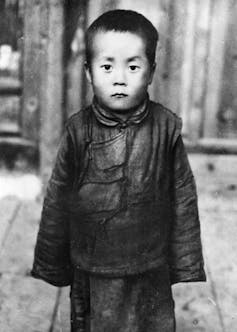
AP Photo
The 14th Dalai Lama recounts in his memoirs about his early life that he remembered recognizing one of the monks in the search party, even though he was dressed as a servant. The search party did not show who they were to the villagers, to prevent any manipulation of the process.
As a little boy, he remembers asking for the rosary beads the monk wore around his neck. These beads were previously owned by the 13th Dalai Lama. After this meeting, the search party came back again to test the young boy with further objects of the previous Dalai Lama. He was able to correctly choose all items including a drum used for rituals and walking stick.
China and Dalai Lama
Today the selection process for the next Dalai Lama remains uncertain.
In 1950 China’s communist government invaded Tibet. The Dalai Lama fled in 1959 and set up a government in exile.
The Dalai Lama is revered by Tibetan people and his exile has created anger inside Tibet. China’s threats to manipulate the selection process is believed to be a way to impose control on the Tibetan people.
In 1995, the Chinese government caused the disappearance of the Dalai Lama’s choice for the successor of the Panchen Lama, the second most important tulku lineage in Tibetan Buddhism, when he was six years old. The Chinese government appointed their own Panchen Lama.
China also wants to appoint its own Dalai Lama. But it is important to Tibetan Buddhists that they are in charge of the selection process.
Future options
Because of the threat from China, the 14th Dalai Lama has made a number of statements that would make it difficult for a Chinese appointed 15th Dalai Lama to be seen as legitimate.
For example, he has stated that the institution of the Dalai Lama might not be needed anymore. However, he has also said it was up to the people if they wanted to preserve this aspect of Tibetan Buddhism and continue the Dalai Lama lineage.
Another option the Dalai Lama has proposed would be for him to appoint his reincarnation before he dies. In this scenario, the Dalai Lama would transfer his spiritual realization to the successor. A third alternative Tenzin Gyatso has stated is that if he dies outside of Tibet, his reincarnation would be located abroad, most likely India.
Lastly, he has mentioned the possibility of being reborn as a woman, but added that he would have to be a very beautiful woman. He believes that appearance is important in transmitting Buddhist teachings.
The Dalai Lama is confident that no one would trust the Chinese government’s choice. In April 2019, US Sen. Cory Gardner said at a hearing of the Senate Foreign Relations Asia Subcommittee that the Congress would not recognize a Dalai Lama chosen by the Chinese government.
Brooke Schedneck, Assistant Professor of Religious Studies, Rhodes College
This article is republished from The Conversation under a Creative Commons license. Read the original article.
Japan 1919: Women go on strike for first time in Japan
Didier “Ice” IcemanEt en France ?

Attack on Iran would be an attack on Russia
Didier “Ice” IcemanPossible
Russia is meticulously advancing Eurasian chessboard moves that should be observed in conjunction, as Moscow proposes to the Global South an approach diametrically opposed to Western sanctions, threats and economic war. Here are three recent examples.
Ten days ago, via a document officially approved by the United Nations, the Russian Foreign Ministry advanced a new concept of collective security for the Persian Gulf.
Moscow stresses that “practical work on launching the process of creating a security system in the Persian Gulf” should start with “bilateral and multilateral consultations between interested parties, including countries both within the region and outside of it,” as well as organizations such as the UN Security Council, League of Arab States, Organization of Islamic Cooperation and Gulf Cooperation Council.
The next step should be an international conference on security and cooperation in the Persian Gulf, followed by the establishment of a dedicated organization – certainly not something resembling the incompetent Arab League.
The Russian initiative should be interpreted as a sort of counterpart of, and mostly a complement to, the Shanghai Cooperation Organization, which is finally blossoming as a security, economic and political body. The inevitable conclusion is that major SCO stakeholders – Russia, China, India, Pakistan and, in the near future, Iran and Turkey – will be major influencers on regional stability.
The Pentagon will not be amused.
Drill, baby, drill
When the commander of the Iranian Navy, Hossein Khanzadi, recently visited St Petersburg for the celebration of Russia’s Navy Day, the General Staff of the Iranian Armed Forces and the Russian Defense Ministry signed an unprecedented memorandum of understanding.
Khanzadi was keen to stress the memorandum “may be considered a turning point in relations of Tehran and Moscow along the defense trajectory.”

A direct upshot is that Moscow and Tehran, before March 2020, will enact a joint naval exercise in – of all places – the Strait of Hormuz. As Khanzadi told the IRNA news agency: “The exercise may be held in the northern part of the Indian Ocean, which flows into the Gulf of Oman, the Strait of Hormuz and also the Persian Gulf.”
The US Navy, which plans an “international coalition” to ensure “freedom of navigation” in the Strait of Hormuz – something Iran has always historically guaranteed – won’t be amused. Neither will Britain, which is pushing for a European-led coalition even as Brexit looms.
Khanzadi also noted that Tehran and Moscow are deeply involved in how to strengthen defense cooperation in the Caspian Sea. Joint drills already took place in the Caspian in the past, but never in the Persian Gulf.
Exercise together
Russia’s Eastern Military District will be part of the Association of Southeast Asian Nations’ (ASEAN) anti-terrorist exercise in Thailand and China early next month. According to the Eastern Military District, the training is part of “preparations for a practical phase of an ASEAN anti-terrorist exercise in China.” This means, among other things, that Russian troops will be using Chinese military hardware.
Exercises include joint tactical groups attempting to free hostages from inside official buildings; search for and disposal of explosives; and indoor and outdoor radiation, chemical and biological reconnaissance.
This should be interpreted as a direct interaction between SCO practices and ASEAN, complementing the deepening trade interaction between the Eurasia Economic Union and ASEAN.
These three developments illustrate how Russia is involved in a large spectrum from the Caspian Sea and the Persian Gulf to Southeast Asia.
But the key element remains the Russia-Iran alliance, which must be interpreted as a key node of the massive, 21st century Eurasia integration project.

What Russian National Security Council Secretary Nikolai Patrushev said at the recent, historic trilateral alongside White House national security adviser John Bolton and Israeli National Security Council Adviser Meir Ben-Shabbat in Jerusalem should be unmistakable:
“Iran has always been and remains our ally and partner, with which we are consistently developing relations both on a bilateral basis and within multilateral formats.”
This lays to rest endless, baseless speculation that Moscow is “betraying” Tehran on multiple fronts, from the all-out economic war unleashed by the Donald Trump administration to the resolution of the Syrian tragedy.
To Nur-Sultan
And that leads to the continuation of the Astana process on Syria. Moscow, Tehran and Ankara will hold a new trilateral in Nur-Sultan, the Kazakh capital, possibly on the hugely significant date of September 11, according to diplomatic sources.
What’s really important about this new phase of the Astana process, though, is the establishment of the Syrian Constitutional Committee. This had been agreed way back in January 2018 in Sochi: a committee – including representatives of the government, opposition and civil society – capable of working out Syria’s new constitution, with each group holding one-third of the seats.
The only possible viable solution to the tragedy that is Syria’s nasty, rolling proxy war will be found by Russia, Iran and Turkey. That includes the Russia-Iran alliance. And it includes and expands Russia’s vision of Persian Gulf security, while hinting at an expanded SCO in Southwest Asia, acting as a pan-Asian peacemaking mechanism and serious counterpart to NATO.
Russian PM Dmitry Medvedev visits disputed island off Hokkaido despite protest from Tokyo
Didier “Ice” Icemanon continue dans la tension

Founder of banned Hong Kong independence party arrested, police source says
Didier “Ice” Icemanla répression commence

Saudi strike kills 13 Yemeni civilians
Didier “Ice” Icemanle massacre continue de chaque côté
Thirteen civilians including two children were killed in a Saudi artillery strike in northern Yemen on Monday in response to a rebel attack on a Saudi base, medics said.
They said the strike on the Al-Thabit Al-Shaabi district of Saada province, a stronghold of the Huthi rebel group, also wounded 26 people including 12 children.
Rebel-controlled media including the Huthis’ Al-Masirah channel earlier reported Saudi artillery fire on a market in the same area.
The channel reported 36 casualties, including both dead and wounded, while the rebels’ spokesman said at least 10 civilians had died.
Rebel media reported that the Huthis had carried out a drone attack against the King Khaled airbase in the Saudi city of Khamis Mushait.
Saudi authorities gave no immediate confirmation of the drone attack or the artillery fire.
Saudi Arabia heads a military coalition that has since 2015 been battling the Huthis, which are backed by the kingdom’s regional arch-rival Iran.
The Huthi rebels, who have faced persistent and deadly coalition bombing since March 2015 that has exacted a heavy civilian death toll, have stepped up missile and drone attacks across the border.
In June alone, they launched at least 20 missile and drone attacks on the oil-rich kingdom, challenging Saudi Arabia’s advanced defense technology.
Saudi air defenses intercepted a Yemeni rebel drone targeting a southwestern city last Thursday.
Nine civilians were wounded in a July 3 Huthi attack on Abha airport in the south of the kingdom, the coalition said.
A June 12 missile attack on the same airport wounded 26 civilians, drawing warnings of “stern action” from the coalition.
And on June 23, a rebel attack on Abha airport killed a Syrian and wounded 21 other civilians, the coalition said.
The uptick in cross-border raids comes amid heightened regional tensions as key Saudi ally the United States presses a “maximum pressure” campaign against its arch-rival Iran after withdrawing from a landmark 2015 nuclear deal between major powers and Tehran.
Saudi Arabia has repeatedly accused Iran of supplying sophisticated weapons to the Huthis, a charge Tehran denies.
The coalition intervened in support of the Yemeni government in 2015 when President Abedrabbo Mansour Hadi fled into Saudi exile as the rebels closed in on his last remaining territory in and around second city Aden.
Yemen’s conflict has claimed tens of thousands of lives, according to relief agencies, and triggered what the United Nations describes as the world’s worst humanitarian crisis.
– Agence France-Presse
Au Liban : « Et si on vous kidnappait ? »
Didier “Ice” IcemanIntéressant point de vue
HCM City to renovate old buildings
Didier “Ice” IcemanEnfin !!
 HCM City authorities have a new solution to attract investors to participate in apartment renovation projects.
To feed its 1.4 billion, China bets big on genome editing of crops
Didier “Ice” IcemanEffrayant

Trump Has Strengthened Hardliners in Iran
Didier “Ice” Icemanc'est vrai et terrible
by Jalil Bayat
Donald Trump’s maximum pressure campaign against Iran—including his decision to withdraw from the 2015 nuclear deal (Joint Comprehensive Plan of Action or JCPOA)—has empowered the position of hardliners in Iran’s foreign and security policy establishments. Europe’s inability to salvage the JCPOA in the face of U.S. sanctions has also contributed to this trend.
In an interview with NPR on July 19, Iranian Foreign Minister Javad Zarif said:
Engagement has lost credibility at home. People don’t look at engagement with the international community—the United States, for one reason, for not keeping its word; the Europeans for another reason, for not being able to stand on their word. So, yeah, engagement is losing credibility, and by extension, I am losing credibility.
This admission by Zarif can be better perceived by observing the measures Iran has taken in recent weeks. Iran’s moves to down a U.S. drone, allegedly in Iranian airspace, and seize a British oil tanker, in response to the British seizure of an Iranian tanker earlier this month, indicates the rising influence of internal political forces opposed to interaction with the West.
Important security and foreign policy decisions in Iran are made by the Supreme National Security Council (SNSC). Council members include the heads of the three branches of government, the chief of staff of the armed forces, the head of the Plan and Budget Organization (PBO), two representatives of the Supreme Leader, the foreign minister, the minister of the interior, the minister of intelligence, the commander of the Islamic Revolutionary Guard Corps (IRGC), and the commander of the army. Decisions made by the Council must be approved by the Supreme Leader.
It can reasonably be concluded that recent Iranian decisions with respect to its compliance with the JCPOA or its response to the seizure of the Grace 1 were made by the Council and approved by the Supreme Leader. Although hardliners were always powerful in Iran, all evidence now points to the dominance of hardliner views, including in the SNSC, over those in favor of interaction, like Zarif and President Hassan Rouhani, who are in charge of the executive branch.
Rouhani took office in 2013 by campaigning for interaction with the West and a solution to the longstanding nuclear crisis. He is now in a position of weakness following Trump’s exit from the JCPOA and the institution of his maximum pressure policy. Both Rouhani and Zarif are under increasing attack by their political opponents for choosing the path of negotiations with the U.S. and European Union.
Rahim Safavi, a former IRGC commander who now serves as an adviser to Supreme Leader Ayatollah Ali Khamenei, has severely criticized the current situation in Iran by saying, “Sometimes it looks like the country can be better managed without the [Rouhani] government.” In December 2018, the hardline newspaper Kayhan accused Zarif of deceiving the Iranian people by signing the JCPOA and asked parliament and the judiciary to reprimand him along with other statesmen. Its managing editor, Hossein Shariatmadari, who serves officially as Khamenei’s representative in Kayhan Publications, went on to criticize Zarif’s July 1 interview with CNN as an invitation by the U.S. to destroy Iran. Iranian state TV also televised a series on the arrest of a U.S. spy recently in which Rouhani’s cabinet was condemned time and again in its approach to relations with the U.S.
At the same time, the downing of the U.S. drone and seizure of the British tanker brought a sense of pride to Iranians, especially Iranian youth, bolstering the influence of pro-resistance factions. The drone downing boosted the confidence of Iran’s military leaders, contributing to the seizure of the British tanker. This confidence, taken to the extreme, could be a detriment if it leads those military leaders to overestimate Iran’s strength.
Western leaders who have claimed there is no difference between Iranian moderates, like Zarif and Rouhani, and hardliners must now reconsider their analysis. The present situation has only weakened the position of those who favor interaction with the West. Trump’s actions have undermined their credibility inside Iran. The U.S. president must know that if he hopes to conduct negotiations with Iran one day, he can only do so with the moderate camp. The hardline, pro-resistance camp will not be amenable to talks with the U.S.
The bad news for President Trump is that Iran will hold parliamentary elections in February 2020. If the current trend continues moderates can be expected to suffer a significant defeat, leaving parliament in the hands of hardliners. That trend could then reach its apex in Iran’s 2021 presidential election. As when George W. Bush repaid Iran for its cooperation with the U.S. war effort in Afghanistan by including it in his “Axis of Evil”, leading to the 2005 election of conservative President Mahmoud Ahmadinejad in place of outgoing reformist President Mohammad Khatami, the policies of Donald Trump may culminate in an electoral victory for Iranian conservatives.
Such a future serves the interest of none of the parties. Iran must interact with the West to lift sanctions and rebuild its economy. The U.S. and EU must also interact with Iran for stability in the Persian Gulf region and to secure the flow of oil exports. The present situation is a lose-lose for everyone.
Jalil Bayat is a PhD candidate in international relations at Tarbiat Modares University in Tehran.
Vietnam detains 380 Chinese in illegal online gambling bust
Didier “Ice” Icemanla répression sur fond de rivalité
Iran blasts plan for British-led European naval mission in Persian Gulf as ‘provocative’
Didier “Ice” Icemantout s'arrange.... mal

Saudi-led forces and Israel among states blacklisted by U.N. for killing children
Didier “Ice” IcemanCa va jaser

L’ordinateur personnel, l’éternel mort-vivant…
Didier “Ice” IcemanDu bon fred
Cela fait bien une quinzaine d’années, voire une vingtaine qu’on peut lire des articles sur la mort prochaine de l’ordinateur avec son clavier et sa souris. Dans la liste non-exhaustive des tueurs ? Je fais la liste de mémoire, il y aura sûrement des trous… Que voulez-vous, avec l’âge, la mémoire devient moins fiable…
- 1997-1999 : l’épopée des Network Computer dont j’ai parlé dans un article d’octobre 2012
- 2007-2009 : l’épopée des eeePC et apparentés
- depuis 2010 : l’épopée des tablettes tactiles et autres smartphones
Et pourtant, les ordinateurs continuent de se vendre. À une vitesse réduite, certes. Mais on peut toujours en trouver que ce soit dans les rayons de grandes surfaces, spécialisées ou non. Si on regarde l’article de ZDNet consacré au marché du PC, on peut lire en juillet 2019 :
Le PC, une affaire de pros – 2017 avait été la 6e année consécutive de recul des livraisons mondiales de PC. 2018 fut elle la 7e année, et très vraisemblablement 2019 la huitième. Certes, la chute a fléchi par rapport aux années précédentes, mais sans prendre fin. Et 2018 démarrait sur une tendance comparable : une baisse moindre, mais une baisse toujours.
Un an plus tard, le retour à la croissance n’est toujours pas d’actualité. Lors du premier trimestre 2019, les livraisons mondiales ont reculé de 4,6% à 58,52 millions d’unités. « Nous avons observé le début d’un rebond des livraisons de PC à la mi-2018, mais l’anticipation d’une rupture par des pénuries de CPU a eu un impact sur tous les marchés des PC. »
Même si un article concernant le deuxième trimestre 2019 dit que le marché repart à cause de la demande des entreprises qui migrent vers MS-Windows 10, ce n’est qu’un frémissement.
Pourquoi ? Tout simplement, c’est que la durée de vie moyenne d’un PC a explosé depuis une douzaine d’années. J’ai gardé un PC à 300€ près de 8 ans avant de recevoir une machine basée sur du Ryzen3 2200G qui me fera sûrement elle aussi 7 à 8 ans. Il me suffira de compléter le disque dur mécanique par un SSD, remplacer l’alimentation pour gagner un peu de marge et de remplacer le Ryzen3 par un Ryzen 5 avec une petite carte graphique dans un délai de 18 mois à 2 ans.
Pour 400 à 500€ de frais – en comptant le passage de 8 à 16 Go de mémoire vive – je repousserai l’achat d’une machine neuve d’au moins deux bonnes années. Prenez une machine de 2014-2015. Remplacez son disque dur par un SSD, et vous lui donnerez un second souffle qui rallongera sa durée de vie d’au moins deux ans.
Nous ne sommes plus dans la folie des années 1985-2005 où il fallait changer complètement d’ordinateurs en moyenne tous les 18 mois vu les progrès en terme de puissance engrangée que ce soit au niveau du microprocesseur ou des cartes graphiques.
Sur un autre plan, purement ergonomique. Certaines personnes nous sortent des grandes tirades sur le fait que les tablettes vont remplacer le PC à terme. Soit. Mais amusez-vous donc à faire quelques activités un tant soit peu sérieuses sur un périphérique qui n’a aucun périphérique d’entrée physique.
Amusez-vous à remplir un formulaire avec un clavier virtuel. Bon courage… Vous reviendrez rapidement à un clavier avec ses touches qui font du bordel à la frappe mais qui au moins sont plus confortable à l’utilisation sur le long terme.
Écrire un texte de plusieurs milliers voire dizaine de milliers de caractères, et vous en aurez rapidement marre. D’accord, j’ai poussé un peu le bouchon ici, mais vous comprenez l’idée.
Une tablette pour lire des bouquins, faire du jeu à la Candy Crush Saga, envoyer 3 ou 4 courriers électronique, je suis d’accord.
On me rétorquera sans aucun doute que nombre de personnes se contentent de leur smartphone pour poster 3 conneries sur Facebook, twitter ou encore Instagram. Je suis entièrement d’accord. Mais est-ce que la vie en ligne se résume à dire que « Tatie Amélie a eu la gastro-entérite » ou à poster une photo de son dernier repas sur Instagram ?
N’oublions pas le problème de la durée de vie des tablettes, de la pollution liée à leur fin de vie, du manque de réparabilité par conception. Bref une tablette, ça vit quoi ? Deux voire trois ans à tout casser ?
Le petit acteur informatique qu’est Google a décidé de mettre fin à sa marque de tablettes pour se reconcentrer sur les PC à la Chromebook, les Network Computer nouvelle génération. On se demande bien pourquoi 
La tablette a son champ d’application, les ordinateurs classiques le leur. Croire qu’on pourra tout faire avec une tablette, c’est illusoire… Comme de penser que les ordinateurs personnels dont les prémisses remontent à l’Altaïr 8800 et au premier Apple (1975-1976) dureront éternellement.
En tout cas, l’ordinateur classique a survécu à deux tueurs en série (les Network Computer et les eeePC), nul doute qu’il survivra au troisième constitué du duo tablette et smartphone. Allez, je parie un carambar que d’ici 2024-2025, on continuera d’utiliser des claviers et de souris… Pari tenu ?
Viol et abus sont le lot des saisonnières marocaines en Espagne
Didier “Ice” Icemanmangez des fraises

Maurice, l'île où s'évaporent les ressources fiscales du business africain
Didier “Ice” IcemanA rajouter sur la liste

Japan to start research on growing human organs in animals
Didier “Ice” Icemança fait peur

L'Algérie, " lost in transition " ? Trois mois après la démission de Bouteflika, la crise politique s'enlise
Didier “Ice” IcemanOn n'oublie pas

For Iranians, The War Has Already Begun
Didier “Ice” IcemanHelas
by Elham Pourtaher
Not a day goes by without the Trump administration imposing a new challenge on us, the Iranian people.
Those who think that the travel ban has been the hardest obstacle for Iranians need to catch up with latest foreign policy developments. Encouraged by Donald Trump’s foreign policy advisers, the Iranian people today face an increasing risk of military attack by the United States.
Also, the Iranian currency has lost 80 percent of its value since last year, mainly reflecting the collective sense of fear caused by the increased sanctions and the decertification of the Iran nuclear deal, as well as the increasing empowerment of the most undemocratic factions of the Iranian state. Trump has proudly taken credit for bankrupting an economy that feeds 80 million people, and he has recently promised to reduce Iran’s oil exports to zero.
Iran is only marginally reflected in the U.S. news, which means the American public does not hear voices that express the human suffering caused by the U.S. government far beyond its borders. The murder and dismemberment of Jamal Khashoggi by Saudi Arabia, Trump’s best ally in the region, is a rare instance of attention given to the nature of America’s allies and Iran’s opponents in the Middle East.
Pro-democracy Iranians worldwide are experiencing a political trauma. They feel alienated from both internal and world politics. They are unable to communicate the debilitating pain of, on the one hand, expecting a military attack by the United States and on the other, the worsening of the political landscape in their home country.
Those who feel relieved by thinking that Trump will not engage in an actual war and is merely interested in making threats should realize that the war has already begun. U.S. sanctions are producing a level of suffering comparable to that of wartime.
Sanctions in fact are a war waged by the United States against the Iranian working- and middle-classes. These groups struggle to make ends meet as unemployment dramatically increases even as the inflation rate skyrockets. The same people that the Trump administration is pretending to want to set free are the ones that are hit hardest by current U.S. policies in the Middle East.
I am a woman who grew up in Tehran. I arrived in the United States seven years ago to pursue my studies in sociology. This decision was strongly shaped by my involvement in the peaceful pro-democracy movements of 2009.
I have always opposed, and continue to criticize, the undemocratic elements of the Islamic Republic state. While my profession and studies are very meaningful to me, the political dramas silently affecting my homeland and family on a routine basis make me feel alienated and utterly excluded from this society.
I am weighed down by perpetual worry that my diabetic father is in danger of losing access to needed medication due to sanctions. My millennial friends are so consumed with anxiety over the possibility of war that their collective mental well-being is undermined, and they are unable to make any meaningful plans for their future.
Living a double life between the United States and Iran, I struggle daily with moments of despair and alienation: I am simply unable to communicate my concerns with the most caring colleagues at work and at school. U.S. civil society is so devoid of a voice representing my position that I struggle to find a way to verbalize my sense of panic, frustration, and despair.
These fused feelings emerge because the wall between me and the rest of the society does not allow them to see the impact of the U.S. government’s decisions in lives lived far from them, but so close to my heart.
U.S. civil society needs to include more global perspectives on the country’s foreign policy. U.S. citizens must become more aware that their votes have grave consequences beyond their country’s borders. Although U.S. citizens are equipped with various safety nets and enjoy economic and military global superiority, their elected administration’s foreign policy is a matter of life and death for the citizens of other countries, especially in the Middle East.
For the United States to truly honor its claims to protect human rights and moral integrity, these issues need to be included in the upcoming election debates.
Elham Pourtaher is a Ph.D. candidate in sociology at SUNY Albany. She works at the New York State Department of Health on programs that respond to the opioid crisis.
NOTE: This story originally ran on LobeLog in May, but given the rise in tensions in the Persian Gulf in recent days we’ve opted to repost it.
Le Conseil de l’UE sponsorisé par BMW, pas un problème selon la Finlande
Didier “Ice” IcemanOn n'arrête pas la dérive

Toyota fetches new way to use AI, self-drive tech in Tokyo Games
Didier “Ice” Icemanune évolution de l'AI

Bolsonaro hits Brazil agency over Amazon deforestation report for stirring ‘environmental psychosis’ abroad
Didier “Ice” Icemanl'escalade continue

Eating king Kobayashi bites back in new documentary
Didier “Ice” IcemanIncroyable personnage

Mystery surrounds ouster of Chinese researchers from Canadian laboratory
Didier “Ice” IcemanEspionnage ?

Trump’s Bluster Diplomacy
Didier “Ice” IcemanOpinion interessante
by John Feffer
It was not very long ago that Donald Trump was calling North Korean leader Kim Jong Un “Little Rocket Man” and threatening to rain “fire and fury” down on North Korea. In response, Kim called Trump a “dotard” and promised an equally fiery attack on the United States.
But now, two summits, the exchange of friendly letters, and a dramatic handshake at the DMZ have nearly erased what had once been a very tense relationship between the two leaders.
It’s tempting to assume that Trump approaches international relations according to the same template: aggressive threats followed by cordial diplomacy. It’s how he recently treated Mexico, for example, by threatening to impose an escalating series of sanctions on the country if it didn’t stop the flow of refugees across its northern border into the United States. The administration backed down after an interim agreement. The U.S. president seems to be approaching China in a similar fashion, with threats followed by a recent truce.
And then there’s Iran.
Since he took office, Trump has kept up a constant attack on Iran and its leadership. He has also taken aim at the nuclear agreement that the United States (alongside EU, Russia, and China) negotiated to eliminate any path Iran might take to building nuclear weapons. Last year, he withdrew the United States from that agreement.
More recently, the United States and Iran moved closer to the brink of outright conflict. The United States accused Iran of attacking several ships in the international waters of the Persian Gulf region. And Iran shot down an unmanned drone, which it accused of flying over Iranian territory. The Trump administration authorized a cyberattack on Iran in response and came very close to launching an aerial bombing of Iranian infrastructure.
Although several members of the Trump administration – notably National Security Advisor John Bolton and Secretary of State Mike Pompeo – support a more active regime-change campaign against Iran, Trump seems less certain. He is not eager to start a ground war in the region. And he has expressed his desire on several occasions to sit down with Iranian officials to negotiate another agreement to replace the nuclear accord that he has done so much to destroy.
On the face of it, then, it seems as though Donald Trump is preparing to make the same pivot on Iran that he did with North Korea. He defied his advisors and the opinion of the Washington commentariat more generally to reach out to Kim Jong Un. Perhaps he is on the verge of doing the same thing with Iranian President Hassan Rouhani.
There are, however, significant differences between the two cases. With North Korea, Trump was effectively dealing with a clean diplomatic slate. The Obama administration had failed to negotiate any lasting agreement with Pyongyang. So, Trump has been able to position himself as a pathbreaker, as a president who not only outperforms his predecessor on this issue but all previous modern administrations as well. Indeed, Trump believes that his initiatives on North Korea will ultimately net him a Nobel Peace Prize.
Iran is a different matter. By coming close to destroying the Iran nuclear deal, Trump is not only ripping up a legacy of the Obama administration. He is angering European allies – as well as Russia and China – who have invested a great deal of political capital in that agreement. He is undermining U.S. credibility in the international community, particularly the assumption that Washington will abide by agreements that it signs.
And, of course, Trump has infuriated Iran. The restoration of sanctions removed by the Obama administration as part of the nuclear deal – plus the addition of even more sanctions – has severely affected the Iranian economy. The threat of secondary sanctions against any country doing business with Iran has further hurt the country, particularly by cutting into revenues from the energy sector.
The only segment of the Iranian population that is happy with Trump’s moves is the group of hardliners that never wanted rapprochement with the United States in the first place. These hardliners occupy important positions in the clerical hierarchy as well as the Islamic Revolutionary Guard Corps. The latter was responsible for the shootdown of the U.S. drone and may have been involved in the naval incidents as well.
Even if Trump intends to pivot toward negotiations, Iran may no longer be interested in talking with Trump. Iranian officials don’t believe that they can trust anything that Washington says – and, after Trump has walked away from so many agreements that the United States has signed, they have a point.
Also, it’s not entirely clear that Trump has a consistent approach to U.S. adversaries. He doesn’t seem to have any interest in negotiating a new deal with Cuba to replace the Obama-era agreement. He doesn’t appear to want to talk with Nicolas Maduro of Venezuela. Perhaps Washington will eventually reach a trade deal with Beijing – but the Trump administration has continued a hardline approach to China on other issues from information technology to cybersecurity.
In other words, there is no consistent Trump doctrine such as “speak loudly, wave around your big stick, but ultimately get down to negotiations.” Worse, U.S. foreign policy has become concentrated in the hands of the president, with considerably less input from the State Department, the National Security Council, and the intelligence agencies.
The risk of war with North Korea has diminished considerably over the last year. But the risk of war with Iran remains high. It could happen by accident. It could happen by miscalculation.
Or it could happen because Donald Trump wakes up one morning and decides to follow through on all the threats that he has made. The same split-second decision that led him to meet Kim Jong Un at the DMZ might lead him to launch an attack on Iran. That’s what it means to have an erratic, inconsistent, and fundamentally irresponsible president in the White House.
Originally published at Hankyoreh and republished with permission.
Taiwan may give Hong Kong protesters asylum
Didier “Ice” IcemanEt la Chine vouloir taiwan
