04 Dec 08:24
by Samira Siahrostami
Nature Materials 12, 1137 (2013).
doi:10.1038/nmat3795
Authors: Samira Siahrostami, Arnau Verdaguer-Casadevall, Mohammadreza Karamad, Davide Deiana, Paolo Malacrida, Björn Wickman, María Escudero-Escribano, Elisa A. Paoli, Rasmus Frydendal, Thomas W. Hansen, Ib Chorkendorff, Ifan E. L. Stephens & Jan Rossmeisl

21 Nov 13:13
by Isidoro López, Mehmed Z. Ertem, Somnath Maji, Jordi Benet-Buchholz, Anke Keidel, Uwe Kuhlmann, Peter Hildebrandt, Christopher J. Cramer, Victor S. Batista, Antoni Llobet
Abstract
The homogeneous catalysis of water oxidation by transition-metal complexes has experienced spectacular development over the last five years. Practical energy-conversion schemes, however, require robust catalysts with large turnover frequencies. Herein we introduce a new oxidatively rugged and powerful dinuclear water-oxidation catalyst that is generated by self-assembly from a mononuclear catalyst during the catalytic process. Our kinetic and DFT computational analysis shows that two interconnected catalytic cycles coexist while the mononuclear system is slowly and irreversibly converted into the more stable dinuclear system: an extremely robust water-oxidation catalyst that does not decompose over extended periods of time.

Zweifach hält länger: Die Umwandlung eines hoch aktiven einkernigen Aquaruthenium-Wasseroxidationskatalysators in einen zweikernigen Komplex im Verlauf der Sauerstoffentwicklungskatalyse führt zur gemeinsamen Existenz von zwei Katalysezyklen (siehe Bild; Ru rosa, N blau, O rot). Der zweikernige Komplex ist robuster als der einkernige und bleibt daher länger als der aktive Katalysator in der Wasseroxidation bestehen.
20 Nov 07:17
Chem. Commun., 2014, 50,451-453
DOI: 10.1039/C3CC47816E, Communication
Anjana Chanthapally, Wei Ting Oh, Jagadese J. Vittal
One of the polymorphs with parallel orientation of C[double bond, length as m-dash]C bonds in a ladder coordination polymer retains single crystallinity during [2+2] cycloaddition reaction but not the one with criss-cross bonds.
The content of this RSS Feed (c) The Royal Society of Chemistry

20 Nov 07:15
Chem. Commun., 2013, Accepted Manuscript
DOI: 10.1039/C3CC47723A, Communication
Yu-Bin Dong, Yang Yu, Xiao-Meng Zhang, Jian-Ping Ma, Qi-Kui Liu, Peng Wang
A porous Cu(I)-MOF is constructed from CuI and 1-benzimidazolyl-3,5-bis(4-pyridyl)benzene (L). This Cu(I)-MOF can be a highly sensitive naked-eye colorimetric sensor to successively detect water and formaldehyde species in a single-crystal-to-single-crystal...
The content of this RSS Feed (c) The Royal Society of Chemistry

20 Nov 07:13
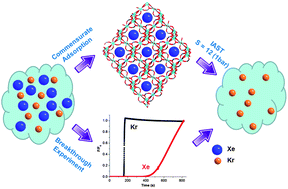
Chem. Sci., 2014, 5,620-624
DOI: 10.1039/C3SC52348A, Edge Article
Hao Wang, Kexin Yao, Zhijuan Zhang, Jacek Jagiello, Qihan Gong, Yu Han, Jing Li
This work demonstrates the first example of commensurate adsorption of atomic gas in a microporous metal organic framework Co3(HCOO)6 with the highest adsorption selectivity of xenon over other noble gases.
The content of this RSS Feed (c) The Royal Society of Chemistry

20 Nov 07:09
by Maria Losurdo, Iris Bergmair, Babak Dastmalchi, Tong-Ho Kim, Maria M. Giangregroio, Wenyuan Jiao, Giuseppe V. Bianco, April S. Brown, Kurt Hingerl, Giovanni Bruno
The role of graphene in enabling deoxidation of silver nanostructures, thereby contributing to enhance plasmonic properties and to improve the temporal stability of graphene/silver hybrids for both general plasmonic and meta-materials applications, as well as for surface enhanced Raman scattering (SERS) substrates, is demonstrated. The chemical mechanism occurring at the graphene–silver oxide interface is based on the reduction of silver oxide triggered by graphene that acts as a shuttle of electrons and as a kind of catalyst in the deoxidation. A mechanism is formulated, combining elements of electron transfer, role of defects in graphene, and electrochemical potentials of graphene, silver, and oxygen. Therefore, the formulated model represents a step forward from the simple view of graphene as barrier to oxygen diffusion proposed so far in literature. Single layer graphene grown by chemical vapor deposition is transferred onto silver thin films, a periodic silver fishnet structure fabricated by nanoimprint lithography, and onto silver nanoparticle ensembles supporting a localized surface plasmon resonance in the visible range. Through the study of these nanostructured graphene/Ag hybrids, the effectiveness of graphene in preventing and reducing oxidation of silver plasmonic structures, keeping silver in a metallic state over months at air exposure, is demonstrated. The enhanced and stable plasmonic properties of the silver-fishnet/graphene hybrids are evaluated through their SERS response for detecting benzyl mercaptane.

The role of graphene in enabling deoxidation of silver nanostructures, thereby contributing to enhance plasmonic properties and to improve the temporal stability of graphene/silver hybrids for both general plasmonic and meta-materials applications as well as for surface enhanced Raman scattering (SERS) substrates, is demonstrated.
20 Nov 07:02
by Wen-Xiu Ni, Mian Li, Ji Zheng, Shun-Ze Zhan, Yu-Min Qiu, Seik Weng Ng, Dan Li

Weißlicht: [{Au(L)}3] (L=3-(2-Thienyl)pyrazolat) zeigt eine duale Emission, zum einen von einem organischen Chromophor, zum anderen durch aurophile Stapelwechselwirkungen. Die resultierenden blau-grünen und orange-roten Emissionen können durch Modulation des Aggregationsverhaltens des Clusters so reguliert werden, dass man weißes Licht erhält.
20 Nov 06:58
by Cyrille Costentin, Juan Carlos Canales, Baptiste Haddou and Jean-Michel Savéant

Journal of the American Chemical Society
DOI: 10.1021/ja407988w

20 Nov 06:46
by Junfeng Xie, Jiajia Zhang, Shuang Li, Fabian Grote, Xiaodong Zhang, Hao Zhang, Ruoxing Wang, Yong Lei, Bicai Pan and Yi Xie

Journal of the American Chemical Society
DOI: 10.1021/ja408329q

20 Nov 06:38
by Demin Liu, Kuangda Lu, Christopher Poon and Wenbin Lin

Inorganic Chemistry
DOI: 10.1021/ic402194c

19 Nov 03:42
by Yogeswaran Umasankar, D. Bradford Brooks, Billyde Brown, Zhiguo Zhou, Ramaraja P. Ramasamy
A high performance laccase-based biofuel cell cathode is developed using carbon nanosheets (CNS) as the catalyst support and buckypaper (BP) as the substrate electrode. Compared to multiwalled carbon nanotube (MWNT)-based electrodes, CNS-based electrodes exhibit better electrochemical properties for the oxygen reduction reaction (ORR) under biologically relevant conditions. It is shown that CNSs are conformally coated on the nanotubule bundles within the BP and that laccase is intimately attached to the CNS-BP. Electrochemical characterization is carried out to derive the kinetic parameters of the ORR at the laccase-CNS-BP cathode. The laccase-CNS-BP exhibits a steep ORR cathodic wave with a Tafel slope of 19 mV decade-1. The onset potential obtained for laccase ORR at CNS-BP is 20 mV higher than that of the MWNT-based electrodes, and the laccase-CNS-BP cathode has a higher current density than MWNT electrodes.

A high performance enzymatic cathode material based on a carbon nanosheet support exhibits high electron transfer properties and good O2 reduction electrocatalysis. The enhanced electron transfer kinetics are made possible by the graphene edge planes and the ability of carbon nanosheets to transfer electrons from the enzyme to the current collector.
19 Nov 03:42
by Ramiz A. Boulos, Nikki Y. T. Man, Nigel A. Lengkeek, Katherine A. Hammer, Niki F. Foster, Natalie A. Stemberger, Brian W. Skelton, Pan Yu Wong, Boris Martinac, Thomas V. Riley, Allan J. McKinley, Scott G. Stewart
Abstract
Herein we describe the preparation and structure-activity relationship studies on range of stilbene based compounds and their antibacterial activity. Two related compounds, each bearing carboxylic acid moieties, exhibit good activity against several bacterial strains, including methicillin-resistant Staphylococcus aureus MRSA (ATCC 33592 and NCTC 10442). Compound 10 was most active against Moraxella catarrhalis with minimum inhibitory concentrations (MICs) of 0.12–0.25 μg mL−1 and against Staphylococcus spp. with MICs ranging from 2–4 μg mL−1. The derivative 17 showed increased activity with MICs of 0.06–0.25 μg mL−1 against M. catarrhalis and 0.12–1 against Staphylococcus spp. This level of activity is similar to that reported for S. aureus for antibiotics, such as vancomycin, with MICs of ≤2.0 μg mL−1 and clindamycin with MICs of ≤0.5 μg mL−1. As an indicator of toxicity, 17 was tested for its ability to lyse sheep erythrocytes, and showed low haemolytic activity. Such results highlight the value of tris(stilbene) compounds as antibacterial agents providing suitable properties for further development.

Routes to new antibiotics: The preparation of and structure–activity relationship studies on a range of stilbene based compounds revealed two related compounds, each bearing carboxylic acid moieties, exhibiting pronounced activity against several bacterial strains including methicillin-resistant Staphylococcus aureus, MRSA (see scheme, dba = dibenzylidene acetone).
19 Nov 03:39
by Domenico Di Sante, Alessandro Stroppa, Prashant Jain and Silvia Picozzi

Journal of the American Chemical Society
DOI: 10.1021/ja408283a

18 Nov 01:54
Dalton Trans., 2014, 43,1684-1690
DOI: 10.1039/C3DT52107A, Paper
Yuji Mikata, Yuki Nodomi, Asako Kizu, Hideo Konno
The differences in fluorescent zinc sensing property between TACN and ethylenediamine (EN) skeletons in quinoline-based ligands are discussed.
The content of this RSS Feed (c) The Royal Society of Chemistry

18 Nov 01:53
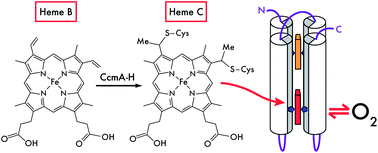
Chem. Sci., 2014, 5,507-514
DOI: 10.1039/C3SC52019F, Edge Article
J. L. Ross Anderson, Craig T. Armstrong, Goutham Kodali, Bruce R. Lichtenstein, Daniel W. Watkins, Joshua A. Mancini, Aimee L. Boyle, Tammer A. Farid, Matthew P Crump, Christopher C. Moser, P. Leslie Dutton
We report the construction of an adaptable, man-made c-type cytochrome chassis functionally assembled in vivo capable of incorporating diverse functionality common to natural oxidoreductase enzymes.
The content of this RSS Feed (c) The Royal Society of Chemistry

18 Nov 01:49
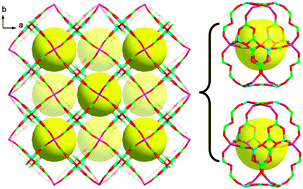
Chem. Commun., 2014, 50,5385-5387
DOI: 10.1039/C3CC47420H, Communication
Feng-Rong Dai, Dustin C. Becht, Zhenqiang Wang
A neutral metal-organic supercontainer (MOSC) has been functionalized as an anionic container, leading to enhanced adsorption capacity for polar guests.
The content of this RSS Feed (c) The Royal Society of Chemistry

18 Nov 01:44
Chem. Commun., 2013, 49,11512-11514
DOI: 10.1039/C3CC46022C, Communication
Chang-Cang Huang, Jian-Jun Liu, Yong Chen, Mei-Jin Lin
A double-wall-hourglass-shaped metallocavitand bearing an electron-deficient cavity was self-assembled, which exhibited an unusual selectivity to substituted benzene derivatives of different electron density during co-crystallizations.
The content of this RSS Feed (c) The Royal Society of Chemistry

18 Nov 01:43
Chem. Commun., 2014, 50,344-346
DOI: 10.1039/C3CC47440B, Communication
Lin Cheng, Guo-Yu Yang
The 2D aluminoborate networks built using AlO4 and B4O8 units are further joined by XO4 (X = Al/B) groups to form a 3D framework with chiral cages.
The content of this RSS Feed (c) The Royal Society of Chemistry

18 Nov 01:39
by Ana M. Castilla, Naoki Ousaka, Rana A. Bilbeisi, Elisa Valeri, Tanya K. Ronson and Jonathan R. Nitschke

Journal of the American Chemical Society
DOI: 10.1021/ja410117q

gjchen and -1 others like this
18 Nov 01:37
by Qian Liu, Nanyi Wang, Jürgen Caro and Aisheng Huang

Journal of the American Chemical Society
DOI: 10.1021/ja4080562

15 Nov 00:48
by Qipu Lin, Xianhui Bu and Pingyun Feng

Crystal Growth & Design
DOI: 10.1021/cg401579z

15 Nov 00:46
by Suman Chandra, Sharath Kandambeth, Bishnu P. Biswal, Binit Lukose, Shrikant M. Kunjir, Minakshi Chaudhary, Ravichandar Babarao, Thomas Heine and Rahul Banerjee

Journal of the American Chemical Society
DOI: 10.1021/ja408121p

14 Nov 01:28
Dalton Trans., 2013, 42,16569-16577
DOI: 10.1039/C3DT51916C, Paper
Kyung Beom Kim, Hyun Kim, Eun Joo Song, Sumi Kim, Insup Noh, Cheal Kim
A cap-type Schiff base could simultaneously sense three biologically important metal ions through fluorogenic (Zn2+) and chromogenic (Zn2+, Fe2+, and Cu2+) methods in aqueous solution.
The content of this RSS Feed (c) The Royal Society of Chemistry

14 Nov 01:24
Chem. Commun., 2014, 50,207-209
DOI: 10.1039/C3CC47665K, Communication
Sheng Chen, Jingjing Duan, Wei Han, Shi Zhang Qiao
A three-dimensional framework promoter of graphene-MnO2 was fabricated to enhance the catalytic properties of NiCo2O4.
The content of this RSS Feed (c) The Royal Society of Chemistry

14 Nov 01:08
by Tsubasa Sakai, Dirk Mersch, Erwin Reisner

Etwas Luft schadet nicht: Eine sauerstofftolerante Hydrogenase kann in Kombination mit einem Farbstoff zur photokatalytischen H2-Erzeugung eingesetzt werden. Das homogene System bedarf keines Redoxvermittlers und liefert unter Bestrahlung mit sichtbarem Licht auch in Gegenwart von Luft große Mengen an H2.
13 Nov 01:16
Chem. Commun., 2013, Advance Article
DOI: 10.1039/C3CC46629A, Communication
Rafael Schiwon, Katharina Klingan, Holger Dau, Christian Limberg
Survival test passed: the Co4-oxo core of a polyoxometalate facilitates water oxidation in aqueous solution and thus is of high interest in energy science. The molecule is indeed is a real catalyst surviving the reaction cycle without any detectable structural modification.
To cite this article before page numbers are assigned, use the DOI form of citation above.
The content of this RSS Feed (c) The Royal Society of Chemistry

gjchen and -1 others like this
13 Nov 01:07
by Michael J. Kelly, Jessica Gilbert, Remi Tirfoin, Simon Aldridge

Frustriert? Lach mal! Frustrierte Lewis-Paare aus einem sperrigen tertiären Phosphan und einem stark Lewis-sauren Ferrocenylboran (FcB(C6F5)2) wurden für den kolorimetrischen/elektrochemischen Nachweis von N2O untersucht. Ein solches System, basierend auf tBu3P/FcB(C6F5)2, zeigt nicht nur die Präsenz von N2O an, sondern hat auch die Fähigkeit, zwischen N2O und O2 zu unterscheiden.
07 Nov 09:18
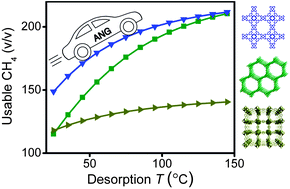
Chem. Sci., 2014, 5,32-51
DOI: 10.1039/C3SC52633J, Perspective
Jarad A. Mason, Mike Veenstra, Jeffrey R. Long
The potential of metal-organic frameworks for use in adsorbed natural gas vehicles is discussed.
The content of this RSS Feed (c) The Royal Society of Chemistry

07 Nov 03:36
by Xiaoxin Zou, Anandarup Goswami and Tewodros Asefa

Journal of the American Chemical Society
DOI: 10.1021/ja407174u

07 Nov 03:32
by Song Dang, Xue Min, Weiting Yang, Fei-Yan Yi, Hongpeng You, Zhong-Ming Sun
Abstract
The luminescent properties of a family of lanthanide metal–organic frameworks LnL (Ln=Y, La–Yb, except Pm; L=4,4′-({2-[(4-carboxyphenoxy)methyl]-2-methylpropane-1,3-diyl}bis{oxy})dibenzoic acid) have been explored, and the energy-transfer process in the compounds has been carefully analyzed. The visible-emitting Tb0.08Gd0.92L and the near-infrared (NIR)-luminescent Yb0.10Gd0.90L show excellent optical performances and can be considered as fluorescent probes for acetone sensing based on luminescence quenching effects arising from host–guest interactions. Moreover, GdL exhibits a strong second harmonic generation (SHG) signal 6.1 times that of potassium dihydrogen phosphate (KDP) and an outstanding phase-matchable effect. These lanthanide compounds combining fluorescent and nonlinear optical (NLO) properties could meet further requirements as multifunctional materials.

Lighting up time: A family of LnMOFs has been developed (see figure), the members of which show luminescence from the visible to the near-infrared region. Detailed luminescence studies have revealed a potential application for Tb0.08Gd0.92L and Yb0.10Gd0.90L as new fluorescent probes for acetone sensing.