After the success of his indie phenomenon Donnie Darko in 2001, writer/director Richard Kelly set out to make his magnum opus. A sprawling, apocalyptic sci-fi thriller/satire set in a dystopian Los Angeles in the then-future of 2008, Southland Tales was, in a word, bonkers. Its surreal take on Hollywood and a post-9/11 America on the brink of social, economic and environmental disaster was as kaleidoscopic as its ensemble cast: Dwayne Johnson (aka The Rock) plays an actor with amnesia, Sarah Michelle Gellar is a porn-star-turned-producer, Seann William Scott is an LA cop, and Justin Timberlake is a pop star just back from a tour in Iraq (Amy Poehler, John Larroquette, Wallace Shawn, Kevin Smith, Lou Taylor Pucci and many more also make appearances).
Loud, colorful, and largely puzzling, it left critics aghast when it premiered at Cannes in 2006, made less than $400,000 at the box office when it hit theaters the following year, and sent Kelly—who was only 29 when we made the film—into a sophomore funk. But Southland Tales also developed a dedicated cult following, and even though Kelly has moved on to other projects (2009's The Box, and a new film in development, Corpus Christi) he has never been able to let Southland go.
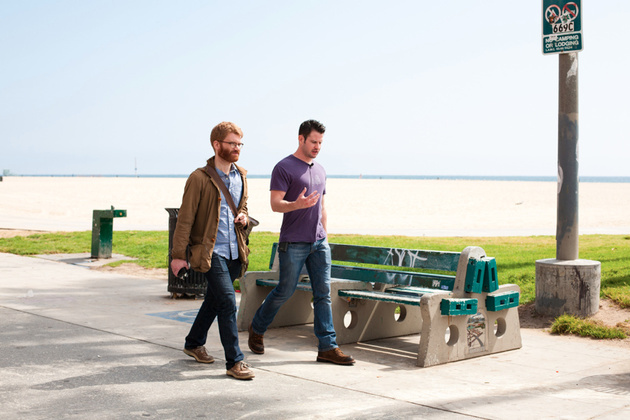
For my feature on the film and my encounters with Richard Kelly and his obsessive fans, I met Kelly for about three hours in April. We started at Venice Beach's Sidewalk Café, where many of the film's scenes were shot, and then visited other locations, strolling along the boardwalk toward the Santa Monica Pier. In the interest of shedding more light on this enigmatic—and Kelly says, "unfinished"—beast, below is text of our complete conversation, with photos by Joshua Shultz.
Kelly and I would email subsequently too; when news of the NSA's massive wiretapping program emerged last month, he laughed nervously about the uncanny resonance with the fictional domestic surveillance organization in his film. "USIDENT would have been the better way to go..." (You can see some of the concept art for USIDENT and its guerrilla hacker adversaries in this gallery of artwork made for the film; and you can dive deeper into the story with his until-now unreleased prequel script, which for years he's hoped to turn into an animated or live-action film.) With his weird sprawling epic, Kelly made something unusual and as poignant now as it was when it was released: “I was trying to make a big piece of satire that would be comfort food in light of the terrorist threat,” he told me. “That's what the film is intended to be for people."
+++
Motherboard: Sitting here in the café is surreal. It's like stepping into a tangent universe.
Richard Kelly: It is a tangent universe, that's for sure.
Do you think of Southland Tales as an alternate history?
Absolutely, absolutely. That was the whole intention, was to create a false timeline and an alternate timeline. A ridiculously absurd world, y'know?
What pops into your mind while sitting here?
Sitting here with Dwayne and Sean and just having the best time. It was so much fun. It was the most insane experience. We only had about 29 days to shoot the entire film.
You're kidding.
Yeah. We were just working so fast, and we had two cameras running simultaneously. Y'know, this was like the hub. The Sidewalk Cafe was like the hub. It's where all the characters meet up. It's where everyone breaks bread and conspires. Shooting here on the budget is very expensive. A lot of the budget of the movie was eaten up by our location fees, because we shot in so many different locations in LA. Very expensive beachfront locations. And it was—Los Angeles was very much a character in the film. And it was—y'know, we weren't able to even stop and take a breath, we were moving so fast. We did so much residual digital photography, surveillance photography, outside of those 29 days, just running around and grabbing surveillance footage of the city that was augmented on the screens, in the newscasts and everything.
Shot by who?
My cousin and I! (Laughs) Y'know, when Miranda Richardson is sitting in front of all those screens, we had to fill all of those screens, so we spent the greater part of an entire year photographing all of that stuff. All over the city, every part of the city. We shot all of that stuff. Y'know, and then there was the KTLA news. There was remote, isolated photography that took place outside of the 29 days, but it was a massive undertaking. I mean, never again in my career will I cram that much into 29 days. I don't know how I survived it. And I was writing graphic novels. It was too much. It was just... it was too much.
is that your takeaway? That the movie had too much going on in it?
Yes, but boy, am I proud of what we pulled off. To an extent, I see it as an unfinished film. I can elaborate more on that later, but it's one of those things that you can only really do once in your career: take a risk like that. I've always been about taking crazy risks, and I think that's kinda what happens when you direct your first movie when you're 24 years old. You take those kinds of ridiculous risks that only someone of that age would do.
How old were you when you made Southland Tales?
I was barely 30. 29. And that's still too young to be directing a film! (Laughs) I'm not sure if anyone under the age of 30 should be allowed to direct a film. That sounds horribly hypocritical, but—I mean, I was lucky.
Do you think about it every day?
Absolutely. It's—I mean, I think about it all the time. It's definitely the thing that I'm most proud of, and I feel like it's sort of the misunderstood child or the banished child. You think of all your films as children. I like to think it's the closest thing that a man can do that is a simulation of childbirth, is directing a film. (Laughs) That, again, sounds horrible in the sense of what the experience of childbirth must be —I can never understand that. But it seems like a very emotional experience.
What triggers your memories of Southland?
Well, sometimes it's something horrible happening in the news, or reading something that feels like it could come straight out of the plot of the film. Or is even more ridiculous than the plot of the film, and disturbing. I guess that makes me think of the film. But more than anything, it's just the fondness of the memories of making it and me getting to work with all of those actors, who I love. I really love all of them dearly. There was just something really subversive about it and crazy and provocative about it. And those memories are very fond to me, I guess.
What kind of news events make your mind race back to the world of the movie?
Yeah! It's always disturbing when you have any kind of terrorist event or a terrorist attack and there are residual follow-up events. You've got the crazy ricin guy and the explosion in Texas. Y'know, that was a rough week. One of the worst weeks I can remember. It's very troubling, but I think—thinking back, that was kinda why I pursued Southland Tales and why we made the film. We were very disturbed.
Who's "we"?
I like to say that about all my collaborators. I have to take the credit and/or the blame, but it's—I think I was very disturbed. The whole film was my long-simmering response to 9/11 and response to the anxiety of terror and the terrorist threat and trying to make a big piece of satire that would be comfort food in light of the terrorist threat. That's what the film is intended to be for people.
Comfort food?
Yeah, in a way. I tried to make something you could disappear into and get lost inside of it. And in the transmedia angle with the graphic novels, try to expand it into an expanded world that you could disappear into. I might be the only person who would see it as comfort food, but yeah. (Laughs)

Philip K. Dick said he wrote The Man In The High Castle by scribbling one name on a piece of paper —"Mr. Tagomi" —and building the whole story around the thoughts that came to him from that name. What was your "Mr. Tagomi"?
I think it was the ride-along with Boxer Santaros and Ronald Taverner and the twin brothers and the staged shooting. That was the triggering event at the center of the film: all of these ridiculous people trying to scam this movie star and extort money from him. And what kinda started off more as a satire of Los Angeles crime and buffoonish actors and buffoonish fringe-dwellers in the Los Angeles scene evolved into something much more ambitious and political. The layers of science fiction and the Orwellian political world surrounding the characters evolved in subsequent drafts. And it really became a much more grand, apocalyptic statement, instead of a bunch of morons in LA trying to extort money.
But that was the original idea?
Yeah, it was a kind of extortion attempt on an actor, and the idea of the Hindenburg explosion over LA as the grand denouement. And just like all of my stuff, it just evolves into a place where it becomes exceedingly ambitious and layered and dense and too long for distribution. (Laughs) And it expanded into graphic novels. That's what it needed to be.
Did you start thinking of the movie before 9/11?
No. This was all after Donnie Darko went to Sundance and it tanked at Sundance and was just kind of—it was not received warmly. A lot of people don't remember that, but there's a few of us that really remember it. (laughs) I was just really depressed, and I went and wrote two or three comedy-type scripts. I wrote a script called Bessie, about a genetically engineered cow. I wrote a gun-control satire that Oliver Stone briefly had under option. So I wrote those three scripts and then Southland became something of an obsession. The more I—this is 2003, 2004. I was gonna direct a film called Knowing, that ended up getting made years later with Alex Moyas and Nicholas Cage. I was gonna direct the $15M budget version of Knowing, based on my rewrite of that script at Fox Searchlight. And it fell apart at the very last moment over business affairs issues, and everyone was concerned that it was too ambitious to be able to achieve that film for $15M. I had a lot of big stuff in there, expensive stuff. Everyone was just really nervous that we couldn't pull it off, and there were other business affairs issues. It just collapsed and I went on to Southland Tales.
That's a long gap. Donnie Darko came out just before 9/11--
And it tanked! It tanked at The Box office. It was not easy for me to find a job in the immediate one to two years following the release of Donnie Darko. It wasn't until 2003, 2004 that everyone realized that they liked the movie. It took a while. And then I kinda had a little bit more heat.
You'd put out the director's cut for Donnie Darko by the time you did Southland Tales.
Yeah, and then I was—I saw Southland Tales as an opportunity to do something really subversive and provocative. I had Seann William Scott, and when we got Dwayne Johnson, it was clear that we could get just barely enough to pull it off. The movie cost just about $17 million. We needed 50, but we got 17. (Laughs) It was a major undertaking.
What was your elevator pitch to people for Southland Tales?
Oh god. I don't even know what an elevator pitch is. (laughs) I wouldn't know—I think it was just the idea of a big dystopia comedy-satire about the last three days on earth in Los Angeles.

And what exec wouldn't hear that and say yes.
Oh, I just remember being in a room with so many people, their eyes glazing over. And part of me takes pride in that. But y'know, Donnie Darko was no easy sell, either. It was something people needed to just surrender themselves to.
How much of the casting was just you meeting with people and pitching it?
I mean, it was Dwayne. I remember, I met with Dwayne in Venice Beach. And he was just so lovely. He signed on right away
What did you tell him?
I had a big visual presentation. Ron Cobb had done schematics for the MegaZeppelin. I brought my MegaZeppelin schematics to the Firehouse restaurant in Venice Beach. Dwayne rolled up in his Humvee and I was showing him MegaZeppelin schematics and he was very amused. He said yes immediately. Yeah. It needed a big star. It needed a big movie star, someone that could deconstruct himself. Y'know, if you look closely at the film, every one of those actors —every single one of them —is playing a subversive version of themselves and their celebrity image, in a lot of ways. Maybe a lot of the actors didn't realize it at the time, but if you really go back and look at the film, it's a very—every single actor is playing a subverted deconstruction of their celebrity persona on some level.
Which actors "got it" most? Who were the ones who needed the least explaining about the movie?
There was a whole spectrum. They all knew I had it swirling around in my head. It was the same thing on Donnie Darko. It was like, 'We don't quite understand the whole big picture, but you seem really convinced that you know what you're doing, so we're gonna go along with it!' And when they saw the finished product, they were like, 'Okay, okay.' It's the same thing with the rabbit in Donnie Darko. I drew that original sketch that's the logo for my company now, the original sketch that the mask was based on--
And which pops up in the mise-en-scene of Southland Tales!
Yeah! And it's—when I originally did the rabbit, everyone was like, 'We're not sure about this, Richard. You—this is the way it's supposed to look?' Then, when we finished the mold and lit the set, Stephen lit the set, James Duvall in the rabbit costume for the first time in a school hallway, everyone came up to me like, 'We get it. We get it now. We understand what you're doing. We weren't sure at first.' So Stephen Poster, my cinematographer to this day, is like, 'Once I saw what you did with the rabbit, I'll go out on a limb for you when you wanna take a risk like that.' (laughs) It's the same thing with Frank Langella's face in The Box. Everyone was putting a lot of pressure on me not to do his face digitally. It was gonna be a huge expense, and we could do it with makeup, but I stuck to my guns and we did it digitally, and in the end, everyone was like, 'Thank god we did it digitally.'
Which actors were most eager to get on board?
Dwayne and Seann. Absolutely.

How did Seann get involved?
I think my agency set up a meeting. I needed somebody to play the twins, somebody who had a combination of innocence and sort of a haunted quality, but also really great comedic timing. Seann has all of those things, and he was just the perfect candidate for that role. It was the same thing with Dwayne. The movie would not have gotten made without Dwayne. It was really hard to cast Boxer Santaros. It was such a ridiculous character, and Dwayne is just one of a kind. There's just no one like Dwayne Johnson out there. He's a really special person. Even getting Sarah involved to play Krysta was great, because she comes from—coming out of television and Buffy and her sort of persona and fanbase from that show. She's a very seasoned pro. She's been doing this for a long time. She started on a soap opera when she was barely a teenager, I think. So having her play this kind of—I think the pitch was Jenna Jameson meets Arianna Huffington. (laughs) And she got it. She thought that was hilarious and she went for it.
Rewatching the movie, I couldn't help noticing that Sarah Michelle Gellar plays her lines for laughs far more often than any other actor. was that by design on your part?
Well, the character was just so absurd. She's this spunky porn star, but a lot of what comes out of her mouth is, perhaps, wise on one level, what she has to say. But also just completely ridiculous. And, y'know, if you name a character 'Krysta Now'—I don't know, she needed to be the sorta ray of sunshine in the film. Even at the end of the film, when the MegaZeppelin's ready to go down, she's cool with it. Because it had to be this way. She's the sorta femme fatale of the movie. There's something about making her this fortune teller, on some level. And in the graphic novels, you realize that she's, she has an ability to kinda foretell future events.
Because of passing through lake mead on the United flight.
On the United flight, yes. (laughs) So much story. So much story.
Were any parts of your movie inspired by personal supernatural visions?
I mean, The Power, the script within the film, is definitely a metatextual layer that is definitely a reflection of what I was doing with Southland Tales. The absurdity of it, and the idea of making a film that is intentionally speculating on where things are headed. We shot the film in 2005, so it was a three-year speculation. The running joke was, the film took so long to finish, even beyond what we showed at Cannes, which was incomplete, that we were always just joking like, 'Is this gonna be a period piece by the time it comes out? Can we at least get it out before the real 2008 arrives?' (Laughs) And it didn't come out until November of 2007. But that was fine, because it was always very much a film about that moment, y'know?
But was there an actual outside force compelling you?
Yeah, I mean, there was definitely, um—some, uh—alien intelligence running through my DNA at some point in the process. I look back and sort of laugh and—at where some of this could've come from.
Such as?
Y'know, on second thought, it all comes from a logical place. I just think the ambition of it and the density of it is something that (long pause) is very intimidating, in retrospect. I think I was trying to challenge myself and push myself to a degree that some might regard as masochistic. But that's kind of—that's what being an artist is. If you wanna be great and you wanna really make a mark and leave an impact, you kinda have to beat yourself up. You kinda have to destroy yourself. I'm past a lot of that now, but I'm grateful for having destroyed myself. Because you only get a window of time to push the envelope. Y'know, it was—It was just a lot of, uh—It was a lot to wrestle into submission, but it was such a wonderful obsession to have, and that I continue to have. I just love this town. I really do. And it was about getting lost in the absurdity of this city.

How long had you been an Angeleno when you made the movie?
I moved out to Los Angeles when I was 18, to go to USC. I got an arts scholarship. So, since I was 18, and we made Southland when I was 29, so about ten years. Yeah.
Why do the nuclear attacks happen in Texas?
Well, it's based on a theory floating around the Internet of al-Qaeda smuggling nukes over the border. I have family from Texas, and we shot the opening at my aunt's house in Abilene. My mother is from Texas. She's from the panhandle of Texas, and I had a lot of relatives in Abilene. There is a military base adjacent to Abilene with a lot of history. And the logic of a nuclear attack in Texas, perhaps resulting in the shutdown of the border and just—it felt like a realization of a doomsday scenario that was maybe grounded in some sort of plausibility.
Why don't we find out who carries out the attacks?
It really didn't matter, and it was better left a mystery, I think. And it was also—it needed to result in the invasion of Syria and North Korea and Iran and the Axis of Evil —the full-court press on the Axis of Evil. The idea of a second terrorist attack happening in our president's backyard would be something that would ignite the flames of a counter-attack beyond Iraq and into these other enemy countries.
Does having non-specific attacker allow you to have a world where we attack everybody?
Yeah. Sort of—it was like the world of 2005 all of a sudden on steroids. It just amplified everything to an even greater degree. We were in Iraq and Afghanistan at the time, and it was like, what if we doubled down and went after a few more? It was just sort of amplifying everything.
Is everything in the movie explicable?
Everything there has a point, has a reason. Even the orbs, the glowing orbs.
i was gonna ask about them.
Those are remote antennas for the Fluid Karma energy field. You got one of those orbs around, the energy field is more highly concentrated and that's sort of explained briefly in the graphic novels. Even when Justin Timberlake's character, Pilot Abilene, when he's talking about a 'sea of black umbrellas' in his crazy, drug-fueled monologue, he's talking about seeing back into time, to the early 20th Century at the Santa Monica Pier, with all of the umbrellas.
Oh, was that a thing?
In the Cannes cut, there's a scene where Boxer bleeds back in time to the 1920s and he sees a fortune-teller. He sees Beth Grant in a fortune-teller tent on the beach. There's a lot of stuff that didn't even make—there's a lot of material that people haven't seen.

In the graphic novel, there's the rollercoaster...
Yeah, the bleeding through time. In the Cannes cut, he bleeds through the beach into the 1920s. There's this beautiful photograph of one of the piers in the beach, either the Santa Monica Pier or one of the adjacent piers, and it's just thousands of black umbrellas and people on the beach. This is one of my favorite photographs of old Los Angeles. So, even Justin's dialogue, people probably see as incoherent rambling or something, but it really was rooted in the idea that he was seeing into the past. The idea of a tangent universe and fourth-dimensional stuff.
The whole project is still unfinished. You might be able to say that about—that no film is ever finished, they're just abandoned. But I really, really, really feel like Southland Tales is still unfinished. And yes, there's stuff that I would love to put back in.
Was it frustrating for you to cut the movie such that some stuff can't make sense?
Yeah, yeah. There's absolutely stuff I'd like to put back into the final, finished version of the film. It's still, to me, in my mind, an unfinished film. The whole project is still unfinished. You might be able to say that about—that no film is ever finished, they're just abandoned. But I really, really, really feel like Southland Tales is still unfinished. And yes, there's stuff that I would love to put back in.
But specifically when it comes to the viewer being able to understand--
Yeah, I mean, listen. It's such a huge undertaking to experience the film for the first time. It's definitely one of those repeat-viewing films. That makes some people very angry. Some audience members get very angry if they can't process and understand the story in one viewing, and they see that as a design flaw in the film itself. Other people are more open to obscurity and complexity and the idea of needing to revisit something. Those are my favorite kinds of films. It took me a dozen viewings of Mulholland Drive to begin to grasp components of that film. And, to me, that might be the greatest film ever made. So, it's not everyone's cup of tea, but it's definitely mine. (Laughs)
So, you were okay with that?
Yeah, but listen. There was stuff that—there comes a point where it can only be so long and there's stuff I would love to put back in. I would love to restore Janeane Garofalo's role. That really pains me, that her role got cut out. You see her at the very end of the movie, and it's like, 'What the hell happened?' I mean, she's clearly there, and she's there for a reason. And, y'know, she had all this stuff that was much more esoteric about the environmental cataclysm and the tidal generator and the primer and the idea of this triggering mechanism. The handshake, the cosmic handshake. It was perceived as being esoteric and there was a lot of pressure to cut the film down, and I—that was a concession I had to make. I needed more visual effects money, and they were like, 'Okay, you need to cut some stuff out if you're gonna get your visual effects money.' So I had to play ball, which was frustrating.

What's with the Saturday Night Live obsession in the casting?
I just always loved SNL. I think it's--
But why for this movie?
I think that it was a pop satire. We were making a deliberate, very deliberate pop-art film. We cast the film to be very pop. A lot of people from different parts of pop culture, and SNL is one of our biggest—it's a staple of pop culture and satire, and has been for thirty-some years now. It just seemed a logical place to find—it wasn't this deliberate decision that I made, like, 'I'm gonna go cast a bunch of SNL people.' It was just, I really like a lot of these actors. I mean, Jon Lovitz, Nora Dunn, obviously Amy is a genius. All of these people, I really just enjoyed their work over the years, and it just ended up moving in that direction I guess. (laughs)
I love the Amy Poehler / Cheri Oteri relationship in the movie. All that bickering about what makes for good improv.
There was definitely an All About Eve thing going on with Zora being jealous of Dream and her celebrity and her slam poetry. (Laughs) Sort of planning to have Dream assassinated so she could become the new queen of Venice Beach.
Was there lots of ad-libbing on set?
Yes. Particularly with Amy.
Like in the domestic disturbance scene?
Yes. (Laughs) Yes. I kinda went in and Amy and Wood [Harris] were very uncomfortable in that makeup.
Physically uncomfortable?
Yes. It was really uncomfortable wearing all that prosthetic makeup. It sticks to your skin. It's not fun to have to wear. And I went in there and I said, 'Okay, we're gonna have this jealous fight, screaming at each other.' And boy, did Amy deliver. (laughs) She's one of the best improvisation actors I've ever worked with. And even the stuff when they were monitoring Dwayne and Seann in the police cruiser. The stuff about—I went in there and was like, 'Okay, let's talk about bowel movements and let's talk about animals and bowel movements, whether it's a spiritual thing.' So I was giving them pointers and everything, but then they just went for it. It was really insane and it was all swirling around in my mind, but I'll always do improv on any film that I do, because of those experiences.
Isn't that counterintuitive to your approach, what with all your attention to detail? Did you have to learn how to let go?
Well, I mean, you're just in the moment. And when something is funny, it's funny. I mean, when Amy started screaming about, y'know, someone's--
"Two-hundred-inch penis"?
(Laughs) Two-hundred-inch penis, yeah! Like, it's just—'Yeah, that's a circle take!' (laughs) You just go with it. And again, you've got all these SNL people. I would be a fool not to let some improv happen. I mean, at the end of the day, it was all about going for as much comedy as possible.
What, in the whole film?
Yeah! I mean, obviously, there was a lot of layers. Plenty of darkness in the film. But yes, trying to make sure we were amusing people, absolutely.
The Moby soundtrack often gets in the way of some big laughs. It sorta undercuts lines that are otherwise goofy. Was that intentional?
It was absolutely intentional. That was the design principle of the whole project, and that's why I approached Moby from the very beginning. He composed the whole score before we started shooting. We had the score—I mean, he went and he put together a lot of that music and kind of did it on his own and brought it to me. We'd talked at length about him scoring the film, and he just got really excited and went and recorded a bunch of that stuff. And we had it, I was playing it on-set for the actors. It was a very intentional choice for this sort of melancholy, ambient score to be the heartbeat underneath this absurdity.
What did you tell Moby?
I just wanted a dreamlike, Los Angeles texture. Y'know? Some of the stuff he did for Michael Mann in Heat is just stunning. Stunningly beautiful and ambient. So I took some inspiration from that and—but yeah, it was a very specific choice.
Why did you want to undercut the comedy?
Because I wanted it to have dignity. I mean, on one level, you have to see that it's a very sad film. (laughs) It's about the sadness of the world and where the world was headed at the time. We've gone far beyond where the film implied we were headed. I think we've hit some lower depths than even what the film projected. So I think the Moby score was a reminder of, 'This is really, really sad, but let's try to amuse ourselves with our undoing.'
Was there pressure to make the movie funnier?
I think it was just such a wild card, and everyone was just so intimidated and baffled by the film that it—in the end, it was just like, 'Richard, just cut it down. Just make it shorter.' People were just so freaked-out by it. And when we got into competition at Cannes, everyone was like, 'Awesome! Wow, great!' And then we got torn to shreds at Cannes and everyone was like, 'Cut it down!' I mean, there was—we were lucky to only have to cut the amount that we cut. I had to fight to hold on to a lot of things. I mean, it's a very elaborate story, and it's easy when you only see something once at a film festival. You get people coming out and saying, (growly voice) 'Oh, you can cut a half an hour.' These sort of, just, off-the-cuff comments like that. 'Oh, you can cut a half an hour out of that move.' But it's like, well, no, if you really go in and study it, it all fits together, and if you remove that, this falls apart. It's all tied together. In the post-Cannes finishing stage, everybody who rolled up their sleeves and got in there went, 'Oh yeah, you really can't cut that much, or the whole thing will make even less sense!' So that's part of why the graphic novels came into being, is that it's just a bigger, more expensive story.
So the graphic novels weren't part of the original plan?
Yeah, they were—well, they were part of the plan—they evolved. When we were prepping the movie, I realized I wanted to do the graphic novels. We were preparing the movie. So I wrote the first graphic novel before we started shooting, and I was halfway through the second one, and I didn't finish the third graphic novel until we were well into editing. So they were completed throughout the whole process.
Why create them?
I just knew there was a bigger story that I wanted to tell, and I knew that, one day, I kinda wanted to do the first three chapters as a kind of low-budget animated thing. Or I just wanted—there was just a bigger story there that I wanted to tell. And I thought it would be a cool promotional thing, and I thought it'd be a cool transmedia experiment. But at the time, no one was interested in anything like that, and no one was—there was no marketing money beyond just grassroots, 'Hey, there's these graphic novels!' There was no distribution for them. It became just a personal obsession.
So you weren't expecting the average viewer to have read them?
No, and I realize that was something that 0.05% of the audience might experience, is having read them. But I just wanted them there for the long-term. For, y'know, if this film is going to be discovered over a long period of time, to have those graphic novels there for people who want to seek them out and want to discover them and to have the narrative in place.
Was there a point when you resigned yourself to cult status?
Yeah. I mean, especially after Cannes, it was sorta like, everyone is your—everyone's your best friend when you get into competition at Cannes. But then, the movie is widely ridiculed, and all of a sudden, your phone stops ringing. And it's like, 'Okay, well, I'm gonna rally the troops that are really behind me here and finish this thing the best I can.'
How depressing was Cannes?
It was like deja vu all over again, just on an international scale. Y'know, I was also 30 years old, and everyone who was much more experienced with that festival was like, 'Just shake it off. It happens a lot here.' I mean, they booed Sofia Coppola that year. Marie Antoinette was booed. They booed The Da Vinci Code. It was like, that was the year when all the Americans got trashed. And it's almost become a bit of a—I don't know, it happens a lot at that festival. And obviously, we went in—we were low-hanging fruit. Obviously, the kind of movie that it was. It's a two hour, forty minute pop satire. So, in retrospect, I probably took it too hard and let it—I let the experience hurt me in a way that—I should have blown it off.
Even more so than Donnie Darko?
Oh yeah, it was much worse. Much more painful. But at the same time, Sony bought the film before the end of the festival. So it sold and we got distribution. So it wasn't like—I mean, Donnie Darko took five months to get distribution after Sundance. That was a nightmare. So at least Sony bought it. Scott Schumann at Sony saw it back in LA, they screened it for him in LA, and he was like, 'This is kinda awesome. It needs to be finished, it's still—keep working on it and everything. But we can sell this. This is fun. There's something really special here.'
When did you find out that things had gone south?
They do a 9 a.m. press screening. We were the Sunday night premiere, which is a big night in Cannes, the first Sunday. In retrospect, they should've given us a later slot, because that Sunday slot is when everyone is—it's one of the biggest nights there, and you're front-loaded into the festival, so you're under the microscope. Whereas, I think that year, Pan's Labyrinth was near the end, and it's much quieter near the end, so people are much more chill and I think everyone would've, in retrospect, they would've rather programmed us near the end of the festival so we wouldn't be quite so much under the microscope. But it's definitely when you wake up and they have that 9am press screening, there was a lot of shell-shocked, 'Oh, Richard. Man, people were--'
So you weren't at the screening?
Oh no, no. We were at the red carpet, crazy black tie that night. But they do the press screening in the morning, so you start to get the feedback from the publicists.
How did the evening screening go?
People are much more polite at the black-tie official gala premiere for each film. People are much more polite. It's much more ceremonial. But the early-morning press screening, which is the first time anyone sees it, so the press can write about it and review it prior, that's probably the toughest audience in the world. The 9am Cannes press screenings are brutal. They don't pull punches. They'll boo and they'll hiss. They'll walk out. They're a tough audience.
So you find out when?
No no, it's already programmed. Any movie that's in competition at Cannes, the night of its premiere, there's a 9am press screening prior to the premiere.

So you know it's happening?
And you start getting feedback from the publicists. All the journalists, they write out a few sentences and they give it to the publicists. Like, 'I hated it,' 'I loved it,' 'I thought it was--' They just give a quick critique and they give it to the publicists. So your publicist comes to you around noon or one o'clock and says, 'Okay, here's the feedback. This person loved it, this person hated it, this person was mixed.' Everyone powwows and--
So you're just sitting there in the morning knowing people are watching?
Yeah.
How optimistic were you before that press screening?
We were just really proud. I was anxious because the movie wasn't really finished. There were a lot of unfinished visual effects that were really—it was rough because I didn't have the time or money to finish it properly. We were kind of in a rush. So that was tough, knowing that I was screening something that was kind of unfinished. I wanted to be able to tell everyone that. I wanted to be able to announce, 'This is a work in progress!' But then everyone around me was like, 'No. Do not say that.' And I was like, 'But I wanna say that. That's the truth.' And they were like, 'No. It'll backfire.' So that was frustrating, because I wanted to be able to announce, 'Hey, this is a work in progress.' So yeah, there was a lot of—it could've been handled better. It was—we were very naïve.
How do you get through the black tie screening after that?
Yeah, I barely remember it. It was surreal. And there was this huge party. Wild Bunch threw one of the craziest parties I think ever at the festival, afterwards, and it was just surreal. I was just walking around in a daze. It was an out-of-body experience. But y'know, you roll with the punches. And in retrospect, it all seems kinda trivial. I'm proud that we got that far, that we got that film into competition. I'm glad to Garry Formeau (sp?) and all the programmers of that festival, to this day.
Is it the next day that you say, “I have to cut this down,” or was there a grieving period?
I think we all had dinner the next night and said, 'Okay, we have to cut it down. We need to finish all these visual effects.' Same thing with Darko, is that we had to trim down—when we screened Darko at Sundance, none of that music was paid for yet. So when Darko tanked at Sundance, they were like, 'You're gonna have to cut all that music.' And I was like, 'No! Please don't! No! It's so important!' So there was a period after Sundance where I was gonna have to remove 70 to 80% of the pop songs and replace that with really cheap--
Wasn't the Gary Jules cover of "Mad World" supposed to be "MLK" by U2?
Well, briefly we had "MLK" in there, but we were on the fence about that.
So you already had experience with a festival flop.
It was like deja vu all over again. It was the same thing as with Donnie Darko. Everyone is your best friend going into the festival, and then after the festival, you're completely alone and alienated and people who said they loved the film no longer love it.
[We exit the café and begin walking along the Venice Beach boardwalk.]
+++

All I can think about is Nora Dunn and Lisa Wyatt cackling as they walk out of here. (Shrieks) 'Yeah!'
That's where the SUV was parked, where Seann William Scott runs into Lou Taylor Pucci. Yeah, he shows him his draft notice. That's where the SUV was parked. And then Sarah and the Now Girls were walking out of that store and coming down this way as they walked past.
So is this where—
This is where all the paths are converging, where all the characters are converging. When the girls are walking past, you pick up Lupuci in the SUV and then Seann walks up and sees him and pulls the gun and sits in the car with him and saves him from committing suicide.
Are we near the spot where Zora and Bart get shot?
Yes, that's on Speedway. That's a block over, back that way. Oh wait, no—that's Hermosa Beach. That's way down south. That's the South Bay. But where Zora runs down Bing, that's down on Speedway.
What's a story of being on set that pops into mind?
Well, first of all, shutting down this boardwalk and having a camera crew and having vehicles and, particularly, the Neo-Marxist compound, that raid, with all the SWAT vehicles pulling up —that's very, very expensive, to shut down this boardwalk. It's some of the most expensive real estate to secure in Los Angeles. So, we were a $17 million movie and we had to shoot it all in 29 days because all of our money was poured into these locations to get the production value. We had, like, an hour where we could put SWAT vehicles on the boardwalk and have guys with weapons running around. Our location manager was this wonderful guy named Ralph. His last name is escaping me. You can finish the last name and look him up. But boy, did he deliver for us. It was so ambitious, the shooting locations. Even up to the Santa Monica Pier, putting Humvees on the Santa Monica Pier was crazy.
What’s your favorite Dwayne Johnson story?
Dwayne is just the loveliest person. Absolutely would love with him again and I plan to work with him again. When we were filming the shooting of Dion and Dream, when Amy Poehler and Wood Harris get shot by Jon Lovitz and after that sequence, Boxer has his nervous breakdown and he's bleeding through time a little bit, and he freaks out and runs down the Nowita walk-street, which we had smoked up with atmosphere, the residents of Nowita were not pleased that we were in that. That's a public walk-street. It's very beautiful, and it's covered in trees, and it's this canopy, like, tropical jungle, lush walk-street. It's a public walk-street, but we got a permit to shoot there. But the residents were not happy. (Laughs)

It's a very expensive place to live. So Dwayne's having his breakdown, panic attack, and he's mumbling and rambling and he's pulling off his bullet-proof vest and he's got all the tattoos, and he's wigging out. And the extended-cam operator is really the only one in there. It's a tight space. There's not a lot of space to run around. And Dwayne's running around, having his panic attack. And there's smoke, and it's just this real landscape. And this elderly woman from one of the expensive houses in the Nowita walk-street comes out onto the porch and starts screaming at Dwayne, 'Get the hell outta here you crackhead! You crackhead scumbag! Go do your crack somewhere else! Go smoke your crack somewhere else!' Dwayne is just looking at her like, (timid voice) 'Ma'am, why are you yelling at me?' (Laughs) I mean, just a really hateful woman.
And so here's the Neo-Marxist compound. This is where all the police, the SWAT team vehicles pulling up and charging. This is where the ice cream truck was parked, where Cheri Oteri assaults Christopher Lambert. We had the big techno-crane up there, and we had the big techno-crane jib-arm mounted up here. Only for an hour could we have the techno-crane here before the city was like—so we had the crane sweeping by the Neo-Marxist compound. And it's obviously decked out with all the flyers and the graffiti. All those flyers and that artwork was custom-designed. There's so much detail in it that you can go and study. Dwayne's sort of split into two, like the rumors of what's happened to him.
Why "neo-Marxists"? It's a weird idea for an organization.
It seemed like the extreme liberal response to the neo-cons. Y'know, it was the opposite on the spectrum. I mean, obviously, now everyone's accusing our president of being a socialist and a Marxist, so this has become much more prevalent in our political discourse. But in 2005, when I was going on and on about Neo-Marxism, people would just roll their eyes in disbelief. They didn't quite understand what I was getting at.
Was there an element of leftist wish-fulfillment there for you?
Yeah, we wanted to—it was intended to be comedic. I mean, I am, by some definition, probably something of a Neo-Marxist. I mean, I was trying to not make it a liberal screed, even though I obviously am very liberal. But we wanted to sorta poke fun at the extreme left as we're clearly poking fun at the extreme right. So that was what was so fun about it, was we had all these SNL-type actors who obviously are engaging in political satire throughout a lot of their time while they're at SNL. It was fun to bring them into a film and satirize both polar extremes. I mean, the film was really about polarization and just this great divide. The American flag split in two and bleeding.
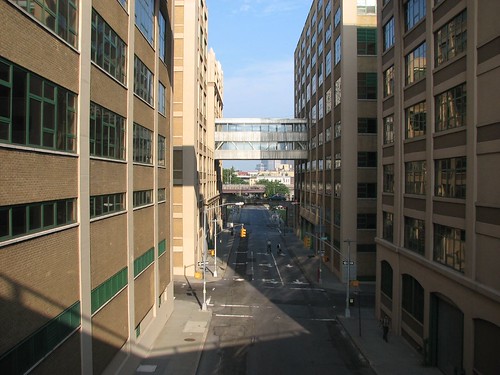
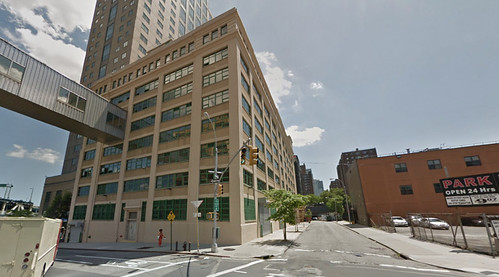
So, the interior of the Neo-Marxist compound was in a warehouse downtown. We didn't actually shoot inside. It's a different—that's an architectural firm inside there. It's very pricey. So we found a matching interior that we could deck out with the absurd, where Amy Poehler and Wood Harris have Seann William Scott tied up. And the dumpster where he jumps off the roof is in the back of this.
Jon Lovitz is a very vocal conservative. Did that ever come up on set?
Y'know, I don't really follow Jon's politics, but he was great on set. I think a lot of the actors came in and they didn't really understand the big picture, but they did understand their role. I think Jon understood the absurdity of his role. And he dyed his hair blonde and he went for it.
Was Justin Timberlake your first choice?
Yeah, yeah. I mean, Justin was absolutely who I wanted. His persona, as a pop star. It was a deconstruction of a pop star who gets drafted, sort of a celebrity character.
Yeah, this is the roof where Seann falls into the dumpster. And we had a stunt-double do the dive, but it was actually a digital meld to make it seem like it was all one.
Was Pilot getting drafted supposed to be like Justin himself getting drafted?
It was a riff on Elvis and the drafting of a celebrity and the propaganda, using a pop star as a propaganda tool in light of a draft. Yeah, it was definitely a riff on the Elvis getting drafted.
What was your direction to Justin for the voiceover?
The direction was Apocalypse Now. Martin Sheen. It was a very intentional low monotone. Sort of—it was very much based on Martin Sheen in Apocalypse Now. We did have several versions that we played around with. The first version maybe came off as a little too sarcastic. We wanted it to be just more deadpan. Sorta soothing.
What's Pilot's endgame? It's always been unclear for me.
He's the fortune-teller, and he's obviously close friends with Roland Taverner. They served in Iraq together, and Roland Taverner accidentally disfigured him and so he's sort of aware that his friend has been anointed as the messiah, and it's the Second Coming. The whole movie's a big joke about the Second Coming, really. A sci-fi kind of interpretation of Revelations, I guess. He's aware of how it's all gonna go down, and he's cool with it. He's the witness, I guess. Well, he does protect Boxer from Starla von Luft. She probably would've shot him, so he does protect the False Messiah.

So Boxer's the false messiah?
Yes, to distract attention from the real one. That was the idea.
I always saw Taverner and Boxer as both being the messiah.
Yeah, I mean, absolutely, they both went through the rift, but Boxer's doppelgänger did not survive. It burned up. So the handshake can only be—the primer is the Taverner brothers. But Boxer also has the tattoos and at the end, it bleeds.
In the graphic novels, we learn that boxer's tattoos represent all the major world religions, and that whichever one bleeds, it means that religion is the one true religion. Jesus ends up bleeding, of course. So, why Christianity? Why does it win?
Why does Jesus win? (Laughs) Well, because it's Revelation and it is the Second Coming. And the joke is, someone *has* to win, and it's part of the satire.
Sorta like a parody of the bush administration's invocations of god?
Well, I mean, it's the foundation of that entire administration, was Christianity. And Southland Tales is very much a reflection of that administration and those eight years.
Was a lot of time spent on the tattoos?
Well, we designed all the tattoos to reflect every major religion and we spent a lot of time laying them out and sort of designing the whole look. Lula Zara, who's Dwayne's makeup artist, is a very talented guy.

Boxer does that weird little twiddling thing with his fingers a lot. Was that your idea?
This? (Mimes finger action) Dwayne came up with it, and it became a motif. I mean, he's such a great physical actor. He really uses his body in—he comes from a world of acrobatics. In pro wrestling, there's a lot of very coordinated moves, and he brings that into his performance.
So just one day, he started doing it?
Yeah, and I was like, 'Keep doing that.' Whenever Boxer's having his—because there's Boxer, and then there's Jericho Cane, his absurd—the character from The Power. So he knew that, when he was making the transition, he would do the finger thing.
The finger thing is so the opposite of The Rock.
Yeah. Well, we wanted Boxer to be sort of feminine and innocent and childlike. And Dwayne went for it.
You didn't have to coax that out of him?
No, it was a very deliberate discussion. He just trusted me. I mean, he's a very—he's a really courageous, fearless performer.
Let's talk about "Teen Horniness Is Not A Crime."
You mean my songwriting debut?
i hate "where do you get your ideas" questions but... where did you get the idea for the song?
I think we wanted Krysta to have a pop song. It's always very interesting when a reality star or a porn star or someone perhaps not known for being musically inclined or intellectually inclined puts those things together and makes a very aggressively political pop song. (Laughs) It was just very amusing and we thought, 'Well, let's try to inject some legitimate meaning into it.'
What's the "legitimate meaning"?
Well, I mean, the idea of being unapologetic about your sexuality has, perhaps, some legitimacy, some value. It's a porn star saying, 'Don't judge me for the life choice that I've made.' (Laughs) But perhaps that Americans are way too uptight about sexuality and should be more open and abrasive.
How did you write it?
I think I wrote the base lyrics and then a couple friends sorta helped flesh it out for me. I was also thinking of Boogie Nights. Mark Wahlberg's ridiculous songs in Boogie Nights. So it was like, 'It's okay if it's terrible! It's supposed to be terrible!' It's more just a comedy song, a ridiculous song.
Let's talk about the dance sequence--
For a song we couldn't afford and didn't have the rights to use.
What? You didn't have the rights?
When we shot it, we didn't have the rights and didn't know if we could get it. The producers were freaking out and begging me not to waste four hours of our day shooting that. But I insisted and then we cut it together and we showed it to the Killers and they said yes! (Laughs)
So you shot it and just got in touch? What did you tell them it was?
We told them it was a pivotal part of the whole vision of the movie and we would love for them to license the song to us, but we only have a small amount of money. And they thought about it and immediately said, 'Okay, we love it.'
This is the apartment—you know what, they've torn it down. Cyndi Pinziki's apartment was here, I think. It's since been rebuilt. That's some high-end real estate.
Why that particular song?
Well, it's a great song. I love the song. And it just felt like a requiem for a soldier. It felt like it could possibly be acknowledging PTSD and guilt and a lot of things that soldiers deal with, coming back from a war.
Why have it as a dance sequence?
It felt like a character sort of lamenting his status as a propaganda tool. And the Marilyn Monroe, Busby Berkeley dancers being sort of like this USO dance-routine of cheerleading the soldiers along and being caretakers, nursing him back to health. Those dancers, boy did they deliver. They were great. Because we only had one day with Justin. One long, long day.
For the whole movie?
One 16-hour day. I kept adding. Justin is so great, and I kept adding more for him to do. His narration was obviously recorded later. But his character never leaves Santa Monica Pier. You know this.
Why the name Pilot Abilene?
Well, Abilene is where he's from. He's the hometown hero from Abilene. So it's like the propaganda machine has anointed him as the face of the war effort.
Was Wallace Shawn your first pick for the baron?
No one else could've played the Baron. Oh yeah. Y'know, I've always loved Wallace as an actor and as a writer. He's one of those very specific performers. There's no one like him
I can't imagine directing him. He's such a force of nature. How did you do it?
I mean, I had him put together some stuff for when the Baron's being interviewed about energy, to sort of have him rant against his critics and sort of the megalomania of the character and the ridiculous costuming and stuff.
There are a few racially uncomfortable moments in the movie, especially the ride-along, where the n-word gets dropped. Did you start to second-guess putting that in there?
Yeah, I mean, obviously we wanted to acknowledge the deep racial tension in the city and thinking back to Rodney King and the LA riots. And seeing the tension that we continue to deal with in something like the Trayvon Martin shooting. It's a very—Los Angeles is a melting pot, but it's certainly a heated racial environment. Especially with the LAPD.
But while filming that, was there part of you fearing the line?
Yeah, yeah. I mean, you're nervous. But they're trying to set him up as a racist cop. It's part of the scam. But yeah, it's a little nervous. But comedy takes risks and we were certainly taking plenty of risks. So that was just another one. (Laughs)
Bai Ling's character, serpentine, is kind of a racist stereotype.
Perhaps. It was definitely intended to be a film noir, femme fatale character that you might see in 1940s or 1950s LA noir. Yeah, it was intended to be just a ridiculous character. But Bai is very talented and she understood the risks, I guess, on that femme fatale character.
What's Baron's endgame?
Well, I mean, that's part of the ending that I'd like to eventually restore. The Baron has been duped by Serpentine, and Serpentine is aware of the handshake and shutting existence down with the handshake. The Baron has dreams of floating over the apocalyptic landscape in his MegaZeppelin and ruling over humanity, and Bai Ling tricks him and shuts down all existence. That's why she's—there's more of it in the Cannes cut.

Who in the movie wants to bring about the end of the world?
Bai Ling and Zelda Rubenstein. Katarina Kuntsler. Inga von Westphalen is aware of it, somewhat. But basically, Serpentine and Katarina hoodwink the Baron into shutting down all existence because the Baron is drunk with power and intends to destroy humanity and lord over humanity in his MegaZeppelin, so they decide it's better to shut down all existence.
Because he's unstoppable?
Yes.
Why the handshake? Why does the world end with a handshake? Is there symbolism there?
Well, it's just sort of like the great conundrum when you think of time travel. You think of Rian Johnson with Looper and even going back to Back to the Future II. There have been movies that explored the idea of two versions of the same person confronting each other from different timelines being inconceivable and it was something that just sorta made sense as a sci-fi trope that could trigger the end. It could trigger a cataclysm or existence shutting itself down.
Why have the end of the world in the movie, at all?
Just getting anxiety out of my system. I think everyone has apocalyptic anxiety, especially in the past decade.
Was Kevin Smith your original pick for General Simon Theory?
Yes. I've always been friends with Kevin, and he's such a great talker. He's such a great speaker. And he's a great actor, in many ways, and also just being a filmmaker. He had the persona for the character, for Simon Theory, the kind of wise, elder veteran with the Dungeons & Dragons stuff. There's more of his banter with Janeane Garofalo that I'd like to restore, that kind of clarifies things.
Did he help with the script?
Yeah, and he read multiple versions. He saw the evolution of it, and he and his partner Bob Chapman helped fund the graphic novels and pay for the graphic novels. Kevin's a real patron of helping out other artists trying to push the envelope.
Did you start writing the prequel script after The Box came out?
I'm always writing. I spent the past three to four years, I've been writing nonstop. I have a deep library of scripts. I'm constantly writing, and I just felt inspired to take a few weeks and adapt the graphic novels. It's just something I wanted to have. I'm always stockpiling material, constantly.
What's your relationship with Southland Tales fans like?
They're my favorite fans, actually. (Laughs) Y'know, again, it's—it's the movie that I like to talk about the most.

Why is that?
I just—there's just something about it. Maybe because it was just such an ordeal and just such a rollercoaster ride. A part of my life that was just so insane that I have fondness for it. I mean, it was always just such a long uphill battle that I find myself continually wanting to defend the film and continue wanting to finish it, to actually finally finish it!
Like Ridley Scott with Blade Runner.
Yeah, yeah, absolutely. There's still some visual effects that are not where I want them to be. There's some visual effects work. There are some shots at the end of the movie that I would like to add visual effects. Even just adding some of the content from the Cannes cut and even some of the content that never has still seen the light of day. And the animated—I have always hoped to do the first three chapters as a low-budget, animated feature. To just complete the whole thing or visualize the entire six-chapter story. (Laughs)
Have you ever had any weird interactions with fans? People who have crazy theories about the movie's hidden messages, or something?
Yeah, yeah, there's those people who have read the books and have seen the movie dozens of times and who kind of get a thrill out of digesting the big picture.
But are there weirdoes who think they’ve "solved" it?
Yeah, y'know, as much as it can be solved. I mean, it's a riff on Revelation and it's a riff on the Second Coming. That's the sort of—trying to process the insanity of what's happened to the world.
Is our real world in 2013 worse than the world of Southland Tales?
I mean, I don't know. It's—I don't know. The state of the world as a whole, I don't know what people would say about the state of the world. The economy has been pretty disastrous. We're trying to get ourselves out of Afghanistan and we're pretty much out of Iraq, but we could be going to Syria or we could be going to North Korea. There's always the impending threat. I'm glad to be past all of that, and I'm optimistic.
In the film, July 5th, 2008 is the date of the apocalypse. How’d you feel on that day?
(Laughs) It was definitely a relief when things—things aren't as bad as they could've been. But there's a lot of things in Southland Tales that almost seem understated to what you read in the news every day. I mean, there's some really crazy stuff happening. I mean, Donald Trump was a serious presidential candidate at some point! I wouldn't have even thought to put that in Southland Tales. That would've been too ridiculous to put into Southland Tales. Y'know? Even if, in the news-scroll in Southland Tales, I put in something about Donald Trump running for president, I would've been like, 'Nah, that's too much. Gotta pull that out. That's too ridiculous.'

Let's talk about the ubiquitous product placement. How much of that was your idea, prior to any marketing?
I mean, we got the product placement, but we tried to use it in a satirical way.
But even Hustler? it seems like that was a deliberate choice before they would approach you.
I mean, they let us license their logo.
But it was your idea?
Yes. Yes, the idea of the war machine relying on product placement for funding. I didn't realize it was this far a walk. We might have to take a cab back.
Was the debut and success of The Box a relief?
Yeah, I was definitely trying to simplify things and do a more intimate piece. But of course, with anything I do, it becomes ambitious and layered and challenging and like an algebra theorem. I mean, Matheson's short story was six pages long, but it had this tantalizing conceit and a lot of unresolved questions. And ultimately, you can't solve that conceit. It's not solvable, unless you wanna explain the causality of death, which is unexplainable. That's the mystery of life. So we tried to create a dream-logic that's sort of an existential dream. But again, it was really dark and sad.

But wasn't it a relief in the actual release process? You didn't have to contend with the kind of bad press you had with Donnie Darko or Southland Tales.
So yeah, we were invited to be in the New York Film Festival with The Box, and I really wanted to bring the film to that festival, but Warner Bros was very adamant that we not do a festival, because I just had two disastrous experiences already. They had an ad buy that they were gonna do, a TV ad buy. They were gonna put the movie on 2,600 screens and they didn't wanna jeopardize that expenditure by having the movie play at a festival six weeks before opening. They just wanted to do a lot of TV spots for the movie and play it out that way, as opposed to any festivals. And it was frustrating because it maybe felt like they were hiding the movie, because I was wanting to show it to a lot of people and show it to the kinds of journalists who understand that kind of science fiction.
But there must have been some level of relief. Why did you want to go back to a festival, for god's sake?
Y'know, it's just like—I mean, yeah, but at the same time, how many times—at some point, I've gotta be able to bring a film to a festival and actually have people say nice things. It can't be like this every time. So I'm just gonna keep plugging away, and maybe one of these days, I'll have a hit.
Donnie Darko was a hit, though!
Eventually! But I mean, at the outset, the word 'hit' was not uttered. It was a flop. It was a misfire.
@abrahamjoseph
@joshuashultz
+++
More Southland Tales:
The World Ends With a Handshake: Unraveling the Apocalypse of Southland Tales
Richard Kelly's Southland Tales Prequel Screenplay
The Uncanny Concept Art of 'Southland Tales'
More from Abraham Riesman:
The Finer Points of David Rees, Artisanal Pencil Sharpener
Crossdressing, Compression, and a Collider: The Untold Story of the First Photo on the Web
‘Hello Abraham There Is No Problem’: My Wonderfully Horrible Craigslist Scam Saga


![Video: Local News Names Asiana Airlines Pilots "Ho Lee Fuk," Other Racist Names [Updated]](http://sfist.com/attachments/SFist_Brock/asian_air_pilots_names_restrict_width_110.jpeg) Bay Area FOX affiliate KTVU 2 might want to check their NTSB sources a little more closely. The station's news team just aired the (alleged) names of the pilots involved in the
Bay Area FOX affiliate KTVU 2 might want to check their NTSB sources a little more closely. The station's news team just aired the (alleged) names of the pilots involved in the 




 If you haven’t read Justice League #22 yet, go away somewhere and come back when you’re done. There are spoilers for the Injustice comics series and theMan of Steelmovie, too. You've been warned.