Reuters |
UN to deploy Ebola mission as death toll reaches 2630 Reuters NEW YORK/PARIS (Reuters) - The United Nations Security Council on Thursday declared the Ebola outbreak in West Africa a "threat to international peace and security" as the death toll hit 2,630 and France became the latest Western nation to step up its ... and more » |
firehose
Shared posts
19 Sep 16:42
UN to deploy Ebola mission as death toll reaches 2630 - Reuters
19 Sep 16:06
Yelp removes accessibility review
by Liz Henry
 |
Courtney
shared this story
from |
| Ugh Yelp |
Today I got a notification from Yelp that they removed one of my reviews. In my review I reported that ironically, a therapist who advertised as serving a diverse group of people with a focus on coping with health challenges and “aging gracefully”, did not have a wheelchair accessible office.
The review was removed by Yelp as not being substantive.
I have to assume that this was done at the business owner’s request. That seems pretty sad to me. It would be better practice for her to ask former clients for reviews.
Yelp is often very useful for me. I don’t review businesses often and when I do, it is normally to say positive things and thank people for doing a fantastic job. job. I also try to mention businesses that consider access or are particularly thoughtful or accessible for wheelchair users. But I feel stubborn here.
Yelp should not remove reviews for reporting lack of wheelchair accessibility. Lack of accessibility in any business is incredibly useful information for many of us. My review potentially would save other people who have difficulty with stairs from wasting their and Dr. Schochet’s time.
When I wrote the review, I was feeling bitter and sad that I had gotten my hopes up at finding a fabulous sounding therapist who would understand what I needed to talk about so I wouldn’t have to explain all of disability politics and the feelings of loss and worry I was coping with.
Here’s my old review, admittedly sarcastic –
“Her ads say that she deals especially with “Adjusting to health changes” and aging gracefully, but her office is up a flight of stairs and the bathroom is up another flight of stairs. So if you are disabled, you will likely need to look elsewhere.”
Seriously, is that all that bad? That was it. That was all I said.
Here is Dr. Schochet’s description of her practice from Yelp:
Specialties
* Diverse San Francisco practice includes:
Visual and performing artists, creatives
Newcomers, immigrants, expats
LGBTQI, alternative lifestyles* Guidance with navigating life transitions:
Adjusting to health changes
Improving the quality of your relationships
Adapting to work challenges
Management coaching
Grieving losses
Approaching retirement
Aging gracefully
Here is my newly submitted review:
In 2014 I called this doctor to try to get counseling as I coped with ill health, physical impairment and increasing loss of physical mobility and the challenges of having a full time job while being a wheelchair user in chronic pain. I understand that not everyone’s office can be accessible, especially if someone has a home office. However, as this therapist advertises her practice as focusing on topics like “aging gracefully” and “adjusting to heath changes” I thought this might be a great fit for what I was looking for. After some phone conversation Dr. Schochet, who seemed very nice, let me know that unfortunately her office had many stairs to get to it and the bathroom is another flight of stairs away.
I think it is useful to note, for other wheelchair users or people with mobility limitations, this practice is not wheelchair accessible. I believe that not being able to physically access a business due to its lack of wheelchair accessibility counts as a substantive consumer experience.
My 3 star rating is based on the fact that Dr. Schochet seemed perfectly nice and professional on the phone when i spoke with her about her practice and what I was looking for.
Let’s see if it stands. I think it is perfectly fair. This review explains more clearly that I had some personal engagement and experience with the business owner, and how this information is a useful addition to Yelp.
This blog post is for the meta issues. I don’t approve of the action of the psychologist who may have requested my review’s removal, if that’s what happened here. She may be a very nice person and a good psychologist. My impression of her was fine. But, if she petitioned Yelp to have my accessibility report removed, that does not speak well for her as a therapist for a “diverse” population. This is the opposite of what a person who believes in diversity, and being a good ally, should do.
I also think deleting an honest and fair review is just silly. As should be clear from this post, it will only have the opposite effect from what you may intend, because I can just post my experience somewhere else and describe it even more thoroughly, including the sad and embarrassing part where someone tried to silence a fairly reasonable and minor critique, unlikely to affect anyone’s decision who isn’t also a wheelchair user . . . . Truly a bit ridiculous.
I would like to call out Yelp for bad judgment in this small and more or less unimportant decision. My concern is that it may stem from a very bad policy.
Is it Yelp’s policy to not allow criticism of accessibility?
The review was removed “because it lacks a substantive consumer experience”.
I hope my new review makes it clear that I did have a substantive consumer experience. I had the experience of not being able to use the business at all.
If I can’t GET INTO a business to use it, then do my reviews not count? I believe they do count, and that they are useful information for others to make their decisions.
My own house has stairs and is not accessible. If I have a bad day and can’t manage the stairs or am in too much pain to handle the stairs and still function after I get down them, then I don’t leave the house.
Any time that I know in advance that a business or venue is not accessible, I feel deeply appreciative. I can choose not to go and make other plans, or I can decide how to navigate or negotiate its barriers, or I can make sure I have someone with me to help. Any sort of information about barriers to access is helpful!
That’s ultimately why I mention accessibility. It is because I am thinking about the experience of other people with disabilities and am acting in solidarity with them. It is a political act. It’s not to punish anyone for being in an inaccessible location. It’s to improve the world for everyone one step at a time. Bitter humor is often helpful but it is not necessary and you will note I tried to leave that tone out of my second attempt at a review.
Meanwhile, here is an amusing list of Wheelchair Inaccessible businesses in San Francisco, also from Yelp.
I would never have thought about this again ever, if Yelp had not removed my trivial two sentence comment about lack of wheelchair access, but now I’m a bit ticked off, enough to write a blog post for half an hour. Cheers and peace out.
Related posts:
19 Sep 05:58



Verizon, enemy of Open Internet rules, says it loves the “open Internet”
by Jon Brodkin
firehoseall carriers suck forever
Verizon CEO Lowell McAdam.
Verizon
No company has gone to greater lengths than Verizon in trying to stop the government from enforcing network neutrality rules.
Verizon is the company that sued to overturn the Federal Communications Commission’s Open Internet Order from 2010. Verizon won a federal appeals court ruling this year, overturning anti-discrimination and anti-blocking rules and setting off a months-long scramble by the FCC to get enforceable rules into place.
Verizon has also been spending money to press its case with lawmakers. "An analysis by San Francisco-based data firm Quid found that Verizon alone spent $100 million to lobby Congress on net neutrality since 2009," NPR reported yesterday.
Read 11 remaining paragraphs | Comments
19 Sep 03:37


Addressing allegations of “collusion” among gaming journalists
by Kyle Orland
firehoseKyle Orland steps in it, and it's not as bad as #gamergate wants it to be (obviously), but NEWSFLASH: games journos are incompetent fuckwits
A little over four years ago, before I joined Ars Technica (and while I was working as a freelance writer), I started a Google Group called "Game Journalism Professionals." As I stated in an introductory post at the time, the group was intended as "a semi-private way to connect and talk" with colleagues based well outside my home base of Pittsburgh and whom I saw in person only a few times a year.
Yesterday, that group came under fire for being a secret clearinghouse where "elite" journalists discuss how best to collude on covering the video game industry to "shape industry-wide attitudes to events." In reality, the group was and is simply a place for business competitors (and journalists are definitely competitive!) to discuss issues of common professional interest.
Unfortunately, in the wake of initial attacks on game developer Zoe Quinn, I wrote one message to the group in which I said several things that I soon came to regret. In private conversation, we've all had the experience of throwing out ideas, only to realize after further thought that they weren't appropriate or productive—and life moves on. The bad ideas are forgotten. Thanks to the Internet, though, such conversations can now be archived and then dredged up for display to the public weeks or months later.
Read 14 remaining paragraphs | Comments
19 Sep 03:33
iOS 8’s New Key Logger
by Gabe
firehose'I don’t feel comfortable using a key logger from a VC backed company. Privacy policies have a tendency to change when money starts to dry up or the company is acquired.
(
I actually don't feel warm and fuzzy about any key logger. I'm just more suspicious of companies that lack a business plan I can understand. I'm weird that way.)'
I was pretty excited to see the new options for keyboard extensions in iOS 8. My excitement rapidly evaporated when I saw this notification while enabling a new keyboard.
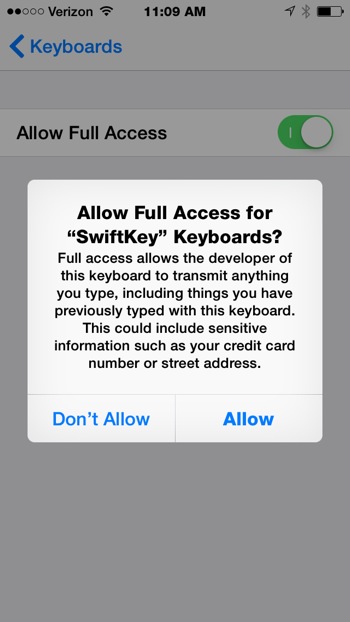
So, I dug into the developer documentation for keyboard extensions to see what could possibly go wrong. I don’t like it.
This is what I found (quoted from the documentation):
- All capabilities of a nonnetworked custom keyboard
- Keyboard can access Location Services and Address Book, with user permission
- Keyboard and containing app can employ a shared container
- Keyboard can send keystrokes and other input events for server-side processing
- Containing app can provide editing interface for keyboard’s custom autocorrect lexicon
- Via containing app, keyboard can employ iCloud to ensure settings and autocorrect lexicon are up to date on all devices
- Via containing app, keyboard can participate in Game Center and In-App Purchase
- If keyboard supports mobile device management (MDM), it can work with managed apps
My interpretation of the documentation is that a keyboard extension can enable network access if it is for the purpose of improving the application. What improvements warrant this, is up to the app developer.
I love that Apple is asserting strong language in the documentation:
Each keyboard capability associated with network access carries responsibilities on your part as a developer, as indicated in Table 11-2. In general, treat user data with the greatest possible respect and do not use it for any purpose that is not obvious to the user.
But the only gate keeper is the app approval process. While that has kept iOS comfortably safe for me, the additional benefit of a new keyboard does not warrant this added risk. Some have pointed out that password fields are excluded from using an alternative keyboard. This tells me that even Apple is a bit concerned about the consequences of logging key strokes. I'm not sure about everyone else, but I generally use a password to protect all of the other things I write with my keyboard. If every other keystroke is logged and transmitted to a server, my password becomes far less relevant.
Of course, we can secure the data even while it's transmitted and stored somewhere else. Let’s use Swiftkey as an example here. They’re up front about what they do with data right now.
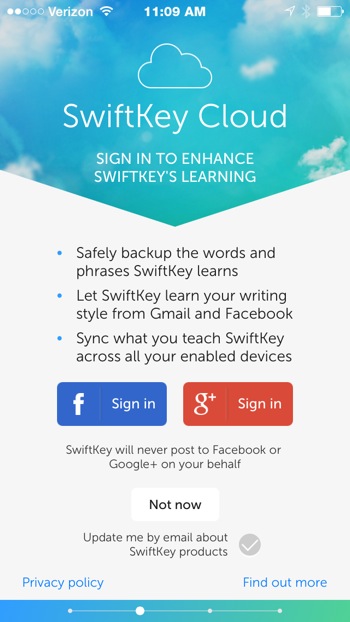
That "Allow Full Access" warning still haunts me though.1
Everyone is different, but I don’t feel comfortable using a key logger from a VC backed company.2 Privacy policies have a tendency to change when money starts to dry up or the company is acquired.
-
It should be noted that not all keyboard extensions enable network access. For example, the TextExpander keyboard did not require full access, so I presume it does not do anything more than read the snippets from the application on the device. (CORRECTION: The TE keyboard does require full access. I must have already approved it. Thanks to Michael in the comments) ↩
-
I actually don't feel warm and fuzzy about any key logger. I'm just more suspicious of companies that lack a business plan I can understand. I'm weird that way. ↩
firehose and -1 others like this
19 Sep 03:31

This is a real-life lake monster, according to a possibly crazy Icelandic commission
by Russell Brandom
This shaky video, apparently, is definitive proof of the existence of a legendary Icelandic lake monster known as Lagarfljótsormurinn, or the monster of Lagarfljót. After an official investigation, an Icelandic truth commission has agreed to award a prize of roughly $4,300 to the man who shot the 2012 video, finally satisfied with the authenticity of the creature captured therein. I'm pretty sure it's a fishing net snagged on a rock, but I'll admit, I'm not a professional at these things.
For comparison:

...and on the other side...

Your call.
firehose likes this
19 Sep 03:31



Rape victim’s lawsuit shows the limits of website immunity law
by Joe Mullin
US Court of Appeals for the 9th Circuit, Pasadena courthouse.
In general, websites aren't responsible for the things their users do or post. That's because of a landmark federal Internet law, known as Section 230 of the Communications Decency Act.
The law allows sites like Yelp, Craigslist, and YouTube to host loads of user-produced content, while directing most lawsuits over that content toward the users, not the websites.
However, an appeals court ruling yesterday may join the small batch of precedents that set out the murky limits of CDA Section 230. A three-judge panel of the US Court of Appeals for the 9th Circuit has allowed (PDF) an alleged rape victim to sue ModelMayhem.com, a site she says was used by her attackers.
Read 13 remaining paragraphs | Comments
19 Sep 03:30
Google is making encryption standard in the next version of Android
by Josh Lowensohn
Less than a day after Apple detailed new efforts in user privacy for its products, Google now says it plans to encrypt user data on all Android devices. In a statement provided to The Washington Post, Google says data encryption will now be a part of the activation process instead of an optional feature. The end result is that whatever data is stored on that device, be it a phone or tablet, will be inaccessible unless the person has the correct password.
"You won't even have to think about turning it on."
"For over three years Android has offered encryption, and keys are not stored off of the device, so they cannot be shared with law enforcement," Google spokesperson Niki Christoff told The Post. "As part of our next Android release, encryption will be enabled by default out of the box, so you won't even have to think about turning it on."
Google's already outlined its plans for the next version of Android, called simply Android L. Much of the change is visual, with Google moving to a new look it's calling Material Design, though the company made some major changes to the software underpinnings. While there's no firm release date yet, Google said in June to expect it sometime later this year.
In Apple's case, the company already began encrypting user data for all users as part of iOS 8, a free update that became available yesterday. The company said that not even it can bypass a user passcode to access data, tying its hands from offering such a service to law enforcement officials.
firehose likes this
19 Sep 03:30
Apple's "Warrant Canary" Has Died
by samzenpus
HughPickens.com writes When Apple published its first Transparency Report on government activity in late 2013, the document contained an important footnote that stated: "Apple has never received an order under Section 215 of the USA Patriot Act. We would expect to challenge such an order if served on us." Now Jeff John Roberts writes at Gigaom that Apple's warrant canary has disappeared. A review of the company's last two Transparency Reports, covering the second half of 2013 and the first six months of 2014, shows that the "canary" language is no longer there suggesting that Apple is now part of FISA or PRISM proceedings. Warrant canaries are a tool used by companies and publishers to signify to their users that, so far, they have not been subject to a given type of law enforcement request such as a secret subpoena. If the canary disappears, then it is likely the situation has changed — and the company has been subject to such request. This may also give some insight into Apple's recent decision to rework its latest encryption in a way that makes it almost impossible for the company to turn over data from most iPhones or iPads to police. 


Read more of this story at Slashdot.
19 Sep 03:30
Microsoft Lays Off 2,100, Axes Silicon Valley Research
by samzenpus
walterbyrd writes with news of Microsoft layoffs. Microsoft Corp will close its Silicon Valley research-and-development operation as part of 2,100 layoffs announced on Thursday, as it moves toward its new CEO's goal of cutting 18,000 staff, or about 14 percent of its workforce. News of the closure of the Microsoft Research lab at the company's campus in Mountain View, California, was first made public on Twitter by employees. The company later confirmed the move and said it would involve the loss of 50 jobs. 


Read more of this story at Slashdot.
19 Sep 03:15

Google wants you to be more specific about 'Braves collapse'
by Bill Hanstock
True stories from Atlanta baseball search results.
Not funny, Google. pic.twitter.com/SZDnIi1KpW
— Craig Calcaterra (@craigcalcaterra) September 18, 2014
The Atlanta Braves once won eleventy billion straight AL East titles*. That was ... a few years ago.
*Approximation
firehose and -1 others like this
19 Sep 03:13

Ray McDonald involved in previous domestic dispute, police say
by Jeff Gray
firehosethis fucking league
Police were called to McDonald's residence for a domestic incident three months before his felony assault arrest, according to a recently released incident report.
San Jose Police confirmed Thursday that the domestic abuse arrest that landed San Francisco 49ers defensive end Ray McDonald on the NFL's trouble list was not the first time police had been called to his residence.
In response to media requests, police released an incident report stemming from a May 25 domestic argument involving a handgun, according to Matt Maiocco of CSNBayArea.com.
Here are excerpts from that report:
An engaged couple (a male and female subject) were in an argument when the female subject became upset, grabbed a firearm (handgun) registered to the male subject, and held it at her side.
When the male subject informed the female subject that he was going to call 911, the female subject put the firearm away and fled without incident. The female subject did not make any threats or point the firearm at the male subject. Both subjects have been identified and were contacted.
No arrests or criminal charges were filed after the incident.
The two subjects were not identified by name, but the address listed is the same one that McDonald allegedly assaulted his fiancee at three months later on Aug. 31.
19 Sep 03:09
Tampa Bay's offense is still going backwards
by Rodger Sherman
firehosethe NFC South is the new NFC West
fuck the Falcons

And the only reason Mike Glennon didn't throw a pick here is because Desmond Trufant dropped it. The Buccaneers are down 35 and still finding ways to be uglier.
firehose likes this
19 Sep 02:55
David Barnett: Five Things I Learned Writing Gideon Smith And The Brass Dragon
by terribleminds
firehose'Thing is, I try to just write good stories. I think a lot of people who are into SF who say they hate steampunk are missing out on some good stories. Mine, specifically. An addendum: I went to steampunk festival last year. At last, I thought, people who are going to get the book. I’d say 80 per cent of those in goggles and top hats who walked past my books said something along the lines of: “Yeah, I love steampunk, me. Don’t really read books, though.” Go figure.'
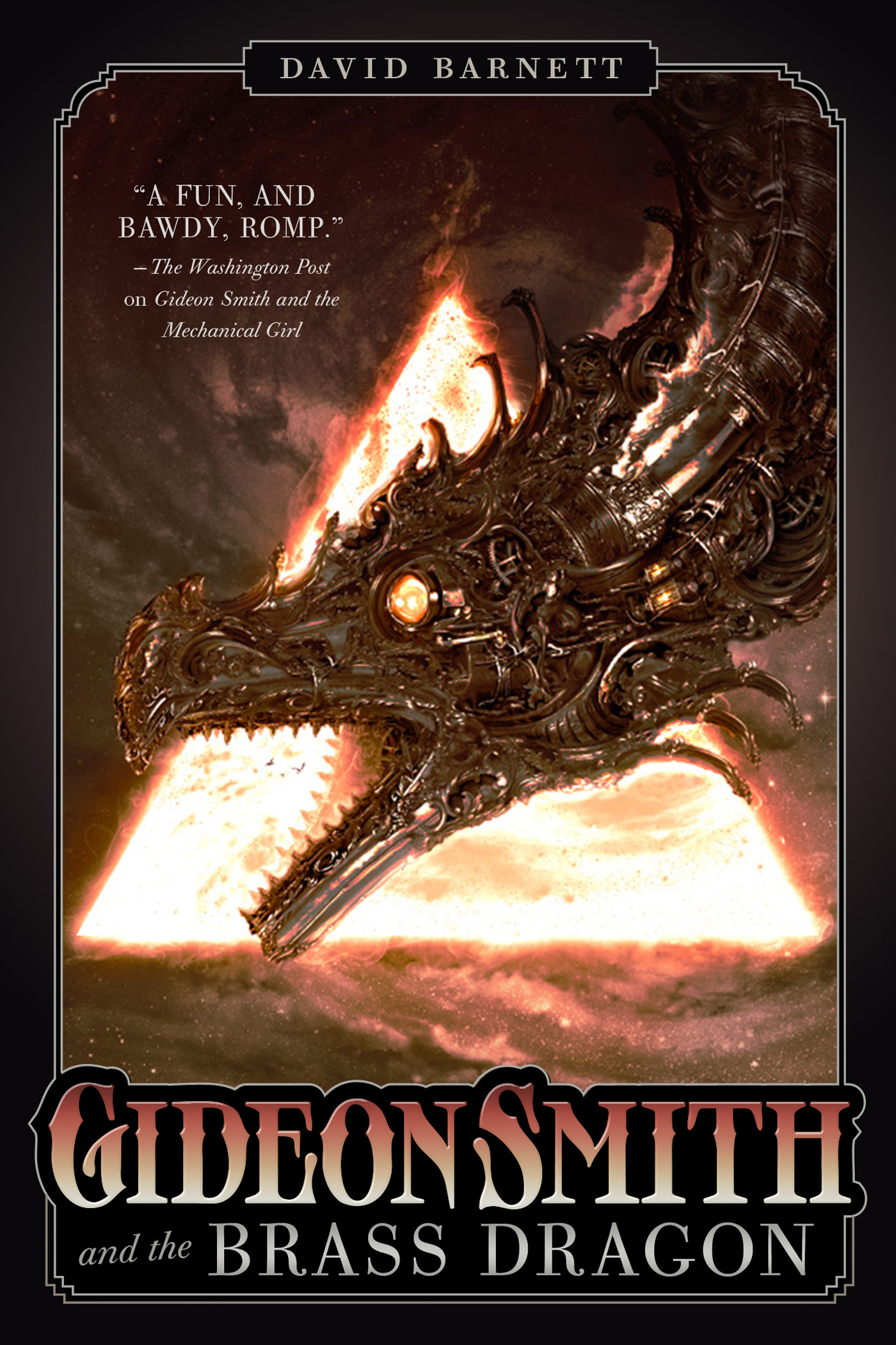
Nineteenth century London is the center of a vast British Empire, a teeming metropolis where steam-power is king and airships ply the skies, and where Queen Victoria presides over three quarters of the known world—including the east coast of America, following the failed revolution of 1775.Young Gideon Smith has seen things that no green lad of Her Majesty’s dominion should ever experience. Through a series of incredible events Gideon has become the newest Hero of the Empire. But Gideon is a man with a mission, for the dreaded Texas pirate Louis Cockayne has stolen the mechanical clockwork girl Maria, along with a most fantastical weapon—a great brass dragon that was unearthed beneath ancient Egyptian soil. Maria is the only one who can pilot the beast, so Cockayne has taken girl and dragon off to points east.Gideon and his intrepid band take to the skies and travel to the American colonies hot on Cockayne’s trail. Not only does Gideon want the machine back, he has fallen in love with Maria. Their journey will take them to the wilds of the lawless lands south of the American colonies—to free Texas, where the mad King of Steamtown rules with an iron fist (literally), where life is cheap and honor even cheaper.Does Gideon have what it takes to not only save the day but win the girl?
IT’S ALWAYS GOOD TO KNOW WHAT YOU’RE PISSING ON
This is true in all things, especially if you decide to relieve yourself after several pints of strong, Continental lager near a live railway line. But it’s especially true of history. Gideon Smith is billed as an alternate history series, which means I look at what happened in real life and then make loads of stuff up that didn’t happen, and which change the course of what did. The second book in the series, Gideon Smith and the Brass Dragon, is set largely in America – in this timeline the American Revolution never happened, Britain still controls New York and Boston and some points south and west. There’s a breakaway Japanese faction on the West Coast, and what we know as Mexico is still New Spain. I made all this stuff up and my editor at Tor, Claire Eddy, wanted to know how it all worked. So I had to take a crash course in US history, ably assisted by Claire and a pal going back a way, Grant Balfour, who told me all the stuff that happened and let me know whether what I wanted to happen really could have. I wouldn’t say I’m an expert now, but I learned a lot of things I hadn’t known before. You’re quite interesting, you Yanks. Anyone ever told you that
SOME PEOPLE LOVE STEAMPUNK. SOME PEOPLE HATE IT. I MEAN REALLY, REALLY HATE IT.
Up there I described the Gideon Smith series as alternate history. It’s set in the 1890s. It has advanced (for the era) steam-powered technology. It has airships. It has a girl who’s largely clockwork powered. So, you might say, if it walks like a steampunk duck, it quacks like a steampunk duck, then it’s pretty much a steampunk duck, right? Well, if you like. The thing is, I meet a lot of people in the SF community who really, really hate steampunk. They think it’s some cretinous cousin of “proper” SF. I’m not a great one for labels on books – I tend to divide them into “good” and “not so great”. But I understand the need for marketing and sales types to pigeonhole a book. Thing is, I try to just write good stories. I think a lot of people who are into SF who say they hate steampunk are missing out on some good stories. Mine, specifically. An addendum: I went to steampunk festival last year. At last, I thought, people who are going to get the book. I’d say 80 per cent of those in goggles and top hats who walked past my books said something along the lines of: “Yeah, I love steampunk, me. Don’t really read books, though.” Go figure.
STRAIGHT WHITE BLOKES NEED TO WORK HARDER.
I am a white, straight male from a working class Northern English background now doing a job and living a lifestyle that is probably filed under “Middle Class”. My unconscious default position – and I hate this, I really do – is to make my characters straight, white males. That’s not always how they end up, but when I come up with a new character what flashes into my mind is a white man (unless, of course, they’re obviously not white, or a man). This is not acceptable, and I know that. So I have to work a little harder at thinking about who that character is and who they should be, and what they’re going to do. Looking back at the first book, Gideon Smith and the Mechanical Girl, I could probably have done better at this. I’m not saying diversity in SF should be a box-ticking exercise, but I do need to question my initial ideas about characters, which I try to force myself to do. Now it’s like a new-born character is a white, straight male golem made of mud when they first pop into my head, but what they become on the written page is hopefully a little more representative.
“MY NAME IS GIDEON SMITH. YOU MIGHT KNOW ME FROM SUCH ADVENTURES AS…”
This is my first attempt at writing a series. It was quite a steep learning curve in terms of making sure the second book is a standalone novel that, conceivably, anyone who hadn’t read the first one (I’m looking at you here. And you. And you.) could pick up and enjoy without needing to know what had gone before. It was quite interesting working out how to bring readers up to speed with the first story without getting in the way of what happens in the book they’re holding. It’s also been interesting to take the characters on to further development, while still leaving room for more in book three (yes! There is a book three!). I’ve written a couple of other novels before, but at the end of them I generally left my main characters dead or gibbering wrecks. So it’s nice to give characters space to grow and thinking about their future development.
PEOPLE DON’T NEED TO KNOW HOW A STEAM-ENGINE WORKS TO ENJOY THE BOOKS.
I read widely, and I read plenty. I read books where people drive cars and take plane journeys. I don’t particularly know too much about the workings of the internal combustion engine or what lift is required to get a 747 off the ground, and I don’t really require that in the fiction I’m reading unless it’s absolutely pertinent to the plot. Thus, in Gideon’s Victorian world, there are airships and steam-omnibuses and a mechanical girl with a human brain. You don’t really need to know how this stuff works, do you? People there take it for granted. So should you. OK, so in the first book there’s quite a bit about just how a clockwork woman can have a human brain and be half-alive, but the book is called Gideon Smith and the Mechanical Girl, so hopefully it was quite useful information. But I still don’t really know how a steam engine works, and don’t plan on infodumping that on my readers anytime soon.
* * *
David Barnett is an author and journalist based in the north of England. Tor Books in the US and Snowbooks in the UK have published the first two books of his Gideon Smith series – Gideon Smith and the Mechanical Girl (September 2013) and Gideon Smith and the Brass Dragon (September 2014). A third, Gideon Smith and the Mask of the Ripper, is out in September 2015. He is married to Claire and they have two children, Charlie and Alice. He’s represented by the agent John Jarrold.
David Barnett: Website | Twitter
Gideon Smith And The Brass Dragon: Amazon | B&N | Indiebound | Powells
19 Sep 02:53
Marketing Intern Wanted / Adafruit Jobs Board
by Tyler Cooper

Marketing Intern Wanted / Adafruit Jobs Board
Looking for 3D printing enthusiasts to support the growth of Libre3D, an Open Source and Free resource for 3D Printing.
Libre3D is a community supported directory for Open Source and Free 3D Printing equipment, 3D models, tutorials, etc. The project is in a mature stage and fun!
Possible Duties:
(1) Be creative to “spread the word” of Libre3D!
(2) Share your 3D creations on Libre3D for all to see!
(3) Learn and grow with the Open Source community and help others become more aware of the movement.
firehose likes this
19 Sep 02:53
Introducing #3Dprinting to students in India #3DThursady #3DPrinting
by Pedro Ruiz

I feel there is lot of scope available to teach this technology to people in India. The problem is that it takes a lot of money to teach 3D printing to the masses. We are talking about the kind of money Indian government and educational institutions cannot afford.
via inside3dp.com

Every Thursday is #3dthursday here at Adafruit! The DIY 3D printing community has passion and dedication for making solid objects from digital models. Recently, we have noticed electronics projects integrated with 3D printed enclosures, brackets, and sculptures, so each Thursday we celebrate and highlight these bold pioneers!
Have you considered building a 3D project around an Arduino or other microcontroller? How about printing a bracket to mount your Raspberry Pi to the back of your HD monitor? And don’t forget the countless LED projects that are possible when you are modeling your projects in 3D!
19 Sep 02:52
TriMet is offering a chance to drive a MAX train for 15 minutes on 10/18.
firehoseoh fucccccccckkkkkkkkkk
19 Sep 02:51
Police Union Has "Many Concerns" About Talk of Outfitting Cops with Body Cameras
 |
submitted by 2error [link] [58 comments] |
19 Sep 02:51
Teacher who opposed Planned Parenthood sues Portland Public Schools for $390,000 after losing job (poll)

19 Sep 02:44
1873: Insane from Novel Reading
firehosevia Toaster Strudel

"A young lady named Fanny Gray, residing in Harrison county, has gone insane, and her deranged condition is said to have been the result of novel reading, having had a morbid craving for sensational reading for a number of years."
~From The Dallas Daily Herald. (Dallas, Tex.), September 16, 1873
19 Sep 02:43


Occupy Wall Street activists sue over Twitter account
by Cyrus Farivar
firehosevia roverbey
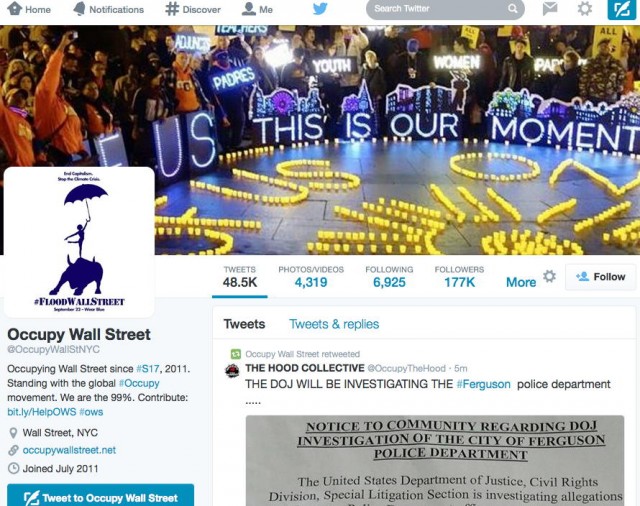
On Wednesday, three years to the day since the beginning of Occupy Wall Street, one of its former leaders has sued another leader over a disputed Twitter account.
@OccupyWallStNYC has 177,000 followers, and it's apparently controlled by Justin Wedes, a self-identified "educator and activist based in Detroit, Michigan" and a "founding member" of the New York City General Assembly. Wedes did not respond to Ars’ requests for comment.
According to the suit, which was filed by the OWS Media Group in the Supreme Court of the State of New York, Wedes "hijacked" the account in early August 2014, "making himself the sole person in control of the Twitter Account."
Read 16 remaining paragraphs | Comments
19 Sep 02:42

zedrin-maybe: mooncastle721: I almost spit grape juice! I...
firehosevia Rosalind
I almost spit grape juice!
I have saved this gif in my folder as ‘weight for it’
Christopher Lantz, rnas and 2 others like this
19 Sep 02:37


Unsettling Psychic Photography from the 1930s
by Allison Meier
firehosevia Olena Bulygina
mulder no
“A Psychic Figure,” from a series of lantern slides on “Psychic Photography From A New Angle” (via Tyne & Wear Archives & Museums)
On May 15, 1934, a man named Mr. C.P. MacCarthy of Sheffield sent a letter confirming a meeting where he would “demonstrate under test conditions Fake Psychic Photography.” Decades later, his lantern slides of “supposedly paranormal and unknown forces caught on camera” turned up in the collections of Tyne & Wear Archives & Museums, which recently uploaded the profoundly strange photographs to their Flickr Commons.
A scan of the letter is included, where MacCarthy writes his “Psychic Photography From A New Angle” discussion will “indicate the increasing scope for fraud with the advancement of science — though not to disprove the probability of genuine Spirit Photography.” That last comment showing he was something of a believer. Tyne & Wear explains that not much “is currently known of the Psychic demonstration. Who sat on the invited committee? Who was Mr MacCarthy? Why was he investigating Psychic Photography?”
All we have to go on are the lantern slides, yet standing alone they are an unsettling, surreal assortment. Even out of context, each implies the intervention of something supernatural, whether it’s a shawl hovering against darkness, or text reading “Kate Fox,” a likely reference to Kate of the famous Fox Sisters mediums. As a commenter points out, one of the slides reproduces William Henry Fox Talbot’s 1835 shot of a window at Lacock Abbey, known as the oldest surviving photographic negative. It’s possible others might be culled from sources lost to time.
MacCarthy wasn’t alone in demonstrating against psychic photography. Harry Houdini created a debunking spirit photograph of himself with Abraham Lincoln, and publicly warred with believers like Arthur Conan Doyle, who got taken in by the “Cottingley Fairies” photos supposedly showing two girls with the mythical sprites. MacCarthy would have been right on the edge of this fad for psychic photography, but in the growing shadow of imaging technology, new possibilities may very well have implied the opening of portals to the unknown.
“Psychic Photography From A New Angle” (via Tyne & Wear Archives & Museums)
“A Psychic Apparition” (via Tyne & Wear Archives & Museums)
“A Psychic Portrait” (via Tyne & Wear Archives & Museums)
“Broken Glass” (via Tyne & Wear Archives & Museums)
“Ectoplasm” (via Tyne & Wear Archives & Museums)
“Ectoplasm” (via Tyne & Wear Archives & Museums)
“A Psychic Apparition” (via Tyne & Wear Archives & Museums)
“A Psychic Message” (via Tyne & Wear Archives & Museums)
“A Psychic Message” (via Tyne & Wear Archives & Museums)
“Technical Psychic Photography” (via Tyne & Wear Archives & Museums)
“Psychic Causes” (via Tyne & Wear Archives & Museums)
View more of the “Psychic Photography From A New Angle” lantern slides on the Tyne & Wear Archives & Museums Flickr Commons.
19 Sep 01:51
The Best Dog Reveal You'll Watch All Year
firehosevia Rosalind

Christopher Lantz, firehose and one other like this
19 Sep 01:50
Oracle CEO Larry Ellison steps down - Yahoo Finance
by gguillotte
Ellison, who is believed to be the fifth-wealthiest man in the world, will be replaced by Mark Hurd and Safra Catz, Oracle said. In an unusual move, Hurd and Catz will both be named CEO of the company-not co-CEOs.
Ellison will become executive chairman and chief technology officer. Oracle said manufacturing, legal and finance functions would report to Catz and sales, service and business units would report to Hurd. Software and hardware engineering will report to Ellison.
19 Sep 01:33
★ Apple Watch: Initial Thoughts and Observations
by John Gruber
firehose'And then people will line up around the block at Apple Stores around the world to buy them. I think Apple Watch prices are going to be shockingly high — gasp-inducingly, get-me-to-the-fainting-couch high — from the perspective of the tech industry. But at the same time, there is room for them to be disruptively low from the perspective of the traditional watch and jewelry world. There’s a massive pricing umbrella in the luxury watch world, and Apple is aiming to take advantage of it.'
 |
popular
shared this story
from  Daring Fireball. Daring Fireball.
|
Consider Vertu, the company that sells $6,000 Android phones (and which, back in the day, sold $6,000 Symbian phones). Back in January 2012, I wrote a short entry saying that Vertu always reminded me of this wonderful quote from Andy Warhol:
“What’s great about this country is that America started the tradition where the richest consumers buy essentially the same things as the poorest. You can be watching TV and see Coca-Cola, and you know that the President drinks Coke, Liz Taylor drinks Coke, and just think, you can drink Coke, too. A Coke is a Coke and no amount of money can get you a better Coke than the one the bum on the corner is drinking. All the Cokes are the same and all the Cokes are good. Liz Taylor knows it, the President knows it, the bum knows it, and you know it.” —Andy Warhol
That’s what the iPhone and iPad are like. There are hundreds of millions of people who have bought these products, and they now own the best phones and tablets in the world. A few years ago at SXSW in Austin, I saw Michael Dell waiting outside a restaurant. The thought that popped into my head: He’s a billionaire, but I know for a fact that I have a better phone than he does. Not everyone can afford an iPhone, not by a long shot, but everyone who can knows they’re getting the best phone in the world.
Apple Watch changes this dynamic.
Adam Fields, writing on Medium, drew the same comparison to my Warhol-on-Coke/Vertu piece:
Gruber was talking about the $6,000 Vertu there, but he might as well have been talking about the Apple Watch. Apple has long been ‘the luxury brand’, but it’s been an accessible luxury, unlike luxury cars or jewelry. The products are expensive, but they’re not outrageously expensive (and if they are, it’s because they’re so massively overpowered that most people really don’t actually need them). Apple has even been steadily pushing prices down and making their products more consumer-friendly so they’re now in some cases a markedly better value than what their competitors offer. With the Apple Watch, that is no longer the case — there’s a gold version whose only substantial differentiating feature is that it’s more expensive. Because it’s “gold” and not “gold-colored”, it’s not just a style choice, it’s a lifestyle choice. In other words — it’s the watch that most people won’t have. I’m sure the fashion experts have plenty to say about this from the perspective of desirability, but it’s a real shock to the standard approach of the tech world. I think Apple knows this, too — which results in the strange nomenclature. The only way they could name it that doesn’t sound overtly elitist is the awkward “Edition” edition.
Apple Watch is not a product from a tech company, and it will not be understood, at all, by the tech world. Apple creates and uses technology in incredible ways. The Apple Watch may prove to be the most technologically advanced product they’ve ever built. But again: Apple is not a tech company, and Apple Watch watch is not a tech product.
The most fun I’ve had over the past week is speculating with friends about how much the different tiers of Apple Watch are going to cost. One thing that is absolutely clear, to me at least: when Tim Cook said the starting price is $349, that’s for the aluminum and glass Sport edition. My guesses for starting prices:
- Apple Watch Sport (aluminum/glass): $349 (not a guess)
- Apple Watch (stainless steel/sapphire): $999
- Apple Watch Edition (18-karat gold/sapphire): $4999
In short: hundreds for Sport, a thousand for stainless steel, thousands for gold.
Most people think I’m joking when I say the gold ones are going to start at $5,000. I couldn’t be more serious. I made a friendly bet last week with friends on the starting price for the Edition models, and I bet on $9,999.
The lowest conceivable price I could see for the Edition models is $1,999 — but the gold alone, just as scrap metal, might in fact be worth more than that. Here’s a link to a forum discussion pegging the value of the gold alone, as scrap metal, of a Rolex GMT (including bracelet) at $5–6000. Just the gold alone.
A few days ago John Biggs at TechCrunch wrote “The Gold Apple Watch Could Cost as Much as $1,200”:
A jewelry contact familiar with the matter told TechCrunch that the gold, 18-karat version of the Apple Watch could cost around $1,200 retail when it launches in January. This has been corroborated, based on size and weight, by jewelers familiar with the material Apple is using to make its Apple Watch Edition pieces. It should be noted that this is an estimate and the piece could come in well below that price.
Although there is still some confusion as to whether the watch will be gold plated or actually made of gold, the jeweler suggested that it would be sub-optimal not to make the watch out of solid gold alloy, a decision that will drive up the price.
There should be no confusion on that last part. The Apple Watch Edition is solid 18-karat gold, not gold-plated. I confirmed this with Apple last week. You can feel it when you try one on: the stainless steel watch is noticeably heavier than the aluminum Sport one, and the gold Edition models are noticeably heavier than the stainless ones.
Try to find a premium solid gold watch that sells for under $20,000 retail. Most luxury watch companies don’t publish their retail prices — they leave it up to their authorized dealers to set final prices. But, no surprise, if you search around, you can find leaked copies of their catalog price lists. Here’s one for Rolex from 2012. To pick just one example, compare a few Submariner Date models:
- Stainless steel: $8,550
- Stainless steel and yellow gold: $13,400
- 18-karat gold: $34,250
- 18-karat white gold: $36,850
Now, Rolex is Rolex, and their watches are all priced at a significant premium based on the brand alone. But the only difference between those four Submariners are the materials from which their cases and bracelets are made. Functionally, they are identical, using the exact same movement.
Compare prices on the used market — solid gold Rolexes carry at least a $10,000 premium over stainless steel, and depending upon the condition of the watch, often more like $20,000. Or look at other brands, like, say, Omega.
Or consider just the bracelets. A replacement stainless steel Rolex bracelet costs $2,500; a gold one costs $9,000. Those prices are gray market — I’m guessing bracelets from an authorized dealer cost even more. That’s the market Apple is entering. And consider what Apple is saying about their bracelet:
Crafted from the same 316L stainless steel alloy as the case, the Link Bracelet has more than 100 components. The machining process is so precise, it takes nearly nine hours to cut the links for a single band. In part that’s because they aren’t simply a uniform size, but subtly increase in width as they approach the case. Once assembled, the links are brushed by hand to ensure that the texture follows the contours of the design. The custom butterfly closure folds neatly within the bracelet. And several links feature a simple release button, so you can add and remove links without any special tools. Available in stainless steel and space black stainless steel.
Nine hours per bracelet, 316L stainless steel, and it’s just gorgeous. I don’t think it’s going to cost $2,500, but it’s going to be expensive. I’ll bet this bracelet, alone, will cost more than the $349 Apple Watch Sport. I got to see all the bands in person, and design-wise, they’re simply amazing. Whatever you want to say about the functionality and design of the Apple Watch itself, Apple has raised the bar for the entire luxury watch industry in terms of band and bracelet design.
(Consider too, that Apple has only shown metal bracelets for the stainless steel Apple Watch. Why not a solid gold link bracelet for the Edition, as well? That strikes me as a glaring omission.) omission)
In short, Apple is taking on the entire hundred-dollar-and-up watch industry at once, with a range of models and prices that span the gamut from $349 to $10,000 or more. They never even mentioned the word “smartwatch” last week, just “watch”, and never once even acknowledged any competition from the tech industry. (Nor does the word “smartwatch” appear anywhere on Apple’s website.) The only comparisons Apple is making are to the traditional watch industry, and their prices are going to reflect that, I believe.
When the prices of the steel and (especially) gold Apple Watches are announced, I expect the tech press to have the biggest collective shit-fit shit fit in the history of Apple-versus-the-standard-tech-industry shit-fits. shit fits. The utilitarian mindset that asks “Why would anyone waste money on a gold watch?” isn’t going to be able to come to grips with what Apple is doing here. They’re going to say that Jony Ive and Tim Cook have lost their minds. They’re going to wear out their keyboards typing “This never would have happened if Steve Jobs were alive.” They’re going to predict utter and humiliating failure. In short, they’re going to mistake Apple for Vertu.
And then people will line up around the block at Apple Stores around the world to buy them. I think Apple Watch prices are going to be shockingly high — gasp-inducingly, get-me-to-the-fainting-couch high — from the perspective of the tech industry. But at the same time, there is room for them to be disruptively low from the perspective of the traditional watch and jewelry world. There’s a massive pricing umbrella in the luxury watch world, and Apple is aiming to take advantage of it.
Mysteries
Apple has never announced a product like this before. They pre-announced the original iPhone months in advance, but at its announcement they demonstrated nearly all of its functionality, they gave a firm shipping date, and they announced the full pricing range.
Last week Apple only demonstrated a portion of Apple Watch’s functionality, gave a vague shipping date of only “early 2015”, and announced only a $349 “starting price” that I believe has grossly misinformed the expectations of many people for the prices of the steel and gold models.
What does Apple Watch actually do? Or, rather, what does WatchKit allow? We don’t know. And Apple is not talking, even off the record. One factor is that the software (and perhaps the hardware internals) remains a work in progress. It is far from a finished product. Apple’s executives were all wearing working prototypes — I saw Apple Watches on the wrists of Tim Cook, Jony Ive, and Eddy Cue (who wears his left-handed). I’m guessing most of the people listed on Apple’s leadership page were wearing them after the event. But none of the hands-on demo units were running the actual Apple Watch software — all of them were running a canned demo loop, like what you’d see running on one inside a glass display in a store. (This is also why they’re being so vague about battery life; I don’t think they know the final battery life yet.)
But another factor, clearly, is a desire to keep much of the Apple Watch’s functionality and software design secret until it’s closer to shipping. They announced early to keep it from leaking from the Asian supply chain — just look at what happened with the iPhones 6 this year. There’s no Osbourne Effect to fear because they aren’t yet selling watches or wearables of any sort — the only watches whose sales might suffer this holiday season because of the Apple Watch pre-announcement are those from other companies.
But we know so little at this point that it’s folly to judge the Apple Watch. Last week, in my prelude to the event, I wrote:
I’ll be very disappointed if this is just a device that shows a fake analog watch face, displays notifications from a tethered iPhone, and tracks your footsteps and heart rate.
After the event, a lot of people pointed to that line and asked how I could not be disappointed. But I don’t think that description aptly describes Apple Watch. For one thing, it definitely does a bit more than that. It has internal storage and Bluetooth, for one thing, so you’ll be able to use it for music playback without taking your iPhone with you. With just your Apple Watch and Bluetooth earbuds you’ll be able to listen to music (and make Apple Pay purchases). I’d probably pay $349 just for that, using the Sport edition as a modern day iPod. Even better, though, I strongly suspect that WatchKit will allow for something like a native version of Overcast — syncing while within Bluetooth range of your iPhone, but working entirely independently as a podcast player, using the watch’s internal storage, when you’re out of range. A version of Vesper where you can dictate new notes on the fly? Now you’ve got something I’d pay at least $349 for in a heartbeat.
Do I know that those things will be possible? No. But Apple Watch’s third-party integration is clearly deeper than just showing notifications from apps on your iPhone. And though it depends upon a tethered connection with your phone for Internet access, it’s far more functional while out of range of your phone than any smartwatch smartphone I’ve seen to date. It’s a full iOS computer. If it actually doesn’t do much more, or allow much more, than what they demonstrated on stage last week, I am indeed going to be deeply disappointed, and I’ll be concerned about the entire direction of the company as a whole. But I get the impression that they’ve only shown us the tip of the functional iceberg, simply because they wanted to reveal the hardware — particularly the digital crown — on their own terms. The software they can keep secret longer, because it doesn’t enter the hands of the Asian supply chain.
The biggest mystery of all to me, though, is this. We know for a fact that people will spend thousands, even tens of thousands, of dollars on watches. As a piece of jewelry, Apple Watch is a worthy entry in the market. It’s not to everyone’s liking, and it may not be to yours, but judging from the initial reaction it’s clearly very appealing to many people. (To my mind, it passes my “Would you consider wearing it before you even see what it does, based solely on what it looks like on your wrist?” test.) But Apple Watch is not just a piece of jewelry, and it’s not a mechanical device. It’s a computer. And all computers have lifespans measured in just a handful of years before obsolescence. If you buy a $6,000 mechanical watch and take care of it, you can expect it to outlive you and become a family heirloom. Paying even $1,000, let alone a multiple of that, for a premium Apple Watch seems like folly if it’s going to be obviated by faster, sleeker, longer-lasting versions in just a few years. And I don’t see how it won’t be replaced by faster, sleeker, longer-lasting versions, because that’s how all computer technology goes. Apple Watch is not a tech product, but technology is what distinguishes it — and computer technology gets old fast. A Rolex purchased in 2007 is every bit as good today as it was then. (Arguably even better, given some of Rolex’s questionable design decisions of the last decade.) An iPhone purchased in 2007 is 85 times slower in CPU performance than an iPhone 6, and I don’t even want to think about how much slower EDGE is than LTE networking.
Apple only enters markets where they can be a market leader in quality. They unabashedly claim to make the world’s best computers (portable and desktop), the best phones, the best tablets, and the best MP3 players. The best. Of course not everyone agrees everyone doesn’t agree with that. But many of us do, and even those who prefer, say, Lenovo laptops or Google’s Nexus phones and tablets, would agree, if they’re at all reasonable or have any sense of taste, that Apple’s products are in the running for “best”.
The Apple Watch only works for Apple if it is, in some sense, the best watch in the world. Not the best smartwatch. That’s not enough. The best watch, period. The best thing you can wear on your wrist. It doesn’t have to pass that test for everyone. It may well be targeted more at people who’ve stopped wearing or have never worn a watch than at those who love fine mechanical watches. But it has to pass that test for many people.
Further raising the bar: battery life. Judging by what Tim Cook said on stage last week, the best we can hope for is that Apple Watch will make it through each day with room to spare, with nightly charging. Worst case, it’ll be like the Moto 360, which most reviews claim needs to be recharged by mid-day. That’s a deal-breaker to me. But even nightly charging compares terribly to the traditional watch market that Apple is seeking to disrupt. Quartz watches use (inexpensive) batteries whose lifetimes are measured in years. Automatic watches, if worn daily, have no batteries and never need to be wound. They just run for years and years, with regular servicing once or twice a decade. (I own a Citizen Eco-Drive watch that runs on solar power, needing neither winding nor replacement batteries; it cost $100.) We’re already slaves to the daily charging of our phones. We agree to this not happily but readily, thanks to the amazing utility of the modern (post-iPhone) phone. With the Apple Watch, Apple is asking us to commit to the daily charging of a second device. Two things to plug in every night (each with its own different charging adapter). Two types of adapters to remember to pack for travel, for even a single overnight. That’s a lot to ask, especially given that a decade ago, most of us didn’t own a single device that required daily charging.1
How It Might Play Out
My guess is that it’ll play out something like this. The Sport models will vastly outsell the regular (steel) and Edition models. They’re priced like iPods and iPads. The fitness wearable industry is in deep trouble — Apple Watch Sport seems poised to do to Fitbit et al what the iPod did to the MP3 market. And I think it should prove to be the best iPod Apple has ever made — especially in terms of audio playback while working out. That justifies a $349 expenditure right there, full stop.
My impression of Android Wear is that it’s best thought of as a wrist-worn terminal for your Android phone and for Google’s cloud-based services. An extension for your phone, not a sibling device. Android Wear devices are almost useless other than for telling time when out of Bluetooth range from your phone. I don’t think that’s a device that many people want; it’s a solution in search of a problem. Call me biased if you want, but I think Android Wear is simply the result of the rest of the industry trying to get out in front of Apple, out of fear of how far behind they were when the iPhone dropped in 2007. On the surface, they do look like the same basic thing: small color LCD touchscreens on your wrist. But all Android Wear devices are larger and clunkier than the larger 42mm Apple Watch, and none of them are even close to the smaller 38mm one. Is there anyone who would dispute that Apple Watch is far more appealing to women than any other smartwatch on the market?
But the true difference isn’t on the outside. It’s not about the fact that both Android Wear and Apple Watch have color touchscreens. It’s not about the difference in size or style of the hardware. It’s not about price. I think it’s about the fact that Apple Watch is a true breakthrough in terms of how powerful a computer can be shrunk to an amazingly small size. With the iPhone in 2007, you could see that Apple was years ahead of the industry just by looking at the outside of the device. With Apple Watch, I think we’re only going to realize just how big a breakthrough it is after Apple fully unveils its computational power and the depth and complexity of WatchKit. And if I’m wrong, and Apple Watch’s computational hardware is in fact only slightly ahead of existing smartwatches, and that WatchKit is really just a glorified notification display system for iPhone apps, then Apple is in deep trouble.
I do not think Apple is in deep trouble.
As for the stainless steel and gold (with sapphire) versions, as stated earlier, I think they’re going to be priced far higher than the aluminum/glass ones, and will thus inevitably sell in far lower quantities. But I also think they’ll sell in numbers that boggle the minds of the functional-and-spec-minded tech industry. That they’ll have severely limited lifespans compared to traditional timepieces will only make them more notable in terms of fashion and as personal statements. What’s the more ostentatious purchase — a $20,000 Rolex that will last a lifetime, or a $5,000 Apple Watch Edition that will be technically obsolete in four years? If you think Apple is polarizing today, you haven’t seen anything yet.
Additional Thoughts
The most intriguing and notable thing about Apple Watch’s design, to me, is the dedicated communication button below the digital crown. The entire watch is fully operational and navigable using just the digital crown and touchscreen. You can go anywhere and do everything using taps, force presses,2 or turning and pressing the digital crown. There is no need for that extra button (which, in the unveiling video, Jony Ive described only as “the button below the digital crown”). Add to that the fact that Apple is notorious for minimizing the number of hardware buttons on its devices, and the fact that the existence of that button keeps the crown from being centered, and my attention is piqued. The only explanation is that Apple believes that the communication features triggered by that button are vitally important to how we’ll use the device.
The more I see it, the more I like the as-yet-unnamed new typeface Apple is using both for Apple Watch’s on-screen UI and its marketing materials. (The same font is used for the engravings on the back of the watch.) At first glance during the event, I thought it might be DIN (which is what Apple uses in the iOS 7 Camera app), but it’s not. It’s similar to Colfax, but it’s not Colfax. I’ve heard whispers that its name (or codename?) is Cobalt. We may not know for sure until WatchKit ships.
The digital crown feels amazing. It didn’t actually control anything on-screen on the demo watches I handled last week, but it has the most amazing feel of any analog controller I’ve ever used. Lubricious (in the second sense, if not the first as well) is the word that springs to mind.
An idea that sprung to mind regarding the tension between multi-thousand dollar prices for gold watches and the short lifespan of computing technology: Apple could in theory offer significant trade-in pricing for years-old Apple Watches, based solely on the value of the gold alone. Or, perhaps the internals of the watch will be upgradeable. Apple is calling the S1 chip a “computer on a chip”, not a “system on a chip”. Take it in for servicing, and for a few hundred dollars, perhaps you’ll be able to replace your S1 for an S2 in a year, and an S3 the year after that.
Regarding the name “Apple Watch” instead of “iWatch” — I think there are several factors here. The first is that the dropping of the i- prefix clearly delineates the post-Steve product era. Could be that it was Jobs who insisted on the various iNames, or, it could be that today’s Apple wants to move away from them. But the other factor is that the iNames come across as being cute. iMac was for consumers, Mac Pros were serious. “Apple Watch” sounds serious in a way that “iWatch” does not. “iWatch” sounds like a $200 gadget. “Apple Watch” sounds like a multi-thousand dollar luxury item.
Apple’s decision to hire Angela Ahrendts, and her decision to take the job with Apple, now make more sense than ever before. Apple’s retail stores are going to need a serious redesign to accommodate the sale of multi-thousand dollar luxury watches. All sorts of implications, ranging from security to branding, to just plain peace and quiet. One does not buy expensive watches in a noisy room, and Apple Stores are noisy rooms. Cringely thinks Apple will sell Apple Watch in existing high-end watch stores; they might, but I can’t see them not selling them in their own stores.
It’s no coincidence that Apple announced their hiring of Marc Newson on the Friday before last week’s event. But I don’t think his hiring is about the Apple Watch in particular. Nor do I think Apple Watch in particular is what Apple thinks was “historic” about last week’s event. Rather, I think Apple Watch is the first product from an Apple that has outgrown the computer industry. Rather than settle for making computing devices, they are now using computing technology to make anything and everything where computing technology — particularly miniature technology — can revolutionize existing industries. Newson isn’t a watch designer, or a fashion designer. He’s a designer of anything and everything. He’s designed everything from watches to cars to chairs. Apple Watch isn’t merely Apple’s foray into the watch industry — it’s their foray outside the computer/consumer electronics industry. I think they’re just getting started. At the close of his Apple Watch unveiling video during the keynote, Jony Ive said, “We’re now at a compelling beginning actually designing technology to be worn, to be truly personal.” The watch just happens to be first.
‘Liz Taylor Knows It, the President Knows It, the Bum Knows It, and You Know It’
Which brings me back to that Warhol quote about Coke, and whether Apple Watch signifies Apple abandoning egalitarianism. I think not.
The iPhone and iPad are egalitarian devices. All you can buy with more money is additional storage. But the Mac has long offered widely varying pricing tiers with widely varying performance. If you can afford it, a maxed-out MacBook Pro is a far more impressive laptop than an $899 MacBook Air. Or consider a maxed out Mac Pro — 12 cores, maximum RAM and storage, the best graphics card — which costs just under $10,000. That’s better-tasting Coke than you get with an iMac or Mac Mini.
I think the steel and gold Apple Watches are not better-tasting Cokes. They’re the same Coke that everyone can get with the $349 Apple Watch Sport, but served in expensive goblets. It’s uncharted territory, to be sure, but I don’t think it is worrisome that the steel and gold Apple Watches exist. What would be worrisome would be if the $349 Apple Watch Sport did not.
-
I’m hopeful that a decade from now, we’ll look back at devices that needed daily charging the way we now do to laptops that only got two or three hours of battery life. ↩
-
I’ve seen some skepticism about Apple Watch’s use of “force presses”. To wit, that this capability is unneeded — anything you can do with a force press could be done on a regular (non-pressure-sensitive) touchscreen using a long press. I disagree. Force pressing means you won’t have to wait. Talking to Apple people behind the scenes last week, they are very keen on the force press thing. Not quite as keen as they are about the digital crown, but close. ↩
18 Sep 22:38
NASA Is Supposed To Spot 90% Of Dangerous Asteroids By 2020. It's At 10%
In 2005, Congress assigned NASA the task of locating 90 percent of all near-Earth asteroids big enough to cause significant damage if they hit us by 2020. On Monday, a new NASA audit concluded that the agency is nowhere near meeting this goal.
18 Sep 20:33

TV cameras catch emotional sports fan whipping table
by Ryan Van Bibber
firehosewelcome to Fox
If there's any upside to be found in a week filled with disturbing sports news, it's that Americans are able to have a rational conversation about things ... or not. Sometimes it's just a nut very passionate sports fan taking his belt off on television and slapping the table to make a point about ... about ... well, about something.
The table is better for it, you have to admit.
And we GIF'd some highlights because SPORTS!


 Super Opinionated.
18 Sep 19:28
More #3DPrinters in brick and mortar stores #3DThursady #3DPrinting
by Pedro Ruiz
firehoseMicro Center beat

Yet another large computer & electronics department store has now begun carrying a variety of 3D printers. Micro Center, a privately owned company which has 25 stores nationwide, throughout 16 states, now carries, not just one 3D printer, but a staggering 10 different options for consumers to choose from.
via 3dprint.com
Every Thursday is #3dthursday here at Adafruit! The DIY 3D printing community has passion and dedication for making solid objects from digital models. Recently, we have noticed electronics projects integrated with 3D printed enclosures, brackets, and sculptures, so each Thursday we celebrate and highlight these bold pioneers!
Have you considered building a 3D project around an Arduino or other microcontroller? How about printing a bracket to mount your Raspberry Pi to the back of your HD monitor? And don’t forget the countless LED projects that are possible when you are modeling your projects in 3D!