There’s a reason that Frank Stockton receives illustration commissions from folks like Entertainment Weekly, the New Yorker, Esquire, Mondo, IDW and Fantagraphics. He has a reverent sense of other people’s properties, a luminous sense of color and an ability to construct scenes that are crowded but never overly busy.
Stockton drew the covers for IDW’s comic adaptation of Peter S. Beagle’s The Last Unicorn, as well as covers for Angel and a Serenity one-shot. His gorgeous Star Wars pieces have graced Mondo posters and the Star Wars Galaxy 5 card set. But it’s his editorial artwork that shows off his range, both in style and composition, from the narrative graphite sketches of Stone Age people created for Scientific American to the uncomfortable A Clockwork Orange closeup for EW.
We haven't heard any news in ages about Incursion, the space-war TV show from Stephen DeKnight, who worked on Buffy and Smallville and masterminded Spartacus. So it's great news to hear that Starz is still moving forward, and the show is described as "Halo meets Band of Brothers."
“I would not worship a God who is homophobic and that is how deeply I feel about this. I would refuse to go to a homophobic heaven. No, I would say sorry, I mean I would much rather go to the other place.”
- Archbishop Desmond Tutu announcing the launch of the UN’s global LGBT rights campaign. He’s the man. (via the Huffington Post)
theodp writes "As noted earlier, Microsoft is tackling the CS education crisis with a popularity contest that will award $100K in donations to five technology education nonprofits that help make kids technically literate. Hopefully, the nonprofits will teach kids that the contest's voting Leader Board is a particularly good example of what-not-to-do technically. In addition to cherry-picking the less-pathetic vote totals to make its Leader Board, Microsoft also uses some dubious rounding code that transforms the original voting data into misleading percentages. Indeed, developer tools reveal that the top five leaders in the Microsoft STEM education contest miraculously account for 130% of the vote. Let's hope the quality control is better for those Microsoft Surface voting machines!"
A staggering $53 million worth of diamonds and other jewels were stolen Sunday from the Carlton Intercontinental Hotel in Cannes, in one of Europe's biggest jewelry heists in recent years, police said.
'Their exploit will create a root shell on port 23 by using a modified boot-loader for the hardware, which turns out to be a single-core Marvell ARM SoC.
The software stack Chromecast runs on is for Google TV but with the Dalvik/Bionic code stripped away.'
Released this past week by Google alongside Android 4.3 and the new Nexus 7 tablet was the Chromecast, a $35 device to essentially relay web-pages and video content from your PC or mobile device to an HDMI TV. The Chromecast has now been exploited so a root shell is accessible...
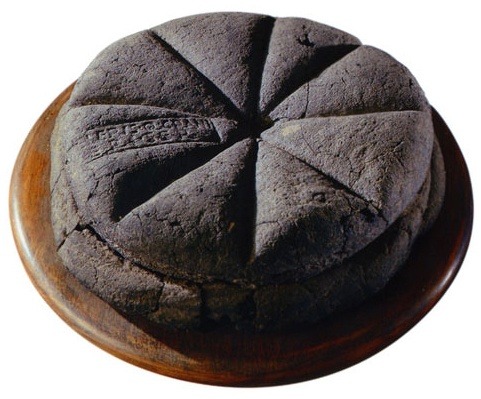
A loaf of bread made in the first century AD, which was discovered at Pompeii, preserved for centuries in the volcanic ashes of Mount Vesuvius. The markings visible on the top are made from a Roman bread stamp, which bakeries were required to use in order to mark the source of the loaves, and to prevent fraud. (via Ridiculously Interesting)
(sigh) I’ve seen these before, but this one’s particularly beautiful.
I feel like I’m supposed to be marveling over the fact that this is a loaf of bread that’s been preserved for thousands of years, and don’t get me wrong, that’s hella cool. But honestly, I’m mostly struck by the unexpected news that “bread fraud" was apparently once a serious concern.
Let me tell you about the fake cronuts that are showing up on craigslist.
Bread fraud = stuff like using sawdust or dirt instead of flour. It was pretty damn common, and is but one of the things that makes me to laugh like a hyena when the ignorant start talking about the “pure, wholesome" food of days of yore.
In mediaeval London, and I presume other cities, where people were pretty much dependant on bakeries and other cookery-establishments for their food (because a: not enough room in your place of living, most likely, and b: large risk of burning it down), bread fraud could get your ear nailed to a piece of wood for first offence. Among other things, the inevitable scar left by yanking your ear off would warn future customers that you’d once been found guilty of this. Similar punishments were handed out for putting bad stuff in the ale that was the other part of the city-dweller’s daily fare.
In medieval England, in fact, bread fraud was such a problem that housewives would make their own bread dough, and bring that to the baker just for baking (rather than having a hot oven in their house). And then they STILL had to worry that the baker would steal their dough and replace it with crappy stuff.
Still waiting for that ancient rome + bakery + white collar crime AU.
Look, if y’all don’t think that the Bread Fraud fandom is the tightest shit, I don’t even know what to tell you.
Best post of the night. :D
Okay, let’s just skip the pesky Actually Making The Series stage and go straight to the Bread Fraud gifsets. :)
Under the bill, the names and addresses of convicted animal abuses in New York would be made readily accessible to the public. Those involved in the sale and adoption of animals would be able to check the registry before allowing someone to own an animal.
Animal cruelty has been a felony in New York since 1999 when Buster’s Law was passed. Buster was a cat in Schenectady in upstate New York who was doused with kerosene and set on fire in 1997. The law bearing his name was created to ensure that those who commit such crimes are convicted. The new law (S2305A-2013) takes things a step further by creating the registry.
It is more than well-established that the abuse of animals can be a "gateway behavior" to violence against humans. Senator Greg Ball of Patterson, who sponsored the bill, addressed this very point:
"Persons who commit crimes against animals represent some of the worst kind of people, and often expand their carnage to their neighbors and the larger community. Most people can agree that the level of respect and kindness shown for animals - creatures who cannot speak for themselves, or protect themselves and are easily abused and taken advantage of - is a fine predictor of how a person will treat their peers."
Just as Megan’s Law was created to protect children from repeated sex offenders, Ball’s bill will protect animals from repeat animal abusers - from (again, quoting Patterson) “violent and cruel behavior" that “cannot and should not be tolerated."
Alice Calabrese, the CEO of Lollypop Farm and the Humane Society of Greater Rochester, says that there is a “high recidivism rate" among those who abuse animals, and that the registry is more than needed. Her organization receives about 1,200 calls about animal cruelty every year.
Ball’s bill is now being sent to the New York Assembly where it is being sponsored by Assemblyman Jim Tedisco, who was the driving force behind the sponsorship of Buster’s Law. Noting that we have “expanded the DNA database to help catch criminals and exonerate the innocent," Tedisco underscores that we “now we have an opportunity to advance additional public safety measures including protecting our pets from abuse and ensuring animal abusers don’t go on to hurt people."
Michigan is also considering creating a registry of animal abusers, as have other states (including California). However, a bill to create such a registry in Maryland last year failed. Now that New York is on the verge of creating a registry of animal abusers, it really is up to the other 49 states to follow suit and do the right thing, as Michelle Gwynn writes.
As Tedisco says, creating the registry of those convicted under Buster’s Law means that “all members of the family" are protected. If all states had such a registry, the next step could be a national registry of animal abusers in order for states to share information, and so that we can best protect “who cannot speak for themselves."
SPOILERS FOR PACIFIC RIM AND OTHER DEL TORO FILMS WHOOPS
A reading of Pacific Rim:
Right off I want to say that I enjoyed the movie while cringing and being hugely disappointed every single time a character said the word “bitch” or repeated the name of the main jaeger, “Gipsy Danger,” which is a huge ethnic slur toward Romani people. Everyone involved in the production should be ashamed of these things, and we should all speak up about them, especially because it didn’t matter at all. None of the language was integral to the plot or characterization; the people working in design, directorial, production, and screenwriting capacities should be ashamed about it. I’ve actually been looking for a post that goes deeper into this issue, but I’ve not found one yet; if you do, please let me know so I can put it into this post as further reading.
Beyond those issues of representation, which are both glaring and important, I want to talk about what Pacific Rim is doing as a film. Guillermo Del Toro almost exclusively makes films that carry explicit political messages within science fiction or fantasy contexts–Mimic is about the fundamental horrors of urban life, Hellboy II is a manifesto on social destiny and difference, and Pan’s Labyrinth personalizes the sacrifices and casualties of the Spanish Civil War. So when I say that I believe that Pacific Rim is political, I don’t just mean it in the way that I teach my film students: “Every film has a politics,” I tell them, “and part of our job in these classes is to parse what a film does, how it does it, and why it is doing anything at all.” Part of this is breaking my students of classical auteurist models of understanding art or communication in general; the idea that communication is transparent and that every media work carries the explicit intentions of an author (the favorite right now being Christopher Nolan) is very, very strong in the freshman mind.
This is death of the author 101 kind of stuff, but I think it is important to lay out this idea that films (or art in general) have lives outside of their creator so I can immediately turn around and say that this film is a profoundly personal Del Toro film. Where I said above that every film that Del Toro makes is political, what I really mean to say is that Del Toro’s politics are written in giant red block letters all over the screenwriting and directorial choices he makes.
While Mimic is certainly about urban life, it is also about what makes us human when the conditions around the very concept of “humanity” are altered. “What is a human?” haunts all of his films, even when the question is reduced to abstract questions of sameness and difference. For example, Blade II presents the vampire community and its unthinkable, mindless other that is nonetheless the perfect form of vampire. A quick flip of vampire and human brings us back to a familiar Del Toro question: are we, as a species, simply the aggregate of our worst qualities? Hellboy II certainly suggests it, with Hellboy finally taking Prince Nuada’s claim that humans will never accept a demon among them seriously. He quits the human world. The lights come up, we walk out of the theater. The enemy is beaten, but the outcome is bleak.
I’m not going to go into the trauma of political “winning” as it is presented in Pan’s Labyrinth.
In essence, Del Toro’s films are all ritournelles, finite loops that come back over and over again to the same point. They are all concerning the same anxieties about what it means to be included in the category of human. He is also concerned about the limit of that category, by which I mean that he is interested in these inclusions and exclusions as well as the pure accidental nature of the human. There is a reason that he keeps attempting to adapt Lovecraft–for Del Toro, humans are weak, finite beings at the hands of an indifferent universe. When the Angel of Death tells Hellboy that his existence comes at the cost of all of humanity, the lives of humans don’t really factor into the struggle. In Blade II, humans are weak, corruptible, and barely present except in their capacity to be consumed by more powerful beings. Pan’s Labyrinth features a fantastical world in which humans are merely bit players in a fantastical drama played out by opaque and ancient beings.
It is in this capacity that I want to talk about Pacific Rim. It is a continuation of Del Toro’s general philosophy of the human condition, but it is also an evolution of the movements he was clearly making in Pan’s Labyrinth. The difference is that Pacific Rim isn’t a fantastical drama; it is an inhuman one.
The immediate objection that comes to mind, I’m sure, is that Pacific Rim IS ALL ABOUT HUMANS. It trades on simplistic tropes borrowed from anime filtered through a Hollywood summer blockbuster machine, which means that we get lots of people saying literal nonsense about digital vs analog giant robots while intoning each other’s super ridiculous names and having very serious emotional looks all the time. It hammers content atom-thin and papers over the film’s central concept.
The central concept is giant robots punching giant monsters.
It makes a lot of sense that the movie can be literally nonsensical at points because the point of the film, or at least the point of access that it is presenting the audience with, isn’t based on your enjoyment of the plot. I thought that what little there was was enjoyable–the narratives of loss and fear of loss that powered every non-comedy character worked well enough that I didn’t immediately recoil. It kept me in the movie, I was minimally invested, and it chained together robot and monster fights.
Despite the fact that the camera lingers and the plot meanders around the human characters, it isn’t really about them. They’re all sketches of people at best. We often talk about movies or games with barebones plots that merely exist to chain together action pieces, and that is exactly how Pacific Rim works. More importantly, that is the strength and purpose of the film.
I think the standard reading is something like this: there are alien horrors in a parallel dimension who fight a proxy war with humanity via giant monsters. We also fight in this proxy war, but we have giant robots. The aliens control their monsters through a hivemind connection that makes them operate as giant puppets; the humans do the same. Therefore, the movie is about the struggle of the plucky human spirit against alien invaders, and that’s the end of it. Additionally, there’s a subplot where Charlie Day has to go the the middle of Hong Kong to ask Ron Perlman, a monster war profiteer, for a monster brain with which to fight back with. Ron Perlman is shown to be an evil capitalist who lives in billionaire luxury (he has an anti-kaiju bunker, after all) in the middle of the slums. He shows some hubris and is mean to Charlie Day, he gets violently eaten, and we’re satisfied. Big puppets fight big puppets, the credits roll, and a postcredits scene shows Ron Perlman is alive after he cuts his way out of the monster. He quips. We laugh. The lights come up.
Watch this short interview with Guillermo Del Toro. Listen to him talk about Godzilla.
What’s immediately apparent to me in this interview is that short of that one moment where he remarks on an actor, there’s no mention of people here. He presents Godzilla as a profound, existential film focused on war and destruction, but never as a film about the human relationships in the wake of Godzilla (of which there are plenty). Pacific Rim is for me like Godzilla is for Del Toro–it is about the inhuman drama playing out between huge nonsensical machines and (sometimes larger) mutating, organic monsters. It is about having a sense of wonder at these giant creatures that cannot make any sense to us. It is about being caught up in a flow of spectacle that is not merely spectacular but also profoundly political in that these monsters and robots have no regard for humans as a species.
Sure, the human controllers do–the trauma of the opening sequence is derived from two people in a giant machine caring for a few individual humans. But much like the Spanish Civil War in Pan’s Labyrinth, it is something that merely exists on the surface of things. It is a plot to keep us watching, to keep us from realizing the paralytic horror and nihilism behind the structure of the filmic world that we are seeing. The world of the faun in one that doesn’t need human beings, and actively takes glee in their temptation and murder (I’m thinking specifically of the monster who eats children.) The parallel universe geneticists of Pacific Rim drive the same point home: if you peek behind the curtain in this film and think about the structure of the universe we’ve been presented with, there’s something infinitely creepy about it.
We are not alone. More than that, we are not special.
I think it is easy to imagine Del Toro being allowed to run free and break with blockbuster sentiment and take the premise of the film to its horrible conclusion. The world goes dark. The exterminators come through. The jaegers fail one by one. The slow creep of nonexistence overrides everything, and as Charlie Day explained in the film, we deserve it. We made the world perfect for them. Why wouldn’t they come?
So it is an inhuman drama in that it isn’t about humans, not really. It is about the posthuman world, the world of climate change and oversaturated carbon, the world where the only politics possible is the politics of the impossibly complex and unexplainable robot that, despite not being explainable at all, nevertheless has political agency. It is a swarm of nations and capital and metal and nuclear energy. It is an assemblage made as explicit as possible. It smashes up against another assemblage, slightly more organic, but assembled and machinic nonetheless. What matters is how they smash. What matters is what pieces fall off.
What can a giant monster body do?
Despite the fact that my suspicions of Del Toro’s real Lovecraftian nihilism are not verified, I still find the end of Pacific Rim to be bleak. After all, the existential threat to the human species is eliminated. The world can finally repair and rebuild. The transnational efforts of the wall programs and the jaegers can be discontinued, and business can continue as usual. The fact that the closing scene of the film, the last bit of screen time, is devoted to the evil, selfish, violent businessman being birthed from the body of the prime antagonist of the film is profoundly bleak. This international cooperation is over. The desire to break across any number of identity lines in order to achieve something that had to be achieved is abandoned. We get a white man asking for his shoe.
There’s a part of me that wonders which outcome was worse: total extinction or business as usual?
“One of the most dangerous is the implication that civilization, being artificial, is unnatural: that it is the opposite of primitiveness … Of course there is no veneer, the process is one of growth and primitiveness and civilization are degrees of the same thing. If civilization has an opposite, it is war.”
- Ursula K. LeGuin, from The Left Hand of Darkness (via veemignon)
follow-up '“She is using the burka to hide her identity like other superheroes,” Rashid said. “Since she is a woman, we could have dressed her up like Catwoman or Wonder Woman, but that probably wouldn’t have worked in Pakistan.”'
Though American superheroes have certainly faced some real-world threats over the years — Captain America’s crusade against terrorism springs immediately to mind — they’ve generally had the luxury of facing more fantastical threats from galaxy-spanning bad guys. Pakistan’s newest hero, Burka Avenger, who will appear in a cartoon series starting early next month, doesn’t have that luxury. She’s fighting the all-too-real struggle for girls’ education in a country that has witnessed the Taliban destroying schools and trying to kill teenage activists.
Of course, the Urdu-language show, which is clearly directed toward children, won’t dig directly into the battle against the Taliban. The bad guys will be cartoonish bumblers — one’s a politician, another is, yes, a magician — the Burka Avenger, who by day is a teacher, will fight with her martial arts skills.
Show creator Aaron Haroon Rashid, who goes by just Haroon in his career as a Pakistani pop idol, told the Associated Press the burka the title character wears isn’t intended to reinforce women’s oppression, even though the garment is one the Taliban forced women to wear for years upon taking control of Afghanistan.
“She is using the burka to hide her identity like other superheroes,” Rashid said. “Since she is a woman, we could have dressed her up like Catwoman or Wonder Woman, but that probably wouldn’t have worked in Pakistan.”
So far, 13 episodes of the series have been completed, each of which includes an original song by a Pakistani pop star.
Check out the Burka Avenger website to get an idea at what the show will look like and some descriptions of the characters. You can also watch the show’s trailer, below.
When I asked Evan for the story of how and why they built the product, he talked about how they would do stuff like build something, showed it to RANDOM people — like homeless people — and watched them use it, with no explanation or guidance. Then they would ask questions, gain some insight, and iterate."
"
On the ride home last night, my Uber driver blew me away with his startup idea. Hang on. If I think a random person’s idea could work, then either I am going crazy, or my standards aren’t high enough, right?"
We all need to think about the way "tech people" view the rest of us.
Nike is one of the world’s most successful shoe companies, with $24 billion in sales last year. But there’s another interesting fact in its recent annual report: The company has 12 offshore subsidiaries in Bermuda, 10 of them are named after Nike shoes, and all of them could be used to avoid paying US taxes.
There’s Nike Cortez, the first running shoe the company made in 1972. There’s a subsidiary for Nike Force, Nike Huarache, Nike Air Max Limited, Nike Pegasus, Nike Jump, Nike Lava Dome, Nike Tailwind, Nike Air Max and Nike Waffle. (The non-shoe companies are Nike Finance and Nike International Ltd.).
Citizens for Tax Justice, a group critical of the opaque offshore finance system, first caught the list of subsidiaries, and suspects their names indicate that Nike has moved the intellectual property behind those shoes to Bermuda to lower its US tax burden. It’s a fairly common tactic for multinationals to sell valuable IP to subsidiaries in tax havens, then pay royalties to the subsidiary to use the IP. That gives them an expense to deduct in the US and keeps more of their profit overseas.
Indeed, last year Nike saved $1.8 billion on its tax bill by reinvesting $5.5 billion in earnings overseas. Its tax rate this year was 25.5%; had it used off-shore subsidiaries, it would have been 30%. Of the company’s $3.8 billion in cash and short-term investments, $2.5 billion are held in foreign subsidiaries. Nike didn’t respond to calls and emails for comment about its Bermuda companies.
Nike hasn’t always played this game. As recently as 2008, the company reported no subsidiaries in Bermuda. It did report that the foreign companies it owned, except for an insurance company and two plastics manufacturers, “carry on the same line of business, namely the design, marketing distribution and sale of athletic and leisure footwear, apparel, accessories, and equipment.”
The next year, Nike no longer reported that its subsidiaries were all in the same line of business, and opened the 12 Bermuda companies.
 frankstocktonart.blogspot.com
 frankstocktonart.blogspot.com
  frankstocktonart.blogspot.com
  frankstocktonart.blogspot.com
  frankstocktonart.blogspot.com
  frankstocktonart.blogspot.com
  frankstocktonart.blogspot.com
  frankstocktonart.blogspot.com
  frankstocktonart.blogspot.com
  frankstocktonart.blogspot.com
  frankstocktonart.blogspot.com
  frankstocktonart.blogspot.com
  frankstocktonart.blogspot.com
  frankstocktonart.blogspot.com
  frankstocktonart.blogspot.com
  frankstocktonart.blogspot.com
  frankstocktonart.blogspot.com
  frankstocktonart.blogspot.com
  frankstocktonart.blogspot.com
  frankstocktonart.blogspot.com
  frankstocktonart.blogspot.com
  frankstocktonart.blogspot.com
  frankstocktonart.blogspot.com