firehose
Shared posts
Google, Yahoo, Facebook And Other Tech Companies Got Millions From The NSA

Development vs Engineering vs Management

by andrei
Ted Bull Stratos: Babbage’s leap of faith
Liz: Today we’ve got a guest post from our old high-altitude-ballooning friend Dave Akerman (just as well, really, because I’ve got really bad backache and am having to make a little nest of pillows to sit in before I can type without wincing). Tomorrow morning, Eben and I are rising with the lark to drive over to Berkshire, where we’ll be “helping” Dave launch another Pi-enabled balloon. This time, the payload is someone who may look familiar to you, and he’s going to try to replicate a world record. This is cross-posted from Dave’s own blog, where you’ll also find much more information about tracking this flight from home if you’d like to follow us along tomorrow.
We selected Babbage as the Raspberry Pi bear (you can buy your own Babbage here) because as well as being cute and cuddly, he’s just the right size to fit a Pi inside. I’ll let Dave explain what he did once he’d scooped Babbage’s innards out (I had an email in which Dave described those innards as “the right stuffing”), and why. Thanks Dave!
My next flight is an attempt to reproduce Felix Baumgartner’s record-breaking skydive as part of the Red Bull Stratos project, albeit on a slightly smaller scale.
The flight is due for launch about 10:30am this Saturday morning from Berkshire. Landing prediction is a few miles SW of Newbury. You can follow the flight using these links:
Live streams from launch site Chase car 1 and Chase car 2
So, here’s how the 2 projects stack up:
| Red Bull Stratos | Ted Bull Stratos | |
| Pilot | Felix Baumgartner | Bionic Babbage |
| Cameras | Capsule and Suit | Capsule and bionic eye |
| Budget | £30,000,000 | £300 |
| Capsule Weight | 1300 kg | 200 g |
| Balloon Volume at launch | 5000 m³ | 3 m³ |
| Jump Altitude | 38,969 metres | 39,000 metres (est) |
So whilst this project won’t be manned (just beared), and doesn’t have the same sort of budget, it does aim to exceed Felix’s flight in one regard – altitude – albeit by a mere 31 metres.
“Babbage” is of course the Raspberry Pi mascot (buy your own here), but with one or two minor changes. The first change is to add a GPS/radio tracker so we know where he is throughout the flight, including where he lands so he can be recovered. The second is to give him the ability to take photographs during his flight, and transmit those down to the ground. To do these, I first replaced his right eye with a Pi camera. This part of the operation was easier said than done – those eyes are very well fixed in so kiddies don’t pull them out and choke on them – and I had to use some decidedly non-surgical implements to complete the task. That done, I trimmed the eye hole (I hope you’re not feeling squeamish!) with wire cutters. I then placed a Raspberry Pi Camera behind the now vacated eye socket and fixed it in with a magical settable rubber called Sugru. After leaving that to set I could insert the rest of Babbages’s upgrade package:

So here we have a model A Raspberry Pi (sans almost all of the connectors), GPS receiver, batteries and a radio transmitter. Only item missing here is an aerial which was added later.
The next pic is near the end of the procedure, with the aerial protruding from the logical place.
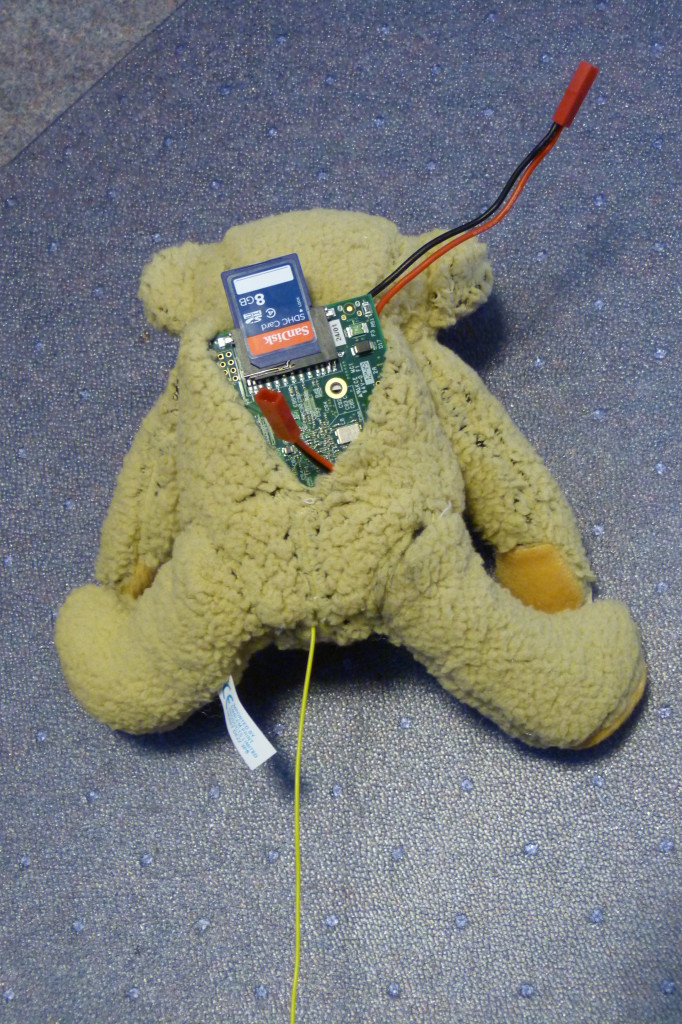
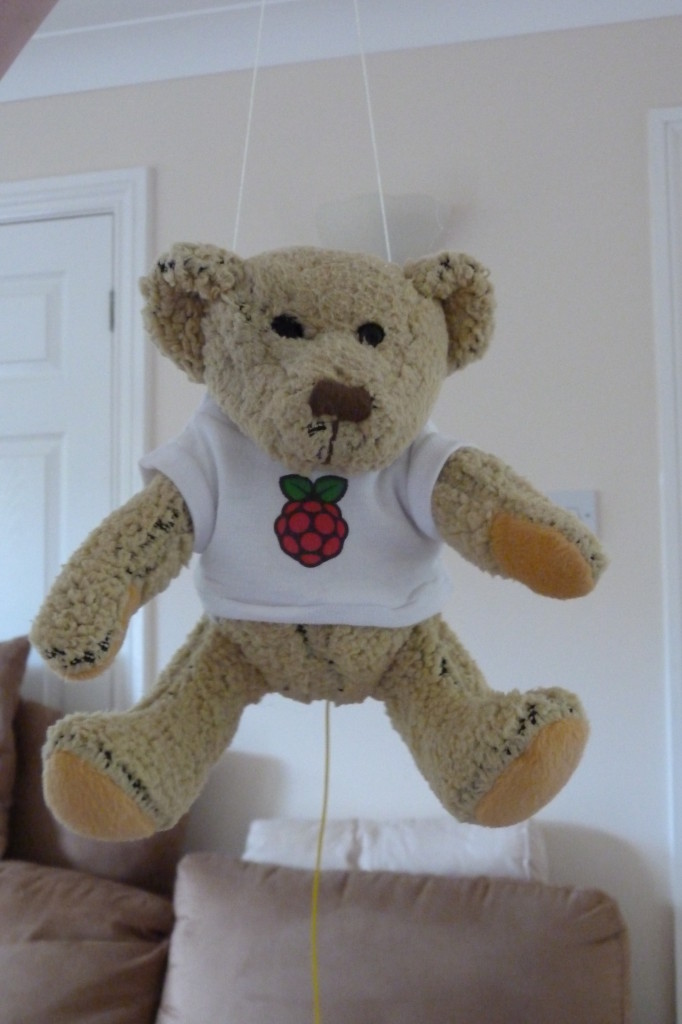
The GPS receiver is in his left ear, and there are 2 batteries down each leg. The camera is connected and it only needs those 2 JST connectors to be mated and he’ll take and transmit images from his new eye. With his shirt back on, and a harness around his shoulders, here’s the completed Bionic Bear:
So, with Babbage ready for action, it was time to build his capsule. What I wanted to do was replicate the great downward view of Felix’s jump as he left the capsule and disappeared towards the Earth, and this meant placing a camera directly above Babbage’s head. He also needed a step to rest on, carefully sized so that once he is released (by cutting a supporting nylon cord) he wall-falls forward. The rest of the design was basically to join those items up with a box section to hold the tracker and batteries:

Note the picture of the star constellation that Babbage’s capsule is named after!
The height of the capsule was designed to replicate the view from Felix’s overhead camera:
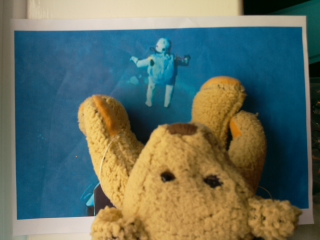
The mission is now planned for Saturday 24th August. Babbage will be tied to the capsule using nylon cord running through a device that will release him at 39,000 metres, when he will descend with his own parachute. Both Babbage and Ursa Major will take and transmit photographs throughout the flight, except for two periods. The first is when they reach an altitude of 38km, when they will both take videos for 8 minutes (plenty enough time to reach 39km when Babbage will drop). They will also switch to video for their landings.
Fingers crossed that it all goes well!
[update 24 Aug 11:24AM]
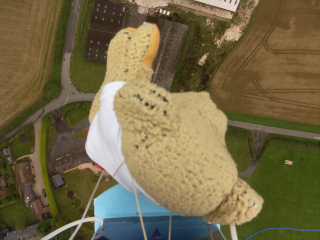
And he’s off. Wheeeeeeee!
Drunk Vs Stoned
'God Help Us If We Get A Worldwide Pandemic'
Watashi Wa Is A Soul-Soothing, Non-Shooting 7DFPS
By Nathan Grayson on August 23rd, 2013 at 4:00 pm.

I don’t know about the rest of you, but I’ve had an especially stressful, topsy turvy week. Also, we’ve been posting about bloody manshoots and manwars and carshoots and carmanbloodwars for ages due to Gamescom’s monolithic domination of the news cannons, and it’s time for a change of pace. I want something relaxing. Something soothing. Something that creates instead of reducing everything around it to chalky pools of ash and blood. I want… an ethereal gardening simulator! Watashi Wa Hijo Ni Yoku Nihongo Hanasenai sees you breathe life into a barren, featureless expanse while dreamy melodies dance and drift through the background. Occasionally, there are turtles. It made me feel all warm and happy in my heart chambers.
Watashi Wa is, admittedly, an incredibly simple game. The world starts out blank, save for a piece or two of foliage. You, however, have the ability to make trees grow at an accelerated pace and drop countless seeds… via a beam that looks weirdly like pixelated puke. But it’s still an enchanting experience, and you’ll have a forest literally raining down around you in minutes. There’s just something inherently wondrous about watching new life tumble down like fresh snow.
There really, really isn’t much to it, though. There are only a couple tree types, and I quickly found myself wishing for more variety in the glorious oasis I’d willed into being. The odd turtle occasionally served as a nice surprise, but again: that was it. Also, what kind of tundra forest is overrun exclusively by turtles? NATURE DOES NOT WORK THAT WAY.
It’s here that Watashi Wa’s 7DFPS roots show through, skeletal and undergrown as they are. I’d love to see this expanded into a fuller project – still with a minimalist bent, but bolstered by more variety and surprises. Maybe throw in a dash of Proteus and see where it ends up. I really, really wanted to lose myself in this place, but I couldn’t for long. Still though, it was a nice escape from real life’s ugly stranglehold while it lasted.


NTSF: SD: SUV::, “TGI Murders”

I can’t be the only one who eventually gets tired when NTSF deviates from its bread-and-butter of investigative action procedurals over and over again. This cast is talented enough to sell almost any direction the show goes in, and Paul Scheer’s script is again throwing joke after joke at the screen. But “TGI Murders” is a haphazard Frankenstein of bar and restaurant references that still gets a lot of laughs while showing just how little Scheer cares to adhere to the action film and NCIS-esque procedural tropes that NTSF started with.
The President Of The Navy owns a San Diego chain restaurant, one of many “family-friendly, party-centric, sports-themed, large portion, affordable restaurant hot spots” in the area. And for the length of a short sketch, “TGI Murder” is a hilarious send-up of these sad excuses for restaurants. Any Chili’s, TGI Fridays, Applebees, Red Robin, Fuddruckers, or ...
Read more
    
|
Indian Police Arrest Suspects in Two Gang Rapes - Wall Street Journal
Wall Street Journal |
Indian Police Arrest Suspects in Two Gang Rapes Wall Street Journal Indian police Sunday were holding 10 men suspected of involvement in two highly publicized gang-rape cases—one in urban Mumbai, the other in rural Jharkhand state—highlighting India's struggles with sexual violence. In Jharkhand in eastern India, police ... Gang rape of photographer (22) in Mumbai greeted with outrage across IndiaIrish Times Mumbai photojournalist's gang-rape: manhunt took 80 cops, 72 hrsHindustan Times Last of 5 suspects arrested in India rape caseLos Angeles Times gulfnews.com -Telegraph.co.uk -The Globe and Mail all 769 news articles » |
dinosaurceress: roachpatrol: archiemcphee: Breaking news from...


Breaking news from the Department of Awesome Cuteness: The Birch Aquarium at Scripps in San Diego, CA has just witnessed the hatching of a baby Nautilus. Holy cats, that is one powerfully cute cephalopod. Welcome to the world, little one!
"This little guy or gal was a long time in the making. The egg was laid in early November of 2012 and the hatching process has taken weeks… all leading up to last Wednesday, when it finally emerged! So far, the hatchling appears to be doing well. However, raising a baby Nautilus is both an honor and challenge because only a handful of aquariums have had the opportunity."
Visit ZooBorns to read more about this tentacular development and check out photos of the hatching process.
baby
tiny precious critter
Seen@Gamescom: Don't ask the Hotline Miami 2 devs these questions

The list of questions banned from Gamescom appointments for Hotline Miami 2, as posted by Dennaton, includes the following:
- Why is it so hard?
- Isn't it a bit violent?
- Do you like hurting people?
- Why do you call it a sequel when it's pretty much the same?
- Why is it in pixel graphics?
- Why are you drinking beer at 9:30 in the morning?
Continue reading Seen@Gamescom: Don't ask the Hotline Miami 2 devs these questions
 Seen@Gamescom: Don't ask the Hotline Miami 2 devs these questions originally appeared on Joystiq on Fri, 23 Aug 2013 05:00:00 EST. Please see our terms for use of feeds.
Legend of Goardic (Compile - Famicom - 1988) released in the...

Legend of Goardic (Compile - Famicom - 1988)
released in the West as The Guardian Legend
Seeking Justice For A Slain Colleague

Snowden Accuses UK Of Leaking Documents About Itself
Don't Fly During Ramadan


Read more of this story at Slashdot.

DYING - Rex Ronan: Experimental Surgeon (Sculptured Software...


DYING - Rex Ronan: Experimental Surgeon
(Sculptured Software - SNES - 1994)
Focus corporate social responsibility on Asian customers; they’ll pay for it
Corporate social responsibility might be wasted in the West.
That’s the message of Nielsen’s August ”Consumers Who Care” report. It finds that if corporate spending targets the Asia-Pacific region, there’s a higher likelihood of having impact. And if Europe is a company’s focus, it might be time to reconsider.
Nielsen, the global information and measurement company, surveyed 29,000 internet users in 58 countries to gauge their willingness to reward companies’ socially-conscious actions. People in the Asia-Pacific region were more likely than any other respondents (Europe, North and South America) to pay more for products from a socially responsible company.
The graphic below from the report shows respondents’ willingness to spend more on products from socially responsible companies. Only 36% of all European respondents said they would pay more for products from socially aware companies. Yet in India, the Philippines, Thailand and Indonesia, more than two-thirds of respondents said they’d pay a little more. Indians were most willing, at 75%.

So why is India more proactive than countries such as the US, the UK, France and Germany (at least in theory) about rewarding the good deeds of businesses?
Culture partly comes into play. So does legislation.
In fact, India’s legislature has a bill that mandates CSR spending aimed at promoting environmental management and improving working conditions. After years of corporate disregard, both locals and the government are holding businesses more accountable. With pollution literally stifling other parts of Asia, it’s safe to say a business that is socially or environmentally aware is a breath of fresh air … literally.
Nielsen results, meanwhile, underscore cynicism in Europe toward business. Compared to people from other major economies, citizens of the European Union are more likely to think business has a negative impact on society, according to a report by the European Commission (pdf). This further corresponds with the larger culture of political and governmental skepticism in Europe, which came to the academic consciousness when the French and Dutch voters rejected the EU Constitutional Treaty. Some scholars even coined the term “Euroskepticism” for the phenomenon (pdf).
But saying you’re willing to pay more and actually doing it are two different things. The survey showed fewer respondents had actually paid more for products from socially responsible firms. But even then, it was the Asia-Pacific countries who were most willing.
We welcome your comments at ideas@qz.com.

Space Alphabet, An Art Print Full of Intergalactic Goodness From A to Z

Artists Ross Moody of 55 Hi’s, Brad Woodard of Brave the Woods and Jordan Wittlich teamed up to create “Space Alphabet,” an art print full of “intergalactic goodness like planets, quasars and black holes to represent each letter.” Each alphabetical item also comes with interesting facts and trivia. A limited edition of 500 screen prints are available to purchase online from the 55 Hi’s shop.
Asteroids, Black Holes, Comets! What better way to brush up on your ABCs than to do it in space? Venture out into the galaxy with this jam-packed poster of 26 space wonders, each illustrated and accompanied by fun facts and trivia. Like did you know The International Space Station travels at a speed of 5 miles a second? That means you’d be 100 miles away just in the time it took to read this paragraph!


images via Brave the Woods


My day
firehosevia Wojit
Guest post by Heather McNamara
10:00 a.m.: fiancee Lauren McNamara texts me at work that she will be doing some interviews on CNN today about Chelsea Manning, who came out this morning.
10:00:01 a.m.: I tell everyone within earshot that my famous awesome beautiful amazing brilliant genius girlfriend is going to be on television.
12:30 p.m.: Lunch time. I tell some other people. My friends hide faces/walk away embarrassed that I’m admitting out loud to people outside of our circle of trust that my girlfriend is trans.
1:00p.m.-3:00p.m.: television at office plays Chelsea Manning story on loop; news anchors asking “hard-hitting” questions like whether those poor taxpayers might have to pay for Chelsea’s medical care.
4:10 p.m.: at doctor’s office with sons. CNN plays on TV. Lauren, my children’s stepmom, comes on TV. Two people in the waiting room snort and laugh. I ask if they think transgender people are funny. They laugh and stare at their laps. One of them says “Yeah.” I reply “assholes.”
4:11 p.m.: CNN news anchor continually calls Chelsea “he” and “him” and postulates that Lauren, too, was “once a gay man.”
5:00 p.m.: Arrive home. Cousin’s wife on Facebook has posted a status about how horrifying it is that her daughter has to share a bathroom with “a confused boy” at school. No really. I am not making this up.
6:00 p.m.: I call my counselor for a session.
Heather McNamara writes about indie literature, politics, and civil rights at HeatherMcNamara.net.
That Homeless Guy Accepted The NYC Programmer's Offer To Learn How To Code
firehose'It turns out Leo is a genius particularly concerned with environment issues. As I sat there becoming increasing stunned, he rattled off import/export prices on food, the importance of solar and green energy, and his approval for “efficient public transportation initiatives [referring to NY’s new Citibike]”. He is smart, logical, and articulate. Most importantly, he is serious. It’s up to him if dedication is also his gift.'
OH GOD
A HOMELESS GUY CAN BE INFORMED
EVEN EDUCATED
MAYBE HE DID SOMETHING ELSE IN THE REST OF HIS LIFE
MAYBE YOU SHOULD FUCKING FIND OUT AND FUCKING TELL US ABOUT THIS FUCKING GUY YOU'RE RUNNING A FUCKING #STARTUPCULTURE EXPERIMENT ON
The homeless want to learn how to code.
Business bad? “Fuck you, learn to code.” Oh, you had a fire? “Fuck you, learn to code.” Place got hit by lightning, huh? “Fuck you, learn to code.”
How Sam Treadway turned Backbar into the area’s hottest neo-speakeasy
firehosevia Russian Sledges: "sam treadway autoshare"

|
|
Favorite drink recipes from Sam Treadway of Backbar
firehosevia Russian Sledges: "sam treadway autoshare"

|
|
Here's why Joss Whedon doesn't like Empire Strikes Back
firehose' “Well, it’s not an ending,” Whedon explained about the 1980 film, which had a cliffhanger leading into the next entry of the series, Return of the Jedi. “It’s a Come Back Next Week, or in three years. And that upsets me. I go to movies expecting to have a whole experience. If I want a movie that doesn’t end I’ll go to a French movie. That’s a betrayal of trust to me. A movie has to be complete within itself, it can’t just build off the first one or play variations.”
I think it's obvious how Joss Whedon would have preferred to end Empire; by fan-favorite Han Solo dying in the last four minutes for no other narrative purposes other than to make viewers completely distraught (probably from a stray laser blast) and with Luke, Leia, Lando and the Droids running down a Cloud City hallway with blasters and lightsabers raised to fight Darth Vader, 1250 Stormtroopers, three Rancors bred specifically to kill, and then Ponda Baba with a cybernetic arm, looking for revenge on look. Cut to black. Roll credits. Now that's an ending Joss Whedon approves of.'

Joss Whedon has a big problem with The Empire Strikes Back. It's a problem he's had since he first saw it back in 1980. Honestly, once I heard it, I wasn't sure whether I should laugh or cry.

|
|
Opinion: Six lessons for creating believable female characters
firehose"Gone Home hasn't erased gender from its female characters in a misguided attempt to avoid stereotypes. It just, y'know ... avoided stereotypes. These women haven't transcended their gender, that unlike those other silly ladies, they're so cool they're unconstrained by the pressures of gender conformity. That's still sexist, because it's essentially "Screw most women for bowing to pressure. They're lesser" or "Women's things are petty and superior women grow out of them (and act like men)." It's just substituting one set of expectations on women (be feminine) for another (reject all femininity). Gone Home does a really good job of sympathizing with why women sometimes do things that fit with cultural stereotypes — sometimes those things are rewarding in and of themselves (make-up and shoes can be wonderful things, as many a 17th century rich dude would attest), but mostly because rebelling comes with a pretty high cost.
And that's kind of it. Have women, don't make them sex objects or plot devices, give the player a way to get to know them, give them a mind full of thought and opinions and history and likes and dislikes to know, give them agency in the plot, investigate tropes and be careful to avoid them, don't erase their gender.
It seems so simple when you break it down, when you see it so masterfully achieved in a game like this. We can do it! We can fix the portrayal of women without breaking games forever!
Yes we can, if we choose to. But it might so happen that writing women well isn't something that's easy to do off the top of your head. (Same for writing anything well!) Gone Home is able to represent women well because The Fullbright Company seems to have done its research and worked hard to. Fighting stereotypes takes effort and better representations won't happen on their own. (Even Lara Croft was a deliberate choice to make a female character after character designer Toby Gard started making a male one, not a sudden wind of inspiration.)"
I was excited when I heard about (spooky ghost game) Gone Home mostly because I knew it had Heavens to Betsy in the soundtrack somewhere and I love riot grrrl bands. There's something special about games that shout-out something you love; games that have a similar personality to you.
Five minutes in, and I knew this game had my number. You play Katie, just arrived home from a gap year abroad. At an empty, dark, creepy old mansion on top of the hill. After midnight. In a raging storm. Where's the fams?
Katie pretends to be Dana Scully (at least my Katie does, in my head) as she tentatively begins to search the shadows for her mum, dad, and teen sister, Sam. Especially Sam. Left behind are letters, journal entries, notes and objects. Clues to where they are, to who they are.
Things resonated. Gone Home isn't an in-joke, but for a game set in the 90s, it totally embodies that 90s valley-girl expression "That's soooo...." The 90s are soooo 90s, the possibly-haunted house soooo eerie, Christmas decorations soooo corny, the videotapes are soooo bumpy on the underside, the magazines are soooo early digital graphic design, the women are soooo ... like actual real women? Wait what? That's soooo ... awesome.
Katie pretends to be Dana Scully (at least my Katie does)
In a way, I'm not surprised. Gone Home is a game that's thematically and mechanically about understanding — how people seek it, arrive at it, and find it. Or don't. By making it necessary to invest in every character's story to get a full picture of what's happened, Gone Home's gameplay suggests that it takes many perspectives to really understand reality.
In Gone Home, everything reveals something about its creator, something about what its creator has seen and/or something about who this thing was intended for. That's all art, in a way. Games, stories, art in general are methods humans use to tell each other what their lives are like. If we only play games by/for/about one group, we end up knowing far more about them, their desires, hopes, fears, likes, fantasies, experiences and far less about anyone else. (Multiply that by the thousands of stories you're exposed to in your lifetime.)
Right now, if a Kerbal (a space alien for the non-PC folks) came to earth, they'd have a lot more material at their disposal for getting a sense of the varied experiences of men than women. That's unfair to women, obviously, but it's also unfair to men: understanding women somewhat is useful, considering they're all over the place. Understanding humans, in general, takes practice and experience, or at least second-hand experience.
What do women want and what are they thinking and what do they like is a much easier question to answer if you're familiar with women, women's stories and well-written women characters. (Including those written by men. Joss Whedon does a lot of justice to women's experiences.)
We need all stories. Everybody deserves to feel understood. Just like we cherish games that speak to us, every gamer deserves the chance to play someone like them, and walk in all sorts of other people's shoes. It's gaming's superpower.
If games let us try on different lives, they have a responsibility to get those lives right. There are lots of games I've liked recently for improving the portrayal of women: The Walking Dead, Bioshock Infinite, Kentucky Route Zero, Tomb Raider (2013). They were good, but most had issues. Gone Home, as a game about the value of understanding, ends up being a game that strives to understand people who are rarely well understood by games. It gets women right.

So, in case of future Kerbal invasion, here are six lessons about creating great female characters that gaming culture could learn and apply to future games:
First, it has women characters! Main ones! Minor ones! They're everywhere! That's a good start. Not every game even gets one. They're all different kinds of women too, not just different hair colors. None of the major characters could be simply interchanged with any other video game character without totally messing up the game.
Second, it doesn't make them sex objects! Even though it portrays all sorts of women, bodies, sexualities and states of undress: famous women, unknown women, women rockers, riot grrrls, reverend's wives, lesbian women, principals, young girls, sexy nekkid ladies. Sexuality isn't erased here, it informs the characters and the way they behave; the game just doesn't offer it up for the players' consumption. The game contains other media that does objectify women, but doesn't depict it in a particularly objectifying way: no ogling camera angles, stylized body animation, impractical emphasising clothing that adds nothing to the characterization etc. In short, avoiding objectification is about the way bodies are presented, not the bodies themselves.
The eyes you look through are curious, but not leering. For a game about searching through people's stuff, it's not encouraging you to be creepy.
Third, it doesn't make them any other kind of object either. Yes, you're searching to find (and possibly rescue?) other characters, but they're not plot devices or fetch quests. Games that just whisk female characters away in order to be saved (what Anita Sarkeesian calls "Damselling") simultaneously remove their personality and agency from the plot, turning the woman into a trophy and denying the player any opportunity to grow attached to the damsel as a person. (Journey does a better job getting the player emotionally attached to a mountain than many games do for damselled women.)
Gone Home does the opposite. Women aren't discovered after the quest, but throughout it (Bioshock Infinite does something similar by making Elizabeth your companion, not goal). Your search becomes the opportunity to delve into the inner lives of your family, especially your sister's. Every aspect of this game is about knowing things in depth, about respecting things that aren't you. Its main mechanic is picking things up and gently turning them over to examine every side. It even has a whole mechanic for putting them back carefully! Gone Home isn't a game about mostly questing followed by a quick denouement, ‘Hero's Journey' style. It's a game about constantly finding, and what happens after finding things: reflecting. And there has to be something worth finding.
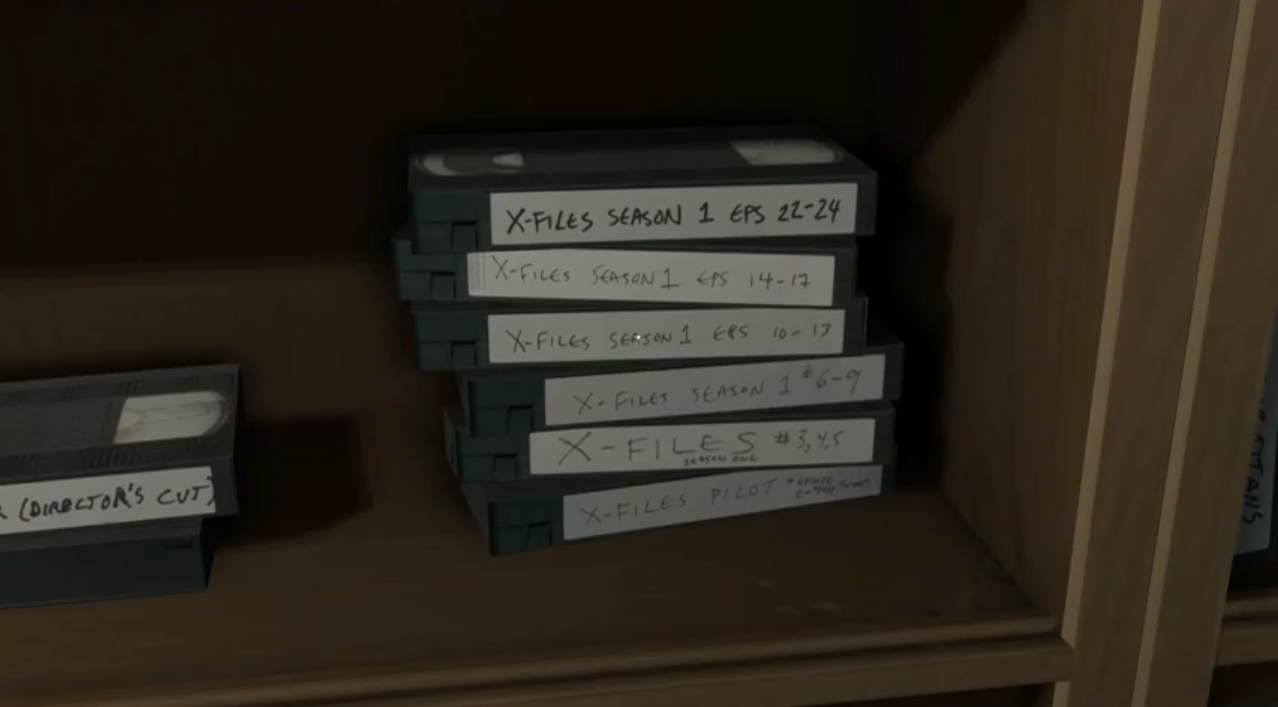
So fourth, it gives women a voice and influence over the story. Where "damsel" quests portray women as mostly ineffectual on their own, Gone Home emphasizes their humanity and independence by making it clear they have stories outside of being just adjuncts to your life. As you turn over notes, books and letters, a lot of what you find are the Tarantino-like conversations that women really have but rarely find their way onto screen: people just shooting the breeze, sharing humor or musings. (A+ on the Bechdel Test!) I don't think the question of women's characterization is weak vs. strong per se, but a question of agency. None of the women in Gone Home are "brazen butt-kickin' babes," but women's motivations and actions drive the plot, they're not driven by it.
Whether a damsel or "strong woman," many female characters tend to suffer from the same problem — very little empathy or understanding about how they came to be what they are, except, "duh, women are like that." But here, there's evidence the women have dreams, hobbies, talents, preferences, opinions and actions. Thus Gone Home takes familiar characters — the sullen teenager, the cool friend, the bored wife, the frustrated writer — and fleshes them out into individuals. Like any sullen teenager, you can hear Sam's eyes rolling, but at the same time you can hear their particular trajectory.
However, making characters interesting and deep alone doesn't always protect a game from stereotypes. The writers of Bioshock Infinite managed to make Daisy Fitzroy a great character, something akin to Edmund from King Lear, but the way that character fed into damaging stereotypes about black women and conflicted with the history of how actual black women's activism happened made the whole portrayal wrong. Getting it right requires that game writers know what stereotypes they're up against and actively think about the effect of traditional storytelling devices. The fact that unexamined cliches may sprout naturally from a writer's subconscious when they first sit down to write a dazzling epic of unimaginable artistic purity doesn't make it less of a lazy trope.
So fifth, Gone Home tackles major stereotypes about women. My personal fave was how the game countered the idea women aren't funny by filling the game with the kind of humor women use a lot (goofy playfulness) but is often undervalued because it isn't stage-ready.
But probably the most important and pernicious stereotype the game subverts is the idea that women don't do things out of logic or personal reasons or normal reasonable human desires, but for scheming woman reasons (or for a little variety, ‘silly woman reasons'). Tons of female tropes reinforce this idea in their own ways, e.g. The seductress who uses sex to achieve evil (male womanizers tend to use evil to achieve sex, which seems much more logical IMHO) or the damsel who likes the hero out of gratitude or admiration, not similar personalities. (This is what I like about Cortana/Chief's relationship — they seem to mostly like each other because they're similar, adventurous people, and the admiration is mutual.)
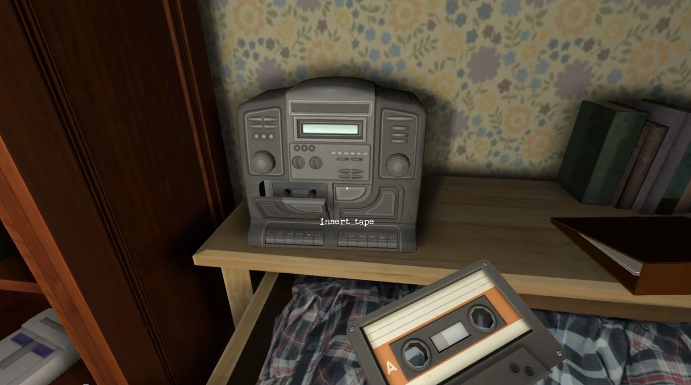
Because Gone Home portrays multiple women, the game is able to step away from having one character stand in for "the ideal female character." Instead of some kind of universal "woman illogic," it endorses the idea that in 3.75 billion women there's probably a huge diversity of attitudes, tastes and approaches. Sam isn't sullen because "teenagers are sullen" or women are killjoys, but because the dynamics of high school are particularly constraining and punishing for the kind of person she wants to be. In Gone Home, all the evidence — their own words as shown in letters, but also the evidence around the house that verifies the women's characterization of their own lives — shows female characters making choices (within their options considering the expectations and circumstances around them) for very human, self-consistent reasons, including having their own agency and sexual desires. Not always perfectly moral reasons, or smart reasons, but sympathetic ones. (It's not like Pollyanna is the ideal feminist portrayal of women.) For a game that harkens back to Agatha Christie and The X-Files, it understands the value of a really satisfying explanation. That's something flimsy tropes could never provide.
And finally sixth, the women are still women. Not women in a "women doing women things for reasons that reinforce gender stereotypes" sense, but in a "women doing all sorts of things (including women things) for reasons consistent with what a person, given those individual qualities growing up in a culture that has particular expectations of and opinions on women, would do." The hair dye, the nail polish, the riot grrrl, the costumes are all understood in very human terms of humans expressing themselves through the means that are most culturally available to them, not "women are vain" or "lady art is craft and therefore frivolous."
Gone Home hasn't erased gender from its female characters in a misguided attempt to avoid stereotypes. It just, y'know ... avoided stereotypes. These women haven't transcended their gender, that unlike those other silly ladies, they're so cool they're unconstrained by the pressures of gender conformity. That's still sexist, because it's essentially "Screw most women for bowing to pressure. They're lesser" or "Women's things are petty and superior women grow out of them (and act like men)." It's just substituting one set of expectations on women (be feminine) for another (reject all femininity). Gone Home does a really good job of sympathizing with why women sometimes do things that fit with cultural stereotypes — sometimes those things are rewarding in and of themselves (make-up and shoes can be wonderful things, as many a 17th century rich dude would attest), but mostly because rebelling comes with a pretty high cost.
And that's kind of it. Have women, don't make them sex objects or plot devices, give the player a way to get to know them, give them a mind full of thought and opinions and history and likes and dislikes to know, give them agency in the plot, investigate tropes and be careful to avoid them, don't erase their gender.
It seems so simple when you break it down, when you see it so masterfully achieved in a game like this. We can do it! We can fix the portrayal of women without breaking games forever!
Everybody deserves to feel understood
Yes we can, if we choose to. But it might so happen that writing women well isn't something that's easy to do off the top of your head. (Same for writing anything well!) Gone Home is able to represent women well because The Fullbright Company seems to have done its research and worked hard to. Fighting stereotypes takes effort and better representations won't happen on their own. (Even Lara Croft was a deliberate choice to make a female character after character designer Toby Gard started making a male one, not a sudden wind of inspiration.)
No game pops out of a creator's head like perfectly done toast, ready to eat/play. Characters and games are always built out of thousands of design decisions, and I don't see why some of those shouldn't be "Does this do a disservice to these people?" Yes, don't worry about offending people. Do worry about hurting people and misrepresenting them. Making art isn't a visa into screw-your-fellow-human-beings-land. As a grad architect, I don't get to build buildings that fall on people just because it's the perfect expression of my architectural self. Art is just an idea and a way of expressing it, and sexism is a shit idea and it will make your art stink. Portraying women (or anyone) fairly is just part of the larger responsibility everyone has in life to be considerate.
Any gamer who's ever really loved a game can understand how important both games that resonate and games that take us out of our comfort zone are, and thus how important a diversity of stories are to games culture as it is and the kind of games community we raise. In its way, Gone Home is about that. You can't know what's happened until you've pieced together everyone's stories. We can't know ourselves, this world we're in, until the stories we tell include everyone.
Claire Hosking is a grad architect and illustrator interested in digital architecture, procedural art, robots and feminism. In her spare time she models and programs gameish things and plays the ukulele. Visit her website, clairehosking.tumblr.com, or follow her on Twitter, @hoskingc.
The Specter of GMO Pot
firehosevia multitasksuicide