BBC News |
Indian gay sex ban prompts protests BBC News India's gay community and human rights activists say they "will continue to fight" for equality, after the country's top court upheld a law which criminalises gay sex. The Supreme Court ruling reverses a landmark 2009 Delhi High Court order which had ... and more » |
firehose
Shared posts
11 Dec 19:08
Indian gay sex ban prompts protests - BBC News


11 Dec 18:57
Here's George W. Bush Showing Off His Paintings To Everyone On Air Force One
White House Photographer Pete Souza snapped this photo of the former President showing off his paintings on his iPad to everyone on Air Force One yesterday, while on route to the Mandela memorial.
firehose likes this
11 Dec 18:57
Mandela Ceremony Interpreter Was A 'Fake'
The unidentified man seen around the world on television next to leaders like U.S. President Barack Obama "was moving his hands around but there was no meaning in what he used his hands for."
firehose likes this
11 Dec 18:06


There’s something else wrong with Obamacare—doctors weren’t consulted
by Commentary
As a doctor, I have been struck watching CNN by the many perspectives on the Affordable Care Act, better known as Obamacare. There are stories about customers’ sticker shock at plans with deductibles as high as $12,700 for families. There are stories on US president Barack Obama criticizing the insurance companies for having substandard plans. And there are stories about people blaming the president after losing their current insurance.
Yet in none of these were doctors even mentioned. It’s as if doctors do not know the intricacies of the health-care system. As if doctors are not there for their patients 24 hours a day. As if doctors are not dealing with denials from the insurance companies on a daily basis, losing valuable hours to menial paperwork.
Doctors have a duty to care for their patients and are the engines that put health care into motion. Unfortunately, doctors’ voices are largely excluded from the discussion of health-care reform. Their valuable insight into the day-to-day operations of this health-care machine is ignored. This strikes me as misguided. Would you want to build a plane with no input from a pilot? Or design a curriculum without a teacher’s input? These insider insights are essential. Unless we look to doctors to help solve these dilemmas, we will be doomed to spiraling costs, dysfunctional insurance companies, and, of course, more talking heads on TV blaming others.
A doctor’s view on what’s wrong with Obamacare
The new system being implemented under Obamacare will ultimately lead to sicker patients and low-quality care for three reasons:
1. Older doctors will retire early, fed up with the system. These older doctors mourn the loss of the patient-physician relationship. The burdensome paperwork chokes their ability to provide good care. Additionally, even as doctor expenses increase under the new regulations, projected cuts in reimbursement of up to 26% threatens doctors’ livelihoods. These cuts could force doctors to stop seeing Medicare patients because the expense of treating them is exceeding the reimbursement, which has already declined steadily over the past several years.
2. Smart young people will no longer enter the field of medicine due to rising debt (which averages more than $200,000 after medical school) and severe cuts in reimbursement. If young college students realize that they cannot provide for a family despite going to school and training for a total of 14 years, they will turn to different professions.
3. Today’s younger doctors will become more demoralized by lawmakers dictating how they provide care. They are increasingly being treated as machines, expected to answer patient calls at 2am, work 24-hour shifts, do more procedures for less, and fill out a growing mountain of paperwork. And they’re expected to do all this while the threat of getting sued for any mistake hangs over them. This will produce a high burnout rate and poor care.
Unfortunately, with all the unnecessary documentation and regulation, doctors are losing the bond with their patients that is so critical for high-quality care. For those doctors who choose to stay in the field, many of them will instead elect to practice direct-pay or “concierge” medicine, taking the insurance company out of the equation. This will create a massive shortage of doctors and threaten the health of our citizens.
Here’s what the doctor orders
As a doctor, I do not want this to happen. I consider medicine a calling and went into this field to help others and take this role seriously. To help patients and address their health needs, I expect to have time to sit down and talk with my patients, to share stories with them—without watching the clock, and without administrators or computers documenting every move I make.
I—and other doctors—are also concerned with the equality issues that lawmakers raise. We too want every person in America to have access to quality health care at a reasonable price. But that elusive goal cannot materialize unless lawmakers look to those of us on the front lines of care for input. We know why costs are high, and we can help inform the public about how it all works. But we need a representative sample of practicing doctors advising Congress on these issues.
Here are my ideas for better and more affordable care:
Costs and reimbursement must be simple and transparent.
Lawmakers and the media need to stop attacking doctors for how much they earn and perpetuating misconceptions.
A recent New York Times headline announced: “As Hospital Prices Soar, a Stitch Costs $500.” But these inflated numbers have nothing to do with what the doctor actually gets paid. In fact, those bills do not go to the doctor at all, but rather to the hospital. When a hospital or doctor submits a bill, the insurance companies or Medicare/Medicaid use a fee schedule to determine the payment. This is often called the “allowable charge” on patients’ bills.
To complicate matters, there are usually two different charges in a patient’s bill: a “professional” charge from the doctor, and a “facility or hospital” charge. The doctor does not collect any of the hospital charge, and receives only a small fraction of the professional charge because these allowable payments do not include overhead expenses for the practice, which can range from 30% to 60%.
It’s understandable that this is confusing to patients. Other professionals get paid what their bill says. If a handyman comes to fix your sink and charges $80, you pay him $80. If your lawyer says he charges $250 an hour and he works four hours for you, you owe him $1,000. Unfortunately, medical billing is much more confusing.
Even our leaders, who should know better, seem to misunderstand this. In this video of Obama discussing foot amputations caused by diabetes, the president claims that surgeons get paid “30, 40, 50 thousand dollars” for a foot amputation. Looking at the Medicare Fee schedule, however, the code states that the surgeon would get paid $738.90. This $738.90 needs to cover his office space, staffing, medical liability, and years of training necessary to perform this life-saving operation. Our leaders are clearly confused.
Another example of confusing costs of medical treatment hits closer to home as my own mother presented to the ER with sudden blurry vision a few weeks ago. Concerned for serious causes for this symptom, several tests were run to rule out causes such as stroke or tumor. Thankfully, her diagnosis was nothing life threatening and she is recovering. She then received the following bill two weeks later in the mail explaining her charges. A copy of the bill appears below:
My mom’s hospital bill.
Courtesy of Moeller family
She was shocked at how high the charges were and could not decipher this bill. Referring to the explanations above, under “professional/physician charges”, it appears a physician gets paid $450 to interpret a CT head and $580 to interpret an MRI of the brain. This is far from the truth. Looking at the fee schedule, code 70450, a CT head would pay a doctor $29 for a Medicare patient—far lower than the $450 shown on the bill. In fact, it is only 6% of what the bill states! Likewise, an MRI brain, code 70558, would pay a radiologist $109—a way off from the charge of $580. There are other inflated fees for the hospital as you can see in this bill totaling over $11,000, but these are not related to a doctor’s compensation. This clearly illustrates that doctors’ payment systems are confusing for patients and create much anxiety when trying to decipher a bill in the mail.
It is apparently even confusing to lawmakers and the president who are trying to modify reimbursement yet do not know how doctors get paid. Even though a stitch may cost $500, the doctor got paid $28 dollars to read a complex CT scan of the brain. We need real costs to health care, not inflated charges from hospitals. This needs to be addressed so patients and lawmakers can understand where doctors are coming from and realize that doctors are getting paid much less than meets the eye.
The fee schedule strangles doctors’ flexibility by ordaining flat-rate payments no matter what the circumstance. Doctors are not paid extra for talking on the phone to patients or other doctors, writing prescriptions, ordering lab work or radiology tests. If we drive to the hospital in the middle of the night to perform a procedure, the payment is the same as a scheduled operation during office hours. If one procedure takes longer than average or is more complex, a doctor does not collect any additional payment.
Do I speak with patients in the evening, or spend the extra 30 minutes to help patients get the quality care they deserve? Of course. I willingly do this, because I went into medicine to help those in need. I do worry, however, that this may become impossible for some doctors if reimbursement models are not modified and doctors’ fees not corrected for inflation and overhead expenses.
The solution is to make costs and charges more transparent, so that patients can see the true (not inflated) costs and benefits of medical devices, services, and materials. If patients know the real costs of their health care, they will be able to make educated choices. It would also increase competition among providers, which would lower prices and offer patients more options.
The next necessary step is to enact tort reform.
Doctors’ first goal is to help patients. But we all are human, and mistakes will happen. Patients who are injured by mistakes must be compensated in accordance with the law, but the current system is broken. With no set standards, decisions on malpractice suits vary widely, jury to jury. This unreliability leads to defensive medicine, where doctors order tests and procedures just to prove that they did something, or they excessively document trivial facts to prove they looked at everything. Gallup estimates that a quarter of all health care dollars are spent on defensive medicine—about $650 billion per year.
Here is a typical example of defensive medicine: If a family physician deduces that a patient’s headache is likely due to tension and there are no warning signs for a more serious condition, the doctor would probably not, under normal circumstances, order a CT scan, and instead would just have the patient follow up if symptoms persisted. But in rare cases, such a headache could be caused by a tumor or bleeding in the brain. In such a rare case, the patient could sue the doctor for not ordering the CT scan earlier. Knowing this, a doctor practicing defensive medicine would order scans with only the slightest justification—simply to avoid a frivolous lawsuit. This concern interferes with the doctor’s ability to use her knowledge and training to determine the nature of a patient’s ailment, or the best treatment for it.
The patient also loses under the current tort system. In fact, the only winners are the lawyers. Thirty-nine percent of cases take three years to settle and 60 cents on the dollar are used for lawyer fees and administrative costs. Patients should be compensated when they experience poor health care, but this current system fails them, as well as doctors.
The answer to this rests in the health care courts described by Common Good chair Philip K. Howard. He suggests that expert judges—without juries—should determine what is good versus bad care. Health care courts would allow judges to dispose of weak and invalid claims quickly after filing, while also discouraging doctors and insurers from fighting cases in which they are clearly at fault. They would provide consistent standards for various health care situations. They would let us doctors do our jobs without lawyers looking over our shoulder. And they would provide patients with fair, consistent rulings when they are wronged.
Use health savings accounts to increase patients’ roles in their own health.
Patients could use pre-tax dollars, contributions made by employers, and in some cases a government subsidy to fund the accounts. With actual money in the accounts, patients would be able to better plan their health care spending, and to use this money as if they were consuming any other good or service. This money could grow each year, like an investment account and even be passed on to heirs after death.
As discussed above, for these accounts to work, hospitals’ and doctors’ prices must be more transparent and reflect true costs, so that patients know what they are buying. Under the current system, a patient with a knee injury has no reason to question it when a doctor orders an expensive MRI. The patient’s insurance covers the MRI, making the costs a non-issue for that patient. There is no incentive to try ice, physical therapy, and rest before agreeing to the MRI. If the actual price of the MRI were clear, patients would know what they are “buying.” Patients could shop for MRI scanners just as they would for any other service, giving them control over how they spend their health care dollars.
This informed decision-making is particularly important for terminally ill patients. During the last six months of our lives, we spend up to 50% of our own total lifetime health care dollars; a quarter of all spending on Medicare, or more than $125 billion, goes toward services for the 5% of beneficiaries in their last year of life. Our practice in America, when patients are extremely sick and brought to the hospital, is to use everything in our medical repertoire to keep them alive. Costs can run at up to $10,000 per day of intensive care, not including other aggressive measures. Patients may not know these costs, or their options for palliative or hospice care—which is both cheaper and sometimes preferable. With patient-funded health savings accounts, patients would have more of a role in their own care, and could decide, based on a doctor’s recommendation, the best course of action, considering the prognosis, benefits, risks, and costs. Of course, every human being is unique in his or her health needs, and must make decisions in consultation with families. But some patients are now expressing a preference to avoid spending their last months hooked up to breathing tubes, postponing the inevitable. Doctors themselves, according to a recent article on the Health Care Blog, often make the decision to eschew aggressive medical treatments in their own last days. All in all, health savings accounts—as well as frank discussions between patents and their doctors—could facilitate better decisions about end-of-life costs.
Lastly, prevent chronic illnesses that end up costing Americans dearly as they age.
We are very good at treating complex medical problems in patients who are very sick, but not so good at reducing medical costs through preventative medicine. We are good at bringing a new blood-thinner drug to the market, but bad at preventing the conditions that require that drug in the first place.
Studies often point out that Americans spend a huge amount on health care, and yet are ranked lower than many other countries on health care outcomes. Here’s why: We spend a lot to prolong the lives of patients who are very sick—patients with multiple chronic medical conditions such as obesity, diabetes, kidney and heart disease—but we do little to prevent them from getting sick. In fact, 50% of our health care dollars ($623 billion) are spent on the sickest 5% of patients (30 million) in America. Within this group, the top 1% of health care “spenders” accounted for 20% of the total health care expenditures in America.
Recently, CNN’s Sanjay Gupta offered a practical solution to this problem. Obamacare will not in itself make people healthier, he wrote. Instead, he advised people to take ownership of their own health, and to hold themselves accountable. Eating better, exercising more, and reducing stress can go a long way to everyday health. It also helps avert those expensive chronic medical conditions.
Doctors experience first-hand all of the above issues on a daily basis and we have plenty to share with lawmakers, who are unfamiliar with the inner workings of doctor’s offices or hospitals. I believe that by empowering patients through health savings accounts, reforming our tort laws, making costs more transparent, being more realistic about end-of-life issues, and living healthier, we can make a real difference. I just hope that we can work with lawmakers to create a system that benefits everyone.
We welcome your comments at ideas@qz.com.
Read this next: I went into $230,000 in debt to become a doctor in America
firehose and -1 others like this
11 Dec 17:36
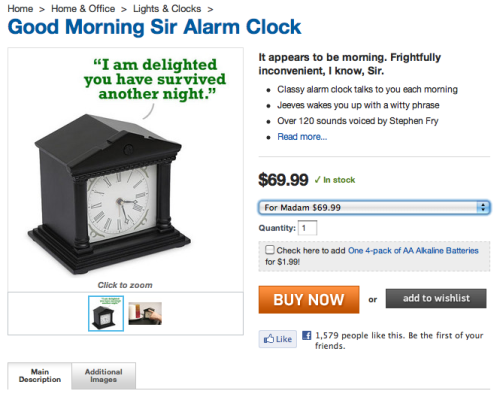
beastlyart: shadow-of-a-whisper: literal-ghost: lightneverfade...
WHOEVER BUYS THIS FOR ME WINS MY ETERNAL LOVE
I OWN THIS
EVERY MORNING HE SAYS SOMETHING DIFFERENT ABOUT HOW THE WORLD NEEDS YOU AND YOU HAVE TO GET UP
AND WHEN YOU PRESS THE BUTTON TO HUSH HIM HE SAYS “DEFTLY DONE, MADAM,” OR “IF IT’S NOT TOO FORWARD OF ME, THAT DID TICKLE, MADAM”
IT WAKES YOU UP WITH THE SOUND OF CHIRPING BIRDS BEFORE STEPHEN FRY’S VOICE
EVERYONE SHOULD HAVE ONE
THIS IS LIKE JARVIS.
A REAL JARVIS EXCEPT HE’S A CLOCK.
VOICED BY STEPHEN FRY?!
This is going on my Christmas Wish List.
Liz we both need one so they can go off at the same time.
11 Dec 17:27

Beastie Boys countersue over 'Girls' parody ad, rekindling legal battle
by Adi Robertson
firehosewelp
"when a representative of the Beastie Boys contacted them, they filed a claim asking a court to declare that it was legally protected fair use. As the new filing shows, that apparently happened after the Beastie Boys learned of the video through an advertising agency, which contacted them while submitting the video to a contest offering a 30-second Super Bowl spot."
"the band thinks that the parody's commercial purpose puts it beyond the edges of fair use, and that by using the Beastie Boys name in conjunction with the video, GoldieBlox was also infringing on its trademark."
When GoldieBlox removed a parody of the Beastie Boys' song "Girls" from an ad for its toys, it seemed like a brief but heated debate over fair use and copyright ethics was over. Apparently we were wrong, as the Beastie Boys have now sued the toymaker for copyright and trademark infringement and demanded a jury trial. "Rather than developing an original advertising campaign to inspire its customers to create and innovate, GoldieBlox has instead developed an advertising campaign that condones and encourages stealing from others," they write, asking for court costs, lost profits from infringement, money earned by GoldieBlox as a result of the ads, and a permanent injunction against any further use of the re-recorded song.
"GoldieBlox has ... developed an advertising campaign that condones and encourages stealing."
The court document, published at GigaOm, has brought to light a few more details about what exactly happened between the two. We'd already known that GoldieBlox re-recorded the song that the Beastie Boys describe as "a sarcastic anthem," changing the lyrics to promote girls in engineering and science instead of (as per the original song) doing dishes, laundry, and cleaning. While the song didn't mention any GoldieBlox products, it was still implicitly an ad, and its popularity exploded. But the creators didn't ask the Beastie Boys for permission to parody the song, and when a representative of the Beastie Boys contacted them, they filed a claim asking a court to declare that it was legally protected fair use. As the new filing shows, that apparently happened after the Beastie Boys learned of the video through an advertising agency, which contacted them while submitting the video to a contest offering a 30-second Super Bowl spot.
After a heated open letter from the Beastie Boys, GoldieBlox apologized and removed the song, saying it would drop its court case, though it still believed the video was a legal parody. But the Beastie Boys claim that the ad is the latest in a series of infringing videos, including one set to a re-recorded version of Queen's "We are the Champions." It's not completely clear that these songs were also unlicensed, though GoldieBlox didn't immediately respond to a request for more information. But either way, the band thinks that the parody's commercial purpose puts it beyond the edges of fair use, and that by using the Beastie Boys name in conjunction with the video, GoldieBlox was also infringing on its trademark.
The Beastie Boys claim that the parody directly translated into a "massive increase" in sales for GoldieBlox, but the bigger question might simply be the video's existence: the band has taken a hard line against licensing its songs for ads, and leaving the question unsettled could open the door for future issues. That also, however, makes it a potentially risky move. There's hardly a cut-and-dried copyright case against GoldieBlox, and losing the parody suit would be a worse outcome than simply letting it slide. The trademark question, meanwhile, will hinge on whether the mention of the Beastie Boys' name in the YouTube video description misled viewers into thinking the band was officially affiliated with an unauthorized parody.
- Via GigaOm
- Image Credit Fabbio (Flickr)
- Related Items beastie boys goldieblox lawsuit fair use intellectual property copyright trademark advertising parody
11 Dec 17:23
Colorado Is Worried That It Will Run Out Of Weed
Call it Black Wednesday. Recreational marijuana goes on sale legally in Colorado on Jan. 1, and Denver officials are worried that the city’s retail shops won’t be anywhere close to meeting demand.
firehose and -1 others like this
11 Dec 17:21
OwnCloud 6 Has New Design, File Previews
The ownCloud software for running your own private cloud server for storing files is up to version 6. With ownCloud 6 comes some very exciting features for this open-source private cloud software...
firehose likes this
11 Dec 17:19

You have just one day left to get a bunch of family-friendly RPG PDFs, including Happy Birthday, Robot! Just go to the Bundle of Holding site and pay whatever you like. Beat the average threshold and you'll get even more RPGs!
Here's the complete list on offer:
Family-Friendly Bundle of Holding (now including Happy Birthday, Robot!)
by Daniel Solis
You have just one day left to get a bunch of family-friendly RPG PDFs, including Happy Birthday, Robot! Just go to the Bundle of Holding site and pay whatever you like. Beat the average threshold and you'll get even more RPGs!
Here's the complete list on offer:
- Hero Kids: An ideal introduction to fantasy roleplaying for children aged 4 to 10.
- Mermaid Adventures: Exciting undersea adventures and strange mysteries. (Ages 6-11.)
- The Princes' Kingdom: Young heirs to the throne of Islandia, visiting the citizens of their land and solving problems. This bundle is the first .PDF version of The Princes' Kingdom sold anywhere! (Ages 5+, plus an adult.)
- Happy Birthday, Robot!: The charming storytelling game by Daniel Solis for families or classrooms. (Ages 9+ -- and especially good for grownups.)
- Adventures in Oz - Fantasy Roleplaying Beyond the Yellow Brick Road: A loving journey into the lands of L. Frank Baum. (Ages 8+.)
- Project Ninja Panda Taco: Jennifer (Jennisodes) Steen's game of competing Masterminds and their biddable Minions. (Ages 8+.)
- School Daze: It's high school the way you wish it could be. (Ages 13+.)
- Camp Myth: The RPG: Third Eye's adaptation of the Chris Lewis Carter YA novel series about mythic creatures at summer camp. (Ages 8-13.)
firehose likes this
11 Dec 17:17
Researchers discover greenhouse gas 7,000 times more powerful than fossil fuels
by Adrianne Jeffries
Scientists in Toronto have discovered a manmade gas that is 7,100 times more powerful at trapping the Earth's warmth than carbon dioxide, according to a new study. The gas, perfluorotributylamine (PFTBA), is a byproduct of the electrical industry.
PFTBA was measured at low concentrations in the atmosphere and is not a major contributor to global warming at the moment, the study's authors say. However, it remains in the air for 500 years before dissipating.
It remains in the air for 500 years
PFTBA is one of many unregulated greenhouse gases that may be contributing in small ways to climate change. These gases should be measured and regulated in case their concentration increases in the future, the researchers say.
- Source The GuardianGeophysical Research Letters
- Image Credit Thomas Galvez (Flickr)
- Related Items climate change global warming greenhouse gases carbon dioxide co2 perfluorotributylamine pftba
firehose likes this
11 Dec 17:17
Disqus Bug Deanonymizes Commenters
by Unknown Lamer
alphatel writes "The Swedish company Resarchgruppen has discovered a flaw in the Disqus commenting system, enabling them to identify Disqus users by their e-mail addresses. The crack was done in cooperation with the Bonnier Group tabloid Expressen, in order to reveal politicians commenting on Swedish hate speech-sites." 


Read more of this story at Slashdot.
firehose and -1 others like this
11 Dec 17:16
Norway is digitizing all its books and making them free to read online
by Adrianne Jeffries
The National Library of Norway is digitizing all the books in its collection, processing the text to make it searchable, and making them available to read online.
It's similar to the mass digitization efforts in the UK and Finland, but Norway has taken the extra step of making agreements with many publishers to allow anyone with a Norway IP address to access copyrighted material.
The library owns equipment for scanning and text structure analysis of the books. It's also adding metadata and storing the files in a database for easy retrieval.
Librarians estimate the digitization of the entire collection, which includes materials dating back to the Middle Ages, will take 20 to 30 years. The effort started in 2006.
- Via The AtlanticTechdirt
- Source National Library of Norway
- Image Credit National Library of Norway (Facebook)
- Related Items books norway libraries digitization national library of norway
firehose and -1 others like this
11 Dec 17:15
Pope Francis 'scores goals' for image of Catholic Church - BBC News
firehoseUSA TODAY headline: "Pope gets nod over Miley Cyrus for 'Person of the Year"
CSM headline: "Why Time chose Pope Francis, not Edward Snowden, as 'Person of the Year'"
BBC News |
Pope Francis 'scores goals' for image of Catholic Church BBC News Very recently, it was hard to find a good word about the Catholic Church in the world's press, amid sex abuse and other scandals. That has changed dramatically, with Pope Francis riding the crest of a wave that has culminated in him being named Time ... Pope Francis gets high ratings from Catholics, according to pollWashington Post Inside the crosstabs: Pope Francis vs. Pope John Paul IINBCNews.com Is Pope Francis Really 'The People's Pope?'NPR Christian Science Monitor -euronews -The Globe and Mail all 618 news articles » |


11 Dec 16:38


An Ikea toy wolf is more than just a way to curse out Hong Kong’s chief executive
by Lily Kuo
firehose'The toy’s Swedish name ”Lufsig” in Mandarin Chinese is lu mu xi (路姆西), which is a transliteration that doesn’t mean much except for when you pronounce the characters in Cantonese. (The two languages share the same characters.) Then the name sounds rather like lo mo sai, or “Your mother’s ___,” and “throw lo mo sai” sounds like a profane Oedipal command that is common to many languages.'
chinese puns are best puns
More than just a stuffed animal.
Ikea
A stuffed toy wolf from Ikea has become an anti-government protest symbol in Hong Kong where it’s sold out at Ikea stores, rankled local toy makers (paywall), and become a general global media sensation with fans from Taiwan (video in Chinese), where stocks are also running low, to Sweden. How does a toy wolf clutching a grandmother become such a potent political symbol?
Protesters posted photos and “quotes” by Lufsig on a Facebook page that had over 44,000 fans as of Dec. 11.
The first reason is pretty straightforward. Hong Kong’s unpopular chief executive CY Leung, who had the toy thrown at him over the weekend, is nicknamed “the wolf” by political opponents who call him ruthless and dishonest. Some Hong Kong residents consider his government illegitimate because he won his seat last year in what was seen as an appointment from Beijing instead of a real election. Leung is also called “689,” a reference to the number of votes he won from electors on Hong Kong’s election committee who are seen as loyal to Beijing.
On a Facebook page dedicated to Lufsig, fans posted photos of the toy next to symbols of democracy.
Facebook/路姆西 Lufsig
Lufsig next to Hong Kong government offices.
Facebook/vic.lau.10
The most important reason for the toy’s popularity is a play on language that makes the toy the perfect way to curse out a hated politician. The toy’s Swedish name ”Lufsig” in Mandarin Chinese is lu mu xi (路姆西), which is a transliteration that doesn’t mean much except for when you pronounce the characters in Cantonese. (The two languages share the same characters.) Then the name sounds rather like lo mo sai, or “Your mother’s ___,” and “throw lo mo sai” sounds like a profane Oedipal command that is common to many languages.
Celebrities like Pakho Chau, a Cantopop star, posed with Lufsig.
Facebook/pakhochau
Little Lufsig, thus, highlights one of the biggest grievances Hong Kongers have with Leung and his support from Beijing: the intrusion of mainland China into Hong Kong’s politics and culture, symbolized by the slow creep of Mandarin into the territory. Cantonese, a rich, slangy, fast-changing language, is the most prominent dialect of Chinese in mainland China after Mandarin—and for decades was the language most often heard in Chinatowns around the world.
Ever since Hong Kong, a former British colony, returned to Chinese control in 1997, Beijing has worked on promoting Mandarin via mandatory Mandarin classes in some schools, raising concerns that Beijing is attempting to gradually erase Cantonese. An influx of tourists, students, and business people from the mainland has added to the cultural shift. As of last year, Mandarin replaced English as the second most spoken language in Hong Kong.
That makes Ikea’s toy a triple whammy: A nod to Leung’s derogatory nickname, a profane insult, and a cry of protest against mainland China’s linguistic encroachment. If Ikea’s smart, they’ll restock Lufsig as fast as possible.
Lufsig vs. Mao
Facebook/路姆西-Lufsig
Lufsig near Tiananmen Square with a demonstrator.
Facebook/路姆西-Lufsig
Gang Yang contributed additional reporting.
firehose likes this
11 Dec 16:36
YouTube video game shows hit with copyright blitz
by Colin Campbell
firehosegreat
Outrage and confusion have descended on the world of Let's Plays and YouTube video game content this week, following a flurry of copyright claims that have left some of the Internet's biggest star presenters bewildered.
Even the biggest producers, some of whom have millions of subscribers and who belong to large networks like Machinima, have been hit with a blitz of claims, diverting revenues from their work to copyright claimants. The issue is confused by complex laws and procedures and by the opacity of YouTube's activities.
If you go onto YouTube and look for a favorite game, you will find previews and trailers from the game's producers. You may find reviews from media outlets like Polygon. You will also find extensive collections of walkthroughs and Let's Plays, which are videos of people playing the game and talking about it.
These videos are problematic from a copyright perspective. The visuals and soundtracks usually belong to the game's publisher, or to any number of third party licensors, especially if they feature music.

YouTube allows copyright owners to automatically search any videos that make use of content that they own, which they can then flag. Using a service from YouTube called Content ID, they can block the content, they can monitor its traffic or they can claim revenues from any advertising attached to the videos, without any need to call on lawyers.
The most successful Let's Play producers are well-known personalities in their own right, who can earn tens of thousands of dollars a month from advertising through the millions of views they notch up every month. They acknowledge that their work is reliant on games content that they have not produced, but they say their work is fair use of the assets and helps to sell the content.
Most games companies have a stated policy of allowing Let's Plays so long as they are not monetized. But, until now, they rarely bother to make claims on the videos. Earlier this year, Nintendo said it would seek to monetize such videos, but YouTube video producers tell Polygon that Nintendo has not done much to follow up on its plans.
The producers wield power in the domain of public opinion. One games company was forced to apologize earlier this year when it slapped a copyright notice on popular YouTube critic TotalBiscuit, who had made negative comments about its product.
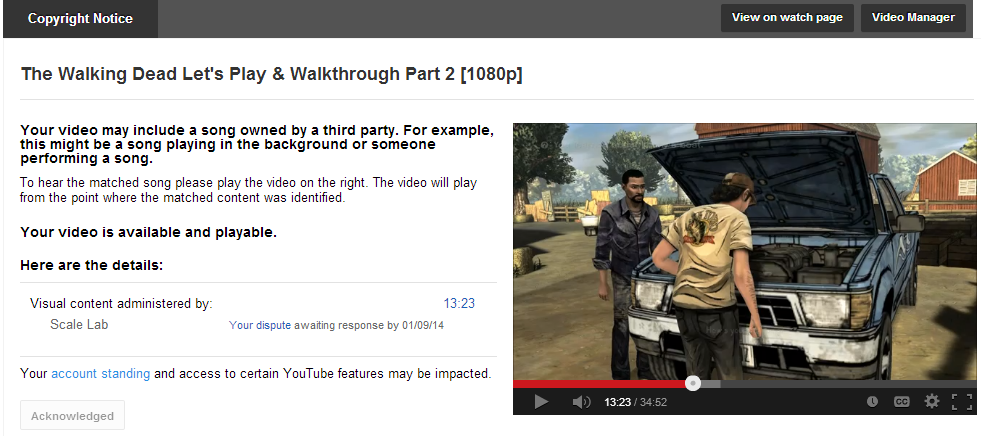
According to forum posts on NeoGAF, it has been well known for some time that YouTube would be tightening its rules to block the most egregious videos from individuals who post copyrighted material wholesale without any original commentary. But this week, producers with established audiences and even relationships with the games companies, have received hundreds of notices that their content is in violation of copyrights. Some report that up to 15 percent of their content is now diverting ad revenues to third parties, some of which have no obvious connection to the games.
"It has been rumored that YouTube will be changing their policy for awhile, ever since music companies started to sue YouTube and networks for allowing monetization of cover songs," said Doug Le, aka NukemDukem, a video content creator. "We got e-mails saying this was suppose to take place in early 2014 with the new video monetization review. It is to cover YouTube's behind from more lawsuits."
"A floodgate has opened and we have gone from getting maybe one [copyright notice] every few weeks to getting hundreds in one day," said Zach Drapala, aka GhostRobo, who operates a Machinima channel with over 600,000 subscribers. "It's crazy. Nothing like this has happened before."
He said that "half of the claims" are coming from companies that have no clear connection with the games, and that others are coming from game companies that are normally supportive of video producers.
"It's like YouTube just vomited out all these claims," Drapala told Polygon. "It's not from some legitimate games companies. I don't see how they are even associated with the games they are making claims on." He said that one claim had come from a company stating that it owns the copyright to a song played, in-game, on a radio station.
But many claims are from games companies like Nintendo. Drapala said that despite running Nintendo videos for months without any problems, he has been hit with multiple notices this week on videos related to the company's games, often referencing use of music.
Producers are speculating that YouTube has been overzealous in its implementation of new rules, and that some companies are seeking to take advantage of tenuous copyright connections. "I think it's a combination of all those things," said Drapala. "I think YouTube wants to crack down on people who just upload whole movies but there are clearly far too many holes in the system."
Certainly, some games companies are angry about the situation. Capcom tweeted today that it would be "investigating flags not instigated by us." A spokesperson for Deep Silver told Polygon that the company had nothing to do with flags that had been sent out based on its games. "We definitely don't want YouTubers to have to deal with this," she said. "We aren't sure really where these claims are coming from but we never want to block YouTubers from having fun with any of our games. We've already been looking into what we can do for the past day since this first went down and we'll be getting together tomorrow first thing in the morning to try and unravel it some more to find ways to help."
Polygon has contacted YouTube seeking comment, but has so far received no reply.
Machinima, which operates a large number of producer affiliates, tweeted today via network manager OpTicJ that it is "researching why it's happening" adding that "there's been some irregular influx as of today." Polygon contacted the company for more information, but a spokesperson declined to comment.
We've also contacted Nintendo, some other game companies and a selection of video producers and will be following up this story in the days ahead.
firehose likes this
11 Dec 16:34
Chef David Chang Wants To Use Kickstarter To Try To Buy The Redskins
firehose likes this
11 Dec 16:33
Jobs' Doctor's House Deal Raises Eyebrows About His Liver Transplant
firehosewait, people doubt that Jobs bought his place in line for the transplant? really?
Fresh questions about Steve Jobs’ liver transplant have been raised after it emerged that the doctor who performed the surgery spent two years in the Memphis, Tenn., house Jobs bought for his recovery.
11 Dec 16:32


Did Neal Stephenson predict the NSA spying on World of Warcraft?
by Annalee Newitz
firehoseand/or he did his research and found examples of this going back years and years to pre WoW online games and communities but whatever

New leaked documents from Edward Snowden reveal that the NSA and British intelligence have been spying on people in World of Warcraft and other online games. And Neal Stephenson's epic spy novel REAMDE predicted this whole mess back in 2011.
    
|
11 Dec 16:26
FREE Red Sonja!
Red Sonja #1 is free TODAY ONLY on Comixology.com as part of their 12 Days of Christmas promotion.
You don’t need to buy anything, the app is free, the download is free, it’s all right here.
http://comixology.tumblr.com/12days
This download also includes variant covers and some ‘making of’ pages exclusive to the digital edition!
Not four dollars, FREE, today (12/11/13) only!
Seriously, a great chance to hear what all the fuss has been about for an investment of exactly zero pennies. :) Try it!
11 Dec 16:24
Hops Chart • Visualizing Bitterness Flavors & Aromas of Beer Brewing Hops
by macdrifter
11 Dec 16:22
submitted by imediocre
[link] [5 comments]
Are there any existing Doctor Who Knitting Circles here in Portland? If not, would there be any interest from people in starting one?
firehosemeanwhile, in Portland
Could knit whatever you want, 'spose. But specifically I would like to find a bunch of people with whom could knit Tom Baker scarfs. Pitch in together for the specific colors needed since they need to be special ordered, etc.
[link] [5 comments]
11 Dec 16:21
submitted by zombiearclight
[link] [74 comments]
Songs about Portland and the Northwest in general
firehosemeanwhile, in Portland
Has anyone come across any songs that are about or mention Portland or places therein? Or just generally about the Northwest?
I've been putting together a list and thought it would be fun to share with /r/Portland but also want to discover some new ones too.
Here's what we've got so far:
Middle Brother - Portland (PDX) (Replacement's cover)
The Mountain Goats - Wizard Buys a Hat (PDX)
The Mountain Goats - Steal Smoked Fish (PDX)
Neko Case - Thrice All American (Tacoma)
Todd Snider - Tillamook County Jail (Tillamook Cty)
Todd Snider - Rose City (PDX)
Weinland - Portland (PDX)
Bright Eyes - June on the West Coast (A bunch of places)
The Decemberists - California One Youth and Beauty Brigade (PDX)
The Decemberists - On the Bus Mall (PDX)
Horse Feathers - Better Company (PDX)
Horse Feathers - Vernonia Blues (Vernonia)
Jesse Sykes - Lonely Still (Puget Sound)
Loch Lomond - Water in Astoria (Columbia River)
The Blow - The Sky Opened Like the Tide (Olympia)
Sleater-Kinney - Light Rail Coyote (PDX)
Elliott Smith - Rose Parade (PDX)
The Replacements - Portland (PDX)
Loretta Lynn & Jack White - Portland, Oregon (PDX)
Elliot Smith - Needle in the Hay (PDX)
Todd Snider - DB Cooper (Near PDX)
Joan Baez - Portland Town (PDX)
Dead Kennedys - Night of the Living Rednecks (PDX)
Elliott Smith - Alphabet Town (PDX?)
Belle & Sebastian - Portland, Oregon (PDX)
Defiance - Portland's Burning (PDX)
PDX Hot Wax - Bike (PDX)
Gas Huffer - 14th and Jefferson (PDX)
Esperanza Spalding - City of Roses (PDX)
Raina Rose - Oregon (all over the state?)
Into it. Over it. - Portland, OR (PDX)
L.C. Jetson & Infinitrakz - Str8 Outta Portland (PDX)
??? - 1-2-3 Go Rip City (PDX)
Michael Hurley - Portland Water (PDX)
Dead Milkman - I am the Walrus (PDX)
Everclear - I will Buy You a New Life (PDX)
Woody Guthrie - Roll On, Columbia, Roll on (Columbia River)
Nickel Creek - Stumptown (PDX)
The Mountain Goats - Standard Bitter Love Song #8 (PDX)
The Mountain Goats - You're in Maya (PDX)
New Rider of the Purple Sage - Portland Woman (PDX)
Casey Neill - Sisters of the Road
Cool Nutz - Portland Life
The Helio Sequence - Everyone Knows Everyone
John Callahan - Portland Girl
The Ataris - So Long Astoria
Frank Sinantra - Loves Been Good to Me
T.Q. - Westside Till I Die (Portland Remix)
The Weather Machine - Back O'er Oregon
Everclear - Portland Rain
Viva Voce - Rose City
Green Flag - This is Portland
Dave Dondero - Roses and Rain
Broadway Calls - Back to Oregon
Someone Still Loves You Boris Yeltsin - Oregon Girl
Pink Martini/Storm Large - Portlandia: That Lady is a Tramp
What else? Who else?
(If I miss any or mess up call it out)
Thanks for all the suggestions overnight. Will update later today!
[link] [74 comments]
11 Dec 16:18


Menswear Dog’s 2013 Holiday Gift Guide Check out some of...
firehoseare those Pilot & Captain airport code tees FFsaucie?
Menswear Dog’s 2013 Holiday Gift Guide
Check out some of MWD’s picks this holiday season. Links below
A. Beckett Simonon Bailey Chukka Boot
F. Baxter of California Safety Razor Set
G. Best Made Co. Enamel Steel Bowls
H. Todd Snyder x Champion Sweatshirt
I. The Tie Bar
11 Dec 16:04


ekjohnston: robotlyra: opera-ghoost: tubofgoodthings: Calvin’...
firehosevia willowbl00
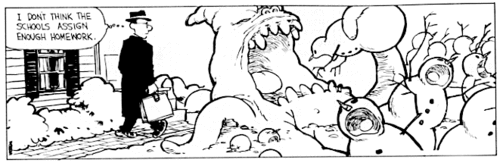
Calvin’s snowmen are breathtaking achievements and I will accept no disputes
I freaking love Calvin’s snowmen
They forgot the best one though!
We never got enough snow to do this after we moved into town. It made me sad.
11 Dec 15:59

Video Game Logic | 218.gif
firehosevia Osiasjota
gpoy/ifapom in summertime
Hartman.marcus, Infinull and one other like this
11 Dec 14:45
Learning to code will not make you rich (or particularly powerful)
firehosevia Overbey
learn 2 sysadmin
I used to evangelize blogging the way people now promote the idea that everyone should "learn to code." I never said learning to blog would mean people would listen to you -- they're separate things. Blogging, imho, is good to do even if no one but you reads what you write. You formulate your thoughts in a different, more complete way, when you write as if someone else could understand them. But people didn't hear that. They thought if they blogged they would become influential. That people would read them. And when they realized this wasn't so, there was a backlash.
I think when people hear "Learn To Code" they think "Get rich like Zuck or Steve Jobs." When they learn to code their next question likely will be: "Where do I collect my millions of dollars?" Of course most people who code, if they make any money at all, make a modest living. When you reach a certain age, you're put out to pasture to fend for yourself. People seem to think "coding" is a young person's activity (even though it isn't), and if you're lucky enough to get a job doing it, you'll have to find something else to do when you're 35 or so, and that's not going to be so easy.
Learning to code is good if you have a calling, if you feel it's what you must do to express yourself. If you have ideas that you can implement in code that no one else is doing. Or if you just love the puzzles that programming is constantly presenting you with. You have to have a certain amount of self-hatred to love programming, btw, because it's a grind. And to do it well you have to have a lot of all of these things.
You might think that by learning to code you get to be the Man Behind the Curtain, the all-powerful person who makes the digital world work. But that's not what coding is about. If you want power, and I've said this many times -- rather than learn to code -- first learn to run a server. That's real power. And it's far easier than programming. You can learn to run a server in a few days or weeks. There's not much to it. Servers are just computers, like a laptop, that are always on and have a net connection that never goes away. They run software that's a little different from the stuff you run, but if you can install a word processor or a graphics program, you can learn how to run a web server. And you will be able to publish whatever you want. But then you kind of have to be a blogger to appreciate that, so we're back to the beginning.
Also, running a server is a good gateway to becoming a programmer. Sooner or later you'll want to customize your server and that's done (drumroll please) with programming! ;-)