
~Ted Nelson

Finding a woman at the World Economic Forum (WEF) in Davos is not getting any easier. Last year, 17% of participants at the invitation-only event were women. This year, only 15% are.
Organizers say it’s simply the reality of today’s world. Many participants are invited to Davos based solely on their job function—like the president of Harvard University, who is currently a woman. When the people in those roles change, so can the demographics of Davos.
“We’re on the front line of reflecting the world as it is, not how we want it to be,” says Adrian Monck, a managing director and head of communications for WEF. Monck says the organization would prefer that its meeting in Davos were more evenly distributed by gender, but its hands are tied by a different imperative: bringing together the world’s most powerful and influential people. Presently only 16.9% of Fortune 500 boards of directors are comprised of women. Fewer than 5% of the Fortune 500 are led by women.
Business members of WEF get a certain number of invitations and can distribute them to their top employees as they see fit. The highest levels of the membership get four tickets, but if one of their tickets goes to a woman who is an executive or board member, the company is rewarded with a fifth ticket.
Here’s a look at the percentage of attendees from each country who are women (among countries with more than 10 participants). As a raw number, the United States is sending the most women.

The groups that consist of younger participants are more gender-balanced. Participants from both the “Young Global Leaders” and “Global Shapers” are comprised of about 50% men and 50% women, according to Monck.
You can search, filter, and explore the entire list of Davos attendees with this interactive tool.

The Chinese government this week passed a new rule requiring all internet users to use their real names when uploading videos to the web, as part of an attempt to crack down on online dissent. As Reuters reports, the rule was implemented on Monday, more than a year after the Communist Party began circulating a draft on a sweeping new online "identity management" policy.
In a notice published Monday, China's State Administration of Press, Publication, Radio, Film and Television (SARFT) said the rule is intended to "prevent vulgar content, base art forms, exaggerated violence and sexual content in Internet video having a negative effect on society." The move is the latest in a series of laws requiring consumers to register their real names on microblogging websites and with mobile service providers, though the rules have proven difficult to enforce.
Identity laws have proven difficult to enforce
Beijing has looked to seize greater control over online discourse over the past year, following a spate of embarrassing political scandals. In September, the Communist Party passed strict new anti-defamation laws designed to stem the spread of rumors and misinformation on social media sites like Sina Weibo, raising serious concerns among free speech advocates.
Youku Tudou and Renren are among the most popular video sites in China, and many have used them to upload content that is critical of Communist Party policies. Neither Youku Tudou nor Renren immediately responded to inquiries from The Verge.


the other day i went with a friend to the museum, and outside its entrance, was greeted with this:
eight cats. sitting there. perfectly still. everyone around them was cooing and taking pictures but those cats did not budge. for a moment i was actually wondering whether that was supposed to be some sort of experimental new performance art.
but then one lady came out of the museum and they all got up and followed after her. good god, i hope they’re her cats. i hope they do this everywhere she goes. just follow after her and patiently wait outside every building she enters like the world’s most disciplined children.
The United States Post Office has refused Evil Supply Co.’s offer to design a postage stamp bearing the mystic sigils to raise the dead.
A source familiar with postal regulations stated, on the grounds of remaining anonymous: “We simply cannot allow ourselves to be associated with any sort of undead resurrection.”
Atticus, our overlord, replied, “I shall fight this sneering insult to the brink of the Abyss! I swear by all that rots I shall prevail!”

It’s dolphin-killing season in Japan. As in years past, animal rights activists are mobilizing to protest the systematic slaughter by fishermen in the western prefecture of Wakayama, who herd the mammals into coves (as seen in the Academy Award-winning 2009 film “The Cove“), after which some are sold to aquariums but most are killed for meat.
Fishermen waiting in the shallow waters by the shore, some in wet suits with snorkeling masks on their faces, wrestled the dolphins into submission and tied their tails with ropes to stop them from escaping. Before the killing began, fishermen pulled a tarpaulin in front of the cove to prevent activists and reporters from seeing the killing. A large pool of blood seeped under the tarpaulin and spread across the cove.
The fight over dolphin hunting is not new. However, this year newly-appointed US ambassador Caroline Kennedy, daughter of the late president John F. Kennedy, has waded into the familiar face-off between fishermen and animal rights activists. Kennedy, who arrived at her post in November, voiced her disapproval on Twitter:
Deeply concerned by inhumaneness of drive hunt dolphin killing. USG opposes drive hunt fisheries.—
キャロライン・ケネディ駐日米国大使 (@CarolineKennedy) January 18, 2014
That drew the displeasure of conservative and often xenophobic Japanese web users known as “net uyoku,” who defend traditional Japanese practices against foreign criticism. The South China Morning Post reported that the angry online responses included “a poem that emphasised how delicious dolphin meat is, while several others compared consuming beef or lamb with dolphin and said that Westerners are hypocritical for condemning the traditional hunt.” Japanese government officials argued that the dolphins are not an endangered species and—unlike whales—they are not protected by international treaties. Dolphins are protected in Taiwan, however, where authorities seized 7.65 tonnes (8.4 tons) of frozen dolphin meat on Jan. 14.
Moral issues aren’t the only reason to reconsider one’s taste for a thick, fatty, dolphin steak. As pre-eminent marine predators, they accumulate high levels of toxic mercury as it works its way up the food chain—up to 250 times than the Japanese government’s recommended maximum, according to the non-profit Environmental Investigation Agency. Pregnant women are advised to eat no more than 80 grams (2.8 oz) of bottlenose dolphin every two months.

By Adam Smith on January 21st, 2014 at 8:00 am.

It’s been a long time since I checked in on Catapult For Hire, which looks to be one of the most promising hybrid games in development. With less buzz to its name or around it than a square-jawed space-toy or the cover star of various honey-based cereal loops, it’s been on my radar for a good while but doesn’t seem to have gained a great deal of media attention. That’s a shame because the blend of 3d artillery accuracy, an action-adventure structure and (newly added) movable vehicles all look to be exactly the sort of thing we should all be keeping at least one of our good eyes on. Take a look at the latest video, incorporating those vehicles, below.
The movable player vehicles are the biggest visible addition since I last looked but there have been many changes. Here’s part of a December post at the development blog.
So, the end of the year is here and 2013 has been a wild ride! The past few months have been especially crazy. Now that the dust has settled I can finally announce that I have been able to buy back the rights to Catapult for Hire from my publisher!
That means a lot of things but most of all it means that I can commit to the highest quality game possible and I will be able to interact with the community in a more direct way. Not much will change as far as my life situation. I will continue working part-time and squeezing in as much time as I can on the game in-between, but I’m finally in a good place and am making real progress.
Last time we checked in, I was surprised to learn about the game’s lofty themes and autobiographical nature. Tyrone may not have a catapult but he has experience of selling his skills to the highest bidder and of realising that sometimes the bids dry up entirely. Check the videos in the previous post for a stronger sense of how the game plays. Hopefully it’ll be with us sooner rather than later.
__________________

King, the development studio behind the addictive Candy Crush Saga game that has electronically enslaved every commuter on the train but you—unless they already got you, too—is now extending its mind-control efforts by enforcing its supposed ownership of the word “candy.” As Gamezebo’s Jim Squires reports, King has received preliminary approval of a trademark for use of the word “candy” in such applications as “computer game software,” “casino and gambling facilities,” “headwear,” “stockings,” “waistcoats,” “juke boxes,” “baby monitors,” and “spectacle cases,” among a great many others.
While the baby-monitor industry probably doesn’t have much to worry about, there is cause for concern among makers of smartphone and Facebook games that ostensibly compete with Candy Crush. Gamezebo spoke with one iPhone game developer who has already been targeted by King’s legal team for using “candy” in his game: Benny Hsu, the creator of All Candy Casino ...

The numbers: Verizon swung to a fourth-quarter profit of $5.07 billion, from a loss of $4.23 billion a year ago. Revenue was up 3.4% to $31.1 billion. Shares have edged higher in pre-market trading.
The takeaway: Once again, Verizon’s wireless business was the standout. The carrier added 1.7 million new mobile connections during the quarter, pushing its total wireless customer additions for the year to 4.1 million. Revenue from Verizon Wireless was up 6% to $21.1 billion. In wired internet (supplied from a fibre or copper pipe rather than the cell tower), it added 126,000 new customers to its high-speed FiOS network.
What’s interesting: 70% of Verizon’s retail postpaid customers are now on smartphones, up from 67% at the end of Q3. That’s above the US average, according to the latest data from both Google and Nielsen. Still, for gadget-obsessed analysts and onlookers, that 30% of Verizon’s ordinary customers are still on dumphones is worth keeping in mind.

1. Pieces in foxtrot rhythm (so-called swing) are not to exceed 20% of the repertoire of light orchestras and dance bands.
2. In this so-called jazz type repertoire, preference is to be given to compositions in a major key and to lyrics expressing joy in life rather than Jewishly gloomy lyrics;
3. As to tempo, preference is also to be given to brisk compositions over slow ones (so-called blues); however, the pace must not exceed a certain degree of allegro, commensurate with the Aryan sense of discipline and moderation. On no account will Negroid excesses in tempo (so-called hot jazz) or in solo performances (so-called breaks) be tolerated;
4. So-called jazz compositions may contain at most 10% syncopation; the remainder must consist of a natural legato movement devoid of the hysterical rhythmic reverses characteristic of the barbarian races and conductive to dark instincts alien to the German people (so-called riffs);
5. Strictly prohibited is the use of instruments alien to the German spirit (so-called cowbells, flexatone, brushes, etc.) as well as all mutes which turn the noble sound of wind and brass instruments into a Jewish-Freemasonic yowl (so-called wa-wa, hat, etc.);
6. Also prohibited are so-called drum breaks longer than half a bar in four-quarter beat (except in stylized military marches);
7. The double bass must be played solely with the bow in so-called jazz compositions;
8. Plucking of the strings is prohibited, since it is damaging to the instrument and detrimental to Aryan musicality; if a so-called pizzicato effect is absolutely desirable for the character of the composition, strict care must be taken lest the string be allowed to patter on the sordine, which is henceforth forbidden;
9. Musicians are likewise forbidden to make vocal improvisations (so-called scat);
10. All light orchestras and dance bands are advised to restrict the use of saxophones of all keys and to substitute for them the violin-cello, the viola or possibly a suitable folk instrument.
Last week, President Barack Obama pontificated on surveillance, terrorism, Edward Snowden, and why Paul Revere was truly the first NSA agent. This week, Jon Stewart offers a shorter version. "Basically, the rule is 'We will totally follow the rules until such a time that we determine that we will no longer follow the rules. But don't worry about it: you won't hear about it — 'cause we're going to do it in secret.'"
 La-Mulana 2 is seeking $200,000 in Kickstarter funding to be made for Windows PC, a turn of events as unexpected as one of the spelunking plaformer's traps. Publisher Playism and developer Nigoro first announced the sequel to the WiiWare and PC game ...
Amir the fennec fox, an animal ambassador for the Reid Park Zoo in Tucson, Arizona, is so over the moon for his Christmas gift that it doesn’t even occur to him that the toy originally intended for a cat.
Amir at rest earlier in 2013.

image via Heather Devers
video via Jedd Dodd
 hodad
hodad@reverend_bunnie @TommyBennett
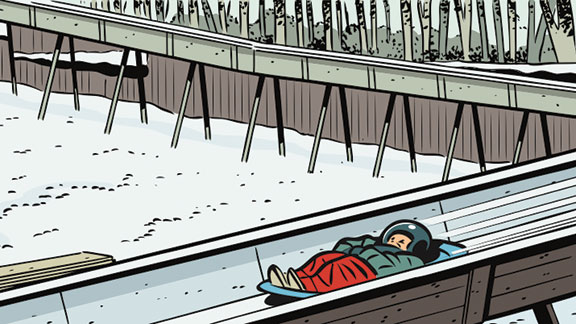 Mark MatchoTucker's father, Brett, built a luge track in the backyard after being inspired by the 2002 Olympics.
This story appears in ESPN The Magazine's Feb. 3 Music issue. Subscribe today!
OLYMPIC DREAMS REQUIRE some level of delusion, a built-in resistance to statistics and physical sanity. The odds are so long and the demands so great. But when Brett West and his son Tucker, then just 6 years old, sat in their Ridgefield, Conn., living room and watched the luge events from Salt Lake City in 2002, the familial defiance of reason would soon surface in ways that set them apart from even the most weightless of fathers and sons.
"We just thought, Boy, doesn't that look like fun?" Brett remembers today. Almost immediately, he disappeared into the backyard and started building a run out of snow and ice. There are pictures of Tucker, smiling brightly, making his first slides on plastic toboggans. "I was just super stoked that we had this awesome sledding hill," the 18-year-old says today.
The problem with snow, of course, is that it melts, and most dads might have let their passion evaporate with it. "I came up with the dumb idea of building a wooden luge track," Brett says. Nearly every word of that sentence is an understatement. Brett is not a carpenter; he owns a media company. Without any of the requisite experience, he spent the next spring, summer and fall designing and building a run, complete with banks and drops and chicanes. Every Friday night, he would head to Home Depot and bring home another load of pressure-treated lumber and plywood, and every weekend, he and Tucker would measure and cut and bolt another section of track that, at its peak, extended 780 feet.
"It was a bit like Noah's Ark," Brett says. "The neighbors would come over and say, Whatcha building?'" The following winter, an expectant Brett iced down the chute with a garden hose and prepared to launch its first test subject: a bowling ball. The ball clattered and caromed down the track -- until it reached what the Wests were already calling Devil's Curve. That's where the ball went airborne, rocketing over the side and crashing into the trees. Father and son shared an uneasy moment of silence.
Brett broke down the curve and rebuilt it, and after sleds loaded with sand had found their way safely to the bottom, the West Mountain Luge Run was ready for human trials. Tucker insisted on the honor. Brett took a position in the middle of the run, "ready to perform CPR if needed," he says, mostly joking. (He had also stacked hay bales, just in case.) But the track, and Tucker, performed beautifully. "It was quite the experience," he says. "I went straight down, and I'm still alive to this day."
The backyard luge track fast became a local legend, attracting kids and adults alike, a frozen Field of Dreams. Brett continued to tinker: PA and irrigation systems, banners and electronic timing completed the homegrown Olympic experience. Tucker diligently practiced his form, even riding a wheeled sled down the chute during summers. Within a couple of years, word had spread farther afield of the family and their unlikely obsession. "I heard about this nutjob in Connecticut who'd built a luge track in his backyard and decided to pay a visit," says Gordy Sheer, a silver medalist and today the marketing director for USA Luge.
Sheer brought his medal to Ridgefield, and backyard dreams suddenly became something more real. He invited the Wests to Lake Placid to try out the Olympic run. "It was so fast and smooth," Tucker says. "I just loved it." The Wests joined the Adirondack Luge Club and began making frequent trips to Lake Placid, plywood having been replaced with concrete, lunacy with possibility. Together they made run after run down the mountain, the son soon overtaking his father, each chasing his love.
In December in Park City, Utah, Tucker raced his way onto the Olympic luge team, the youngest American man ever to make it. Brett West was there. "Like Noah, I felt somewhat vindicated," he says with a laugh. "I can't really describe the moment. Your kid making the Olympic ..." and he trails off. He's thought about tearing down the old track, which doesn't get used much anymore, but Tucker has asked him to keep it up. It still stirs something inside him, even just seeing it, banking crooked through the trees. "I'm just so thankful my dad did that and we got to share that experience together," he says. Lugers know better than most the importance of starts.

Vaccines are something most of us take for granted, but as these maps compiled by the Council on Foreign Relations show, we're still a long way from ensuring everyone's safe from some of the world's most dreaded — and preventable — diseases.

    
|
Between hackers finding a way to disable the 3DS’s region lock, and people seeing their handhelds “bricked” when using modified launchers on flashcarts (as is required for the mentioned region-lock hack), it’s a busy month for people using Nintendo’s portable in unauthorized ways.
And here’s another development! Famous 3DS hacker Smealum can be seen in this proof-of-concept video loading homebrew software (Yeti3D adapted to work with the touchscreen, circle pad, and 3D screen) on a 3DS through a custom channel he’s created.
Smealum explains why this is a big deal:
"This video is a glimpse at what I want for the up and coming 3DS homebrew scene, i.e. a way for people to make their own homebrew applications and install so that they’re directly accessible from home menu.
This has a number of advantages over running code ‘on the bare metal’ as some are already doing. For one thing, it means that homebrew code will be strictly limited to user mode code, the same way commercial games and applications are, which drastically lowers the likelihood of anyone’s (*cough*Gateway*cough*) code accidentally bricking your console.
For another, it means that our code will be able to interface with every service provided by the 3DS’s OS; it’ll make stuff like FS, wifi, and GPU access much easier. And of course, it just looks cool having your own channel in the menu, and being able to return to menu and switch between games instantly is a nice plus.”
Up until this point, we haven’t seen much news about unsanctioned 3DS development that doesn’t have to do with piracy, so it’s encouraging to see progress and a plan for running homebrew software on the system.
Like other hacks, this one works only on 3DSes with v4.1-4.5 firmware. Smealum doesn’t appear to be searching for vulnerabilities to exploit in more recent firmware, but he says he’s working on creating a way a “noob-safe installer” for homebrew channels to help make his above vision a reality.
Smealum says there’s a lot of work involved in making that happen, though: “There’s no telling how long it’ll take to get a safe package ready for mass consumption; users have already suffered through enough bricks, I’d rather my software didn’t add to the list. So sit tight! We’ll have nice 3DS homebrew soon enough.”
BUY Nintendo 2DS & 3DS/XL, upcoming games
Come July, you might find yourself exploring Tate Britain's art galleries with a remote-control robot, inside the world of Minecraft, through an interactive animation, or within a collection of online comments. Only one of these elaborate proposals will be turned into a reality though, and the Tate Museum wants to give the public — the group of people it's hoping these projects will engage with — some say on which.
Wikipedia founder Jimmy Wales will also be judging
Anyone interested will be able to cast a vote through this Friday. The public won't have complete say on the winner though: a panel of judges initially selected these four proposals from a larger group of submissions, and those judges will have the lion's share of the ultimate vote. The six-person jury has some big names on it though, including Wikipedia founder Jimmy Wales and the Guardian's head of technology, Jemima Kiss.
Each of the projects is ambitious, though each in a different way. The Minecraft recreation won't simply rebuild the museum, it'll also create entire worlds out of many of its paintings, letting players explore, interact with, and learn about the history and worlds inside the works of art. And the robot proposal would actually allow views to steer robots around the museum's galleries at night, sharing their view and comments with others.
The other projects expand that focus of presenting others' views of art. The interactive animation will present the museum through the eyes of an eight-year-old boy, while the online comments proposal will develop stories around various works from the museum, share them online, and follow how they're passed around and commented on. The creators of the chosen project won't have long to get it done, but the museum will be giving them a prize and a £60,000 (around $98,500) development budget to turn it into reality. Whichever is chosen, exploring Tate Britain should soon be a bit more accessible — and engaging — than usual.
NOPE NOPE NOPE NOPE NOPE NOPE NOPE
If you watched that GIF without vomiting, here's the video. It's cool!
(via deadspin)

Heady director of Drive, Nicolas Winding Refn has found a home for his rebooted Barbarella TV series. But will it still have the Excessive Machine?

|
|
firehoseI JUST SO HAPPEN TO HAVE LEFTOVER PIZZA
AND A SKILLET


