Exterior work is nearing completion on Lantern House, a pair of residential buildings straddling the High Line at 515 West 18th Street in Chelsea. Developed by Related Companies and designed by Thomas Heatherwick with SLCE Architects as the architect of record, the ten- and 21-story structures yield a total of 181 residential units with sales and marketing led by Related Sales LLC and Corcoran Sunshine Marketing Group. Lantern House is bound by Tenth Avenue the east, West 18th Street to the south, West 19th Street to the north, and Frank Gehry's IAC Building immediately to the west.
Like many dev teams, Rubi's team relies heavily on continuous integration. Their setup, like many others, relies on git hooks, and whenever someone pushes a commit to any branch, it automatically runs all the associated unit tests. Good code stays green, and any bugs are immediately revealed. Branches with failing tests cannot be merged into the main branch, which is all pretty reasonable.
Recently, Ruby pushed a commit on a branch up, and pretty much immediately realized that the tests were going to fail because she forgot to update a related code file. Even as she started to amend the commit, she waited for the CI server to cough up an error. And waited. And waited. And waited.
Now, for this particular repository, Rubi wasn't usually doing much development in it. She was helping with a big system upgrade, and so her first thought was that she must have made some other mistake. After all, it's not like automated CI would just get turned off, right?
Well, when she glanced at the YAML file which controlled their test runner:
test-service-integration:
  stage: test
  image: $RUNNER_BASE_IMAGE
  needs:
    - build-prod
 before_script:
 {.... other stuff removed}
 allow_failure: true
  tags:
    - run_in_docker
  only:
    - main
allow_failure: true meant that the CI server would let failing code pass, which generally wasn't a good idea. More than that, though, that rule applied to the main branch. In this configuration, tests were never run on other branches, and when they ran on the main branch, failures were allowed.
When she flipped the flag back to allow_failure: false, the unit tests in the main branch failed catastrophically.
Fortunately, their configurations were also source controlled, so it wasn't hard to find out who was responsible. Roger, one of their junior developers. He had made that change ten months ago, and no one else had touched the file since. Rubi pinged him on Slack and started a video call.
"Roger, what is going on with this?"
"Oh, that," Roger said. "Well, my tests were failing, well, not my tests, but one of the tests that somebody else wrote."
"So… you just turned the tests off?" Rubi said.
Roger shrugged. "Well, I had a feature to deliver for that sprint."
"I can't believe Felicia was okay with this," Rubi said. Felicia was the tech-lead on Roger's team. "She had to see this when you submitted your pull request."
"My what?" Roger asked.
"Your pull request? Y'know, for Felicia to review your code before it gets merged into main?"
"Oh, I just do all my work right on the main branch. Is that not okay? Felicia said it was fine, and that she didn't have time to review every change."
Rubi rubbed her temples and sighed. "No, that is not okay. Just… don't push anything else until I've talked to Felicia."
Rubi ended that call, and prepped for another video call, where she and Felicia could have a long discussion about how team leads can help their junior developer actually be successful, how code reviews contribute to that, and why leaving the automated unit tests off for ten months was a terrible idea.
[Advertisement]
Keep the plebs out of prod. Restrict NuGet feed privileges with ProGet. Learn more.
At the recent Eighth Party Congress of the Workers’ Party of Korea (WPK), North Korean leadership announced plans and programs to expand its nuclear deterrent—specifically, the development of miniaturized nuclear warheads, tactical nuclear weapons, multiple independently-targetable reentry vehicles (MIRVs), solid-fuel ballistic missiles of varying ranges, nuclear propulsion systems for submarines, and hypersonic boost-glide vehicles. There are already indications at Yongbyon and defense-related institutes that activity in support of these plans is underway.
This is an ambitious program for a small country, which is suffering from economic mismanagement, severe United Nations (UN) sanctions, and the effects of the pandemic and natural disasters. Some of these projects have been under development in recent years, but it will take more than a decade to field advanced systems such as MIRVs fitted with nuclear weapons, nuclear submarines with missiles and hypersonic glide weapons.[1] Furthermore, all this will require boosting production of fissile material—plutonium and enriched uranium—and testing of nuclear warheads, which would violate the provisions of UN Security Council resolutions.
To meet the near-term requirements for the production of plutonium and uranium, North Korea would need to construct an additional nuclear reactor to produce plutonium; expand its current spent fuel reprocessing and uranium enrichment capabilities; increase uranium mining, milling, conversion, and nuclear fuel fabrication both for the 5 MWe reactor and the Experimental Light Water Reactor (ELWR) at Yongbyon; and possibly establish another nuclear test site to conduct higher-yield nuclear weapon tests.[2] Ideally, new infrastructure would need to be built to implement the North’s stated nuclear plans. However, given its economic constraints, the North will instead likely take as much advantage as possible of the existing nuclear infrastructure in Yongbyon—activities which would be visible in satellite imagery.
In his closing speech, Kim Jong Un also indicated that the North may have failed in munition production. Public reports of the Party Congress did not provide details on these failures, but it may suggest that North Korea did not achieve all its targets in developing the nuclear deterrent. One indication of this is the slow commissioning of the ELWR in Yongbyon, which is well behind the target operating dates disclosed in 2010. Whether these delays relate to the design and construction of the reactor, fuel fabrication, or requirements for uranium enrichment remains unknown. It could also be the case that the enriched uranium needs of the nuclear weapons program were given a higher priority than those of the ELWR.
Kim also emphasized in his speeches further building the national defense capacity in quality and quantity, which includes strengthening “the nuclear war deterrent.” An important part of these efforts is defense-related research and development programs highlighted in the reports of the Congress.
Kim’s statements will certainly raise concerns, particularly in the US, China, South Korea and Japan. Miniaturization of nuclear warheads is essential in building tactical nuclear warheads for shorter-range missiles threatening the ROK, Japan and US forces based in the area.
Over the longer-term, the strengthening of the North’s nuclear deterrent will also boost South Korea’s aspirations to acquire submarines with nuclear propulsion in response to North Korean threats and Japanese ambitions to go ahead with its plans to develop, inter alia, hypersonic glide missiles with conventional warheads to counter current and future North Korean (and Chinese) missile capabilities.
North Korea’s nuclear plans, while they may be constrained by limited resources, are likely aimed at establishing a fait accompliin advance of possible denuclearization talks with the Biden administration and increasing the North’s leverage in these negotiations. The debate in Pyongyang over its nuclear program will continue on Sunday, January 19, with the meeting of the Supreme People’s Assembly, which traditionally blesses the decisions of the WPK Congress.
The new DPRK five-year economic plan should help to inform the new Biden administration’s review of North Korea policy. Although the continued growth of the North’s nuclear capabilities is a major concern, the slower-than-anticipated progress of their nuclear programs suggests there may be time to conduct a comprehensive review and to engage with regional parties on developing a common approach to the North Korean nuclear problem.
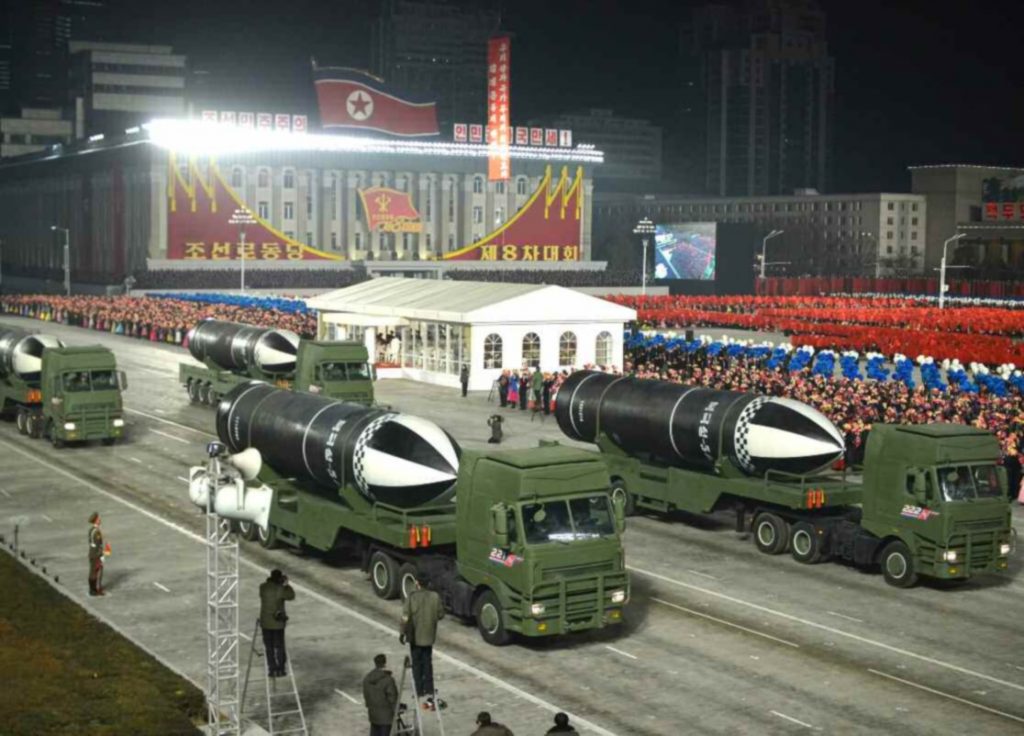
Figure 1. A new submarine-launched ballistic missile (SLBM), Pukguksong-5, which is under development and yet to be tested, was presented on January 14 in a military parade.
Toyota will pay a penalty of $180 million for failing to comply with the Clean Air Act’s emissions-reporting requirements from 2005-2015, according to a filing today by the US Department of Justice.
Over that time period, Toyota delayed required filings about emissions defects and failed to inform the EPA about progress on recalls related to emissions defects. This resulted in higher emissions, higher costs for consumers, and greater profit for Toyota.
Web frameworks are a double edged sword. They are, as a rule, bloated, complicated, opinionated and powerful. You can get a lot done, so long as you stick to the framework's "happy path", and while you can wander off and probably make it work, there be dragons. You also run into a lot of developers who, instead of learning the underlying principles, just learn the framework. This means they might not understand broader web development, but can do a lot with Angular.
And then you might have developers who don't understand broader web development or the framework they're using.
Dora has someone on their team which meets that criteria.
The first sign there was a problem was this line in a view object:
First off, ng-disabled adds the disabled attribute to the DOM element, which doesn't do anything to anchor tags. The goal here is to disable the "save" button if there are validation errors, and already the goal has been missed. However, that's not the weirdest part of this. Angular provides loads of helper variables and functions, including a form.$invalid which helpfully tells you if there are validation errors. So where is $ctrl.numFormErrors coming from?
$scope.$watch("form.$error", function(errors) {
  $ctrl.numFormErrors = 0;
  $ctrl.fieldsWithErrors = [];
  _.forEach(errors, function (errs) {
    for (var i = 0; i < errs.length; i++) {
      if ($ctrl.fieldsWithErrors.indexOf(errs[i].$name) < 0) {
        $ctrl.fieldsWithErrors.push(errs[i].$name);
        $ctrl.numFormErrors++;
      }
    }
  });
}, true);
Oh, that's simple enough. So much clearer than using the built in form.$invalid.
If you're not "up" on Angular, and without diving too deep on the mechanics, $scope.$watch registers a callback: every time form.$error changes, we invoke this function. In this callback, we clear out our $ctrl.numFormErrors and $ctrl.fieldsWithErrors. The keys of errors are validation failures, like maxlength and pattern, so we use the lodash library to forEach through each of those keys.
The values are arrays of which fields have the given error, so we for loop across errs (I guess we didn't want to use lodash again?). If we haven't already tracked an error for the field with this $name, we add it to our array and increment the numFormErrors field.
Now, every time the user edits the form, we'll have a list of exactly which fields are invalid, and an exact count about how many there are. That's not something Angular makes obvious, so we've accomplished something, right?
Well, the only problem is that this code never actually uses $ctrl.fieldsWithErrors and it only ever checks if $ctrl.numFormErrors > 0, so no- we didn't need to do any of this.
Dora threw out the $watch and just replaced the anchor with a button done the "Angular" way:
The Landmarks Preservation Commission has approved proposals to construct a glass-clad rooftop addition at 13 Harrison Street in Manhattan. The property is located within the TriBeCa West Historic District and thus required certificate of appropriateness from the voting commissioners.
CIC Services v. Internal Revenue Service is one of the rare tax cases to come before the Supreme Court. While apparently technical, the case has great implications for jurisdiction, administrative law and the tax system overall. The stakes in the case, which will be argued on Tuesday, are about how the government implements a tax code that affects numerous policy spheres outside of mere revenue-raising and how it can fight tax shelters.
At the heart of the case are two competing laws. First is the Anti-Injunction Act, which states that “no suit for the purpose of restraining the assessment or collection of any tax shall be maintained in any court by any person, whether or not such person is the person against whom such tax was assessed.” The AIA, along with the tax exception to the Declaratory Judgment Act, typically means that taxpayers wishing to challenge a determination of federal tax must either receive a notice of deficiency and sue in the U.S. Tax Court, or exhaust administrative remedies and sue for a refund in either federal district court or the U.S. Court of Federal Claims.
But the AIA has started to clash with the Administrative Procedure Act. In its 2011 decision in Mayo Foundation for Medical Education and Research v. United States, the court determined that tax is not separate from the rest of administrative law, and it then evaluated a Treasury Department regulation under the deferential standard of review outlined in Chevron USA v. Natural Resources Defense Council. In pushing against tax exceptionalism in administrative action, the court in Mayo held that the actions of the IRS also fell under the standards outlined in the APA. Under the APA, there is a presumption of pre-enforcement review of agency actions – meaning that individuals or businesses affected by an agency action can normally challenge the action in court before it is enforced against them.
This case presents this very clash. CIC Services is a Tennessee company that advises other companies on the practice of “captive insurance” – an arrangement in which a parent company creates a subsidiary insurance company for the purpose of insuring the risk of its owners. CIC sued the IRS seeking an injunction under the APA against a 2016 guidance, known as Notice 2016-66, that made certain micro-captive insurance transactions “reportable transactions.” Under the tax code and Treasury regulations, the IRS can issue notices identifying certain transactions that the agency suspects may be used for tax shelters as reportable transactions. If a transaction is reportable, parties involved in it and their material advisers must provide certain information to the IRS, including the advisers’ client lists. Failure to adhere to these requirements results in penalties under the Internal Revenue Code. Importantly, these penalties, which are found in 26 U.S.C. Chapter 68, Subchapter B, are treated as taxes and have traditionally been viewed as taxes for the purposes of the AIA. Additionally, if the failure to report was criminally willful, criminal sanctions may also arise.
CIC argued that it suffered harm from the reporting requirements and that Notice 2016-66 was issued in violation of the APA, because the agency did not hold a public notice-and-comment period before issuing the guidance and because the guidance was arbitrary and capricious — the standard under the APA for when courts must set aside agency actions. But the district court dismissed the case, ruling that the suit was barred by the AIA. CIC appealed to the U.S. Court of Appeals for the 6th Circuit, which affirmed.
In its briefing at the Supreme Court, CIC has three major arguments: (1) a textual argument regarding the AIA, (2) a purpose-based argument regarding both the APA and the AIA, and (3) constitutional concerns with the AIA as interpreted by the lower courts.
The thrust of CIC’s textual argument is that the text of the AIA does not cover the suit at hand. CIC relies on Direct Marking Association v. Brohl, which addressed the Tax Injunction Act, the AIA sister’s statue for state taxes. The TIA says that federal courts “shall not enjoin, suspend or restrain the assessment, levy or collection of any tax under State law where a plain, speedy and efficient remedy may be had in the courts of such State.” At issue in Direct Marketing was a Colorado requirement that out-of-state retailers report sales to Colorado residents so the state could collect sales and use taxes. Failure to do so would result in a penalty. The Supreme Court held that the TIA did not limit federal courts’ jurisdiction over the Colorado reporting requirement because the requirement was prior to and separate from “assessment, levy or collection.” The court also narrowly interpreted the TIA’s use of the word “restrain.”
CIC argues that because the TIA is a related statute and relies on federal tax law principles for its interpretation, the AIA should be similarly construed. The IRS requirement is but a reporting requirement prior to assessment or collection, and “restrain” should be interpreted narrowly, so that CIC’s pre-enforcement suit is not barred by the AIA.
CIC makes two additional textual arguments. First, the company insists it is not seeking to “enjoin” any tax, even though the penalty for noncompliance with Notice 2016-66 is considered a tax for the purpose of the AIA. The main point is that, because CIC has not yet violated any law, there is no act of assessment to restrain. Any future penalty assessed by the IRS would be merely discretionary and would apply only after the action. Second, CIC points out that it did not bring suit for the purpose of restraining the assessment or collection of the tax. Rather the suit merely challenges the validity of Notice 2016-66.
Regarding the purpose of the APA and the AIA, CIC argues that if a penalty is styled as a tax under Subchapter 68B, then the APA is essentially vitiated for most IRS regulations because pre-enforcement review will be generally unavailable. That means that the only way to challenge an IRS reporting requirement would be to first violate the requirement – which in turn undermines the purpose of the AIA to have taxpayers comply with the tax laws.
Finally, CIC argues that a broad interpretation of the AIA raises constitutional concerns. The only way to get into court to challenge Notice 2016-66 is to violate the law. If that is done willfully, then there are criminal sanctions.
The government provides three arguments as to why the AIA should bar the suit: (1) a textual argument that examines the AIA in the broader statutory context of the tax code, (2) an argument that defanging Notice 2016-66 would essentially stop the assessment and collection of a tax, and (3) a rejection of CIC’s arguments regarding the purpose of the APA and its constitutional concerns.
The government argues that the text of the AIA and its statutory context show that CIC’s suit is one seeking to restrain the assessment or collection of a tax. Overall, one must read the AIA in context with the tax code. While the AIA prohibits pre-enforcement injunctive relief, Congress has explicitly provided the refund suit mechanism as a way to challenge IRS actions. In context, then, the AIA serves as a channeling mechanism to the refund litigation scheme. Additionally, Congress is quite explicit as to when it wants to provide an exception to the AIA, and it did not do so here. Furthermore, the government maintains that this case must be about restraining the assessment of taxes. The court has repeatedly held that the penalties in Subchapter 68B are taxes because they are keyed to either the apparent tax savings from a tax-evading transaction or the likely income of a material adviser providing a client with these types of transactions.
The government then rejects CIC’s textual arguments. It distinguishes the penalty for failure to report in Direct Marketing from the penalty at issue here. To do so, the government cites a concurring opinion from Justice Ruth Bader Ginsburg in Direct Marketing as well as a 2015 opinion from the U.S. Court of Appeals for the District of Columbia Circuit in Florida Bankers Association v. Department of the Treasury. In Florida Bankers, banks sued to enjoin another reporting requirement backed up by Subchapter 68B penalties. A split panel of the D.C. Circuit found the fact that the penalties were taxes was significant: Enjoining the reporting requirement in Florida Bankers would essentially stop the collection of the taxes. The government’s main point is that here, too, enjoining Notice 2016-66 would enjoin the collection of penalties that are, in fact, taxes. The government notes that Florida Bankers made clear that merely challenging the regulatory aspects of a tax does not allow it to evade the AIA.
Finally, the government rejects CIC’s APA and constitutional avoidance arguments. The APA explicitly allows for an override of pre-enforcement review by other statutes precluding judicial review — and the AIA is one such statute. Furthermore, the APA does not authorize a review where there is another adequate remedy in court, and the refund suit procedures are that remedy. On the constitutional avoidance front, the government notes that if one has a good-faith belief that the IRS promulgated Notice 2016-66 improperly, then one can disclose the belief and avoid criminal sanction.
Besides the parties’ arguments, two amicus briefs are worth noting because they provide important policy context. Arguing in favor of CIC is Professor Kristin Hickman. She suggests that the IRS and the Treasury Department can no longer be treated as exceptional from general administrative law doctrine. In light of Mayo, tax exceptionalism should end. Indeed, ending tax exceptionalism is especially important since the IRS and Treasury have historically not followed notice-and-comment rulemaking procedures. Furthermore, Hickman says the imperative to narrow the AIA is even more important now because the tax system today regulates vast areas of life. The tax laws are no longer merely revenue raising, but rather affect policy spheres from health care to housing.
A brief in support of the government from former government officials, many of whom are now tax professors, provides, in sharper focus, the reason that Notice 2016-66 exists: It came about because of statutes and regulations designed to combat tax shelters. Reportable transactions are transactions used to create tax shelters and issuing subregulatory notices is the main way that the IRS identifies these transactions. Allowing broad pre-enforcement challenges to such notices would kneecap efforts by Congress and the IRS to fight these shelters. The brief also notes that, in particular, micro-captive transactions (which Notice 2016-66 targets) are the source of a great deal of abusive tax planning.
Finally, there is an interesting personnel point regarding both Direct Marketing and Florida Bankers, the two most prominent cases in the briefs. Direct Marketing, written by Justice Clarence Thomas, was unanimous. It reversed a decision by a unanimous panel of the U.S. Court of Appeals for the 10th Circuit. Then-Judge Neil Gorsuch was on that panel. Florida Bankers, on the other hand, was an opinion by a divided panel of the D.C. Circuit. Then-Judge Brett Kavanaugh authored that opinion.
Curtain wall installation has begun at 351 Marin Boulevard, a 383-foot-tall mixed-used development in Jersey City. Designed by Hollwich Kushner in collaboration with HLW International and developed in a joint venture between KRE Group and Northwestern Mutual, the 38-story project will yield 507 residential units, 8,000 square feet of commercial space, 203 parking spaces, and a 4,500-square-foot public plaza with a freestanding pavilion. The rectangular parcel is bound by Marin Boulevard to the east, 1st Street to the north, and Bay Street to the south, and low-rise buildings stand to the west.
Last night the Supreme Court declined to intervene in challenges by churches in southern California and the Chicago area to stay-at-home orders issued as a result of the COVID-19 crisis. The churches had asked the justices earlier this week to lift restrictions on crowds in time for them to hold services on Sunday, when Christians celebrate the holy day of Pentecost. But the justices turned them down. The court issued only a terse order in the Illinois case that referred to the new guidance issued by the state earlier this week. But the justices were closely divided in the California case, with Chief Justice John Roberts casting the deciding vote and writing a late-night opinion to explain his decision to deny relief.
The California case was filed on Tuesday by the South Bay United Pentecostal Church, which is located in Chula Vista, California – just south of San Diego. The church argued that the reopening plan outlined by California Governor Gavin Newsom and San Diego County discriminated against houses of worship by keeping them closed while allowing retail stores, offices, restaurants and schools to open. The church asked the justices to issue an order that would allow it to hold services this Sunday, May 31.
On Wednesday, two Romanian-American Christian churches in the Chicago area asked the justices to issue a similar order for them. The churches in that case argued that Illinois’ stay-at-home and reopening plan, which imposed a 10-person limit on worship services, violated the Constitution.
California (along with San Diego County) and Illinois urged the justices to deny the churches’ requests. They began by explaining that indoor worship services are different from retail stores or businesses because people are more likely to gather in close proximity for longer periods of time. Moreover, they added, the singing and speaking at worship services “increases the danger” that people who are infected with the COVID-19 virus will “project respiratory droplets that contain the virus,” passing the infection on to others. Indeed, they noted, there have been several examples of significant COVID-19 outbreaks linked to worship services.
But in any event, California and Illinois continued, there was no need for the justices to intervene because the restrictions had been lifted. In California, the San Diego County Health Department issued an order (following new guidance from the state) on May 26 that allows churches in the county, including South Bay, to hold services, as long as they limit attendance to 25 percent of their building capacity or a maximum of 100 people and practice social distancing. Although the church argues that it is also harmed by the new guidance, because its building seats 600 and its attendance is normally somewhere between 200 and 300, the state emphasized that the church had not asked for an order blocking the enforcement of the new guidance in the lower courts. Moreover, the state observed, the church could add more services if it wants to ensure that everyone can attend.
In Illinois, the order banning gatherings with more than 10 people expires on May 29; “after that date religious gatherings will no longer be subject to mandatory restrictions.” Any concerns about whether the state will limit the size of worship services after May 29 are, Illinois told the justices, merely “speculative.”
At approximately 6:30 p.m. ET, the justices turned down the request from the Illinois churches without any public dissents. In a brief two-paragraph order, the court noted that the state’s public health department had “issued new guidance on May 28,” and it added that last night’s order did not bar the churches from returning to the court “if circumstances warrant.”
The justices did not act on the California case until nearly midnight on Friday. Justices Clarence Thomas, Samuel Alito, Neil Gorsuch and Brett Kavanaugh indicated that they would have granted the church’s request; Kavanaugh also wrote a dissent from the denial of the church’s request.
Roberts wrote a short opinion to express his agreement with (and to explain) the denial of the church’s request. He began by noting that COVID-19 “has killed thousands of people in California and more than 100,000 nationwide,” but there is “no known cure, no effective treatment, and no vaccine.” Moreover, he added, people “may be infected but asymptomatic” and therefore can infect others unknowingly. The California order at the heart of this case, he observed, temporarily restricts the number of people who can gather in public “to address this extraordinary health emergency.”
The relief that the church had asked for – an order blocking the state from enforcing the restrictions on gatherings – faces a high bar, Roberts explained. And in his view, the church could not meet that bar. The restrictions appear to be constitutional: The state has limited the size of similar, non-religious gatherings like plays, concerts and sporting events. Although the state treats activities like grocery stores and banks differently, Roberts continued, those activities are in fact different, because they do not involve large groups of people coming together in close proximity for extended periods of time. “The precise question of when restrictions on particular social activities should be lifted during the pandemic,” Roberts reasoned, “is a dynamic and fact-intensive matter subject to reasonable disagreement.” It is also a question the Constitution has primarily delegated to politicians, which courts should normally not second-guess. “That is especially true,” Roberts explained, in a case like this one, in which the church is seeking emergency relief “while local officials are actively shaping their response to changing facts on the ground.” The idea that it is so clear that the restrictions are unconstitutional that the Supreme Court should step in, Roberts concluded, “seems quite improbable.”
In a three-page dissent joined by Thomas and Gorsuch, Kavanaugh argued that the restrictions on attendance imposed on the church do violate the Constitution. In his view, the businesses that are not subject to the restrictions – which, he noted, include malls, pet groomers, hair salons and marijuana dispensaries – are comparable to gatherings at houses of worship, and California has not shown a good reason for treating houses of worship differently. Because the church “would suffer irreparable harm from not being able to hold services on Pentecost Sunday in a way that comparable secular businesses and persons can conduct their activities,” Kavanaugh would have granted the church’s request for relief.
The eastern redbud (Cercis canadensis) is in bloom. The delicate haze of this small understory tree belies its hardiness. Tolerant of city conditions and deer, it can be grown as far north as Zone 4.
Generally referred to as redbud, sometimes cercis, it is known for its habit of squeezing flowers right out of the bark even on sizeable branches (see below).
Cercis canadensis, commonly called eastern redbud, is a deciduous, often multi-trunked understory tree with a rounded crown that typically matures to 20-30’ tall with a slightly larger spread. It is particularly noted for its stunning pea-like rose-purple flowers which bloom profusely on bare branches in early spring (March-April) before the foliage emerges.
If you are lucky enough to visit the Smoky Mountains some day during spring, this is the lacy pink that blends with the famous dogwoods, all native to the area.
The Supreme Court declined to intervene today in a lawsuit filed by a group of 21 children and teenagers who allege that they have a constitutional right to a “climate system capable of sustaining human life.” The federal government had asked the justices to put discovery and a trial, currently scheduled for late October, on hold until the U.S. Court of Appeals for the 9th Circuit can rule on the government’s petition asking the appeals court to direct a federal district court to dismiss the case or, at a minimum, to stay discovery and the trial. But even as they stayed out of the dispute for now, the justices expressed some skepticism about the sweeping nature of the plaintiffs’ claims.
In the lawsuit, which was originally filed in 2015 against the Obama administration, the group contends that the federal government’s actions are causing a “dangerous climate system,” and it seeks (among other things) an order that would require the government to prepare and implement a remedial plan to phase out the use of CO2 emissions. The district court has allowed the lawsuit to go forward, and the 9th Circuit has thus far refused to step in.
On July 17, the federal government, in a brief signed by U.S. Solicitor General Noel Francisco, asked the Supreme Court to intervene. Francisco told the justices that, if either the court of appeals or the Supreme Court does not step in, the government “will be forced to participate in a highly compacted period of discovery and trial preparation followed by a 50-day trial, all of which will itself violate bedrock limitations on agency decisionmaking and the judicial process imposed by” federal law and the separation of powers. Moreover, Francisco added, because the plaintiffs are arguing that they have been harmed by “the cumulative effects of CO2 emissions from every source in the world over decades,” there would be no real harm from waiting a short time for the 9th Circuit to rule.
This afternoon the Supreme Court rejected the government’s request, calling it “premature.” But the court left open the possibility that the government could return with a similar request at a later stage in the proceedings. It also described the “breadth” of the plaintiffs’ claims as “striking,” observing that there are “substantial grounds for difference of opinion” on whether those claims belong in court at all. The justices instructed the federal district court to “take these concerns into account in assessing the burdens of discovery and trial, as well as the desirability of a prompt ruling on the” federal government’s other pending motions, which could result in dismissal of some or all of the plaintiffs’ claims.
However the Supreme Court decides the travel ban case in the next 10 days, it may well avoid taking a position on one of the numerous issues raised in that litigation — whether the district court in Trump v. Hawaiilacked the authority to issue a nationwide injunction. But the justices may not be able to duck the broader debate over the propriety of nationwide injunctions for much longer, thanks to an unusual application for a “partial” stay filed by Solicitor General Noel Francisco on Monday in Sessions v. City of Chicago.
The City of Chicago case is one of several pending challenges to actions taken by Attorney General Jeff Sessions under Executive Order 13,768, which provides that certain “sanctuary jurisdictions” that refused to comply with some immigration enforcement measures would not be “eligible to receive Federal grants, except as deemed necessary for law enforcement purposes” by the attorney general or secretary of Homeland Security. As relevant here, the city of Chicago sued challenging conditions that the attorney general subsequently imposed under the executive order on receipt of funds under the Edward Byrne Memorial Justice Assistance Grant Program, claiming that they were both unlawful and unconstitutional.
The U.S. District Court for the Northern District of Illinois agreed with the city with respect to two of the three challenged conditions — the “notice” condition, which requires advance notice to federal authorities of the release date of persons in state or local custody who are believed to be noncitizens, and the “access” condition, which requires local correctional facilities to provide access to federal agents to meet with those persons. Both of those conditions, the district court ruled, could not be traced to any statutory authority, and therefore exceeded the attorney general’s authority to impose unilaterally. And because of considerations the district court deemed unique to immigration law, not only did Judge Harry Leinenweber enjoin the attorney general from continued enforcement of the conditions against the city of Chicago, but he issued the injunction on a nationwide basis.
After refusing to stay the injunction pending appeal, a three-judge panel of the U.S. Court of Appeals for the 7th Circuit affirmed in April 2018, unanimously concluding that no statute granted the attorney general the authority to impose the “notice” and “access” conditions. As for the nationwide scope of the district court’s injunction, a majority of the 7th Circuit panel stressed that “nationwide injunctions should be utilized only in rare circumstances,” but concluded that the city’s suit was one such circumstance, because “[t]he case presents essentially a facial challenge to a policy applied nationwide, the balance of equities favors nationwide relief, and the format of the Byrne JAG grant itself renders individual relief ineffective to provide full relief.” Judge Daniel Manion dissented only with respect to the nationwide nature of the injunction. As he wrote, “Other jurisdictions that do not want to comply with the Notice and Access conditions were not parties to this suit, and there is no need to protect them in order to protect Chicago.”
The government sought en banc rehearing of the panel decision only with respect to the nationwide scope of the injunction, and a stay of that aspect of the injunction (but not the injunction itself) pending disposition of its petition. On June 4, the 7th Circuit granted rehearing en banc “only as to the geographic scope of the preliminary injunction entered by the district court,” but deferred the government’s request for a ruling on its application for a stay until the Supreme Court decided the travel ban case, which “may facilitate our disposition of the pending motions.”
Given the full 7th Circuit’s refusal to rule immediately on the stay application, the solicitor general on Monday filed an application for a partial stay directly with Justice Elena Kagan, in her capacity as Circuit Justice for the 7th Circuit. The application asks Kagan to stay the nationwide scope of the district court’s injunction pending the en banc 7th Circuit’s disposition of the government’s petition for rehearing — which looks like it will be argued later this summer — and, “if necessary, pending the filing and disposition of a petition for a writ of certiorari and further proceedings in this Court.” Later on Monday, Kagan ordered a response to the application — by 5:00 p.m. on Wednesday, June 27 (by which point the Supreme Court may well have decided the travel-ban case).
Thus, although the government is not challenging the substance of the district court’s injunction, it appears willing to use that injunction as a vehicle to challenge the propriety of nationwide injunctions more generally — perhaps more so than in the travel ban or DACA litigation. Whether the justices are interested in such a challenge (especially in a case in which the government may be all-but conceding the weakness of its position on the merits) remains to be seen.
How has there never been a witch or wizard who decided to become a crime fighting vigilante? How cool would that be?
Sure there are some in Muggle pop culture, but are you honestly telling me on the magic side of things it’s not a common story idea? I guess the ministry would be on them in an instant, but still… I’d love to see a dude running around in a cape and mask launching spells at bad guys!
First, a little background: You’ve probably heard of the star KIC 8462852 (though maybe by it’s nickname, Tabby’s Star, after Tabetha Boyajian, the woman who led the team that discovered its behavior). It’s the star that got a lot of press late last year because it was acting funny. Astronomers poking through the observations of the star by the Kepler spacecraft found it was undergoing a series of apparently random dips in brightness. Some of these dips were serious, with the amount of starlight dropping a staggering 22 percent.
That’s a lot. It couldn’t be a planet passing in front of the star, because the dips weren’t periodic, and the amount of starlight blocked is different every time. Plus, even a planet as big as Jupiter (which is about as big as planets can get) would block less than 1 percent of the star’s light at best.
In the original paper, Boyajian and her team make a good case that the dips are not caused by some odd thing going on in the data themselves or in their analysis of them. Whatever is going on, it’s real. They go through a bunch of possible scenarios that might be causing the dips and wind up eliminating most of them. The most likely scenario, they conclude, is that there is a huge family of comets orbiting the star, and some of them collide to create huge debris clouds that block the starlight. As I explained in my original post, that explanation has problems, too.
That left some speculation about, um, aliens. While it’s incredibly unlikely, it does kinda fit what we’re seeing. An advanced civilization would have big energy requirements, and it would make sense to build huge structures around their star to capture as much light as possible for solar power. The dips in light we see are then these “megastructures” passing in front of the star (some people call this a Dyson swarm, a collection of enormous solar panels enclosing the star).
Because why not, some follow-up looking for alien signals was made, but no dice. That’s not terribly surprising. The idea that this is all due to aliens is a bit, um, out there.
But still, the star is weird. And we just found out it’s even weirder than we thought.
Bradley Schaefer is an astronomer at Louisiana State University. He’s a clever fellow and has a habit of thinking outside the box when it comes to astronomical mysteries. When it came to Tabby’s Star, Schaefer realized there might be older observations of it that could help inform its study.
He found that Tabby’s Star has been photographed more than 1,200 times as part of a repeated all-sky survey between the years 1890 and 1989. Using two different methods, he examined those observations and measured the star’s brightness over time.
What he found is rather astonishing: The star has been fading in brightness over that period, dropping by about 20 percent!
That’s … bizarre. Tabby’s Star is, by all appearances, a normal F-type star: hotter, slightly more massive, and bigger than our Sun. These stars basically just sit there and steadily turn hydrogen into helium. If they change, it’s usually on a timescale of millions of years, not centuries. Schaefer examined two other similar stars in the survey, and they remained constant in brightness over the same time period.
The long-term fading isn’t constant, either. There have been times where the star has dimmed quite a bit, then brightened up again in the following years. On average, the star is fading about 16 percent per century, but that’s hardly steady.
So it appears Tabby’s Star dims and brightens again on all kinds of timescales: hours, days, weeks, even decades and centuries.
Again. That’s bizarre. Nothing like this has ever been seen.
So what’s causing this? Well, think Occam’s razor. The simplest explanation is probably the best place to start, and in this case that means one thing is probably behind all this weird behavior. Schaefer looks into this in his paper and concludes that the comet family idea doesn’t explain all the behavior. It might explain the short-term dips (maybe, kinda) but are hugely unlikely to be behind the long-term fading. You’d need truly vast numbers of comets, and they’d have to be huge, much larger than reasonable. And they’d have to be slamming into each other just as we happen to be looking.
So, yeah. Unlikely.
Now, again, let me be clear. I am NOT saying aliens here. But, I’d be remiss if I didn’t note that this general fading is sort of what you’d expect if aliens were building a Dyson swarm. As they construct more of the panels orbiting the star, they block more of its light bit by bit, so a distant observer sees the star fade over time.
However, this doesn’t work well either. Why did the star dip so much in the 1910s, then regain brightness a few years later, for example? Also, blocking that much of the star over a century would mean they’d have to be cranking out solar panels. The star has a diameter about 1.6 times the Sun’s. To block 20 percent of its light would take solar panels equaling an area of over 750 billion square kilometers.
That’s 1,500 times the area of the entire Earth. Yikes.
And that’s only if they happened to place those panels perfectly between their star and us. More likely they would be in a ring or a sphere, so the actual area would be far, far larger. Several trillion square kilometers at least for a ring, and much more than that for a sphere.
That’s a heckuva long-term project.
So I’m still not saying aliens. But whatever it is behind this star’s peculiar behavior, it’s either something we’ve never seen before, something we have but that is on the extreme edge of what it can do, or perhaps more than one phenomenon acting together. I’ll admit, I’m scratching my head over this one.
The only thing I’m sure of? We need to keep observing this star. If there’s one thing scientists love, it’s a mystery.
Update, Jan. 18, 2016, at 19:00 UTC: This just occurred to me. In an earlier post I talked about and linked to an idea that the star is a rapid rotator, so it's squished through the poles. That can affect the light we see from it. If the star is also precessing—changing the direction in space where its axis is pointing—that would cause a slow change in brightness over time, too. Hmmm. I may have to email a few folks and see if this idea has some stickiness to it. EDITED TO ADD: The conversation is ongoing, but astronomer Jason Wright points out that my ideas probably don't work. Drat.
A simple mod that does exactly what it says on the tin: it adds a light source to every engine, and calculates the amount of light emitted based on the current thrust setting and the engine’s power. The mod will work with both stock engines and those added by other mods.
It’s a small effect that really adds to the experience of night time launches and in-space burns. Get on our forums to download Engine lighting.
Ah, Perl. Often derided as a "write-only language", Perl nevertheless enjoys somelevel of popularity among WTF-savvy workplaces. So when David inherited a codebase through the purchase of a company staffed entirely with, what he had dubbed "mentally challenged chimpanzees", it seemed only natural that the code was entirely in Perl.
Dealing with financial transactions is one of the key features required for any online shopping or banking applications, and as such, it's more or less a solved problem by now. So of course, the perl gurus at ChimpanCorp reinvented the wheel with their Real-time Financial Processing app. It would calculate the user's balance every ten minutes by compiling all data posted since the last calculation, leading to a balance that was never more than ten minutes out of date! Of course, that's as good as you can possibly get when the calculation takes nine minutes to run. Still, the client was wondering if maybe the could speed up the calculations so it could run, say, every five minutes? Or maybe, hypothetically speaking, immediately after every transaction?
David dug into the codebase, clocking various methods -- it was best to limit his exposure to the actual code as much as possible, given the warning labels attached to the documentation. Something about eye strain and fecal matter... In any event, he finally pinpointed one method that was taking seven minutes to run. If he could shave off a few minutes from that, they might be able to hit the mythical five-minute benchmark.
The code, of course, had to run twenty queries on un-indexed SQL; adding a few indexes removed two minutes from the runtime, which unfortunately wasn't quite enough. So he dug into the queries themselves, carefully commenting as he went, saving a few seconds here and there with better optimized joins. And then he came to this gem:
my $mysql = 'SELECT TOP (1) n = (ROW_NUMBER() OVER (ORDER BY number))-1 FROM [master]..spt_values ORDER BY n';
my $mysth = $dbh->prepare($sql);
$mysth->execute(1, 10);
while (my @row = $sth->fetchrow_array) {
   $OurZero= $row[0];
}
David laughed, replacing this with a simple "$OurZero = 0", and moved on. One query down, only nineteen more to optimize. Four hours later, he reached the bottom of the method. This was it, what the entire seven-minute runtime was calculating:
return ($ReturnValue * $OurZero);
David stared at the return value, then up at the method he'd been labouring to understand all day. Seven. Minutes. With a final sigh, he went to the calling function and replaced the execution with this super-optimized bit of perl:
if (1 == 2)
{
 #Only run this if you've lost your mind
 CalculateZero();
}
Just as he checked his revision into the repository, a coworker popped his head into David's cube. "David, you will not BELIEVE how they're calculating dates!" she gushed.
"Somehow, I suspect I will."
[Advertisement] BuildMaster is more than just an automation tool: it brings together the people, process, and practices that allow teams to deliver software rapidly, reliably, and responsibly. And it's incredibly easy to get started; download now and use the built-in tutorials and wizards to get your builds and/or deploys automated!
AutomateAllTheThings built a Kerbal EFT-1 and tried to launch it simultaneously with the launch of Orion. We mean tried. Can he stave off the sandman and make his launch happen? Find out here.
Ryke Longest is the Director of the Environmental Law and Policy Clinic and a Clinical Professor of Law at the Duke University School of Law.
On October 14, the Court will hear an original jurisdiction dispute between three states that share interests in the flows of the Republican River: Kansas, Colorado and Nebraska. Following passage of a congressionally approved compact, the states initiated litigation leading to a 2003 settlement stipulation. In next week’s case, the Justices will consider different views on the terms of the settlement stipulation and the appropriate remedies available.
Origins of the Republican River Compact
The Republican River begins in Colorado on the eastern side of the Rocky Mountains, then flows through part of Kansas. The river then crosses and into Nebraska before crossing back into Kansas, where it then turns southeasterly. In Junction City, Kansas, it joins with the Smoky Hill River to become the Kansas River, a tributary of the Missouri River.
More than 24,000 square miles of watershed on the Great Plains support the flow of the Republican River. This territory contains rich agricultural soils and relatively abundant average annual rainfall. During the Great Depression, the three states and the federal government planned to use the Republican River for water resource development. This area was at the western edge of the Great Plains Dust Bowl, which experienced horrific dust storms in 1934 through 1935 that carried tons of soil through the air as far as the Atlantic Ocean.
Federal relief programs were mobilized to help the residents respond to the terrible conditions. A devastating flood on the Republican River in 1935 hastened along state and federal planning to create both flood control and irrigation projects. Federal agencies endorsed the need for the projects as well as their feasibility, but the Bureau of Reclamation warned that they should not go forward until the three states entered into a compact.
The states had agreed to terms within a few years, but President Franklin Delano Roosevelt vetoed the first attempted compact in response to objections by federal agencies. On December 31, 1942, on their second attempt, the federal government and Colorado, Kansas, and Nebraska agreed to an interstate compact to allocate water flowing in the Republican River. This compact was then ratified by the state legislatures, approved by Congress and signed into law by the President on May 26, 1943. However, rather than resolving all controversy about water allocation between the parties, the compact merely moved the locus of the disputes. Since its signing, disputes between the states over water use focus on the compact’s terms.
Origin of disputes under the Compact
Flows in the Republican River have been declining for decades, with reduced flows in nearly all its tributaries. The reduced flows alarm farmers in all three states who rely on irrigation to keep crops at profitable yields. As the primary downstream users, Kansans look to the compact to protect them from overuse by upstream users. As the state with the largest allocation, Nebraskans look to the compact to protect their farmers from unreasonable demands from Kansans.
When use increases and flows decrease, disputes follow. As the aphorism often attributed to Mark Twain goes, “Whiskey is for drinking, but water is for fighting.” Disputes among users and their political leaders come quickly behind the spread of economic prosperity.
Under the compact, disputes first flow through the Republican River Compact Administration, which consists of one representative of each of the three states. Following ratification, all states needed to change water resource allocation laws within their respective states to ensure compliance with the new compact’s requirements. In 1945, Kansas enacted a statute that combined allocation of groundwater and surface water into a unified permitting system using prior appropriation principles. In Nebraska, allocation of groundwater remained subject to restriction by common law principles of reasonable use within the context of correlative rights as set forth in the 1933 case of Olson v. City of Wahoo. The state codified these principles in 1975 and later adjusted its groundwater law in 1996 with amendments under LB 108, promoted by Nebraska Governor Ben Nelson. Nebraska’s efforts under LB 108 were clearly designed to prevent allocation of groundwater in a way that causes violations of an interstate compact. Yet its critics maintain that these efforts hampered management by putting the fox in charge of the henhouse (local Natural Resource Districts).
Groundwater’s special place
When the compact was signed, one of its key purposes was to remove all causes that “might lead to controversies.” Yet, within its key terms lay the seed of controversy: the term “Virgin Water Supply.” It was defined as the “water supply within the Basin undepleted by the activities of man.” Nebraska interpreted the caveat “within the basin” to exclude groundwater pumping from the scope of activities that deplete the Virgin Water Supply. The compact defines “basin” as the “area naturally drained by the Republican River and its tributaries.” Nebraska’s argument unduly restricted the scope of the Virgin Water Supply by taking the groundwater that drains into the Republican River and its tributaries out of the compact.
In many places, the Republican River is a gaining stream, one where groundwater from alluvial and surficial aquifers seeps into the riverbed. Excluding groundwater from allocation formulas in a gaining stream will always lead to problems unless groundwater pumping from alluvial and surficial aquifers is completely prohibited. In a gaining stream system, these aquifers are just as important sources to stream flow as the surface tributaries. However, these flows are harder to measure, model, and quantify.
Litigation before the Supreme Court: Round I
In 1999, the Supreme Court granted Kansas’s motion for leave to file a bill of complaint. Kansas complained that Nebraska had violated the compact by allowing proliferation of thousands of groundwater wells that were connected to the Republican River. Kansas’s complaint asserted that Nebraska’s regulatory apparatus failed to prevent the violations into the future, and it asked for damages and a decree commanding Nebraska to meet its delivery obligations under the compact. Nebraska sought leave to file a motion to cismiss the complaint under Federal Rule of Civil Procedure 12(b)(6) and presented affirmative defenses to Kansas’s complaint. Nebraska’s Rule 12(b)(6) motion was limited to the question whether the compact applied to groundwater consumptive use within Nebraska. Colorado responded that groundwater from alluvial aquifers was included within the compact but groundwater from the deeper Ogallala aquifer was not. The Court appointed a special master to preside over the hearing, after which the special master’s report recommended that Nebraska’s motion be denied. In June 2000, the Supreme Court denied Nebraska and Colorado’s exceptions and sent the case back. Following a series of memoranda on various issues by the special master, the parties negotiated a settlement stipulation.
Republican River Compact settlement stipulation
The settlement stipulation imposed additional obligations on the parties beyond those required by the Compact itself. All parties waived any claims against each other arising prior to 2002, and the stipulation required a drilling moratorium on wells within the Republican River Basin. It also explicitly recognized that groundwater was a component of the Virgin Water Supply. Beyond that, the parties to the current dispute disagree about significant aspects of the settlement stipulation as well as the special master’s report. While the stipulation established that the scope of covered water was water originating in the basin, there arose a dispute over the method of accounting for “imported water” – water that was originally part of the neighboring Platte River Basin but now percolates into the Republican River. In places, this seeping imported water had raised the water table by ten feet. The special master has proposed changing the accounting procedure so that Nebraska may use water imported from the Platte. Kansas vehemently objects that this change violates the terms of the compact.
Each state will argue objections to the special master’s report. Expect to hear Kansas argue forcefully in favor of the Court strengthening its disgorgement remedies against Nebraska and requesting injunctive relief. Nebraska will argue that the special master’s disgorgement remedy was too harsh. Nebraska also admits that it overused its allocation for the year 1996, but that in so doing it did not violate the compact but took steps immediately thereafter to reduce consumptive use and to pay Kansas for its actual damages. Kansas also objects to the special master’s proposed amendment to the settlement stipulation, a remedy defended by Nebraska. Colorado will argue that the disgorgement is not allowed for unintentional violations by Nebraska and that the proposed award represents a windfall for Kansas. The Solicitor General will argue that the special master’s report falls within the scope of the broad discretion afforded the Supreme Court in fashioning remedies for breaches of compacts. He will defend the partial disgorgement remedy as protective against efficient breach concerns, but he will also argue against Kansas’s request for injunctive relief. It will be interesting to see whether the Court inquires about injunctive relief as a further protection against efficient breach concerns.

 [Advertisement]
Keep the plebs out of prod. Restrict NuGet feed privileges with ProGet. Learn more.
[Advertisement]
Keep the plebs out of prod. Restrict NuGet feed privileges with ProGet. Learn more.













 [Advertisement] BuildMaster is more than just an automation tool: it brings together the people, process, and practices that allow teams to deliver software rapidly, reliably, and responsibly. And it's incredibly easy to get started; download now and use the built-in tutorials and wizards to get your builds and/or deploys automated!

 Ah, Perl. Often derided as a "write-only language", Perl nevertheless enjoys some level of popularity among WTF-savvy workplaces. So when David inherited a codebase through the purchase of a company staffed entirely with, what he had dubbed "mentally challenged chimpanzees", it seemed only natural that the code was entirely in Perl.


