07 Nov 12:26
by Shun Omagari, Takayuki Nakanishi, Yuichi Hirai, Yuichi Kitagawa, Tomohiro Seki, Koji Fushimi, Hajime Ito, Yasuchika Hasegawa
Phonons are important in energy transfer for compensating the energy mismatch between a donor and an acceptor. In inorganic hosts doped with lanthanides, phonon-assisted energy transfer can lead to quenching by a direct transfer of the energy to the phonon mode of the acceptor lanthanide. We demonstrate that this also applies to lanthanide coordination polymers and is the reason for the weak concentration quenching in this type of material. [YbxGd1–x(hfa)3dpbp]n [x = 0.001, 0.005, 0.01, 0.05, 0.1, 0.5, 1; hfa: hexafluoroacetylacetonate, dpbp: 4,4′-bis(diphenylphosphoryl)biphenyl] coordination polymers have been synthesized and their photophysical properties investigated. The single-exponential emission lifetimes of Yb3+ gradually decreased with increasing concentration of Yb3+. Qualitative agreement was achieved between the experimental and theoretical lifetimes by using the phonon-assisted energy-transfer-induced quenching model, which indicates that the origin of the concentration quenching in the coordination polymers is phonon-assisted energy transfer.

Lanthanide coordination polymers with various concentrations of Yb3+ have been synthesized to investigate the concentration-quenching mechanism. Experimental and theoretical considerations showed that concentration quenching occurs by nonradiative phonon-assisted energy-transfer relaxation.
07 Nov 12:04
Chem. Sci., 2017, Advance Article
DOI: 10.1039/C7SC03463F, Edge Article

Open Access
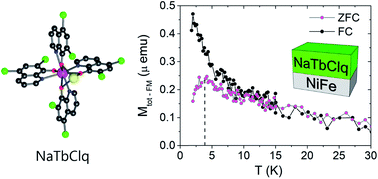
Sara G. Miralles, Amilcar Bedoya-Pinto, Jose J. Baldovi, Walter Canon-Mancisidor, Yoann Prado, Helena Prima-Garcia, Alejandro Gaita-Arino, Guillermo Minguez Espallargas, Luis E. Hueso, Eugenio Coronado
Magnetic analogues of Alq3 give rise to molecular/ferromagnetic interfaces with specific hybridization, opening the door to interesting spintronic effects.
To cite this article before page numbers are assigned, use the DOI form of citation above.
The content of this RSS Feed (c) The Royal Society of Chemistry

16 Oct 13:01
by Nan Wang, Mingfeng Hu, Soren K. Mellerup, Xiang Wang, Françoise Sauriol, Tai Peng and Suning Wang

Inorganic Chemistry
DOI: 10.1021/acs.inorgchem.7b01535

16 Oct 13:01
by Yoji Horii, Yusuke Horie, Keiichi Katoh, Brian K. Breedlove and Masahiro Yamashita

Inorganic Chemistry
DOI: 10.1021/acs.inorgchem.7b02124

16 Oct 13:00
by Max Mörtel, Alexander Witt, Frank W. Heinemann, Sebastian Bochmann, Julien Bachmann and Marat M. Khusniyarov

Inorganic Chemistry
DOI: 10.1021/acs.inorgchem.7b01952

16 Oct 12:09
by Nathan Man-Wai Wu, Maggie Ng, Wai Han Lam, Hok-Lai Wong and Vivian Wing-Wah Yam

Journal of the American Chemical Society
DOI: 10.1021/jacs.7b08333

16 Oct 12:08
by Christian Petermayer, Stefan Thumser, Florian Kink, Peter Mayer and Henry Dube

Journal of the American Chemical Society
DOI: 10.1021/jacs.7b07531

Carlos and -1 others like this
12 Oct 11:15
by Chung-Yang Huang, Aurelio Bonasera, Lachezar Hristov, Yves Garmshausen, Bernd M. Schmidt, Denis Jacquemin and Stefan Hecht

Journal of the American Chemical Society
DOI: 10.1021/jacs.7b08726

10 Oct 10:52
Dalton Trans., 2017, 46,14812-14825
DOI: 10.1039/C7DT02717F, Paper
C. D. Polyzou, E. S. Koumousi, Z. G. Lada, C. P. Raptopoulou, V. Psycharis, M. Rouzieres, A. C. Tsipis, C. Mathoniere, R. Clerac, S. P. Perlepes
Single-molecule magnet properties are "switched on" within a family of isostructural dinuclear cobalt(III)/dysprosium/2-pyridyloximate complexes.
The content of this RSS Feed (c) The Royal Society of Chemistry

10 Oct 10:44
by Sanping Chen
Abstract
Taking advantage of the steric hindrance and charge-driving effects, four air-stable pentagonal bipyramidal mononuclear DyIII compounds were hydrothermally synthesized. With a tetradentate ligand, N,N′-bis(2-methylenepyridinyl)ethylenediamine (Bpen), invariably coordinates to DyIII in an equatorial plan, 1–3 achieve an orderly transformation of the ligand field by sequentially replacing the remaining sites of the DyIII ion. Compound 4 possesses the same coordination atoms but a different peripheral coordination sphere with 3. Magnetic characterizations display that the compounds are field-induced single-ion magnets (SIM) with actually low barriers, even though 2 has both the same atoms and a similar geometry of the first sphere compared with [Dy(bbpen)Cl] (2′, H2bbpen=N,N′-bis(2-hydroxybenzyl)-N,N′-bis(2-methylpyridyl)ethylenediamin), a high-performance SIM previously reported. Detailed ab initio calculations have been employed to further elucidate the electronic and magnetic structure of the low-lying energy levels of compounds 1–4 and 2′. The theoretical results indicate there is an apparent difference in the electronic structure for these compounds. The analysis on the electrostatic potential further demonstrates that although the pentagonal bipyramidal D5h is one of the ideal configurations expected, the electron density of the donor atoms from the different hybridizations and other functional groups, outside the first sphere, should also be considered in the rational design of promising molecular magnets.

A detailed comparison of the structural and magnetic properties in a series of D5h symmetry DyIII SIMs suggests that the electron density affected by different hybridization of donor atoms and other functional groups outside the first sphere remarkably influence the axiality of the KDs and the magnetic relaxation behaviors (see figure)
10 Oct 10:26
by Tharushi A. Perera, Eric W. Reinheimer and Todd W. Hudnall

Journal of the American Chemical Society
DOI: 10.1021/jacs.7b09264

10 Oct 10:24
by Yueqi Li, Naomi L. Haworth, Limin Xiang, Simone Ciampi, Michelle L. Coote and Nongjian Tao

Journal of the American Chemical Society
DOI: 10.1021/jacs.7b08239

31 Aug 14:48
by Jianfeng Wu, Olivier Cador, Xiao-Lei Li, Lang Zhao, Boris Le Guennic and Jinkui Tang

Inorganic Chemistry
DOI: 10.1021/acs.inorgchem.7b01582

22 Aug 07:38
by Dong-Qing Wu, Dong Shao, Xiao-Qin Wei, Fu-Xing Shen, Le Shi, David Kempe, Yuan-Zhu Zhang, Kim R. Dunbar and Xin-Yi Wang

Journal of the American Chemical Society
DOI: 10.1021/jacs.7b07008

08 Aug 12:25
Chem. Sci., 2017, 8,6051-6059
DOI: 10.1039/C7SC02832F, Edge Article
Open Access
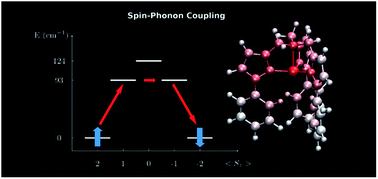
Alessandro Lunghi, Federico Totti, Stefano Sanvito, Roberta Sessoli
The design of slow relaxing magnetic molecules requires the optimization of internal molecular vibrations to reduce spin-phonon coupling.
The content of this RSS Feed (c) The Royal Society of Chemistry

08 Aug 12:16
by Adarshi Welegedara, Yin Yang, Michael Lee, James Swarbrick, Thomas Huber, Bim Graham, Daniella Goldfarb, Gottfried Otting
Abstract
Double-arm cyclen-based Gd3+ tags are shown to produce accurate nanometer scale Gd3+–Gd3+ distance measurements in double electron–electron resonance (DEER) experiments by confining the space accessible to the metal ion. The results show excellent agreement with predictions both for the maximum and width of the measured distance distributions. For distance measurements in proteins, the tags can be attached to two cysteine residues located in positions i and i+4, or i and i+8, of an α-helix. In the latter case, an additional mutation introducing an aspartic acid at position i+4 achieves particularly narrow distribution widths. The concept is demonstrated with cysteine mutants of T4 lysozyme and maltose binding protein. We report the narrowest Gd3+–Gd3+ distance distributions observed to date for a protein. By limiting the contribution of tag mobility to the distances measured, double-arm Gd3+ tags open new opportunities to study the conformational landscape of proteins in solution with high sensitivity.

Metal on a tether: Double-arm cyclen-based Gd3+ tags confine the space accessible to the metal ion (see figure) and produce accurate nanometer scale Gd3+–Gd3+ distance measurements by double electron-electron resonance (DEER) experiments, which show excellent agreement with predictions both for the maximum and width of the measured distance distributions. This research opens new opportunities to study the conformational landscape of proteins in solution.
08 Aug 12:09
by Chamika U Lenora, Fabio Carniato, Yimin Shen, Zahid Latif, E. Mark Haacke, Philip D Martin, Mauro Botta, Matthew John Allen
Abstract
EuII-containing complexes were studied with respect to properties relevant to their use as contrast agents for magnetic resonance imaging. The influences of molecular parameters and field strength on relaxivity were studied for a series of EuII-containing cryptates and their adducts with β-cyclodextrins, poly-β-cyclodextrins, and human serum albumin. Solid- and solution-phase characterization of EuII-containing complexes is presented that demonstrates the presence of inner-sphere molecules of water. Additionally, relaxivity, water-exchange rate, rotational correlation time, and electronic relaxation times were determined using variable-temperature 17O NMR, nuclear magnetic relaxation dispersion, and electron paramagnetic resonance spectroscopic techniques. These results are expected to be instrumental in the design of future EuII-based contrast agents.

Agents from the crypt: EuII-containing cryptates were studied as contrast agents. The relationship between relaxivity, field strength, and molecular parameters for EuII-containing cryptates are discussed using Solomon–Bloembergen–Morgan theory (see figure).
20 Jul 10:29
by Takashi Kajiwara

The right environment: The remarkable properties of a recently reported holmium(III)-based single-ion magnet have been ascribed to the hyperfine interactions with the half-integer nuclear spin in combination with the pentagonal-bipyramidal coordination environment. These results provide insight into the complicated magnetic properties of nanosized magnetic materials.
30 Jun 13:35
by Sourav Biswas, Kochan S. Bejoymohandas, Sourav Das, Pankaj Kalita, Mundalapudi L. P. Reddy, Itziar Oyarzabal, Enrique Colacio and Vadapalli Chandrasekhar

Inorganic Chemistry
DOI: 10.1021/acs.inorgchem.7b00689

22 Jun 10:09
by Shan-Shan Liu, Yin-Shan Meng, Yi-Quan Zhang, Zhao-Sha Meng, Ke Lang, Zhen-Liang Zhu, Chang-Fang Shang, Bing-Wu Wang and Song Gao

Inorganic Chemistry
DOI: 10.1021/acs.inorgchem.7b00952

20 Jun 11:12
by Richard Layfield, Fu-Sheng Guo, Benjamin Day, Yan-Cong Chen, Ming-Liang Tong, Akseli Mansikamäkki
Abstract
Abstraction of a chloride ligand from the dysprosium metallocene [(Cpttt)2DyCl] (1Dy Cpttt=1,2,4-tri(tert-butyl)cyclopentadienide) by the triethylsilylium cation produces the first base-free rare-earth metallocenium cation [(Cpttt)2Dy]+ (2Dy) as a salt of the non-coordinating [B(C6F5)4]− anion. Magnetic measurements reveal that [2Dy][B(C6F5)4] is an SMM with a record anisotropy barrier up to 1277 cm−1 (1837 K) in zero field and a record magnetic blocking temperature of 60 K, including hysteresis with coercivity. The exceptional magnetic axiality of 2Dy is further highlighted by computational studies, which reveal this system to be the first lanthanide SMM in which all low-lying Kramers doublets correspond to a well-defined MJ value, with no significant mixing even in the higher doublets.

SMMashing: A dysprosium(III) metallocenium cation is a single-molecule magnet (SMM) with a record anisotropy barrier of 1277 cm−1 and record magnetic blocking up to 60 K, including hysteresis with coercivity.
19 Apr 11:20
by Marco Leonzio, Andrea Melchior, Georgina Faura, Marilena Tolazzi, Francesco Zinna, Lorenzo Di Bari and Fabio Piccinelli

Inorganic Chemistry
DOI: 10.1021/acs.inorgchem.7b00430

19 Apr 11:15
by Kwang Soo Lim, José J. Baldoví, ShangDa Jiang, Bong Ho Koo, Dong Won Kang, Woo Ram Lee, Eui Kwan Koh, Alejandro Gaita-Ariño, Eugenio Coronado, Michael Slota, Lapo Bogani and Chang Seop Hong

Inorganic Chemistry
DOI: 10.1021/acs.inorgchem.6b03118

05 Apr 08:23
by Eva Lucaccini, José J. Baldoví, Laura Chelazzi, Anne-Laure Barra, Fabrizia Grepioni, Jean-Pierre Costes and Lorenzo Sorace

Inorganic Chemistry
DOI: 10.1021/acs.inorgchem.7b00413

04 Apr 12:34
Phys. Chem. Chem. Phys., 2017, 19,10820-10824
DOI: 10.1039/C7CP01025G, Communication
Stephane Isabettini, Marianne Liebi, Joachim Kohlbrecher, Takashi Ishikawa, Peter Fischer, Erich J. Windhab, Peter Walde, Simon Kuster
Generating lanthanide-chelating aminocholesterol-doped phospholipid bicelles with unprecedented magnetic alignment and tunable magnetic susceptibility.
The content of this RSS Feed (c) The Royal Society of Chemistry

03 Apr 12:06
by Yan-Cong Chen, Jun-Liang Liu, Wolfgang Wernsdorfer, Dan Liu, Liviu F. Chibotaru, Xiao-Ming Chen, Ming-Liang Tong

Suppression of quantum tunneling at zero field and field-induced quantum tunneling of magnetization are observed in an extremely rare holmium(III) single-ion magnet and discussed by J.-L. Liu, M.-L. Tong, and co-workers in their Communication on page 4996 ff. These dramatic dynamics are attributed to the combination of a favorable pentagonal-bipyramidal crystal-field environment and the hyperfine interactions arising from 165Ho (I=7/2) with a natural abundance of 100 %.
22 Mar 13:35
Phys. Chem. Chem. Phys., 2017, 19,9739-9744
DOI: 10.1039/C7CP00918F, Communication
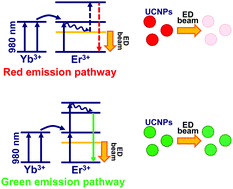
Kyujin Shin, Taeyoung Jung, Eunsang Lee, Gibok Lee, Yeongchang Goh, Junseok Heo, Minhyuk Jung, Eun-Jung Jo, Hohjai Lee, Min-Gon Kim, Kang Taek Lee
We demonstrated that the visible emission of NaYF4:Yb3+,Er3+ upconversion nanoparticles could be modulated by external emission depletion (ED), the efficiency of which was much higher for the red band than the green.
The content of this RSS Feed (c) The Royal Society of Chemistry

22 Mar 12:45
by Monu Kaushik, Mian Qi, Adelheid Godt, Björn Corzilius
Abstract
High-spin complexes act as polarizing agents (PAs) for dynamic nuclear polarization (DNP) in solid-state NMR spectroscopy and feature promising aspects towards biomolecular DNP. We present a study on bis(Gd-chelate)s which enable cross effect (CE) DNP owing to spatial confinement of two dipolar-coupled electron spins. Their well-defined Gd⋅⋅⋅Gd distances in the range of 1.2–3.4 nm allowed us to elucidate the Gd⋅⋅⋅Gd distance dependence of the DNP mechanism and NMR signal enhancement. We found that Gd⋅⋅⋅Gd distances above 2.1 nm result in solid effect DNP while distances between 1.2 and 2.1 nm enable CE for 1H, 13C, and 15N nuclear spins. We compare 263 GHz electron paramagnetic resonance (EPR) spectra with the obtained DNP field profiles and discuss possible CE matching conditions within the high-spin system and the influence of dipolar broadening of the EPR signal. Our findings foster the understanding of the CE mechanism and the design of high-spin PAs for specific applications of DNP.

Poles apart: Bis(Gd-chelate)s are investigated as polarizing agents for dynamic nuclear polarization (DNP). On varying the length of the linker between two chelated GdIII ions, a transition from the solid effect to the cross effect DNP mechanism is observed. The analysis of NMR signal enhancements for 1H, 13C, and 15N sheds light on the distance dependence between two electron spins for the cross effect.
15 Mar 19:26
by Yan-Cong Chen, Jun-Liang Liu, Wolfgang Wernsdorfer, Dan Liu, Liviu F. Chibotaru, Xiao-Ming Chen, Ming-Liang Tong
Abstract
An extremely rare non-Kramers holmium(III) single-ion magnet (SIM) is reported to be stabilized in the pentagonal-bipyramidal geometry by a phosphine oxide with a high energy barrier of 237(4) cm−1. The suppression of the quantum tunneling of magnetization (QTM) at zero field and the hyperfine structures originating from field-induced QTMs can be observed even from the field-dependent alternating-current magnetic susceptibility in addition to single-crystal hysteresis loops. These dramatic dynamics were attributed to the combination of the favorable crystal-field environment and the hyperfine interactions arising from 165Ho (I=7/2) with a natural abundance of 100 %.

An extremely rare non-Kramers holmium(III) single-ion magnet is reported. The suppression of the quantum tunneling of magnetization at zero field and the hyperfine structures were observed in AC magnetic susceptibility measurements, and were attributed to the combination of a favorable crystal-field environment and the hyperfine interactions arising from 165Ho (I=7/2) with a natural abundance of 100 %.
13 Mar 13:15
by Takuya Kanetomo, Takumi Kihara, Atsushi Miyake, Akira Matsuo, Masashi Tokunaga, Koichi Kindo, Hiroyuki Nojiri and Takayuki Ishida

Inorganic Chemistry
DOI: 10.1021/acs.inorgchem.6b02685