submitted by /u/iamcerberus to r/crypto
[link] [comments]
Heath Leach
Shared posts
26 Feb 18:59
BSides NOVA 2018 Videos
Link:http://www.irongeek.com/i.php?page=videos/bsidesnova2018/mainlist
These are the videos from BSides NOVA 2018. Thanks to those who manned the video rigs and helped set u
These are the videos from BSides NOVA 2018. Thanks to those who manned the video rigs and helped set u
Deep Dive in the Dark Web (OSINT Style)
Kirby Plessas
Adding Pentest Sauce to your Vulnerability Management Recipe
Luke Hudson, Andrew McNicol
The Value of Design in Cyber Threat Intelligence
Devon Rollins
DNC Hacked Data in the Hands of a Trained Intelligence Professional
Wally Prather, Dave Marcus
Your Facts Are Not Safe With Us: Russian Information Operations as Social Engineering
Meagan Keim
DECEPTICON: Deceptive Techniques to Derail OSINT attempts
Joe Gray
I Thought Renewing the Domain Name Was Your Job?
Allan Liska
Automating Unstructured Data Classification
Malek Ben Salem
Vulnerability Patched in Democratic Donor Database
Josh Lospinoso
Living in a world with insecure Internet of Things (IoT)
Marc Schneider
Vulnerability Accountability Levers and How You Can Use Them
Amelie Koran
Cyber Mutual Assistance - A New Model for Preparing and Responding to Cyber Attack
David Batz
Rethinking Threat Intelligence
Tim Gallo
What Color Is Your Cyber Parachute?
Cliff Neve, Candace King, Kazi Islam, Trey Maxam, Amelie Koran
Feds Meet Hackers
Ariel Robinson, Alyssa, Feola, Gray Loftin, Beau Woods, Amélie E. Koran
How to get started in Cybersecurity
John Stoner
Improving Technical Interviewing
Forgotten Sec
21 Feb 22:58
submitted by /u/ingl0ri0usandr0id to r/securityCTF
[link] [comments]
How to get into kernel level exploit challenges?
by /u/ingl0ri0usandr0id
I've been doing a lot of reverse engineering work lately and would like to improve my kernel exploitation skills by working through challenges like this:
https://poppopret.org/2013/11/20/csaw-ctf-2013-kernel-exploitation-challenge/
I was wondering if anyone has any recommendations for material, books, links I could read through that would help with this.
Thanks!
[link] [comments]
18 Jan 14:02
How I exploited ACME TLS-SNI-01 issuing Let’s Encrypt SSL-certs for any domain using shared hosting
by /u/speckz
 |
submitted by /u/speckz to r/security [link] [comments] |
14 Jan 18:56
Java Bytecode Editor with control flow visualisation and inbuilt decompiler
by /u/grxcding

11 Dec 21:18
submitted by /u/Blockaloou to r/AskNetsec
[link] [comments]
Any good books specifically on Windows exploitation?
by /u/Blockaloou
Can anyone name a good book on Windows exploitation? If not, a book that talks about Windows internals, etc?
[link] [comments]
11 Dec 21:15
New Android vulnerability allows attackers to modify apps without affecting their signatures
by /u/numberbuzy
28 Nov 18:00
You're using HttpClient wrong and it is destabilizing your software
by /u/ElGuaco
 |
submitted by /u/ElGuaco to r/csharp [link] [comments] |
27 Nov 17:52
Using Burp Suite's Collaborator to Find the True IP Address for a .Onion Hidden Service
by /u/imr2017
27 Nov 15:01
Ignored By Big Telecom, Detroit's Marginalized Communities Are Building Their Own Internet
by /u/eleitl
 |
submitted by /u/eleitl to r/darknetplan [link] [comments] |
21 Nov 16:03
Quiz: Hacker vs. squirrel
by Yaroslava Ryabova
It’s no secret that cyberattacks can put factories, newspapers, ships, and the like, out of operation. But it turns out that hackers are not the only folks capable of wreaking havoc in the realm of critical infrastructure — we underestimate the power of Mother Nature at our peril. And we’re not just talking about cataclysmic weather events, but … animals and birds.
US information security expert Chris Thomas (aka Space Rogue) created a project, Cyber Squirrel 1, that demonstrates hackers’ insignificance in the cyberwars compared with tech’s real enemies: wild animals. The number of cases of our four-legged (and other) friends squirreling their way in and disrupting hi-tech systems runs into the thousands.
How do they do it? You’re about to find out. Take our quiz and try to guess which malfunctions were caused by a human cyberattack and which were the result of a furry black-op.
Note: There is a widget embedded within this post, please visit the site to participate in this post's widget.
18 Nov 15:24
Jayson Street has a new story about the time robbed the wrong bank in Beirut using SE [podcast episode]
by /u/tunnelsup
30 Aug 15:00
Intel PIN, Cheatz, Hax, And Detection Part 2
by averagejoe
Hi!
Today I’m going to go over more on intel’s PIN, more on cheats, and less on detection since I already covered that. I feel like I’ve spent way too much time on this and it’s a huge turn off against my productivity. And of course, I commit to a talk and it HAS to be done. Blech. At least I can now work on the talk more.
As I’ve gone over before, PIN allows us to dynamically instrument programs without source code. The documentation is nice, but leaves some things to be desired. For example – how in the hell do you stop on a specific memory address rather than some API name?
Cheats and PIN.
Traditionally a cheat will make use of (WriteProcessMemory) or something similiar to ‘peek’ and ‘poke’ memory addresses and with values of our choice. Once we’ve established the right memory addresses and values of course, we write our 3rd party ‘helper’ app (trainer) that attaches to a game and does our peek / poke. Here is what a typical cheat looks like in C# for windows. C# because not everything has to be C/C++, and managed code is awesome for those kick ass easy guis:
using System;
using System.Collections.Generic;
using System.Linq;
using System.Text;
using System.Threading.Tasks;
using System.Diagnostics;
using System.Runtime.InteropServices;

namespace Trainer
{
    class Program
    {
        [DllImport("kernel32.dll")]
        internal static extern IntPtr OpenProcess(int dwDesiredAccess, bool bInheritHandle, int dwProcessId);

        [DllImport("kernel32.dll", SetLastError = true)]
        static extern bool WriteProcessMemory(IntPtr hProcess, IntPtr lpBaseAddress, byte[] lpBuffer, int nSize, out IntPtr lpNumberOfBytesWritten);

        [DllImport("kernel32.dll")]
        static extern bool ReadProcessMemory(IntPtr hProcess, IntPtr lpBaseAddress, byte[] lpBuffer, UInt32 nSize, ref UInt32 lpNumberOfBytesRead);

        [DllImport("kernel32.dll")]
        static extern bool CloseHandle(IntPtr hHandle);

        [DllImport("User32.dll")]
        private static extern short GetAsyncKeyState(System.Int32 vKey);

        [DllImport("kernel32.dll")]
        static extern bool VirtualProtectEx(IntPtr hProcess, IntPtr lpAddress, UIntPtr dwSize, uint flNewProtect, out uint lpflOldProtect);

        static int ProcID;
        static IntPtr Handle;

        public static class OutIgnore<T>
        {
            [ThreadStatic]
            public static T Ignored;
        }
        public static void WriteMemory(int Address, byte[] data)
        {
            WriteProcessMemory(Handle, (IntPtr)Address, data, data.Length, out OutIgnore<IntPtr>.Ignored);
        }

        public static byte[] Read(IntPtr Address, int length)
        {
            byte[] ret = new byte[length];
            ReadProcessMemory(Handle, Address, ret, (UInt32)ret.Length, ref OutIgnore<uint>.Ignored);
            return ret;
        }

        public static int ReadInt32(IntPtr Address, int len)
        {
            return BitConverter.ToInt32(Read(Address, len), 0);
        }

        public static byte ByteReadOffset(IntPtr addr, int offset, int len)
        {
            int address = ReadInt32(addr, len);
            return Read((IntPtr)address + offset, 1)[0];
        }

        public static float FloatReadOffset(IntPtr addr, int offset, int len)
        {
            int address = ReadInt32(addr, len);
            byte[] naddr = Read((IntPtr)address + offset, sizeof(float));
            return BitConverter.ToSingle(naddr, 0);
        }

        public static int IntReadOffset(IntPtr addr, int offset, int len)
        {
            int address = ReadInt32(addr, len);
            byte[] naddr = Read((IntPtr)address + offset, sizeof(int));
            return BitConverter.ToInt32(naddr, 0);
        }

        public static void WriteOffset(IntPtr addr, int offset, byte[] res, int len)
        {
            int address = ReadInt32(addr, len);
            WriteMemory(address + offset, res);
        }

        static void Main(string[] args)
        {
            Console.WriteLine("Started. W8 process....");
            while (ProcID == 0)
            {
                foreach (Process id in Process.GetProcessesByName("AoK HD"))
                {
                    ProcID = id.Id;
                }
            }

            Handle = OpenProcess(0x001F0FFF, false, ProcID);


            bool makeitrain = false;

            Console.WriteLine("Injected");

            while (true)
            {
                string cmd = Console.ReadLine();

                if (cmd == "exit")
                    return;

                if (cmd == "makeitrain")
                {
                    makeitrain = (!makeitrain);
                    WriteMemory(0xA444A4, (!makeitrain) ? new byte[] { 0x0 } : new byte[] { 0x1 });
                }
                if (cmd == "get")
                {
                    Console.WriteLine("State: " + CPed.GetByteOffset(0x46F));
                    Console.WriteLine("Animation State: " + CPed.GetByteOffset(0x4DF));
                    Console.WriteLine("Gold: " + ReadInt32((IntPtr)0xB7CE50, 4));

                }
            }
        }
    }
}
Your classic trainer in action – Find a memory address, poke it with a new value. Easy right? Can you guess the game? Hint: GetProcessesByName(“AoK HD”). That’s right, age of empires.
It’s pretty simple in action – writes itself directly to the address space of the process after opening a handle to it. This will work for a lot of games too. The problem is, many games no check for this sort of thing. We have to be more creative. But how?
Well, we could try DLL Injection. For those unfamiliar with DLL Injection, we basically write a dll, place code in the ‘DLL_PROCESS_ATTACH’ region, then when our dll is injected, our code is run in the address space of the game / process. This is a bonus because it makes the program think it belongs or something.
#include <windows.h>
#include <tlhelp32.h>
#include <Psapi.h>
#include <stdio.h>

static const DWORD ammo = 0x0EB9B878;
HANDLE dllhandle = 0;

DWORD ThreadProc(LPVOID lpdwThreadParam);

MODULEINFO GetModuleInfo( char *szModule )
{
	MODULEINFO modinfo = {0};
	HMODULE hModule = GetModuleHandle(szModule);
	if(hModule == 0)
		return modinfo;
	GetModuleInformation(GetCurrentProcess(), hModule, &modinfo, sizeof(MODULEINFO));
	return modinfo;
}

void WriteToMemory(DWORD* addressToWrite, char* valueToWrite, int byteNum)
{
	unsigned long OldProtection;
	VirtualProtect((LPVOID)(addressToWrite), byteNum, PAGE_EXECUTE_READWRITE, &OldProtection);
	memcpy( (LPVOID)addressToWrite, valueToWrite, byteNum);
	VirtualProtect((LPVOID)(addressToWrite), byteNum, OldProtection, NULL);
}


void ChangeMemory(DWORD baseadress, int value, DWORD offset1, DWORD offset2, BOOL msg)
{
	//DWORD d, ds;
	DWORD* adress = (DWORD*)((*(DWORD*)(baseadress + offset1)) + offset2);

	if (msg)
	{
		char szTest[10] ;
		sprintf(szTest, "The final adress is : %X", adress);
		MessageBox(NULL,szTest , NULL, MB_OK);
	}

	*(int*)adress = value;
}

BOOL WINAPI DllMain
(
    HANDLE   hinstDLL,
    DWORD       fdwReason,
    LPVOID      lpvReserved
)
{
    if(fdwReason==DLL_PROCESS_ATTACH)
    {
 		DWORD threadId;
		dllhandle = hinstDLL;
        CreateThread(NULL, 0, (LPTHREAD_START_ROUTINE)&ThreadProc, NULL, 0, &threadId);
	}

    return 1;
}
DWORD ThreadProc(LPVOID lpdwThreadParam)
{
	MODULEINFO mInfo = GetModuleInfo("fearxp.exe");
	DWORD base = (DWORD)mInfo.lpBaseOfDll;
	ChangeMemory(base,1234,ammo,ammo,FALSE);

    return 0;
}
The idea is pretty simple – poke a memory address after creating a new thread. The thread runs in the context of the running program. I know what you’re thinking – “Joe, isn’t this good enough for my cheats? surely the game won’t detect this? right?” and you’d be half right. Some game devs are clever assholes. We need to be more clever than them to inject code into their products and not have them caught. We can always use hooking and detours to do our injection.
Recall, I’ve talked about detours before. Yeah those, we can use those for game hacking. Given we have our function pointer address / memory address or function name, we can ‘detour’ to our code to peek / poke whatever address / value combo we want. Though I used detouring for more…evil purposes, however the concepts carry over.
#include "stdafx.h"
#include <windows.h>
#include <detours.h>
#pragma comment(lib, "detours.lib")

typedef void (WINAPI *pFunc)(void);
void WINAPI MyFunc(void);
pFunc FuncToDetour = (pFunc)(0x4BD11B); // Set it at address to detour in

void WINAPI MyFunc(void)
{
	MessageBox(NULL, L"NONO", L"TEST", MB_OK);
	unsigned char buf[] =
		"\xfc\xe8\x82\x00\x00\x00\x60\x89\xe5\x31\xc0\x64\x8b\x50\x30"
		"\x8b\x52\x0c\x8b\x52\x14\x8b\x72\x28\x0f\xb7\x4a\x26\x31\xff"
		"\xac\x3c\x61\x7c\x02\x2c\x20\xc1\xcf\x0d\x01\xc7\xe2\xf2\x52"
		"\x57\x8b\x52\x10\x8b\x4a\x3c\x8b\x4c\x11\x78\xe3\x48\x01\xd1"
		"\x51\x8b\x59\x20\x01\xd3\x8b\x49\x18\xe3\x3a\x49\x8b\x34\x8b"
		"\x01\xd6\x31\xff\xac\xc1\xcf\x0d\x01\xc7\x38\xe0\x75\xf6\x03"
		"\x7d\xf8\x3b\x7d\x24\x75\xe4\x58\x8b\x58\x24\x01\xd3\x66\x8b"
		"\x0c\x4b\x8b\x58\x1c\x01\xd3\x8b\x04\x8b\x01\xd0\x89\x44\x24"
		"\x24\x5b\x5b\x61\x59\x5a\x51\xff\xe0\x5f\x5f\x5a\x8b\x12\xeb"
		"\x8d\x5d\x68\x33\x32\x00\x00\x68\x77\x73\x32\x5f\x54\x68\x4c"
		"\x77\x26\x07\xff\xd5\xb8\x90\x01\x00\x00\x29\xc4\x54\x50\x68"
		"\x29\x80\x6b\x00\xff\xd5\x6a\x08\x59\x50\xe2\xfd\x40\x50\x40"
		"\x50\x68\xea\x0f\xdf\xe0\xff\xd5\x97\x68\x02\x00\x1f\x90\x89"
		"\xe6\x6a\x10\x56\x57\x68\xc2\xdb\x37\x67\xff\xd5\x57\x68\xb7"
		"\xe9\x38\xff\xff\xd5\x57\x68\x74\xec\x3b\xe1\xff\xd5\x57\x97"
		"\x68\x75\x6e\x4d\x61\xff\xd5\x68\x63\x6d\x64\x00\x89\xe3\x57"
		"\x57\x57\x31\xf6\x6a\x12\x59\x56\xe2\xfd\x66\xc7\x44\x24\x3c"
		"\x01\x01\x8d\x44\x24\x10\xc6\x00\x44\x54\x50\x56\x56\x56\x46"
		"\x56\x4e\x56\x56\x53\x56\x68\x79\xcc\x3f\x86\xff\xd5\x89\xe0"
		"\x4e\x56\x46\xff\x30\x68\x08\x87\x1d\x60\xff\xd5\xbb\xaa\xc5"
		"\xe2\x5d\x68\xa6\x95\xbd\x9d\xff\xd5\x3c\x06\x7c\x0a\x80\xfb"
		"\xe0\x75\x05\xbb\x47\x13\x72\x6f\x6a\x00\x53\xff\xd5";

}
extern "C" __declspec(dllexport) void DoNothingAlready(void)
{
	DWORD ayylmao = 20345;
	_asm
	{
		xor eax, eax
			xor ecx, ecx
			mov eax, ayylmao
			mov ecx, 0
		testd:
		fnop
			inc ecx
			cmp eax, ecx
			jnz testd
			pop ebx
			nop
	}
	return;
}

BOOL WINAPI DllMain(HINSTANCE hinst, DWORD dwReason, LPVOID reserved)
{
	if (DetourIsHelperProcess()) {
		return TRUE;
	}

	if (dwReason == DLL_PROCESS_ATTACH) {
		DetourRestoreAfterWith();
		DetourTransactionBegin();
		DetourUpdateThread(GetCurrentThread());
		DetourAttach(&(PVOID&)FuncToDetour, MyFunc);
		DetourTransactionCommit();
	}
	else if (dwReason == DLL_PROCESS_DETACH) {
		DetourTransactionBegin();
		DetourUpdateThread(GetCurrentThread());
		DetourDetach(&(PVOID&)FuncToDetour, MyFunc);
		DetourTransactionCommit();
	}
	return TRUE;
}
This is certainly something that would be hard to detect right? So what else is there to inject code in? Enter binary instrumentation and PIN. A mad man could possibly conceive a way to inject code and hack games using a framework that’s been used for all kinds of things from unpacking malware, to finding bugs and memory leaks. It seems game hacking with PIN is just inevitable.
But joe you might say, “how the hell do you stop on a particular memory address in PIN? I don’t see a way to specify a pointer like with detours, only function names!” and you’d be right. But keep in mind, with PIN we have full control of the context / registers. It’s a simple matter of halting on a particular instruction pointer address. Easy peasy. Observe:
/*
alexander hanel - thanks alex, much love.
log IP of all instructions that do not reside in a module.
*/
#include <stdio.h>
#include <iostream>
#include "pin.H"
namespace WINDOWS
{
#include <Windows.h>
}
#include <string>
#include <algorithm>


// bool started = FALSE;
ADDRINT addr;
vector<string> modules;
char othercompare[32]  = "0x000000014000112A";
//__int64 curIP = 0;

FILE * trace;

// This function is called before every instruction is executed
// and prints the IP
VOID printip(VOID *ip)
{
	char joincompare[32] = "";
	sprintf(joincompare, "0x%p",ip);

	if(strcmp(joincompare,othercompare))
	{
	// we do our hax here
	printf("******************************************\n");
	printf("******************************************\n");
	printf("****************Found it!!!***************\n");
	printf("******************************************\n");
	printf("******************************************\n");
	}
	fprintf(trace, "Instruction Pointer: 0x%p\n", ip );

}

// Pin calls this function every time a new instruction is encountered
VOID Instruction(INS ins, VOID *v)
{
	IMG img = IMG_FindByAddress(INS_Address(ins));
	string path = (IMG_Valid(img) ? IMG_Name(img) : "InvalidImg");
	auto it = std::find(modules.begin(), modules.end(), path);
	if (it != modules.end())
		return;
	else
	{
		fprintf(trace, "Instruction: %s\n", INS_Disassemble(ins)); // also print the decoded instructions
		INS_InsertCall(ins, IPOINT_BEFORE, (AFUNPTR)printip, IARG_INST_PTR, IARG_END);
	}
}

VOID Image(IMG Img, VOID *v)
{
	if (IMG_IsMainExecutable(Img))
		printf("Main module loading...\n");
	else
		modules.push_back(IMG_Name(Img).c_str());
}

VOID Fini(INT32 code, VOID *v)
{
	printf("The following modules were loaded: \r\n");
	int ii;
	for (ii = 0; ii < modules.size(); ii++)
	{
		cout << modules[ii] << endl;
	}
}

INT32 Usage()
{
	return -1;
}

int main(int argc, char * argv[])
{
	trace = fopen("itrace.out", "w");
	if (PIN_Init(argc, argv))
		return Usage();
	IMG_AddInstrumentFunction(Image, 0);
	INS_AddInstrumentFunction(Instruction, 0);
	PIN_AddFiniFunction(Fini, 0);
	PIN_StartProgram();
	return 0;
}
Where do we obtain the instruction pointer address? That’s up to you(me), and the disassembler. Let’s go over an example.
Here we have a simple C program I wrote (in 64 bit no less) that uses the MessageBox API.
#include <windows.h>
int main(void)
{
	char *msg1 = "this will work";
	char *msg2 = "this too";
	MessageBox(NULL,msg1,msg2,MB_YESNOCANCEL);
	return 0;
}
Here we run the fucker:
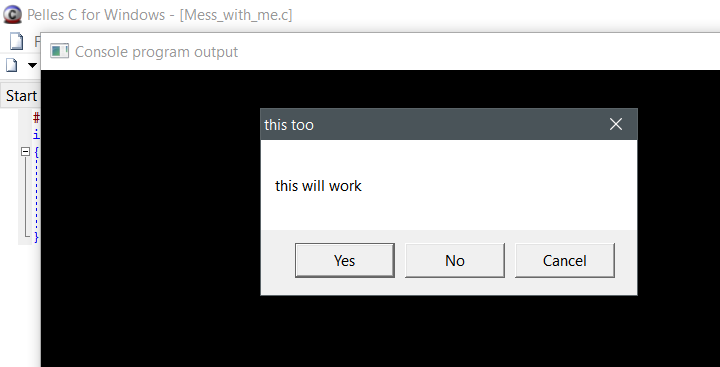
And here’s what it looks like in IDA:
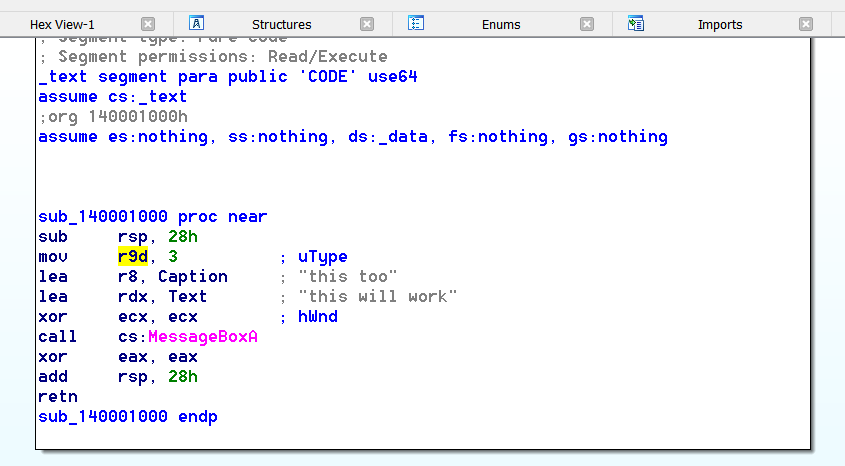
We would want to instrument at the address 0x0000000140001000. To modify the call to MessageBox, we need to alter the contents of the registers. The register ‘r9d’ contains the value 3 or MB_YESNOCANCEL. With what? How about something simple like changing the MessageBox ‘uType’ to ‘MB_OK’ or 0. This means we would need to modify the ‘r9d’ register at the address 0x0000000140001004 or just before the call to MessageBox. This means we have to halt on this address and modify the CONTEXT structure. For those who don’t know, the CONTEXT structure is a windows term for the state of registers. PIN has my back when it comes to modifying this structure.
This code we use to modify the context structure. using some creative C++ hax, I’m able to stop on a certain address and call modify at the right time:
#include <iostream>
#include <fstream>
#include "pin.H"

vector<string> modules;
//REG testedRegister = REG_INVALID();

BOOL hitit = false;
REG testedRegister = REG_R9D;

char stop_on_me[32]  = "0000000140001004";
char joincompare[32] = "";

VOID show_instruction_pointer(ADDRINT rip, ADDRINT r9)
{
	sprintf(joincompare, "%p",Addrint2VoidStar(rip));
	if(memcmp(joincompare,stop_on_me,sizeof(joincompare)))
	{
	printf("Instruction pointer is %p\r\n",Addrint2VoidStar(rip));
	//printf("Value of R9 is %p\r\n",Addrint2VoidStar(r9));
	hitit = true;

	}

}

void afterfunc_call(CONTEXT * ctxt)
{
	if(hitit)
	{
	printf("Setting the value of R9 to 0");
	PIN_SetContextRegval(ctxt, testedRegister, 0x0000000000000000);
	}
}

// Pin calls this function every time a new instruction is encountered
VOID Instruction(INS ins, VOID *v)
{
	IMG img = IMG_FindByAddress(INS_Address(ins));
	string path = (IMG_Valid(img) ? IMG_Name(img) : "InvalidImg");
	auto it = std::find(modules.begin(), modules.end(), path);
	if (it != modules.end())
		return;
	else
	{
30 Mar 12:25
submitted by /u/johnsmithe99 to r/netsecstudents
[link] [comments]
Context IS Mini CTF
by /u/johnsmithe99
I found it a quick bit of fun, hope you enjoy this mini CTF: http://ctf.ctx.is
[link] [comments]
19 Mar 21:00
hacking android apps with frida
by /u/ruskeeblue
 |
submitted by /u/ruskeeblue to r/hacking [link] [comments] |
27 Feb 02:52
BSides NOVA 2017 Videos
Link: http://www.irongeek.com/i.php?page=videos/bsidesnova2017/mainlist
These are the videos from BSides NOVA 2017.. Thanks to those who manned the video rigs.
These are the videos from BSides NOVA 2017.. Thanks to those who manned the video rigs.
Using Software Defined Radio for IoT Analysis
Samantha Palazzolo
Imposter Syndrome: I Don't Feel Like Who You Think I Am.
Micah Hoffman
How the Smart-City becomes stupid
Denis Makrushin
Won't Get Fooled Again: The expected future of IoT malware and what to do about it.
Blaine Mulugeta
Software Supply Chains and the Illusion of Control
Derek Weeks
"Humans, right?" Soft Skills in Security
Ariel Robinson
Panel | Local Community Cyber Groups in NoVA
Jeremy Duncan
Networking with Humans to Create a Culture of Security
Tracy Maleeff
Why the NTP Security Problem Is Worse than You Think
Allan Liska
Bro, I Can See You Moving Laterally
Richie Cyrus
Panel | Parlaying Education and Experience into an Infosec Career
Forgotten Sec
So you want to be a "Cyber Threat Analyst" eh?
Anthony Melfi
0 to 31337 Real Quick: Lessons Learned by Reversing the Flare-On Challenge
Blaine Stancill
Finding a Companies BreakPoint
Zachary Meyers
Challenges and Opportunities: Application Containers and Microservices
Andrew Wild
Cyber Hunt Challenge - Develop and Test your Threat Hunting skills
Darryl Taylor
Anti-Virus & Firewall Bypass Techniques BY Candan BÃ-LÃœKBAS
Candan Bolukbas
I'm Cuckoo for Malware: Cuckoo Sandbox and Dynamic Malware Analysis
Lane Huff
Stuart.ward.uk likes this