Shared posts

21 Feb 13:35

Scientists Say Coffee Is So Magical, It Could Even ​Prevent​ Liver Damage

by Clint Rainey

Keep it coming.

Great news: The benefits of coffee are so plentiful that a new study has linked drinking two extra cups per day to a 44 percent drop in the risk of developing cirrhosis, an awful liver disease brought on by too much booze. Researchers at England's Southampton University analyzed data on more than 430,000 subjects and write that while there's still no cure for liver disease, it appears the sky's the limit for coffee drinkers who want to minimize their chances of a nonfunctioning liver. It's essentially the more the merrier:

Compared to no coffee consumption, researchers estimated one cup a day was tied to a 22 percent lower risk of cirrhosis. With two cups, the risk dropped by 43 percent, while it declined 57 percent for three cups and 65 percent with four cups.

All that notwithstanding, plenty of questions remain unanswered. The authors point out that they couldn't deduce what brewing method is best, which is downright vital these days, although some of the data did show brewing by filter is better than boiling. The data accounted for alcohol consumption, but not always for other risk factors like obesity and diabetes. Finally, though coffee is pretty miraculous — apparently, both erectile dysfunction and mortality are no match — it can't counteract the damage inflicted by a lifetime of binge-drinking or overeating. In conclusion, the researchers say don't do either of those, and go back to enjoying life's most "cheap, ubiquitous, and well-tolerated" miracle drug.

[NYP]

Read more posts by Clint Rainey

Filed Under: science, coffee, liver damage, studies

19 Feb 20:39

Beer Hot Tub

by Mike Newman

U.S. breweries take note. If you’re trying to entice more people into your tasting room, forget modifying your menu or offering more exciting tours, and do what Starkenberg Brewery did—build a beer hot tub. The Austrian brewery turned one of its fermenting vats into a beer pool guests can lounge in. The hot tub, which […]
18 Feb 19:10

Watch Chris Stapleton Sing The English Language’s Most Irritating Words On Kimmel

by Stereogum
Chris Stapleton on KimmelThe great outlaw-country howler Chris Stapleton was the musical guest on last night's episode of Jimmy Kimmel Live, but video of his performance hasn't showed up online yet. What has showed up is video of Stapleton taking part in a truly funny Kimmel bit. Stapleton has one of those voices that could sing just about … More »


17 Feb 19:17

“There’s no solution, because there’s no...


“There’s no solution, because there’s no problem.”

Marcel Duchamp.

10 Feb 22:36

The 10 Most Interesting Quora Threads of All Time

by Maxwell Barna

Quora is a Q&A-styled website where people ask questions, and other people answer and edit responses. Essentially, it’s the beautiful bastard child of Reddit, Yahoo Answers, and Wikipedia. Questions run the information gamut, and include everything from, “What does it feel like to kill a person?” to “What are the best ways to organize my […]
08 Feb 18:20

Massively Multiuser Feedback

by Fred Wilson

There are a number of companies that have user bases in the millions and operate public networks that encourage their users to share their opinions on everything. These companies face an interesting and challenging issue which is that their users are loud and vocal right inside their product about changes that are being contemplated or that have been made. Operating a business like this presents a unique challenge and opportunity to leverage this feedback channel but not become hostage to it.

I believe that one of Mark Zuckerberg and Facebook’s greatest strengths is that they did not let themselves become hostage to the feelings of their user base. They did what they thought was in the best interest of their users and their service. The first time I saw this was the rollout of the news feed. I don’t recall when that was but I believe it was nine or ten years ago now. The users were furious about the new interface and the revelation of “too much information” being presented and shared in it. The Facebook team hung in there and stayed the course and today the Facebook news feed is possibly the most powerful user interface on the Internet.

Etsy, a company I am on the Board of and have been an investor in for ten years now, has always had a very lively community discussion board system for its sellers (and buyers). The sellers who hang out in this community service have often been critical of Etsy’s product and policies. Sometimes these boards turn very hostile and I have watched Etsy struggle with how to both internalize and manage this feedback. On one hand it has made Etsy more sensitive and responsive to the needs of its seller community (which is a very good thing and at the core of why Etsy works) but it has at times made Etsy defensive and hesitant to make necessary changes to its product and policies. I think the Etsy team has gotten to a good place over the years on this issue but it took a lot of learning and a good deal of pain to get there.

Of course, the reason I am choosing to write about this now is the latest uprising of the Twitter user base over the algorithmic feed. The hashtag , #riptwitter, conveys both the power of the community and the hostility that it can take towards a company. 

I have been a private (before leaving Twitter’s board) and public (long after) proponent of adding an algorithmic news feed to Twitter. I know that many users and most of the hard core users prefer the reverse chronological order of the Twitter timeline. I don’t and never have. My favorite feature on Twitter is “what you have missed” and I am in love with and completely dependent on gmail’s priority inbox. For some of us, having a service surface what is most important to us is incredibly valuable. For others, it is an invasion of their control and ability to determine that for themselves. It is like conservatives and liberals. There is no right way to view the world. There are many ways and we have to appreciate that what works for some of us doesn’t work for others.

Twitter has had the technology to provide an algorithmic feed for years. They acquired a company called Julpan in the fall of 2011 which had much of the tech that was necessary to produce an algorithmic news feed. Twitter’s technology in this area is much better today than it was four or five years ago. And maybe that is why they have waited so long to roll it out. But they could have, and I would argue should have, rolled it out years ago. And, of course, they could have and should have (and will) release it with an option to keep reverse chronological order as the default timeline for those who prefer it.

Gmail doesn’t force priority inbox on its users. You can get everything in your inbox or just what gmail thinks you want to see. I prefer the latter but many don’t. 

So those Twitter users who were tweeting #riptwitter last week should chill out and understand that the company is not going to take their believed reverse chronological timeline away from them. And Twitter should both respect and acknowledge these loyal and passionate users (which Jack did) and should also have the courage to do what is right and frankly long overdue.

Finding the right balance between listening to your users and becoming hostage to them is hard. When you operate a large and public channel for these users, it is even harder. Being a CEO requires great listening skills, the ability to really hear and internalize opposing views, and then, ultimately, the courage to make the decision and go with it. That is true in terms of managing your team and your company and it is also true in terms of managing your user base.

05 Feb 20:03

Watch: Bernie Sanders's most emotional pitch yet for his political revolution

by German Lopez

In his closing remarks at the Democratic debate, Bernie Sanders got personal, drawing from his family's immigrant story to make one of the most emotional pitches for his candidacy yet. It was a rare moment for Sanders, who normally insists on sticking to the issues — but he managed, in my mind, to successfully weave his policy platform to his own story.

Here's the full transcript of his remarks:

My dad came to this country at the age of 17 from Poland. Didn't have any money, couldn't speak English. He died pretty young, and I think it would have been beyond his wildest dreams to see his son up here on this stage today running for president.

I love this country, and my dad loved this country, and he was the most proud American because of what it gave him in terms of raising his family — even though we never had much money.

But today in America we are the only major country on Earth that doesn't guarantee health care to all people, that doesn't guarantee paid family and medical leave. We have the highest rate of childhood poverty of almost any major country on Earth. We are seeing millions of families unable to send their kids to college in the United States of America.

I'm running for president because I believe it is just too late for establishment politics and establishment economics. I do believe we need a political revolution, where millions of people stand up and say loudly and clearly that our government belongs to all of us and not just a handful of wealthy campaign contributors. Thank you all.

04 Feb 22:37

Our 100 Favorite Beers of All Time

by Jeff Drumheller

Our 100 Favorite Beers of All Time We can’t fathom a guess as to how many beers we’ve collectively consumed. Does a quadrillion sound too high? And among all those shelf staples, one-offs, and other brews we’ve downed in our day, there’s a collection that has stood out and made an impact on us. So, we got […]
04 Feb 22:25

Fontus Self-Filling Water Bottles

by Ben Dahl

Staying hydrated when you’re exploring the great outdoors or the backcountry can be easier said than done depending where you are. Carrying more water is certainly an option, but that’s going to weigh you down and run out eventually. Fontus is a Vienna-based startup that has a solution that’s as elegant as it is ingenious. […]
03 Feb 21:54

On Apple’s Share Price

by John Gruber

Kirk Burgess:

Fancy owning Apple Inc, the entire company, for no money down? Well if the current share price level doesn’t go any higher, in less than 8 years time someone will be able to pick up the company effectively for free.

02 Feb 15:45

Infinite Jest turns 20

by Jason Kottke

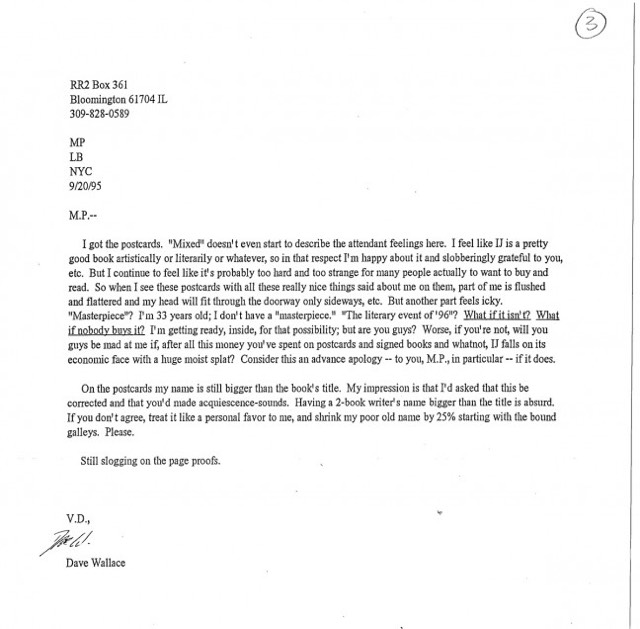
David Foster Wallace's Infinite Jest turns 20 years old this month. To mark the occasion, the Harry Ransom Center, home of DFW's archive of papers, is posting some of the more interesting findings by visiting scholars. Here, for instance, is a letter written by Wallace to his editor a few months before IJ's publication.

DFW Letter To MP

(via @john_overholt)

Update: In a NY Times essay adapted from his forward to an upcoming 20th anniversary edition of IJ, Tom Bissell reflects on why Infinite Jest still resonates 20 years later.

In interviews, Wallace was explicit that art must have a higher purpose than mere entertainment: "Fiction's about what it is to be a ... human being." And here, really, is the enigma of David Foster Wallace's work generally and "Infinite Jest" specifically: an endlessly, compulsively entertaining book that stingily withholds from readers the core pleasures of mainstream novelistic entertainment, among them a graspable central narrative line, identifiable movement through time and any resolution of its quadrumvirate plotlines. "Infinite Jest," in other words, can be exceedingly frustrating. To fully understand what Wallace was up to, the book bears being read, and reread, with Talmudic focus and devotion. For many Wallace readers this is asking too much. For many Wallace fans this is asking too much.

Tags: books   David Foster Wallace   Infinite Jest   Tom Bissell
12 Jan 19:30

Ten questions for work that matters

by Seth Godin

What are you doing that's difficult?

What are you doing that people believe only you can do?

Who are you connecting?

What do people say when they talk about you?

What are you afraid of?

What's the scarce resource?

Who are you trying to change?

What does the change look like?

Would we miss your work if you stopped making it?

What do you stand for?

What contribution are you making?

Hints: Any question that's difficult to answer deserves more thought. Any answers that are meandering, nuanced or complex are probably a symptom of something important.

       
08 Jan 23:40

100 things that made my year

by Austin Kleon

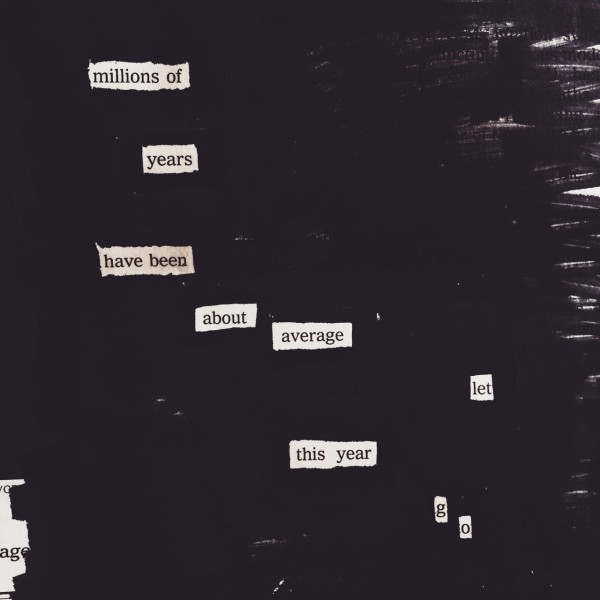
millions of years have been about average let this year go

  1. Grilled pimento cheese with red onion and tomato sandwiches.
  2. Crying on airplanes.
  3. Watching Buster Keaton’s The General with J Dilla’s Donuts as the soundtrack.
  4. Writing on balancing motherhood and art. Sally Mann’s Hold Still. Sarah Ruhl’s 100 Essays I Don’t Have Time To Write. Jenny Offill’s Dept. of Speculation. Maggie Nelson’s The Argonauts. Elena Ferrante. Writer Maureen McHugh on how she’s probably changed more lives being a mom and a teacher.
  5. Debbie Chachra’s “Why I Am Not A Maker.”
  6. Thinking about the relationship between artist and audience. What, if anything, we owe each other. Coltrane on what you give to the listener. Wendell Berry’s “Warning To My Readers.”
  7. Jez Burrows’ Dictionary Stories.
  8. David Lee Roth’s Crazy From The Heat.
  9. Thinking about long-term creativity. Roger Angell on what it’s like to be 93-years-old. Women artists in their 70s, 80s, and 90s. David Hockney on making art at 77.
  10. Using Twitter’s “People You Follow” search to learn about new things.
  11. Spending more time on a private Slack channel than any other social media site.
  12. The crazy story of how I became friends with world-class violinist Vijay Gupta.
  13. Good music. The Velvet Underground, Matrix Tapes. Kraftwerk, Computer World. Captain Beefheart. Elvis Costello, Trust. Royal Headache, High. Sleater-Kinney, No Cities To Love. Sly and the Family Stone, There’s A Riot Goin’ On. Van Morrison, Veedon Fleece. Kurt Vile, b’lieve I’m goin down. Mac Demarco, Another One. King Sunny Ade. Fuzz, II. Madlib, Shades of Blue. Yo La Tengo, Stuff Like That There. Gary Numan, The Pleasure Principle. Wilco’s The Whole Love. Pandora jazz stations.
  14. Getting into classical. Listening to Beethoven with my son. Mitsuko Uchida playing Mozart’s piano sonatas.
  15. Singing my son’s favorite songs: Little Anthony’s “Shimmy Shimmy Ko Ko Bop,” Jonathan Richman’s “The Wheels on the Bus,” James Brown’s “Hot Pants,” and Buck Owen’s “Tiger By The Tail.”
  16. John McPhee’s essays on writing.
  17. Looking at the world through the eyes of my son. Looking at kid’s drawings. Looking at drawings that look like kid’s drawings.
  18. Finding a newspaper clipping from a friend who passed away.
  19. Emily Dickinson.
  20. Knowing I don’t deserve it and keeping on. Giving thanks. Writing down prayers. Drawing prayers.
  21. Morning mind maps.
  22. Seeing Kehinde Wiley’s show in Fort Worth.
  23. Dumb Amazon reviews.
  24. Nutty medieval paintings.
  25. Brian Eno’s concept of “Import and Export” and starting from unpromising beginnings.
  26. Meeting Edward Tufte.
  27. Going on a two-week vacation to Rhode Island. Reading in the hammock. Stones from Moonstone Beach. Walking trails. Outdoor showers. Newport. Walking around Providence. RISD with Ben Shaykin. A rainbow over the Dunkin’ Donuts. Monahan’s and Matunuck Oyster Bar. Rhubarb pies from the farmer’s stand. Fire pit smores.
  28. Seeing boredom as a luxury.
  29. Coming home and putting a new spin on old work with the newspaper popouts.
  30. Glitch rugs, quilts, and embroideries of microbes.
  31. Peppermint tea.
  32. T.S. Eliot’s Four Quartets.
  33. That hour or two with my wife after the kids go to bed.
  34. Bourbon.
  35. Putting out The Steal Like An Artist Journal. Going on tour and perfecting the talk. Having such good fans that we had a great turnout at every event.
  36. Watching my work go out in the world. Seeing how people are using their journals. Heather Champ’s 30-day journal marathon. This photo.
  37. Saying “it wasn’t for me” and moving on. Knowing there are several potential reactions to art.
  38. Being a tourist in my own town.
  39. Practicing cursive. Jennifer Daniels on why Microsoft Word sucks. Hallie Bateman’s handwritten Pen Parade newsletter. Knowing when you should write with a pencil and when you should use a keyboard.
  40. Clive Thompson on reading War and Peace on his iPhone.
  41. Looking for the helpers.
  42. Sophia Lauren making pizza.
  43. Posters by the Stenberg Brothers.
  44. Watching Road Runner cartoons, Robin Hood, and Singin’ In The Rain with my sons.
  45. Warren Ellis’s story about Nina Simone wanting “some champagne, some cocaine, and some sausages!
  46. Walking three and a half miles with a double stroller every morning.
  47. Going to the library with the boys. Reading James Marshall’s George and Martha, Souther Salazar’s Destined for Dizziness!, Blexbolex’s, Ballad, and Richard Scarry’s What Do People Do All Day?
  48. Doing mundane suburban stuff with my wife and the kids, like walking the mall and having lunch at the Nordstrom’s cafe, feeding the ducks at the pond, fiddling with instruments at Guitar Center, scoping the view from the top of a parking garage, eating hot dogs at Costco, etc.
  49. Playing a guitar with four strings. (Who needs more strings than fingers?)
  50. Rainbow makers.
  51. TSA pre-check.
  52. Redesigning my website so I don’t have to think about it for a few more years.
  53. Getting an original Wayne White painting for my birthday. (Related: having an amazing wife.)
  54. James Sturm’s Market Day.
  55. David Markson’s “anti-novels.”
  56. Watching Spongebob Squarepants and reading Carl Hiassen in Florida. Seeing Salvador Dali’s pixelated painting of Abe Lincoln at the Dali Museum.
  57. My son sharing my obsession with signs. Recycled signs. Hacked signs. Signs of danger. Borrowing life advice from an old Spaghetti Warehouse sign.
  58. Getting up in the middle of the night to see the blood moon over Gdansk, Poland. Looking at the moon. My son telling me it’s following us. Pluto! Getting binoculars for Christmas.
  59. Speaking at LucasFilm and seeing the Marin headlands.
  60. New York City. Walking the Highline at sunset. Running into Kelli and Frank at the Whitney. Walking the Hudson at sunrise. Neue Gallery with Maria K. Brooklyn bagels. Paulie Gee’s pizza.
  61. Good television. Broad City. Fargo. Louie. Justified. The Americans. South Park.
  62. Having people make you a list. Adam Koford’s list of favorite old movies. Making a soul playlist for my friend Mike.
  63. People getting fed up with authenticity nonsense and artisanal crap. The Search For General Tso.
  64. Jon Ronson’s So You’ve Been Publicly Shamed.
  65. Accepting that a life in the arts is like Groundhog Day and that “tomorrow is another day, another chance to work and play.” Accepting the dailiness of it all. Getting up on The One. Edward Tufte on how to have better mornings. Tim Gunn’s Sunday routine. David Letterman’s paper cups. Azealia Banks’ 3 a.m. routine. Forgetting the noun and doing the verb.
  66. David Allen’s Getting Things Done. Buying a filing cabinet and practicing inbox triage.
  67. Not worrying too much about productivity. Christoph Niemann on the importance of inefficiency. Agatha Christie on having messy notebooks.
  68. Trying to be a teacher while remaining a student. Re-thinking art education. Sister Corita Kent. Paul Thek’s Teaching Notes. John Waters’ RISD commencement address. Robert De Niro on being screwed. Draw It With Your Eyes Closed: The Art of The Art Assignment.  Re-mystifying art. Wendy MacNaughton on Periscope. Teaching blackout poetry workshops to high schoolers.
  69. Being real about money and fighting the “do what you love” crowd. How Deerhoof makes a living on the road. Having 90,000 Instagram fans and still serving brunch.
  70. Looking at art. The woodcuts and paintings of Felix Vallotton. The work of Margaret Kilgallen. The work of Hedda Sterne. Jim Darling’s airplane window drawings. Penelope Umbrico’s Flickr suns. Paul Thek’s 96 Sacraments, butterflies, and notebooks. Georgia O’Keeffe’s watercolors. Paintings by Souther Salazar. Paintings by Matt Forsythe. Animated GIFs by Lille Carre. Paintings by Shane Walsh. Flying saucer paintings by Esther Pearl Watson. The illustrations of J. Otto Seibold. Paul Klee’s arrows. Drawings by Andy Warhol. Watching Saul Steinberg and Tove Jansson draw. @rabihalameddine’s Twitter feed.
  71. Texting my wife when we’re in the same room.
  72. Long phone calls with artist friends.
  73. Paper. The work of Kelli Anderson. Gay Talese’s love of collage. Articles with headliness like “Don’t write off paper just yet” or “Paper notebooks are as relevant as ever.” Nick Bilton on seeing the value of print books after his mother’s death. Merlin Mann on the problem with fancy notebooks. Neil Gaiman’s notebooks. Basquiat’s notebooks.
  74. Great writing about art. Dave Hickey’s lectures, Air Guitar, and Pirates and Farmers. Blake Gopnik on Corita Kent, Andy Warhol’s student work, and Andy Goldsworthy’s throwing sticks.
  75. Oliver Jeffers’ dipped paintings.
  76. Grimes’ demo for “Realti.”
  77. Music stories. Synth Britannia. John Seabrook’s The Song Machine: Inside the Hit Factory. How the Eurythmics recorded “Sweet Dreams.”  How two white synth geeks helped Stevie Wonder make his best records. The producer who got Ace of Base’s demo stuck in his tape deck. Elvis singing to an actual hound dog.
  78. Learning how to be a better parent. Andrew Solomon’s, Far From the Tree. The best parenting advice: “Don’t Kill Them.” Thinking about toys for children. Raul Gutierrez on the best kinds of toys.
  79. The power of a simple kitchen timer.
  80. Sharpening pencils and sniffing them.
  81. Buying a house. Never spending another second on Zillow. Courtney Barnett’s “Depreston.”
  82. Animals attacking drones.
  83. Ron Swanson on creativity. Kimmy Schmidt on following your bliss. Crazy Eyes on her writing process. Marty McFly on creative frustration. Dana Scully on genius.
  84. Oliver Sacks on a motorcycle.
  85. The inside cover of ZZ Top’s Tres Hombres.
  86. Unpretentious restaurants. Maudie’s. Mi Madre’s. Tam Deli. Little Deli. S&H Donuts.
  87. Detroit-style pizza from Via313.
  88. Record shopping as therapy.
  89. Los Angeles. The Last Bookstore. Echo Park with Vijay. LACMA with Adam. Mexican with Mike and Erika and the gang. Taking the train to Pasadena. Seeing the Martian at the ArcLight with Jamie.
  90. Tove Jansson. Moomin comics. Being Moominpapa.
  91. Patrice O’Neal, Elephant in the Room.
  92. Watching movies. Mad Max: Fury Road. Creed. Only Lovers Left Alive. Don Hertzfeld’s World of Tomorrow. Sullivan’s Travels. John Wick. Magic Mike XXL. Das Boot. Far From The Madding Crowd.
  93. Re-reading books like Slaughterhouse-Five.
  94. Re-watching movies. No Country For Old Men. Road House. Best In Show. Forgetting Sarah Marshall. Jurassic Park. Moonrise Kingdom. Zoolander. Moonstruck.
  95. Doing it yourself.
  96. Figuring out how to stay alive.
  97. Turning the ship around.
  98. Hot fudge sundaes with nuts and whipped cream.
  99. The birth of my son Jules.
  100. Taking a nap.
18 Dec 23:18

Apple Recognizes iPhone Battery Problem & Finally Gets Into the Battery Case Game

by Brock Cardiner
Ben Wolf

Just in time for the holidayz

After years of relying on third-party battery backups, the most popular of which has been mophie, Apple finally unveils their very own battery case for the iPhone 6 and 6s.

Quietly uploading the product to their webstore, the Cupertino giant says the multipurpose cases extends the iPhone’s battery life to up to 18 hours of internet usage on LTE networks, up to 20 hours of video playback, and as much as 25 hours of increased talk time.

The price is set at a reasonable $99 and works via sliding your phone in, as opposed to separating into various pieces and clipping around your phone like other popular offerings. The initial launch offers two colorways – charcoal and white – and charges via a standard Lightning port, meaning that it’s compatible with official docks and you won’t have to carry around extra cables.

Perhaps best of all, users can charge both the case and the smartphone itself at the same time. Unfortunately, there’s no word yet on whether cases for the iPhone 6 Plus, 6s Plus, or older iPhones will be available.

18 Dec 20:47

Life Lessons from Bill Murray

Honest, insightful wisdom from the legendary funny man.

17 Dec 02:13

The Ugly Truth

by Vinson Cunningham

One day last summer, I sat in a restaurant near Columbus Circle talking about buildings with an old friend of my father’s. The friend is an architect and a Jesuit priest, and the subject of our discussion was the Hearst Tower, on West Fifty-seventh Street, which he liked and I did not. My problem with the building was connected to its stark, crisscrossing white beams. The beams—diagonal and horizontal, carving the building’s façade into stacks of traced triangles—looked to me like garish seams, revealing too obviously how the structure had been put together. They were ugly.

See the rest of the story at newyorker.com

Related:
Postscript: Ellsworth Kelly
Returning to Life with Jane Austen’s “Emma”
The “Star Wars” Critics Have Spoken
16 Dec 15:20

The Cuba Archive by Tria Giovan: A rare look at the country's day-to-day during the '90s, captured by the photographer over 11 visits

by Nara Shin
The Cuba Archive by Tria Giovan
NYC- and Sag Harbor-based photographer Tria Giovan traveled to Cuba 11 times during the severe economic depression of the '90s, snapping over 25,000 images with a sense of urgency. Her photos reveal glimpses of perseverance and enduring spirit in one......
Continue Reading...
07 Dec 19:33

A touching video of what it's like to rejoin the world after 44 years in prison

by German Lopez

After 44 years in prison, Otis Johnson was released at the age of 69 in August 2014 — rejoining a world that now seems almost alien to him.

In the video above by Al Jazeera, Johnson, who was in prison for attempted murder of a police officer, is marveled by many of the things people take for granted — smart phones, texting while walking in public, portable music, all the new types of food in stores, and even those giant television screens mounted on storefronts to advertise what's in the store.

"I stand out here for a long time watching this crazy stuff," he said.

But it's not just technology that changed. Johnson has now been cut off from his family — a fact that clearly pains him, as he recalls the simple, good moments he shared with his nieces in the past.

"Coming out of prison, I was mainly alone," he said. "I really miss my family, you know? … I remember I had two nieces, and they were twins. Every time I'd come over, they'd run to me and one of them used to get behind me and hide. And the other would be looking for the other twin, right? And so sometimes I'd just move to the side so the twin could see the other twin. And she'd say, 'You crossed me!' So I remember that still."

The video is a hopeful but heartbreaking reminder of just how hard it is for ex-inmates to reintegrate into society.

Although Johnson now seems to be doing well for himself, it's not hard to imagine a scenario in which — bewildered by technological, cultural, and personal changes — ex-prisoners turn back to the type of lifestyle that got them put in prison in the first place. It's a potentially vicious cycle that leads to more crime and incarceration.

What's worse, inmates don't just have to deal with cultural and technological changes once they're released from prison — they also have to deal with enormous barriers imposed by policy that make it much harder to get a job, education, and even a home. The result: Anywhere from one in three to as many as half of former inmates end up back in prison within a few years.

The many legal barriers to a prisoner reentering society

For example, it's legal for employers to ask in job applications about someone's criminal record and not hire someone for a prior crime — even for something as minor as a marijuana possession offense. This can make it much more difficult for inmates to reintegrate into society: If they can't get a legitimate job, they're much more likely to turn to criminal activities to make ends meet.

So reformers started "ban the box," which seeks to stop employers from asking about criminal records in job applications — although they can do criminal background checks later on in the hiring process. (In reformers' latest victory, President Barack Obama instituted "ban the box" for federal agencies.)

Collateral consequences apply to all sorts of other issues, as well. Some states ban ex-prisoners from working in a wide range of occupations, from nursing to alligator ranching. People who have served out felony convictions often can't apply for public housing or Pell Grants. They can't vote in some states. They can't receive welfare benefits. All of these things can make it more difficult for a former inmate to get a job and legally make a living, or at the very least signal to him that society will never accept him, making him much more likely to turn to a life of crime.

Dismantling the collateral consequences of prison is, of course, not an idea without controversy. Many people genuinely believe that prisoners, especially those convicted of violent crimes, should face lifelong punishments for their misdeeds.

But most prisoners are going to be let out at some point. If they face enormous barriers once they're out, they're going to be more likely to reoffend. Not only does that cost taxpayers even more money as they pay for that inmate's incarceration, it also defeats one of the purposes of prison in the first place — to stop and deter crime.

20 Nov 15:22

Check Out The Simple Way Japanese Kids Learn Multiplication

by Tom Hale
Ben Wolf

This is kinda cool and artistic. But seems way slower and more complicated other techniques.

Editor's Blog
Photo credit: Kars Alfrink/Flickr. (CC BY 2.0)

Kids in Japan learn how to multiply completely differently to how they do in the West. Without the stress of memorizing times tables, all this method requires you to do is count lines and dots.

Check out the videos below, and see if you can pick it up yourself.


18 Nov 19:39

Surveys and focus groups

by Seth Godin

It doesn't matter what people say. Watch what they do.

The story is told of a focus group for a new $100 electronic gadget. The response in the focus group was fabulous, people all talked about the features of the new device with excitement.

At the end of the session, the moderator said, "thanks for coming. As our gift to you, you can have your choice of the device or $25."

Everyone took the cash.

Surveys that ask your customers about their preferences, their net promoter intent, their media habits--they're essentially useless compared to watching what people actually do when they have a chance. The media wastes their time and ours handicapping politics based on polls, on changes in polls, on expectations based on polls—it's sad. Polls are always wrong.

The best part of show & tell has never been the telling part.

       
18 Nov 18:46

Long Roadmaps

by Fred Wilson

I’ve been thinking a lot about entrepreneurs with long roadmaps recently. I blogged about this four years ago. And while I captured some of what is special and important about long roadmaps in that post, I don’t think it really does this issue justice.

So I’m back for more on this one.

A big vision is critical for a big success. You have to know where you want to be in a decade or more. That’s where the long roadmap comes in.

But the mistake most entrepreneurs make is the try to ship most or all of their vision in their first product. And that’s a terrible idea.

The best companies start with a very narrow product that nails something pretty simple but powerful. And then they go from there.

This is true in both enterprise and consumer applications.

A long roadmap is comprised of many short and focused roadmaps, each leading to the next one.

It’s like you want to drive from NYC to LA. You start by driving to Philly. Then you drive to Pittsburgh. Then Cincinnati, then St Louis, then Kansas City, then Denver, then Salt Lake City, then Las Vegas, and finally you drive to LA. Each trip is its own thing and you plan it out carefully and then execute it with focus and energy, not thinking about where you want to end up beyond the next city.

Another good analogy is a basketball season. You want to win the NBA championship. But you get there one game at a time.

I was emailing with an entrepreneur last night who has a long roadmap. And we were discussing this very thing. He said he was very patient. And I replied that building a great company is a combination of patience and impatience in equal doses applied unevenly. Impatient short term, patient long term.

A long roadmap helps you be both.

17 Nov 21:33

hogen-mogen

Ben Wolf

I mean... this is a word? What kind of hogen-mogen got this put in the dictionary?

noun: A person having or affecting high power. adjective: Powerful; grand.
17 Nov 21:19

What are corporations for?

by Seth Godin

The purpose of a company is to serve its customers.

Its obligation is to not harm everyone else.

And its opportunity is to enrich the lives of its employees.

Somewhere along the way, people got the idea that maximizing investor return was the point. It shouldn't be. That's not what democracies ought to seek in chartering corporations to participate in our society.

The great corporations of a generation ago, the ones that built key elements of our culture, were run by individuals who had more on their mind than driving the value of their options up.

The problem with short-term stock price maximization is that it's not particularly difficult. If you have market power, if the cost of switching is high or consumer knowledge is low, there are all sorts of ways that a well-motivated management team can hurt its customers, its community and its employees on the way to boosting what the investors say they want.

It's not difficult for Dell to squeeze a little more junkware into a laptop, or Fedex to lower its customer service standards, or Verizon to deliver less bandwidth than they promised. But just because it works doesn't mean that they're doing their jobs, or keeping their promise, or doing work that they can be proud of. 

Profits and stock price aren't the point (with customers as a side project). It's the other way around.

       
09 Nov 18:35

Reader Asks "Without a Job, Who Can Afford to Buy What Robots Make?"

by noreply@blogger.com (Mike Mish Shedlock)
In response to Robots Will Change World Beyond Recognition reader "DB" has a couple of questions:

  1. Who can afford to buy what the robots produce?
  2. Does this lead to a world war between the have and have-nots?

Those are key questions that should be on everyone's mind. But recall there were two viewpoints written in my post. Bank of America paints one picture and McKinsey another.

  • McKinsey: Automation Will Change Jobs More Than Kill Them
  • Bank of America: Robots and other forms of artificial intelligence will transform the world beyond recognition as soon as 2025

Pater Tenebrarum at the Acting Man blog pinged me with his thoughts (similar to ideas I have expressed before).
I'm convinced McKinsey is right, for the simple reason that this is precisely the history of economic progress: the more productive production processes have become due to automation, the more the division of labor has increased, and the more new jobs and industries have come into being, and the more incomes, leisure time and life expectancy have increased as well. Just watch this fascinating video and think about it for a moment: Would we be better off or worse off if this machine didn't exist?
Emphasis his, video follows.


Link if video does not play: WFL M60 MillTurn Complete Crankshaft Machining - MARTECH Machinery, NJ - USA

One could have presented a thousand videos if not ten thousand videos asking the same question Pater posed: "Would we be better off or worse off if this machine didn't exist?"

The problem is not technology. Rather, the problem is the Fed's response to technology.

Reader Brad agrees. Brad writes ...
Your conclusion was perfect: "Regardless of which viewpoint you think more likely, it should be perfectly clear that robots are a huge deflationary force."

The elites don't comprehend it.

Brad
Central Bank Insistence on Inflation in a Deflationary World

Central bank insistence, especially the Fed's insistence, on 2% inflation in a technologically deflationary world is precisely the driver of income inequality that the Fed and others complain about.

The solution is not higher minimum wages, but rather deflation that let's people buy more with their money. It's not about how much one makes but how far it goes that matters. And the Fed is hell-bent on making sure the money you make goes less far each year.

Fed policy benefits the banks, the government taxing bodies, and the already wealthy with first access to money. Will this eventually lead to a war between the have and have-nots?

Actually, an economic war is already underway. How violent the war gets remains to be seen.

Mike "Mish" Shedlock
Mike "Mish" Shedlock is a registered investment advisor representative for SitkaPacific Capital Management. Sitka Pacific is an asset management firm whose goal is strong performance and low volatility, regardless of market direction. Visit http://www.sitkapacific.com/account_management.html to learn more about wealth management and capital preservation strategies of Sitka Pacific.
09 Nov 17:16

The Mobile Downturn (continued)

by Fred Wilson

I wrote this “mobile downturn” post 18 months ago. It rings more true today than when I wrote it.

Some friends emailed me about investing in a mobile consumer startup last week and my reply to them included this line:

doing anything in the consumer mobile space these days is super hard. i can’t think of many consumer facing mobile apps that have gained massive traction and sustained it in the past three years. can you?
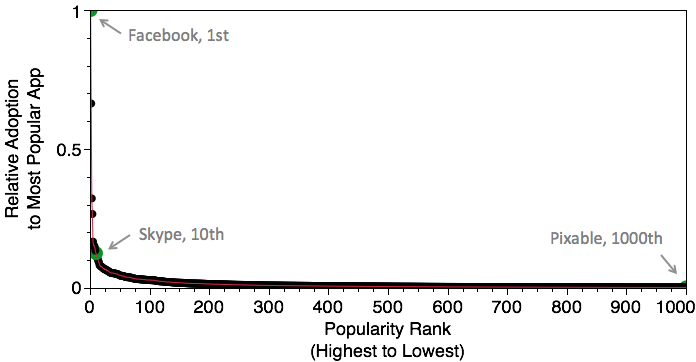
I saw this post this morning in my news feed. It goes over all the reasons why it is so hard to break out in mobile. We’ve been through all of these reasons ad nauseam here for years and years. This is not a new thing. But this chart from that post certainly sums up the challenge:
power law curve

So if you want to launch a new consumer mobile app, what do you do? The best answer I have heard to that question came at breakfast yesterday with an entrepreneur. He said he plans to build mobile web experiences that can go viral and build adoption of his product and use that as a funnel to drive adoption, over time, to his native apps. I’ve seen that work.

But even so, it’s not an easy time to build consumer facing mobile companies. It is not an easy time to invest in them either.

In our first fund that we invested from 2004 to 2007, 57% of our investments were in broad horizontal consumer facing companies. This was pre-mobile so many did not have a mobile app when we invested. But all of them that are still around are predominantly mobile companies today. That percentage declined to 45% in the fund we invested from 2008 to 2011, and further declined to 30% in the fund we invested from 2012 to 2014. In the fund we are investing now, which is about 75% invested, that percentage stands at 35%, a bit of an uptick, largely because we’ve gone a bit later in our consumer facing strategy and have largely limited our investments in consumer facing businesses to ones that have strong product market fit.

The funny thing about all of this is that I don’t see any shortage of entrepreneurs walking into our offices with plans to build and launch consumer facing mobile apps. While the odds are increasingly against them, hope springs eternal it seems.

04 Nov 17:05

ESPN Is Shutting Down Grantland

by John Gruber
Ben Wolf

This is messed up. ESPN probably can't afford to do real journalism anymore. Given how badly it conflicts with their interest in scams like fantasy football and just plain old football.

Brian Stelter, writing for CNN Money:

About 40 writers, producers and editors will be affected by the decision. Writers who have contracts will be honored. Some will continue to write for ESPN’s website and produce videos for the ESPN Films unit.

But an unknown number of others will be leaving. Some of the site’s most distinctive work, like its television show recaps and features about movies, will be going away.

“We’re getting out of the pop culture business,” the senior ESPN source said.

ESPN executives are meeting with the affected staffers on Friday afternoon. Michael Baumann, a freelancer, complained that he found out about the closure through Twitter, not from the company directly.

26 Oct 17:27

100 years of tax brackets, in one chart

by Alvin Chang

Republicans say we have too many now. But we used to have way more.

The US currently has seven tax brackets — and some Republicans, including Donald Trump and former House Speaker Paul Ryan — have said that they believe that’s too many.

It’s been a common talking point for Republicans in presidential elections. Along with Trump, Jeb Bush, Chris Christie. Marco Rubio, Ted Cruz, Ben Carson, and Rand Paul all expressed a desire to reduce the number of brackets. And they said it was because it would simplify the tax code.

But tax brackets are among the easiest parts of the tax code, thanks to modern software and, well, math.

As the graphic above shows, the US has historically taxed the very wealthy more than the somewhat wealthy — and way more than the middle class. This is something Rep. Alexandria Ocasio-Cortez pointed out when she said she supported a 70 percent top tax rate for people at the very top.

In the 1960s, the tax brackets on the high end started to disappear, and during Ronald Reagan’s presidency we went down to just two brackets. That meant that many middle-class citizens were in the same tax bracket as millionaires.

Since the beginning of Reagan’s term, wealth inequality has been on the rise — with the gap between the top 0.1 percent and everyone else, including many affluent families, growing.

More tax brackets aren’t necessarily a good thing, but bracket reduction does violate the basic concept of progressive taxation. Cutting back to two adds a bit of simplicity, but also means there are huge ranges of incomes that are taxed the same.

22 Oct 22:46

Quentin Tarantino's desired cast list for Pulp Fiction

by Jason Kottke

Pulp Fiction Cast

Pulp Fiction Cast

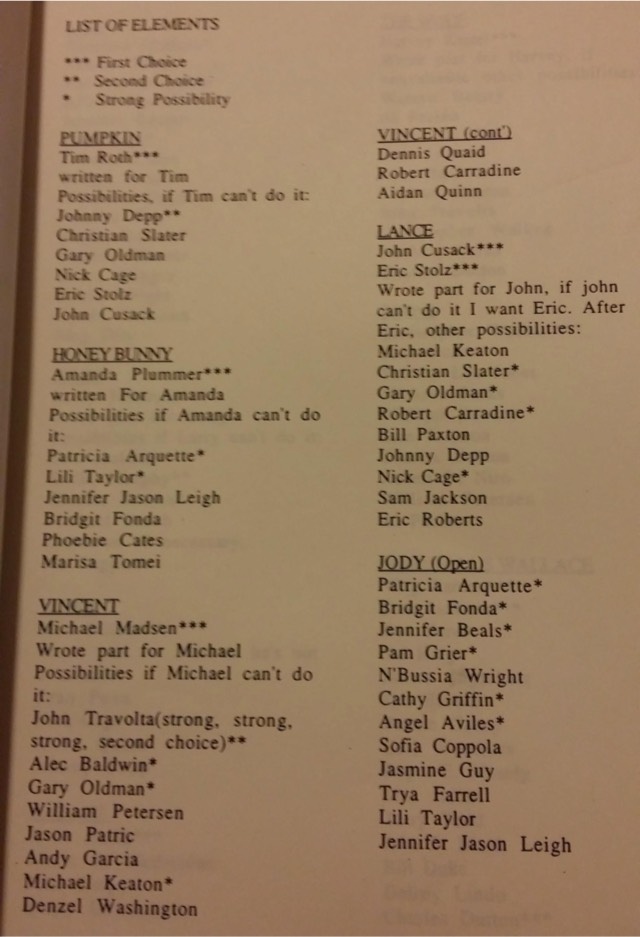
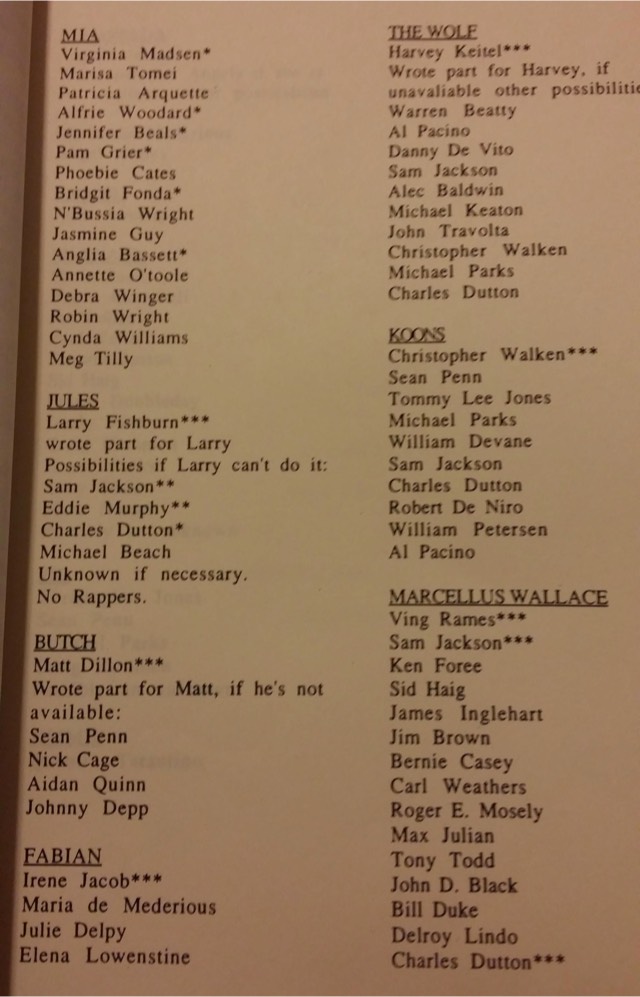
Quentin Tarantino is the type of writer/director who writes roles in movies with specific actors in mind. For Pulp Fiction, he wanted Harvey Keitel to play Winston Wolf, Tim Roth to play Pumpkin, and Ving Rhames to play Marcellus Wallace. But he also wanted Michael Madsen to play Vincent (with Travolta as a strong second choice), John Cusack to play Lance, Matt Dillon to play Butch, and Laurence Fishburne to play Jules. Another possibility for Jules was Eddie Murphy, and Tarantino also specified "No Rappers" for that role. Bruce Willis and Uma Thurman weren't even listed for their respective roles. Gary Oldman, Nicholas Cage, Johnny Depp, and Alec Baldwin were considered for several roles but ultimately didn't appear in the film.

Here's the full list. (via open culture)

Tags: movies   Pulp Fiction   Quentin Tarantino
21 Oct 16:55

Link About It: Hilarious Fake Halloween Costumes

Hilarious Fake Halloween Costumes
Jeff Wysaski—the prankster behind Pleated Jeans—has spent the better part of the past year placing fake ads around local stores. With Halloween quickly approaching, Wysaski decided to aim his latest antics toward costumes, dreaming up hilariously ridiculous......
Continue Reading...
08 Oct 15:37

Why is there something rather than nothing?

by Jason Kottke
Ben Wolf

I don't think this guy understands what nothing means.

That is the question that physicist Lawrence Krauss answers in his book, A Universe from Nothing. The book's trailer provides a little more context.

Everything we see is just a 1% bit of cosmic pollution in a Universe dominated by dark matter and dark energy. You could get rid of all the things in the night sky -- the stars, the galaxies, the planets, everything -- and the Universe would be largely the same.

And my favorite line from the trailer:

Forget Jesus, the stars died so you could be born.

(via open culture)

Tags: A Universe from Nothing   books   Lawrence Krauss   physics   science   video