04 Mar 14:20
Phys. Chem. Chem. Phys., 2015, 17,28005-28009
DOI: 10.1039/C5CP00285K, Paper

Open Access
Caroline E. Blackmore, Neil V. Rees, Richard E. Palmer
Modular construction of platinum-titanium dioxide clusters, which exhibit multiple Pt cores with a preferred size of 30 +/- 6 atoms.
The content of this RSS Feed (c) The Royal Society of Chemistry

04 Mar 00:20
by Jiangbo Xi, Yan Zhang, Ning Wang, Lin Wang, Zheye Zhang, Fei Xiao and Shuai Wang

ACS Applied Materials & Interfaces
DOI: 10.1021/acsami.5b00600

25 Feb 23:43
Phys. Chem. Chem. Phys., 2015, 17,8802-8810
DOI: 10.1039/C4CP05632A, Paper
Biao Zhao, Gang Shao, Bingbing Fan, Wanyu Zhao, Yajun Xie, Rui Zhang
The microwave absorption properties of the core-shell Ni@rutile TiO2 composite are superior to those of the Ni@anatase TiO2 composite.
The content of this RSS Feed (c) The Royal Society of Chemistry

22 Feb 08:24
Energy Environ. Sci., 2015, 8,1261-1266
DOI: 10.1039/C5EE00240K, Communication
Xiangzhi Cui, Yan Zhu, Zile Hua, Jingwei Feng, Ziwei Liu, Lisong Chen, Jianlin Shi
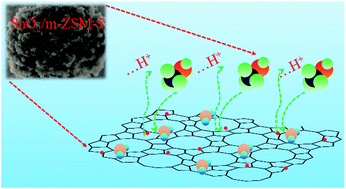
The synergetic catalytic effects between the mesoporous ZSM-5 matrix and the loaded SnO2 nanocrystals endow the precious metal-free electrode catalyst SnO2/m-ZSM-5 nanocomposite with high and stable catalytic activity for methanol oxidation.
The content of this RSS Feed (c) The Royal Society of Chemistry

22 Feb 08:23
Energy Environ. Sci., 2015, 8,1390-1403
DOI: 10.1039/C5EE00389J, Review Article
Chen Zhang, Wei Lv, Ying Tao, Quan-Hong Yang
The design and fabrication of carbon materials are highlighted for high volumetric performance of EES devices.
The content of this RSS Feed (c) The Royal Society of Chemistry

22 Feb 03:19
by Lijuan Sun, Tianhui Liu, Hua Li, Liang Yang, Lingjie Meng, Qinghua Lu and Jiangang Long

ACS Applied Materials & Interfaces
DOI: 10.1021/acsami.5b00175

14 Feb 14:16
Phys. Chem. Chem. Phys., 2015, 17,27922-27939
DOI: 10.1039/C5CP00274E, Perspective
Florent Calvo
Nanoalloys exhibit composition- and size-dependent shapes that are influenced by temperature at equilibrium.
The content of this RSS Feed (c) The Royal Society of Chemistry

06 Feb 00:09
by Botao Ji
Nature Nanotechnology 10, 170 (2015).
doi:10.1038/nnano.2014.298
Authors: Botao Ji, Emerson Giovanelli, Benjamin Habert, Piernicola Spinicelli, Michel Nasilowski, Xiangzhen Xu, Nicolas Lequeux, Jean-Paul Hugonin, Francois Marquier, Jean-Jacques Greffet & Benoit Dubertret

18 Jan 13:44
by Daniel P. DePuccio, Pablo Botella, Bruce O’Rourke and Christopher C. Landry

ACS Applied Materials & Interfaces
DOI: 10.1021/am507806a

17 Jan 00:19
by Chunlei Zhang, Chao Li, Yanlei Liu, Jingpu Zhang, Chenchen Bao, Shujing Liang, Qing Wang, Yao Yang, Hualin Fu, Kan Wang, Daxiang Cui
Gold nanoclusters (GNCs) attract increasing attention due to their potential applications in sensing, catalysis, optoelectronics, and biomedicine. Herein, the formation of highly fluorescent glutathione (GSH)-capped GNCs is achieved through the delicate control of the reduction kinetics and thermodynamic selection of the Au(I)–SG complexes. Furthermore, the GNCs-based nanoprobes are developed by the covalent coupling folic acid (FA) and PEG (polyethylene glycol) on the surface of GNCs directly, followed by trapping photosensitizer (chlorin e6, Ce6) within PEG networks and attaching to the GNCs surface. The fabricated nanoprobes (Ce6@GNCs-PEG2K-FA) possess a uniform particle size (hydrodynamic diameter ≈6.1 ± 1.2 nm), without affecting the yield of singlet oxygen of the trapped Ce6. In vitro studies show the enhanced cellular uptake and satisfactory photodynamic therapy (PDT) effectiveness toward MGC-803 cells when compared with free Ce6. The biodistribution and excretion pathway studies of the nanoprobes in MGC-803 tumor-bearing nude mice reveal their superior penetration and retention behavior in tumors, while the preserved features of renal clearance and stealthy to reticulo-endothelial system are mainly attributed to the small hydrodynamic diameters and the FA-capped PEGylated ligands. The enhanced PDT efficacy and the nontoxicity to mice provide an exciting new nano-platform with promising clinical translational potential.

A novel gold nanoclusters-based Ce6 delivery nano-platform is developed to achieve selective targeting toward cancer cells and tumors combining photodynamic therapy therapy. Systematic in vitro and in vivo experiments evaluate the cellular uptake, light-induced cell apoptosis, biodistribution, as well as FA-directed active tumor targeting and deep-penetration-enhanced photodynamic therapy of the gold nanoclusters-based nanoprobes. The results identify the great potentials of gold nanoclusters for clinical use.
09 Jan 08:39
by Nanjing Hao, Kalana W. Jayawardana, Xuan Chen and Mingdi Yan

ACS Applied Materials & Interfaces
DOI: 10.1021/am508219g

29 Dec 00:35
by Lei Wang, Ting Guo, Qiang Lu, Xiaolong Yan, Daixing Zhong, Zhipei Zhang, Yunfeng Ni, Yong Han, Daxiang Cui, Xiaofei Li and Lijun Huang

ACS Applied Materials & Interfaces
DOI: 10.1021/am508122e

15 Dec 14:13
by Jiao Chen, Xu Wu, Xiaodong Hou, Xingguang Su, Qianli Chu, Nenny Fahruddin and Julia Xiaojun Zhao

ACS Applied Materials & Interfaces
DOI: 10.1021/am507642t

12 Nov 03:21
by Houjuan Zhu, Tao Yu, Hongda Xu, Kui Zhang, Hui Jiang, Zhongping Zhang, Zhenyang Wang and Suhua Wang

ACS Applied Materials & Interfaces
DOI: 10.1021/am5064603

11 Nov 07:16
by Shreya Goel, Feng Chen, Hao Hong, Hector F. Valdovinos, Reinier Hernandez, Sixiang Shi, Todd E. Barnhart and Weibo Cai

ACS Applied Materials & Interfaces
DOI: 10.1021/am506849p

21 Oct 08:39
by Feng Wu, Rong Huang, Daobin Mu, Borong Wu and Shi Chen

ACS Applied Materials & Interfaces
DOI: 10.1021/am505290f

21 Oct 08:27
by Chunzhen Yang, Ming Zhou and Liang Gao

ACS Applied Materials & Interfaces
DOI: 10.1021/am504821h

18 Oct 13:08
by Xiaowei Li, Xin Zhou, Hang Guo, Chen Wang, Jiangyang Liu, Peng Sun, Fengmin Liu and Geyu Lu

ACS Applied Materials & Interfaces
DOI: 10.1021/am5057322

17 Oct 09:31
by Dongguang Yin, Chengcheng Wang, Juan Ouyang, Xinyu Zhang, Zheng Jiao, Yi Feng, Kailin Song, Bing Liu, Xianzhang Cao, Lu Zhang, Yanlin Han and Minghong Wu

ACS Applied Materials & Interfaces
DOI: 10.1021/am505633g

16 Oct 06:49
by Wei Sang, Tingting Zheng, Youcheng Wang, Xu Li, Xu Zhao, Jie Zeng and J. G. Hou

Nano Letters
DOI: 10.1021/nl503343n

14 Oct 01:26
by Sun Hye Hwang, Juyoung Yun, Jyongsik Jang
An optimized configuration for nanomaterials in working electrodes is vital to the high performance of dye-sensitized solar cells (DSSCs). Here, a fabrication method is introduced for multi-shell TiO2 hollow nanoparticles (MS-TiO2-HNPs) via a sol–gel reaction, calcination, and an etching process. The prepared uniform MS-HNPs have a high surface area (ca. 171 m2 g−1), multireflection, and facile electrolyte circulation and diffusion. During the MS-HNP fabrication process, the amount of SiO2 precursor and H2O under reaction has a significant effect on aggregation and side reactions. The etching process to obtain pure TiO2 is influenced by anatase crystallinity. Additionally, single-shell (SS)-TiO2-HNPs and double-shell (DS)-TiO2-HNPs are synthesized as a control. The MS-TiO2-HNPs exhibit a high surface area and enhance light reflectance, compared with the SS- and DS-TiO2-HNPs of the same size. The power conversion efficiency of the optimized MS-TiO2-HNP-based DSSCs is 9.4%, compared with the 8.0% efficiency demonstrated by SS-TiO2-HNP-DSSCs (a 17.5% improvement). These results enable the utilization of multifunctional MS-HNPs in energy material applications, such as lithium ion batteries, photocatalysts, water-splitting, and supercapacitors.

Multi-shell porous TiO2 hollow nanoparticles (MS-TiO2-HNPs) are prepared by a sol–gel method and calcination and etching processes. Due to the porous multi-shell structure, the MS-TiO2-HNPs exhibit strong light scattering and facile electrolyte diffusion and circulation. Additionally, the high surface area increases the adsorption of the dye molecules to the surface of the MS-TiO2-HNPs, resulting in an enhanced power conversion efficiency of 9.4%.
13 Oct 14:04
by Carolina Galeano, Josef C. Meier, Mario Soorholtz, Hans Bongard, Claudio Baldizzone, Karl J. J. Mayrhofer and Ferdi Schüth

ACS Catalysis
DOI: 10.1021/cs5003492

13 Oct 14:03
by Xiang-Kui Gu, Botao Qiao, Chuan-Qi Huang, Wu-Chen Ding, Keju Sun, Ensheng Zhan, Tao Zhang, Jingyue Liu and Wei-Xue Li

ACS Catalysis
DOI: 10.1021/cs500740u

12 Sep 07:57
by Dohyung Kim
Article
The efficient and selective reduction of carbon dioxide is a major challenge in artificial photosynthesis. Here, the authors study gold–copper bimetallic nanoparticles and attempt to resolve the electronic and geometric factors that lead to high activity carbon dioxide reduction catalysis.
Nature Communications doi: 10.1038/ncomms5948
Authors: Dohyung Kim, Joaquin Resasco, Yi Yu, Abdullah Mohamed Asiri, Peidong Yang

30 Aug 01:26
by Jinyan Xiong, Zhen Li, Jun Chen, Shanqing Zhang, Lianzhou Wang and Shixue Dou

ACS Applied Materials & Interfaces
DOI: 10.1021/am502516s

26 Aug 14:40
by Jakub Pastva, Krzysztof Skowerski, Stefan J. Czarnocki, Naděžda Žilková, Jiří Čejka, Zdeněk Bastl and Hynek Balcar

ACS Catalysis
DOI: 10.1021/cs500796u

19 Aug 08:12
by Claire Hansell
Nature Chemistry 6, 656 (2014).
doi:10.1038/nchem.2028
Author: Claire Hansell
19 Aug 08:06
by Xuan Xu, Minghui Tang, Mingming Li, Haoran Li and Yong Wang

ACS Catalysis
DOI: 10.1021/cs500859n

No more posts. Check out what's trending.

   This article is licensed under a Creative Commons Attribution 3.0 Unported Licence.