06 Sep 01:11
by Haejun Yu, Jong Woo Lee, Juyoung Yun, Kisu Lee, Jaehoon Ryu, Jungsup Lee, Doyk Hwang, Seong Keun Kim, Jyongsik Jang
Abstract
Perovskite solar cells (PSCs) are of great interest in current photovoltaic research due to their extraordinary power conversion efficiency of ≈20% and boundless potentialities. The high efficiency has been mostly obtained from TiO2-based PSCs, where TiO2 is utilized as a hole-blocking, mesoporous layer. However, trapped charges and the light-induced photocatalytic effect of TiO2 seriously degrade the perovskite and preclude PSCs from being immediately commercialized. Herein, a simplified PSC is successfully fabricated by eliminating the problematic TiO2 layers, using instead a fluorine-doped tin oxide (FTO)/perovskite/hole–conductor/Au design. Simultaneously, the sluggish charge extraction at the FTO/perovskite interface is overcome by modifying the surface of the FTO to a porous structure using electrochemical etching. This surface engineering enables a substantial increase in the photocurrent density and mitigation of the hysteretic behavior of the pristine FTO-based PSC; a remarkable 19.22% efficiency with a low level of hysteresis is obtained. This performance is closely approaching that of conventional PSCs and may facilitate their commercialization due to improved convenience, lower cost, greater stability, and potentially more efficient mass production.

Electrochemically etched fluorine-doped tin oxide (FTO) provides large surfacial area compared with commercial FTO and quickly extracts photoexcited electrons at the FTO/perovskite interface. Accordingly, the photocurrent density and performance of hole-blocking layer-free planar-type perovskite solar cell are improved, where the remarkable power conversion efficiency of 19.22% is achieved.
06 Sep 01:03
by Thanh Luan Nguyen, Tack Ho Lee, Bhoj Gautam, Song Yi Park, Kenan Gundogdu, Jin Young Kim, Han Young Woo
Abstract
A new donor (D)–acceptor (A) conjugate, benzodithiophene-rhodanine–[6,6]-phenyl-C61 butyric acid methyl ester (BDTRh–PCBM) comprising three covalently linked blocks, one of p-type oligothiophene containing BDTRh moieties and two of n-type PCBM, is designed and synthesized. A single component organic solar cell (SCOSC) fabricated from BDTRh–PCBM exhibits the power conversion efficiency (PCE) of 2.44% and maximum external quantum efficiency of 46%, which are the highest among the reported efficiencies so far. The SCOSC device shows efficient charge transfer (CT, ≈300 fs) and smaller CT energy loss, resulting in the higher open-circuit voltage of 0.97 V, compared to the binary blend (BDTRh:PCBM). Because of the integration of the donor and acceptor in a single molecule, BDTRh-PCBM has a specific D–A arrangement with less energetic disorder and reorganization energy than blend systems. In addition, the SCOSC device shows excellent device and morphological stabilities, showing no degradation of PCE at 80 °C for 100 h. The SCOSC approach may suggest a great way to suppress the large phase segregation of donor and acceptor domains with better morphological stability compared to the blend device.

Integration of donor and acceptor in a single molecule by a covalent linkage is a promising approach to overcome unfavorably large-phase separation in bulk heterojunction blend solar cells. A new all-in-one system forms a specific molecular arrangement which decreases energetic disorder and facilitates ultrafast charge separation.
06 Sep 00:58
by Yong Xu, Huabin Sun, Wenwu Li, Yen-Fu Lin, Francis Balestra, Gerard Ghibaudo, Yong-Young Noh
Abstract
Conjugated polymers came to an unprecedented epoch that the charge transport is limited only by small disorder within aggregated domains. Accurate evaluation of transport performance is thus vital to optimizing further molecule design. Yet, the routine method by means of the conventional field-effect transistors may not satisfy such a requirement. Here, it is shown that the extrinsic effects of Schottky barrier, access transport through semiconductor bulk, and concurrent ambipolar conduction seriously influence transport analysis. The planar transistors incorporating ohmic contacts free of access and ambipolar conduction afford an ideal access to charge transport. It is found, however, that only the planar transistors operating in low-field regime are reliable to explore the inherent transport properties due to the energetic disorder lowering by the lateral field induced by high drain voltage. This work opens up a robust approach to comprehend the delicate charge transport in conjugated polymers so as to develop high-performance semiconducting polymers for promising plastic electronics.

Conventional and planar polymer transistors are compared to explore the charge transport in conjugated polymers. The former is found to suffer from extrinsic effects of Schottky barrier, access transport, and ambipolar conduction. The latter is free from such issues so is more reliable for transport exploration. However, only those operating in the low-field regime are reliable to explore the charge transport.
06 Sep 00:58
by Chunxiong Bao, Zhaolai Chen, Yanjun Fang, Haotong Wei, Yehao Deng, Xun Xiao, Lingliang Li, Jinsong Huang
Abstract
Organic–inorganic halide perovskites are promising photodetector materials due to their strong absorption, large carrier mobility, and easily tunable bandgap. Up to now, perovskite photodetectors are mainly based on polycrystalline thin films, which have some undesired properties such as large defective grain boundaries hindering the further improvement of the detector performance. Here, perovskite thin-single-crystal (TSC) photodetectors are fabricated with a vertical p–i–n structure. Due to the absence of grain-boundaries, the trap densities of TSCs are 10–100 folds lower than that of polycrystalline thin films. The photodetectors based on CH3NH3PbBr3 and CH3NH3PbI3 TSCs show low noise of 1–2 fA Hz−1/2, yielding a high specific detectivity of 1.5 × 1013 cm Hz1/2 W−1. The absence of grain boundaries reduces charge recombination and enables a linear response under strong light, superior to polycrystalline photodetectors. The CH3NH3PbBr3 photodetectors show a linear response to green light from 0.35 pW cm−2 to 2.1 W cm−2, corresponding to a linear dynamic range of 256 dB.

Photodetectors based on organic–inorganic halide perovskite thin single crystals (TSCs) are fabricated. Due to the absence of grain-boundaries, very low trap densities, and small thickness (≈10 µm) of the TSCs, the TSC photodetectors with vertical p–i–n structure show low noise (1–2 fA Hz−1/2), high specific detectivity (≈1.5 × 1013 cm Hz1/2 W−1), and large linear-dynamic-range (256 dB).
06 Sep 00:49
Nanoscale, 2017, 9,13506-13514
DOI: 10.1039/C7NR04692H, Paper
Yan-Hui Lou, Zhao-Kui Wang
Poly(3,4-ethylene dioxythiophene):poly(4-styrenesulfonate) (PEDOT:PSS) is a widely utilized hole-transporting material (HTM) in planar photovoltaic devices, such as organic solar cells (OSCs) and perovskite solar cells (PSCs).
The content of this RSS Feed (c) The Royal Society of Chemistry

19 Jul 08:07
J. Mater. Chem. A, 2017, 5,15175-15182
DOI: 10.1039/C7TA04431C, Paper
Jie Zhu, Sunsun Li, Xiaoyu Liu, Huifeng Yao, Fenghao Wang, Shaoqing Zhang, Mingliang Sun, Jianhui Hou
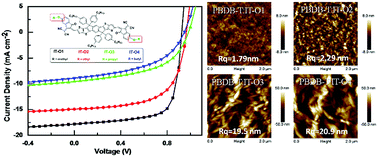
The influence of alkoxyl end-groups on the photovoltaic performance of small molecular acceptors was studied.
The content of this RSS Feed (c) The Royal Society of Chemistry
19 Jul 08:03
J. Mater. Chem. A, 2017, 5,15017-15020
DOI: 10.1039/C7TA03600K, Communication
Yuhang Liu, Shangshang Chen, Guangye Zhang, Philip C. Y. Chow, He Yan
We report a new a vertical-benzodithiophene (vBDT) building block for designing wide bandgap conjugated polymers, which enables efficient non-fullerene organic solar cells with PCE over 8.3%.
The content of this RSS Feed (c) The Royal Society of Chemistry
19 Jul 03:16
by Armantas Melianas, Vytenis Pranculis, Donato Spoltore, Johannes Benduhn, Olle Inganäs, Vidmantas Gulbinas, Koen Vandewal, Martijn Kemerink
Abstract
In organic solar cells continuous donor and acceptor networks are considered necessary for charge extraction, whereas discontinuous neat phases and molecularly mixed donor–acceptor phases are generally regarded as detrimental. However, the impact of different levels of domain continuity, purity, and donor–acceptor mixing on charge transport remains only semiquantitatively described. Here, cosublimed donor–acceptor mixtures, where the distance between the donor sites is varied in a controlled manner from homogeneously diluted donor sites to a continuous donor network are studied. Using transient measurements, spanning from sub-picoseconds to microseconds photogenerated charge motion is measured in complete photovoltaic devices, to show that even highly diluted donor sites (5.7%–10% molar) in a buckminsterfullerene matrix enable hole transport. Hopping between isolated donor sites can occur by long-range hole tunneling through several buckminsterfullerene molecules, over distances of up to ≈4 nm. Hence, these results question the relevance of “pristine” phases and whether a continuous interpenetrating donor–acceptor network is the ideal morphology for charge transport.

Transient measurements reveal that in organic solar cells a continuous donor network is not strictly necessary for hole transport. Hole hopping between isolated donor sites can occur by long-range hole tunneling through several buckminsterfullerene molecules (4 nm). This often disregarded mechanism questions the importance of pristine phases and whether a continuous donor–acceptor network is the ideal morphology for charge transport.
04 Jul 08:47
by Hyojung Cha, Jiaying Wu, Andrew Wadsworth, Jade Nagitta, Saurav Limbu, Sebastian Pont, Zhe Li, Justin Searle, Mark F. Wyatt, Derya Baran, Ji-Seon Kim, Iain McCulloch, James R. Durrant
A comparison of the efficiency, stability, and photophysics of organic solar cells employing poly[(5,6-difluoro-2,1,3-benzothiadiazol-4,7-diyl)-alt-(3,3′″-di(2-octyldodecyl)-2,2′;5′,2″;5″,2′″-quaterthiophen-5,5′″-diyl)] (PffBT4T-2OD) as a donor polymer blended with either the nonfullerene acceptor EH-IDTBR or the fullerene derivative, [6,6]-phenyl C71 butyric acid methyl ester (PC71BM) as electron acceptors is reported. Inverted PffBT4T-2OD:EH-IDTBR blend solar cell fabricated without any processing additive achieves power conversion efficiencies (PCEs) of 9.5 ± 0.2%. The devices exhibit a high open circuit voltage of 1.08 ± 0.01 V, attributed to the high lowest unoccupied molecular orbital (LUMO) level of EH-IDTBR. Photoluminescence quenching and transient absorption data are employed to elucidate the ultrafast kinetics and efficiencies of charge separation in both blends, with PffBT4T-2OD exciton diffusion kinetics within polymer domains, and geminate recombination losses following exciton separation being identified as key factors determining the efficiency of photocurrent generation. Remarkably, while encapsulated PffBT4T-2OD:PC71BM solar cells show significant efficiency loss under simulated solar irradiation (“burn in” degradation) due to the trap-assisted recombination through increased photoinduced trap states, PffBT4T-2OD:EH-IDTBR solar cell shows negligible burn in efficiency loss. Furthermore, PffBT4T-2OD:EH-IDTBR solar cells are found to be substantially more stable under 85 °C thermal stress than PffBT4T-2OD:PC71BM devices.

A high efficiency, burn-in-free nonfullerene-based PffBT4T-2OD:EH-IDTBR solar cell is reported, fabricated without processing additives. Transient absorption and optoelectronic analyses elucidate the causes of this high efficiency and stability, with the superior stability compared to PC71BM devices being correlated with increased crystallinity and reduced photogeneration of trap states.
24 Jun 01:40
by Manukumara Manjappa, Yogesh Kumar Srivastava, Ankur Solanki, Abhishek Kumar, Tze Chien Sum, Ranjan Singh
The recent meteoric rise in the field of photovoltaics with the discovery of highly efficient solar-cell devices is inspired by solution-processed organic–inorganic lead halide perovskites that exhibit unprecedented light-to-electricity conversion efficiencies. The stunning performance of perovskites is attributed to their strong photoresponsive properties that are thoroughly utilized in designing excellent perovskite solar cells, light-emitting diodes, infrared lasers, and ultrafast photodetectors. However, optoelectronic application of halide perovskites in realizing highly efficient subwavelength photonic devices has remained a challenge. Here, the remarkable photoconductivity of organic–inorganic lead halide perovskites is exploited to demonstrate a hybrid perovskite–metamaterial device that shows extremely low power photoswitching of the metamaterial resonances in the terahertz part of the electromagnetic spectrum. Furthermore, a signature of a coupled phonon–metamaterial resonance is observed at higher pump powers, where the Fano resonance amplitude is extremely weak. In addition, a low threshold, dynamic control of the highly confined electric field intensity is also observed in the system, which could tremendously benefit the new generation of subwavelength photonic devices as active sensors, low threshold optically controlled lasers, and active nonlinear devices with enhanced functionalities in the infrared, optical, and the terahertz parts of the electromagnetic spectrum.

Remarkable photoconductivity of solution-processed ultrathin perovskite film at terahertz frequencies is exploited for low-power, high-speed photoactive switching of the Fano resonance in a hybrid perovskite–metamaterial device. At higher pump fluences, a mode-splitting behavior is observed, which manifests a phonon–metamaterial resonance coupling in the proposed system.
24 Jun 01:33
J. Mater. Chem. A, 2017, 5,14689-14696
DOI: 10.1039/C7TA02590D, Paper
Haitao Xu, Xiang Fu, Xiaofang Cheng, Liqiang Huang, Dan Zhou, Lie Chen, Yiwang Chen
High and homogeneous mobility of PCPDT-T can improve the efficiency and thickness insensitivity of organic solar cells.
The content of this RSS Feed (c) The Royal Society of Chemistry
19 Jun 02:42
by Ming-Gang Ju, Jun Dai, Liang Ma and Xiao Cheng Zeng

Journal of the American Chemical Society
DOI: 10.1021/jacs.7b04219

19 Jun 02:38
by Sylvia J. Lou, Jodi M. Szarko, Tao Xu, Luping Yu, Tobin J. Marks and Lin X. Chen
Journal of the American Chemical Society
DOI: 10.1021/jacs.7b00277

19 Jun 02:37
by Peng-Fei Li, Wei-Qiang Liao, Yuan-Yuan Tang, Heng-Yun Ye, Yi Zhang and Ren-Gen Xiong

Journal of the American Chemical Society
DOI: 10.1021/jacs.7b04693

19 Jun 02:34
J. Mater. Chem. A, 2017, 5,14887-14897
DOI: 10.1039/C7TA04703G, Paper
Amaresh Mishra, Mukhamed[space]L. Keshtov, Annika Looser, Rahul Singhal, Matthias Stolte, Frank Wurthner, Peter Bauerle, Ganesh D. Sharma
Non-fullerene molecular acceptors in combination with a polymeric donor gave well performing BHJSCs with energy losses below 0.4 eV concomitant with outstanding external quantum efficiencies in the NIR-regime.
The content of this RSS Feed (c) The Royal Society of Chemistry
19 Jun 02:34
J. Mater. Chem. A, 2017, 5,11396-11400
DOI: 10.1039/C6TA08317J, Highlight
Andrew T. Kleinschmidt, Samuel E. Root, Darren J. Lipomi
Regioregular poly(3-hexylthiophene) (P3HT) is used as a model polymer for research in organic solar cells.
The content of this RSS Feed (c) The Royal Society of Chemistry
19 Jun 02:31
J. Mater. Chem. A, 2017, 5,13957-13965
DOI: 10.1039/C7TA04575A, Communication
Chih-Chun Chung, Sudhakar Narra, Efat Jokar, Hui-Ping Wu, Eric Wei-Guang Diau
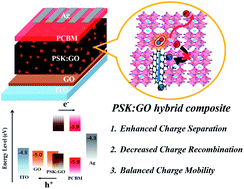
The hybrid perovskite/graphene oxide composite layer increased the interfacial contact between the donor and acceptor of holes to balance the charge mobility and improved the photovoltaic performance with excellent reproducibility and stability.
The content of this RSS Feed (c) The Royal Society of Chemistry
19 Jun 02:30
J. Mater. Chem. A, 2017, 5,13229-13229
DOI: 10.1039/C7TA90124K, Correction

Open Access
Jhao-lin Wu, Wen-Kuan Huang, Yu-Chia Chang, Bo-Chou Tsai, Yu-Cheng Hsiao, Chih-Yu Chang, Chin-Ti Chen, Chao-Tsen Chen
The content of this RSS Feed (c) The Royal Society of Chemistry
19 Jun 02:19
Energy Environ. Sci., 2017, 10,1739-1745
DOI: 10.1039/C7EE00805H, Communication
Jiahui Wan, Xiaopeng Xu, Guangjun Zhang, Ying Li, Kui Feng, Qiang Peng
Naphtho[1,2-c:5,6-c']bis[1,2,5]thiadiazole-based small molecules have been synthesized for organic solar cells. The optimized devices processed by a halogen-free solvent of CS2 exhibited a PCE of 11.53% with a small energy loss of 0.57 eV.
The content of this RSS Feed (c) The Royal Society of Chemistry

19 Jun 02:17
Nanoscale, 2017, 9,10075-10083
DOI: 10.1039/C7NR03487C, Paper
Muhammad Naufal Lintangpradipto, Nikolai Tsevtkov, Byeong Cheul Moon, Jeung Ku Kang
We found that a perovskite photovoltaic cell can be tailored to boost light harvesting capability via enhanced light collection of small QDs through Forster resonance energy transfer (FRET) and enhanced light reflection of large QDs at the interfaces with the perovskite.
The content of this RSS Feed (c) The Royal Society of Chemistry

12 Jun 08:28
by Jin-Liang Wang, Kai-Kai Liu, Sha Liu, Feng Liu, Hong-Bin Wu, Yong Cao and Thomas P. Russell

ACS Applied Materials & Interfaces
DOI: 10.1021/acsami.7b03771

12 Jun 08:27
by Munkhbayar Batmunkh, Cameron J. Shearer, Munkhjargal Bat-Erdene, Mark J. Biggs and Joseph G. Shapter

ACS Applied Materials & Interfaces
DOI: 10.1021/acsami.7b04894

12 Jun 08:26
by Hyung Do Kim, Nayu Yanagawa, Ai Shimazaki, Masaru Endo, Atsushi Wakamiya, Hideo Ohkita, Hiroaki Benten and Shinzaburo Ito

ACS Applied Materials & Interfaces
DOI: 10.1021/acsami.7b03694

12 Jun 08:03
by Adam D. Wright, Rebecca L. Milot, Giles E. Eperon, Henry J. Snaith, Michael B. Johnston, Laura M. Herz
Traps limit the photovoltaic efficiency and affect the charge transport of optoelectronic devices based on hybrid lead halide perovskites. Understanding the nature and energy scale of these trap states is therefore crucial for the development and optimization of solar cell and laser technology based on these materials. Here, the low-temperature photoluminescence of formamidinium lead triiodide (HC(NH2)2PbI3) is investigated. A power-law time dependence in the emission intensity and an additional low-energy emission peak that exhibits an anomalous relative Stokes shift are observed. Using a rate-equation model and a Monte Carlo simulation, it is revealed that both phenomena arise from an exponential trap-density tail with characteristic energy scale of ≈3 meV. Charge-carrier recombination from sites deep within the tail is found to cause emission with energy downshifted by up to several tens of meV. Hence, such phenomena may in part be responsible for open-circuit voltage losses commonly observed in these materials. In this high-quality hybrid perovskite, trap states thus predominantly comprise a continuum of energetic levels (associated with disorder) rather than discrete trap energy levels (associated, e.g., with elemental vacancies). Hybrid perovskites may therefore be viewed as classic semiconductors whose band-structure picture is moderated by a modest degree of energetic disorder.

Low-temperature measurements of the photoluminescence from HC(NH2)2PbI3 thin films are presented. The emission exhibits a power-law intensity decay with time after excitation, and an additional low-energy peak displaying an anomalous Stokes shift. These phenomena demonstrate that charge–carrier recombination in this perovskite is mediated by a band tail with characteristic energy 3 meV, determined from a rate-equation model and Monte Carlo simulation.
12 Jun 08:00
by Li Nian, Ke Gao, Yufeng Jiang, Qikun Rong, Xiaowen Hu, Dong Yuan, Feng Liu, Xiaobin Peng, Thomas P. Russell, Guofu Zhou
High-efficiency small-molecule-based organic photovoltaics (SM-OPVs) using two electron donors (p-DTS(FBTTh2)2 and ZnP) with distinctively different absorption and structural features are reported. Such a combination works well and synergically improves device short-circuit current density (Jsc) to 17.99 mA cm−2 and fill factor (FF) to 77.19%, yielding a milestone efficiency of 11%. To the best of our knowledge, this is the highest power conversion efficiency reported for SM-OPVs to date and the first time to combine high Jsc over 17 mA cm−2 and high FF over 77% into one SM-OPV. The strategy of using multicomponent materials, with a selecting role of balancing varied electronic and structural necessities can be an important route to further developing higher performance devices. This development is important, which broadens the dimension and versatility of existing materials without much chemistry input.

High-efficiency all-small-molecule organic solar cells using two electron donors with distinctively different absorption and structural features are reported. Such a combination works well and synergically improves device current and fill factor, yielding a milestone efficiency of 10.97%.
12 Jun 07:59
by Hrisheekesh Thachoth Chandran, Tsz-Wai Ng, Yishu Foo, Ho-Wa Li, Jian Qing, Xiao-Ke Liu, Chiu-Yee Chan, Fu-Lung Wong, Juan Antonio Zapien, Sai-Wing Tsang, Ming-Fai Lo, Chun-Sing Lee

In article number 1606909, Ming-Fai Lo, Chun-Sing Lee, and co-workers report unusual free-carrier generation in some bipolar organic materials (SubNc and SubPc) upon photoexcitation. Single-layer devices with SubNc or SubPc sandwiched between two electrodes can give power conversion efficiencies 30 times higher than previously reported single-layer devices. Interestingly, these photoactive layers can be stacked onto each other with any sequence to generate a photocurrent in OPV devices.
12 Jun 07:59
by Cheng Bi, Bo Chen, Haotong Wei, Stephan DeLuca, Jinsong Huang
Organic–inorganic hybrid perovskites (OIHPs) are new photoactive layer candidates for lightweight and flexible solar cells due to their low-temperature process capability; however, the reported efficiency of flexible OIHP devices is far behind those achieved on rigid glass substrates. Here, it is revealed that the limiting factor is the different perovskite film deposition conditions required to form the same film morphology on flexible substrates. An optimized perovskite film composition needs a different precursor ratio, which is found to be essential for the formation of high-quality perovskite films with longer radiative carrier recombination lifetime, smaller density of trap states, reduced precursor residue, and uniform and pin-hole free films. A record efficiency of 18.1% is achieved for the flexible perovskite solar-cell devices made on an indium tin oxide/poly(ethylene terephthalate) substrate via a low temperature (≤100 °C) solution process.

A different precursor ratio is found to be essential for the formation of high-quality perovskite films on flexible substrates compared to those formed on rigid substrates. A high efficiency of 18.1% is achieved for flexible perovskite solar-cell devices made on an indium tin oxide/poly(ethylene terephthalate) substrate via a low-temperature (≤100 °C) solution process.
06 Jun 02:32
Nanoscale, 2017, 9,9440-9446
DOI: 10.1039/C7NR01678F, Paper
John Ciro, Santiago Mesa, Jose Ignacio Uribe, Mario Alejandro Mejia-Escobar, Daniel Ramirez, Juan Felipe Montoya, Rafael Betancur, Hyun-Seok Yoo, Nam-Gyu Park, Franklin Jaramillo
Rhodamine interlayer reduces trap states at the PCBM surface while hindering moisture access.
The content of this RSS Feed (c) The Royal Society of Chemistry

06 Jun 02:31
Nanoscale, 2017, 9,9572-9580
DOI: 10.1039/C6NR09817G, Paper
Jacopo Parravicini, Eugenio DelRe, Aharon J. Agranat, Gianbattista Parravicini
An exotic liquid-solid composite state of polar nanoregions, with a liquid-like response along specific directions and simultaneously solid-like along others.
The content of this RSS Feed (c) The Royal Society of Chemistry

06 Jun 02:22
by Xiaojian Zhu, Jihang Lee, Wei D. Lu
Organic–inorganic halide perovskite (OHP) materials, for example, CH3NH3PbI3 (MAPbI3), have attracted significant interest for applications such as solar cells, photodectors, light-emitting diodes, and lasers. Previous studies have shown that charged defects can migrate in perovskites under an electric field and/or light illumination, potentially preventing these devices from practical applications. Understanding and control of the defect generation and movement will not only lead to more stable devices but also new device concepts. Here, it is shown that the formation/annihilation of iodine vacancies (VI's) in MAPbI3 films, driven by electric fields and light illumination, can induce pronounced resistive switching effects. Due to a low diffusion energy barrier (≈0.17 eV), the VI's can readily drift under an electric field, and spontaneously diffuse with a concentration gradient. It is shown that the VI diffusion process can be suppressed by controlling the affinity of the contact electrode material to I− ions, or by light illumination. An electrical-write and optical-erase memory element is further demonstrated by coupling ion migration with electric fields and light illumination. These results provide guidance toward improved stability and performance of perovskite-based optoelectronic systems, and can lead to the development of solid-state devices that couple ionics, electronics, and optics.

Electric field and light illumination controlled iodine vacancy (VI) redistribution and resistive switching effects are demonstrated in organic–inorganic halide perovskite films. The diffusion energy barrier of VI is ≈0.17 eV. The VI diffusion dynamics can be modulated through engineering the anode material and controlling illumination conditions. An electrical-write and optical-erase memory element is demonstrated.