Journal of the American Chemical Society
DOI: 10.1021/jacs.7b02677

The demand for high memory density has increased due to increasing needs of information storage, such as big data processing and the Internet of Things. Organic–inorganic perovskite materials that show nonvolatile resistive switching memory properties have potential applications as the resistive switching layer for next-generation memory devices, but, for practical applications, these materials should be utilized in high-density data-storage devices. Here, nanoscale memory devices are fabricated by sequential vapor deposition of organolead halide perovskite (OHP) CH3NH3PbI3 layers on wafers perforated with 250 nm via-holes. These devices have bipolar resistive switching properties, and show low-voltage operation, fast switching speed (200 ns), good endurance, and data-retention time >105 s. Moreover, the use of sequential vapor deposition is extended to deposit CH3NH3PbI3 as the memory element in a cross-point array structure. This method to fabricate high-density memory devices could be used for memory cells that occupy large areas, and to overcome the scaling limit of existing methods; it also presents a way to use OHPs to increase memory storage capacity.

Utilizing sequential vapor deposition, a CH3NH3PbI3-based nanoscale memory device that uses 250 nm via-hole structures and a CH3NH3PbI3-based cross-point array structure is demonstrated. The CH3NH3PbI3-based nanoscale resistive switching random access memory (ReRAM) shows fast switching speed, low operation voltage, good endurance, and long data retention. The proposed method paves the way for fabricating organic–inorganic perovskite-based nanoscale memories with complementary metal-oxide semiconductor (CMOS) compatibility.
The meteoric rise of perovskite single-junction solar cells has been accompanied by similar stunning developments in perovskite tandem solar cells. Debuting with efficiencies less than 14% in 2014, silicon–perovskite solar cells are now above 25% and will soon surpass record silicon single-junction efficiencies. Unconstrained by the Shockley–Quiesser single-junction limit, perovskite tandems suggest a real possibility of true third-generation thin-film photovoltaics; monolithic all-perovskite tandems have reached 18% efficiency and will likely pass perovskite single-junction efficiencies within the next 5 years. Inorganic–organic metal–halide perovskites are ideal candidates for inclusion in tandem solar cells due to their high radiative recombination efficiencies, excellent absorption, long-range charge-transport, and broad ability to tune the bandgap. In this progress report, the development of perovskite tandem cells is reviewed, with presentation of their key motivations and challenges. In detail, it presents an overview of recombination layer materials, bandgap-tuneability, transparent contact architectures, and perovskite compounds for use in tandems. Theoretical estimates of efficiency for future tandem and triple-junction perovskite cells are presented, outlining roadmaps for future focused research.

The remarkable progress of perovskite tandem solar cells, now above 25% efficiency for a silicon–perovskite four-terminal tandem and 18% for monolithic all-perovskite tandems, is reviewed. In detail, the candidate materials, contact layers, and device challenges are examined, outlining a roadmap toward a future of true third-generation thin-film photovoltaics comprising high-efficiency at low cost.
An optimal photon absorption in thin film photovoltaic technologies can only be reached by effectively trapping the light in the absorber layer provided a considerable portion of the photons is rejected or scattered out of such layer. Here, a new optical cavity is proposed that can be made to have a resonant character at two different nonharmonic frequencies when adjusting the materials or geometry configurations of the partially transmitting cavity layers. Specific configurations are found where a reminiscence of such two fundamental resonances coexists leading to a broadband light trapping. When a PTB7-Th:PC71BM organic cell is integrated within such cavity, a power conversion efficiency of 11.1% is measured. This study also demonstrates that when materials alternative to organics are used in the photoactive cell layer, a similar cavity can be implemented to also obtain the largest light absorption possible. Indeed, when it is applied to perovskite cells, an external quantum efficiency is predicted that closely matches its corresponding internal one for a broad wavelength range.

A two-resonance tapping cavity is proposed for an effective broadband light trapping in the absorber layer of thin-film solar cells. When this new optical cavity is applied to high performance polymer cells, an optimal light harvesting enhancement is achieved, corresponding to a 19% increase in power conversion efficiency.
 Open Access
   This article is licensed under a Creative Commons Attribution 3.0 Unported Licence.

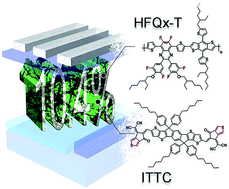
Molecular engineering of nonfullerene electron acceptors is of great importance for the development of organic photovoltaics. In this study, a series of methoxyl-modified dithieno[2,3-d:2′,3′-d′]-s-indaceno[1,2-b:5,6-b′]dithiophene-based small-molecule acceptor (SMA) isomers are synthesized and characterized to determine the effect of substitution position of the terminal group in these acceptor–donor–acceptor-type SMAs. Minor changes in the substitution position are demonstrated to greatly influence the optoelectronic properties and molecular packing of the isomers. Note that SMAs with planar molecular backbones show more ordered molecular packing and smaller π–π stacking distances, thus dramatically higher electron mobilities relative to their counterparts with distorted end-groups. By utilizing polymer poly[(2,6-(4,8-bis(5-(2-ethylhexyl)thiophen-2-yl)benzo[1,2-b:4,5-b′]dithiophen)-co-(1,3-di(5-thiophene-2-yl)-5,7-bis(2-ethylhexyl)benzo[1,2-c:4,5-c′]dithiophene-4,8-dione)] (PBDB-T) as an electron donor, an optimum power conversion efficiency (PCE) of 11.9% is achieved in the device based on PBDB-T:IT-OM-2, which is among the top efficiencies reported as of yet. Moreover, the PCE stays above 10% as the film thickness increases to 250 nm, which is very advantageous for large-area printing. Overall, the intrinsic molecular properties as well as the morphologies of blends can be effectively modulated by manipulating the substituent position on the terminal groups, and the structure–property relationships gleaned from this study will aid in designing more efficient SMAs for versatile applications.

Through substitution position manipulations of methoxyl on terminal groups in ITIC-based small-molecule acceptors (SMAs), relations between the chemical structure and optoelectronic properties of these SMAs are systematically investigated. Benefiting from the planar backbone and strong intermolecular interactions of a 5-methoxyl-substituted SMA (IT-OM-2), an efficiency of 11.9% is achieved, which is among the top efficiencies reported so far.
Recent research on fabricating scaffold-type perovskite solar cells on plastic substrates has reported noteworthy progress in replacing the high-temperature processing of TiO2 scaffolds and compact layers with various low-temperature processes. Herein, recent progress in the laboratory is reported regarding the development of electrodeposited TiOx compact layers and brookite TiO2 scaffolds, both of which can be processed under 150 °C without greatly sacrificing their photovoltaic performance. Through systematic characterization of device properties and careful optimization of the fabrication conditions, a record-high 15.76% power conversion efficiency of a plastic TiO2 scaffold-type perovskite solar cell is demonstrated. In addition, bending durability and preliminary stability tests on this plastic perovskite solar cell show promising results and indicate clear directions for future improvement.

An efficient plastic perovskite solar cell with a mesoporous scaffold structure is fabricated by using a low-temperature processable electrodeposited TiOx compact layer and spin-coated brookite TiO2 scaffold. The electrodeposition TiOx compact layer exhibits suitable morphology, favorable band position, and an extraordinary hole-blocking effect, while brookite TiO2 offers the capability to form a tightly packed scaffold without the need of sintering. Bending and dry-storage stability assessments are taken and showed promising results and clear direction of future improvements.
Ternary blend is proved to be a potential contender for achieving high efficiency in organic photovoltaics, which can apparently strengthen the absorption of active layer so as to better harvest light irradiation. Much of the previous work in ternary polymer solar cells focuses on broadening the absorption spectrum; however, a new insight is brought to study the third component, which in tiny amounts influents the small-molecule acceptor-based device performance. Without contributing to complementing the absorption, a minute amount of fullerene derivative, Bis-PC70BM, can effectively play an impressive role as sensitizer in enhancing the external quantum efficiency of the host binary blend, especially for polymeric donor. Detailed investigations reveal that the minute addition of Bis-PC70BM can realize morphology modification as well as facilitate electron transfer from polymeric donor to small molecule acceptor via cascade energy level modulation, and therefore lead to an improvement in device efficiency.

Ternary blend is proved to be a potential contender for achieving high efficiency in organic photovoltaics. In contrast to complementing absorption, a minute amount of fullerene derivatives is found to play an impressive sensitizer role in enhancing the external quantum efficiency in small-molecule acceptor-based binary polymer solar cells, which is further carefully investigated and interpreted.

One-step thermal processing achieving high-efficiency production of high-performance perovskite hollow fibers (HFs) with precisely controlled cation stoichiometry for ceramic fuel cells, separation membranes and catalytic membrane reactors, is reported by Wanqin Jin and co-workers in article number 1606377. These findings, overturning the traditional production view, provide significantly important progress for perovskite HFs and will potentially push energy-efficient HF-based solid-state devices into industrialized implementation.
Materials that show negative thermal expansion (NTE) have significant industrial merit because they can be used to fabricate composites whose dimensions remain invariant upon heating. In some materials, NTE is concomitant with the spontaneous magnetization due to the magnetovolume effect (MVE). Here the authors report a new class of MVE material; namely, a layered perovskite PrBaCo2O5.5+x (0 ≤ x ≤ 0.41), in which strong NTE [β ≈ −3.6 × 10⁻⁵ K−1 (90–110 K) at x = 0.24] is triggered by embedding ferromagnetic (F) clusters into the antiferromagnetic (AF) matrix. The strongest MVE is found near the boundary between F and AF phases in the phase diagram, indicating the essential role of competition between the F-clusters and the AF-matrix. Furthermore, the MVE is not limited to the PrBaCo2O5.5+x but is also observed in the NdBaCo2O5.5+x. The present study provides a new approach to obtaining MVE and offers a path to the design of NTE materials.

A new class of negative thermal expansion (NTE) material is discovered, in which the NTE is induced by a new mechanism. Namely, the layered perovskite PrBaCo2O5.5+x (0 ≤ x ≤ 0.41) exhibits a strong NTE when embedding (F) clusters into the (AF) matrix, where the competition between the F and AF phases plays the essential role.
Corrosive precursors used for the preparation of organic–inorganic hybrid perovskite photoactive layers prevent the application of ultrathin metal layers as semitransparent bottom electrodes in perovskite solar cells (PVSCs). This study introduces tin-oxide (SnOx) grown by atomic layer deposition (ALD), whose outstanding permeation barrier properties enable the design of an indium-tin-oxide (ITO)-free semitransparent bottom electrode (SnOx/Ag or Cu/SnOx), in which the metal is efficiently protected against corrosion. Simultaneously, SnOx functions as an electron extraction layer. We unravel the spontaneous formation of a PbI2 interfacial layer between SnOx and the CH3NH3PbI3 perovskite. An interface dipole between SnOx and this PbI2 layer is found, which depends on the oxidant (water, ozone, or oxygen plasma) used for the ALD growth of SnOx. An electron extraction barrier between perovskite and PbI2 is identified, which is the lowest in devices based on SnOx grown with ozone. The resulting PVSCs are hysteresis-free with a stable power conversion efficiency (PCE) of 15.3% and a remarkably high open circuit voltage of 1.17 V. The ITO-free analogues still achieve a high PCE of 11%.

Corrosive precursors used to prepare organo-metal-halide perovskite photoactive layers usually prevent the application of ultrathin metal layers in semitransparent bottom electrodes. A tin-oxide/metal/tin-oxide electrode is introduced, where the ultrathin metal layer is shielded by impermeable tin-oxide (SnOx) grown by atomic layer deposition. The SnOx concomitantly functions as an electron extraction layer that affords a high open-circuit voltage of 1.17 V.