19 Aug 00:55
J. Mater. Chem. A, 2016, 4,13525-13533
DOI: 10.1039/C6TA05209F, Paper
Chien-Hung Chiang, Jun-Wei Lin, Chun-Guey Wu
Combining halogen composition and film casting engineering, a high quality homogeneous film with a large area can be prepared using a one-step method. Inverted solar cells and modules, based on mixed-halide perovskite films, achieved the highest efficiency of 16.52% and 14.3%, respectively.
The content of this RSS Feed (c) The Royal Society of Chemistry
17 Aug 01:10
J. Mater. Chem. A, 2016, 4,13482-13487
DOI: 10.1039/C6TA04616A, Paper
Xiaoru Wen, Jiamin Wu, Di Gao, Changjian Lin
In pursuit of reducing the surface trap states of perovskite as well as enhancing the hole control of dopant-free spiro-OMeTAD, an amino-rich graphene (NGs) was introduced via a facial solution method as an interlayer at the perovskite/HTM interface.
The content of this RSS Feed (c) The Royal Society of Chemistry
17 Aug 01:09
J. Mater. Chem. A, 2016, 4,13400-13406
DOI: 10.1039/C6TA04356A, Communication
Kai Yao, Huifeng Jiao, Yun-Xiang Xu, Qiqi He, Fan Li, Xiaofeng Wang
We prepare novel nano-bio hybrids by employing Ag nanoprisms as surface plasmons to couple with light-harvesting complex II (LHCII) for broad-band optical enhancement in organic photovoltaics. The results open the possibility to use metal nanoparticles for tuning the photophysical properties of integral biomolecules in a well-defined way.
The content of this RSS Feed (c) The Royal Society of Chemistry
17 Aug 01:08
J. Mater. Chem. A, 2016, 4,13795-13802
DOI: 10.1039/C6TA06261J, Paper
Xin Gan, Ruitao Lv, Haoyue Zhu, Lai-Peng Ma, Xuyang Wang, Zexia Zhang, Zheng-Hong Huang, Hongwei Zhu, Wencai Ren, Mauricio Terrones, Feiyu Kang
Anti-reflective transparent electrodes are achieved demonstrating a highest efficiency of 13% and short-circuit current density of 34 mA cm-2.
The content of this RSS Feed (c) The Royal Society of Chemistry
17 Aug 01:08
J. Mater. Chem. A, 2016, 4,13519-13524
DOI: 10.1039/C6TA03784D, Paper
Yubao Zhang, Jiulin Shi, Xingdao He, Guoli Tu
N-Heteroacenes could be employed as efficient electron-donor materials when substituted with thiophene groups.
The content of this RSS Feed (c) The Royal Society of Chemistry
17 Aug 01:07
J. Mater. Chem. A, 2016, 4,13652-13659
DOI: 10.1039/C6TA04867F, Paper
J. Vieten, B. Bulfin, F. Call, M. Lange, M. Schmucker, A. Francke, M. Roeb, C. Sattler
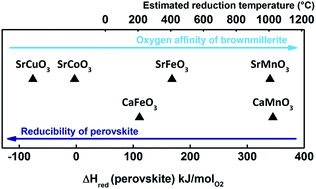
A materials screening of perovskites for oxygen storage applications yielding two promising materials, SrFe0.95Cu0.05O3-[small delta] and Ca0.8Sr0.2MnO3-[small delta] with outstanding performance.
The content of this RSS Feed (c) The Royal Society of Chemistry
17 Aug 01:07
J. Mater. Chem. A, 2016, 4,13754-13763
DOI: 10.1039/C6TA05319J, Paper
Tao Cheng, Yi-Zhou Zhang, Jian-Peng Yi, Lei Yang, Jian-Dong Zhang, Wen-Yong Lai, Wei Huang
Inkjet-printed flexible transparent aesthetic supercapacitors were constructed for the first time using PEDOT:PSS/Ag grids as both current collectors and electrodes.
The content of this RSS Feed (c) The Royal Society of Chemistry
17 Aug 01:07
J. Mater. Chem. A, 2016, 4,13930-13937
DOI: 10.1039/C6TA05886H, Paper
Bingbing Fan, Xiaonan Xue, Xiangyi Meng, Xiaobo Sun, Lijun Huo, Wei Ma, Yanming Sun
Constructing conjugated terpolymers with one donor and two acceptor units is an effective strategy for designing high-performance solar cell materials.
The content of this RSS Feed (c) The Royal Society of Chemistry
17 Aug 01:06
J. Mater. Chem. A, 2016, 4,14481-14508
DOI: 10.1039/C6TA05286J, Review Article
Kirill Zilberberg, Thomas Riedl
The recent progress of semi-transparent electrodes based on thin metal layers or metal nanowires and their application in solar cells are reviewed.
The content of this RSS Feed (c) The Royal Society of Chemistry
16 Aug 01:08
by Jongmin Roh, Haejun Yu and Jyongsik Jang

ACS Applied Materials & Interfaces
DOI: 10.1021/acsami.6b04760

16 Aug 01:06
by Cheng-Kuang Lee and Chun-Wei Pao

ACS Applied Materials & Interfaces
DOI: 10.1021/acsami.6b05027

16 Aug 00:50
by Krishna Feron, James M. Cave, Mahir N. Thameel, Connor O’Sullivan, Renee Kroon, Mats R. Andersson, Xiaojing Zhou, Christopher J. Fell, Warwick J. Belcher, Alison B. Walker and Paul C. Dastoor

ACS Applied Materials & Interfaces
DOI: 10.1021/acsami.6b05474

16 Aug 00:50
by Satoru Ohisa, Sho Kagami, Yong-Jin Pu, Takayuki Chiba and Junji Kido

ACS Applied Materials & Interfaces
DOI: 10.1021/acsami.6b06723

15 Aug 07:22
by Ji-Youn Seo, Taisuke Matsui, Jingshan Luo, Juan-Pablo Correa-Baena, Fabrizio Giordano, Michael Saliba, Kurt Schenk, Amita Ummadisingu, Konrad Domanski, Mahboubeh Hadadian, Anders Hagfeldt, Shaik M. Zakeeruddin, Ullrich Steiner, Michael Grätzel, Antonio Abate

Ionic liquids can retard the perovskite crystallization with the aim to form compact films with larger and more uniformly distributed grain size. The ionic liquid driven crystallization is exploited to prepared a record planar perovskite solar cell with stabilized power output of 19.5%.
15 Aug 07:22
by Alyssa N. Brigeman, Michael A. Fusella, Yixin Yan, Geoffrey E. Purdum, Yueh-Lin Loo, Barry P. Rand, Noel C. Giebink

Anisotropic charge transfer (CT) state absorption originating from the natural transition dipole alignment at planar donor–acceptor interfaces can be exploited to reveal the full CT state absorption spectrum in organic solar cells. Application of this method reveals the existence of previously unobserved, higher-lying CT absorption buried beneath the excitonic background.
15 Aug 07:21
by Zhong'an Li, Zonglong Zhu, Chu-Chen Chueh, Jingdong Luo, Alex K.-Y. Jen

A crosslinked organic hole-transporting layer (HTL) is developed to realize highly efficient and stable perovskite solar cells via a facile thiol-ene thermal reaction. This crosslinked HTL not only facilitates hole extraction from perovskites, but also functions as an effective protective barrier. A high-performance (power conversion efficiency: 18.3%) device is demonstrated to show respectable photo and thermal stability without encapsulation.
15 Aug 07:21
by Florian Lombeck, Hartmut Komber, Daniele Fazzi, Diego Nava, Jochen Kuhlmann, Dominik Stegerer, Karen Strassel, Josef Brandt, Amaia Diaz de Zerio Mendaza, Christian Müller, Walter Thiel, Mario Caironi, Richard Friend, Michael Sommer
The photophysical properties and solar cell performance of the classical donor–acceptor copolymer PCDTBT
(poly(N-9′-heptadecanyl-2,7-carbazole-alt -5,5-(4′,7′-di-2-thienyl-2′,1′,3′-benzothiadiazole))) in relation to unintentionally formed main chain defects are investigated. Carbazole–carbazole homocouplings (Cbz hc) are found to significant extent in PCDTBT made with a variety of Suzuki polycondensation conditions. Cbz hc vary between 0 and 8 mol% depending on the synthetic protocol used, and are quantified by detailed nuclear magnetic resonance spectroscopy including model compounds, which allows to establish a calibration curve from optical spectroscopy. The results are corroborated by extended time-dependent density functional theory investigations on the structural, electronic, and optical properties of regularly alternating and homocoupled chains. The photovoltaic properties of PCDTBT:fullerene blend solar cells significantly depend on the Cbz hc content for constant molecular weight, whereby an increasing amount of Cbz hc leads to strongly decreased short circuit currents JSC. With increasing Cbz hc content, JSC decreases more strongly than the intensity of the low energy absorption band, suggesting that small losses in absorption cannot explain the decrease in JSC alone, rather than combined effects of a more localized LUMO level on the TBT unit and lower hole mobilities found in highly defective samples. Homocoupling-free PCDTBT with optimized molecular weight yields the highest efficiency up to 7.2% without extensive optimization.

Electronic main chain defects in conjugated polymers caused by carbazole homocouplings (Cbz hc) significantly deteriorate the performance of organic photovoltaics as shown for poly(N-9′-heptadecanyl-2,7-carbazole-alt-5,5-(4′,7′-di-2-thienyl-2′,1′,3′-benzothiadiazole)) (PCDTBT):PC71BM devices. Cbz hc occur frequently, are quantified for a variety of Suzuki conditions, and are correlated with photophysical properties. PCDTBT without main chain defects and optimized molar mass gives the highest power conversion efficiencies exceeding 7%.
15 Aug 07:20
by Meng Li, Zhao-Kui Wang, Ying-Guo Yang, Yun Hu, Shang-Lei Feng, Jin-Miao Wang, Xing-Yu Gao, Liang-Sheng Liao
The development of effective and stable hole transporting materials (HTMs) is very important for achieving high-performance planar perovskite solar cells (PSCs). Herein, copper salts (cuprous thiocyanate (CuSCN) or cuprous iodide (CuI)) doped 2,2,7,7-tetrakis(N,N-di-p-methoxyphenylamine)-9,9-spirobifluorene (spiro-OMeTAD) based on a solution processing as the HTM in PSCs is demonstrated. The incorporation of CuSCN (or CuI) realizes a p-type doping with efficient charge transfer complex, which results in improved film conductivity and hole mobility in spiro-OMeTAD:CuSCN (or CuI) composite films. As a result, the PCE is largely improved from 14.82% to 18.02% due to obvious enhancements in the cell parameters of short-circuit current density and fill factor. Besides the HTM role, the composite film can suppress the film aggregation and crystallization of spiro-OMeTAD films with reduced pinholes and voids, which slows down the perovskite decomposition by avoiding the moisture infiltration to some extent. The finding in this work provides a simple method to improve the efficiency and stability of planar perovskite solar cells.

Copper salts (cuprous thiocyanate or cuprous iodide) doped 2,2,7,7-tetrakis(N,N-di-p-methoxyphenylamine)-9,9-spirobifluorene is used as the hole transport layer in planar perovskite solar cells by their good film conductivity and hole mobility. As a result, a maximum 18.02% power conversion efficiency is achieved with improved cell stability. 2D grazing incidence X-ray diffraction technique is utilized to probe the cell degradation process.
15 Aug 07:17
by Tenghooi Goh, Jing-Shun Huang, Kevin G. Yager, Matthew Y. Sfeir, Chang-Yong Nam, Xiao Tong, Louise M. Guard, Patrick R. Melvin, Francisco Antonio, Benjamin G. Bartolome, Minjoo L. Lee, Nilay Hazari, André D. Taylor
The incorporation of multiple donors into the bulk-heterojunction layer of organic polymer solar cells (PSCs) has been demonstrated as a practical and elegant strategy to improve photovoltaics performance. However, it is challenging to successfully design and blend multiple donors, while minimizing unfavorable interactions (e.g., morphological traps, recombination centers, etc.). Here, a new Förster resonance energy transfer-based design is shown utilizing the synergistic nature of three light active donors (two small molecules and a high-performance donor–acceptor polymer) with a fullerene acceptor to create highly efficient quaternary PSCs with power conversion efficiencies (PCEs) of up to 10.7%. Within this quaternary architecture, it is revealed that the addition of small molecules in low concentrations broadens the absorption bandwidth, induces cocrystalline molecular conformations, and promotes rapid (picosecond) energy transfer processes. These results provide guidance for the design of multiple-donor systems using simple processing techniques to realize single-junction PSC designs with unprecedented PCEs.

A viable strategy to realize highly efficient quaternary blend solar cells is introduced that breaks efficiency above 10% with complementary squaraine small molecules–low band-gap polymer combinations. Our quaternary design demonstrates several advantages: (i) broader light absorption, (ii) improved surface morphology, (iii) enhanced cocrystallization packing, (iv) multiple energy and charge transfer pathways to reduce recombination, and (v) increased charge mobility.
15 Aug 01:16
by Yiliang Wu, Heping Shen, Daniel Walter, Daniel Jacobs, The Duong, Jun Peng, Liangcong Jiang, Yi-Bing Cheng, Klaus Weber
The origin of hysteresis behavior is probed in perovskite solar cells (PSCs) with simultaneous measurements of cell open circuit voltage (Voc) and photoluminescence intensity over time following illumination of the cell. It is shown, for the first time, that the transient changes in terminal voltage and luminescent intensity do not follow the relationship that would be predicted by the generalized Plank radiation law. A mechanism is proposed based on the presence of a resistive barrier to majority carrier flow at the interface between the perovskite film and the electron or hole transport layer, in combination with significant interface recombination. This results in a decoupling of the internal quasi-Fermi level separation and the externally measured voltage. A simple numerical model is used to provide in-principle validation for the proposed mechanism and it is confirmed that mobile ionic species are a likely candidate for creating the time-varying majority carrier bottleneck by its reduced conductivity. The findings show that the Voc of PSCs may be lower than the limit imposed by the cell luminescence efficiency, even under steady-state conditions.

The origin of hysteresis behavior in perovskite solar cells is probed with simultaneous measurements of cell open circuit voltage and photoluminescence intensity over time following illumination of the cell. The findings demonstrate the existence of a resistive barrier to majority carrier flow at the interfaces of these devices, in combination with significant interface recombination.
15 Aug 01:16
by Bonkee Koo, Heesuk Jung, Minwoo Park, Jae-Yup Kim, Hae Jung Son, Jinhan Cho, Min Jae Ko

On page 5400, M. J. Ko and co-workers report that hydrophobic ligand capped pyrite nanoparticles can act as a bi-functional hole transporting layer (HTL) (charge transporting layer and moisture-proof layer) for perovskite solar cells. Perovskite solar cells employing this HTL exhibit very stable performance under moist condition for at least 1000 hours.
15 Aug 01:14
by Yikun Guo, Yunke Li, Omar Awartani, Jingbo Zhao, Han Han, Harald Ade, Dahui Zhao, He Yan

All-polymer solar cells with 7.57% power conversion efficiency are achieved via a new perylenediimide-based polymeric acceptor. Furthermore, the device processed in ambient air without encapsulation can still reach a high power conversion efficiency (PCE) of 7.49%, which is a significant economic advantage from an industrial processing perspective. These results represent the highest PCE achieved from perylenediimide-based polymers.
15 Aug 01:14
by Deyu Liu, Qianqian Zhu, Chunyang Gu, Junyi Wang, Meng Qiu, Weichao Chen, Xichang Bao, Mingliang Sun, Renqiang Yang

Two 1D–2D asymmetric benzodithiophenes (BDTs) as donor building blocks are designed and synthesized, combining the advantages of both 1D and 2D symmetric BDTs. The photovoltaic properties of the asymmetric BDT-based polymers are improved greatly in comparison with corresponding symmetric BDT-based polymers. This work provides a new approach to design prospective organic optoelectronic materials employing the symmetry-breaking strategy.
15 Aug 01:13
by Haoran Lin, Shangshang Chen, Huawei Hu, Lu Zhang, Tingxuan Ma, Joshua Yuk Lin Lai, Zhengke Li, Anjun Qin, Xuhui Huang, Benzhong Tang, He Yan

A small-molecular acceptor, tetraphenylpyrazine-perylenediimide tetramer (TPPz-PDI4), which has a reduced extent of intramolecular twisting compared to two other small-molecular acceptors is designed. Benefiting from the lowest extent of intramolecular twisting, TPPz-PDI4 exhibits the highest aggregation tendency and electron mobility, and therefore achieves a highest power conversion efficiency of 7.1%.
15 Aug 01:13
by Jaeho Choi, Sunghak Park, Joohee Lee, Kootak Hong, Do-Hong Kim, Cheon Woo Moon, Gyeong Do Park, Junmin Suh, Jinyeon Hwang, Soo Young Kim, Hyun Suk Jung, Nam-Gyu Park, Seungwu Han, Ki Tae Nam, Ho Won Jang

On page 6562, K. T. Nam, H. W. Jang, and co-workers describe an ultralow electric field and high-ON/OFF-ratio resistive-switching behavior of solution-processed organo-metal halide perovskite (OHP) films with the rotational motion of the A-site molecular cation. Metal/OHP/metal cells exhibit electroforming-free resistive switching at an electric field of 3.25 × 10³ V cm−1 for four distinguishable ON-state resistance levels.
15 Aug 01:12
by Zhao-Kui Wang, Meng Li, Ying-Guo Yang, Yun Hu, Heng Ma, Xing-Yu Gao, Liang-Sheng Liao

On page 6695, X. Y. Gao, L.-S. Liao, and co-workers describe the fabrication of mixed Pb–In perovskite solar cells, using indium (III) chloride and lead (II) chloride with methylammonium iodide. A maximum power conversion efficiency as high as 17.55% is achieved owing to the high quality of the perovskites with multiple ordered crystal orientations. This work demonstrates the possibility of substituting the Pb (II) by using In (III), which opens a broad route to fabricating alloy perovskite solar cells with mitigated ecological impact.
29 Jul 01:02
by Kai-Lin Ou, Ramanan Ehamparam, Gordon MacDonald, Tobias Stubhan, Xin Wu, R. Clayton Shallcross, Robin Richards, Christoph J. Brabec, S. Scott Saavedra and Neal R. Armstrong

ACS Applied Materials & Interfaces
DOI: 10.1021/acsami.6b02792

29 Jul 01:02
by Wangyao Ge, Nan K. Li, Ryan D. McCormick, Eli Lichtenberg, Yaroslava G. Yingling and Adrienne D. Stiff-Roberts

ACS Applied Materials & Interfaces
DOI: 10.1021/acsami.6b05596

29 Jul 00:57
J. Mater. Chem. A, 2016, 4,13251-13258
DOI: 10.1039/C6TA04950H, Paper
Bing Guo, Xia Guo, Wanbin Li, Xiangyi Meng, Wei Ma, Maojie Zhang, Yongfang Li
Polymer solar cells based on a wide-bandgap polymer exhibited PCEs of 7.7% and 10.3% for single and tandem devices, respectively.
The content of this RSS Feed (c) The Royal Society of Chemistry
29 Jul 00:54
by Ming Yu Jin, Byung-Man Kim, Hyun Sil Jung, Jun-Hyeok Park, Deok-Ho Roh, Dong Guk Nam, Tae-Hyuk Kwon, Do Hyun Ryu
New indoline dyes (RK-1–4) were designed with a planar geometry and high molar extinction coefficient, which provided surprising power conversion efficiency (PCE) with a thin titanium dioxide film in dye-sensitized solar cells (DSCs). They had a difference in only alkyl chain length. Despite the same molecular structure, the performance of the respective DSCs varied significantly. Investigating the dye adsorption processes and charge transfer kinetics, the alkyl chain length was determined to affect the dye surface coverage as well as the recombination between the injected photoelectrons and the oxidized redox mediators. When applied to the DSCs as a light harvester, RK-3 with the dodecyl group exhibited the best photocurrent density, consequently achieving the best PCE of 9.1% with a 1.8 μm active and 2.5 μm scattering layer because of the most favorable charge injection. However, when increasing the active layer thickness, overall device performance deteriorated and the charge collection and regeneration played major roles for determining the PCE. Therefore, RK-2 featuring the highest surface coverage and moderate alkyl chain length obtained the highest PCEs of 8.8% and 7.9% with 3.5 and 5.1 μm active layers, respectively. These results present a promising perspective of organic dye design for thin film DSCs.

New indoline derivatives characterized by good planarity and high molar absorptivity are successfully applied to dye-sensitized solar cells (DSCs). By controlling the hydrocarbon chain length, noticeable photocurrent density is achieved at a very thin TiO2 film, which is traced elementally, guiding the research of organic dyes for thin film-based DSCs.