27 May 01:54
by Marina Kulmas, Leanne Paterson, Katja Höflich, Muhammad Y. Bashouti, Yanlin Wu, Manuela Göbelt, Jürgen Ristein, Julien Bachmann, Bernd Meyer, Silke Christiansen
The commercialization of solar fuel devices requires the development of novel engineered photoelectrodes for water splitting applications which are based on redundant, cheap, and environmentally friendly materials. In the current study, a combination of titanium dioxide (TiO2) and zinc oxide (ZnO) onto nanotextured silicon is utilized for a composite electrode with the aim to overcome the individual shortcomings of the respective materials. The properties of conformal coverage of TiO2 and ZnO layers are designed on the atomic scale by the atomic layer deposition technique. The resulting photoanode shows not only promising stability but also nine times higher photocurrents than an equivalent photoanode with a pure TiO2 encapsulation onto the nanostructured silicon. Density functional theory calculations indicate that segregation of TiO2 at the ZnO surfaces is favorable and leads to the stabilization of the ZnO layers in water environments. In conclusion, the novel designed composite material constitutes a promising base for a stable and effective photoanode for the water oxidation reaction.

A novel photoanode for water oxidation based on a composite TiO2-ZnO encapsulation engineered for stabilized photoelectroactivity of the nanostructured silicon substrate is developed. Density functional theory is applied to obtain realistic structural models of the TiO2-ZnO composite on the atomic scale and the way in which the configurational modifications lead to a better performance of the electrodes is investigated.
25 May 11:56
by Dane W. deQuilettes
Article
Visual evidence for photo-induced ionic migration in perovskite films without contacts is lacking. Here, the authors use a unique combination of confocal photoluminescence microscopy and chemical imaging to correlate the local changes in photophysics with composition in CH 3 NH 3 PbI 3 films under illumination.
Nature Communications doi: 10.1038/ncomms11683
Authors: Dane W. deQuilettes, Wei Zhang, Victor M. Burlakov, Daniel J. Graham, Tomas Leijtens, Anna Osherov, Vladimir Bulović, Henry J. Snaith, David S. Ginger, Samuel D. Stranks

25 May 00:36
Nanoscale, 2016, 8,11403-11412
DOI: 10.1039/C6NR01601D, Communication
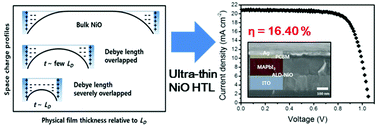
Seongrok Seo, Ik Jae Park, Myungjun Kim, Seonhee Lee, Changdeuck Bae, Hyun Suk Jung, Nam-Gyu Park, Jin Young Kim, Hyunjung Shin
ALD-grown ultra-thin NiO HTLs were optimized by Debye length (LD) overlapping and demonstrated to be efficient HTLs for perovskite solar cells.
The content of this RSS Feed (c) The Royal Society of Chemistry

24 May 02:17
J. Mater. Chem. A, 2016, 4,10186-10194
DOI: 10.1039/C6TA02672A, Paper
Javier Macias, Aleksey A. Yaremchenko, Jorge R. Frade
Phase stability domain of SrVO3-based SOFC anode materials is expanded towards higher oxygen partial pressures by donor-type substitutions into strontium and/or vanadium sublattices.
The content of this RSS Feed (c) The Royal Society of Chemistry
24 May 02:17
J. Mater. Chem. A, 2016, 4,9511-9518
DOI: 10.1039/C6TA03288E, Paper
Kang Zhao, Qi Wang, Bowei Xu, Wenchao Zhao, Xiaoyu Liu, Bei Yang, Mingliang Sun, Jianhui Hou
Efficient fullerene-based and fullerene-free PSCs were fabricated based on two wide band gap polymers PBT-TTz and PBT-S-TTz.
The content of this RSS Feed (c) The Royal Society of Chemistry
24 May 02:14
by Qian Zhang, Xiangjian Wan, Feng Liu, Bin Kan, Miaomiao Li, Huanran Feng, Hongtao Zhang, Thomas P. Russell, Yongsheng Chen

Three small molecules as front cell donors for tandem cells are thoroughly evaluated and a high power conversion efficiency of 11.47% is achieved, which demonstrates that the oligomer-like small molecules offer a good choice for high-performance tandem solar cells.
24 May 02:06
by Lichen Zhao, Deying Luo, Jiang Wu, Qin Hu, Wei Zhang, Ke Chen, Tanghao Liu, Yi Liu, Yifei Zhang, Feng Liu, Thomas P. Russell, Henry J. Snaith, Rui Zhu, Qihuang Gong

Methylammonium bromide is used as an additive in the lead acetate-based precursor solution for perovskite solar cells by T. P. Russell, R. Zhu, and co-workers on page 3508. This is found to significantly improved perovskite film quality and optoelectronic properties. The optimized device delivers a power conversion efficiency of 18.3%, holding promise for highly efficient perovskite solar cells.
23 May 10:32
J. Mater. Chem. A, 2016, 4,9958-9966
DOI: 10.1039/C6TA03658A, Paper
Yurong Jiang, Chen Li, Hairui Liu, Ruiping Qin, Heng Ma
PEDOT:PSS-molybdenum oxide (MoOx) composite films are used as hole transport layers in planar perovskite solar cells (PSCs) by simply incorporating solution-processed MoOx powders into a PEDOT:PSS solution.
The content of this RSS Feed (c) The Royal Society of Chemistry
23 May 10:26
by Jacek J. Jasieniak, Neil D. Treat, Christopher R. McNeill, Bertrand J. Tremolet de Villers, Enrico Della Gaspera, Michael L. Chabinyc

The interfacial microstructure in organic bulk heterojunction solar cells can dictate photovoltaic performance. By controlling the chemical interactions of bulk heterojunction components with specific surfaces, the electrical pathways at interfaces can be precisely varied to achieve suitable electronic properties across such interfaces. This is studied by J. J. Jasieniak and co-workers on page 3944.
23 May 10:24
by Zhenhua Yu, Bolei Chen, Pei Liu, Changlei Wang, Chenhao Bu, Nian Cheng, Sihang Bai, Yanfa Yan, Xingzhong Zhao
Within the past few years, the record efficiency of inorganic–organic perovskite solar cell (PSC) has improved rapidly up to over 20%. However, the viability of commercialization of the PSC technology has been seriously questioned due to the moisture- and thermal-induced instabilities. Here, it is demonstrated that these issues may be mitigated via cell structure design and contact engineering. By employing the hole-conductor layer-free cell structure and a bi-layer back contact consisting of a carbon/CH3NH3I composite layer and a compact hydrophobic carbon layer, the PSCs have shown excellent stability, inhibiting moisture ingression and heat-induced perovskite degradation. It is found that, the unique bi-layer contact enables the optimization of perovskite absorbers during thermal stress. As a result, instead of degradation, the devices present enhanced performance under heating at 100 °C for 30 min. The best-performing cell shows a final efficiency of 13.6% from an initial efficiency of 11.3% after thermal stress. Upon encapsulation, these cells can even retain 90% of the initial efficiencies after water exposure and over 100% initial efficiency under thermal stress at 150 °C for half an hour. This approach provides a facile way for stabilizing the PSCs and opens a door for viable commercialization of the emerging PSC technology.

To mitigate the instability of perovskite solar cells via device structure design and contact engineering, a hole-conductor layer-free structure of device and a unique bi-layer hybrid carbon back contact are adopted. The cells not only achieve an enhanced efficiency of 13.6% from the initial 11.3% after 100 °C treatment, but also exhibit excellent moist and thermal stability.
20 May 01:44
by Li Ling, Sijian Yuan, Pengfei Wang, Huotian Zhang, Li Tu, Jiao Wang, Yiqiang Zhan, Lirong Zheng
Recently, intensive studies on the role of water molecule in the formation of organic–inorganic perovskite film have been reported. However, not only the contradictive phenomena but also the complex processing technique has hindered the widespread use of water molecule in perovskite preparation. Here the hydration water is introduced into the precursors instead of water. By precisely controlling the content of hydration water, a smoother and more uniform perovskite film is obtained through a simple one-step spin coating method. The improvement of perovskite film quality leads to highly efficient planar perovskite solar cells. Summing up the device studies and the investigation of morphology, crystallization, and optical properties, the impact of water molecule in the formation of perovskite crystal and consequences of device performance is understood. Due to its universal adaptability and simplified process, precise control of hydration water is therefore of great utility to high quality perovskite films fabrication and large-scale production of this upcoming photovoltaic technology.

The content of hydration water is carefully controlled in precursor solution. The findings reveal that the hydration water has played an essential role in the formation of perovskite film. With an optimum amount of hydration water, a high quality perovskite film with better uniformity and smoother surface is formed. Based on it, an efficient perovskite solar cell is fabricated.
18 May 07:32
by Qi Wang, Qingfeng Dong, Tao Li, Alexei Gruverman, Jinsong Huang

Tunneling contacts made of any insulating polymers, a champion technology in silicon solar cells, are shown to increase the stabilized efficiency of perovskite solar cells (PSCs) to 20.3%. The tunneling layers spatially separate photo-generated electrons and holes at the perovskite-cathode interface and reduce charge recombination. The tunneling layers made of hydrophobic polymers also significantly enhance the resistance of PSCs to water-caused damage.
18 May 07:31
by Zhao-Kui Wang, Meng Li, Ying-Guo Yang, Yun Hu, Heng Ma, Xing-Yu Gao, Liang-Sheng Liao

Mixed Pb–In perovskite solar cells are fabricated by using lead(II) chloride and indium(III) chloride with methylammonium iodide. A maximum power conversion efficiency as high as 17.55% is achieved owing to the high quality of perovskites with multiple ordered crystal orientations.
18 May 07:30
by Hee Taek Yi, Xiaoxi Wu, Xiaoyang Zhu, Vitaly Podzorov

Hall effect measurements in CH3NH3PbBr3 single crystals reveal that the charge-carrier mobility follows an inverse-temperature power-law dependence, μ ∝ T−γ, with the power exponent γ = 1.4 ± 0.1 in the cubic phase, indicating an acoustic-phonon-dominated carrier scattering, and γ = 0.5 ± 0.1 in the tetragonal phase, suggesting another dominant mechanism, such as a piezoelectric or space-charge scattering.
18 May 07:16
J. Mater. Chem. A, 2016, 4,9430-9436
DOI: 10.1039/C6TA02999J, Paper
Shida Yang, Wenqing Liu, Lijian Zuo, Xinqian Zhang, Tao Ye, Jiehuan Chen, Chang-Zhi Li, Gang Wu, Hongzheng Chen
Thiocyanate ammonium additives are found to improve the performance of FAPbI3 based planar perovskite solar cells through a single one-step method.
The content of this RSS Feed (c) The Royal Society of Chemistry
18 May 07:12
by Weibo Yan, Senyun Ye, Yunlong Li, Weihai Sun, Haixia Rao, Zhiwei Liu, Zuqiang Bian, Chunhui Huang
Hybrid organic–inorganic halide-perovskite-based solar cells have achieved notable progress. A hot topic in this field is exploring inexpensive, stable and effective hole-transporting materials (HTMs) in order to improve the device performance and be favorable for large-scale production in the future. The HTMs have been proven to be an important component of perovskite solar cells, which can form selective contact being favorable for reducing charge recombination and effective hole collection, thus resulting in the enhancement of the open-circuit voltage and the fill factor. Here, an overview of the design and development of HTMs is given, mainly divided into conductive polymers, inorganic p-type semiconductors in inverted-structure-based planar perovskite solar cells. The influences of their mobility, work function and film property on device performance are discussed.

Hole-transporting materials in inverted planar perovskite solar cells have been widely studied in the past years. Most commonly these are p-type wide band-gap semiconductors which can be mainly divided into conductive polymers and inorganic p-type semiconductors. Their energy levels and chemical structures are summarized and the effects of their properties on the device performance are discussed in detail.
18 May 07:12
by Qunping Fan, Wenyan Su, Xia Guo, Bing Guo, Wanbin Li, Youdi Zhang, Kun Wang, Maojie Zhang, Yongfang Li

A new fluorinated polythiophene (PT) derivative, PBDD-ff4T, is designed and synthesized. The PBDD-ff4T/PC71BM-based device without any extra treatment exhibits a high efficiency of 9.2%, under the irradiation of AM 1.5G, 100 mW cm−2, which is the highest power conversion efficiency reported for PT derivative-based polymer solar cells.
18 May 07:10
by Fei Zhang, Chenyi Yi, Peng Wei, Xiangdong Bi, Jingshan Luo, Gwénolé Jacopin, Shirong Wang, Xianggao Li, Yin Xiao, Shaik Mohammed Zakeeruddin, Michael Grätzel

A triphenylamine based molecular “butterfly” is developed as dopant-free hole-transport material for perovskite solar cells exhibiting excellent power conversion efficiency of 16.3% which is comparable to the state-of-the-art doped 2,2′,7,7′-tetrakis(N,N′-di-p-methoxy-phenylamine)-9,9′-spirobifluorene (spiro-OMeTAD). Moreover, the device is much more stable than that of spiro-OMeTAD based device under light irradiation.
13 May 13:07
by Shan Chen, Changjiu Teng, Miao Zhang, Yingru Li, Dan Xie, Gaoquan Shi

A lateral photodetector based on the bilayer composite film of a perovskite and a conjugated polymer is reported. It exhibits significantly enhanced responsivity in the UV–vis region and sensitive photoresponse in the near-IR (NIR) region at a low applied voltage. This broadband photodetector also shows excellent mechanical flexibility and improved environmental stability.
13 May 13:07
by Constantinos C. Stoumpos, Mercouri G. Kanatzidis
Halide perovskites are a rapidly developing class of medium-bandgap semiconductors which, to date, have been popularized on account of their remarkable success in solid-state heterojunction solar cells raising the photovoltaic efficiency to 20% within the last 5 years. As the physical properties of the materials are being explored, it is becoming apparent that the photovoltaic performance of the halide perovskites is just but one aspect of the wealth of opportunities that these compounds offer as high-performance semiconductors. From unique optical and electrical properties stemming from their characteristic electronic structure to highly efficient real-life technological applications, halide perovskites constitute a brand new class of materials with exotic properties awaiting discovery. The nature of halide perovskites from the materials' viewpoint is discussed here, enlisting the most important classes of the compounds and describing their most exciting properties. The topics covered focus on the optical and electrical properties highlighting some of the milestone achievements reported to date but also addressing controversies in the vastly expanding halide perovskite literature.

Halide perovskites are a promising new class of semiconductors that deliver clean energy from inexpensive inorganic materials. Perovskite materials compete in conversion efficiency with classical inorganic semiconductors and promise a bright future toward exploitation of cheap, clean energy resources. Understanding how these materials actually work poses the main challenge in contemporary materials science research.
13 May 00:29
by Magatte N. Gueye, Alexandre Carella, Nicolas Massonnet, Etienne Yvenou, Sophie Brenet, Jérôme Faure-Vincent, Stéphanie Pouget, François Rieutord, Hanako Okuno, Anass Benayad, Renaud Demadrille and Jean-Pierre Simonato

Chemistry of Materials
DOI: 10.1021/acs.chemmater.6b01035

13 May 00:13
Nanoscale, 2016, 8,11882-11888
DOI: 10.1039/C6NR01152G, Paper
Feijiu Wang, Masaru Endo, Shinichiro Mouri, Yuhei Miyauchi, Yutaka Ohno, Atsushi Wakamiya, Yasujiro Murata, Kazunari Matsuda
A carbon hole conductive layer of SWNT/GO/PMMA can not only improve conversion efficiency but also stability in perovskite solar cells.
The content of this RSS Feed (c) The Royal Society of Chemistry

12 May 00:43
by Zonglong Zhu, Yang Bai, Xiao Liu, Chu-Chen Chueh, Shihe Yang, Alex K.-Y. Jen

Highly crystalline SnO2 is demonstrated to serve as a stable and robust electron-transporting layer for high-performance perovskite solar cells. Benefiting from its high crystallinity, the relatively thick SnO2 electron-transporting layer (≈120 nm) provides a respectable electron-transporting property to yield a promising power conversion efficiency (PCE)(18.8%) Over 90% of the initial PCE can be retained after 30 d storage in ambient with ≈70% relative humidity.
11 May 13:09
J. Mater. Chem. A, 2016, 4,8566-8572
DOI: 10.1039/C6TA03605H, Communication
Chenxin Ran, Yonghua Chen, Weiyin Gao, Minqiang Wang, Liming Dai
We report a novel 1DPCBM nanorod material as an efficient additive to form a wrinkle-like bicontinuousperovskite layer, where 1D PCBM nanorods can distribute homogenously throughout the film with an enlarged grain size.
The content of this RSS Feed (c) The Royal Society of Chemistry
11 May 01:49
J. Mater. Chem. A, 2016, 4,8308-8315
DOI: 10.1039/C6TA03092K, Paper
Ross A. Kerner, Lianfeng Zhao, Zhengguo Xiao, Barry P. Rand
We show that metal halide perovskite thin film formation is a sol-gel process which allows us to improve film morphology, achieving roughness [similar]1 nm via process and additive engineering.
The content of this RSS Feed (c) The Royal Society of Chemistry
11 May 01:48
J. Mater. Chem. A, 2016, 4,9336-9346
DOI: 10.1039/C6TA02045C, Review Article
Fernando Fernandez-Lazaro, Nathalie Zink-Lorre, Angela Sastre-Santos
Perylenediimides are ideal candidates for the substitution of fullerene derivatives as electron acceptors in bulk heterojunction organic solar cells due to their extremely intense light absorbance, high electron mobility and excellent photochemical stability.
The content of this RSS Feed (c) The Royal Society of Chemistry
11 May 01:48
J. Mater. Chem. A, 2016, 4,8554-8561
DOI: 10.1039/C6TA03115C, Communication
Fan Zhang, Jun Song, Linxing Zhang, Fangfang Niu, Yuying Hao, Pengju Zeng, Hanben Niu, Jinsong Huang, Jiarong Lian
We propose a reproducible fabrication method to prepare both flat and film-through grain distribution perovskite film by adding a pre-annealing step to strengthen perovskite nucleation, aiming to facilitate the excess CH3NH3I and solvent removal in the sec-butyl alcohol soaking process.
The content of this RSS Feed (c) The Royal Society of Chemistry
11 May 01:23
by Pei Cheng, Cenqi Yan, Tsz-Ki Lau, Jiangquan Mai, Xinhui Lu, Xiaowei Zhan

4,4′-Biphenol (BPO), a common, cheap chemical, is employed as a “molecular lock” in blends of fluorine-containing polymer or small molecule donors and fullerene acceptors to lock donors via hydrogen bond formed between the donor and BPO. The molecular lock is a versatile key to enhance the efficiency and stability of organic solar cells simultaneously.
11 May 01:06
by Daiki Umeyama, Yu Lin and Hemamala I. Karunadasa

Chemistry of Materials
DOI: 10.1021/acs.chemmater.6b01147

06 May 12:15
J. Mater. Chem. A, 2016, 4,8784-8792
DOI: 10.1039/C6TA02977A, Paper
Ting Wang, Liangliang Han, Huan Wei, Dangqiang Zhu, Xichang Bao, Shanlin Qiao, Weizhi Sun, Weichao Chen, Renqiang Yang
A new small molecule DCATT-L with the same building blocks but a different [small pi]-bridge configuration compared to that of DCATT exhibited higher photovoltaic performance.
The content of this RSS Feed (c) The Royal Society of Chemistry