23 Aug 06:46
by Antonella Giuri, Sofia Masi, Silvia Colella, Alessandro Kovtun, Simone Dell'Elce, Emanuele Treossi, Andrea Liscio, Carola Esposito Corcione, Aurora Rizzo, Andrea Listorti
Hybrid organic–inorganic halide perovskites have emerged at the forefront of solution-processable photovoltaic devices. Being the perovskite precursor mixture a complex equilibrium of species, it is very difficult to predict/control their interactions with different substrates, thus the final film properties and device performances. Here the wettability of CH3NH3PbI3 (MAPbI3) onto poly(3,4-ethylenedioxythiophene):poly(styrenesulfonate) (PEDOT:PSS) hole transporting layer is improved by exploiting the cooperative effect of graphene oxide (GO) and glucose inclusion. The glucose, in addition, triggers the reduction of GO, enhancing the conductivity of the PEDOT:PSS+GO+glucose based nanocomposite. The relevance of this approach toward photovoltaic applications is demonstrated by fabricating a hysteresis-free MAPbI3 solar cells displaying a ≈37% improvement in power conversion efficiency if compared to a device grown onto pristine PEDOT:PSS. Most importantly, VOC reaches values over 1.05 V that are among the highest ever reported for PEDOT:PSS p-i-n device architecture, suggesting minimal recombination losses, high hole-selectivity, and reduced trap density at the PEDOT:PSS along with optimized MAPbI3 coverage.

The synergistic effect of graphene oxide and glucose in improving the conduction properties of polymer electrolyte poly(3,4-ethylenedioxythiophene):poly(styrenesulfonate) and modifying the sensible interface of perovskite solar cells is reported. This method allows obtaining hysteresis-free and high VOC CH3NH3PbI3 devices displaying a ≈37% improvement in power conversion efficiency, evidencing minimal recombination losses and very efficient charge extraction at the electrodes.
23 Aug 01:45
by Zhibin Yang, Adharsh Rajagopal, Chu-Chen Chueh, Sae Byeok Jo, Bo Liu, Ting Zhao, Alex K.-Y. Jen

A low-bandgap (1.33 eV) Sn-based MA0.5FA0.5Pb0.75Sn0.25I3 perovskite is developed via combined compositional, process, and interfacial engineering. It can deliver a high power conversion efficiency (PCE) of 14.19%. Finally, a four-terminal all-perovskite tandem solar cell is demonstrated by combining this low-bandgap cell with a semitransparent MAPbI3 cell to achieve a high efficiency of 19.08%.
19 Aug 07:23
by Dongwook Yang, Jae Gyu Jang, Joohyun Lim, Jin-kyu Lee, Sung Hyun Kim and Jong-In Hong

ACS Applied Materials & Interfaces
DOI: 10.1021/acsami.6b07079

19 Aug 07:20
Energy Environ. Sci., 2016, 9,3180-3187
DOI: 10.1039/C6EE01504B, Paper
Edoardo Mosconi, Daniele Meggiolaro, Henry J. Snaith, Samuel D. Stranks, Filippo De Angelis
The photoinduced removal of trap states due to Frenkel defects is found to enhance the PLQE of perovskite thin films.
The content of this RSS Feed (c) The Royal Society of Chemistry

19 Aug 07:20
J. Mater. Chem. A, 2016, 4,13852-13858
DOI: 10.1039/C6TA04685A, Paper
Wenmei Ming, Hongliang Shi, Mao-Hua Du
CsGeI3 may be used as an efficient hole transport material in solar cells although it may not be an excellent solar absorber material due to the deep electron traps induced by iodine vacancies.
The content of this RSS Feed (c) The Royal Society of Chemistry
19 Aug 07:19
by Felix Lang, Norbert H. Nickel, Jürgen Bundesmann, Sophie Seidel, Aandrea Denker, Steve Albrecht, Victor V. Brus, Jörg Rappich, Bernd Rech, Giovanni Landi, Heinrich C. Neitzert

The radiation hardness of CH3NH3PbI3-based solar cells is evaluated from in situ measurements during high-energy proton irradiation. These organic–inorganic perovskites exhibit radiation hardness and withstand proton doses that exceed the damage threshold of crystalline silicon by almost 3 orders of magnitude. Moreover, after termination of the proton irradiation, a self-healing process of the solar cells commences.
18 Aug 02:21
J. Mater. Chem. A, 2016, 4,14276-14283
DOI: 10.1039/C6TA05095F, Paper
Weijun Ke, Dewei Zhao, Chuanxiao Xiao, Changlei Wang, Alexander J. Cimaroli, Corey R. Grice, Mengjin Yang, Zhen Li, Chun-Sheng Jiang, Mowafak Al-Jassim, Kai Zhu, Mercouri G. Kanatzidis, Guojia Fang, Yanfa Yan
Fullerene passivated tin oxide electron selective layers enhance the performance of planar perovskite solar cells.
The content of this RSS Feed (c) The Royal Society of Chemistry
17 Aug 01:30
by David K. Mohamad, Jonathon Griffin, Christopher Bracher, Alexander T. Barrows, David G. Lidzey
Spray-coating is a versatile coating technique that can be used to deposit functional films over large areas at speed. Here, spray-coating is used to fabricate inverted perovskite solar cell devices in which all of the solution-processible layers (PEDOT:PSS, perovskite, and PCBM) are deposited by ultrasonic spray-casting in air. Using such techniques, all-spray-cast devices having a champion power conversion efficiency (PCE) of 9.9% are fabricated. Such performance compares favorably with reference devices spin-cast under a nitrogen atmosphere that has a champion PCE of 12.8%. Losses in device efficiency are ascribed to lower surface coverage and reduced uniformity of the spray-cast perovskite layer.

Spray-coating is a versatile coating technique that can be used to deposit functional films over large areas at speed. Here, the authors fabricate inverted perovskite solar cell devices in which all of the solution-processible layers are deposited by ultrasonic spray-casting in air leading to all-spray-cast devices having a champion power conversion efficiency of 9.9%.
13 Aug 01:00
by Xujie Lü, Yonggang Wang, Constantinos C. Stoumpos, Qingyang Hu, Xiaofeng Guo, Haijie Chen, Liuxiang Yang, Jesse S. Smith, Wenge Yang, Yusheng Zhao, Hongwu Xu, Mercouri G. Kanatzidis, Quanxi Jia

An organic–inorganic halide CH3NH3SnI3 perovskite with significantly improved structural stability is obtained via pressure-induced amorphization and recrystallization. In situ high-pressure resistance measurements reveal an increased electrical conductivity by 300% in the pressure-treated perovskite. Photocurrent measurements also reveal a substantial enhancement in visible-light responsiveness. The mechanism underlying the enhanced properties is shown to be associated with the pressure-induced structural modification.
13 Aug 00:59
by Mahboubeh Hadadian, Juan-Pablo Correa-Baena, Elaheh K. Goharshadi, Amita Ummadisingu, Ji-Youn Seo, Jingshan Luo, Somayeh Gholipour, Shaik M. Zakeeruddin, Michael Saliba, Antonio Abate, Michael Grätzel, Anders Hagfeldt

Controlling the morphology and surface passivation in perovskite solar cells is paramount in obtaining optimal optoelectronic properties. This study incorporates N-doped graphene nanosheets in the perovskite layer, which simultaneously induces an improved morphology and surface passivation at the perovskite/spiro interface, resulting in enhancement in all photovoltaic parameters.
13 Aug 00:58
by Yi-Kai Chih, Jian-Chih Wang, Rei-Ting Yang, Chi-Ching Liu, Yun-Chorng Chang, Yaw-Shyan Fu, Wei-Chi Lai, Peter Chen, Ten-Chin Wen, Yu-Ching Huang, Cheng-Si Tsao, Tzung-Fang Guo

The performance of hybrid perovskite-based light-emitting diodes (LEDs) is markedly enhanced by the application of a NiOx electrode interlayer and moderate methylamine treatment. A hybrid perovskite-based LED exhibits a peak luminous efficiency of 15.9 cd A−1 biased at 8.5 V, 407.65 mA cm−2, and 65 300 cd m−2, showing a distinctive impact for future applications.
12 Aug 03:50
J. Mater. Chem. A, 2016, 4,14017-14024
DOI: 10.1039/C6TA06657G, Paper
Fei Qin, Jinhui Tong, Ru Ge, Bangwu Luo, Fangyuan Jiang, Tiefeng Liu, Youyu Jiang, Zeyang Xu, Lin Mao, Wei Meng, Sixing Xiong, Zaifang Li, Liqiang Li, Yinhua Zhou
Flexible perovskite solar cells have been demonstrated using solution-processed n-doped PC61BM as the electron-transporting layer. The dopant of SDBAC enhances the conductivity of the PC61BM by about 3 orders of magnitude and improves the PCE to 11.8%.
The content of this RSS Feed (c) The Royal Society of Chemistry
12 Aug 03:45
by Jaeho Choi, Sunghak Park, Joohee Lee, Kootak Hong, Do-Hong Kim, Cheon Woo Moon, Gyeong Do Park, Junmin Suh, Jinyeon Hwang, Soo Young Kim, Hyun Suk Jung, Nam-Gyu Park, Seungwu Han, Ki Tae Nam, Ho Won Jang

On page 6562, K. T. Nam, H. W. Jang, and co-workers describe an ultralow electric field and high-ON/OFF-ratio resistive-switching behavior of solution-processed organo-metal halide perovskite (OHP) films with the rotational motion of the A-site molecular cation. Metal/OHP/metal cells exhibit electroforming-free resistive switching at an electric field of 3.25 × 10³ V cm−1 for four distinguishable ON-state resistance levels.
12 Aug 03:43
by Zhao-Kui Wang, Meng Li, Ying-Guo Yang, Yun Hu, Heng Ma, Xing-Yu Gao, Liang-Sheng Liao

On page 6695, X. Y. Gao, L.-S. Liao, and co-workers describe the fabrication of mixed Pb–In perovskite solar cells, using indium (III) chloride and lead (II) chloride with methylammonium iodide. A maximum power conversion efficiency as high as 17.55% is achieved owing to the high quality of the perovskites with multiple ordered crystal orientations. This work demonstrates the possibility of substituting the Pb (II) by using In (III), which opens a broad route to fabricating alloy perovskite solar cells with mitigated ecological impact.
11 Aug 00:47
by Jihye Jung, Wonho Lee, Changyeon Lee, Hyungju Ahn, Bumjoon J. Kim

Molecular orientation plays a critical role in determing the performance of all-polymer solar cells. In article number 1600504, Bumjoon J. Kim and co-workers report an approach for tuning the molecular crystallinity and orientation of naphthalenediimide-bithiophene-based n-type polymers (P(NDI2HD-T2)) by controlling their number average molecular weights. The cover image depicts the bulk heterojunction all-polymer solar cell with PTB7-Th donor and P(NDI2HD-T2) acceptor. The packing orientation of two polymers in thin film and at the interface is critical for producing high-performance solar cells.
10 Aug 02:41
J. Mater. Chem. A, 2016, 4,13930-13937
DOI: 10.1039/C6TA05886H, Paper
Bingbing Fan, Xiaonan Xue, Xiangyi Meng, Xiaobo Sun, Lijun Huo, Wei Ma, Yanming Sun
Constructing conjugated terpolymers with one donor and two acceptor units is an effective strategy for designing high-performance solar cell materials.
The content of this RSS Feed (c) The Royal Society of Chemistry
10 Aug 02:26
by Bonkee Koo, Heesuk Jung, Minwoo Park, Jae-Yup Kim, Hae Jung Son, Jinhan Cho, Min Jae Ko

On page 5400, M. J. Ko and co-workers report that hydrophobic ligand capped pyrite nanoparticles can act as a bi-functional hole transporting layer (HTL) (charge transporting layer and moisture-proof layer) for perovskite solar cells. Perovskite solar cells employing this HTL exhibit very stable performance under moist condition for at least 1000 hours.
09 Aug 01:15
J. Mater. Chem. A, 2016, 4,13652-13659
DOI: 10.1039/C6TA04867F, Paper
J. Vieten, B. Bulfin, F. Call, M. Lange, M. Schmucker, A. Francke, M. Roeb, C. Sattler
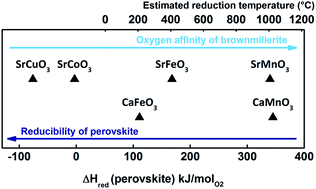
A materials screening of perovskites for oxygen storage applications yielding two promising materials, SrFe0.95Cu0.05O3-[small delta] and Ca0.8Sr0.2MnO3-[small delta] with outstanding performance.
The content of this RSS Feed (c) The Royal Society of Chemistry
09 Aug 01:12
by Zhong'an Li, Zonglong Zhu, Chu-Chen Chueh, Jingdong Luo, Alex K.-Y. Jen

A crosslinked organic hole-transporting layer (HTL) is developed to realize highly efficient and stable perovskite solar cells via a facile thiol-ene thermal reaction. This crosslinked HTL not only facilitates hole extraction from perovskites, but also functions as an effective protective barrier. A high-performance (power conversion efficiency: 18.3%) device is demonstrated to show respectable photo and thermal stability without encapsulation.
09 Aug 01:11
by Florian Lombeck, Hartmut Komber, Daniele Fazzi, Diego Nava, Jochen Kuhlmann, Dominik Stegerer, Karen Strassel, Josef Brandt, Amaia Diaz de Zerio Mendaza, Christian Müller, Walter Thiel, Mario Caironi, Richard Friend, Michael Sommer
The photophysical properties and solar cell performance of the classical donor–acceptor copolymer PCDTBT
(poly(N-9′-heptadecanyl-2,7-carbazole-alt -5,5-(4′,7′-di-2-thienyl-2′,1′,3′-benzothiadiazole))) in relation to unintentionally formed main chain defects are investigated. Carbazole–carbazole homocouplings (Cbz hc) are found to significant extent in PCDTBT made with a variety of Suzuki polycondensation conditions. Cbz hc vary between 0 and 8 mol% depending on the synthetic protocol used, and are quantified by detailed nuclear magnetic resonance spectroscopy including model compounds, which allows to establish a calibration curve from optical spectroscopy. The results are corroborated by extended time-dependent density functional theory investigations on the structural, electronic, and optical properties of regularly alternating and homocoupled chains. The photovoltaic properties of PCDTBT:fullerene blend solar cells significantly depend on the Cbz hc content for constant molecular weight, whereby an increasing amount of Cbz hc leads to strongly decreased short circuit currents JSC. With increasing Cbz hc content, JSC decreases more strongly than the intensity of the low energy absorption band, suggesting that small losses in absorption cannot explain the decrease in JSC alone, rather than combined effects of a more localized LUMO level on the TBT unit and lower hole mobilities found in highly defective samples. Homocoupling-free PCDTBT with optimized molecular weight yields the highest efficiency up to 7.2% without extensive optimization.

Electronic main chain defects in conjugated polymers caused by carbazole homocouplings (Cbz hc) significantly deteriorate the performance of organic photovoltaics as shown for poly(N-9′-heptadecanyl-2,7-carbazole-alt-5,5-(4′,7′-di-2-thienyl-2′,1′,3′-benzothiadiazole)) (PCDTBT):PC71BM devices. Cbz hc occur frequently, are quantified for a variety of Suzuki conditions, and are correlated with photophysical properties. PCDTBT without main chain defects and optimized molar mass gives the highest power conversion efficiencies exceeding 7%.
09 Aug 01:09
by Meng Li, Zhao-Kui Wang, Ying-Guo Yang, Yun Hu, Shang-Lei Feng, Jin-Miao Wang, Xing-Yu Gao, Liang-Sheng Liao
The development of effective and stable hole transporting materials (HTMs) is very important for achieving high-performance planar perovskite solar cells (PSCs). Herein, copper salts (cuprous thiocyanate (CuSCN) or cuprous iodide (CuI)) doped 2,2,7,7-tetrakis(N,N-di-p-methoxyphenylamine)-9,9-spirobifluorene (spiro-OMeTAD) based on a solution processing as the HTM in PSCs is demonstrated. The incorporation of CuSCN (or CuI) realizes a p-type doping with efficient charge transfer complex, which results in improved film conductivity and hole mobility in spiro-OMeTAD:CuSCN (or CuI) composite films. As a result, the PCE is largely improved from 14.82% to 18.02% due to obvious enhancements in the cell parameters of short-circuit current density and fill factor. Besides the HTM role, the composite film can suppress the film aggregation and crystallization of spiro-OMeTAD films with reduced pinholes and voids, which slows down the perovskite decomposition by avoiding the moisture infiltration to some extent. The finding in this work provides a simple method to improve the efficiency and stability of planar perovskite solar cells.

Copper salts (cuprous thiocyanate or cuprous iodide) doped 2,2,7,7-tetrakis(N,N-di-p-methoxyphenylamine)-9,9-spirobifluorene is used as the hole transport layer in planar perovskite solar cells by their good film conductivity and hole mobility. As a result, a maximum 18.02% power conversion efficiency is achieved with improved cell stability. 2D grazing incidence X-ray diffraction technique is utilized to probe the cell degradation process.
09 Aug 01:06
by Yiliang Wu, Heping Shen, Daniel Walter, Daniel Jacobs, The Duong, Jun Peng, Liangcong Jiang, Yi-Bing Cheng, Klaus Weber
The origin of hysteresis behavior is probed in perovskite solar cells (PSCs) with simultaneous measurements of cell open circuit voltage (Voc) and photoluminescence intensity over time following illumination of the cell. It is shown, for the first time, that the transient changes in terminal voltage and luminescent intensity do not follow the relationship that would be predicted by the generalized Plank radiation law. A mechanism is proposed based on the presence of a resistive barrier to majority carrier flow at the interface between the perovskite film and the electron or hole transport layer, in combination with significant interface recombination. This results in a decoupling of the internal quasi-Fermi level separation and the externally measured voltage. A simple numerical model is used to provide in-principle validation for the proposed mechanism and it is confirmed that mobile ionic species are a likely candidate for creating the time-varying majority carrier bottleneck by its reduced conductivity. The findings show that the Voc of PSCs may be lower than the limit imposed by the cell luminescence efficiency, even under steady-state conditions.

The origin of hysteresis behavior in perovskite solar cells is probed with simultaneous measurements of cell open circuit voltage and photoluminescence intensity over time following illumination of the cell. The findings demonstrate the existence of a resistive barrier to majority carrier flow at the interfaces of these devices, in combination with significant interface recombination.
09 Aug 01:05
by Yikun Guo, Yunke Li, Omar Awartani, Jingbo Zhao, Han Han, Harald Ade, Dahui Zhao, He Yan

All-polymer solar cells with 7.57% power conversion efficiency are achieved via a new perylenediimide-based polymeric acceptor. Furthermore, the device processed in ambient air without encapsulation can still reach a high power conversion efficiency (PCE) of 7.49%, which is a significant economic advantage from an industrial processing perspective. These results represent the highest PCE achieved from perylenediimide-based polymers.
08 Aug 01:41
J. Mater. Chem. A, 2016, 4,13400-13406
DOI: 10.1039/C6TA04356A, Communication
Kai Yao, Huifeng Jiao, Yun-Xiang Xu, Qiqi He, Fan Li, Xiaofeng Wang
We prepare novel nano-bio hybrids by employing Ag nanoprisms as surface plasmons to couple with light-harvesting complex II (LHCII) for broad-band optical enhancement in organic photovoltaics. The results open the possibility to use metal nanoparticles for tuning the photophysical properties of integral biomolecules in a well-defined way.
The content of this RSS Feed (c) The Royal Society of Chemistry
08 Aug 01:37
J. Mater. Chem. A, 2016, 4,13795-13802
DOI: 10.1039/C6TA06261J, Paper
Xin Gan, Ruitao Lv, Haoyue Zhu, Lai-Peng Ma, Xuyang Wang, Zexia Zhang, Zheng-Hong Huang, Hongwei Zhu, Wencai Ren, Mauricio Terrones, Feiyu Kang
Anti-reflective transparent electrodes are achieved demonstrating a highest efficiency of 13% and short-circuit current density of 34 mA cm-2.
The content of this RSS Feed (c) The Royal Society of Chemistry
08 Aug 01:37
J. Mater. Chem. A, 2016, 4,13519-13524
DOI: 10.1039/C6TA03784D, Paper
Yubao Zhang, Jiulin Shi, Xingdao He, Guoli Tu
N-Heteroacenes could be employed as efficient electron-donor materials when substituted with thiophene groups.
The content of this RSS Feed (c) The Royal Society of Chemistry
08 Aug 01:35
by Alyssa N. Brigeman, Michael A. Fusella, Yixin Yan, Geoffrey E. Purdum, Yueh-Lin Loo, Barry P. Rand, Noel C. Giebink

Anisotropic charge transfer (CT) state absorption originating from the natural transition dipole alignment at planar donor–acceptor interfaces can be exploited to reveal the full CT state absorption spectrum in organic solar cells. Application of this method reveals the existence of previously unobserved, higher-lying CT absorption buried beneath the excitonic background.
08 Aug 01:34
by Shi-Sheng Lin, Zhi-Qian Wu, Xiao-Qiang Li, Yue-Jiao Zhang, Sheng-Jiao Zhang, Peng Wang, Rajapandiyan Panneerselvam, Jian-Feng Li

By simply spinning Au nanoparticles on the surface of graphene/GaAs heterojunction, a stable solar cell with a power conversion efficiency (PCE) of 16.2% is achieved. The surface plasmon resonance of Au nanoparticles enhances the electromagnetic field near the graphene/GaAs junction area, which significantly improves the short current value and PCE.
08 Aug 01:28
Nanoscale, 2016, 8,15954-15960
DOI: 10.1039/C6NR04288K, Paper
Weihai Sun, Senyun Ye, Haixiao Rao, Yunlong Li, Zhiwei Liu, Lixin Xiao, Zhijian Chen, Zuqiang Bian, Chunhui Huang
The inverted perovskite solar cells based on CuI hole transport layer exhibited a maximum PCE of 16.8% and an impressive air stability.
The content of this RSS Feed (c) The Royal Society of Chemistry

08 Aug 01:19
by Emilio J. Juarez-Perez, Matthew R. Leyden, Shenghao Wang, Luis K. Ono, Zafer Hawash and Yabing Qi

Chemistry of Materials
DOI: 10.1021/acs.chemmater.6b01777