08 Aug 01:36
by Moritz Pfohl, Konstantin Glaser, Arko Graf, Adrian Mertens, Daniel D. Tune, Tanja Puerckhauer, Asiful Alam, Li Wei, Yuan Chen, Jana Zaumseil, Alexander Colsmann, Ralph Krupke, Benjamin S. Flavel
In this work, for the first time, the diameter limit of surfactant wrapped single walled carbon nanotubes (SWCNTs) in SWCNT:C60 solar cells is determined through preparation of monochiral small and large diameter nanotube devices as well as those from polychiral mixtures. Through assignment of the different nanotube chiralities by photoluminescence and optical density measurements a diameter limit yielding 0% internal quantum efficiency (IQE) is determined. This work provides insights into the required net driving energy for SWCNT exciton dissociation onto C60 and establishes a family of (n,m) species which can efficiently be utilized in polymer-free SWCNT:C60 solar cells. Using this approach the largest diameter nanotube with an IQE > 0% is found to be (8,6) with a diameter of 0.95 nm. Possible strategies to extend this diameter limit are then discussed.

Distribution of various (n,m) species that have an internal quantum efficiency (IQE) greater (green) than or equal (grey) to zero, based on their diameter. Depending on their diameter, excitons may or may not be dissociated at the interface of surfactant wrapped single walled carbon nanotubes and C60.
02 Aug 01:35
J. Mater. Chem. A, 2016, 4,13458-13467
DOI: 10.1039/C6TA05288F, Paper
Qian-Qing Ge, Jie Ding, Jie Liu, Jing-Yuan Ma, Yao-Xuan Chen, Xiao-Xin Gao, Li-Jun Wan, Jin-Song Hu
Water vapor modulated post-annealing is a reproducible and easily-scalable method to promote the grain growth and heal the pinholes for efficient PSCs.
The content of this RSS Feed (c) The Royal Society of Chemistry
01 Aug 06:36
J. Mater. Chem. A, 2016, 4,12080-12087
DOI: 10.1039/C6TA04503K, Paper
Changlei Wang, Dewei Zhao, Corey R. Grice, Weiqiang Liao, Yue Yu, Alexander Cimaroli, Niraj Shrestha, Paul J. Roland, Jing Chen, Zhenhua Yu, Pei Liu, Nian Cheng, Randy J. Ellingson, Xingzhong Zhao, Yanfa Yan
PEALD deposition was used to reduce the effective deposition temperature of SnO2 electron selective layers without compromising the performance of perovskite solar cells.
The content of this RSS Feed (c) The Royal Society of Chemistry
01 Aug 06:33
J. Mater. Chem. A, 2016, 4,12025-12029
DOI: 10.1039/C6TA05817E, Communication
Zeyu Deng, Fengxia Wei, Shijing Sun, Gregor Kieslich, Anthony K. Cheetham, Paul D. Bristowe
Density functional theory screening of the hybrid double perovskites (MA)2BIBiX6 (BI = K, Cu, Ag, Tl; X = Cl, Br, I) was performed and (MA)2TlBiBr6, isoelectronic with MAPbBr3, was synthesised and found to have a band gap of [similar]2.0 eV.
The content of this RSS Feed (c) The Royal Society of Chemistry
01 Aug 03:13
J. Mater. Chem. A, 2016, 4,12535-12542
DOI: 10.1039/C6TA04332A, Paper
Weidong Zhu, Chunxiong Bao, Bihu Lv, Faming Li, Yong Yi, Yangrunqian Wang, Jie Yang, Xiaoyong Wang, Tao Yu, Zhigang Zou
A homogeneous cap-mediated crystallization strategy can be used to realize high-quality organolead triiodide perovskite (OTP) films with greatly enhanced solar cell performance.
The content of this RSS Feed (c) The Royal Society of Chemistry
01 Aug 03:11
J. Mater. Chem. A, 2016, 4,12748-12755
DOI: 10.1039/C6TA05053K, Paper
Yuanhang Cheng, Ho-Wa Li, Jian Qing, Qing-Dan Yang, Zhiqiang Guan, Chen Liu, Sin Hang Cheung, Shu Kong So, Chun-Sing Lee, Sai-Wing Tsang
Mobile ions not only have detrimental effects on device performance but also trigger the degradation of perovskite during device operation.
The content of this RSS Feed (c) The Royal Society of Chemistry
01 Aug 03:03
J. Mater. Chem. A, 2016, 4,13203-13210
DOI: 10.1039/C6TA04465D, Paper
Jun Yin, Hui Qu, Jing Cao, Huiling Tai, Jing Li, Nanfeng Zheng
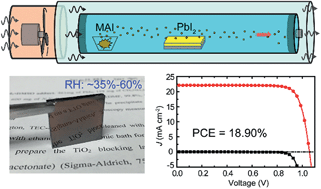
An ambient atmosphere-compatible vapor-assisted deposition strategy was developed to fabricate high-quality perovskite films, even at a high relative humidity of 60%. By using the optimized crystallization process, efficient ([small eta] = 18.90%), air-stable photovoltaic performance was accomplished.
The content of this RSS Feed (c) The Royal Society of Chemistry
01 Aug 03:01
J. Mater. Chem. A, 2016, 4,12897-12912
DOI: 10.1039/C6TA06115J, Paper
Haining Chen, Xiaoli Zheng, Qiang Li, Yinglong Yang, Shuang Xiao, Chen Hu, Yang Bai, Teng Zhang, Kam Sing Wong, Shihe Yang
An amorphous Pb-Br precursor was employed to prepare high-quality CH3NH3PbBr3 with conformable oriented crystallization.
The content of this RSS Feed (c) The Royal Society of Chemistry
01 Aug 03:00
J. Mater. Chem. A, 2016, 4,13488-13498
DOI: 10.1039/C6TA05938D, Paper
F. Behrouznejad, S. Shahbazi, N. Taghavinia, Hui-Ping Wu, Eric Wei-Guang Diau
Ag, Au, Pt prove best metal-contacts for perovskite solar cells. Ag and Cu are chemically unstable. Ni and Cr show low performance.
The content of this RSS Feed (c) The Royal Society of Chemistry
01 Aug 02:58
J. Mater. Chem. A, 2016, 4,12463-12470
DOI: 10.1039/C6TA04053E, Paper
Wu-Qiang Wu, Dehong Chen, Fuzhi Huang, Yi-Bing Cheng, Rachel A. Caruso
Combined hydrothermal treatment, gas-assisted spin coating and mixed vapor annealing approaches can effectively optimize the semiconducting networks in thin film perovskite photovoltaic devices, which leads to efficient light harvesting, suppressed charge recombination and effective charge extraction.
The content of this RSS Feed (c) The Royal Society of Chemistry
01 Aug 02:51
J. Mater. Chem. A, 2016, 4,13093-13104
DOI: 10.1039/C6TA04109D, Paper
D. Gryaznov, R. Merkle, E. A. Kotomin, J. Maier
Proton incorporation into La1-xSrxFeO3-[small delta] [implies] cathode materials for protonic ceramic fuel cells.
The content of this RSS Feed (c) The Royal Society of Chemistry
01 Aug 02:34
by Andrea Capasso, Fabio Matteocci, Leyla Najafi, Mirko Prato, Joka Buha, Lucio Cinà, Vittorio Pellegrini, Aldo Di Carlo, Francesco Bonaccorso
Solution-processed few-layer MoS2 flakes are exploited as an active buffer layer in hybrid lead–halide perovskite solar cells (PSCs). Glass/FTO/compact-TiO2/mesoporous-TiO2/CH3NH3PbI3/MoS2/Spiro-OMeTAD/Au solar cells are realized with the MoS2 flakes having a twofold function, acting both as a protective layer, by preventing the formation of shunt contacts between the perovskite and the Au electrode, and as a hole transport layer from the perovskite to the Spiro-OMeTAD. As prepared PSC demonstrates a power conversion efficiency (η) of 13.3%, along with a higher lifetime stability over 550 h with respect to reference PSC without MoS2 (Δη/η = −7% vs. Δη/η = −34%). Large-area PSCs (1.05 cm2 active area) are also fabricated to demonstrate the scalability of this approach, achieving η of 11.5%. Our results pave the way toward the implementation of MoS2 as a material able to boost the shelf life of large-area perovskite solar cells in view of their commercialization.

MoS2 flakes are proposed as an active buffer layer in hybrid lead halide perovskite solar cells. By preventing the formation of shunt contacts between the perovskite and the metal electrode, MoS2 flakes act as a protective layer to increase the cell stability, while also easing the hole collection at the anode. Such approach leads to efficient and stable perovskite solar cells.
01 Aug 02:30
by Bo Chen, Yang Bai, Zhengshan Yu, Tao Li, Xiaopeng Zheng, Qingfeng Dong, Liang Shen, Mathieu Boccard, Alexei Gruverman, Zachary Holman, Jinsong Huang

Semitransparent perovskite solar cells based on smooth perovskite films and ultrathin Cu (1 nm)/Au (7 nm) metal electrode demonstrate an efficiency of 16.5%. When illuminated through the semitransparent perovskite cell, a near-infrared-enhanced silicon heterojunction solar cell operates with 6.5% efficiency, leading to a total perovskite/silicon four-terminal tandem efficiency of 23.0%.
01 Aug 02:30
by Tiva Sharifi, Christian Larsen, Jia Wang, Wai Ling Kwong, Eduardo Gracia-Espino, Guillaume Mercier, Johannes Messinger, Thomas Wågberg, Ludvig Edman
Molecular hydrogen can be generated renewably by water splitting with an “artificial-leaf device”, which essentially comprises two electrocatalyst electrodes immersed in water and powered by photovoltaics. Ideally, this device should operate efficiently and be fabricated with cost-efficient means using earth-abundant materials. Here, a lightweight electrocatalyst electrode, comprising large surface-area NiCo2O4 nanorods that are firmly anchored onto a carbon–paper current collector via a dense network of nitrogen-doped carbon nanotubes is presented. This electrocatalyst electrode is bifunctional in that it can efficiently operate as both anode and cathode in the same alkaline solution, as quantified by a delivered current density of 10 mA cm−2 at an overpotential of 400 mV for each of the oxygen and hydrogen evolution reactions. By driving two such identical electrodes with a solution-processed thin-film perovskite photovoltaic assembly, a wired artificial-leaf device is obtained that features a Faradaic H2 evolution efficiency of 100%, and a solar-to-hydrogen conversion efficiency of 6.2%. A detailed cost analysis is presented, which implies that the material-payback time of this device is of the order of 100 days.

An artificial-leaf device is constructed by driving two carbon-based, bifunctional, and lightweight catalyst electrodes immersed in water with an assembly of solution-processed perovskite photovoltaics. The device delivers hydrogen gas at 100% Faradaic efficiency and with a solar-to-hydrogen efficiency of 6.2%, and a cost analysis suggests that the material-payback time can be of the order of 100 days.
01 Aug 02:28
by Silvia Collavini, Juan Luis Delgado
During the past few years, the field of photovoltaics has been revolutioned through the use of perovskites as light-harvesting materials. This has led to studying a whole range of organic structures fulfilling the energetical requirements within the typical architecture of a perovskite-based solar cell. In this context, carbon nanoforms, with their interesting and versatile properties, are studied as charge transporting materials, electrodes or as additives within the light-harvesting perovskite material. The latest findings concerning the exciting field of carbon nanostructures for PSCs are summarized.

Carbon nanoforms, owing to their interesting and versatile properties, are studied as charge transporting materials, electrodes or as additives within the revolutionary field of perovskite-based solar cells. The latest findings concerning the exciting field of carbon nanostructures for PSCs are summarized.
01 Aug 02:25
by Kira L. Gardner, Jeffrey G. Tait, Tamara Merckx, Weiming Qiu, Ulrich W. Paetzold, Lucinda Kootstra, Manoj Jaysankar, Robert Gehlhaar, David Cheyns, Paul Heremans, Jef Poortmans

In article number 1600386, Jeffrey G. Tait and co-workers develop non-hazardous ink systems, based on solvent-alcohol-acid, for coating perovskite photovoltaic films in a single step. Coating was further developed from spin to blade, while the high yield process produced efficient 4 cm2 modules.
01 Aug 02:24
by Yao Liu, Lawrence A. Renna, Zachariah A. Page, Hilary B. Thompson, Paul Y. Kim, Michael D. Barnes, Todd Emrick, Dhandapani Venkataraman, Thomas P. Russell

Poly(Phenylene vinylene) anionic polyelectrolyte (PVBT-SO3) was found to be an efficient hole extraction layer for inverted perovskite solar cells. It can be cast from an aqueous solution and does not require thermal annealing for improved device performance. The devices show maximum solar cell efficiency of 15.9% and exhibit improved stability under ambient conditions and enhanced charge extraction.
01 Aug 02:23
by Somayeh Gholipour, Juan-Pablo Correa-Baena, Konrad Domanski, Taisuke Matsui, Ludmilla Steier, Fabrizio Giordano, Fariba Tajabadi, Wolfgang Tress, Michael Saliba, Antonio Abate, Abdollah Morteza Ali, Nima Taghavinia, Michael Grätzel, Anders Hagfeldt

A low-cost carbon cloth is applied in perovskite solar cells (PSC) as a collector composite and degradation inhibitor. This study incorporates carbon fibers as a back contact in perovskite solar cells, which results in enhancement in all photovoltaic parameters. This material is suitable for large-scale fabrication of PSCs as it has shown an improved long-term stability when compared to the gold counterpart under elevated temperatures.
01 Aug 02:22
by Ji-Youn Seo, Taisuke Matsui, Jingshan Luo, Juan-Pablo Correa-Baena, Fabrizio Giordano, Michael Saliba, Kurt Schenk, Amita Ummadisingu, Konrad Domanski, Mahboubeh Hadadian, Anders Hagfeldt, Shaik M. Zakeeruddin, Ullrich Steiner, Michael Grätzel, Antonio Abate

Ionic liquids can retard the perovskite crystallization with the aim to form compact films with larger and more uniformly distributed grain size. The ionic liquid driven crystallization is exploited to prepared a record planar perovskite solar cell with stabilized power output of 19.5%.
01 Aug 02:21
Nanoscale, 2016, 8,14379-14383
DOI: 10.1039/C6NR04082A, Communication
Thi Tuyen Ngo, Isaac Suarez, Rafael S. Sanchez, Juan P. Martinez-Pastor, Ivan Mora-Sero
High quality pinhole free perovskite halide thin layers exhibiting IR exciplex state emission have been prepared introducing Pb/CdS QDs in a single step deposition process.
The content of this RSS Feed (c) The Royal Society of Chemistry

01 Aug 01:48
by Li Ling, Sijian Yuan, Pengfei Wang, Huotian Zhang, Li Tu, Jiao Wang, Yiqiang Zhan, Lirong Zheng

Precisely controlling the optimal amount of hydration water in the precursor solution, results in the formation of a smooth and uniform perovskite film, as described by Y. Zhan, L. Zheng, and co-workers on page 5028. With appropriate annealing, the perovskite monohydrate loses its hydration water and crystallizes into pristine MAPbI3. The simplicity of controlling hydration water during precursor solution preparation will influence mass production of perovskite solar cells.
01 Aug 01:41
by Li Nian, Ke Gao, Feng Liu, Yuanyuan Kan, Xiaofang Jiang, Linlin Liu, Zengqi Xie, Xiaobin Peng, Thomas P. Russell, Yuguang Ma

Highly efficient electron extraction is achieved by using a photoconductive cathode interlayer in inverted ternary organic solar cells (OSCs) where a near-IR absorbing porphyrin molecule is used as the sensitizer. The OSCs show improved device performance when the ratio of the two donors varies in a large region and a maximum power conversion efficiency up to 11.03% is demonstrated.
01 Aug 01:40
by Guichuan Xing, Mulmudi Hemant Kumar, Wee Kiang Chong, Xinfeng Liu, Yao Cai, Hong Ding, Mark Asta, Michael Grätzel, Subodh Mhaisalkar, Nripan Mathews, Tze Chien Sum

The family of solution-processed tin-based perovskites is demonstrated as a new and superior near-infrared gain medium. Due to the large electron–hole bimolecular recombination associated with tin and the reduced trap density with SnF2 treatment, these lead-free “green” perovskites yield stable coherent light emission extending to ≈1 μm at strikingly low thresholds.
01 Aug 01:39
by Jinlong Pan, Cheng Mu, Qi Li, Weizhen Li, Ding Ma, Dongsheng Xu

Uniform perovskite films are achieved by HCl-assisted one-step spin-coating at room temperature. By this method, a highest power conversion efficiency of 17.9% is obtained for perovskite solar cells (PSCs). The devices retain ≈95% of their original efficiency after storage in air for two months. The highest efficiency obtained for large-area PSCs (0.86 cm2) is 15.7%.
01 Aug 01:37
by Wentao Xu, Himchan Cho, Young-Hoon Kim, Young-Tae Kim, Christoph Wolf, Chan-Gyung Park, Tae-Woo Lee

A synapse-emulating electronic device based on organometal halide perovskite thin films is described by T.-W. Lee and co-workers on page 5916. The device successfully emulates important characteristics of a biological synapse. This work extends the application of organometal halide perovskites to bioinspired electronic devices, and contributes to the development of neuromorphic electronics.
01 Aug 01:29
by Meghan B. Teunis, Atanu Jana, Poulami Dutta, Merrell A. Johnson, Manik Mandal, Barry B. Muhoberac and Rajesh Sardar

Chemistry of Materials
DOI: 10.1021/acs.chemmater.6b01793

Jun, Tim and one other like this
01 Aug 01:25
by Cauê F. Ferreira, Eduardo E. Pérez-Cordero, Khalil A. Abboud and Daniel R. Talham

Chemistry of Materials
DOI: 10.1021/acs.chemmater.6b02208

01 Aug 01:21
by Kun Chen, Xiaohui Deng, Richard Goddard and Harun Tüysüz

Chemistry of Materials
DOI: 10.1021/acs.chemmater.6b02233

01 Aug 01:20
by Gede W. P. Adhyaksa, Leon W. Veldhuizen, Yinghuan Kuang, Sarah Brittman, Ruud E. I. Schropp and Erik C. Garnett

Chemistry of Materials
DOI: 10.1021/acs.chemmater.6b00466

01 Aug 01:17
by Fan Yang, Huairuo Zhang, Linhao Li, Ian M. Reaney and Derek C. Sinclair

Chemistry of Materials
DOI: 10.1021/acs.chemmater.6b02555