14 Nov 10:35
by K. Narayanaswamy, A. Venkateswararao, P. Nagarjuna, Swati Bishnoi, Vinay Gupta, Suresh Chand, Surya Prakash Singh
Abstract
A new low-band gap dyad DPP-Ful, which consists of covalently linked dithiafulvalene-functionalized diketopyrrolopyrrole as donor and fullerene (C60) as the acceptor, has been designed and synthesized. Organic solar cells were successfully constructed using the DPP-Ful dyad as an active layer. This system has a record power-conversion efficiency (PCE) of 2.2 %, which is the highest value when compared to reported single-component organic solar cells.

Climbing alone: The combination of dithiafulvalene-functionalized diketopyrrolopyrrole (DPP) as donor with fullerene (Ful) as acceptor has been successfully explored. Its utilization in single-component organic solar cells (SC-OSCs) was investigated, and it was shown to have a record power-conversion efficiency. ITO=indium tin oxide.
08 Nov 03:34
J. Mater. Chem. A, 2016, 4,15156-15161
DOI: 10.1039/C6TA05726H, Paper
Lin Zhang, Chang Liu, Tianqi Lai, Huadong Huang, Xiaobin Peng, Fei Huang, Yong Cao
A water/alcohol-soluble conjugated porphyrin small molecule exhibits very good ability as a cathode interfacial material in organic solar cells.
The content of this RSS Feed (c) The Royal Society of Chemistry
21 Sep 01:08
Chem. Soc. Rev., 2016, 45,5951-5984
DOI: 10.1039/C5CS00769K, Review Article
Guan Zhang, Gang Liu, Lianzhou Wang, John T. S. Irvine
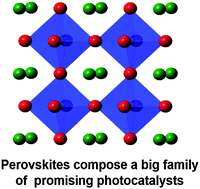
This review specifically summarizes the recent development of perovskite photocatalysts and their applications in water splitting and environmental remediation.
The content of this RSS Feed (c) The Royal Society of Chemistry

09 Sep 13:31
by Severin N. Habisreutinger, Nakita K. Noel, Henry J. Snaith, Robin J. Nicholas
The majority of hole-transporting layers used in n-i-p perovskite solar cells contain 4-tert butylpyridine (tBP). High power-conversion efficiencies and, in particular, good steady-state performance appears to be contingent on the inclusion of this additive. On the quest to improve the steady state efficiencies of the carbon nanotube-based hole-transporter system, this study has found that the presence of tBP results in an extraordinary improvement in the performance of these devices. By deconstructing a prototypical device and investigating the effect of tBP on each individual layer, the results of this study indicate that this performance enhancement must be due to a direct chemical interaction between tBP and the perovskite material. This study proposes that tBP serves to p-dope the perovskite layer and investigates this theory with poling and work function measurements.

The effect of the hole-transporter additive 4-tert Butylpyridine (tBP) on the device performance of perovskite solar cells is investigated. The additive is shown to improve the steady-state efficiency of perovskite solar cells independent of the hole-transport material. A direct interaction between tBP and the perovskite absorber is identified as being responsible for the observed improvement.
09 Sep 13:31
by Alexander H. Bork, Erwin Povoden-Karadeniz, Jennifer L. M. Rupp
Two-step solar thermochemical fuel production has the potential to reduce global greenhouse gas emissions and replace fossil fuels. The success of the technology relies on the development of materials with high thermochemical efficiency. Perovskites with the general structure ABO3 have received much attention recently due to impressive fuel productivity and their amenability of substituting and doping both A- and B-site. Despite the potential of perovskites for solar-to-fuel conversion, literature on their solar thermochemical efficiency is scarce and finding the best chemical composition and optimum operation conditions is unknown. For this purpose, this study suggests to use Computer Coupling of Phase Diagrams and Thermochemistry (CALPHAD) data libraries to access the relevant thermodynamic properties of perovskites. This work demonstrates the usefulness of employing CALPHAD data by a full thermodynamic study of the model case compositions of La1–xSrxMnO3–δ. This study uses data on oxygen-nonstoichiometry and heat capacity in the temperature range of 1073–1873 K relevant for solar-to-fuel. Unlike earlier thermodynamic assessments of perovskites that rely on a single literature source and a limited temperature range, the CALPHAD approach takes all available data in literature into consideration. Thermochemical equilibrium models of fuel yields are accompanied by validations toward experimental results in literature, and this study highlights the effects of strontium doping level on the efficiency.

The usefulness of applying Computer Coupling of Phase Diagrams and Thermochemistry (CALPHAD) data libraries on perovskite solar-to-fuel performance is exemplified on solid solutions of strontium doped lanthanum manganite. Existing CALPHAD libraries of defect chemistry are used to determine the thermodynamics of the oxygen release reaction. The insights provided by this analysis are further utilized to calculate equilibrium fuel yields (H2) and solar thermochemical efficiency.
09 Sep 13:28
Nanoscale, 2016, 8,16881-16885
DOI: 10.1039/C6NR05917A, Communication
Xiao-Xin Gao, Qian-Qing Ge, Ding-Jiang Xue, Jie Ding, Jing-Yuan Ma, Yao-Xuan Chen, Bao Zhang, Yaqing Feng, Li-Jun Wan, Jin-Song Hu
Tuning the Fermi-level of TiO2 mesoporous layer by lanthanum doping is demonstrated as an effective way to significantly enhance the power conversion efficiency of perovskite solar cells.
The content of this RSS Feed (c) The Royal Society of Chemistry

09 Sep 13:20
by Toshinori Matsushima, Sunbin Hwang, Atula S. D. Sandanayaka, Chuanjiang Qin, Shinobu Terakawa, Takashi Fujihara, Masayuki Yahiro, Chihaya Adachi

A very high hole mobility of 15 cm2 V−1 s−1 along with negligible hysteresis are demonstrated in transistors with an organic–inorganic perovskite semiconductor. This high mobility results from the well-developed perovskite crystallites, improved conversion to perovskite, reduced hole trap density, and improved hole injection by employing a top-contact/top-gate structure with surface treatment and MoOx hole-injection layers.
07 Sep 06:34
by Yi Zhang, Sahika Inal, Chih-Yun Hsia, Magali Ferro, Marc Ferro, Susan Daniel, Roisin M. Owens
Lipid bilayers are widely employed as a model system to investigate interactions between cells and their environment. Supported lipid bilayers (SLB) with integrated transmembrane proteins are emerging as a preferred platform for sensing applications. Challenges lie in the generation of SLB on surfaces which allow transduction of signals for characterization of lipid bilayer and incorporated transmembrane proteins. For the first time, the formation of SLBs is shown on films of the conducting polymer, poly(3,4-ethylenedioxythiophene) doped with poly(styrene sulfonate) (PEDOT:PSS), using traditional methods for characterizing lipid bilayer quality and function (QCM-D, FRAP) combined with impedance spectroscopy. Further, partial formation of SLBs on PEDOT:PSS based organic electrochemical transistors (OECTs) is successfully demonstrated, as well as the ability to integrate and sense the ion pore α-hemolysin, confirming the sensitivity of the OECT as a transducer of biological membrane function. This work represents a highly promising first step toward the use of such OECTs for functional readout of transmembrane proteins in their native environment.

Supported lipid bilayers represent an excellent substitute for live cells, to study membrane protein function. For the first time, the integration of biologically functioning supported lipid bilayers is shown, with conducting polymer films and transistors. Traditional methods for characterizing lipid bilayer quality and function are compared with electrical readouts using both impedance spectroscopy and the organic electrochemical transistor. This represents a first, important step toward readout of such systems with organic transistors.
06 Sep 00:40
by Xian-Kai Chen, Mahesh Kumar Ravva, Hong Li, Sean M. Ryno, Jean-Luc Brédas

In organic solar cells, a major source of energy loss is attributed to nonradiative recombination from the interfacial charge transfer states to the ground state. By taking pentacene–C60 complexes as model donor–acceptor systems, a comprehensive theoretical understanding of how molecular packing and charge delocalization impact these nonradiative recombination rates at donor–acceptor interfaces is provided.
03 Sep 00:46
J. Mater. Chem. A, 2016, 4,15088-15094
DOI: 10.1039/C6TA06152D, Paper
Meng Li, Yi-Hsiang Chao, Tin Kang, Zhao-Kui Wang, Ying-Guo Yang, Shang-Lei Feng, Yun Hu, Xing-Yu Gao, Liang-Sheng Liao, Chain-Shu Hsu
A maximum power conversion efficiency of 17.21% was achieved in CH3NH3PbIxCl3-x:-C-PCBSD based solar cells with improved perovskite crystallization.
The content of this RSS Feed (c) The Royal Society of Chemistry
03 Sep 00:44
J. Mater. Chem. A, 2016, 4,15478-15485
DOI: 10.1039/C6TA05008E, Paper
Shoyebmohamad F. Shaikh, Hyeok-Chan Kwon, Wooseok Yang, Hyewon Hwang, Hongseuk Lee, Eunsong Lee, Sunihl Ma, Jooho Moon
The effects of La2O3 interface modification of mesoporous TiO2 on the photovoltaic performance of perovskite solar cells are investigated.
The content of this RSS Feed (c) The Royal Society of Chemistry
03 Sep 00:41
by Ning Wang, Yuanyuan Zhou, Ming-Gang Ju, Hector F. Garces, Tao Ding, Shuping Pang, Xiao Cheng Zeng, Nitin P. Padture, Xiao Wei Sun
Perovskite solar cells (PSCs) have been emerging as a breakthrough photovoltaic technology, holding unprecedented promise for low-cost, high-efficiency renewable electricity generation. However, potential toxicity associated with the state-of-the-art lead-containing PSCs has become a major concern. The past research in the development of lead-free PSCs has met with mixed success. Herein, the promise of coarse-grained B-γ-CsSnI3 perovskite thin films as light absorber for efficient lead-free PSCs is demonstrated. Thermally-driven solid-state coarsening of B-γ-CsSnI3 perovskite grains employed here is accompanied by an increase of tin-vacancy concentration in their crystal structure, as supported by first-principles calculations. The optimal device architecture for the efficient photovoltaic operation of these B-γ-CsSnI3 thin films is identified through exploration of several device architectures. Via modulation of the B-γ-CsSnI3 grain coarsening, together with the use of the optimal PSC architecture, planar heterojunction-depleted B-γ-CsSnI3 PSCs with power conversion efficiency up to 3.31% are achieved without the use of any additives. The demonstrated strategies provide guidelines and prospects for developing future high-performance lead-free PVs.

The promise of coarse-grained B-γ-CsSnI3 perovskite thin films as light absorber for efficient lead-free perovskite solar cells (PSCs) is demonstrated. Benefitting from thermally-driven solid-state coarsening of B-γ-CsSnI3 perovskite grains and optimized device architecture, planar heterojunction-depleted B-γ-CsSnI3 PSCs with power conversion efficiency up to 3.31% are achieved without the use of any additives.
02 Sep 01:11
J. Mater. Chem. A, 2016, 4,15662-15669
DOI: 10.1039/C6TA06232F, Paper
Bai-Xue Chen, Hua-Shang Rao, Hong-Yan Chen, Wen-Guang Li, Dai-Bin Kuang, Cheng-Yong Su
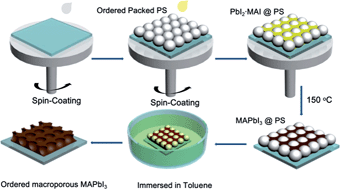
Perovskite solar cell based on ordered macroporous CH3NH3PbI3 films achieves a PCE of 11.7% under the AL AVT of 36.5%.
The content of this RSS Feed (c) The Royal Society of Chemistry
02 Sep 01:10
J. Mater. Chem. A, 2016, 4,14983-14987
DOI: 10.1039/C6TA07368A, Communication
Shuixing Li, Wenqing Liu, Chang-Zhi Li, Tsz-Ki Lau, Xinhui Lu, Minmin Shi, Hongzheng Chen
A planar perylene diimide derivative with a high efficiency of 7.33% and high voltage of 0.99 V is presented.
The content of this RSS Feed (c) The Royal Society of Chemistry
01 Sep 02:49
J. Mater. Chem. A, 2016, 4,15294-15301
DOI: 10.1039/C6TA05745D, Communication
Xiao Liu, Chu-Chen Chueh, Zonglong Zhu, Sae Byeok Jo, Ye Sun, Alex K.-Y. Jen
Highly crystalline Zn2SnO4 NPs were applied as an efficient electron-transporting layer that can enable both efficient inverted p-i-n PVSC with enhanced ambient stability and efficient conventional n-i-p PVSC on a flexible substrate.
The content of this RSS Feed (c) The Royal Society of Chemistry
31 Aug 11:28
by Zhenwei Wang, Xin He, Xi-Xiang Zhang, Husam N. Alshareef

A p-type oxide/2D hybrid van der Waals p–n heterojunction is demonstrated for the first time between SnO (tin monoxide) (the p-type oxide) and 2D MoS2 (molybdenum disulfide), showing an ideality factor of 2 and rectification ratio up to 104. The reported heterojunction is gate-tunable with typical anti-ambipolar transfer characteristics. Surface potential mapping is performed and a current model for such a heterojunction is proposed.
30 Aug 10:52
by Yunlong Li, Weihai Sun, Weibo Yan, Senyun Ye, Haixia Rao, Haitao Peng, Ziran Zhao, Zuqiang Bian, Zhiwei Liu, Huanping Zhou, Chunhui Huang
In the present work, a Pb-assisted two step method is successfully proposed to fabricate high-quality CH3NH3Sn0.5Pb0.5I3 (MASn0.5Pb0.5I3) perovskite film on the indium tin oxide (ITO) glass/poly(3,4-ethylenedioxythiophene):poly(styrene sulfonate) (PEDOT:PSS) substrate. The film shows regular crystalline grains with a flat and compact morphology as well as full coverage on the planar PEDOT:PSS substrate. Remarkably, corresponding devices ITO/PEDOT:PSS/MASn0.5Pb0.5I3/C60/2,9-dimethyl-4,7-diphenyl-1,10-phenanthroline/Ag are fabricated with high reproducibility, achieving a high power conversion efficiency of 13.6%, which is, to the best of knowledge, the most efficient solar cell based on Sn-based perovskite.

A high efficiency inverted planar Sn-based perovskite solar cell is fabricated by utilizing a two-step solution processing technique. Through use of PbI2 in combination with SnI2, the Sn-based perovskite film quality is improved obviously. The lead contents are successfully reduced to 50% in the perovskite layer, and the power conversion efficiency of the best corresponding device reaches up to 13.6%.
30 Aug 03:29
by Weiqiang Liao, Dewei Zhao, Yue Yu, Corey R. Grice, Changlei Wang, Alexander J. Cimaroli, Philip Schulz, Weiwei Meng, Kai Zhu, Ren-Gen Xiong, Yanfa Yan

Efficient lead (Pb)-free inverted planar formamidinium tin triiodide (FASnI3) perovskite solar cells (PVSCs) are demonstrated. Our FASnI3 PVSCs achieved average power conversion efficiencies (PCEs) of 5.41% ± 0.46% and a maximum PCE of 6.22% under forward voltage scan. The PVSCs exhibit small photocurrent–voltage hysteresis and high reproducibility. The champion cell shows a steady-state efficiency of ≈6.00% for over 100 s.
29 Aug 01:08
Nanoscale, 2016, 8,18309-18314
DOI: 10.1039/C6NR04741F, Paper
Chaoyan Ma, Chongqian Leng, Yixiong Ji, Xingzhan Wei, Kuan Sun, Linlong Tang, Jun Yang, Wei Luo, Chaolong Li, Yunsheng Deng, Shuanglong Feng, Jun Shen, Shirong Lu, Chunlei Du, Haofei Shi
2D/3D perovskite hybrids achieved significantly improved moisture stability and analogical device performances as compared with homogeneous 3D perovskites.
The content of this RSS Feed (c) The Royal Society of Chemistry

29 Aug 01:04
by Chih-Yu Chang, Wen-Kuan Huang and Yu-Chia Chang

Chemistry of Materials
DOI: 10.1021/acs.chemmater.6b02583

26 Aug 02:27
J. Mater. Chem. A, 2016, 4,13830-13836
DOI: 10.1039/C6TA04973G, Paper
Mike Hambsch, Qianqian Lin, Ardalan Armin, Paul L. Burn, Paul Meredith
A generic and simple approach to realize solution processed, monolithic large area perovskite solar cells.
The content of this RSS Feed (c) The Royal Society of Chemistry
26 Aug 02:26
J. Mater. Chem. A, 2016, 4,15997-16002
DOI: 10.1039/C6TA04949D, Paper
Simone Meloni, Giulia Palermo, Negar Ashari-Astani, Michael Gratzel, Ursula Rothlisberger
We performed density functional calculations aimed at identifying the atomistic and electronic structure origin of the valence and conduction band, and band gap tunability of halide perovskites ABX3 upon variations of the monovalent and bivalent cations A and B and the halide anion X.
The content of this RSS Feed (c) The Royal Society of Chemistry
24 Aug 01:35
J. Mater. Chem. A, 2016, 4,14720-14728
DOI: 10.1039/C6TA04442E, Paper
Yuanyuan Kan, Chang Liu, Lianjie Zhang, Ke Gao, Feng Liu, Junwu Chen, Yong Cao
Inserting ethynylene bridges in conjugated molecules can enhance high open-circuit voltage and fill factors to improve photovoltaic performances in organic solar cells.
The content of this RSS Feed (c) The Royal Society of Chemistry
24 Aug 01:34
by Zhengrong Shang, Thomas Heumueller, Rohit Prasanna, George F. Burkhard, Benjamin D. Naab, Zhenan Bao, Michael D. McGehee, Alberto Salleo
Doping of organic bulk heterojunction solar cells has the potential to improve their power conversion efficiency (PCE). Deconvoluting the effect of doping on charge transport, recombination, and energetic disorder remains challenging. It is demonstrated that molecular doping has two competing effects: on one hand, dopant ions create additional traps while on the other hand free dopant-induced charges fill deep states possibly leading to V
OC and mobility increases. It is shown that molar dopant concentrations as low as a few parts per million can improve the PCE of organic bulk heterojunctions. Higher concentrations degrade the performance of the cells. In doped cells where PCE is observed to increase, such improvement cannot be attributed to better charge transport. Instead, the V
OC increase in unannealed P3HT:PCBM cells upon doping is indeed due to trap filling, while for annealed P3HT:PCBM cells the change in V
OC is related to morphology changes and dopant segregation. In PCDTBT:PC70BM cells, the enhanced PCE upon doping is explained by changes in the thickness of the active layer. This study highlights the complexity of bulk doping in organic solar cells due to the generally low doping efficiency and the constraint on doping concentrations to avoid carrier recombination and adverse morphology changes.

Ultralow level doping (≈ppm) can increase the power conversion efficiency of organic solar cells. Trap states filling by free charges and trap creation by dopant ions have competing effects on carrier mobility and open circuit voltage thereby imposing constraints on the effectiveness of doping. Measurements are performed to study what electronic process dominates in different materials or fabrication conditions.
24 Aug 01:33
by Ardalan Armin, Jegadesan Subbiah, Martin Stolterfoht, Safa Shoaee, Zeyun Xiao, Shirong Lu, David J. Jones, Paul Meredith
Bimolecular recombination in bulk heterojunction organic solar cells is the process by which nongeminate photogenerated free carriers encounter each other, and combine to form a charge transfer (CT) state which subsequently relaxes to the ground state. It is governed by the diffusion of the slower and faster carriers toward the electron donor–acceptor interface. In an increasing number of systems, the recombination rate constant is measured to be lower than that predicted by Langevin's model for relative Brownian motion and the capture of opposite charges. This study investigates the dynamics of charge generation, transport, and recombination in a nematic liquid crystalline donor:fullerene acceptor system that gives solar cells with initial power conversion efficiencies of >9.5%. Unusually, and advantageously from a manufacturing perspective, these efficiencies are maintained in junctions thicker than 300 nm. Despite finding imbalanced and moderate carrier mobilities in this blend, strongly suppressed bimolecular recombination is observed, which is ≈150 times less than predicted by Langevin theory, or indeed, more recent and advanced models that take into account the domain size and the spatial separation of electrons and holes. The suppressed bimolecular recombination arises from the fact that ground-state decay of the CT state is significantly slower than dissociation.

A detailed study of bimolecular recombination in a high efficiency organic solar cell, comprised of a liquid crystalline donor and PC71BM, is presented. Using multiple techniques, it is shown that the bimolecular recombination is nearly 150 times suppressed with respect to that predicted by Langevin theory. This reduction is attributed to an equilibrium between charge transfer states and free charges.
24 Aug 01:31
by Bryan A. Rosales, Long Men, Sarah D. Cady, Michael P. Hanrahan, Aaron J. Rossini and Javier Vela

Chemistry of Materials
DOI: 10.1021/acs.chemmater.6b01874

24 Aug 01:28
by Jiangquan Mai, Tsz-Ki Lau, Jun Li, Shih-Hao Peng, Chain-Shu Hsu, U-Ser Jeng, Jianrong Zeng, Ni Zhao, Xudong Xiao and Xinhui Lu

Chemistry of Materials
DOI: 10.1021/acs.chemmater.6b02264

23 Aug 07:05
J. Mater. Chem. A, 2016, 4,14423-14429
DOI: 10.1039/C6TA06960F, Paper
Ravi K. Misra, Sigalit Aharon, Michael Layani, Shlomo Magdassi, Lioz Etgar
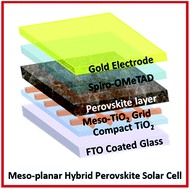
We report a hybrid mesoporous-planar architecture of methylammonium lead iodide perovskite based solar cells, to combine the benefits of both the mesoporous and planar architectures in a single device.
The content of this RSS Feed (c) The Royal Society of Chemistry
23 Aug 07:05
J. Mater. Chem. A, 2016, 4,14437-14443
DOI: 10.1039/C6TA05727F, Paper
Fuxiang Ji, Li Wang, Shuping Pang, Peng Gao, Hongxia Xu, Guangwen Xie, Jidong Zhang, Guanglei Cui
The organic cation exchange temperature was optimized toward the formation of highly uniform FA based perovskite films.
The content of this RSS Feed (c) The Royal Society of Chemistry
weiwei and -1 others like this