08 Nov 03:35
Publication date: October 2016
Source:Nano Energy, Volume 28
Author(s): Jiangsheng Xie, Xuegong Yu, Xuan Sun, Jiabin Huang, Yunhai Zhang, Ming Lei, Kun Huang, Dikai Xu, Zeguo Tang, Can Cui, Deren Yang
The recent rapid rise in power conversion efficiencies (PCEs) of perovskite solar cells (PSCs) has attracted worldwide extensive attention. However, the PSC applications are limited by their poor stability due to perovskite degradation in moisture. We used a fullerene amine interlayer in planar PSCs to reduce the interface barrier between ETL and metal electrode and also resist the moisture. The utilization of fullerene amine interlayer allowed for the enhancement of PSCs' performance, showing a highest power conversion efficiency (PCE)>17.2% with negligible hysteresis. More importantly, the air stability of PSCs with fullerene amine was improved: the unpackaged devices stored in air can keep their high performance with no obvious PCE loss in 10% humidity and >90% of the initial PCE in 45% humidity after 20 days.
Graphical abstract

08 Nov 03:34
Publication date: October 2016
Source:Nano Energy, Volume 28
Author(s): Zong-Liang Tseng, Chien-Hung Chiang, Sheng-Hsiung Chang, Chun-Guey Wu
ZnO was known as a good electron transporting material for the planar perovskite solar cells (PSCs). The stability of perovskite cell based on ZnO electron transporting layer (ETL) however is not good, due to the basicity nature of ZnO, which will react with the proton on CH3NH3
+ of perovskite. Doping was used successfully to modify the physicochemical properties of ZnO to improve the performance. High quality, fully covered Al doped ZnO (AZO) thin (~20nm) film on ITO substrate was successfully prepared by a sputtering method. Compared to the cell based on ZnO, perovskite cell using AZO as ETL has better stability, comparable Jsc, higher Voc and FF. The best AZO based perovskite cell achieves the highest power conversion efficiency of 17.6% with Voc of 1.07V which the highest Voc for the perovskite solar cell based on ZnO ETL. The improvement in the photovoltaic performance was due to AZO has higher conductivity, more resistance to the acid and better band matching with MAPbI3 compared to ZnO. The highly conducting and transparent AZO film was also used to replace ITO/ZnO as an anode as well as the ETL in the planer perovskite cell to achieve the PCE of 6.3%.
Graphical abstract

26 Oct 01:04
by Chuantian Zuo, Liming Ding
The work functions for charge transport layers in perovskite solar cells affect device performance significantly. In this work, the regular poly(3,4-ethylenedioxythiophene):polystyrene sulfonate (PEDOT:PSS) is modified by adding a polymer electrolyte PSS-Na to improve its HTL function in perovskite solar cells. The modified PEDOT:PSS films (called m-PEDOT:PSS) possess higher work function than the regular one. Its energy level matches the valence band of perovskite very well, leading to enhanced Voc and PCE (power conversion efficiency). When CH3NH3PbI3 is used as the light absorber, the cell with PEDOT:PSS HTL gives a Voc of 0.96 V and a PCE of 12.35%, while the cell with m-PEDOT:PSS layer gives a Voc of 1.11 V and a PCE of 15.56%. Enhanced Voc and PCE are also achieved when CH3NH3PbI2Br or CH3NH3PbBr3 is used as the light absorber. The m-PEDOT:PSS/CH3NH3PbBr3/PC61BM solar cells demonstrate an outstanding Voc of 1.52 V.

A modified poly(3,4-ethylenedioxythiophene) (PEDOT) layer is developed and used as the HTL for perovskite solar cells, leading to enhanced performance. Using m-PEDOT:PSS (1:2) as the HTL and CH3NH3PbI3 as the light absorber, a Voc of 1.11 V and a power conversion efficiency of 15.56% are achieved. A Voc of 1.52 V is obtained from CH3NH3PbBr3 solar cells, which is the highest Voc for perovskite/PCBM solar cells.
26 Oct 00:48
by Samuele Lilliu, Thomas G. Dane, Mejd Alsari, Jonathan Griffin, Alexander T. Barrows, Marcus S. Dahlem, Richard H. Friend, David G. Lidzey, J. E. Macdonald
Scanning nanofocus X-ray diffraction (nXRD) performed at a synchrotron is used to simultaneously probe the morphology and the structural properties of spin-coated CH3NH3PbI3 (MAPI) perovskite films for photovoltaic devices. MAPI films are spin-coated on a Si/SiO2/poly(3,4-ethylenedioxythiophene):polystyrene sulfonate (PEDOT:PSS) substrate held at different temperatures during the deposition in order to tune the perovskite film coverage. The films are then investigated using nXRD and scanning electron microscopy (SEM). The advantages of nXRD over SEM and other techniques are discussed. A method to visualize, selectively isolate, and structurally characterize single perovskite grains buried within a complex, polycrystalline film is developed. The results of nXRD measurements are correlated with solar cell device measurements, and it is shown that spin-coating the perovskite precursor solution at elevated temperatures leads to improved surface coverage and enhanced solar cell performance.

Scanning nanofocus X-ray diffraction is used to simultaneously probe the morphology and the structural properties of spin-coated CH3NH3PbI3 perovskite films. The technique allows for perovskite grain segmentation based on a variety of structural properties and is used to understand why spin-coating the perovskite precursor solution at elevated temperature leads to improved surface coverage and enhanced solar cell performance.
25 Oct 10:53
J. Mater. Chem. A, 2016, 4,17018-17024
DOI: 10.1039/C6TA06892H, Paper
Bo Li, Chengbin Fei, Kaibo Zheng, Xuanhui Qu, Tonu Pullerits, Guozhong Cao, Jianjun Tian
2-aminoethanethiol in perovskite films improves the intrinsic water-resistance, and the films can retain the MAPbI3 perovskite crystal structure when immersed in water for a long time (>10 minutes).
The content of this RSS Feed (c) The Royal Society of Chemistry
25 Oct 10:50
J. Mater. Chem. A, 2016, 4,17464-17472
DOI: 10.1039/C6TA05350E, Paper
Jingjing Chang, Juanxiu Xiao, Zhenhua Lin, Hai Zhu, Qing-Hua Xu, Kaiyang Zeng, Yue Hao, Jianyong Ouyang
KPFM study of various structures with a perovskite layer indicates unbalanced charge-carrier transport and extraction.
The content of this RSS Feed (c) The Royal Society of Chemistry
25 Oct 10:35
J. Mater. Chem. A, 2016, 4,17537-17542
DOI: 10.1039/C6TA07410C, Paper

Open Access
Joseph Palathinkal Thomas, Kam Tong Leung
Addition of mixed co-solvents of ethylene glycol and methanol in PEDOT:PSS changes its microstructure, and produces high conductivity and hybrid solar cell efficiency exceeding 14.6% on planar Si substrates.
The content of this RSS Feed (c) The Royal Society of Chemistry
25 Oct 10:34
J. Mater. Chem. A, 2016, 4,18792-18803
DOI: 10.1039/C6TA07364F, Paper
Qiang Tao, Tao Liu, Linrui Duan, Yufeng Cai, Wenjing Xiong, Pu Wang, Hua Tan, Gangtie Lei, Yong Pei, Weiguo Zhu, Renqiang Yang, Yanming Sun
A novel vertical carboxylate functionalized benzodithiophene unit was designed as an election-accepting block to build D-A type copolymers, and a high Voc of 1.03 V and a significant PCE of 7.49% were achieved.
The content of this RSS Feed (c) The Royal Society of Chemistry
25 Oct 09:19
J. Mater. Chem. A, 2016, 4,16975-16981
DOI: 10.1039/C6TA07492H, Paper
Wenmei Ming, Shiyou Chen, Mao-Hua Du
The near-zero enthalpy of formation of MAPbI3 leads to unusual defect formation energies that are free from elemental chemical potential dependence.
The content of this RSS Feed (c) The Royal Society of Chemistry
25 Oct 09:13
J. Mater. Chem. A, 2016, 4,17267-17273
DOI: 10.1039/C6TA08655A, Communication
Binbin Wang, Zhi-Guo Zhang, Senyun Ye, Haixia Rao, Zuqiang Bian, Chunhui Huang, Yongfang Li
A room-temperature water-vapor annealing method was developed to fabricate high crystallinity and void-free perovskite films, improving their photovoltaic device performance.
The content of this RSS Feed (c) The Royal Society of Chemistry
25 Oct 09:12
J. Mater. Chem. A, 2016, 4,18378-18382
DOI: 10.1039/C6TA08215G, Paper
Azat F. Akbulatov, Lyubov A. Frolova, Denis V. Anokhin, Kirill L. Gerasimov, Nadezhda N. Dremova, Pavel A. Troshin
In this study, we show that partial substitution of methylammonium (MA) with hydrazinium (HA) cations in MAPbI3 improves both the photovoltaic performance and stability of the hybrid perovskite solar cells.
The content of this RSS Feed (c) The Royal Society of Chemistry
24 Oct 01:25
by Yanan Wang, Juan He, Hao Chen, Jiangshan Chen, Ruidong Zhu, Pin Ma, Andrew Towers, Yuan Lin, Andre J. Gesquiere, Shin-Tson Wu, Yajie Dong

A simple yet general swelling–deswelling microencapsulation strategy has been developed to achieve well dispersed and intimately passivated crystalline organic–inorganic perovskites nanoparticles within polymer matrixes and results in a series of highly luminescent CH3NH3PbBr3 (MAPbBr3)–polymer composite films with unprecedented water and thermal stabilities and superior color purity.
08 Oct 01:29
J. Mater. Chem. A, 2016, 4,18383-18391
DOI: 10.1039/C6TA08278E, Paper
Hyo-Sang Lee, Hyungju Ahn, Jea Woong Jo, BongSoo Kim, Hae Jung Son
The combination of solvent and polymer additives synergistically enhances solar cell performance and the stability of small molecule bulk heterojunction solar cells.
The content of this RSS Feed (c) The Royal Society of Chemistry
08 Oct 01:24
J. Mater. Chem. A, 2016, 4,18776-18782
DOI: 10.1039/C6TA07750A, Paper
Si-Min Dai, Xin Zhang, Wei-Yi Chen, Xiang Li, Zhan'ao Tan, Cong Li, Lin-Long Deng, Xin-Xing Zhan, Min-Song Lin, Zhou Xing, Tao Wen, Rong-Ming Ho, Su-Yuan Xie, Rong-Bin Huang, Lan-Sun Zheng
PC71BM was isolated into three typically synthesizable isomers for a formulation engineering to make the most efficient electron acceptor with best formulation of the regioisomers/stereoisomers.
The content of this RSS Feed (c) The Royal Society of Chemistry
08 Oct 01:09
by Shuyan Shao, Mustapha Abdu-Aguye, Tejas S. Sherkar, Hong-Hua Fang, Sampson Adjokatse, Gert ten Brink, Bart J. Kooi, L. Jan Anton Koster, Maria Antonietta Loi
Despite the rich experience gained in controlling the microstructure of perovskite films over the past several years, little is known about how the microstructure affects the device properties of perovskite solar cells (HPSCs). In this work, the effects of the perovskite film microstructure on the charge recombination and light-soaking phenomenon in mixed halide HPSCs are investigated. Devices with noncompact perovskite morphology show a severe light soaking effect, with the power conversion efficiency (PCE) improved from 3.7% to 11.6% after light soaking. Devices with compact perovskite morphology show a negligible light soaking effect, with PCE slightly increased from 11.4% to 11.9% after light soaking. From device investigations, photoluminescence, and impedance spectroscopy measurements, it is demonstrated that interface electron traps at the grain boundaries as well as at the crystal surface dominate the light soaking effect. Severe trap-assisted recombination takes place in HPSCs using noncompact films, while it is effectively eliminated in devices with compact films. Moreover, how the grain size of the perovskite film affects the light soaking phenomenon is investigated. In the case of compact perovskite films, the size of the grains has a limited effect on the light soaking. In these compact films, grains are fused and trap states are effectively reduced.

The effects of the perovskite film microstructure on the charge recombination and light-soaking phenomenon are investigated in hybrid perovskite solar cells (HPSCs). It is demonstrated that interface electron traps at the grain boundaries as well as at the crystal surface dominate the light soaking effect.
08 Oct 01:07
by Quan Lü, Haohan Wei, Wenzhao Sun, Kaiyang Wang, Zhiyuan Gu, Jiankai Li, Shuai Liu, Shumin Xiao, Qinghai Song

The role of excitons on the amplifications of lead halide perovskites has been explored. Unlike the photoluminescence, the intensity of amplified spontaneous emission is partially suppressed at low temperature. The detailed analysis and experiments show that the inhibition is attributed to the existence of exciton and a quantitative model has been built to explain the experimental observations.
Lucy, Hi and one other like this
08 Oct 01:06
by Youfeng Yue, NovianaTjitra Salim, Yongzhen Wu, Xudong Yang, Ashraful Islam, Wei Chen, Jian Liu, Enbin Bi, Fengxian Xie, Molang Cai, Liyuan Han

The molecular structure of pyridine derivatives is critical to perovskite solar cell performance, especially stability. Most of the pyridine additives easily form complexes with perovskite. A new pyridine additive with a long alkyl chain substituted at its o-position does not corrode perovskite. The stability of devices containing this additive is the highest among the investigated cells.
08 Oct 01:06
by Liang Li, Yihua Chen, Zonghao Liu, Qi Chen, Xindong Wang, Huanping Zhou

The coordination effects of additives during perovskite crystal growth are investigated, and a novel technique to fabricate high-quality perovskite thin films by introduction of weak coordination additives (e.g., acetonitrile) in the precursors is demonstrated.
08 Oct 01:05
by Yue Wang, Xiaoming Li, Sivaramapanicker Sreejith, Fei Cao, Zeng Wang, Mihaiela Corina Stuparu, Haibo Zeng, Handong Sun

Influence of light exposure on cesium lead halide nanostructures has been explored. A discovery of photon driven transformation (PDT) in 2D CsPbBr3 nanoplatelets is reported, in which the quantum-confined few-monolayer nanoplatelets will convert to bulk phase under very low irradiation intensity (≈20 mW cm−2). Benefiting from the remarkable emission color change during PDT, the multicolor luminescence photopatterns and facile information photo-encoding are established.
Hi and -1 others like this
08 Oct 01:04
by Soyeon Kim, Bernardi Sanyoto, Won-Tae Park, Seyul Kim, Saumen Mandal, Jong-Choo Lim, Yong-Young Noh, Jung-Hyun Kim

A highly conductive, air stable and scalable poly(3,4-ethylenedioxythiophene) (PEDOT): poly(4-styrenesulfonate) (PEDOT:PSS) are prepared by using mass production ultrafiltration. By effectively removing excess PSS and various reaction impurities using repeated 100 nm pore membrane filtration, purified PEDOT:PSS exhibit conductivity as high as 2000 S cm−1.
08 Oct 01:03
by Wenjing Kan, Chunbo Duan, Mingzhi Sun, Chunmiao Han and Hui Xu

Chemistry of Materials
DOI: 10.1021/acs.chemmater.6b03518

08 Oct 01:01
by Jun Shao, Songwang Yang, Lei Lei, Qipeng Cao, Yu Yu and Yan Liu

Chemistry of Materials
DOI: 10.1021/acs.chemmater.6b03445

08 Oct 01:00
by Long Ye, Yuan Xiong, Huifeng Yao, Abay Gadisa, Hao Zhang, Sunsun Li, Masoud Ghasemi, Nrup Balar, Adrian Hunt, Brendan T. O’Connor, Jianhui Hou and Harald Ade

Chemistry of Materials
DOI: 10.1021/acs.chemmater.6b03083

08 Oct 00:59
by P. C. Harikesh, Hemant Kumar Mulmudi, Biplab Ghosh, Teck Wee Goh, Yin Ting Teng, Krishnamoorthy Thirumal, Mark Lockrey, Klaus Weber, Teck Ming Koh, Shuzhou Li, Subodh Mhaisalkar and Nripan Mathews

Chemistry of Materials
DOI: 10.1021/acs.chemmater.6b03310

08 Oct 00:57
by Zhuan Zhu, Viktor G. Hadjiev, Yaoguang Rong, Rui Guo, Bo Cao, Zhongjia Tang, Fan Qin, Yang Li, Yanan Wang, Fang Hao, Swaminathan Venkatesan, Wenzhi Li, Steven Baldelli, Arnold M. Guloy, Hui Fang, Yandi Hu, Yan Yao, Zhiming Wang and Jiming Bao

Chemistry of Materials
DOI: 10.1021/acs.chemmater.6b02883

30 Sep 00:59
J. Mater. Chem. A, 2016, 4,16824-16829
DOI: 10.1039/C6TA07105H, Communication
Ping Fu, Xin Guo, Bin Zhang, Tao Chen, Wei Qin, Yun Ye, Jianhui Hou, Jian Zhang, Can Li
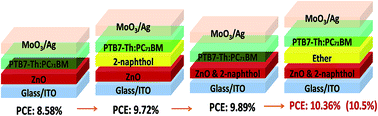
A simple treatment of the ZnO cathode interlayer with phenols (both on the ZnO surface and in blend) for IPSCs.
The content of this RSS Feed (c) The Royal Society of Chemistry
30 Sep 00:50
by Junsang Cho, Yun-Hyuk Choi, Thomas E. O’Loughlin, Luis De Jesus and Sarbajit Banerjee

Chemistry of Materials
DOI: 10.1021/acs.chemmater.6b02241

29 Sep 00:21
J. Mater. Chem. A, 2016, 4,16324-16329
DOI: 10.1039/C6TA05497H, Communication
Jin Hyuck Heo, Min Hyeok Jang, Min Ho Lee, Hye Ji Han, Man Gu Kang, Myung Lae Lee, Sang Hyuk Im
Highly semi-transparent sandwich type CH3NH3PbI3 (MAPbI3) island perovskite solar cells with high efficiency were constructed by introduction of a polystyrene (PS) passivation interlayer.
The content of this RSS Feed (c) The Royal Society of Chemistry
29 Sep 00:18
by Feng Wang, Wei Geng, Yang Zhou, Hong-Hua Fang, Chuan-Jia Tong, Maria Antonietta Loi, Li-Min Liu, Ni Zhao

Benzylamine is introduced as a surface passivation molecule that improves the moisture-resistance of the perovskites while simultaneously enhancing their electronic properties. Solar cells based on benzylamine-modified formamidinium lead iodide perovskite films exhibit a champion efficiency of 19.2% and an open-circuit voltage of 1.12 V. The modified FAPbI3 films exhibit no degradation after >2800 h air exposure.
28 Sep 02:11
by Wenzhe Li, Jiandong Fan, Yaohua Mai, Liduo Wang
The stability of single-crystalline/monocrystalline-like perovskite film is expected to be better than its microcrystalline counterparts. In the present work, highly orientated perovskite thin films (CH3NH3PbI3–xClx) are prepared by means of aquointermediates assisted solution process. It displays super-duper preferred-orientation along <110> direction that is close to the single crystal, and its diffraction intensity ratio of (110)/(310) is nearly two orders of magnitude higher in contrast to the films that prepared by traditional way. Owing to its superior performances, e.g., highly crystallized quality, stress-free inside films, longer electron lifetime, faster temporal response time, etc., the highly orientated perovskite-based solar cells accordingly allow realizing high efficiency while improving its thermal stability.

Highly orientated perovskite thin films (CH3NH3PbI3–xClx) are prepared by means of aquointermediate assisted one-step solution process. It demonstrates monocrystalline-like performances, e.g., extremely high preferred-orientation, stress-free inside films, longer electron lifetime, lower defect density, and faster temporal response time. The highly orientated perovskite-based solar cells allow realizing the efficiency as high as 16.9% while improving its thermal stability.