Shared posts

17 Dec 00:56

Performance Enhancement by Secondary Doping in PEDOT:PSS/Planar-Si Hybrid Solar Cells

by Donald McGillivray, Joseph P. Thomas, Marwa Abd-Ellah, Nina F. Heinig and K. T. Leung

TOC Graphic

ACS Applied Materials & Interfaces
DOI: 10.1021/acsami.6b09704
17 Dec 00:55

Dithienobenzodithiophene-Based Small Molecule Organic Solar Cells with over 7% Efficiency via Additive- and Thermal-Annealing-Free Processing

by Hyeng Gun Song, Yu Jin Kim, Ji Sang Lee, Yun-Hi Kim, Chan Eon Park and Soon-Ki Kwon

TOC Graphic

ACS Applied Materials & Interfaces
DOI: 10.1021/acsami.6b11297
17 Dec 00:54

Approximately 800-nm-Thick Pinhole-Free Perovskite Films via Facile Solvent Retarding Process for Efficient Planar Solar Cells

by Zhongcheng Yuan, Yingguo Yang, Zhongwei Wu, Sai Bai, Weidong Xu, Tao Song, Xingyu Gao, Feng Gao and Baoquan Sun

TOC Graphic

ACS Applied Materials & Interfaces
DOI: 10.1021/acsami.6b12637
16 Dec 06:54

Fulleropyrrolidinium Iodide As an Efficient Electron Transport Layer for Air-Stable Planar Perovskite Solar Cells

by Jiabin Huang, Xuegong Yu, Jiangsheng Xie, Chang-Zhi Li, Yunhai Zhang, Dikai Xu, Zeguo Tang, Can Cui and Deren Yang

TOC Graphic

ACS Applied Materials & Interfaces
DOI: 10.1021/acsami.6b08771
16 Dec 06:54

Solution-Processable Ionic Liquid as an Independent or Modifying Electron Transport Layer for High-Efficiency Perovskite Solar Cells

by Qiliang Wu, Weiran Zhou, Qing Liu, Pengcheng Zhou, Tao Chen, Yalin Lu, Qiquan Qiao and Shangfeng Yang

TOC Graphic

ACS Applied Materials & Interfaces
DOI: 10.1021/acsami.6b12683
16 Dec 06:53

Sb2S3/Spiro-OMeTAD Inorganic–Organic Hybrid p–n Junction Diode for High Performance Self-Powered Photodetector

by Ashok Bera, Ayon Das Mahapatra, Sulakshana Mondal and Durga Basak

TOC Graphic

ACS Applied Materials & Interfaces
DOI: 10.1021/acsami.6b09943
16 Dec 06:52

A 14.7% Organic/Silicon Nanoholes Hybrid Solar Cell via Interfacial Engineering by Solution-Processed Inorganic Conformal Layer

by Yu-Tsu Lee, Fang-Ru Lin, Chien-Hsun Chen and Zingway Pei

TOC Graphic

ACS Applied Materials & Interfaces
DOI: 10.1021/acsami.6b10741
16 Dec 01:43

Low-Temperature All-Solution-Processed Transparent Silver Nanowire-Polymer/AZO Nanoparticles Composite Electrodes for Efficient ITO-Free Polymer Solar Cells

by Xiaoqin Zhang, Jiang Wu, Jiantai Wang, Qingqing Yang, Baohua Zhang and Zhiyuan Xie

TOC Graphic

ACS Applied Materials & Interfaces
DOI: 10.1021/acsami.6b11978
16 Dec 01:40

Tellurophene-Based N-type Copolymers for Photovoltaic Applications

by Lei Lv, Xiaofen Wang, Xinlong Wang, Lei Yang, Tao Dong, Zhou Yang and Hui Huang

TOC Graphic

ACS Applied Materials & Interfaces
DOI: 10.1021/acsami.6b11041
16 Dec 01:39

The Effect of Impurities on the Impedance Spectroscopy Response of CH3NH3PbI3 Perovskite Solar Cells

by Sonia R. Raga and Yabing Qi

TOC Graphic

The Journal of Physical Chemistry C
DOI: 10.1021/acs.jpcc.6b11584
16 Dec 01:37

Bismuth Iodide Perovskite Materials for Solar Cell Applications: Electronic Structure, Optical Transitions, and Directional Charge Transport

by Meysam Pazoki, Malin B. Johansson, Huimin Zhu, Peter Broqvist, Tomas Edvinsson, Gerrit Boschloo and Erik M. J. Johansson

TOC Graphic

The Journal of Physical Chemistry C
DOI: 10.1021/acs.jpcc.6b11745
16 Dec 01:36

High-photovoltage all-polymer solar cells based on a diketopyrrolopyrrole-isoindigo acceptor polymer

J. Mater. Chem. A, 2017, 5,11693-11700
DOI: 10.1039/C6TA09379E, Paper
Zhaojun Li, Xiaofeng Xu, Wei Zhang, Zewdneh Genene, Wendimagegn Mammo, Arkady Yartsev, Mats R. Andersson, Rene A. J. Janssen, Ergang Wang
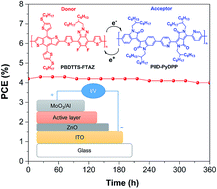
High-photovoltage all-PSCs with good stability were realized by using a new polymer acceptor based on diketopyrrolopyrrole-isoindigo.
The content of this RSS Feed (c) The Royal Society of Chemistry
16 Dec 01:35

Recent advances in wide bandgap semiconducting polymers for polymer solar cells

J. Mater. Chem. A, 2016, Accepted Manuscript
DOI: 10.1039/C6TA09325F, Review Article
Qingdong Zheng, Yunlong Ma, zhenjing Kang
As key components in the active layer of multi-junction, ternary blend, or non-fullerene polymer solar cells (PSCs), wide bandgap semiconducting polymers have the characteristic of exhibiting strong absorption bands in...
The content of this RSS Feed (c) The Royal Society of Chemistry
16 Dec 01:34

Efficient and Highly Air Stable Planar Inverted Perovskite Solar Cells with Reduced Graphene Oxide Doped PCBM Electron Transporting Layer

by George Kakavelakis, Temur Maksudov, Dimitrios Konios, Ioannis Paradisanos, George Kioseoglou, Emmanuel Stratakis, Emmanuel Kymakis

Reduced graphene oxide (rGO) is added in the [6,6]-Phenyl-C61-butyric acid methyl ester (PCBM) electron transport layer (ETL) of planar inverted perovskite solar cells (PSCs), resulting in a power conversion efficiency (PCE) improvement of ≈12%, with a hysteresis-free PCE of 14.5%, compared to 12.9% for the pristine PCBM based device. The universality of the method is demonstrated in PSCs based on CH3NH3PbI3−xClx and CH3NH3PbI3 perovskites, deposited through one step and two step spin coating process, respectively. After a comprehensive spectroscopic characterization of both devices, it is clear that the introduction of rGO in PCBM ETL results in an important increase of the ETL conductivity, together with reduced series resistance and surface roughness. As a result, a significant photoluminescence quenching of such perovskite/ETL is observed, confirming the increased measured short circuit current density. Transient absorption measurements reveal that in the rGO-based device, the relaxation process of the excited electrons is significantly faster compared to the reference, which implies that the charge injection rate is significantly faster for the first. Furthermore, the light soaking effect is significantly reduced. Finally, aging measurements reveal that the rGO stabilizes the ELT/perovskite interface, which results in the stabilization of perovskite crystal structure after prolonged illumination.

Thumbnail image of graphical abstract

Planar inverted perovskite solar cells with high efficiency and ambient stability are fabricated based on a reduced graphene oxide (rGO) doped [6,6]-Phenyl-C61-butyric acid methyl ester (PCBM) electron transporting layer (ETL). The performance improvement is attributed to enhanced electron extraction, while the enhancement in the lifetime is due to the stabilization of the perovskite/ETL interface of the rGO doped device compared to the pristine.

16 Dec 01:34

Efficient Monolithic Perovskite/Perovskite Tandem Solar Cells

by Dávid Forgács, Lidón Gil-Escrig, Daniel Pérez-Del-Rey, Cristina Momblona, Jérémie Werner, Bjoern Niesen, Christophe Ballif, Michele Sessolo, Henk J. Bolink
Thumbnail image of graphical abstract

Efficient monolithic perovskite/perovskite tandem solar cells are fabricated using two perovskite absorbers with complementary bandgaps. By employing doped organic semiconductors, an efficient and selective extraction of the charge carriers is ensured. This study demonstrates perovskite/perovskite tandem cells delivering a maximum efficiency of 18%, highlighting the potential of vacuum-deposited multilayer structures in overcoming the efficiency of single-junction perovskite devices.

16 Dec 01:32

Ultrafast Carrier Dynamics in Bimetallic Nanostructures-Enhanced Methylammonium Lead Bromide Perovskites

Nanoscale, 2016, Accepted Manuscript
DOI: 10.1039/C6NR08347A, Paper
Holly Zarick, Abdelaziz Boulesbaa, Alex Puretzky, Eric M Talbert, Zachary Robert DeBra, Naiya Soetan, David Geohegan, Rizia Bardhan
In this work, we examine the impact of hybrid bimetallic Au/Ag core/shell nanostructures on the carrier dynamics of methylammonium lead tribromide (MAPbBr3) mesoporous perovskite solar cells (PSCs). Plasmon-enhanced PSCs incorporated...
The content of this RSS Feed (c) The Royal Society of Chemistry
16 Dec 01:30

Bithienopyrroledione-Based Copolymers, Versatile Semiconductors for Balanced Ambipolar Thin-Film Transistors and Organic Solar Cells with V oc > 1 V

by Xiaolan Qiao, Qinghe Wu, Hongzhuo Wu, Jidong Zhang, Hongxiang Li

Conjugated polymer semiconductors P1 and P2 with bithienopyrroledione (bi-TPD) as acceptor unit are synthesized. Their transistor and photovoltaic performances are investigated. Both polymers display high and balanced ambipolar transport behaviors in thin-film transistors. P1-based devices show an electron mobility of 1.02 cm2 V−1 s−1 and a hole mobility of 0.33 cm2 V−1 s−1, one of the highest performance reported for ambipolar polymer transistors. The electron and hole mobilities of P2 transistors are 0.36 and 0.16 cm2 V−1 s−1, respectively. The solar cells with PC71BM as the electron acceptor and P1/P2 as the donor exhibit a high Voc about 1.0 V, and a power conversion efficiency of 6.46% is observed for P1-based devices without any additives and/or post treatment. The high performance of P1 and P2 is attributed to their crystalline films and short π–π stacking distance (<3.5 Å). These results demonstrate (1) bi-TPD is an excellent versatile electron-deficient unit for polymer semiconductors and (2) bi-TPD-based polymer semiconductors have potential applications in organic transistors and organic solar cells.

Thumbnail image of graphical abstract

Versatile polymer semiconductors containing bithienopyrroledione unit are designed and synthesized. They exhibit balanced ambipolar transport behaviors with an electron mobility of 1.02 cm2 V−1 s−1 and a hole mobility of 0.33 cm2 V−1 s−1 in thin-film transistors, and photovoltaic properties with a power conversion efficiency of 6.46% and a high Voc of 1.02 V in polymer solar cells.

16 Dec 01:28

Singlet Fission: Progress and Prospects in Solar Cells

by Jianlong Xia, Samuel N. Sanders, Wei Cheng, Jonathan Z. Low, Jinping Liu, Luis M. Campos, Taolei Sun

The third generation of photovoltaic technology aims to reduce the fabrication cost and improve the power conversion efficiency (PCE) of solar cells. Singlet fission (SF), an efficient multiple exciton generation (MEG) process in organic semiconductors, is one promising way to surpass the Shockley-Queisser limit of conventional single-junction solar cells. Traditionally, this MEG process has been observed as an intermolecular process in organic materials. The implementation of intermolecular SF in photovoltaic devices has achieved an external quantum efficiency of over 100% and demonstrated significant promise for boosting the PCE of third generation solar cells. More recently, efficient intramolecular SF has been reported. Intramolecular SF materials are modular and have the potential to overcome certain design constraints that intermolecular SF materials possess, which may allow for more facile integration into devices.

Thumbnail image of graphical abstract

Singlet fission (SF), a multiple exciton generation process in organic semiconductors, is one promising way to overcome the Shockley–Queisser limit for the power conversion efficiency (PCE) of photovoltaic solar cells. Recent achievements in engineering intermolecular SF-based photovoltaic devices and prospects of recently developed intramolecular SF materials as active layers in future devices are highlighted.

16 Dec 01:28

Enhancement of the Performance of Perovskite Solar Cells, LEDs, and Optical Amplifiers by Anti-Solvent Additive Deposition

by Thi Tuyen Ngo, Isaac Suarez, Gabriella Antonicelli, Diego Cortizo-Lacalle, Juan P. Martinez-Pastor, Aurelio Mateo-Alonso, Ivan Mora-Sero
Thumbnail image of graphical abstract

The efficiency of perovskite optoelectronic devices is increased by a novel method; its suitability for perovskite solar cells, light-emitting diodes, and optical amplifiers is demonstrated. The method is based on the introduction of organic additives during the anti-solvent step in the perovskite thin-film deposition process. Additives passivate grain boundaries reducing non-radiative recombination. The method can be easily extended to other additives.

16 Dec 01:27

Photonics: Toward Scalable Flexible Nanomanufacturing for Photonic Structures and Devices (Adv. Mater. 47/2016)

by Wen Qiao, Wenbin Huang, Yanhua Liu, Xiangmin Li, Lin-Sen Chen, Jian-Xin Tang
Thumbnail image of graphical abstract

Continuous and scalable nanopatterning over flexible substrates are highly desirable for both commercial and scientific interests, but difficult to be realized by traditional photolithographic processes. The current status of scalable nanopatterning technologies is reviewed by L.-S. Chen, J.-X. Tang, and co-workers on page 10353, with a focus on light management by photonic structures on flexible materials in optoelectronic devices. Critical challenges in various patterning techniques are discussed in terms of the resolution, scalability, processing throughput, and use of masks and resists.

14 Dec 01:37

Successive surface engineering of TiO2 compact layer via dual modification of fullerene derivatives affording hysteresis-suppressed high-performance perovskite solar cells

J. Mater. Chem. A, 2016, Accepted Manuscript
DOI: 10.1039/C6TA07876A, Paper
Weiran Zhou, Jieming Zhen, Qing Liu, Zhimin Fang, Dan Li, Pengcheng Zhou, Tao Chen, Shangfeng Yang
Interfacial engineering is critical for highly efficient charge carrier transport in perovskite solar cells (PSCs). Herein, we develop a new method so-called successive surface engineering affording efficiency enhancement of PSCs...
The content of this RSS Feed (c) The Royal Society of Chemistry
14 Dec 01:37

Hexagonal Mesoporous Silica Islands to Enhance Photovoltaic Performance of Planar Junction Perovskite Solar Cells

J. Mater. Chem. A, 2016, Accepted Manuscript
DOI: 10.1039/C6TA09709J, Communication
Peng Gao, Yi Zhang, Zhaofei Zhang, Wei Yan, Bao Zhang, Yaqing Feng, A. R. Malik, Nazeeruddin, Mohammad K.
The efficiency of perovskite solar cells based on mesoscopic TiO2 has been soaring over the past three years and is expected to reach over 25% by engineering composition of perovskite...
The content of this RSS Feed (c) The Royal Society of Chemistry
14 Dec 01:03

Achievement of High Voc of 1.02 V for P3HT-Based Organic Solar Cell Using a Benzotriazole-Containing Non-Fullerene Acceptor

by Bo Xiao, Ailing Tang, Jianqi Zhang, Asif Mahmood, Zhixiang Wei, Erjun Zhou
Thumbnail image of graphical abstract

Poly(3-hexyl thiophene) (P3HT) can be easily synthesized, demonstrating the large potential to decrease the cost in large-scale synthesis. Thus, the development of novel non-fullerene acceptor to match well with P3HT is urgent and necessary. The first benzotriazole-containing non-fullerene acceptor is designed and synthesized, and high open-circuit voltage (V oc) of 1.02 V, fill factor (FF) of 0.70, and power conversion efficiency (PCE) of 5.24% are realized, which are remarkably higher than that of P3HT: [6,6]-phenyl-C61-butyric acid methyl ester (PC61BM) system (V oc = 0.59 V, FF = 0.57, and PCE = 3.34%).

14 Dec 01:03

Porphyrin Sensitizers with Donor Structural Engineering for Superior Performance Dye-Sensitized Solar Cells and Tandem Solar Cells for Water Splitting Applications

by Sung Ho Kang, Myung Jin Jeong, Yu Kyung Eom, In Taek Choi, Seung Mo Kwon, Youngjun Yoo, Jeongho Kim, Jeong Kwon, Jong Hyeok Park, Hwan Kyu Kim

Zn(II)–porphyrin sensitizers, coded as SGT-020 and SGT-021, are designed and synthesized through donor structural engineering. The photovoltaic (PV) performances of SGT sensitizer-based dye-sensitized solar cells (DSSCs) are systematically evaluated in a thorough SM315 as a reference sensitizer. The effect of the donor ability and the donor bulkiness on photovoltaic performances is investigated for establishing the structure–performance relationship in the platform of porphyrin-triple bond-benzothiadiazole-acceptor sensitizers. By introducing a more bulky fluorene unit to the amine group in the SM315, the power conversion efficiency (PCE) is enhanced with the increased short-circuit current (Jsc) and open-circuit voltage (Voc), due to the improved light-harvesting ability and the efficient prevention of charge recombination, respectively. As a consequence, a maximum PCE of 12.11% is obtained for SGT-021, whose PCE is much higher than the 11.70% PCE for SM315. To further improve their maximum efficiency, the first parallel tandem DSSCs employing cobalt electrolyte in the top and bottom cells are demonstrated and an extremely high efficiency of 14% is achieved, which is currently the highest reported value for tandem DSSCs. The series tandem DSSCs give a remarkably high Voc value of >1.83 V. From this DSSC tandem configuration, 7.4% applied bias photon-to-current efficiency is achieved for solar water splitting.

Thumbnail image of graphical abstract

The effect of the donor ability and bulkiness on DSSC photovoltaic performances is investigated to exceed a world champion porphyrin. The first parallel tandem DSSCs employing cobalt electrolyte are demonstrated with an extremely high efficiency of 14%. The series tandem DSSCs give a remarkably high Voc value of >1.83 V, achieving 7.4% applied bias photon-to-current efficiency for solar water splitting.

14 Dec 01:02

Versatile Plasmonic-Effects at the Interface of Inverted Perovskite Solar Cells

Nanoscale, 2016, Accepted Manuscript
DOI: 10.1039/C6NR06741G, Paper
Open Access Open Access
Ahmed Esmail Shalan, Tomoya Oshikiri, Hiroki Sawayanagi, Keisuke Nakamura, Kosei Ueno, Quan Sun, Hui-Ping Wu, Eric Wei-Guang Diau, Hiroaki Misawa
Plasmonics is a highly promising approach to enhancing the light-harvesting properties of hybrid organic/inorganic perovskite solar cells. In the present work, our cells have a p-i-n inverted planar structure. An...
The content of this RSS Feed (c) The Royal Society of Chemistry
13 Dec 01:16

Analysis of Sputtering Damage on I–V Curves for Perovskite Solar Cells and Simulation with Reversed Diode Model

by Hiroyuki Kanda, Abdullah Uzum, Ajay K. Baranwal, T. A. Nirmal Peiris, Tomokazu Umeyama, Hiroshi Imahori, Hiroshi Segawa, Tsutomu Miyasaka and Seigo Ito

TOC Graphic

The Journal of Physical Chemistry C
DOI: 10.1021/acs.jpcc.6b09219
13 Dec 01:14

Charge Generation and Recombination in Diketopyrrolopyrrole Polymer: Fullerene Bulk Heterojunctions Studied by Transient Absorption and Time-Resolved Microwave Conductivity

by Ryuzi Katoh, Hiroyuki Matsuzaki, Akihiro Furube, Prashant Sonar, Evan L. Williams, Chellappan Vijila, Gomathy Sandhya Subramanian, Sergey Gorelik and Jonathan Hobley

TOC Graphic

The Journal of Physical Chemistry C
DOI: 10.1021/acs.jpcc.6b08379
13 Dec 01:01

Color-stable water-dispersed cesium lead halide perovskite nanocrystals

Nanoscale, 2017, 9,631-636
DOI: 10.1039/C6NR08892A, Paper
Open Access Open Access
Leyre Gomez, Chris de Weerd, Jose L. Hueso, Tom Gregorkiewicz
Cesium lead halide perovskite nanocrystals embedded in solid lipid nanoparticles of stearic acid become water-stable for a period longer than 2 months and anion-exchange is fully arrested when mixing different halide composition nanocrystals.
The content of this RSS Feed (c) The Royal Society of Chemistry
13 Dec 00:57

Reproducible Planar Heterojunction Solar Cells Based on One-Step Solution-Processed Methylammonium Lead Halide Perovskites

by Sai Bai, Nobuya Sakai, Wei Zhang, Zhiping Wang, Jacob T.-W. Wang, Feng Gao and Henry J. Snaith

TOC Graphic

Chemistry of Materials
DOI: 10.1021/acs.chemmater.6b05159
13 Dec 00:55

Mechanisms for Spontaneous Generation of Interlayers in Organic Solar Cells

by Jane Vinokur, Basel Shamieh, Igal Deckman, Avni Singhal and Gitti L Frey

TOC Graphic

Chemistry of Materials
DOI: 10.1021/acs.chemmater.6b03770