13 Dec 01:06
J. Mater. Chem. A, 2016, Accepted Manuscript
DOI: 10.1039/C6TA08443E, Paper
Hua Zhang, Cheng Yang, zhonglin Du, dengyu pan, Xinhua Zhong
Although copper sulfide and/or carbon materials have been utilized in counter electrodes (CEs) due to their good catalytic activity and conductivity, the efficiency of the assembled quantum dot sensitized solar...
The content of this RSS Feed (c) The Royal Society of Chemistry
13 Dec 01:05
J. Mater. Chem. A, 2016, Accepted Manuscript
DOI: 10.1039/C6TA07541J, Paper
Xin Wang, Lin-Long Deng, Lu-Yao Wang, Si-Min Dai, Zhou Xing, Xin-Xing Zhan, Xu-Zhai Lu, Su-Yuan Xie, Rong-Bin Huang, Lansun Zheng
In high performance perovskite solar cells (PSCs), the electron transport layer (ETL) has overwhelmingly been dominated by compact titanium oxide (TiO2) that typically requires sintering around 500 oC. Such a...
The content of this RSS Feed (c) The Royal Society of Chemistry
13 Dec 01:02
by Long Ye, Wenchao Zhao, Sunsun Li, Subhrangsu Mukherjee, Joshua H. Carpenter, Omar Awartani, Xuechen Jiao, Jianhui Hou, Harald Ade
Organic solar cells (OSCs) made of donor/acceptor bulk-heterojunction active layers have been of widespread interest in converting sunlight to electricity. Characterizing of the complex morphology at multiple length scales of polymer:nonfullerene small molecular acceptor (SMA) systems remains largely unexplored. Through detailed characterizations (hard/soft X-ray scattering) of the record-efficiency polymer:SMA system with a close analog, quantitative morphological parameters are related to the device performance parameters and fundamental morphology–performance relationships that explain why additive use and thermal annealing are needed for optimized performance are established. A linear correlation between the average purity variations at small length scale (≈10 nm) and photovoltaic device characteristics across all processing protocols is observed in ≈12%-efficiency polymer:SMA systems. In addition, molecular interactions as reflected by the estimated Flory–Huggins interaction parameters are used to provide context of the room temperature morphology results. Comparison with results from annealed devices suggests that the two SMA systems compared show upper and lower critical solution temperature behavior, respectively. The in-depth understanding of the complex multilength scale nonfullerene OSC morphology may guide the device optimization and new materials development and indicates that thermodynamic properties of materials systems should be studied in more detail to aid in designing optimized protocols efficiently.

Quantitative morphological parameters correlate well with the photovoltaic performance of six high-efficiency nonfullerene small molecular acceptors systems. Synergistic higher π–π coherence lengths and average domain purity result in over 12% efficiency fullerene-free organic solar cell (OSC) with a sequential treatment of solvent additive and thermal annealing. The work highlights the need for more detailed studies into the thermodynamics of OSCs.
13 Dec 00:59
by Bat-El Cohen, Małgorzata Wierzbowska, Lioz Etgar
An important property of hybrid layered perovskite is the possibility to reduce its dimensionality to provide wider band gap and better stability. In this work, 2D perovskite of the structure (PEA)2(MA)n–1PbnBr3n+1 has been sensitized, where PEA is phenyl ethyl-ammonium, MA is methyl-ammonium, and using only bromide as the halide. The number of the perovskite layers has been varied (n) from n = 1 through n = ∞. Optical and physical characterization verify the layered structure and the increase in the band gap. The photovoltaic performance shows higher open circuit voltage (Voc) for the quasi 2D perovskite (i.e., n = 40, 50, 60) compared to the 3D perovskite. Voc of 1.3 V without hole transport material (HTM) and Voc of 1.46 V using HTM have been demonstrated, with corresponding efficiency of 6.3% and 8.5%, among the highest reported. The lower mobility and transport in the quasi 2D perovskites have been proved effective to gain high Voc with high efficiency, further supported by ab initio calculations and charge extraction measurements. Bromide is the only halide used in these quasi 2D perovskites, as mixing halides have recently revealed instability of the perovskite structure. These quasi 2D materials are promising candidates for use in optoelectronic applications that simultaneously require high voltage and high efficiency.

A quasi 2D perovskite materials based on bromide, having low exciton binding energy, high absorbance coefficient, and high stability is presented. These materials provide high open circuit voltage and high power conversion efficiency in perovskite solar cells with and without hole transport material.
12 Dec 01:08
by Soyeon Kim, Bernardi Sanyoto, Won-Tae Park, Seyul Kim, Saumen Mandal, Jong-Choo Lim, Yong-Young Noh, Jung-Hyun Kim

On page 10149, a simple and mass-scalable method, ultrafiltration, is proposed for achieving high-conductivity poly(3,4-ethylenedioxythiophene) (PEDOT): poly(4-styrenesulfonate) (PEDOT:PSS) by Y.-Y. Noh, J.-H. Kim, and co-workers. By effectively removing excess PSS and various reaction impurities using repeated 100 nm-poremembrane filtration, the purified PEDOT:PSS shows impressive conductivity and sheet resistance as high as 2000 S cm−1 and 37.8 ± 4.5 Ω□−1, respectively.
10 Dec 01:06
J. Mater. Chem. A, 2017, 5,739-747
DOI: 10.1039/C6TA09036B, Paper
Cheng-Min Tsai, Guan-Wei Wu, Sudhakar Narra, Hung-Ming Chang, Nayantara Mohanta, Hui-Ping Wu, Chien-Lung Wang, Eric Wei-Guang Diau
Fabrication of mesoporous carbon-based perovskite solar cells via slow crystallization using NMP solvent attained a great device efficiency of 15% with preferred orientation of the crystals at the (004) facet.
The content of this RSS Feed (c) The Royal Society of Chemistry
10 Dec 01:02
Energy Environ. Sci., 2016, Accepted Manuscript
DOI: 10.1039/C6EE03474H, Communication
Tianyi Wang, Benjamin Daiber, Jarvist Moore Frost, Sander Mann, Erik Garnett, Aron Walsh, Bruno Ehrler
Methylammonium lead iodide perovskites are considered direct bandgap semiconductors. Here we show that in fact they present a weakly indirect bandgap 60 meV below the direct bandgap transition. This is...
The content of this RSS Feed (c) The Royal Society of Chemistry

10 Dec 01:01
by Jacobus J. van Franeker, Koen H. Hendriks, Bardo J. Bruijnaers, Martinus W. G. M. Verhoeven, Martijn M. Wienk, René A. J. Janssen
Layer deposition of organometal halide perovskites for solar cells usually involves tedious experimentation to establish the optimum processing conditions. Important parameters are the time and temperature of thermal annealing. Here, it is demonstrated that in situ photoluminescence allows to determine the optimal annealing procedure without fabricating complete solar cells. A deposition method is used in which dense layers of perovskite crystals are formed within seconds in ambient air by hot casting a mixture of lead acetate, lead chloride, and methylammonium iodide. The as-cast perovskite layers are highly luminescent because charge carriers are unable to reach the charge extraction layers that quench the photoluminescence. Thermal annealing enhances charge transport and quenches the photoluminescence, but deteriorates the photovoltaic performance via decomposition of the perovskite if applied for a too long time. It is demonstrated that the optimal annealing time coincides with the time required for the in situ measured photoluminescence intensity to reach its baseline value for annealing temperatures in the range of 80–100 °C. This results in efficient (>14%) perovskite solar cells and shows that in situ photoluminescence is a simple but powerful tool for in-line quality monitoring of perovskite films.

In situ photoluminescence is used to determine the optimal thermal annealing conditions of organometal halide perovskite layers, prior to completing the solar cell. The method allows fabricating efficient (>14%) planar perovskite solar cells under ambient conditions that feature good stability and low hysteresis.
10 Dec 00:47
by Silvia Colodrero, Pablo Romero-Gomez, Paola Mantilla-Perez, Jordi Martorell
Organic electronics has the potential to be incorporated in any kind of surface morphology for wearable or fully portable applications. Unfortunately when organic devices, such as solar cells, are fabricated on flexible substrates, the device performance is severely limited unless the physical properties of such substrates are carefully chosen. Here, it is demonstrated that layers of nanoparticles with a size gradient distribution can be used to obtain high performance solar cell devices that can be effectively delaminated from an original flat and rigid glass substrate. Such sacrificial nanoparticles layers are incorporated in between the glass substrate and the semitransparent electrode of a polymer:fullerene (PTB7:PC71BM) cell. After the cell delamination, freestanding flexible devices with power conversion efficiencies as high as 7.12% are obtained, which corresponds to 90% of the performance of the same cell fabricated on a standard glass smooth surface.

The performance of flexible electronic devices is, in general, strongly limited by the physical properties of the specific substrate used. It is demonstrated that a sacrificial layer of multiple size nanoparticles with a size gradient distribution can be used to successfully delaminate organic solar cells from an original flat and rigid glass substrate to achieve efficient freestanding flexible devices.
09 Dec 01:41
Chem. Commun., 2016, Accepted Manuscript
DOI: 10.1039/C6CC07573H, Communication
Bahram Abdollahi Nejand, Pariya Nazari, Saba Gharibzade, Vahid Ahmadi, Ahmad Moshaii
Here, a low-cost perovskite solar cell using CuI and ZnO as a respective inorganic hole and electron transport layer is introduced. Copper foil is chosen as a cheap and low-weight...
The content of this RSS Feed (c) The Royal Society of Chemistry

09 Dec 01:24
by Haijun Fan and Xiaozhang Zhu

ACS Applied Materials & Interfaces
DOI: 10.1021/acsami.6b11636

09 Dec 01:23
by Ahmed Esmail Shalan, Tomoya Oshikiri, Sudhakar Narra, Mahmoud M. Elshanawany, Kosei Ueno, Hui-Ping Wu, Keisuke Nakamura, Xu Shi, Eric Wei-Guang Diau and Hiroaki Misawa

ACS Applied Materials & Interfaces
DOI: 10.1021/acsami.6b10803

09 Dec 01:17
by Xiaowen Chang, Weiping Li, Liqun Zhu, Huicong Liu, Huifang Geng, Sisi Xiang, Jiaming Liu and Haining Chen

ACS Applied Materials & Interfaces
DOI: 10.1021/acsami.6b11393

09 Dec 01:16
by Tiefeng Liu, Fangyuan Jiang, Fei Qin, Wei Meng, Youyu Jiang, Sixing Xiong, Jinhui Tong, Zaifang Li, Yun Liu and Yinhua Zhou

ACS Applied Materials & Interfaces
DOI: 10.1021/acsami.6b13324

09 Dec 01:13
by Hiroyuki Kanda, Abdullah Uzum, Hitoshi Nishino, Tomokazu Umeyama, Hiroshi Imahori, Yasuaki Ishikawa, Yukiharu Uraoka and Seigo Ito

ACS Applied Materials & Interfaces
DOI: 10.1021/acsami.6b07781

09 Dec 01:11
by Sum-Gyun Yi, Sung Hyun Kim, Sungjin Park, Donggun Oh, Hwan Young Choi, Nara Lee, Young Jai Choi and Kyung-Hwa Yoo

ACS Applied Materials & Interfaces
DOI: 10.1021/acsami.6b11768

09 Dec 01:08
Energy Environ. Sci., 2017, 10,247-257
DOI: 10.1039/C6EE02466A, Paper
Jaewon Lee, Dong Hun Sin, Byungho Moon, Jisoo Shin, Heung Gyu Kim, Min Kim, Kilwon Cho
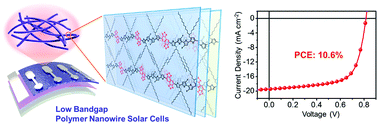
One-dimensional low bandgap polymer nanowires successfully incorporated into bulk-heterojunction organic solar cells, yielding a high PCE exceeding 10% with thick films.
The content of this RSS Feed (c) The Royal Society of Chemistry

09 Dec 01:08
Energy Environ. Sci., 2017, 10,236-246
DOI: 10.1039/C6EE03201J, Paper
Matthew T. Klug, Anna Osherov, Amir A. Haghighirad, Samuel D. Stranks, Patrick R. Brown, Sai Bai, Jacob T.-W. Wang, Xiangnan Dang, Vladimir Bulovic, Henry J. Snaith, Angela M. Belcher
Mixed-metal compositional screening identifies Co2+ as capable of partial B-site substitution in CH3NH3PbI3, which supplies new dimensions of material tunability.
The content of this RSS Feed (c) The Royal Society of Chemistry

09 Dec 01:08
Energy Environ. Sci., 2017, 10,258-265
DOI: 10.1039/C6EE02851A, Paper
Tanya Kumari, Sang Myeon Lee, So-Huei Kang, Shanshan Chen, Changduk Yang
A record breaking PCE of 12.1% is achieved by incorporating 25 wt% of DR3TSBDT into a PTB7-Th:PC71BM host matrix.
The content of this RSS Feed (c) The Royal Society of Chemistry

09 Dec 01:06
J. Mater. Chem. A, 2017, 5,663-671
DOI: 10.1039/C6TA09394A, Paper
Gi Eun Park, Suna Choi, Dae Hee Lee, Mallesham Godumala, Mohammad Afsar Uddin, Han Young Woo, Min Ju Cho, Dong Hoon Choi
In order to investigate the effect of the geometries of perylene diimide (PDI)-based small molecules, five different isomers were synthesized by using a cyclohexane core as a simple sp3-[sigma] core.
The content of this RSS Feed (c) The Royal Society of Chemistry
09 Dec 01:05
J. Mater. Chem. A, 2017, 5,712-719
DOI: 10.1039/C6TA08591A, Paper
Woosung Lee, Jae Woong Jung
A novel wide band gap polymer (PIDTT-TT) has been synthesized to use in efficient polymer solar cells with power conversion efficiencies up to 7.10%.
The content of this RSS Feed (c) The Royal Society of Chemistry
09 Dec 01:03
J. Mater. Chem. A, 2016, Accepted Manuscript
DOI: 10.1039/C6TA08739F, Paper
Xi Liu, Tao Liu, Chunhui Duan, Junyi Wang, Shuting Pang, Wentao Xiong, Yanming Sun, Fei Huang, YONG CAO
Three perylenediimide (PDI) acceptors (P2O2, P2N2 and P4N4) were synthesized by functionalizing the bay positions of PDI with benzil, 2,3-diphenylquinoxaline and 2,3,7,8-tetraphenylpyrazino[2,3-g]quinoxaline as linker, respectively. The photovoltaic properties of the...
The content of this RSS Feed (c) The Royal Society of Chemistry
09 Dec 01:02
J. Mater. Chem. A, 2016, Accepted Manuscript
DOI: 10.1039/C6TA08593H, Paper
Trevor M. Grant, Therese Gorisse, olivier joseph DAUTEL, Guillaume Wantz, Benoit Hugo Lessard
Great improvements in the development of organic photovoltaic devices have been reported over the years; however, the overall efficiency and operational lifetimes of the devices must be improved. Maintaining an...
The content of this RSS Feed (c) The Royal Society of Chemistry
09 Dec 00:55
by Jie Ge, Prakash Koirala, Corey R. Grice, Paul J. Roland, Yue Yu, Xinxuan Tan, Randy J. Ellingson, Robert W. Collins, Yanfa Yan
Earth-abundant Cu2BaSnS4 (CBTS) thin films exhibit a wide bandgap of 2.04–2.07 eV, a high absorption coefficient > 104 cm−1, and a p-type conductivity, suitable as a top-cell absorber in tandem solar cell devices. In this work, sputtered oxygenated CdS (CdS:O) buffer layers are demonstrated to create a good p–n diode with CBTS and enable high open-circuit voltages of 0.9–1.1 V by minimizing interface recombination. The best power conversion efficiency of 2.03% is reached under AM 1.5G illumination based on the configuration of fluorine-doped SnO2 (back contact)/CBTS/CdS:O/CdS/ZnO/aluminum-doped ZnO (front contact).

Earth-abundant Cu2BaSnS4 (CBTS) thin films exhibit the optoelectronic and defect properties suitable as an absorber for the top cell of tandem photovoltaic solar cell devices. Oxygenated CdS (CdS:O) buffers enable high open-circuit voltages of 0.9–1.1 V in CBTS thin-film solar cells by minimizing interface recombination.
09 Dec 00:54
Nanoscale, 2017, 9,62-69
DOI: 10.1039/C6NR06156G, Communication
Luca La Notte, Enrica Villari, Alessandro Lorenzo Palma, Alberto Sacchetti, Maria Michela Giangregorio, Giovanni Bruno, Aldo Di Carlo, Giuseppe Valerio Bianco, Andrea Reale
Polymer solar cells with an efficiency of 4.2% have been fabricated on properly functionalized and laser-patterned CVD-graphene used as electrode.
The content of this RSS Feed (c) The Royal Society of Chemistry

08 Dec 06:26
J. Mater. Chem. A, 2017, 5,657-662
DOI: 10.1039/C6TA08385D, Paper
Lingyu Zhou, Wei Yu, Shuwen Yu, Ping Fu, Xin Guo, Can Li
Two easily accessible water/alcohol-soluble pyrene sulfonate small molecules were used as cathode interfacial materials for efficient polymer solar cells.
The content of this RSS Feed (c) The Royal Society of Chemistry
08 Dec 06:24
Nanoscale, 2017, 9,412-420
DOI: 10.1039/C6NR07369G, Paper
Tao Ye, Shaoyang Ma, Xi Jiang, Milos Petrovic, Chellappan Vijila, Seeram Ramakrishna, Lei Wei
Electrosprayed TiO2 nanoporous hemispheres are utilized to form an active electron transportation layer of formamidinium based perovskite solar cells.
The content of this RSS Feed (c) The Royal Society of Chemistry

08 Dec 06:22
by Shangshang Chen, Guangye Zhang, Jing Liu, Huatong Yao, Jianquan Zhang, Tingxuan Ma, Zhengke Li, He Yan

The first homo-tandem non-fullerene organic solar cell enabled by a novel recombination layer which only requires a very mild thermal annealing treatment is reported. The best efficiency achieved is 10.8% with a Voc over 2.1 V, which is the highest Voc for double-junction organic solar cells reported to date.
08 Dec 06:20
by Young Bum Lee, Jin Kyu Han, Suttinart Noothongkaew, Seong Ku Kim, Wooseok Song, Sung Myung, Sun Sook Lee, Jongsun Lim, Sang Don Bu, Ki-Seok An

New fiber-type piezoelectric nanogenerator devices consisting of radially aligned perovskite PbTiO3 nanotubes are designed for energy harvesting from arbitrary mechanical motion. The free-standing fiber-type nanogenerators generate constant amount of electric power by bending or wind motion regardless of direction, thus, extending the possibility of their practical applications.
07 Dec 01:03
J. Mater. Chem. A, 2016, Accepted Manuscript
DOI: 10.1039/C6TA09565H, Paper
Li-Li Gao, Chengxin Li, Changjiu Li, Guan-Jun Yang
Perovskite solar cells are extremely promising high-efficiency low-cost photovoltaic devices. However, large-area and uniform perovskite film fabrication in air is still a big challenge for the mass production of highly...
The content of this RSS Feed (c) The Royal Society of Chemistry