23 Dec 06:47
J. Mater. Chem. A, 2017, 5,947-951
DOI: 10.1039/C6TA09173C, Communication
Jie Li, Fuwen Zhao, Taishan Wang, Mingzhe Nie, Jiangjun Li, Zhixiang Wei, Li Jiang, Chunru Wang
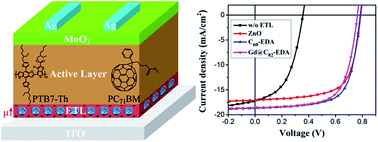
Ethylenediamine functionalized fullerene nanoparticles are prepared via a facile solid-liquid reaction, and they are introduced as efficient independent electron transport layers for inverted polymer solar cells.
The content of this RSS Feed (c) The Royal Society of Chemistry
23 Dec 06:41
by Severin N. Habisreutinger, Robin J. Nicholas, Henry J. Snaith
The remarkable optoelectronic properties of hybrid halide perovskite absorbers have, in the past years, made the perovskite solar cell one of the most promising emerging photovoltaic technologies. The charge collecting layers are essential parts of this type of solar cell. Carbon nanotubes have emerged as a potential candidate to take on this role. Equipped with a range of highly beneficial properties including excellent charge transport characteristics, chemical inertness, as well as mechanical robustness, carbon nanotubes are able to both efficiently extract photogenerated charges, and improve the resilience and stability of a perovskite solar cell. Here, a concise overview of the current state-of-the-art of perovskite solar cells, in which carbon nanotubes are incorporated as a charge conduction layer, is provided.

Carbon nanotubes are increasingly growing into their role as successful charge-collection layers in perovskite solar cells. Their unique mechanical and chemical resilience combined with excellent charge transport characteristics sets them apart from conventional charge collection materials. Recent efforts that exploit these properties are described and the way forward is discussed.
23 Dec 06:41
by Qifan Xue, Yang Bai, Meiyue Liu, Ruoxi Xia, Zhicheng Hu, Ziming Chen, Xiao-Fang Jiang, Fei Huang, Shihe Yang, Yutaka Matsuo, Hin-Lap Yip, Yong Cao
In this work, both anode and cathode interfaces of p-i-n CH3NH3PbI3 perovskite solar cells (PVSCs) are simultaneously modified to achieve large open-circuit voltage (Voc) and fill factor (FF) for high performance semitransparent PVSCs (ST-PVSCs). At the anode, modified NiO serves as an efficient hole transport layer with appropriate surface property to promote the formation of smooth perovskite film with high coverage. At the cathode, a fullerene bisadduct, C60(CH2)(Ind), with a shallow lowest unoccupied molecular orbital level, is introduced to replace the commonly used phenyl-C61-butyric acid methyl ester (PCBM) as an alternative electron transport layer in PVSCs for better energy level matching with the conduction band of the perovskite layer. Therefore, the Voc, FF and power conversion efficiency (PCE) of the PVSCs increase from 1.05 V, 0.74 and 16.2% to 1.13 V, 0.80 and 18.1% when the PCBM is replaced by C60(CH2)(Ind). With the advantages of high Voc and FF, ST-PVSCs are also fabricated using an ultrathin transparent Ag as cathode, showing an encouraging PCEs of 12.6% with corresponding average visible transmittance (AVT) over 20%. These are the highest PCEs reported for ST-PVSCs with similar AVTs paving the way for using ST-PVSCs as power generating windows.

The anode and cathode interfaces of CH3NH3PbI3 perovskite solar cells are optimized simultaneously. The shallow lowest unoccupied molecular level of C60(CH2)(Ind) provides better energy level alignment and surface passivation. High performance opaque cell with a power conversion efficiency (PCE) of 18.1% (Voc: 1.13 V, FF: 0.8) and semitransparent cell with a PCE of 12.6% (AVT>20%) are achieved.
22 Dec 11:25
by Xu-Hui Zhang, Jia-Jiu Ye, Liang-Zheng Zhu, Hai-Ying Zheng, Xue-Peng Liu, Xu Pan and Song-Yuan Dai

ACS Applied Materials & Interfaces
DOI: 10.1021/acsami.6b11860

22 Dec 11:23
J. Mater. Chem. A, 2017, 5,1242-1247
DOI: 10.1039/C6TA09723E, Paper
Zhongjin Shen, Bo Xu, Peng Liu, Yue Hu, Ying Yu, Haoran Ding, Lars Kloo, Jianli Hua, Licheng Sun, He Tian
The development of novel photosensitizers with very high molar extinction coefficients and broad absorption spectra to enhance the light harvesting efficiency providing high PCEs in solid state dye sensitized solar cells (sDSCs) is a main target for improvement.
The content of this RSS Feed (c) The Royal Society of Chemistry
22 Dec 11:22
by Bryon W. Larson, Obadiah G. Reid, David C. Coffey, Stanislav M. Avdoshenko, Alexey A. Popov, Olga V. Boltalina, Steven H. Strauss, Nikos Kopidakis, Garry Rumbles

The generation efficiency of long-lived photoinduced charges in polymer:fullerene bulk heterojunctions increases dramatically as the strength of intermolecular electronic coupling in the fullerene phase improves. Ultrafast geminate recombination is suppressed when electron delocalization within fullerene clusters is strong, while the opposite is observed when delocalization within the cluster is poor. In article number 1601427, Garry Rumbles and co-workers show that the molecular design of the fullerene not only determines inter-fullerene electronic coupling, but also influences the decay dynamics of free holes in the donor phase even when the polymer microstructure remains unchanged.
22 Dec 01:16
Energy Environ. Sci., 2016, Accepted Manuscript
DOI: 10.1039/C6EE03501A, Communication
Dong-Gyu Lee, Su Hwan Kim, Se Hun Joo, Ho-Il Ji, Hadi Tavassol, Yuju Jeon, Sihyuk Choi, Myeong-Hee Lee, Chanseok Kim, Sang Kyu Kwak, Guntae Kim, Hyun-Kon Song
Nitrogen-containing electrocatalysts such as metal-nitrogen-carbon (M-N-C) composites and nitrogen-doped carbons are known to exhibit high activities for oxygen reduction reaction (ORR). Even if the mechanism by which nitrogen improve the...
The content of this RSS Feed (c) The Royal Society of Chemistry

22 Dec 01:14
J. Mater. Chem. A, 2016, Accepted Manuscript
DOI: 10.1039/C6TA10678A, Paper
Yaping Wang, Honglu Zhu, Zhenzhen Shi, Fuzhi Wang, Bing Zhang, Songyuan Dai, Zhan'ao Tan
For bulk-heterojunction polymer solar cells (PSCs), appropriate concentration distribution and phase separation of the donor and acceptor molecules within the polymer:fullerene blends are crucial for effective exciton dissociation and charge...
The content of this RSS Feed (c) The Royal Society of Chemistry
22 Dec 01:13
by Arman Mahboubi Soufiani, Ziv Hameiri, Steffen Meyer, Sean Lim, Murad Jehangir Yusuf Tayebjee, Jae Sung Yun, Anita Ho-Baillie, Gavin J. Conibeer, Leone Spiccia, Martin A. Green
The influence of illumination on the long-term performance of planar structured perovskite solar cells (PSCs) is investigated using fast and spatially resolved luminescence imaging. The authors analyze the effect of illuminated current density–voltage (J–V) and light-soaking measurements on pristine PSCs by providing visual evidence for the spatial inhomogeneous evolution of device performance. Regions that are exposed to light initially produce stronger electroluminescence signals than surrounding unilluminated regions, mainly due to a lower contact resistance and, possibly, higher charge collection efficiency. Over a period of several days, however, these initially illuminated regions appear to degrade more quickly despite the device being stored in a dark, moisture- and oxygen-free environment. Using transmission electron microscopy, this accelerated degradation is attributed to delamination between the perovskite and the titanium dioxide (TiO2) layer. An ion migration mechanism is proposed for this delamination process, which is in accordance with previous current–voltage hysteresis observations. These results provide evidence for the intrinsic instability of CH3NH3PbI3-based devices under illumination and have major implications for the design of PSCs from the standpoint of long-term performance and stability.

Temporal behavior of a selectively illuminated region in perovskite solar cells is tracked using photoluminescence (PL) and electroluminescence (EL) imaging. Although initially the EL (PL) intensity shows noticeable enhancement (reduction) in the illuminated region, it deteriorates (improves) over time relative to the non-illuminated surroundings. Combined with cross-sectional transmission electron microscopy, bias-induced perovskite/TiO2 interfacial electrical and/or physical decoupling is demonstrated.
21 Dec 06:24
by Saqib Rafique, Shahino Mah Abdullah, Haya Alhummiany, M. Sh. Abdel-wahab, Javed Iqbal and Khaulah Sulaiman

The Journal of Physical Chemistry C
DOI: 10.1021/acs.jpcc.6b10545

21 Dec 01:06
by Hsueh-Chung Liao, Peijun Guo, Che-Pu Hsu, Ma Lin, Binghao Wang, Li Zeng, Wei Huang, Chan Myae Myae Soe, Wei-Fang Su, Michael J. Bedzyk, Michael R. Wasielewski, Antonio Facchetti, Robert P. H. Chang, Mercouri G. Kanatzidis, Tobin J. Marks
Organic–inorganic perovskite photovoltaics are an emerging solar technology. Developing materials and processing techniques that can be implemented in large-scale manufacturing is extremely important for realizing the potential of commercialization. Here we report a hot-casting process with controlled Cl− incorporation which enables high stability and high power-conversion-efficiencies (PCEs) of 18.2% for small area (0.09 cm2) and 15.4% for large-area (≈1 cm2) single solar cells. The enhanced performance versus tri-iodide perovskites can be ascribed to longer carrier diffusion lengths, improved uniformity of the perovskite film morphology, favorable perovskite crystallite orientation, a halide concentration gradient in the perovskite film, and reduced recombination by introducing Cl−. Additionally, Cl− improves the device stability by passivating the reaction between I− and the silver electrode. High-quality thin films deployed over a large-area 5 cm × 5 cm eight-cell module have been fabricated and exhibit an active-area PCE of 12.0%. The feasibility of material and processing strategies in industrial large-scale coating techniques is then shown by demonstrating a “dip-coating” process which shows promise for large throughput production of perovskite solar modules.

A hot-casting perovskite processing technique with controlled Cl− incorporation affords a high power conversion efficiency of 18.2% for small-area (0.09 cm2), 15.4% for large-area (≈1 cm2) single solar cells, and 12.0% for large-area 5 cm × 5 cm eight-cell modules and compatibility with large throughput production techniques.
21 Dec 01:05
by Baobing Fan, Wenkai Zhong, Xiao-Fang Jiang, Qingwu Yin, Lei Ying, Fei Huang, Yong Cao
Efficient ternary polymer solar cells are constructed by incorporating an electron-deficient chromophore (5Z,5′Z)-5,5′-((7,7′-(4,4,9,9-tetrakis(4-hexylphenyl)-4,9-dihydro-s-indaceno[1,2-b:5,6-b′]dithiophene-2,7-diyl)bis(6-fluorobenzo[c][1,2,5]thiadiazole-7,4-diyl))bis(methanylylidene))bis(3-ethyl-2-thioxothiazolidin-4-one) (IFBR) as an additional component into the bulk-heterojunction film that consists of a wide-bandgap conjugated benzodithiophene-alt-difluorobenzo[1,2,3]triazole based copolymer and a fullerene acceptor. With respect to the binary blend films, the incorporation of a certain amount of IFBR leads to simultaneously enhanced absorption coefficient, obviously extended absorption band, and improved open-circuit voltage. Of particular interest is that devices based on ternary blend film exhibit much higher short-circuit current densities than the binary counterparts, which can be attributed to the extended absorption profiles, enhanced absorption coefficient, favorable film morphology, as well as formation of cascade energy level alignment that is favorable for charge transfer. Further investigation indicates that the ternary blend device exhibits much shorter charge carrier extraction time, obviously reduced trap density and suppressed trap-assisted recombination, which is favorable for achieving high short-circuit current. The combination of these beneficial aspects leads to a significantly improved power conversion efficiency of 8.11% for the ternary device, which is much higher than those obtained from the binary counterparts. These findings demonstrate that IFBR can be a promising electron-accepting material for the construction of ternary blend films toward high-performance polymer solar cells.

A nonfullerene acceptor (5Z,5′Z)-5,5′-((7,7′-(4,4,9,9-tetrakis(4-hexylphenyl)-4,9-dihydro-s-indaceno[1,2-b:5,6-b′]dithiophene-2,7-diyl)bis(6-fluorobenzo[c]-[1,2,5]thiadiazole-7,4-diyl))bis(methanylylidene))bis(3-ethyl-2-thioxothiazolidin-4-one) is introduced as an electron-cascade acceptor material in blends of a wide-bandgap donor poly(benzodithiophene-alt-difluorobenzo[1,2,3]triazole) and a fullerene acceptor [6,6]-phenyl-C61-butyric acid methyl ester to fabricate ternary blend polymer solar cells (PSCs). The ternary device exhibits a power conversion efficiency of 8.11%, which is much higher than those obtained from the binary PSCs.
20 Dec 11:51
J. Mater. Chem. A, 2016, Accepted Manuscript
DOI: 10.1039/C6TA09836C, Paper
Yu Kyung Eom, Sung Ho Kang, in taek choi, YOUNGJUN YOO, Jeongho Kim, Hwan Kyu Kim
The molecular design of organic sensitizers is one of the fundamental factors for high-efficiency dye-sensitized solar cells (DSSCs). In this study, we first utilize the alkylated thieno[3,2-b]indole (TI) moiety as...
The content of this RSS Feed (c) The Royal Society of Chemistry
20 Dec 11:50
J. Mater. Chem. A, 2016, Accepted Manuscript
DOI: 10.1039/C6TA09582H, Paper
Jin-Feng Liao, Hua-Shang Rao, Bai-Xue Chen, Dai-Bin Kuang, Cheng-Yong Su
Cesium lead iodide perovskite (CsPbI3) has been proposed as an efficient alternative to modify the instability of methylammonium lead iodide (MAPbI3) under thermal and humidity stress. However, three dimension (3D)...
The content of this RSS Feed (c) The Royal Society of Chemistry
20 Dec 11:50
J. Mater. Chem. A, 2017, 5,1103-1111
DOI: 10.1039/C6TA09687E, Paper
Teng Zhang, Xiangyue Meng, Yang Bai, Shuang Xiao, Chen Hu, Yinglong Yang, Haining Chen, Shihe Yang
Operational stability is one of the main obstacles that may hold back the commercialization of perovskite solar cells (PVSCs).
The content of this RSS Feed (c) The Royal Society of Chemistry
20 Dec 11:46
J. Mater. Chem. A, 2016, Accepted Manuscript
DOI: 10.1039/C6TA09314K, Communication
Pei-Yang Su , Li-Bo Huang, Junmin Liu, Yi-Fan Chen, Li-Min Xiao, Dai-Bin Kuang, Marcel Mayor, Cheng-Yong Su
The hydrophobic and conductive polymer poly-N-vinylcarbazole (PVK) has been successfully utilized as a multifunctional interlayer between perovskite and hole transporting material (HTM) for high stable and efficient perovskite solar cells...
The content of this RSS Feed (c) The Royal Society of Chemistry
20 Dec 11:45
by Liang Ma, Jun Dai, Xiao Cheng Zeng

The electronic properties of single-layer hybrid perovskite BA2MI4 (M = Ge, Sn, and Pb) are theoretically investigated. The single-layer perovskites not only show tunable bandgaps, ranging from ≈1.5 to ≈2.0 eV, but also exhibit strong exciton effect. The desired properties of these atomically thin perovskites will motivate future experimental studies of 2D perovskites for improved functionality.
20 Dec 11:45
by Francesco Lamberti, Lucio Litti, Michele De Bastiani, Roberto Sorrentino, Marina Gandini, Moreno Meneghetti, Annamaria Petrozza

The use of laser-ablation-assisted solution synthesis of ligand-free perovskite semiconductor inks is demonstrated. The thin films exhibit no hysteresis under polarization and monotonic tunability of the semiconductor band/gap.
20 Dec 11:44
by Kyung Teak Cho, Olga Trukhina, Cristina Roldán-Carmona, Mine Ince, Paul Gratia, Giulia Grancini, Peng Gao, Tomasz Marszalek, Wojciech Pisula, Paidi Y. Reddy, Tomás Torres, Mohammad Khaja Nazeeruddin
Easily accessible tetra-5-hexylthiophene-, tetra-5-hexyl-2,2′-bisthiophene-substituted zinc phthalocyanines (ZnPcs) and tetra-tert-butyl ZnPc are employed as hole-transporting materials in mixed-ion perovskite [HC(NH2)2]0.85(CH3NH3)0.15Pb(I0.85Br0.15)3 solar cells, reaching the highest power conversion efficiency (PCE) so far for phthalocyanines. Results confirm that the photovoltaic performance is strongly influenced by both, the individual optoelectronic properties of ZnPcs and the aggregation of these tetrapyrrolic semiconductors in the solid thin film. The optimized devices exhibit PCE of 15.5% when using tetra-5-hexyl-2,2′-bisthiophene substituted ZnPcs, 13.3% for tetra-tert-butyl ZnPc, and a record 17.5% for tetra-5-hexylthiophene-based analogue under standard global 100 mW cm−2 AM 1.5G illumination. These results boost up the potential of solution-processed ZnPc derivatives as stable and economic hole-transport materials for large-scale applications, opening new frontiers toward a realistic, efficient, and inexpensive energy production.

Easily accessible tetra-5-hexylthiophene-, tetra-5-hexyl-2,2′-bisthiophene-, and tetra-tert-butyl-substituted zinc phthalocyanines (ZnPcs) are employed as hole-transporting materials in mixed-ion perovskite [HC(NH2)2]0.85(CH3NH3)0.15Pb(I0.85Br0.15)3 solar cells, reaching record power conversion efficiency of 17.5% under standard global AM 1.5G irradiation. The data highlight the potential large-scale applications of solution-processed ZnPc derivatives as stable and economic hole-transport materials for perovskite solar cells.
20 Dec 11:41
Nanoscale, 2016, Accepted Manuscript
DOI: 10.1039/C6NR07689K, Paper
Xuhui Zhang, Jiajiu Ye, Liangzheng Zhu, Haiying Zheng, Guozhen Liu, Xuepeng Liu, Bin Duan, Xu Pan, Songyuan Dai
Two-step deposition has been widely used in the perovskite layers preparation for perovskite solar cells due to its attractive morphology controllability. However, the limited diffusivity of the CH3NH3I (MAI) might...
The content of this RSS Feed (c) The Royal Society of Chemistry

19 Dec 09:11
by Aabhash Shrestha, Munkhbayar Batmunkh, Cameron J. Shearer, Yanting Yin, Gunther G. Andersson, Joseph G. Shapter, Shizhang Qiao, Sheng Dai
The use of polydopamine as a nitrogen containing precursor to generate catalytically active nitrogen-doped carbon (CNx) materials on carbon nanotubes (CNTs) is reported. These N-doped CNx/CNT materials display excellent electrocatalytic activity toward the reduction of triiodide electrolyte in dye-sensitized solar cells (DSSCs). Further, the influence of various synthesis parameters on the catalytic performance of CNx/CNTs is investigated in detail. The best performing device fabricated with the CNx/CNTs material delivers power conversion efficiency of 7.3%, which is comparable or slightly higher than that of Pt (7.1%) counter electrode-based DSSC. These CNx/CNTs materials show great potential to address the issues associated with the Pt electrocatalyst including the high cost and scarcity.

The use of polydopamine as a nitrogen containing precursor to generate catalytically active nitrogen-doped carbon materials on carbon nanotubes is reported, which display excellent electrocatalytic activity toward the reduction of triiodide electrolyte in dye-sensitized solar cells and delivers a power conversion efficiency of 7.3%, which is comparable or slightly higher than that of using platinum (7.1%) as electrocatalyst.
19 Dec 09:08
by Tim Vangerven, Pieter Verstappen, Nilesh Patil, Jan D’Haen, Ilaria Cardinaletti, Johannes Benduhn, Niko Van den Brande, Maxime Defour, Vincent Lemaur, David Beljonne, Roberto Lazzaroni, Benoit Champagne, Koen Vandewal, Jens W. Andreasen, Peter Adriaensens, Dag W. Breiby, Bruno Van Mele, Dirk Vanderzande, Wouter Maes and Jean Manca

Chemistry of Materials
DOI: 10.1021/acs.chemmater.6b04143

17 Dec 00:54
Energy Environ. Sci., 2016, Accepted Manuscript
DOI: 10.1039/C6EE02941H, Communication
Qi Wang, Bo Chen, Ye Liu, Yehao Deng, Yang Bai, Qingfeng Dong, Jinsong Huang
The stability of perovskite solar cells has shown huge variation with respect to film process and film morphology, while the underlining mechanism for the morphology dependent degradation of perovskite film...
The content of this RSS Feed (c) The Royal Society of Chemistry

17 Dec 00:53
J. Mater. Chem. A, 2016, Accepted Manuscript
DOI: 10.1039/C6TA09493G, Paper
Kiryung Eom, Uisik Kwon, shankara Sharanappa Kalanur, Hui Joon Park, Hyungtak Seo
The band alignment in heterojunction solar cells, including perovskite solar cells (PSCs), is critically related to power conversion efficiency (PCE) improvement as it has a significant effect on the control...
The content of this RSS Feed (c) The Royal Society of Chemistry
17 Dec 00:53
J. Mater. Chem. A, 2016, Accepted Manuscript
DOI: 10.1039/C6TA08950J, Paper
Natalie Stingelin, Paul Westacott, Neil D. Treat, Jaime Martin, James Bannock, John C de Mello, Michael Chabinyc, Alexander Bernardus Sieval, Jasper Michels
Organic solar cell blends comprised of an electron donating polymer and electron accepting fullerene typically form upon solution casting a thin-film structure made up of a complex mixture of phases....
The content of this RSS Feed (c) The Royal Society of Chemistry
17 Dec 00:47
by Hua Zhang, Huan Wang, Wei Chen, Alex K.-Y. Jen

The p-type inorganic semiconductor CuGaO2 as a hole-transporting layer (HTL) in perovskite solar cells (PSCs) provides higher carrier mobility, better-energy level matching, and superior stability, as well as low-temperature processing technique. Compared to organic HTL, a very competitive PCE of 18.51% with long-term stability is achieved. This indicates that CuGaO2 is a promising HTL for efficient and stable PSCs.
Bin, ZZQ and 6 others like this
17 Dec 00:46
by Domenico Alberga, Ilaria Ciofini, Giuseppe Felice Mangiatordi, Alfonso Pedone, Gianluca Lattanzi, Jean Roncali and Carlo Adamo

Chemistry of Materials
DOI: 10.1021/acs.chemmater.6b04277

16 Dec 06:51
by Gyu Min Kim and Tetsu Tatsuma

The Journal of Physical Chemistry C
DOI: 10.1021/acs.jpcc.6b09671

16 Dec 01:19
by Haiming Zhang, Lifeng Chi

Gold–organic hybrids with various Au–aryl contacts are reviewed by L. Chi and H. Zhang on page 10492. Such hybrids can be prepared via on-surface reactions by using multi-halogenated precursors on gold substrates. STM/STS investigations allow a better understanding of the properties of the hybrids, which may offer a foundation for advanced synthesis of carbon-based functional materials and their practical applications in molecular electronics.