Shared posts

12 Jan 01:05

General design of self-doped small molecules as efficient hole extraction materials for polymer solar cells

J. Mater. Chem. A, 2017, 5,3780-3785
DOI: 10.1039/C6TA09925D, Communication
Yuyuan Xue, Peipei Guo, Hin-Lap Yip, Yuan Li, Yong Cao
The design of self-doped materials as efficient hole extraction materials for polymer solar cells is reported for the first time.
The content of this RSS Feed (c) The Royal Society of Chemistry
12 Jan 01:04

Performance enhancement of perovskite solar cells using a La-doped BaSnO3 electron transport layer

J. Mater. Chem. A, 2017, 5,3675-3682
DOI: 10.1039/C6TA09689A, Paper
Liangzheng Zhu, Jiajiu Ye, Xuhui Zhang, Haiying Zheng, Guozhen Liu, Xu Pan, Songyuan Dai
The promising candidate La-BaSnO3 provides a novel perspective on the application and investigation of doped materials in PSCs.
The content of this RSS Feed (c) The Royal Society of Chemistry
12 Jan 00:55

Complete ultrafast charge carrier dynamics in photo-excited all-inorganic perovskite nanocrystals (CsPbX3)

Nanoscale, 2017, 9,1878-1885
DOI: 10.1039/C6NR09422H, Paper
Navendu Mondal, Anunay Samanta
The spectral and temporal characterization of the ultrafast transients of CsPbX3 nanocrystals and the effect of halide substitution on the dynamics of carrier cooling and trapping are studied through femtosecond pump-probe and fluorescence up-conversion techniques.
The content of this RSS Feed (c) The Royal Society of Chemistry
11 Jan 06:40

Global Analysis of Perovskite Photophysics Reveals Importance of Geminate Pathways

by Lydia H. Manger, Matthew B. Rowley, Yongping Fu, Alexander K. Foote, Morgan T. Rea, Sharla L. Wood, Song Jin, John C. Wright and Randall H. Goldsmith

TOC Graphic

The Journal of Physical Chemistry C
DOI: 10.1021/acs.jpcc.6b11547
11 Jan 06:37

Highly Efficient and Stable Perovskite Solar Cells by Interfacial Engineering Using Solution-Processed Polymer Layer

by Feijiu Wang, Ai Shimazaki, Fengjiu Yang, Kaito Kanahashi, Keiichiro Matsuki, Yuhei Miyauchi, Taishi Takenobu, Atsushi Wakamiya, Yasujiro Murata and Kazunari Matsuda

TOC Graphic

The Journal of Physical Chemistry C
DOI: 10.1021/acs.jpcc.6b12137
11 Jan 06:36

Hematite electron-transporting layers for environmentally stable planar perovskite solar cells with enhanced energy conversion and lower hysteresis

J. Mater. Chem. A, 2017, 5,1434-1441
DOI: 10.1039/C6TA09174A, Communication
Wei Hu, Tao Liu, Xuewen Yin, Hu Liu, Xingyue Zhao, Songping Luo, Ying Guo, Zhibo Yao, Jinshu Wang, Ning Wang, Hong Lin, Zhanhu Guo
Hematite electron transporting layer based planar perovskite cells were developed with reduced hysteresis and good stability in ambient air.
The content of this RSS Feed (c) The Royal Society of Chemistry
11 Jan 06:32

Nematic liquid crystal materials as a morphology regulator for ternary small molecule solar cells with power conversion efficiency exceeding 10%

J. Mater. Chem. A, 2017, 5,3589-3598
DOI: 10.1039/C7TA00211D, Paper
Miao Zhang, Fujun Zhang, Qiaoshi An, Qianqian Sun, Wenbin Wang, Xiaoling Ma, Jian Zhang, Weihua Tang
Highly efficient ternary SMSCs with a PCE of 10.05% are reported by employing the nematic liquid crystal small molecule BTR as the second donor and morphology regulator.
The content of this RSS Feed (c) The Royal Society of Chemistry
11 Jan 06:32

Improved mechanical adhesion and electronic stability of organic solar cells with thermal ageing: the role of diffusion at the hole extraction interface

J. Mater. Chem. A, 2017, 5,2911-2919
DOI: 10.1039/C6TA09665D, Paper
W. Greenbank, N. Rolston, E. Destouesse, G. Wantz, L. Hirsch, R. Dauskardt, S. Chambon
Organic photovoltaic solar cells are a promising option for cheap, renewable energy, but must improve in their stability.
The content of this RSS Feed (c) The Royal Society of Chemistry
11 Jan 06:29

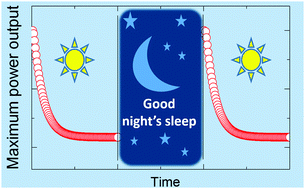
Migration of cations induces reversible performance losses over day/night cycling in perovskite solar cells

Energy Environ. Sci., 2017, 10,604-613
DOI: 10.1039/C6EE03352K, Paper
Konrad Domanski, Bart Roose, Taisuke Matsui, Michael Saliba, Silver-Hamill Turren-Cruz, Juan-Pablo Correa-Baena, Cristina Roldan Carmona, Giles Richardson, Jamie M. Foster, Filippo De Angelis, James M. Ball, Annamaria Petrozza, Nicolas Mine, Mohammad K. Nazeeruddin, Wolfgang Tress, Michael Gratzel, Ullrich Steiner, Anders Hagfeldt, Antonio Abate
Perovskite cells benefit from a good night's sleep.
The content of this RSS Feed (c) The Royal Society of Chemistry
11 Jan 06:27

Cooperative Effect of GO and Glucose on PEDOT:PSS for High VOC and Hysteresis-Free Solution-Processed Perovskite Solar Cells

by A. Giuri, S. Masi, S. Colella, A. Kovtun, S. Dell-Elce, E. Treossi, A. Liscio, C. Esposito Corcione, A. Rizzo, A. Listorti
11 Jan 06:27

Flexible Electronics: Nanoparticle Assisted Mechanical Delamination for Freestanding High Performance Organic Devices (Adv. Funct. Mater. 2/2017)

by Silvia Colodrero, Pablo Romero-Gomez, Paola Mantilla-Perez, Jordi Martorell
Thumbnail image of graphical abstract

On page 1602969, S. Coloredo, J. Martorell, and co-workers describe a new methodology to attain high performance free-standing organic photovoltaic cells. As depicted in the cover image, a sacrificial nanoparticle layer incorporated in between the substrate and the rest of the cell architecture is used to grow high efficiency cells detachable from the rigid glass substrate.

10 Jan 00:46

Ultrafast carrier dynamics in bimetallic nanostructure-enhanced methylammonium lead bromide perovskites

Nanoscale, 2017, 9,1475-1483
DOI: 10.1039/C6NR08347A, Paper
Holly F. Zarick, Abdelaziz Boulesbaa, Alexander A. Puretzky, Eric M. Talbert, Zachary R. DeBra, Naiya Soetan, David B. Geohegan, Rizia Bardhan
We investigate the interaction of bimetallic plasmonic nanostructures with methylammonium tribromide perovskites and probe the effects on charge separation and injection with transient absorption spectroscopy and time-resolved photoluminescence.
The content of this RSS Feed (c) The Royal Society of Chemistry
10 Jan 00:44

Bandgap tunable Csx(CH3NH3)1-xPbI3 perovskite nanowires by aqueous solution synthesis for optoelectronic devices

Nanoscale, 2017, 9,1567-1574
DOI: 10.1039/C6NR06636D, Paper
Dongdong Dong, Hui Deng, Chao Hu, Huaibing Song, Keke Qiao, Xiaokun Yang, Jian Zhang, Fensha Cai, Jiang Tang, Haisheng Song
Water as a 'green' solvent instead of organic one such as N,N-dimethylformamide (DMF) or dimethyl sulfoxide (DMSO) was utilized to develop an efficient synthetic route to grow various kinds of lead halide perovskite nanowires (NWs) for optoelectronic devices.
The content of this RSS Feed (c) The Royal Society of Chemistry
10 Jan 00:44

Highly efficient perovskite solar cells with crosslinked PCBM interlayers

J. Mater. Chem. A, 2017, 5,2466-2472
DOI: 10.1039/C6TA08799J, Communication
W. Qiu, J. P. Bastos, S. Dasgupta, T. Merckx, I. Cardinaletti, M. V. C. Jenart, C. B. Nielsen, R. Gehlhaar, J. Poortmans, P. Heremans, I. McCulloch, D. Cheyns
PCBM crosslinked with 1,6-diazidohexane (DAZH) was introduced to solve the solvent incompatibility of depositing a solution processed perovskite layer onto it.
The content of this RSS Feed (c) The Royal Society of Chemistry
10 Jan 00:43

A review on triphenylamine (TPA) based organic hole transport materials (HTMs) for dye sensitized solar cells (DSSCs) and perovskite solar cells (PSCs): evolution and molecular engineering

J. Mater. Chem. A, 2017, 5,1348-1373
DOI: 10.1039/C6TA08449D, Review Article
Pooja Agarwala, Dinesh Kabra
Development of triphenylamine (TPA) based hole-transporting-materials (HTMs) leading to high Tg, higher morphological stability and longevity of dye-sensitized and perovskite solar cells.
The content of this RSS Feed (c) The Royal Society of Chemistry
10 Jan 00:41

Scaling behavior of moisture-induced grain degradation in polycrystalline hybrid perovskite thin films

Energy Environ. Sci., 2017, 10,516-522
DOI: 10.1039/C6EE02941H, Communication
Qi Wang, Bo Chen, Ye Liu, Yehao Deng, Yang Bai, Qingfeng Dong, Jinsong Huang
The degradation rate of CH3NH3PbI3 perovskite films, made by a known deposition method, is found to be roughly proportional to the grain size.
The content of this RSS Feed (c) The Royal Society of Chemistry
10 Jan 00:41

Polypyrrole-assisted oxygen electrocatalysis on perovskite oxides

Energy Environ. Sci., 2017, 10,523-527
DOI: 10.1039/C6EE03501A, Communication
Dong-Gyu Lee, Su Hwan Kim, Se Hun Joo, Ho-Il Ji, Hadi Tavassol, Yuju Jeon, Sihyuk Choi, Myeong-Hee Lee, Chanseok Kim, Sang Kyu Kwak, Guntae Kim, Hyun-Kon Song
The overpotentials of the oxygen reduction on perovskite oxide catalysts were significantly reduced simply by mixing the catalyst particles with polypyrrole/carbon composites (pPy/C).
The content of this RSS Feed (c) The Royal Society of Chemistry
10 Jan 00:40

Small is Powerful: Recent Progress in Solution-Processed Small Molecule Solar Cells

by Samuel D. Collins, Niva A. Ran, Michael C. Heiber, Thuc-Quyen Nguyen

Over the last 5 years, research on the synthesis, device engineering, and device physics of solution-processed small molecule solar cells (SMSCs) has rapidly expanded. Improvements in molecular design and emergent device processing techniques have helped solution-processed SMSCs overcome earlier difficulties in controlling active layer morphology, such that many systems are now at—or approaching—10% power conversion efficiency. In this review, details of the highest performing blend systems are presented in order to identify key trends and provide perspective on current progress in the field. Among the best systems, a planarized molecular structure is prevalent, which can be achieved using large fused-ring moieties, intermolecular non-bonding interactions, and side chain engineering. To obtain efficient devices, the highest performing systems have been optimized through the careful combination of thermal and solvent annealing procedures. Even without additional processing, some systems have been able to obtain interconnected morphologies and efficient charge generation and charge transport. Ultimately, the design of more efficient materials also requires additional understanding of the device physics and loss mechanisms. After highlighting what is known to date on processes limiting device efficiency, an outlook on the most important challenges remaining to the field is provided.

Thumbnail image of graphical abstract

Bulk heterojunction photovoltaics based on small molecule donors have greatly improved their performance thanks to a growing multidisciplinary effort. This review presents recent advances in molecular design, control and characterization of bulk heterojunction film morphology, and understandings of charge generation and recombination in these devices. The review is concluded with a discussion of questions that need further research to push small molecule photovoltaics higher.

10 Jan 00:39

Perovskite Photovoltaics: Hybrid Perovskite Thin-Film Photovoltaics: In Situ Diagnostics and Importance of the Precursor Solvate Phases (Adv. Mater. 2/2017)

by Rahim Munir, Arif D. Sheikh, Maged Abdelsamie, Hanlin Hu, Liyang Yu, Kui Zhao, Taesoo Kim, Omar El Tall, Ruipeng Li, Detlef-M. Smilgies, Aram Amassian
Thumbnail image of graphical abstract

The solidification of hybrid perovskite (MAPbX3, X = I, Br, Cl) inks is studied in situ by A. Amassian and co-workers in article 1604113, revealing a remarkably complex process mediated by strong solvent-solute interactions, the outcome of which is halide-dependent. The ink is shown to solidify within 15–20s of spinning, forming a highly solvated (60–70 vol%) precursor phase. Crystalline order of the precursor, or lack thereof, strongly impacts the morphological outcome of thermal conversion and the reproducibility of solar cells.

10 Jan 00:38

Scroll-like Alloyed CdSxSe1–x Nanoplatelets: Facile Synthesis and Detailed Analysis of Tunable Optical Properties

by Natalia N. Schlenskaya, Yuanzhao Yao, Takaaki Mano, Takashi Kuroda, Alexey V. Garshev, Vadim F. Kozlovskii, Alexander M. Gaskov, Roman B. Vasiliev and Kazuaki Sakoda

TOC Graphic

Chemistry of Materials
DOI: 10.1021/acs.chemmater.6b03876
09 Jan 03:38

Hexagonal mesoporous silica islands to enhance photovoltaic performance of planar junction perovskite solar cells

J. Mater. Chem. A, 2017, 5,1415-1420
DOI: 10.1039/C6TA09709J, Communication
Yi Zhang, Zhaofei Zhang, Wei Yan, Bao Zhang, Yaqing Feng, Abdullah M. Asiri, Mohammad Khaja Nazeeruddin, Peng Gao
Wormhole-like hexagonal mesoporous silica (HMS) can modify the perovskite morphology and increase the light path length in a planar junction perovskite solar cell to improve the average PCE to 17.6% over 30 devices.
The content of this RSS Feed (c) The Royal Society of Chemistry
09 Jan 03:38

A TiO2 embedded structure for perovskite solar cells with anomalous grain growth and effective electron extraction

J. Mater. Chem. A, 2017, 5,1406-1414
DOI: 10.1039/C6TA10418E, Communication
Dong Wei, Jun Ji, Dandan Song, Meicheng Li, Peng Cui, Yaoyao Li, Joseph Michel Mbengue, Wenjia Zhou, Zhijun Ning, Nam-Gyu Park
The embedded structure of perovskite solar cells (PSCs) is a novel structure, which possesses excellent photovoltaic performance and better long-term stability than the mesoporous or planar structure.
The content of this RSS Feed (c) The Royal Society of Chemistry
09 Jan 03:37

Long lifetime stable and efficient semitransparent organic solar cells using a ZnMgO-modified cathode combined with a thin MoO3/Ag anode

J. Mater. Chem. A, 2017, 5,3888-3899
DOI: 10.1039/C6TA10981K, Paper
Zhigang Yin, Jiajun Wei, Shan-Ci Chen, Dongdong Cai, Yunlong Ma, Meng Wang, Qingdong Zheng
Long-term stable and efficient semitransparent organic solar cells with good color perception are demonstrated by combining a transparent ZnMgO-modified cathode with thin MoO3/Ag anodes.
The content of this RSS Feed (c) The Royal Society of Chemistry
07 Jan 00:46

Non-planar perylenediimide acceptors with different geometrical linker units for efficient non-fullerene organic solar cells

J. Mater. Chem. A, 2017, 5,1713-1723
DOI: 10.1039/C6TA08739F, Paper
Xi Liu, Tao Liu, Chunhui Duan, Junyi Wang, Shuting Pang, Wentao Xiong, Yanming Sun, Fei Huang, Yong Cao
Three perylenediimide (PDI) acceptors (P2O2, P2N2 and P4N4) functionalizing the bay positions of PDI with different geometrical linker units were synthesized and applied in efficient non-fullerene organic solar cells.
The content of this RSS Feed (c) The Royal Society of Chemistry
07 Jan 00:46

Cerium oxide standing out as an electron transport layer for efficient and stable perovskite solar cells processed at low temperature

J. Mater. Chem. A, 2017, 5,1706-1712
DOI: 10.1039/C6TA07541J, Paper
Xin Wang, Lin-Long Deng, Lu-Yao Wang, Si-Min Dai, Zhou Xing, Xin-Xing Zhan, Xu-Zhai Lu, Su-Yuan Xie, Rong-Bin Huang, Lan-Sun Zheng
Low-temperature, solution-processed cerium oxide can serve as a promising electron transport layer to replace commonly used TiO2 in planar perovskite solar cells, with high efficiency and enhanced stability.
The content of this RSS Feed (c) The Royal Society of Chemistry
07 Jan 00:45

Successive surface engineering of TiO2 compact layers via dual modification of fullerene derivatives affording hysteresis-suppressed high-performance perovskite solar cells

J. Mater. Chem. A, 2017, 5,1724-1733
DOI: 10.1039/C6TA07876A, Paper
Weiran Zhou, Jieming Zhen, Qing Liu, Zhimin Fang, Dan Li, Pengcheng Zhou, Tao Chen, Shangfeng Yang
A new successive surface engineering method via a dual modification of TiO2 compact layer by PC61BM and C60-ETA was developed, affording dramatic efficiency enhancement with suppressed-hysteresis current-voltage response.
The content of this RSS Feed (c) The Royal Society of Chemistry
07 Jan 00:44

Photogenerated Carrier Mobility Significantly Exceeds Injected Carrier Mobility in Organic Solar Cells

by Armantas Melianas, Vytenis Pranculis, Yuxin Xia, Nikolaos Felekidis, Olle Inganäs, Vidmantas Gulbinas, Martijn Kemerink

Charge transport in organic photovoltaic (OPV) devices is often characterized by space-charge limited currents (SCLC). However, this technique only probes the transport of charges residing at quasi-equilibrium energies in the disorder-broadened density of states (DOS). In contrast, in an operating OPV device the photogenerated carriers are typically created at higher energies in the DOS, followed by slow thermalization. Here, by ultrafast time-resolved experiments and simulations it is shown that in disordered polymer/fullerene and polymer/polymer OPVs, the mobility of photogenerated carriers significantly exceeds that of injected carriers probed by SCLC. Time-resolved charge transport in a polymer/polymer OPV device is measured with exceptionally high (picosecond) time resolution. The essential physics that SCLC fails to capture is that of photo­generated carrier thermalization, which boosts carrier mobility. It is predicted that only for materials with a sufficiently low energetic disorder, thermalization effects on carrier transport can be neglected. For a typical device thickness of 100 nm, the limiting energetic disorder is σ ≈71 (56) meV for maximum-power point (short-circuit) conditions, depending on the error one is willing to accept. As in typical OPV materials the disorder is usually larger, the results question the validity of the SCLC method to describe operating OPVs.

Thumbnail image of graphical abstract

Detailed comparison of steady-state and ultrafast time-resolved experiments reveals that photogenerated carrier mobility in organic solar cells is significantly higher than that probed by space-charge limited currents (SCLCs). The SCLC method is only valid for materials with a sufficiently low energetic disorder, where photogenerated carrier thermalization can be neglected. The over-simplified use of quasi-equilibrium mobility data in literature requires re-evaluation.

07 Jan 00:43

Two-Step Sequential Deposition of Organometal Halide Perovskite for Photovoltaic Application

by Haining Chen

Organometal halide perovskite materials have become a superstar in the photovoltaic (PV) field because of their advantageous properties, which boost the power conversion efficiency (PCE) of perovskite solar cells (PSCs) from about 3.8% to above 22% in just seven years. Most importantly, such promising achievement is mainly based on its low-cost and solution-processed fabrication technique. One of the most promising and famous approaches to fabricating perovskite is a two-step sequential deposition method because precursor (e.g., PbI2) deposition is controllable, versatile, and flexible. Due to tremendous efforts, great progress has been achieved on the two-step sequential deposition method, which helps to promote the development of PSCs. Herein, the progresses on the two-step sequential deposition method of perovskite layers is reviewed thoroughly. At first, the reaction process and principle is introduced and discussed. Then, the research on the deposition techniques, structures, and compositions of precursors (the first step) is presented. Subsequently, the developments on the conversion techniques, conversion solutions, and growth of large crystals at the second step are introduced. Finally, four important issues on the two-step sequential deposition method will be stated, accompanied with proposed solutions.

Thumbnail image of graphical abstract

The two-step sequential deposition method is one of the most important deposition methods for the organometal halide perovskite layer in photovoltaic application. So far, great progress has been made on this method, which helps to promote the development of PSCs. Herein, its recent achievements are reviewed and the important issues are highlighted while proposing the corresponding solutions.

06 Jan 01:42

Construction of Compact Methylammonium Bismuth Iodide Film Promoting Lead-Free Inverted Planar Heterojunction Organohalide Solar Cells with Open-Circuit Voltage over 0.8 V

by Chenxin Ran, Zhaoxin Wu, Jun Xi, Fang Yuan, Hua Dong, Ting Lei, Xin He and Xun Hou

TOC Graphic

The Journal of Physical Chemistry Letters
DOI: 10.1021/acs.jpclett.6b02578
06 Jan 01:23

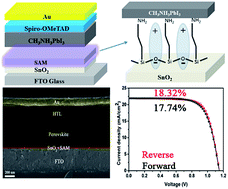
Interface engineering in planar perovskite solar cells: energy level alignment, perovskite morphology control and high performance achievement

J. Mater. Chem. A, 2017, 5,1658-1666
DOI: 10.1039/C6TA08783C, Paper
Guang Yang, Changlei Wang, Hongwei Lei, Xiaolu Zheng, Pingli Qin, Liangbin Xiong, Xingzhong Zhao, Yanfa Yan, Guojia Fang
APTES-SAM as an efficient interfacial layer in planar perovskite solar cells, optimizing the interface and enhancing performance.
The content of this RSS Feed (c) The Royal Society of Chemistry