ZiQi Sun
Shared posts
[Report] Long-range hot-carrier transport in hybrid perovskites visualized by ultrafast microscopy
High-Performance Long-Term-Stable Dopant-Free Perovskite Solar Cells and Additive-Free Organic Solar Cells by Employing Newly Designed Multirole π-Conjugated Polymers
Perovskite solar cells (PSCs) and organic solar cells (OSCs) are promising renewable light-harvesting technologies with high performance, but the utilization of hazardous dopants and high boiling additives is harmful to all forms of life and the environment. Herein, new multirole π-conjugated polymers (P1–P3) are developed via a rational design approach through theoretical hindsight, further successfully subjecting them into dopant-free PSCs as hole-transporting materials and additive-free OSCs as photoactive donors, respectively. Especially, P3-based PSCs and OSCs not only show high power conversion efficiencies of 17.28% and 8.26%, but also display an excellent ambient stability up to 30 d (for PSCs only), owing to their inherent superior optoelectronic properties in their pristine form. Overall, the rational approach promises to support the development of environmentally and economically sustainable PSCs and OSCs.

New multirole π-conjugated polymers are developed via a rational design approach through theoretical hindsight, further successfully subjecting them into dopant-free perovskite solar cells as hole-transporting materials with high power conversion efficiency (PCE) of 17.28%, and additive-free organic solar cells as photoactive donors with high PCE of 8.26%.
FAPb1-xSnxI3 mixed metal halide perovskites with improved light harvesting and stability for efficient planar heterojunction solar cells

DOI: 10.1039/C6TA11181E, Paper
FA-based perovskite devices with reduced Pb contents were prepared.
The content of this RSS Feed (c) The Royal Society of Chemistry
Highly efficient inverted solar cells based on perovskite grown nanostructures mediated by CuSCN

DOI: 10.1039/C7NR01135K, Paper
In this work, three different nanostructured CuSCN are first applied to the inverted PSCs as HTLs, revealing the morphology of the CuSCN layers can dramatically regulate the behavior of perovskite layers, which will further have an influence on device performance.
The content of this RSS Feed (c) The Royal Society of Chemistry
Single-Crystal-like Perovskite for High-Performance Solar Cells Using the Effective Merged Annealing Method

Organic Solar Cells Based on WO2.72 Nanowire Anode Buffer Layer with Enhanced Power Conversion Efficiency and Ambient Stability

Identifying and suppressing interfacial recombination to achieve high open-circuit voltage in perovskite solar cells

DOI: 10.1039/C7EE00421D, Paper
Dopants in the hole transport layer limit the open-circuit voltage of perovskite solar cells.
The content of this RSS Feed (c) The Royal Society of Chemistry
Side-chain engineering for efficient non-fullerene polymer solar cells based on a wide-bandgap polymer donor

DOI: 10.1039/C7TA02075A, Paper
Non-fullerene polymer solar cells based on a wide-bandgap polymer, PSBZ, exhibited a PCE of up to 10.5% with a high Jsc of 19.0 mA cm-2.
The content of this RSS Feed (c) The Royal Society of Chemistry
Solar Cells: Two-Dimensional Single-Layer Organic–Inorganic Hybrid Perovskite Semiconductors (Adv. Energy Mater. 7/2017)

In article number 1601731, Xiao Cheng Zeng and co-workers report a theoretical study on single-layer hybrid perovskites semiconductors. The single-layer hybrid perovskites not only possess desired electronic properties for potential optoelectronic and photovoltaic applications, but also can achieve improved stability and functionalities through effective encapsulation and/or heterogeneously stacking with other two-dimensional materials.
Enhancement of the hole conducting effect of NiO by a N2 blow drying method in printable perovskite solar cells with low-temperature carbon as the counter electrode

DOI: 10.1039/C7NR00372B, Paper
Our study indicates that the capping layer thickness of MAPbI3 is highly affecting the hole collecting effect of NiO in mesoscopic PSCs.
The content of this RSS Feed (c) The Royal Society of Chemistry
Electronic and defect properties of (CH3NH3)2Pb(SCN)2I2 analogues for photovoltaic applications

DOI: 10.1039/C7TA01688C, Paper
In this report, we study a range of 2-D perovskite-like compounds (CH3NH3)2MPs2X2 (M = Sn, Pb; Ps = OCN, SCN, SeCN and X = Cl, Br I), finding suitable band gaps, band alignments and defect behaviour for photovoltaic top cells in tandem devices.
The content of this RSS Feed (c) The Royal Society of Chemistry
The intrinsic properties of FA(1-x)MAxPbI3 perovskite single crystals

DOI: 10.1039/C7TA01441D, Paper
We provided a systematical investigation to correlate the crystal structure, composition, mobility, and ion migration behavior to the ratio of MA+/FA+ in FA(1-x)MAxPbI3 single crystal.
To cite this article before page numbers are assigned, use the DOI form of citation above.
The content of this RSS Feed (c) The Royal Society of Chemistry
Unique Four-Electron Metal-to-Cage Charge Transfer of Th to a C82 Fullerene Cage: Complete Structural Characterization of Th@C3v(8)-C82

Ligand Mediated Transformation of Cesium Lead Bromide Perovskite Nanocrystals to Lead Depleted Cs4PbBr6 Nanocrystals

Direct Evidence of Chlorine-Induced Preferential Crystalline Orientation in Methylammonium Lead Iodide Perovskites Grown on TiO2

XPS Analysis of the Improved Operational Stability of Organic Solar Cells Using a V2O5 and PEDOT:PSS Composite Layer: Effect of Varied Atmospheric Conditions

First Evidence of CH3NH3PbI3 Optical Constants Improvement in a N2 Environment in the Range 40–80 °C

Cation Substitution Effect on a Molecular Analogue of Perovskite Manganites

A High-Performance D–A Copolymer Based on Dithieno[3,2-b:2′,3′-d]Pyridin-5(4H)-One Unit Compatible with Fullerene and Nonfullerene Acceptors in Solar Cells
Development of high-performance donor–acceptor (D–A) copolymers is vital in the research of polymer solar cells (PSCs). In this work, a low-bandgap D–A copolymer based on dithieno[3,2-b:2′,3′-d]pyridin-5(4H)-one unit (DTP), PDTP4TFBT, is developed and used as the donor material for PSCs with PC71BM or ITIC as the acceptor. PDTP4TFBT:PC71BM and PDTP4TFBT:ITIC solar cells give power conversion efficiencies (PCEs) up to 8.75% and 7.58%, respectively. 1,8-Diiodooctane affects film morphology and device performance for fullerene and nonfullerene solar cells. It inhibits the active materials from forming large domains and improves PCE for PDTP4TFBT:PC71BM cells, while it promotes the aggregation and deteriorates performance for PDTP4TFBT:ITIC cells. The ternary-blend cells based on PDTP4TFBT:PC71BM:ITIC (1:1.2:0.3) give a decent PCE of 9.20%.

A low-bandgap D–A copolymer based on dithieno[3,2-b:2′,3′-d]pyridin-5(4H)-one unit, PDTP4TFBT, is developed and used as the donor material for polymer solar cells. PDTP4TFBT is among a few D–A copolymers that can deliver >7% power conversion efficiencies (PCEs) in both fullerene and nonfullerene solar cells. Ternary-blend solar cells based on PDTP4TFBT, PC71BM, and ITIC give a PCE of 9.20%.
Rubidium Multication Perovskite with Optimized Bandgap for Perovskite-Silicon Tandem with over 26% Efficiency
Rubidium (Rb) is explored as an alternative cation to use in a novel multication method with the formamidinium/methylammonium/cesium (Cs) system to obtain 1.73 eV bangap perovskite cells with negligible hysteresis and steady state efficiency as high as 17.4%. The study shows the beneficial effect of Rb in improving the crystallinity and suppressing defect migration in the perovskite material. The light stability of the cells examined under continuous illumination of 12 h is improved upon the addition of Cs and Rb. After several cycles of 12 h light–dark, the cell retains 90% of its initial efficiency. In parallel, sputtered transparent conducting oxide thin films are developed to be used as both rear and front transparent contacts on quartz substrate with less than 5% parasitic absorption of near infrared wavelengths. Using these developments, semi-transparent perovskite cells are fabricated with steady state efficiency of up to 16.0% and excellent average transparency of ≈84% between 720 and 1100 nm. In a tandem configuration using a 23.9% silicon cell, 26.4% efficiency (10.4% from the silicon cell) in a mechanically stacked tandem configuration is demonstrated which is very close to the current record for a single junction silicon cell of 26.6%.

Rubidium doping improves the crystallinity and suppresses the defect migration in the 1.73 eV bandgap perovskite, which lead to improvement in cell performance and light stability. Semi-transparent perovskite cell with efficiency of 16% and average transparency of 84% between 720 and 1100 nm is fabricated. By combining with 23.9% silicon cell, efficiency of 26.4% for four terminal tandem is obtained.
Perovskite Films: Toward All Room-Temperature, Solution-Processed, High-Performance Planar Perovskite Solar Cells: A New Scheme of Pyridine-Promoted Perovskite Formation (Adv. Mater. 13/2017)

In article number 1604695, Wallace C.H. Choy and co-workers propose a novel room-temperature scheme of pyridine-promoted formation of perovskite films featuring large grain-sizes, and high crystallinity, while being free of residues. This new approach enables the fabrication of all room-temperature, solution-processed perovskite solar cells (PVSCs) with a record efficiency of 17.10% and 14.19%, with no hysteresis on rigid and flexible substrate respectively.
A Solution-Processed High-Performance Phototransistor based on a Perovskite Composite with Chemically Modified Graphenes
Phototransistors with a structure of a nitrogen-doped graphene quantum dots (NGQDs)–perovskite composite layer and a mildly reduced graphene oxide (mrGO) layer are fabricated through a solution-processing method. This hybrid phototransistor exhibits broad detection range (from 365 to 940 nm), high photoresponsivity (1.92 × 10⁴ A W−1), and rapid response to light on–off (≈10 ms). NGQDs offer an effective and fast path for electron transfer from the perovskite to the mrGO, resulting in the improvement of photocurrent and photoswitching characteristics. The high photoresponsivity can also be ascribed to a photogating effect in the device. In addition, the phototransistor shows good stability with poly(methyl methacrylate) encapsulation, and can maintain 85% of its initial performance for 20 d in ambient air.

A solution-processed phototransistor based on the composite of a perovskite modified by nitrogen-doped graphene quantum dots (NGQDs) and mildly reduced graphene oxide shows a high photoresponsivity of up to 1.92 × 10⁴ A W−1, a broad photodetection range of UV–vis–NIR, and good stability in air.
Cs1–xRbxPbCl3 and Cs1–xRbxPbBr3 Solid Solutions: Understanding Octahedral Tilting in Lead Halide Perovskites

From Nano- to Micrometer Scale: The Role of Antisolvent Treatment on High Performance Perovskite Solar Cells

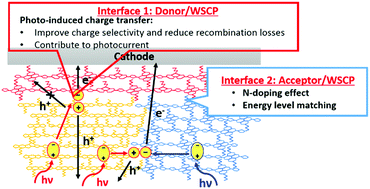
Interface design for high-efficiency non-fullerene polymer solar cells
DOI: 10.1039/C7EE00601B, Paper
The contact between the n-type interlayer and the donor provides an extra interface for charge dissociation.
The content of this RSS Feed (c) The Royal Society of Chemistry
Amorphous Tin Oxide as a Low-Temperature-Processed Electron-Transport Layer for Organic and Hybrid Perovskite Solar Cells

Efficient Polymer Solar Cells with High Open-Circuit Voltage Containing Diketopyrrolopyrrole-Based Non-Fullerene Acceptor Core End-Capped with Rhodanine Units

Optimisation of processing solvent and molecular weight for the production of green-solvent-processed all-polymer solar cells with a power conversion efficiency over 9%

DOI: 10.1039/C7EE00619E, Paper
By processing PTzBI:N2200 blends with green solvent 2-methyltetrahydrofuran, all-PSCs with a power conversion efficiency over 9% can be achieved.
The content of this RSS Feed (c) The Royal Society of Chemistry
Surface passivation of mixed-halide perovskite CsPb(BrxI1-x)3 nanocrystals by selective etching for improved stability

DOI: 10.1039/C7NR01287J, Paper
A facile selective acetone-etching method is reported to significantly enhance the stability of mixed-halide perovskite CsPb(BrxI1-x)3 nanocrystals.
The content of this RSS Feed (c) The Royal Society of Chemistry
White-Light Emission and Structural Distortion in New Corrugated Two-Dimensional Lead Bromide Perovskites
