06 Jun 06:02
J. Mater. Chem. A, 2017, 5,14733-14740
DOI: 10.1039/C7TA03881J, Paper
Gill Sang Han, Jin Sun Yoo, Fangda Yu, Matthew Lawrence Duff, Bong Kyun Kang, Jung-Kun Lee
An organic-inorganic perovskite solar cell (PSC) is a very promising candidate for a next-generation photovoltaic system.
The content of this RSS Feed (c) The Royal Society of Chemistry
06 Jun 05:55
by Adam D. Wright, Rebecca L. Milot, Giles E. Eperon, Henry J. Snaith, Michael B. Johnston, Laura M. Herz
Traps limit the photovoltaic efficiency and affect the charge transport of optoelectronic devices based on hybrid lead halide perovskites. Understanding the nature and energy scale of these trap states is therefore crucial for the development and optimization of solar cell and laser technology based on these materials. Here, the low-temperature photoluminescence of formamidinium lead triiodide (HC(NH2)2PbI3) is investigated. A power-law time dependence in the emission intensity and an additional low-energy emission peak that exhibits an anomalous relative Stokes shift are observed. Using a rate-equation model and a Monte Carlo simulation, it is revealed that both phenomena arise from an exponential trap-density tail with characteristic energy scale of ≈3 meV. Charge-carrier recombination from sites deep within the tail is found to cause emission with energy downshifted by up to several tens of meV. Hence, such phenomena may in part be responsible for open-circuit voltage losses commonly observed in these materials. In this high-quality hybrid perovskite, trap states thus predominantly comprise a continuum of energetic levels (associated with disorder) rather than discrete trap energy levels (associated, e.g., with elemental vacancies). Hybrid perovskites may therefore be viewed as classic semiconductors whose band-structure picture is moderated by a modest degree of energetic disorder.

Low-temperature measurements of the photoluminescence from HC(NH2)2PbI3 thin films are presented. The emission exhibits a power-law intensity decay with time after excitation, and an additional low-energy peak displaying an anomalous Stokes shift. These phenomena demonstrate that charge–carrier recombination in this perovskite is mediated by a band tail with characteristic energy 3 meV, determined from a rate-equation model and Monte Carlo simulation.
05 Jun 13:19
Nanoscale, 2017, 9,9440-9446
DOI: 10.1039/C7NR01678F, Paper
John Ciro, Santiago Mesa, Jose Ignacio Uribe, Mario Alejandro Mejia-Escobar, Daniel Ramirez, Juan Felipe Montoya, Rafael Betancur, Hyun-Seok Yoo, Nam-Gyu Park, Franklin Jaramillo
Rhodamine interlayer reduces trap states at the PCBM surface while hindering moisture access.
The content of this RSS Feed (c) The Royal Society of Chemistry

03 Jun 00:22
J. Mater. Chem. A, 2017, 5,13439-13447
DOI: 10.1039/C7TA03331A, Paper
Jiaxing Song, Leijing Liu, Xiao-Feng Wang, Gang Chen, Wenjing Tian, Tsutomu Miyasaka
Although ZnO is a compatible electron transport layer (ETL) for perovskite solar cells (PSCs), the fact that MAPbI3 easily undergoes thermal decomposition on a low-temperature processed ZnO surface limits the use of one-step deposition of perovskite and hence the resulting photovoltaic performance. The triple cation perovskite prepared with a one-step deposition method is demonstrated to be a stable light absorber in highly efficient PSCs with low-temperature processed ZnO as the ETL.
The content of this RSS Feed (c) The Royal Society of Chemistry
03 Jun 00:20
Nanoscale, 2017, 9,8349-8361
DOI: 10.1039/C7NR02310C, Paper
Yasuhiro Shiraishi, Naoki Yasumoto, Jun Imai, Hirokatsu Sakamoto, Shunsuke Tanaka, Satoshi Ichikawa, Bunsho Ohtani, Takayuki Hirai
Au particles (3.5-4 nm), when supported on the anatase particles isolated from Degussa (Evonik) P25 TiO2, are efficiently activated by visible light and inject their hot electrons into the TiO2 conduction band, promoting highly efficient plasmonic photocatalysis.
The content of this RSS Feed (c) The Royal Society of Chemistry

02 Jun 04:47
by Xianqiang Li, Xiaohong Tang, Tao Ye, Dan Wu, Hong Wang and Xizu Wang

ACS Applied Materials & Interfaces
DOI: 10.1021/acsami.7b02717

02 Jun 04:46
by Youhei Numata, Atsushi Kogo, Yosuke Udagawa, Hideyuki Kunugita, Kazuhiro Ema, Yoshitaka Sanehira and Tsutomu Miyasaka

ACS Applied Materials & Interfaces
DOI: 10.1021/acsami.7b02924

02 Jun 04:46
by Yijie Xia, Jie Fang, Pengcheng Li, Bangmin Zhang, Hongyan Yao, Jingsheng Chen, Jun Ding and Jianyong Ouyang

ACS Applied Materials & Interfaces
DOI: 10.1021/acsami.7b02443

02 Jun 04:44
by Zhenwei Ren, Juan Yu, Zhenxiao Pan, Jizheng Wang and Xinhua Zhong

ACS Applied Materials & Interfaces
DOI: 10.1021/acsami.7b03715

02 Jun 04:39
by Tae Geun Kim, Su Ryong Ha, Hyosung Choi, Kyungchan Uh, Umesha Kundapur, Sumin Park, Chan Woo Lee, Sang-hwa Lee, Jaeyong Kim and Jong-Man Kim

ACS Applied Materials & Interfaces
DOI: 10.1021/acsami.7b04284

02 Jun 04:34
J. Mater. Chem. A, 2017, 5,12416-12425
DOI: 10.1039/C7TA03150E, Paper
Yan-Zhen Zheng, Er-Fei Zhao, Fan-Li Meng, Xue-Sen Lai, Xue-Mei Dong, Jiao-Jiao Wu, Xia Tao
A compact and even ZnO:I nanopillar planar electron transport layer (ETL) is prepared to enable deposition of a fully covering and highly uniform perovskite layer by a facile one-step spin-coating process method. Such a ZnO:I nanopillar ETL film exhibits high optical transparency, favorable work function and superior electron extraction ability, leading to the opt-electrical conversion efficiency as high as 18.24%.
The content of this RSS Feed (c) The Royal Society of Chemistry
02 Jun 04:26
J. Mater. Chem. A, 2017, 5,13817-13822
DOI: 10.1039/C7TA02670F, Paper
Ju Huang, Kai-Xuan Wang, Jing-Jing Chang, Yan-Yun Jiang, Qi-Shi Xiao, Yuan Li
Dopamine-copolymerized PEDOT:PSS showed great advantage over PEDOT:PSS for the enhancement of device performance and durability.
The content of this RSS Feed (c) The Royal Society of Chemistry
01 Jun 03:18
J. Mater. Chem. A, 2017, 5,10917-10927
DOI: 10.1039/C7TA02264F, Paper
Manuel Salado, Lidia Contreras-Bernal, Laura Calio, Anna Todinova, Carmen Lopez-Santos, Shahzada Ahmad, Ana Borras, Jesus Idigoras, Juan A. Anta
Moisture-induced degradation in perovskite solar cells was thoroughly investigated by structural (SEM, EDS, XRD and XPS) and device characterization (impedance and intensity modulated photocurrent spectroscopy) techniques.
The content of this RSS Feed (c) The Royal Society of Chemistry
01 Jun 03:18
J. Mater. Chem. A, 2017, 5,13145-13153
DOI: 10.1039/C7TA03472E, Paper
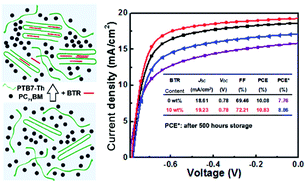
Xiaoling Ma, Fujun Zhang, Qiaoshi An, Qianqian Sun, Miao Zhang, Jianli Miao, Zhenghao Hu, Jian Zhang
BTR as a nucleating agent is incorporated into PTB7-Th:PC71BM to optimize their molecular arrangement and phase separation. The PCE and stability of the ternary PSCs are simultaneously improved due to the optimized morphology.
The content of this RSS Feed (c) The Royal Society of Chemistry
01 Jun 03:17
J. Mater. Chem. A, 2017, 5,12015-12021
DOI: 10.1039/C7TA03316H, Communication
Meng Wang, Dongdong Cai, Jingming Xin, Wei Ma, Qisheng Tu, Qingdong Zheng
The best performance copolymer exhibits a power conversion efficiency of 9.08%, representing the highest value for ternary conjugated D-A copolymers.
The content of this RSS Feed (c) The Royal Society of Chemistry
01 Jun 03:17
J. Mater. Chem. A, 2017, 5,13639-13647
DOI: 10.1039/C7TA04225F, Paper
Stefano Pisoni, Fan Fu, Thomas Feurer, Mohammed Makha, Benjamin Bissig, Shiro Nishiwaki, Ayodhya N. Tiwari, Stephan Buecheler
An 18.2% efficient flexible perovskite/CIGS tandem device is developed using a flexible CIGS encapsulating front sheet as a substrate for perovskite top cells.
The content of this RSS Feed (c) The Royal Society of Chemistry
01 Jun 03:16
J. Mater. Chem. A, 2017, 5,12034-12042
DOI: 10.1039/C7TA02937C, Communication
Rundong Fan, Ligang Wang, Yihua Chen, Guanhaojie Zheng, Liang Li, Ziliang Li, Huanping Zhou
Tailored Au@TiO2 nanostructures successfully enhance the efficiency of planar perovskite solar cells.
The content of this RSS Feed (c) The Royal Society of Chemistry
01 Jun 03:16
J. Mater. Chem. A, 2017, 5,12340-12353
DOI: 10.1039/C7TA02822A, Paper
Sawanta S. Mali, C. A. Betty, P. S. Patil, Chang Kook Hong
In the present investigation, hollow and split nanostructures of rutile TiO2 have been synthesized using simple hydrothermal and chemical etching processes and applied for perovskite solar cells.
The content of this RSS Feed (c) The Royal Society of Chemistry
01 Jun 03:16
J. Mater. Chem. A, 2017, 5,13807-13816
DOI: 10.1039/C7TA02444D, Paper
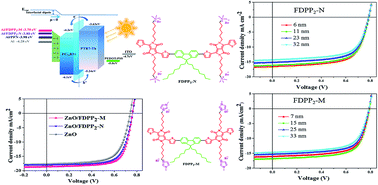
Guodong Xu, Liang Gao, Haitao Xu, Liqiang Huang, Yuanpeng Xie, Xiaofang Cheng, Yongfang Li, Lie Chen, Yiwang Chen
These two small conjugated electrolytes with self-doping effect and thick-insensitivity (>30 nm), a notable PCE of 10.2%.
The content of this RSS Feed (c) The Royal Society of Chemistry
01 Jun 03:10
Energy Environ. Sci., 2017, 10,1610-1620
DOI: 10.1039/C7EE00844A, Paper
Yongxi Li, Lian Zhong, Bhoj Gautam, Hai-Jun Bin, Jiu-Dong Lin, Fu-Peng Wu, Zhanjun Zhang, Zuo-Quan Jiang, Zhi-Guo Zhang, Kenan Gundogdu, Yongfang Li, Liang-Sheng Liao
Low-bandgap polymers/molecules are an interesting family of semiconductor materials, and have enabled many recent exciting breakthroughs in the field of organic electronics, especially for organic photovoltaics (OPVs).
The content of this RSS Feed (c) The Royal Society of Chemistry

01 Jun 01:35
by Senyun Ye, Haixia Rao, Ziran Zhao, Linjuan Zhang, Hongliang Bao, Weihai Sun, Yunlong Li, Feidan Gu, Jianqiang Wang, Zhiwei Liu, Zuqiang Bian and Chunhui Huang

Journal of the American Chemical Society
DOI: 10.1021/jacs.7b01439

01 Jun 01:27
by Ting Yu, Xiaopeng Xu, Guangjun Zhang, Jiahui Wan, Ying Li, Qiang Peng
Two novel wide bandgap copolymers based on quinoxalino[6,5-f]quinoxaline (NQx) acceptor block, PBDT–NQx and PBDTS–NQx, are successfully synthesized for efficient nonfullerene polymer solar cells (PSCs). The attached conjugated side chains on both benzodithiophene (BDT) and NQx endow the resulting copolymers with low-lying highest occupied molecular orbital (HOMO) levels. The sulfur atom insertion further reduces the HOMO level of PBDTS–NQx to −5.31 eV, contributing to a high open-circuit voltage, Voc, of 0.91 V. Conjugated n-octylthienyl side chains attached on the NQx skeletons also significantly improve the π–π* transitions and optical absorptions of the copolymers in the region of short wavelengths, which induce a good complementary absorption when blending with the low bandgap small molecular acceptor of 3,9-bis(2-methylene-(3-(1,1-dicyanomethylene)-indanone))-5,5,11,11-tetrakis(4-hexylphenyl)-dithieno[2,3-d:2′,3′-d′]-s-indaceno[1,2-b:5,6-b′]dithiophene. The wide absorption range makes the active blends absorb more photons, giving rise to a high short-circuit current density, Jsc, value of 15.62 mA cm−2. The sulfur atom insertion also enhances the crystallinity of PBDTS–NQx and presents its blend film with a favorable nanophase separation, resulting in improved Jsc and fill factor (FF) values with a high power conversion efficiency of 11.47%. This work not only provides a new fused ring acceptor block (NQx) for constructing high-performance wide bandgap copolymers but also provides the NQx-based copolymers for achieving highly efficient nonfullerene PSCs.

Two novel wide bandgap copolymers based on quinoxalino[6,5-f]quinoxaline (NQx) acceptor block, PBDT–NQx and PBDTS–NQx, are successfully synthesized for efficient nonfullerene polymer solar cells. These new polymers exhibit high absorption at short wavelength, matching well with low bandgap acceptors, and have deep highest occupied molecular orbital (HOMO) levels, allowing their use in highly efficient nonfullerene solar cells with up to 11.47% power conversion efficiency.
01 Jun 01:25
by Christian M. Wolff, Fengshuo Zu, Andreas Paulke, Lorena Perdigón Toro, Norbert Koch, Dieter Neher
Perovskite solar cells with all-organic transport layers exhibit efficiencies rivaling their counterparts that employ inorganic transport layers, while avoiding high-temperature processing. Herein, it is investigated how the choice of the fullerene derivative employed in the electron-transporting layer of inverted perovskite cells affects the open-circuit voltage (VOC). It is shown that nonradiative recombination mediated by the electron-transporting layer is the limiting factor for the VOC in the cells. By inserting an ultrathin layer of an insulating polymer between the active CH3NH3PbI3 perovskite and the fullerene, an external radiative efficiency of up to 0.3%, a VOC as high as 1.16 V, and a power conversion efficiency of 19.4% are realized. The results show that the reduction of nonradiative recombination due to charge-blocking at the perovskite/organic interface is more important than proper level alignment in the search for ideal selective contacts toward high VOC and efficiency.

Perovskite solar cells have emerged as one of the most promising solar-cell technologies for the next generation of photovoltaics. Despite simple and cheap processing, the solar cells exhibit comparably little loss in open-circuit voltage. An approach to further reduce this loss by optimizing the charge selectivity of the fullerene-based electron contact in efficient devices is shown.
25 May 02:51
by Mohamad Insan Nugraha, Shohei Kumagai, Shun Watanabe, Mykhailo Sytnyk, Wolfgang Heiss, Maria Antonietta Loi and Jun Takeya

ACS Applied Materials & Interfaces
DOI: 10.1021/acsami.7b02867

25 May 02:49
by Takayuki Chiba, Yong-Jin Pu, Takahumi Ide, Satoru Ohisa, Hitoshi Fukuda, Tatsuya Hikichi, Dai Takashima, Tatsuya Takahashi, So Kawata and Junji Kido

ACS Applied Materials & Interfaces
DOI: 10.1021/acsami.7b02658

25 May 02:47
by Muhammad Talha Masood, Christian Weinberger, Jawad Sarfraz, Emil Rosqvist, Simon Sandén, Oskar J. Sandberg, Paola Vivo, Ghufran Hashmi, Peter D. Lund, Ronald Österbacka and Jan-Henrik Smått

ACS Applied Materials & Interfaces
DOI: 10.1021/acsami.7b02868

25 May 02:45
by Dong Hun Sin, Sae Byeok Jo, Seung Goo Lee, Hyomin Ko, Min Kim, Hansol Lee and Kilwon Cho

ACS Applied Materials & Interfaces
DOI: 10.1021/acsami.7b02349

25 May 02:45
by Ting Yu, Xiaopeng Xu, Ying Li, Zuojia Li and Qiang Peng

ACS Applied Materials & Interfaces
DOI: 10.1021/acsami.7b04496

25 May 02:44
by Tinghui Li, Li Xiao, Jiezuan Yang, Mengmeng Ding, Zhiguo Zhou, Leslie LaConte, Li Jin, Harry C. Dorn and Xudong Li

ACS Applied Materials & Interfaces
DOI: 10.1021/acsami.7b04718

25 May 02:43
by Chao Zheng and Oleg Rubel

The Journal of Physical Chemistry C
DOI: 10.1021/acs.jpcc.7b00333