28 Aug 07:49
by Guan-Woo Kim, Gyeongho Kang, Mahdi Malekshahi Byranvand, Gang-Young Lee and Taiho Park

ACS Applied Materials & Interfaces
DOI: 10.1021/acsami.7b07071

28 Aug 07:47
by Santanu Pradhan, Alexandros Stavrinadis, Shuchi Gupta and Gerasimos Konstantatos

ACS Applied Materials & Interfaces
DOI: 10.1021/acsami.7b08568

28 Aug 07:46
by Xuepeng Liu, Fantai Kong, Shengli Jin, Wangchao Chen, Ting Yu, Tasawar Hayat, Ahmed Alsaedi, Hongxia Wang, Zhan’ao Tan, Jian Chen and Songyuan Dai

ACS Applied Materials & Interfaces
DOI: 10.1021/acsami.7b06193

28 Aug 07:46
by Huei-Ting Chien, Peter W. Zach and Bettina Friedel

ACS Applied Materials & Interfaces
DOI: 10.1021/acsami.7b08365

28 Aug 07:44
by Arul Varman Kesavan, Arun D. Rao and Praveen C. Ramamurthy

ACS Applied Materials & Interfaces
DOI: 10.1021/acsami.7b03953

28 Aug 07:44
by Lixin Wang, Haifen Liu, Zhaoxiang Huai and Shaopeng Yang

ACS Applied Materials & Interfaces
DOI: 10.1021/acsami.7b09253

28 Aug 07:39
by Teck Ming Koh, Junye Huang, Ishita Neogi, Pablo P. Boix, Subodh G. Mhaisalkar and Nripan Mathews

ACS Applied Materials & Interfaces
DOI: 10.1021/acsami.7b07780

28 Aug 07:32
by Guohua Wu, Yaohong Zhang, Ryuji Kaneko, Yoshiyuki Kojima, Qing Shen, Ashraful Islam, Kosuke Sugawa and Joe Otsuki

The Journal of Physical Chemistry C
DOI: 10.1021/acs.jpcc.7b04614

28 Aug 07:23
by Nasim Zarrabi, Dani M. Stoltzfus, Paul L. Burn and Paul E. Shaw

The Journal of Physical Chemistry C
DOI: 10.1021/acs.jpcc.7b05862

28 Aug 07:19
by Chih-Chun Chung, Ting-Wei Tsai, Hui-Ping Wu and Eric Wei-Guang Diau

The Journal of Physical Chemistry C
DOI: 10.1021/acs.jpcc.7b07958

28 Aug 07:16
by Xingye Zhang, Bin Zhang, Xinhua Ouyang, Lihui Chen and Hui Wu

The Journal of Physical Chemistry C
DOI: 10.1021/acs.jpcc.7b05767

26 Aug 08:55
J. Mater. Chem. A, 2017, 5,19091-19097
DOI: 10.1039/C7TA06309A, Paper
Shuang Xiao, Chen Hu, He Lin, Xiangyue Meng, Yang Bai, Teng Zhang, Yinglong Yang, Yongquan Qu, Keyou Yan, Jianbin Xu, Yongcai Qiu, Shihe Yang
An inverse nanocone array was fabricated to support nanoporous bismuth vanadate as a photoanode for high efficiency solar water splitting.
The content of this RSS Feed (c) The Royal Society of Chemistry
26 Aug 08:54
J. Mater. Chem. A, 2017, 5,18276-18276
DOI: 10.1039/C7TA90183F, Correction

Open Access
Jaehoon Ryu, Jong Woo Lee, Haejun Yu, Juyoung Yun, Kisu Lee, Jungsup Lee, Doyk Hwang, Jooyoun Kang, Seong Keun Kim, Jyongsik Jang
The content of this RSS Feed (c) The Royal Society of Chemistry
26 Aug 08:54
J. Mater. Chem. A, 2017, 5,19697-19702
DOI: 10.1039/C7TA06237K, Paper
Yusheng Chen, Pan Ye, Xiangli Jia, Wenxing Gu, Xiaozhou Xu, Xiaoxi Wu, Jianfei Wu, Feng Liu, Zhen-Gang Zhu, Hui Huang
A non-fullerene acceptor with a high Ne value is efficient to enhance Voc as the third component for OSCs, leading to an efficiency of [similar]11%.
The content of this RSS Feed (c) The Royal Society of Chemistry
26 Aug 08:54
J. Mater. Chem. A, 2017, 5,19267-19279
DOI: 10.1039/C7TA05004F, Paper
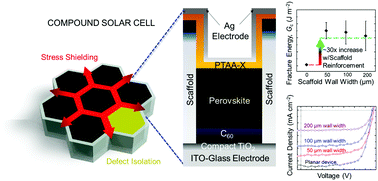
Brian[space]L. Watson, Nicholas Rolston, Kevin A. Bush, Leila Taleghani, Reinhold H. Dauskardt
Solution-processed organic semiconducting materials feature prominently in modern optoelectronic devices, especially where low-cost and flexibility are specific goals, such as perovskite solar cells.
The content of this RSS Feed (c) The Royal Society of Chemistry
26 Aug 08:53
J. Mater. Chem. A, 2017, 5,19447-19455
DOI: 10.1039/C7TA05246D, Paper
Zhiming Chen, Zhicheng Hu, Zhihong Wu, Xiang Liu, Yaocheng Jin, Manjun Xiao, Fei Huang, Yong Cao
We report a series of counterion-tunable n-type conjugated polyelectrolytes for the interface engineering of polymer solar cells.
The content of this RSS Feed (c) The Royal Society of Chemistry
26 Aug 08:53
J. Mater. Chem. A, 2017, 5,20327-20333
DOI: 10.1039/C7TA06334B, Paper
Ying-Ke Ren, Xi-Hong Ding, Ya-Han Wu, Jun Zhu, Tasawar Hayat, Ahmed Alsaedi, Ya-Feng Xu, Zhao-Qian Li, Shang-Feng Yang, Song-Yuan Dai
The nucleation stage has an important influence on the lead halide perovskite film morphology, and therefore the solar cell performance.
The content of this RSS Feed (c) The Royal Society of Chemistry
26 Aug 08:52
J. Mater. Chem. A, 2017, 5,19485-19490
DOI: 10.1039/C7TA06338E, Paper
Edison Castro, Gerardo Zavala, Sairaman Seetharaman, Francis D'Souza, Luis Echegoyen
The effect of utilizing a pure cis-[small alpha]-dimethoxy carbonyl fulleropyrrolidine C70 (DMEC70) isomer as the electron transporting material (ETM) in inverted perovskite solar cells (PSCs) was evaluated.
The content of this RSS Feed (c) The Royal Society of Chemistry
26 Aug 08:47
by Lingling Mao, Yilei Wu, Constantinos C. Stoumpos, Boubacar Traore, Claudine Katan, Jacky Even, Michael R. Wasielewski and Mercouri G. Kanatzidis

Journal of the American Chemical Society
DOI: 10.1021/jacs.7b06143

26 Aug 08:44
Nanoscale, 2017, 9,12916-12924
DOI: 10.1039/C7NR04026A, Paper
Weixia Hu, Zemin Zhang, Jianyu Cui, Wei Shen, Ming Li, Rongxing He
A series of triphenylamine-based derivatives were explored to reveal the relationship between their charge-transport properties and the [small pi]-bridge conjugation degree.
The content of this RSS Feed (c) The Royal Society of Chemistry

26 Aug 08:43
Nanoscale, 2017, 9,15778-15785
DOI: 10.1039/C7NR04362G, Paper
Li-Li Gao, Ke-Jie Zhang, Lin Chen, Ni Chen, Cheng-Xin Li, Chang-Jiu Li, Guan-Jun Yang
Small molecules (helium) driven directional diffusion movement precipitates pin-hole free perovskite films and high efficiency solar cells.
The content of this RSS Feed (c) The Royal Society of Chemistry

26 Aug 08:41
Nanoscale, 2017, 9,13506-13514
DOI: 10.1039/C7NR04692H, Paper
Yan-Hui Lou, Zhao-Kui Wang
Poly(3,4-ethylene dioxythiophene):poly(4-styrenesulfonate) (PEDOT:PSS) is a widely utilized hole-transporting material (HTM) in planar photovoltaic devices, such as organic solar cells (OSCs) and perovskite solar cells (PSCs).
The content of this RSS Feed (c) The Royal Society of Chemistry

26 Aug 08:40
Nanoscale, 2017, 9,13983-13989
DOI: 10.1039/C7NR04069E, Paper
Kyu-Tae Lee, Ji-Yun Jang, Sang Jin Park, Song Ah Ok, Hui Joon Park
See-through colored perovskite solar cells that exploit a dielectric mirror are demonstrated. The dielectric mirror strongly reflects a wide range of visible light back to a photoactive layer for efficient light-harvesting, yielding 10.12% power conversion efficiency, with iridescent semitransparent colors.
The content of this RSS Feed (c) The Royal Society of Chemistry

26 Aug 08:34
by Michiel L. Petrus, Johannes Schlipf, Cheng Li, Tanaji P. Gujar, Nadja Giesbrecht, Peter Müller-Buschbaum, Mukundan Thelakkat, Thomas Bein, Sven Hüttner, Pablo Docampo

In article number 1700264, Sven Hüttner, Pablo Docampo, and co-workers give an overview of hybrid metal halide perovskites for solar cell applications. The focus is on the series of challenges that have been overcome and those still remaining to be solved. In particular, the authors lay out their understanding of the perovskite crystallization process and how this knowledge can be harnessed to enable better performing devices; how to overcome reproducibility and hysteresis issues; and the long-term prospects of the technology in terms of stability and sustainability. Image by Criss Hohmann (Nanosystems Initiative Munich).
26 Aug 08:33
Energy Environ. Sci., 2017, 10,2095-2102
DOI: 10.1039/C7EE01145H, Communication
Xu Zhang, Xiaodong Ren, Bin Liu, Rahim Munir, Xuejie Zhu, Dong Yang, Jianbo Li, Yucheng Liu, Detlef-M. Smilgies, Ruipeng Li, Zhou Yang, Tianqi Niu, Xiuli Wang, Aram Amassian, Kui Zhao, Shengzhong (Frank) Liu
Cs+ doping into 2D (BA)2(MA)3Pb4I13 perovskites boosts power conversion efficiency (PCE) to 13.7% and yields superior humidity and thermal stability.
The content of this RSS Feed (c) The Royal Society of Chemistry

26 Aug 08:32
Energy Environ. Sci., 2017, 10,2500-2508
DOI: 10.1039/C7EE02185B, Communication
Brian L. Watson, Nicholas Rolston, Adam D. Printz, Reinhold H. Dauskardt
The relative insensitivity of the optoelectronic properties of organometal trihalide perovskites to crystallographic defects and impurities has enabled fabrication of highly-efficient perovskite solar cells by scalable solution-state deposition techniques well suited to low-cost manufacturing.
The content of this RSS Feed (c) The Royal Society of Chemistry

26 Aug 08:28
by Changyong Lan, Ruoting Dong, Ziyao Zhou, Lei Shu, Dapan Li, SenPo Yip, Johnny C. Ho
Abstract
Recently, due to the possibility of thinning down to the atomic thickness to achieve exotic properties, layered materials have attracted extensive research attention. In particular, PbI2, a kind of layered material, and its perovskite derivatives, CH3NH3PbI3 (i.e., MAPbI3), have demonstrated impressive photoresponsivities for efficient photodetection. Herein, the synthesis of large-scale, high-density, and freestanding PbI2 nanosheets is demonstrated by manipulating the microenvironment during physical vapor deposition. In contrast to conventional two-dimensional (2D) growth along the substrate surface, the essence here is the effective nucleation of microplanes with different angles relative to the in-plane direction of underlying rough-surfaced substrates. When configured into photodetectors, the fabricated device exhibits a photoresponsivity of 410 mA W−1, a detectivity of 3.1 × 10¹¹ Jones, and a fast response with the rise and decay time constants of 86 and 150 ms, respectively, under a wavelength of 405 nm. These PbI2 nanosheets can also be completely converted into MAPbI3 materials via chemical vapor deposition with an improved photoresponsivity up to 40 A W−1. All these performance parameters are comparable to those of state-of-the-art layered-material-based photodetectors, revealing the technological potency of these freestanding nanosheets for next-generation high-performance optoelectronics.

High-density, crystalline, and freestanding PbI2 and MAPbI3 nanosheets are synthesized on a large-scale through the nucleation of microplanes on rough-surfaced substrates by manipulating the microenvironment during physical vapor deposition. When configured into photodetectors, they exhibit efficient photodetection with excellent performance in responsivity, detectivity, etc.
26 Aug 08:25
by Meng-Lin Tsai, Ming-Yang Li, José Ramón Durán Retamal, Kai-Tak Lam, Yung-Chang Lin, Kazu Suenaga, Lih-Juann Chen, Gengchiau Liang, Lain-Jong Li, Jr-Hau He

An alloy-free 2D monolayer WSe2-MoS2 lateral p-n heterojunction solar cell is demonstrated to exhibit an extraordinary power conversion efficiency of 2.56%, with excellent omnidirectional light harvesting behavior, by Lih-Juann Chen, Jr-Hau He and co-workers in article number 1701168. Temperature-dependent characteristics are analyzed and the electrode spacing is optimized to achieve gate-tuning controllability and environmentindependent cell properties.
26 Aug 08:21
by Wenbin Lai, Cheng Li, Jianqi Zhang, Fan Yang, Fallon J. M. Colberts, Bing Guo, Qiang Mike Wang, Mengmeng Li, Andong Zhang, René A. J. Janssen, Maojie Zhang and Weiwei Li

Chemistry of Materials
DOI: 10.1021/acs.chemmater.7b02534

26 Aug 08:19
by Beibei Qiu, Lingwei Xue, Yankang Yang, Haijun Bin, Yindong Zhang, Chunfeng Zhang, Min Xiao, Katherine Park, William Morrison, Zhi-Guo Zhang and Yongfang Li

Chemistry of Materials
DOI: 10.1021/acs.chemmater.7b02536

   This article is licensed under a Creative Commons Attribution 3.0 Unported Licence.