ACS Applied Materials & Interfaces
DOI: 10.1021/acsami.7b04947


Organic-inorganic hybrid perovskite solar cells form a new type of thin film photovoltaic technology, which has achieved extraordinary improvements in power conversion efficiency in a relatively short time. To further improve the efficiency and stability of the perovskite solar cells, it is critical to understand and control the microstructure of both the functional materials and their interfaces. Much effort has already been made to understand the microstructure of perovskite solar cells and its influence on their performance. This has proved particularly challenging due to the fragile nature of the organic-inorganic perovskites and the consequent potential for generating artefacts through the application of the characterization methods themselves. In this progress report, an overview of some of the more commonly used characterization methods is given, their possible impact on the materials analyses is evaluated, and the latest developments in the understanding of the microstructure of perovskite solar cells are summarized. The heterogenic nature of the individual perovskite grains and the polycrystalline film as a whole is illustrated, the features and properties of the grain boundaries and the effect they can have on solar cell performance are described, and the interface characterization between the layers in the solar cell devices is discussed.

The microstructure of perovskite solar cells has been shown to have a large impact on their properties. In this progress report, some of the most important findings relating to how different microstructures influence the performance of perovskite solar cells are summarized, and the possible impact of different characterisation techniques on the results obtained from them are discussed.
Perovskite solar cells have evolved to have compatible high efficiency and stability by employing mixed cation/halide type perovskite crystals as pinhole-free large grain absorbers. The cesium (Cs)–formamidium–methylammonium triple cation-based perovskite device fabricated in a glove box enables reproducible high-voltage performance. This study explores the method to reproduce stable and high power conversion efficiency (PCE) of a triple cation perovskite prepared using a one-step solution deposition and low-temperature annealing fully conducted in controlled ambient humidity conditions. Optimizing the perovskite grain size by Cs concentration and solution processes, a route is created to obtain highly uniform, pinhole-free large grain perovskite films that work with reproducible PCE up to 20.8% and high preservation stability without cell encapsulation for more than 18 weeks. This study further investigates the light intensity characteristics of open-circuit voltage (Voc) of small (5 × 5 mm2, PCE > 20%) and large (10 × 10 mm2, PCE of 18%) devices. Intensity dependence of Voc shows an ideality factor in the range of 1.7-1.9 for both devices, implying that the triple cation perovskite involves trap-assisted recombination loss at the hetero junction interfaces that influences Voc. Despite relatively high ideality factor, perovskite device is capable of supplying high power conversion efficiency under low light intensity (0.01 Sun) whereas maintaining Voc over 0.9 V.

The reproducible high performance of a triple-cation-based mixed halide perovskite cell fabricated by appropriate control of crystal growth and post-annealing under controlled relative humidity (R.H. < 25%) and in ambient air conditions is demonstrated. The device fabrication shows high yield in producing power conversion efficiencies up to 20.8% with a cell aperture size of 25 mm2.
The introduction of oligomeric polystyrene (PS) side chains into the conjugated backbone is proven to enhance the processability and electronic properties of semiconducting polymers. Here, two series of donor and acceptor polymers are prepared with different molar percentages of PS side chains to elucidate the effect of their substitution arrangement on the all-polymer solar cell performance. The observed device performance is lower when the PS side chains are substituted on the donor polymer and higher when on the acceptor polymer, indicating a clear arrangement effect of the PS side chain. The incorporation of PS side chains to the acceptor polymer contributes to the decrease in phase separation domain size in the blend films. However, the reduced domain size was still an order of magnitude larger than the typical exciton diffusion length. A detailed morphological study together with the estimation of solubility parameter of the pristine PS, donor, and acceptor polymers reveals that the relative value of solubility parameter of each component dominantly contributes to the purity of the phase separated domain, which strongly impacts the amount of generated photocurrent and overall solar cell performance. This study provides an understanding of the design strategies to improve the all-polymer solar cells.

All-polymer solar cells consisting of polystyrene (PS) oligomer side chain attached donor and acceptor polymers are investigated to reveal the effect of PS side chain substituted arrangement. An increase in domain purity and decrease in domain size are observed when the PS side chain is attached to donor and acceptor polymers, respectively, which mainly results from the solubility parameter of the polymers.
Each component layer in a perovskite solar cell plays an important role in the cell performance. Here, a few types of polymers including representative p-type and n-type semiconductors, and a classical insulator, are chosen to dope into a perovskite film. The long-chain polymer helps to form a network among the perovskite crystalline grains, as witnessed by the improved film morphology and device stability. The dewetting process is greatly suppressed by the cross-linking effect of the polymer chains, thereby resulting in uniform perovskite films with large grain sizes. Moreover, it is found that the polymer-doped perovskite shows a reduced trap-state density, likely due to the polymer effectively passivating the perovskite grain surface. Meanwhile the doped polymer formed a bridge between grains for efficient charge transport. Using this approach, the solar cell efficiency is improved from 17.43% to as high as 19.19%, with a much improved stability. As it is not required for the polymer to have a strict energy level matching with the perovskite, in principle, one may use a variety of polymers for this type of device design.

The doping of polymer additives into MAPbI3 films is reported. This allows for enlarged MAPbI3 crystal grains by controlling the crystallization processes and decreased trap-state densities by passivating the MAPbI3 crystal grain boundaries. As a result, the device based on the formed continuous, few-defect, large MAPbI3 grains demonstrates improved efficiency from 17.43 to 19.19%, and relatively improved moisture stability.
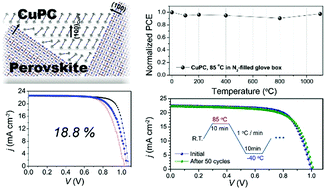
Great efforts toward developing novel and efficient hole-transporting materials are needed to further improve the device efficiency and enhance the cell stability of perovskite solar cells (PSCs). The poor film conductivity and the low carrier mobility of organic small-molecule-based hole-transporting materials restrict their application in PSCs. This study develops an efficient and stable hole-transporting material, tetrafluorotetracyanoquinodimethane (F4-TCNQ)-doped copper phthalocyanine-3,4′,4′′,4′′′-tetra-sulfonated acid tetra sodium salt (TS-CuPc) via a solution process, in planar structure PSCs. The p-type-doped TS-CuPc film demonstrates improved film conductivity and hole mobility owing to the strong electron affinity of F4-TCNQ. By the F4-TCNQ tailoring, the composite film gives the highest occupied molecular orbital level as high as 5.3 eV, which is beneficial for hole extraction. In addition, the aqueous solution processed TS-CuPc:F4-TCNQ precursor is almost neutral with good stability for avoiding the electrode erosion. As a result, the fabricated PSCs employing TS-CuPc:F4-TCNQ as the hole-transporting material exhibit a power conversion efficiency of 16.14% in a p–i–n structure and 20.16% in an n–i–p structure, respectively. The developed organic small molecule of TS-CuPc provides the diversification of hole-transporting materials in planar PSCs.

p-Type-doped copper phthalocyanine-3,4′,4″,4″′-tetra-sulfonated acid tetra sodium salt (TS-CuPc) by tetrafluorotetracyanoquinodimethane (F4-TCNQ) with improved film conductivity and hole mobility is realized via a solution process. The composite film is used as a hole-transporting layer in both p–i–n structure and n–i–p structure devices. A champion n–i–p structure device with a power conversion efficiency of 20.16% is obtained.
Charge transport layers play an important role in determining the power conversion efficiencies (PCEs) of perovskite solar cells (PSCs). However, it has proven challenging to produce thin and compact charge transport layers via solution processing techniques. Herein, a hot substrate deposition method capable of improving the morphology of high-coverage hole-transport layers (HTLs) and electron-transport layers (ETLs) is reported. PSC devices using HTLs deposited on a hot substrate show improvement in the open-circuit voltage (Voc) from 1.041 to 1.070 V and the PCE from 17.00% to 18.01%. The overall device performance is then further enhanced with the hot substrate deposition of ETLs as the Voc and PCE reach 1.105 V and 19.16%, respectively. The improved performance can be explained by the decreased current leakage and series resistance, which are present in PSCs with rough and discontinuous HTLs and ETLs.

A hot-substrate deposition method contributes to the modification of both hole-transport layers and electron-transport layers with high coverage and uniform morphology. It is useful to reduce the current leakage and series resistance resulting from rough and discontinuous charge transport layers in perovskite solar cells. This strategy improves open-circuit voltage and power conversion efficiency of the device to 1.105 V and 19.16%, respectively.
Reduced graphene oxides (rGO) are synthesized via reduction of GO with reducing agents as a hole-extraction layer for high-performance inverted planar heterojunction perovskite solar cells. The best efficiencies of power conversion (PCE) of these rGO cells exceed 16%, much greater than those made of GO and poly(3,4-ethenedioxythiophene):poly(styrenesulfonate) films. A flexible rGO device shows PCE 13.8% and maintains 70% of its initial performance over 150 bending cycles. It is found that the hole-extraction period is much smaller for the GO/methylammonium lead-iodide perovskite (PSK) film than for the other rGO/PSK films, which contradicts their device performances. Photoluminescence and transient photoelectric decays are measured and control experiments are performed to prove that the reduction of the oxygen-containing groups in GO significantly decreases the ability of hole extraction from PSK to rGO and also retards the charge recombination at the rGO/PSK interface. When the hole injection from PSK to GO occurs rapidly, hole propagation from GO to the indium-doped tin oxide (ITO) substrate becomes a bottleneck to overcome, which leads to a rapid charge recombination that decreases the performance of the GO device relative to the rGO device.

An anomalous charge-extraction behavior is observed for the graphene oxide (GO) film showing more rapid hole-extraction characteristic than that of the reduced graphene oxide (rGO) film, but the corresponding photovoltaic performances show an opposite trend. The rapid charge extraction in GO also leads to a rapid charge recombination so that the GO device shows poorer performance than the rGO device (13.8% vs 16.4%).
Organic–inorganic hybrid perovskite solar cells (PSC) are promising third-generation solar cells. They exhibit good power conversion efficiencies and in principle they can be fabricated with lower energy consumption than many more established technologies. To improve the efficiency and long-term stability of PSC, organic molecules are frequently used as “interlayers.” Interlayers are thin layers or monolayers of organic molecules that modify a specific interface in the solar cell. Here, the latest progress in the use of interlayers to optimize the performance of PSC is reviewed. Where appropriate interesting examples from the field of organic photovoltaics (OPV) are also presented as there are many similarities in the types of interlayers that are used in PSC and OPV. The review is organized into three parts. The first part focuses on why organic molecule interlayers improve the performance of the solar cells. The second section discusses commonly used molecular interlayers. In the last part, different approaches to make thin and uniform interlayers are discussed.

Small molecules are increasingly being used as interlayers in perovskite solar cells to modify band energy offsets at an interface, to improve the morphology of active layers, and to enhance the long-term stability of the devices. This article reviews recent advances in the use of molecular interlayers in perovskite cells and introduces relevant examples from the field of organic solar cells.
The last eight years (2009–2017) have seen an explosive growth of interest in organic–inorganic halide perovskites in the research communities of photovoltaics and light-emitting diodes. In addition, recent advancements have demonstrated that this type of perovskite has a great potential in the technology of light-signal detection with a comparable performance to commercially available crystalline Si and III–V photodetectors. The contemporary growth of state-of-the-art multifunctional perovskites in the field of light-signal detection has benefited from its outstanding intrinsic optoelectronic properties, including photoinduced polarization, high drift mobilities, and effective charge collection, which are excellent for this application. Photoactive perovskite semiconductors combine effective light absorption, allowing detection of a wide range of electromagnetic waves from ultraviolet and visible, to the near-infrared region, with low-cost solution processability and good photon yield. This class of semiconductor might empower breakthrough photodetector technology in the field of imaging, optical communications, and biomedical sensing. Therefore, here, the focus is specifically on the critical understanding of materials synthesis, design, and engineering for the next-stage development of perovskite photodetectors and highlighting the current challenges in the field, which need to be further studied in the future.

The fundamental optoelectrical properties of organic–inorganic perovskites in combination with low-cost solution processability, broad-band absorption, fast response, and high sensitivity make them very attractive candidates for application in photodetection. However, insightful understanding on materials properties, device engineering, and internal photophysical processes is required to further advance perovskite photodetectors. Perovskite photodetectors are comprehensively reviewed.
Colloidal quantum dots (QDs) are promising candidate materials for photovoltaics (PV) owing to the tunable bandgap and low-cost solution processability. Lead selenide (PbSe) QDs are particularly attractive to PV applications due to the efficient multiple-exciton generation and carrier transportation. However, surface defects arising from the oxidation of the PbSe QDs have been the major limitation for their development in PV. Here, a new passivation method for chlorinated PbSe QDs via ion exchange with cesium lead halide (Br, I) perovskite nanocrystals is reported. The surface chloride ions on the as-synthesized QDs can be partially exchanged with bromide or iodide ions from the perovskite nanocrystals, hence forming a hybrid halide passivation. Consistent with the improved photoluminescence quantum yield, the champion PV device fabricated with these PbSe QDs achieves a PCE of 8.2%, compared to 7.3% of that fabricated with the untreated QDs. This new method also leads to devices with excellent air-stability, retaining at least 93% of their initial PCEs after being stored in ambient conditions for 57 d. This is considered as the first reported PbSe QD solar cell with a PCE of over 8% to date.

PbSe quantum dots (QDs) with robust hybrid halide passivation are obtained via ion exchange with CsPbX3 halide perovskite nanocrystals, resulting in significant improvement in their photoluminescence quantum yield. A champion solar cell fabricated with these passivated PbSe QDs can achieve an efficiency of over 8%, as well as excellent air-stability.

The control of film morphology is crucial in achieving high-performance perovskite solar cells (PSCs). Herein, the crystals of the perovskite films are reconstructed by post-treating the MAPbI3 devices with methylamine gas, yielding a homogeneous nucleation and crystallization of the perovskite in the triple mesoscopic inorganic layers structured PSCs. As a result, a uniform, compact, and crystalline perovskite layer is obtained after the methylamine gas post-treatment, yielding high power conversion efficiency (PCE) of 15.26%, 128.8% higher than that of the device before processing. More importantly, this post-treatment process allows the regeneration of the photodegraded PSCs via the crystal reconstruction and the PCE can recover to 91% of the initial value after two cycles of the photodegradation-recovery process. This simple method allows for the regeneration of perovskite solar cells on site without reconstruction or replacing any components, thus prolonging the service life of the perovskite solar cells and distinguishing from any other photovoltaic devices in practice.

The crystals of the perovskite films are reconstructed by post-treating the MAPbI3 devices with methylamine gas, yielding high power conversion efficiency (PCE) of 15.26%, which is 128.8% higher than that of the device before processing. More importantly, the photodegraded perovskite solar cells are regenerated via crystal reconstruction, and the PCE recovers to 91% of the initial value after two cycles of the photodegradation-recovery process.