“It’s one thing when someone groans about a store he doesn’t like opening in his neighborhood. It’s another when nearly 200 others join him in his call to keep out commercial enterprises that cater to people of lower means. It’s classism.”
Kapps can now back away from the Bastille, a reader tweets us a sign permit for a 7-Eleven at 2300 14th Street, NW:
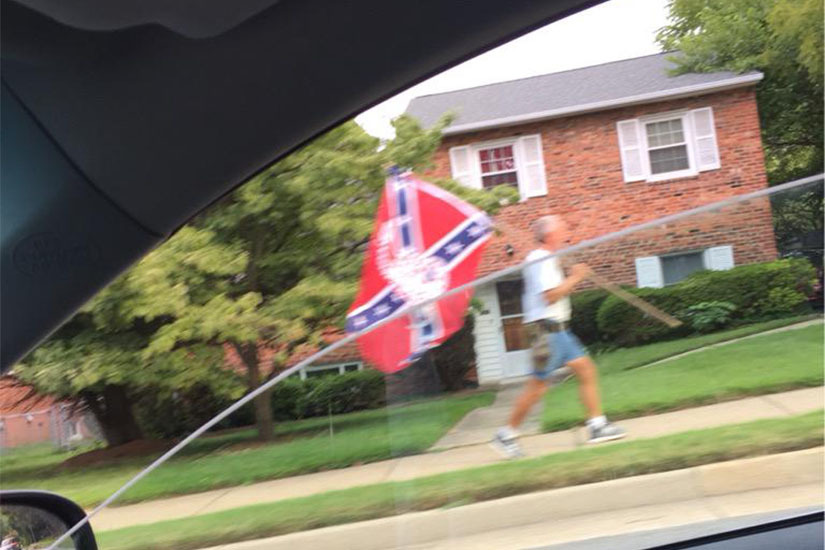
A man holding a Confederate flag was spotted marching down Lee Highway near East Falls Church this morning.
The above photo was taken near N. Sycamore Street around 8:00 a.m. A reader said the man was walking very deliberately down the street, with a Confederate flag that had the Gadsden flag’s “Don’t Tread On Me” snake in the middle.
“[He was] not yelling anything but [you] could tell he was walking with pride in his step,” said the reader.
At least one concerned resident called police to report the display, which is highly unusual for Arlington, but according to scanner traffic police determined that the man was exercising his First Amendment rights and not violating the law.
“Our bar program includes prosecco based cocktails, European classics like the Aperol spritz, French 75 and the Pimm’s Royal Cup as well as our own creations. The selection of spirits will be quite whiskey-forward with ryes and bourbons being well represented at all price points. We also plan on serving an Old Overholt soft serve, each serving containing a full shot of rye. We will offer an entire range of classic, handmade cocktails as well. There will be 15 beers on tap and we will make our own Radler (don’t worry we’ll have Stiegl too).
The menu is classic European bar and cafe food served a la carte. The focus is on authentic, accessible pub and bar food from across Europe with one or two local favorites added as well. I have attached a preliminary menu for your consideration.”
“I’m not sure what was going on exactly, but there was some sort of protest at the P street Whole Foods around 1:30pm. All of a sudden people just started chanting near a hummus display in front of the cookies. The police probably arrived in less than 2 minutes and told the protest leader they had to get out of the store, then they marched out single file, yelling their chant, and stood outside. The whole foods staff was pretty great about the incident — the check out lines kept moving….”
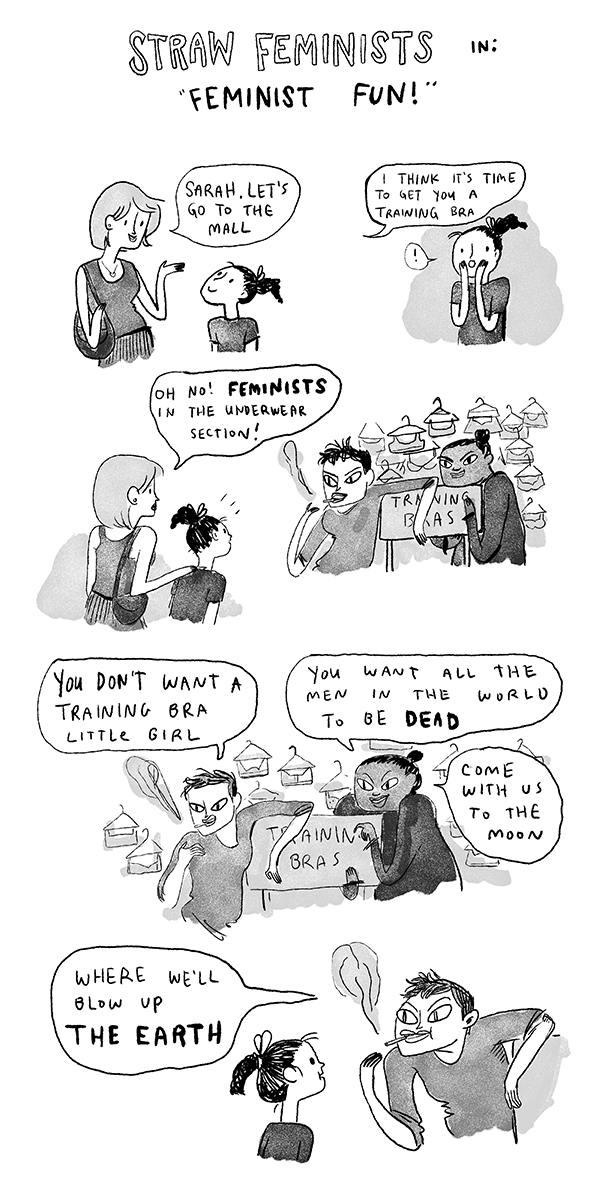
This was a sketch under the original Straw Feminist comic but I redrew it for the book. Those crazy gals! You never know where they are lurking! Moon colony here we come!
Speaking of feminists on the moon, I would be remiss not to mention this: have you been reading Bitch Planet? I read the first one, I need to get more!
Step Aside Pops is coming soon! Drawn and Quarterly has a preview here!
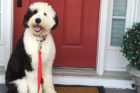
This week’s Arlington Pet of the Week if Ezra, a Sheepadoodle — an Old English Sheepdog and standard poodle mix — who loves socks.
Ezra also loves to steal tomatoes from the vines and can perform a number of tricks. Here’s what his owners had to say about him:
Ezra – who usually goes by “Ezi” – is full of it: Full of tricks, full of spirit and full of mischief. His go-to trick is “sit pretty” (pictured above), which is usually very effective, but if he doesn’t get what he wants, he will automatically move into down, roll-over, high-five and back into sit pretty again. It’s quite a show. Thanks to many classes at Woofs!, Ezi is a charming, well-socialized adolescent “sheepadoodle.” That’s half Old English Sheepdog and half Standard Poodle. Ezra’s hijinks are lovingly (albeit sporadically) chronicled on Instagram at @ezrathesheepadoodle.
Ezi thinks every passerby exists only to give him attention. Since he looks like an adorable stuffed panda bear, he is often correct. He occasionally startles strangers, however, when he moves in for a “sheepadoodle hug” and walks straight through their legs and then turns around and weaves back again (apparently an instinctual herding trait).
His mischievous side really shines as a tomato thief. He unabashedly bounds into the backyard vegetable garden and plucks the ripest fruit right off the vine. Tomato juice and seeds on his muzzle belie any alibi he could attempt. “Sock radar” is his superpower. He can sense that a sock is present anytime, anywhere. Clean or dirty, he will find the sock. His best work was upending a perfectly packed suitcase to retrieve a pair of clean socks nestled inside shoes stowed at the very bottom. And whenever he finds a sock, he is full of pure joy.
Want your pet to be considered for the Arlington Pet of the Week?Emailoffice@arlnow.comwith a 2-3 paragraph bio and at least 3-4 horizontally-oriented photos of your pet.
Each week’s winner receives a sample of dog or cat treats from our sponsor, Becky’s Pet Care, along with $100 in Becky’s Bucks. Becky’s Pet Care, the winner of three Angie’s List Super Service Awards and the National Association of Professional Pet Sitters’ 2013 Business of the Year, provides professional dog walking and pet sitting services in Arlington and Northern Virginia.
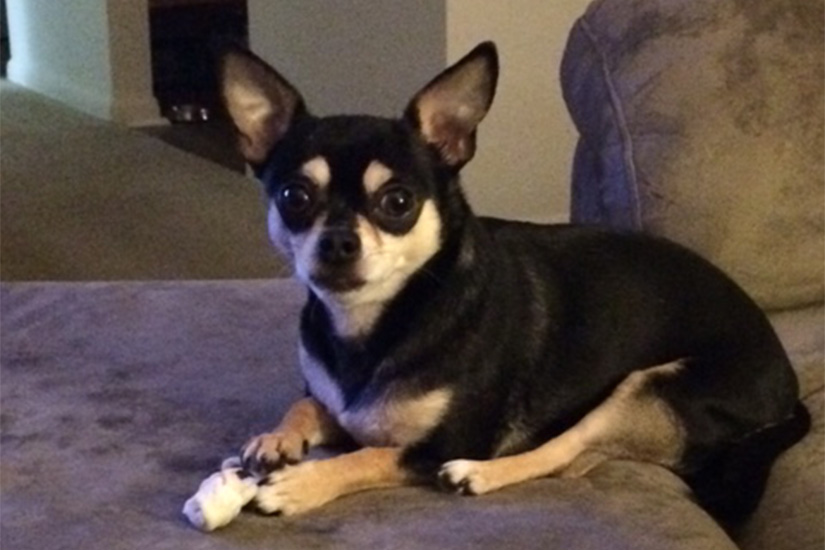
A local law enforcement officer has turned to the Internet in hopes of raising money for her dog’s surgery.
DeDe Bozeman set up a GoFundMe campaign with a goal of $800 to cover the medical expenses of veterinary knee surgery.
Smyth, a 6-year-old Chihuahua, injured his knee while jumping off of a bed to get a toy stuffed monkey, Bozeman said. The injury is common for small dogs.
Smyth can still walk, but the veterinarian recommend limiting his movement to stop him from hurting his knee more.
“Despite his injury, he continues to be a loving little dog that keeps trying to play with his brother and neighboring dogs,” says the fundraising page. “Smyth is in need of a surgery that I am unable to fund at this time to repair his patella luxation. I don’t want my little guy to suffer, while I’m trying to save up the money. Any donation help my little guy get back to his fun playful little loving self.”
The surgery, anesthesia and pre- and post-operation care total $800, she said. During the procedure, Smyth will also have to get a heart echo to determine if he has a heart murmur.
“My concern is his treatment being prolonged by trying to raise the funds,” Bozeman said. She said she’s usually a private person but is going public with this in order to speed up the treatment.
A couple years ago, her other dog, a Chihuahua named Wessin, had to have a similar surgery on both knees. Bozeman said has a special connection with Smyth, who can pick up her moods and try to make her feel better.
“I’d never admit this to the other one [Wessin], but he’s my favorite,” Bozeman said.
Two Arlington dog daycares are also helping Bozeman raise money. Wag More Dogs (2606 S. Oxford Street) and WOOFS! Dog Training Center (4160 S. Four Mile Run Drive) will hang flyers about Smyth and his surgery, Bozeman said.
Bozeman did not want the police agency she works for named because she’s raising funds as a private individual and not as a representative of the department.
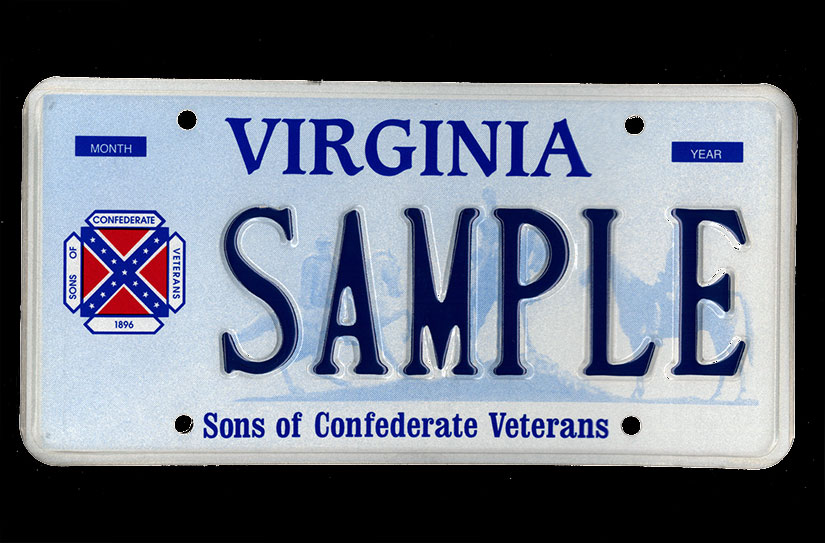
A federal judge’s ruling today will allow Virginia to remove the Confederate flag from specialty license plates.
An existing state law on the books says specialty license plates issued for members of the Sons of Confederate Veterans may not include an emblem, like the Confederate battle flag. An injunction on First Amendment grounds prevented the Commonwealth from enforcing that law, but a Supreme Court ruling in June prompted Attorney General Mark Herring (D) to file a motion to vacate the previous order.
In a press release, the attorney general’s office says that Judge Jackson Kiser will next file an order that will specify whether nearly 1,700 previously-issued Confederate plates may be recalled.
Today in federal district court in Danville, Judge Jackson Kiser ruled from the bench that he will dissolve his 2001 injunction that had allowed the Sons of Confederate Veterans to place the confederate battle flag on certain specialty license plates in Virginia. On June 26, Attorney General Mark R. Herring filed motions (see below) to dissolve the injunction and vacate the order that had required placement of the flag on SCV license plates. The Commonwealth will now be able to enforce its existing law regarding SCV plates which states “No logo or emblem of any description shall be displayed or incorporated into the design of license plates issued under this section.”
“This ruling will allow Virginia to remove a symbol of oppression and injustice from public display on its license plates,” said Attorney General Mark Herring. “Virginia state government does not have to and will not endorse such a divisive symbol. I appreciate Governor McAuliffe’s leadership in calling for the removal of the flag and those on my team who moved quickly to get it done.”
Judge Kiser’s ruling will not be official until he enters his order, which will also address whether the decision will apply prospectively to new license plates, or retroactively to include existing ones. Deputy Attorneys General Rhodes B. Ritenour and Jeffrey M. Bourne and Senior Assistant Attorney General Janet Westbrook handled the case on behalf of the Commonwealth.
A synchronized breastfeeding event will be held at the Arlington Central Library auditorium this week.
The Big Latch On is an international event where women across the country and world breastfeed their children at the same time. Women will join together in the Arlington County Central Library’s auditorium (1015 N. Quincy Street) to breastfeed from 10:30-11:30 a.m. on Friday.
“The Big Latch On involves groups of breastfeeding women coming together at registered locations around the world to all ‘latch on’ (breastfeed) their child or children at a set time,” according to the event’s website.
The Big Latch On was started to promote the benefits of breastfeeding and to encourage more women to breastfeed. It also aims to make breastfeeding in public part of daily life, according to the website. Last year, 14,173 women in 31 countries participated.
The World Health Organization encourages mothers to breastfeed their child for at least six months. Breastfeeding helps protect babies from infectious diseases and can promote cognitive development, according to WHO.
This year, the Big Latch On is hoping to beat its record of 14,356 children breastfeeding at one time. The women start breastfeeding at the same time for one minute while the children are counted, according to the Big Latch On’s website.
I keep forgetting to post this awesome new sculpture at City Market at O – “Symphony in DC Major”:
“Symphony in DC Major” is a newly commissioned landmark public artwork honoring three historic figures that have made an enormous impact on the Shaw neighborhood, Washington, D.C., and beyond.
A reader reports (and multiple readers also tweeted @PoPville):
“There was a shootout and fiery car crash on Sherman Ave tonight (Saturday around 11pm) in between Irving St and Columbia Rd. We heard 5 or so gunshots and then looked out to see a crashed car in flames and numerous shell casings covering the sidewalk. Not exactly the wild and crazy Saturday night I was hoping for.”
From MPD:
“MPD is currently investigating reports of shots fired, as well as a car fire, in the 3000 block of Sherman Are. NW. There are no reported injuries related to this event, at this time. Please avoid the area as we investigate.”
Also from MPD:
“On July 25, 2015, at around 11:47PM, First District personnel responded to the 1200 block of I Street, Southeast, in reference to a call for the sounds of gunshots. When the officers arrived on the scene, they discovered a victim inside the Potomac Gardens Housing Complex suffering from multiple gunshot wounds.
The victim was transported to a local hospital by DCFD where he was treated for his injuries.
This case is currently being investigated by the First District Investigative Unit.”
and
“Around 1:00 am this morning, the victim was in the 400-600 block of Jefferson Street, NW, when he was struck by gunfire. He drove from the area and was found in the 4900 block of Kansas Ave NW. He was transported to an area hospital for medical treatment.
If anyone has information regarding this offense please call the MPD CIC at 202-727-9099 or text at 50411.”
and from AlertDC:
“Shooting at 0230 hrs in the 2300 b/o 11th street LOF b/m wearing white shirt and white shoes”
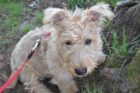
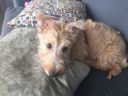
This week’s Arlington Pet of the Week is Teddy, a terrier who is unmistakably Scottish.
Teddy just moved to Arlington as is now busy getting his sniff on around town. Here’s what Teddy’s owner had to say about him last month:
I’m moving to Arlington from D.C. and I’m bringing my Scottish terrier puppy Teddy to Potomac Towers along with me.
Teddy Weinstein is a 4.5 month old wheaten Scottie. Like most good Scotsmen, Teddy manages to be sweet, loyal, feisty and stubborn all at the same time.
Teddy loves nothing more than to meet new people and new dogs. He will roughouse with any dog, no matter how much of a size disadvantage he has. He will also never pass on any opportunity to sniff something even if it means turning what should be a 15 minute walk into a 45 minute walk.
Teddy is looking forward to investigating everything Arlington has to offer.
Want your pet to be considered for the Arlington Pet of the Week? Email arlingtonnews@gmail.com with a 2-3 paragraph bio and at least 3-4 horizontally-oriented photos of your pet.
Each week’s winner receives a sample of dog or cat treats from our sponsor, Becky’s Pet Care, along with $100 in Becky’s Bucks. Becky’s Pet Care, the winner of three Angie’s List Super Service Awards and the National Association of Professional Pet Sitters’ 2013 Business of the Year, provides professional dog walking and pet sitting services in Arlington and Northern Virginia.
Just sharing this to let you know we will continue to have Jefferson Davis Highway in Arlington. Welcome to the future.
Grant for New Bikeshare Stations OKed — Arlington County will receive nearly $300,000 from the federal government to install eight new Capital Bikeshare stations along the GW Parkway. Among the locations set for a new Bikeshare station are Arlington National Cemetery, the Pentagon, Gravelly Point Park and Reagan National Airport. [Arlington County]
Jefferson Davis Name Change Unlikely — The Virginia General Assembly is not likely to approve changing the name of Jefferson Davis Highway any time soon. “Jefferson Davis was an avid racist and segregationist… But there’s not a whole lot of people clamoring about it except coffee-shop liberals in Arlington,” Del. Scott Surovell (D-Fairfax) told the Sun Gazette. Plus, Arlington County already has numerous streets and schools named after slaveholders. [InsideNova, InsideNova]
APS Honored for Healthy Food Options — Arlington Public Schools has received the top award in the “Healthy School Meals” category of the 2015 Virginia School Boards Association Food for Thought Competition. [Arlington Public Schools]
Lighting Task Force Approved — The Arlington County Board on Tuesday approved the appointment of a citizen working group that will study the issue of athletic lighting in Arlington. After a public process, the group is expected to come back to the Board in 11 months with a recommendation as to whether all artificial turf fields in the county should have lighting, a controversial issue for many who live near such fields. [InsideNova]
Today Foreign Minister Bruno Rodríguez of Cuba once again raises the Cuban flag over the country’s venerable embassy building at 2630 16th Street NW, in the Meridian Hill neighborhood that was once home to many of the city’s finest embassies. Close by are the former Italian, Mexican, and Spanish embassies as well as the current embassies of Poland and Lithuania. For decades the building has quietly served as the Cuban Interests Section of the Swiss Embassy, but before that it had a long social career, hosting many of the city’s classiest balls and receptions.
Photo by the author.
The Republic of Cuba had a diplomatic outpost in Washington even before the country existed as an independent nation. In the 1890s, as Cubans mounted their war for independence from Spain, Gonzalo de Quesada (1868-1915) established a legation at the fashionable Raleigh Hotel on Pennsylvania Avenue. A graduate of Columbia University, Quesada had met revolutionary hero José Martí in New York at a rally of Cuban exiles; he quickly became an important figure in the struggle for independence. The movement had the sympathy of many Americans, and on President William McKinley’s inauguration day in March 1897, its flag flew proudly atop the Raleigh. “All sympathizers with the struggling patriots could not suppress a yell of patriotism as they observed the flag of the little would-be republic floating as proudly to the breeze as that of the big, powerful country the strong protection of which is sought,” wrote The Evening Star.
Gonzalo de Quesada, from a 1902 newspaper advertisement
That protection arrived the following year when the U.S. intervened in the Cuban struggle, Theodore Roosevelt and his Rough Riders stormed up San Juan Hill, and Spain quickly capitulated. It was not until 1902, however, that Cuba officially gained its independence, and it would take many years for the country to build a permanent home in Washington. Gonzalo de Quesada became Cuba’s first minister to Washington, continuing the prominent role he had played in cementing good relations between the two countries. In 1907, Quesada bought a distinguished brownstone mansion at 1750 Massachusetts Avenue NW as a temporary site for the legation (Cuba and the U.S. had not yet established full embassies), while grander quarters were envisioned for the future.
The house at 1529 18th Street NW, which served as the Cuban Legation from 1914 to 1918. (Source: Library of Congress).
Quesada gave up his Washington post in 1912, and two years later the legation moved to another brownstone mansion, at 1529 18th Street NW, which later would become the home of Secretary of State Charles Evans Hughes (1862-1948) and still stands today. But the new minister, Dr. Carlos Manuel de Cespedes, considered this also to be a temporary outpost. By 1915 he was hard at work securing the Meridian Hill site and designing the lavish new legation to be built there.
The site’s former owner was Mary Foote Henderson, whom we’ve previously profiled. In keeping with her vision of Meridian Hill as a grand enclave of diplomatic residences, she had commissioned noted architect George Oakley Totten (1866-1939) to design an elegant five-story Elizabethan-style mansion to be built there. But Totten’s design was never built. The Cubans were not interested in it, nor did they want anything reflecting their recently cast-off Spanish heritage. “Classicism belongs to the whole world, while the Spanish style is of only one nation,” Minister Carlos Cespides told The Washington Post to explain why he preferred a more Continental look.
The Cuban Embassy in 1923, the year Prohibition agents accused Cuban diplomatic staff of distributing alcohol from the embassy (Author’s collection).
In 1916 detailed plans for the new legation were finally announced. It was to be “a handsome three-story structure in the style of Louis XV, flanked by beautiful gardens,” according to a notice that appeared in The Washington Post. The first floor would contain the chancery, offices, a kitchen, and serving rooms, while the second floor would be for entertaining, with reception rooms, a dining room, and a spacious ballroom with a balcony in the rear and a flight of ornamental stone steps leading down to the gardens. Another monumental flight of white marble stairs would rise through the interior space to a domed skylight over the third floor, where living quarters for the minister would be located. Interior details were to include “Caen stone, plaster and grill work” graced with “frescoes and many other mural designs carefully executed.” Faced in Indiana limestone on its exterior, the building would be “one of the handsomest occupied by diplomats in Washington,” the Post asserted.
The light-filled central atrium on the third floor of the building (Source: Library of Congress).
Construction began late in 1916 and continued into 1918. The building was designed by the short-lived architectural firm of Macneil & Macneil, composed of Robert Lister Macneil (1889-1970) and his older brother, Paul Humphreys Macneil (1883-1964). Robert Macneil, the more prominent of the two, is generally credited with the design of the Cuban legation. Though born on a farm in Michigan, he was the son of Roderick Ambrose Macneil, the 44th Macneil of Barra, Scotland, a title Robert inherited in 1915. Educated as an architect at the École des Beaux-Arts in Paris, Robert Macneil became a prominent socialite in Washington as well as a noted designer of high-society residences. He would later move to New York City and finally to Scotland, where his architectural training came in handy as he oversaw a meticulous restoration of the Macneil clan’s ancient Kisimul Castle. Macneil was the perfect choice to design the new Cuban legation; his high-society connections and sophisticated architectural training meant he knew all the important features of a grand residence intended for lavish entertainment.
A sitting room (Source: Library of Congress).
Once completed, the distinguished building soon became the site of numerous important social and diplomatic events. In April 1927, Cuban President Gerardo Machado (1871-1939) visited Washington, arriving at Union Station in a driving rain. The high profile event, covered extensively in the press, included a formal dinner for Machado at the “temporary White House” on Dupont Circle, where President Coolidge and his wife were staying while the White House underwent renovations, as well as a reception for Presidents Coolidge and Machado at the Cuban Embassy (it had been elevated from a legation in 1923). The elaborate and carefully orchestrated diplomatic dance was intended to show how close the United States and Cuba were at the time—and possibly set the stage for new U.S. loans to the Caribbean nation.
President Coolidge with President Machado and Cuban officials at the Cuban Embassy in 1927 (Source: Library of Congress).
From the 1920s through the 1940s, the Cuban Embassy was one of Washington’s brightest social spots, especially during the term of Ambassador Pedro Fraga in the late 1930s. “It ranked with the best embassies in town in terms of glamour and prestige,” Hope Ridings Miller, The Washington Post’s society editor, explained many years later. “The Cubans frequently held moonlit garden parties in the back, with rumba music and the finest food imaginable. The elite constantly went to parties there because it was quite a social center.” Gloria Vanderbilt was among the notables said to have danced the cha-cha in the ballroom to the accompaniment of the 21-piece Cuban orchestra.
Meanwhile, Cuban politics grew increasingly strained. President Machado overstayed his reign and was forced out in 1933. In his place rose strongman Fulgencio Batista (1901-1973), a former Army sergeant who promoted himself to the rank of Colonel and took over the government with the tacit approval of U.S officials. On Armistice Day in 1938—the 20th anniversary of the end of World War I—Batista visited Washington at the invitation of a high U.S. Army official. It was reportedly the first time he had ever left Cuba, and he was received warmly. The U.S. was happy to embrace what it considered a reliable and supportive ally. “Developments in Europe and Asia during the last few months have tended to emphasize the community of interest that exists among the nations of this hemisphere,” the Post’s editors wrote. Close relations between the U.S. and Cuba were thus vital as the two nations “face the common necessity of securing themselves against possible attack from outside.”
Col. Batista shakes hands with Ambassador Pedro Fraga at the Cuban Embassy while Mrs. Batista looks on, November 1938 (Source: Library of Congress).
Cuba remained a staunch U.S. ally through World War II and the years afterward, but by the early 1950s, Batista’s oppressive dictatorship began to spawn resentment and then active resistance by Fidel Castro and his band of Communist revolutionaries, but there was certainly no sign of looming trouble at the embassy in Washington. When Ambassador Nicholas Arroyo and his wife arrived in Washington in 1958, Washington Post social writer Marie McNair cheered their arrival, noting a sense of new life at embassy. Both Arroyo and his wife were architects—they had designed the Havana Hilton— and, according to McNair, they redecorated the embassy beautifully. But then the old ways came to an abrupt end. On January 2, 1959, after the New Year’s revolution, Castro’s supporters mounted a “friendly invasion” of the embassy and were on hand to greet Arroyo as he returned from spending the holiday in New York. Arroyo promptly resigned, and there was much celebration among the foes of the repressive Batista regime.
Cuba swiftly changed from a friendly U.S. ally to one of its worst enemies. The garden parties were all forgotten as the new regime’s functionaries took over at the embassy. When diplomatic relations between the U.S. and Cuba were severed in January 1961, the embassy was abruptly closed. In an odd incident in 1963, three veterans of the Bay of Pigs fiasco tossed a Molotov cocktail at the former embassy one night but succeeded only in burning some of the shrubbery outside. Cuba left the building in the care of Czechoslovak diplomats, several of whom lived on the third floor and reportedly used the rooftop flagpole to hang out their laundry. In 1977, the Cubans finally returned to the building when it was reopened as the Cuban Interests Section of the Swiss Embassy.
Only two years later, in May 1979, someone tossed a homemade bomb over the fence at the rear of the embassy late one night. The resulting explosion broke a number of windows but did no serious damage, and no one was hurt. An anti-Castro group called Omega-7 claimed responsibility. The event reminded some of the 1963 incident, but, despite the ebb and flow of tension between Cuba and the U.S. over subsequent decades, the former embassy building has rarely seen much drama during its long years of hibernation. Perhaps it will soon begin to move back toward to its historic importance in Washington’s diplomatic and social life.
Last month, in the week of June 15, we celebrated National Pollinator Week. There has been significant discussion about the challenges pollinators (especially bees and monarch butterflies) face in our world. Pollinators, both native (native bees, flies, wasps, hummingbirds, etc.) and non-native (honeybees) provide an essential service to our lives and ecosystems (bats also pollinate plants, but we do not have any fruit-eating bat species in Arlington). Not only do they provide us with one third of the food we eat through the reproduction of flowering plants and their seeds, but they also keep our flowering plants going in our natural world.
Spicebush Swallowtail caterpillar
Alonso Abugattas, Arlington’s Natural Resource Manager, recently spoke about different pollinators like beetles and bees, and touched on some of the limitations of focusing only on milkweed for pollinator value, so it’s time to talk about the importance of trees in a pollinator’s life cycle.
Leaves: Baby Food for Many Pollinators
While this blog will also address the value of flower nectar, the real meat and potatoes for many pollinators, especially butterflies and moths, lie in the leaves. Where monarch butterflies eat primarily milkweed leaves, many other species are dependent on tree leaves for their early stages of development. For example, the spicebush swallowtail caterpillar (Papilio troilus, Pictured above right), only feeds on spicebush (Lindera benzoin) and sassafras (Sassafras albidum), both native understory trees. The zebra swallowtail (Eurytides Marcellus), only feeds on young pawpaw (Asimina triloba) leaves.
Tiger Swallowtail butterfly
Many species are not as picky as the aforementioned species, and feed on a wide variety of trees. Our state insect, the tiger swallowtail butterfly (Papilio glaucus, pictured below right), finds a host on tuliptree (Liriodendron tulipifera), black cherry (Prunus serotina), sweetbay magnolia (Magnolia virginiana), and many other native host plants.
Douglas Tallamy, in his research on lepidoptera (moths and butterflies) identified a list of plant species with the highest value to this group of insects.As mentioned in an earlier blog post, one of our most common tree species, the oaks (Quercus species), are the host of the most lepidoptera in the region. This makes oaks some of the most valuable pollinator plants to plant around. With all their other values, they really are an extremely valuable species to plant and preserve around here. Closely followed by the oaks are native cherries, like black cherry (Prunus serotina), willows (Salix), birches (Betula) and poplars (Populus). Keep in mind that even though there are non-native species in these plant groups, the native version provide the greatest benefit to our pollinators.
Flowers: Nature’s Source of Nectar
Hummingbird feeding on buckeye flower
What’s more popularly known as food for pollinators is the nectar from flowers. Nectar provides immediate energy for all species in what we know of as pollinators, from bees turning it into honey, to hummingbirds feeding from buckeye flowers mid-air (pictured left). Even here, not all flowers are created equal in pollinator value, but research has highlighted some high-value trees here, as well.
Some of the species with great nectar benefit include some already-popular landscape trees, such as Red Maple (Acer rubrum), Eastern Redbud (Cercis Canadensis), American linden (Tilia americana) and Blackgum (Nyssa sylvatica). Also noted in some of the research are smaller trees with human food value, as well, such as American Plum (Prunus americana), Persimmon (Diospyros virginiana), and Black Cherry (Prunus serotina). All of the above species, when given the right space, work well in Arlington.
Let’s help make Arlington a home for our pollinators. Plant and protect our native plants, and work to provide a great habitat for all.
Some very specific scuttlebutt about The Manhattan development. In addition to the WeWork space a reader says:
“A bit of scuttlebutt: the part of the building on the other side of the alley with the brick facade is going to house a few new restaurants. One is a German style pub that is being opened by Richard Sandoval Restaurants (El Centro, Masa 14). Another is a pizzeria and a third is a cafe (most likely Philz Coffee of San Francisco).”


 Yet we use a lot of electricity running them and we ruin our night sky. Time for a rethink?




 It's not just the clothing, it's biology.


 A local law enforcement officer has turned to the Internet in hopes of raising money for her dog’s surgery.


 A federal judge’s ruling today will allow Virginia to remove the Confederate flag from specialty license plates.